Develop an international marketing plan for an actual company | Môn Marketing quốc tế - Đại học Kinh Tế Quốc Dân
According to Statista, in 2021, the craft beer market size of China and the USA were 10.84 billion USD and 26.8 billion USD respectively. Craft beer consumption in the USA is 1.150 billion liters, about 15% higher than just one billion liters in China. Tài liệu được sưu tầm gồm 34 trang, giúp bạn ôn tập tốt hơn. Mời các bạn đón xem.
Môn: Marketing quốc tế 93 tài liệu
Trường: Trường Đại học Kinh Tế Quốc Dân 8.2 K tài liệu
Tác giả:


















Preview text:
lOMoAR cPSD| 59691467
NATIONAL ECONOMICS UNIVERSITY
CENTER FOR ADVANCED EDUCATIONAL PROGRAMS
-------------------------🕮-------------------------
INTERNATIONAL MARKETING PROJECT 2: DEVELOP AN
INTERNATIONAL MARKETING PLAN FOR AN ACTUAL COMPANY TEAM 1
Nguyễn Doanh Tùng - ID: 11208329 Đào Thu An - ID: 11200002 Nguyễn Quỳnh Châu
- ID: 11200558 Tạ Quỳnh Phương - ID: 11203221 Trần Khánh Linh - ID:
11205893 Lê Đình Hiếu - ID: 11205288 Hanoi, 2022 lOMoAR cPSD| 59691467 TABLE OF CONTENTS
BUSINESS INTRODUCTION .................................................................................................... 1
PROMISING MARKETS FOR CRAFT BEER EXPORT ...................................................... 1
1. Market attractiveness evaluation ........................................................................................ 6
2. Conclusion ............................................................................................................................. 9
MARKET ANALYSIS .................................................................................................................. 9
1. PESTEL analysis ................................................................................................................... 9
2. External factors: .................................................................................................................. 13
3. Internal factors .................................................................................................................... 19
MARKET ENTRY MODE ........................................................................................................ 21
PLANNING MARKETING STRATEGY ................................................................................ 22
1. STP analysis ......................................................................................................................... 22
2. Marketing Mix strategy (4P) .............................................................................................. 24
CONTROL AND EVALUATION ............................................................................................. 30
REFERENCES ........................................................................................................................... 31 lOMoAR cPSD| 59691467 BUSINESS INTRODUCTION
iBiero craft beer was born at the end of 2016 with the founder - Founder Do Giang Vinh - A
genuine Vietnamese with five sharp passions for craft beer with the desire to ignite a brand: BEST
CRAFTS CHOOSE VIETNAM, owned by Vietnamese people, bringing with them the
quintessence, taste, and style...
During a trip with a foreign author when talking about the culture of enjoying beer, they said
that Vietnamese people do not know how to enjoy and cannot produce delicious beers like in their
country even though the amount of beer consumed every year is very high. Beer consumption in
Vietnam is always at the top of countries that consume the most beer in the world. At that moment,
Vinh automatically told people that he must make a craft beer that is "the best for Vietnamese
people". And so "iBiero - The best craft beer in Vietnam" was born.
iBiero craft beer products are produced with original beer ingredients such as dried malt and
100% fresh hops imported from Belgium and Australia, as well as exclusive beer recipes from
well-known and long-standing craft brewers of Czech Republic, Belgium. The brewing process of
draft beer is carried out through pasteurization and fermentation to create natural CO2, without the
use of preservatives, making iBiero beers safe for health with rich and appealing tastes typical of the tropics.
PROMISING MARKETS FOR CRAFT BEER EXPORT
According to Statista, in 2021, the craft beer market size of China and the USA were 10.84
billion USD and 26.8 billion USD respectively. Craft beer consumption in the USA is 1.150 billion
liters, about 15% higher than just one billion liters in China. At the same time, beer consumption
in Brazil was 10.46 billion liters. The craft beer market share of Brazil's overall beer industry is
9% in 2022, and it can be inferred that about 941.4 million liters of craft beer were consumed.
From the data above, China, the US, and Brazil are the 3 most prominent and potential craft beer markets.
The table below shows an overview comparison of 3 countries markets: China, the USA, and Brazil China The USA Brazil lOMoAR cPSD| 59691467
Market Size China craft beer market The market size, The market makes about
marked 10.84 billion USD in measured by revenue, $2.42 billion in 2022. revenue in 2022 of the Craft Beer Production industry is $26.8 billion in 2022.
Conclusion: With a long history and huge community, the USA is still the biggest
market for craft breweries, followed by China with the rapid growth in demand for
craft beer. In Brazil, craft beers are still considered high-end goods, making
consumers quite reserved for this product despite Brazil's massive demand for alcoholic drinks. Market The craft beer Growth in sales of Growth
A couple of years ago, craft industry has marked Brazilian craft breweries
beer made up only 0.3 an increase of 5.6% is 40% in 2022 percent of total beer in 2022. consumption. It has since risen to about 5 percent in
2022, making 30% growth in craft beer market revenue year-on-year.
Conclusion: Both Brazil and China show brilliant market growth rates. These are
both new and promising markets for craft beer. lOMoAR cPSD| 59691467 Prices
- From 25 CNY to 60 CNY - The average price of - Approximately 9 BRL
for a bottle of 330ml beer craft beer around the for a bottle of 330 ml.
(around $10.5 - $25.2 per
(around $5.1 per liter)
liter). Most craft beers in country is $8 per six-
China are imported from pack, which is about
USA and EU countries, so 2.13 liters. (around prices are higher than the
average global craft beer $3.75 per liter). This price. underaverage is due to the massive quantity of craft breweries in the USA.
Conclusion: Compared to current Ibiero’s prices, which are about $6.7 per liter,
it’s nearly impossible to compete with other craft beer brewers in the USA and
Brazil. However, compared to Chinese craft beer's average prices, Ibiero can take a great advantage. Buying - According to Power
- China has the biggest craft - According to a justbeerapp, consumers in
beer consumption in volume. survey of over 2,000
- Based on a survey on the Americans conducted Brazil are willing to spend
frequency of craft beer by C + R Research, 36 BRL monthly on craft
consumption as of May 2019 the average American beers. (About $6.77 per
by asiabeernetwork, it shows between the age of 21
that 30,15% of consumers and 70 is spending month).
occasionally buy craft beers. $59 per month on Brazilians still prefer industrial beer with lOMoAR cPSD| 59691467
23,45% responded to drink craft brews. For men, cheaper prices and more
craft beers frequently. 6,77% the average monthly diverse choices. cost was $66, while
of the surveyees always women spent $50. choose craft beers when it comes to drinks. The rest rarely or never buy craft beers. - As of May 2019, 57.45% of Chinese consumers polled said that they are willing to pay 25% more than the regular price and 16.8% are willing to pay 50% more.
Conclusion: Craft beer seems to be a new trend among Chinese beer consumers.
Many people are willing to spend more money to pay for craft beer which results
in the increase in craft beer prices. The USA with a long history of craft beers has
built a huge community of craft beer lovers with huge purchasing power.
Competitive - Vancouver-based writer - There are
over - There are 30 regional Intensity
Rick Green's How to Drink 9,000 craft breweries breweries and more than
Beer in Mandarin lists in the US – but big around 400 craft beer 1200 microbreweries in beer dominates. producers in China, most of Brazil, which are mainly them are regional brewpubs concentrated in the seven
that don't sell their products states of the South and commercially. South-East region. lOMoAR cPSD| 59691467
Conclusion: With the domination of big craft beer brands, the craft beer market in
the US is highly competitive. Along with that is a rapid rise in the number of craft
brewers in Brazil. On the contrary, the craft beer market in China is on the
way to booming, with many niche markets undiscovered. Market - Ibiero has a - Long - Long geographical Access priceadvantage when distance,different distance, different culture.
compared to the market price cultures and
the - It is a federal excise tax
of craft beers in China. The inferiority of product that applies to practically
close geographical distance quality make it all sales and transfers of
and similar culture were also difficult for IBiero to products made or
beneficial for the exporting enter this market imported in Brazil. The process. - The
United IPI rate can range between - Besides,
the Stateslevies a federal 0% and 300%
Chinesegovernment does not excise tax on beer, (5% to 15% on average). levy an excise tax on beer, Basic foods are the least
there is only VAT (17%) and along with VAT and taxed, while alcohol and consumption tax. consumption tax cigarettes are the most (varying from $0.11 taxed. to $0.58 per gallon depending on production, region, and amount).
Conclusion: With Ibiero's potential, the Chinese market has the most favorable
factors for brands to have access to the market. lOMoAR cPSD| 59691467 Political / - Political Stability - Political Stability Economic Index: 0.48 - Political Index: - 0.49 Risks - The Chinese StabilityIndex: 0 - According to Law governmenthas strongly - Downward 9,294/1996, advertising encouraged and guided the
trend inbeer market alcoholic beverages on development of the alcohol share has
been radio or television must be industry, resulting in a
reflected in the online restricted and only aired steady increase in alcohol
ordering and alcohol between 9 pm and 6 am. production. delivery platform Drizly. Over the past 12 months, beer has accounted for a 14% share, a two-percentage point drop from the previous 12 months
Conclusion: Although considered to have a low PSI index, the supportive policies
of the Chinese government create great advantages for imported beer brewers in
China. In contrast, the US and Brazilian markets faced economic and policy
problems, hindering the beer market and alcoholic beverages in general.
1. Market attractiveness evaluation -
Newly developed craft beer markets which have fast growth rates and great buying
powergive great advantages for new brewers, compared to an already saturated market. Consumers
in these markets are eager to try new brands' products. So market growth rate and buying power
are important criteria for evaluation. -
Besides, the larger the market size, the larger the quantity of consumers. Prices in
eachmarket also show the cost that consumers are willing to pay for a product. -
Other external factors such as market access, competitive intensity, and
Political/Economicrisks are also important criteria that need to be evaluated to assess the attractiveness of the market.
Table 1. China craft beer market attractiveness evaluation lOMoAR cPSD| 59691467 1 3 5 Very Mediu Very Market 2 Weight Poor m 4 Good Result (grading x Attractiveness Poor Good Factor weight) Market Size 4 0.15 0.6 Market Growth 5 0.2 1 Prices 5 0.15 0.75 Buying Power 4 0.2 0.8 Market Access 4 0.1 0.4 Competitive Intensity 3 0.1 0.3 Political / Economic Risks 4 0.1 0.4 To tal 1 4.1
Table 2. The USA craft beer market attractiveness evaluation 1 5 Very Very 2 4 Weight Poor 3 Good Result (grading x Market Attractiveness Poor Medium Good Factor weight) Market Size 5 0.15 0.75 Market Growth 3 0.2 0.6 lOMoAR cPSD| 59691467 Prices 2 0.1 0.2 Buying Power 5 0.2 1 Market Access 3 0.1 0.3 Competitive Intensity 1 0.15 0.15 Political / Economic Risks 4 0.1 0.4 Total 1 3.4
Table 3. Brazil craft beer market attractiveness evaluation 1 5 Very Very 2 4 Weight Poor 3 Good Result (grading x Market Attractiveness Poor Medium Good Factor weight) Market Size 3 0.15 0.45 Market Growth 5 0.2 1 Prices 3 0.1 0.3 Buying Power 2 0.2 0.2 Market Access 3 0.1 0.3 Competitive Intensity 5 0.15 0.75 lOMoAR cPSD| 59691467 Political / Economic Risks 4 0.1 0.4 Total 1 3.4 2. Conclusion
According to the market attractiveness evaluation, by calculating the market with the highest
score, China (4.1) will be selected as the target market that Ibiero targets. Imported beer is
becoming more popular in China, as the Chinese have developed to get access to international
products. We are witnessing a trend shift as the citizens become wealthier, travel more, and becomes more exposed. MARKET ANALYSIS 1. PESTEL analysis 1.1. Economic factors
China has a total area of 9,571,300 km², making it the fourth biggest nation in the world,
with a population of more than 1.3 billion people. Furthermore, China and Vietnam have a shared
border that is almost 1300 kilometers long and has several border gateways into China. China
supports cross-border trade by enacting many beneficial policies for Vietnamese imports into
China's Yunnan, Guangdong, and Guangxi provinces.
According to Fitch Solutions' analysis, the trend of high-end consumption in the Chinese
beer industry is growing, with consumers tending to spend money on high-quality craft beers and
imported brands. The result is, this sector is experiencing significant transformation, with major
brewers attempting to reduce traditional brand output while boosting access to premium beer
through investment in craft beer and cooperation with export brands.
As a country, China has shown impressive economic growth. Thus, making it an ideal
location for business investment.
In China, the labor cost is significantly low, and hence many reputed companies prefer to
hire employees from China. They can also hire experienced labor from this country with a price
much lesser than other countries.
China has a high GDP. Thus, the purchasing power of the people of the country is also
significantly higher. Therefore, investors find a good market in China. lOMoAR cPSD| 59691467
The inflation rate in China is rising, and the cost of property is also increasing. It can slow
down the growth of the economy in the future, which may impact its growth. 1.2. Political factors
One of the primary political factors that interfere with the Chinese market is its government
regulations. The socialist Chinese government is known for making unsettling changes to policies
overnight and this affects both Chinese and foreign traders. As a result of this creation of long-
term marketing plans becomes almost an impossible concept in China.
The strong presence of the Communist Party is also another factor that all businesses must
eternally keep in mind. If any product or service or any of its peripherals are deemed to be against
the ideals of the Communist Party, then it will be strictly banned. So, all advertisements and
marketing strategies need to be revised accordingly when dealing with the Chinese market.
Though the country has good trade relations with most of the other powerful nations, its
dispute with the US and countries of South China may ruin the political stability. Hence, disturb
the ideal business environment for the investors.
China has proper strategies to maintain the low cost of the raw materials.
The government makes plans to promote businesses and subsidize companies. For example,
the Chinese government is currently promoting e-commerce businesses. 1.3. Social factors
Eating and Drinking culture of China can be a mind-broadening and enjoyable cultural
experience. Therefore, they might be easily open-minded in tasting new things from other
countries. There will be the opportunity for iBiero.
The Chinese tend to enjoy having dinner with a big group and drinking is mentioned as one
of the indispensable parts between the meal.
Beer is a very popular beverage in China, but it is all very similar (about 3–5% alcohol), with
none of the stronger or darker varieties brewed in the West. With the eating and drinking culture
above, iBiero holds the big opportunity in the drinking’s customers market as it seems that beer is
very popular in China and shows that Chinese people usually use beer during the meal. iBiero also
provides the customers a variety types of craft beer with 4%-8% alcohol, which is suitable for
many demands, then Chinese customers can have many chances to choose the one that suits them most. lOMoAR cPSD| 59691467
Chinese consumers preferred to drink lighter, less bitter beers, and chose premium products
at business dinners or during formal social occasions for their high-grade quality and better taste,
according to market research firm Euromonitor in May 2017. As a result of such upgrading, total
beer sales also declined by 4 percent in 2016 from a year ago. Craft beer, however, is witnessing
growing interest in big cities. The number of people using craft beer in China is increasing rapidly,
which will become a potential market for iBiero. The brand can reach out to a large range of
consumers as their demands and lifestyle are being changed, including using craft beer. However,
there still is the threat to iBiero, hence the more people tend to pay for craft beer, the more domestic
brands will be opened. iBiero will have to face many other old and new brands when it comes into the Chinese market.
1.4. Technological factor
China has been mentioned to be global and domestic about manufacturing, digital platforms,
and associated markets (spurred by new apps and small money-based transactions); the utilization
of apps and other technologies designed “to solve societal problems” (and reconfigure existing
businesses in the process, such as bike share apps and unstaffed convenience stores); and basic
science R&D in fields such as computing and biotechnology.
New infrastructure facilitates the transmission of data and enhances operation of existing
facilities. 5G networks, extra-high voltage power grids, inter-city rail transit, new-energy vehicle
charging stations, big data centers, artificial intelligence (AI) and the industrial Internet all fall into
this category. The Chinese Government is channeling increasing investment into new
infrastructure, as it aims to boost the development of the digital economy to spur economic growth.
There will be an opportunity for iBiero to get into the market by using the network and information
provided by China. However, iBiero might also face the problem of the barrier on the Internet
controlled by the Chinese government as the brand needs to accept all the requirements of the
network and be controlled under the Chinese policies.
1.5. Environmental factor
- Natural hazards: China is exposed to an array of natural hazards, e.g., earthquakes,floods,
typhoons, and volcanoes. This has caused a lot of losses in Chinese eg. Between 2000 and 2015,
natural disasters affected some 1.6 billion people and caused about $300 billion in damages.
- Green development: China has relied for decades on huge energy consumption
andexcessive environmental pollution. To face the ecological issues, this has caused the lOMoAR cPSD| 59691467
government to invest in industrial pollutant governance and ecological protection and incorporate
it in the 5year-plan. China is expected to become a world leader in developing a low-carbon economy.
- Fun fact: The ancient Chinese philosophy advocates the unification of humanity andnature.
Respect for and conformity to the laws of nature is at the very heart of Chinese culture. 1.6. Legal factors
- No proper legal protection from the government - business should take legal advice
whenmoving into a country like this.
- Foreign Investment Law in 2019
+ On March 15, 2019, China passed a new Foreign Investment Law (FIL), landmark
legislation that’s stated aim is twofold: to improve the business environment for foreign investors
and ensure that foreign-invested enterprises participate in the market competition on an equal basis.
As a result, this should make it more appealing for companies to make business in China and invest there
- Drinking Laws - Except for some minor local regulations, there are no liquor laws inChina.
Alcohol can be bought in any convenience store, supermarket, restaurant, bar, hotel, or club, 7
days a week, and maybe drunk anywhere you feel like drinking it.
- Environmental protection tax law in China goes into effect on 1.1.2020. air pollution,water
pollution, solid wastes, and noise are the four major categories of taxable emissions.
The brewing industry is one of the largest industrial users of water. Despite significant
technological improvements over the last 20 years, energy consumption, water consumption,
wastewater, solid waste, and by-products and emissions to air remain significant environmental
challenges in the brewing industry. lOMoAR cPSD| 59691467 2. External factors:
2.1. Sociocultural distance between the home country and host country
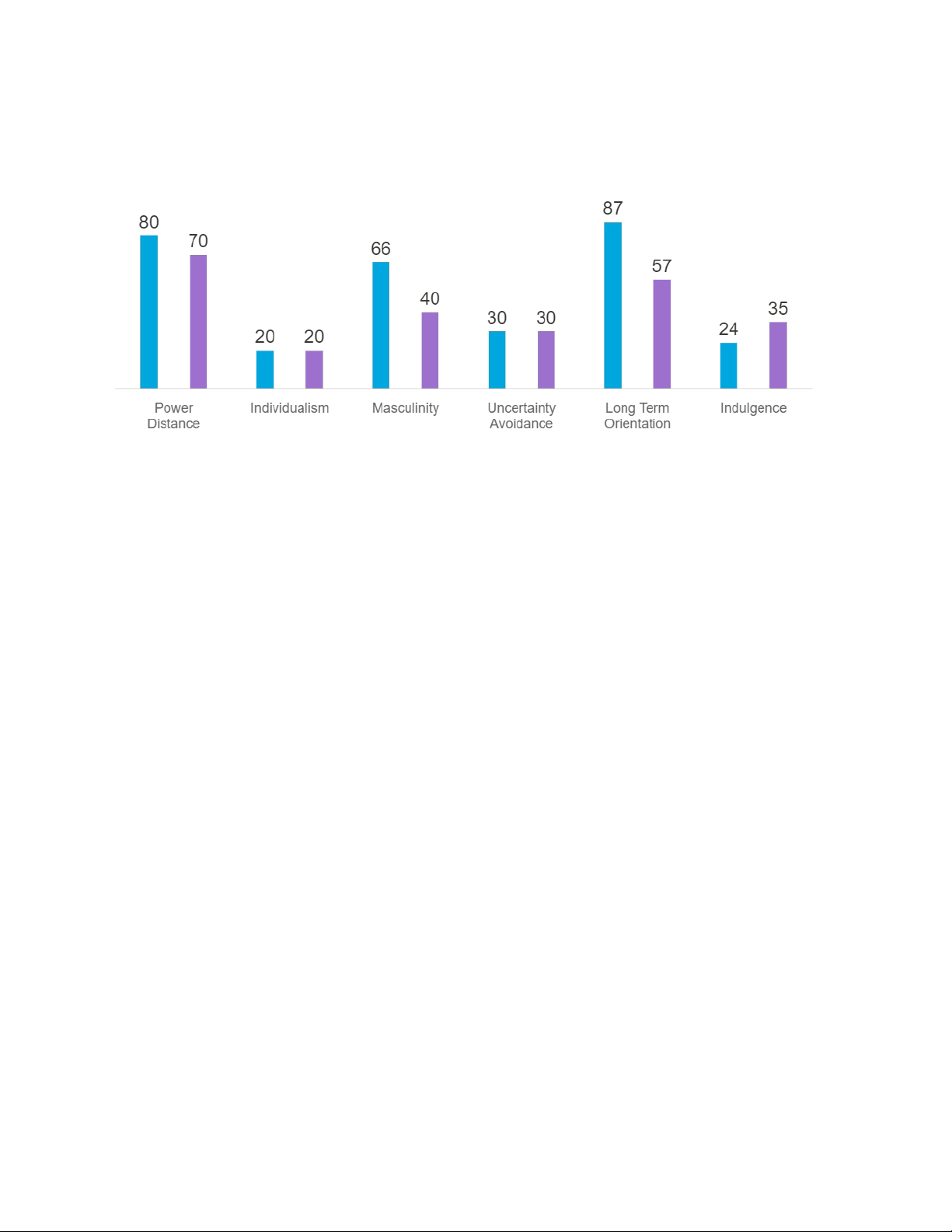
Blue: China Purple: Vietnam
According to the data updated by Hofstede Insights, in general, Vietnam and China share
nearly the same culture and society.
Looking at the Power Distance scale, at the rate of 80, Chinese society accepts inequities
among individuals. The subordinate-superior relationship is polarized, and there is no protection
against superiors abusing authority. Individuals are influenced by official authority and
punishments, and they are generally enthusiastic about people's leadership and initiative abilities.
China is a strong collectivist culture in which individuals operate in the interests of the group
rather than in their own. Otherwise, China is also well-known as a masculine society that is driven by achievement.
Low UAI societies continue to have a more flexible attitude where departure from the norm
is more amenable to tolerance and practice is valued above ideals. People in low UAI cultures hold
the view that there should be no more regulations that are essential, and if any are unclear or
ineffective, they should be altered or abandoned.
People in pragmatic civilizations hold the view that situation, context, and time all play a
significant role in determining what is true. They exhibit a high desire to save money and invest it,
and they can readily adjust their customs to changing circumstances. persistence in getting things done while being frugal. lOMoAR cPSD| 59691467
Societies with a low score in indulgence tend to cynicism and pessimism. Also, in contrast
to Indulgent societies, Restrained societies do not put much emphasis on leisure time and control
the gratification of their desires.
2.2. Country risk/ demand uncertain
2.2.1. Governmental risks:
In China, the government owns more than 76% of assets in total, which means that people
just possess less than a quarter of assets. This implies that if one firm wants to conduct business in
China, they almost certainly have to deal with the government. Negotiating with the state can be
time-consuming due to the bureaucracy involved. Joint ventures are difficult to form because they
require significant government participation.
The Chinese government is notorious for making abrupt policy changes that harm both
Chinese and international traders. As a result, developing long-term marketing strategies has
become nearly difficult in China.
Another element that all enterprises must always bear in mind is the Communist Party's powerful
presence. If any product or service, or any of its components, is found to be contrary to the
Communist Party's values, it shall be completely prohibited. As a result, while dealing with the
Chinese market, all ads and marketing techniques must be updated properly. 2.2.2. Market access:
Local distribution networks, customer purchasing behaviors, and regulatory constraints
might make China a tough market to enter. Furthermore, the market environment is entirely
disconnected from most of the world's economy, making it impossible to start taking steps. It is
reported that 37% of items that pass muster in the US market fail in China.
2.2.3. Customer preference
Over the last several decades, there has been a significant class movement in China, and
the consumer environment is significantly more diversified than it formerly was. It is also utterly
disconnected from the rest of the world's markets, and many businesses have failed in China
because they neglected to consider consumer preferences.
2.3. Market size and growth
China has the world's largest beer market in terms of both production and consumption
volume, with 38.3 billion liters drank in 2019, far ahead of other developed economies such as the
United States (21.9 billion liters) and Germany (8 billion liters). By 2020, the Chinese will have lOMoAR cPSD| 59691467
eaten more than 35 million kiloliters of beer, enough to fill 14,000 Olympic-sized swimming pools.
It accounted for 20.3% of all beer drank globally that year.
According to Statista, China produced 341.11 million hectolitres of beer in 2020, almost 1.6
times more than the US. In 2020, China had 346 beer enterprises, with 146.894 billion CNY in
sales revenue and a total profit of 13.391 billion CNY, a 0.47% increase from 2019.
The imported beer industry doesn't appear to be very saturated because there isn't a clear
leading country that produces beer. Craft beer is growing in popularity, and customers are eager to
sample new brands whether they are at home, at beer festivals, or in bars.
2.4. Direct and indirect trade barriers
China has steadily lowered trade restrictions and liberalized its overseas trading system since
joining the World Trade Organization (WTO) on December 11, 2001. All sorts of firms, including
private enterprises, are permitted to engage in overseas commerce in accordance with the modified
Foreign Trade Law of China, which took effect in July 2004. Chinese nationals are also permitted
to do personal business abroad.
Alcohol is taxed in three different taxes in China: an import tariff, a value-added tax (VAT),
and a consumption tax (CT). The import duty on beer brewed from malt (HS code: 2203.0000.00) is 0%.
VAT on imported beer is 13%. CT is about $34 per ton if the price is less than or equal to
$370 per ton, and approximately $39 per ton if the price is more than $370 per ton.
2.5. Intensity of competition
Domestic beer market: The top five domestic beer producers, who altogether control more
than half of the market, are Snow Beer (China Resources Holdings), Tsingtao Beer (Tsingtao
Brewery), Harbin Beer (Anheuser-Busch InBev), Budweiser (Anheuser-Busch InBev), and
Yanjing Beer (Beijing Yanjing Brewery). lOMoAR cPSD| 59691467
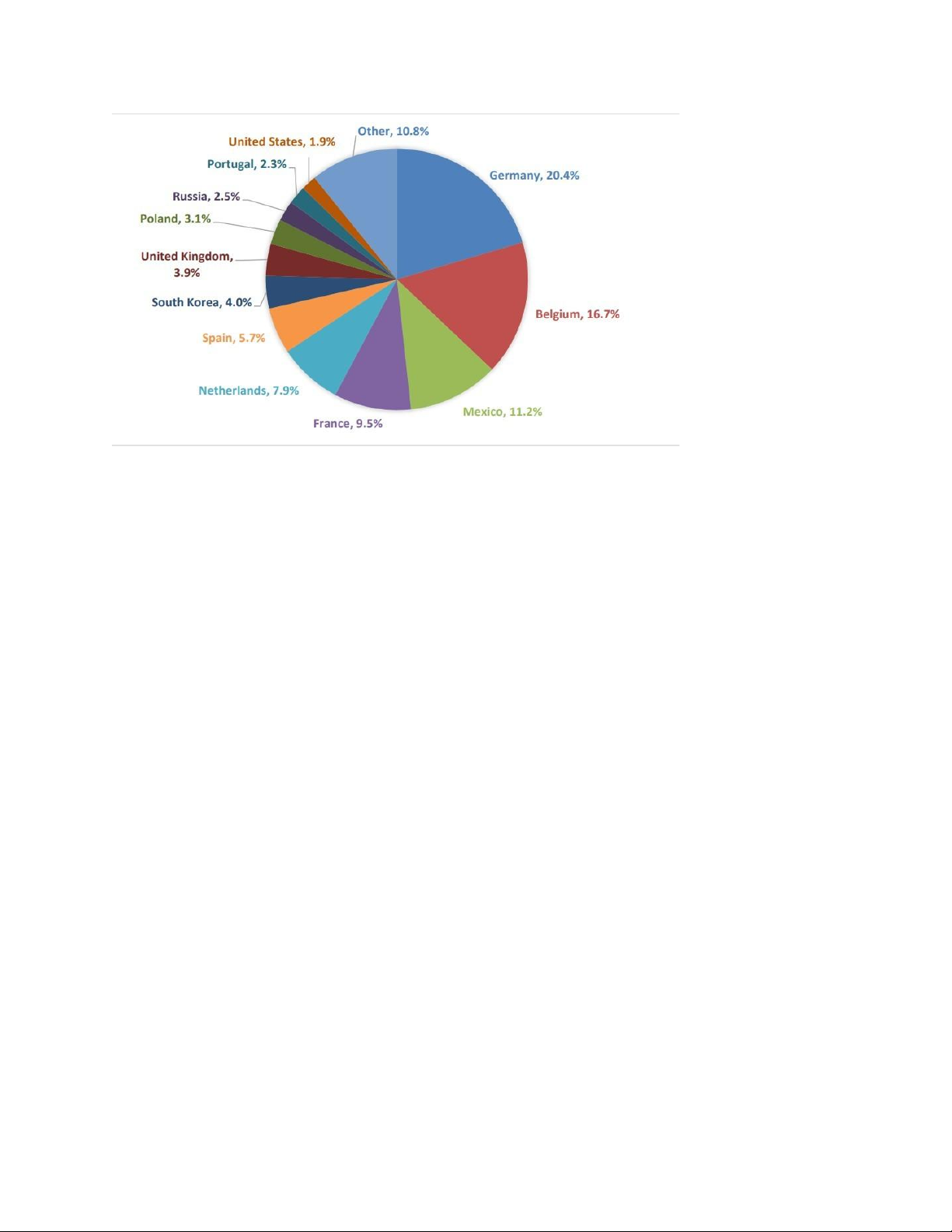
China Imported Beer Market Share in 2020
Imported beer market: As recorded, the amount of beer imported from foreign countries to
China’s beer market is so big. Germany and Belgium are the two countries that have been exporting
beer to China the most, at nearly 20% of the twos. Therefore, once entering the China market,
iBiero needs to compete with many other big countries like Germany, Belgium or Mexico. iBiero
is just staying in the 10,8% of others left out of the big countries, which have stable places in that market.
Craft beer market: Industry analysts predict that craft beer will see exponential growth by
2021, indicating a shift in customer taste toward novel flavors and variations. Most first-tier cities
and several rising second-tier cities, where consumers are less price sensitive and more open to
trying new flavors, are where craft beer consumption is now concentrated. The main distribution
routes include retail, dining establishments, and pubs. 2019 saw the availability of American barley
malts in China, and some brewers combined these malts and hops to create new craft beer variants that were well-received.
2.6. Number of relevant intermediaries available
When iBiero enters the Chinese market, they need to consider which is the best channel for them:
• Trading companies: Serve as intermediaries, purchasing items in bulk and reselling them to retailers.
• Sales agents: Get paid a commission for promoting products. lOMoAR cPSD| 59691467
• Distributors: Take ownership of the goods, then advertise and support them.
• E-commerce: The practice of conducting business online.
Distributors and agents may work across the nation, in certain provinces or regions, and may
hold the only right to sell goods in a given location. Multiple sales channels that may differ by
sector or location are available to exporters. Opportunities:
- The socio-cultural distance between the home country and the host country discussedabove
is not that big. Vietnam and China are sharing nearly the same society and culture, which will be
good notice for iBiero when researching the market to enter. The behavior of Chinese people can
be accessed the same as the Vietnamese. They all like to behave in groups and act based on the
majority. Once researching the market, iBiero just needs the market into the different types of
groups who have the same behavior.
- Both the manufacture and consumption of alcohol have a long history in China. Based
onthis basis, the Chinese beer industry quickly overtook the US beer market in terms of volume,
and by 2013, it had eclipsed the US beer market in terms of value, making it the largest beer market
in the world with a wealth of untapped potential.
- Chinese beer companies have profited from the experimental mindset of Chinese
beerdrinkers. Prior to the 1990s, virtually all connections in people's lives for learning about the
outside world were severed due to China's economy's extended isolation. For the first time, the
opening reform allowed individuals to return to the planet with a wide variety of strange goods.
Chinese consumers are seeking new products all around the world. New flavors are especially
appealing to craft brewers and beer enthusiasts.
- The number of intermediaries available in the China market is various for iBiero tochoose.
However, the rules of each channel are different so the company needs to be careful in choosing
which one will be the most suitable. Threats:
- China is a large industry which leads to a very huge and potential market. This markethas
been attracting a lot of global and domestic firms or corporations. Vietnam is just one of many
other countries that have to compete with many big beer brands from other big countries like
Germany and Belgium. The opportunity for having a small piece of cake is not too big. iBiero also
needs to face the problem of making benefits for both brand’s profits and for the Chinese lOMoAR cPSD| 59691467
economy’s growth. The company can not immediately compete with other domestic brands and needs to take time.
- The types of tariffs on alcohol in China are various and they are all different. It will
bedifficult for the company to take care of the tariffs and control the changes of the tariffs’ rate.
- As the policy in China is not stable, iBiero has to face the effect of the government ontaxes
for drinks, especially for alcohol. EFE matrix: Weight: 0,0 - 1,0 Rating: 1 - 4
No External factors
Weight Rating Weighted . scores 1
Opportunities Sociocultural distance between Vietnam 0.05 3 0.15 and China 2 Population 0.05 3 0.15 3 Market trend 0.1 4 0.4 4 GDP 0.05 3 0.15 5 Consumer’s demands 0.15 4 0.6 6
The number of intermediaries available 0.1 4 0.4 in the China 7 Threats
The changes of Chinese policy on tariffs 0.05 2 0.1 and taxes