Discuss the product and brand decisions of Coca Cola | Môn Marketing quốc tế - Đại học Kinh Tế Quốc Dân
Founded in 1886 in Atlanta, Georgia, The Coca-Cola Company began with a single beverage — a cola-flavored soft drink — but has since grown into one of the most influential global corporations. Tài liệu được sưu tầm gồm 59 trang, giúp bạn ôn tập tốt hơn. Mời các bạn đón xem.
Môn: Marketing quốc tế 92 tài liệu
Trường: Trường Đại học Kinh Tế Quốc Dân 8.2 K tài liệu
Tác giả:



















Preview text:
lOMoAR cPSD| 59691467
NATIONAL ECONOMICS UNIVERSITY
SCHOOL OF ADVANCED EDUCATION PROGRAMS --------o0o--------
INTERNATIONAL MARKETING GROUP ASSIGNMENT Group 10
Topic : Discuss the product and brand decisions of Coca Cola.
Class: International Business Management 64C
1. Nguyễn Vân Anh – 11220505
2. Hoàng Tuệ Lam – 11223197
3. Trần Thành Đạt– 11221271
4.Phạm Thanh Bình– 11220865
5. Vũ Minh Thành- 11225830 Hanoi, 10/2025 TABLE OF CONTENTS lOMoAR cPSD| 59691467
CHAPTER 1: INTRODUCTION OF COCA COLA....................................................3
1. The Corporation: The Coca-Cola Company................................................................3
2. The Product: Coca-Cola (Classic Coke).....................................................................4
CHAPTER 2: CORE, ACTUAL, AND AUGMENTED PRODUCT BENEFITS OF
COCA-COLA...................................................................................................................7
1. Core Product Benefits.................................................................................................7
2. Actual Product Benefits of Coca-Cola........................................................................9
3. Augmented Product Benefits....................................................................................12
CHAPTER 3: THE ORIGINS OF COCA-COLA BRAND EQUITY.......................15
b. Feelings — Emotional Responses..........................................................................19
1.Market Targeting........................................................................................................22
2.Positioning.................................................................................................................26
CHAPTER 5 : STRATEGIES FOR COMMUNICATING THE BRAND TO
INTERNATIONAL MARKETS...................................................................................29
1. Brand Positioning:....................................................................................................29
2. Brand Name Selection:.............................................................................................31
3. Brand Sponsorship:...................................................................................................32
4. Brand Development:.................................................................................................35
CHAPTER 7: THE GLOBAL-LOCALIZATION OF COCA-COLA’S
MARKETING MIX (4PS).............................................................................................45
1. Product......................................................................................................................46
2. Price..........................................................................................................................47
3. Place (Distribution)...................................................................................................48
4. Promotion.................................................................................................................51
CHAPTER 8: EXAMPLES OF COCA-COLA’S ADAPTATION TO DIFFERENT
MARKETS.....................................................................................................................53
2. India – Adapting to Culture and
Climate..........................................................54
3. Vietnam – Linking with Cultural Traditions and Tea
Consumption..............55
4. China – Respecting Cultural Symbols and
Language......................................55
5. United States – Strategic Partnerships and Brand
Reinforcement..................56 lOMoAR cPSD| 59691467
REFERENCES...............................................................................................................58
CHAPTER 1: INTRODUCTION OF COCA COLA
1. The Corporation: The Coca-Cola Company
Founded in 1886 in Atlanta, Georgia, The Coca-Cola Company began with a single
beverage — a cola-flavored soft drink — but has since grown into one of the most
influential global corporations. Today, Coca-Cola manages a portfolio of over 500 brands
and operates in more than 200 countries, offering a wide range of products including
carbonated drinks, bottled water, juices, teas, coffees, and sports and energy beverages.
This expansion reflects not only the company’s financial strength but also its strategic
adaptability to diverse cultural, economic, and regulatory environments worldwide.
From a business model perspective, Coca-Cola operates through a distinct separation
between concentrate production (concentrates and syrups) and bottling–distribution, which
is handled by independent bottling partners. This structure allows Coca-Cola to retain
control over its brand, formula, and marketing strategies while leveraging the operational
capacity and market knowledge of local partners. Combined with its extensive distribution
network — spanning supermarkets, convenience stores, fast-food chains, and vending
machines — Coca-Cola fulfills its fundamental business philosophy: “within an arm’s reach of desire.”
However, Coca-Cola’s global success is not solely the result of its distribution system or
scale. It stems primarily from a series of strategic product and brand decisions that balance
global consistency with local adaptation, and emotional heritage with continuous
innovation. Through emotionally driven branding (“Share a Coke”), sponsorship of major
global events (FIFA World Cup, Olympic Games), and localized product innovation (such
as ready-to-drink teas in Asia or low-sugar variants in Western markets), Coca-Cola has
built a brand identity that transcends cultural boundaries while remaining relevant to individual markets. lOMoAR cPSD| 59691467
At the same time, Coca-Cola faces growing challenges in today’s market landscape:
increasing health consciousness and sugar-related concerns, taxation on sugary beverages,
intensifying competition from both global and local brands, and rising expectations
regarding environmental responsibility (for example, plastic reduction and recycling
initiatives). These challenges compel the company to make more sophisticated product,
pricing, and communication decisions that both preserve its traditional brand value and
align with evolving social expectations.
2. The Product: Coca-Cola (Classic Coke)
Coca-Cola—commonly known as Classic Coke—functions not merely as a product in The
Coca-Cola Company’s portfolio but as the firm’s flagship brand and a global cultural
emblem. This section examines Classic Coke’s defining attributes (sensory profile and
packaging), its role as a mass-consumed global commodity, the symbolic meanings it
carries across markets, and the strategic implications these facts create for product, brand, and marketing decisions.
As the company’s flagship, Classic Coke performs multiple strategic functions
simultaneously. First, it is a brand anchor: its heritage and recognition lend credibility to
extensions and sub-brands (e.g., Diet Coke, Coca-Cola Zero, flavored colas). Second, it is
a financial backbone: despite the company’s broad portfolio, consumer preference and high
sales volumes for Classic Coke support scale economies in production, distribution, and
marketing. Third, it is a benchmark for brand equity—internal metrics, creative campaigns,
and retail partnerships are often framed with reference to the Classic Coke identity. For a
global corporation, having a single, consistently recognizable anchor mitigates risk when
testing innovations in other categories or markets, because Classic Coke’s stability
reassures both investors and consumers. lOMoAR cPSD| 59691467
Classic Coke’s unique cola flavor is its most defensible attribute. This sensory signature —
an interplay of sweetness, acidity, carbonation, and a proprietary blend of flavoring oils —
creates a reliable sensory expectation across contexts. Consistency in taste is not accidental
but a deliberate operational priority: maintaining formula integrity across different
production sites (given local sourcing and bottlers) builds trust and repeat purchase
behavior. The beverage’s sensory package also includes incidental cues—sound of a can
opening, effervescence, the mouthfeel of carbonation—that contribute to a multisensory
brand memory. Marketing that references these cues (visuals of fizz, audio of opening) taps
into conditioned associations, increasing the effectiveness of advertising and in-store display.
The red-and-white color palette, the Spencerian script logo, and the contoured bottle shape
form a triad of visual assets that produce instant recognition. Packaging functions both
practically (protecting product, enabling transport) and symbolically (communicating
authenticity and heritage). The contoured glass bottle, for example, has become a semiotic
device—signaling “original” or “classic” even when consumers encounter the product in a
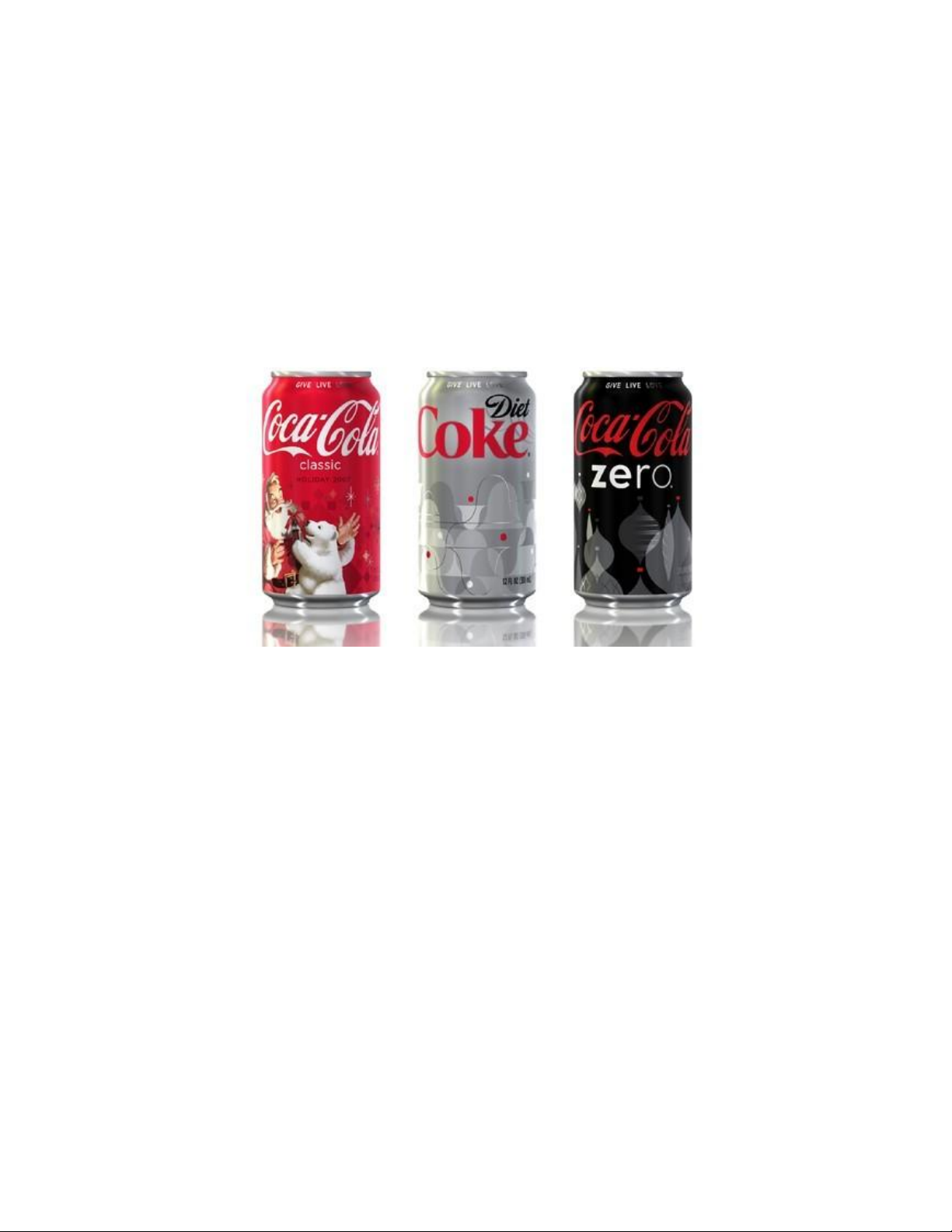
can or PET bottle. Limited-edition and seasonal packaging (holiday cans, local festival
motifs) leverage this visual identity to create urgency and cultural resonance while
preserving the core brand markers. From a shelf-space perspective, these distinct assets
improve striking power and reduce consumer search costs, which in turn supports impulse buys and habitual repurchase.
The fact that Classic Coke constitutes billions of daily servings worldwide (the figure
provided—1.9 billion—illustrates sheer scale) implies several strategic realities. High
consumption volume enables economies of scale in procurement, production, and
advertising. It also justifies and enables a pervasive distribution network: partnerships with
global foodservice chains, retail giants, and local mom-and-pop stores help achieve the
“within an arm’s reach” promise. Because of its pervasiveness, the brand exerts influence
over category norms (pricing, portion sizes, point-of-sale placement), often shaping retail
layouts and promotional calendars in ways that favor the brand and its extensions.
Beyond functional refreshment, Classic Coke carries strong symbolic value. It operates as
a cultural shorthand for conviviality, leisure, and modern consumer life—images
reinforced in decades of advertising, event sponsorships, and product placement. These
associations permit Coca-Cola to occupy cultural moments (holidays, sporting events,
celebrations) and to transact emotion rather than mere hydration. Emotional branding
reduces price elasticity, increases tolerance for premium formats or branded experiences,
and fosters user-generated content—consumers sharing photos with “Share a Coke” bottles
are co-creating brand meaning at near-zero media cost. lOMoAR cPSD| 59691467
Classic Coke’s iconic status yields clear advantages but also strategic constraints. On the
positive side, the brand confers cross-category leverage, lowers promotional risk for new
launches, and maintains durable consumer loyalty. On the negative side, the flagship
identity creates brand rigidity: radical formula or positioning changes risk alienating core
consumers and diluting heritage value. Moreover, rising health concerns (sugar intake),
regulatory pressures (soda taxes), and environmental scrutiny (single-use plastics) create
structural threats to volume and social license. Managers must therefore pursue dual
strategies—protect and monetize the heritage asset while incrementally innovating around
health, sustainability, and convenience (e.g., low-sugar variants, alternative packaging, portion sizes). lOMoAR cPSD| 59691467
CHAPTER 2: CORE, ACTUAL, AND AUGMENTED PRODUCT BENEFITS OF COCA-COLA
1. Core Product Benefits
At its most fundamental level, the core product benefit of Coca-Cola lies in refreshment —
the satisfaction of a universal physiological and psychological need. The act of drinking
Coca-Cola is primarily associated with quenching thirst, particularly in contexts of heat,
fatigue, or social activity. However, unlike plain water, Coca-Cola elevates this basic
function into an experiential form of refreshment, offering not only hydration but also
energy, pleasure, and emotional comfort. This transformation of a functional need into a
symbolic and sensory experience is central to Coca-Cola’s enduring market success.
1.1. Refreshment as a Universal Need
The concept of refreshment fulfills both biological and psychological dimensions.
Biologically, humans require constant fluid intake to maintain hydration and energy
balance. Psychologically, refreshment is linked with feelings of rejuvenation, relief, and
reward. Coca-Cola has mastered this dual dynamic by positioning its beverage as the goto
option when individuals seek immediate relief from thirst or fatigue.
Market research by The Coca-Cola Company (2023) indicates that more than 60% of
consumers worldwide associate Coca-Cola primarily with “refreshment and energy
recovery.” The company leverages this perception in its slogan “Taste the Feeling,” which
invites consumers to equate emotional satisfaction with physical refreshment. This dual
message allows Coca-Cola to transcend the boundaries of a mere beverage and occupy a
broader emotional territory of happiness and renewal.
1.2. Added Stimulation – Energy and Alertness
In contrast to plain water, Coca-Cola offers added stimulation due to its sugar and caffeine
content. A standard 330ml can of Coca-Cola Classic contains about 35g of sugar and 32mg
of caffeine (Coca-Cola Company Nutrition Facts, 2024). These ingredients act as mild
stimulants: sugar provides a short-term energy boost through rapid glucose absorption,
while caffeine enhances alertness by blocking adenosine receptors in the brain.
For instance, a student studying late at night or an employee working through fatigue may
choose Coke over water or juice because it combines hydration with a psychological lift.
A survey by Statista (2022) reported that 42% of young adults aged 18–30 cited
“energy and wakefulness” as a key reason for consuming Coca-Cola products. This
dualpurpose consumption behavior—hydration and stimulation—has allowed Coca-Cola
to maintain relevance among younger, active demographics who equate the drink with vitality and productivity. lOMoAR cPSD| 59691467
1.3. Pleasure and Comfort – The Emotional Layer of Refreshment
Beyond its functional benefits, Coca-Cola provides pleasure and emotional comfort,
turning a simple act of drinking into an experience of joy and familiarity. The sweetness,
carbonation, and cool temperature stimulate the senses, creating a burst of effervescence
that many consumers associate with relaxation or celebration. The product’s sensory
appeal—the hiss of a freshly opened can, the sparkling bubbles, the crisp first sip— triggers
positive emotional memories formed through repeated consumption across various life moments.
Psychological studies on taste and memory have shown that multi-sensory cues such as
smell, sound, and visual identity contribute strongly to emotional attachment. In
CocaCola’s case, its consistent flavor and packaging design foster what brand theorists call
“emotional continuity”—the ability of a product to evoke nostalgia and comfort. This
explains why, during times of stress or nostalgia, many consumers choose Coca-Cola for
the sense of familiarity it provides.
A 2021 consumer behavior report by Nielsen revealed that nearly 70% of respondents
associated Coca-Cola with “positive emotions and pleasant memories from family
gatherings or holidays.” Thus, beyond quenching thirst, Coca-Cola satisfies a deeper
psychological need for comfort and connection.
1.4. Transforming Basic Hydration into an Experience
The genius of Coca-Cola’s product design and marketing lies in its ability to elevate a
physiological act—drinking—to a pleasurable ritual. While hydration is a universal need,
Coca-Cola reframes it as an opportunity for joy, togetherness, and stimulation. The brand
effectively converts a low-involvement product category (everyday beverages) into an
emotional consumption experience.
Through decades of branding efforts, Coca-Cola has managed to associate refreshment not
only with the act of drinking but also with moments of social bonding. The “Open
Happiness” and “Share a Coke” campaigns exemplify this transformation: they reposition
refreshment as something shared—both a physical and emotional renewal. As a result,
Coca-Cola does not compete solely on taste or function; it competes on experience.
1.5. Strategic Implications
Understanding refreshment as Coca-Cola’s core benefit has significant managerial implications:
• Brand Consistency: Maintaining the original flavor profile and sensory cues ensures
that every Coca-Cola experience delivers the same emotional and physical
refreshment, regardless of geography. lOMoAR cPSD| 59691467
• Product Innovation: Even as the company introduces low-sugar or caffeine-free
variants, it must preserve the perception of “refreshment and uplift” that defines the brand’s essence.
• Marketing Communication: Campaigns that portray laughter, togetherness, and
cooling relief reinforce the symbolic meaning of refreshment beyond the beverage itself.
In essence, Coca-Cola’s strategy is not simply to quench thirst, but to refresh the human
experience—linking the sensory pleasure of the product to broader emotional values such
as happiness, energy, and belonging.
2. Actual Product Benefits of Coca-Cola
2.1. Consistent Taste Worldwide: Trust Through Standardization
One of Coca-Cola’s strongest product assets is its consistent flavor profile across markets.
Whether purchased in Vietnam, the United States, or Europe, Coca-Cola delivers the same
familiar taste — a precise balance of sweetness, acidity, and carbonation derived from its
secret formula, Merchandise 7X. This consistency creates a powerful sense of predictability
and brand reliability that builds consumer trust.
The company ensures this standardization through strict quality control systems and
centralized syrup production, while local bottlers handle distribution and packaging under
detailed operational guidelines. According to The Coca-Cola Company’s Quality and Food
Safety Report (2023), over 900 bottling plants worldwide follow identical formula
specifications and testing protocols to maintain uniformity. This reliability means
consumers never face uncertainty about product performance — a crucial factor that
reinforces repeat purchase and brand loyalty.
Furthermore, the consistency of taste acts as a psychological anchor. It connects memories
and emotions to the brand, regardless of geography. A consumer drinking Coca-Cola in
Tokyo or Paris experiences not just the same taste but the same feeling — “the taste of
happiness.” This standardized sensory promise underpins Coca-Cola’s global identity and
allows it to maintain equity even in culturally diverse markets.
2.2. Strong Sensory Identity: Creating Emotional and Multisensory Recognition
Coca-Cola’s sensory experience extends far beyond its flavor. Every sensory element —
the fizzing sound when opened, the effervescent bubbles, the caramel aroma, and the
crisp mouthfeel — forms part of what scholars describe as “multisensory branding.”
These cues trigger nostalgia and positive emotions, making the act of drinking Coca-Cola
as much about memory and mood as about taste. lOMoAR cPSD| 59691467
Research by Lindstrom (2010) on sensory marketing shows that brands engaging three or
more senses increase brand recall by up to 70%. Coca-Cola exemplifies this principle: its
advertising often highlights sound and movement (the opening of a can, the pour over ice,
the sparkle of bubbles) to activate sensory memories. The consistency of these sensory
triggers across decades of campaigns reinforces the feeling that every Coke moment is familiar, safe, and joyful.
Moreover, Coca-Cola’s temperature ritual — serving chilled — enhances the perception of
refreshment and taste intensity. This ritualized consumption further deepens its association
with satisfaction and reward, turning product interaction into a comforting habit.
2.3. Iconic Packaging: A Visual Symbol of Authenticity
Coca-Cola’s packaging is perhaps its most recognizable physical asset and one of the
world’s strongest examples of visual branding. The contoured glass bottle, designed in
1915, was intended to be identifiable “even in the dark or when broken.” Over time, it
became a design icon synonymous with authenticity and nostalgia.
The red label, white Spencerian script logo, and simple, curvilinear bottle shape together
convey timelessness, optimism, and approachability. These visual assets are so distinctive
that Coca-Cola can often appear in advertisements without the name being explicitly shown
— and still be instantly recognized.
In the modern era, packaging remains a strategic tool for differentiation and storytelling.
Limited-edition designs, national symbols, and seasonal artwork (for instance, Christmas
polar bears or Vietnamese Tết greetings) reinforce Coca-Cola’s ability to localize its
imagery without losing brand coherence. This balance between global consistency and
cultural relevance makes Coca-Cola’s visual identity both enduring and adaptable.
2.4. Multiple Formats: Meeting Diverse Consumer Occasions
Coca-Cola’s product architecture accommodates diverse lifestyles and consumption
contexts through multiple formats and package sizes. From the mini 250ml can for quick
refreshment to the 2-liter bottle for family gatherings, Coca-Cola effectively segments its
physical formats according to usage occasions.
This flexibility aligns with behavioral consumption research: consumers often choose
beverage size based on social setting, portion control, or affordability. In emerging markets
such as Vietnam or India, smaller and cheaper bottle sizes make Coca-Cola accessible to a
broader population. In contrast, multipacks and large bottles dominate in developed
markets, where value and sharing are key motivators. lOMoAR cPSD| 59691467
According to Statista (2023), Coca-Cola’s 250ml and 330ml formats together accounted
for over 50% of unit sales globally, illustrating how strategic sizing supports affordability
and ubiquity. Additionally, Coca-Cola’s presence in fountain dispensers within restaurants
and cinemas enhances visibility and convenience, embedding the brand into consumers’ everyday routines.
2.5. Ubiquity and Access: The “Within an Arm’s Reach” Philosophy
Perhaps no company embodies the principle of omnipresence better than Coca-Cola. Its
distribution model is designed around the idea that the product should always be “within
an arm’s reach of desire.” Operating in over 200 countries, Coca-Cola leverages an
extensive bottling network, local logistics expertise, and partnerships with global chains
like McDonald’s, KFC, and Burger King to ensure universal availability.
In emerging economies, the brand extends its reach through mom-and-pop stores,
convenience kiosks, and vending machines, ensuring accessibility in both urban and rural
areas. This distribution ubiquity not only increases sales opportunities but also reinforces
Coca-Cola’s symbolic presence in daily life. The brand becomes part of the landscape —
always visible, always available, always top of mind.
Coca-Cola’s strategic focus on distribution excellence contributes directly to brand trust.
Consumers perceive it as a reliable and convenient choice, which explains why, in
spontaneous purchase situations, Coca-Cola often serves as the “default beverage option.”
Its omnipresence reinforces both market share and cultural familiarity.
2.6. Why Consumers Demand It: Predictability, Recognition, and Emotional Security
Consumers are drawn to Coca-Cola not solely because of its taste but because of the
certainty it represents. In a world of endless beverage choices, Coca-Cola stands as a
symbol of predictability and emotional safety. Its consistent quality, familiar packaging,
and constant availability make it a low-risk, high-satisfaction option.
From a psychological perspective, this aligns with the “mere exposure effect” — the more
often people encounter a brand, the more they tend to trust and prefer it. Coca-
Cola’s omnipresence amplifies this effect, turning routine exposure into habitual
preference. Thus, Coca-Cola becomes not just a beverage but a default cultural choice —
a comforting constant amid the variability of modern life.
2.7. Strategic Implications
At the actual product level, Coca-Cola’s competitive advantage is built on tangible
elements that support intangible brand equity: lOMoAR cPSD| 59691467 •
Product standardization builds trust and global scalability. •
Sensory coherence reinforces emotional engagement. •
Iconic packaging serves as a visual shorthand for authenticity. •
Format variety and distribution ubiquity ensure accessibility across markets and demographics.
Together, these attributes transform Coca-Cola from a mere commodity into a globally
recognized and emotionally resonant product system. The “actual product” thus bridges
the company’s core promise of refreshment with the broader brand experience of
happiness, unity, and belonging.
In sum, Coca-Cola’s actual product benefits reveal how meticulous product design and
operational precision can sustain both market leadership and emotional relevance. By
maintaining taste consistency, fostering multi-sensory identity, leveraging iconic
packaging, and ensuring unmatched accessibility, Coca-Cola continues to deliver a
universally familiar yet emotionally powerful experience.
This combination of functional reliability and symbolic recognition explains why
CocaCola remains not only the world’s most popular soft drink but also one of its most trusted and enduring brands.
3. Augmented Product Benefits
Coca-Cola’s marketing goes beyond product formulation and core brand identity to create
augmented experiences that transform a commodity into a social and cultural phenomenon.
These tactics — personalization, seasonal and limited packaging, highprofile event
sponsorships, promotions and loyalty programs, and community engagement — operate
together to increase purchase intent, deepen emotional bonds, and generate free, organic
reach. Below I analyze each element in detail and explain the mechanisms through which
they add commercial and brand value.
- “Share a Coke” — Personalization as a Social Trigger
The “Share a Coke” campaign is a textbook example of personalization that converts
transactional buying into social behavior. By printing popular names and nicknames on
bottles and cans, Coca-Cola changed consumer motivation from mere consumption to gift,
collect, and share. Psychologically, this taps into identity signalling and the endowment
effect (a named bottle feels personally owned or meaningful), as well as social proof when lOMoAR cPSD| 59691467
photos are posted online. The campaign produced measurable commercial uplift and
massive user-generated content: it reversed a long sales decline in key markets (the U.S.
campaign produced a reported sales uptick) and generated hundreds of thousands of social
shares, demonstrating how personalization catalyzes organic virality and brand advocacy.
Operationally, the initiative also leverages limited SKU variation and dynamic packaging
runs to create perceived scarcity and novelty, which drives repeat purchases.
- Holiday & Seasonal Packaging — Cultural Anchoring
Limited-edition designs (Santa Claus, polar bears, local festive motifs) function as cultural
anchors that link Coca-Cola to specific rituals and occasions. Seasonal packaging performs
three roles: it increases shelf visibility through novelty, aligns the brand with positive
associative memories (holidays, celebrations), and encourages time-bound purchasing
behaviors (gift buying, party stocking). Because these designs are tied to anniversaries and
national celebrations, they also provide ready-made storytelling hooks for advertising and
point-of-sale promotions, amplifying campaign cohesion across offline and online channels.
- Event Sponsorships — Prestige, Reach, and Contextual Relevance
Sponsorships of global events (e.g., FIFA World Cup, Olympic Games) and local festivals
place Coca-Cola in culturally salient contexts where large audiences are already
emotionally engaged. The value comes in three dimensions: sheer reach (mass
impressions), prestige transfer (positive associations from beloved events), and contextual
relevance (consumption moments aligned with viewing and celebration). Activations at
events — branded fan zones, collectible merch, in-stadium activations — also drive
immediate sales uplift and create experiential touchpoints that are highly shareable across
social media, reinforcing both awareness and affective attachment.
Promotions & Loyalty Programs — Incentivizing Choice and Repetition
Promotional mechanics such as collectible bottle caps, sweepstakes, discounts, or loyalty
rewards add an economic and game-like layer to purchase decisions. These programs
increase short-term purchase probability through tangible incentives and encourage
longterm retention via points systems or repeat-purchase motivators. When combined with
personalization and seasonal items, promotions can boost cross-category purchases and
encourage trial of newly launched variants (line or brand extensions), serving both tactical
sales and strategic portfolio goals.
- Community Engagement — Embedding the Brand in Everyday Life lOMoAR cPSD| 59691467
Programs that support music events, local festivals, sustainability initiatives (recycling
drives, bottle return schemes), and community projects extend Coca-Cola’s role from
vendor to social actor. This builds goodwill, generates local PR, and creates multiple
nontransactional touchpoints where the brand contributes to community life. In
sustainability communications, participation in recycling and circularity programs also
helps address consumer concerns about environmental impact, contributing to trust and license to operate.
- Why these augmentations are valuable
Taken together, these tactics move Coca-Cola from a single-purpose beverage to a
multidimensional cultural experience. They firstly increase motives to buy beyond thirst
(gifting, collecting, identity signalling), then produce user-generated content and earned
media that amplify paid campaigns, thirdly create seasonal and situational purchase spikes,
and finally deepen long-term emotional bonds that support premiumization and portfolio
expansion. Strategically, augmented experiences make Coca-Cola more resilient to
category disruption because the brand occupies cultural and social territory that is harder
for competitors to replicate purely through product features.
CHAPTER 3: THE ORIGINS OF COCA-COLA BRAND EQUITY
1. Level 1: Brand Salience — “Ubiquitous Presence”
- Goal: Brand salience measures how easily a brand is noticed and recalled in buying
situations. At this foundational level, the aim is to be present in consumers’ minds and
physical environments so that the brand becomes the default choice when a relevant need
(thirst, gifting, socializing) arises.
Coca-Cola exemplifies near-perfect salience through a combination of extraordinarily
broad distribution, highly consistent visual identity, and relentless presence across media
and physical touchpoints. The brand is available in over 200 countries, stocked from
supermarkets to corner shops, restaurants, cinemas, vending machines and informal street
vendors. This physical ubiquity is matched by pervasive advertising: television, outdoor
billboards, cinema spots, and digital channels continually refresh the brand in consumers’
minds. The cumulative effect is that Coca-Cola exists both as an object on shelves and as
a recurring element in people’s daily cultural landscape — making it one of the easiest
brands to retrieve in memory when the category need arises.
Two visual assets do a great deal of the cognitive heavy lifting for Coca-Cola’s salience.
First, the contour bottle functions as an almost instant recognition cue: research and brand lOMoAR cPSD| 59691467
testing repeatedly show that consumers can identify Coca-Cola by shape alone, even
without the label. Second, the distinctive red color and Spencerian script logo are globally
consistent visual markers that accelerate recognition across languages and cultures. These
design constants reduce cognitive effort during choice: consumers do not need to process
ingredient lists or advertising claims to know what the product stands for and where it fits in their routines.
Operational systems underpin this perception. Coca-Cola’s distribution and trade
marketing networks prioritize share of shelf, strategic point-of-sale displays, and category
management with retail partners—tactics that ensure frequent exposure at the precise
moment of purchase. Seasonal displays, limited-edition packaging and in-store sampling
create additional salience spikes tied to occasions (holidays, sporting events), while
cobranding and sponsorships (major sports and music events) extend presence into
highattention cultural moments. Together, these supply-side and communication-side
tactics create both high frequency (how often consumers see the brand) and ease of
recognition (how quickly they identify it).
Why this matters: High salience lowers the cognitive and transactional barriers to
purchase. When consumers face a beverage choice, a highly salient brand is more likely to
be considered, preferred, and purchased—especially in low-involvement categories like
soft drinks where habit and convenience dominate. For Coca-Cola, salience supports
premium pricing on special SKUs, encourages impulse buys, and amplifies the
effectiveness of line and brand extensions because the parent brand is already top-ofmind.
Limitations and considerations: Ubiquity can breed complacency; salience alone does
not guarantee favorable brand attitudes or long-term loyalty. In markets where health
concerns rise or local brands gain cultural preference, high salience must be reinforced by
relevance (e.g., healthier options, local adaptations). Additionally, maintaining
omnipresence requires substantial ongoing investment in distribution and marketing, and
it exposes the brand to reputation risks that scale with visibility.
Coca-Cola scores at the highest level of brand salience: it is both omnipresent in
physical distribution and instantly recognizable through powerful visual cues. This
foundational strength makes Coca-Cola the default retrieval in many purchase
situations, enabling the company to drive trial, support extensions, and capitalize on
cultural moments—provided salience is continually refreshed with relevance and trust-building initiatives. lOMoAR cPSD| 59691467
2. Level 2: Brand Meaning — “More Than Just a Soft Drink”
Goal:Level 2 of brand building—Brand Meaning—captures what the brand stands for in
consumers’ minds. It splits into two complementary dimensions: Performance (functional,
tangible benefits of the product) and Imagery (social, psychological and symbolic
benefits). For Coca-Cola, both dimensions are important, but the brand’s distinctive power
resides more strongly in imagery than in product performance.
a. Performance: Functional Benefits and Reliability Quality & Taste
Coca-Cola’s taste is the single most identifiable performance attribute. The secret
“Merchandise 7X” formula and the company’s emphasis on tight quality control create a
highly consistent sensory experience across markets. This consistent taste expectation is
supported by standardized manufacturing, global sourcing controls, and rigorous bottling
standards that minimize variation. As a result, consumers expect “the same Coke” whether
they buy a can in São Paulo, Seoul, or Lagos—an important functional promise in a low-
involvement category where repeat purchase is driven by predictable enjoyment.
Product Range and Occasion Fit
Beyond the flagship SKU, Coca-Cola’s performance meaning is extended through a broad
portfolio—zero-sugar variants, flavored colas, and adjacent categories (waters, coffees,
dairy). These line and brand extensions increase functional relevance by offering choices
for different consumption moments (e.g., calorie-conscious consumers choose Zero Sugar;
athletes may choose protein drinks). However, the core performance promise —refreshing,
sweet, carbonated taste—remains central.
Reliability & Distribution
Reliability is also a performance cue. Coca-Cola’s distribution network and trade
relationships ensure the brand is available where and when consumers expect it
(supermarkets, cinemas, vending machines). This availability reinforces the product’s
functional dependability: consumers rarely encounter out-of-stock issues or inconsistent
packaging quality in mainstream outlets. lOMoAR cPSD| 59691467
Performance Limitations
Performance alone is now a mixed advantage. The classic Coca-Cola offering is high in
sugar, which creates a growing structural weakness as health concerns intensify globally.
In some markets, performance perceptions have been challenged by competitors that
position around natural ingredients, functional benefits, or low-sugar formulations. Thus,
while Coca-Cola’s reliability and taste are strengths, they are also pressures for ongoing
product innovation and clear communication about healthier options.
b. Imagery: Social and Psychological Benefits Brand Personality
Imagery is where Coca-Cola excels. The brand projects a personality that is fun, optimistic,
friendly, and sociable—traits consistently reinforced through decades of advertising,
sponsorships, and experiential marketing. Campaigns like “Open Happiness,” “Taste the
Feeling,” and “Share a Coke” deliberately foreground shared moments, emotional
connection, and celebration, making the brand a social lubricant in many cultures.
Heritage & Cultural Embeddedness
Coca-Cola’s history (over 130 years) is woven into global cultural narratives. Historical
ties—such as providing beverages to soldiers during major 20th-century conflicts and the
company’s role in 20th-century advertising—have made Coca-Cola a familiar cultural
artifact. The visual association with Santa Claus (popularized in 20th-century advertising)
and recurring seasonal motifs (polar bears, holiday packaging) have anchored Coca-Cola
in holiday rituals and collective memory. This heritage grants the brand a symbolic
longevity that few competitors can claim.
Symbolic Meaning & Identity Signalling
Coca-Cola functions as an identity cue and a social signal. Carrying or gifting a Coke can
signal participation in global popular culture, nostalgia, or simple generosity. The “Share a
Coke” personalization magnified this aspect by letting bottles become tokens of personal
relationships. In short, Coca-Cola’s imagery makes it not just a drink but a cultural object
associated with togetherness and positive affect.
Coca-Cola’s Level 2 meaning is a dual construct: a solid foundation of performance
(consistent taste and availability) supports an exceptionally strong imagery layer lOMoAR cPSD| 59691467
(heritage, happiness, social connection). The imagery dimension is the brand’s
decisive advantage—what transforms Coca-Cola from a mere beverage into a
cultural symbol. To remain relevant, the company must preserve this imagery while
evolving product performance to meet changing consumer health and lifestyle expectations.
3. Level 3: Brand Response - "What Do Customers Think and Feel?"
Goal:Level 3 evaluates how consumers respond to the brand — their rational evaluations
(judgments) and emotional reactions (feelings). These responses determine whether a
brand is trusted, chosen, and loved. For Coca-Cola, both judgments and feelings are strong
and mutually reinforcing, creating durable brand equity.
a. Judgments — Rational Evaluations
Perceived Quality (“The Real Thing”) Coca-
Cola’s perceived quality goes beyond objective
attributes; it is a normative standard in the cola
category. The phrase “the real thing” encapsulates
two ideas: a sensory benchmark (the distinctive
Coca-Cola taste) and an implicit quality guarantee
(consistent manufacturing, packaging integrity,
and food-safety standards). This perception is
reinforced by decades of quality-control practices,
standardized recipes, and visible quality cues
(sealed packaging, recognizable branding). The
consequence is that consumers often use Coca-
Cola as the reference point when evaluating other
colas — competitors are judged against the Coca- Cola experience. lOMoAR cPSD| 59691467 Credibility and Trust
Credibility for Coca-Cola rests on longevity, transparency in product information, and a
track record of global presence and partnerships. As a cultural icon that has been visible
through major historical moments, corporate sponsorships, and widespread distribution,
Coca-Cola benefits from institutional trust: consumers assume the product is legitimate,
available, and safe. This credibility reduces perceived transaction risk (especially important
in new or unfamiliar markets) and supports acceptance of new variants or promotions
because consumers transfer trust from the parent brand to new SKUs.
Consideration and Top-of-Mind Status
Consideration is the behavioral consequence of salience and positive judgments: when a
consumer wants a soft drink, Coca-Cola is frequently in the short list of options. This topof-
mind status comes from ubiquitous availability, habitual purchase behavior, and consistent
communications. In practical terms, high consideration reduces the mental search cost at
the point of purchase and often converts into impulse buys or default choices in social
settings (restaurants, cinemas, events).
b. Feelings — Emotional Responses Happiness and Warmth
Coca-Cola’s emotional appeal is deliberately constructed. Campaigns such as “Open
Happiness” and “Taste the Feeling” frame consumption as a source of small pleasures and
shared joy. These messages tap into positive affective states — warmth, nostalgia, uplift
— which are powerful drivers of brand preference in low-involvement categories.
Emotions created by Coca-Cola advertising are typically low-arousal positive states
(comfort, contentment) and higher-arousal convivial states (celebration, excitement), both
of which increase likelihood of choice and sharing behavior.
Social Connection and Belonging
A core emotional value for Coca-Cola is social connection. Packaging, campaigns, and
sponsorships are designed to position the product as a facilitator of togetherness — a prop
in social rituals from family meals to sporting celebrations. The “Share a Coke”
personalization campaign made this explicit: bottles became social tokens, encouraging lOMoAR cPSD| 59691467
gifting, naming, and public sharing (photos, posts). This fosters a sense of belonging and
communal identity that goes beyond individual taste — consuming Coca-Cola can be an act of social affiliation.
Coca-Cola elicits a powerful combination of favorable judgments (quality, credibility,
consideration) and positive feelings (happiness, belonging). The brand’s enduring
advantage is that these two response types reinforce each other: credibility makes it
easy to choose Coca-Cola, and emotion makes consumers want to choose it.
Maintaining this dual strength requires ongoing attention to both product reliability
and emotionally resonant storytelling.
4. Level 4: Brand Resonance - THE PINNACLE - "An Intense Relationship"
Goal:Level 4 — brand resonance — describes the deepest relationship consumers can have
with a brand: intense loyalty, strong attachment, active engagement, and a sense of
community. At this stage the brand moves from being chosen to being championed;
consumers incorporate the brand into their identity and life rituals.
Loyalty: Choice despite alternatives
Coca-Cola’s consumers do more than prefer the product; many habitually choose it even
when cheaper or readily available substitutes exist. This behavior stems from a
combination of long-term habit formation, emotional associations, and normative social
cues (Coke as the “default” drink at parties, cinemas, and gatherings). Habitual purchasing
is reinforced by distribution ubiquity and point-of-sale prominence, but the key multiplier
is affective: consumers frequently report an emotional preference that outweighs price or
convenience. This durable preference sustains market share across cycles and allows Coca-
Cola to command premium positioning for special SKUs and collectible editions.
Attachment: Memory, ritual and symbolic meaning
Attachment occurs when Coca-Cola becomes part of consumers’ autobiographical
memory—shared family moments, holiday rituals, and rites of passage. Seasonal
packaging (holiday cans with Santa or polar bears), long-running campaigns that tie brand
to nostalgia, and sponsorships of culturally important events turn the product into a cue for
memory recall. For many consumers, “Coke at the table” or “Coke at the game” are
ritualized scripts; the brand becomes embedded in life events, which makes displacing it
with alternatives emotionally costly.