Final Exam Review on Managerial Functions and Skills | Môn Organizational behavior - Đại học Kinh Tế Quốc Dân
Managers play a significant role in the running of an organization. To be an effective manager, you’ll need to develop a set of skills, including planning, communication, organization, and leadership. Tài liệu được sưu tầm gồm 29 trang, giúp bạn ôn tập tốt hơn. Mời các bạn đón xem.
Môn: Organizational behavior 38 tài liệu
Trường: Trường Đại học Kinh Tế Quốc Dân 6.7 K tài liệu
Tác giả:


















Preview text:
lOMoAR cPSD| 58675420
ORGANIZATIONAL BEHAVIOR REVIEW
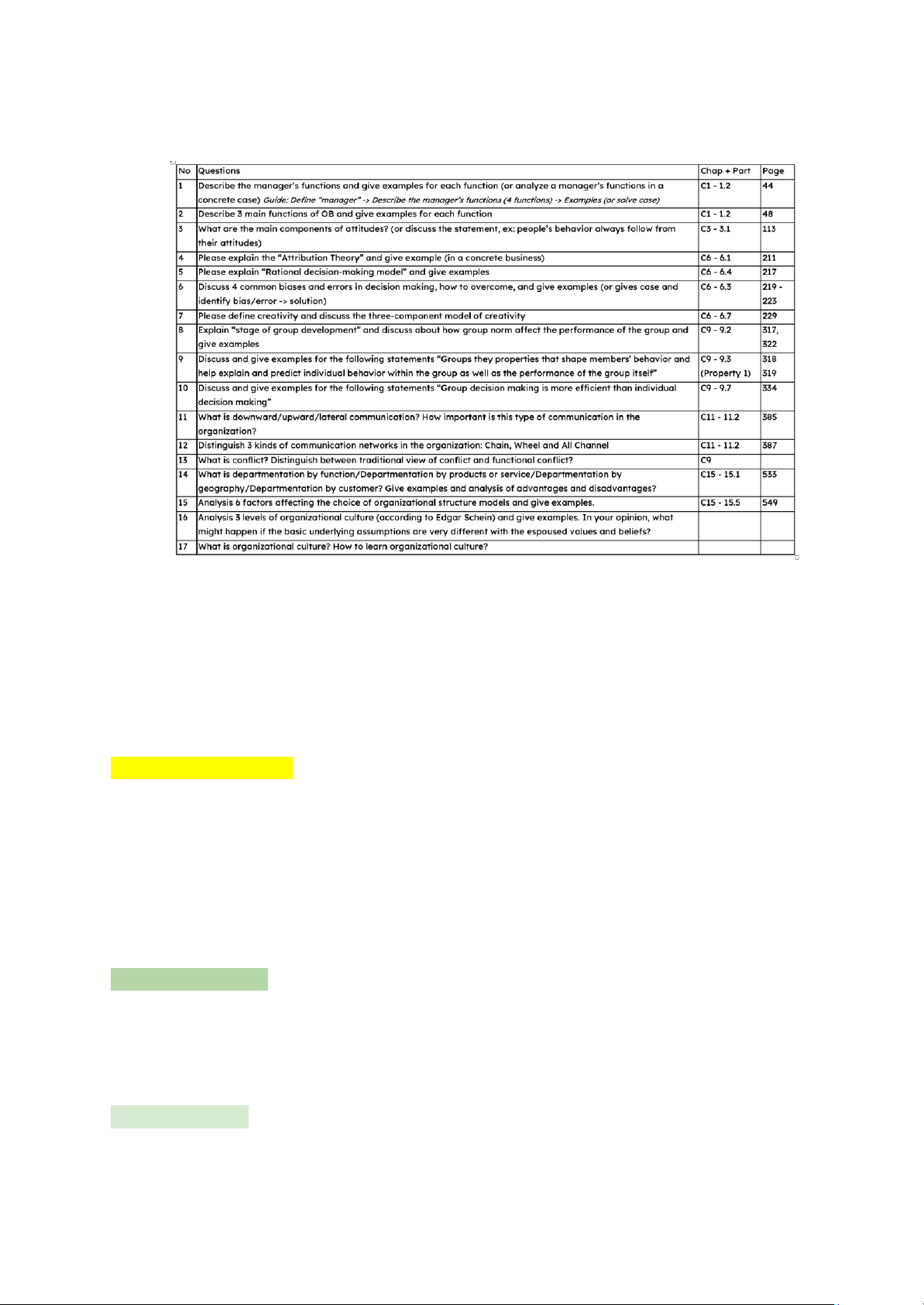
1. Describe the manager’s functions and give examples for each function (or analyze a
manager’s functions in a concrete case)
Managers play a significant role in the running of an organization. To be an effective manager,
you’ll need to develop a set of skills, including planning, communication, organization, and leadership. FUNCTION 1 PLANNING
The planning function encompasses defining an organization's goals, establishing an overall
strategy for achieving those goals and developing a comprehensive set of plans to integrate
and coordinate activities. Evidence indicates the need for planning increases the most as
managers move from lower-level to mid-level management.
There are several approaches to planning:
Strategic planning: This type of planning is often carried out by an organization’s top
management and usually creates goals for the entire organization. It analyzes threats to the
organization, evaluates the organization’s strengths and weaknesses and creates a plan of how
the organization can best compete in its environment. Strategic planning usually has a long
time frame of three years or more.
Tactical planning: Tactical planning is the shorter-term planning of an objective that will take
a year or less to achieve. It is usually carried out by an organization’s middle management. lOMoAR cPSD| 58675420
Tactical planning is usually aimed at a specific area or department of the organization such as
its facilities, production, finance, marketing or personnel.
Contingency Planning: Contingency planning involves developing alternative courses of action
to address unexpected events or potential risks. It includes identifying potential disruptions
or challenges, formulating response strategies, and establishing contingency plans to mitigate
the impact of unforeseen circumstances. FUNCTION 2 ORGANIZING
Organizing is the second function of management, and a large part of this is assigning tasks to
your team members according to their abilities. This requires knowing what needs to be done
to finish a project and understanding what each of your team members brings to the table as
far as strengths, weaknesses, available time, and the assumed time it will take to complete. FUNCTION 3 LEADING
Leading consists of motivating employees and influencing their behavior to achieve
organizational objectives. Leading focuses on managing people, such as individual employees,
teams and groups rather than tasks. Though managers may direct team members by giving
orders and directing to their team, managers who are successful leaders usually connect with
their employees by using interpersonal skills to encourage, inspire and motivate team
members to perform to the best of their abilities.
Managers usually incorporate different leadership styles and change their management style
to adapt to different situations. Examples of situational leadership styles include:
● Directing: The manager leads by deciding with little input from the employee. This is
an effective leadership style for new employees who need a lot of initial direction and training.
● Coaching: The manager is more receptive to input from employees. They may pitch
their ideas to employees to work cooperatively and build trust with team members.
This style of leadership is effective for individuals who need managerial support to further develop their skills.
● Supporting: The manager decides with team members but focuses more on building
relationships within the team. This style of leadership is effective for employees who
have fully developed skills but are sometimes inconsistent in their performance.
● Delegating: The leader provides a minimum of guidance to employees and is more
concerned with the vision of the project than day-to-day operations. This style of
leadership is effective with employees able to work and perform tasks on their own
with little guidance. The leader can focus more on high-level goals than on tasks. lOMoAR cPSD| 58675420 FUNCTION 4 CONTROLLING
Controlling is the process of evaluating the execution of the plan and making adjustments to
ensure that the organizational goal is achieved. During the controlling stage, managers
perform tasks such as training employees as necessary and managing deadlines. Managers
monitor employees and evaluate the quality of their work. They can conduct performance
appraisals and give employees feedback, providing positive remarks on what they are doing
well and suggestions for improvement. They may also offer pay raise incentives to high- performing employees. 2.
Describe 3 main functions of OB and give examples for each function INTERPERSONAL ROLES
The interpersonal roles are ones that involve people (subordinates and persons outside the
organization) and other duties that are ceremonial and symbolic in nature. The three
interpersonal roles are figurehead, leader, and liaison. They are as follows:
The figurehead's role is primarily ceremonial and symbolic. As a
result, the manager who occupies this role is often seen as a
spokesperson or ambassador for the organization. A figurehead is
typically required to perform several tasks, such as greeting VIPs,
attending special events, and giving speeches.
Example: Queen Elizabeth II - as the head of state for the United Figurehead
Kingdom, she was required to perform many ceremonial duties,
such as attending state functions, greeting dignitaries, and giving
speeches. Although she did have some political power, her primary role was symbolic. lOMoAR cPSD| 58675420
The leader's role is to provide guidance and direction to members
of an organization as well as evaluate their performance. Leaders
typically set goals for their team, create a plan for achieving these
goals, and provide feedback to team members. In addition to these
activities, they also provide mentorship, motivation, and training to team members and employees. Leader
Example: Mahatma Gandhi was the political leader of India during
the country's struggle for independence from British rule. Gandhi
is best known for his philosophy of nonviolent resistance, which he
used to lead the Indian people in their fight for independence. He
was also a master of public relations, using his charisma and
communication skills to rally support for the Indian independence movement. Liaison
The liaison role is all about connecting people. It maintains a
network of outside contacts who provide favors and information.
Example: a foreign ambassador acts as a liaison between two
countries so that, even if the countries’ leaders are not
communicating regularly, the two countries can maintain a
relationship and a flow of information. INFORMATION ROLES
The informational roles involve collecting, receiving, and disseminating information. The three
informational roles are monitor, disseminator, and spokesperson. Monitor
The role of monitor is performed whenever managers seek or
acquire work-related information. They might do so by reading
reports and other documents, searching online, and talking with other people.
Example: As an example of the monitor role, think of a police
detective conducting an investigation, searching the crime scene
for clues, doing background checks using a police database,
interviewing witnesses, and interrogating suspects. Disseminator
The role of disseminator is performed whenever managers
communicate information, whether verbally or in writing, to
others within their organizations.
Example: As an example, think of a military commander lOMoAR cPSD| 58675420
briefing his or her troops about the battle plan before a critical
mission. In this case, the commander is only sharing the
information with other members of the unit. Spokesperson
The spokesperson role involves managers communicating
information, again, whether verbally or in writing, to others outside their organizations
Example: As an example, think of the White House Press Secretary
speaking at the podium to the news media and, thereby, the public. DECISIONAL ROLES
This category describes a manager's responsibility to use the information they gain to form
business and strategic decisions. The managerial roles included in this category are
entrepreneur, disturbance-handler, resource-allocator and negotiator. Entrepreneur
When performing this role, managers are coming up with and
implementing new and innovative ideas to improve their
businesses, adapt to changing conditions, and take advantage of opportunities Example: Steve Jobs revitalizing Apple with exciting new products like the iPod and iPhone in the early 2000s. Disturbance Handler
The role of disturbance or crisis handler is performed whenever
managers react to problems, conflicts, disputes, etcetera, and
take corrective action. These disturbances can be caused by internal or external issues.
Example: The managers had to help navigate their companies
through the Covid-19 pandemic. Think of a manager having to deal with a product recall. Resource Allocator
The role of resource allocator is performed whenever managers
make decisions about the people and projects that will receive
certain resources under their control, as well as when, how, and
where. This role involves planning, scheduling, and budgeting functions.
Example: Depending on the restaurant's needs, the manager
might authorize a server to stay over their scheduled hours. lOMoAR cPSD| 58675420 Negotiator
The role of negotiator is performed whenever managers
negotiate agreements or contracts with buyers, suppliers, unions, new hires, etcetera.
Example: James on behalf of the company, negotiates with
customers about the contract price for outsourcing marketing
services to arrive at the most reasonable price.
3. What are the main components of attitudes? (or discuss the statement, ex: people’s
behavior always follow from their attitudes)
Researchers assume attitudes have three components: cognition, affect, and behavior.
Cognitive component of an attitude is a description of or belief in the way things are. This
component includes thoughts, feelings, beliefs, and behaviors that are related to how
individuals think about their attitudes.
Affective component: stage for the more critical part of an attitude. Affect is the emotional or
feeling segment of an attitude reflected in the statement, "I am angry over how little I'm paid."
Affect can lead to behavioral outcomes.
The behavioral component of an attitude describes an intention to behave a certain way
toward someone or something-as in, "I'm going to look for another job that pays better."
Viewing attitudes as having three components-cognition, affect, and behavior-helps
understand their complexity and the potential relationship between attitudes and behavior.. Example:
1. Cognitive: My supervisor gave a promotion to a coworker who deserved it less than I did. My supervisor is unfair.
2. Affecting: I dislike my supervisor.
3. Behavioral: I’m looking for other work, I’ve complained about my supervisor to anyone who would listen.
4. Please explain the “Attribution Theory” and give example (in a concrete business)
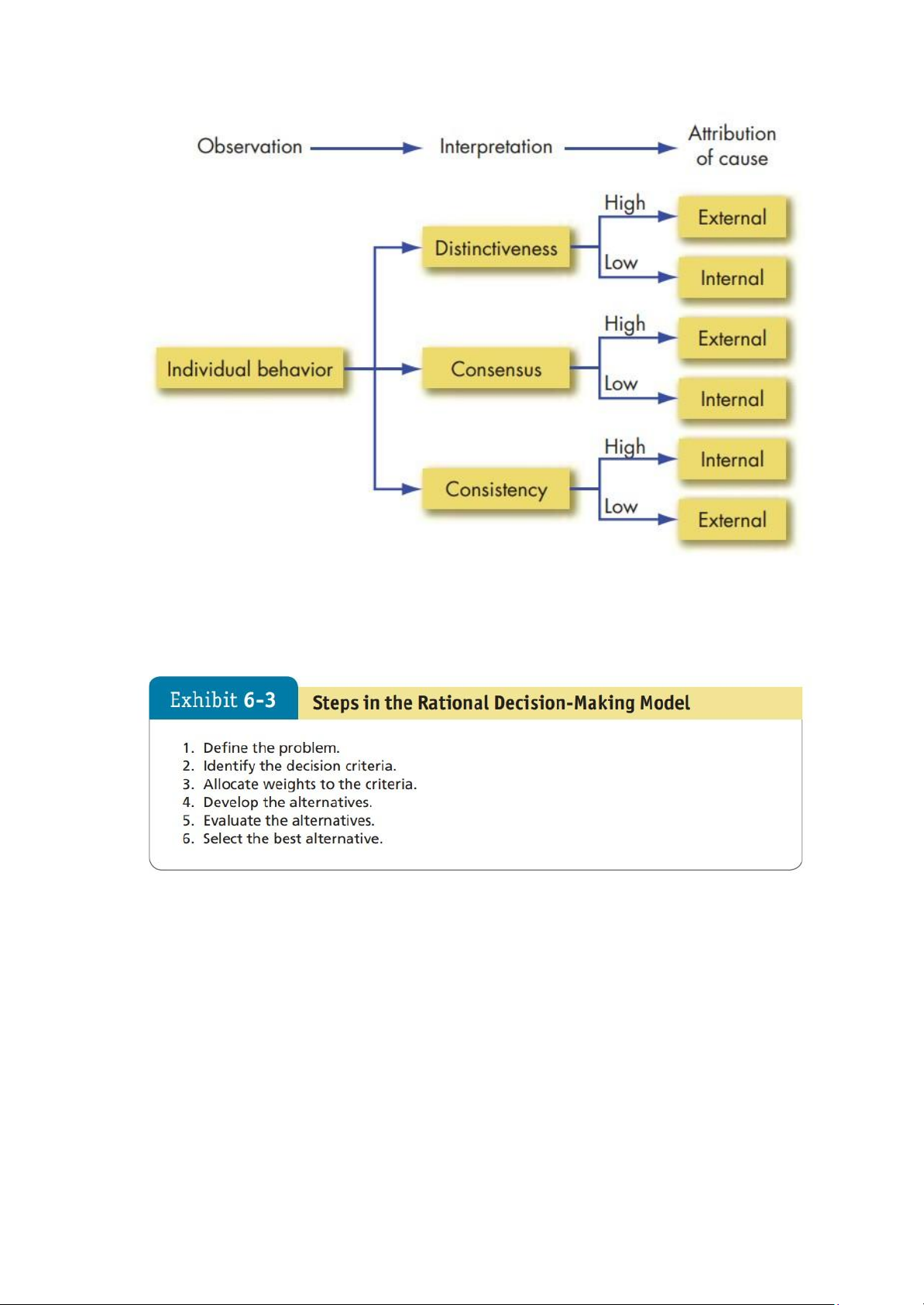
The Attribution Theory is a notion in organizational behavior that aids in our comprehension
of how people interpret and justify behavior in a corporate environment. It investigates the
cognitive processes involved in assigning causes to deeds or occurrences in an effort to provide
an explanation for why this occurred.
According to the Attribution Theory, people frequently choose between explaining behavior
by internal or external sources. lOMoAR cPSD| 58675420 EX: Performance Evaluation
Assume a manager is evaluating the performance of an employee, Ms A, who has frequently
missed project deadlines. The manager's interpretation of the behavior will have an impact
on their subsequent actions or decisions.
Internal Attribution: If Ms A's missed deadlines are attributed to internal sources, the
manager may interpret it as a lack of competence, poor time management skills, or low
motivation. The manager may then consider providing further training, direction, or
counseling to Ms A in order to improve her performance.
External Attribution: If the management blames Ms A's missed deadlines to outside
circumstances, they may see it as a result of a hard workload, insufficient resources, or
disruptions from other team members. To assist Ms A in meeting deadlines more successfully,
the manager may consider reallocating work, giving more resources, or altering project schedules.
The manager's attribution may have ramifications for how Ms A is handled and supported
inside the organization. If the manager believes the cause is internal and under Ms A's control,
he or she may take a more directive or disciplinary approach. If the cause is perceived to be
external and beyond Ms A's control, the manager may take a more supportive or problem- solving approach.
It's vital to remember that attribution is subjective and might differ amongst people
depending on their own biases, experiences, and perceptions. As a result, managers should
aim for a balanced and objective understanding of the causes of behaviour in order to make
fair and effective business decisions. lOMoAR cPSD| 58675420 5.
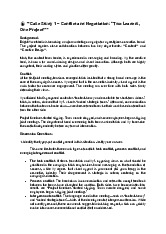
Please explain “Rational decision-making model” and give examples Step 1 Define the problem
Though this starting place might seem rather obvious, a failure to identify the problem clearly
can derail the entire process. It can sometimes require serious thought to find the central issue that must be addressed.
For example, Henry is a manager at Cloud ClearWaters Inc. After his performance review with
company executives, he receives a memo to increase monthly profits and generate more
revenue. The challenge for Henry is finding the best way to increase profits every month. lOMoAR cPSD| 58675420
Step 2 Identify the decision criteria
In this step, the decision maker needs to determine what is relevant in making the decision.
This step will bring the decision maker’s, and any other stakeholders, interests, values and
preferences into the process. To continue our example, let’s assume you are married. Some of
the criteria identified might include budget, safety, functionality, and reliability.
For example, Henry examines the relevant information that can help him increase profits. He
doesn't believe in terminating or laying off a teammate to reduce expenses but feels finding
cost-effective vendors and improving sales are more effective strategies. Henry considers the
impact of his decision on customers, teammates, and product quality, which is his decision criteria.
Step 3 Allocate weights to the criteria
Because the criteria identified will seldom be equally important, you will need to weigh the
criteria to create the correct priority in the decision.
For example, he may have weighted budget, safety, and reliability as the most important
criteria to consider, along with several other slightly less critical criteria.
Step 4 Develop the alternatives
Once you have identified the issue and gathered relevant information, now it is time to list
potential options for how to decide what to do. Some of those alternatives will be common
and fairly obvious options, but it is often helpful to be creative and name unusual solutions as
well. The alternatives you generated could include the types of cars, as well as using public
transportation, car pooling and a ride-hailing service.
Example: Henry creates a list of alternative solutions. Ranking them according to their ability
to meet the decision criteria, he has the following strategies for solving the financial challenge:
● Select a new distributor that charges less money.
● Reduce overtime hours, which would reduce overhead costs.
● Increase customer promotions to attract new customers and make more sales.
● Rent a section of the company's building to increase revenue. ● Request more funding from company executives for expansion operations.
● Invest in more stocks and bonds to improve the company's market position.
● To develop an effective sales pitch, request funding from angel investors and venture capitalists.
● Lay off employees who receive high salaries but contribute less to revenue generation. lOMoAR cPSD| 58675420
Step 5 Evaluate the alternatives
After creating a somewhat full list of possible alternatives, each alternative can be evaluated.
Which choice is most desirable and why? Are all of the options equally feasible, or are some
unrealistic or impossible? Now is the time to identify both the merits and the challenges
involved in each of the possible solutions.
Step 6 Select the best alternative
Take enough time to evaluate your options and how they can affect your success. Reflecting
on alternative solutions ensures you make the correct decision. Once you're confident of the
preferred strategy or solution, commit to implementing it.
Example: Henry recommends that finding a new distributor for the company can reduce costs,
leading to more profits. He also chooses this option because it's the most favorable when
considering his established decision criteria. He then creates a document detailing the process
followed when implementing the rational decision-making model to present to Cloud ClearWater Inc executives.
6. Discuss 4 common biases and errors in decision making, how to overcome, and give
examples (or gives case and identify bias/error -> solution) Overconfidence Bias
We are often overconfident in our abilities and the abilities of others, unaware of this bias.
Those with weaker skills tend to overestimate their performance. Optimistic entrepreneurs
have lower success rates in their ventures. Being overly confident can hinder problem-solving.
Ex: a business owner who is confident that their new product- retinol will be successful in the
younger segmentation without conducting market research or considering potential
competition. The business owner may believe that their intuition and experience are enough
to ensure the success of the product and may not see the need for additional research or planning. => Solution
- Gather data and evidence: Market research is essential to gather data on customer
needs and preferences. It helps identify opportunities and challenges, ensuring
decisions are evidence-based. For instance, while retinol is beneficial for the skin and
should be used early, its high price of $30 may not be affordable for many young
individuals in the target market.
- Look for information that disconfirms his beliefs: The business owner should consider
potential risks and uncertainties, such as competition and changing market conditions.
This helps identify roadblocks and ensures a decision is made with a full understanding
of the risks and benefits. Failure in the target market would lead to significant losses considering production costs. lOMoAR cPSD| 58675420 Anchoring bias
Anchoring bias occurs when we fixate on initial information without adjusting for subsequent
information. It is commonly observed in professions where persuasion is important. During
negotiations, the initial information provided sets the tone and serves as an anchor for
subsequent offers. It's crucial to set your anchor truthfully but as high as possible to influence the negotiation outcome.
Ex: Hiring manager who sets the salary range for a new position based on the previous
employee's salary, rather than market rates or the candidate's qualifications. The hiring
manager may be anchored to the previous salary and may not consider other factors that
could impact the appropriate salary range for the new position. => Solution
- Increase a broader range of options: The hiring manager should research industry
salary ranges or consult HR professionals to avoid biasing the salary solely on the previous employee's earnings.
- Gather multiple sources of information: The hiring manager should gather diverse
salary information to make an informed decision, avoiding reliance on the first piece of information Confirmation Bias
In decision-making, we exhibit confirmation bias by selectively seeking information that
supports our past choices and disregarding contradictory information. We also tend to favor
sources that align with our beliefs and give more weight to supporting information. However,
those who prioritize accuracy in decision-making are less susceptible to confirmation bias.
Ex: a manager who believes that a particular employee is not performing well and only focuses
on negative feedback, while ignoring positive feedback. The manager may seek out
information that confirms their belief and discount information that contradicts it. => Solution
- Actively seek out alternative perspectives and information: The manager should
actively gather feedback from various sources, such as the employee, colleagues, and
stakeholders, to gain alternative perspectives and make an informed decision based on a range of information.
- Consider the potential biases and limitations of their own beliefs and assumptions:
The manager could reflect on their own beliefs and assumptions and consider how
they may be influencing their interpretation of information. This can help to identify
potential biases and ensure that the decision is based on objective data.
Availability Bias Availability bias is our tendency to base judgments on readily available
information. A combination of readily available information and our previous direct
experience with similar information has a particularly strong impact on our decision making. lOMoAR cPSD| 58675420
Also, events that evoke emotions, are particularly vivid, or are more recent tend to be more
available in our memory, leading us to overestimate the chances of unlikely events.
Ex: marketing manager who decides to invest in a particular advertising channel because it is
the most memorable or top-of-mind for them, rather than considering the effectiveness of other advertising channels. => Solution
- Gather data and evidence: The marketing manager could gather data and evidence
about the effectiveness of different advertising channels, such as click-through rates,
conversion rates, and return on investment. This can help to ensure that the decision
is based on objective data rather than subjective impressions.
- Avoid relying solely on personal experience or anecdotes: The marketing manager
could avoid relying solely on their own personal experience or anecdotes about the
effectiveness of different advertising channels. By being aware of the potential for
availability bias, the marketing manager can actively work to overcome it.
- Consider a range of options: The marketing manager could consider a range of
advertising channels that are appropriate for their target audience and marketing
goals. This can help to ensure that the decision is based on a broad range of options
rather than a narrow set of choices. Randomness error
Believing we can predict random events leads to the randomness error, where we try to find
meaning or patterns that aren't actually there. This can result in superstitions and biased
decision-making based on imaginary connections. Such decisions can hinder our judgment
and bias our major choices. It's important to recognize and overcome this error by making
decisions based on reliable information and logical reasoning rather than on superstitions or unfounded patterns.
Ex: of randomness error in decision-making could be a sales manager who attributes the
success of a particular salesperson to luck or chance, rather than identifying the specific
factors that led to their success. => Solution
- Identify and analyze the specific factors that led to success: The sales manager could
identify the specific factors that contributed to the salesperson's success, such as their
skills, strategies, and work ethic. This can help to ensure that the decision is based on
objective data rather than chance.
- Avoid attributing success or failure solely to luck or chance: The sales manager could
avoid attributing success or failure solely to luck or chance, and instead consider the
specific factors that contributed to the outcome. By being aware of the potential for
randomness error, the sales manager can actively work to overcome it. lOMoAR cPSD| 58675420
- Gather data and evidence: The sales manager could gather data and evidence about
the performance of different salespeople, such as sales figures, customer feedback,
and performance metrics. This can help to ensure that the decision is based on solid
evidence rather than subjective impressions.
7. Please define creativity and discuss the three-component model of creativity. a. Definition:
Creativity can be defined as the ability to generate novel and valuable ideas, solutions,
or products. It involves thinking, exploring, and producing original and innovative
outcomes. Novel ideas are different from what’s been done before but which are appropriate for the problem b. Three-components model: Creative Behavior:
- Problem formulation: Any act of creativity begins with a problem that the behavior is
designed to solve. Thus, problem formulation is the stage of creative behavior in which
we identify a problem or opportunities that require a solution as yet unknown.
- Information gathering: Given a problem, the solution is rarely directly at hand. We
need time to learn more and to process that learning. Thus, information gathering is
the stage of creative behavior when knowledge is sought and possible solutions to a
problem incubate in an individual’s mind. Information gathering leads us to identifying innovation opportunities.
- Idea generation: Idea generation is the process of creative behavior in which we
develop possible solutions to a problem from relevant information and knowledge.
Sometimes we do this alone, when tricks like taking a walk and doodling can jumpstart
the process. Increasingly, though, idea generation is collaborative
- Idea evaluation: Finally, it’s time to choose from the ideas we have generated. Thus,
idea evaluation is the process of creative behavior in which we evaluate potential
solutions to identify the best one. Sometimes the method of choosing can be innovative.
Causes of creative behavior: - Creative Potential:
+ Intelligence and Creativity: Intelligence is related to creativity. Smart people are more
creative because they are better at solving complex problems. However, intelligent
individuals may also be more creative because they have greater “working memory,”
that is, they can recall more information related to the task at hand.
+ Personality and Creativity: The Big Five personality trait of openness to experience
correlates with creativity, probably because open individuals are less conformist in
action and more divergent in thinking. Other traits of creative people include proactive
personality, self-confidence, risk taking, tolerance for ambiguity, and perseverance. lOMoAR cPSD| 58675420
Hope, self-efficacy (belief in your capabilities), and positive affect also predict an individual’s creativity.
+ Expertise and Creativity: Expertise is the foundation for all creative work and thus is the
single most important predictor of creative potential. The potential for creativity is
enhanced when individuals have abilities, knowledge, proficiencies, and similar
expertise to their field of endeavor. The expertise of others is important, too. People
with larger social networks have greater exposure to diverse ideas and informal access
to the expertise and resources of others.
+ Ethics and Creativity: Although creativity is linked to many desirable individual
characteristics, it is not correlated with ethicality. People who cheat may actually be
more creative than those who behave ethically, according to recent research. It may
be that dishonesty and creativity can both stem from a rule-breaking desire. - Creative Environment:
+ Motivation: If you aren’t motivated to be creative, it is unlikely you will be. Intrinsic
motivation, or the desire to work on something because it’s interesting, exciting,
satisfying, and challenging, correlates fairly strongly with creative outcomes.
+ It is also valuable to work in an environment that rewards and recognizes creative work.
The organization should foster the free flow of ideas, including providing fair and
constructive judgment. Freedom from excessive rules encourages creativity;
employees should have the freedom to decide what work is to be done and how to do it.
+ Creativity can be inspired by an abundance of resources as well. It appears that managers
greatly affect the outcomes. They may be able to heighten innovation when resources
are limited by encouraging employees to find resources for their novel ideas, and by
giving direct attention to appropriate tools when resources are plentiful. The weaker
ties between team members and manager networks may actually have more impact
on creativity than the direct, stronger ties that team members have with their own
networks, because the weaker sources provide more divergent thinking.
+ Good leadership matters to creativity too. When leaders are encouraging in tone, run
their units in a transparent fashion, and encourage the development of their
employees, the individuals they supervise are more creative. c. Creative Outcomes:
In a large agribusiness company, creative ideas were most likely to be implemented
when an individual was motivated to translate the idea into practice—and had strong
networking ability.128 These studies highlight an important fact: Creative ideas do not
implement themselves; translating them into creative outcomes is a social process
that requires utilizing other concepts addressed in this text, including power and
politics, leadership, and motivation. lOMoAR cPSD| 58675420
8. Explain “stage of group development” and discuss about how group norm affect the
performance of the group and give examples
The notion of "stage of group development" refers to the several stages that a group goes
through as it forms, develops, and matures over time in the field of organizational behavior.
This paradigm assists us in comprehending the dynamics and obstacles that groups encounter,
as well as their potential for productivity and effectiveness.
Bruce Tuckman's "Forming, Storming, Norming, and Performing" paradigm is the most well-
known group development model. Let's go over each stage and then talk about how group
norms can affect group performance:
- Forming: During this stage, group members get to know one another and identify the
group's purpose and goals. Members are still getting to know one other and clarifying
their positions, so there is a sense of civility and caution. At this stage, group norms
are not fully formed, and there may be a lack of clear direction or structure.
- Storming: Conflicts and disagreements may emerge during this stage when group
members begin to express their thoughts, ideas, and competing interests. It is a pivotal
stage in which power disputes, communication problems, and opposition to authority
may emerge. As members negotiate and navigate the storming process, group norms evolve.
- Norming: Group members begin to acquire a sense of cohesion and establish shared
expectations, values, and standards during the norming stage. Individuals' trust and
collaboration grow when they match their behaviour with the evolving group
standards. Roles become more defined, and a greater sense of teamwork and mutual support develops.
- Performing: The performing stage is the ideal state of development for a group. At this
point, the group is highly functional, productive, and focused on its objectives. Group
norms are well-established, and members collaborate successfully, using their skills
and coordinating their efforts to complete tasks.
Group Performance and Group Norms:
Group norms are the unwritten rules and expectations that govern group behavior. They have
an impact on how members interact with one another, communicate, make decisions, and
approach tasks. Group norms can have a substantial impact on group performance. EX: Decision-Making Norms lOMoAR cPSD| 58675420
Consider a project team tasked with creating a new marketing plan for a business. The team
is made up of people with a wide range of skills and viewpoints. The group norm about
decision-making processes can have a substantial impact on team performance.
Consensus Norm: If the organization adopts a consensus-based decision-making norm, it
indicates that all members must agree on a choice before it is adopted. This standard ensures
that everyone's perspectives are taken into account and fosters a sense of teamwork and buy-
in. However, if consensus cannot be established, it may result in delayed decision-making and
potential deadlock. On the plus side, the group gains collective wisdom and a stronger
commitment to the judgements made.
Norm of Majority Rule: In contrast, the group may develop a norm of majority rule, under
which choices are decided based on the preferences of the majority. This standard can help
to speed up decision-making and minimize stagnation. However, it may result in the
suppression of minority viewpoints and a reduction of commitment from individuals who
disagree with the majority decision.
Norm of Expert Authority: The group may also adopt a norm in which decision-making is
centralized in an expert or authority figure. When time is limited and immediate action is
required, this rule can be effective. However, it may undercut other team members'
commitment and motivation, reducing their sense of ownership and contribution.
The influence of decision-making norms on group performance varies. Consensus-based
decision making may result in higher-quality decisions, but it may also result in slower
development. Majority rule may speed up decision-making but at the expense of inclusivity.
Although expert authority can provide clear direction, it can also stifle creativity and shared accountability.
9. Discuss and give examples for the following statements “Groups they properties that
shape members’ behavior and help explain and predict individual behavior within
the group as well as the performance of the group itself”
(1) Roles: The allocation and fulfillment of roles influence individual behavior as members
strive to meet the expectations associated with their assigned roles.
Example: To be a good father, the director needs to cut back on after-hours receptions.
This also means, the chances of career success will be affected.
(2) Norms: providing explicit cues about how hard members should work, what the level
of output should be, how to get the job done, what level of tardiness is appropriate,
and the like which are extremely powerful and are capable of significantly modifying a performance prediction based lOMoAR cPSD| 58675420
solely on ability and level of personal motivation
For example, you don’t have to talk privately during a discussion
(3) Status: Those with higher status may have more influence, decision-making power,
and perceived expertise. The behavior of individuals is often influenced by the desire
to gain or maintain a certain status within the group.
For example, members of a high-status group tend to have more freedom, are less
subject to organizational standards, and less pressure to conform than do low-status groups.
(4) Size and Dynamics: One of the key findings regarding team size is social loafing. This
waste is understood as when working in a group, individuals tend to put less effort
than working individually, leading to the average labor productivity of the whole group
will be smaller than the labor productivity of each individual in group.
(5) Cohesiveness: The correlation between linkages and labor productivity also depends
on the performance-related norms set by the group. If this norm is high and the group
is highly connected, the team's productivity will be high.
For example, Police officers, firefighters, and paramedics often work together as part
of emergency response teams, responding quickly to crises and life-threatening
situations. They need to trust one another and work well together in order to save
lives, and keep each other safe.
(6) Diversity: When a group is not homogenous in terms of gender, personality, opinions,
abilities, and views, that group often has conflicts but the work performance is high.
And racial and cultural differences will also make it more difficult for team members
to perform tasks or solve problems.
For instance, African American students who were made to feel welcome and included
as they entered college, had a higher GPA and visited their physicians less frequently
during their three-year college period
10. Discuss and give examples for the following statements “Group decision making is
more efficient than individual decision making” (333 - 216)
Group decision making can be more efficient than individual decision making in certain
situations. However, it is still unclear whether group decisions are more efficient than
individual decisions since a tradeoff may exist between speed and accuracy. Increasing the
number of group members may increase the group’s response accuracy, but at the same time
would slow down the processing speed. Group decisions are time-consuming because groups
typically take more time to reach a solution. It takes additional time because there is a need
for active participation, discussion, and coordination among group members. Group decisions
can sometimes be less efficient than individual decisions. If they’re low- and medium-ability
members, the group’s overall effectiveness will suffer. Without good facilitation and structure,
meetings can get eliminated in trivial details that may matter a lot to one person but not to the others. lOMoAR cPSD| 58675420
For example, if there is an emergency and a quick decision is required, individual decision-
making may take precedence. On the other hand, if a new employee has no experience or
skills, a team's decision-making can be more effective.
11. What is downward/upward/lateral communication? How important is this type of
communication in the organization? Downward Upward Lateral Definition
Flows to a higher level in the Occurs between members of
group or organization used to the same workgroup,
Communication that flows provide feedback to higher-ups, members at the same level in
from one level of a group or inform them of progress toward separate workgroups, or any
organization to a lower level goals, and relay current other horizontally equivalent
use it to assign goals, problems workers provide job instructions, explain policies and procedures, point out problems that need attention, and offer feedback. Importance
- Creates a disciplined and - Keeps managers aware of how - Increases coordination: high
organized working space: employees feel about their jobs, chance of mutual helps coworkers, and understanding and lOMoAR cPSD| 58675420
the organization in general - coordination. Planning the
higher-level Increases mutual trust, lower- becomes easier, direct
executives and managers level employees trust that the conversations take place, and to discipline the company considers
their the communication style is employees at the suggestions, and upper warmer. bottom, disseminate management believes that - Reduces information in
a employees will be proactive and misunderstanding though structured way, and positive meeting, discussion, face to organize work activities. - Improves workplace face conversation - Ensures proper procedures and - Performs communication of
productivity. Employees can interdepartmental instructions and
send suggestions to improve communication principles workplace condition - Helps - Gains benefits of - Paves the way
managers identify areas for self- informal communication for a improvement through - Brings dynamism in workplace, creates an decentralized employee-to-employer feedback environment of cooperation, organization - Makes employees feel teamwork and team spirit. - Helps maintain valued, every employee, hierarchy
regardless of their role, feels like - Explains complex they are an important procedures and contributor to the company's concepts for better
success. so creates an inclusive understanding: The environment within an
seniors can easily convey organization explanations and information to simplify difficult or - incomprehensible concepts for the juniors. - The administration and management can delegate authority and instill a sense of responsibility within the lower-level employees. This helps the people at the lOMoAR cPSD| 58675420 higher level to focus on more important tasks and train the lower-level workers simultaneously.
12. Distinguish 3 kinds of communication networks in the organization: Chain, Wheel and All Channel Chain Wheel All channel Definition
The leader of the organization All members can communicate with all the
The vertical upward and works as a central person to members without any formal
downward form of the accumulate information and restrictions. formal chain of disseminate it to all the
communication. In this members communication network, a person can communicate only with his immediate superior and subordinate. Found in
A team with a strong leader, a The matrix structure, Rigid three-level
customer service center with a organic structure organization (simple supervisor. Ex: creative structure or agencies, start-ups,... mechanistic structure). Ex: military,... Suitable for Simple routine types of a leader/manager
when tasks require high degree of work. monitoring, directing, and collaboration,
evaluating performance and communication, and outcomes creativity Pros and cons
Tài liệu liên quan:
-
Ôn thi Môn Organizational behavior | Đại học Kinh Tế Quốc Dân
61 31 -
Câu hỏi tổng hợp Môn Organizational behavior | Đại học Kinh Tế Quốc Dân
64 32 -
Case Study Analysis Costco's Competitive Strategy | Môn Organizational behavior - Đại học Kinh Tế Quốc Dân
73 37 -
Ảnh hưởng của drone R2D2 đến hành vi nhân viên và đạo đức | Môn Organizational behavior - Đại học Kinh Tế Quốc Dân
57 29 -
Analyzing InnovateX's Organizational Behavior Issues | Môn Organizational behavior - Đại học Kinh Tế Quốc Dân
56 28