Christina Latham-Koenig
Clive
Oxenden
Paul Seligson
OXFORD
SECOND
EDITION

...
2
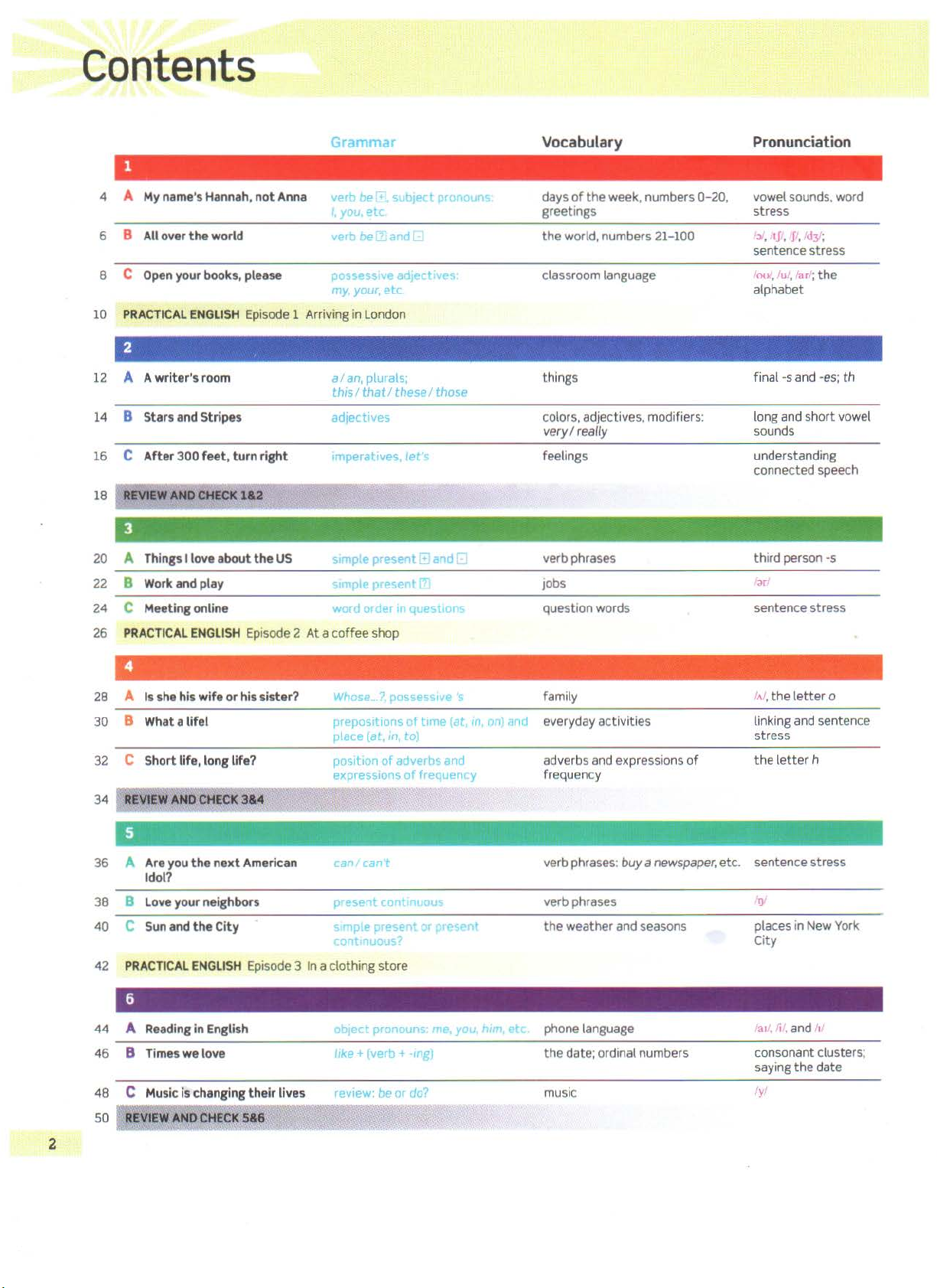
Contents
4 A My name's Hannah, not Anna
5
B All over
the
w
or
ld
8
C
Open
your books, please
Grammar
verb be'• subject prono
un
s
I,
you,
etc
verb
be
~
and [
possess
ve
adj
ect
1
vec;
:
you·,
etc
10
PRACTICAL
ENGLISH
Episode l Arriving in London
12
A A
writer's
room
al
an,
plurals;
this!
that
I these I those
14 B
Star
s and S
tr
ipes adjectives
15 c
After
300
feet,
turn
right
imperatives,
let
s
18
REVIEW
AND
CHECK
112
20 A
Things I love a
bout
the
US
simple present
:;:}
and 8
22
8
Wo
rk and play simple pr
esert
:!)
24 c Meeting online
-uest
:
ins
26
PRACTICAL
ENGLISH
Episode 2
At
a
coffee
shop
28
A Is she his
wife
or
his s
ister
?
30
8 What a
lif
e!
32
c
Short life,
long
life?
34
REVIEW
AND
CHECK
31~
36 A Are you
th
e
next
American
Idol
?
38 Love your neighbors
40
Sun
and
the
C
ity
Whose .
..
?, possessive 's
prepositions
of
time (
at,
m,
on) a1
~
place (at,
in,
to)
position
of
adverbs a"ld
expressions
of
frequency
can/
can't
present
continuous
s
mp
le pres!mt
or
pr
esent
or
42
PRACTI
C
AL
ENGLISH
Episode 3 In a clothing store
44
A Reading in English obj
ect
pronouns·
me
, you, him,
et
45 B Times we love
ltke
+ (verb + ·
mg)
48 c Music is changing
their
lives review:
be
or
do?
50
REVIEW
~ND
CHECK
5&6
'·
.........
··'
....
.·
• • • •
~.
r •
••
Vocabulary
days
of
the week, numbers
0-20,
greetings
the world, numbers
21
-100
classroom language
things
colors, adjectives, modifiers:
very/really
feelings
verb phrases
jobs
question words
family
everyday activities
adverbs and expressions
of
frequency
Pronunciation
vowel sounds, word
stress
~
.
tJ, .f .• !dy ;
sentence stress
/()(JI,
tu/
,
tw
;
the
alphabet
fi
nal -
sand
-es;
th
long and
short
vowel
sounds
understanding
connected speech
th
ird person
·s
;ir
sentence stress
'""'
·the
letter
o
linking and sentence
stress
the
letter
h
verb phrases:
buy
Cl
newspaper,
etc
. sentence stress
verb phrases
IJi
the
weather and seasons places in New York
City
phone language
the
date; ordinal numbers
music
1a11,
·J,,
and /i
consonant clusters;
saying
the
date
ly!
.·

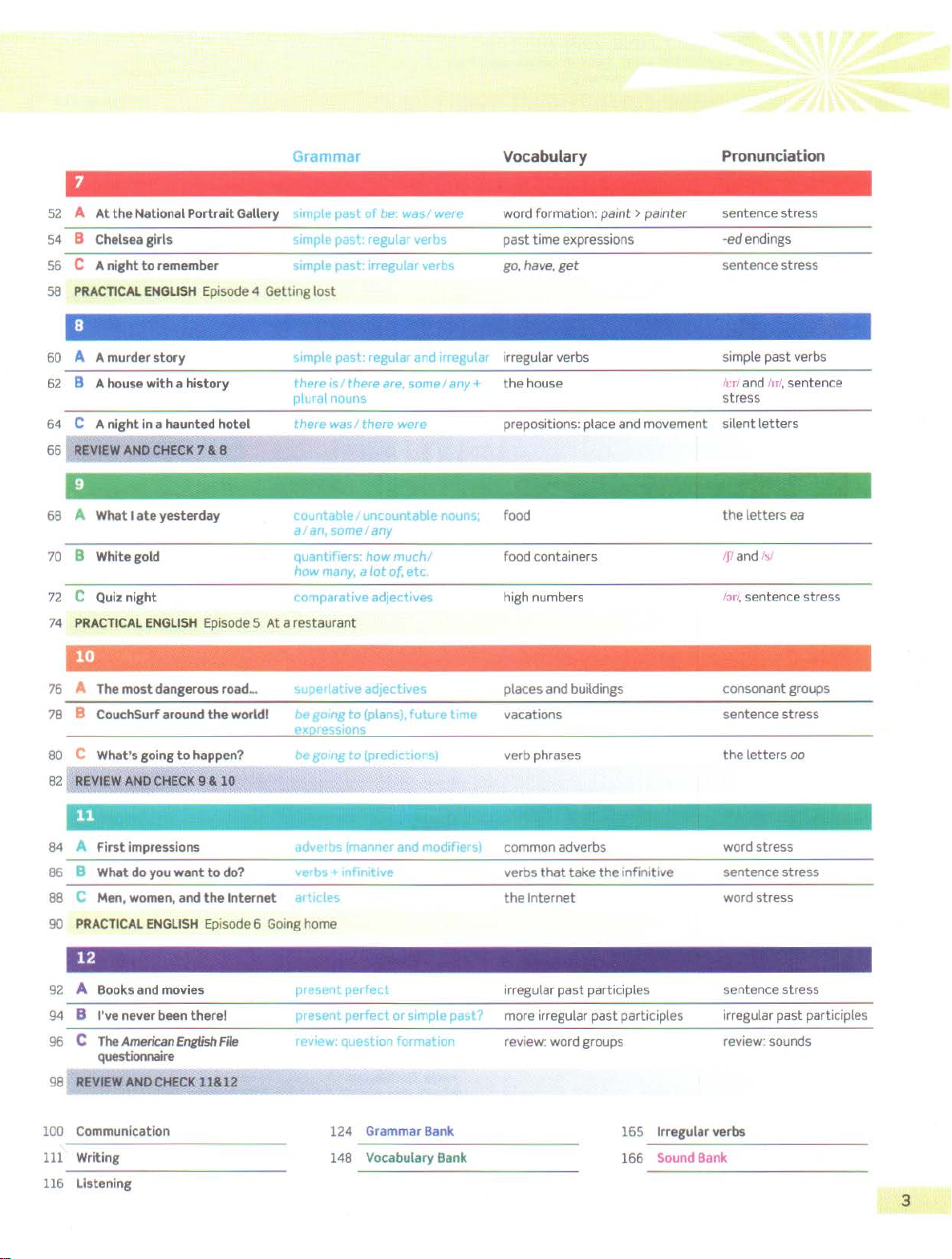
Grammar Vocabulary
Pronunciation
52
A
At
the
National
Portrait
Gallery
rT"ple
past
of
be:
was/
were
word formation:
paint
>
painter
sentence stress
54
B Chelsea
girls
1:-r.ple
past: regu.ar verbs
past
time
expressions
-edendings
56
c
A
night
to
remember
~-•-
-
..
o;t:
irregular verbs
go, have,
get
sentence stress
58
PRACTICAL
ENGL
.
ISH
Episode 4 Getting
lost
60
A A murder
story
simple past: regular
a'ld
irregul11
irregular verbs
simple
past
verbs
62
B A house
with
a h
istory
thPre
isl
there
are,
some/
any+
the
house
ti;rl
and lirt, sentence
plval
'10uns stress
64
c A
night
in a haunted
hotel
there
was/there
were prepositions: place and
movement
silent
letters
66
REVIEW
AND
CHECK
1 & 8
68
What I
ate
yesterday
countable / uncountable nouns, food
the
letters
ea
al
an,
some/
any
70
B
White gold quantrf1ers:
how
much/
food containers
lfi and
1,
how
many, a
tot
of,
etc.
72 c Quiz
night
comoarative adjectives high numbers
/;'Ir/
, sentence stress
74
PRACTICAL
ENGLISH
Episode 5
At
a restaurant
76
The
most
dangerous road
...
super
lab
'°'•Pr :ives places and buildings consonant groups
78
Couch
Surf
around
the
world
I bt1going
a:
),
future
time
vacations
sentence stress
PX!l<cl<;Si011'>
80
c
What's
going
to
happen?
be
going
to
(pred ct1o:is)
verb phrases
the
letters
oo
82
REVIEW
ANO
CHECK
9 &
1-0
84
A
First
impressions tldverbs (manner and modifiers) common adverbs word stress
86
88
What do you
want
to
do?
Men, women, and
the
Internet
verbs+
mfimt1ve
90
PRACTICAL
ENGLISH
Episode 6 Going home
92
A
Books and movies
94
B
I've never been there!
96
c
The
American
English
File
questionnaire
98
REVIEW
AND
CHECK
11&12
100 Communication
111 Writing
116 Listening
prec;erit
perfect
preserit
perfect
or
siriple
past'i
rev1f'w questio11 forrnatiol'
124 Grammar Bank
148 Vocabulary Bank
verbs
that
take
the
i
nfinitive
sentence stress
the
Internet
word stress
irregular
past
participles sentence stress
more irregular
past
participles
irregular past participles
review: word groups review: sounds
165 Irregular verbs
166 Sound Bank
3
·.

-
V days
of
the
week, numbers
0-20,
greetings
P vowel sounds, word
stress
1 LISTENING & SPEAKING
Hi,
I'm
Mike.
What's your name?
a
1 2
>))
Look
at
the picture
s.
Listen
and
number them 1- 4.
b Listen again and complete the blanks.
1
A
Hi,
I'm
Mike.
What's
your
1
?
B
Hannah.
A
2_
~
?
B
H
annah!
2 A
What
's
your
phone 3
?
B
It's
212-555-7894.
A 4
. See
you
on
Saturday.
Bye
.
B
Goodbye
.
3 A
5
___
,
Mom.
This
is
Hannah.
B
6
.
Nice
to meet
you
.
c
Nice
to
1
you,
Anna
.
B
8
name's
Hannah.
c
Sorry,
Hannah.
4 A
Hi,
9 .
You're
early!
B
Hello,
Mrs
.
Archer
.
How
are io ?
C
I'm
very
well,
11
__
you,
Anna.
And
you?
B i
2
. thanks.
A It's
Hannah,
Mom
.
c Fill
in
the blanks
with
a word from the list.
Fine
Hi
I'm...
Thanks
Bye
Hello = _ _ _
My
name's ... =
__
_
Very
well =
__
_
Thank
yo
u =
__
_
Goodbye= _ _ _
d 1 3
>))
Listen and repeat some phrases
from
the dialogue.
.(:Qpy
the
~t
h m.
e 1 4
>))
In groups
of
three, practice the dialogues with the
sound effects.
Change
role
s.
f Introduce yourself
to
other
st
udents.
Hello,
I'm
Antonio._
')
What's
your
na~
0rta.
Nice
to meet you.

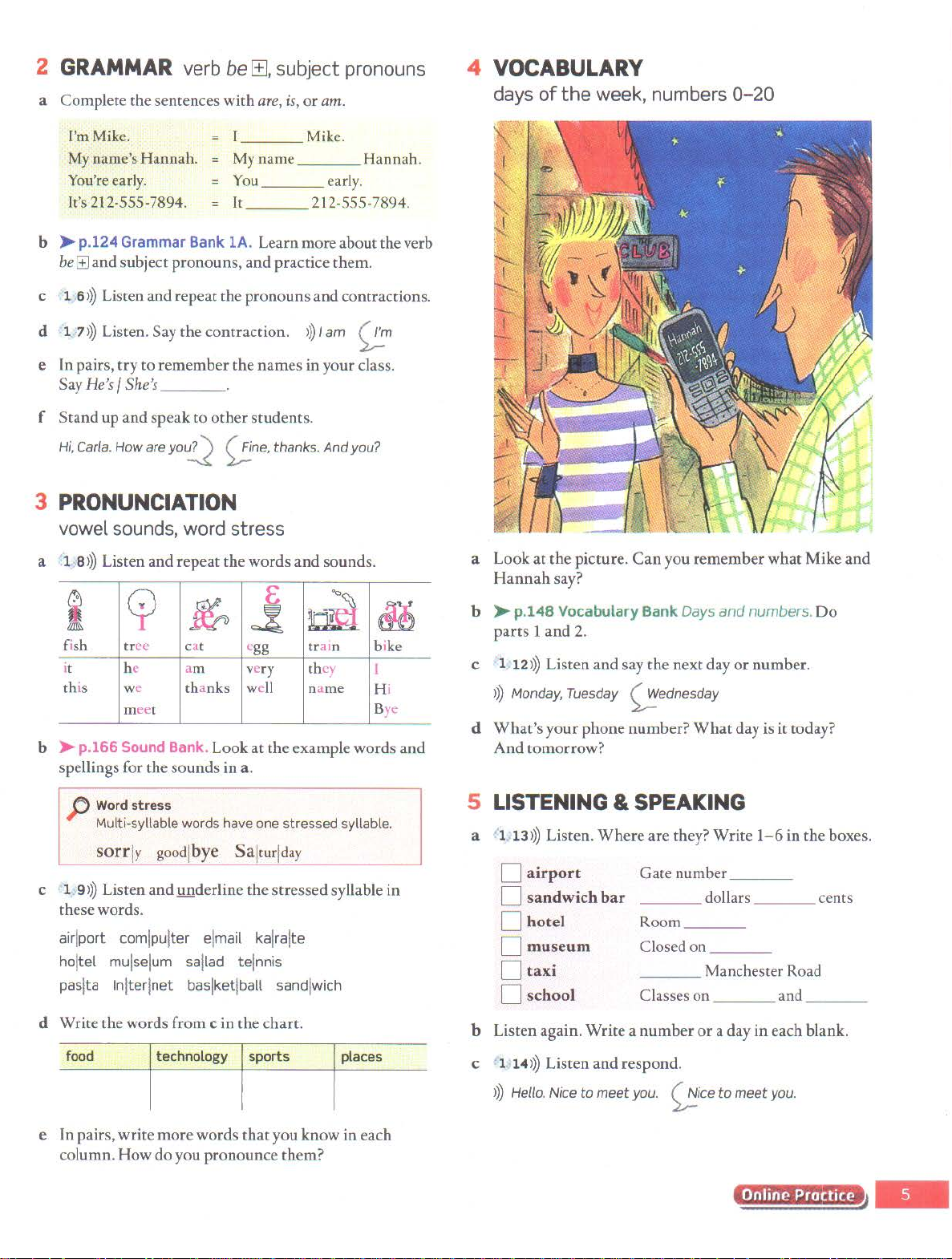
2 GRAMMAR verb be
r±l,
subject pronouns
a Complete the sentences
with
are, is,
or
am.
I'm Mike.
___
Mike.
My
name's Hannah.
You're early.
My name
___
Hannah
.
=
You
_
__
early.
It's 212-555-7894.
It
21
2-555-7894.
b
>-
p.124 Grammar Bank
lA.
Learn more about the verb
be
l±l
and subject
pronouns,
and
practice them.
c 1
,.
6
l))
Listen
and
repeat the
pronouns
and
contractions.
d
1
71))
Listen. Say
the
contraction.
1))
I
am
~
m
e In pairs,
try
to
remember
the
names
in
your
class.
Say
He
'
s/
She's _ _ _
f
Stand
up
and
speak
to
other
students.
Hi,
Carla
. How are
yo
~
0
ne,
thanks. And you?
3 PRONUNCIATION
vowel sounds, word stress
a 1
8>))
Listen
and
repeat
the words
and
sounds.
~
&
cp
~
E
~
~
&e
fish
tr
ee cat
e
gg
tr
ain bike
it
he am very th
ey
I
this we thanks we
ll
name
Hi
meet B
ye
b
>-
p.166 Sound Bank. Look
at
the example words
and
spellings for the
sounds
in
a.
p
Word
stress
Multi-syllable words have one stressed syllable.
sorr
jy
good
lbye
Sa
i
cur
j
day
c 1
9>))
Listen
and
llilderlinc
the
stressed
syllable
in
these words.
airj
port
comj
pu
j
ter
ejmail kajraj
te
ho
j
tel
mujsejum
sa
llad
te
jnnis
pasj
ta
lnj
ter
l
net
basl
ket
jball sandlwich
d Write
the
words from c
in
the
chart.
food technology sports
places
e In pairs, write
more
words
that
you
know
in
each
column.
How
do you
pronounce
them?
4 VOCABULARY
days
of
the
week, numbers 0- 20
a
Look
at
the
picture.
Can
you
remember
what
Mike
and
Hannah
say?
b
>-
p.
148
Vocabulary Bank
Days
and numbers.
Do
parts
1
and
2.
c
1
12>))
Listen
and
say
the
next
day
or
number.
>))
Monday,
Tuesday
0ednesday
d
What's
your
phone
number?
What
day
is it today?
And
tomorrow?
5 LISTENING & SPEAKING
a 1
13>))
Listen.
Where
are
they?
Write
1-6
in
the boxes.
D
airport
Gate number
__
_
D
sandwich
bar
dollars cents
D
hotel
Room
__
_
D
museum
D
taxi
D
school
Closed
on
__
_
___
Manchester Road
Classes on and
__
_
b Listen again.
Write
a
number
or
a day
in
each blank.
c
1
14>))
Listen
and
respond
.
1))
Hello. Nice to meet
you.
<;_;!.
ice to meet
you.
Online
Practice

-
G ve b be[?'
anc
g
V
the
world, numbers 21-100
P
fa/,
ltfl,
If/,
ld3/;
sentence stress
l
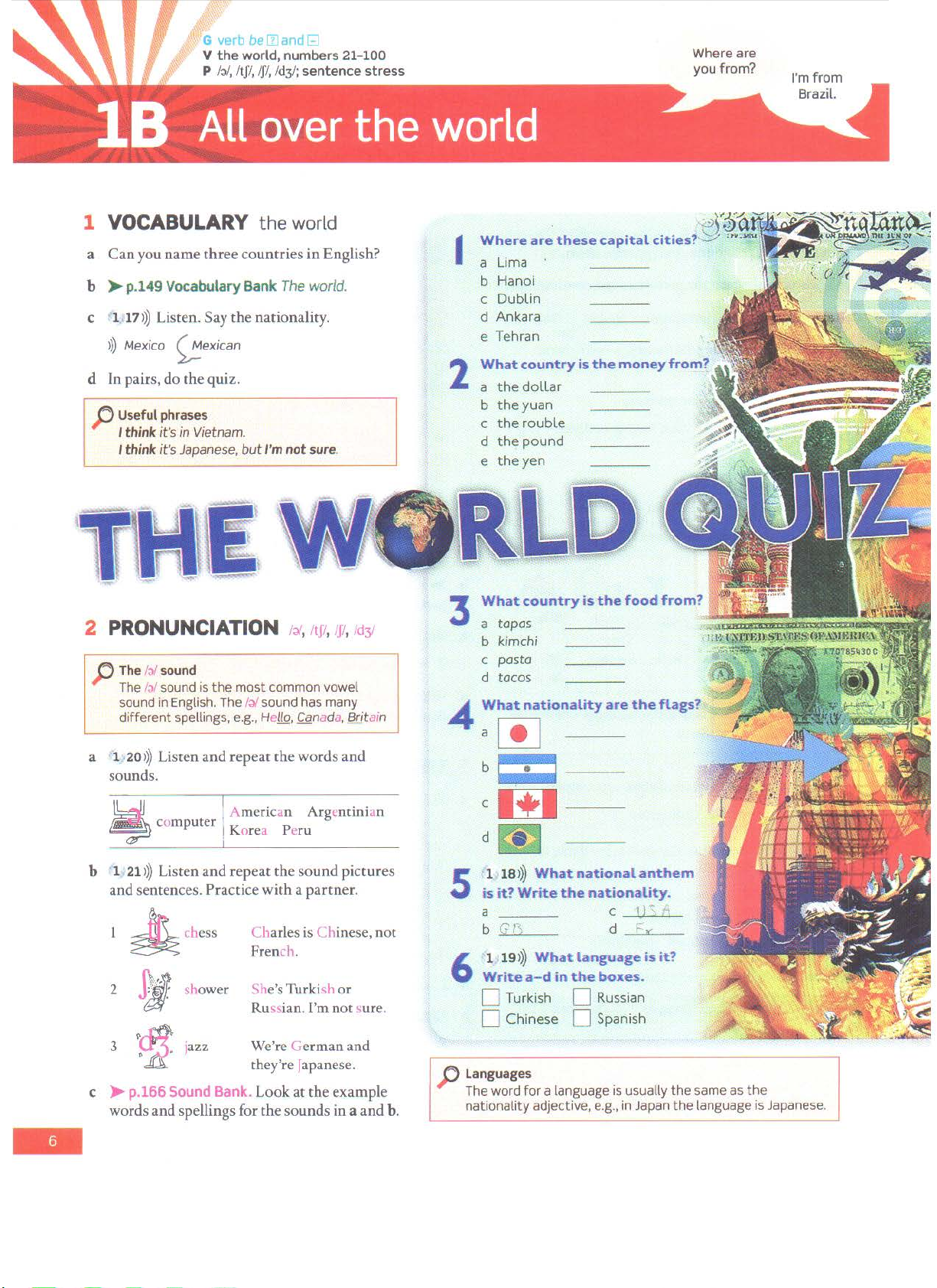
VOCABULARY
th
e world
a
Can
you
name
three
count
ries
in
English?
b
~
p.149 Vocabulary Bank
The
world.
c 1 17
>))
Listen. Say
the
nat
iona
lit
y.
»)
Mexico
0exican
d In pairs,
do
the
quiz.
p
Use
.fut phrases
I think it's
in
Vietnam.
I
th
i
nk
it's
Japanese,
but
I'm
not
sur
e.
2
PRONUNCIATION
fat
, ttft, tft,
ict31
p
The
fol
sound
The
fat.sound.is
the
most common vowel
sound
in
English. The
fa/
sound has man
different spellings,
e.g.,
Hello,
Can
ada,
Jrit
ai
n
a l ·
20>))
Listen and
re
p
eat
the
words
and
sounds.
~
computer · American Argentinian
~
I Ko
re
a Peru
b 1 21
l))
Listen
and
repeat
the
sound
pictures
and
sentences. Practice
with
a
partner.
2
3
~
chess Chades is Ch
inm,
not
Fren
ch
.
shower
~
~
'
~
·
jazz
Sh
e's Turki
sh
or
Ru
ssian. I'm not sure.
We're G
erman
and
they're Japanese.
c
~
p.
166
Sound Ba
nk.
Look
at
the
exam
le
words
and
spellings for
the
sounds
in
a
a~d
b.
I
2
3
5
Where are
you from?
e Tehran
-
~
What
country
is
the
money
from?
'
a
the
dollar
b
theyuan
c
the
rouble
d
the
pound
e
theyen
What
country
is
the
food
from?
a tapas
b kirnchi
c pasta
d tacos
1
18
>))
What
national
anthem
..
, .
•sit
. Writ.e
the
nationality
.
a c 110::,.,
b GB d
F'
--'--
--"---
6
1
~
g
>))
What
language
is
it?
Wnte
a-din
the
boxes.
C
Tu
rkish D Russian
D Chinese 0 Spanish

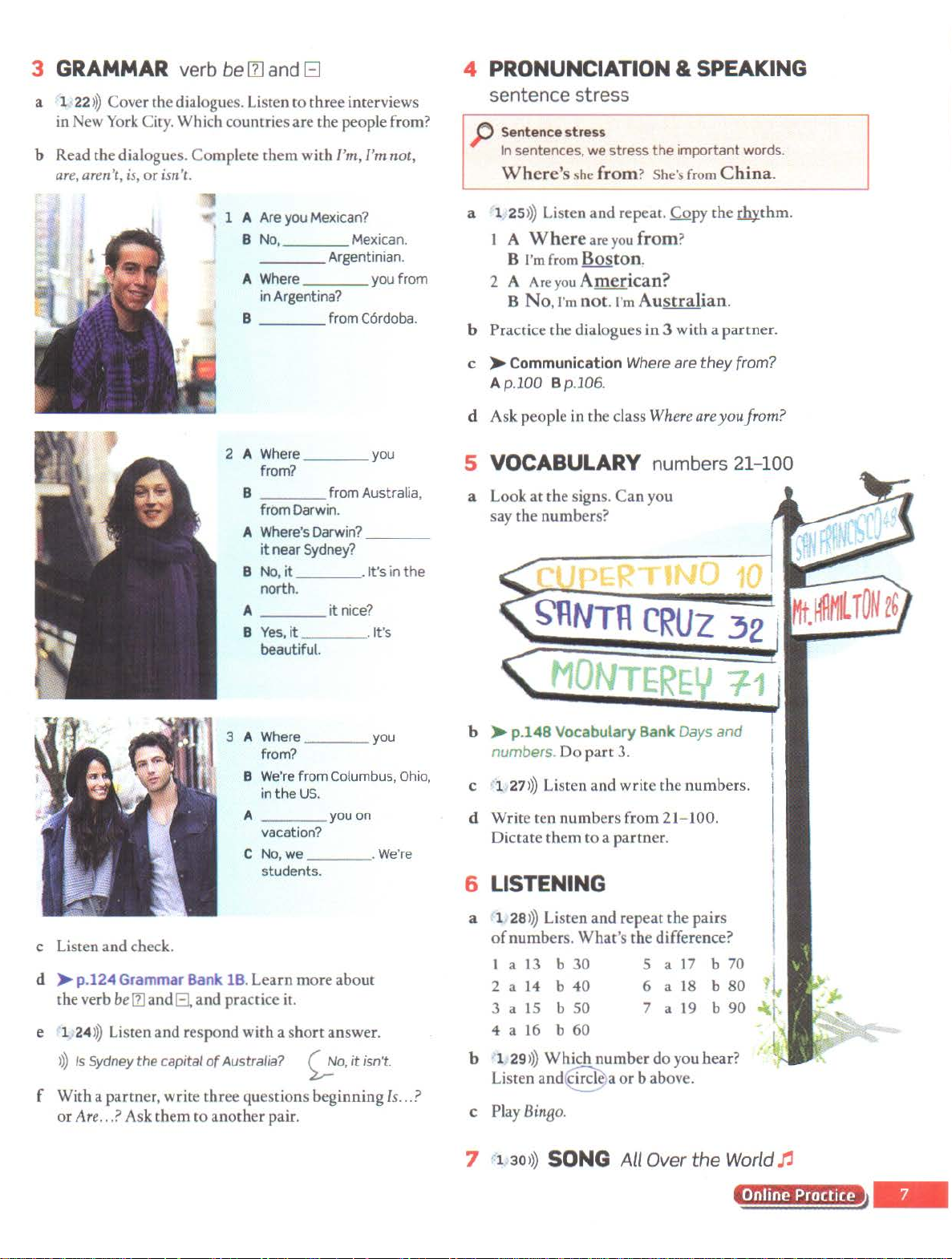
3 GRAMMAR verb be
Ill
and El
a 1
22>))
Cover the dialogues. Listen
to
three interviews
in New York City. Which countries are the people from?
b Read
the
dialogues.
Co
mplete
them
with I'm, I'm not,
are,
aren't,
is,
or
isn't.
c Listen and check.
1 A Are you Mexican?
8
No,
Mexican.
___
Argentinian.
A Where you from
in Argentina?
B from C6rdoba.
2 A Where
__
_ you
from?
8 from Australia,
from
Darwin.
A Where's Darwin?
__
_
it
near Sydney?
B No,
it
. It's
in
the
north.
A
it
nice?
B
Yes,
it
. It's
beautiful.
A Where you
from?
8 We're from Columbus, Ohio,
in
the
US.
A you on
vacation?
C No,
we
. We're
students.
d > p.124 Grammar Bank
18
.
Learn
more about
the verb
be
rn
and 8 and practice it.
e
1 24
>))
Li
sten and respond
with
a
short
answer.
>))
/s
Sydney
the
capital
of
Australia?
00.
it
isn't.
f With a partner, write three questions beginning
Is
... ?
or Are ... ? Ask them
to
another pair.
4 PRONUNCIATION & SPEAKING
sentence stress
p Sentence
stress
In
sentences,
we
stress
the
important
words.
Where's
she from?
She'~
from
China.
a 1
25
l))
Listen and repeat. Copy
the
Ih}'.thm.
I A
Where
are
you
from?
B I'm from
Boston
.
2 A A
re
you
American?
B
No
,
I'm
not
. I'm Australian.
b Practice
the
dialogues
in
3 with a partner.
c
>
Co
mmunication Where are
they
from?
A p.100 B
p.106.
d Ask people in the class Where
are
you
from?
5 VOCABULARY numbers 21-100
a Look
at
the
signs.
Can
you
say
the
numbers?
'"'
'PER
lfl
~n
SRNTH
CRUZ
32
'
MONTEREN
;-1
;1
b > p.
148
Vocabulary Bank Days
and
I
numbers.
Do
part
3. j
c 1
27>))
Listen and write
the
numbers. 1
d Write
ten
numbers
from
21-100.
Dictate them
to
a
partner
.
6 LISTENING
a 1
28
>))
Lis
ten
and repeat
the
pairs
of
numbers
.
What
's
the
difference?
a
13
b 30
2 a
14
b
40
3 a
15
b 50
4 a
16
b
60
5 a
17
b 70
6 a
18
b
80
7 a 19 b
90
b 1
29>))
Which
number
do
you hear?
---
Listen
and~le
a
orb
above.
c
Play
Bin8o·
I
I
I
7 i
30>))
SONG All Over
the
World
~
Online
Practice
,_

-
G possessive adjectives·
my,
your,
etc
.
V classroom language
How
do
you spell
your
last
name?
P
/ou/,
/u/,
far!;
the
alphabet
1
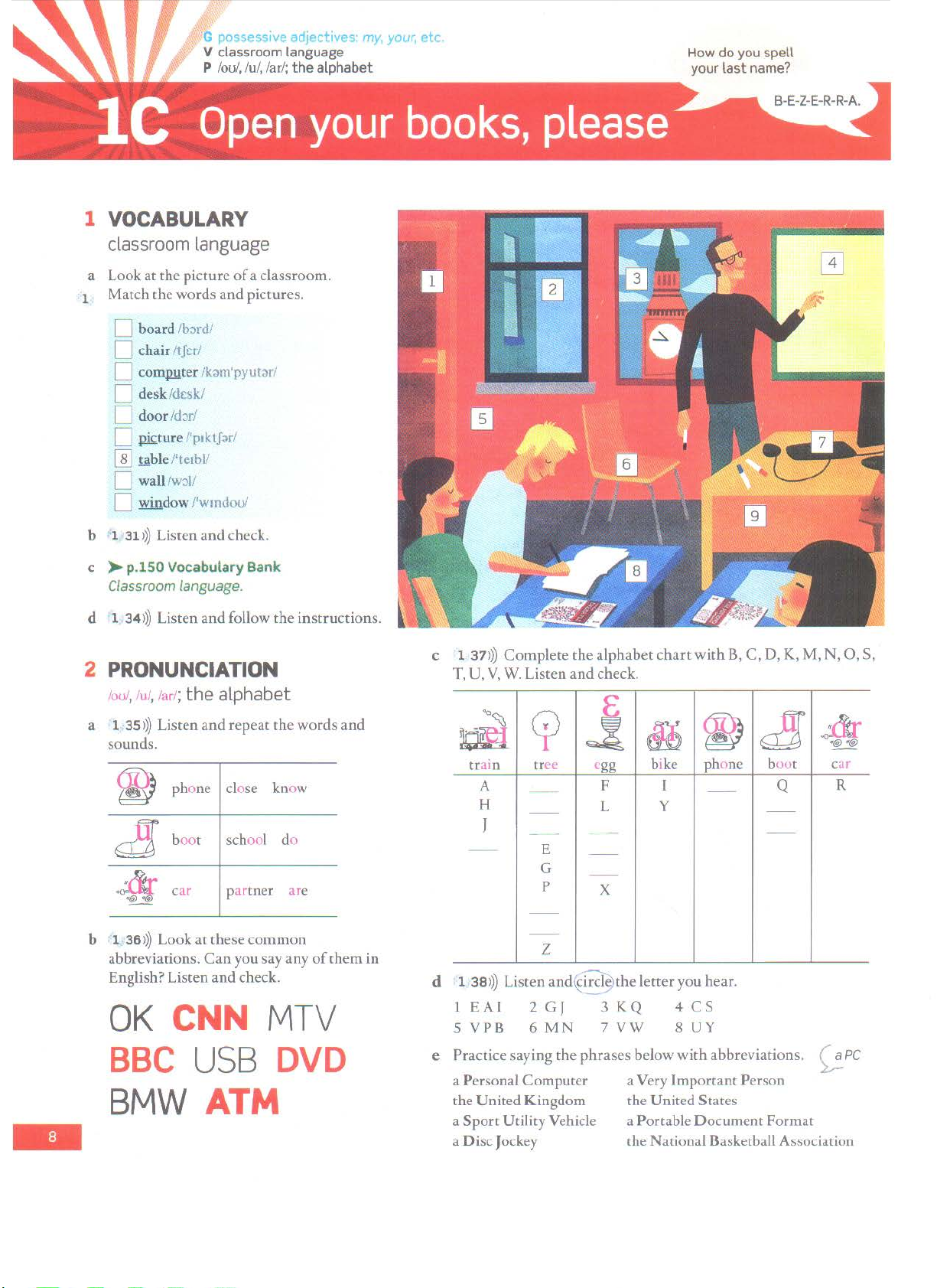
VOCABULARY
classroom language
a Look
at
the
picture
of
a
classroom.
1 Match
the
words
and
pictures
.
0 board
/b;:ird/
D chair ltJcr/
D
COOlpl!t
er
/hm'pyut~r/
D desk /desk/
L_
door /d:ir/
L
pk
ture /'p1ktJ3r/
[II
table /'te1bl/
D wall
/w;:il/
D window /'wmdou/
b 1
31
>))
Listen
and
check.
c
>-
p.150 Vocabulary Bank
Classroom
language
.
d 1 34
>))
Listen
and
follow
the
instructions.
2
PRONUNCIATION
foul
, tu!,
!ar1
;
the
alphabet
a 1
35>))
Listen
and
repeat
the
words
and
sounds.
~
phone close
kn
ow
d!
b
oo
t
sch
oo
l do
·~
c
ar
p
ar
tner
ar
e
b 1
36
l))
Look
at
these
common
abbreviations.
Can
you say
any
of
them
in
English? Listen
and
check.
OK
CNN
MTV
BBC
USB
DVD
BMW
ATM
c 1 37l))
Complete
the
alphabet
chart
with
B,
C,
D,
K,
M,
N,
0,
S,
T,
U,
V,
W.
Listen
and
check.
~
Ci>
j
~
~
di
4h-
.,~
tr
ain
tr
ee
e
gg
bi
ke
ph
one b
oo
t
c
ar
A
F I
- -
Q R
H
L
y
--
--
J
-
-
-
- -
--
E
--
G
--
p
x
--
- -
z
d 1
38>))
Listen
and
1t
i~the
letter
you
hear
.
lEAI
2GJ
3KQ
4CS
SVPB
6MN
7VW
8UY
e Practice
saying
the
phrases
below
with
abbreviations.
~
PC
a Personal
Computer
a Very
Important
Person
the
United
Kingdom
the
United
States
a
Sport
Utility Vehicle a Portable
Document
Format
a
Disc
Jockey the National Basketball Association

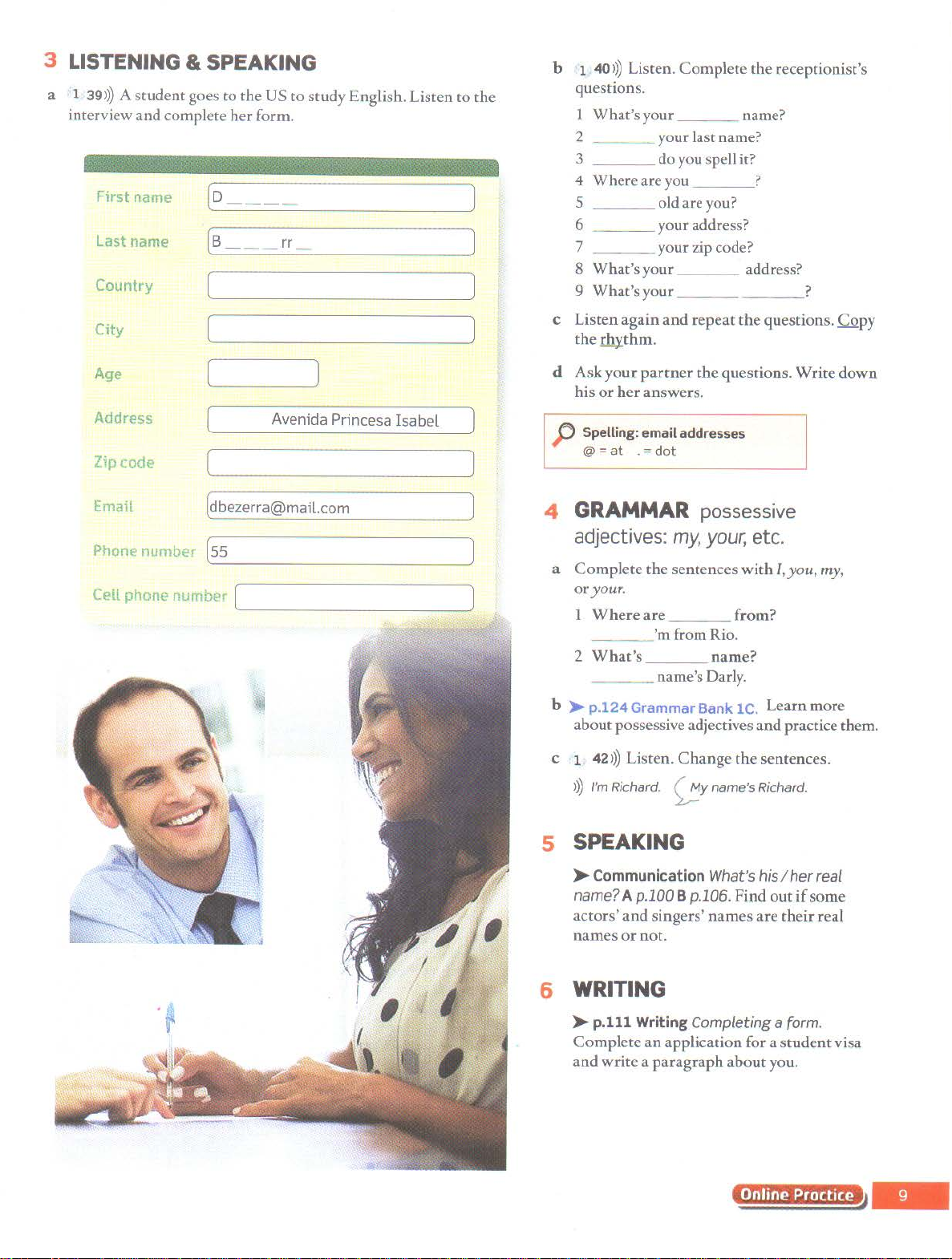
3 LISTENING & SPEAKING
a 1
39J))
A student goes to the
US
to
study English. Listen
to
the
interview and complete her form.
First
name
(o ___ _
last
name
(s
___
rr
_
Country
City
Age
Address
Avenida Princesa Isabel
Zip
code
Email
(dbezerra@mail.com
Cell phone nurnbe.
b 1
40>))
Listen. Complete the receptionist's
questions.
What's your
___
name?
2 _ your last name?
3 do
you
spell it?
4 Where are
you
?
5 old are
you?
6 your address?
7 your zip code?
8 What's your address?
9 What's your
?
c Listen again
and
repeat the questions. Copy
the
rh}'..thm.
d Ask your
partner
the questions. Write
down
his
or
her answers.
p Spelling: email addresses
@=
at
.
=dot
4 GRAMMAR possessive
adjectives:
my,
your,
etc.
a Complete the sentences with I, you, my,
or
your.
Where
are
__
_ from?
'mfromRio.
2
What's
name?
__
_ name's Darly.
b > p.124 Grammar Bank
lC.
Learn more
about possessive adjectives
and
practice them.
c
1 42J)) Listen. Change the sentences.
>))
I'm
Richard.
0y name's
Richard.
5 SPEAKING
> Communication
What's
his
I her
real
name?
A
p.100
B
p.106.
Find out
if
some
actors' and singers' names are their real
names
or
not.
6 WRITING
> p.111 Writing Completing a
form.
Complete
an
application for a student visa
and
write a paragraph about you.
Online
Procf
ce

1
VOCABULARY
in
a hotel
a
Match
the
words
and
symbol
s.
l1
re~tion
n'-.cpf nf
D the
~Jevator
/
'davc1t~r
'
D a single room
/
1
~11)91
rum
/
L 1 a dmlble
room
/'dAbl
rum!
LJ
the first
floor
/far
st
fbr
/
(second, third, etc.)
b
l 43
>))
Listen
and
check
.
~
INTRODUCTION
a l 44
>))
Watch
or
listen
ro
Jenny
and
Rob.
Mark
the
sentences
T (true)
or
F (false).
1 Rob lives
and
works in London.
2 He's a writer for a magazine.
3
The
name
of
his
magazine is London
20seven.
4 Jenny is British.
S She's an assiscanr editor.
6 lt's her second time in the
UK.
b
Watch
or
listen
again.
Say
why
the
F
sentences
are
false.
Arriving
in
London
~
CHECKING
IN
a l 45
>))
Watch
or
listen
to
Jenny
checking
into
a
hotel
r
oom.
Answer
the
questions.
I Complete Jenny's last name:
ZI
LI
SK_ .
2
What's
her
room
number
?
b
Watch
or
listen
again.
Complete
the
You
Hear
phrases.
>))
You
H
ear
You
Say 0
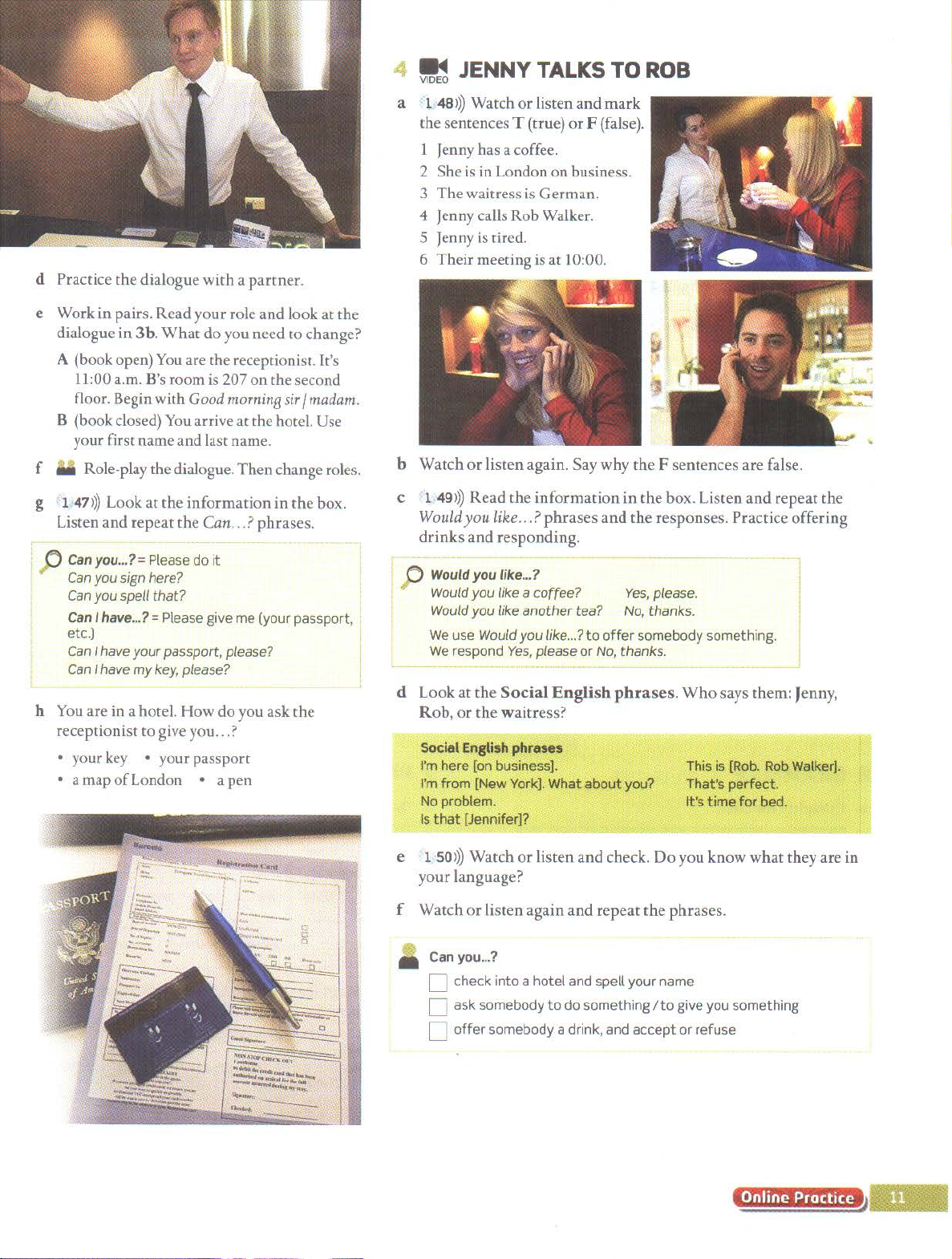
Good evening, madam. Hello. I have a reservation.
My name's Jennifer Zielinski.
Can
you
___
that.
please?
Z-1-E-L+N
-S-
K-I.
For five nights?
Yes,
that's
right.
Can
I have your passport, p
le
ase?
Just
a second
...
Here you are.
Thank you.
Can
you sign
here, ? Thank you.
Here's your
__
_
It's room 306, on
the
third
floor.
The is over there. The
lift?
Oh.
the
elevator.
Yes.
Enjoy your stay, Ms. Zielinski. Thank you.
0 American
an
d Br
itis
h En
glis
h
elevator= American English
lift=
British English
z =
/zi/
in
American English, /zed/ in British English
Greetings
Good
morning=> 12:00 p.m.
Good
after!1QQ!1
= 12:00 p.m. > 6:00
p.m.
Good
evening
= 6:00 p.m. >
Good
night= Goodbye (when you
go
to
bed)
Madam=
a
polite
way
to
greet
a woman
Sir= a polite
way
to
greet
a man
c 1 46
>))
Watch
or
listen
and
repeat
the
You
Say
phrases.
.GQpy
the
~thm.

d Practice
the
dialogue with a partner.
e Work
in
pairs. Read your role
and
look
at
the
dialogue
in
3b.
What
do
you need to change?
A (book open)
You
are the receptionist. It's
11:00 a.m. B's room is 207 on the second
floor. Begin with Good mornin8 sir/ madam.
B
(book closed)
You
arrive at the hotel. Use
your first name and last name.
f
..
Role-play the dialogue.
Then
change roles.
g 1
47>))
Look
at
the
information
in
the
box.
Listen
and
repeat the Can
...
? phrases.
0
Can
you
...
?= Please
do
it
Can
you sign here?
Can
you spell that?
Can
I
have
...
?=
Please give me (your passport,
etc
.)
Can
I
have
your passport, please?
Can
I
have
my
key,
please?
h
You
are in a hotel. How
do
you ask
the
receptionist to give you
...
?
• your
key
• your passport
• a map
of
London • a pen
~
J
ENNY
TALKS
TO
ROB
a 1
48>))
Watch
or
listen
and
mark
the sentences T (true)
or
F (false).
1 Jenny has a coffee.
2 She
is
in London
on
business.
3 The waitress is
German
.
4 Jenny calls Rob Walker.
5 Jenny is tired.
6 Their meeting is at I 0:00.
b Watch
or
listen again. Say why the F sentences
are
false.
c 1
49>))
Read
the
information
in
the
box. Listen
and
repeat the
Would
you
like
...
?
phrases
and
the
responses. Practice offering
drinks
and
responding.
p
Would
you
like
.
..
?
Would
you like a coffee?
Would
you like another tea?
Yes,
please.
No,
thanks.
We
use
Would
you
like
...
?to
offer
somebody something.
We
respond
Yes,
please
or
No,
thanks.
d Look
at
the
Social
English phrases.
Who
says them: Jenny,
Rob,
or
the
waitress?
Social
English
phrases
I'm here [on business].
I'm
from
[New York). What
about
you?
No problem.
Is
that
[Jennifer]?
This is [Rob.
Rob
Walker].
That's
perfect.
It's
time
for
bed.
e 1
SO>))
Watch
or
listen
and
check.
Do
you
know
what
they are
in
your language?
f Watch
or
listen
again
and
repeat
the
phrases
.
•
Canyou
...
?
D check
into
a
hotel
and spell your name
D ask somebody
to
do
something/to
give you something
D
offer
somebody a drink, and
accept
or refuse
Online
Practice

-
rat,
tn1c.
that
these those
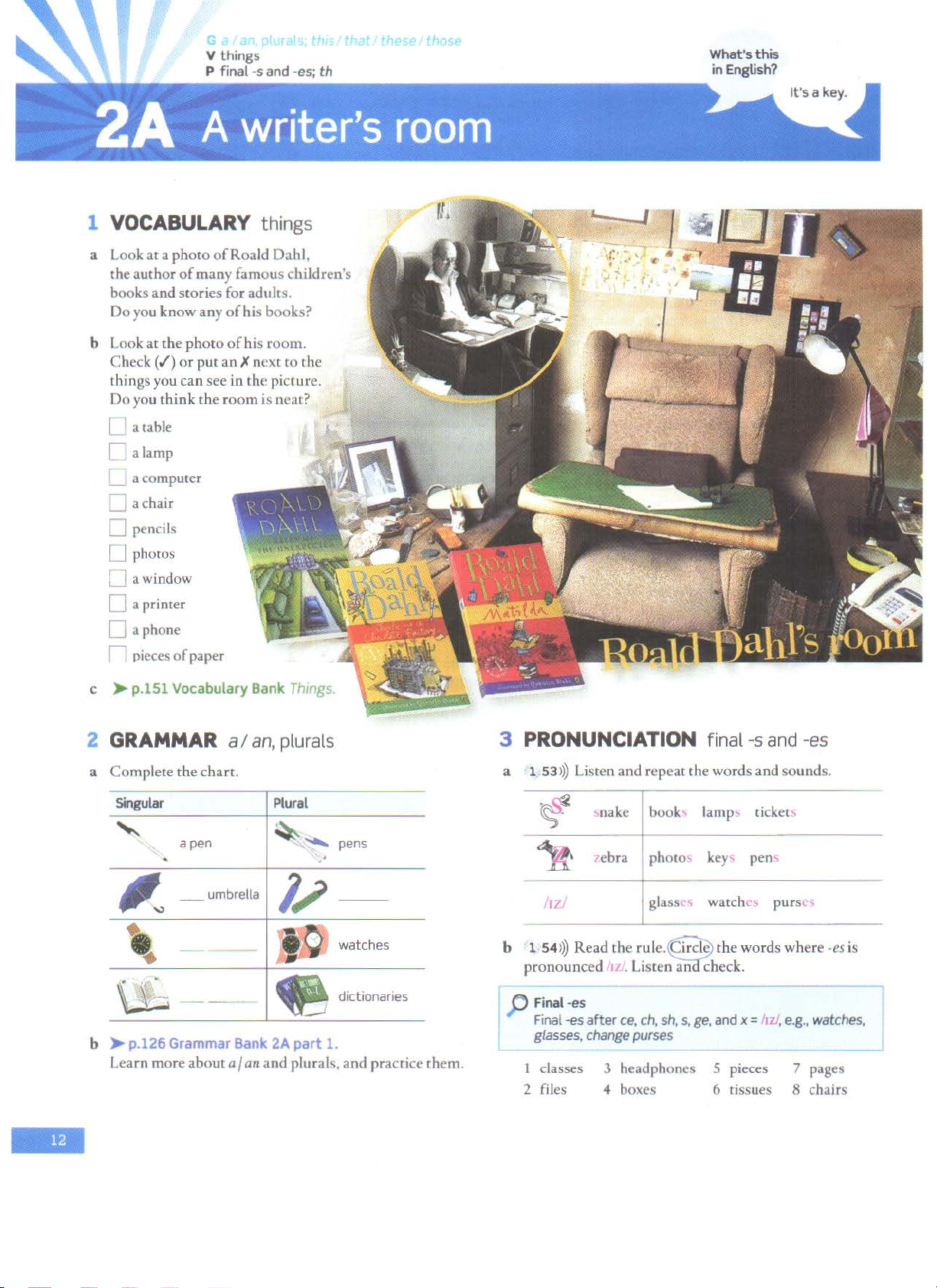
1 VOCABULARY things
a Look
at
a
photo
ofRoa
ld
Dahl,
the author
of
many famous children's
books
and
stories for adults.
Do you know any
of
his books?
b Look
at
the
photo
of
his room.
Check
(vi')
or
put
an~
next
to
the
things you
can
see
in
the picture.
Do you
think
the
room is neat?
L a table
L a lamp
u a computer
0
achair
D pencils
[J
photos
D a window
D a printer
D a phone
n pieces
of
paper
c > p.
151
Vocabulary Bank Things.
2 GRAMMAR a I
an,
plurals
a Complete
the
chart.
b > p.126 Grammar Bank 2A
part
1.
Learn more about
a/
an
and
plurals,
and
practice them.
What's
this
in
English?
3 PRONUNCIATION final -sand -es
a
b
1
53>))
Listen
and
repeat the words
and
so
unds.
~
..
nakc
[
book
lamps
ticket
<.
"It
1ebra
photo ke
y-;
pens
I
w~
"
'
/1z/
watches
purs
cc;
1
54>))
Read the
rule.~
the
words where -
es
is
pronounced
11 .
Listen~heck.
p
F~nal-
es
L
Final -es
after
ce,
ch,
sh,
s,
ge, and x =
Im
, e.g
.,
watches,
glasses, change purses
I classes 3 headphones 5 pieces 7 pages
2 files 4 boxes 6 tissues B chairs
--'

4 LISTENING & SPEAKING
a > Communicati
on
What's
on
the
table?
p.100.
b l
55>))
Listen
to
three
people
say
what
th
ings
they
have
on
the
table
or
desk
where
they work.
Are
th
eir
tab
l
es
neat?
c Listen again and check (.I)
th
e t
hings
they have.
I 2 3
a computer I a laptop
0 D
D
a printer
D D
D
a lamp
D D
D
a phone
D
D
D
books
D 0 D
a dictionary
D n D
a calendar
D D
0
photos
D n n
pieces
of
paper
D D
LJ
pens
D D D
DVDs
D D
D
tissues
D D
D
d
Talk
to
a
pa
r
tner
about
the
table
where
you
work
or
study.
Say
what
thi
n
gs
yo
u have.
Say
if
the
tab
le is
neat
or
not.
0ave
a laptop
and
a printer. I
have
...
It isn't neat.
e Play What
is
it?
with
your
partner.
A close
your eyes.
B give
things
to
your
partner
and
ask What is it?
What
are they?
5 GRAMMAR
this I
that
I these I tho
se
a 1
56
l))
Look
at
pict
ur
es
1
-4
and
co
mp
le
te
the dialogues.
Listen
and check. Pr
act
i
ce
the
dia
l
ogues.
b
Read
the dialogu
es
again.
Wha
t's the
difference
be
t
ween
...
?
I
this
and
these
2 this and that
3
these
and
those
c > p.126 Grammar Bank
2A
part
2.
Learn
more
about
this/
th
at
/ these/ those
and
practice
t
hem.
6 PRONUNCIATION
th
a 1 S
B>))
Listen
and
repeat
the
words
and
sounds.
~
mo
th
er
th
is th
at
th
ese
1e they
& th
umb
thanks
th
ing
th
irty
th
ree
Th
ursday
b 1 5
9>))
Listen
and
repea
t
the
ph
rases.
Practice
saying
them.
is ursday
2
irty-1 ree
3
th
ose
things
4
rh
anks
for that.
5
Th
ese
are
t
~
e
keys.
6
What
arc
rh
ose
th
ings there?
7
l'm
t lirty-three t l
iS
·1
hursday.
c
Wor
k
in
pai
rs.
Put
four
of
your
things
on
your
table
(singular
or
plural).
Ask
your
partner.
For
the
things
on
your
table:
What's
this
in
Eng/is~
0,'s
a watch.
For
things
in the
classroom
(point):
What
are
those
in
Englis~
0 hey're pictures.
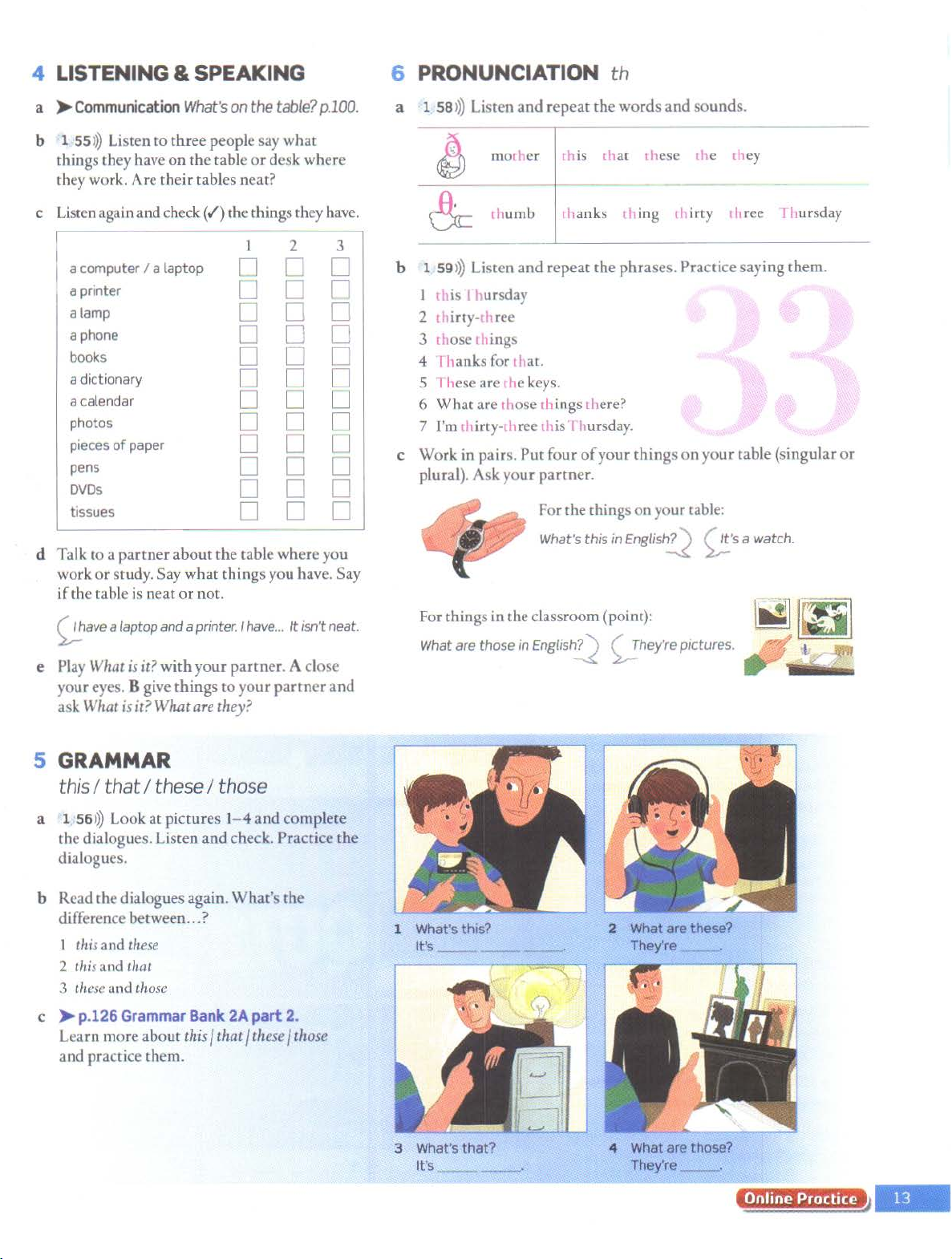
1 What's this?
It's
---~
·
3 What's that?
4 What are those?
It's
- ·
They're
._
.
Online Practice

G jJ
E'•
.,
V colors, adjectives, modifiers:
very
I really
P long and
short
vowel sounds
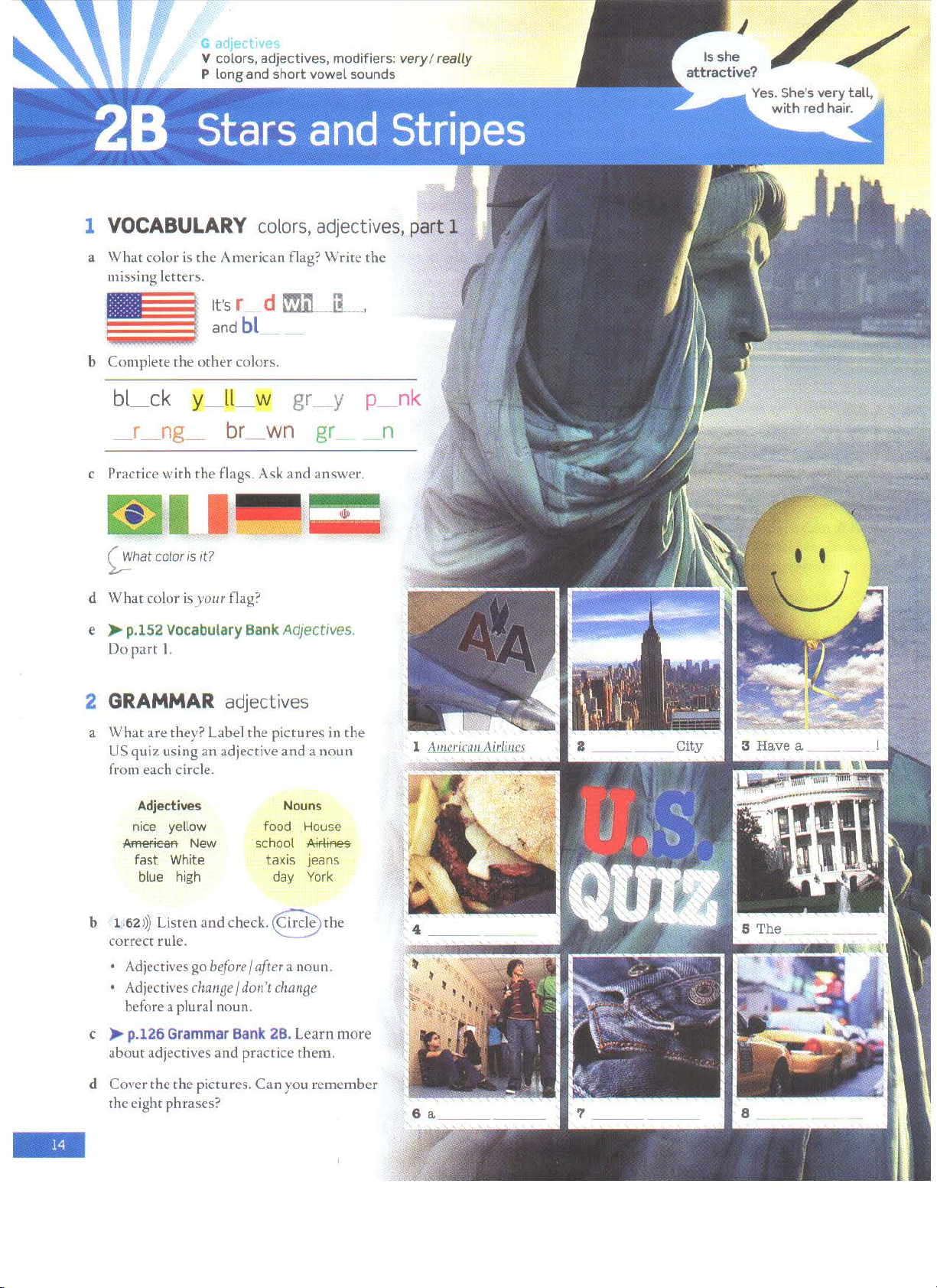
1 VOCABULARY
a
What
color
is the
American
flag?
Write
the
missing letters.
It's r d
l'!'m
~
___
,
and
bl
.
h
Complete
the
ocher colors.
bl
_
ck
y
~
w
gr
___
y p_ nk
_ r
___
ng
_ br_
wn
gr n
c Practice
with
the
flags. Ask
and
answer.
=c
:
0
hat
color is
it?
d
What
color
is your flag?
e > p.152 Vocabulary
Bank
Adjectives.
Do
part
I.
2 GRAMMAR adjectives
-
a
What
are they? Label the
pictures
in
the
US
quiz
using
an
adjective
and
a
noun
from each circle.
Adjectives
nice yellow
AmeFieaA
New
fast White
blue high
N6
un
s
food House
schoo
i
~
taxis i
eans
day
York
b l 62i)) Listen
and
check. ®
the
correct
rule.
Adjectives
go
before/ after a
noun
.
• Adjectives
chan[Je
/
do11
't
chan[Je
before a plural
noun
.
c > p.126
Grammar
Bank
28
.
Learn
more
about adjectives
and
practice
them.
d Cover the
the
pictures.
Can
you
remember
the eight phrases?
:::
:::.··:
..
·~·
·.
.
·
..
•.:· :
..
....

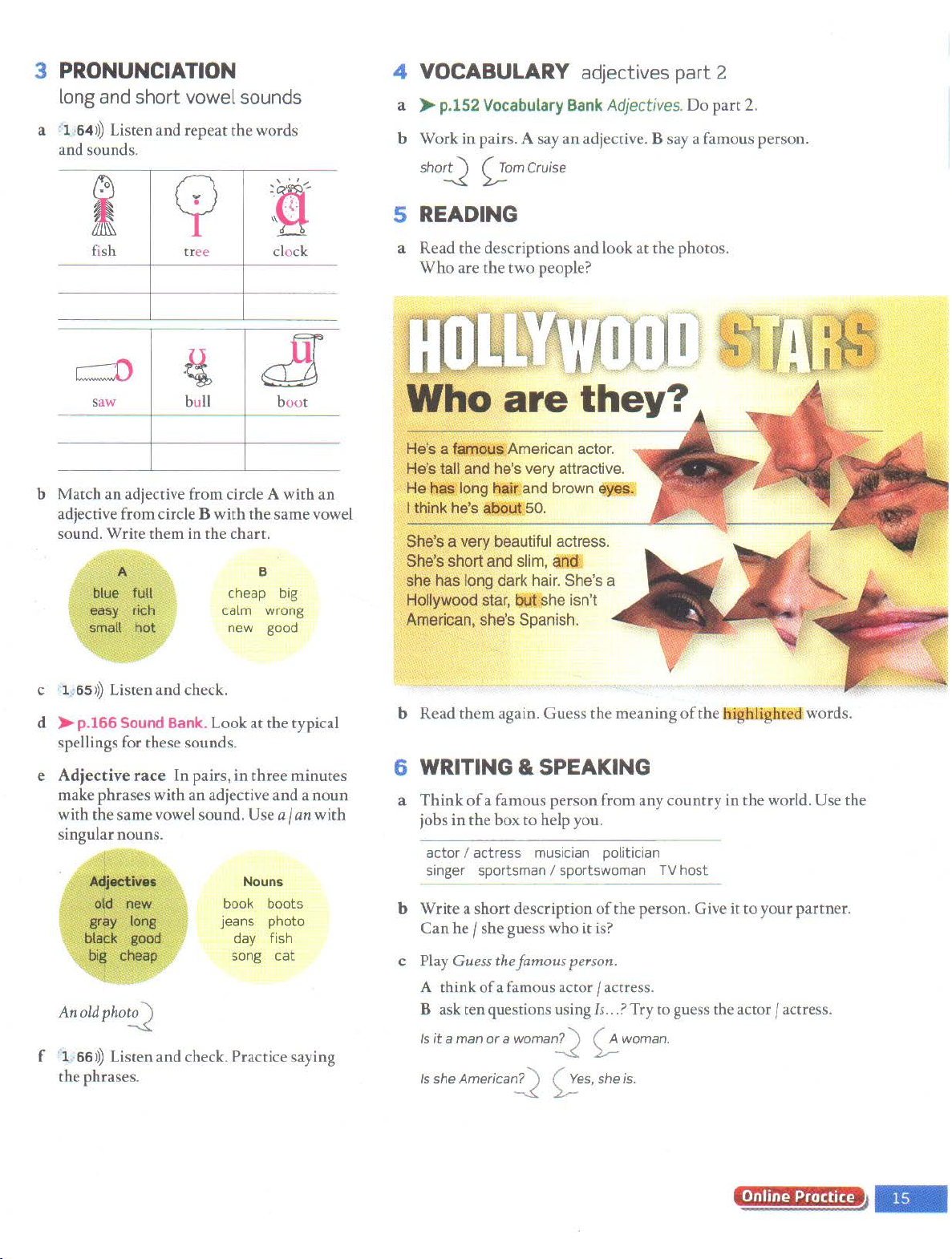
3 PRONUNCIATION
long and short vowel sounds
a 1
64
>))
Listen and repeat
the
words
and sounds.
i
cp
'
~
,,
.
-
fish
tr
ee clo
ck
s
aw
bu
ll
b
oo
t
b Match an adjective from circle A
with
an
adjective from circle B
with
the.
same
vowel
sound
. Write them
in
the chart.
A
blue full
easy
rich
small hot
B
cheap big·
ca
lm
w(Mg
new good
c 1
.•
65
>))
Listen and check.
d
> p.166 Sound Bank. Look
at
the typical
spellings for these sounds.
e Adjective ra
ce
In
pairs, in three minutes
make phrases with
an
adjecti
ve
and a
noun
with the
same
vowel sound. Use
a/
an with
singular nouns.
Adjectives
old
n
ew
gray long
black
good
big
cheap
An
old
pho'i2_
Nouns
book boots
jeans photo
day fish
sorig
cat
f ·1 66
>))
Listen
and
check. Practice saying
the phrases.
4 VOCABULARY adjectives
part
2
a > p.152 Vocabulary Bank Adjectives.
Do
part
2.
b Work in pairs. A say
an
adjective. B say a famous person.
sho~
0om
Cruise
5 READING
a Read
the
descriptions
and
look
at
the photos.
Who
are the two people?
He's a famous American actor.
H
e's
tall and he's very attractive.
He has long hair and brown
eyes
.
I think he's about
50.
She's a very beautiful actress.
She's short and
slim
,;
and
she
has
long dark hair. She's a
Ho
ll
ywood
star,
but she isn't
American, she's Spanish.
b Read
them
again. Guess the
meaning
of
the 6i.ghli
gh
te words.
6 WRITING & SPEAKING
a
Think
of
a famous person from any
country
in
the
world. Use the
jobs
in
the
box to help you.
------------
-
---
actor I actress musician politician
singer sportsman
I sportswoman
TV
host
b Write a
short
description
of
the
person. Give it to your partner.
Can
he
/ she guess who it is?
c Play Guess the
famous
person.
A think
of
a famous
actor/
actress.
B ask ten questions using
Is
.. .
?Try
to guess the
actor/
actress.
/sit
a
man
or
a
woman
_Q
0
woman.
Is
she
America
'!!]
0
es,
she
is.
Online Practice

lr>t
'
V feelings
P understanding connected speech
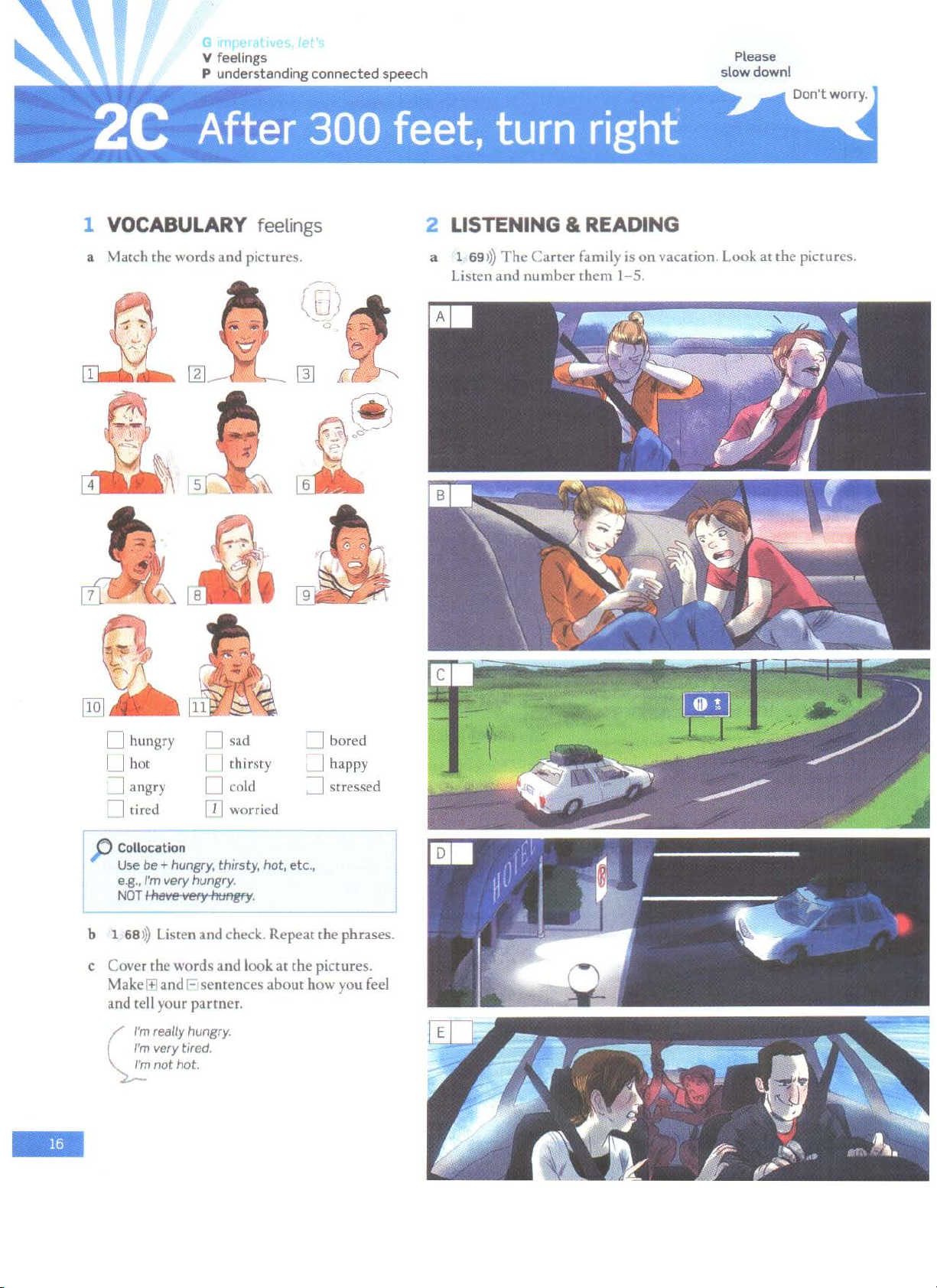
1 VOCABULARY feelings
a Match the words
and
pictures.
r
LJ"
l - )
\.
...._
...-_,.-
'
0
[l]
£-
~
~
'
6
0 hungry n sad
:=i
bored
l_J
hot
I
] thirsty
~
happy
~
] angry n cold
:]
stressed
=1
tired m worried
I p
Co
ll
ocation -
Use
be+
hungry,
thirsty, hot, etc.,
I
e.g.,
I'm
very
hungry.
NOT
11'teve
-;ery
1'ttmgry.
-
~~~~~~~~~
b 1
68
>))
Listen and check. Repeat
the
phrases.
c Cover the words
and
look at the pictures.
Make [ij and F sentences about
how
you feel
and tell your partner.
(
I'm
really
hungry.
I'm
very
tired.
I'm
not hot.
2 LISTENING & READING
a 1
69
>))
The
Carter
family is
on
vacation. Look
at
the
pictures.
Listen and
number
them
1-5.

b Listen again and read. Try
to
guess what the
fbighligluea phrases mean.
1
GPS
After 100 feet, turn
right.
Turn
right.
Mom
Please
slow
down!
This
road
is
very
dangerous.
Da
d
Don't
worry.
You
know
I'm
a good
driver.
Mom
Be
carefuj!
z
Suzy
Dad,
this
music
is terrible.
Can
you
turn
it
off?
Dad
OK
Tim
Dad,
I'm
really
hot.
Turn
the
air
conditioning
on,
please.
Dad
Are
you
hot,
Suzy?
Suzy
No,
I'm cold.
Mom
Open
your
window,
Tim.
3 Suzy
rm
thirsty.
Where's
the water?
Mom
Here
you
are.
Tim
I'm
hungry.
Can
we
stop soon?
Mom
Let's
stop at that service station.
Da
d
OK.
4 T
im
Give
me
my
iPod.
Su
zy
This
is
my
iPod!
Dad
Be
quiet!
T
im
Are
we
there yet?
I'm
bored.
Da
d
It's
not far
now.
Only
15
mites.
T
im
Can
you
turn the
radio
on
please,
Mom?
Mom
OK.
Dad
Oh,
no!
5
Su
zy
Where
are
we?
Dad
We're
here.
At
the hotel.
Tim
Great!
Mom
Don't
park here.
Look
at
that
sign.
No
parking
.
Da
d
Don't
worry.
It's
OK.
Come
on
.
Let's
go
.
c
1,
70>))
Listen to the end
of
the story.
What
are the two problems the family has?
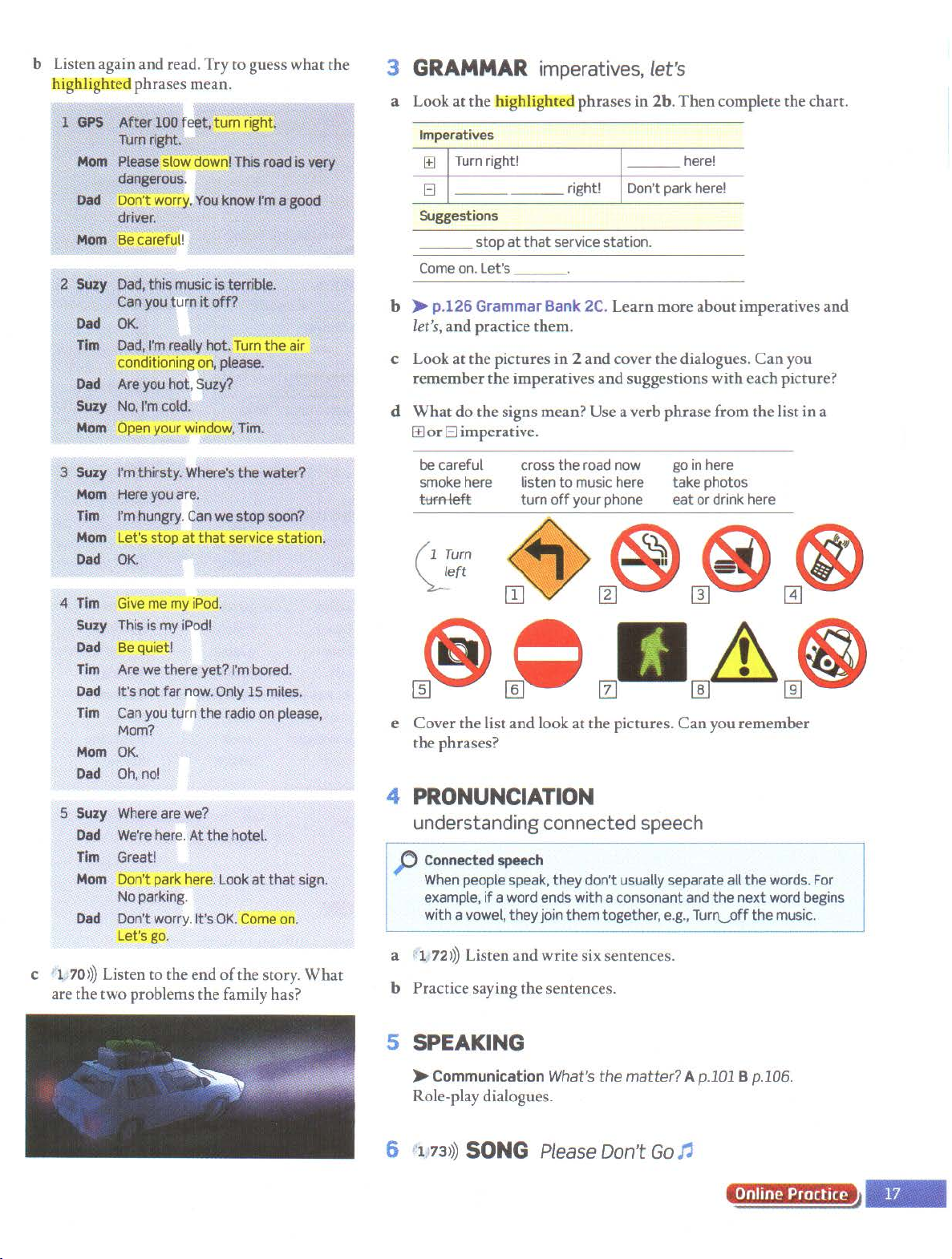
3 GRAMMAR imperatives, let's
a Look at the
lhigOiigllted
phrases in 2b.
Then
complete the chart.
Imperatives
1±1
Turn
right!
__
_
here!
El
_____
_
right!
Don't
park here!
Suggestions
___
stop
at
that service station.
Come
on
. Let's _ _ _
b > p.126 Grammar Bank
2C
. Learn more about imperatives and
let's,
and
practice them.
c Look
at
the pictures
in
2
and
cover the dialogues.
Can
you
remember the imperatives and suggestions with each picture?
d
What
do the signs mean? Use a verb phrase from the list
in
a
1±1
or
El
imperative.
be careful
smoke here
turn
left
cross the
road
now
listen to
music
here
turn off
your
phone
go
in
here
take photos
eat
or
drink
here
( 1
Turn
\;_
eft
e Cover the list
and
look
at
the pictures.
Can
you remember
the phrases?
4 PRONUNCIATION
understanding connected speech
.f::J
Connectedspeech
When
people speak, they don't
usually
separate
all
the
words.
For
example,
if
a
word
ends with a consonant and the next
word
begins
with
a
vowel,
they
join
them together, e.g.,
Turl\...,Off
the
music.
a l
72>))
Listen
and
write six sentences.
b Practice saying the sentences.
5 SPEAKING
>Communication
What's
the matter? A p.
101
B
p.106.
Role-play dialogues.
6 1
73>))
SONG
Please Don't
Go
1'
Online Practi
ce

-
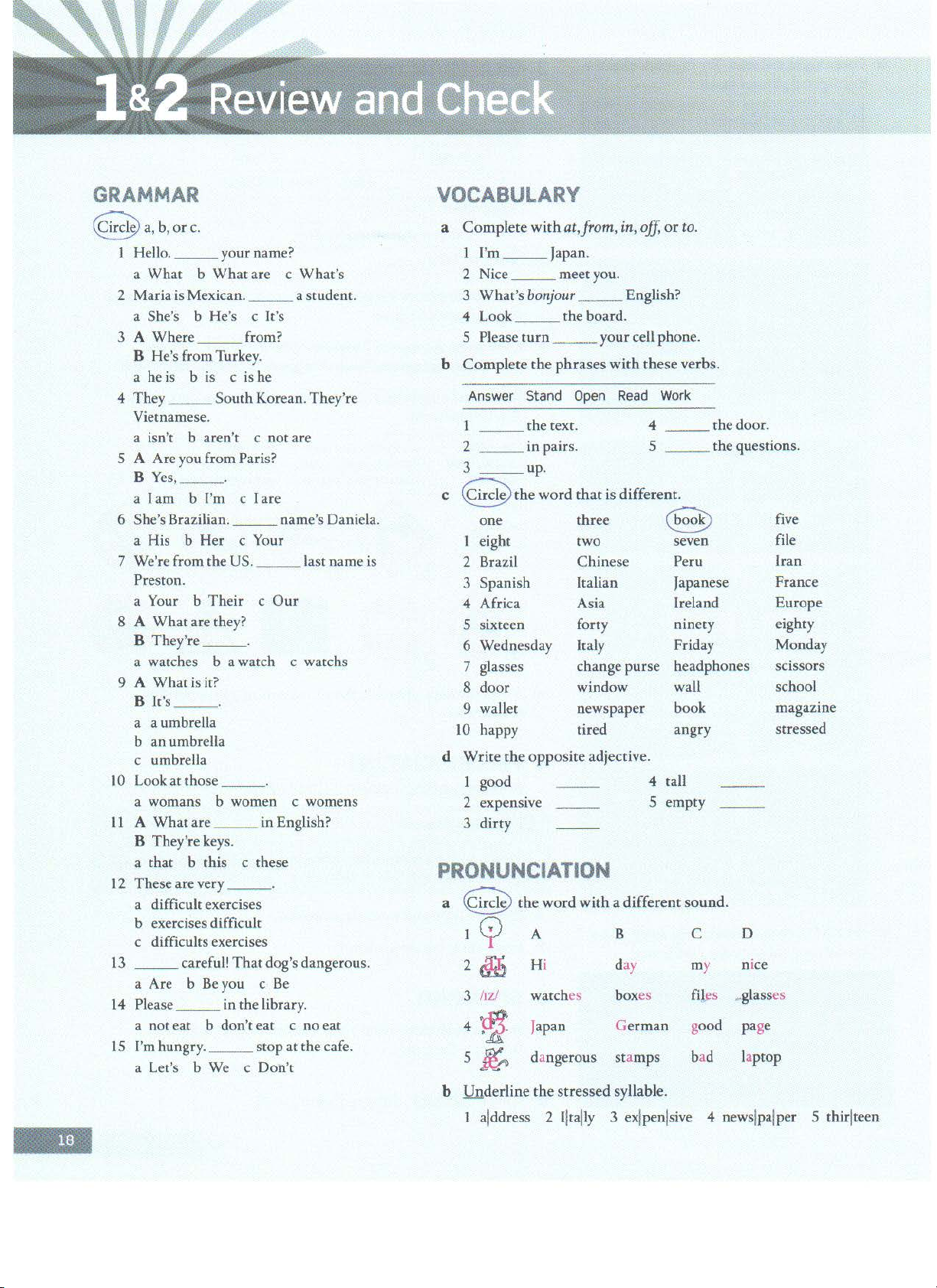
GRAMMAR
@a,b,orc.
I Hello.
__
your name?
a
What
b
What
are c What's
2 Maria is Mexican. a
student
.
a
She's b He's c It's
3 A Where from?
B He's from Turkey.
a he is b is c is
he
4 They
__
South
Korean. They're
Vietnamese.
a isn't b
aren't
c
not
are
5 A Are you from Paris?
B
Yes,
_ _ .
a
I am b
I'm
c I are
6 She's Brazilian. name's Daniela.
a
His
b
Her
c Your
7 We're
from
the US.
___
last
name
is
Preston.
a Your b
Their
c
Our
8 A
What
are they?
B They're
__
.
a watches
b a watch c watchs
9 A
What
is it?
B It's _ _ _ .
a a umbrella
b
an
umbrella
c umbrella
10
Look
at
those
___
.
a womans b women c womens
11
A
What
are
__
_
in
English?
B They're keys.
a that b this c these
12 These are very
__
.
a difficult exercises
b exercises difficult
c difficults exercises
13
__
careful!
That
dog's dangerous.
a Are b
Beyou
c Be
14 Please
___
in
the library.
a not eat b don't
eat
c
no
eat
15
I'm hungry.
___
stop at the cafe.
a Let's b We c
Don't
VOCABULARY
a
Complete
with
at,Jrom, in, off,
or
to.
1 I'm
__
Japan.
2 Nice _
__
meet you.
3 What's bonjour _
__
English?
4 Look
___
the
board
.
5 Please
turn
_
___
your cell phone.
b
Complete
the
phrases
with
these
verbs.
Answer Stand
Open
Read
Work
1
the
text.
4 _
__
thedoor.
2
__
_ in pairs. 5 _ _ _ the questions.
3
__
up
.
c @
the
word
that
is
different.
one
three e
1 eight two seven
five
file
2 Brazil
Chinese
Peru
3 Spanish Italian Japanese
4 Africa Asia Ireland
S sixteen forty ninety
6 Wednesday Italy Friday
7 glasses change purse headphones
Iran
France
Europe
eighty
Monday
scissors
school
magazine
stressed
8
door
window wall
9 wallet newspaper book
10
happy tired angry
d
Write
the
opposite
adjective.
1 good 4 tall
2 expensive S empty
3
dirty
PRONUNCIATION
a Q
the
word
with
a
different
sound.
I 7 A B C
D
2
~
Hi d
ay
my
ni
ce
3
lizl watches
boxes
files
_glass
es
4
~
J
apan
G
erman
g
ood
pa
ge
s
~
dangerous
st
a
mps
bad la
ptop
b
l!nderline
the
stressed
syllable.
1
alddress 2 Ijtally 3 exj
pen
lsive
4 newsj
pa
l
per
5
thir
lteen

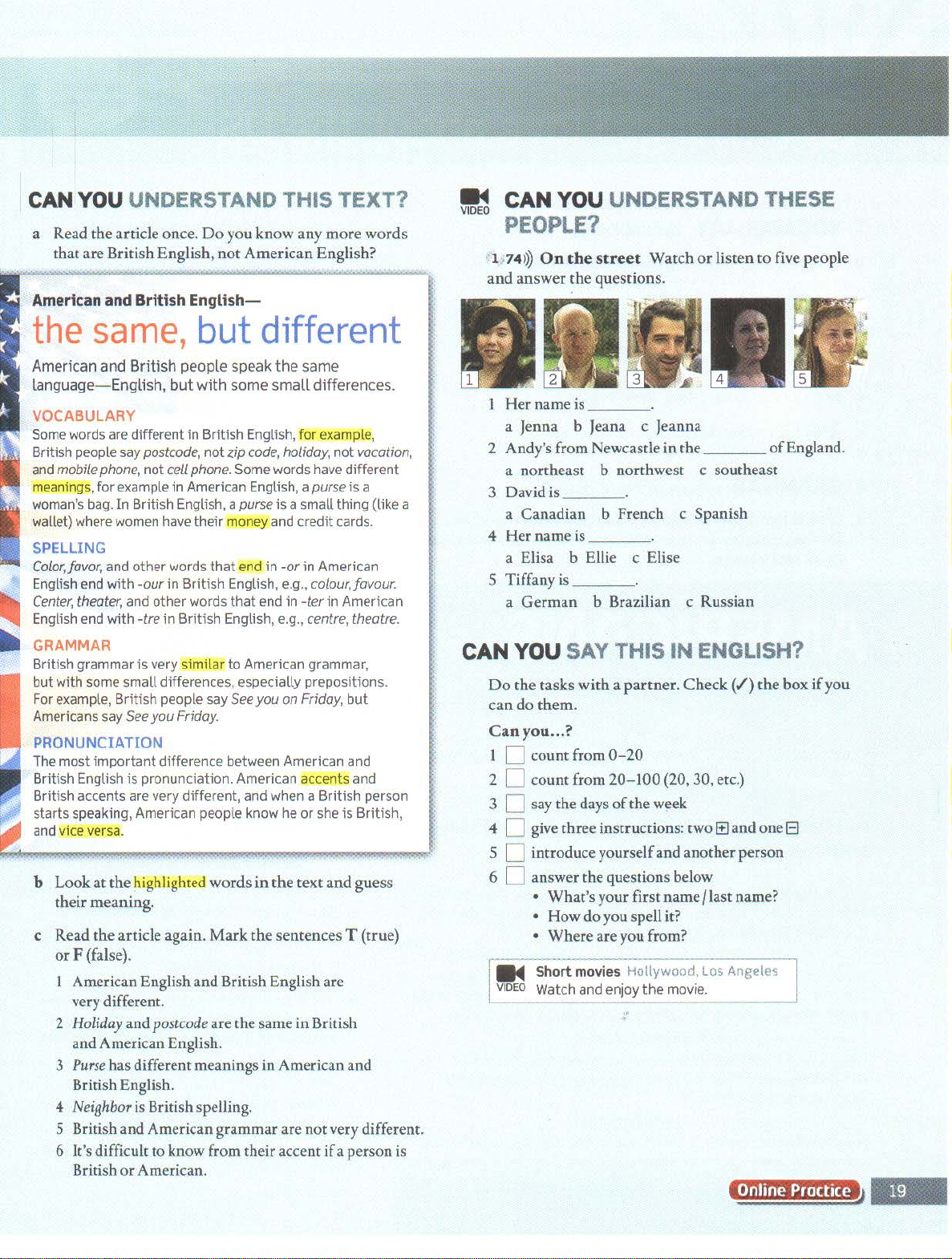
CAN YOU UNDERSTAND THIS
TEXT?
a Read
the
article once.
Do
you
know
any
more
words
that
are
British English,
not
American
English?
Am
er
ic
an and B
riti
sh Eng
lish-
t
he
same,
but
different
American and British people speak the same
language- English,
but
with some small differences.
VOCABULARY
Some words are different
in
British English, for
~xample,
British people say
postcode,
not
zip
code,
holiday,
not
vacation,
and mobile
phone,
not
cell
phone.
Some words have different
meanings, for example
in
American English, a
purse
is
a
woman's bag.
In
British English, a purse
is
a small thing (like a
wallet) where women have their
moQgy
and credit cards.
Color.favor, and other words
that
end
in
-or
in
American
• English end
with
-our
in
British English, e.g., colour.favour.
..
Center,
theater,
and other words that end
in
-ter
in
American
""II
English end
with
-tre
in
British English, e.g.,
centre,
theatre .
...
GRAMMAR
British grammar
is
very simila
to
American grammar,
but
with some small differences, especially prepositions.
For example,
British
people say
See
you
on
Friday,
but
Americans say
See
you Friday.
PRONUNCIATION
The
most
important
difference between American and
British English
is
pronunciation. American accents and
British accents are very different, and when a
British
person
starts speaking, American people know he
or
she
is
British,
and vice
verg
b
Look
at
the
~
ighlighted
words
in
the
text
and
guess
their meaning.
c
Read
the
article again.
Mark
the
sentences T (true)
or
F (false).
1 American English and British English are
very different.
2
Holiday and postcode are the same
in
British
and American English.
3
Purse
has different meanings
in
American
and
British English.
4
NeiBhbor
is British spelling.
5 British and American
grammar
are
not
very different.
6 It's difficult
to
know from their accent
if
a person is
British
or
American.
~
CAN
YOU UNDERSTAND THESE
PEOPLE?
1,74
i))
On
the str
ee
t
Watch
or
listen
to
five people
and
answer
the
questions.
•
lilf
·
..
3
1
Her
name is _ _ _
a Jenna b Jeana c Jeanna
2 Andy's from Newcastle in
the
of
England.
a
northeast
b northwest c southeast
3 David is
___
_
a
Canadian
b French c Spanish
4 Her
name
is
__
_
a Elisa
b Ellie c Elise
S Tiffany is
__
_
a
German
b Brazilian c Russian
CAN
YOU SAY
THIS
IN
ENGLISH?
Do
the
tasks
with
a
partner
.
Check(.")
the
box
if
you
can
do
them
.
Can
you
... ?
1
D
count
from
0-20
2 D
count
from 20- 100 (20, 30, etc.)
3 D say the days
of
the
w~ek
4 D give
three
instructions: two[±) and one
El
5 D introduce yourself and another person
6 D answer the questions below
•
What's
your first
name/
last name?
•
How
do
you spell it?
• Where are you from?
j
m.
Sh~;t
mo~;~
--
H~ltyw~~ct7o-;Angeles
I
j
VIDEO
Watch and enjoy
the
movie.
Online Practice

G simple prP"l>n ] and F
V verb phrases
P third person -s
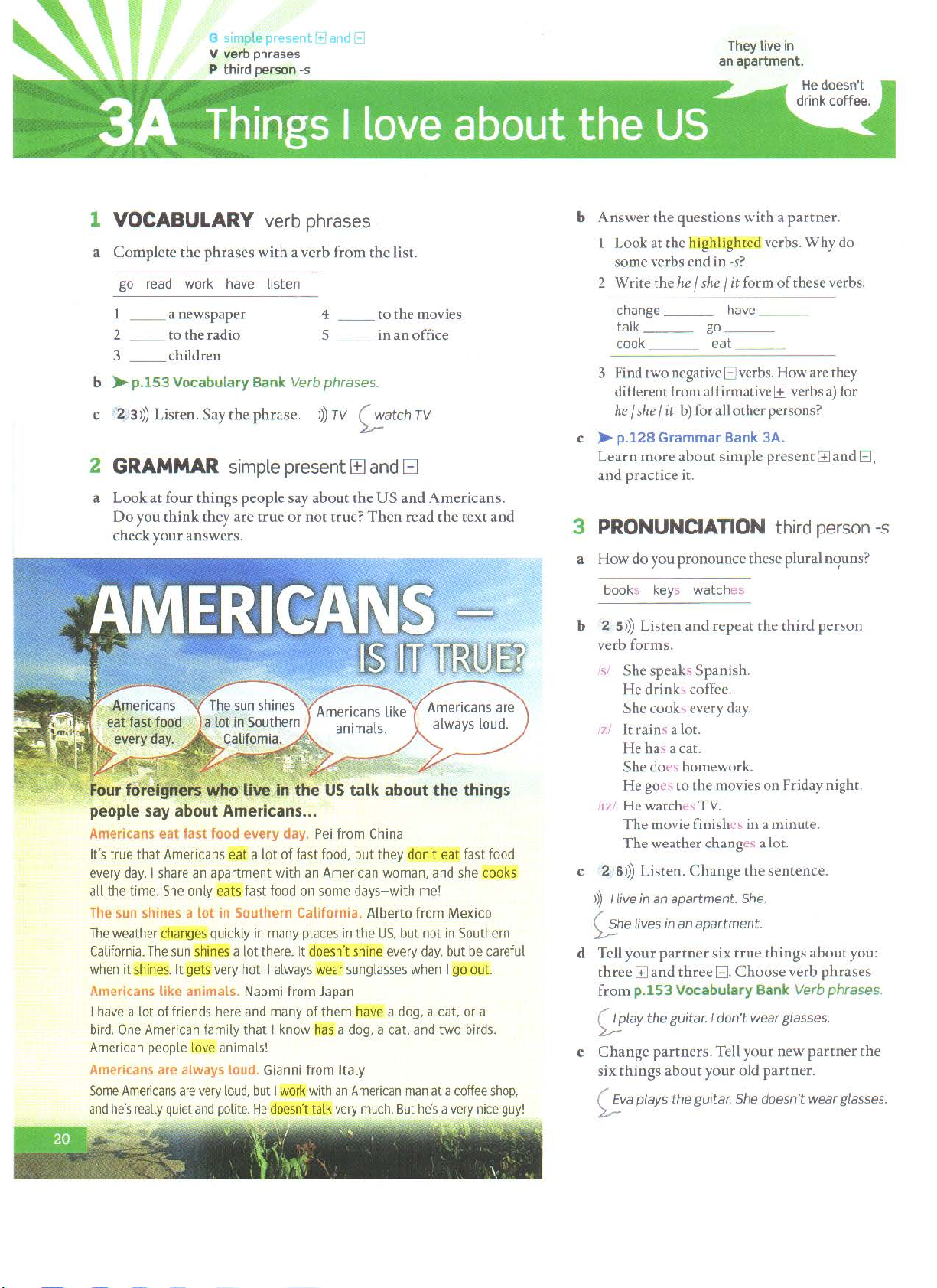
1 VOCABULARY verb phrases
a Complete the
phrases
with
a verb from
the
list.
go read work have listen
1 _ _
a newspaper
2 to the radio
3 children
4
5
co
the movies
in
an
office
b > p.153 Vocabulary Bank Verb phrases.
c 2
3>))
Listen. Say
the
phrase.
>))TV
~atch
TV
2 GRAMMAR
simpl
e present[±]
and
B
a Look
at
four
things
people say
about
the
US
and
Americans.
Do
you
think
they
are
true
or
not
true?
Then
read
the
text
and
check
your
answers.
;.:_,~-
. 4
.....
·,,
;
-
~
> • •
Four
foreigners, who
live
in
the
US
talk
about
the
things
people say about Americans ...
Americans eat fast food every day.
Pei
from
China
It's
true
that
Americans
eat
a lot of
fast
food,
but
they
don't eat fast
food
every
day.
I
share
an
apartment with
an
American
woman,
and
she
cooks
all
the
time.
She
only
eats
fast
food
on
some
days-with
me!
The
sun
shines a
lot
in Southern California. Alberto from Mexico
The
weather
changes
quickly
in
many
places
in
the
US,
but not
in
Southern
California.
The
sun
shines
a lot
there.
It
doesn't
shin
ei
every
day,
but
be
careful
when
it
shines
.
It
gets
very
hot!
I
always
~
r
sunglasses
when
I
go
ou
tl
Americans
like animals.
Naomi
from
Japan
I
have
a lot of
friends
here
and
many
of
them
have
a
dog,
a
cat
or
a
bird
.
One
American
family that I
know
has
a
dog,
a cat.
and
two
birds.
American
people
love
animals!
Americans
are
always loud.
Gianni
from Italy
Some
Americans
are
very
loud,
but
I
work
with
an
American
man
at
a
coffee
shop,
and
he's
really
quiet
and
polite.
He
doesn't
~
very
much.
But
he's
a
very
nice
guy!
b
Answer
the
questions
with
a
partner.
Look
at
the llighlightea verbs. Why do
some verbs end in
-s?
2 Write the
he/
she/
it
form
of
these verbs.
change
___
have
talk
__
_
go
__
_
cook
___
eat
3 Find two negative
El
verbs. How are they
different from affirmative
1±1
verbs
a)
for
he/
she/ it
b)
for all other persons?
c > p.128 Grammar Bank 3A.
Learn
more
about
simple present(±]
and
l=J,
and
practice it.
3 PRONUNCIATION third
person
-s
a
How
do
you pronounce these plural
nc~uns?
books
key
s watch
es
b 2
S>))
Listen
and
repeat the
third
person
verb forms.
Isl
She speaks Spanish.
He
drinks coffee.
She cooks every day.
/z/ It rains a lot.
He has a cat.
She do
es
homework.
He goes to the movies on Friday night.
/1z/
He watches TV.
The
movie finishes
in
a minute.
The
weather changes a lot.
c 2
6>))
Listen.
Change
the
sentence.
)))
I live
in
an
apartment.
She
.
0.
he lives in
an
apartment.
d Tell
your
partner
six
true
things
about
you:
three
1±1
and
three
G.
Choose
verb
phrases
from p.
153
Vocabulary Bank Verb phrases.
0
1ay
the guitar. I don't wear glasses.
e
Change
partners.
Tell
your
new
partner
the
six
things
about
your
old partner.
~
va
plays the guitar.
She
doesn't wear glasses.
Bấm Tải xuống để xem toàn bộ.