Guest user 0 Followers 0 Uploads 0 Upvotes Home My Library AI Notes Ask AI AI Quiz Recent Courses Studylists Refraction and Thomas Harriot's Contributions - PHYS 101 Lecture Notes môn English Studies| Trường Đại học Thăng Long
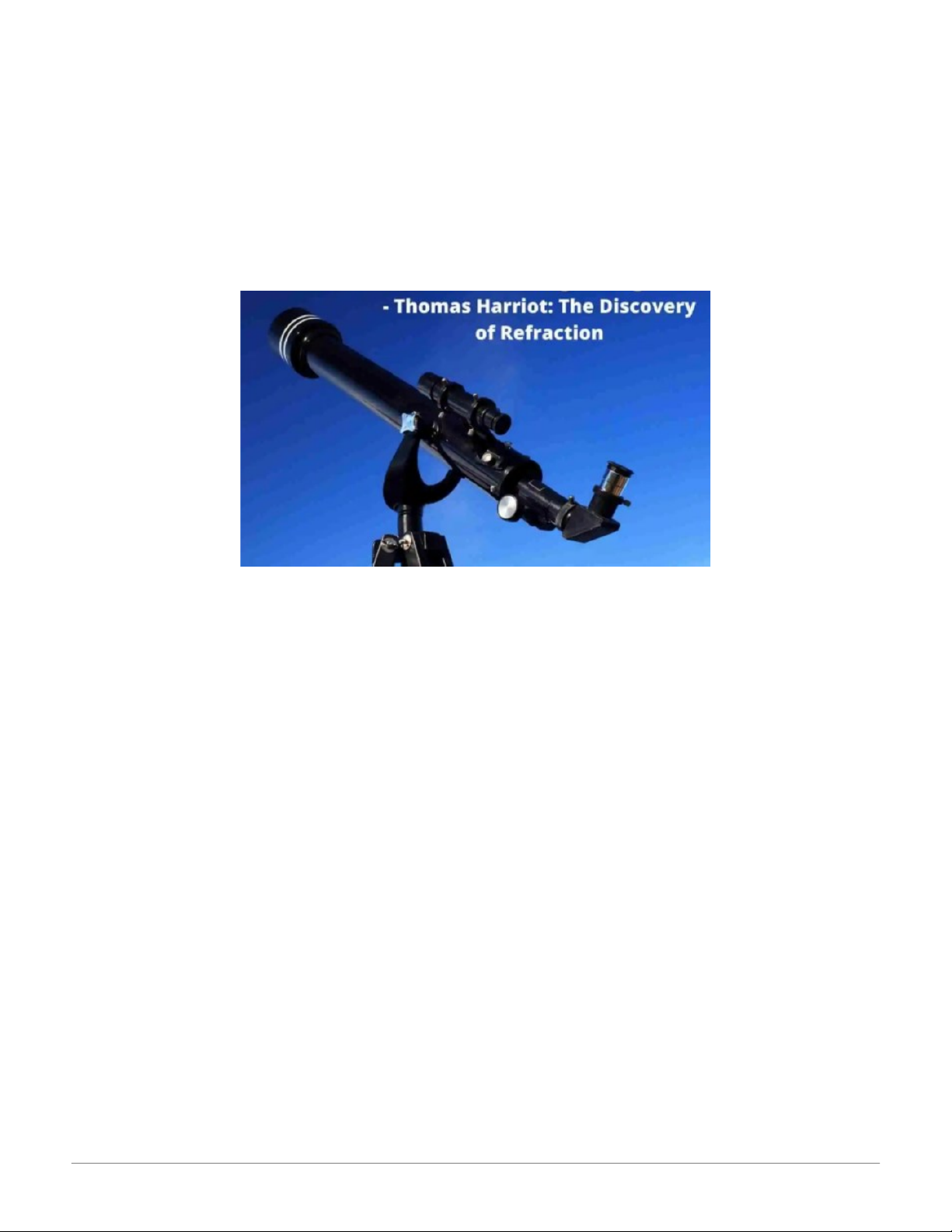
Thomas Harriot: The Discovery ofRefraction A When light travels from one medium to another, it generally bends, or refracts. The law of refraction gives us a way of predicting the amount of bending. Refraction has many applications in optics and technology. A lens uses refraction to form. Tài liệu giúp bạn tham khảo, ôn tập và đạt kết quả cao. Mời đọc đón xem!
Môn: English Studies 199 tài liệu
Trường: Trường Đại học Thăng Long 550 tài liệu
Tác giả:




Preview text:
17:20, 09/01/2026
Refraction and Thomas Harriot's Contributions - PHYS 101 Lecture Notes - Studocu
Thomas Harriot: The Discovery of Refraction A
When light travels from one medium to another, it generally bends, or refracts. The law of refraction
gives us a way of predicting the amount of bending. Refraction has many applications in optics and
technology. A lens uses refraction to form an image of an object for many different purposes, such as
magnification. A prism uses refraction to form a spectrum of colors from an incident beam of light.
Refraction also plays an important role in the formation of a mirage and other optical illusions. The
law of refraction is also known as Snell’s Law, named after Willobrord Snell, who discovered the law
in 1621. Although Snell’s sine law of refraction is now taught routinely in undergraduate courses, the
quest for it spanned many centuries and involved many celebrated scientists. Perhaps the most
interesting thing is that the first discovery of the sine law, made by the sixteenth-century English
scientist Thomas Harriot (1560-1621), has been almost completely overlooked by physicists, despite
much published material describing his contribution. B
A contemporary of Shakespeare, Elizabeth I, Johannes Kepler and Galilei Galileo, Thomas Harriot
(1560-1621) was an English scientist and mathematician. His principal biographer, J. W. Shirley, was
quoted saying that in his time he was “England’s most profound mathematician, most imaginative
and methodical experimental scientist”. As a mathematician, he contributed to the development of
algebra, and introduced the symbols of ”>”, and ”<” for ”more than” and ”less than.” He also studied
navigation and astronomy. On September 17, 1607, Harriot observed a comet, later Identified as
Hailey-s. With his painstaking observations, later workers were able to compute the comet’s orbit.
Harriot was also the first to use a telescope to observe the heavens in England. He made sketches
of the moon in 1609, and then developed lenses of increasing magnification. By April 1611, he had
developed a lens with a magnification of 32. Between October 17, 1610 and February 26, 1612, he
observed the moons of Jupiter, which had already discovered by Galileo. While observing Jupiter’s
moons, he made a discovery of his own: sunspots, which he viewed 199 times between December
8, 1610 and January 18, 1613. These observations allowed him to figure out the sun’s period of rotation. C 17:20, 09/01/2026
Refraction and Thomas Harriot's Contributions - PHYS 101 Lecture Notes - Studocu
He was also an early English explorer of North America. He was a friend of the English courtier and
explorer Sir Walter Raleigh and travelled to Virginia as a scientific observer on a colonising
expedition in 1585. On June 30, 1585, his ship anchored at Roanoke Island off Virginia. On shore,
Harriot observed the topography, flora and fauna, made many drawings and maps, and met the
native people who spoke a language the English called Algonquian. Harriot worked out a phonetic
transcription of the native people’s speech sounds and began to learn the language, which enabled
him to converse to some extent with other natives the English encountered. Harriot wrote his report
for Raleigh and published it as A Briefe and True Report of the New Found Land of Virginia in
1588. Raleigh gave Harriot his own estate in Ireland, and Harriot began a survey of Raleigh’s Irish
holdings. He also undertook a study of ballistics and ship design for Raleigh in advance of the Spanish Armada’s arrival. D
Harriot kept regular correspondence with other scientists and mathematicians, especially in England
but also in mainland Europe, notably with Johannes Kepler. About twenty years before Snell’s
discovery, Johannes Kepler (1571-1630) had also looked for the law of refraction, but used the early
data of Ptolemy. Unfortunately, Ptolemy’s data was in error, so Kepler could obtain only an
approximation which he published in 1604. Kepler later tried to obtain additional experimental results
on refraction, and corresponded with Thomas Harriot from 1606 to 1609 since Kepler had heard
Harriot had carried out some detailed experiments. In 1606, Harriot sent Kepler some tables of
refraction data for different materials at a constant incident angle, but didn’t provide enough detail for
the data to be very useful. Kepler requested further information, but Harriot was not forthcoming, and
it appears that Kepler eventually gave up the correspondence, frustrated with Harriot’s reluctance. E
Apart from the correspondence with Kepler, there is no evidence that Harriot ever published his
detailed results on refraction. His personal notes, however, reveal extensive studies significantly
predating those of Kepler, Snell and Descartes. Harriot carried out many experiments on refraction in
the 1590s, and from his notes, it is clear that he had discovered the sine law at least as early as
1602. Around 1606, he had studied dispersion in prisms (predating Newton by around 60 years),
measured the refractive indices of different liquids placed in a hollow glass prism, studied refraction
in crystal spheres, and correctly understood refraction in the rainbow before Descartes. F
As his studies of refraction, Harriot’ s discoveries in other fields were largely unpublished during his
lifetime, and until this century, Harriot was known only for an account of his travels in Virginia
published in 1588, and for a treatise on algebra published posthumously in 1631. The reason why
Harriot kept his results unpublished is unclear. Harriot wrote to Kepler that poor health prevented him
from providing more information, but it is also possible that he was afraid of the seventeenth
century’s English religious establishment which was suspicious of the work carried out by mathematicians and scientists. G
After the discovery of sunspots, Harriot’ s scientific work dwindled. The cause of his diminished
productivity might have been a cancer discovered on his nose. Harriot died on July 2, 1621, in
London, but his story did not end with his death. Recent research has revealed his wide range of
interests and his genuinely original discoveries. What some writers describe as his “thousands upon
thousands of sheets of mathematics and of scientific observations” appeared to be lost until 1784,
when they were found in Henry Percy’s country estate by one of Percy’s descendants. She gave
them to Franz Xaver Zach, her husband’s son’s tutor. Zach eventually put some of the papers in the
hands of the Oxford University Press, but much work was required to prepare them for publication,
and it has never been done. Scholars have begun to study them , and an appreciation of Harriot’s 17:20, 09/01/2026
Refraction and Thomas Harriot's Contributions - PHYS 101 Lecture Notes - Studocu
contribution started to grow in the second half of the twentieth century. Harriot’s study of refraction is
but one example where his work overlapped with independent studies carried out by others in
Europe, but in any historical treatment of optics his contribution rightfully deserves to be acknowledged. 17:20, 09/01/2026
Refraction and Thomas Harriot's Contributions - PHYS 101 Lecture Notes - Studocu
Tài liệu liên quan:
-
English-Vietnamese Translation Guide: The World is Flat môn English Studies| Trường Đại học Thăng Long
31 16 -
Midterm Exam - IC Course: Intercultural Communication Insights môn English Studies| Trường Đại học Thăng Long
33 17 -
Outline and Essay on Apathy's Effects on Individuals & Society môn English Studies| Trường Đại học Thăng Long
35 18 -
Listening Practice: Tapescripts and Exercises - Level 1 môn English Studies| Trường Đại học Thăng Long
35 18 -
TOEIC Sample Tests: Speaking and Writing Overview môn English Studies| Trường Đại học Thăng Long
38 19