Hướng dẫn thực dụng môn Cấu trúc dữ liệu và Giải thuật | Đại học Bách Khoa Hà Nội
Hướng dẫn thực dụng môn Cấu trúc dữ liệu và Giải thuật | Đại học Bách Khoa Hà Nội. Tài liệu được sưu tầm giúp bạn tham khảo, ôn tập và đạt kết quả cao. Mời bạn đọc đón xem.
Môn: Cấu trúc dữ liệu và giải thuật (ET2100) 145 tài liệu
Trường: Đại học Bách Khoa Hà Nội 5.6 K tài liệu
Tác giả:



















Preview text:
Early Praise for A Common-Sense Guide to Data Structures and Algorithms
A Common-Sense Guide to Data Structures and Algorithms is a much-needed dis-
tillation of topics that elude many software professionals. The casual tone and
presentation make it easy to understand concepts that are often hidden behind
mathematical formulas and theory. This is a great book for developers looking to
strengthen their programming skills. ➤ Jason Pike
Senior software engineer, Atlas RFID Solutions
At university, the “Data Structures and Algorithms” course was one of the driest in
the curriculum; it was only later that I realized what a key topic it is. As a software
developer, you must know this stuff. This book is a readable introduction to the
topic that omits the obtuse mathematical notation common in many course texts. ➤ Nigel Lowry
Company director & principal consultant, Lemmata
Whether you are new to software development or a grizzled veteran, you will really
enjoy and benefit from (re-)learning the foundations. Jay Wengrow presents a very
readable and engaging tour through basic data structures and algorithms that
will benefit every software developer. ➤ Kevin Beam
Software engineer, National Snow and Ice Data Center (NSIDC), University of Colorado Boulder We've left this page blank to make the page numbers the same in the electronic and paper books. We tried just leaving it out, but then people wrote us to ask about the missing pages. Anyway, Eddy the Gerbil wanted to say “hello.” A Common-Sense Guide to Data Structures and Algorithms
Level Up Your Core Programming Skills Jay Wengrow The Pragmatic Bookshelf Raleigh, North Carolina
Many of the designations used by manufacturers and sellers to distinguish their products
are claimed as trademarks. Where those designations appear in this book, and The Pragmatic
Programmers, LLC was aware of a trademark claim, the designations have been printed in
initial capital letters or in all capitals. The Pragmatic Starter Kit, The Pragmatic Programmer,
Pragmatic Programming, Pragmatic Bookshelf, PragProg and the linking g device are trade-
marks of The Pragmatic Programmers, LLC.
Every precaution was taken in the preparation of this book. However, the publisher assumes
no responsibility for errors or omissions, or for damages that may result from the use of
information (including program listings) contained herein.
Our Pragmatic books, screencasts, and audio books can help you and your team create
better software and have more fun. Visit us at https://pragprog.com.
The team that produced this book includes: Publisher: Andy Hunt VP of Operations: Janet Furlow
Executive Editor: Susannah Davidson Pfalzer
Development Editor: Brian MacDonald Copy Editor: Nicole Abramowtiz
Indexing: Potomac Indexing, LLC Layout: Gilson Graphics
For sales, volume licensing, and support, please contact support@pragprog.com.
For international rights, please contact rights@pragprog.com.
Copyright © 2017 The Pragmatic Programmers, LLC.
All rights reserved. No part of this publication may be reproduced, stored in a retrieval system,
or transmitted, in any form, or by any means, electronic, mechanical, photocopying, recording,
or otherwise, without the prior consent of the publisher. ISBN-13: 978-1-68050-244-2 Book version: P2.0—July 2018 Contents Preface . . . . . . . . . . . . . . ix 1. Why Data Structures Matter . . . . . . . . . 1
The Array: The Foundational Data Structure 2 Reading 4 Searching 7 Insertion 9 Deletion 11
Sets: How a Single Rule Can Affect Efficiency 12 Wrapping Up 15 2. Why Algorithms Matter . . . . . . . . . . 17 Ordered Arrays 18 Searching an Ordered Array 20 Binary Search 21
Binary Search vs. Linear Search 24 Wrapping Up 26 3. Oh Yes! Big O Notation . . . . . . . . . . 27 Big O: Count the Steps 28 Constant Time vs. Linear Time 29
Same Algorithm, Different Scenarios 31 An Algorithm of the Third Kind 32 Logarithms 33 O(log N) Explained 34 Practical Examples 35 Wrapping Up 36 4.
Speeding Up Your Code with Big O . . . . . . . 37 Bubble Sort 37 Bubble Sort in Action 38 Contents • vi Bubble Sort Implemented 42 The Efficiency of Bubble Sort 43 A Quadratic Problem 45 A Linear Solution 47 Wrapping Up 49 5.
Optimizing Code with and Without Big O . . . . . . 51 Selection Sort 51 Selection Sort in Action 52 Selection Sort Implemented 56
The Efficiency of Selection Sort 57 Ignoring Constants 58 The Role of Big O 59 A Practical Example 61 Wrapping Up 62 6.
Optimizing for Optimistic Scenarios . . . . . . . 63 Insertion Sort 63 Insertion Sort in Action 64 Insertion Sort Implemented 68
The Efficiency of Insertion Sort 69 The Average Case 71 A Practical Example 74 Wrapping Up 76 7.
Blazing Fast Lookup with Hash Tables . . . . . . 77 Enter the Hash Table 77 Hashing with Hash Functions 78
Building a Thesaurus for Fun and Profit, but Mainly Profit 79 Dealing with Collisions 82 The Great Balancing Act 85 Practical Examples 86 Wrapping Up 89 8.
Crafting Elegant Code with Stacks and Queues . . . . 91 Stacks 92 Stacks in Action 93 Queues 98 Queues in Action 100 Wrapping Up 101 Contents • vii 9.
Recursively Recurse with Recursion . . . . . . 103 Recurse Instead of Loop 103 The Base Case 105 Reading Recursive Code 105
Recursion in the Eyes of the Computer 108 Recursion in Action 110 Wrapping Up 112
10. Recursive Algorithms for Speed . . . . . . . 113 Partitioning 113 Quicksort 118 The Efficiency of Quicksort 123 Worst-Case Scenario 126 Quickselect 128 Wrapping Up 131 11. Node-Based Data Structures . . . . . . . . 133 Linked Lists 133 Implementing a Linked List 135 Reading 136 Searching 137 Insertion 138 Deletion 140 Linked Lists in Action 142 Doubly Linked Lists 143 Wrapping Up 147
12. Speeding Up All the Things with Binary Trees . . . . 149 Binary Trees 149 Searching 152 Insertion 154 Deletion 157 Binary Trees in Action 163 Wrapping Up 165
13. Connecting Everything with Graphs . . . . . . 167 Graphs 168 Breadth-First Search 169 Graph Databases 178 Weighted Graphs 181 Contents • viii Dijkstra’s Algorithm 183 Wrapping Up 189
14. Dealing with Space Constraints . . . . . . . . 191
Big O Notation as Applied to Space Complexity 191
Trade-Offs Between Time and Space 194 Parting Thoughts 195 Index . . . . . . . . . . . . . . 197 Preface
Data structures and algorithms are much more than abstract concepts.
Mastering them enables you to write more efficient code that runs faster,
which is particularly important for today’s web and mobile apps. If you last
saw an algorithm in a university course or at a job interview, you’re missing
out on the raw power algorithms can provide.
The problem with most resources on these subjects is that they’re...well...obtuse.
Most texts go heavy on the math jargon, and if you’re not a mathematician, it’s
really difficult to grasp what on Earth is going on. Even books that claim to
make algorithms “easy” assume that the reader has an advanced math degree.
Because of this, too many people shy away from these concepts, feeling that
they’re simply not “smart” enough to understand them.
The truth, however, is that everything about data structures and algorithms
boils down to common sense. Mathematical notation itself is simply a partic-
ular language, and everything in math can also be explained with common-
sense terminology. In this book, I don’t use any math beyond addition, sub-
traction, multiplication, division, and exponents. Instead, every concept is
broken down in plain English, and I use a heavy dose of images to make
everything a pleasure to understand.
Once you understand these concepts, you will be equipped to write code that
is efficient, fast, and elegant. You will be able to weigh the pros and cons of
various code alternatives, and be able to make educated decisions as to which
code is best for the given situation.
Some of you may be reading this book because you’re studying these topics at
school, or you may be preparing for tech interviews. While this book will
demystify these computer science fundamentals and go a long way in helping
you at these goals, I encourage you to appreciate the power that these concepts
provide in your day-to-day programming. I specifically go out of my way to make
these concepts real and practical with ideas that you could make use of today. report erratum • discuss Preface • x Who Is This Book For?
This book is ideal for several audiences:
• You are a beginning developer who knows basic programming, but wants
to learn the fundamentals of computer science to write better code and
increase your programming knowledge and skills.
• You are a self-taught developer who has never studied formal computer
science (or a developer who did but forgot everything!) and wants to
leverage the power of data structures and algorithms to write more scalable and elegant code.
• You are a computer science student who wants a text that explains data
structures and algorithms in plain English. This book can serve as an
excellent supplement to whatever “classic” textbook you happen to be using.
• You are a developer who needs to brush up on these concepts since you
may have not utilized them much in your career but expect to be quizzed
on them in your next technical interview.
To keep the book somewhat language-agnostic, our examples draw from
several programming languages, including Ruby, Python, and JavaScript, so
having a basic understanding of these languages would be helpful. That being
said, I’ve tried to write the examples in such a way that even if you’re familiar
with a different language, you should be able to follow along. To that end, I
don’t always follow the popular idioms for each language where I feel that an
idiom may confuse someone new to that particular language. What’s in This Book?
As you may have guessed, this book talks quite a bit about data structures
and algorithms. But more specifically, the book is laid out as follows:
In Why Data Structures Matter and Why Algorithms Matter, we explain what
data structures and algorithms are, and explore the concept of time complex-
ity—which is used to determine how efficient an algorithm is. In the process,
we also talk a great deal about arrays, sets, and binary search.
In Oh Yes! Big O Notation, we unveil Big O Notation and explain it in terms
that my grandmother could understand. We’ll use this notation throughout
the book, so this chapter is pretty important.
In Speeding Up Your Code with Big O, Optimizing Code with and Without Big O,
and Optimizing for Optimistic Scenarios, we’ll delve further into Big O Notation report erratum • discuss How to Read This Book • xi
and use it practically to make our day-to-day code faster. Along the way, we’ll
cover various sorting algorithms, including Bubble Sort, Selection Sort, and Insertion Sort.
Blazing Fast Lookup with Hash Tables and Crafting Elegant Code discuss a
few additional data structures, including hash tables, stacks, and queues.
We’ll show how these impact the speed and elegance of our code, and use
them to solve real-world problems.
Recursively Recurse with Recursion introduces recursion, an anchor concept
in the world of computer science. We’ll break it down and see how it can be
a great tool for certain situations. Recursive Algorithms for Speed will use
recursion as the foundation for turbo-fast algorithms like Quicksort and
Quickselect, and take our algorithm development skills up a few notches.
The following chapters, Node-Based Data Structures, Speeding Up All the
Things, and Connecting Everything with Graphs, explore node-based data
structures including the linked list, the binary tree, and the graph, and show
how each is ideal for various applications.
The final chapter, Dealing with Space Constraints, explores space complexity,
which is important when programming for devices with relatively small
amounts of disk space, or when dealing with big data. How to Read This Book
You’ve got to read this book in order. There are books out there where you
can read each chapter independently and skip around a bit, but this is not
one of them. Each chapter assumes that you’ve read the previous ones, and
the book is carefully constructed so that you can ramp up your understanding as you proceed.
Another important note: to make this book easy to understand, I don’t always
reveal everything about a particular concept when I introduce it. Sometimes,
the best way to break down a complex concept is to reveal a small piece of it,
and only reveal the next piece when the first piece has sunken in. If I define
a particular term as such-and-such, don’t take that as the textbook definition
until you’ve completed the entire section on that topic.
It’s a trade-off: to make the book easy to understand, I’ve chosen to oversim-
plify certain concepts at first and clarify them over time, rather than ensure
that every sentence is completely, academically, accurate. But don’t worry
too much, because by the end, you’ll see the entire accurate picture. report erratum • discuss Preface • xii Online Resources
This book has its own web page1 on which you can find more information
about the book, and help improve it by reporting errata, including content suggestions and typos.
You can find practice exercises for the content in each chapter at http://common-
sensecomputerscience.com/, and in the code download package for this book. Acknowledgments
While the task of writing a book may seem like a solitary one, this book simply
could not have happened without the many people who have supported me
in my journey writing it. I’d like to personally thank all of you.
To my wonderful wife, Rena—thank you for the time and emotional support
you’ve given to me. You took care of everything while I hunkered down like a
recluse and wrote. To my adorable kids—Tuvi, Leah, and Shaya—thank you for
your patience as I wrote my book on “algorizms.” And yes—it’s finally finished.
To my parents, Mr. and Mrs. Howard and Debbie Wengrow—thank you for
initially sparking my interest in computer programming and helping me
pursue it. Little did you know that getting me a computer tutor for my ninth
birthday would set the foundation for my career—and now this book.
When I first submitted my manuscript to the Pragmatic Bookshelf, I thought it
was good. However, through the expertise, suggestions, and demands of all the
wonderful people who work there, the book has become something much, much
better than I could have written on my own. To my editor, Brian MacDonald—
you’ve shown me how a book should be written, and your insights have sharp-
ened each chapter; this book has your imprint all over it. To my managing editor,
Susannah Pfalzer—you’ve given me the vision for what this book could be, taking
my theory-based manuscript and transforming it into a book that can be
applied to the everyday programmer. To the publishers Andy Hunt and Dave
Thomas—thank you for believing in this book and making the Pragmatic
Bookshelf the most wonderful publishing company to write for.
To the extremely talented software developer and artist Colleen McGuckin—
thank you for taking my chicken scratch and transforming it into beautiful
digital imagery. This book would be nothing without the spectacular visuals
that you’ve created with such skill and attention to detail. 1.
https://pragprog.com/book/jwdsal report erratum • discuss Acknowledgments • xiii
I’ve been fortunate that so many experts have reviewed this book. Your feed-
back has been extremely helpful and has made sure that this book can be
as accurate as possible. I’d like to thank all of you for your contributions:
Aaron Kalair, Alberto Boschetti, Alessandro Bahgat, Arun S. Kumar, Brian
Schau, Daivid Morgan, Derek Graham, Frank Ruiz, Ivo Balbaert, Jasdeep
Narang, Jason Pike, Javier Collado, Jeff Holland, Jessica Janiuk, Joy
McCaffrey, Kenneth Parekh, Matteo Vaccari, Mohamed Fouad, Neil Hainer,
Nigel Lowry, Peter Hampton, Peter Wood, Rod Hilton, Sam Rose, Sean Lindsay,
Stephan Kämper, Stephen Orr, Stephen Wolff, and Tibor Simic.
I’d also like to thank all the staff, students, and alumni at Actualize for your
support. This book was originally an Actualize project, and you’ve all contribut-
ed in various ways. I’d like to particularly thank Luke Evans for giving me the idea to write this book.
Thank you all for making this book a reality. Jay Wengrow jay@actualize.co August, 2017 report erratum • discuss CHAPTER 1 Why Data Structures Matter
Anyone who has written even a few lines of computer code comes to realize
that programming largely revolves around data. Computer programs are all
about receiving, manipulating, and returning data. Whether it’s a simple
program that calculates the sum of two numbers, or enterprise software that
runs entire companies, software runs on data.
Data is a broad term that refers to all types of information, down to the most
basic numbers and strings. In the simple but classic “Hello World!” program,
the string "Hello World!" is a piece of data. In fact, even the most complex pieces
of data usually break down into a bunch of numbers and strings.
Data structures refer to how data is organized. Let’s look at the following code: x = "Hello! " y = "How are you " z = "today?" print x + y + z
This very simple program deals with three pieces of data, outputting three
strings to make one coherent message. If we were to describe how the data
is organized in this program, we’d say that we have three independent strings,
each pointed to by a single variable.
You’re going to learn in this book that the organization of data doesn’t just
matter for organization’s sake, but can significantly impact how fast your
code runs. Depending on how you choose to organize your data, your program
may run faster or slower by orders of magnitude. And if you’re building a
program that needs to deal with lots of data, or a web app used by thousands
of people simultaneously, the data structures you select may affect whether
or not your software runs at all, or simply conks out because it can’t handle the load. report erratum • discuss
Chapter 1. Why Data Structures Matter • 2
When you have a solid grasp on the various data structures and each one’s
performance implications on the program that you’re writing, you will have
the keys to write fast and elegant code that will ensure that your software
will run quickly and smoothly, and your expertise as a software engineer will be greatly enhanced.
In this chapter, we’re going to begin our analysis of two data structures: arrays
and sets. While the two data structures seem almost identical, you’re going
to learn the tools to analyze the performance implications of each choice.
The Array: The Foundational Data Structure
The array is one of the most basic data structures in computer science. We
assume that you have worked with arrays before, so you are aware that an
array is simply a list of data elements. The array is versatile, and can serve
as a useful tool in many different situations, but let’s just give one quick example.
If you are looking at the source code for an application that allows users
to create and use shopping lists for the grocery store, you might find code like this:
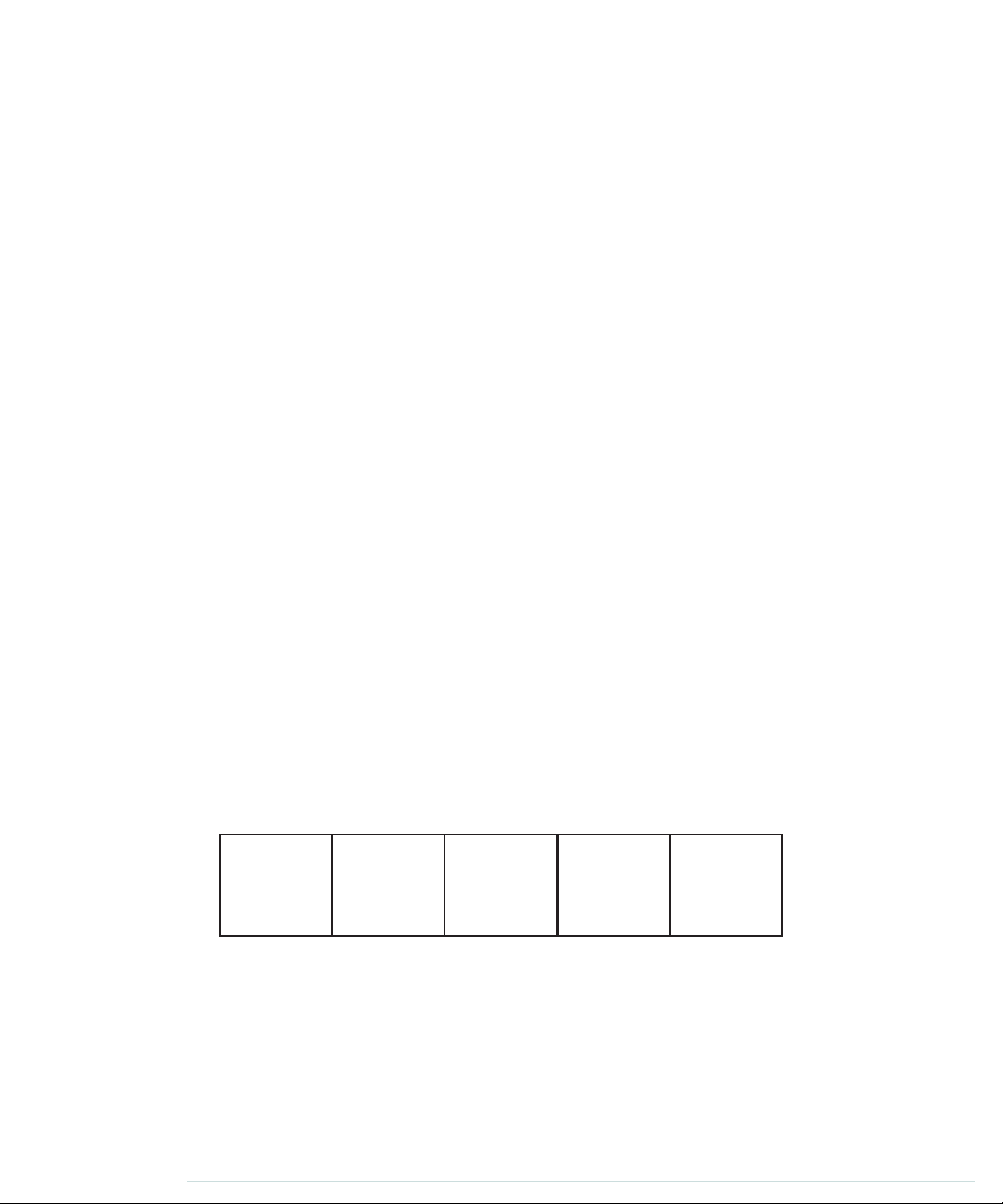
array = ["apples", "bananas", "cucumbers", "dates", "elderberries"]
This array happens to contain five strings, each representing something that
I might buy at the supermarket. (You’ve got to try elderberries.)
The index of an array is the number that identifies where a piece of data lives inside the array.
In most programming languages, we begin counting the index at 0. So for our
example array, "apples" is at index 0, and "elderberries" is at index 4, like this: “apples” “bananas” “cucumbers” “dates” “elderberries” index 0 index 1 index 2 index 3 index 4
To understand the performance of a data structure—such as the array—we
need to analyze the common ways that our code might interact with that data structure. report erratum • discuss
The Array: The Foundational Data Structure • 3
Most data structures are used in four basic ways, which we refer to as opera- tions. They are:
• Read: Reading refers to looking something up from a particular spot
within the data structure. With an array, this would mean looking up a
value at a particular index. For example, looking up which grocery item
is located at index 2 would be reading from the array.
• Search: Searching refers to looking for a particular value within a data
structure. With an array, this would mean looking to see if a particular
value exists within the array, and if so, which index it’s at. For example,
looking to see if "dates" is in our grocery list, and which index it’s located
at would be searching the array.
• Insert: Insertion refers to adding another value to our data structure. With
an array, this would mean adding a new value to an additional slot within
the array. If we were to add "figs" to our shopping list, we’d be inserting a new value into the array.
• Delete: Deletion refers to removing a value from our data structure. With
an array, this would mean removing one of the values from the array. For
example, if we removed "bananas" from our grocery list, that would be
deleting from the array.
In this chapter, we’ll analyze how fast each of these operations are when applied to an array.
And this brings us to the first Earth-shattering concept of this book: when
we measure how “fast” an operation takes, we do not refer to how fast the
operation takes in terms of pure time, but instead in how many steps it takes. Why is this?
We can never say with definitiveness that any operation takes, say, five sec-
onds. While the same operation may take five seconds on a particular com-
puter, it may take longer on an older piece of hardware, or much faster on
the supercomputers of tomorrow. Measuring the speed of an operation in
terms of time is flaky, since it will always change depending on the hardware that it is run on.
However, we can measure the speed of an operation in terms of how many
steps it takes. If Operation A takes five steps, and Operation B takes 500
steps, we can assume that Operation A will always be faster than Operation report erratum • discuss
Chapter 1. Why Data Structures Matter • 4
B on all pieces of hardware. Measuring the number of steps is therefore the
key to analyzing the speed of an operation.
Measuring the speed of an operation is also known as measuring its time
complexity. Throughout this book, we’ll use the terms speed, time complexity,
efficiency, and performance interchangeably. They all refer to the number of
steps that a given operation takes.
Let’s jump into the four operations of an array and determine how many steps each one takes. Reading
The first operation we’ll look at is reading, which is looking up what value is
contained at a particular index inside the array.
Reading from an array actually takes just one step. This is because the
computer has the ability to jump to any particular index in the array and
peer inside. In our example of ["apples", "bananas", "cucumbers", "dates", "elderberries"],
if we looked up index 2, the computer would jump right to index 2 and report
that it contains the value "cucumbers".
How is the computer able to look up an array’s index in just one step? Let’s see how:
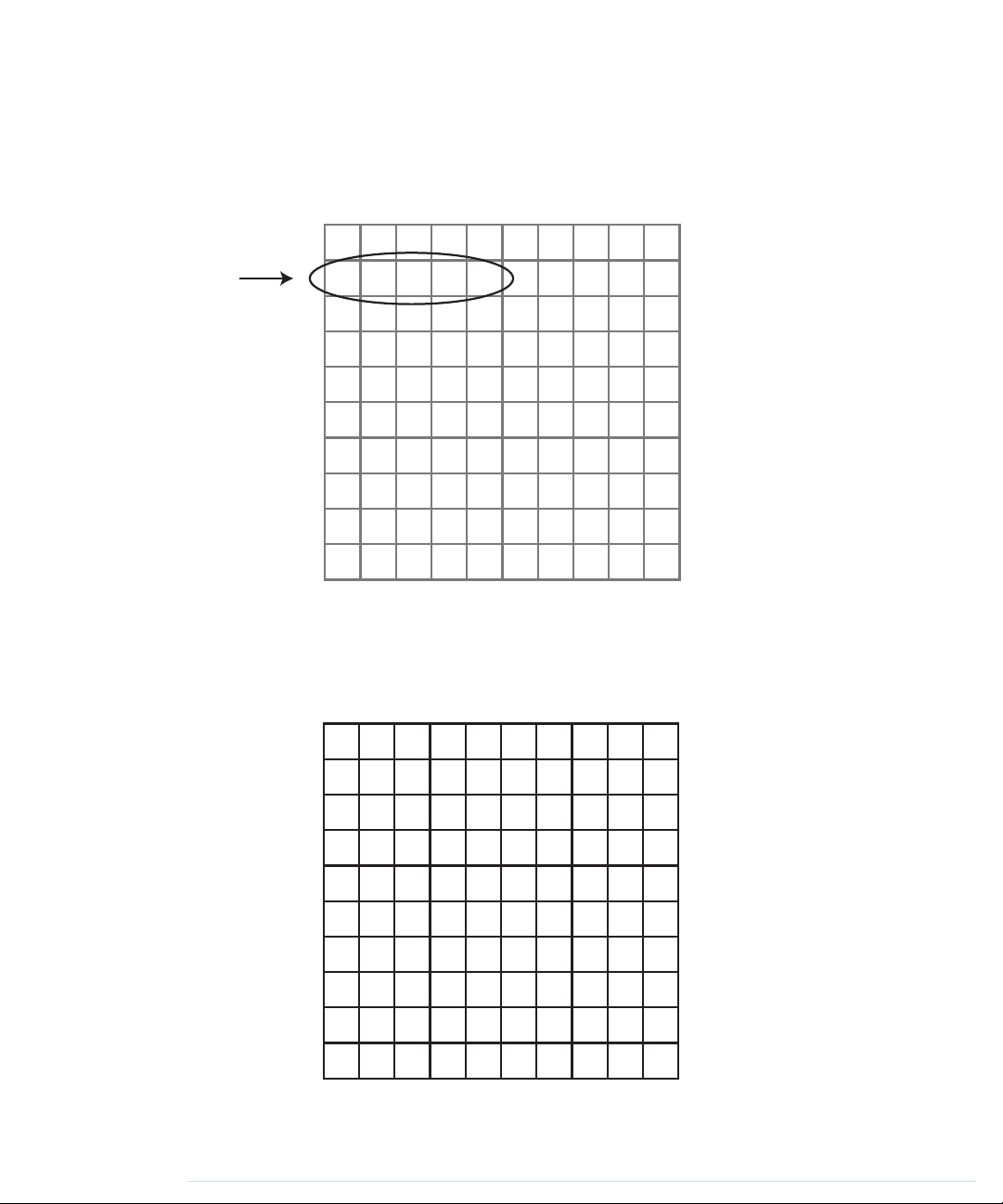
A computer’s memory can be viewed as a giant collection of cells. In the fol-
lowing diagram, you can see a grid of cells, in which some are empty, and some contain bits of data: 9 16 “a” 100 “hi” 22 “woah” report erratum • discuss Reading • 5
When a program declares an array, it allocates a contiguous set of empty
cells for use in the program. So, if you were creating an array meant to hold
five elements, your computer would find any group of five empty cells in a
row and designate it to serve as your array: 9 16 “a” 100 “hi” 22 “woah”
Now, every cell in a computer’s memory has a specific address. It’s sort of
like a street address (for example, 123 Main St.), except that it’s represented
with a simple number. Each cell’s memory address is one number greater
than the previous cell. See the following diagram:
1000 1001 1002 1003 1004 1005 1006 1007 1008 1009
1010 1011 1012 1013 1014 1015 1016 1017 1018 1019
1020 1021 1022 1023 1024 1025 1026 1027 1028 1029
1030 1031 1032 1033 1034 1035 1036 1037 1038 1039
1040 1041 1042 1043 1044 1045 1046 1047 1048 1049
1050 1051 1052 1053 1054 1055 1056 1057 1058 1059
1060 1061 1062 1063 1064 1065 1066 1067 1068 1069
1070 1071 1072 1073 1074 1075 1076 1077 1078 1079
1080 1081 1082 1083 1084 1085 1086 1087 1088 1089
1090 1091 1092 1093 1094 1095 1096 1097 1098 1099 report erratum • discuss
Tài liệu liên quan:
-
đề cương ôn tập môn cấu trúc dữ liệu và giải thuật
7 4 -

giáo án cấu trúc dữ liệu và giải thuật
8 4 -
Bài giảng Sorting – Giải thuật sắp xếp môn Cấu trúc dữ liệu và giải thuật | Đại học Bách Khoa Hà Nội
31 16 -
Đề thi cuối kỳ 1 môn Cấu trúc dữ liệu và giải thuật | Đại học Bách Khoa Hà Nội
29 15 -
Bài tập Cấu trúc dữ liệu | Đại học Bách Khoa Hà Nội
35 18