IEEE Standard for Software Quality Assurance Processes - Sách Mạng máy tính | Trường Đại học Khoa học - Đại học Thái Nguyên
IEEE Standard for Software Quality Assurance Processes - Sách Mạng máy tính | Trường Đại học Khoa học - Đại học Thái Nguyên. Tài liệu được sưu tầm giúp bạn tham khảo, ôn tập và đạt kết quả cao. Mời bạn đọc đón xem.
Môn: Mạng máy tính (TN) 4 tài liệu
Trường: Trường Đại học Khoa học - Đại học Thái Nguyên 85 tài liệu
Tác giả:




















Preview text:
IEEE Standard for Software Quality Assurance Processes IEEE Computer Society Sponsored by the
Software & Systems Engineering Standards Committee IEEE IEEE Std 730™-2014 3 Park Avenue (Revision of New York, NY 10016-5997 IEEE Std 730-2002) USA
Authorized licensed use limited to: RMIT University Library. Downloaded on October 25,2018 at 12:36:52 UTC from IEEE Xplore. Restrictions apply.
Authorized licensed use limited to: RMIT University Library. Downloaded on October 25,2018 at 12:36:52 UTC from IEEE Xplore. Restrictions apply. IEEE Std 730™-2014 (Revision of IEEE Std 730-2002)
IEEE Standard for Software Quality Assurance Processes Sponsor
Software & Systems Engineering Standards Committee of the IEEE Computer Society Approved 27 March 2014 IEEE-SA Standards Board
Authorized licensed use limited to: RMIT University Library. Downloaded on October 25,2018 at 12:36:52 UTC from IEEE Xplore. Restrictions apply.
Abstract: Requirements for initiating, planning, controlling, and executing the Software Quality
Assurance processes of a software development or maintenance project are established in this
standard. This standard is harmonized with the software life cycle process of ISO/IEC/IEEE
12207:2008 and the information content requirements of ISO/IEC/IEEE 15289:2011.
Keywords: assurance, conformance, contract, cycle, IEEE 730™, management, project,
quality, requirements, software, SQA, standard
The Institute of Electrical and Electronics Engineers, Inc.
3 Park Avenue, New York, NY 10016-5997, USA
Copyright © 2014 by The Institute of Electrical and Electronics Engineers, Inc.
All rights reserved. Published 13 June 2014. Printed in the United States of America.
IEEE is a registered trademark in the U.S. Patent & Trademark Office, owned by The Institute of Electrical and Electronics Engineers, Incorporated. PDF: ISBN 978-0-7381-9168-3 STD98691
Print: ISBN 978-0-7381-9169-0 STDPD98691
IEEE prohibits discrimination, harassment, and bullying.
For more information, visit http://www.ieee.org/web/aboutus/whatis/policies/p9-26.html.
No part of this publication may be reproduced in any form, in an electronic retrieval system or otherwise, without the prior written permission of the publisher.
Authorized licensed use limited to: RMIT University Library. Downloaded on October 25,2018 at 12:36:52 UTC from IEEE Xplore. Restrictions apply.
Important Notices and Disclaimers Concerning IEEE Standards Documents
IEEE documents are made available for use subject to important notices and legal disclaimers. These
notices and disclaimers, or a reference to this page, appear in all standards and may be found under the
heading “Important Notice” or “Important Notices and Disclaimers Concerning IEEE Standards Documents.”
Notice and Disclaimer of Liability Concerning the Use of IEEE Standards Documents
IEEE Standards documents (standards, recommended practices, and guides), both full-use and trial-use, are
developed within IEEE Societies and the Standards Coordinating Committees of the IEEE Standards
Association (“IEEE-SA”) Standards Board. IEEE (“the Institute”) develops its standards through a
consensus development process, approved by the American National Standards Institute (“ANSI”), which
brings together volunteers representing varied viewpoints and interests to achieve the final product.
Volunteers are not necessarily members of the Institute and participate without compensation from IEEE.
While IEEE administers the process and establishes rules to promote fairness in the consensus development
process, IEEE does not independently evaluate, test, or verify the accuracy of any of the information or the
soundness of any judgments contained in its standards.
IEEE does not warrant or represent the accuracy or content of the material contained in its standards, and
expressly disclaims all warranties (express, implied and statutory) not included in this or any other
document relating to the standard, including, but not limited to, the warranties of: merchantability; fitness
for a particular purpose; non-infringement; and quality, accuracy, effectiveness, currency, or completeness
of material. In addition, IEEE disclaims any and all conditions relating to: results; and workmanlike effort.
IEEE standards documents are supplied “AS IS” and “WITH ALL FAULTS.”
Use of an IEEE standard is wholly voluntary. The existence of an IEEE standard does not imply that there
are no other ways to produce, test, measure, purchase, market, or provide other goods and services related
to the scope of the IEEE standard. Furthermore, the viewpoint expressed at the time a standard is approved
and issued is subject to change brought about through developments in the state of the art and comments
received from users of the standard.
In publishing and making its standards available, IEEE is not suggesting or rendering professional or other
services for, or on behalf of, any person or entity nor is IEEE undertaking to perform any duty owed by any
other person or entity to another. Any person utilizing any IEEE Standards document, should rely upon his
or her own independent judgment in the exercise of reasonable care in any given circumstances or, as
appropriate, seek the advice of a competent professional in determining the appropriateness of a given IEEE standard.
IN NO EVENT SHALL IEEE BE LIABLE FOR ANY DIRECT, INDIRECT, INCIDENTAL, SPECIAL,
EXEMPLARY, OR CONSEQUENTIAL DAMAGES (INCLUDING, BUT NOT LIMITED TO:
PROCUREMENT OF SUBSTITUTE GOODS OR SERVICES; LOSS OF USE, DATA, OR PROFITS;
OR BUSINESS INTERRUPTION) HOWEVER CAUSED AND ON ANY THEORY OF LIABILITY,
WHETHER IN CONTRACT, STRICT LIABILITY, OR TORT (INCLUDING NEGLIGENCE OR
OTHERWISE) ARISING IN ANY WAY OUT OF THE PUBLICATION, USE OF, OR RELIANCE
UPON ANY STANDARD, EVEN IF ADVISED OF THE POSSIBILITY OF SUCH DAMAGE AND
REGARDLESS OF WHETHER SUCH DAMAGE WAS FORESEEABLE. Translations
The IEEE consensus development process involves the review of documents in English only. In the event
that an IEEE standard is translated, only the English version published by IEEE should be considered the approved IEEE standard.
Authorized licensed use limited to: RMIT University Library. Downloaded on October 25,2018 at 12:36:52 UTC from IEEE Xplore. Restrictions apply. Official statements
A statement, written or oral, that is not processed in accordance with the IEEE-SA Standards Board
Operations Manual shall not be considered or inferred to be the official position of IEEE or any of its
committees and shall not be considered to be, or be relied upon as, a formal position of IEEE. At lectures,
symposia, seminars, or educational courses, an individual presenting information on IEEE standards shall
make it clear that his or her views should be considered the personal views of that individual rather than the formal position of IEEE. Comments on standards
Comments for revision of IEEE Standards documents are welcome from any interested party, regardless of
membership affiliation with IEEE. However, IEEE does not provide consulting information or advice
pertaining to IEEE Standards documents. Suggestions for changes in documents should be in the form of a
proposed change of text, together with appropriate supporting comments. Since IEEE standards represent a
consensus of concerned interests, it is important that any responses to comments and questions also receive
the concurrence of a balance of interests. For this reason, IEEE and the members of its societies and
Standards Coordinating Committees are not able to provide an instant response to comments or questions
except in those cases where the matter has previously been addressed. For the same reason, IEEE does not
respond to interpretation requests. Any person who would like to participate in revisions to an IEEE
standard is welcome to join the relevant IEEE working group.
Comments on standards should be submitted to the following address: Secretary,
IEEE-SA Standards Board 445 Hoes Lane Piscataway, NJ 08854 USA Laws and regulations
Users of IEEE Standards documents should consult all applicable laws and regulations. Compliance with
the provisions of any IEEE Standards document does not imply compliance to any applicable regulatory
requirements. Implementers of the standard are responsible for observing or referring to the applicable
regulatory requirements. IEEE does not, by the publication of its standards, intend to urge action that is not
in compliance with applicable laws, and these documents may not be construed as doing so. Copyrights
IEEE draft and approved standards are copyrighted by IEEE under U.S. and international copyright laws.
They are made available by IEEE and are adopted for a wide variety of both public and private uses. These
include both use, by reference, in laws and regulations, and use in private self-regulation, standardization,
and the promotion of engineering practices and methods. By making these documents available for use and
adoption by public authorities and private users, IEEE does not waive any rights in copyright to the documents. Photocopies
Subject to payment of the appropriate fee, IEEE will grant users a limited, non-exclusive license to
photocopy portions of any individual standard for company or organizational internal use or individual,
non-commercial use only. To arrange for payment of licensing fees, please contact Copyright Clearance
Center, Customer Service, 222 Rosewood Drive, Danvers, MA 01923 USA; +1 978 750 8400. Permission
to photocopy portions of any individual standard for educational classroom use can also be obtained
through the Copyright Clearance Center.
Authorized licensed use limited to: RMIT University Library. Downloaded on October 25,2018 at 12:36:52 UTC from IEEE Xplore. Restrictions apply.
Updating of IEEE Standards documents
Users of IEEE Standards documents should be aware that these documents may be superseded at any time
by the issuance of new editions or may be amended from time to time through the issuance of amendments,
corrigenda, or errata. An official IEEE document at any point in time consists of the current edition of the
document together with any amendments, corrigenda, or errata then in effect.
Every IEEE standard is subjected to review at least every ten years. When a document is more than ten
years old and has not undergone a revision process, it is reasonable to conclude that its contents, although
still of some value, do not wholly reflect the present state of the art. Users are cautioned to check to
determine that they have the latest edition of any IEEE standard.
In order to determine whether a given document is the current edition and whether it has been amended
through the issuance of amendments, corrigenda, or errata, visit the IEEE-SA Website at
http://ieeexplore.ieee.org/xpl/standards.jsp or contact IEEE at the address listed previously. For more
information about the IEEE SA or IEEE’s standards development process, visit the IEEE-SA Website at http://standards.ieee.org. Errata
Errata, if any, for all IEEE standards can be accessed on the IEEE-SA Website at the following URL:
http://standards.ieee.org/findstds/errata/index.html. Users are encouraged to check this URL for errata periodically. Patents
Attention is called to the possibility that implementation of this standard may require use of subject matter
covered by patent rights. By publication of this standard, no position is taken by the IEEE with respect to
the existence or validity of any patent rights in connection therewith. If a patent holder or patent applicant
has filed a statement of assurance via an Accepted Letter of Assurance, then the statement is listed on the
IEEE-SA Website at http://standards.ieee.org/about/sasb/patcom/patents.html. Letters of Assurance may
indicate whether the Submitter is willing or unwilling to grant licenses under patent rights without
compensation or under reasonable rates, with reasonable terms and conditions that are demonstrably free of
any unfair discrimination to applicants desiring to obtain such licenses.
Essential Patent Claims may exist for which a Letter of Assurance has not been received. The IEEE is not
responsible for identifying Essential Patent Claims for which a license may be required, for conducting
inquiries into the legal validity or scope of Patents Claims, or determining whether any licensing terms or
conditions provided in connection with submission of a Letter of Assurance, if any, or in any licensing
agreements are reasonable or non-discriminatory. Users of this standard are expressly advised that
determination of the validity of any patent rights, and the risk of infringement of such rights, is entirely
their own responsibility. Further information may be obtained from the IEEE Standards Association.
Authorized licensed use limited to: RMIT University Library. Downloaded on October 25,2018 at 12:36:52 UTC from IEEE Xplore. Restrictions apply. Participants
At the time this IEEE standard was completed, the Software Quality Assurance Plans (C/S2ESC/730_WG)
Working Group had the following membership:
Sue McGrath Carroll, Chair
John Walz, Vice Chair
Steven Rakitin, Vice Chair
J. David Blaine, Editor
Byron Frank, Secretary T. Scott Ankrum Robin Goldsmith Sheila Ray Bakul Banerjee Michelle Gross Annette Reilly Linda Binkley David Heimann Jeanne Ruggles Pieter Botman Bernard Homes Robert Schaaf Yegor Bugayenko John Janeri Kandy Senthilmaran Emile Captain Mike Kress Maud Schlich Irene Chan Claude Laporte Peter Schulz Shumin Cheng Carla Lienhard Jeet Shangari Milton Concepcion H. Clark Leiphart Maury Skibba Ken Costello George Lipscomb Lisa Smith Cynthia Didio Linda McInnis Malcolm Stiefel Rebecca Draxten Denis Meredith Teri Stokes Tom Ehrhorn Keith Middleton John Suzuki Eva Freund Prabhu Parthasarathy Bill Trest* Mike Gayle Michelle Pierce Vincent Tume Gregg Giesler Mark Paulk Linda Wharton Marilyn Ginsberg-Finner Nancy Phillips Dan Zrymiak * Deceased
The following members of the individual balloting committee voted on this standard. Balloters may have
voted for approval, disapproval, or abstention. Edward Addy Robin Goldsmith Greg Luri Johann Amsenga Randall Groves Edward McCall T. Scott Ankrum Louis Gullo James Moore Angela Anuszewski John Harauz Michael Newman Chris Bagge David Heimann Charles Ngethe Bakul Banerjee Mark Henley Mark Paulk Pieter Botman David Herrell Robert Peterson Bill Brown Rutger A. Heunks William Petit Lyle Bullock Werner Hoelzl Ulrich Pohl Juan Carreon Bernard Homes Steven Rakitin Sue McGrath Carroll Peter Hung Annette Reilly Lawrence Catchpole Noriyuki Ikeuchi Robert Robinson Keith Chow Atsushi Ito Terence Rout Paul Croll Mark Jaeger Randall Safier Geoffrey Darnton Cheryl Jones Bartien Sayogo Ray Davis Piotr Karocki Robert Schaaf Ronald Dean John Kay Hans Schaefer Andrew Fieldsend Thomas Kurihara David Schultz Andre Fournier Susan Land Stephen Schwarm Byron Frank Claude Laporte Raymond Senechal Eva Freund Michael Lauxman Gil Shultz David Friscia David Leciston Carl Singer David Fuschi H. Clark Leiphart Kapil Sood Gregg Giesler Claire Lohr Luca Spotorno vi
Copyright © 2014 IEEE. All rights reserved.
Authorized licensed use limited to: RMIT University Library. Downloaded on October 25,2018 at 12:36:52 UTC from IEEE Xplore. Restrictions apply. Friedrich Stallinger Chandrasekaran Subramaniam Michael Waterman Thomas Starai John Suzuki Stephen Webb Eugene Stoudenmire Thomas Tullia M. Karen Woolf Walter Struppler Vincent Tume Oren Yuen Gerald Stueve Charlene Walrad Janusz Zalewski Marcy Stutzman John Walz Daidi Zhong Jingxin Wang
When the IEEE-SA Standards Board approved this standard on 27 March 2014, it had the following membership:
John Kulick, Chair
Jon Walter Rosdahl, Vice-chair
Richard H. Hulett, Past Chair
Konstantinos Karachalios, Secretary Peter Balma Michael Janezic Ron Peterson Farooq Bari Jeffrey Katz Adrian Stephens Ted Burse Joseph L. Koepfinger* Peter Sutherland Clint Chaplain David Law Yatin Trivedi Stephen Dukes Hung Ling Phil Winston Jean-Phillippe Faure Oleg Logvinov Don Wright Gary Hoffman Ted Olsen Yu Yuan Glenn Parsons *Member Emeritus
Also included are the following nonvoting IEEE-SA Standards Board liaisons:
Richard DeBlasio, DOE Representative
Michael Janezic, NIST Representative Michelle Turner
IEEE Standards Program Manager, Document Development Malia Zaman
IEEE Standards Program Manager, Technical Program Development vii
Copyright © 2014 IEEE. All rights reserved.
Authorized licensed use limited to: RMIT University Library. Downloaded on October 25,2018 at 12:36:52 UTC from IEEE Xplore. Restrictions apply. Introduction
This introduction is not part of IEEE Std 730™-2014, IEEE Standard for Software Quality Assurance Processes.
IEEE Std 730 has been a benchmark for Software Quality Assurance (SQA) professionals since it was first
published in 1979. While previous versions of IEEE Std 730 provided an SQA plan outline this revision
expands the scope of this standard to address the processes defined in software life cycle framework
standard, ISO/IEC/IEEE 12207:2008. This change in emphasis is consistent with and elaborates the process
requirements in ISO/IEC/IEEE 12207:2008. viii
Copyright © 2014 IEEE. All rights reserved.
Authorized licensed use limited to: RMIT University Library. Downloaded on October 25,2018 at 12:36:52 UTC from IEEE Xplore. Restrictions apply. Contents
1. Overview .................................................................................................................................................... 1
1.1 Scope ................................................................................................................................................... 1
1.2 Purpose ................................................................................................................................................ 1
1.3 Field of application.............................................................................................................................. 2
1.4 Limitations........................................................................................................................................... 2
1.5 Conformance ....................................................................................................................................... 2
1.6 Intended usage of this standard............................................................................................................ 3
1.7 Organization of this standard............................................................................................................... 3
2. Normative references.................................................................................................................................. 5
3. Definitions, acronyms, and abbreviations .................................................................................................. 5
3.1 Conventions......................................................................................................................................... 5
3.2 Definitions ........................................................................................................................................... 5
3.3 Acronyms and abbreviations ............................................................................................................... 9
4. Key concepts of Software Quality Assurance ............................................................................................ 9
4.1 Organizational management responsibility.......................................................................................... 9
4.2 Organization and project relationship.................................................................................................. 9
4.3 Software quality and relationship to requirements ............................................................................ 12
4.4 Overview of SQA activities............................................................................................................... 14
4.5 Acquirer and supplier perspectives.................................................................................................... 15
4.6 Key concepts of this standard ............................................................................................................ 15
4.7 Software process improvement.......................................................................................................... 16
4.8 Maintaining quality management system consistency....................................................................... 16
5. Software Quality Assurance process ........................................................................................................ 17
5.1 Purpose .............................................................................................................................................. 17
5.2 Organization of SQA process outcomes ............................................................................................ 17
5.3 SQA process implementation activities............................................................................................. 19
5.4 Product assurance activities............................................................................................................... 27
5.5 Process assurance activities ............................................................................................................... 31
Annex A (informative) Mapping between 7.2.3 of ISO/IEC/IEEE 12207:2008 and IEEE Std 730-2014 .. 37
Annex B (informative) Mapping between SQA Plan outlines contained in IEEE Std 730-2002 and IEEE
Std 730-2014 ................................................................................................................................................ 41
Annex C (informative) Guidance for creating Software Quality Assurance Plans...................................... 44
C.1 Introduction....................................................................................................................................... 44
C.2 Organization of this annex ................................................................................................................ 47
C.3 Guidance ........................................................................................................................................... 47
Annex D (informative) Mapping IEEE Std 730-2014 and ISO/IEC 15504 (SPICE).................................. 81
D.1 Capability Level 1 for SQA .............................................................................................................. 81
D.2 Capability Level 2 for SQA .............................................................................................................. 81
D.3 Capability Level 3 to Capability Level 5 for SQA ........................................................................... 83
D.4 Capability Level 3 to Capability Level 5 for other SLC processes................................................... 84
Annex E (informative) Applying IEEE Std 730-2014 — Industry-specific guidance ................................ 86
E.1 Medical device industry .................................................................................................................... 86 ix
Copyright © 2014 IEEE. All rights reserved.
Authorized licensed use limited to: RMIT University Library. Downloaded on October 25,2018 at 12:36:52 UTC from IEEE Xplore. Restrictions apply.
E.2 Nuclear power generation industry ................................................................................................... 90
Annex F (informative) SQA activities and their relationship to the agile development process................. 95
F.1 Introduction ....................................................................................................................................... 95
F.2 Modifying the 16 SQA activities to accommodate agile software development............................... 96
Annex G (informative) Mapping between IEEE Std 730-2014 and ISO/IEC 29110 standard for Very Small
Entities.......................................................................................................................................................... 99
Annex H (informative) Software tool validation....................................................................................... 104
Annex I (informative) Assessing product risk: Software integrity levels and assurance cases ................. 106
I.1 Software integrity levels................................................................................................................... 106
I.2 Overview of activities for integrity level determination................................................................... 109
I.3 Assurance cases................................................................................................................................ 111
Annex J (informative) Example corrective and preventive action process and root cause analysis process
.................................................................................................................................................................... 116
Annex K (informative) Cross-reference .................................................................................................... 120
Annex L (informative) Bibliography.......................................................................................................... 123 x
Copyright © 2014 IEEE. All rights reserved.
Authorized licensed use limited to: RMIT University Library. Downloaded on October 25,2018 at 12:36:52 UTC from IEEE Xplore. Restrictions apply.
IEEE Standard for Software Quality Assurance Processes
IMPORTANT NOTICE: IEEE Standards documents are not intended to ensure safety, security, health,
or environmental protection, or ensure against interference with or from other devices or networks.
Implementers of IEEE Standards documents are responsible for determining and complying with all
appropriate safety, security, environmental, health, and interference protection practices and all
applicable laws and regulations.
This IEEE document is made available for use subject to important notices and legal disclaimers.
These notices and disclaimers appear in all publications containing this document and may
be found under the heading “Important Notice” or “Important Notices and Disclaimers
Concerning IEEE Documents.” They can also be obtained on request from IEEE or viewed at
http://standards.ieee.org/IPR/disclaimers.html. 1. Overview 1.1 Scope
This standard establishes requirements for initiating, planning, controlling, and executing the Software
Quality Assurance (SQA) processes of a software development or maintenance project. This standard is
harmonized with the software life cycle process of ISO/IEC/IEEE 12207:20081 and the information content
requirements of ISO/IEC/IEEE 15289:2011.
NOTE—Annex A presents detailed explanations and mappings between ISO/IEC/IEEE 12207:2008 and IEEE Std 730™-2014 subclauses.2 1.2 Purpose
The activities described in this standard are intended to enable the software project to use the SQA
processes to produce and collect evidence that form the basis for giving a justified statement of confidence
that the software product conforms to its established requirements. The purpose of this standard is to
provide uniform, minimum acceptable requirements for SQA processes in support of a software project. In
considering adoption of this standard, regulatory bodies should be aware that specific application of this
standard may already be covered by one or more IEEE or ANSI (American National Standards Institute)
1 Information on normative references can be found in Clause 2.
2 Notes in text, tables, and figures of a standard are given for information only and do not contain requirements needed to implement this standard. 1
Copyright © 2014 IEEE. All rights reserved.
Authorized licensed use limited to: RMIT University Library. Downloaded on October 25,2018 at 12:36:52 UTC from IEEE Xplore. Restrictions apply. IEEE Std 730-2014
IEEE Standard for Software Quality Assurance Processes
standards documents relating to quality assurance, definitions, or other matters. It is not the purpose of this
document to supersede, revise, or amend existing standards directed to specific industries or applications.
1.3 Field of application
This standard guides SQA activities for software products or services. This standard is applicable to
software as part of a system as well as standalone software products. This standard regards the field of
software engineering to include projects to develop new or enhanced products, maintenance of existing
products, and software integration projects.
This standard is aligned with the outcomes specified in ISO/IEC/IEEE 12207:2008 and ISO/IEC/IEEE
15289:2011. This standard is not restricted by size, complexity, criticality, or application of the software product. 1.4 Limitations
This standard specifies definitions, activities, tasks, and outcomes for SQA processes. This standard does
not impose constraints on the implementation or performance of those activities and tasks. 1.5 Conformance
1.5.1 Conformance language conventions
The word shall is used to express a requirement, should to express a recommendation, and may to express
alternative or optional methods of satisfying a requirement.
1.5.2 Conformance scope
Conformance to this standard is achieved by demonstrating that the requirements of Clause 5, indicated by
the use of shall, are satisfied.
Conformance to this standard is a sufficient condition to meet the SQA outcomes enumerated in 7.2.3 of
ISO/IEC/IEEE 12207:2008. The converse is not true—meeting all requirements of 7.2.3 of ISO/IEC/IEEE
12207:2008 is not sufficient for the SQA work and output to meet all requirements of this standard. Finally,
conformance to this standard is not sufficient to meet other clauses of ISO/IEC/IEEE 12207:2008 or any
other standard in whole or in part.
There are two ways that projects or organizations can claim conformance to the provisions of this standard:
full conformance and tailored conformance as explained in 1.5.3 and 1.5.4 below. 1.5.3 Full conformance
Full conformance to this standard is achieved by demonstrating that all of the requirements of Clause 5 are
satisfied, using the required outcomes as evidence. 2
Copyright © 2014 IEEE. All rights reserved.
Authorized licensed use limited to: RMIT University Library. Downloaded on October 25,2018 at 12:36:52 UTC from IEEE Xplore. Restrictions apply. IEEE Std 730-2014
IEEE Standard for Software Quality Assurance Processes
1.5.4 Tailored conformance
When this standard is used as a basis for establishing a set of activities that do not qualify for full
conformance, the clauses of this standard are selected or modified in accordance with the tailoring process prescribed below.
To conform to this standard, only the following modifications are allowed: a project team may limit the
scope of the product and process assurance activities described in 5.4 and 5.5 in order to align with the
project’s activities, products, and services. Any SQA activity, task, or outcome required by this standard
that is not performed is identified in the project SQA Plan as not applicable along with a justification for why it is not performed.
NOTE—When this standard is used to help develop an agreement between an acquirer and a supplier, clauses of this
standard can be incorporated into the agreement with or without modification.
1.6 Intended usage of this standard
The requirements in this standard are contained in normative Clause 5. This standard specifies requirements
for activities that may be executed during the life cycle of a software product or service. It is recognized
that particular projects or organizations may not need to use all of the activities in this standard. Therefore,
implementing this standard typically involves selecting a set of activities suitable to the organization or project as described in 1.5.
1.7 Organization of this standard
This standard is organized into clauses and annexes:
Clause 1 contains scope, purpose, and introductory material.
Clause 2 identifies the normative references used in this standard.
Clause 3 defines terms and acronyms used in this standard.
Clause 4 describes the context for the SQA processes and SQA activities, and covers expectations
for how this standard will be applied.
Clause 5 specifies the SQA processes, activities, and tasks. Sixteen activities are identified in this
clause and are grouped into three major areas: process implementation, product assurance, and
process assurance. These activities implement the required outcomes for SQA specified by 7.2.3 of ISO/IEC/IEEE 12207:2008.
Refer to Annex A for the mapping of the four required outcomes to the subclauses of this standard.
Refer to Annex B for information about mapping between the SQA plan outlines in IEEE Std
730-20023,4 and IEEE Std 730-2014.
Refer to Annex C for information about guidance for creating a Software Quality Assurance Plan (SQAP).
Refer to Annex D for information about mapping between IEEE Std 730-2014 and ISO/IEC 15504-1:2004 [B34].5
3 IEEE publications are available from the Institute of Electrical and Electronics Engineers (http://standards.ieee.org/).
4 The IEEE standards or products referred to in this clause are trademarks of the Institute of Electrical and Electronics Engineers, Inc.
5 Information in brackets corresponds to those of the bibliography in Annex L. 3
Copyright © 2014 IEEE. All rights reserved.
Authorized licensed use limited to: RMIT University Library. Downloaded on October 25,2018 at 12:36:52 UTC from IEEE Xplore. Restrictions apply. IEEE Std 730-2014
IEEE Standard for Software Quality Assurance Processes
Refer to Annex E for information about applying IEEE Std 730-2014 to specific industries.
Refer to Annex F for information about SQA’s relationship to agile development methods.
Refer to Annex G for information about mapping between IEEE Std 730-2014 and ISO/IEC 29110:2011 [B40].
Refer to Annex H for information about validating software tools.
Refer to Annex I for information about software integrity levels and assurance cases.
Refer to Annex J for examples of corrective action, preventive action, and root cause analysis processes.
Refer to Annex K for a cross-reference of IEEE Std 730-2014 SQA Activities and ISO/IEC/IEEE
12207:2008 Life Cycle Processes.
Refer to Annex L for the bibliography of this standard.
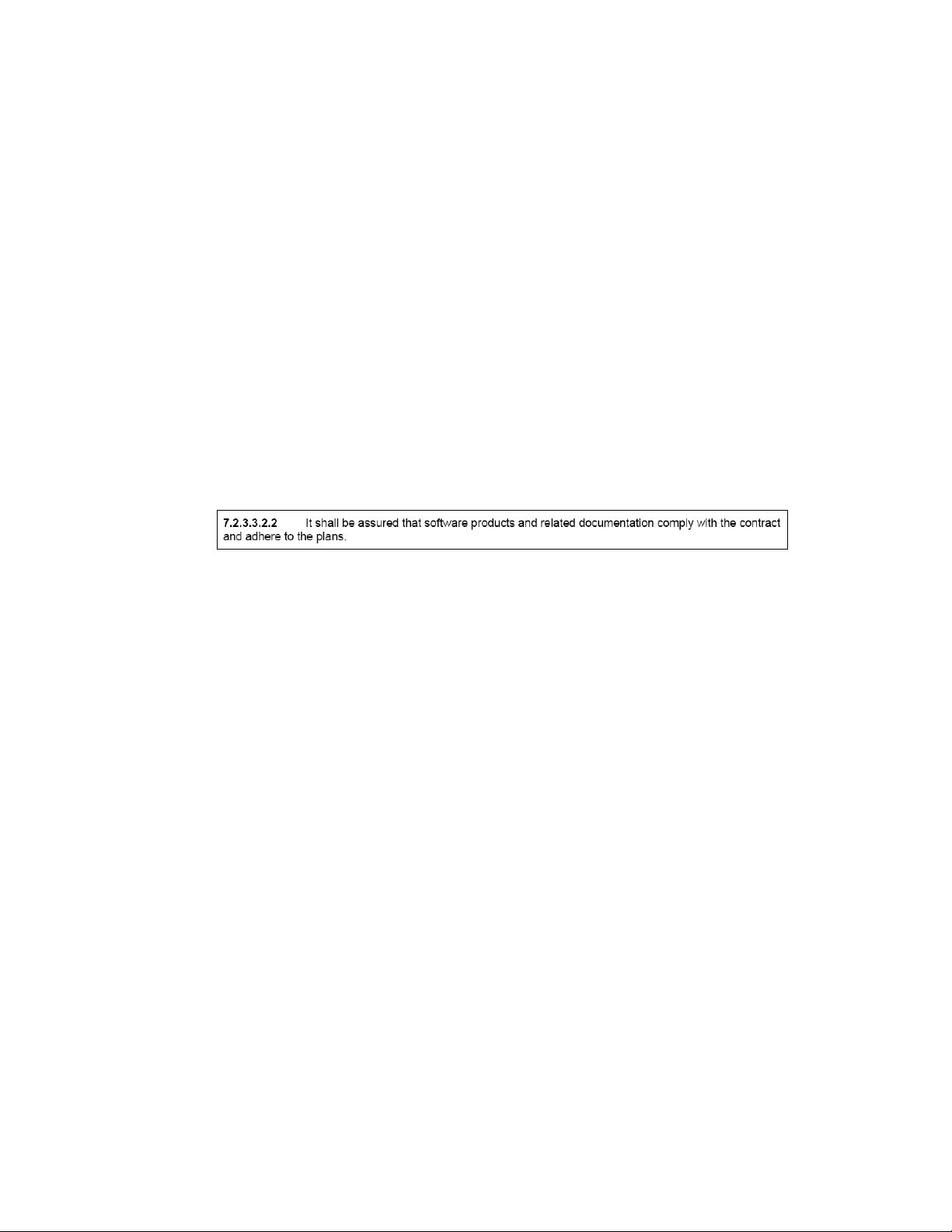
Each of the activities in Clause 5 of this standard is described by the following information: a)
Reference to ISO/IEC/IEEE 12207:2008 clause. The text of the ISO/IEC/IEEE 12207:2008
subclause relevant to the activity is presented in a boxed figure, for example:
This subclause addresses the following ISO/IEC/IEEE 12207:2008 subclause:
b) Purpose. Defines the activity’s intention (e.g., “Determine the degree to which the software
products and related documentation conform to established requirements.”). c)
Outcomes. Specific observable results of successful achievement of activity’s purpose, measurable
and tangible business, or technical results. An outcome may be a software executable, a physical
artifact, an information item (e.g., records, documents), a change in the state or an attribute of an
information item, a change to a project constraint, or a change to an attribute (e.g., training,
experience, capability) of a project team member. Information items are defined in ISO/IEC/IEEE
15289:2011. These outcomes are the basis for validated evidence to provide a justified statement of
confidence in the quality of the software products. Outcomes are written as declarative sentences in
the present tense (e.g., “Non-conformances are raised when software products do not conform to
established software requirements.”).
d) Tasks. Specific actions intended to contribute to the achievement of one or more of the stated
outcomes of the activity. Using the definitions from ISO/IEC TR 24774:2010 [B41], a statement in the task description can be: 1) A required action, 2) A recommended action, or 3) A permissible action.
Task statements identify the role performing the task. The role is either the subject of the sentence or is in a
clause that introduces a set of tasks. Task statements for required actions begin with an action verb and are
written as declarative sentences in the present tense. Recommended and permissible action statements start
with a phrase or clause that qualifies the conditions under which the task may be performed. There is not
necessarily a one-to-one relationship between tasks and outcomes. (e.g., Identify software products and
related documentation required by the contract.)
The SQAP is the key document that defines the activities to be performed on a specific project. The SQA
function’s planning activities and the SQAP outline are described in 5.3.3. 4
Copyright © 2014 IEEE. All rights reserved.
Authorized licensed use limited to: RMIT University Library. Downloaded on October 25,2018 at 12:36:52 UTC from IEEE Xplore. Restrictions apply. IEEE Std 730-2014
IEEE Standard for Software Quality Assurance Processes
2. Normative references
The following referenced documents are indispensable for the application of this document (i.e., they must
be understood and used, so each referenced document is cited in text and its relationship to this document is
explained). For dated references, only the edition cited applies. For undated references, the latest edition of
the referenced document (including any amendments or corrigenda) applies.
ISO/IEC/IEEE 12207:2008 Systems and Software Engineering — Software Life Cycle Processes.
ISO/IEC/IEEE 15289:2011 Systems and Software Engineering — Content of Life-Cycle Information Products (documentation).
3. Definitions, acronyms, and abbreviations
For the purposes of this document, the following terms and definitions apply. ISO/IEC/IEEE 24765:2010
Systems and Software Engineering — Vocabulary [B42], the IEEE Standards Dictionary Online,6 and
IEEE Computer Society’s Software and Systems Engineering Vocabulary7 should be consulted for terms not defined in this clause. 3.1 Conventions
Throughout this standard, unless specifically noted otherwise, the term “SQA” refers to either the SQA
function or the SQA process. The term “SQA function” is not to be interpreted as a particular person, tool,
document, job title, or a specific group dedicated to SQA, regardless of how that function is staffed,
organized, or executed. The term “SQA process” means a set of activities. 3.2 Definitions
Acquirer: A stakeholder that acquires or procures a product or service from a supplier [ISO/IEC/IEEE 12207:2008].
Activity: A set of cohesive tasks of a process, which transforms inputs into outputs [ISO/IEC/IEEE 12207:2008].
Assurance: Grounds for justified confidence that a claim has been or will be achieved (ISO/IEC 15026-1:2013 [B36]).
Assurance case: Representation of a claim or claims, and the support for these claims (ISO/IEC 15026-1:2013 [B36]).
NOTE—An assurance case is a reasoned, auditable artifact created to support the contention its claim or claims are
satisfied. It contains the following and their relationships: one or more claims about properties; arguments that logically
link the evidence and any assumptions to the claim(s); a body of evidence; and possibly assumptions supporting these arguments for the claim(s).
Assure: To promise or state with certainty by one person to another person or group. Contrast with ensure.
6 IEEE Standards Dictionary Online subscription is available at:
http://www.ieee.org/portal/innovate/products/standard/standards_dictionary.html.
7 The current version of this dictionary is available at: http://www.computer.org/sevocab. 5
Copyright © 2014 IEEE. All rights reserved.
Authorized licensed use limited to: RMIT University Library. Downloaded on October 25,2018 at 12:36:52 UTC from IEEE Xplore. Restrictions apply. IEEE Std 730-2014
IEEE Standard for Software Quality Assurance Processes
Audit: An independent examination of a work product or set of work products to assess compliance with
specifications, standards, contractual agreements, or other criteria (ISO/IEC/IEEE 24765:2010 [B42]).
Compliance: Doing what has been asked or ordered; as required by rule or law (e.g., comply with a regulation).
Conformance: The fulfillment by a product, process, or service of specified requirements (adapted from
ISO/IEC/IEEE 24765:2010 [B42]). For conformance to be meaningful, the specified requirements
accurately represent stakeholder requirements.
Constraint: A limitation or implied requirement that constrains the design solution or implementation of
the systems engineering process and is not changeable by the enterprise (ISO/IEC/IEEE 24765:2010
[B42]). A design constraint is an explicit and direct restriction regarding the choice of design ideas. It either
declares a design idea to be compulsory or to be excluded.
Contract: A binding agreement between two parties, especially enforceable by law, or a similar internal
agreement wholly within an organization [ISO/IEC/IEEE 12207:2008]. A contract is an agreement between
two or more parties regarding a course of action. The formality of a contract can range from a simple
informal oral description to a formal written instrument. This standard calls an agreement between software
acquirer and supplier a contract.
Deliverable: Item to be provided to an acquirer or other designated recipient as specified in an agreement
(ISO/IEC/IEEE 24765:2010 [B42]). This item can be a document, hardware item, software item, service, or any type of work product.
Document: A uniquely identified unit of information for human use, such as a report, specification,
manual, or book, in printed or electronic form [ISO/IEC/IEEE 15289:2011].
Ensure: To make certain that things occur or events take place. Contrast with assure.
Established requirement: A requirement that the project has verified as satisfying project-specific criteria
(such as clarity, suitability, and feasibility) and has validated to be an accurate representation of stakeholder
needs, wants, and expectations. Established requirements are accepted by the project to form the basis of product development.
Function: In a software application, a module that performs a specific action. In an organization, a function
is a set of resources and activities that achieve a particular purpose.
Functional requirement: A requirement that specifies a function that a system or system component must
perform (ISO/IEC/IEEE 24765:2010 [B42]).
Independence [of SQA]: Situation in which SQA is free from technical, managerial, and financial
influences (intentional or unintentional).
Independence, financial [of SQA]: Situation in which control of the SQA budget is vested in an
organization independent of the development organization. (IEEE Std 1012™-2012 [B26]).
Independence, managerial [of SQA]: Situation in which the responsibility of the SQA effort is vested in
an organization separate from the development and project management organizations. (IEEE Std 1012- 2012 [B26] ).
Independence, technical [of SQA]: Situation in which the SQA effort uses personnel who are not involved
in the development of the system or its elements. (IEEE Std 1012-2012 [B26]). 6
Copyright © 2014 IEEE. All rights reserved.
Authorized licensed use limited to: RMIT University Library. Downloaded on October 25,2018 at 12:36:52 UTC from IEEE Xplore. Restrictions apply. IEEE Std 730-2014
IEEE Standard for Software Quality Assurance Processes
Information item: A separately identifiable body of information that is produced, stored, and delivered for
human use during a system or software life cycle [ISO/IEC/IEEE 15289:2011].
Integrity level: A value representing project-unique characteristics (e.g., complexity, criticality, risk, safety
level, security level, desired performance, reliability) that define the importance of the system, software, or
hardware to the user. (IEEE Std 1012-2012 [B26] ).
Life cycle model: A framework of processes and activities concerned with the life cycle that may be
organized into stages, which also acts as a common reference for communication and understanding [ISO/IEC/IEEE 12207:2008].
Measure: A variable to which a value is assigned as the result of measurement (IEEE Std 15939™-2008 [B28]).
Non-functional: As applied to requirements, the term “non-functional” is deprecated and is not used in this
standard. The terms “performance requirement” or “performance attribute” are preferred.
Performance requirement: The measurable criterion that identifies a quality attribute of a function or how
well a functional requirement must be accomplished (IEEE Std 1220™-2005 [B27]). A performance
requirement is always an attribute of a functional requirement.
Plan: An information item that presents a systematic course of action for achieving a declared purpose,
including when, how, and by whom specific activities are to be performed [ISO/IEC/IEEE 15289:2011].
Process: A set of interrelated or interacting activities which transforms inputs into outputs [ISO/IEC/IEEE
12207:2008]; a process can exist whether it is documented or not.
Product: The result of a process; an artifact that is produced, is quantifiable, and can be either an end item
in itself or a component item (PMBOK® Guide [B48]).
NOTE—includes intermediate as well as end-item artifacts; complete set of software and documentation; output of
software development activities.
Project: A temporary endeavor to develop a unique product, service, or result (PMBOK® Guide [B48]).
Quality: The degree to which a product or process meets established requirements; however, quality
depends upon the degree to which those established requirements accurately represent stakeholder needs,
wants, and expectations (adapted from ISO/IEC/IEEE 24765:2010 [B42]).
Record: A set of related data items treated as a unit [ISO/IEC/IEEE 15289:2011].
Requirement: A condition or capability that is to be met or possessed by a system, product, service, result,
or component to satisfy a contract, standard, specification, or other formally imposed document.
Requirements include the quantified and documented needs, wants, and expectations of the sponsor,
customer, and other stakeholders (PMBOK® Guide [B48]). Requirements provide value when delivered, satisfied, or met.
Review: A process, which may include a meeting, in which work products are presented to some
stakeholders for comment or approval (adapted from ISO/IEC/IEEE 24765:2010 [B42]).
Software engineering environment (SEE): The hardware, software, and firmware used to perform a
software engineering effort (ISO/IEC/IEEE 24765:2010 [B42]).
Software integrity level: See: Integrity level. 7
Copyright © 2014 IEEE. All rights reserved.
Authorized licensed use limited to: RMIT University Library. Downloaded on October 25,2018 at 12:36:52 UTC from IEEE Xplore. Restrictions apply. IEEE Std 730-2014
IEEE Standard for Software Quality Assurance Processes
Software life cycle (SLC): The project-specific sequence of activities that is created by mapping the
activities of a standard onto a selected software life cycle model (ISO/IEC/IEEE 24765:2010 [B42]).
Software quality: The degree to which a software product meets established requirements; however,
quality depends upon the degree to which those established requirements accurately represent stakeholder
needs, wants, and expectations (adapted from ISO/IEC/IEEE 24765:2010 [B42]).
Software Quality Assurance: A set of activities that define and assess the adequacy of software processes
to provide evidence that establishes confidence that the software processes are appropriate for and produce
software products of suitable quality for their intended purposes. A key attribute of SQA is the objectivity
of the SQA function with respect to the project. The SQA function may also be organizationally
independent of the project; that is, free from technical, managerial, and financial pressures from the project.
Software quality management: Coordinated activities to direct and control an organization with regard to software quality.
Software testing: (1) An activity in which a system or component is executed under specified conditions,
the results are observed or recorded, and an evaluation is made of some aspect of the system or component.
(2) To conduct an activity as in (1). (IEEE Std 829™-2008 [B25]).
Software testing environment: The facilities, hardware, software, firmware, procedures, and
documentation needed to perform…testing of software (ISO/IEC/IEEE 24765:2010 [B42]).
Software validation: (1) The process of evaluating a system or component during or at the end of the
development process to determine whether it satisfies specified requirements. (2) The process of providing
evidence that the system, software, or hardware and its associated products satisfy requirements allocated
to it at the end of each life cycle activity, solve the right problem (e.g., correctly model physical laws,
implement business rules, and use the proper system assumptions), and satisfy intended use and user needs.
(3) The confirmation, through the provision of objective evidence, that the requirements for a specific
intended use or application are fulfilled. (ISO/IEC/IEEE 12207:2008)
Software verification: (1) The process of evaluating a system or component to determine whether the
products of a given development phase satisfy the conditions imposed at the start of that phase. (2) The
process of providing objective evidence that the system, software, or hardware and its associated products
conform to requirements (e.g., for correctness, completeness, consistency, and accuracy) for all life cycle
activities during each life cycle process (acquisition, supply, development, operation, and maintenance);
satisfy standards, practices, and conventions during life cycle processes; and successfully complete each
life cycle activity and satisfy all the criteria for initiating succeeding life cycle activities. (3) The
confirmation, through the provision of objective evidence, that specified requirements are fulfilled. (ISO/IEC/IEEE 12207:2008)
NOTE—“Verified” designates the corresponding status. In design and development, verification includes examining
the result of a given activity to determine conformity with the stated requirement for that activity. A system may be
verified to meet the stated requirements, yet be unsuitable for operation by the actual users (ISO 9000:2005 [B30]).
Specification: An information item that identifies, in a complete, precise, and verifiable manner, the
requirements, design, behavior, or other expected characteristics of a system, service, or process [ISO/IEC/IEEE 15289:2011].
Supplier: An organization or individual that enters into an agreement with an acquirer for the supply of a
product or service [ISO/IEC/IEEE 12207:2008].
Task: A required, recommended, or permissible action intended to contribute to the achievement of one or
more outcomes of a process [ISO/IEC/IEEE 12207:2008].
Work product: An artifact resulting from the execution of a process (ISO/IEC 15504-1:2004 [B34]). 8
Copyright © 2014 IEEE. All rights reserved.
Authorized licensed use limited to: RMIT University Library. Downloaded on October 25,2018 at 12:36:52 UTC from IEEE Xplore. Restrictions apply.