IELTS Speaking Tips: Common Phrases for Part 1 Responses | Tiếng Anh | Đại học Kinh tế - Đại học Đà Nẵng
Tài liệu được sưu tầm và soạn thảo dưới dạng file PDF với mục đích hỗ trợ học tập và tham khảo. Nội dung tài liệu được trình bày rõ ràng, dễ tiếp cận, phù hợp cho việc ôn tập và củng cố kiến thức trong quá trình học đại học. Đây sẽ là nguồn tư liệu hữu ích giúp các bạn sinh viên chuẩn bị tốt hơn cho các buổi học, đồng thời mở rộng thêm hiểu biết về môn học. Hy vọng tài liệu này sẽ mang lại nhiều giá trị và hỗ trợ các bạn trong hành trình học tập. Mời bạn đọc cùng tham khảo!
Môn: Tiếng Anh (11) 12 tài liệu
Trường: Trường Đại học Kinh tế - Đại học Đà Nẵng 1.4 K tài liệu
Tác giả:


Preview text:
IELTS Speaking Questions about THINGS YOU LIKE
1. Yes, I canÕt get enough of it
In part 1 the examiner may ask you if you like different things. For example, ¥ Do you like music? ¥ Do you like art? ¥
Do you like social media? ¥ Do you like coffee?
Instead of saying Ôyes, I like itÕ, you could say,
Yes, I canÕt get enough of it
Notice this is for singular things, but if the question is about plural things, such
as cakes, you need to change the ÔitÕ for ÔthemÕ For example, ¥ Do you like cakes? ¥ Do you like books? ¥ Do you like cars?
Yes, I canÕt get enough of them.
2. What I like most about it is
This is a nice expression to help you develop your answers a little. ItÕs a
more complex signpost that emphasizes what you like and so naturally you wil go on to say why.
So you may use a structure like this:
What I like most about it is + adjective clause + example For example, ¥ Do you like science?
Yes, what I like most about it is itÕs so interesting for example, last week
I read an article about solar panels and how we can use them
We can use this phrase for those questions we saw above, such as: ¥ Do you like music? ¥ Do you like art? ¥ Do you like social media? ¥ Do you like coffee?
3. I love that it allows me to For example, ¥ Do you like science?
Yes, I love that it allows me to understand the world around us ¥
Do you like social media?
Yes, I love that it allows me to connect with family and friends at the press of a button ¥ Do you like coffee?
Yes, I love that it allows me to wake up quickly and be on the ball at work
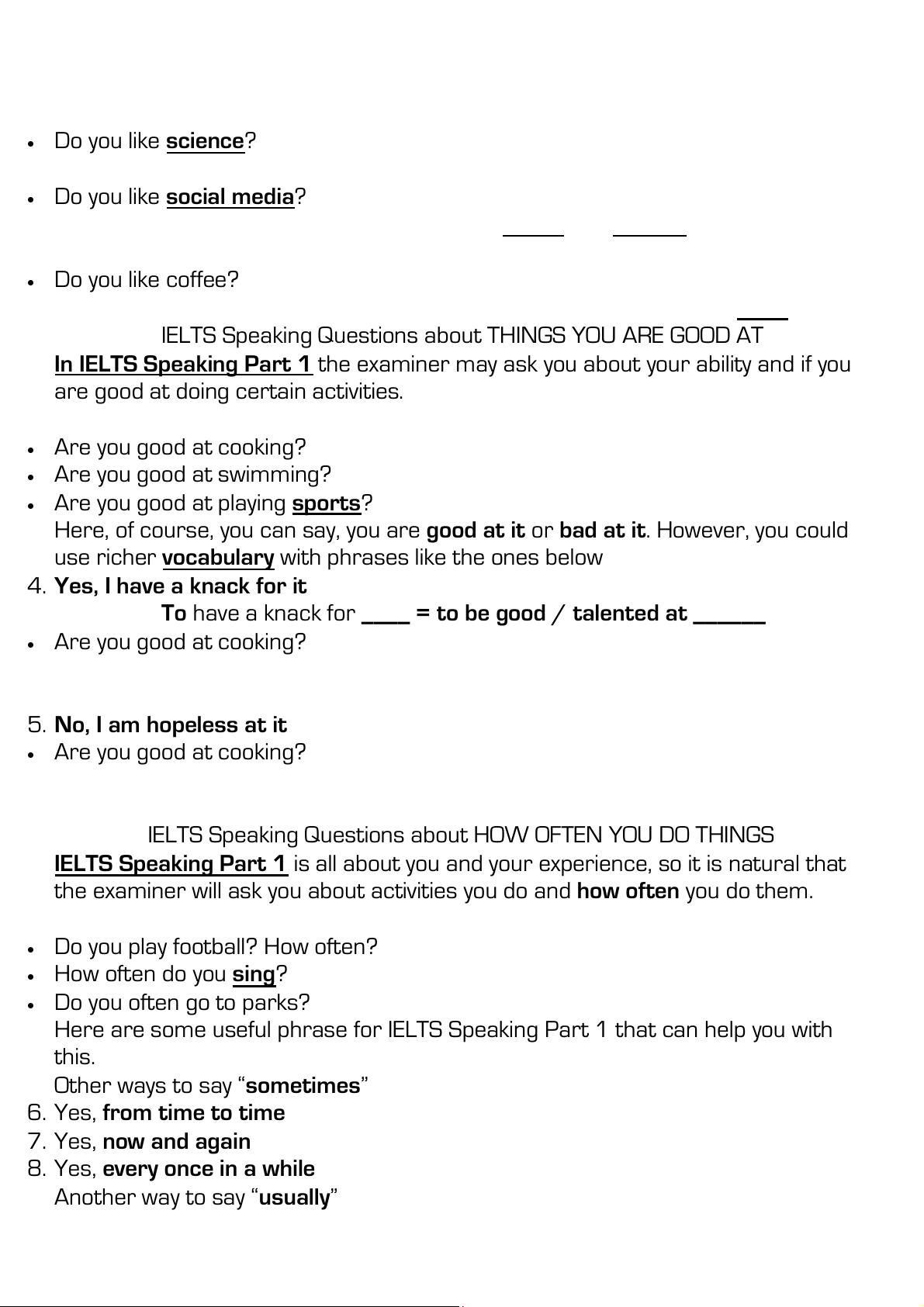
IELTS Speaking Questions about THINGS YOU ARE GOOD AT
In IELTS Speaking Part 1 the examiner may ask you about your ability and if you
are good at doing certain activities. For example, ¥ Are you good at cooking? ¥ Are you good at swimming? ¥
Are you good at playing sports?
Here, of course, you can say, you are good at it or bad at it. However, you could
use richer vocabulary with phrases like the ones below
4. Yes, I have a knack for it
To have a knack for ____ = to be good / talented at ______ ¥ Are you good at cooking? Yes, I have a knack for it
5. No, I am hopeless at it ¥ Are you good at cooking? No, I am hopeless at it
IELTS Speaking Questions about HOW OFTEN YOU DO THINGS
IELTS Speaking Part 1 is all about you and your experience, so it is natural that
the examiner will ask you about activities you do and how often you do them. For example, ¥
Do you play football? How often? ¥ How often do you sing? ¥ Do you often go to parks?
Here are some useful phrase for IELTS Speaking Part 1 that can help you with this.
Other ways to say ÒsometimesÓ
6. Yes, from time to time 7. Yes, now and again
8. Yes, every once in a while
Another way to say ÒusuallyÓ
9. Yes, I play football at the weekends, more often than not
Another way to say ÒneverÓ
10. No, IÕm not in the least bit interested in that
IELTS Speaking Answers with CONNECTORS
In IELTS Speaking Part 1, you may get questions asking your opinion about something. For instance, ¥
Do you prefer hot weather or cold weather? ¥
WhatÕs your favourite kind of weather?
If you start your answer with a connector or signpost, it can make your answer
more coherent and easier for the examiner to follow. Here are some examples, 11. Without a doubt,
12. In all seriousness,
13. To be totally upfront, ¥
Do you prefer hot weather or cold weather?
Without a doubt, I prefer cold weather because in the hot weather, if itÕs sunny, my skins burns so easily
In all seriousness, I prefer cold weather because in the hot weather, if itÕs sunny, my skins burns so easily
To be totally upfront, I prefer cold weather because in the hot weather, if itÕs
sunny, my skins burns so easily
IELTS Speaking Questions with WOULD YOU?
Another common question type in IELTS Speaking Part 1 is ÔWould you ______?Õ For example, ¥ Would you like to be famous? ¥
Would you give a pen as a present?
Here are two simple phrases for IELTS Speaking Part 1 you can use to answer this kind of question. 14.
Yes, I wouldnÕt think twice about it ¥
This means, yes for sure, I would not hesitate and I do not need to think about it. 15.
No, not for the love of money ¥
This means no not at all, even if you gave me a lot of money, I would not do it.