Interpreting 1 - 2023 Textbook: Essential Skills and Techniques | Translation | Trường Đại học Ngoại ngữ, Đại học Đà Nẵng
The course aims to introduce students to an overview of interpretation and different types of interpretation. The course focuses on providing learners with opportunities to practise fundamental interpretation skills such as listening for gist, memorizing, note-taking, summarizing and interpreting (mainly sentence-by-sentence and consecutive). Students are assisted in building up a repertoire for interpretation including topic-based vocabulary and structures through exposure to content knowledge of familiar topics (education, health, environment…). Tài liệu được sưu tầm và soạn thảo dưới dạng file PDF để gửi tới các bạn cùng tham khảo, ôn tập đầy đủ kiến thức, chuẩn bị cho các buổi học thật tốt. Mời bạn đọc đón xem!
Môn: Translation 3 2 tài liệu
Trường: Trường Đại học Ngoại ngữ, Đại học Đà Nẵng 292 tài liệu
Tác giả:



Preview text:
Nguyen Cung Tram, M.A.
THE UNIVERSITY OF DA NANG UN U I N VE I R VE S R I S T I Y T Y OF O F F O F R O E R I E G I N G N LANGUAGE L ANGUAGE S TUDIES TUDIE FACULTY F ACULTY O F O F EN E G N L G I L S I H S INTERPRETING 1 INTER INTE N R A N L A L C I C R I C R U C L U AT A ION T Co C mp o i mp l i e l d e b d y b Ngu y y Ngu e y n C n u C n u g T n r g T a r m, a M m, . M A. Danang 2022 COURSE OUTLINE Name : Interpreting 1 Credit value : 3 Length of the course
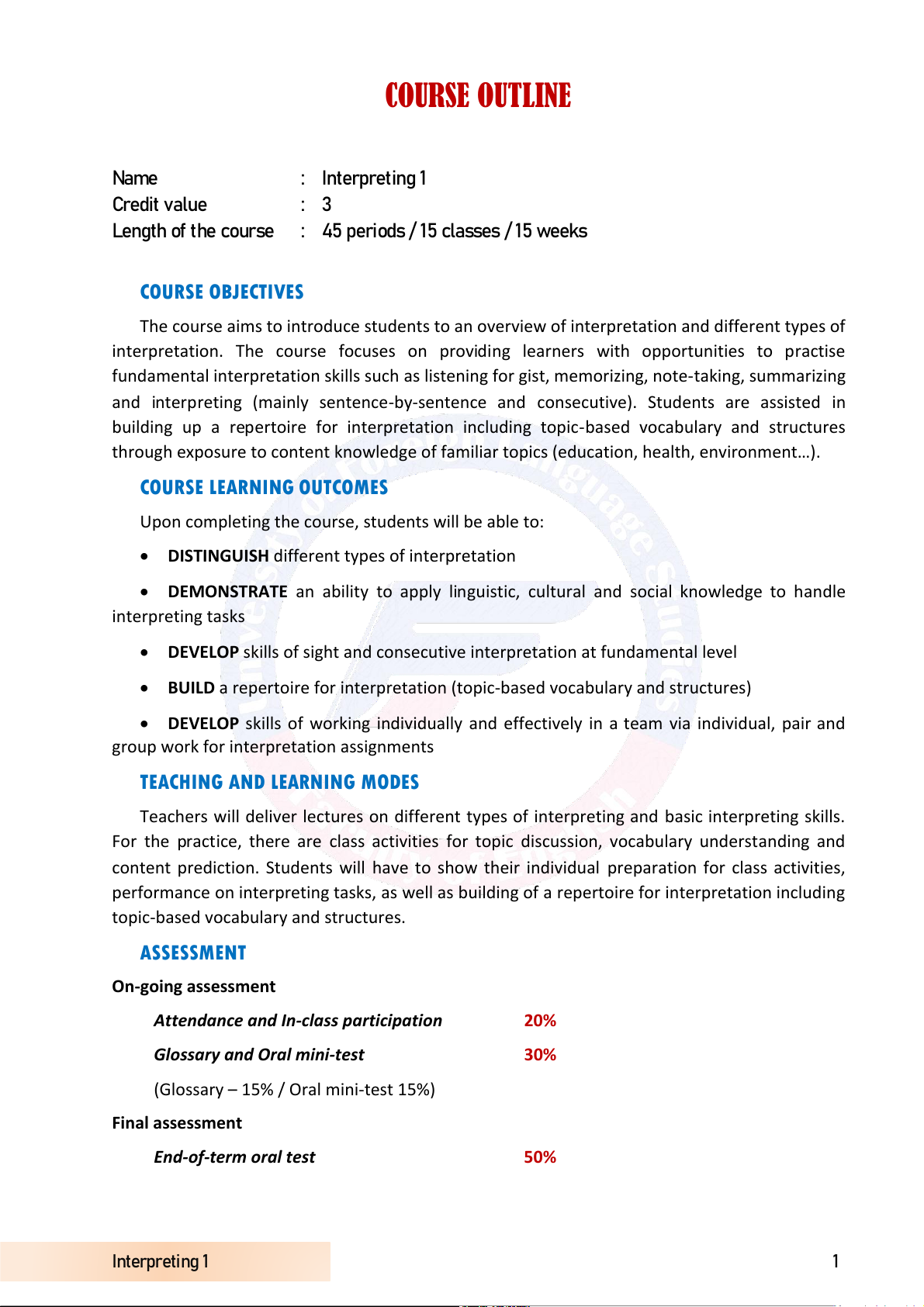
: 45 periods / 15 classes / 15 weeks COURSE OBJECTIVES
The course aims to introduce students to an overview of interpretation and different types of
interpretation. The course focuses on providing learners with opportunities to practise
fundamental interpretation skills such as listening for gist, memorizing, note-taking, summarizing
and interpreting (mainly sentence-by-sentence and consecutive). Students are assisted in
building up a repertoire for interpretation including topic-based vocabulary and structures
through exposure to content knowledge of familiar topics (education, health, environment…).
COURSE LEARNING OUTCOMES
Upon completing the course, students will be able to:
• DISTINGUISH different types of interpretation
• DEMONSTRATE an ability to apply linguistic, cultural and social knowledge to handle interpreting tasks
• DEVELOP skills of sight and consecutive interpretation at fundamental level
• BUILD a repertoire for interpretation (topic-based vocabulary and structures)
• DEVELOP skills of working individually and effectively in a team via individual, pair and
group work for interpretation assignments
TEACHING AND LEARNING MODES
Teachers will deliver lectures on different types of interpreting and basic interpreting skills.
For the practice, there are class activities for topic discussion, vocabulary understanding and
content prediction. Students will have to show their individual preparation for class activities,
performance on interpreting tasks, as well as building of a repertoire for interpretation including
topic-based vocabulary and structures. ASSESSMENT On-going assessment
Attendance and In-class participation 20%
Glossary and Oral mini-test 30%
(Glossary – 15% / Oral mini-test 15%) Final assessment
End-of-term oral test 50% Interpreting 1 1 INTRODUCTION
Interpreting 1 material is designed to develop learners’ basic interpreting skills with a
wide range of knowledge and vocabulary in various areas such as culture, tourism,
environment, health, medicine, and education in both English and Vietnamese.
Talks or recordings are selected from authentic materials with slow and medium
speed for the purpose of students’ practicing basic skills of memorizing, note-taking and
summarizing. Interpreting tasks are designed to give learners step-by-step guide:
understanding the vocabulary related to the topic of the interpreting task, discussing and
exploring the topic, memorizing and taking notes for the talks, rephrasing the ideas of
the talk according to their understanding, and doing the interpretation into the target language.
Further practice section is to provide learners with extra materials for home practice and self-study.
Any comment from teachers and learners on practicality of this material would be a
great contribution to our more enjoyable learning experience in the future.
Nguyen Cung Tram Interpreting 1 2 IN I T N R T O R D O U D C U T C IO I N O N T O T O I N I T N E T RP R R P E R T E I T N I G N
TRANSLATION VERSUS INTERPRETING
• Product of the transfer: Interpreting means “to transfer orally a text from one
language to another” → the product of interpreting appears in spoken form. Whereas, in
translation or translating, the product of this transfer appears in written form.
• Length of the text: The interpreter normally produces a text in the TL which is
shorter than the text in the SL. In contrast, the final product comes out invariably longer
than the original in translation.
• Access to reference books: The translator always has easy access to bilingual and
monolingual dictionaries, thesauri, encyclopedia and the like. This never happens for the
interpreter. An interpreter who consults a dictionary is, at times, looked at with suspicion.
THE INTERPRETER’S ROLE AND QUALITIES
The interpreter’s role:
• The main purpose of interpreting is communication, which means transmitting
thoughts from one person to another. In this way, the interpreter can eliminate language
barrier that separates people, thus functioning as an instrument of understanding between them.
• In various interpreting modes, the interpreter is seen as instruments of mutual
understanding between nations (consecutive and simultaneous interpreting at
international conferences, high level meetings), facilitates the relationship between
citizens in a community of different ethnic extraction (community interpreting, liaison
interpreting), and assists in promoting the development of an individual, a company or a
corporation (conversation, interview interpreting), etc.
The interpreter’s qualities:
• proficient in two or more languages with special attributes as resistance,
promptness of speech and mind, and with several intellectual gifts as good memory, power of concentration
• high moral standards and a sense of responsibility (impartiality, confidentiality)
• ability to recognize the subject matter (wide knowledge of history, geography,
economics, politics, medical sciences, law, environment, and other subjects of special interests) • good voice
• ability to work under pressure (long hours of working, tendency of losing
confidence, concentration or being distracted) Interpreting 1 3 MODES OF INTERPRETING
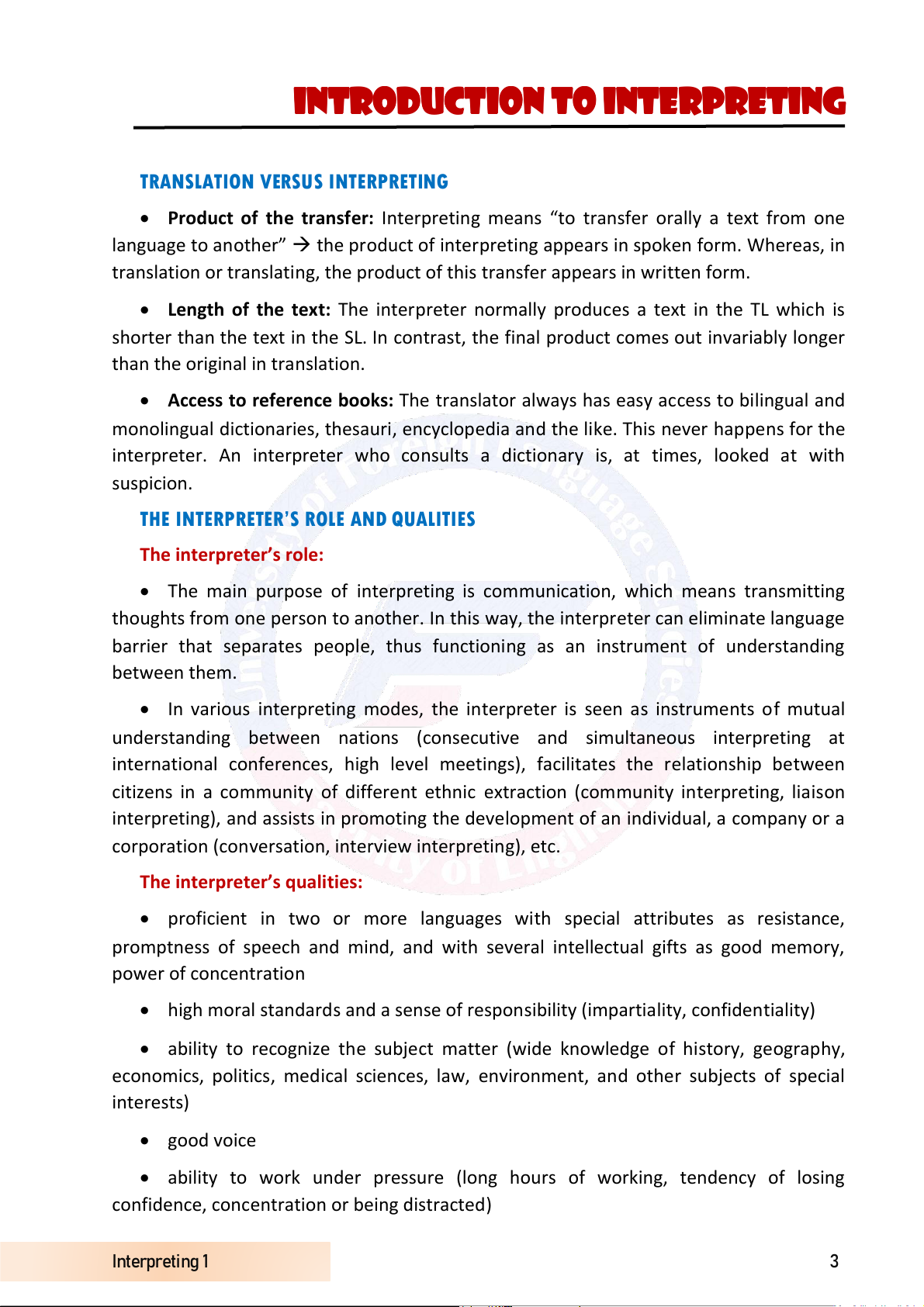
1. Consecutive interpreting:
• the most exhaustive form of interpreting;
• consisting of listening to a speech in one
language and translating or summarizing it orally into another;
• the time lapse between the speech and the interpretation varies.
1.1. Sentence-by-sentence interpreting:
• known as dialogue interpreting
• commonly used at courts, commissions, at conferences, interviews and other “triangular situation”
• requiring good memory training
1.2. Summarizing the whole speech:
• may last one, two, five, ten minutes up to half an hour interpreting
• requiring excellent memory and note-taking skills, obtainable by training and exercise 2. Sight translation:
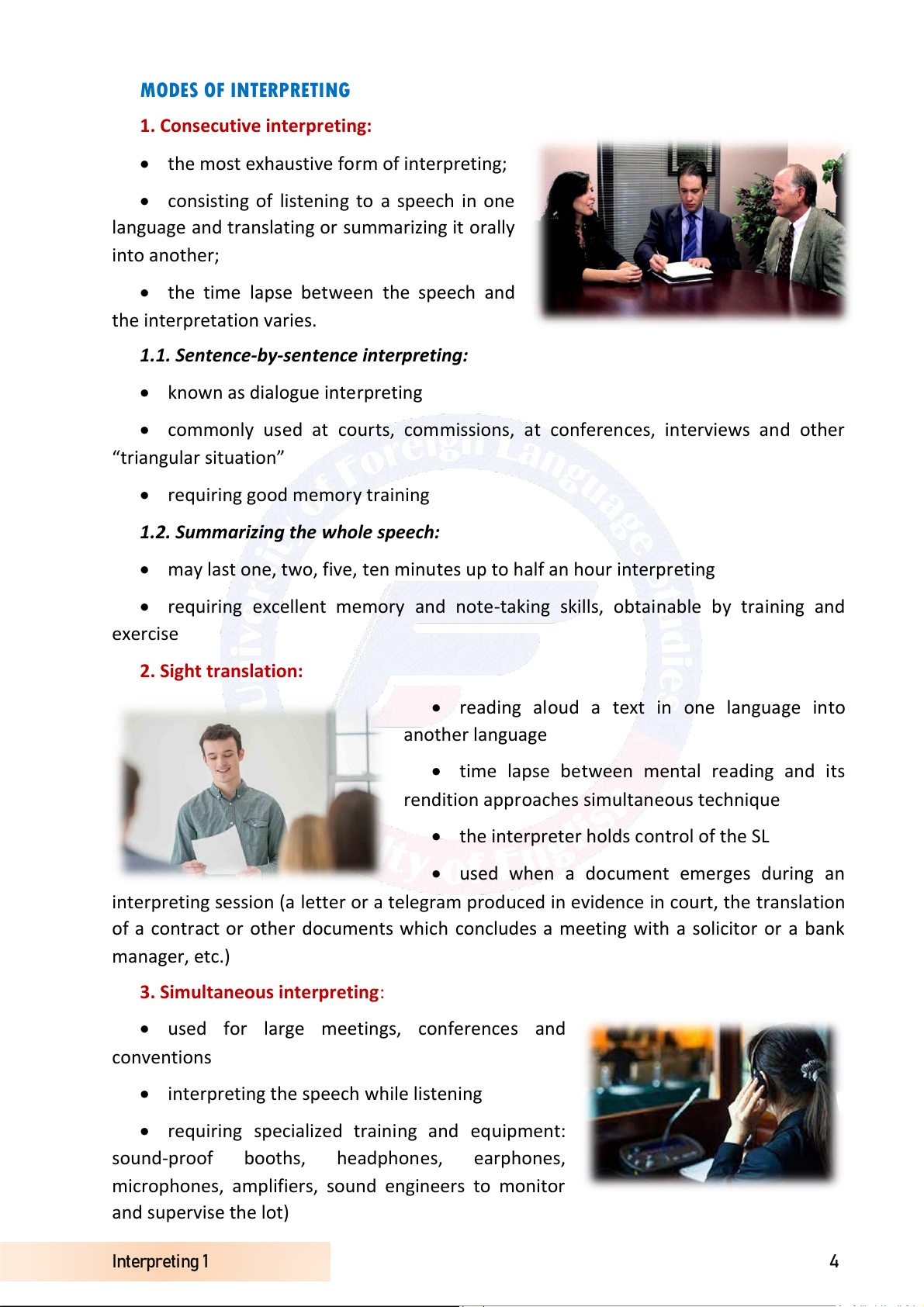
• reading aloud a text in one language into another language
• time lapse between mental reading and its
rendition approaches simultaneous technique
• the interpreter holds control of the SL
• used when a document emerges during an
interpreting session (a letter or a telegram produced in evidence in court, the translation
of a contract or other documents which concludes a meeting with a solicitor or a bank manager, etc.)
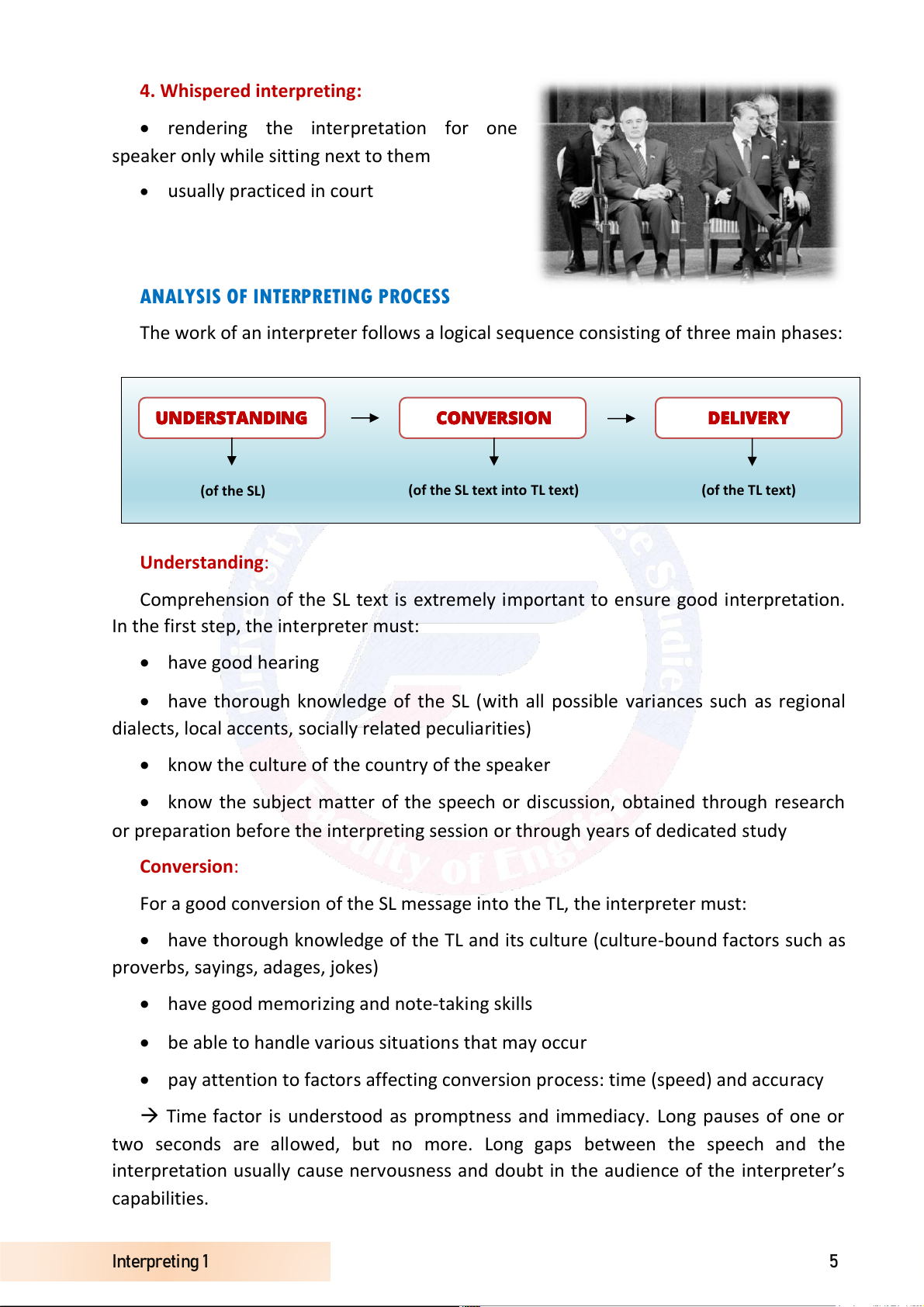
3. Simultaneous interpreting:
• used for large meetings, conferences and conventions
• interpreting the speech while listening
• requiring specialized training and equipment: sound-proof booths, headphones, earphones,
microphones, amplifiers, sound engineers to monitor and supervise the lot) Interpreting 1 4
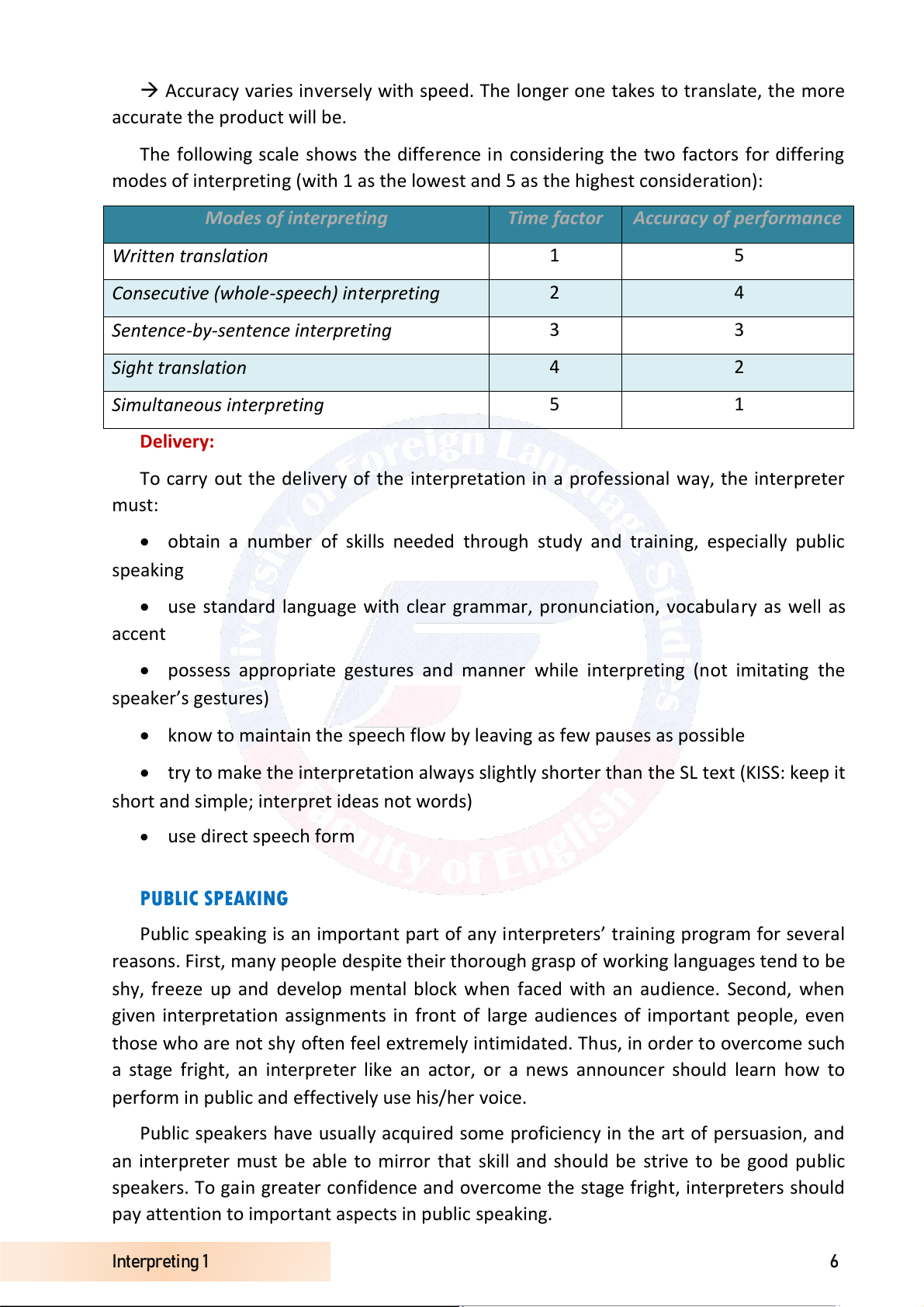
4. Whispered interpreting:
• rendering the interpretation for one
speaker only while sitting next to them
• usually practiced in court
ANALYSIS OF INTERPRETING PROCESS
The work of an interpreter follows a logical sequence consisting of three main phases: UNDER UNDE S R T S A T ND A I ND NG CO C NV O E NV R E S R I S O I N O DE D LI E V LI E V R E Y R (of the SL)
(of the SL text into TL text) (of the TL text) Understanding:
Comprehension of the SL text is extremely important to ensure good interpretation.
In the first step, the interpreter must: • have good hearing
• have thorough knowledge of the SL (with all possible variances such as regional
dialects, local accents, socially related peculiarities)
• know the culture of the country of the speaker
• know the subject matter of the speech or discussion, obtained through research
or preparation before the interpreting session or through years of dedicated study Conversion:
For a good conversion of the SL message into the TL, the interpreter must:
• have thorough knowledge of the TL and its culture (culture-bound factors such as
proverbs, sayings, adages, jokes)
• have good memorizing and note-taking skills
• be able to handle various situations that may occur
• pay attention to factors affecting conversion process: time (speed) and accuracy
→ Time factor is understood as promptness and immediacy. Long pauses of one or
two seconds are allowed, but no more. Long gaps between the speech and the
interpretation usually cause nervousness and doubt in the audience of the interpreter’s capabilities. Interpreting 1 5
→ Accuracy varies inversely with speed. The longer one takes to translate, the more accurate the product will be.
The following scale shows the difference in considering the two factors for differing
modes of interpreting (with 1 as the lowest and 5 as the highest consideration):
Modes of interpreting Time factor
Accuracy of performance Written translation 1 5
Consecutive (whole-speech) interpreting 2 4
Sentence-by-sentence interpreting 3 3 Sight translation 4 2
Simultaneous interpreting 5 1 Delivery:
To carry out the delivery of the interpretation in a professional way, the interpreter must:
• obtain a number of skills needed through study and training, especially public speaking
• use standard language with clear grammar, pronunciation, vocabulary as well as accent
• possess appropriate gestures and manner while interpreting (not imitating the speaker’s gestures)
• know to maintain the speech flow by leaving as few pauses as possible
• try to make the interpretation always slightly shorter than the SL text (KISS: keep it
short and simple; interpret ideas not words) • use direct speech form PUBLIC SPEAKING
Public speaking is an important part of any interpreters’ training program for several
reasons. First, many people despite their thorough grasp of working languages tend to be
shy, freeze up and develop mental block when faced with an audience. Second, when
given interpretation assignments in front of large audiences of important people, even
those who are not shy often feel extremely intimidated. Thus, in order to overcome such
a stage fright, an interpreter like an actor, or a news announcer should learn how to
perform in public and effectively use his/her voice.
Public speakers have usually acquired some proficiency in the art of persuasion, and
an interpreter must be able to mirror that skill and should be strive to be good public
speakers. To gain greater confidence and overcome the stage fright, interpreters should
pay attention to important aspects in public speaking. Interpreting 1 6
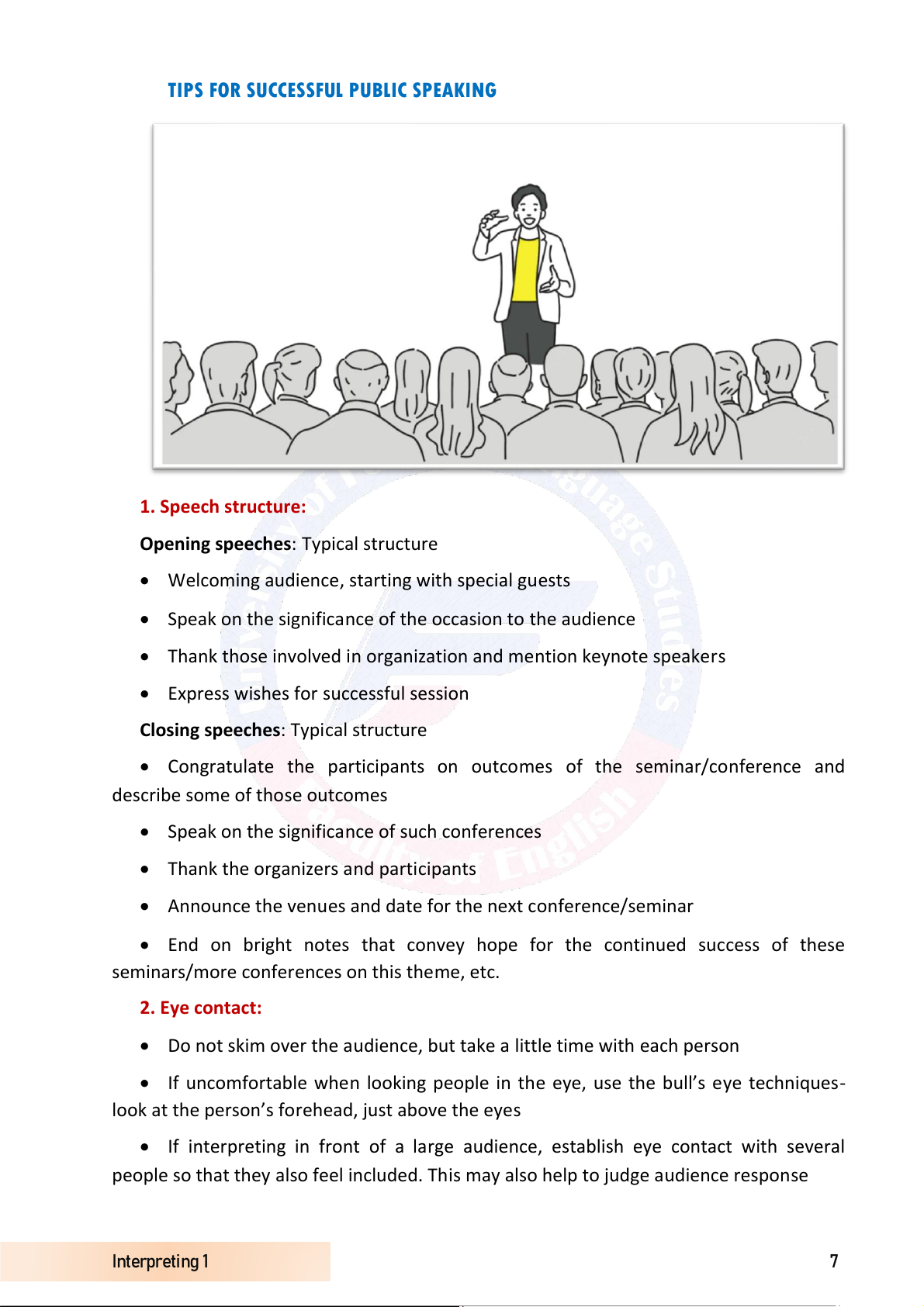
TIPS FOR SUCCESSFUL PUBLIC SPEAKING 1. Speech structure:
Opening speeches: Typical structure
• Welcoming audience, starting with special guests
• Speak on the significance of the occasion to the audience
• Thank those involved in organization and mention keynote speakers
• Express wishes for successful session
Closing speeches: Typical structure
• Congratulate the participants on outcomes of the seminar/conference and
describe some of those outcomes
• Speak on the significance of such conferences
• Thank the organizers and participants
• Announce the venues and date for the next conference/seminar
• End on bright notes that convey hope for the continued success of these
seminars/more conferences on this theme, etc. 2. Eye contact:
• Do not skim over the audience, but take a little time with each person
• If uncomfortable when looking people in the eye, use the bull’s eye techniques-
look at the person’s forehead, just above the eyes
• If interpreting in front of a large audience, establish eye contact with several
people so that they also feel included. This may also help to judge audience response Interpreting 1 7 3. Body language:
Nervous body language undermines the creditability of the speaker. Thus, it is
recommended to walk confidently and directly to the podium and hold your stomach in,
your shoulders back and your chest out. This projects confidence. And when you project
confidence, you usually end up feeling confident. 4. Posture:
• Posture is important in allowing good breath
• Do not stoop or hunch, and do not stand stiffly
• Place your weight evenly on both feet, without resting on either hip, position your shoulders evenly
• Do not tilt your head to the side, do not cross your legs, do not pull your head
back with the chin in, do not thrust your head forward with the chin out 5. Facial expressions:
Interpreters should possess appropriate facial expressions. They should never be too
sad or too happy in the course of interpreting. Nor should they show too much
enthusiasm or empathy over an issue or problem. 6. Appearance:
• Make sure your appearance (clothing, jewelry, hair, etc.) does not distract
listeners from your interpreting
• Dress smartly and stylishly, but conservatively and unobtrusively, avoiding patterns 7. Ways to relax:
In the minutes before the speech, when your nerves are at their worst, do some
exercises to release tension. Or try watch or visualize something funny as this will help you keep calm. 8. Voice:
Tape yourself. Evaluate your pace, speech control, volume control, rhythm, clarity, pronunciation, etc. Interpreting 1 8 UN U I N T I T 1 : MEMO ME R MO Y R Y Topic: Culture and Language
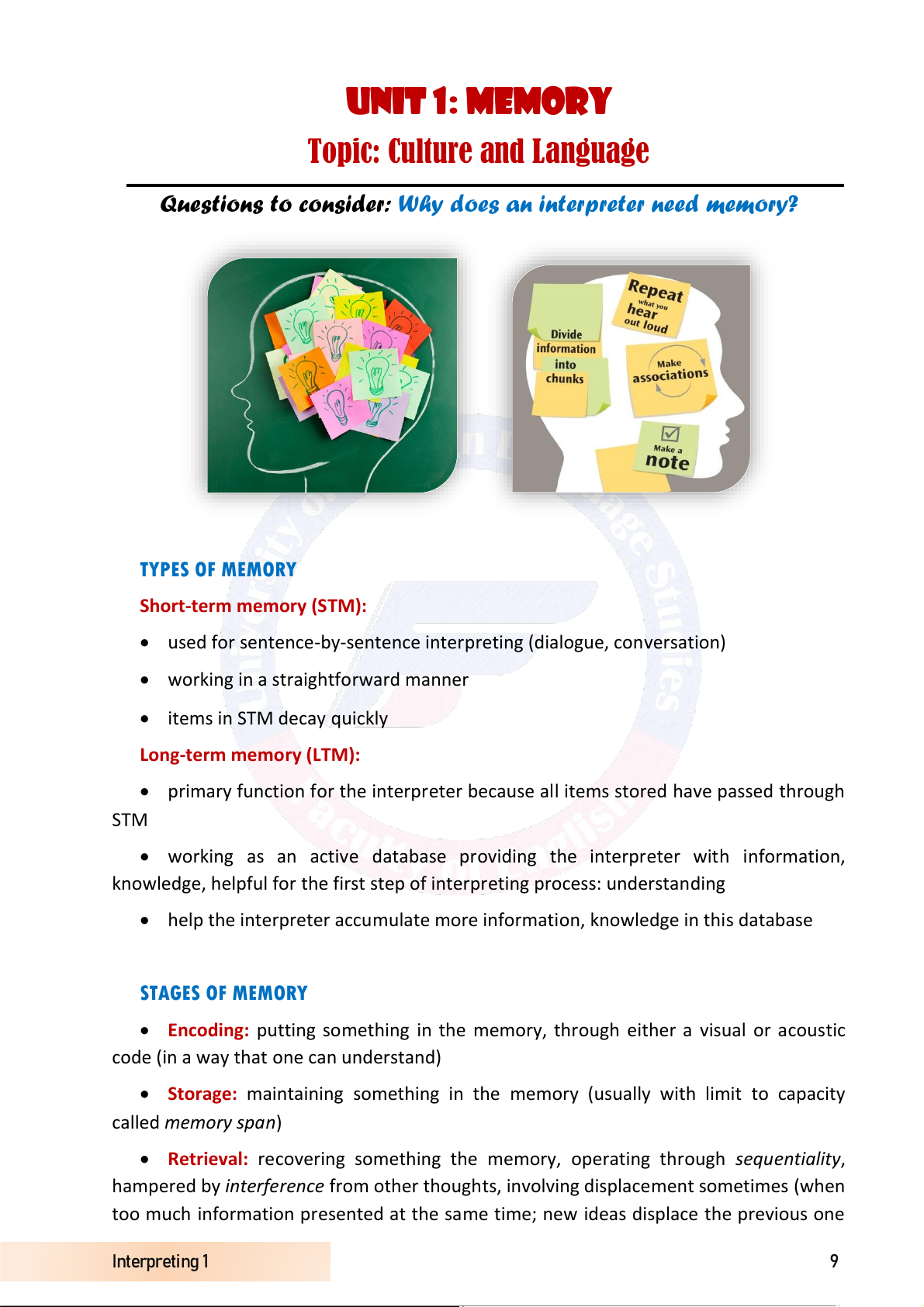
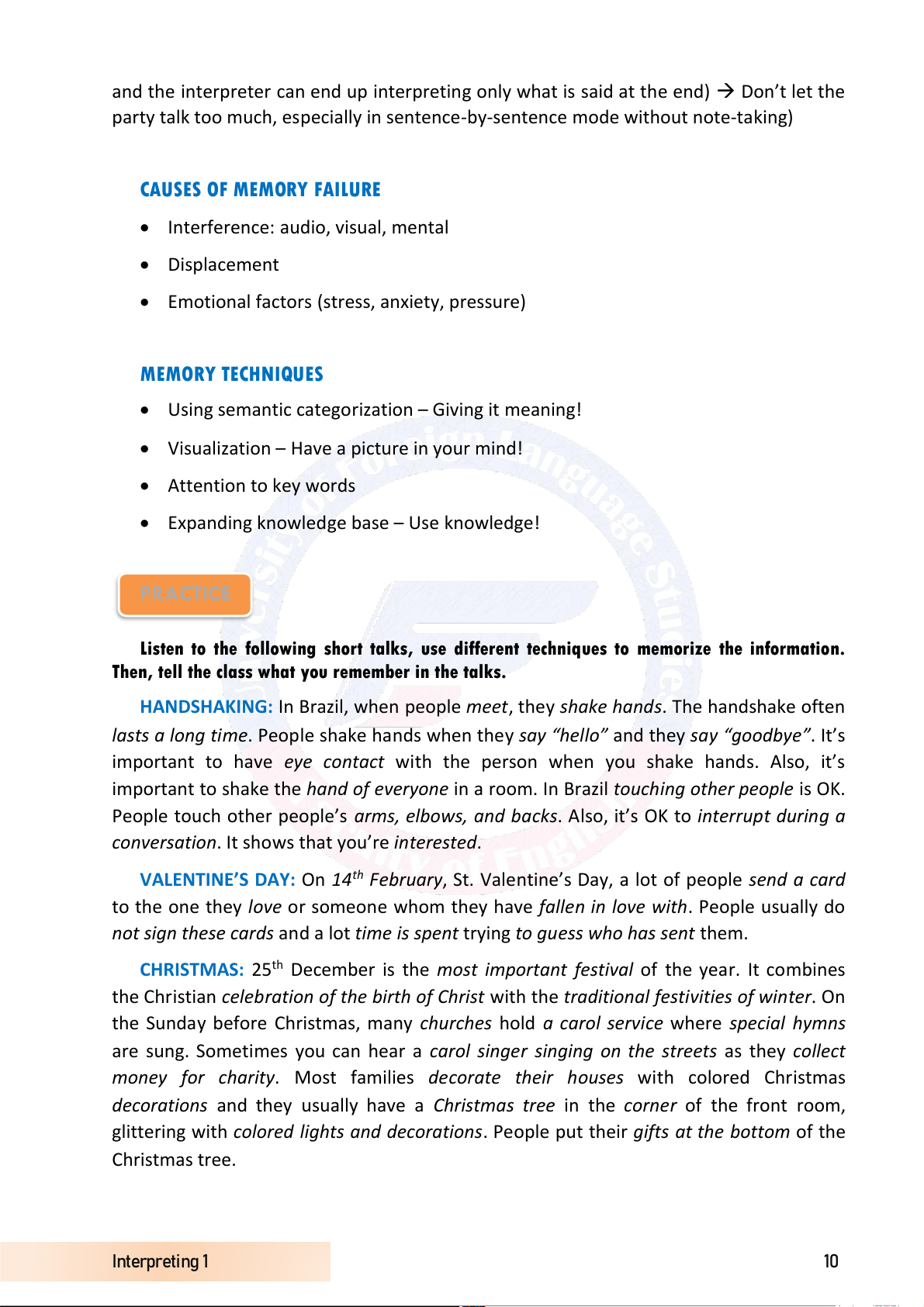
Questions to consider: Why does an interpreter need memory? TYPES OF MEMORY
Short-term memory (STM):
• used for sentence-by-sentence interpreting (dialogue, conversation)
• working in a straightforward manner
• items in STM decay quickly
Long-term memory (LTM):
• primary function for the interpreter because all items stored have passed through STM
• working as an active database providing the interpreter with information,
knowledge, helpful for the first step of interpreting process: understanding
• help the interpreter accumulate more information, knowledge in this database STAGES OF MEMORY
• Encoding: putting something in the memory, through either a visual or acoustic
code (in a way that one can understand)
• Storage: maintaining something in the memory (usually with limit to capacity called memory span)
• Retrieval: recovering something the memory, operating through sequentiality,
hampered by interference from other thoughts, involving displacement sometimes (when
too much information presented at the same time; new ideas displace the previous one Interpreting 1 9
and the interpreter can end up interpreting only what is said at the end) → Don’t let the
party talk too much, especially in sentence-by-sentence mode without note-taking)
CAUSES OF MEMORY FAILURE
• Interference: audio, visual, mental • Displacement
• Emotional factors (stress, anxiety, pressure) MEMORY TECHNIQUES
• Using semantic categorization – Giving it meaning!
• Visualization – Have a picture in your mind! • Attention to key words
• Expanding knowledge base – Use knowledge! PRACTICE
Listen to the following short talks, use different techniques to memorize the information.
Then, tell the class what you remember in the talks.
HANDSHAKING: In Brazil, when people meet, they shake hands. The handshake often
lasts a long time. People shake hands when they say “hello” and they say “goodbye”. It’s
important to have eye contact with the person when you shake hands. Also, it’s
important to shake the hand of everyone in a room. In Brazil touching other people is OK.
People touch other people’s arms, elbows, and backs. Also, it’s OK to interrupt during a
conversation. It shows that you’re interested.
VALENTINE’S DAY: On 14th February, St. Valentine’s Day, a lot of people send a card
to the one they love or someone whom they have fallen in love with. People usually do
not sign these cards and a lot time is spent trying to guess who has sent them.
CHRISTMAS: 25th December is the most important festival of the year. It combines
the Christian celebration of the birth of Christ with the traditional festivities of winter. On
the Sunday before Christmas, many churches hold a carol service where special hymns
are sung. Sometimes you can hear a carol singer singing on the streets as they collect
money for charity. Most families decorate their houses with colored Christmas
decorations and they usually have a Christmas tree in the corner of the front room,
glittering with colored lights and decorations. People put their gifts at the bottom of the Christmas tree. Interpreting 1 10 PRE-INTERPRETING
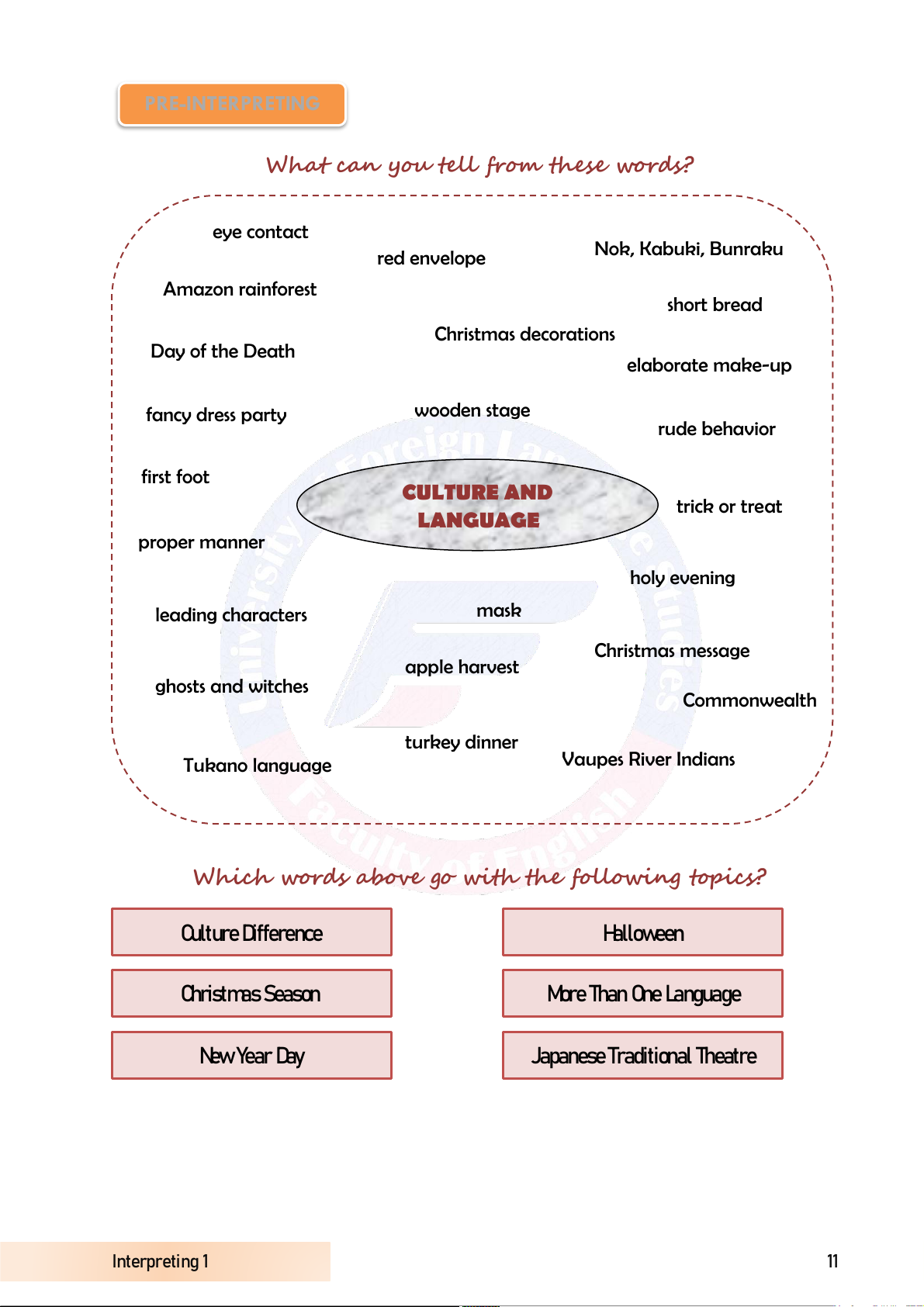
What can you tell from these words? eye contact Nok, Kabuki, Bunraku red envelope Amazon rainforest short bread Christmas decorations Day of the Death elaborate make-up fancy dress party wooden stage rude behavior first foot CULTURE AND trick or treat LANGUAGE proper manner holy evening leading characters mask Christmas message apple harvest ghosts and witches Commonwealth turkey dinner Tukano language Vaupes River Indians
Which words above go with the following topics? Culture Difference Halloween Christmas Season More Than One Language New Year Day Japanese Traditional Theatre Interpreting 1 11
ENGLISH VIETNAMESE INTERPRETING PRACTICE –
Listen to the following pieces of talks about cultural issues. Before you listen, discuss the
idea for each talk and give the Vietnamese equivalents to the words/phrases given. Use
memorizing technique to rephrase the ideas of the talk, and then interpret into Vietnamese. 1. CULTURAL DIFFERENCE
• to be considered normal / strange or unacceptable
• western cultures / eastern cultures • eye contact • proper manners • to discourage eye contact
• to be viewed as rude behavior • disrespect 2. NEW YEAR DAY a. Karen
• not so much New Year’s Day
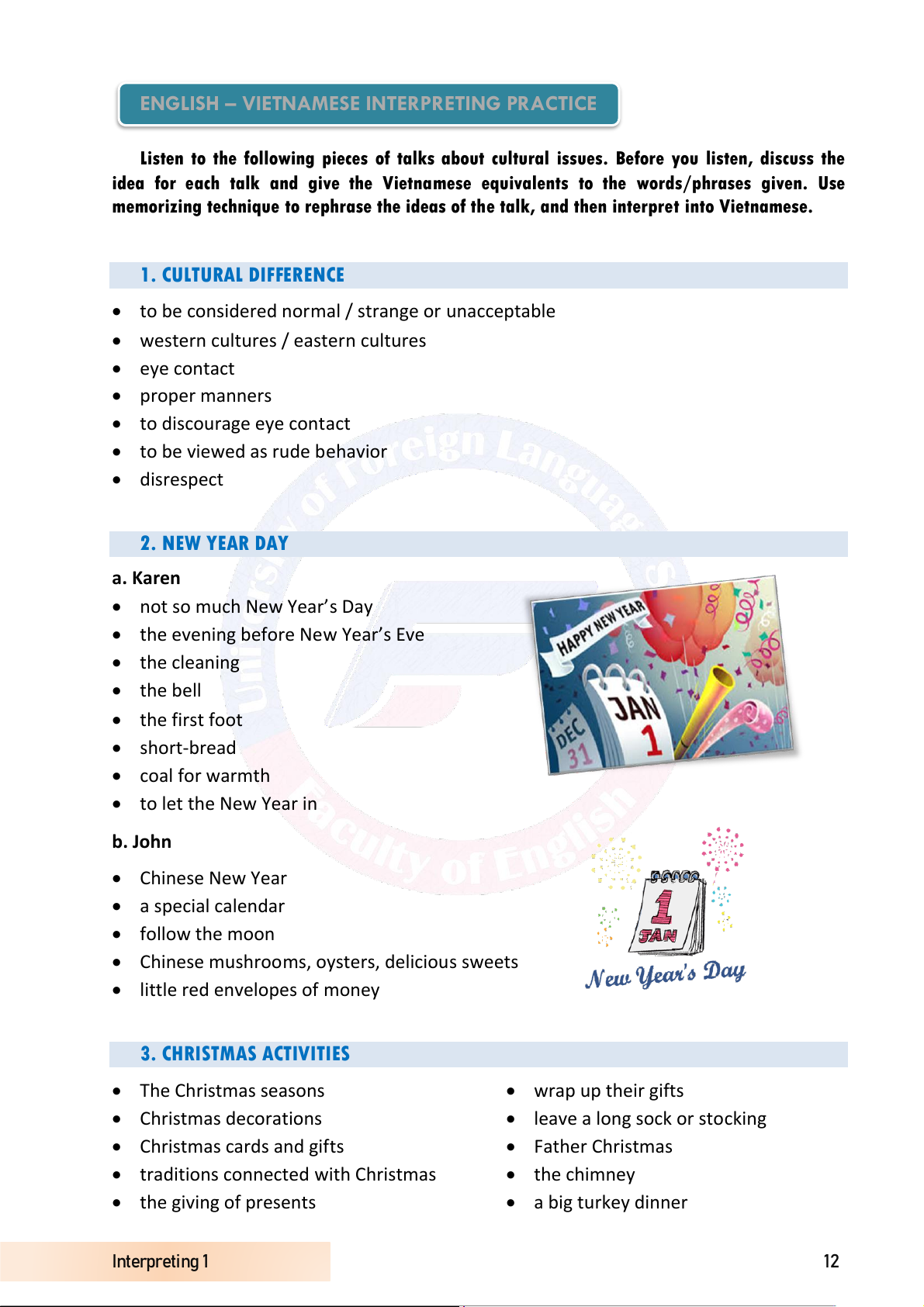
• the evening before New Year’s Eve • the cleaning • the bell • the first foot • short-bread • coal for warmth • to let the New Year in b. John • Chinese New Year • a special calendar • follow the moon
• Chinese mushrooms, oysters, delicious sweets
• little red envelopes of money
3. CHRISTMAS ACTIVITIES • The Christmas seasons • wrap up their gifts • Christmas decorations
• leave a long sock or stocking • Christmas cards and gifts • Father Christmas
• traditions connected with Christmas • the chimney • the giving of presents • a big turkey dinner Interpreting 1 12 • Christmas pudding • the Queen on television
• traditional Christmas message
• the United Kingdom and the Commonwealth
• have room for even more food
• Christmas cake / a hot mince pie
• a public holiday - Boxing Day 4. HALLOWEEN • holy evening
• eat an apple from a bucket of water • connected with ghosts • dressed in white sheets
• dress up in strange costumes
• knock on doors at Halloween • pretend they are witches
• a “trick” or “treat”
• cut horrible faces in pumpkins • play a trick on you • put a candle inside • making a lot of noise • shines through the eyes
• spilling flour on your front doorstep
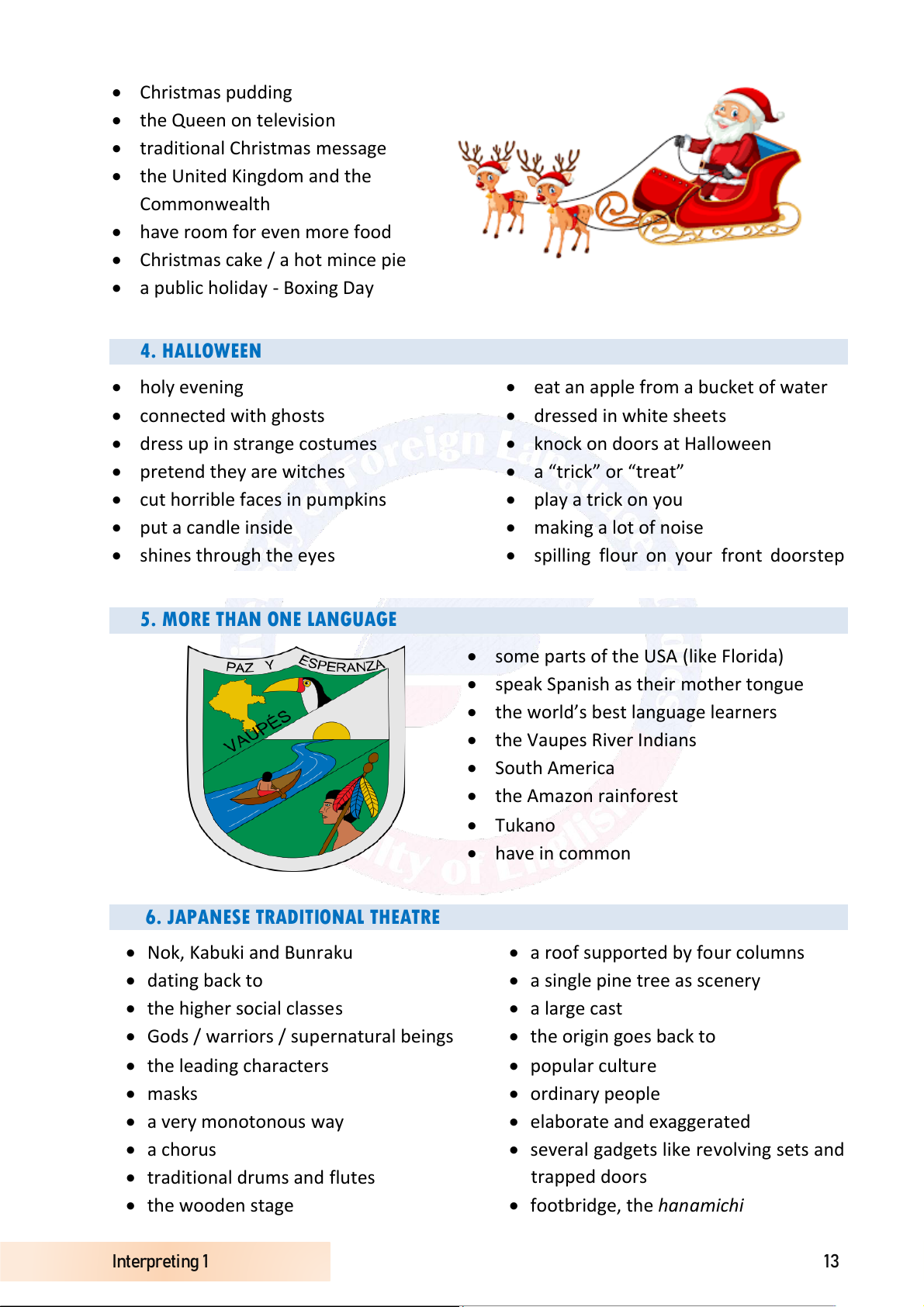
5. MORE THAN ONE LANGUAGE
• some parts of the USA (like Florida)
• speak Spanish as their mother tongue
• the world’s best language learners • the Vaupes River Indians • South America • the Amazon rainforest • Tukano • have in common
6. JAPANESE TRADITIONAL THEATRE • Nok, Kabuki and Bunraku
• a roof supported by four columns • dating back to
• a single pine tree as scenery • the higher social classes • a large cast
• Gods / warriors / supernatural beings • the origin goes back to • the leading characters • popular culture • masks • ordinary people • a very monotonous way • elaborate and exaggerated • a chorus
• several gadgets like revolving sets and
• traditional drums and flutes trapped doors • the wooden stage
• footbridge, the hanamichi Interpreting 1 13
• dramatic entrances and exits • manipulated
• traditional Japanese puppet theatre • the puppeteer
• has its origin in the Edo period • traditional formal dress • emotional conflicts • assistants • to commit suicide
• an instrument called a samisen
VIETNAMESE ENGLISH INTERPRETING PRACTICE –
Listen to the following pieces of news in Vietnamese. Rephrase the news in your own words
using your memory, and then do sight translation into English.
1. NHỮNG NGÀY VĂN HÓA NGA TẠI VIỆT NAM
Tối 05/10 tại Nhà hát lớn Hà Nội diễn ra lễ khai mạc Những Ngày Văn hóa Nga tại Việt
Nam. Đây là dịp để khán giả Việt Nam có cơ hội thưởng thức các giá trị văn hóa Nga vốn
rất đặc sắc, phong phú mà cũng gần gũi với người Việt Nam. Sự kiện này cũng là minh
chứng cho thấy hai dân tộc luôn quan tâm đến văn hóa của nhau. Một số hoạt động đáng
chú ý trong sự kiện này bao gồm triển lãm với chủ đề Thiên nhiên miền bắc nước Nga,
và chương trình hòa nhạc của các nghệ sĩ thính phòng nổi tiếng. Những Ngày Văn hóa
Nga tại Việt Nam sẽ diễn ra tại Hà Nội và thành phố Hồ Chí Minh từ ngày 05 đến ngày 10/10.
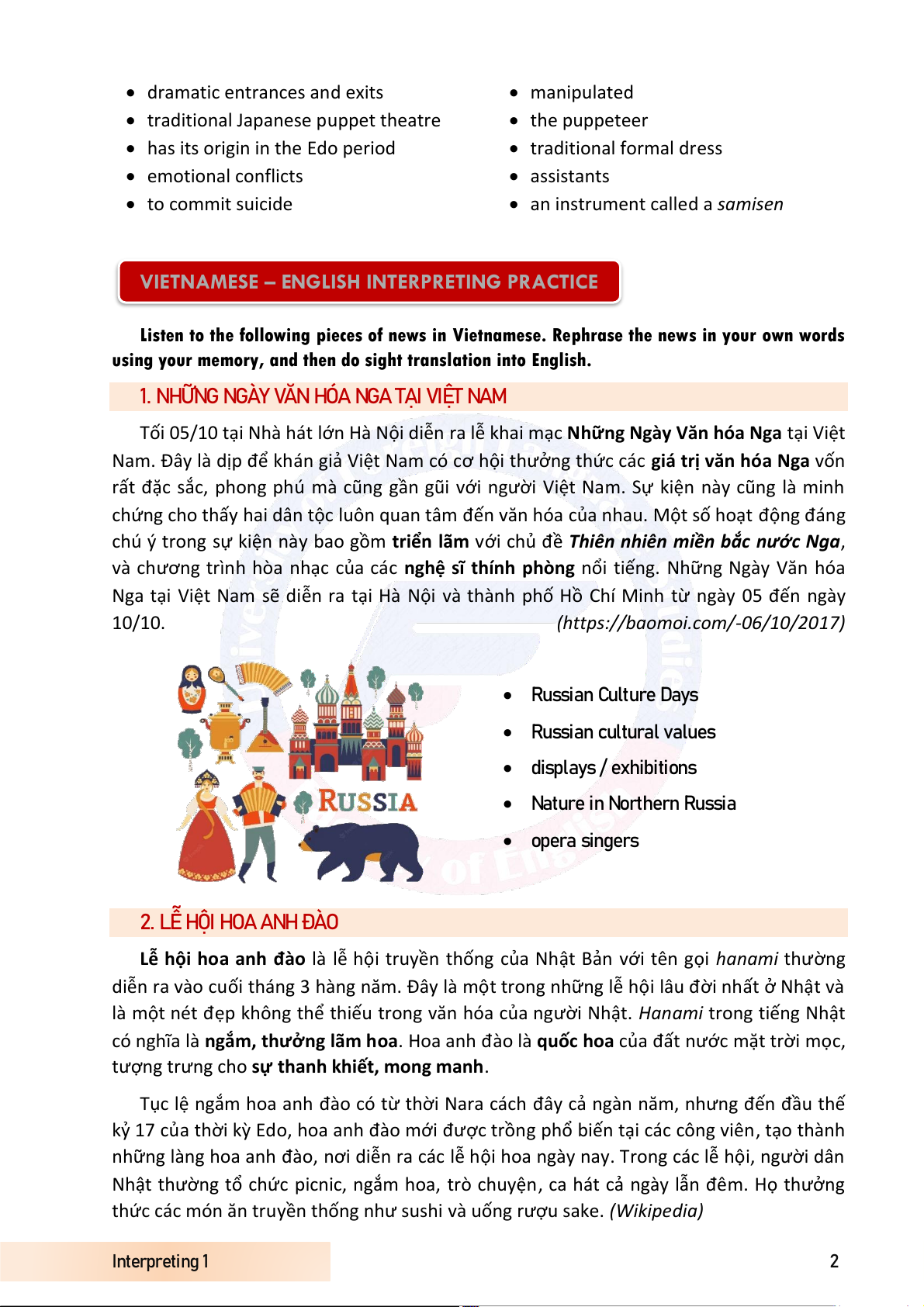
(https://baomoi.com/-06/10/2017) • Russian Culture Days • Russian cultural values • displays / exhibitions • Nature in Northern Russia • opera singers 2. LỄ HỘI HOA ANH ĐÀO
Lễ hội hoa anh đào là lễ hội truyền thống của Nhật Bản với tên gọi hanami thường
diễn ra vào cuối tháng 3 hàng năm. Đây là một trong những lễ hội lâu đời nhất ở Nhật và
là một nét đẹp không thể thiếu trong văn hóa của người Nhật. Hanami trong tiếng Nhật
có nghĩa là ngắm, thưởng lãm hoa. Hoa anh đào là quốc hoa của đất nước mặt trời mọc,
tượng trưng cho sự thanh khiết, mong manh.
Tục lệ ngắm hoa anh đào có từ thời Nara cách đây cả ngàn năm, nhưng đến đầu thế
kỷ 17 của thời kỳ Edo, hoa anh đào mới được trồng phổ biến tại các công viên, tạo thành
những làng hoa anh đào, nơi diễn ra các lễ hội hoa ngày nay. Trong các lễ hội, người dân
Nhật thường tổ chức picnic, ngắm hoa, trò chuyện, ca hát cả ngày lẫn đêm. Họ thưởng
thức các món ăn truyền thống như sushi và uống rượu sake. (Wikipedia) Interpreting 1 2 • peach blossom festival • flower viewing • national flower
• purity and impermanence of beauty
3. LỄ HỘI ẨM THỰC VÀ VĂN HÓA CHÂU Á
Lễ hội Ẩm thực và Văn hóa châu Á 2018 được tổ chức với mục đích tôn vinh nét tinh túy,
đa dạng về ẩm thực cũng như đặc trưng văn hóa các quốc gia trong khu vực Châu Á. Diễn
ra từ 27/4 - 29/4/2018 tại Quảng trường 30/10, Thành phố Hạ Long, tỉnh Quảng Ninh,
chuỗi sự kiện Lễ hội ẩm thực và văn hóa Châu Á tại Hạ Long nhằm hưởng ứng “Năm du
lịch quốc gia 2018” với chủ đề “Hạ Long Di sản, Kỳ quan – Điểm đến thân thiện”. Đây là
chuỗi sự kiện đầy ý nghĩa, mang tính cộng đồng và nhân văn sâu sắc dành cho nhiều đối
tượng cá nhân và gia đình, mở đầu cho mùa hè sôi động năm 2018.
(https://dangcongsan.vn/quang-ninh-co-hoi-dau-tu-va-phat-trien-ben-vung/ ) 28/04/2018
Lễ hội Ẩm thực và Văn hóa châu Á 2018: Mon Asian Food Festival – MAFF 2018
4. LỄ HỘI PHÁO HOA ĐÀ NẴNG
Đà Nẵng là một trong những địa điểm du lịch nổi tiếng của Việt Nam. Trong những năm trở lại
đây, Đà Nẵng luôn đón hàng triệu lượt khách trong và ngoài nước. Lễ hội pháo hoa Đà Nẵng là
một lễ hội thường niên được tổ chức với tên tiếng Anh là Danang International Fireworks
Festival, viết tắt là DIFF. Sau 10 năm, đây đã trở thành một trong những lễ hội pháo hoa lớn nhất
thế giới. Uỷ ban nhân dân thành phố Đà Nẵng tổ chức lễ hội lần đầu tiên vào năm 2008. Trong
thời điểm này, cuộc thi thường diễn ra trong hai ngày từ 27 đến 28 tháng 3 tại bờ sông Hàn.
(https://vn.alongwalker.co/le-hoi-phao-hoa-da-nang-2021-va-nhung-dieu-can-biet.html) SELF-STUDY TASK
➢ Go to the self-study material provided on LMS and do further practice about the topic of Language and Culture.
➢ Practice using memory techniques to interpret the English talks into Vietnamese.
➢ Do sight translation for the Vietnamese texts into English.
➢ Learn the vocabulary related to the topic of Culture and Language, record them in the glossary for interpreting. FURTHER PRACTICE Interpreting 1 15
- Search for more practice of listening and interpreting from the following website:
http://www.bbc.co.uk/worldservice/learningenglish/general/sixminute/2010/12/101 209_6min_tea_page.shtml
- Practice interpreting the talk “The Meaning of Colour” from Huong Dan Ky Thuat
Phien Dich Anh-Viet, Viet-Anh (2007) by Nguyen Quoc Hung, Ho Chi Minh City Publishing House. Interpreting 1 16 UN U I N T I T 2 : NO N T O E T - E TA T K A I K N I G N G
Topic: Tourism and Places of Interest
INTRODUCTION TO NOTE-TAKING WHY TO NOTE
• provide support to the memory, when there are too
many elements for the interpreter to remember,
particularly when the speech contains numbers, names, lists …
• help relieve memory and interpreters’ fatigue
during the understanding of the speech
• help the interpreter reproduce the structure of the
speech / retrace how ideas are related and separated from one another WHEN TO NOTE
• start as soon as possible, arrange the notes later with various symbols or signs
when having understood the whole ideas (subject → object)
• only during the speech; stop noting when the speaker finishes the speech
• avoid being left behind; adjust between timing and note-taking
• when anticipating that numbers or lists are going to be presented, the interpreter
needs to be highly attentive to the speech to note down the numbers and lists WHAT TO NOTE
• main ideas → creating an outline for the interpretation. With a good memory,
note-taking for main ideas is not very important. However, it helps the interpreter to
retrace the order of these ideas as outlined
• linking words → forming the relations between ideas
• numbers / figures (percentage, dates, measurement) → always with meanings (for
example: 25 mil. pp = 25 million people)
• proper names (people, countries, organizations, publications, events) → with
accuracy. In case the interpreter cannot write down the difficult names, note the sound
of the names as originally spoken in the SL, and then read it as exactly as possible
• lists → as sufficient as possible. In case the interpreter cannot note down all the
items in the list, try to have at least some of them, and use etc. during the interpretation. Interpreting 1 17
If the complete list is of some importance, the interpreter can ask the speaker for the
missing items and fill in the space of the note. HOW TO NOTE
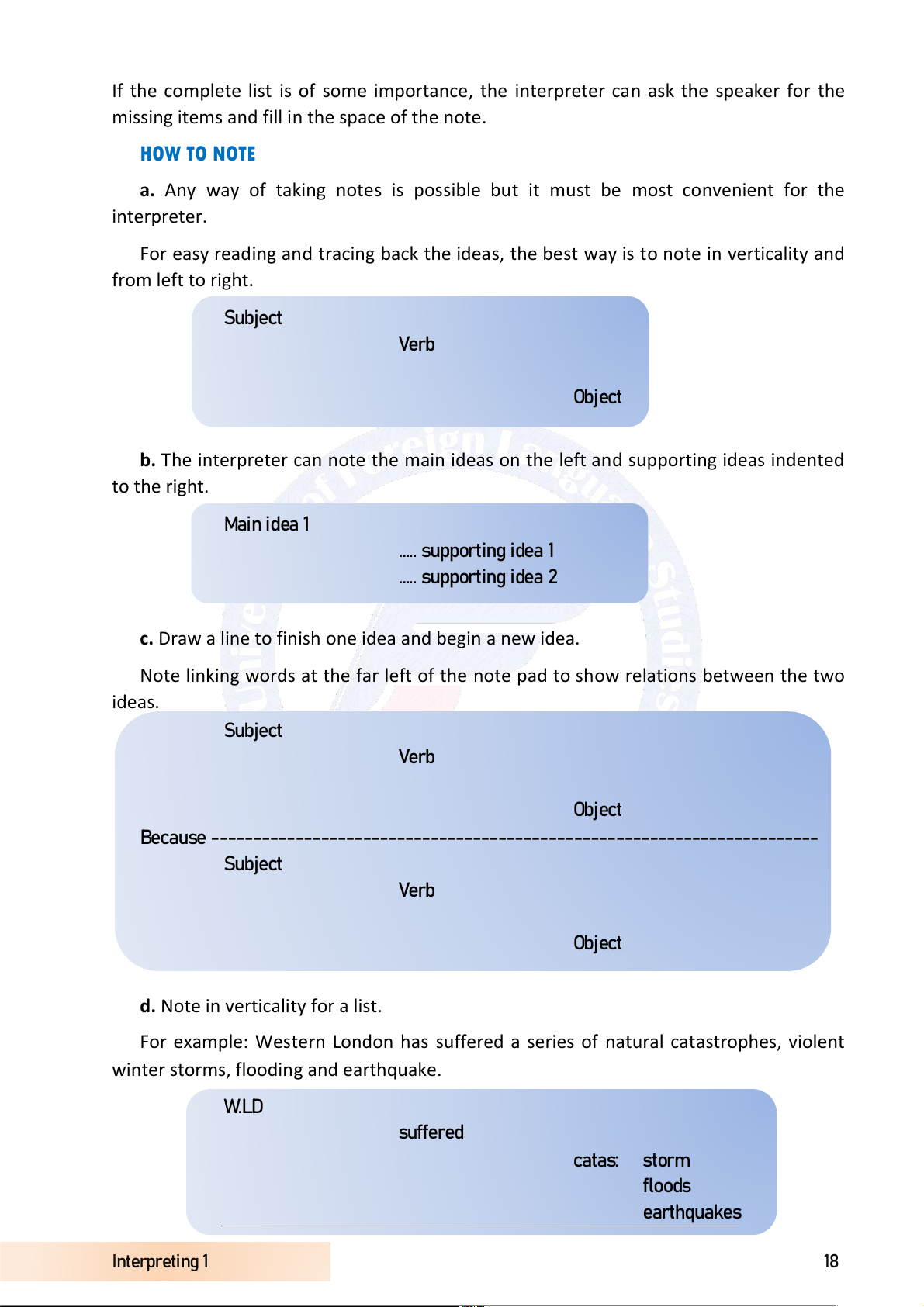
a. Any way of taking notes is possible but it must be most convenient for the interpreter.
For easy reading and tracing back the ideas, the best way is to note in verticality and from left to right. Subject Verb Object
b. The interpreter can note the main ideas on the left and supporting ideas indented to the right. Main idea 1 …. supporting idea 1 …. supporting idea 2
c. Draw a line to finish one idea and begin a new idea.
Note linking words at the far left of the note pad to show relations between the two ideas. Subject Verb Object
Because ------------------------------------------------------------------------ Subject Verb Object
d. Note in verticality for a list.
For example: Western London has suffered a series of natural catastrophes, violent
winter storms, flooding and earthquake. W.LD suffered catas: storm floods earthquakes Interpreting 1 18