Lecture 10: Class, Method, Subclass môn Nhập môn lập trình | Trường Đại học Công nghệ, Đại học Quốc gia Hà Nội
Lecture 10: Class, Method, Subclass môn Nhập môn lập trình | Trường Đại học Công nghệ, Đại học Quốc gia Hà Nội. Tài liệu được sưu tầm giúp bạn tham khảo, ôn tập và đạt kết quả cao. Mời bạn đọc đón xem.
Môn: Nhập môn lập trình (UET) 14 tài liệu
Trường: Trường Đại học Công nghệ, Đại học Quốc gia Hà Nội 824 tài liệu
Tác giả:



















Preview text:
Computational Thinking
Lecture 10: Class, Method, Subclass
University of Engineering and Technology
VIETNAM NATIONAL UNIVERSITY HANOI Outline ▪ Classes: initializers
▪ Methods and the self parameter
▪ Methods for string representations of objects
▪ Subclassing and inheritance ▪ The Python class hierarchy ▪ Method overriding ▪ Exceptions and subclassing ▪ Equivalence Reading for today: Think Python, 3rd ed., 15.{1,2,5,6}, 17.{1,2,5,8,9} Classes:
Constructors & Initializers Computational Thinking 2 Classes
● An object's type is a class
● An object is an instance of a class
● The name of a class can be used as a constructor
function that instantiates (creates) objects
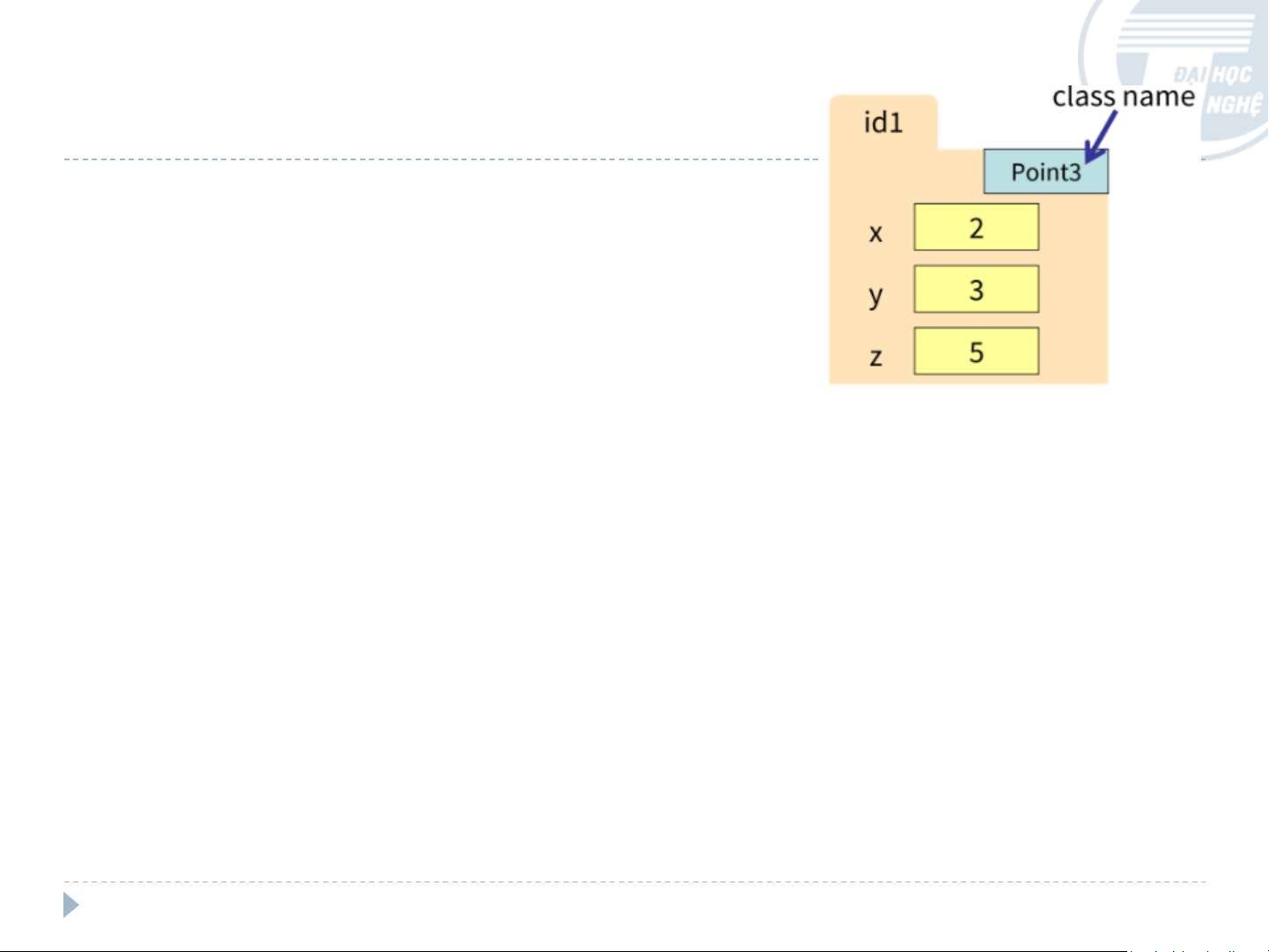
● Classes also provide methods: special functions that can be used with objects Computational Thinking 3 Example: a Class for 3D Points class Point3: The simplest possible class pass
definition. Just a name, no body.
Instantiate object of the class by p = Point3() calling constructor function. Same name as class. p.x = 2 p.y = 3 Assign to attributes. p.z = 5 Computational Thinking 4 Initializing Attributes Tedious and error-prone to p = Point3()
manually initialize attributes like p.x = 2 this! p.y = 3
• What if we forget an attribute? p.z = 5
• What if we misspell an attribute name?
• What if we store data of wrong type in p2 = Point3() attribute? p2.eks = 2 p2.z = 'five' We need a means to ensure
attributes are initialized uniformly
and correctly for all objects of the class. 5 Computational Thinking 5 The Initializer Method two "double underscores" aka dunders class Point3:
def __init__(obj, x_val, y_val, z_val): obj.x = x_val obj.y = y_val obj.z = z_val point1 = Point3(2, 3, 5) Computational Thinking 6
Conventional parameter name: self class Point3:
def __init__(self, x_val, y_val, z_val): self.x = x_val self.y = y_val self.z = z_val Python programmers expect the first parameter point1 = Point3(2, 3, 5) name here to be self. Not obj or this etc. Python itself doesn't care which name you use, but for sake of good communication with other programmers, use self Computational Thinking 7
Example: a Class for Social Media Posts class Post: def __init__(self, text):
"""A post with whose text is `text` and with no likes so far.""" self.text = text self.n_likes = 0 post1 = Post('good vibes') A common convention: give the parameter and the attribute the same name. Computational Thinking 8 Object Creation Protocol You want to know
Given a constructor function call: all of this by heart. () Python does the following:
1. Creates a new object (folder) in heap space
2. Gives that object an identifier
3. Calls the __init__ method aka initializer of
A. Passes the new object's identifier as the first argument to the initializer
B. Passes the remaining (if any) from the constructor
function call as the rest of the arguments to the initializer
C. The initializer must return None (i.e., no return statement)
4. Returns the new object's identifier as the result of the constructor function call Computational Thinking 9 Summary: Class Syntax So Far Class Definition Initializer Method class : def __init__(self, ): ● The class name should be ● The method name must be capitalized for new classes
__init__ with dunders you create
● The first argument should be
● Built-in Python types (str, named self
list, ...) do not always follow that rule Computational Thinking 10
Do All Methods Have Dunder Names?
Definitely not! Recall these list methods: lst.index(item)
The index of the first occurrence of item in lst. lst.insert(i, item)
Insert item into lst just before the item at index i, shifting items to the right. lst.append(item) Insert item at the end of lst. lst1.extend(lst2)
Append al the items of lst2 to lst1.
"Dunder methods" are for specialized Python-specific tasks.
Most methods we define will not be dunders. Computational Thinking 11 Methods What are Methods?
● Practically, methods are class C:
functions nested inside a class def __init__(self):
● Conceptually, methods are ...
messages we can send to objects
○ The object might exhibit or
participate in some behavior in response to a message
○ The object might reply with a message (a return value); or it might not Computational Thinking 13
Example: "Messages" to a Tally Counter
● Tell me your current count
● Increment your count ● Reset your count Computational Thinking 14 A Counter Class class Counter: def __init__(self): ... def currCount(self): ... def incr(self): ... def reset(self): ...
>>> ctr = methods.Counter() >>> ctr.currCount() 0 >>> ctr.incr() >>> ctr.currCount() 1 Computational Thinking 15 How Methods Work
1. Methods use self to access attributes
2. Method calls make the object the self parameter
3. Methods are stored in class folder Computational Thinking 16
1. Methods Use self to Access Attributes class Counter: Initializer creates an def __init__(self): attribute in self's self.count = 0 folder def currCount(self): Other methods return self.count use that attribute def incr(self): through self self.count = self.count + 1 def reset(self): self.count = 0 Computational Thinking 17
2. Method Calls Make the Object the self Param. Method call syntax: .() The call is executed as: (, )
That is how the receiver object* becomes the
value of the self parameter to the method
* the object that receives the message. Computational Thinking 18
2. Method Calls Make the Object the self Param.
Therefore if you forget the self parameter in a method header,
you will get an error about a missing argument when that method is called. class Counter: def __init__(self): ctr.currCount() self.count = 0 def currCount(self): currCount(ctr) return self.count >>> ctr = Counter() >>> ctr.currCount()
TypeError: Counter.currCount() takes 0 positional arguments but 1 was given Computational Thinking 19
Tài liệu liên quan:
-
Một số vấn đề xử lý ngoại lệ trong C++ - TS. Trần Thanh Hải. Môn Nhập môn lập trình (UET) | Trường Đại học Công nghệ, Đại học Quốc gia Hà Nội.
77 39 -
Ôn tập cấu trúc dữ liệu và giải thuật - KTLT - FFF. Môn Nhập môn lập trình (UET) | Trường Đại học Công nghệ, Đại học Quốc gia Hà Nội.
87 44 -
Kiến thức C++ - Cấu trúc Dữ liệu và Các Hàm Cơ Bản. Môn Nhập môn lập trình (UET) | Trường Đại học Công nghệ, Đại học Quốc gia Hà Nội.
80 40 -
Lý thuyết và Bài Tập C++ - LTNC: Câu hỏi và Giải thích. Môn Nhập môn lập trình (UET) | Trường Đại học Công nghệ, Đại học Quốc gia Hà Nội.
81 41