Lectures 9-10. QuicksortIntroduction to AlgorithmsDa Nang University of Science and Technology | Tài liệu Tiếng Anh
Lectures 9-10. QuicksortIntroduction to AlgorithmsDa Nang University of Science and Technology | Tài liệu Tiếng Anh
Môn: Tiếng Anh chuyên ngành 332 tài liệu
Trường: Tài liệu Tiếng Anh chuyên ngành, Tiếng Anh cho người đi làm 432 tài liệu
Tác giả:














Preview text:
Lectures 9-10. Quicksort Introduction to Algorithms
Da Nang University of Science and Technology Dang Thien Binh dtbinh@dut.udn.vn
Intelligent Networking Laboratory Copyright 2000-2022 DANG Intelligent Ne THIEN BIN two H rking Labo 1/44 ratory Introduction of Quicksort
Worst-case running time: Θ(𝑛²)
Expected running time: Θ(𝑛 lg 𝑛)
Constants hidden in Θ(𝑛 lg 𝑛) are small
Another divide-and-conquer algorithm
Intelligent Networking Laboratory DANG THIEN BINH 2/44 Quicksort
To sort the subarray 𝐴[𝑝 . . 𝑟] Divide
Partition 𝐴[𝑝. . 𝑟], into two (possibly empty) subarrays 𝐴[𝑝 . . 𝑞 − 1]
and 𝐴[𝑞 + 1 . . 𝑟], such that each element of 𝐴[𝑝 . . 𝑞 − 1] is less
than or equal to each element of 𝐴[𝑞 + 1 . . 𝑟] Conquer
Sort the two subarrays by recursive calls to QUICKSORT Combine
No work is needed to combine the subarrays because they are already sorted
Perform the divide step by a procedure PARTITION,
which returns the index 𝑞 that marks the position separating the subarrays
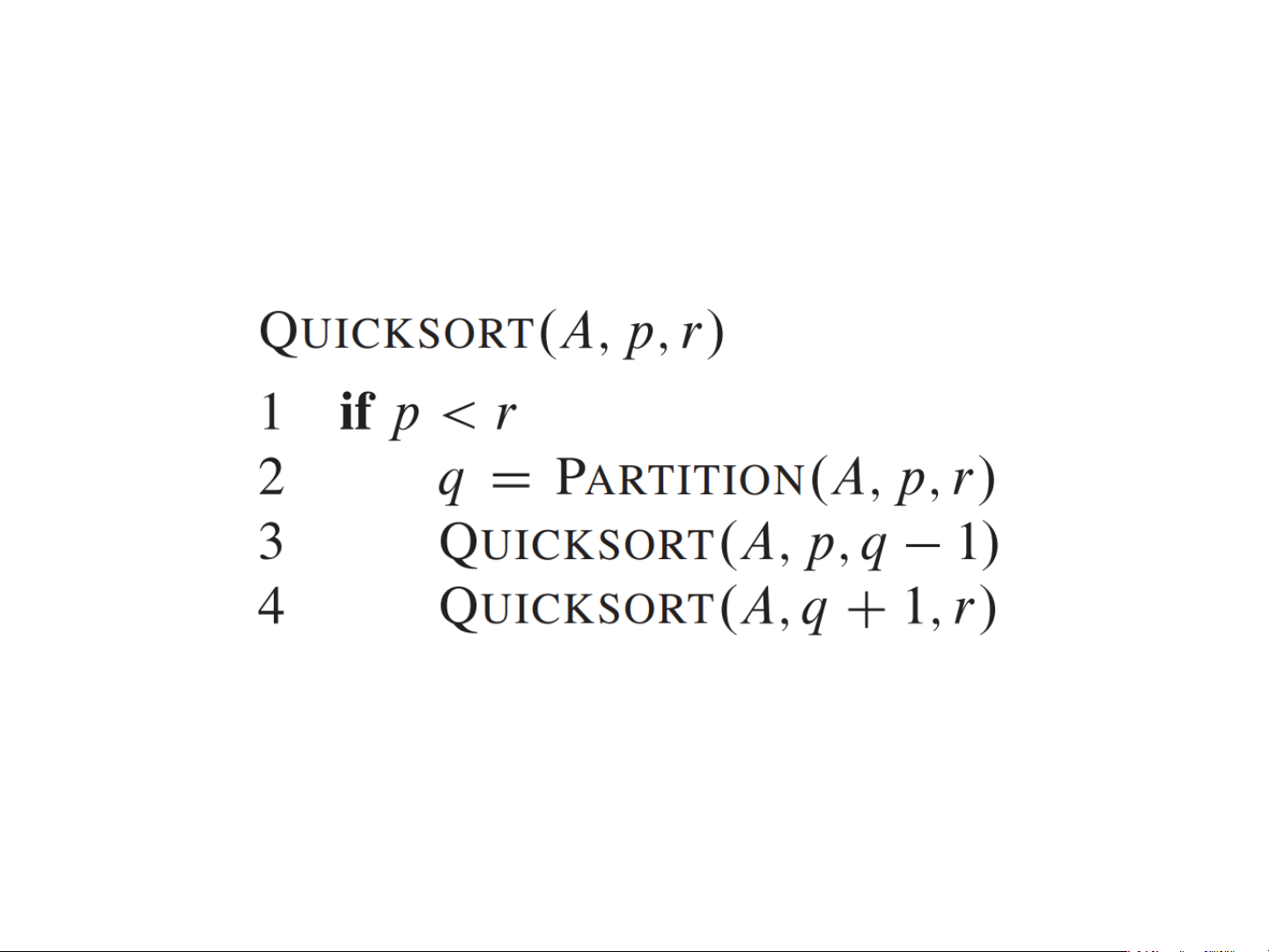
Intelligent Networking Laboratory DANG THIEN BINH 3/44 N e t w o Quicksort Pseudocode (1/2) r k i n g L a b o r a t o r y 4 / 4 8
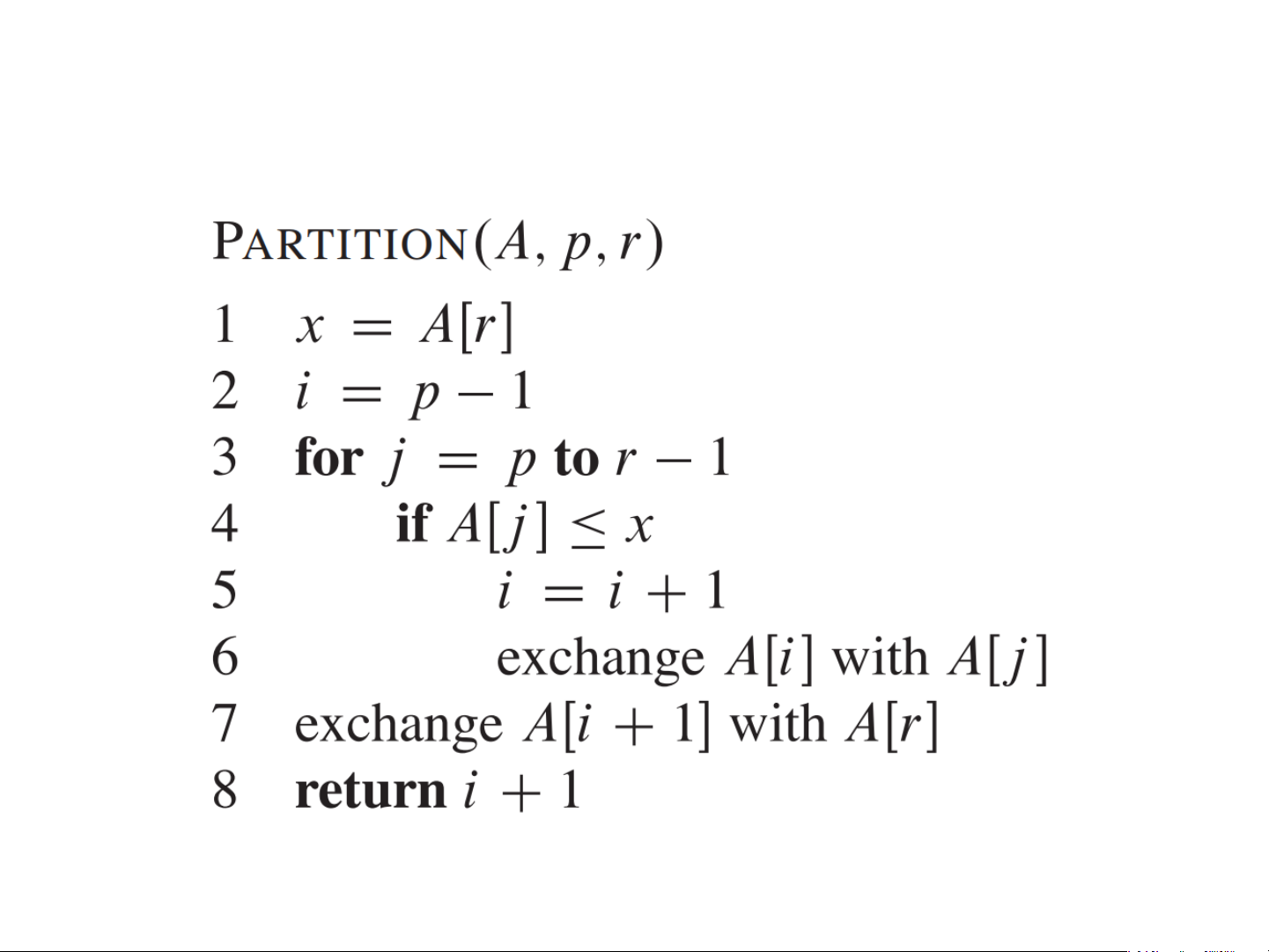
Intelligent Networking Laboratory DANG THIEN BINH 4/44 N e t w o Quicksort Pseudocode (2/2) r k i n g L a b o r a t o r y 5 / 4 8
Intelligent Networking Laboratory DANG THIEN BINH 5/44 Partition (1/2)
Clearly, all the action takes place in the partition() function
Rearrange the subarray 𝐴[𝑝 . . 𝑟] in place End result: Two subarrays
All values in first subarray all values in second one
Return index of the “𝑝𝑖𝑣𝑜𝑡” element separating the two subarrays
Intelligent Networking Laboratory DANG THIEN BINH 6/44 Partition (2/2)
PARTITION always selects the last element 𝐴[𝑟] in the
subarray 𝐴[𝑝 . . 𝑟] as the 𝒑𝒊𝒗𝒐𝒕
The element around which to partition
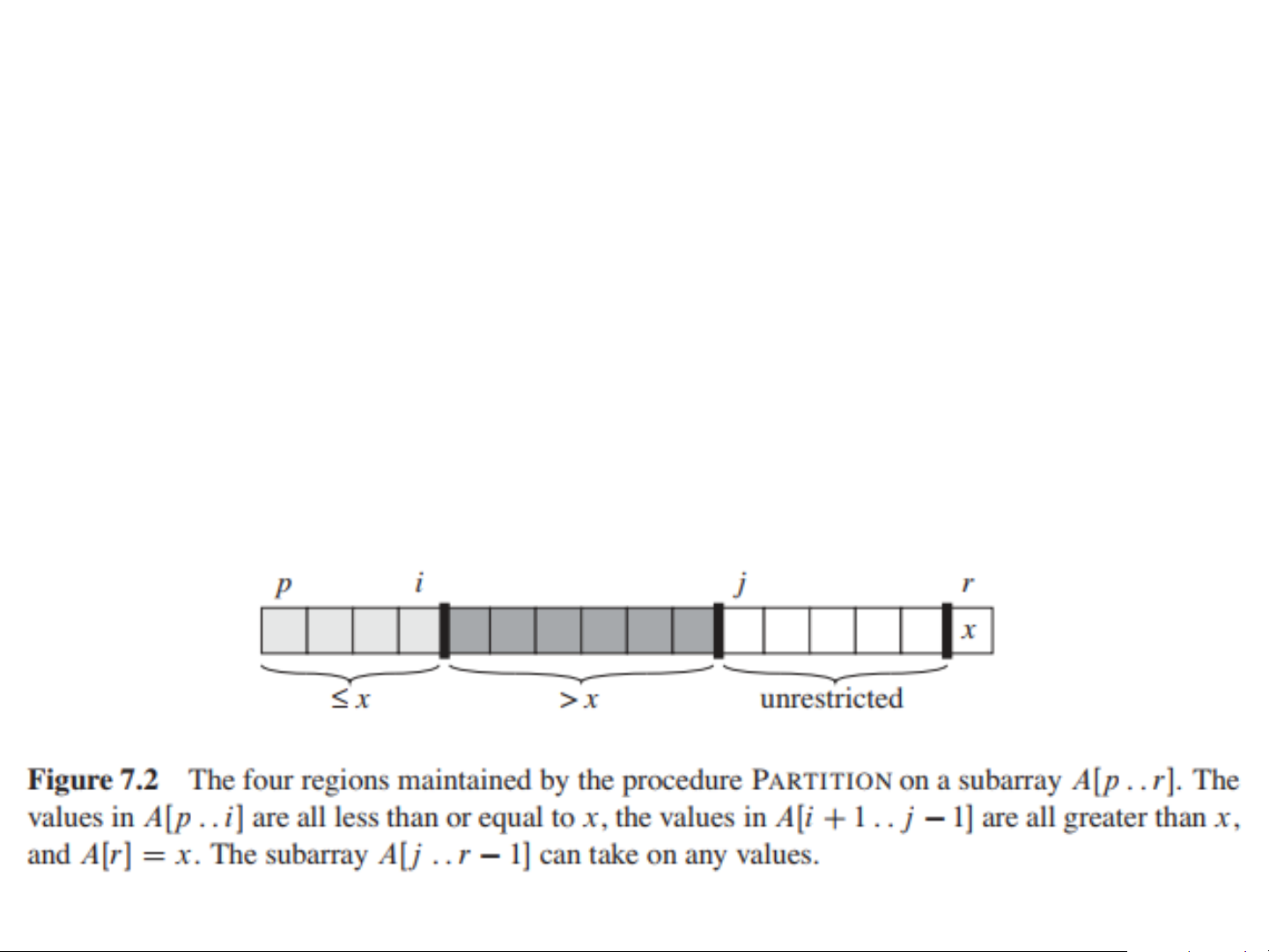
As the procedure executes, the array is partitioned
into four regions, some of which may be empty
Intelligent Networking Laboratory DANG THIEN BINH 7/44 Partition Property
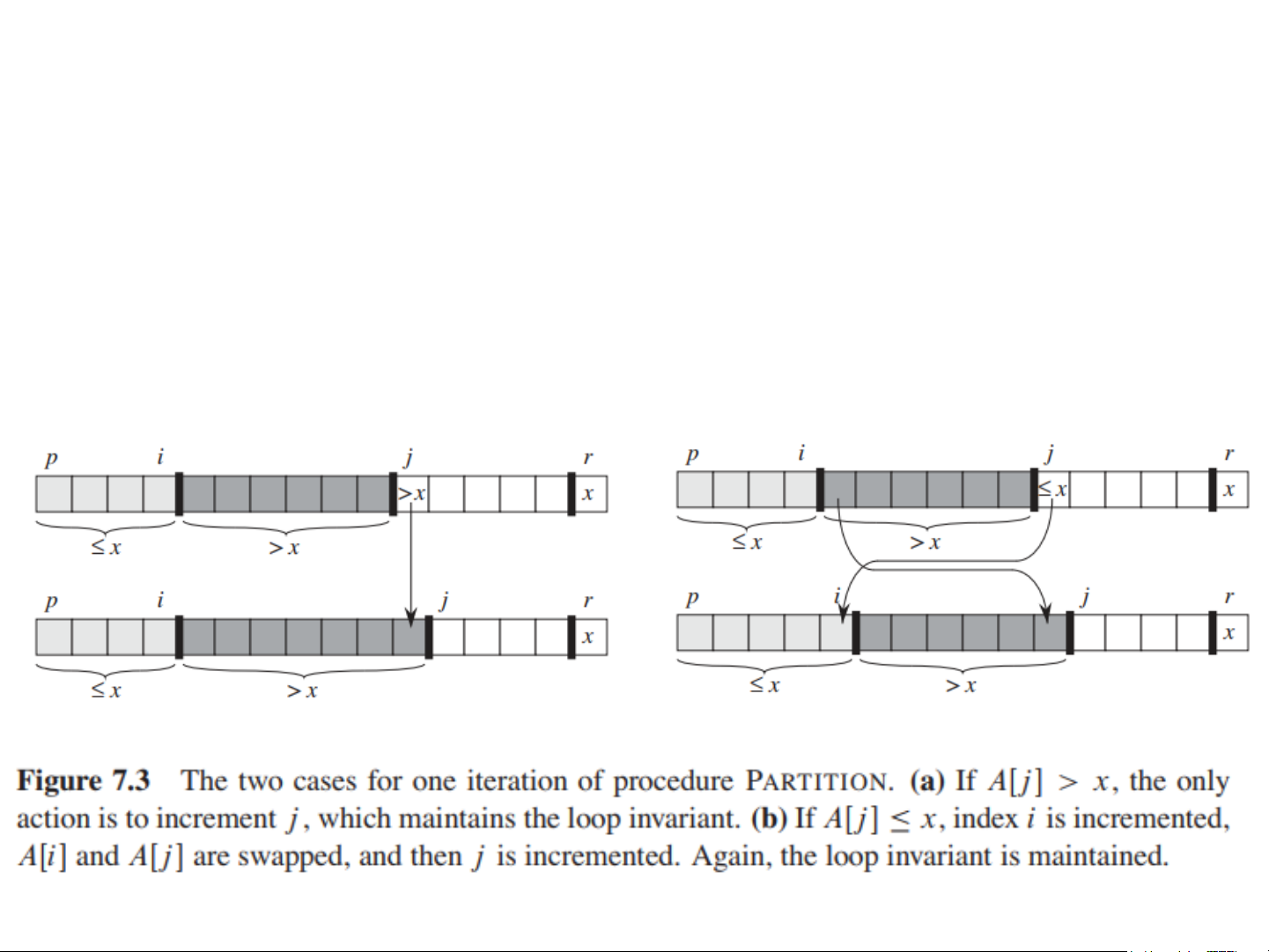
Loop invariant: For any array index i
1. All entries in 𝐴[𝑝 . . 𝑖] 𝑝𝑖𝑣𝑜𝑡
2. All entries in 𝐴[𝑖 + 1 . . 𝑗 − 1] > 𝑝𝑖𝑣𝑜𝑡
3. 𝐴[𝑟] = 𝑝𝑖𝑣𝑜𝑡
It’s not needed as part of the loop invariant, but the
fourth region is 𝐴[ 𝑗 . . 𝑟 − 1], whose entries have not
yet been examined, and so we don’t know how they compare to the pivot.
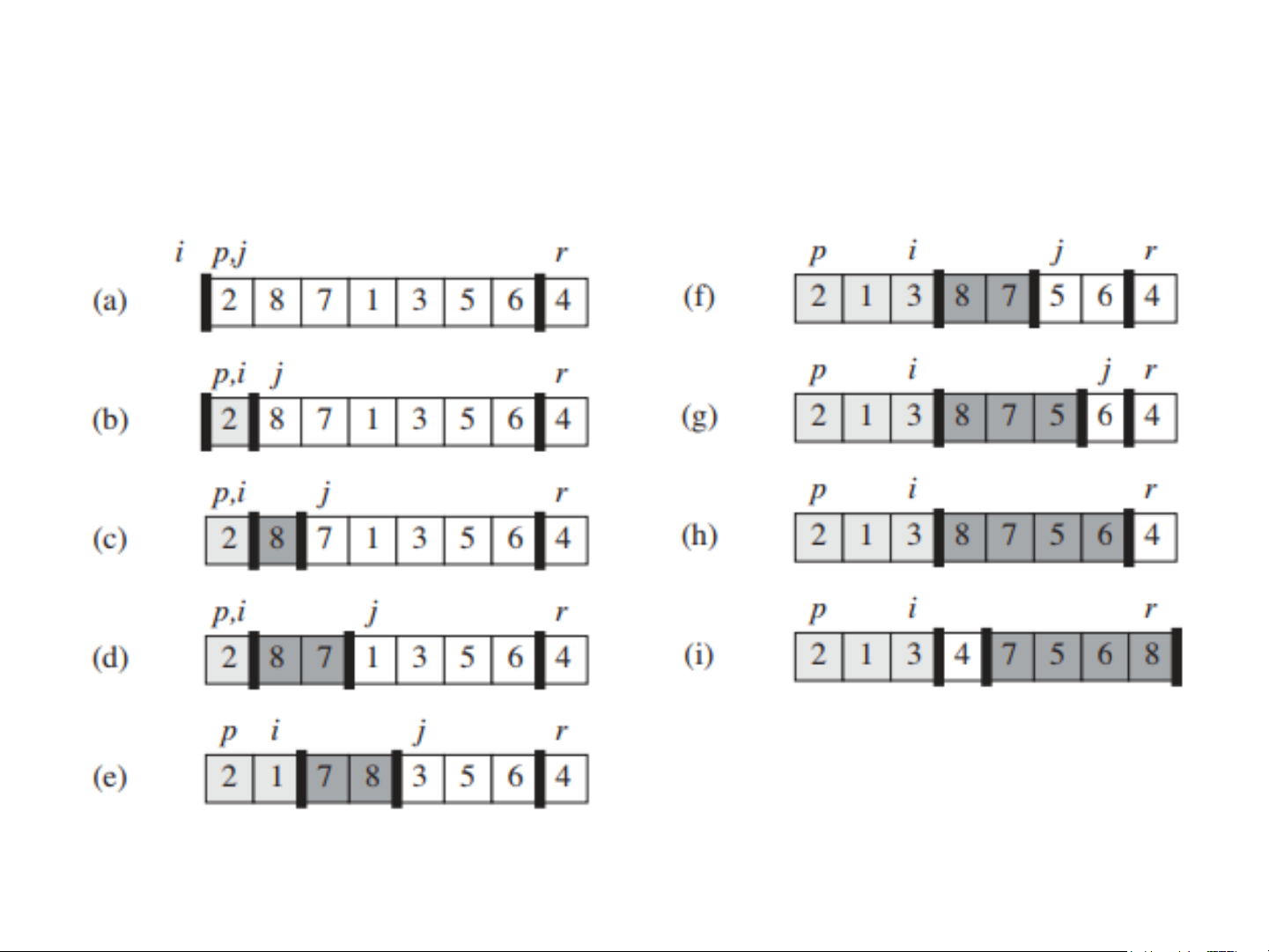
Intelligent Networking Laboratory DANG THIEN BINH 8/44 Partition Example
Intelligent Networking Laboratory DANG THIEN BINH 9/44
Correctness of Loop Invariant (1/3) Initialization:
Before the loop starts, all the conditions of the loop invariant
are satisfied, because 𝐴[𝑟] is the pivot and the subarrays
𝐴[𝑝 . . 𝑖] and 𝐴[𝑖 + 1 . . 𝑗 − 1] are empty
Intelligent Networking Laboratory DANG THIEN BINH 10/44
Correctness of Loop Invariant (2/3)
Maintenance: while the loop is running,
if 𝐴[𝑗] ≤ 𝑝𝑖𝑣𝑜𝑡, then 𝐴[ 𝑗] and 𝐴[𝑖 + 1] are swapped and 𝑖 and 𝑗 are incremented
If 𝐴[𝑗] > 𝑝𝑖𝑣𝑜𝑡, then increment only 𝑗 (a) (b)
Intelligent Networking Laboratory DANG THIEN BINH 11/44
Correctness of Loop Invariant (3/3) Termination:
When the loop terminates, 𝑗 = 𝑟, so all elements in 𝐴 are
partitioned into one of the three cases:
𝐴[𝑝 . . 𝑖 ] ≤ 𝑝𝑖𝑣𝑜𝑡, 𝐴[𝑖 + 1 . . 𝑟 − 1] > 𝑝𝑖𝑣𝑜𝑡, and 𝐴[𝑟] = 𝑝𝑖𝑣𝑜𝑡
The last operation of PARTITION is to move the pivot
from the end of the array to a position between two subarrays:
swapping the 𝑝𝑖𝑣𝑜𝑡 𝐴[𝑟] and the first element of the second subarray 𝐴[𝑖 + 1] Time for partitioning:
(𝑛) to partition an 𝑛-element subarray
Intelligent Networking Laboratory DANG THIEN BINH 12/44 Quicksort Algorithm Video Content
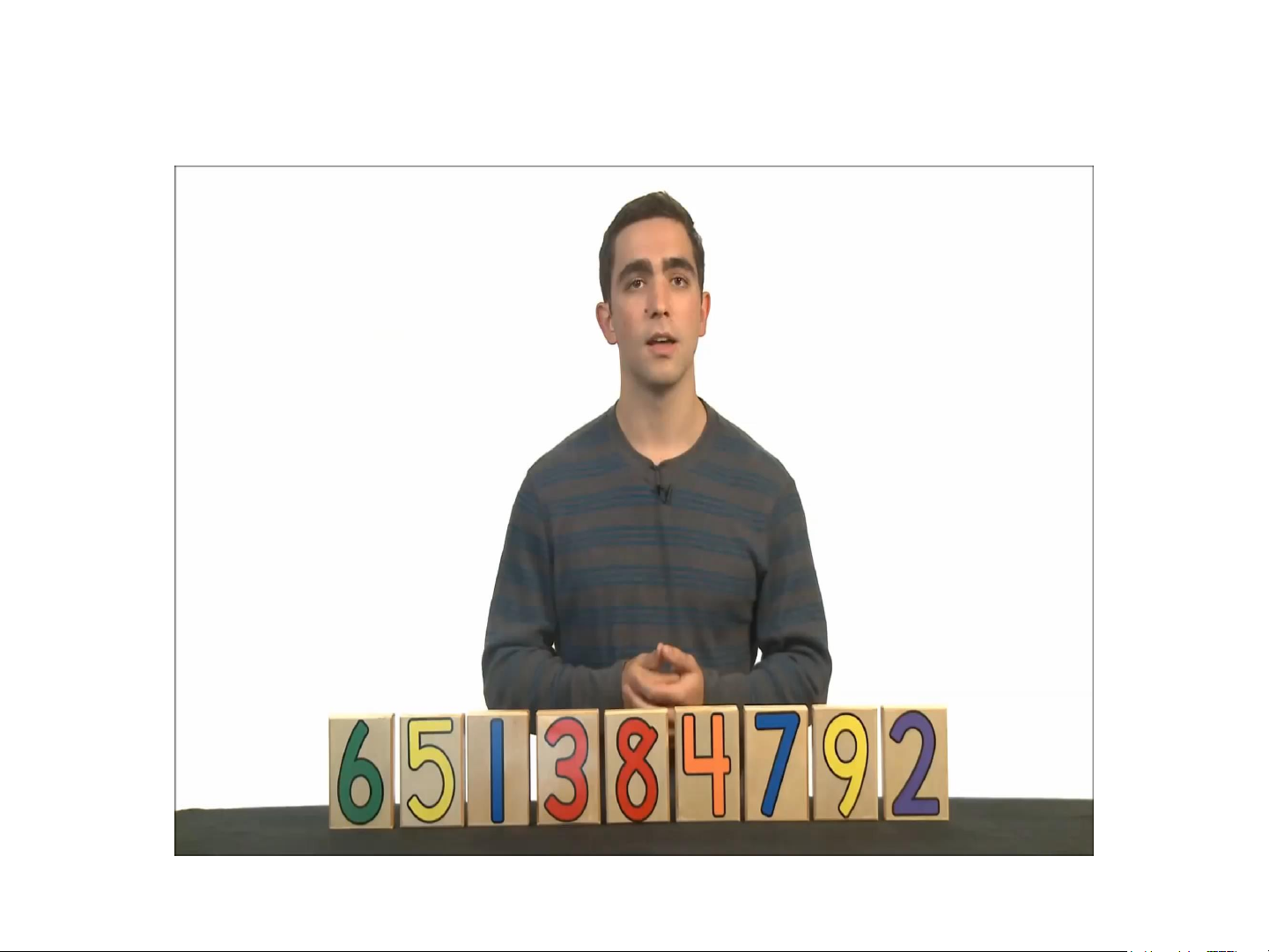
An illustration of Quick Sort.
Intelligent Networking Laboratory DANG THIEN BINH 13/44 Quicksort Algorithm
Intelligent Networking Laboratory DANG THIEN BINH 14/44 Practice Problem The operation of PARTITION on an array
𝐴 1. . 12 = [13,19,9,5,12,8,7,4,21,2,6,11] is performed.
Then the given array is divided into 𝐴[1. . 𝑞] and 𝐴[𝑞 + 1. . 12] such that 𝐴[𝑖] ≤ 𝐴[𝑗] for all
1 ≤ 𝑖 ≤ 𝑞 and 𝑞 + 1 ≤ 𝑗 ≤ 12. What are 𝑞 and 𝐴[𝑞]? 𝑞 = 8 𝐴[𝑞] = 11
Intelligent Networking Laboratory DANG THIEN BINH 15/44 Performance of Quicksort (1/9)
The running time of Quicksort depends on the partitioning of the subarrays:
If the subarrays are unbalanced, then quicksort can run as
slowly as insertion sort (worst case)
If the subarrays are balanced, then quicksort can run as fast as mergesort (best case)
Intelligent Networking Laboratory DANG THIEN BINH 16/44 Performance of Quicksort (2/9) Worst case
Occurs when the subarrays are completely unbalanced
Has 0 elements in one subarray and (n-1) elements in the other subarray Get the recurrence:
𝑇(𝑛) = 𝑇(𝑛 − 1) + 𝑇(0) + (𝑛)
= 𝑇(𝑛 − 1) + (𝑛) = (𝑛²)
Same running time as insertion sort
In fact, the worst-case running time occurs when quicksort
takes a sorted array as input, but insertion sort runs in 𝑂(𝑛) time in this case
Intelligent Networking Laboratory DANG THIEN BINH 17/44 Performance of Quicksort (3/9) Best case
Occurs when the subarrays are completely balanced every time.
Each subarray has 𝑛/2 elements: 𝑛Τ2 and 𝑛Τ2 −1 Get the recurrence:
𝑇(𝑛) = 2𝑇(𝑛/2) + (𝑛) = (𝑛 lg 𝑛)
Intelligent Networking Laboratory DANG THIEN BINH 18/44 Performance of Quicksort (4/9) Balanced partitioning
Quicksort’s average running time is much closer to the best case than to the worst case.
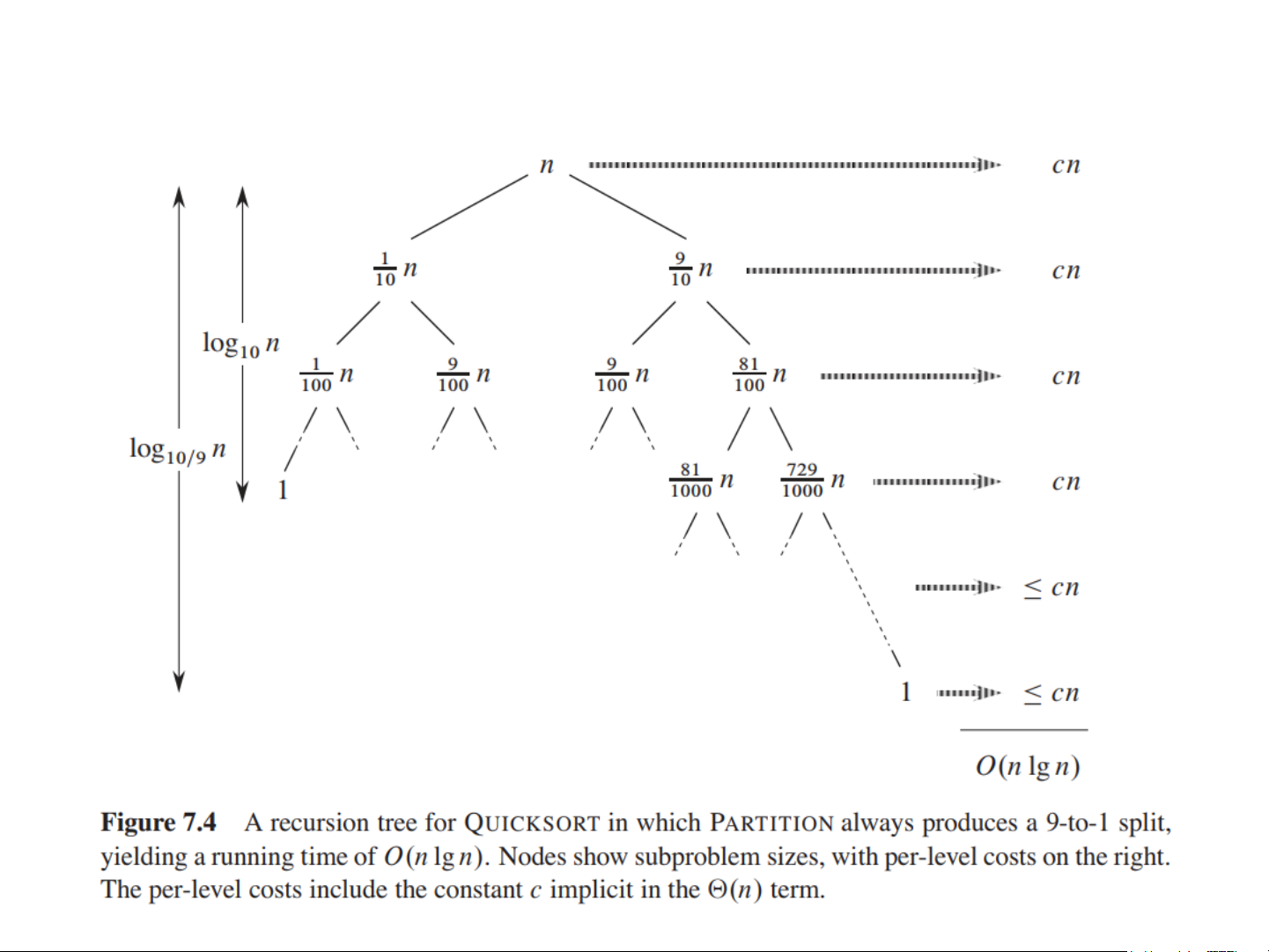
Imagine that PARTITION always produces a 9-to-1 split. Get the recurrence:
𝑇(𝑛) ≤ 𝑇(9𝑛/10) + 𝑇(𝑛/10) + (𝑛) 𝑂(𝑛 lg 𝑛)
Intelligent Networking Laboratory DANG THIEN BINH 19/44 Performance of Quicksort (5/9)
Intelligent Networking Laboratory DANG THIEN BINH 20/44
Tài liệu liên quan:
-
Cambridge IELTS 13 Test-1 Overview and Practice Review | Tài liệu Tiếng Anh
6 3 -
IELTS Test 2 Review - Cambridge 13 Preparation Guide | Tài liệu Tiếng Anh
9 5 -
Litfocus Litreading Survey: Student Reading Interests & Habits Questionnaire | Tài liệu Tiếng Anh
8 4 -

Sách Pre-intermediate Market leader - Business English Course Book
24 12 -

Exam booster for B1 preliminary and B1 preliminary for schools with answer key
10 5