Lý thuyết tự luận môn Xác suất thống kê| Trường Đại học Ngoại Thương
In the era of digitalization, Blockchain is an evolving technologythat has the potential to change the shape of numerous industries. Blockchain is considered the transforming technology that has the ability to change the conventional supply chain network by providing additional transparency of transactions in terms of information and physical goods. Tài liệu giúp bạn tham khảo, ôn tập và đạt kết quả cao. Mời đọc đón xem!
Môn: Xác suất thống kê (FTU) 355 tài liệu
Trường: Trường Đại học Ngoại Thương 1.1 K tài liệu
Tác giả:















Preview text:
Operations Management Research (2023) 16:668–683
https://doi.org/10.1007/s12063-023-00358-z
Barriers toblockchain technology adoption insupply chains: thecase ofIndia
ShahbazKhan1 · AbidHaleem2 · ZafarHusain3 · DanielSamson4 · R.D.Pathak5
Received: 26 July 2022 / Revised: 20 February 2023 / Accepted: 21 February 2023 / Published online: 23 March 2023 © The Author(s) 2023 Abstract
In the era of digitalization, Blockchain is an evolving technology that has the potential to change the shape of numerous
industries. Blockchain is considered the transforming technology that has the ability to change the conventional supply
chain network by providing additional transparency of transactions in terms of information and physical goods. Addition-
ally, the implementation of blockchain technology in the supply chain is required to accomplish the objectives of industry
4.0. However, there has to date been a scarcity of blockchain implementations due to the numerous barriers associated with
it. Therefore, the primary aim of this research is to identify and investigate the major barriers to implementing blockchain
technology in supply chains. We identified ten significant barriers to adopting blockchain technology through a literature
review and expert opinions.Additionally, the finalized barriers were categorized into an influential and influenced group
using the DEMATEL method. The findings of this study show that 'influential group' barriers require more attention from
the supply chain partners to mitigate these barriers. The primary influential barriers are 'Lack of information sharing,' 'Trust
management issues,' and 'Lack of upgraded technologies’, and these barriers require immediate attention from supply chain
stakeholders wishing to use blockchain. These findings contribute to improving managerial decisions and digital strategies
regarding blockchain within organisations, and how implementation can effectively be achieved.
Keywords Barriers· Blockchain Technology· DEMATEL· Supply Chain· Sustainability 1 Introduction
Supply Chains (SC) are becoming more complex due to * Daniel Samson d.samson@unimelb.edu.au
globalization, environmental legislation, and increased
government requirements, and increased compliance Shahbaz Khan shahbaz.me12@gmail.com
requirements. These SC transformations challenge SC part-
ners and compel them to integrate the emerging tools and Abid Haleem ahaleem@jmi.ac.in
technologies to gain competitive advantages. The Block-
chain is one of the relatively new and increasingly popular Zafar Husain Zafar.husain@aau.ac.ae
technologies that is integrated with SC operations. Due
to this, it is receiving significant attention from different R. D. Pathak raghuvar.pathak@usp.ac.fj
SC stakeholders and academia. Blockchain can improve
SC operations through increasing end-to-end visibility. 1
Institute ofBusiness Management, GLA University,
Blockchain Technology (BT) has drawn a lot of atten- Mathura, India
tion and has made significant progress in fraud preven- 2
Faculty ofEngineering, Jamila Millia Islamia, NewDelhi,
tion and data security (Demirkan etal. 2020a, b; Francisco India and Swanson 2018). 3
College ofBusiness, Al Ain University, AlAin,
Moreover, this technology could mitigate other SC UnitedArabEmirates
complexities such as data loss, transparency, veracity, 4
University ofMelbourne, Melbourne, Australia
and reliable communication. BT is considered to be a tool
that can re-establish the confidence of the SC partners by 5
Graduate School ofBusiness, University ofSouth Pacific, Suva, Fiji 1 3 Vol:.(1234567890)
Barriers toblockchain technology adoption insupply chains: thecase ofIndia 669
offering a platform for sharing credible and safe infor-
(i) To identify the barrier to BT implementation in sup-
mation. Therefore, BT is seen as a potentially significant ply chain management
technology trend that will impact business and society in
(ii) To develop knowledge of the interrelationships
the upcoming years (Khan etal. 2019). among these barriers
The emergence of BT as a general-purpose technology
(iii) Provide recommendations for the adoption of BT
has disrupted organizations' functioning and is endorsed by
some governments for revealing the information and trans-
Our specific motivation in designing and conducting
actions that involve verification and trust (Yli-Huumo etal.
this study was to identify BT barriers and the causal rela-
2016). The transactional data is saved in separate nodes
tionships between them, so as to allow decision makers at
on the Blockchain and only added after the consensus is
government policy and company levels to efficiently and
achieved among the nodes. The primary features of the BT
effectively take actions to overcome such barriers, and allow
comprise the decentralization of decision making, immu-
BT to flourish. While some previous studies have identi-
tability of data, reliability, distributed processing, fewer
fied barriers, the causal structure of such barriers has not
transaction fees, transmission speed, automaticity, irrevers-
previously been identified as we have now done: the present
ibility, and transparency with pseudonymity (Treiblmaier
study provides sound guidance for which barriers influence
2018; Iansiti and Lakhani 2017). These features lead to
other ‘influenced’ barriers, hence giving practitioners an
higher-level concepts such as data origin, increased secu-
understanding of where they should focus their efforts in
rity, enhanced trust, privacy, authenticity, integrity, avail- implementing blockchain.
ability, consensus, and accountability, allowing substantial
We conducted a literature review to identify significant
managerial implications (Neisse etal. ; 2017 Treiblmaier
barriers to achieving the above research objectives, as iden-
2018; Liang etal. 2017). These implications are valuable
tifying the significant barrier helps adopt BT in the supply for SC management.
chain. However, the identified barriers are substantial and
Managing BT's supply chain activities can be path-
hence it is not practically feasible to mitigate them all simul- breaking (Venkatesh et al. ) 2020 . Contemporary sup-
taneously. Consequently, to successfully implement the BT
ply chain managers are trying to reduce duplication and
in the supply chain, we need to develop a causal relationship
increase efficiency (Upadhyay2020). With the usage of
map to provide for systematic mitigation of these barriers.
BT, SC will potentially increase efficiencies, saving the
In addition, once the cause and effect relationships between
stakeholders' time and cost. Complex and diverse SCs can
apparent barriers are known, organizations can utilize their
be tracked with relatively more accuracy and efficiency
resources in a more optimized manner related to the mitiga-
by capturing the decisive data in the Blockchain, from the
tion of these barriers. Identification of this causal structure
sourcing of raw material to the manufacturer to the con-
of BT implementation barriers is a unique contribution of
sumer (Xu etal. 2019; Upadhyay etal. 2021a, b).
this study, especially in a developing economy from where
The literature indicates that using Blockchain in the SC
we gathered our data, being India.
will enhance the visibility and efficiency of operations,
The remaining sections of this paper are structured as
improve trustworthiness, eliminate unwanted SC inter-
follows: Section2 provides the background of the study
mediaries, and increase consumer confidence (Saurabh
and review of the relevant literature, section3 provides the
and Dey 2021). While the BT offers several advantages
details of the research methodology applied in the study;
for the dynamic and volatile SC, its effective applica-
section4 deals with data analysis and result; section gi 5 ves
tion in the SC confronts several barriers. For example,
the discussion about the findings; finally, section6 delivers
studied BT literature and observed a scarcity of research
the conclusion, limitation and future scope of the study.
on BT deployment. There are still unsolved limitations
and problems associated with BT, which necessitate more
investigation and analysis. These barriers become even
2 Background ofthestudy
more crucial in growing and developing economies such
as India. For example, inadequate IT infrastructure, low
In the era of industry 4.0, BT is getting considerable atten-
technological expertise, and a distributed supply chain
tion among industry professionals and academicians. This
network all contribute to the potential and limits of BT
technology has numerous benefits and applications across
deployment. The presence of these barriers needs to
industries, from goods producers to service providers. Inte-
be tackled for the successful implementation of Block-
grating SC is beneficial for efficient operations and reducing
chain. Therefore, this research addresses these barriers
uncertainties. Blockchain deployment enhances the SC trans-
associated with adopting Blockchain in supply chain
action by increasing transparency, security, traceability, and
management. Precisely, this research has the following
flexibility using smart contracts (Kosba etal. 2016). In supply objectives:
chain management, there are five essential strategic priorities: 1 3 6 70 S.Khan et al.
low cost, high processing speed, risk control, sustainability,
banking because of less research and development. In cyber-
and flexibility. These objectives of the SC can be achieved or
security and accounting, Demirkan etal. (2020a b , ) studied
enhanced to a certain degree through the implementation
the blockchain framework and observed that for financial
of BT. The specific characteristics of Blockchain, such as
security, cybersecurity and financial misconduct monitoring,
real-time exchange of information, cybersecurity, visibility,
and financial accounting, Blockchain would be used. BT is
consistency, traceability, and transparency, are the primary
clearly demonstrated from the literature to be of potentially
reason behind the blockchain integration of SC. Aslam etal.
significant benefit to organisations and SC’s efficiency, yet
(2021) studied the requirement of blockchain adoption and
is still immature and needing to overcome barriers to change
its impact on operational performance, demonstrating that
and perceived risks that always come with new technologies
operational performance positively links supply chain man- (Samson etal. 2022). agement practices.
Lu (2018) observed that Blockchain gives us an enor- Risius and Spohrer ( )
2017 mentioned that "BT is a fully
mous potential to construct data security and confidence
distributed system for cryptographically capturing and stor-
for automation and knowledge development on the IoT.
ing a consistent, immutable, linear event log of transactions
Based on blockchain-related insights, they claim that
between networked actors. This is functionally similar to a
Blockchain could play a vital role in the planet's sustain-
distributed ledger that is consensually kept, updated, and
able development. In addition, the numerous applications
validated by all the transactions within a network by the
of BT, such as Internet of Things (IoT), smart contracts,
parties involved. In such a network, BT enforces transpar-
healthcare, Industry 4.0, and digital assets, were estab-
ency and guarantees eventual, system-wide consensus on the
lished. Finally, Viriyasitavat and Hoonsopon (2019)
validity of an entire history of transactions". This definition
describe Blockchain and evaluate its functionality and
claim that BT works as "a digital logbook of transactions",
business processes. Moreover, this study recommended
which provide the most secure, consistent, safe, decentral-
that the design of business processes can also address the
ized peer to peer sharing of information.
problems of time inconsistency and consensus bias.
Existing studies in the SC perspective regarding block-
Blockchain is also implemented in the construction
chain applications are categorized into four major types:
industry; for instance, Perera etal. (2020) examined the
"conceptual", "descriptive", "predictive," and "prescriptive"
BT implementation in construction and mentioned that the
research. For instance, Cole etal. (2019) studied BT and
conservative essence of this industry in digitalization and
identified the potential areas of BT contribution to perfor-
its resistance to adapt reduces the incorporation of Block-
mance from a SC perspective. Further, they also highlighted
chain in this industry. They found that Blockchain has much
the scope for future research, from which we derived motiva-
potential in this industry. Viriyasitavat etal. (2019) recog-
tion for this study, of shining a light on BT barriers and their
nize new research areas, challenges, and potential applica-
interrelationships. Wang etal. (2020) proposed blockchain-
tions in incorporating Blockchain into the development of
based system architecture and found that BT can decrease
business process management through a literature review.
the complexity of the management of SC. Viriyasitavat etal. ( )
2020 explore that Blockchain could be Mohanta etal. ( )
2019 identified privacy and security as
used to pass and authenticate the trust of businesses and
the major challenges in implementing Blockchain using a
partners and presents a system of business process manage- literature review. Lu ( )
2019 reviewed BT and identified the
ment to assist in a timely, reliable, and economic evaluation.
significant components of Blockchain, blockchain-enabled
In a sense, IoT and Blockchain, describe the many problems
data management, blockchain-enabled security, BT-based
of the business method. Many business process challenges
IoT, and primary applications of Blockchain. Further, they
are also identified for IoT and blockchain adoptions.
also describe potential trends in BT and associated chal-
Some studies have attempted to create lists of BT lenges. Helo and Hao ( ) 2019 reviewed BT and outlined
barriers: Li et al. (2021) perform a literature survey of
potential immutable distributed ledgers in SC operations.
Blockchain applications and provide some research direc-
Finally, Reyna etal. (2018) investigate the blockchain-
tion. Further, they also identified the major challenges,
enabled IoT challenges and examine how BT can advance
opportunities, and barriers to adopting industrial Block- IoT performance.
chain. Lim etal. (2021) conducted the literature survey Zhang and Chen ( )
2020 conduct a literature survey on
to explore the research area of the Blockchain in the con-
IoTs, Blockchain, business analytics, and Industry 4.0 tech-
text of supply chain management. The finding shows an
nologies. They considered Blockchain as a novel idea and
increasing concern in using Blockchain for SC operations.
most of the studies have been conducted in the last two to
Finally, Kamble etal. (2021) provided a decision support
three years. From an academic perspective, Hassani etal.
framework for policymakers to forecast the probability of
(2018) investigated the implementation of BT in banking
a successful blockchain implementation by an organiza-
and observed a substantial negative effect of Blockchain on
tion using machine learning techniques. 1 3
Barriers toblockchain technology adoption insupply chains: thecase ofIndia 671 Sanka etal. ( )
2021 conduct literature surveys to assess
On the other hand, TISM is an extension of the ISM and
the breakthrough in Blockchain and provides the major chal-
has the same limitation, while DEMATEL does not have
lenges for adoption, its applications, and future research
such limitations. Therefore, DEMATEL is a well-suited direction. Saurabh and Dey ( ) 2021 focused on the grape-
method to explore the causal interrelationship among the
wine SC and identified some significant drivers of imple-
barriers to blockchain adoption (Khan etal. 2019). The pro-
menting blockchain technologies. They found that disin-
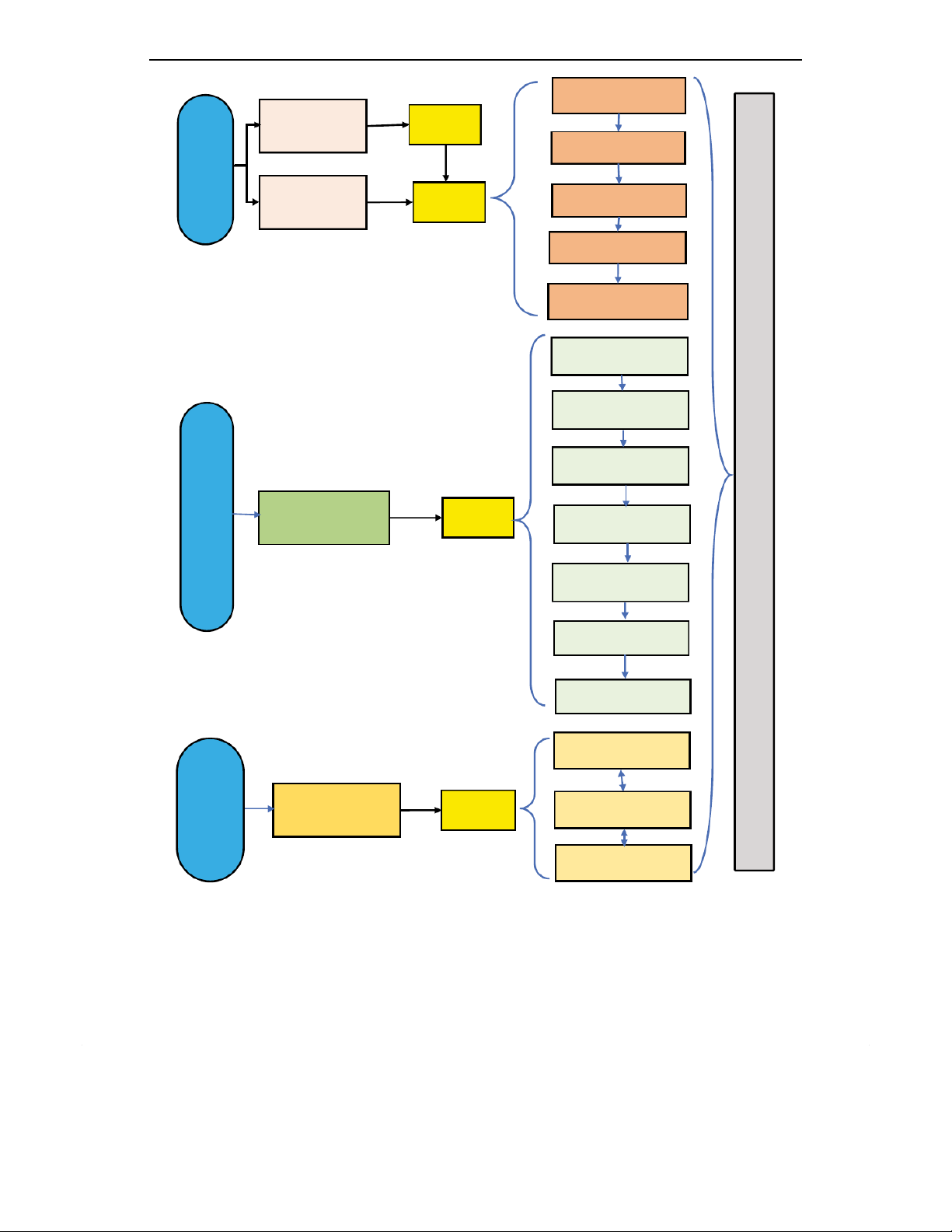
posed framework for this study is presented in Fig.1.
termediation, traceability, expense, faith, enforcement, and
This study is conducted in the context of developing coun-
alignment and control can affect the adoption-intention deci-
tries, and experts are selected from India. This study utilises
sion processes of SC actors. Finally, Agrawal etal. (2021)
the two methods, grey Delphi and DEMETAL. Ten experts are
propose a blockchain-enabled traceability structure for trace-
participated in the grey Delphi method for the finalisation of the
ability in the SC of multi-tier textiles and garments.
barriers and five experts among them participated in the DEM-
This review of literature determined that most studies,
ATEL analysis. The experts’ details are provided in Table1.
using a range of methodologies, pointed to the conceptual
and in some instances practical benefits of BT, with only 3.1 Grey delphi
early stage research yet published on the details and nuances
of BT drivers and barriers. Of those who list such drivers
Dalkey and Helmer (1963) developed the Delphi technique.
and barriers, we note that priorities of such are rarely pub-
It is a well-known survey approach for reaching consensus
lished to date, and we also note that it is likely (but not yet
by integrating the opinions of experts on a particular prob-
empirically verified) that some barriers and more important
lem. The Grey Delphi approach combines the Delphi and
than others, and that some are likely to be the (primary) driv-
the theory of grey sets to overcome the limitation of the
ers and influencers of (secondary) others. Clear knowledge
conventional Delphi method. The following are the steps of
of this will help to effect better and faster take-up of BT, the grey Delphi:
hence research that contributes to this unanswered question
is deemed to be valuable from both conceptual and practical
Step 1: Identification of barriers
bases. In short, our primary research question is: what are
the primary cause and effect relationships between block-
Reviewing relevant literature has identified a list of barri-
chain adoption barriers, that allows for identification of
ers associated with blockchain adoption in SC. These identi-
‘influencing’ and ‘influenced’ barrier elements? We have
fied barriers serve as the basis for the questionnaire used to
chosen to focus on BT barriers rather than drivers, because collect data from experts.
the drivers are already relatively well demonstrated and
indeed are somewhat obvious, at least in conceptual terms.
Step 2: Collection of responses through linguistic scale
Experts are expected to respond to the questionnaire using 3 Research methodology
the corresponding scale using the linguistic scale. Table2
provides the linguistic scale and its equivalent grey number.
The present study's main aim is to identify the primary
Step 3: Establishing the grey numbers
barriers to adopting BT in supply chain management and
to evaluate the causal interrelationship between them. The
According to Table2, the collected responses are con-
significant barriers were identified through a literature sur-
verted to corresponding grey values. This grey number is
vey and further evaluated using the grey Delphi method to
employed in subsequent processes. Suppose the evaluation
fulfill these objectives. Additionally, the causal relation-
panel is comprised of k experts. The evaluation of the factor
ship between these barriers was determined through the
⊗Gi can be obtained as follows:
DEMATEL method. Several methods exist to explore the
causal relationship among the barriers, such as Interpretive h k (⊗G1 i+⊗G 2 i+ ) ⋯+⊗G i+ + ⋯ ⊗G i Structural Modelling (ISM), ⊗Gi= (1) k
Total Interpretive Structural Modelling (TISM), and Deci-
sion Making Trial and Evaluation Laboratory DEMATEL
Where ⊗ Gi is the overall assessment of barrier significance (Khan and Haleem )
2021 . However, these methods have
and ⊗ Gh denotes that hth expert's evaluation of barrier I of i
some limitations, for example, the ISM method can provide BT adoption in SC.
the causal interrelationship among the barriers, but it cannot
measure relationship strength (Mathivathanan etal. 2021).
Step 4: Whitening of the grey numbers 1 3 6 72 S.Khan et al. Identification of barriers Identification of BT Literature adoption barriers review Collection of response through linguistic s cale
Identification Finalisation of BT Establishing the grey Phase I: Barriers Grey Delphi adoption barriers numbers Whitening of the grey numbers Setting threshold value Determine initial direct relationship matrix Generate the overall direct relation matrix Normalise the direct relation matrix Causal relationship among DEMATEL Compute the total relation of BT adoption barriers method matrix Determine the causal parameter Discuss the result and
Phase II: Causal Relationship Development Construct the causal diagram Prioritise and categorised the BT adoption barriers Validation from Academic Experts Validate the result and finding Feedback Literature Confrontation the findings
Phase III: Validation of Validation from Industrial Experts
Fig. 1 A proposed research framework for this study 1 3
Barriers toblockchain technology adoption insupply chains: thecase ofIndia 673
Table 1 Descriptive data about expert panelists S No Designation Work Country Education Gender Working Area
Participated Participated Experience in Grey in in years Delphi DEMATEL 1. Professor 32 India Doctorate Male Data Driven Supply Yes Yes Chain; Industry 4.0 2. Professor 15 India Doctorate Female Technology Transfer, Yes No Blockchain 3. Supply Chain 16 India Master of Male Supply Chain Yes Yes Manager Technology Management; Industry 4.0 4. Procurement 14 India Master of Business Male Supplier selection, Yes No Manager Administration Procurement 5. Logistics Managers 15 India Bachelor of Male Smart logistics Yes Yes Technology management; 6. Process Designer 14 India Doctorate Female Technology Yes No integration and system design 7. Operations Managers 18 India Master of technology Male Production and Yes No operations Blockchain designer 12 India Master of Sciences Male Blockchain design Yes Yes and coding 9. Supply Chain 13 India Master of business Male Supply chain Yes No Manager Administration management 10. Warehouse Manager 18 India Master of Female Technology Yes Yes Engineering integration in warehouse and Smart warehousing
The general interval grey number 3.2 DEMATEL ⊗G == [G G] = i , � �
[G ∈G|G≤G
≤G ] , considers the �
⊗ as its whitenisation
value. When the distribution of, �
⊗ is uncertain/unkown,
DEMATEL was proposed to establish the causal interrelation-
whitenisation may be accomplished using Eq. (2).
ship among the factors in 1976. Since then, it is widely used in
various application areas such as supply chain management,
⊗ =𝛼.G +(1−𝛼).G,= [0, 1] (2)
traceability, smart city, healthcare, consumer behavior, and _
many more (Haleem etal. 2019; Medalla etal. 2021). The
The commonly used value of 𝛼 is 0.5, � ⊗ is known as
steps of the DEMATEL technique are presented as follows:
‘whitenization’, whose value equals the weighted mean (Liu and Forrest 2010).
Step I: Develop the direct influence matrix
Step 5: Setting threshold value
The influence of one barrier over others is determined
using the experts through a questionnaire. In this study,
The selection/rejection of barriers concludes the grey
an expert panel is formed who provided their responses to
Delphi procedure. The relevance of the factor is established
develop the direct influence matrix. For example, the influ-
by comparing the total score to a threshold value(λ). The
ence of a barrier' i' over 'j,' by kth expert, have expressed
rationale underlying the barrier selection procedure is if � ⊗
through the 0-4 scale (0 -no influence and 4-very high influ-
≥ λ,, then the factor is selected; else, it is rejected. ence), as shown in Table3.
Table 2 Linguistic scale and their associated grey number Linguistic scale Vier m y l p ow ort ant (VL) L(o L w ) im Me p d or iu tan m t important (M) H(igh H) i V m er por y hitan gh t important (VH) Grey number [0,1] [1,2] [2,3] [3,4] [4,5] 1 3 6 74 S.Khan et al.
Table 3 Linguistic Scale for
The prominence score (Pi) implies that net influence influential score Scale Interpretation
barrier i adds to the system and the effect score (Ei) shows 0 No influence
the net effect of barriers on the system. If the effect score 1 Very low influence
(Ei =Ri − Ci) is more than zero, barrier i produces a net 2 Medium influence
cause otherwise it is a net receiver. Prominence and effect 3 High influence
score is utilized to develop the causal diagram by plotting 4 Very high influence
the prominence score on x-axis and effect score on y-axis.
In this matrix, xij implies the influence of barrier i over 4 Results
barrier j and the diagonal element is 0. For each respond-
ent, an n×n matrix is acquired as Xh = [xij h] where h rep-
4.1 Identification ofthebarriers ofblockchain
resents the hth experts (1≤h≤k). In this manner, k number
technology adoption inSC
of matrices is get from k experts as X1, X , 2 X3…. Xk.
Step II: Develop the overall direct-relation matrix using the
Barriers to the BT implementation of the SC were identi-
fied through the literature review. The Scopus database
input from H experts, the average matrix A = [aij] is obtained
is selected to identify the relevant articles because it using Eq. (3)
is the largest scientific literature database. Afterward, k ∑h
we searched the keywords' supply chain management =1xh ij (3) aij
and 'Blockchain', 'blockchain technology, 'obstacles,' = k
'challenges' and 'barriers' in the Scopus database. The
Step III: Create a normalized initial direct-relation matrix
combination of these keywords are searched in TITLE- using the Eqs. ( ) 4 and (5)
ABS-KEY field. The relevant literature is finalized by an
initial review of the abstract and title of the article. After- D=A S ⋅ (4)
ward, a comprehensive literature review is conducted,
and thir teen barriers are identified for the blockchain 1 WhereS =
implementation in the SC; these finalized barriers with ∑n (5)
max1≤i≤n 1aij j
their relevant references are shown in Table . 4 =
Based on this preliminary identification of barriers, a
Step IV: Develop the total relation matrix "T" using Eq. (6)
questionnaire was created to collect input from experts. T=D (I−D)−1
These experts were requested to provide feedback on the ⋅ (6)
applicability of these barriers in the context of emerging
Where, “I” represents identity matrix
nations. In accordance with the grey Delphi method's pro-
cedures, experts' responses are gathered through question-
Step V: Calculate the causal parameters with Eqs. (7) and
naires. Table5 displays these results on the linguistic scale. (8):
After receiving responses from an expert panel, we
have translated the linguistic value to a grey number using n ∑ R
Table2. Finally, Table6 displays the resulting grey matrix. i t = ij for all i (7) j
Moreover, the overall grey weight is determined using =1 Eq. ( )
1 . Finally, using Eq. (2), the overall grey weight (crisp n
number) is whitened. These crisp data are utilized to select ∑ Cj t
or reject the barriers for further analysis. If the crisp value = ij for all j (8) i=1
is greater than 3.5, the barriers are included in the study;
otherwise, they are excluded. Table 7 displays the overall
Where Ri signifies the row-wise summation and Cj implies
grey and crisp weight and the decision. the column-wise summation.
In this manner, ten barriers are found relevant for adopting Step VI:
BT in the context of emerging economies. Further, the final-
Prominence and effect score is calculated from Eqs.
ized barriers to blockchain adoption are presented in Table8. (9) and (10): Pi=Ri+C (9) 4.2 DEMATEL analysis E
The finalized barriers to adopting BT for the management i R C = i− i (10)
of SC are presented in Table 9. First, the Initial Direct 1 3
Barriers toblockchain technology adoption insupply chains: thecase ofIndia 675
Table 4 Barriers of blockchain technologies implementation in the supply chain S. No Code Barriers References
1. IBT1 Blockchain adoption framework complexity
Balasubramanian etal. (2021), Stranieri etal. (2021), Vadgama and Tasca (2021)
2. IBT2 Scalability issue
Boutkhoum etal. (2021), Khan etal. (2022)
3. IBT3 Ineffective organizational policies
Mendling etal. (2017), Saberi etal. (2018)
4. IBT4 Communication gap among SC partners
Upadhyay etal. (2021a, b), Bragadeesh and Umamakeswari (2020)
5. IBT5 Data security protocol Wamba and Queiroz (2020)
6. IBT6 Data Security and privacy
Lone and Naaz (2021), Mougayar (2016)
7. IBT7 High investment cost
Rana etal. (2021), Teodorescu and Korchagina ( ) 2021 , Saberi etal. ( ) 2018
8. IBT8 Trust management issue
Bader etal. (2021), Upadhyay etal. (2021a, ) b , Andoni etal. ( ) 2019
9. IBT9 Online platform cost Kumar and Prakash (2019)
10. IBT10 Lack of information sharing
Bader etal. (2021), Lim etal. (2021), Sengupta etal. (2019)
11. IBT11 Lack of technical recourse
Falcone etal. (2020), Kurpjuweit etal. ( ) 2019 , Mougayar (2016)
12. IBT12 Lack of upgraded technologies
Tandon etal. (2020), Ferdous etal. ( ) 2019 , Mangla etal. (2017)
13. IBT13 Lack of adequate knowledge about Blockchain
Benzidia etal. (2021), Falcone etal. (2020), Cole etal. (2019)
Relationship Matrix (IDRM) is obtained from the expert
only aids in determining the importance of one barrier over
panel. Five experts in the present study have expertise in sup-
another but also allows minor effects to be filtered out of
ply chain management, technology adoption, and Blockchain.
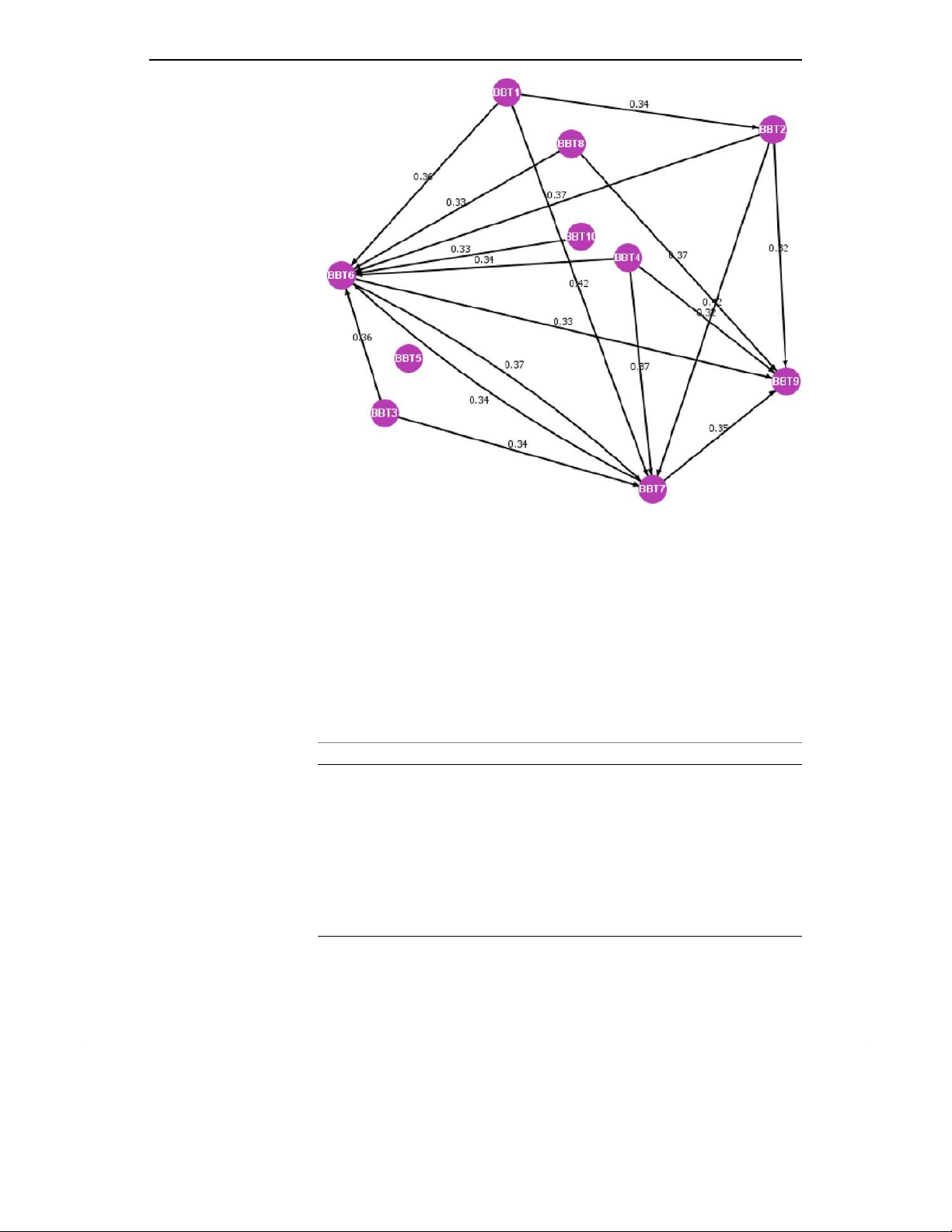
the causal effect map. The causal map of the blockchain
After getting the IDRM, the overall direct relationship matrix
technology adoption barriers is created and shown in Fig.2
is developed with the help of Eq. ( ) 1 and shown in Table . 5
is constructed using the T matrix presented in Table11.
This IDRM is transformed into a Normalised Relation-
Figure2 depicts the causal relationships between the barri-
ship Matrix (NRM) using Eqs. ( ) 2 and ( ) 3 . The obtained
ers of blockchain technologies adoption. The nodes signify
NRM is demonstrated in Table10.
the barriers, and the arrow shows the direction of relation-
The obtained NRM is transformed into a total relationship
ships along with the relationship weight. The relationship matrix (T) applying Eq. ( )
4 , which is presented in Table . 11
weight is provided over the directional arrow. The higher
The threshold value has been computed to identify the
weights signify the strong relationship between the barriers.
significant relationship among the barriers. This threshold
Further, it also shows the cause-and-effect barriers with two
value is determined by adding the "average of the T matrix" different colours.
and the "standard deviation of the T matrix." This thresh-
In the total relationship matrix T, the row-wise summa-
old value supports this structure's differentiation and the
tion (R) and column-wise summation (C) is performed using
causal map's development. If the values in the T matrix (see Eqs. ( ) 5 and ( )
6 and shown in Table12. Further, the promi-
Table11) are more than the threshold value, then the causal
nence and effect scores are determined with the help of Eqs.
map is deemed to be drawn. This cause and effect map not (7) and (8), respectively.
Table 5 Experts' assessment of barriers to BT implications IBT
E1 E2 E3 E4 E5 E6 E7 E8 E9 E10 IBT1 M H H VH VH VH VH M H H IBT2 H H L L H M M M M M IBT3 H H VH H VH VH VH VH VH VH IBT4 VH M H M H H VH H VH H IBT5 M L H H M L VH M M M IBT6 H H M H H M VH VH H VH IBT7 H H VH VH H VH H VH M H IBT8 M H M H H H VH VH H VH IBT9 M M M M H H VH H L M IBT10 VH VH M H VH VH VH VH VH H IBT11 VH H M VH VH M H M M H IBT12 M VH H H VH VH VH M VH VH IBT13 M VH VH M VH M H VH H VH 1 3 6 76 S.Khan et al.
Table 6 Transformed Grey matrix ICFs
E1 E2 E3 E4 E5 E6 E7 E8 E9 E10
ICF1 [2,3] [3,4] [3,4] [4,5] [4,5] [4,5] [4,5] [2,3] [3,4] [3,4]
ICF2 [3,4] [3,4] [1,2] [1,2] [3,4] [2,3] [2,3] [2,3] [2,3] [2,3]
ICF3 [3,4] [3,4] [4,5] [3,4] [4,5] [4,5] [4,5] [4,5] [4,5] [4,5]
ICF4 [4,5] [2,3] [3,4] [2,3] [3,4] [3,4] [4,5] [3,4] [4,5] [3,4]
ICF5 [2,3] [1,2] [3,4] [3,4] [2,3] [1,2] [4,5] [2,3] [2,3] [2,3]
ICF6 [3,4] [3,4] [2,3] [3,4] [3,4] [2,3] [4,5] [4,5] [3,4] [4,5]
ICF7 [3,4] [3,4] [4,5] [4,5] [3,4] [4,5] [3,4] [4,5] [2,3] [3,4]
ICF8 [2,3] [3,4] [2,3] [3,4] [3,4] [3,4] [4,5] [4,5] [3,4] [4,5]
ICF9 [2,3] [2,3] [2,3] [2,3] [3,4] [3,4] [4,5] [3,4] [1,2] [2,3]
ICF10 [4,5] [4,5] [2,3] [3,4] [4,5] [4,5] [4,5] [4,5] [4,5] [3,4]
ICF11 [4,5] [3,4] [4,5] [4,5] [4,5] [2,3] [3,4] [4,5] [2,3] [3,4]
ICF12 [2,3] [4,5] [3,4] [3,4] [4,5] [4,5] [4,5] [2,3] [4,5] [4,5]
ICF13 [2,3] [4,5] [4,5] [2,3] [4,5] [2,3] [3,4] [4,5] [3,4] [4,5]
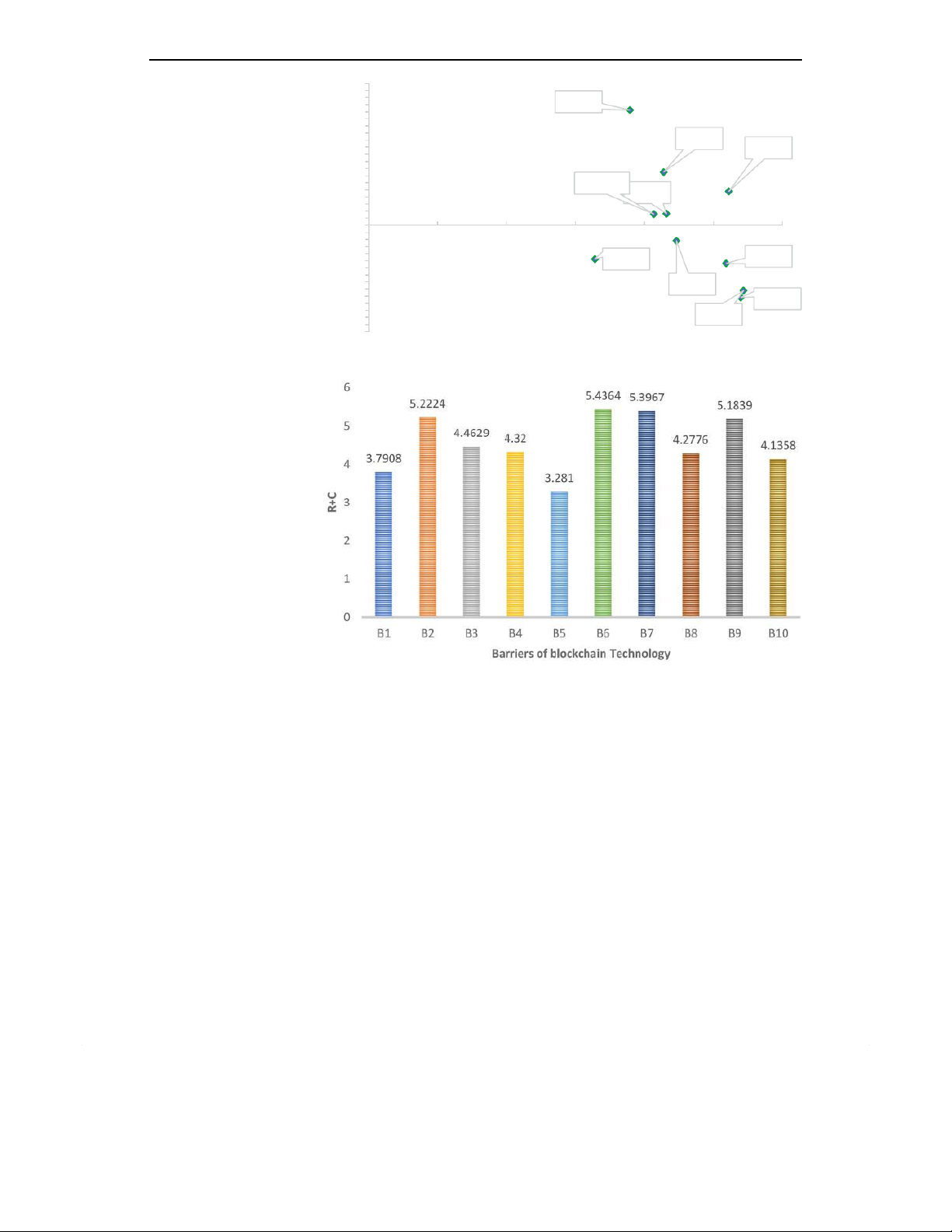
As per the prominence and net effect score, the causal
influences the other significant barriers. The most influen-
relationship map is constructed and illustrated in Fig.3.
tial barrier is the 'Lack of information sharing' that would
The importance order of each barrier is obtained through
be a major concern of the SC partners. The SC partners
the DEMATEL method. The critical order of the barrier is
are unwilling to share their information with other parties
'Lack of information sharing' ≻ 'Trust management issue'
because they believe this crucial information can be mis-
≻ 'Lack of upgraded technologies' ≻ 'Ineffective organiza-
used. To overcome this barrier, there is a requirement to
tional policies' ≻ 'Communication gap among SC partners'
establish trust among the SC stakeholders. The next influ-
≻ 'Lack of technical recourse' ≻ 'Data Security and privacy'
encing barriers, ' Trust management issue,' are mitigated
≻ 'Lack of adequate knowledge about blockchain' ≻ 'Block-
through cooperation and understanding of the need of cur-
chain adoption framework complexity' ≻ 'high investment
rent business scenarios. The implementation of the Block-
cost'. The important order of each barrier is shown in Fig.4.
chain itself increases the trust among the SC partners. The
Further, the identified barriers are classified into "influen-
third influencing barrier is the 'Lack of upgraded technolo-
tial barriers" and "influenced barriers." The 'influential bar-
gies' that require high investment and extensive support from
riers' consist of five barriers: ' Lack of information sharing',
the top management. Without technological advancement
'Trust management issue' and 'Lack of upgraded technolo-
and sufficient technical capability, Blockchain cannot be
gies', 'Communication gap among SC partners' and 'high
implemented at the SC level. Therefore, it is recommended
investment cost.' These barriers require more focus, which
that top management could put enough resources into imple-
menting the Blockchain technological capability for long-
term success. The next influencing barrier is the 'Commu-
Table 7 Results of the grey Delphi method
nication gap among SC partners' that could be mitigated
Initial Barriers Overall
Crisp Weight Decision Rename
through effective communication with SC partners. The next Grey Weigh
influencing barrier is 'high investment cost', which could
be a major concern, particularly for small enterprises. Our ICF1 [3.2,4.2] 3.7 Select BBT1
results show that in a developing country like India, some ICF2 [2.1,3.1] 2.6 Reject NA
SC partners are not ready to invest in the high-cost advanced ICF3 [3.7,4.7] 4.2 Select BBT2
technologies like Blockchain. To motivate them to imple- ICF4 [3.1,4.1] 3.6 Select BBT3
ment the Blockchain, there is a crucial requirement to create ICF5 [2.2,3.2] 2.7 Reject NA
awareness about the benefits of BT. Since the investment ICF6 [3.1,4.1] 3.6 Select BBT4
requirement is viewed as a significant barrier, enhanced ICF7 [3.3,4.3] 3.8 Select BBT5
focus on business case creation and overall value determi- ICF8 [3.1,4.1] 3.6 Select BBT6
nation should be a managerial focus. ICF9 [2.4,3.4] 2.9 Reject NA
The influenced group barrier includes the 'ineffective ICF10 [3.6,4.6] 4.1 Select BBT7
organizational policies', 'lack of technical recourse', 'data ICF11 [3.3,4.3] 3.8 Select BBT8
security and privacy, 'lack of adequate knowledge about ICF12 [3.4,4.4] 3.9 Select BBT9
blockchain', and 'lack of a framework for blockchain'. ICF13 [3.2,4.2] 3.7 Select BBT10
These influenced factors can be expected to be readily 1 3
Barriers toblockchain technology adoption insupply chains: thecase ofIndia 677
Table 8 Finalised barriers of blockchain technologies with description S. No Code Barriers Description
BBT1 Blockchain adoption framework complexity
The structure for applying it is insufficient because BT is still in its initial stage in the context of SC.
BBT2 Ineffective organizational policies
Adopting BT necessitates the establishment of new organizational standards to
reflect shifting roles, responsibilities, and expertise.
BBT3 Communication gap among SC partners
BT implementation is hampered by a lack of effective communication among SC stakeholders
BBT4 Data Security and privacy
Cyber-attacks may result in the unauthorized access and dissemination of sensitive data
BBT5 High investment cost
Adopting BT requires an organization to invest in new infrastructure for data
collecting and processing, which is costly
BBT6 Trust management issue
The SC partners are not willing to share the information due to a lack of trust
BBT7 Lack of information sharing
Numerous businesses consider their data a competitive advantage and are
reluctant to reveal critical information.
BBT8 Lack of technical recourse
The Lack of technical skills in BT is a key barrier to its adoption for SC.
BBT9 Lack of upgraded technologies
The absence of standardized tools, methods, and performance measurements
complicates BT implementation in SC
BBT10 Lack of adequate knowledge about Blockchain Implementing BT in SC is difficult due to the theory and application for BT in different sectors.
able to be mitigated, once the influencer barrier factors
that in India, lack of upgraded technologies is a barrier
are effectively overcome. For example where the barriers
that is influenced by numerous other influencer barriers,
related to trust, communication, technological knowledge
and we acknowledge that this situation might be different
and willing information sharing are mitigated, our results
in other, more developed economies.
show that organisational policy barriers, lack of knowl-
edge barriers, and technical barriers such as perceived
security/ privacy bar riers should be consequentially
5 Discussion andimplications
mitigated with more ease and effectiveness. Our study
has thus demonstrated the causal relationships between
5.1 International comparisons
barrier factors to BT implementation and these findings
can have potential utility for professional purposes in a
It is reasonable to expect that barriers to BT adoption, and practical sense.
indeed drivers of the same might vary across industries
Our specific findings about barriers to BT implementa-
and countries, because of the different settings, motiva-
tion are not able to be directly benchmarked against most
tional factors and incentives (Cole etal.201 ) 9 , and capa-
other such studies, because most others were conducted
bilities within supply chains across such industries, sectors
in developing countries, or across a mix of countries,
and countries. For example, emphasis in Balasubramanian
whereas ours were specific to the developing nation of
etal. (2021) was placed on government directed policies
India. For example, the insights coming from Fig.2 show
and business readiness in Dubai, whereas in our data from
Table 9 Initial relationship matrix
Barriers BBT1 BBT2 BBT3 BBT4 BBT5 BBT6 BBT7 BBT8 BBT9 BBT10 BBT1 0 3.75 2.25
3.125 1.625 2.125 3.625 1.125 0 2.125 BBT2 2.875 0 2.5 1.125 1.5 2.25 3.5 3.125 1.625 2.375 BBT3 0.375 2.625 0 3.125 1.125 3.875 3.125 0 1.125 0
BBT4 0.125 1.125 2.125 0 1.375 3.125 3.75 1.125 2.75 1.125 BBT5 1.125 0 1.125 1.125 0 2.625 1.875 0.75 1.5 0
BBT6 0.125 2.125 3.125 2.375 1.125 0 3.625 0 3.125 1 BBT7 1.125 2.125 1.25 0.125 0.125 3.375 0 1.125 4 2.25
BBT8 0.125 3.125 1.125 3.25 1.75 2.125 1.125 0 3.625 2.125 BBT9 0.125 1.75
2.125 1.125 2.625 1.125 2.125 3.25 0 3.125 BBT10 1.75 1.125 1.125 0.625 2.75 3.125 1.125 2.125 2.125 0 1 3 6 78 S.Khan et al. Table 10 Normalised relationship matrix
Barriers BBT1 BBT2 BBT3 BBT4 BBT5 BBT6 BBT7 BBT8 BBT9 BBT10 BBT1 0
0.1571 0.0942 0.1309 0.0681 0.0890 0.1518 0.0471 0.0000 0.0890 BBT2 0.1204 0
0.1047 0.0471 0.0628 0.0942 0.1466 0.1309 0.0681 0.0995 BBT3 0.0157 0.1099 0
0.1309 0.0471 0.1623 0.1309 0.0000 0.0471 0.0000
BBT4 0.0052 0.0471 0.0890 0
0.0576 0.1309 0.1571 0.0471 0.1152 0.0471
BBT5 0.0471 0.0000 0.0471 0.0471 0
0.1099 0.0785 0.0314 0.0628 0.0000
BBT6 0.0052 0.0890 0.1309 0.0995 0.0471 0 0.1518 0.0000 0.1309 0.0419
BBT7 0.0471 0.0890 0.0524 0.0052 0.0052 0.1414 0 0.0471 0.1675 0.0942
BBT8 0.0052 0.1309 0.0471 0.1361 0.0733 0.0890 0.0471 0 0.1518 0.0890
BBT9 0.0052 0.0733 0.0890 0.0471 0.1099 0.0471 0.0890 0.1361 0 0.1309
BBT10 0.0733 0.0471 0.0471 0.0262 0.1152 0.1309 0.0471 0.0890 0.0890 0
India, where information technologies are relatively well
This research identifies significant barriers to imple-
developed in rapidly developing and competitive markets,
menting BT in the SC, and the relationships between these
key factors were more at the organisational level of infor-
barriers. The identified barriers should be mitigated for the
mation sharing, trust, information technological and capa-
successful adoption of BT in supply chain management.
bility, and organisational capabilities.
These causal relationships among the barriers helps the SC
An example of differences in industry context and its
managers and policy planners to mitigate these barriers by
impact on blockchain barriers comes from Kurpjuweit
knowing those that influence others. This research suggests
etal. (2019), who examined BT in the additive manufac-
that we can impact and control the influenced group barriers
turing field in particular, determining that lack of technical
by controlling the influential group barriers, hence providing
expertise was the major barrier, as well as blockchain-skilled
the knowledge that makes overcoming such barriers more
specialists and governance mechanisms being absent, as
effective. This research also provides the advantages and
compared with our findings in the context of Indian industry
requirements of the BT that encourage SC stakeholders to
in general, where these factors were much less prominent,
implement the BT in their respective SC. The causal rela-
compared with information sharing and trust challenges.
tionship among the barriers helps the managers to prepare
From the studies that we reviewed, it is reasonable to con-
the action plan and tactics more effectively.
clude that context matters, because the regulatory situation,
the business sophistication and internal business readiness,
as well as the style of relationships between supply chain
5.2 Implications forgovernment andindustry
partners does vary across sectors and countries.
We note that while some contextual differences exist
Policy implications come from our study for both govern-
across countries and industries, that overlapping similarities
ment / regulators, and for businesses. For government, that
can be reasonably expected, such as in the reported results
sets the contextual conditions for new technology adoption,
from, who comment on the need for a culture of collabo-
several strategies are possible to contribute to reduction in
ration, which, if not present, could be a common barrier,
the height of barriers, such as fostering trust in industry, for
wherever the industry and country.
example through convening roundtables for industry groups,
Table 11 Total relationship matrix
Barriers BBT1 BBT2 BBT3 BBT4 BBT5 BBT6 BBT7 BBT8 BBT9 BBT10
BBT1 0.0996 0.3425 0.2876 0.2906 0.2164 0.3592 0.4153 0.1933 0.2521 0.2500
BBT2 0.2082 0.2199 0.3039 0.2342 0.2254 0.3724 0.4158 0.2754 0.3230 0.2725
BBT3 0.0879 0.2559 0.1639 0.2520 0.1613 0.3598 0.3438 0.1163 0.2458 0.1351
BBT4 0.0791 0.2105 0.2485 0.1401 0.1827 0.3426 0.3658 0.1678 0.3171 0.1870
BBT5 0.0867 0.1090 0.1513 0.1374 0.0789 0.2397 0.2176 0.1027 0.1895 0.0895
BBT6 0.0832 0.2471 0.2864 0.2304 0.1743 0.2293 0.3667 0.1306 0.3263 0.1832
BBT7 0.1197 0.2477 0.2157 0.1488 0.1428 0.3390 0.2191 0.1752 0.3491 0.2327
BBT8 0.0930 0.2980 0.2324 0.2814 0.2218 0.3289 0.2980 0.1492 0.3667 0.2433
BBT9 0.0876 0.2369 0.2468 0.1945 0.2410 0.2796 0.3048 0.2550 0.2151 0.2627
BBT10 0.1392 0.2043 0.2045 0.1694 0.2339 0.3284 0.2600 0.1992 0.2754 0.1327 1 3
Barriers toblockchain technology adoption insupply chains: thecase ofIndia 679
Fig. 2 Network relationship Map for the barriers to block- chain technology adoption
and providing BT education programs and improved infor-
chains that BT can be used to develop win-win outcomes,
mation infrastructure. Government also has a role to play in
through data and knowledge sharing. For some businesses
overseeing data security standards.
that may have a tradition of keeping information ‘secret’, they
For executives in businesses, overcoming the primary bar-
may benefit from a formal business case evaluation of BT,
riers such as lack of preparedness to share information and
that clearly articulates net benefits and provides the impetus to
to trust counterparties can be mitigated by placing additional
make a step change in their information policies and culture.
effort into relationship building, aligning incentives and co-
While every business and every supply relationship is to some
investing in BT. Third party technologies and training can be
extent unique, the findings of this study provide a solid context
used to source expertise and hence overcome that barrier. With
of the barrier factors that can be checked by policy makers and
that knowledge will come increased confidence in such new
business leaders, in order to anticipate and assist in mitigating
technologies such as BT, and a collective view within supply
potential implementation blockages and problems.
Table 12 Cause and effect of barriers to the adoption of BT Barriers R C R+C R-C Cause/ Effect
BBT1 2.7066 1.0841 3.7908 1.6225 Cause
BBT2 2.8506 2.3718 5.2224 0.4788 Cause
BBT3 2.1219 2.3410 4.4629 -0.2192 Effect
BBT4 2.2411 2.0788 4.3200 0.1623 Cause
BBT5 1.4023 1.8787 3.2810 -0.4763 Effect
BBT6 2.2576 3.1789 5.4364 -0.9213 Effect
BBT7 2.1899 3.2069 5.3967 -1.0170 Effect
BBT8 2.5128 1.7647 4.2776 0.7481 Cause BBT9 2.3239 2.8600 5.1839 -0.5361 Effect
BBT10 2.1470 1.9888 4.1358 0.1582 Cause 1 3 6 80 S.Khan et al.
Fig. 3 Causal relationships 2 among barriers of BT adoption in the supply chain BBT1 1.5 BBT8 BBT2 1 BBT10 0.5 BBT4 0 R-C0123456 -0.5 BBT5 BBT9 R+C BBT3 -1 BBT7 BBT6 -1.5
Fig. 4 Ranking of the barriers to BT implementation in the supply chain
6 Conclusion, limitation, andsuggestions
group. Managerial implications were drawn from these find- forfuture research
ings, based on this cause-effect knowledge as generated.
The study has certain limitations, such as the barriers
This study's objective was to identify and assess the causal
being finalized through a literature survey and expert opin-
relationship among the barriers to adopting BT in the SC.
ions. Thus, there is always a possibility of overlooking some
The literature review recognized ten primary barriers to
potential barriers in the article's selection and review. Fur-
blockchain adoption in the SC to accomplish this objective.
ther, the evaluation is based on expert feedback, which could
These significant barriers to adopting BT were confirmed and
be biased, despite the study design efforts to minimise such
analytically finalized by the grey Delphi method. After that,
bias. These shortcomings can be eased by broadening the
the causal interrelationship between them was developed
literature review process so that certain relevant barriers can
using the DEMATEL method. The adopted methodology
also be captured. We propose that interviews with industry
also categorized the identified barriers into an influential and
practitioners who have implemented BT, and the construc-
influenced group. The influential group contains five barri-
tion of both quantitative (survey) based research, and quali-
ers, and the remaining five were classified into the influenced
tative case studies will build on this present study to further 1 3
Barriers toblockchain technology adoption insupply chains: thecase ofIndia 681
validate and refine our collective understanding of BT bar-
accountability. Inform Process Manag 58(3):102529. https:// doi.
org/ 10. 1016/j. ipm. 2021. 102529
riers. Given the business and supply chain potential of BT,
Balasubramanian S, Shukla V, Sethi, J, Islam N, Saloum R (2021)
such further refinement of knowledge about blockchain bar-
A readiness assessment framework for Blockchain adoption: A
riers is much warranted. This study is based on expert views
healthcare case study. Technol Forecast Soc Change 165:120536.
from a developing nation, India, where barriers might be
https:// doi. org/ 10. 1016/j. techf ore. 2020. 120536
Benzidia S, Makaoui N, Subramanian N (2021) Impact of ambidexter-
expected to different than in other regions such as devel-
ity of blockchain technology and social factors on new product
oped nations in Europe and USA, hence we suggest that
development: A supply chain and Industry 4.0 perspective. Tech-
studies that explicitly compare barriers across these regions
nol Forecast Soc Change 169:120819. https:// doi. org/ 10. 1016/ j.
will be useful in future. In addition, such comparative and techf ore. 2021. 120819
Boutkhoum O, Hanine M, Nabil M, El Barakaz F, Lee E, Rustam F,
benchmarking studies will lead to learning across regions
Ashraf I (2021) Analysis and Evaluation of Barriers Influenc-
and economy classifications, that will also add to collec-
ing Blockchain Implementation in Moroccan Sustainable Supply
tive knowledge and expertise. Further studies should also
Chain Management: An Integrated IFAHP-DEMATEL Frame-
include case studies of how such barriers were overcome or work. Mathematics 9(14):1601
Bragadeesh S, Umamakeswari A (2020) Development of a reliable sup-
mitigated at the individual firm or supply chain level.
ply chain system using Blockchain. J Intel Fuzzy Syst 39(6):8377–
8387. https:// doi. org/ 10. 3233/ jifs- 189156
Cole R, Stevenson M, Aitken J (2019) Blockchain technology: impli-
Funding Open Access funding enabled and organized by CAUL and
cations for operations and supply chain management. Supply its Member Institutions.
Chain Manag: An Int J 24(4):469–483. https:// do i. or g/ 10. 1108/ scm- 09- 2018- 0309 Declarations
Dalkey N, Helmer O (1963) An Experimental Application of the
DELPHI Method to the Use of Experts. Manag Sci 9(3):458–
Conflict of interest The authors have no relevant financial or non-financial 467. https:// doi . org/ 10. 1287/ mnsc.9 . 3 . 458
interests to disclose. The authors have no competing interests to declare
Demirkan S, Demirkan I, McKee A (2020a) Blockchain technology in
that are relevant to the content of this article. All authors certify that they
the future of business cyber security and accounting. J Manag Anal
have no affiliations with or involvement in any organization or entity with online published. https:// d
oi. org/ 10. 1080/ 23270 012. 2020. 17 317 21
any financial interest or non-financial interest in the subject matter or ma-
Demirkan S, Demirkan I, McKee A (2020b) Blockchain technology
terials discussed in this manuscript.
in the future of business cyber security and accounting. J Manag
Analytics 7(2):189–208. https:// doi . or g/ 10. 1080/ 23270 012. 2020.
Open Access This article is licensed under a Creative Commons Attri- 17317 21
bution 4.0 International License, which permits use, sharing, adapta-
Falcone E, Steelman Z, Aloysius J (2020) Understanding Managers’
tion, distribution and reproduction in any medium or format, as long
Reactions to Blockchain Technologies in the Supply Chain: The
as you give appropriate credit to the original author(s) and the source,
Reliable and Unbiased Software Agent. J Bus Logist 42(1):25–
provide a link to the Creative Commons licence, and indicate if changes 45. https:// doi . org/ 10. 1111/ jbl . 12263
were made. The images or other third party material in this article are
Ferdous M, Chowdhury F, Alassafi M (2019) In Search of Self-Sovereign
included in the article's Creative Commons licence, unless indicated
Identity Leveraging Blockchain Technology. IEEE Access 7:103059–
otherwise in a credit line to the material. If material is not included in
103079. https:// doi. org/ 10. 1 109/ access. 2019. 29311 73
the article's Creative Commons licence and your intended use is not
Francisco K, Swanson D (2018) The Supply Chain Has No Clothes:
permitted by statutory regulation or exceeds the permitted use, you will
Technology Adoption of Blockchain for Supply Chain Transpar-
need to obtain permission directly from the copyright holder. To view a
ency. Logistics 2(1):2. https:// doi . org/ 10. 3390/ logis tics2 010002
copy of this licence, visit http:// creat iveco mmons. org/ licen ses/ by/4. 0/.Haleem A, Khan S, Khan M (2019) Traceability implementation in
food supply chain: A grey-DEMATEL approach. Inform Process Agric 6(3):335–348
Hassani H, Huang X, Silva E (2018) Banking with blockchain-ed big References
data. Journal of Management Analytics 5(4):256–275
Helo P, Hao Y (2019) Blockchains in operations and supply chains: A
Agrawal T, Kumar V, Pal R, Wang L, Chen Y (2021) Blockchain-based
model and reference implementation. Comp Indust Eng 136:242–
framework for supply chain traceability: A case example of textile 251. https:// doi. org/ 1 0. 1016/j. cie. 2019. 07. 023
and clothing industry. Comp Indust Eng 154:107130. https:// doi.
Iansiti M, Lakhani KR (2017) The truth about Blockchain. Harvard
org/ 10. 1016/j. cie. 2021. 107130 Bus Rev 95:118–127
Andoni M, Robu V, Flynn D, Abram S, Geach D, Jenkins D etal (2019)
Kamble S, Gunasekaran A, Kumar V, Belhadi A, Foropon C (2021)
Blockchain technology in the energy sector: A systematic review
A machine learning based approach for predicting blockchain
of challenges and opportunities. Renew Sustain Energy Rev
adoption in supply Chain. Technol Forecast Soc Change
100:143–174. https:// doi. org/ 10. 1016/j. rser. 2018. 10. 014
163:120465. https:// doi. org/ 10. 1016/j. techf ore. 2020. 120465
Aslam J, Saleem A, Khan N, Kim Y (2021) Factors influencing block-
Khan S, Haleem A (2021) Investigation of circular economy practices
chain adoption in supply chain management practices: A study
in the context of emerging economies: a CoCoSo approach. Int J
based on the oil industry. J Innov Knowledge. https:// doi. org/ 10.
Sustain Eng 1-11. https:// doi. org/ 10. 1080/ 19397 0 38. 2020. 18714 42 1016/j. jik. 2021. 01. 002
Khan S, Haleem A, Khan M (2022) A grey-based framework for cir-
Bader L, Pennekamp J, Matzutt R, Hedderich D, Kowalski M, Lücken
cular supply chain management: a forward step towards sustain-
V, Wehrle K (2021) Blockchain-based privacy preservation for
ability.Management Of Environmental Quality: An International
supply chains supporting lightweight multi-hop information
Journal. https:// doi. org/ 10. 1108/ meq- 11- 2021- 0265 1 3 6 82 S.Khan et al.
Khan S, khan M, Haleem A (2019) Blockchain Enabled Supply Chain:
Journal, ahead-of-print(ahead-of-print). https:// doi. org/ 10. 1108/
An Implementation Perspective. Our Heritage 67(5):318-334. bfj- 09- 2020- 0832 677-1-10-20200108
Reyna A, Martín C, Chen J, Soler E, Díaz M (2018) On Blockchain and
Kosba A, Miller A, Shi E, Wen Z, Papamanthou C (2016) Hawk: the
its integration with IoT. Challenges and opportunities. Future Gen
blockchain model of cryptography and privacy-preserving smart
Comp Syst 88:173–190. https:// doi . o rg/ 10. 1016/ j. future. 2018. 05.
contracts. May In: 2016 IEEE Symp Sec Privacy (SP). IEEE. pp. 046 839–858
Risius M, Spohrer K (2017) A blockchain research framework: what we
Kumar K, Prakash A (2019) Examination of sustainability reporting
(don’t) know, where we go from here, and how we will get there.
practices in Indian banking sector. Asian J Sustaina Soc Res 4(1).
Bus Inform Syst Eng 59(6):385–409
https:// doi. org/ 10. 1186/ s41180- 018- 0022-2
Saberi S, Kouhizadeh M, Sarkis J, Shen L (2018) Blockchain technol-
Kurpjuweit S, Schmidt C, Klöckner M, Wagner S (2019) Blockchain in
ogy and its relationships to sustainable supply chain management.
Additive Manufacturing and its Impact on Supply Chains. J Bus
Int J Prod Res 57(7):2117–2135. https:// doi. org/ 1 0. 1080/ 0 0207 543.
Logist 42(1):46–70. https:// doi. org/ 10. 1111/ jbl. 12231 2018. 1 5332 61
Li Z, Zhong R, Tian Z, Dai H, Barenji A, Huang G (2021) Industrial
Samson D, Ellis A, Black S (2022) Business Model Transformation: The AI
Blockchain: A state-of-the-art Survey. Robot Computer-Integr
& Cloud Technology Revolution. Taylor & Francis
Manuf 70:102124. https:// doi. org/ 10. 1016/j. rcim. 2021. 102124
Sanka A, Irfan M, Huang I, Cheung R (2021) A survey of breakthrough
Liang X, Shetty S, Tosh D, Kamhoua C, Kwiat K, Njilla L (2017)
in blockchain technology: Adoptions, applications, challenges and
Provchain: a Blockchain-Based data provenance architecture in
future research. Comp Commun 169:179–201. https:// doi . org/ 10.
cloud environment with enhanced privacy and availability. Pro- 1016/j. comcom. 2020. 1 2. 028
ceedings of the 17thIEEE/ACM International Symposium on
Saurabh S, Dey K (2021) Blockchain technology adoption, archi-
Cluster, Cloud and Grid Computing, Madrid, Spain, 468-477
tecture, and sustainable agri-food supply chains. J Clean Prod
Lim M, Li Y, Wang C, Tseng M (2021) A literature review of block-
284:124731. https:// doi. org/ 10. 1016/j. jclep ro. 20 20. 124731
chain technology applications in supply chains: A comprehensive
Sengupta J, Ruj S, Das Bit S (2019) A Comprehensive Survey on Attacks,
analysis of themes, methodologies and industries. Comp Indust
Security Issues and Blockchain Solutions for IoT and IIoT. J Network
Eng 154:107133. https:// doi. org/ 10. 1016/j. cie. 2021. 107133
Comp App 149:102481. https:// doi. org/ 10. 1016/j. jnca. 2019. 102481
Liu S, Forrest JY (2010) Grey Systems: Theory and Applications.
Stranieri S, Riccardi F, Meuwissen M, Soregaroli C (2021) Explor- Springer
ing the impact of Blockchain on the performance of agri-food
Lone A, Naaz R (2021) Applicability of Blockchain smart contracts in
supply chains. Food Control 119:107495. https:// doi. org/ 10.
securing Internet and IoT: A systematic literature review. Comp
1016/j. foodc ont. 2020. 107495
Sci Rev 39:100360. https:// doi. org/ 10. 1016/ j. c osrev. 2020.
100360 Tandon A, Dhir A, Islam A, Mäntymäki M (2020) Blockchain in
Lu Y (2018) Blockchain and the related issues: a review of current
healthcare: A systematic literature review, synthesizing frame-
research topics. J Manag Analytics 5(4):231–255
work and future research agenda. Comp Indust 122:103290.
Lu Y (2019) The Blockchain: State-of-the-art and research challenges. J
https:// doi. org/ 10. 1016/j. compi nd. 202 0. 103290
Indust Inform Integ 15:80–90. https:// doi. org/ 10. 1016/j. jii. 2019. 04. 002Teodorescu M, Korchagina E (2021) Applying Blockchain in the Mod-
Mangla SK, Govindan K, Luthra S (2017) Prioritizing the Barriers
ern Supply Chain Management: Its Implication on Open Innova-
to Achieve Sustainable Consumption and Production Trends in
tion. J Open Innov: Technol, Market, Complex 7(1):80. https://
Supply Chains Using Fuzzy Analytical Hierarchy Process. J Clean
doi. org/ 10. 3390/ joitm c7010 080 Prod 151:509–525
Treiblmaier H (2018) The Impact of the Blockchain on the Supply
Mathivathanan D, Mathiyazhagan K, Rana Nripendra P, Khorana Sangeeta,
Chain: A Theory-Based Research Framework and a Call for
Dwivedi Yogesh K (2021) Barriers to the adoption of blockchain tech-
Action. SSRN Electron J. https:// do i. or g/ 10. 2 139/ s srn. 32241 45
nology in business supply chains: a total interpretive structural model-
Upadhyay A, Mukhuty S, Kumar V, Kazancoglu Y (2021a) Block-
ling (TISM) approach. Int J Prod Res 59(11):3338–3359. https:// doi.
chain technology and the circular economy: Implications for sus-
org/ 10. 1080/ 00207 543. 2020. 18685 97
tainability and social responsibility. J Clean Prod 293:126130.
Medalla M, Yamagishi K, Tiu A, Tanaid R, Abellana D, Caballes S etal https:// doi. org/ 10 . 1016/j. jclep ro . 2021. 126130
(2021) Relationship mapping of consumer buying behavior ante-
Upadhyay A, Mukhuty S, Kumar V, Kazancoglu Y (2021b) Blockchain
cedents of secondhand clothing with fuzzy DEMATEL. J Manag
technology and the circular economy: Implications for sustainabil- Analytics 1-39. https:// doi . or g/ 10 . 1080/ 23270 012. 2020. 1 8708 7 8
ity and social responsibility. J Clean Product 293:126130. https://
Mendling J, Weber I, van der Aalst W, Brocke JV, Cabanillas C, Daniel
doi. org/ 10. 1016/j. jclep ro. 2021. 126130
F, Dustdar S (2017) Blockchains for Business Process Manage-
Upadhyay N (2020) Demystifying Blockchain: A critical analysis of
ment-Challenges and Opportunities. ACM Transactions on Man-
challenges, applications and opportunities. Int Inform Manag
agement Information Systems (TMIS) 9 (1): 1–16. arXiv Preprint 54:102120. https:// do i. or g/ 10 . 1016/j. i jinf o mgt. 2 020. 1 02120 https:// arxiv. o rg/ abs/ 1704. 03610
Vadgama N, Tasca P (2021) An Analysis of Blockchain Adoption
Mohanta B, Jena D, Panda S, Sobhanayak S (2019) Blockchain technol-
in Supply Chains Between 2010 and 2020. Front Blockchain 4.
ogy: A survey on applications and security privacy Challenges.
https:// doi. org/ 10. 3389/ fbloc. 2021. 610476
Internet Things 8:100–107. https:// doi. org/ 10. 1016/j. iot. 2019. 100107 Venkatesh V, Kang K, Wang B, Zhong R, Zhang A (2020) System
Mougayar W 2016 The Business Blockchain: Promise, Practice, and Appli-
architecture for Blockchain based transparency of supply chain
cation of the Next Internet Technology. Hoboken: JohnWiley & Sons
social sustainability.Robot Computer-Integ Manuf 63:101896.
Neisse R, Steri G, Nai-Fovino I (2017) A Blockchain- Based approach
https:// doi. org/ 10. 1016/j. rcim. 2019. 101896
for data accountability and provenance tracking. Proceedings of
Viriyasitavat W, Hoonsopon D (2019) Blockchain characteristics and
the 12th International Conference on Availability, Reliability and
consensus in modern business processes. J Indust Inform Integ
Security, Reggio Calabria, Italy, Article No. 14, pp. 1-9 13:32–39
Perera S, Nanayakkara S, Rodrigo MNN, Senaratne S, Weinand R
Viriyasitavat W, Xu L, Bi Z, Pungpapong V (2019) Blockchain
(2020) Blockchain Technology: Is it Hype or Real in the Con-
and Internet of Things for Modern Business Process in Digital
struction Industry? J Indust Inform Integ 17:100125
Economy—the State of the Art. IEEE Transact Comput Soc Syst
Rana R, Tricase C, De Cesare L (2021) Blockchain technol- 6(6):1420–1432
ogy for a sustainable agri-food supply chain. British Food 1 3
Barriers toblockchain technology adoption insupply chains: thecase ofIndia 683
Viriyasitavat W, Xu L, Bi Z, Sapsomboon A (2020) Blockchain-based
Yli-Huumo J, Ko D, Choi S, Park S, Smolander K (2016) Where Is
business process management (BPM) framework for service
Current Research on Blockchain Technology? A Systematic
composition in industry 4.0. J Intel Manuf 31(7):1737–1748
Review. PLOS ONE 11(10):e0163477
Wamba S, Queiroz M (2020) Blockchain in the operations and sup-
Zhang C, Chen Y (2020) A Review of Research Relevant to the Emerg-
ply chain management: Benefits, challenges and future research
ing Industry Trends: Industry 4.0, IoT, Blockchain, and Business
opportunities. Int Jo Inform Manag 52:102064
Analytics. J Indust Integ Manag 5(01):165–180. https:// doi. org/
Wang B, Luo W, Zhang A, Tian Z, Li Z (2020) Blockchain-enabled cir- 10. 1142/ s2424 86221 95001 92
cular supply chain management: A system architecture for fast fash-
ion. Comp Indust 123:103324. https:// doi. or g/ 10. 1016/j. c
ompi nd. Publisher's Note Springer Nature remains neutral with regard to 2020. 103324
jurisdictional claims in published maps and institutional affiliations.
Xu M, Chen X, Kou G (2019) A systematic review of Blockchain.
Financial Innov 5(1). https:// doi
. org/ 10. 1186/ s40854- 019- 0147- z 1 3
Tài liệu liên quan:
-
Bảng giá trị phân phối thống kê poisson và student môn Xác suất thống kê| Trường Đại học Ngoại Thương
27 14 -
Bảng giá trị quyết định thống kê wilcoxon rank-sum test môn Xác suất thống kê| Trường Đại học Ngoại Thương
29 15 -
Bài 1 Định nghĩa cổ điển về xác suất môn Xác suất thống kê| Trường Đại học Ngoại Thương
26 13 -
Exercises for probability & statistics môn Xác suất thống kê| Trường Đại học Ngoại Thương
26 13 -
Đề thi cuối kỳ lý thuyết môn Xác suất thống kê| Trường Đại học Ngoại Thương
27 14