Lý thuyết và công thức tiếng anh môn Xác suất thống kê| Trường Đại học Ngoại Thương
Lý thuyết và công thức tiếng anh môn Xác suất thống kê| TrườngĐại học Ngoại Thương. Tài liệu giúp bạn tham khảo, ôn tập và đạt kết quả cao. Mời đọc đón xem!
Môn: Xác suất thống kê (FTU) 355 tài liệu
Trường: Trường Đại học Ngoại Thương 1.1 K tài liệu
Tác giả:





Preview text:
1 ASSIGNMENT 1
MANAGERIAL REPORT – CHAPTER 11
CASE PROBLEM 1 – AIR FORCE TRAINING PROGRAM
Question 1: Use appropriate descriptive statistics to summarize the training time
data for each method. What similarities or differences do you observe from the sample data?
Using Data Analysis – Descriptive Statistics in Excel, we have these results:
As we can see, there are no differences between the median and the mode in both
methods. The average time in Current Training Method is less than the average time
in Proposed Computer-Assisted Method – only 0.36 hour. However, almost the data
of Current Training Method are more than Proposed Computer-Assisted Method,
especially for the differences of Sample Variance and Population Variance (9.28 and 9.13 respectively).
Question 2: Use the methods of Chapter 10 to comment on any difference between
the population means for the two methods. Discuss your findings.
Based on the results in Question 1:
We call Current Training Method is 1, Proposed Computer-Assisted Method is 2;
Suppose the Confident Coefficient is 95% => α = 5% = 0.05;
• Sample means: 𝑥1 = 75.07, 𝑥2 =75.43;
• Sample size: n1 = n2 = 61;
• Population Variance: 𝜎12=15.31, 𝜎22= 6.18; 2
a. Point estimator of the difference between two population means: 𝑥1
− 𝑥2 =75.07 −75.43 = −0.36
We find that the point estimate of the difference between the mean ages of the two
populations is -0.36 hours.
b. Interval estimate of the difference between two population means (population
variances are known) 𝑛1 + 𝜎2 𝑥1 − 𝑥2 ± 𝑧2√𝜎12 2 𝛼 𝑛2
↔ −0.36 ± 1.96√15.6311+ 6.18 61 ↔ −0.36 ± 1.16
We can see that the margin of error is 1.16 hours and the 95% confidence interval
estimate of the difference between the two-population means is -0.36 – 1.16 = -1.52
hours to -0.36 + 1.16 = 0.8 hours => -1.52 to 0.8 (hours)
Question 3: Compute the standard deviation and variance for each training method.
Conduct a hypothesis test about the equality of population variances for the two
training methods. Discuss your findings.
We call Current Training Method is 1, Proposed Computer-Assisted Method is 2;
Based on the results in Question 1:
• Standard deviation: s1 = 3.94, s2 = 2.51;
• Sample variance: 𝑠12=15.56, 𝑠22= 6.28;
Suppose the Confident Coefficient is 95% => α = 5% = 0.05;
• Sample size: n1 = n2 = 61;
• Sample means: 𝑥1 = 75.07, 𝑥2 =75.43;
• Degree of freedom (dof) = 61 – 1 = 60;
To conduct a hypothesis test about the equality of population variances for the two-
training method, we use the F Distribution: 𝐻0: 𝜎12= 𝜎22 𝐻𝑎: 𝜎12 ≠ 𝜎22 3 𝐹 = 𝑠122= 15.56 6.28 = 2.48
Based on the F Distribution table, we will have Area in Upper Tail .10 .05 .025 .01
F value (df1 = df2 = 60) 1.40 1.53 1.67 1.84
Because F = 2.48 is on the right side of 1.84, the area in the upper tail of the
distribution is more than 0.1. For this two-tailed test, we double the upper tail area,
which results in a p-value more than 0.2. Because we selected α = 0.05 as the level
of significance, the p-value < α = 0.05 Thus, the null hypothesis is rejected.
Question 4: What conclusion can you reach about any differences between the two
methods? What is your recommendation? Explain.
We can see that the Current Training Method has a lesser mean than Proposed
Computer-Assisted Method, but it has a higher variance. That means there will be a
probability that students in Proposed Computer-Assisted Training will pass the exam
the complete the training faster.
Tài liệu liên quan:
-
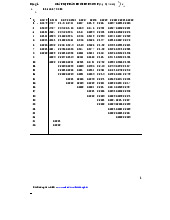
Bảng giá trị phân phối thống kê poisson và student môn Xác suất thống kê| Trường Đại học Ngoại Thương
27 14 -
Bảng giá trị quyết định thống kê wilcoxon rank-sum test môn Xác suất thống kê| Trường Đại học Ngoại Thương
29 15 -
Bài 1 Định nghĩa cổ điển về xác suất môn Xác suất thống kê| Trường Đại học Ngoại Thương
26 13 -
Exercises for probability & statistics môn Xác suất thống kê| Trường Đại học Ngoại Thương
26 13 -
Đề thi cuối kỳ lý thuyết môn Xác suất thống kê| Trường Đại học Ngoại Thương
27 14