Lý thuyết về học ngôn ngữ thứ 2
Theories of learning English as a second language
Môn: Giao tiếp Sư Phạm 174 tài liệu
Trường: Trường Đại học Sư Phạm Hà Nội 3.9 K tài liệu
Tác giả:



















Preview text:
Copyright © 2013. Routledge. All rights reserved.
Ebook pages 47-80 | Printed page 1 of 41
2 The recent history of second language learning research 2.1 Introduction
In order to understand current developments in second language learning research, it is helpful to retrace
its recent history. We will see throughout this chapter that the kind of questions researchers are asking
today are for the most part firmly rooted in earlier developments in the fields of linguistics, psychology, sociology and pedagogy.
The aim of the first part of this chapter is to explore in general terms the theoretical foundations of
today's thinking. More detailed reviews can be found in other sources, for example Dulay et al. (1982),
Selinker (1992), Thomas (2004) and Gass (2009). We will limit ourselves to the period since the 1950s,
which has seen the development of theorizing about second language learning from an adjunct to
language pedagogy, to an autonomous field of research. This period can itself be divided into three main phases.
We will start with the 1950s and 1960s and a short description of how second languages were believed
to be learned at the time. We will then describe the impact of the ‘Chomskyan revolution’ in linguistics
on the field of language acquisition, initially on the study of first language acquisition, and subsequently
that of second language acquisition. This had a huge impact on psycholinguistics in the 1970s, and we
will see that its influence is still very much felt today.
We will then briefly consider the 1980s, which witnessed the development of second language
acquisition theorizing as a relatively autonomous field of enquiry (a ‘coming of age’, as Sharwood Smith
put it: 1994, p. ix). During this period, the impact of Chomskyan linguistics developed considerably,
though with SLL researchers sometimes struggling to adapt their empirical programmes in line with
changes in Chomskyan theorizing. However, ideas coming from fields such as cognitive psychology also
became increasingly significant. Research strands initiated in the 1980s will then systematically be
reviewed and evaluated in the rest of the book, as well as some newer trends which made their
appearance in the 1990s and developed further in the 2000s. On the one hand, cognitive and
psycholinguistic theorizing about SLL have developed considerably. On the other hand there has
Mitchell, Rosamond, et al. Second Language Learning Theories, Routledge, 2013. ProQuest Ebook Central, http://ebookcentral.proquest.com/lib/flinders/detail.action?docID=1356341.
Created from flinders on 2025-08-15 16:51:09.
Copyright © 2013. Routledge. All rights reserved.
Ebook pages 47-80 | Printed page 2 of 41
emerged what has been described as the ‘social turn’ in SLL (Block, 2003), with greatly increased
interest in learner identity and agency, and the social context for SLL.
The last part of the chapter comprises a ‘timeline’ of significant publications which have advanced the
second language learning field, from the 1950s up to the present. 2.2 The 1950s and 1960s
In the 1950s and early 1960s, theorizing about second language learning was still very much an
accompaniment to the practical business of language teaching. However, the idea that language teaching
methods had to be justified in terms of an underlying learning theory was well established, since the
pedagogic reform movements of the late nineteenth century at least (see Howatt, 2004, pp. 187–227 for
an account of these). The writings of language teaching experts in the 1950s and 1960s include
consideration of learning theory, as preliminaries to their practical recommendations (for example, Lado, 1964; Rivers, 1964, 1968).
As far as its linguistic content was concerned, ‘progressive’ 1950s language pedagogy drew on a version
of structuralism developed by the British linguist Palmer in the 1920s, and subsequently by Fries and
his Michigan colleagues in the 1940s. Howatt sums up key features of this approach as follows:
Learning the spoken language meant acquiring a set of appropriate speech habits
Courses of instruction should be built round a graded syllabus of structural patterns to ensure
systematic step-by-step progress …
Grammar should be taught inductively through the presentation and practice of new patterns …
with visual and/or textual support …
Error should be avoided through adequate practice and rehearsal. (Howatt, 2004, pp. 299–300)
Howatt's summary makes it clear that language teaching experts and reformers were appealing at this
time to the general learning theory then dominant in mainstream psychology, behaviourism, which we
explain more fully in the next section. 2.2.1 Behaviourism
In the behaviourist view (Bloomfield, 1933; Skinner, 1957; Thorndike, 1932; Watson, 1924), language
learning is seen like any other kind of learning, as the formation of habits. It stems from work in
Mitchell, Rosamond, et al. Second Language Learning Theories, Routledge, 2013. ProQuest Ebook Central, http://ebookcentral.proquest.com/lib/flinders/detail.action?docID=1356341.
Created from flinders on 2025-08-15 16:51:09.
Copyright © 2013. Routledge. All rights reserved.
Ebook pages 47-80 | Printed page 3 of 41
psychology which saw the learning of any kind of behaviour as being based on the notions of stimulus
and response. Human beings are exposed to numerous stimuli in their environment. The response they
give to these stimuli will be reinforced if successful, that is if some desired outcome is obtained. Trough
repeated reinforcement, a certain stimulus will elicit the same response time and again, which will then
become a habit. The learning of any skill is seen as the formation of habits, that is, the creation of
stimulus–response pairings which become stronger with reinforcement. Applied to language learning, a
certain situation will call for a certain response; for example, meeting someone will call for some kind of
greeting, and the response will be reinforced if the desired outcome is obtained (that is, if the greeting is
understood); in the case of communication breakdown, the particular response will not be reinforced and
the learner will hopefully abandon it.
From this point of view, when learning a first language the process is relatively simple: all we have to do
is learn a set of new habits as we learn to respond to stimuli in our environment. When learning a second
language, however, we run into problems: we already have a set of well-established responses in our
mother tongue. The second language learning process therefore involves replacing those habits by a set
of new ones. The complication is that the old L1 habits interfere with this process, either helping or
inhibiting it. If structures in the L2 are similar to those of the L1, then learning will take place easily. If,
however, structures are different, then learning will be difficult. As Lado put it:
We know from the observation of many cases that the grammatical structure of the native language tends
to be transferred to the foreign language … we have here the major source of difficulty or ease in
learning the foreign language … Those structures that are different will be difficult. (Lado, 1957, pp. 58–
9, cited in Dulay et al., 1982, p. 99)
Take the example of an English L1 learner of French as a second language wanting to say I am twelve
years old, which in French is realized as J'ai douze ans (= I have twelve years), and now consider the
same learner learning to express the same meaning in German, which is realized as Ich bin zwölf Jahre
alt (= I am twelve years old). According to a behaviourist view of learning, the German structure would
be much easier and quicker to learn, and the French one more difficult, the English structure acting as a
facilitator in one instance, and an inhibitor in the other. Indeed, it may well be the case that English
learners have more difficulty with the French structure than the German one, as many French teachers
would testify after hearing their pupils repeatedly saying *Je suis douze1 (=I am twelve), but more about that later.
Mitchell, Rosamond, et al. Second Language Learning Theories, Routledge, 2013. ProQuest Ebook Central, http://ebookcentral.proquest.com/lib/flinders/detail.action?docID=1356341.
Created from flinders on 2025-08-15 16:51:09.
Copyright © 2013. Routledge. All rights reserved.
Ebook pages 47-80 | Printed page 4 of 41
From a teaching point of view, the implications of this approach were twofold. First, it was strongly
believed that practice makes perfect; in other words, learning would take place by imitating and
repeating the same structures time after time.
Second, teachers needed to focus their teaching on structures which were believed to be difficult, and as
we saw above, difficult structures would be those that were different in the L1 and the L2, as was the
case for the English/French pair cited above. The teacher of French, in our example, would need to
engage his/her pupils in many drilling exercises in order for them to produce the French structure correctly.
The logical outcome of such beliefs about the learning process was that effective teaching should
concentrate on areas of difference, and therefore of difficulty. Researchers embarked on the huge task of
comparing pairs of languages in order to pinpoint these areas. This work was termed Contrastive
Analysis (or CA for short) and can be traced back to Fries, who wrote in the introduction to his book
Teaching and learning English as a foreign language: ‘The most effective materials are those that are
based upon a scientific description of the language to be learned, carefully compared with a parallel
description of the native language of the learner’ (Fries, 1945, p. 9, cited in Dulay et al., 1982, p. 98).
Work in this tradition has some continuing influence on second/foreign language pedagogy, in spite of
many emerging criticisms which we will now discuss.
2.2.2 Behaviourism under attack
Starting in the 1950s and continuing in the 1960s, both the fields of linguistics and of psychology
witnessed major developments. Linguistics saw a shift from structural linguistics, which was based on
the description of the surface structure of a large corpus of language, to generative linguistics, which
emphasized the rule-governed and creative nature of human language. This shift was initiated by the
publication in 1957 of Syntactic structures, the first of many influential books by Noam Chomsky.
In the field of psychology, the pre-eminent role for the environment – as argued by Skinner and others –
in shaping the child's learning and behaviour was losing ground in favour of more developmentalist
views of learning, such as Piaget's cognitive developmental theory, in which inner forces drive the child,
in interaction with the environment (Piaget, 1970; Piaget and Inhelder, 1966; Piatelli-Palmarini, 1980).
Mitchell, Rosamond, et al. Second Language Learning Theories, Routledge, 2013. ProQuest Ebook Central, http://ebookcentral.proquest.com/lib/flinders/detail.action?docID=1356341.
Created from flinders on 2025-08-15 16:51:09.
Copyright © 2013. Routledge. All rights reserved.
Ebook pages 47-80 | Printed page 5 of 41
The clash of views about the way in which we learn language came to a head at the end of the 1950s
with two publications. These were Skinner's Verbal behavior in 1957 which outlined in detail his
behaviourist view of learning as applied to language (summarized above in ), and Section 2.2.1
Chomsky's critical review of Skinner's book, published in 1959.
Chomsky's criticisms centred around a number of issues: 1
The creativity of language: children do not learn and reproduce a large set of sentences, but they
routinely create new sentences that they have never heard before. This is only possible because they
internalize rules rather than strings of words; extremely common examples of utterances such as it
breaked or Mummy goed show clearly that children are not copying the language around them but applying rules. 2
Given the complexity and abstractness of linguistic rules (for example, the rules underlying the
formation of questions in many languages, or the rules underlying the use of reflexive pronouns in
English, discussed in Chapter 3), it is amazing that children are able to master them so quickly and
efficiently, especially given the limited input they receive. This has been termed ‘Plato's problem’
(Chomsky, 1987), and refers specifically to the idea that some of the structural properties of
language, given their complexity, could not possibly be learned on the basis of the samples of
language which children are exposed to. Furthermore, children are not very often corrected on the
form of their utterances, but rather on their truth values. When correction of form does take place, it
seems to have very little effect on the development of language structure.
For the above reasons, Chomsky claimed that children have an innate faculty which supports them in
their learning of language. Given a body of speech, children are programmed to discover its rules, and
are guided in doing so by an innate knowledge of what the rules should look like. We will leave fuller
discussion of Chomsky's ideas until Chapter 3. Suffice to say for now that this revolutionary approach
gave a great stimulus to the field of psycholinguistics, and especially to the study of language
acquisition. The next section reviews work in the 1970s, which was heavily influenced by these new ideas.
Mitchell, Rosamond, et al. Second Language Learning Theories, Routledge, 2013. ProQuest Ebook Central, http://ebookcentral.proquest.com/lib/flinders/detail.action?docID=1356341.
Created from flinders on 2025-08-15 16:51:09.
Copyright © 2013. Routledge. All rights reserved.
Ebook pages 47-80 | Printed page 6 of 41 2.3 The 1970s
2.3.1 First language acquisition
The work outlined above led to investigations of the acquisition of language in young children, by
researchers such as Edward Klima and Ursula Bellugi (1966), Dan Slobin (1970) or Roger Brown
(1973). They found striking similarities in the language learning behaviour of young children, whatever
the language they were learning. It seemed that children all over the world go through similar stages, use
similar constructions in order to express similar meanings, and make the same kinds of errors. The
stages can be summarized as follows (Aitchison, 2008, p. 80): Language stage Beginning age2 Crying Birth Cooing 6 weeks Babbling 6 months Intonation patterns 8 months One-word utterances 1 year Two-word utterances 18 months Word infections 2 years Questions, negatives 2 years 3 months Rare or complex constructions 5 years Mature speech 10 years
2The ages are given as a very rough guideline only; children vary considerably both in the age of onset of a given
phase, and in how fast they proceed from one phase to another. All children normally go through the stages in the order indicated, however.
The research emphasis of the time was on the universal nature of these stages, which were claimed to be
followed by children learning any language.
Similarly, when studying children's learning of particular languages, a consistent order of acquisition
was found for the emergence of new structures. Roger Brown's (1973) so-called ‘morpheme study’ is
Mitchell, Rosamond, et al. Second Language Learning Theories, Routledge, 2013. ProQuest Ebook Central, http://ebookcentral.proquest.com/lib/flinders/detail.action?docID=1356341.
Created from flinders on 2025-08-15 16:51:09.
Copyright © 2013. Routledge. All rights reserved.
Ebook pages 47-80 | Printed page 7 of 41
probably the best known L1 study of that time, and was to be very influential for second language
acquisition research. In an in-depth study of three children of different backgrounds, Brown compared
the development of 14 grammatical morphemes in English. He found that although the rate at which
children learnt these morphemes varied, the order in which they acquired them remained the same for all
children, as listed below in a simplified form: Present progressive boy singing Prepositions dolly in car Plural sweeties Past irregular broke Possessive baby's biscuit Articles car a Past regular wanted Third singular eats Auxiliary be he is running.
As well as acquiring a number of grammatical morphemes in a fixed order, children were also shown to
follow fairly rigid stages during the acquisition of a given area of grammar. For example, children all
over the world not only acquire negatives around the same age, but they also mark the negative in
similar ways in all languages, initially attaching some negative marker to the outside of the sentence: for
example, no go to bed and pas faut boire (= not need to drink), and gradually moving the negative
marker inside the sentence. These stages are illustrated below for English (R. Ellis, 2008, p. 71, based on
Klima and Bellugi, 1966, and Cazden, 1972): Stage 1:
Negative utterances consist of a ‘nucleus’ (that is, the positive proposition) either
preceded or followed by a negator. wear mitten no not a teddy bear Stage 2:
Negators are now incorporated into affirmative clauses. Negators at this stage include
don't and can't, used as unitary items. Negative commands appear. there no squirrels you can't dance
Mitchell, Rosamond, et al. Second Language Learning Theories, Routledge, 2013. ProQuest Ebook Central, http://ebookcentral.proquest.com/lib/flinders/detail.action?docID=1356341.
Created from flinders on 2025-08-15 16:51:09.
Copyright © 2013. Routledge. All rights reserved.
Ebook pages 47-80 | Printed page 8 of 41 don't bite me yet Stage 3:
Negators are now always incorporated into affirmative clauses. The ‘Auxiliary + not’
rule has been acquired, as don't, can't etc. are now analysed. But some mistakes still
occur (for example, copula be is omitted from negative utterances and double negatives occur). I don't have a book Paul can't have one I not crying no one didn't come
These stages are not unlike the stages followed by second language learners which were outlined in Chapter 1 (
). Similar phenomena can be observed for the acquisition of interrogatives and Section 1.4.4 other structures.
Another important characteristic of child language which started to receive attention was that it seemed
to be rule-governed, even if initially the ‘rules’ children create do not correspond to adult ones. As early
as the two-word stage, children express relationships between elements in a sentence, such as
possession, negation or location, in a consistent way. Also, it has been demonstrated convincingly that
when children produce an adult-like form which reflects the application of a rule, such as for example adding –s to
in order to produce the plural form dog
dogs, they are not merely imitating and repeating
parrot-fashion the adult language around them. Two kinds of evidence show that very clearly. First,
children commonly produce forms such as sheeps or breads, which they have never heard before.
Second, some ingenious and now famous experiments were carried out with very young children back in
the 1950s (Berko, 1958) in which children were shown a picture of a strange bird-like creature and told,
for example, this is a wug; they were then shown a picture of two of those creatures and told Now there's
another one. There are two of them. There are two …? The children almost invariably replied wugs (91
per cent of them), showing that they do not merely learn plurals by remembering each plural form they
hear, but that they somehow extract a plural rule from the language they hear, and then apply that rule to
their own productions. This experiment contained not only a series of nonsense nouns, but also nonsense
verbs; for example, children were shown a picture of a person doing some strange action and told This
person knows how to gling. He is glinging. Yesterday, he did the same thing. Yesterday, he …? Children consistently answered
(77 per cent), again showing that they had created a rule for forming the glinged
past tense. In fact, children go through an early stage when they supply irregular past-tense forms such
Mitchell, Rosamond, et al. Second Language Learning Theories, Routledge, 2013. ProQuest Ebook Central, http://ebookcentral.proquest.com/lib/flinders/detail.action?docID=1356341.
Created from flinders on 2025-08-15 16:51:09.
Copyright © 2013. Routledge. All rights reserved.
Ebook pages 47-80 | Printed page 9 of 41
as took or went, on the basis of having learnt these forms individually, before having created the past- 3
tense rule. When they do so, they start producing forms such as taked and goed which can persist a very
long time in spite of any attempts at correction by worried parents who might think their child is
regressing. It can take considerable time for children to be able to take on board exceptions to rules.
The fact that children do not seem susceptible to adult correction is well documented in the first
language acquisition literature. The psycholinguist Martin Braine once tried for several weeks to stamp
out one of his daughter's grammatical errors. Here is an example (quoted in Pinker, 1994, p. 281): Child: Want other one spoon, Daddy Father:
You mean, you want THE OTHER SPOON Child:
Yes, I want other one spoon, please, Daddy Father:
Can you say ‘the other spoon’? Child: Other … one … spoon Father: Say … ‘other’ Child: Other Father: ‘Spoon’ Child: Spoon Father: ‘Other … spoon’ Child:
Other … spoon. Now give me other one spoon?
This famous example is typical of such unsuccessful attempts, and this child is neither slow in her
development, nor particularly stubborn; it is as if she cannot make the alternative proposed by her father ft within her current grammar.
From this necessarily brief and oversimplified account of 1970s first language acquisition research, the
following characteristics emerged: children go through stages
these stages are very similar across children for a given language, although the rate at which
individual children progress through them is highly variable
these stages are similar across languages
child language is rule-governed and systematic, and the rules created by the child do not
necessarily correspond to adult ones
Mitchell, Rosamond, et al. Second Language Learning Theories, Routledge, 2013. ProQuest Ebook Central, http://ebookcentral.proquest.com/lib/flinders/detail.action?docID=1356341.
Created from flinders on 2025-08-15 16:51:09.
Copyright © 2013. Routledge. All rights reserved.
Ebook pages 47-80 | Printed page 10 of 41
children are resistant to correction.
These findings seemed to support Chomsky's claims that children followed some kind of pre-
programmed, internal route in acquiring language. However, psycholinguists as well as theoretical
linguists were taking an interest in this kind of evidence. For example, the psycholinguist Dan Slobin
made proposals about language acquisition orders which were grounded in a set of Operating
Principles supposed to characterize the way in which children perceive their environment, and try to
make sense of it and organize it. Slobin's early principles were as follows (Slobin 1979, pp. 108–10): Operating Principle A:
Pay attention to the ends of words. Operating Principle B:
there are linguistic elements that encode relations between words. Operating Principle C: avoid exceptions. Operating Principle D:
underlying semantic relations should be marked overtly and clearly. Operating Principle E:
the use of grammatical markers should make semantic sense.
2.3.2 Second language learning: the birth of Error Analysis and the concept of interlanguage
The findings reported above soon came to the attention of researchers and teachers interested in second
language learning. This was the case, not only because of their intrinsic interest, but also because the
predictions made by Contrastive Analysis did not seem to be borne out in practice. Teachers were
finding out in the classroom that constructions that were different in pairs of languages were not
necessarily difficult, and that constructions that were similar in two languages were not necessarily easy
either. Moreover, difficulty sometimes occurred in one direction but not the other. For example, the
placement of unstressed object pronouns in English and French differs: whereas English says I like them
, French says Je les aime (= I them like). Contrastive Analysis would therefore predict that object
pronoun placement would be difficult for both English learners of French and French learners of
English. This is not the case, however; whereas English learners of French do have problems with this
construction and produce errors such as *J'aime les in initial stages, French learners of English do not
produce errors of the type *I them like, as would be predicted by CA. The task of comparing pairs of
languages in order to design efficient language teaching programmes now seemed to be
disproportionately huge in relation to its predictive powers: if it could not adequately predict areas of
difficulty, then the whole enterprise seemed to be pointless.
Mitchell, Rosamond, et al. Second Language Learning Theories, Routledge, 2013. ProQuest Ebook Central, http://ebookcentral.proquest.com/lib/flinders/detail.action?docID=1356341.
Created from flinders on 2025-08-15 16:51:09.
Copyright © 2013. Routledge. All rights reserved.
Ebook pages 47-80 | Printed page 11 of 41
These two factors combined – developments in first language acquisition and disillusionment with CA –
meant that researchers and teachers became increasingly interested in the language produced by learners,
rather than the target language or the first language. This was the origin of Error Analysis, the
systematic investigation of second language learners' errors. The language produced by learners began to
be seen as a linguistic system in its own right, which was worthy of description. Corder (1967) was the
first to focus attention on the importance of studying learners' errors, as it became evident that they did
not all originate in the first language by any means. The predictions of Contrastive Analysis, that all
errors would be due to interference from the L1, were shown to be unfounded, as many studies showed
convincingly that the majority of errors could not be traced to the L1, and also that areas where the L1
should have prevented errors were not always error-free. For example, Hernández-Chávez (1972)
showed that, although the plural is realized in almost exactly the same way in Spanish and in English,
Spanish children learning English still went through a phase of omitting plural marking. Such studies
became commonplace, and a book-length treatment of the topic appeared (Richards, 1974: see Timeline).
In a review of studies looking at the proportion of errors that can be traced back to the first language, R.
Ellis (1985a) found that there was considerable variation in the findings, with results ranging from 3 per
cent of errors attributed to the L1 (Dulay and Burt, 1973), to 51 per cent (Tran-Chi-Chau, 1975), and a
majority of studies finding around a third of all errors traceable to the L1. Error Analysis thus showed
clearly that the majority of the errors made by second language learners do not come from their first language.
The next question therefore was: where do such errors come from? They are not target-like, and they are
not L1-like; they must be learner-internal in origin. Researchers started trying to classify these errors in
order to understand them, and to compare them with errors made by children learning their mother
tongue. This was happening at the same time as the developments in first language acquisition research
described above, whereby child language was now seen as an object of study in its own right, rather than
as an approximation of adult language. In second language learning research, coupled with the interest in
understanding learner-internal errors, interest in the overall character of the L2 system was also growing.
The term interlanguage was coined in 1972, by Selinker, to refer to the language produced by learners,
both as a system which can be described at any one point in time as resulting from systematic rules, and
as the series of interlocking systems that characterize learner progression. In other words, the
interlanguage concept relies on two fundamental notions: the language produced by the learner is a
system in its own right, obeying its own rules, and it is a dynamic system, evolving over time.
Interlanguage studies thus moved a major step beyond Error Analysis, by focusing on the learner system
Mitchell, Rosamond, et al. Second Language Learning Theories, Routledge, 2013. ProQuest Ebook Central, http://ebookcentral.proquest.com/lib/flinders/detail.action?docID=1356341.
Created from flinders on 2025-08-15 16:51:09.
Copyright © 2013. Routledge. All rights reserved.
Ebook pages 47-80 | Printed page 12 of 41
as a whole, rather than only on its non-target-like features. The term ‘interlanguage’ has proved
descriptively useful up to the present (as in, for example, Gass and Selinker, 2008).
2.3.3 Morpheme studies and second language learning
As far as second language acquisition research is concerned, the most important empirical findings of
this period were probably the results of the so-called morpheme studies, and, at a conceptual level,
Krashen's Monitor Model, which was a logical theoretical development arising from such studies.
The L2 morpheme studies of the 1970s were inspired by the work of Roger Brown (1973) in L1
acquisition which we introduced above. Brown had found a consistent order of emergence of 14
grammatical morphemes in English in his longitudinal study. The same order was confirmed by other
researchers, for example by De Villiers and De Villiers (1973) in their cross-sectional study of 20 4
children acquiring English as a first language.
Researchers in second language acquisition set about investigating the acquisition of the same
grammatical morphemes by L2 learners. Dulay and Burt (1973, 1974, 1975) were the first to undertake
such studies, reporting first of all on the accuracy of production of eight of Brown's morphemes in
Spanish-speaking children acquiring English as an L2 (1973). Their study was cross-sectional, and was
based on the speech of three groups of Spanish-speaking children who had been exposed to English for
different lengths of time as immigrants in the United States.
There were 151 children in the study, and the method used for eliciting speech was the Bilingual Syntax
Measure, a structured conversation based on cartoons and designed to elicit certain grammatical
constructions. The researchers found that ‘the acquisition sequences obtained from the three groups of
children were strikingly similar. This was so even though each group on the whole was at a different
level of English proficiency’ (Dulay et al., 1982, p. 204). Dulay and Burt (1974) then carried out a
similar study, but this time using children from different L1 backgrounds, namely Chinese and Spanish.
They found very similar acquisition orders for 11 of Brown's grammatical morphemes, for both groups.
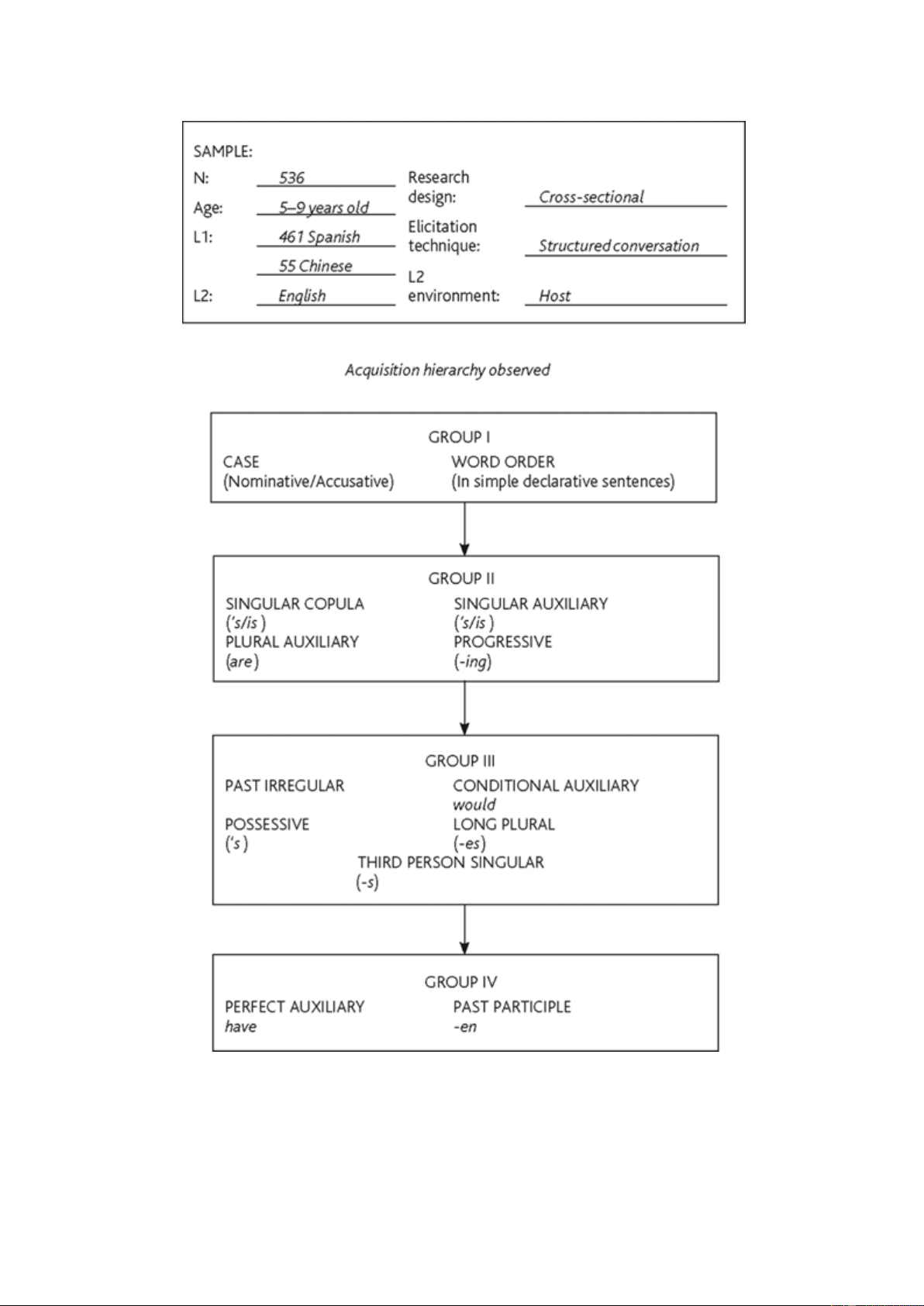
Dulay and Burt (1975) then extended their study to include 536 Spanish- and Chinese-speaking children
of varying levels of proficiency in English as a second language, and they investigated 13 of Brown's
original morphemes. They found a clear hierarchy for the acquisition of these morphemes, with four
different groups of morphemes being acquired in a set order, no matter the L1, as shown in Figure 2.1
(from Dulay et al., 1982, p. 208).
Mitchell, Rosamond, et al. Second Language Learning Theories, Routledge, 2013. ProQuest Ebook Central, http://ebookcentral.proquest.com/lib/flinders/detail.action?docID=1356341.
Created from flinders on 2025-08-15 16:51:09.
Copyright © 2013. Routledge. All rights reserved.
Ebook pages 47-80 | Printed page 13 of 41
Dulay et al. (1982, pp. 207–9) conclude: ‘It is highly probable that children of different language
backgrounds learning English in a variety of host country environments acquire eleven grammatical
morphemes in a similar order.’
To investigate whether adults would also exhibit the same order of acquisition, Bailey et al. (1974)
conducted a similar study with adults. They used the same
Mitchell, Rosamond, et al. Second Language Learning Theories, Routledge, 2013. ProQuest Ebook Central, http://ebookcentral.proquest.com/lib/flinders/detail.action?docID=1356341.
Created from flinders on 2025-08-15 16:51:09.
Copyright © 2013. Routledge. All rights reserved.
Ebook pages 47-80 | Printed page 14 of 41
Figure 2.1 Acquisition hierarchy for 13 English grammatical morphemes for Spanish-speaking and Cantonese-
speaking children (source: Dulay et al., 1982, p. 208)
Mitchell, Rosamond, et al. Second Language Learning Theories, Routledge, 2013. ProQuest Ebook Central, http://ebookcentral.proquest.com/lib/flinders/detail.action?docID=1356341.
Created from flinders on 2025-08-15 16:51:09.
Copyright © 2013. Routledge. All rights reserved.
Ebook pages 47-80 | Printed page 15 of 41
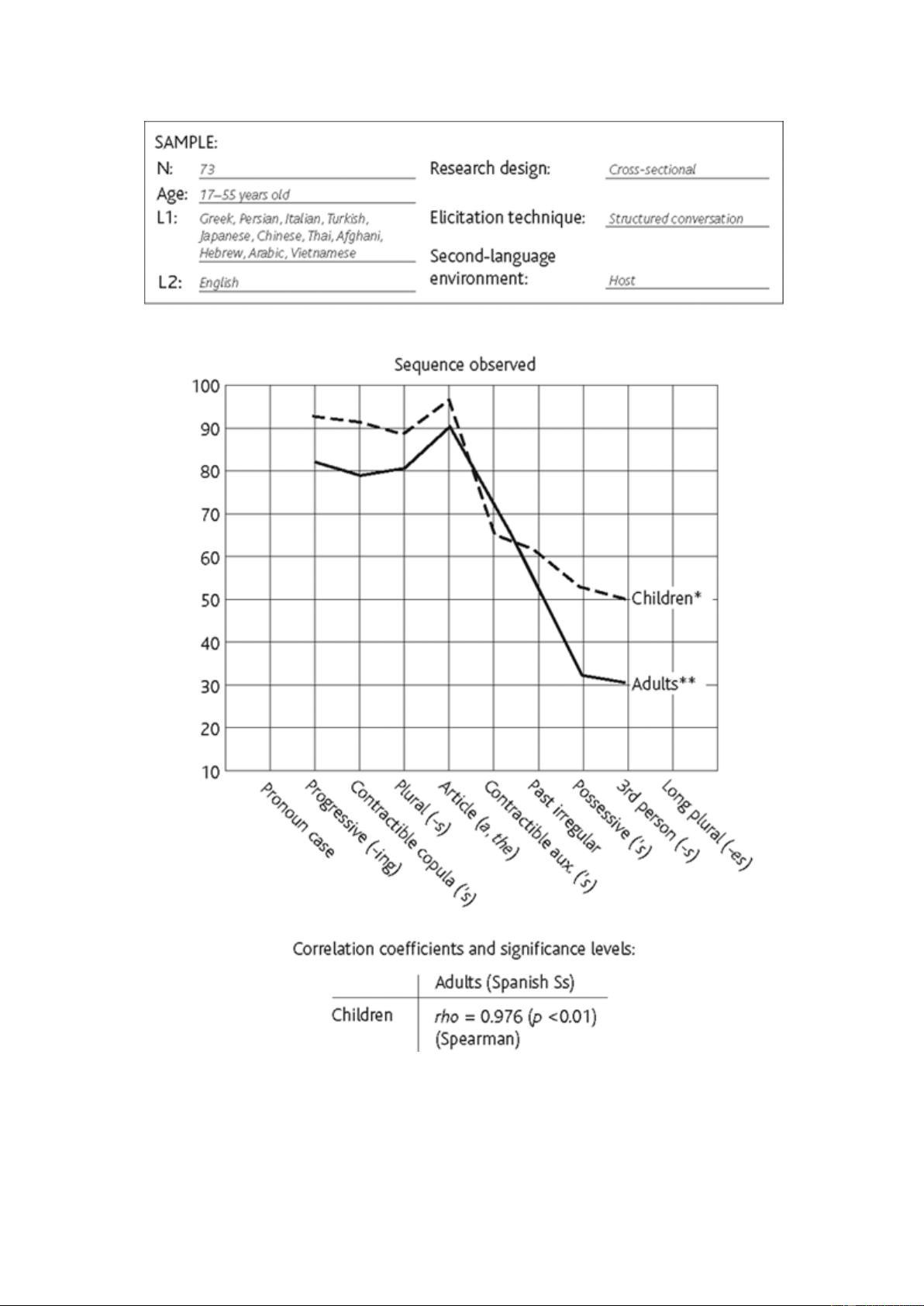
elicitation method (Bilingual Syntax Measure) in order to investigate the accuracy of production of the
eight morphemes studied in Dulay and Burt (1973), in 73 adult learners of English from different L1
backgrounds. Their results were very similar to those reported in the case of children, as shown in Figure (taken from Dulay 2.2 et al., 1982, p. 210).
Mitchell, Rosamond, et al. Second Language Learning Theories, Routledge, 2013. ProQuest Ebook Central, http://ebookcentral.proquest.com/lib/flinders/detail.action?docID=1356341.
Created from flinders on 2025-08-15 16:51:09.
Copyright © 2013. Routledge. All rights reserved.
Ebook pages 47-80 | Printed page 16 of 41
Figure 2.2 Comparison of adult and child acquisition sequences for eight grammatical morphemes (source: Dulay et al., 1982, p. 210)
These morpheme acquisition studies attracted criticism, both at the time and subsequently. (The
criticisms are mainly about the elicitation technique used in these early studies – thought to bias the
results – and also about the assumption that relative accuracy of production reflects acquisition
Mitchell, Rosamond, et al. Second Language Learning Theories, Routledge, 2013. ProQuest Ebook Central, http://ebookcentral.proquest.com/lib/flinders/detail.action?docID=1356341.
Created from flinders on 2025-08-15 16:51:09.
Copyright © 2013. Routledge. All rights reserved.
Ebook pages 47-80 | Printed page 17 of 41
sequences: see review in Gass and Selinker, 2008, pp. 132–5.) However, the basic argument that both 5
child and adult learners of English as an L2 developed accuracy in a number of grammatical morphemes
in a set order, no matter what the context of learning (classroom, naturalistic, mixed), survived the
critique. The fact that this set order did not match the order found by L1 acquisition researchers is
neither here nor there. The existence of such an order suggested that L2 learners are guided by internal
principles which are largely independent of their first language; this was a serious blow for Contrastive Analysis.
Moreover, soon after, a number of studies were reported which strongly suggested that systematic staged
development could be found in a number of syntactic domains as well. For example, the acquisition of
negative structures in English L2 was shown to occur in well-defined stages by several early studies
reviewed by R. Ellis (2008, pp. 92–3). Similar stages were also noted in the acquisition of negatives in
German L2 (R. Ellis, 2008, p. 94). Moreover, the acquisition of negatives in English by L2 learners is
not dissimilar to that of children acquiring English as their L1 (see above). Section 2.2.1
The acquisition of other syntactic structures such as interrogatives and relative clauses in English, or
word order in German, are also well documented as exhibiting uniform patterns of acquisition, whatever
the L1 of the learner (R. Ellis, 2008, pp. 94–8, provides an overview of early studies). Moreover, the
stages followed by L2 learners in the various areas studied show similarities to those followed by
children learning their first language.
Thus, the 1970s witnessed a wealth of studies investigating development in L2 learners which seemed to
show convincingly that it is systematic, that it is largely independent of the L1 of the learner and that it
presents many similarities with L1 acquisition, even though there are differences. These were major
empirical findings which undermined classic behaviourist beliefs about how second languages are acquired.
Before moving to examine the theoretical proposals advanced to explain such findings, let us pause for
an instant on the last point, namely the finding that acquisitional patterns in L1 and L2 learning were
both similar and different, as this issue is still debated today. Remember that the discovery of acquisition
sequences in first language acquisition was linked to the theory that children are endowed with a
language faculty which guides them in the hypotheses they make about the language around them.
Brown's order of acquisition of grammatical morphemes was seen as evidence to support this view. So,
what can we make of the finding that L2 learners also seem to follow an order of acquisition, but that
Mitchell, Rosamond, et al. Second Language Learning Theories, Routledge, 2013. ProQuest Ebook Central, http://ebookcentral.proquest.com/lib/flinders/detail.action?docID=1356341.
Created from flinders on 2025-08-15 16:51:09.
Copyright © 2013. Routledge. All rights reserved.
Ebook pages 47-80 | Printed page 18 of 41
this order is different? The existence of such an order suggests that they are indeed guided by some set
of internal principles, as children are. On the other hand, the fact that this order varies from that found
for L1 suggests that these internal principles are different, in some respects at least.
A somewhat confused picture therefore emerges from the empirical work characteristic of the 1970s, and
the 1980s research agenda tried to address some of these issues. But before we turn to later agendas, we
need to consider Krashen's Monitor Model, an influential first attempt to bring together a range of post-
behaviourist findings in a comprehensive model of second language acquisition.
2.3.4 Krashen's Monitor Model
Krashen developed his ideas in the late 1970s in a series of articles (1977a, 1977b, 1978), building on
the findings outlined above. He then refined and expanded his theoretical claims in the early 1980s in a
series of books (Krashen, 1981, 1983, 1985). While many of his specific proposals have been overtaken 6
today, they opened up a range of research agendas of ongoing importance.
Krashen based his general theory around a set of five basic hypotheses: 1
The Acquisition-Learning Hypothesis 2 The Monitor Hypothesis 3 The Natural Order Hypothesis 4 The Input Hypothesis 5
The Affective Filter Hypothesis.
We shall briefly outline each of these in turn.
2.3.4.1 The Acquisition-Learning Hypothesis
This hypothesis attracted considerable attention and, albeit in a different form, still remains the source of
much debate today. The basic premise is that language acquisition on the one hand, and learning on the
other, are separate processes. For Krashen, acquisition refers to the ‘subconscious process identical in all
important ways to the process children utilize in acquiring their first language’, and learning refers to the
‘conscious process that results in “knowing about” language’ (1985, p. 1). In other words, acquisition is
the result of natural interaction with the language via meaningful communication, which sets in motion
developmental processes akin to those outlined in first language acquisition, and learning is typically the
result of classroom experience in which the learner is made to focus on form and to learn about the
linguistic rules of the target language.
Mitchell, Rosamond, et al. Second Language Learning Theories, Routledge, 2013. ProQuest Ebook Central, http://ebookcentral.proquest.com/lib/flinders/detail.action?docID=1356341.
Created from flinders on 2025-08-15 16:51:09.
Copyright © 2013. Routledge. All rights reserved.
Ebook pages 47-80 | Printed page 19 of 41
The contrast between the naturalistic environment and the classroom environment is not the crucial
issue, however. What is claimed to be important is the difference between meaningful communication
on the one hand, which can very well take place in the language classroom, and which will supposedly
trigger subconscious acquisition processes, and conscious attention to form on the other hand, which can
also take place in naturalistic settings, especially with older learners who might explicitly request
grammatical information from people around them. Krashen has been criticized for his vague definition
of what constitutes conscious vs. subconscious processes, as they are very difficult to test in practice:
how can we tell when a learner's production is the result of a conscious process and when it is not?
Nonetheless, this conceptual contrast between acquisition and learning has been very influential,
especially among foreign language teachers who saw it as an explanation of the lack of correspondence
between error correction and direct teaching on one hand, and their students' (in)accuracy of
performance on the other. If there was some kind of internal mechanism constraining learners'
development, then perhaps it could account for the fact that some structures, even simple ones like the
third person singular –s in English (he likes), can be so frustrating to teach, with learners knowing the
rule consciously, but often being unable to apply it in spontaneous conversation. In Krashen's
terminology, learners would have learned the rule, but not acquired it.
Another problematic issue is Krashen's claim that learning cannot turn into acquisition; that is, that
language knowledge acquired/learned by these different routes cannot eventually become integrated into
a unified whole (Krashen and Scarcella, 1978). Other 1980s researchers disagreed (for example, Gregg,
1984; McLaughlin, 1987), and the debate about whether different kinds of knowledge interact or remain
separate, has been a long-standing one, even though the terms used might differ. (For example, see
Schwartz, 1993; Towell and Hawkins, 1994; Zobl, 1995; Myles et al., 1999; Krashen, 2003, and also
Chapters 4 and below, for a review of contemporary thinking about implicit and explicit knowledge 5
and the interactions between them in SLL.)
2.3.4.2 The Monitor Hypothesis
According to Krashen, ‘learning’ and ‘acquisition’ are used in very specific ways in second-language
performance. The Monitor Hypothesis states that ‘learning has only one function, and that is as a
Monitor or editor’ and that learning comes into play only to ‘make changes in the form of our utterance,
after it has been “produced” by the acquired system’ (1982, 15). Acquisition ‘initiates’ the speaker's
Mitchell, Rosamond, et al. Second Language Learning Theories, Routledge, 2013. ProQuest Ebook Central, http://ebookcentral.proquest.com/lib/flinders/detail.action?docID=1356341.
Created from flinders on 2025-08-15 16:51:09.
Copyright © 2013. Routledge. All rights reserved.
Ebook pages 47-80 | Printed page 20 of 41
utterances and is responsible for fluency. Thus the Monitor is thought to alter the output of the acquired
system before or after the utterance is actually written or spoken, but the utterance is initiated entirely by
the acquired system. (McLaughlin, 1987, p. 24)
The above quotation summarizes Krashen's view that conscious ‘learning’, with attention to L2 form,
contributes only to the development of an editor or ‘Monitor’, which does not operate all the time. Given
enough time, when a focus on form is important for learners, and when the relevant grammatical rule has
consciously been learned, Krashen believed they might make use of the Monitor in order to modify their
own output (for example, to self-correct and apply target language norms). However, early studies
investigating learners' performance when given more time (Hulstijn and Hulstijn, 1984), or being made
to focus on form (Houck et al., 1978; Krashen and Scarcella, 1978), failed to provide evidence of
Monitor use. The same applied to studies checking whether learners who are able to explain the rules
perform better than learners who do not (Hulstijn and Hulstijn, 1984).
Krashen also appealed to the concept of the Monitor in order to explain individual differences in
learners. He suggests that it is possible to find Monitor ‘over-users’ who do not like making mistakes
and are therefore constantly checking what they produce against the conscious stock of rules they
possess. On the other hand, Monitor ‘under-users’ do not seem to care very much about the errors they
make, and for them speed and fluency are more important. In between the two are the supposed
‘optimal’ Monitor users who use the Monitor when it is appropriate, that is, when it does not interfere
with communication. These early claims remained underdeveloped and difficult to test empirically.
However, elsewhere in this book we see how later research has pursued some of the ideas ‘opened up’
by the Monitor Hypothesis, in particular exploring interactions between implicit and explicit learning,
with a new range of methodologies (Chapter 5).
2.3.4.3 The Natural Order Hypothesis
We acquire the rules of language in a predictable order, some rules tending to come early and others late.
The order does not appear to be determined solely by formal simplicity and there is evidence that it is
independent of the order in which rules are taught in language classes. (Krashen, 1985, p. 1)
There is evidently some truth in such a statement, which was grounded in the concept of interlanguage
and the research into Morpheme Acquisition Orders we have briefly reviewed in Section above. 2.3.3
The idea of a natural order received further support from later claims about systematicity in L2 syntactic
development (for example, for domains such as negation, relative clauses or word order, also discussed in Section
). However, as will be seen in following chapters, later research has seen a revival of 2.3.3
Mitchell, Rosamond, et al. Second Language Learning Theories, Routledge, 2013. ProQuest Ebook Central, http://ebookcentral.proquest.com/lib/flinders/detail.action?docID=1356341.
Created from flinders on 2025-08-15 16:51:09.