Maketing Introductions - Cultural Variations and Practices | Tiếng Anh Thương Mại | Đại học Hàng hải Việt Nam
Maketing Introductions - Cultural Variations and Practices | Tiếng Anh Thương Mại | Đại học Hàng hải Việt Nam. Tài liệu được sưu tầm và soạn thảo dưới dạng file PDF để gửi tới các bạn cùng tham khảo, ôn tập đầy đủ kiến thức, chuẩn bị cho các buổi học thật tốt. Mời bạn đọc đón xem!
Môn: Tiếng anh thương mại 12 tài liệu
Trường: Trường Đại học Hàng Hải Việt Nam 175 tài liệu
Tác giả:





Preview text:
CHAPTER 1: MAKING INTRODUCTION Overview Objectives There are four main parts:
After this lesson, students will be able to: ● Titles in introductions
● understand the making introduction between English-speaking countries
● Eye contact and handshaking in introduction
● compare some ways of introduction among English-speaking countries. ● Small talks
● know how to make an introduction every day.
● Cultural variations in introduction Preparation
● Read the materials for Chapter 1.
● Apply knowledge to involve discussions.
● Practice more often to get better. 1
Looking at the following situation
Professor. Mr. Lustig, I would like to introduce you to Dr. John, director of the
language institute. Dr. Johns, this is Mr. Lusting, the academic adviser from Barnum College.
How do you do, Dr. Johns?
Mr. Lustig: It’s a pleasure to meet you, Mr. Lustig. I’m glad that we finally have the
Dr. Johns: occasion to meet. Friend:
I’d like you to meet my friend. Nancy Pipkin. Nancy, this is my brother, Jack. Nancy:
Hi, Jack. Nice to meet you! Jack: Hi, Nancy Friend:
Hi, George, have you met Bill? George:
No, I haven’t. Hi, Bill? Bill: Hi! How ya doing?
These introductions exemplify typical Anglicist introductions which range from formal to informal.
Although Anglicists tend to use informal language as illustrated in the second and third
introductions, there are situations where formal introductions are appropriate. When meeting a
president of a university, it is advisable to say, “How do you do?” rather than “How ya doing?”
Likewise, someone who is your age or younger would probably say, “It’s nice to meet you. How are
you doing? ' becomes “How ya doing?” a very informal introduction does not use title or last names.
1.1. Titles in introductions
Often when there is a difference in status or age between two individuals, formal titles and
last names are used unless the person of lower status is told to use the first name For example:
- Accountant (age 50): Hello, my name is Bob Thomas.
- Student (age 19): It’s nice to meet you, Mr. Thomas.
- Accountant: Please, just call me Bob.
In formal introductions there is a tendency to reduce status differences by using first names.
In more formal situations, the title along with the last name is appropriate.
For example: When a student introduces herself to a university professor, she might say:
Mary (student): Hello, Dr. Mc Carick. My name is Mary Hall and I would like to ask you about your course.
Mary used her professor’s title (Dr.) and his last name, whereas when she introduced herself,
she used her first name and last name and no title. (Some professors prefer and informal
rapport with students and allow them to use first names both in and out of the classroom.) 2
1.2. Eye contact and handshaking in introduction
Direct eye contact and firm handshakes during introductions are customary in English speaking countries.
Introductions as well as in general conversations, speakers maintain frequent eye contact.
Most people become nervous if frequent eye contact turns into staring. When shaking hands,
people shake firmly and briefly. The expression “He shakes hands like a dead fish” refers to
a limp handshake, a sign in the Anglicist culture of a weak character. Prolonged handshaking is not usual.
Problems can arise when these customs are unfamiliar to foreign visitors. One foreign student
remarked “I’m beginning to think that there is something wrong with me. I have the
impression that people in the United States don’t like me. When I shake hands with them,
they always pull their hands away quickly”. “Is his impression correct or is he misinterpreting
a cultural ritual?” Anglicist visitors sometimes pull their hands away too quickly in countries
where prolonged handshaking is common. 1.3. Small talks
Immediately after introductions are made, there is usually a period of time in which
impersonal or trivial subjects are discussed. This type of conversation called “small talk”, is
important because it often helps to maintain conversations and it can lead to interesting
discussions. Usually speakers initiate small talk with such questions as “Do you live in this
area?”. “How are you living here?” or “What are you studying?” It is also common for people to ask. “What do you ”
do? which means “What is your job?” but it is uncommon and
considered impolite to ask “How much money do you make?” or “How much does your house
cost?” Other questions such as “Are you married?” or “How old are you?” (to an adult) are
generally considered too personal for initial meetings.
Sometimes, small talk is a way to meet someone or start a conversation. In an introductory
meeting, maintaining a conversation is easier when two people find that they have something
in common. In the following dialogue, small talk takes place until the speakers discover that
they share the same experience. Sue:
It’s nice to meet you. My friend told me about you. Have you lived in Seattle long?
Mark: No, only three months. How about you? Sue:
I moved here three years ago from California.
Mark: Oh really? I’m from California too. Where did you live in California? Sue:
In Gilroy, not far from San Jose.
Mark: This is really a coincidence. I’m from Gilroy, too! I like telling people I’m from
the garlic capital of the world. Did you usually go to the summer garlic festival? 3 Sue:
I used to go every summer. How about you?
Mark: I went to most of them. I thought the one in 1980 was great. Did you go to that one?
In the conversation, Sue and Mark asked each other small talk questions before they found
that they had a common background. Once they discovered this, the conversation flowed easily.
1.4. Cultural variations in introduction
Styles of introductions, including initial conversations and nonverbal rituals, vary among
individuals and situations. The introduction of a university president to a new professor is
considerably more formal than that of two people of the same status in a social situation. At
a business meeting, an introduction is likely to be more formal than one made at a party. In
addition, styles of introductions vary from country to country. Bowing to show respect is
customary in parts of the Far East. In the Western Hemisphere and in other parts of the world
shaking hands is common practice. Putting the palm of the hand to the heart is traditional in
North Africa. Despite the cultural variations, the purpose of all introductions is always the
same- to provide an opportunity for people to get to know each other. 4 SUMMARY
In a formal introduction, Anglicists often use titles until they are told they may use the first
name. When two people are introduced by a third person, the first and last names are usually given. For example:
A friend: Michael, I’d like you to meet my friend, Diane Rae. Diane, I’d like you to meet Michael Lipsett.
Note: In less formal introduction, last names may be dropped
The following is a list of titles used in introductions and conversations. (Except when noted,
these titles are followed by a person’s last name)
Dr. (Doctor) Used to address medical doctor (M.D) and university professors who have
earned a doctorate degree (Ph.D.) Prof.
Used to address a college or university teacher (Professor) Teacher
Used by very young children in school (Note: The word ‘teacher’ is not usually followed by a name.) Mrs.
Used to address a married woman. Miss
Used to address an unmarried woman. Ms.
Used to address a woman when we are not sure she is married or not
(teacher, housewife, professional, etc.) Mr. Used to address a man.
The following phrases may be used if a name given in an introduction is not understood or is forgotten) Informal Formal
- “Excuse me, I didn’t catch your name.”
- “May I please have your name again?”
- “I’m sorry, what is your name again?”
- “Would you please repeat your name?”
- “Could you spell your first name? That will
help me pronounce it better.”
In traditional introductions, a man shakes a woman’s hand if she extends her hand first. However,
this custom is changing and some men offer their hand first. Some women shake hands with each
other although the majority still do not. 5 PRACTICE MAKING INTRODUCTIONS
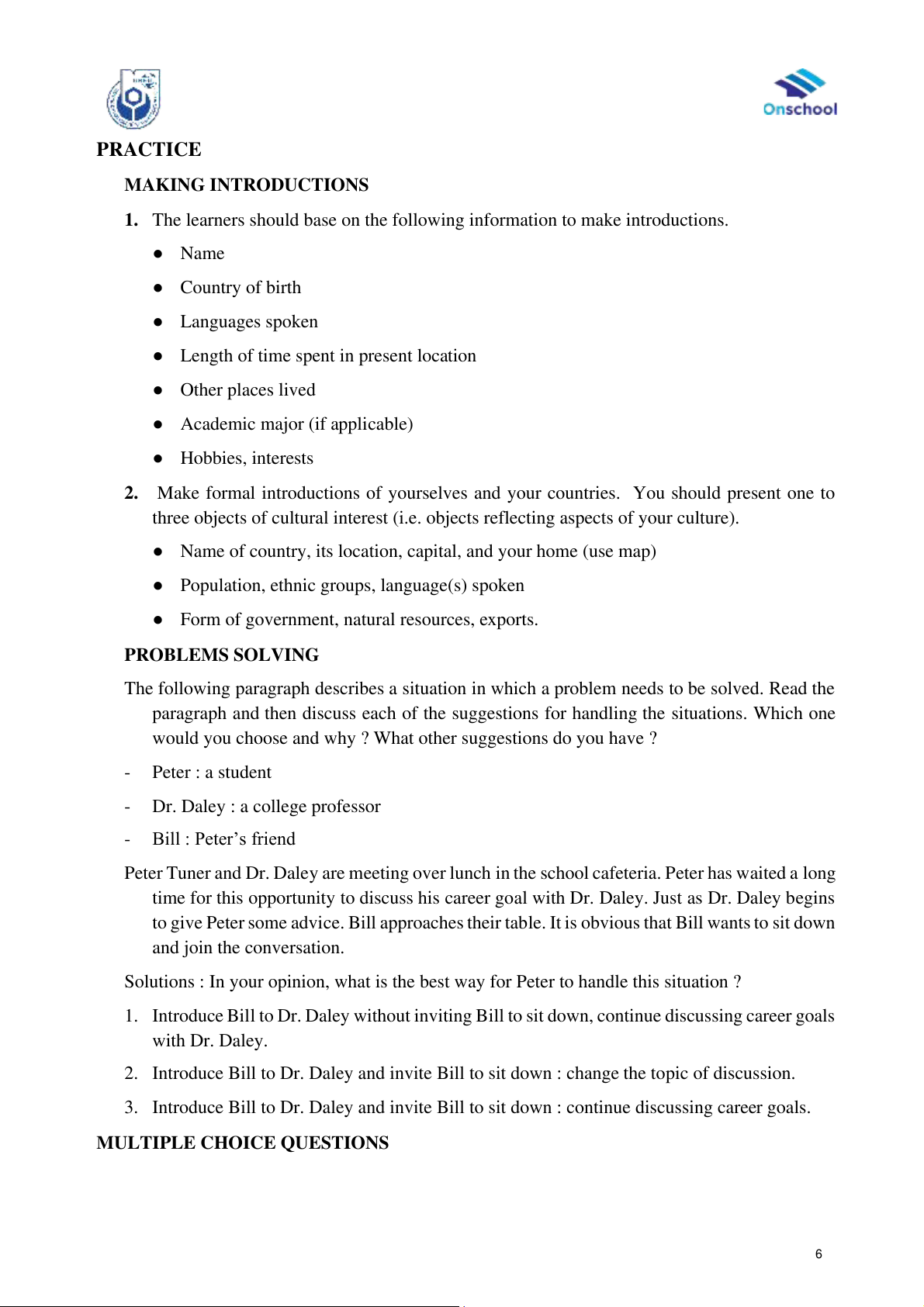
1. The learners should base on the following information to make introductions. ● Name ● Country of birth ● Languages spoken
● Length of time spent in present location ● Other places lived
● Academic major (if applicable) ● Hobbies, interests
2. Make formal introductions of yourselves and your countries. You should present one to
three objects of cultural interest (i.e. objects reflecting aspects of your culture).
● Name of country, its location, capital, and your home (use map)
● Population, ethnic groups, language(s) spoken
● Form of government, natural resources, exports. PROBLEMS SOLVING
The following paragraph describes a situation in which a problem needs to be solved. Read the
paragraph and then discuss each of the suggestions for handling the situations. Which one
would you choose and why ? What other suggestions do you have ? - Peter : a student
- Dr. Daley : a college professor - Bill : Peter’s friend
Peter Tuner and Dr. Daley are meeting over lunch in the school cafeteria. Peter has waited a long
time for this opportunity to discuss his career goal with Dr. Daley. Just as Dr. Daley begins
to give Peter some advice. Bill approaches their table. It is obvious that Bill wants to sit down and join the conversation.
Solutions : In your opinion, what is the best way for Peter to handle this situation ?
1. Introduce Bill to Dr. Daley without inviting Bill to sit down, continue discussing career goals with Dr. Daley.
2. Introduce Bill to Dr. Daley and invite Bill to sit down : change the topic of discussion.
3. Introduce Bill to Dr. Daley and invite Bill to sit down : continue discussing career goals.
MULTIPLE CHOICE QUESTIONS 6
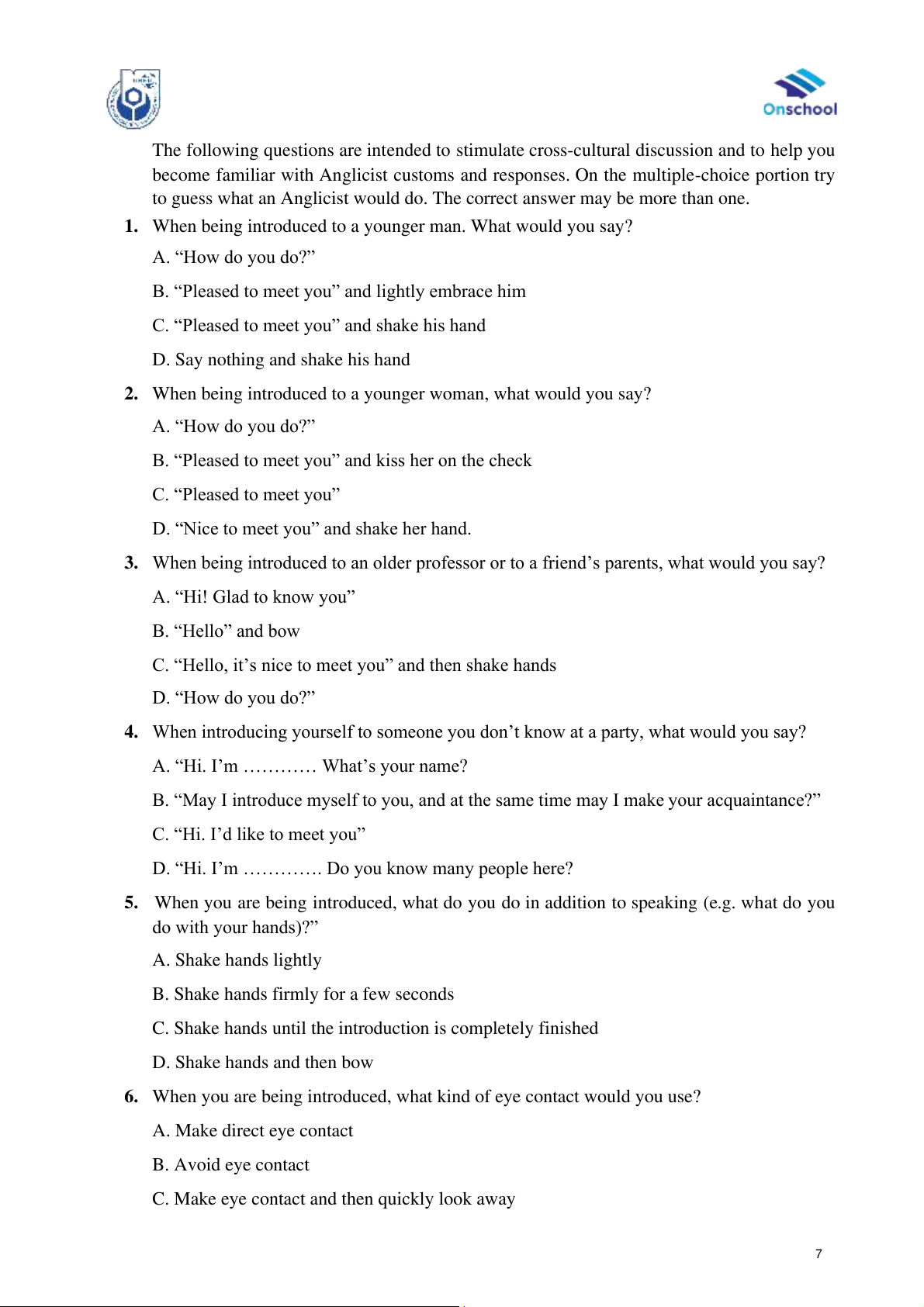
The following questions are intended to stimulate cross-cultural discussion and to help you
become familiar with Anglicist customs and responses. On the multiple-choice portion try
to guess what an Anglicist would do. The correct answer may be more than one.
1. When being introduced to a younger man. What would you say? A. “How do you do?”
B. “Pleased to meet you” and lightly embrace him
C. “Pleased to meet you” and shake his hand
D. Say nothing and shake his hand
2. When being introduced to a younger woman, what would you say? A. “How do you do?”
B. “Pleased to meet you” and kiss her on the check C. “Pleased to meet you”
D. “Nice to meet you” and shake her hand. 3.
When being introduced to an older professor or to a friend’s parents, what would you say? A. “Hi! Glad to know you” B. “Hello” and bow
C. “Hello, it’s nice to meet you” and then shake hands D. “How do you do?”
4. When introducing yourself to someone you don’t know at a party, what would you say?
A. “Hi. I’m ………… What’s your name?
B. “May I introduce myself to you, and at the same time may I make your acquaintance?”
C. “Hi. I’d like to meet you”
D. “Hi. I’m …………. Do you know many people here?
5. When you are being introduced, what do you do in addition to speaking (e.g. what do you do with your hands)?” A. Shake hands lightly
B. Shake hands firmly for a few seconds
C. Shake hands until the introduction is completely finished D. Shake hands and then bow
6. When you are being introduced, what kind of eye contact would you use? A. Make direct eye contact B. Avoid eye contact
C. Make eye contact and then quickly look away 7
D. Make eye contact and then look at the floor
7. Which topics are inappropriate to discuss immediately after an introduction? A. Marital status B. Religion C. Age D. Academic major/occupation 8 ANSWER KEY MAKING INTRODUCTIONS
1. Good morning, everyone. My name is Thuy. I come from Hanoi, the capital of Vietnam. I
can speak English and a little French. In my free time, I like listening to music, and I really
love Bolero Vietnamese music. On my holiday I would like to visit such interesting places
in my countries as Da nang, Hoi an. That’s a brief introduction about myself. Thank you !
2. My name is Aliyah, and I work in the marketing department as the social media manager.
I’d like to introduce my country. Vietnam is located in the eastern Indochina Peninsula in
Southeast Asia with Hanoi as its capital and with an area of 331,690 sq. kilometers. Its
population is about 90 million. PROBLEMS SOLVING
In my opinion, the best way for Peter to handle this situation is number 3.
Because Peter Tuner and Dr. Daley are meeting over lunch in the school cafeteria. Peter has
waited a long time for this opportunity to discuss his career goal with Dr. Daley. Just as Dr.
Daley begins to give Peter some advice, so the content of the meeting is very important for Peter
therefore they can’t change the topic of the meeting if someone goes near by and Peter still
shows his politeness when inviting his friend to sit down. At that time, if the topic is suitable
for Bill, he can stay if not he can go.
MULTIPLE CHOICE QUESTIONS 1. C
Because when introduced to a man your age or younger, you can use informal ways to
introduce yourself and shake hands. 2. D
Because when introduced to a woman your age or younger, you should show politeness more
than with man, and you can make the word nicer and shake her hand. 3. D
Because when introduced to an older professor or to a friend’s parents, you should show your
respect to the older person and introduce in a formal way. 4. A
When introducing yourself to someone you don’t know at a party, you should use the formal
way to speak and ask the opposite name in order to communicate more easily. 5. B
When being introduced, you should show your attention by shaking firmly, it means that you
are attending the introduction and would like to communicate with the opposite. 6. A
Because direct eye contact during introductions is customary in English-speaking countries. 9 7. A
Because the topic - marital status is a tactful topic. It should be avoided in small talks. 10
Tài liệu liên quan:
-

Giáo trình Tiếng Anh trong giao dịch thương mại
16 8 -
Đáp án, tài liệu ôn kỹ năng viết | Tiếng Anh Thương Mại | Đại học Hàng hải Việt Nam
58 29 -
Top 50 Bài tập trắc nghiệm câu so sánh trong Tiếng anh | Tiếng Anh Thương Mại | Đại học Hàng hải Việt Nam
62 31 -
Mock Test 1 & 2 – English Language Exam Preparation | Tiếng Anh Thương Mại | Đại học Hàng hải Việt Nam
65 33