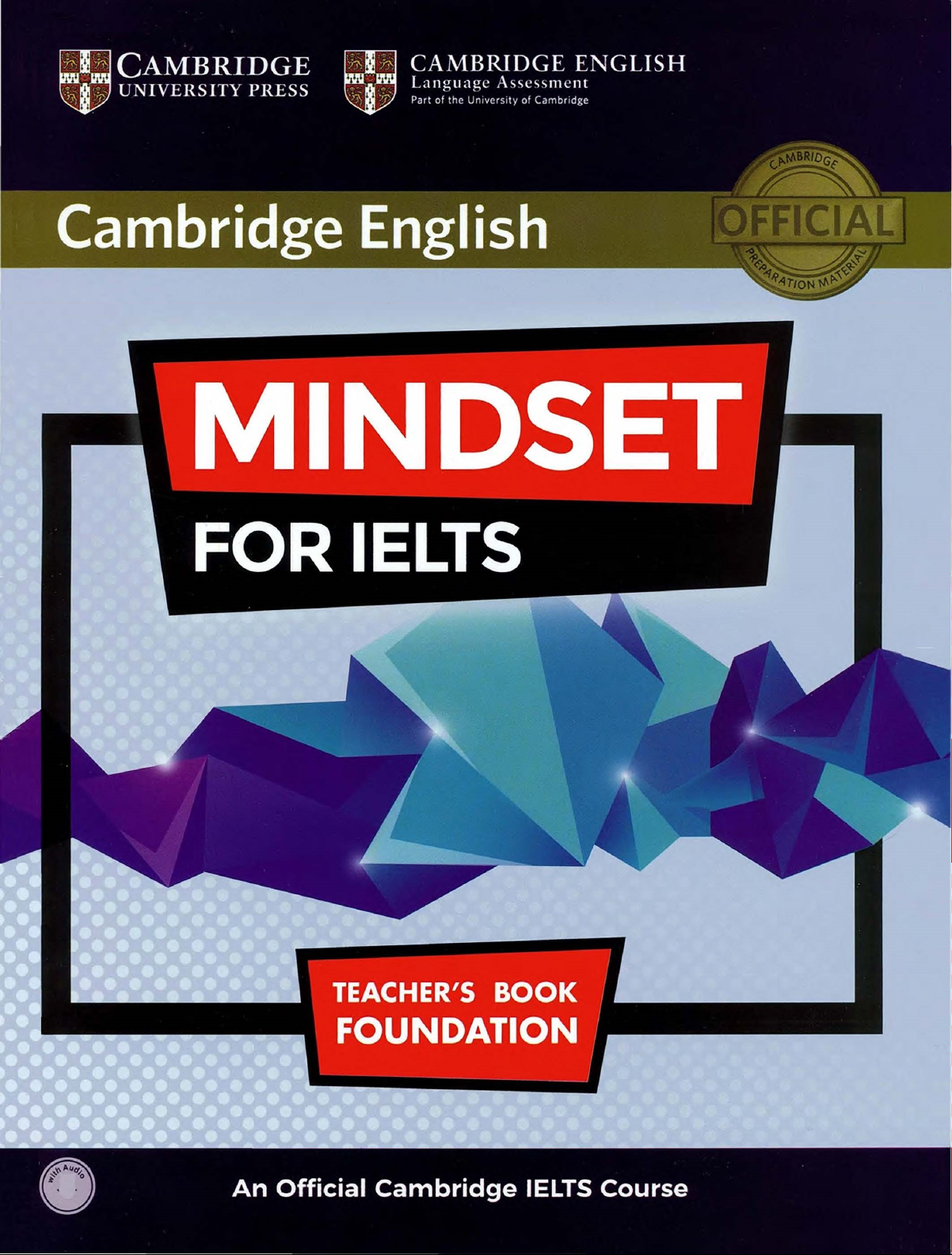
Mindset for IELTS Foundation Teacher_s Book
Tài liệu luyện thi IELTS foundation dành cho học sinh muốn xây dựng nền móng ban đầu
Tác giả:




















Preview text:
An Official Cambridge IELTS Course Cambridge University Press www.cambridge.org/elt
Cambridge English Language Assessment www.cambridgeenglish.org
Information on this title: www.cambridge.org/9781316640241
© Cambridge University Press and UCLES 2017
Cambridge University Press is part of the University of Cambridge.
It furthers the University's mission by disseminating knowledge in the pursuit of
education, learning and research at the highest international levels of excellence.
This publication is in copyright. Subject to statutory exception
and to the provisions of relevant collective licensing agreements,
no reproduction of any part may take place without the written
permission of Cambridge University Press. First published 2017
20 19 18 17 16 15 14 13 12 11 10 9 8 7 6 5 4 3 2 1
Printed in Malaysia by Vivar Printing
A catalogue record for this publication is available from the British Library
Additional resources for this publication at www.cambridge.org/mindsetforielts
Cambridge University Press has no responsibility for the persistence or accuracy
of URLs for external or third-party internet websites referred to in this publication,
and does not guarantee that any content on such websites is, or will remain,
accurate or appropriate. Information regarding prices, travel timetables, and other
factual information given in this work is correct at the time of first printing but
Cambridge University Press does not guarantee the accuracy of such information thereafter. About the author Jishan Uddin
Jishan has been an EFL teacher since 2001 and in that time, he has taught on a range of courses in the UK and Spain including
general English, exam preparation and academic English courses (EAP). He is currently an EAP lecturer and academic module
leader at King's College London. He has extensive experience in IELTS preparation classes for groups of students from many parts
of the world, particularly China, Saudi Arabia and Kazakhstan. In terms of material design, he has a great deal of experience in
designing resources for language skills development as well as exam preparation and administration. Jishan is also a member of
the team of authors who has written on the Student's Books for Mindset for IELTS
The authors and publishers would like to thank the following people for
their work on this level of the Student's Book.
Sarah Jane Lewis and William Inge for their editing and proof reading.
Audio produced by Leon Chambers at The Sound house Studios, London.
The publishers would like to thank the following people for their input
and work on the digital materials that accompany this level.
Nigel Barnsley; Lucy Passmore; Bryan Stephens.
Cover and text design concept: Juice Creative Ltd.
Typesetting: emc design Ltd.
Cover illustration: MaryliaDesign/iStock/Getty Images Plus. CONTENTS UNIT 01 DAILY LIFE 08 UNIT 02 HOUSE AND HOME 23
UNIT 03 HOBBIES, L EISURE AND ENTERTAINMENT 40 UNIT 04 TRAVEL AND HOL IDAYS 54 UNIT 05 FOOD 63
UNIT 06 TRANSPORT AND PLACES IN TOWN 70 UNIT 07 JOBS, WORK AND STUDY 79 UNIT 08 HEALTH AND MEDICINE 86 UNIT 09 LANGUAGE 98
UNIT 10 SCIENCE AND TECHNOLOGY 106 Student's Book
Mindset for IELTS Foundation Level is aimed at students who are thinking about taking IELTS, but who are currently at an A2 level. It
teaches students in a linear way and helps them to improve both their general English level and introduces elements of assessment
that are helpful for both the IELTS test and English language assessment in general. It is designed for up to 90 hours of classroom
use. The topics have been chosen to help students develop their skills and knowledge in connection with everyday topics at the
start of the course and introduces topics that will be useful for the IELTS test as they progress.
• Topics have been chosen to suit the needs and abilities of studen at this level. They help build confidence at the start of the
course whilst stretching them in the later stages, so that they start to get an idea of what they will meet on the IELTS test.
• There is coverage of the type of tasks that students at this level can cope with on the IELTS test and more general activities that
will give students the foundation for understanding how assessment items work when they progress to a full lELTS course.
• Each level of Mindset is challenging, but doesn't push students above what they can do.
How Mindset for IELTS Foundation helps with each skill
In the Foundation level all of the skills are integrated within the unit. This is because students at this level need to be able to see
how the skills work with each other. Reading skills help develop the ideas and skills that are needed to complete Writing tasks and
Listening skills help to develop the ideas and skills that are needed for the Speaking activities.
• Speaking- Mindset for IELTS Foundation helps students to develop their skills and confidence on familiar topics that they will
need to progress their general English knowledge, while also enabling them to become more familiar with the type of questions
that they will need to be able to deal with on the IELTS test.
• Writing- In the Foundation level students develop their writing skills for everyday communication; become familiar with the
type of tasks for Part 1 and Part 2 of the IELTS test; and learn about how these types of writing can be developed and in respect
to exam type tasks, how they will be assessed.
• Reading - Mindset for IELTS Foundation helps develop ideas and language skills that students can use in conjunction with the
other skills. It also helps them get used to the types of questions they will face at IELTS in a way that is appropriate for students who are at this level.
• Listening - Mindset for IELTS Foundation helps to develop strategies for listening and makes students aware of the types of
activities that are used on the IELTS test. It also helps to build confidence and develop ideas that will help them with their
short-term and long-term linguistic goals. Outcomes
At the start of every unit you will see a list of outcomes
IN THIS UNIT YOU WILL LEARN HOW TO
• identify types of holidays and different holiday activities
• read multiple texts to find specific information and detailed meaning
• listen to identify specific information and detailed meaning
• add more detail and give reasons while speaking
• use past simple and present simple • write an email
•speak about experiences
In the Student's Book you will see how these outcomes relate to the unit as a whole and in the Teacher's Book you will see which
part of the unit that they refer to. This will help you to decide the best way to develop the skills that your students need. There are
typically three or four overarching outcomes that relate to either goals that will help students to progress their overall English ability
and knowledge, or ones that will give them an insight into the types of skills they will need when they enter a full lELTS course.
Tip Boxes, Bullet Boxes and Mini Tips
• Tip boxes help you and your students improve task awareness and language skills. You will find further information on how to get
the most out of them in the Teacher's Book. Note that the number in the corner relates to the exercise that the tip goes with. 2 4
You might be asked to write about a process in
the exam so it is important to practise linking
your ideas together. Look at the sequencing
words highlighted in Exercise 22 to see how
the parts of the instructions are linked.
• Bullet boxes tell you how students are assessed in tests and give a better understanding of the task being addressed.
In some exam reading tasks, you may be asked
to complete a matching exercise where you
match descriptions to people. First, identify
key words and ideas for each person.
Then, match these words and ideas with the descriptions.
• Mini tips help with the understanding of discrete questions and items that will help develop an understanding of the type of question
being asked. Note that the first number in the corner relates to the exercise number and the second one relates to the question number.
06.1 MINI TIP Look at the
information in yellow in the article
about family members. Which one
answers the question correctly? Teacher's Book
The Teacher's Book has been designed to give you a step-by-step look at the activities and how to teach them. It has also been developed
in a way that will help you see how the language and skills development relate directly to moving your students in the direction of IELTS.
It also contains the following:
• Extension activities - exercises that give more practice in the skill or area, if you feel that your students need to spend longer on them.
• Alternative activities - ideas that will help you develop ideas to tailor them to your students' needs and/or interests.
• Definitions - to help you with understanding of concepts connected with assessment features that are used both in the IELTS
test and other forms of assessment.
How to use the online modules
As well as the Student's Book there are also on line modules that can aid with further study. These can be used for homework or to
reinforce what has been taught in class. • Reading and Writing • Speaking and Listening • Language Builder • Grammar and Vocabulary
The Reading and Writing and Speaking and Listening modules give more practice on the topics that have been studied in the book.
They help to develop both ideas and the language skills that the students will need in order to be successful.
The Language Builder builds knowledge of everyday topics and sets them in an IELTS context. It can aid with understanding
assessment and to build confidence and knowledge for lower level students.
The Grammar and Vocabulary module presents the grammar and vocabulary from the final section of each unit in a series of interactive exercises
There are also a number of other on line modules with specific learners in mind. It is worth noting that these modules are also packaged
with higher levels in the series, but you may want to use them to get your learners familiar with the test as they progress through the course.
• Pronunciation and Speaking for Chinese Learners • Speaking Plus
These modules look at the types of mistakes that students make from different language groups. The syllabus and exercises have
been developed with insight from our corpus database of students speaking. Students can also analyse and view video content of
Speaking Tests in these modules.
• Spelling and Vocabulary for Arabic Learners
• Writing for Arabic Learners • Writing Plus
These modules use our database of past writing IELTS papers and Corpus research to look at typical mistakes that students from the
different language groups make on the Writing paper of the exam. They are encouraged to improve their writing skills and also avoid
the common pitfalls that students make.
How to deal with students expectations at this level
The Foundation Level has been created for A2 level students who wish to learn about IELTS, but who are not yet ready to take the test.
The aim is to familiarise them with elements of the test that they can cope with at this level and to also develop their English language
skills as a whole. By the end of the course the aim is that they will be roughly a band 4 or 4.5 level and will be ready to start a Level 1
course. Students need to realise that improving their IELTS score is, realistically, a slow process. Any student preparing for IELTS needs
to also develop their general English skills. It is a process of getting used to the type of tasks which they will face in the exam while at
the same time learning grammar, vocabulary and improving their abilities in the four skills. Mindset for IELTS Foundation is the first in a
series of four books, and students will probably need to complete Level 2 before they reach a minimum level to study abroad.
Students should be made aware that simply attending class is not a guarantee of achieving scores indicated on the books. They
need to commit to a programme of self-study: learn new vocabulary, read and listen in English as much as possible and take every
opportunity to speak in English, even if it is just with other learners like themselves.
How to use the material in a mixed-level class
There are two main ways of addressing the needs of a mixed-level class: the first involves adapting materials and activities so
that they can be more or less challenging and assigning them to different groups of students. You will find notes on how to do this
throughout the Teacher's Book. The second involves treating the higher-level students as a resource to help lower-level students,
while ensuring the tasks given are useful for the higher-level learners too.
You may wish to set different homework for different level students. The Language Builder tends to offer more remedial help for students
who are having problems at this level, whereas the language specific and plus modules will stretch students studying on this course.
The Teacher's Book contains suggestions for alternative and extension activities. Many of these address the needs of activities at
different levels for students in a mixed-level class. For alternative activities, group all the higher-level students together and give
instructions to them. Give instructions to the lower-level students for the basic activity. For extension activities which you feel are
only suitable for some of the students, ensure lower-level students also have a useful task. Try some of the following.
• If the unit has covered a tense, such as the simple present, ask them to write 5 more sentences in that tense.
• Ask them to re-read the text or audio-script again and use the dictionary to look up any unknown words which have not
already been dealt with in the exercises.
• Get students to practise testing each other on the new words from the previous unit.
• Get students re-do speaking tasks with a different partner.
• Ask them to listen again to recordings of themselves doing the previous task, identify errors or ways to improve.
• In groups or pairs get students to make a display chart for the wall on grammar or vocabulary covered so far in the course.
It is important that you don't always separate students in the class by level. For the main activities, it is generally useful for the more
advanced students to be grouped with the lower-level ones. The lower-level ones will benefit from exposure to the more advanced
language and skills of their classmates. The higher-level students benefit from having to explain language and concepts to other
students. This is a linguistically challenging activity for them.
When working positively with mixed-level classes, you should be sensitive to the feelings of the students. Don't refer to the students
as the 'less able' or 'lower-level' students. Just say, 'Okay, for this activity, Danny, Chen, Mayuri and Qing will be working together'. If
different groups are doing different activities, you don't need to stress this. Just give the instructions to different groups, rather than
announcing to the whole class that different groups are doing different activities. If questioned, explain that, 'These students will
benefit from this activity' or 'This ·group needs more practice in this area'.
Always use the time when students are doing activities to monitor all the students so that you, as a teacher, are well aware of the
different capabilities of different students. By knowing your class well and giving careful thought to their needs, you can ensure that
a mixed-level class is successful. • OUTCOMES how many more? (five) • speak about your day (*depends on the exercise)
Tell students they have 2-3 minutes to complete Exercise 01. OUTCOMES
It's good practice to let students know how much time
they have to do an exercise as this will help with classroom
Ask students to focus on the outcome. This is a good way to
management and help students manage their time. With
show students what the lesson will cover and why it is useful
all the times suggested, respond to your students' needs. If
for them. This outcome is for students to be able to speak
you feel that students can complete the exercise in less than
about their day. Explain to students that the topic of daily
the advised time or if they need longer, you can be flexible.
routines is very common in both English exams as well as in
Monitor to check that students are on task. Monitoring can
general conversation. In many speaking exams for example, a
also tell you if you need to give students more or less time
simpler more general topic (such as routines) is often used at
in future. In addition, if students feel that they are being
the start of the exam. Being able to speak about a typical day
monitored, they are more likely to complete the activity.
is therefore very useful for students. In addition, tell students Feedback
that knowing the vocabulary to describe routines can also be
useful in English listening exams. This is because it is common
Focus only on the five more activities for now, as you will
in exams for students to listen and identify key information.
look at the activities in the picture at the end of Exercise
02. Allow students to volunteer their answers or nominate LEAD-IN
students. Volunteering encourages some students to
speak more and is more spontaneous and natural.
01 Ask students to look at the pictures of daily activities. To give
However, it is possible that less confident students
students something to actively produce, ask them to draw
will not answer as frequently - if at all. In these cases,
a circle or underline in the book the activities they do every
nomination is better as you will be able to give weaker
day. Alternatively, they can write these down on paper. Ask
and less confident speakers the opportunity to answer.
students to write five more activities below the pictures or
You can also check if students need more support by
on paper. This not only allows you to monitor what students
doing this. It's a good idea to find a balance between the
have done but also prepares them for the next activity.
two approaches based on your class' needs.
Before students do the activity, ask them the following
As some of these answers will be useful for the next task,
questions to confirm that they understand the instructions.
write the correct answers on the board. If a student says an
It's a good idea to do this particularly if you feel that some
answer you're not sure is correct, ask for more information
students have weak listening skills. Stronger students
(Where do you do that? When do you do that? Who do you do
may not need so much input, but a common challenge for
that with?). This helps to understand what the student means.
teachers in English teaching classrooms is to make sure the
When there is no fixed answer - as with this exercise - this is
weaker students do not fall behind. It's very likely that within
a good way to support students to produce a correct answer
a class, there are students with different strengths and
that the class can benefit from (e.g. to use in the next
needs and it is important that teachers are able to provide
activity). If the student is still unable to produce an accurate
opportunities for all students to learn as much as they can.
answer (and you feel this is vocabulary that could be
This activity works best when questions are simple and
beneficial for the class), ask other students if they can help.
require short answers. For this type of activity, either allow
You can say: This is done with/ in/ at ... what's it called? This
students to volunteer answer as a quick and effective way
encourages more class participation.
of getting correct answers or nominate students you feel
may be weaker as a good way of checking they understand
When you write the correct answers on the board, check
what to do. It's likely that stronger students will be happy
that students understand what they mean. For each, ask
with asking students questions to check comprehension if it questions to check:
is done quickly and students will all accept quickly that this Where do I do this?
is the way you check students' understanding. This method Who do I do it with?
and suggestions for questions will be demonstrated in many When do I do this?
of the following activities in this book.
What do I need for this? In this exercise, . . .
This is a good way to check students understand new
. . . will you underline I circle/ write about* all the activities? (no)
vocabulary particularly if it is helpful for them to be
. . . will you underline/ circle/ write about* all the activities you
able to use it in future. It's also a good idea to focus on do every day? (yes)
pronunciation of any new items of vocabulary. This can be
. . . will you write about more activities? (yes)
done by asking students to do the following: .UNITOl
1) listen to you say the word(s) two-three times.
feedback and also encourages students to listen actively. If
2) repeat after you as a group (choral drilling).
students do not hear or understand what their partner says,
3) repeat the word individually (individual drilling).
this approach will encourage them to ask their partner to
explain or repeat what they have said. Monitor as students
Drilling is the action where students repeat a word or phrase
work in pairs. As you monitor, note down any common
after the teacher or other students. It can be a fun way to
errors the class in general makes that you may wish to use in
approach pronunciation. Stages 1-2 above should be done
feedback. This is a good way to respond to students' needs
with this approach and Stage 3 is particularly useful to check
and to provide specific feedback that is useful for all students.
individual students who you may feel need the opportunity to
practise. When individual drilling, if students make mistakes Feedback and extension
in the pronunciation, ask students to try again. You could say:
Ask students to report what their partner said to them. They
Not quite, can you try again, please? If students still find it
can volunteer to do this or you can nominate students you
difficult, ask other students to help. You could say: Can anyone
want to hear from. For these students, you can say: (Tell
help?. When another student pronounces the word correctly,
me about [name}'s daily routine. What does he/she do?) To
you can ask them to model this pronunciation for the original
encourage other students to listen, you can pretend that
student who has difficulties with this word. This encourages
you didn't hear something or that you misheard something.
students to listen and learn from each other. Of course, if the Ask the class to help you:
pronunciation of this item is still problematic for the student,
So, [name] goes to bed at ... ?
you may wish to move on to avoid delaying the lesson.
So, [name] goes to bed at Spm? (deliberately incorrect)
Another option is to use phonemic script. If you are familiar
with this, write the script next to the word or phrase. It's a good
It's important to make sure the class do not switch off when
idea to familiarise yourself and your class with the phonemic
other students are speaking and this is a good way to avoid
script and encourage students to practise writing any new
this. Students are likely to find the teacher making deliberate
vocabulary with phonemic script to help with pronunciation.
mistakes fun and they may enjoy correcting you. It is also
There are many websites and on line dictionaries which not
helpful not to be predictable when asking students. You want
only provide the script but also a recording of the word such
to make sure that all students feel that they could be asked as
as dictionary.cambridge.org. You can also use an on line
this improves participation and engagement. It's important to
dictionary when drilling. As correct English pronunciation is
realise that it's natural for teachers to have preferences about
often not easily known just from the spelling of a word, it is
which students they ask and which part of the room they
important that you support students with pronunciation.
focus on. You can get a good idea of what you do by recording
yourself teaching or ask colleagues to observe you.
Possible answers: wake up, sleep, have dinner, chat online,
As you have monitored the activity, there is no nee� for all play sport
students to talk about their partner's daily routine.
Use any errors you noted down when you monitored. Write a
02 Ask students to get into pairs or, if this is not possible, threes.
list of these on the board (three-five is manageable). Also, add
Pairs are an effective way to encourage student participation
one-two correct answers. Ask students to identify the correct
with other students. Groups of three can also work well,
answers and correct the incorrect ones. This is a good way to
but this may limit the amount of time students have to
recycle what has been learnt in the exercise and to also focus
speak to each other about the task. Unless the Student's
on responding to emerging student errors and needs.
Book instruction suggests to do something differently for an
exercise, it is good practice for students to work in pairs where Student's own answers.
possible. It's a good idea to encourage students to speak and
discuss their ideas because it provides speaking practice,
You can use the following phonemic script as support for
students can help each other and you are able to monitor
pronunciation of the words and phrases. There are many
what is being said. This will allow you to identify student
on line dictionaries which also offer recordings of words
needs that you may wish to address immediately and/or at
for further support. You do not need to show students the
the end of the activity. It's important to make sure students
phonemic script, unless this is something you regularly do in
are comfortable with sharing their work with classmates. This
class and students are familiar with.
is particularly important when asking to work together or to get up /get Ap/
compare their work in pairs and in groups. It's important that
you explain the benefits of pair and group work to students exercise /'eksasa1z/
as well as how students can learn from each other by sharing work /w3:k/
and comparing work that they do. If it's done regularly, study /'stAdl/
students will accept it as expected practice in class. catch the bus /kretf oa bAs/
Ask students to compare their answers together. Tell students watch TV /wotf ,ti:'vi:/
to remember to say what time they do each activity. Tell
students to write down what their partner says as they will go online /gau 'on.lam/
need to tell the class after the exercise. It's a good idea to ask
relax with friends /n'lcEks w10 frendz/
students to write down 1) what the activity is and 2) at what go to bed /gau ta bed/
time their partner does the activity. This will be useful for
have breakfast /hrev 'brekfast/ UNITOl.
03 This exercise is designed to revise the vocabulary in
To do this, students need to be able to locate the relevant
Exercise 01 as well as introduce new activities commonly
information from different parts of the text. Tell students that
used in the present simple tense. In each question, there
in many reading exams, answers are in the same order as the
are three options, one correct answer and two incorrect
questions, although this is not always the case because in
options. Ask students to do this activity in pairs. This will
some reading exams, students have to find the answer from
encourage students to give reasons for their answers.
different sections of the text and answers are not in order. This Feedback
lesson focuses on learning how to do this.
Students can volunteer answers or you can nominate
students to answer. A good way to provide feedback is to LEAD-IN
ask other students if they agree with an answer from other
Ask students to look at the pictures of Ava, Michael and Nina
students. This can be done in a number of ways. When a
(if possible, try to show the pictures on a large screen -you
student answers, do not immediately say: (Correct, Good,
can use a smartphone to take a picture and then email it to
Well done or Incorrect, That's not correct etc.). Instead, you
yourself to save an electronic copy on your computer). Say
can ask other students if they agree or not. This will increase
that Ava is from Australia, Michael is from Brazil and Nina
participation and student attention during feedback. When
is from Norway. Ask students not to read the text yet. Tell
a student is nominated to answer a question, other students
students to work in pairs and answer the following question
may feel that they do not need to continue to listen as (write this on the board):
they will not be asked to answer. This method of checking
How do you think Ava's, Michael's and Nina's daily routines
answers, however, encourages all students to listen to are similar to yours?
answers given by other students as they too may be asked
It's a good idea to ask students to predict before reading as to add a response.
it can prepare them for the reading topic. Nominate answers 1 B
or allow students to volunteer. 2 B 3 C 4 A 5 A
05 Ask students to read the text quickly to answer the
04 This activity gives students an opportunity to practise using
question in the Lead-in. 'Skim' reading or 'skimming' is
the vocabulary from Exercises 01 and 03. Put students in
reading quickly to get a general meaning. At this stage, tell
pairs and ask them to take turns asking and answering
students not to worry about any difficult words and not to
the questions. As students ask and answer the questions,
use a dictionary. Give students a 2-minute time limit. It's
monitor and note down any errors that you think the class
important for students to not be too dependent on online
will benefit from focusing on in feedback.
translators and dictionaries. This slows down the process
of reading and can make it less enjoyable. In addition, Student's own answers.
it's important to focus on the aim of the task: to help
students develop the skill of reading quickly and getting Feedback
the main idea of a text. Students should underline the
Nominate a few students to tell the class about their
similar activities individually as reading is not often most
partner's answers. This will encourage students to complete
effective in pairs. After 2 minutes, ask students to compare
the activity and remember responses. If you do this
what they have underlined. Monitor to see if students are
regularly, this can increase the participation of students
able to complete this task. As students work through the during pair work.
book, they will often be asked to skim read in this way.
Monitor the progress of students doing this to see if extra
From the errors you noted down when monitoring, write support is needed.
some on the board and add correct answers. Ask students
to work in pairs to identify the correct answers and correct Feedback
the incorrect ones. Nominate or allow students to volunteer
Allow students to volunteer or nominate. To keep students
answers. Before confirming the answer as correct or
fully involved in feedback, you could ask students to say
incorrect, ask other students to comment.
how many similar activities they found. Start with the
lowest number and ask students to say which activities. OUTCOMES
Nominate students with the next highest similarities and finish with the highest.
• understand activities that people do in their daily routine
• read multiple texts to choose the correct answer Student's own answers.
06 This activity provides practice of answering reading OUTCOMES
questions when the answers are not in the same order as
the questions and information related to each question
Ask students to focus on the outcomes. Tell students that
is in different parts of the text. Ask students to look at the
the topic of daily life and daily routines is very common in
Tip Box. Then go through the example together in class.
conversational English. It's also a topic which often appears
It's a good idea to spend time focusing on the example
in English exams. Tell students that this lesson will focus on
as this will help students to identify the skills they need
reading for specific details about three people's daily routines.
and the process they need to follow. Ask students to look .UNITOl
at the example question and answer, and then to look at
the green highlighted parts of the text. Ask the following OUTCOMES
questions to check understanding of what steps students need to follow:
• use present simple and adverbs of frequency
Do I need to read all three parts? (yes)
Is there information about the question in all three parts of OUTCOMES the reading? (yes)
Is the answer in all three parts of the reading? (no)
Ask students to focus on the outcome. Tell students that
when talking about daily routines, the present simple and
Tell students that when they have found where the possible
adverbs of frequency are often used. The present simple is
answers are they have to decide which text answers the
the first tense that many students learn to use and English question. Write on the board:
exams test students on their ability to use this in speaking
Who finishes studying before lpm?
and in writing before testing more complex grammatical A. Ava ...
structures. Tell students that it is essential to be able to use
this grammatical structure accurately as it is used in many . . . finishes at 4pm.
situations. As mentioned above, in spoken English exams, it B. Michael ...
is likely that students will be asked about basic details about
. . . then study until 12.30pm.
themselves at the start of the exam. These might include C. Nina ...
where they live, likes and dislikes and may also include daily
routines. In each case, accurate use of the present simple is . . . finish at 3pm needed and will be expected.
As more attention will be focused on identifying key
words in questions, underline the key words above. LEAD-IN
Ask students to decide which of the sentences from
Ava, Michael and Nina means the same as the question
It can be a good idea to try to use examples of grammar in (answer: B - Michael).
previous lessons when analysing grammar. In this lead-
in, sentences from the reading are used. Ask students to
Ask students to look at the Mini Tip. Then read question 1
work in pairs. Tell students to discuss together what they
in class. Ask students to look at the yellow highlighted
remember from the daily routines of Ava, Michael and Nina .
parts of the text. Then ask students to complete the
Tell students that they cannot look at the book. Give pairs 2
exercise individually and then compare answers in
minutes to discuss and allow students to volunteer answers.
pairs. Tell students that they should show their partner
Write the following sentences on the board:
where the answer is in the text. As students discuss their
answers, monitor to see how well students are able to True or False? complete the task.
1. Nina's dad makes dinner. Feedback
2. Michael's mum teaches at his college.
Allow students to volunteer answers or nominate. It's a
3. Ava tries to watch TV but is usually too tired.
good idea to ask students to give a reason for their answer.
Ask students to say if the sentences are True or False. After
They can do this by reading the sentence from the text
a few students have answered, ask other students if they
that supports their answer. This will help you to identify
agree, and then confirm the correct answers with the class.
if students are following the suggested strategy or just guessing. 1 True 2 False (Ava) 3 True 1 I\ 2 C 3 A 4 B 5 C 6 A 7 A
Ask students to focus on the underlined verbs. Ask students
in pairs to say why sentence 1 ends in -s, sentence 2 ends
in -es and sentence 3 ends in -ies. Give student pairs 2-3
1. When I get home, I help my dad on the farm for a
minutes to discuss this. This will show whether students few hours. (Ava)
know about the rules. Ask students to answer but do not say
2 .... my dad makes dinner and we all eat together. After
if they are correct or not. This helps with the 'noticing' of
that, my mum takes me out for a driving. (Nina)
grammar rules. Simply let students answer and then invite
3. My mum teaches at my college, so I usually go with her
other students to agree or disagree.
in the car instead of taking the bus. (Ava)
Then ask students to look at the grammar box in Exercise 07
4. In the evenings, I cook dinner for my family. (Michael)
to help them with their answers. As this is an activity where
5 . ... I go to one of the college clubs. These are not very
students need to notice rules, allow students to look at the
expensive and there are lots to choose from. {Nina)
box and make their own decisions before giving the answers.
6 . ... I try to watch TV but I'm usually too tired. (Ava) Feedback
7. Most people in Australia live near the coast, but we live
Nominate or allow students to volunteer answers.
on a cattle farm in the centre of the country. (Ava)
Confirm answers after allowing a number of students to answer first. Ill UNITOl
While students are speaking in pairs, monitor to make Possible answers:
sure that the correct form of the verb (with -s, -es, -ies
All sentences are 3rd person singular (he I she I it). Sentence 1
endings) is used. Students whose first language does not
is a regular verb so we just add -s. Sentence 2 is a group 2
change forms depending on the person speaking may not
verb (ends in -s, -ch, -sh or -x) so we add -es. Sentence 3 is a
always add the -s, -es, -ies endings. In addition, as English
group 3 verb (ends in -y) so we add -ies.
verbs do not vary as much as some languages do in terms
of verb endings, some students may forget that he I she I it
07 Again, this exercise is a noticing activity but also focuses on
does change in English in the present tense. If you notice
the use of present simple with adverbs of frequency. Ask
that students are making errors with this, either correct
students to read the grammar box again so that they can
individual students as you hear it or note it down for
complete the exercise. Allow students 1-2 minutes to do this.
class feedback. Immediate correction can be disruptive
They can do this individually but then ask them to compare
but can also be useful for students to stop 'bad habits'
their answers in pairs. When trying to understand grammar,
developing. When correcting, question the incorrect use
it's a good idea for students to share their ideas. This also as follows:
gives you an opportunity to measure understanding.
Student - She like swimming. Feedback
Teacher- She like (swimming)?
Allow students to volunteer answers or nominate students.
Student self corrects - She likes swimming. 1 B 2 C 3 A
This can be a good way to give students the opportunity to
correct themselves and may mean that they remember not
08 This activity is designed for students to notice examples of to make the mistake again.
the three verb groups. It's important to tell students that Feedback and extension
there is a fourth group here - irregular verbs. The box gives
After students have completed the activity, write three-five
the example go, do and have. You may want to say that be is
common errors that you noted when monitoring on the
also a (very) irregular verb in the present simple tense. Tell
board and add one-two correct answers. Ask students to
students to look for examples in Exercise 01 and the text for
work in pairs to decide which sentences are correct and to
Exercise 05 and 06. Students can do this activity individually
correct the mistakes. Allow students to volunteer or you
but should compare their answers together in pairs.
can nominate students to answer. If you can remember the
Feedback and alternative
students who made the mistake, nominate those students.
Allow students to volunteer answers or nominate. Ask
This is a good way to respond to student needs. As before,
students to agree or disagree with other students' answers
do not confirm answers until a few students have given
before confirming the answer is or is not correct.
their opinion about whether they agree or disagree with
Alternatively, write on the board:
the answers other students gave. Group 1 Group 2 Group 3
If you feel that students need more practice or that they
would enjoy doing more of the same activity, ask students
Ask students to take turns to come to the board and write
to read out their sentences to the whole class and let other
a verb from the text under the correct heading. Allow
students guess who (Ava, Michael or Nina) the activity is
students to say if they agree or disagree. If a verb is placed
about. If students make mistakes with verb forms, firstly
incorrectly, ask students for help to correct it. Changing
try to encourage them to self-correct (see above) or ask
the dynamics of the classroom by allowing students to
students if they can help to correct mistakes. This will
move around and come up to the board can add variety to encourage more participation.
classroom activities. By giving students the opportunity to
challenge or confirm answers on the board helps students Student's own answers. to memorise rules and verbs.
10 Students have an opportunity to practise using verbs
Group 1- exercise, work, play, live, come, get up, help,
in the correct form of the present tense in this exercise.
swim, stay, cook, listen, practise
Also, students can see adverbs of frequency in context.
Group 2 - catch, watch, relax, finish, switch, teach
Ask students to complete the task in pairs but encourage Group 3 - try, study
students to discuss their answers. This will encourage
students to think about and explain their answers. Monitor
09 This activity provides practice of the he/she/it form of the
as students are discussing their answers. This will give you
present tense. Give students 3-4 minutes to read the text
a good idea about whether students can use the grammar
again and make notes. When students are ready, put them accurately.
into pairs to complete the exercise. Feedback
To make sure that students understand what to do, you can
Allow students to volunteer answers or nominate. As before,
model the example dialogue with a confident student. Give
ask students to say if they agree that the answer given by
students 5 minutes to do this and then ask them to swap.
another student is correct or not. Then you can confirm
This gives both partners the opportunity to practise. the answer. l!I UNITOl
their daily routine and their partner's. As answers will
1 gets up 2 has 3 eats 4 gets 5 goes 6 returns
vary and this is a preparation task for Exercise 11, whole
7 makes 8 watches 9 meets 10 go 11 studies
class feedback is not necessary if you have monitored and
12 goes 13 cooks 14 exercises 15 sees 16 falls
checked that students have done the task. Extension
11 This exercise provides written practice for students to use
Write the following on the board:
the present simple and adverbs of frequency to write about
their daily routine. Give students around 10 minutes to write
this individually. Ask students to look at the Tip Box. Then 0% 100%
tell students that they can use the writing in Exercise 10 to A B c D E
help them but that they should not copy it.
Ask students to focus on the adverbs of frequency
Feedback and alternative
highlighted in Exercise 10. Tell students to copy the
I You could collect in the writing from each student and
diagram above into their notebooks. Then ask students
mark it. Focus on correct use of verb and adverbs of
to put activities from Dan's daily routine in the right
frequency by students and provide feedback.
place under each letter according to how often they do
Alternatively, before students start the exercise, give
the activity. Tell students that they can look again at the
students paper and ask them to write clearly and not to
grammar box if they need to. This activity helps to increase
write their name on the paper. Once they have finished
students' understanding of adverbs of frequency. Students
writing, collect all the papers in. Shuffle the papers and
can do this individually but should compare their answers
hand out a different student's work to each student. Ask
in pairs. Nominate or allow students to volunteer answers.
each student to read out the daily routine of an unknown
student. The class listens and then guesses who wrote it. A goes to bed early
After other students guess, the student who wrote the daily
B watches TV, goes to the library, exercises
routine can tell the class. As you listen, note down any errors C meets a friend for coffee you wish to talk about.
D gets up at 8am, returns home and makes lunch, cooks
It's a good idea to focus on common errors with verb use or
dinner, falls asleep at midnight
adverbs of frequency that a number of students have made.
You can then address these by speaking directly to the class
E gets his books ready, studies for a few hours
or by writing three-five sentences with the errors that you
noted on the board and add correct sentences. Ask students OUTCOMES
to decide which sentences are correct and to correct the
incorrect ones. Students can do these in pairs. Nominate or
• use present simple and adverbs of frequency
allow students to volunteer answers.
• write about a daily routine OUTCOMES OUTCOMES
Ask students to focus on the outcomes. Outcome 1 is the same
as in the previous lesson. Outcome 2 is about how to describe a
• understand activities that people do in their daily routine
daily routine when writing. In English exams, students are often
• read to guess meaning from context
asked to write about simple information about themselves,
particularly at lower levels. Writing about daily routines may be part of a longer description. OUTCOMES
Ask students to focus on the outcomes. Remind students LEAD-IN
that the topic of daily routines is a very common one in
Write the following words on the board:
conversational English. It's also a topic which appears in Always
English exams. In this lesson, students read further examples
of daily routines and learn extra vocabulary to help them to Usually
speak, write and understand more about this topic. Often
The outcome how to guess meaning by context is very Sometimes
important skill for reading, especially in exams where there Never are no dictionaries.
Ask students to write activities next to each word above
based on their daily routines. Ask students to write at LEAD-IN
least one activity for each. Tell students that they can look
The aim of this task is for students to familiarise themselves
at Exercise 10 for ideas. Ask students to compare with a
with the content of the text before looking more closely at
partner and discuss what is similar and different between
the reading in Exercise 12. Ask students to look at the text UNITOl.
in Exercise 12 and tell them to underline all the adverbs of
frequency. Students can do this individually. Ask students Helpful words:
to say how many times they can see the following words - 2. put things away write these on the board:
3. after dinner I don't have a dishwasher/ clean dishes by Always himself Usually
4. likes cooking I prepared delicious meal Often
5. leaves it by the back door instead of taking it out to Sometimes the bins Never
Ask students to compare their answers in pairs. You
can nominate students to answer or allow students to OUTCOMES volunteer.
• write describing a daily routine
Always-3 Usually-3 Often-2 Sometimes-2 Never-1
12 This exercise aims to give students practice of guessing OUTCOMES
meaning of unknown words from the context - the words
around the unknown words. Before doing the exercise,
Ask students to focus on the outcome. Tell them that this lesson
ask students what they do if they see a word they do not
will give students an opportunity to practise writing about a
understand (tell them that they can' t use a dictionary).
daily routine. Explain that students will be able to show what
Elicit (encourage students to say) the idea that students
they have learnt so far in this unit. Tell students that they will
should look at the words and sentences around the
be able to show that they can use the present simple using he/
unknown word. To show students this, write the following
she/it, adverbs of frequency and sequencing words. on the board:
In English writing exams, students are asked to write more do the laundry
extended pieces of writing. A typical form of this is writing
a description. Tell them that being able to write a few well
Tell students to read the sentence before and after this
connected and grammatically correct sentences is important
phrase. Ask students to say if there are any words that help
particularly when doing English exams.
them understand the meaning of the phrase. Ask students
to discuss in pairs. Then nominate or allow students to LEAD-IN volunteer answers.
Before looking at Exercise 13, show students a picture of Helpful words:
a woman, a map and picture of Fiji and something which
help around the house ... never washes his clothes
represents a science project. You could use a picture of scientific
equipment- a white coat, safety glasses or a test tube etc. - Try
Then ask students to work together to match do the laundry
to project this on a large screen if possible. Alternatively, you
with one of the words on the right (A-F). Nominate or allow
can put this on paper and hand this out to students. You can answers to be volunteered.
find many appropriate pictures of the above on line. Be selective
and make sure you feel the images are appropriate for your 1 C
learners. Tell students that the woman in the picture is Julia
Grant who is 21 years old. Explain to students that she works on
Ask students to complete the exercise in pairs. Monitor
a science project in Fiji. You can say that she is a volunteer. The
to check that students are looking for helpful words
images should help to support students but you may want to
before and after any unknown words and that students
ask the following questions to check:
are not using dictionaries. If students say that they
What's her name? (Julia)
prefer to use a dictionary, tell them that this is a very
Where does she live? {Fiji)
important skill that good readers have and that it is
unlikely that they will be able to use a dictionary in
What does she do? (works on a science project) English exams.
Is she a scientist? (no, a volunteer) Feedback
Ask students to get into pairs. Tell students to think of five
Allow students to volunteer answers or nominate.
things Julia does in her daily routine. This is a good way to
Before confirming answers, ask other students if they
give students an opportunity to predict content, show that
agree or disagree. Also, ask students to say what the
they understand the situation and prepare them for the next helpful words were.
exercise. Give students 3-4 minutes to talk to each other and
then nominate students or allow them to volunteer answers. 1 C 2 D 3 F 4 B 5 A 6 E
At this stage, students are just generating ideas so do not
say if they are correct or not. Simply say: 'maybe', 'probably',
'perhaps' etc. and ask other students if they agree or not. .UNITOl
Then ask students to look at the pictures in Exercise 13.
you can get a good idea of how well students have done by
Tell students to see how many of the activities they said
selecting students from around the class and from a range
Julia does every day are shown in the pictures. In pairs, ask I of abilities.
students to say which daily activities they thought of for
Julia were correct and how many were not correct. Allow
students to volunteer answers or nominate. This is a good
way to make sure that students understand the activities in
the pictures that Julia does. As students give their answers OUTCOMES
about the activities, you can ask for more information
especially if you feel that some of the class may not know
• listen to information about a student exchange trip
what the activity is. Use the process of asking questions to
make sure students all understand.
13 This exercise aims to provide more extensive written OUTCOMES
practice of describing a daily routine. The Lead-in prepares
Ask students to focus on the outcome. Tell students that the
students for this exercise. Write on the board:
topic of a student exchange trip is relatively common in English
1. Julia is 21 years old and works as a volunteer on a science
exams. Also, say that the skill of listening for specific short
project in Fiji. Every morning she ...
information is a very important skill. Tell students that almost
all listening exams test students' abilities to listen for specific
2. After that ... / Next ... I Then ...
information and that this lesson practises this.
Ask students to work in pairs and complete the two
sentences by looking at the picture. Give students 3 LEAD-IN
minutes to discuss what they can add to the start of the
two sentences. Monitor as students discuss to make sure
Ask students to look at the banner from the online advert from
students know what they need to do. Nominate students
Exercise 15. Tell students not to read the information below
the banner yet. To help dissuade students from reading the
to answer or allow students to volunteer. To encourage
students to add an adverb of frequency and details of times,
information, if possible, you could show the banner on a large you can ask
screen. This can be done by taking a picture of the banner
How often? or When?. Allow around three or four
students to answer to check that the class understands. Tell
using a smartphone and emailing it to yourself and then
students that the sequencing words I phrases can be used in
projecting the image on the board. Alternatively, you could
write the words of the banner on the board. Ask students
any order as they are practically synonyms.
to try to guess what the advert is for. It's a good idea for
Ask students to work individually. This will provide the
students to try to predict before reading. Ask students if they
most practice for students and is a good way to test what
are interested in doing this. Ask for reasons. Nominate a few
individual students have learnt and what they still need to
students or allow some to volunteer their answers. The aim
learn. Give students 10-15 minutes to do this as you want
at this stage is to get students thinking about the topic and
them to concentrate on accuracy.
understand the situation. Ask students to look at the True or
False questions for Exercise 15 and try to guess the answers. Student's own answers.
Tell students not to read the advert yet. This will help students
make predictions before they read and is an important skill.
14 When students finish Exercise 13, ask students to compare
what they have written. Tell students to make comments
15 This exercise aims to give students the context of the
and help their partners to improve the description. On the
listening in the next exercise. Ask students to work board, write the following:
individually and compare their answers to the True or False
questions. Monitor to see if students need more support.
• Present simple (he I she I it)
The Mini Tips can be used either if students need more
• Adverbs of frequency
support at this stage or to check understanding when
• Sequencing words (after that, next, then)
students have completed the exercise.
Ask students to tick (v"') if their partner has done each of Feedback
the above correctly. Monitor to see how well students have
After students have discussed their answers, nominate
achieved this and to help students if they are not sure.
or allow students to volunteer. Use the Mini Tips to check
Ask students to make corrections based on their partner's student understanding.
comments. This is a good way to encourage peer feedback.
This can be a very useful habit for students to develop. 1 F 2 F 3 T
Feedback and alternative
You can take in the daily routine descriptions from each
16 This first exercise is called a 'gist' listening. The aim here
is for students to listen first for more general meaning
student. This will allow you to have a closer look at your
and less specific information than is in required for the main
students' work - what needs they have etc. - if you want to.
listening task. It's common in listening and reading practice
You could alternatively complete the exercise on the board
exercises although exams tend not to do this. Before
and nominate students to say what they wrote. As there is
students do the exercise, read the instructions and ask
likely to be little variation in terms of what students write,
questions (How many people will speak? (2), What are their 111 UNITOl
names? (Carlos and Jack), What do you need to write? (the
17 This is the main listening activity. Ask students to look at the
countries they come from) etc. to make sure students are
Mini Tips before playing the recording. Tell students that it
aware of what they need to do. It's particularly important
is common in exams for the questions and the recording to
that students understand the task before the recording starts
use different words which have similar meanings. Explain
to avoid them missing the opportunity to practise, or having
to students that the same words may not be used. Also, tell
to restart the recording. Ask students to listen and answer
students that they may hear a word from the question but it
the questions individually and then check answers in pairs.
may not be the answer. Tell students that it is a very good idea
It's extremely difficult to listen in pairs so students should
in listening exercises to read the questions and information
do this part on their own. Checking in pairs gives you a good
first. Give students 2 minutes to read the questions and options.
opportunity to monitor how well students have performed.
Ask students to work individually as they listen and compare Feedback
their answers with a partner after. Monitor as students
Nominate or allow students to volunteer answers. Before
discuss their answers. This may show you that students
confirming the answer, ask other students if they agree or
need to listen to the recording another time. not with the answer given. Feedback
Nominate students or allow students to volunteer. As Jack -Australia; Carlos - USA
before, ask other students to comment on answers before you confirm them. Listening script (02]
Carlos: Hi Jack! I'm really excited about coming to stay 1 F 2 D 3 C 4 E 5 A
with you on the student exchange trip to Australia next term. Extension Jack:
Me too, Carlos! I know you're going to have a great
You could use the listening script to help students
time at my school and with my family.
understand the reasons for the answers. Photocopy the
Carlos: Tell me a bit about your family. What do you all
script and hand out copies to students working in pairs. Give like doing?
one copy to each pair to encourage pair work. Ask students Jack:
Well, I love playing volleyball and basketball. I do
to underline the part of the listening script which gives the
volleyball once a week and basketball twice a week.
answer to each question. Monitor as they do this ..
Carlos: I remember you have a brother. What does he do?
Is he interested in sport, too?
Carlos: I remember you have a brother. What does he do? Jack:
No, not really. He prefers staying at home and
Is he interested in sport, too?
reading. He's a member of our local gym but he never goes.
Jack: No, not really. He prefers staying at home and reading.
Carlos: Oh, that sounds like me! You've got a sister too, 20 haven't you?
Carlos: Oh, that sounds like me! You've got a sister too, Jack:
Yes, she's really good at painting and drawing. haven't you?
Some of her work is hanging up on the walls at
Jack: Yes, she's really good at painting and drawing.
home, so you'll be able to see it when you come. 3(
Carlos: That would be great. I'd love to see it. What about your parents?
Jack: Well, my mum loves growing things. She spends a lot
of time outdoors, planting flowers and cutting the grass. Jack:
Well, my mum loves growing things. She spends a
lot of time outdoors, planting flowers and cutting 4E the grass.
Carlos: That sounds interesting. And your dad? What does
Carlos: That sounds interesting. And your dad? What does he like doing? he like doing?
Jack: Well, he's really good at building and fixing things. Jack:
Well, he's really good at building and fixing things.
If anything gets broken around the house, he fixes it.
If anything gets broken around the house, he fixes SA
it. He makes new things, too, like furniture.
Carlos: Great! And I know your grandma lives with you.
Carlos: Great! And I know your grandma lives with you. What does she like doing? What does she like doing?
Jack: Well, we're lucky - she's an amazing cook and Jack:
Well, we're lucky - she's an amazing cook and
makes us all wonderful meals every day.
makes us all wonderful meals every day. She
already wants to know what you like eating.
Nominate or allow students to answer. As students answer,
Carlos: [Laughs] Really? Well, that gives me an idea for
ask students if the recording uses the same word in the
a present for her- a recipe book from where I'm
question or a different word with a similar meaning. By from in the USA.
doing this, students will become more aware of how Jack: Perfect!
listening recordings often use different words with similar
meanings from the actual questions. lrJuNJTOl
18 This exercise uses the topic of the listening and asks
to look at the instructions and Tips next to Exercise 19.
students to respond to the ideas and to give their opinions.
Nominate or invite answers. Explain to students that
Give the instructions to students. Do the exercise once with
inventing information is only useful if they don't know what
a strong student as a model for other students, asking and
to say. Generally speaking, we do not advise students to
answering the questions: It's a good idea to give students a always lie in speaking exams.
model in this way. To do this, ask the questions to stronger
more confident speakers and allow students to hear the
A True B False C True D False E True
replies. To avoid a poor model being given if students make
mistakes when doing this, ask students to reformulate what
19 This activity familiarises students with a typical speaking
they have said or correct it yourself (or ask other students to
exam format. Remind students that it is important for them
suggest corrections). Then, ask students to do the exercise
to talk about every point and to make notes to help them.
in pairs and monitor. As you monitor, write down any errors
Tell students that it is difficult to speak for up to 2 minutes
that you wish to go over in feedback.
without preparation. Ask students to look at the Tip Boxes Feedback and extension
before preparing their answers. Explain to them that they
should only write words or phrases because if they read out
Allow students to volunteer answers or nominate. If students
full sentences they will lose marks. Tell students they can
make errors, ask them to reformulate the answer by
invent things to say if they can't think of anything to say that
pretending you do not understand. Invite other students to
is true. When students compare their notes, ask them to give help if you need to. I
advice on each other's ideas. Monitor as students compare Extension
and note down good student examples.
With the list of errors you noted during the pair work, Feedback
write a few on th� board along with a few correct answers.
Write these examples on the board and ask students to say
Ask students to say which were correct and to correct the
why these are good examples (e.g. related to the each point, incorrect ones.
and short words and phrases used). Try to give feedback to
individual students as you monitor. The reason for this is it can Student's own answers.
be difficult to provide feedback on individual student notes in
front of the whole class. One possible way of doing this is to OUTCOMES
take a picture of the notes using a smartphone and emailing
or transferring it to your computer (e.g. via email). Then you • speak about your day
can display these and invite students to comment on them. Student's own answers. OUTCOMES
20 This exercise provides practice of the spoken task. Make sure
Ask students to focus on the outcome. Tell students that
students understand the six sentences. To help students,
this lesson gives them more practice of what they learnt
ask them to say if the sentences (1-6) are for good or not so
about describing daily routines but this time they will do this
good talks. Ask students to discuss this in pairs. Nominate
as a speaking activity. Tell students that they will be given
students to answer or allow them to volunteer.
instructions on paper and that they will have 2 minutes to
prepare before they speak. This format is very typical for English 1 Good 2 Not so good 3 Good
speaking exams. Students are expected to prepare and make 4 Not so good 5 Not so good 6 Good
brief notes. They are then expected to talk for up to 2 minutes on
their topic without the examiner asking questions. This is also a
If possible, put an on line digital clock on your screen or put a
very good skill when preparing and giving spoken presentations.
digital clock in a place that all students can see. Alternatively,
ask students to use their phones or watches to time their LEAD-IN
partner. Ask students to start when you say or when their Write on the board:
partner says. Monitor as students do this exercise. Note
down any areas you want to talk about during feedback. In
Good advice for speaking for 1-2 minutes:
this type of activity, it's a good idea to note down things that
A. Read the instructions and spend time thinking about
are done well, as well as areas that can be improved. your answer. Feedback
B. Write full sentences before you speak.
Using your notes, write on the board comments about what
C. Write short words or phrases before you speak.
was done well and what could be improved. Ask students
D. Always tell the truth.
to discuss together if they think the comment is positive or
E. Sometimes you can invent information about yourselt
negative. After students have had 1-2 minutes to discuss,
nominate or allow students to volunteer answers. Invite
Ask students to get into pairs and say if they think the
other students to comment before confirming correct
advice is good or not so good. Nominate or allow students
answers. If you feel that a student has done particularly well
to volunteer but do not confirm answers yet. Ask other
in this activity, you can ask them to do it again in front of
students to also give their opinions. Then ask students Ill UNITOl
the class. After they listen, ask other students to comment. D.15:15
Reinforce what you thought was good about the talk. E. 20:45 Student's own answers.
Ask students to get into pairs and decide how to say these
times in English. Give students 3 minutes to do this. This is
21 This is an opportunity for students to swap roles. Follow
a simplified version of Exercise 01 and gives students some
instructions for Exercise 20. You may wish to wait until the
preparation for the next exercise.
end of this exercise before giving feedback. However, if you Feedback
provide feedback between exercises, you give students the
Nominate or allow students to volunteer. Try to involve
opportunity to learn from the feedback from other students.
as many of the class as possible by asking other students
This will help with the learning process.
to say if they agree with their classmates' answers.
Confirm answers after hearing from a number of students. Student's own answers.
Tell students that before 30 minutes past in each hour we
Alternative and extension
say past (e.g. 15:15 is a quarter past 3) but after 30 minutes
past the hour, we say to (e.g. 20:45 is a quarter to 9). Make
If possible, ask students to record their talk or ask their partner
sure students know that for times on the hour (e.g. 1:00,
to record for them. This can be done on many smartphones.
10:00, 21:00) we use o'clock. Tell students that we use
This recording can be shared with other students. If you have
quarter past, half past and a quarter to for xx.15, xx:30 and
internet in the classroom, you can ask students to send the
xx:45 respectively. Explain to students that for other times
recording to you and you can then send it to another group.
(e.g. xx:25 or xx:40), we just use the number
This allows a closer analysis of the recording and more past or to.
detailed feedback. Groups can listen to a student's recording, A It's eight o'clock B It's half past ten
discuss their thoughts and then provide detailed feedback. C It's twelve o'clock D It's a quarter past three
Alternatively, or in addition to above, ask students to listen
to their recording again and to re-record it at home using E It's a quarter to nine
the feedback given to them by their partner or another
group. Once this has been re-recorded, ask students to
01 Ask students to get into pairs and complete the activity.
send it to you. You can choose to provide feedback to the
Monitor as students are working together. The times in
students and/or you can use a good example as a model for
the exercise are more complicated than in the Lead-in
the whole class to listen to later.
so monitor to see if students are able to use the rule you
explained as well as to check pronunciation. GRAMMAR AND VOCABULARY Feedback
Nominate students to answer or allow them to volunteer. OUTCOMES
Do not confirm answers before a few other students have
the opportunity to say if they agree or disagree. It's a
• use present simple and adverbs of frequency
good idea to ask students to say the whole phrase rather
than just the letter so that you can see if pronunciation
is accurate. If you feel that students need support with GRAMMAR AND VOCABULARY
pronunciation, drill chorally and then individually as OUTCOMES discussed previously.
Ask students to focus on the outcome. Tell them that this
1 H 2 D 3 E 4 J 5 B 6 C 7 I 8 A 9 F 10 G
lesson helps them to use the present simple accurately and
also looks again at vocabulary used in the unit to talk about Extension
daily routines. Remind students that English exams often test
Write on the board the following:
students on their ability to use the present simple and it is What time do you . . .
expected that even quite low level students are able to use this
tense accurately. As mentioned before, the topic of describing, . . . get up?
hearing or reading about a routine is common and this lesson
. . . have breakfast I lunch I dinner?
helps students to do this better. Tell students that the present . . . go to school?
simple is not only used to describe routines but is also very
. . . go home after school?
useful when describing other basic facts - for example, where
you live or work, describing an object, a person or a place etc.
. . . go to bed/ sleep?
Ask students to get into pairs to ask these questions to each LEAD-IN
other. Tell students to respond with a time. To make sure
Write on the board the following:
students understand what they need to do, model this with
a confident sp�aker. Tell students to swap roles after they A. 8:00
finish. As students do this, monitor to check pronunciation B.10:30
and grammatical accuracy. Note down any errors you wish C.12:00 to discuss during feedback. • UNITOl
02 This exercise recyc,les common present simple verbs
of any areas you want to discuss in feedback. During
to describe routines. If you feel you need to make sure
feedback, write on the board some of the common errors
students understand what they need to do and what is
students made and add some correct sentences to these.
meant by 'unscramble', ask students to look at the first
Ask students to work together in pairs to decide which were
question. Write 'ahve a shower' on the board. Ask students
the correct answers and then to correct the others. You
to guess what the word is. After getting the correct answer
could then ask students to read out their sentences to the
(have), you can ask-students:
whole class for the class to guess which sentence is false.
Is the word spelt correctly? (no)
Tell the student's original partner not to answer as he or she
Do I need to add any letters? (no)
obviously already knows the answer. This is a good way to
encourage students to listen to each other and reply directly
Do I need to move the letters? (no)
to the students, rather than channelling everything through
Ask students to do work in pairs to complete this.
you, as teacher. This helps to develop learner independence. Feedback
03 This exercise focuses on daily routine activities using make
Nominate or ask students to volunteer their answers. Focus
and do. As many languages do not have a different word
on the pronunciation of a few words that may be difficult
for make and do, it is very common for learners of English
due to the combination of consonants at the end:
to make mistakes with these two verbs. To help students brush /brAJ/
before they do the activity, write the following on the board: catch /kre the washing tf I watch /wn breakfast tf I
For many languages having lots of consonants together
Tell students to work together in pairs to say if we should
(consonant clusters) is very rare and students may find this
use make or do. Give students a minute to discuss this. After,
challenging. If your students have difficulty pronouncing
nominate or allow students to volunteer answers. Allow a
these words, model the words, drill chorally and then check
few students to answer before confirming the answer (do by drilling individually.
the washing, make breakfast). Ask students to complete
the exercise in pairs. This allows students to share their 1 have 2 brush 3 meet 4 catch 5 leave
experience of the words to help each other. Ask pairs to 6 go 7 watch 8 do 9 goto 10 fall
compare with another pair. This is a good way to compare
pair work before class feedback. Extension Feedback
Write the following on the board:
Allow students to volunteer answers or nominate students
I brush my teeth at __ every day.
if you want to hear specific students - perhaps because they are weaker or less confident.
I usually have a shower at __ ,
I always go to bed at __ ,
make - a noise, lunch, the beds, dinner, a mess
Read out the sentences and add a time for each one. It's
do - some homework, the laundry, the shopping, the
important that two of the times are true for you and one cleaning, the housework
of the times is false for you. Tell students to fill in the gaps.
Allow students to volunteer answers and after a few have
answered, write the times on the board that you said. LEAD-IN
Tell students that one of the sentences is not true. Tell
On the board, write the following verbs:
them to work in pairs to guess which one is false. After walk leave have finish
2-3 minutes, ask students to say which sentence is not get up catch go out work
true. Nominate or allow students to volunteer answers and
encourage students to say:('/ think you brush your teeth at/ meet live
have a shower at/go to bed at'). After a few students have
Tell students that they will read an email from Harry who
answered, tell them which one is not correct. Tell them the
is on a student exchange holiday in France. Put students true time.
into pairs and ask them to think about Harry's daily routine.
Now you have provided a model for this, ask students to
Tell them to use the verbs on the board to help them.
write three sentences about their own daily routine. Tell
Give students 3 minutes to discuss this together. Monitor
students that they need to use some of the verbs from
to check students are on task. Then allow students to
Exercise 02 and some of the times from Exercise 01. Ask
volunteer answers about Harry's daily routine in France. For
students to work individually here as this is specific to
now, just allow students to make suggestions without giving
their own daily routine. Give students 3-5 minutes to do
feedback other than to make language correctjons. This
this. After they have completed their sentences, ask them
activity prepares students for the next task and encourages
to tell their partner. Their partner has to guess which is
them to think about how to use the verbs in the box.
the false statement. Monitor as students do this to check
04 This exercise aims to give students an opportunity to use
grammatical accuracy and pronunciation. Make a note
phrases for daily routines from the unit- some of which m UNITOl