NCKH ABCXYC ABCIEJJSDFHGDSKJHFDSH
TÀI LIỆU HAY VÀ CUNG CẤP THÔNG TIN VỀ KHÍ HẬU RỦI O
Môn: Quản trị dự án 40 tài liệu
Trường: Trường Đại học Kinh Tế Quốc Dân 8.9 K tài liệu
Tác giả:


















Preview text:
Received: 5 February 2023 Revised: 8 September 2023 Accepted: 25 November 2023 DOI: 10.1002/bse.3649 R E S E A R C H A R T I C L E
Climate change disclosure and evolving institutional investor
salience: Roles of the Principles for Responsible Investment Kentaro Azuma 1 | Akira Higashida 2
1Ritsumeikan University, Osaka, Japan 2 Abstract
Meijo University, Nagoya, Japan
This study investigates the relationship between climate change disclosure and insti- Correspondence
tutional investors. A particular focus of the present study is the question of if and
Kentaro Azuma, College of Business
Administration, Ritsumeikan University, 2-150
how the relationship is affected by the Principles for Responsible Investment (PRI). A
Iwakura, Ibaraki, Osaka 567-8570, Japan.
relevant context to the question is shareholder engagement, where institutional
Email: kentaro@fc.ritsumei.ac.jp
investors' legitimacy affects the outcomes. Thus, this study examines Japan, where Funding information
shareholder engagement is the main pathway for institutional investors to convey
Kakenhi, Grant/Award Numbers: 19H01547, 22K01824
their ESG-related influence to investee companies. Using the stakeholder salience
theory as a theoretical framework, the empirical results of analyzing 17,604 firm-year
eXtensible Business Reporting Language (XBRL) documents of listed Japanese com-
panies provide evidence for the following. First, institutional stakeholders' holding
ratio has positively influenced corporate climate change disclosure (power). Second,
the positive influence of institutional investors is more significant when PRI-signed
institutional investors are present (legitimacy). Third, the aforementioned relations
gained statistical significance gradually during the analysis period (urgency). Funda-
mentally, this study shows that the stakeholder salience theory contributes to a dee-
per understanding of the relationship. K E Y W O R D S
climate change disclosure, ESG investment, institutional investors, PRI, shareholder
engagement, stakeholder salience theory 1 | I N T R O D U C T I O N
significant financial effects. The capital market needs corporate disclo-
sure about risks and opportunities related to climate change (hereafter
As the threat of climate change to human beings becomes more evi-
climate change disclosure), and the practice is currently under expan-
dent and real (IPCC, 2022), associated risks and opportunities are
sion. Prompted by the rise of ESG (Environment, Social, and Gover-
becoming more acute for corporate activities. How companies
nance) investing, initiatives including the Task Force on Climate-
address the problems of climate change potentially generates
Related Financial Disclosures (TCFD), the Sustainability Accounting
Standards Board (SASB), and the International Sustainability Standards
Board (ISSB) are engaged in establishing frameworks for climate
Abbreviations: CSR, Corporate Social Responsibility; ESG, Environment, Social, and change disclosure (Amir & Serafeim, 2018; O'Dwyer &
Governance; PRI, Principles for Responsible Investment; XBRL, eXtensible Business Reporting Language. Unerman, 2020).
This is an open access article under the terms of the Creative Commons Attribution-NonCommercial-NoDerivs License, which permits use and distribution in any
medium, provided the original work is properly cited, the use is non-commercial and no modifications or adaptations are made.
© 2024 The Authors. Business Strategy and The Environment published by ERP Environment and John Wiley & Sons Ltd.
Bus Strat Env. 2024;33:3669–3686.
wileyonlinelibrary.com/journal/bse 3669
10990836, 2024, 4, Downloaded from https://onlinelibrary.wiley.com/doi/10.1002/bse.3649 by Readcube (Labtiva Inc.), Wiley Online Library on [07/03/2026]. See the Terms and Conditions (https://onlinelibrary.wiley.com/terms-and-conditions) on Wiley Online Library for rules of use; OA articles are governed by the applicable Creative Commons License 3670 AZUMA and HIGASHIDA T A B L E 1
The six principles for responsible investment. (1)
We will incorporate ESG issues into investment analysis and decision-making processes. (2)
We will be active owners and incorporate ESG issues into our ownership policies and practices. (3)
We will seek appropriate disclosure on ESG issues by the entities in which we invest. (4)
We will promote acceptance and implementation of the Principles within the investment industry. (5)
We will work together to enhance our effectiveness in implementing the Principles. (6)
We will each report on our activities and progress toward implementing the Principles. Note: Emphasis by authors.
Regarding climate change disclosure, previous literature has
2021; Jaggi et al., 2018; Liesen et al., 2015; Stanny & Ely, 2008),
explored diverse perspectives. The drivers, which had previously been
addressing the following research gaps.
explored, include institutional settings (Kolk et al., 2008) such as emis-
First, the Principles for Responsible Investment (PRI), an influential
sion trading schemes (Comyns & Figge, 2015), local greenhouse gas
platform for institutional investors in engaging with ESG investing, has
regulations (Reid & Toffel, 2009), and non-mandatory disclosure guid-
not been considered in the relationship between climate change disclo-
ance (Tauringana & Chithambo, 2015). The literature also points to
sure and institutional investors. As of January 2022, 3826 signatories
firm-specific drivers such as independence and diversity of board
with a total of US$121.3 trillion assets under management have joined
directors (Bui et al., 2020; Liao et al., 2015), explicit Corporate Social
the initiative.1 The PRI states its six principles as presented in Table 1.
Responsibility (CSR) practices (Hsueh, 2019), board effectiveness
The third principle explicitly articulates the goal of seeking ESG disclo-
(Ben-Amar & McIlkenny, 2015), environmental committees (Peters &
sure, of which climate change disclosure is a significant component.
Romi, 2014), internal organizations (Rankin et al., 2011), corporate vis-
Expecting that the PRI is playing a considerable role in the recent growth
ibility (Dawkins & Fraas, 2011), and greenhouse gas performance
of climate change disclosure, this study aims to capture its effect. Studies
(Cong et al., 2020; Giannarakis et al., 2017; Luo & Tang, 2014).
have demonstrated that signing the PRI has a significant effect on institu-
Following such studies, institutional investors are gradually arising
tional investors, such as facilitating their collective actions (Gond &
as an additional determinant for climate change disclosure. Practically,
Piani, 2013), enhancing their ESG performance (Bauckloh et al., 2021),
the strengthening of climate change-related policies (Pfeifer &
and improving their investees' ESG performance (Brandon et al., 2022;
Sullivan, 2008) and urges from environmental Non-Governmental
Dyck et al., 2019). Adding to the PRI literature, this study addresses the
Organizations (NGOs) such as CDP (Cotter & Najah, 2012; Kolk et al.,
empirical question of “whether institutional investors' signing the PRI will
2008) made institutional investors keen on climate risks and opportu-
affect their influence on climate change disclosure,” which has not been
nities (Krueger et al., 2020; Solomon et al., 2011). Institutional
explored in previous studies to the best of our knowledge.
investors have more experience and resources than non-institutional
To understand how the PRI moderate the relationship between
investors and are more likely to influence corporate disclosure
climate change disclosure and institutional investors, we leverage (Velte, 2022).
stakeholder salience theory (Mitchell et al., 1997), a derivative of
Theoretically, the literature provides two lines of explanation on
stakeholder theory (Freeman, 1984). We posit that this theory aptly
the mechanisms behind institutional investors' influence on climate
addresses the identified research gap. Within the realm of shareholder
change disclosure. One approach is voluntary disclosure theory
engagement, institutional investors influence managerial decisions
(Verrecchia, 1983); institutional investors have resources for higher
through private dialogs. Their legitimacy stands pivotal for effective
levels of scrutiny, and their monitoring increases companies' costs for
communication (Gifford, 2010; Wagemans et al., 2018). By signing the
not disclosing climate change-related information (Stanny & Ely, 2008).
PRI, institutional investors can potentially augment their legitimacy
Thus, companies are more likely to respond with climate change disclo-
(Bauckloh et al., 2021; Majoch et al., 2017)—a point further elucidated
sure when institutional investors are involved with the claims despite
in the theoretical framework section. Given the growing roster of PRI
the potential revelation of vulnerabilities (Flammer et al., 2021).
signatories in recent years, it is prudent to span our analysis over this
Another approach is stakeholder theory, which this study is based
period to capture shifts in investors' legitimacy. This extended time-
on. This approach views social and environmental disclosure as deter-
frame also illuminates the evolving urgency of their claims. Prior litera-
mined, among others, by stakeholders' power, that is, degree of con-
ture on institutional investors' impact on climate change disclosure
trol over the resource required by the company (Deegan, 2002;
(Cotter & Najah, 2012; Depoers et al., 2016; Jaggi et al., 2018; Liesen
Roberts, 1992; Ullmann, 1985). Capturing the relative extent of the
et al., 2015) and the broader nexus between stakeholders and CSR
power by ownership ratio, the line of literature evidences the positive
disclosure (Deegan, 2002; Roberts, 1992; Ullmann, 1985) primarily
relationship between institutional investors' power and climate change
highlighted stakeholders' power as the sole determinant. By utilizing
disclosure (Cotter & Najah, 2012; Depoers et al., 2016; Jaggi et al.,
stakeholder salience theory—which encompasses legitimacy and 2018; Liesen et al., 2015).
urgency alongside power, previously the sole focus of earlier studies—
This study aims to extend the body of the literature investigating
this research seeks to broaden the scope of analysis.
the relationship between institutional investors and climate change
disclosure (Cotter & Najah, 2012; Depoers et al., 2016; Flammer et al.,
1https://www.unpri.org/pri/about-the-pri (last accessed on January 4, 2022).
10990836, 2024, 4, Downloaded from https://onlinelibrary.wiley.com/doi/10.1002/bse.3649 by Readcube (Labtiva Inc.), Wiley Online Library on [07/03/2026]. See the Terms and Conditions (https://onlinelibrary.wiley.com/terms-and-conditions) on Wiley Online Library for rules of use; OA articles are governed by the applicable Creative Commons License AZUMA and HIGASHIDA 3671
Stakeholder salience theory has been widely applied to share-
emerges as the predominant mechanism. It is within this unique land-
holder activism (David et al., 2007), secondary stakeholder actions
scape that enhancing institutional investors' legitimacy via PRI signing
(Eesley & Lenox, 2006), natural environment (Haigh & Griffiths, 2009),
may further bolster their sway over climate change disclosure.
ESG disclosure (Aluchna et al., 2022), and corporate social and sustain-
While the EU and Japan share similarities in their subordinate use
ability reports (Weber & Marley, 2012) (see Joos, 2019, for a review).
of shareholder proposals, they markedly differ in the format and avail-
Adding to these lines of research, we apply this theory to the relation-
ability of disclosure data for analyses. In the European context, disclo-
ship between institutional investors and climate change disclosure.
sure documents, which include annual reports and CSR reports, are
Second, previous studies investigating institutional investors'
typically available in discretionary formats like PDF or HTML on indi-
influence on climate change disclosure are geographically unevenly
vidual corporate websites. Consequently, prior studies exploring the
distributed. The majority of the studies have investigated the US
European setting often relied on datasets manually assembled from
(Flammer et al., 2021; Stanny & Ely, 2008), European (Depoers et al.,
corporate reports (Depoers et al., 2016; Liesen et al., 2015) or sourced
2016; Jaggi et al., 2018; Liesen et al., 2015), and global settings
from third-party organizations such as CDP (Jaggi et al., 2018).
(Cotter & Najah, 2012), but analogous studies have not been con-
Japan's setting, on the other hand, presents a distinct methodo-
ducted in Asian settings. In general, climate change disclosure has
logical opportunity: the application of digitally assisted text analysis
been rarely studied in Asian settings except for China (Li et al., 2018),
using a web-scraped dataset. In the Japanese context, listed compa-
and the topics in Japanese settings have been addressed only in a few
nies are mandated to file Annual Securities Reports (ASR: Yukashoken
studies such as Saka and Oshika (2014) and Nishitani and Kokubu
Hokokusho). These reports are centrally archived on the EDINET por-
(2012). We aim to narrow this gap by studying the relationship in
tal,5 overseen by Japan's Financial Service Agency (FSA). What's piv- Japanese settings.
otal is the standardization in the format of these reports. The original
The empirical focus on Japan in this study offers unique insights
files are uniformly stored in XBRL (eXtensible Business Reporting into the literature, especially when juxtaposed against the
Language),6 a digital language that enables mass downloads via an
United States and the EU. Distinctly in Japan, institutional investors'
Application Programming Interface (API). This technological infrastruc-
engagement can be seen as the primary means of influencing climate
ture in Japan provides a conducive environment for quantitative anal-
change disclosure. Broadly speaking, institutional investors' influence
ysis involving larger datasets (Bai et al., 2014).
on their investee companies manifests in two main ways: through the
Furthermore, Japan has yet to regulate ESG (non-financial) disclo-
often distant and adversarial tactics of shareholder activism and
sures directed at investors in contrast to Europe. ESG disclosure in
through more engaged, collaborative relationships with companies,
ASR, the main disclosure document for investors, has remained free
known as shareholder engagement (Majoch et al., 2012; McNulty &
from specific non-financial reporting regulations. The Ministry of the
Nordberg, 2016). In the US context, the former typically manifests as
Environment pioneered the “Guidelines for Environmental Reports”7
shareholder proposals, addressing a range of social and environmental
in 2000. This initiative catalyzed an uptick in environmental disclo-
issues (O'Rourke, 2003). Prior research has delved into how such pro-
sures among prominent Japanese corporations. However, such
posals influence US firms' disclosures on climate change strategies
disclosures have predominantly been confined to voluntary public
(Reid & Toffel, 2009), associated risks (Flammer et al., 2021), and
communications, such as CSR/sustainability reports. In contrast, the
broader CSR initiatives (Michelon et al., 2020).
incorporation of ESG disclosure within the ASR is still in the delibera-
In stark contrast, Japan rarely employs this adversarial pathway.
tion phase for the regulatory establishment, leading to continued vari-
Japanese shareholder proposals often adopt a narrower focus, rarely
ability in disclosure practices among companies regarding both the
encompassing ESG matters (Saito, 2012).2 Emphasis on the signifi-
decision to disclose and the extent of the disclosure related to climate
cance of ESG-related shareholder engagement in Japan has been
change. It is only after the financial years concluding after March
highlighted in scholarly works (Clark et al., 2015; Solomon et al.,
2023 that such ESG disclosures in ASR are expected to be
2004). This approach aligns with initiatives such as the “Principles for
incorporated, which remains beyond the purview of this research. This
Responsible Institutional Investors, Japan's Stewardship Code.”3
contrasts with European settings with a structured approach to non-
Notably, during our study period (2017–2022), ESG-related share-
financial disclosure, especially following the advent of the Non-
holder proposals were seldom put forth in Japan.4 This marks Japan's
Financial Reporting Directive 2014/95/EU (NFRD). This particularity
distinct approach from the United States: Shareholder engagement
in the Japanese framework provides scholars with an environment
where the regulatory effect on climate change disclosures can be dis-
2Anti-nuclear proposals submitted to the power companies as a notable exception tinctly excluded. (Saito, 2012).
The remainder of this paper is organized as follows. Section 2
3An English version of the Code is available under the following link: https://www.fsa.go.jp/
presents the theoretical background and hypotheses development.
en/refer/councils/stewardship/20140407/01.pdf (last accessed on October 13, 2022).
4According to our search in Nikkei Shimbun, a leading Japanese business newspaper, the first
Section 3 describes the research methods. Section 4 presents the
shareholder proposal explicitly related to climate change submitted by a Japanese company
empirical results. Finally, Section 5 concludes the paper by
was the climate change case of Mizuho Financial Group in June 2020. https://www.nikkei.
com/article/DGXMZO60766070V20C20A6EE9000/?type=my#QAAKAgAqMA (last
accessed on July 10, 2023). This is significantly different from the dataset used in previous
5https://disclosure2.edinet-fsa.go.jp/WEEK0020.aspx (last accessed on July 10, 2023)
studies; Michelon and Rodrigue (2015), for instance, stated that the first climate change-
6https://www.xbrl.org (last accessed on August 16, 2022).
related shareholder proposal was found as early as 2001 with international data.
7https://www.env.go.jp/policy/report/h12-02/index.html (last accessed on July 10, 2023).
10990836, 2024, 4, Downloaded from https://onlinelibrary.wiley.com/doi/10.1002/bse.3649 by Readcube (Labtiva Inc.), Wiley Online Library on [07/03/2026]. See the Terms and Conditions (https://onlinelibrary.wiley.com/terms-and-conditions) on Wiley Online Library for rules of use; OA articles are governed by the applicable Creative Commons License 3672 AZUMA and HIGASHIDA
summarizing the findings and discussing the contributions and limita-
understanding, empirical studies have predominantly adopted the tions of this study.
ownership ratio as an indicator to gauge the power exerted by institu-
tional investors (Cotter & Najah, 2012; Depoers et al., 2016; Liesen
et al., 2015; Pfeifer & Sullivan, 2008). 2 |
T H E O R E T I C A L F R A M E W O R K A N D
A substantive body of literature underscores that the positive H Y P O T H E S E S
influence of institutional investors' power on corporate sustainability
(for a comprehensive review, see Velte, 2022). Empirical investiga-
This research is anchored in stakeholder theory, which envisions a
tions illustrate that higher ownership ratios by institutional investors
corporation not as a solitary unit but as an entity interwoven within
often lead to enhanced environmental and social performance (Dyck
a nexus of diverse stakeholder groups (Freeman, 1984). The broad
et al., 2019), as well as improved CSR ratings (Chen et al., 2020;
applicability of stakeholder theory is evident across multifarious busi-
Motta & Uchida, 2018). Interestingly, the positive correlation between
ness research areas (refer to Mahajan et al., 2023, for a comprehen-
institutional investors' shareholding and social performance is found
sive review), with CSR disclosure being one prominent domain (Gray
to be further amplified when investors actively engage in activism
et al., 1995a). A descriptive branch of the stakeholder theory (Neubaum & Zahra, 2006).
(Deegan, 2011) accentuates the power of stakeholders as a pivotal
Furthermore, the proportion of shares held by institutional inves-
driver for CSR disclosure (Roberts, 1992; Ullmann, 1985). In line with
tors has been linked to better greenhouse gas performance (Benlemlih
this perspective, prior research probing the sway of institutional
et al., 2023), a higher likelihood of employing sustainability assurance
investors over climate change disclosure predominantly focused on
services (García-Sánchez et al., 2022), adoption of robust environmen-
their power, which is often manifested as ownership proportions
tal strategies (Wahba, 2010), and an inclination toward eco-innovation
(Cotter & Najah, 2012; Depoers et al., 2016; Liesen et al., 2015). This
(García-Sánchez et al., 2020). Recognizing that institutional investors
research aligns with and expands the framework delineated by these
are not a monolithic group and encompass entities with diverse inter- antecedent studies.
ests and incentives, several studies have delved deeper to distinguish
Beyond the foundational stakeholder theory that emphasizes
effects based on subcategories. For instance, differences are dis-
stakeholders' power, this research integrates the stakeholder salience
cerned based on the specific type of financial institution (Johnson &
theory (Mitchell et al., 1997). This theory suggests that managerial
Greening, 1999; Garcia-Sanchez et al., 2020) or the duration for which
reactions to stakeholder demands are governed by the perceived
they hold onto their investments (Cox et al., 2004; Li & Lu, 2016).
salience of these stakeholders, a salience derived from a triad of attri-
However, the consensus about the role of institutional investors'
butes: power, legitimacy, and urgency. Each of these attributes will be
power on corporate sustainability is far from universal. A set of stud-
elaborated upon in subsequent sections.
ies, especially from the early 1990s, failed to observe a significant
impact of institutional ownership on various aspects of corporate
responsibility. For instance, no significant effect was found on charita- 2.1 | Power
ble contributions (Coffey & Fryxell, 1991) or broader measures of cor-
porate social performance (Graves & Waddock, 1994). Contemporary
The concept of power as a pivotal determinant is well-established
findings still echo some of these reservations. Researchers have
in the literature, especially when applying stakeholder theory
observed that institutional ownership did not necessarily drive the
(Freeman, 1984) to CSR disclosure (Gray et al., 1995a; Roberts, 1992;
adoption of CSR practices (Ducassy & Montandrau, 2015), nor did it
Ullmann, 1985). This literature identifies power as the capacity to
stimulate the implementation of robust carbon management strate-
command resources upon which a company depends, drawing insights
gies (Yunus et al., 2020) or encourage environmental proactivity
from Salancik and Pfeffer (1974). In articulating the stakeholder
(Calza et al., 2014). Moreover, David et al. (2007) made a contention
salience theory, Mitchell et al. (1997) referenced a taxonomy pro-
that shareholder activism might even be counterproductive for corpo-
posed by Etzioni (1964) that delineates three forms of power: coer-
rate social performance. The argument is that addressing activism
cive, normative, and utilitarian.
could potentially divert critical organizational resources away from
While coercive power is exercised through physical means, sustainability objectives.
encompassing force, and even violence, normative power taps into
Yet, a more consistent narrative emerges when it comes to the
societal symbols, invoking notions of prestige and esteem. Utilitarian
narrower domain, i.e., climate change disclosure. The prevalent view
power is of particular relevance to institutional investors. Rooted in
in recent studies is that institutional investors' power, as quantified by
financial mechanisms of control, this form of power is often quantified
ownership percentages, exerts a positive influence. Empirical evidence
in terms of share ownership within a company. A substantial owner-
from Cotter and Najah (2012) underscores that the ownership ratio of
ship percentage signifies a higher capital infusion into the company
institutional investors enhances climate change disclosure, especially
and endows the investor with amplified voting privileges (voice
through communication channels like the CDP. This positive correla-
options). Equally, a higher ownership percentage implies a potent
tion retains its hold even in specialized contexts, such as disclosures
threat of capital withdrawal through divestments, exerting indirect
around GHG emissions (Liesen et al., 2015) or sectors known for their influence (exit options) (Hirschman, 1970). Reflecting this
significant environmental footprint (Jaggi et al., 2018).
10990836, 2024, 4, Downloaded from https://onlinelibrary.wiley.com/doi/10.1002/bse.3649 by Readcube (Labtiva Inc.), Wiley Online Library on [07/03/2026]. See the Terms and Conditions (https://onlinelibrary.wiley.com/terms-and-conditions) on Wiley Online Library for rules of use; OA articles are governed by the applicable Creative Commons License AZUMA and HIGASHIDA 3673
In line with this body of research, our study posits that the power
investing, mainly after the 2010s (Alda, 2021). Climate change disclo-
vested in institutional investors is best mirrored by their ownership
sure, which is one of the major areas of disclosure needed for ESG
stakes in the firms they invest in. Drawing upon these insights and
investing, is a new domain for institutional investors (Krueger et al.,
building upon prior research, we posit that institutional investors'
2020), and therefore, institutional investors may be inclined to man-
power will act as a catalyst in promoting climate change disclosure.
age their legitimacy in the area. Particularly in the context of share-
This leads us to our first hypothesis:
holder engagement, where institutional investors hold private
communications and dialogs with corporate managers to elicit their
Hypothesis 1. Institutional investors' holding ratio posi-
demands from the companies they invest in, their legitimacy is essen-
tively affects climate change disclosure.
tial in determining the outcome (Gifford, 2010; Wagemans et al.,
2018). This setting is particularly important for Japan, which is an
empirical setting of this study. 2.2 | Legitimacy
Signing the PRI is one way for institutional investors to extend
their legitimacy. Since its launch in 2005, the PRI has constantly been
If we take Hypothesis 1 as a given, then it suggests that there are fac-
expanding its presence in the global sustainable financial system
tors beyond mere power that shape the extent of institutional inves-
under the support of the United Nations. The PRI is an institutional
tors' impact. Based on the framework of Mitchell et al. (1997), we
infrastructure that has successfully encouraged institutional investors
posit that institutional investors with extended legitimacy generate
to undertake responsible investment (Sievänen et al., 2013). The PRI
more significant influence than those without. Specifically, this study
signing may enhance institutional investors' legitimacy from substan-
focuses on the legitimacy extension of institutional investors' signing
tive and symbolic perspectives. From the substantive viewpoint, sign- the PRI.
ing the PRI creates real and material changes. To be qualified as a
Mitchell et al. (1997) proposed that more legitimate stakeholders
signatory, the institutional investor must meet the minimum require-
are likelier to prompt positive firm responses. They define legitimacy
ments set by the PRI, and failing to meet the requirement results in
as “a generalized perception or assumption that the actions of an
delisting.8 Previous literature reports that signing the PRI generates
entity are desirable, proper, or appropriate within some socially
substantive changes in institutional investors, such as facilitation of
constructed system of norms, values, beliefs, and definitions”
collective actions (Gond & Piani, 2013), improvement of their ESG
(Suchman, 1995). The concept is applied to the legitimacy of organiza-
performance (Bauckloh et al., 2021), and investment in companies
tional standing and the legitimacy of their claims (Eesley &
with better ESG performance (Brandon et al., 2022; Dyck et al.,
Lenox, 2006; Gifford, 2010). While the main emphasis of this study is
2019). From the symbolic viewpoint, organizations use signing the PRI
on the legitimacy of an organization's standing, it is intrinsically linked
to portray themselves as consistent with social values and expecta-
to the legitimacy of its claims. Consequently, both forms are pertinent
tions. Being labeled as “PRI signatories,” the signed institutional inves- to this investigation.
tors can “borrow legitimacy” (Mattingly & Westover, 2015) from the
Organizations strategically manage their legitimacy (Dowling &
PRI, which is backed by a globally well-known organization in environ-
Pfeffer, 1975), and one context in which they attempt to extend their
mental protection, the United Nations (Bernstein, 2004). Consistently,
legitimacy is when entering new domains of activities (Ashforth &
Majoch et al. (2017) indicated that institutional investors' motivation
Gibbs, 1990). Extending legitimacy, managers typically lean toward the
to sign lies in the PRI's organizational legitimacy. Thus, institutional
flexibility and economy of symbolic management, whereas their stake-
investors are expected to extend their legitimacy by signing the PRI.
holders tend to favor more substantive actions (Suchman, 1995). One
In summary, institutional investors have incentives to sign the PRI
concrete path to enhancing organizational legitimacy is an endorse-
that will result in their legitimacy extension on substantive and sym-
ment of the commitment by a reputable third party (Doh et al., 2010),
bolic levels. Corporate managers perceive the extended legitimacy of
which is a mechanism used in numerous ways in sustainability issues.
the PRI-signed institutional investors because of their endorsed com-
The most widely known example is “certification” such as eco-label
mitment to ESG investing that their signing of the PRI signals. As
(Darnall et al., 2018) and sustainability certifications (Richards et al.,
stakeholders with extended legitimacy will generate greater influence
2017). Further examples are social indexes (Doh et al., 2010),
on companies (Mitchell et al., 1997), especially in engagement-
voluntary agreement with the government (Delmas & Montes-
oriented settings (Gifford, 2010; Wagemans et al., 2018) like Japan
Sancho, 2010), and participation in self-regulatory codes of conduct
(Clark et al., 2015; Solomon et al., 2004), this study predicts that the (Perez-Batres et al., 2012).
presence of PRI-signed institutional investors strengthens the rela-
This study aims to add institutional investors' signing the PRI to
tionship between institutional investors' power and climate change
the line of the literature about legitimacy extension by reputable third
disclosure. Our second hypothesis is presented below.
parties' endorsements. During the initial period when social and envi-
ronmental issues began to be considered on the stock market, in the
8The minimum requirements include setting out a responsible investment policy covering
latter half of the 1900s, only SRI funds with particular social interests
over 50% of AUM (Assets Under Management), senior-level oversight, and internal/external
staff implementing responsible investment. https://www.unpri.org/reporting-and-
were involved in this relatively limited wave. Mainstream institutional
assessment/minimum-requirements-for-investor-membership/315.article (last accessed on
investors started joining this stream along with the rise of ESG August 3, 2022).
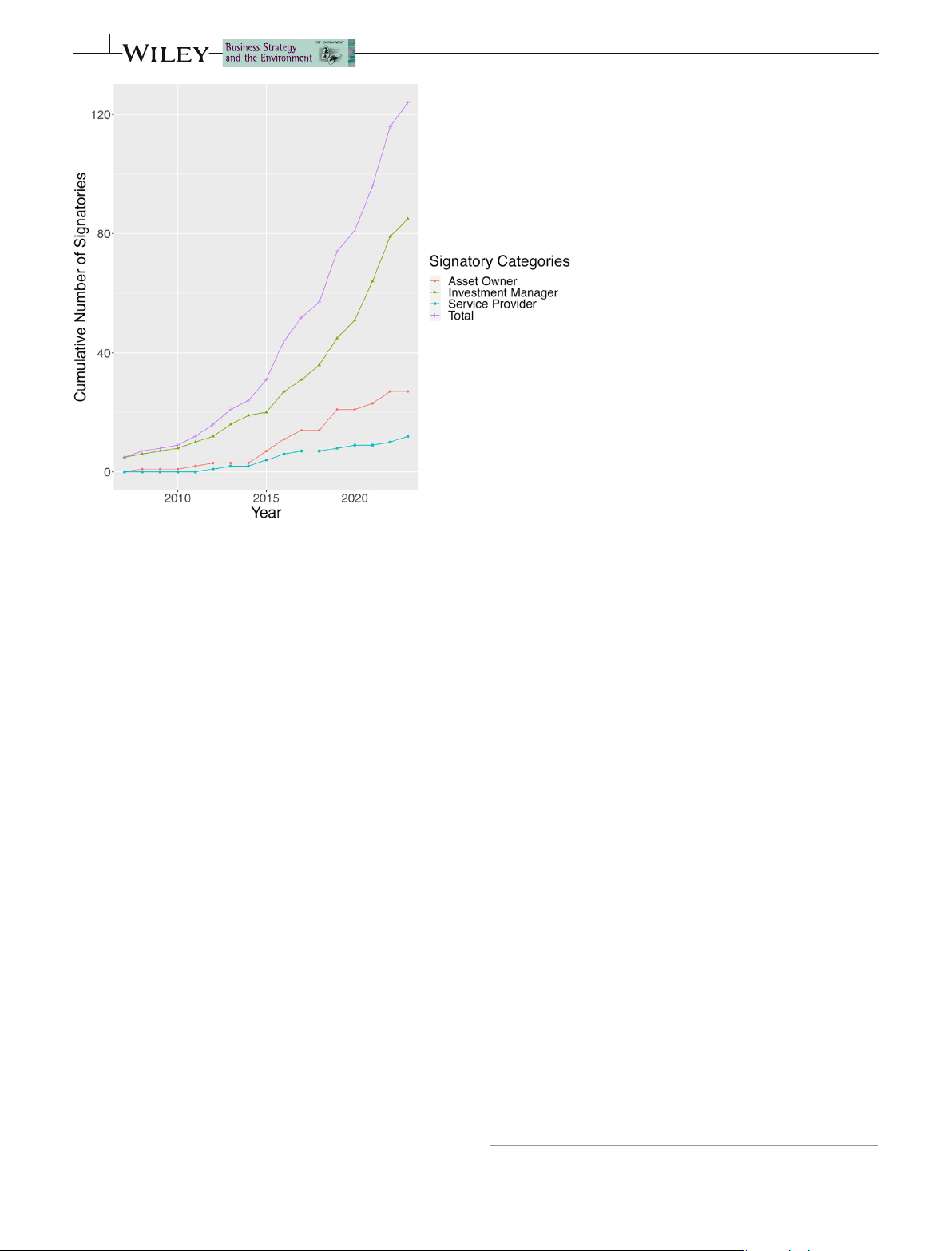
10990836, 2024, 4, Downloaded from https://onlinelibrary.wiley.com/doi/10.1002/bse.3649 by Readcube (Labtiva Inc.), Wiley Online Library on [07/03/2026]. See the Terms and Conditions (https://onlinelibrary.wiley.com/terms-and-conditions) on Wiley Online Library for rules of use; OA articles are governed by the applicable Creative Commons License 3674 AZUMA and HIGASHIDA F I G U R E 1 Cumulative number of PRI
signatories headquartered in Japan. Source: http://
www.unpri.org, accessed on September 1, 2023
Hypothesis 2. The presence of PRI signatories posi-
Simultaneously, the FSA unveiled the “Corporate Governance Code
tively influences the relationship between the institu-
(2014)” and the “Guidelines for Investor and Company Engagement
tional investor ratio and climate change disclosure. (2018).”
In tandem with these changes, Japanese institutional investors
have shown an increasing alignment with ESG requirements. Japan 2.3 | Urgency
has observed a rise in the number of institutional investors endorsing
the PRI, mirroring global trends. Figure 1 highlights this uptrend, with
The theory highlights urgency as its third component. Mitchell et al.
a noticeable surge post-2015. Delving into the specifics, this growth
(1997) described urgency as the extent to which stakeholders' claims
is primarily attributed to the ascendance of investment managers, demand swift response.
typically the direct shareholders of corporations. Notably, in 2015,
Historically, in Japan, the urgency of institutional investors' claims
the GPIF (Government Pension Investment Fund, Japan)—one of
was a recent phenomenon for corporations. Following the collapse of
the world's leading pension funds—became a signatory of the PRI.
the “bubble economy” in the early 1990s, traditional oversight mecha-
This move amplified the ESG demands on investment managers. Rein-
nisms such as cross-holding and “main banks” saw a decline in their
forcing this shift, a 2019 survey by the Investment Trust Association
influence. This shift led institutional investors to actively enhance the
identified ESG concerns, inclusive of climate change disclosure, as
corporate governance of the firms they invested in (Mizuno, 2010).
focal points in shareholder engagement.9
However, the influence of these institutional investors was not imme-
Recent developments in Japan have accentuated the urgency of
diate in its medium- and long-term impacts. A factor attributing to this
institutional investors' claims, especially on ESG matters, including cli-
delay was the inherent short-term focus of Japanese institutional
mate change. Consequently, we anticipate that the relationships out-
investors, driven by the need for frequent self-promotion and portfo-
lined in Hypotheses 1 and 2 have become increasingly pronounced
lio performance improvement (Suto & Toshino, 2005).
with these institutional shifts in Japan. Our third hypothesis is out-
Over the last decade, Japan has witnessed a surge in the urgency lined below.
of institutional investors' demands due to regulatory changes. The
Financial Services Agencies (FSA) in Japan introduced the “Principles
Hypothesis 3. The positive influence of institutional
for Responsible Institutional Investors, Japan's Stewardship Code
investors' holding ratio and the presence of the PRI sig-
(2014),” aiming to foster proactive engagement from investors and
natories has increased over the passage of time.
meaningful conversations with companies they invest in (Ueda, 2015).
Responding to the rising importance of ESG, the Stewardship Code
9https://www.toushin.or.jp/files/statistics/11/2019_plan_servey.pdf (last accessed on
underwent revisions in 2020 to include ESG considerations. August 16, 2022).
10990836, 2024, 4, Downloaded from https://onlinelibrary.wiley.com/doi/10.1002/bse.3649 by Readcube (Labtiva Inc.), Wiley Online Library on [07/03/2026]. See the Terms and Conditions (https://onlinelibrary.wiley.com/terms-and-conditions) on Wiley Online Library for rules of use; OA articles are governed by the applicable Creative Commons License AZUMA and HIGASHIDA 3675 3 | R E S E A R C H D E S I G N
take this alternative approach because we were not able to find evi-
dence on whether the effect of the PRI signing was shared among 3.1 | Data collection
institutions within the financial groups. For example, Mizuho Finan-
cial Group has numerous subordinated institutions with “Mizuho”
This study is predicated on archival quantitative methods, utilizing
included in their names, such as “Mizuho Trust,” “Mizuho Bank,” and
statistical analyses of secondary data. The main data analyzed in this
“Mizuho Securities.” An alternative approach would have been using
study is retrieved from Japanese Annual Securities Reports (ASR,
the string “Mizuho” to match all the subordinated institutions as
Yukashoken Hokokusho) in XBRL (eXtensible Business Reporting
signed. Instead, we used the string “Mizuho Trust” so that only the
Language)10 format. The following procedure was undertaken to col-
institution that has actually signed the PRI would be identified as lect the data: signed.
First, through the API (Application Programming Interface) pro-
The list of shareholders in security reports included names of
vided by the FSA (Financial Service Agency, Japan), a list of security
Japanese institutions as standing proxies (“Jonin-Dairinin”) where
reports published for accounting years ending between January
non-Japanese institutions hold shares of the firm. Thus, non-Japanese
1, 2017, and December 31, 2022, was downloaded in JSON
shareholders were considered as PRI-signed, corresponding to their
(JavaScript Object Notation) format (the so-called metadata). We then
standing proxies. The signing dates were also considered in this
scraped annual security reports from the API using a self-developed
approach. The shareholders would not be identified as signed until
program relying on the RCurl package in R. In total, 25,033 firm-year
the latest closing date after the signing.
security reports were downloaded in XBRL format. Each report con-
Summing up the holding ratios of PRI-signed shareholders in the
tained a list of the ten largest shareholders with their respective
report, the total holding ratios by PRI-signed investors were calculated
names and holding ratios. Using commands in stringr package, we
for each firm-year security report.
extracted a list of 261,620 shareholders with the data points from the XBRL files.11
The dataset scraped from the API was merged with the NIKKEI 3.3 | Climate change disclosure
CGES (Corporate Governance Evaluation System) dataset, a com-
monly used database in empirical analyses of Japanese firms. In total,
This study uses computer-assisted text analysis to measure climate
CGES had 22,794 observations during the timeframe of our analysis
change disclosure. Computer-assisted text analysis is broadly divided
(2017–2022). The common observations between the two databases
into two types: dictionary-based text analysis and unsupervised
(XBRL documents and CGES) were 18,702, and after eliminating those
machine learning algorithms (Li, 2010; Matthies & Coners, 2015).
with missing data, we were left with a sample of 17,604 firm-year
While the former relies on predetermined lists of words and catego- observations.
ries, the latter attempts to learn the “hidden structure” in unlabeled
texts. This study is based on the former approach; we predetermine
a list of strings related to climate change and count the appearances 3.2 |
Identifying shareholders who had signed
of the strings in the text as explained by the concrete procedure the PRI below.
We argue that using dictionary-based text analysis with computer
PRI-signed shareholders were identified based on public data. A list of
assistance is relevant, particularly for this study's task. First, the task
signatories was downloaded from the PRI website as of July 28, 2023.
addressed in this study, the measurement of climate change disclo-
This list captures the names of all institutions that have signed the PRI
sure, is topic-specific and comparable to previous studies using the
since its launch, accompanied by their signing dates. This facilitates
dictionary-based approach such as Hummel et al. (2022) and
accurate identification of PRI signatories based on the timing of publi-
Mittelbach-Hörmanseder et al. (2021). This is distinct from the
cation dates of the reports. For the sake of feasibility, the list was
goals pursued in previous environmental disclosure literature, such
limited to institutions headquartered in Japan, resulting in a total of
as a more comprehensive understanding (Clarkson et al., 2008; 87 institutions.
Patten, 2002) or investigation of verbal tones (Cho et al., 2010). Tech-
We manually developed a list of strings for the 87 institutions
nically, climate change has specific terms used only in the context of
after translating each name to Japanese to match the shareholder
the issue; for example, the term “greenhouse gas” typically appears
names extracted from the security reports in XBRL format. In devel-
only under the topic of climate change. This is especially true when
oping this set of strings, we aimed to match them only with institu-
the text analyzed is extracted from a specific context, namely certain
tions that had actually signed the PRI. An alternative approach
sections of the Japanese security reports. In general, a computer-
would have been to match all the institutions within the financial
assisted content analysis must be conditioned on the words for spe-
group to which the signing institution belongs. However, we did not
cific meanings in specialized contexts (Krippendorff, 2019), and the
task in this study meets this condition well.
10https://www.xbrl.org (last accessed on August 16, 2022). 11
Second, applying computer-assisted content analysis to XBRL
The number of shareholders does not match the exact tenfold of security reports
downloaded because some firms list more than ten shareholders.
documents dramatically increases the analysis's efficiency. The most
10990836, 2024, 4, Downloaded from https://onlinelibrary.wiley.com/doi/10.1002/bse.3649 by Readcube (Labtiva Inc.), Wiley Online Library on [07/03/2026]. See the Terms and Conditions (https://onlinelibrary.wiley.com/terms-and-conditions) on Wiley Online Library for rules of use; OA articles are governed by the applicable Creative Commons License 3676 AZUMA and HIGASHIDA
crucial advantage of computer-aided techniques is the higher speed
specifically opted to count nouns. Subsequently, stopwords were
of processing a large volume of data in a programmed manner (Riffe omitted.14
et al., 2014). Along with the growing availability of “big data,” the pop-
• Raw disclosure volume: Due to the unique characteristics of the
ularity of automated content analysis methods is increasing in social
Japanese language, which does not have clear word separations
science studies; these studies have the advantage of analyzing large
like English, our first measure could introduce biases. To counter-
datasets, such as SNS (Jung et al., 2018) and patent documents (Tseng
act this, we employed specialized algorithms, such as MeCab, for
et al., 2007). Similarly, we apply computer-assisted content analysis to
precise word counting. However, to further ensure the robustness
a large dataset of XBRL disclosure documents.
of our results and provide a more nuanced understanding, we also
To delineate our approach, we used a predetermined list of
incorporated the absolute frequency of the predetermined words.
strings to detect and measure climate change disclosure in security
reports. Relying on Cannon et al. (2020) and Landrum and Ohsowski
For the independent variables, our primary focus is on the
(2017), which used external documents on the topics in selecting following:
strings, both authors read the best practice examples of climate
change disclosure chosen by the local authority,12 then made a list of
• Institutional investors holding ratio: This variable represents the
strings, selecting from the strings that appeared in the document.
holding ratio by institutional investors, as sourced from the Nikkei
Strings included in the list had to be directly related to the issue of cli- CGES.
mate change; strings potentially used in different contexts, such as
• PRI signatories: A binary variable, it assigns a value of 1 when over
“carbon” and “environment,” were not included in the list following
1% of the firm's shareholders have signed the PRI and 0 otherwise. Cannon et al. (2020).
This categorization is conducted following the procedure of
Using a self-developed program in R, we searched for the follow-
identifying PRI-signed investors outlined previously. Given our
ing strings in the sections and counted their appearance frequencies.
assumption that the influence of PRI-signed investors does not
Concrete strings used were “global warming” (“Ondanka”), “green-
linearly correlate with their holding ratio, this variable takes on a
house effect” (“Onshitsukoka”), “climate change” (“Kikohendo”), “car-
binary form. Our choice of a 1% threshold aligns with Johnson
bon dioxide” (“Nisankatanso”), CO2 (“CO2”), and “decarbonization”
and Greening (1999), which deemed holdings below 1% as negligi-
(“Datsutanso”). Because of the nature of the Japanese language and
ble. This leads us to postulate that the sway of institutional
the strings chosen, stemming and lemmatization13 are not issues that
investors shifts noticeably once this 1% threshold is crossed. Fur-
need to be addressed. The sections searched in the security reports
thermore, only the interaction effect of PRI signatories with Insti-
are “Management Policy, Management Environment, Issues to
tutional investors holding ratio was considered, excluding PRI
Address” (“Keieihoshin, Keieikankyo oyobi Taishosubeki Kadai to”)
signatories as an individual term to avoid collinearity issues. It is
and “Business Risks (“Jigyo to no Risuku”). Based on the electronic
worth noting that non-institutional investors are less likely to
search, two different variables (plus one for robustness checks) on cli- become PRI signatories.
mate change disclosure were developed (explained in detail in the var- iable description section).
The control variables incorporated in the models are detailed below: 3.4 | Variable descriptions
• Corporate Size: Various studies have empirically confirmed the
impact of corporate size on social and environmental disclosure
The dependent variables of the analysis are related to climate change
(Gray et al., 1995b; Patten, 2002), as well as on climate change
disclosure and are captured using two distinct measures:
disclosure (Cotter & Najah, 2012; Prado-Lorenzo et al., 2009). To
account for this, we include the natural logarithm of total assets as
• Relative disclosure volume: This measure is constructed in line with a control for corporate size.
Li et al. (2013) and Cannon et al. (2020), utilizing the frequency of
• Leverage: The stakeholder theory literature underscores the pres-
predetermined word appearances normalized by the total word
sure exerted by capital lenders (Liesen et al., 2015; Roberts, 1992).
count in the sections. The values are multiplied by 1000 to simplify
We control for this influence by incorporating the firm's leverage
coefficient presentations, following Cannon et al. (2020). Given the ratio.
structural nuances of the Japanese language, which lacks “white
• Carbon Intensive: Previous research highlights the relationship
spaces” between words, we utilized the MeCab algorithm with the
between environmental performance and social and environmental
mecab-ipadic-NEologd dictionary (Kudo et al., 2004) to tokenize disclosures (Cho & Patten, 2007; Clarkson et al., 2008;
the text. Based on the taxonomy of MeCab, our research
Patten, 2002). In the realm of climate change, this extends to GHG
(greenhouse gas) performance (Cong et al., 2020; Freedman &
12https://www.fsa.go.jp/news/r3/singi/20220325/01-2.pdf (last accessed on August 16, 2022).
14Stopwords were removed using the list of words https://svn.sourceforge.jp/svnroot/
13https://nlp.stanford.edu/IR-book/html/htmledition/stemming-and-lemmatization-1.html
slothlib/CSharp/Version1/SlothLib/NLP/Filter/StopWord/word/Japanese.txt (accessed on
(last accessed on August 16, 2022). December 21, 2021).
10990836, 2024, 4, Downloaded from https://onlinelibrary.wiley.com/doi/10.1002/bse.3649 by Readcube (Labtiva Inc.), Wiley Online Library on [07/03/2026]. See the Terms and Conditions (https://onlinelibrary.wiley.com/terms-and-conditions) on Wiley Online Library for rules of use; OA articles are governed by the applicable Creative Commons License AZUMA and HIGASHIDA 3677
Jaggi, 2005; Luo & Tang, 2014). To account for this effect, we
over the years, we repeatedly run Equation (1) as a cross-sectional
employ an industry-based approach (Stanny & Ely, 2008) and for-
analysis from 2017 to 2022 and then conduct a panel analysis.
mulate a binary variable as per Liesen et al. (2015). The variable
In Hypothesis 3, we posited that the institutional investors'
Carbon intensive is binary, assigned a value of 1 if the firm operates
positive influence increases over the passage of time. To be precise,
within carbon-intensive industries, as classified by the Nikkei
we predict that the marginal effect of institutional investors' holding
Industry Classification System (Nikkei-Chubunrui). This includes
ratio and the presence of the PRI signatories, which we expect to be
industries of sea transportation, air transportation, petroleum,
positive for Hypotheses 1 and 2, respectively, increased over the
iron & steel, electric & electronic equipment, utilities (electric and
years. To test Hypothesis 3, we develop the following Equation (2):
gas), chemicals, motor vehicles & auto parts, trucking, railroad
transportation, pulp & paper, and precision equipment. Disclosurei,t ¼ γ þ γ 0
1 Inst:hold:ratioi,t Timetrendi,t
• Manufacturing: Besides carbon intensity, certain studies address þγ ð
2 Inst:hold:ratioi,t PRIsig:i,t Timetrendi,t 2Þ þγ
the industry sector's influence, such as potential regulatory threats
3 Timetrendi,t þ θ2 Xi,t þ υi,t
(Reid & Toffel, 2009). Aligning with this perspective, we introduce
this variable, a binary variable. It assumes a value of 1 if the firm is
In Equation (2), we introduce an interaction between the Time
part of the manufacturing sector, based on the Nikkei Industry
trend and Institutional investors' holding ratio, as well as its interaction
Classification System (Nikkei-Daibunrui), and 0 otherwise.
with PRI signatories. Contrary to conventional models, we do not
• Time Trend: We opted for a continuous variable rather than year-
include the main effects of Institutional investors' holding ratio or its
fixed effects in panel regressions to encapsulate the time trend.
interaction with PRI signatories in this equation. Our primary interest
This decision stems from an intention to sidestep the potential bias
lies in understanding how the influence of Institutional investors'
that fixed effects estimators might introduce in nonlinear models
holding ratio and its interaction with PRI signatories evolves over time.
(Greene et al., 2002). As outlined by Wooldridge (2008), Time trend
This is distinct from their individual effects, which are explored in
sequentially takes values from 1 to 6, mapping onto the study
Equation (1). We argue that, for the purposes of Equation (2), it is not years from 2017 to 2022.
imperative to account for these variables outside of their relationship
with Time trend. Furthermore, we control for the linear progression of
time by incorporating Time trend as an independent term. 3.5 | Econometric models
The marginal effect of Institutional investors' holding ratio on
Disclosure after holding all other variables fixed in Equation (2) is
This study employs two econometric models, and the first one is pre- expressed as follows:
sented as the following equation (1): ΔDisclosure ¼ γ
ΔInstitutionalinvestors0holdingratio
1 Timetrendi,t þ γ2 PRIsig:i,t Timetrendi,t Disclosurei ¼ β þ β 0
1 Inst:hold:ratioi þ β2Inst:hold:ratioi PRIsig:i þ θ ¼ ðγ þ γ Þ 1 2 PRIsig:i,t Timetrendi,t 1Xi þ εi ð1Þ ð3Þ
Equation (1) includes alternately one of Relative disclosure volume
or Raw disclosure volume as a dependent variable. X is a vector of
Equation (3) shows that the marginal effect of Institutional inves-
control variables and θ is a vector of their coefficient estimates. Of
tors' holding ratio is a linear function of Time trend, and our prediction
interest to our hypotheses are β1 and β2, which are coefficients of
of the marginal effect's growth along with the time passage requires
Institutional investors' holding ratio and its interaction with PRI signa- ðγ þγ 1
2 PRIsig:i,tÞ to be positive (Time trend increases with the progres-
tories, respectively. We interacted PRI signatories with Institutional
sion of time). When PRI signatories are absent (PRIsig:i,t ¼ 0),
investors holding ratio and, supposing only this interaction effect, did
Equation (3) becomes γ1 Timetrendi,t. Then, γ1 needs to be positive to
not include PRI signatories by itself in the model. Non-institutional
assume the growth of Institutional investors' holding ratio's marginal
investors are unlikely to become PRI signatories, and the exclusion of
effect along with time progression. In the case of the PRI signatories'
PRI signatories for the main effect was necessary because of collinear-
presence (PRIsig:i,t ¼ 1), Equation (3) becomes ðγ þ γ Þ 1 2 Timetrendi,t. In ity concerns.
alignment with Hypothesis 3, the sum ðγ þ γ Þ 1 2 must be positive.
In accordance with Hypothesis 1, that Institutional investors' hold-
Notably, when γ2 is positive, it indicates an enhanced marginal effect
ing ratio positively influences climate change disclosure, we predict β1
due to the presence of PRI signatories. Our prediction in Hypothesis 2
to take a positive value. In Hypothesis 2, we predicted that the pres-
expects a positive effect with the presence of PRI signatories. If the
ence of PRI-signed institutional investors positively influences the
time progression positively moderates this effect as suggested by
relationship between institutional investors and climate change disclo-
Hypothesis 3, γ2 would manifest a positive value.
sure. Econometrically, this means that the marginal effect of Institu-
In summary, for Hypotheses 1 and 2, we refer to Equation (1) and
tional investors' holding ratio is greater when PRI-signed institutional
anticipate β1 and β2 to be positive, respectively. In the context of
investors are present (β þ β 1
2 > β1 if PRI signatories = 1). Thus, we pre-
Hypothesis 3, we draw upon Equation (2) and its derivative,
dict β2 to be positive. To illustrate the effects of institutional investors
Equation (3), expecting both γ1 and γ2 to exhibit positive values.
10990836, 2024, 4, Downloaded from https://onlinelibrary.wiley.com/doi/10.1002/bse.3649 by Readcube (Labtiva Inc.), Wiley Online Library on [07/03/2026]. See the Terms and Conditions (https://onlinelibrary.wiley.com/terms-and-conditions) on Wiley Online Library for rules of use; OA articles are governed by the applicable Creative Commons License 3678 AZUMA and HIGASHIDA
As for the statistical approach, we employed the Tobit model
In contrast to the variables above, the time trend is not observed in
given that our dependent variables, Relative disclosure volume and
any of the control variables of Corporate size, Carbon intensive, Lever-
Raw disclosure volume, represent censored variables (with a left-
age, and Manufacturing as expected.
skewed distribution and a peak at 0). When conducting panel regres-
Table 3 exhibits the mean value comparisons of climate change
sions, we opted against using fixed effects to sidestep the inherent
disclosure to the presence of PRI-signed institutional investors along
bias of the fixed effects estimator within nonlinear frameworks
with the years. The group of firms with (without) PRI-signed institu-
(Greene et al., 2002). Consequently, we adopted the random effects
tional investors (ownership ratio over (under) 1%) are displayed under
model (Tobit RE) (Berndt et al., 1974; Henningsen, 2022) and
the columns of Present (Absent), and the mean values of the two cli-
accounted for the time trend effect by incorporating a continuous
mate change disclosure measures are compared between the groups
time trend variable (Flammer, 2013; Wooldridge, 2008).
for each year. With both Relative disclosure volume and Raw disclosure
volume, the mean values are greater for the Present group throughout
the timeframe of the analysis, and the absolute value of t generally 4 | R E S U L T S
increases along with the year's passage. This indicates that the influ-
ence of PRI-signed institutional investors on climate change disclosure 4.1 | Main results
becomes more distinct with time. Overall, the results suggest a posi-
tive influence of PRI signing by institutional investors on climate
Table 2 presents the descriptive statistics of the variables. These
change disclosure, and the influence is growing with time.
statistics are organized annually, with the final column amalgamating
Tables 4 and 5 present the results of the multivariate analysis.
data across all years. Means of Relative disclosure volume and Raw
Table 4 exhibits the results of the Tobit regression analyses with Rela-
disclosure volume are constantly increasing over the years. Notably,
tive disclosure volume as a dependent variable. Cross-sectional ana-
the medians for these variables consistently stand at zero in every
lyses are repeated for each year from 2017 to 2022, and then a panel
sub-sample (data not shown), pointing to a leftward skew in their
regression analysis with random effect Tobit is executed. distributions.
Concerning the annual executions of cross-sectional analyses, the
The means of Institutional investors holding ratio over the years
estimated coefficient for Institutional investors holding ratio is positive
reflect an increasing presence of institutional investors in Japan,
throughout the analysis period except for 2017. Statistical significance
although not strictly persistent. The means of PRI signatories repre-
was first detected in 2020, but only with p < 0:1. In 2021 and 2022,
sent percentage ratios of firms with PRI-signed institutional investors
statistical significance becomes more evident (p < 0:01 and p < 0:01,
over 1% holding ratio within the firm. The values reflect a gradual pro-
respectively), which is consistent with Hypothesis 1. Analogous results
liferation of PRI-signed institutional investors among Japanese firms.
are observed for the interactive variable Inst. holding ratio*PRI sig. The T A B L E 2 Descriptive statistics. Year 2017 Year 2018 Year 2019 Year 2020 Year 2021 Year 2022 Pooled n = 2809 n = 2903 n = 2995 n = 3092 n = 2707 n = 3098 n = 17,604 mean sd mean sd mean sd mean sd mean sd mean sd mean sd Relat. dis. volume 0.18 0.88 0.22 1.00 0.33 1.42 0.71 2.04 1.59 3.40 2.97 4.92 0.98 2.84 Raw dis. volume 0.13 0.63 0.17 0.92 0.28 1.37 0.75 2.44 1.65 4.42 3.43 7.53 1.04 3.88 Inst. holding ratio 7.37 7.18 8.36 7.62 9.56 8.31 8.91 8.19 8.97 8.16 10.00 8.90 8.86 8.12 PRI signatories 0.33 0.47 0.32 0.47 0.38 0.49 0.42 0.49 0.40 0.49 0.40 0.49 0.37 0.48 Corporate size 7.02 1.64 6.99 1.65 7.02 1.66 6.99 1.66 6.98 1.67 7.02 1.65 7.00 1.65 Leverage 2.44 35.39 3.08 8.86 2.92 4.69 2.81 9.74 3.16 7.42 3.14 5.89 2.93 15.76 Carbon intensive 0.25 0.43 0.24 0.43 0.23 0.42 0.23 0.42 0.23 0.42 0.23 0.42 0.23 0.42 Manufacturing 0.56 0.50 0.57 0.49 0.58 0.49 0.59 0.49 0.59 0.49 0.59 0.49 0.58 0.49 Time trend 1.00 0.00 2.00 0.00 3.00 0.00 4.00 0.00 5.00 0.00 6.00 0.00 3.50 1.68
Note: Variable descriptions as follows: Relat. dis. volume = continuous variable taking word frequency values of climate words that appeared in the relevant
sections of security reports deflated by the total number of nouns in the text; Raw dis. volume = continuous variable taking word frequency values of
climate words that appeared in the relevant sections of security reports; Inst. holding ratio = institutional ownership holding ratio; PRI signatories = binary
variable taking a value of 1 when the holding ratio of PRI signed institutional investors exceeds 1% or 0 otherwise; Corporate size = natural log of total
assets; Leverage = leverage ratio of the firm; Carbon intensive = binary variable taking a value of 1 when firm belongs to carbon-sensitive industries or 0
otherwise; Manufacturing = binary variable taking a value of 1 when the firm belongs to manufacturing industry or 0 otherwise; and Time trend =
continuous variable taking values from 1 to 6 corresponding to 2017 to 2022.
10990836, 2024, 4, Downloaded from https://onlinelibrary.wiley.com/doi/10.1002/bse.3649 by Readcube (Labtiva Inc.), Wiley Online Library on [07/03/2026]. See the Terms and Conditions (https://onlinelibrary.wiley.com/terms-and-conditions) on Wiley Online Library for rules of use; OA articles are governed by the applicable Creative Commons License AZUMA and HIGASHIDA 3679 T A B L E 3
Mean value comparisons between climate change disclosure and the presence of PRI signatories. Relative disclosure volume Raw disclosure volume N PRI signatories Absent Present Absent Present Absent Present mean mean t mean mean t 2017 0.13 0.27 3.55*** 0.09 0.20 3.86*** 1883 926 2018 0.17 0.32 3.65*** 0.12 0.27 3.73*** 1969 934 2019 0.23 0.50 4.85*** 0.19 0.41 4.22*** 1862 1133 2020 0.41 1.13 9.00*** 0.44 1.17 7.72*** 1805 1287 2021 1.00 2.50 11.34*** 0.99 2.65 9.25*** 1871 1227 2022 1.90 4.55 13.20*** 2.08 5.41 10.44*** 1613 1094 *p < 0:1: **p < 0:05: ***p < 0:01: T A B L E 4
Regression analysis: Relative disclosure volume as dependent variable. Relative disclosure volume 2017 2018 2019 2020 2021 2022 2017–2022 2017–2022 Inst. holding ratio 0.02 0.00 0.01 0.04* 0.09*** 0.20*** 0.09*** (0.03) (0.03) (0.03) (0.02) (0.02) (0.03) (0.01)
Inst. holding ratio* Time trend 0.03*** (0.00) Inst. hol. ratio*PRI sig. 0.05 0.03 0.03 0.07*** 0.08*** 0.09*** 0.06*** (0.03) (0.03) (0.03) (0.02) (0.02) (0.02) (0.01)
Inst. hol. ratio*PRI sig.* Time trend 0.01*** (0.00) Corporate size 1.05*** 1.14*** 1.42*** 1.34*** 1.59*** 1.55*** 1.66*** 1.57*** (0.14) (0.14) (0.14) (0.10) (0.11) (0.13) (0.07) (0.07) Leverage 0.00 0.05 0.05 0.00 0.03 0.04* 0.00 0.00 (0.01) (0.04) (0.03) (0.01) (0.03) (0.03) (0.02) (0.02) Carbon intensive 2.19*** 1.74*** 1.80*** 0.89** 0.93** 0.93** 1.07*** 1.13*** (0.45) (0.43) (0.46) (0.35) (0.37) (0.42) (0.25) (0.25) Manufacturing 0.10 0.07 0.63 1.26*** 1.85*** 1.53*** 1.70*** 1.67*** (0.42) (0.41) (0.44) (0.32) (0.33) (0.37) (0.24) (0.23) Time trend 2.62*** 2.16*** (0.03) (0.04) (Intercept) 15.96*** 16.20*** 18.71*** 14.71*** 14.64*** 13.70*** 29.07*** 26.55*** (1.33) (1.24) (1.26) (0.83) (0.81) (0.88) (0.57) (0.57) Model Tobit Tobit Tobit Tobit Tobit Tobit Tobit RE Tobit RE N 2809 2903 2995 3092 3098 2707 17,604 17,604 Left-censored 2601 2655 2669 2457 2063 1435 13,880 13,880 Uncensored 208 248 326 635 1035 1272 3724 3724 Log Likelihood 1042.42 1227.45 1586.62 2734.59 4269.61 5060.03 14,717.49 14,659.23 PseudoR2 0.08 0.07 0.08 0.09 0.08 0.08 0.21 0.21 *p < 0:1. **p < 0:05. ***p < 0:01.
10990836, 2024, 4, Downloaded from https://onlinelibrary.wiley.com/doi/10.1002/bse.3649 by Readcube (Labtiva Inc.), Wiley Online Library on [07/03/2026]. See the Terms and Conditions (https://onlinelibrary.wiley.com/terms-and-conditions) on Wiley Online Library for rules of use; OA articles are governed by the applicable Creative Commons License 3680 AZUMA and HIGASHIDA T A B L E 5
Regression analysis: Raw disclosure volume as dependent variable. Raw disclosure volume 2017 2018 2019 2020 2021 2022 2017–2022 2017–2022 Inst. holding ratio 0.01 0.00 0.02 0.06** 0.11*** 0.27*** 0.13*** (0.02) (0.02) (0.03) (0.03) (0.03) (0.04) (0.02)
Inst. holding ratio* Time trend 0.04*** (0.00) Inst. hol. ratio*PRI sig. 0.03 0.02 0.02 0.06** 0.08*** 0.13*** 0.06*** (0.02) (0.02) (0.02) (0.02) (0.03) (0.03) (0.01)
Inst. hol. ratio*PRI sig.* Time trend 0.01*** (0.00) Corporate size 0.79*** 1.06*** 1.38*** 1.74*** 2.29*** 2.75*** 2.19*** 1.91*** (0.10) (0.11) (0.13) (0.11) (0.14) (0.19) (0.08) (0.07) Leverage 0.00 0.05 0.04 0.00 0.01 0.09** 0.01 0.01 (0.01) (0.04) (0.03) (0.01) (0.03) (0.04) (0.02) (0.02) Carbon intensive 1.43*** 1.29*** 1.35*** 0.88** 0.72 0.57 0.73** 0.84*** (0.31) (0.36) (0.41) (0.38) (0.45) (0.62) (0.33) (0.32) Manufacturing 0.04 0.08 0.59 1.14*** 1.94*** 1.55*** 1.90*** 1.77*** (0.29) (0.34) (0.39) (0.35) (0.41) (0.55) (0.29) (0.28) Time trend 3.18*** 2.49*** (0.04) (0.05) (Intercept) 11.46*** 14.26*** 17.58*** 18.38*** 21.02*** 24.83*** 37.10*** 32.30*** (0.91) (1.02) (1.12) (0.91) (1.00) (1.31) (0.61) (0.62) Model Tobit Tobit Tobit Tobit Tobit Tobit Tobit RE Tobit RE N 2809 2903 2995 3092 3098 2707 17,604 17,604 Left-censored 2601 2655 2669 2457 2063 1435 13,880 13,880 Uncensored 208 248 326 635 1035 1272 3724 3724 Log Likelihood 960.57 1168.95 1533.49 2763.93 4411.36 5475.34 15,559.81 15,500.31 PseudoR2 0.09 0.09 0.09 0.10 0.09 0.08 0.20 0.20 *p < 0:1. **p < 0:05. ***p < 0:01.
coefficient is estimated to be positive throughout the analysis period,
Table 5 exhibits the results of regression analyses with Raw
consistent with Hypothesis 2. Statistical significance is detected for
disclosure volume as the dependent variable. Models are repeated
the first time in 2020 (p < 0:01) and stays until 2022 (p < 0:01). Gradual
identically to the analyses in Table 4. Concerning the repeated cross-
increase of the statistical significance of the coefficients for Institu-
sectional analyses along with the years, the signs of the coefficients
tional investors holding ratio and Inst. holding ratio*PRI sig. conform
are all identical. Statistical significance in 2020 was p < 0:05, but then with Hypothesis 3.
later turns into p < 0:01 for both Institutional investors holding ratio
The random effects Tobit regressions in the final two columns
and Inst. holding ratio*PRI sig. The panel regression analyses display
report consistent results. In the first model (the second from the right-
similar results. In the first model, the coefficients for Institutional
est), the coefficients for Institutional investors holding ratio and Inst.
investors holding ratio and Inst. holding ratio*PRI sig. are both positive
holding ratio*PRI sig. are both positive and statistically significant and statistically significant (p < 0:01). These results support
(p < 0:01) supporting Hypotheses 1 and 2, respectively. In the second
Hypotheses 1 and 2, respectively. In the second model (the final col-
model (the final column) using Time trend as an interactive variable,
umn) using Time trend as an interaction term, the coefficients for Inst.
the estimated coefficients for the variables of Inst. holding ratio*Time
holding ratio*Time trend, Inst. holding ratio*PRI sig.*Time trend, and
trend, Inst. holding ratio*PRI sig.*Time trend, and Time trend are all
Time trend are all positive and statistically significant (p < 0:01). Conse-
positive and statistically significant (p < 0:01). Thus, the result is in
quently, the findings corroborate Hypothesis 3. support of Hypothesis 3.
Overall, our empirical results support our Hypotheses 1,2, and 3.
10990836, 2024, 4, Downloaded from https://onlinelibrary.wiley.com/doi/10.1002/bse.3649 by Readcube (Labtiva Inc.), Wiley Online Library on [07/03/2026]. See the Terms and Conditions (https://onlinelibrary.wiley.com/terms-and-conditions) on Wiley Online Library for rules of use; OA articles are governed by the applicable Creative Commons License AZUMA and HIGASHIDA 3681 4.2 | Robustness tests
changes (results not tabulated). We also created a binary version of
the variable that takes the value of 1 if any of the keywords were
We conducted a series of additional tests to check the robustness of
detected and 0 otherwise. Once more, after replicating our primary
our results. First, we experimented with various alternative versions
analysis with the Probit regression model using this binary metric, we
of the disclosure measures. Although our measures of Relative disclo-
observed no significant variations (results not shown).
sure volume and Raw disclosure volume are derived from the previous
Second, we examined if lagging explanatory variables by one year
studies (Cannon et al., 2020; Li et al., 2013), the computer-assisted
would result in any notable changes. We developed our models posit-
text analysis is a comparatively novel method, and as such, the appro-
ing that the institutional investors' holding ratio during the year has
priateness of the disclosure measure chosen still requires verification.
affected firms' disclosure at the end of the year. In line with certain
To mitigate any potential effects from the long tail distributions of the
studies that consider values from one year prior (e.g., Flammer et al.,
measures, we replaced the measures with natural logs of Relative dis-
2021; Liesen et al., 2015), we adjusted all explanatory variables with a
closure volume + 1 and Raw disclosure volume + 1, respectively; add-
one-year lag and replicated the main analysis (results not shown). We
ing 1 before computing the natural logarithm is customary to
verified that lagging the variables by one year does not produce any
accommodate variables with 0 values (Wooldridge, 2008). We repli-
essential changes to our results.
cated our main analyses presented in Tables 4 and 5 with the alterna-
Third, we ascertained that employing a fixed effects model does
tive logged forms, and the results did not produce any notable
not yield alternative conclusions. As mentioned before, because our T A B L E 6 Robustness check with Relative disclosure volume Raw disclosure volume instrumental variables. 2017–2022 2017–2022 2017–2022 2017–2022 Inst. holding ratio 0.29*** 0.30*** (0.07) (0.02)
Inst. holding ratio* Time trend 0.09*** 0.15*** (0.02) (0.02) Inst. hol. ratio*PRI sig. 0.25** 0.61*** (0.12) (0.02)
Inst. hol. ratio*PRI sig.* Time trend 0.06* 0.03* (0.03) (0.02) Corporate size 0.51*** 0.48*** 0.45*** 0.78*** (0.13) (0.15) (0.10) (0.10) Leverage 0.00 0.00 0.01 0.01 (0.01) (0.01) (0.01) (0.01) Carbon intensive 1.68*** 1.68*** 1.76*** 1.64*** (0.21) (0.21) (0.25) (0.25) Manufacturing 1.44*** 1.45*** 1.53*** 1.33*** (0.16) (0.16) (0.23) (0.23) Time trend 2.47*** 2.47*** 3.15*** 2.86*** (0.07) (0.07) (0.13) (0.13) (Intercept) 22.38*** 22.31*** 28.48*** 29.76*** (0.93) (1.06) (1.45) (1.45) Model Tobit Tobit Tobit Tobit Method Pooling Pooling Pooling Pooling SE estimate Bootstrap Bootstrap Bootstrap Bootstrap N 17,521 17,521 17,521 17,521 Left-censored 13,823 13,823 13,823 13,823 Uncensored 3698 3698 3698 3698 Log Likelihood 15,981.70 15,981.93 16,604.33 16,548.57 *p < 0:1: **p < 0:05: ***p < 0:01:
10990836, 2024, 4, Downloaded from https://onlinelibrary.wiley.com/doi/10.1002/bse.3649 by Readcube (Labtiva Inc.), Wiley Online Library on [07/03/2026]. See the Terms and Conditions (https://onlinelibrary.wiley.com/terms-and-conditions) on Wiley Online Library for rules of use; OA articles are governed by the applicable Creative Commons License 3682 AZUMA and HIGASHIDA
main analyses are based on the non-linear Tobit model, we did not
both disclosure measures (p < 0:01). Conversely, the coefficients of
use a fixed effects model in our panel regressions to avoid potential
Inst. holding ratio PRI sig. Time trend register only borderline
bias in our estimators (Greene et al., 2002). Replacing it with linear
significance with the disclosure metrics (p < 0:10). Hence, when
OLS panel regression, we introduced firm fixed effects to account for
accounting for endogeneity, Hypothesis 3 is supported only to a lim-
unobserved, time-invariant individual characteristics. We reproduced ited extent.
the analysis of the final two columns in Tables 4 and 5, and the results
did not generate notable changes to our conclusions (results not shown). 5 | C O N C L U S I O N
Last, we employed an instrumental variable strategy to tackle
potential endogeneity concerns. Overall, we present consistent results 5.1 | Summary and discussion
with our hypotheses after controlling for endogeneity; however, it is
worth noting that our ability to demonstrate robustness in this con-
This study investigated the influence of institutional investors on cli-
text is relatively constrained (results shown in Table 6). This study
mate change disclosure from the perspective of stakeholder salience
potentially suffers from reverse causality; institutional investors might
theory (Mitchell et al., 1997) with a particular focus on institutional
prefer companies with specific attributes that do not influence their
investors signing the PRI. The theoretical framework was developed
disclosure practices after acquiring shares in these firms.
in relation to institutional investors' power, legitimacy, and urgency.
We employed an instrumental variable approach to alleviate this
Empirical data was collected in Japan, where institutional investors'
concern. In our primary models, we incorporate the Institutional inves-
influence is exerted mainly through shareholder engagement. The
tors' holding ratio and its interaction. To address potential endogeneity
determinants—holding ratio (power), PRI signing (legitimacy), and time
concerns, it is imperative to identify a minimum of two instrumental
passage (urgency)—were tested in relation to climate change disclosure
variables. These instruments should be anticipated to affect the hold-
captured by two alternative measurements. As a result, all three
ing ratios of institutional investors yet remain orthogonal to disclosure hypotheses were supported.
practices. We use the following three variables as instruments. As
Regarding Hypothesis 1, institutional investors' holding ratio posi-
inclusion in a local market index may positively affect (especially local)
tively influenced climate change disclosure. With Hypothesis 2, the
institutional investors' investment behaviors (Gao et al., 2019), we use
relationship between institutional investors and climate change
Nikkei225 membership as our first instrumental variable. Overseas
disclosure was positively moderated by the presence of PRI-signed
institutional investors are more affected by international visibility, and
investors. Specifically, the institutional investors' ratio increased cli-
we use MSCI Index membership as our second instrumental variable
mate change disclosure in a greater magnitude if PRI-signed institu-
following Flammer et al. (2021). Companies with a higher market capi-
tional investors were present. Finally, regarding Hypothesis 3, the
talization typically possess increased stock liquidity; this feature is
influence predicted in Hypotheses 1 and 2 was not confirmed in the
advantageous for institutional investors, as it allows for trading large
earlier time period of our cross-sectional analysis. Rather, it emerged
volumes without significant impacts on stock prices. Thus, the natural
gradually with the passage of time and was statistically most signifi-
log of market capitalization is our third instrumental variable.
cant in the latest period of the analysis when the institutional inves-
Due to the inclusion of these variables, the sample size decreased
tors' claims on climate change disclosure became most pressing. The
to 17,521 firm-years. In the first stage, we use the three instrumental
statistical tests using time trend as an additional interactive variable
variables and Corporate size with linear OLS regression to gain fitted
support Hypothesis 3 with statistical rigor. However, Hypothesis 3
values. The three instrumental variables are all positively affecting the
displayed only limited robustness after controlling for endogeneity.
dependent variables. We then incorporated the instrumented
These results were consistent across two alternative disclosure
variables into our main two equations as the second stage with the measures.
Tobit regression pooling model and estimated standard errors by
Our empirical results suggest that the stakeholder salience theory bootstrapping.
explains the current situation of climate change disclosure pressured
The results outlined in Table 6 remain consistent in relation to
by institutional investors. Institutional investors' power drives the cur-
Hypotheses 1 and 2 for both metrics: Relative disclosure volume and
rent growth of climate change disclosure; the more power institutional
Raw disclosure volume. However, only limited support was observed
investors have in a firm, the more the firm will likely produce climate
for Hypothesis 3. In the initial model, the coefficient associated with
change disclosure. Power alone, however, does not determine this
Institutional investors' holding ratio is positively calculated for both dis-
development, as the stakeholder salience theory indicates that power
closure metrics (p < 0:01), solidifying our findings in favor of Hypothe-
and legitimacy interact. Institutional investors' power affects climate
sis 1. Within the same model, the Inst. holding ratio PRI sig. displays
change disclosure more positively after they sign the PRI because of
a positive estimation and is statistically significant; for Relative disclo-
the enhanced legitimacy. Furthermore, corresponding with the rapid
sure volume at p < 0:05 and Raw disclosure volume at p < 0:01. This
growth of urgency, especially in Japan, the positive influence of insti-
underscores the robust backing for Hypothesis 2. As for Hypothesis
tutional investors toward climate change disclosure has gained statis-
3, the coefficients linked to Inst. holding ratio Time trend in the sec-
tical significance only in recent years. Thus, power, legitimacy, and
ond model is positively determined and statistically significant for
urgency collectively determine the salience of institutional investors
10990836, 2024, 4, Downloaded from https://onlinelibrary.wiley.com/doi/10.1002/bse.3649 by Readcube (Labtiva Inc.), Wiley Online Library on [07/03/2026]. See the Terms and Conditions (https://onlinelibrary.wiley.com/terms-and-conditions) on Wiley Online Library for rules of use; OA articles are governed by the applicable Creative Commons License AZUMA and HIGASHIDA 3683
and, in turn, positively influence climate change disclosure. Viewed
format using tags based on taxonomies. Our study aims to illustrate
from a corporate manager perspective, our empirical evidence sug-
the potential of XBRL as a valuable medium for investigating social
gests that managers are more likely to respond to institutional inves-
and environmental disclosure through text analysis. This does not
tors when these investors possess greater power and extended
negate or diminish the significance of other data sources but adds to
legitimacy and present urgent claims. the existing repertoire.
This research is subject to several limitations, including the fol-
lowing. First, our empirical results confirm the positive roles of institu- 5.2 | Contributions and limitations
tional investors in increasing the volume of climate change disclosure,
but this does not guarantee the improvement of transparency in the
This study makes substantial contributions. First, this study contrib-
capital market since our study does not exclude the corporate use of
utes a deeper understanding of institutional investors' relationship
greenwashing (Seele & Gatti, 2017). The question of whether the
with climate change disclosure. This study's results demonstrate that
consequences of institutional investors' influence on climate change
institutional investors' ownership ratio positively influenced climate
disclosure are favorable for the market and society awaits future
change disclosure, consistent with the previous literature (Cotter & research.
Najah, 2012; Depoers et al., 2016; Jaggi et al., 2018; Liesen et al.,
Second, our study's analysis faces certain methodological limita-
2015). Additionally, the act of institutional investors signing the PRI
tions, with endogeneity being a significant concern, as emphasized by
amplifies their impact on climate change disclosure. This observation
Velte (2022). A positive relationship exists between institutional
complements existing literature that underscores the constructive role
investors and climate change disclosure. This might stem from institu-
of the PRI in fostering corporate sustainability (Bauckloh et al., 2021;
tional investors' propensity to invest in firms that are more forthcom-
Dyck et al., 2019; Gond & Piani, 2013; Majoch et al., 2017). Practi-
ing with their climate change disclosures rather than the other way
cally, our results also serve as a recommendation for institutional
around. Notably, our support for Hypothesis 3 appeared tenuous after
investors to sign the PRI to augment their influence over their inves-
accounting for endogeneity. In a broader perspective, after the inclu-
tee companies. Moreover, as societal interest in ESG investing surges,
sion of instrumental variables, the results typically manifest reduced
the influence of institutional investors correspondingly intensifies.
robustness when subjected to additional modifications. While we
This broadens the insights from earlier research, highlighting the influ-
acknowledge this with a certain reluctance, our commitment to scien-
ence of power at specific junctures.
tific rigor compels us to emphasize that, after addressing endogeneity
Second, this study extends the application of stakeholder salience
concerns, our conclusions exhibit only limited robustness. This gap
theory (Mitchell et al., 1997). The theory has been applied to a large
presents an avenue ripe for future research endeavors.
body of empirical literature (Eesley & Lenox, 2006; Gifford, 2010,
etc.); however, the majority of the applications are theoretical and
C O N F L I C T O F I N T E R E S T S T A T E M E N T
qualitative studies, and quantitative studies mainly focus on survey
We have no conflicts of interest to disclose.
data (Joos, 2019, p. 21). This study is one of few studies, such as
David et al. (2007), applying the theory to archival data quantitatively, O R C I D
and we present consistent results with the theory's predictions. Kentaro Azuma
https://orcid.org/0000-0002-7394-290X
Third, this study provides empirical evidence about Japan, a Akira Higashida
https://orcid.org/0000-0002-8395-8761
country rarely addressed in the previous literature. Japan has the
third-largest economy measured by GDP and the fifth-largest GHG R E F E R E N C E S
(Greenhouse Gases) emissions by country.15 Comprehending the
Alda, M. (2021). The environmental, social, and governance (ESG) dimen-
interplay between institutional investors and climate change disclo-
sion of firms in which social responsible investment (SRI) and conven-
tional pension funds invest: The mainstream SRI and the ESG
sure within this context is crucial, serving both local and international
inclusion. Journal of Cleaner Production, 298, 126812–126812.
managers and investors. Our results confirm that institutional
Aluchna, M., Roszkowska-Menkes, M., Kami nski, B., & Bosek-Rak, D.
investors' positive influence on climate change disclosure extends to
(2022). Do institutional investors encourage firm to social disclosure? Japan.
The stakeholder salience perspective. Journal of Business Research, 142, 674–682.
Fourth, this study demonstrates methodological explorations
Amir, A. Z., & Serafeim, G. (2018). Why and how investors use ESG infor-
through text analysis based on XBRL documents. Along with the
mation: Evidence from a global survey. Financial Analysts Journal,
spread of “big data,” recent literature applies text analysis on social 74(3), 87–103.
and environmental disclosure using voluntary CSR reports (Hummel
Ashforth, B. E., & Gibbs, B. W. (1990). The double-edge of organizational
legitimation. Organization Science, 1(2), 177–194.
et al., 2022), sustainability reports (Landrum & Ohsowski, 2017), 10K
Bai, Z., Sakaue, M., & Takeda, F. (2014). The impact of XBRL adoption on
reports (Cannon et al., 2020), and annual reports (Mittelbach-Hörman-
the information environment: Evidence from Japan. The Japanese
seder et al., 2021). This study is one of the first studies applying text
Accounting Review, 4(2014), 49–74.
analysis directly to security reports written in XBRL, a structured data
Bauckloh, T., Schaltegger, S., Utz, S., Zeile, S., & Zwergel, B. (2021). Active
first movers vs. late free-riders? An empirical analysis of UN PRI signa-
tories' commitment. Journal of Business Ethics, 1, 1–35.
15Data respectively from the World Bank and World Resources Institute.
10990836, 2024, 4, Downloaded from https://onlinelibrary.wiley.com/doi/10.1002/bse.3649 by Readcube (Labtiva Inc.), Wiley Online Library on [07/03/2026]. See the Terms and Conditions (https://onlinelibrary.wiley.com/terms-and-conditions) on Wiley Online Library for rules of use; OA articles are governed by the applicable Creative Commons License 3684 AZUMA and HIGASHIDA
Ben-Amar, W., & McIlkenny, P. (2015). Board effectiveness and the volun-
Deegan, C. (2002). Introduction: The legitimising effect of social and envi-
tary disclosure of climate change information. Business Strategy and
ronmental disclosures—A theoretical foundation. Accounting, Auditing &
the Environment, 24(8), 704–719.
Accountability Journal, 15(3), 282–311.
Benlemlih, M., Arif, M., & Nadeem, M. (2023). Institutional ownership and
Deegan, C. (2011). Financial accounting theory: European edition: McGraw
greenhouse gas emissions: A comparative study of the UK and the Hill.
USA. British Journal of Management, 34(2), 623–647.
Delmas, M. A., & Montes-Sancho, M. J. (2010). Voluntary agreements to
Berndt, E. R., Hall, B. H., Hall, R. E., & Hausman, J. A. (1974). Estimation
improve environmental quality: Symbolic and substantive cooperation.
and inference in nonlinear structural models, Annals of economic and
Strategic Management Journal, 31(6), 575–601.
social measurement, volume 3, number 4: NBER, pp. 653–665.
Depoers, F., Jeanjean, T., & Jérôme, T. (2016). Voluntary disclosure of
Bernstein, S. (2004). Legitimacy in global environmental governance. Jour-
greenhouse gas emissions: Contrasting the carbon disclosure project
nal of International Law & International Relations, 1, 139.
and corporate reports. Journal of Business Ethics, 134(3), 445–461.
Brandon, R. G., Glossner, S., Krueger, P., Matos, P., & Steffen, T. (2022).
Doh, J. P., Howton, S. D., Howton, S. W., & Siegel, D. S. (2010). Does the
Do responsible investors invest responsibly? Osmosis Investment
market respond to an endorsement of social responsibility? The role of
Management ECGI Working Paper Series in Finance. (Tech. Rep.
institutions, information, and legitimacy. Journal of Management, 36(6),
No. February): European Corporate Governance Institute. 1461–1485.
Bui, B., Houqe, M. N., & Zaman, M. (2020). Climate governance effects on
Dowling, J., & Pfeffer, J. (1975). Organizational legitimacy: Social values
carbon disclosure and performance. The British Accounting Review, and organizational behavior. Pacific Sociological Review, 18(1), 52(2), 100880. 122–136.
Calza, F., Profumo, G., & Tutore, I. (2014). Corporate ownership and envi-
Ducassy, I., & Montandrau, S. (2015). Corporate social performance, own-
ronmental proactivity. Business Strategy and the Environment, 25(6),
ership structure, and corporate governance in France. Research in 369–389.
International Business and Finance, 34, 383–396.
Cannon, J. N., Ling, Z., Wang, Q., & Watanabe, O. V. (2020). 10-K disclo-
Dyck, A., Lins, K. V., Roth, L., & Wagner, H. F. (2019). Do institutional
sure of corporate social responsibility and firms' competitive advan-
investors drive corporate social responsibility? International evidence.
tages. European Accounting Review, 29(1), 85–113.
Journal of Financial Economics, 131(3), 693–714.
Chen, T., Dong, H., & Lin, C. (2020). Institutional shareholders and corpo-
Eesley, C., & Lenox, M. J. (2006). Firm responses to secondary stakeholder
rate social responsibility. Journal of Financial Economics, 135(2),
action. Strategic Management Journal, 27(8), 765–781. 483–504.
Etzioni, A. (1964). Modern organizations, Foundations of modern sociology
Cho, C. H., & Patten, D. M. (2007). The role of environmental disclosures series. Prentice-Hall.
as tools of legitimacy: A research note. Accounting, Organizations and
Flammer, C. (2013). Corporate social responsibility and shareholder reac- Society, 32(7-8), 639–647.
tion: The environmental awareness of investors. Academy of Manage-
Cho, C. H., Roberts, R. W., & Patten, D. M. (2010). The language of US cor-
ment journal, 56(3), 758–781.
porate environmental disclosure. Accounting, Organizations and Society,
Flammer, C., Toffel, M. W., & Viswanathan, K. (2021). Shareholder activism 35(4), 431–443.
and firms' voluntary disclosure of climate change risks. Strategic Man-
Clark, G. L., McGill, S., Saito, Y., & Viehs, M. (2015). Institutional share-
agement Journal, 42(10), 1850–1879.
holder engagement with Japanese firms. Annals in Social Responsibility,
Freedman, M., & Jaggi, B. (2005). Global warming, commitment to the 1(1), 30–56.
kyoto protocol, and accounting disclosures by the largest global public
Clarkson, P. M., Li, Y., Richardson, G. D., & Vasvari, F. P. (2008). Revisiting
firms from polluting industries. The International Journal of Accounting,
the relation between environmental performance and environmental 40(3), 215–232.
disclosure: An empirical analysis. Accounting, Organizations and Society,
Freeman, R. E. (1984). Strategic management: A stakeholder approach. 33(4-5), 303–327. Pitman.
Coffey, B. S., & Fryxell, G. E. (1991). Institutional ownership of stock and
Gao, K., Shen, H., Gao, X., & Chan, K. C. (2019). The power of sharing: Evi-
dimensions of corporate social performance: An empirical examina-
dence from institutional investor cross-ownership and corporate inno-
tion. Journal of Business Ethics, 10(6), 437–444.
vation. International Review of Economics & Finance, 63, 284–296.
Comyns, B., & Figge, F. (2015). Greenhouse gas reporting quality in the oil Garcia-Sanchez, I.-M., Rodriguez-Ariza, L., Aibar-Guzman, B., &
and gas industry: A longitudinal study using the typology of “search”,
Aibar-Guzman, C. (2020). Do institutional investors drive corporate
“experience” and “credence” information. Accounting, Auditing and
transparency regarding business contribution to the sustainable
Accountability Journal, 28(3), 403–433.
development goals? Business Strategy and the Environment, 29(5),
Cong, Y., Freedman, M., & Park, J. D. (2020). Mandated greenhouse gas 2019–2036.
emissions and required SEC climate change disclosures. Journal of
García-Sánchez, I.-M., Aibar-Guzmán, C., & Aibar-Guzmán, B. (2020).
Cleaner Production, 247, 119111.
The effect of institutional ownership and ownership dispersion on
Cotter, J., & Najah, M. M. (2012). Institutional investor influence on global
eco-innovation. Technological Forecasting and Social Change, 158,
climate change disclosure practices. Australian Journal of Management, 120173. 37(2), 169–187.
García-Sánchez, I.-M., Aibar-Guzmán, B., & Aibar-Guzmán, C. (2022). What
Cox, P., Brammer, S., & Millington, A. (2004). An empirical examination of
sustainability assurance services do institutional investors demand and
institutional investor preferences for corporate social performance.
what value do they give them? Sustainability Accounting, Management
Journal of Business Ethics, 52(1), 27–43.
and Policy Journal, 13(1), 152–194.
Darnall, N., Ji, H., & Vázquez-Brust, D. A. (2018). Third-party certification,
Giannarakis, G., Zafeiriou, E., & Sariannidis, N. (2017). The impact of car-
sponsorship, and consumers' ecolabel use. Journal of Business Ethics,
bon performance on climate change disclosure. Business Strategy and 150(4), 953–969.
the Environment, 26(8), 1078–1094.
David, P., Bloom, M., & Hillman, A. J. (2007). Investor activism, managerial
Gifford, E. J. M. (2010). Effective shareholder engagement: The factors
responsiveness, and corporate social performance. Strategic Manage-
that contribute to shareholder salience. Journal of Business Ethics, 92 ment Journal, 28(1), 91–100. (SUPPL 1), 79–97.
Dawkins, C., & Fraas, J. W. (2011). Coming clean: The impact of environ-
Gond, J.-P., & Piani, V. (2013). Enabling institutional investors' collective
mental performance and visibility on corporate climate change disclo-
action: The role of the Principles for Responsible Investment Initiative.
sure. Journal of Business Ethics, 100(2), 303–322.
Business & Society, 52(1), 64–104.
10990836, 2024, 4, Downloaded from https://onlinelibrary.wiley.com/doi/10.1002/bse.3649 by Readcube (Labtiva Inc.), Wiley Online Library on [07/03/2026]. See the Terms and Conditions (https://onlinelibrary.wiley.com/terms-and-conditions) on Wiley Online Library for rules of use; OA articles are governed by the applicable Creative Commons License AZUMA and HIGASHIDA 3685
Graves, S. B., & Waddock, S. A. (1994). Institutional owners and corporate
Li, F., Lundholm, R., & Minnis, M. (2013). A measure of competition based
social performance. The Academy of Management Journal, 37(4), 1034–
on 10-k filings. Journal of Accounting Research, 51(2), 399–436. 1046.
Li, W., & Lu, X. (2016). Institutional interest, ownership type, and environ-
Gray, R., Kouhy, R., & Lavers, S. (1995a). Corporate social and environmen-
mental capital expenditures: Evidence from the most polluting Chinese
tal reporting: A review of the literature and a longitudinal study of UK
listed firms. Journal of Business Ethics, 138(3), 459–476.
disclosure. Accounting, Auditing & Accountability Journal, 8(2), 47–77.
Liao, L., Luo, L., & Tang, Q. (2015). Gender diversity, board independence,
Gray, R., Kouhy, R., & Lavers, S. (1995b). Constructing a research database
environmental committee and greenhouse gas disclosure. British
of social and environmental reporting by UK companies. Accounting,
Accounting Review, 47(4), 409–424.
Auditing & Accountability Journal, 8(2), 78–101.
Liesen, A., Hoepner, A. G., Patten, D. M., & Figge, F. (2015). Does stake-
Greene, W., Han, C., & Schmidt, P. (2002). The bias of the fixed effects
holder pressure influence corporate GHG emissions reporting? Empiri-
estimator in nonlinear models. Unpublished Manuscript, Stern School of
cal evidence from Europe. Accounting, Auditing & Accountability Business, NYU, 29, 2002. Journal, 28(7), 1047–1074.
Haigh, N., & Griffiths, A. (2009). The natural environment as a primary
Luo, L., & Tang, Q. (2014). Does voluntary carbon disclosure reflect under-
stakeholder: The case of climate change. Business Strategy and the
lying carbon performance?. Journal of Contemporary Accounting and Environment, 18(6), 347–359. Economics, 10(3), 191–205.
Henningsen, A. (2022). censreg: Censored regression (tobit) models.
Mahajan, R., Lim, W. M., Sareen, M., Kumar, S., & Panwar, R. (2023). Stake-
https://CRAN.R-project.org/package=censReg. R package version
holder theory. Journal of Business Research, 166, 114104. 0.5-36.
Majoch, A. A., Gifford, E. J. M., & Hoepner, A. ndreasG. F. (2012). Active
Hirschman, A. O. (1970). Exit, voice, and loyalty: Responses to decline in
ownership and ESG performance. In Jones, S., & Ratnatunga, J. (Eds.),
firms, organizations, and states (Vol. 25). Harvard University Press.
Contemporary issues in sustainability accounting, assurance and report-
Hsueh, L. (2019). Opening up the firm: What explains participation and
ing: Emerald Group Publishing Bingley, UK, pp. 115–138.
effort in voluntary carbon disclosure by global businesses? An analysis
Majoch, A. A. A., Hoepner, A. G. F., & Hebb, T. (2017). Sources of stake-
of internal firm factors and dynamics. Business Strategy and the Envi-
holder salience in the responsible investment movement: Why do ronment, 28(7), 1302–1322.
investors sign the Principles for Responsible Investment? Journal of
Hummel, K., Mittelbach-Hörmanseder, S., Cho, C. H., & Matten, D. (2022).
Business Ethics, 140(4), 723–741.
Corporate social responsibility disclosure: A topic-based approach.
Matthies, B., & Coners, A. (2015). Computer-aided text analysis of corpo-
Accounting and Business Research, 1–38. https://doi.org/10.1080/
rate disclosures-demonstration and evaluation of two approaches. The 00014788.2022.2071199
International Journal of Digital Accounting Research, 15(21), 69–98.
IPCC (2022). Climate change 2022: Impacts, adaptation, and vulnerability,
Mattingly, E. S., & Westover, J. H. (2015). Enacting change through bor-
Contribution of Working Group II to the Sixth Assessment Report of
rowed legitimacy: An institutional perspective. International Journal of
the Intergovernmental Panel on Climate Change [H.-O. Pörtner,
Organizational Analysis, 23(4), 637–651.
D.C. Roberts, M. Tignor, E.S. Poloczanska, K. Mintenbeck, A. Alegía,
McNulty, T., & Nordberg, D. (2016). Ownership, activism and engagement:
M. Craig, S. Langsdorf, S. Löschke, V. Möller, A. Okem, B. Rama]:
Institutional investors as active owners. Corporate Governance: An Cambridge University Press.
International Review, 24(3), 346–358.
Jaggi, B., Allini, A., Macchioni, R., & Zagaria, C. (2018). The factors motivat-
Michelon, G., & Rodrigue, M. (2015). Demand for CSR: Insights from
ing voluntary disclosure of carbon information: Evidence based on Ital-
shareholder proposals. Social and Environmental Accountability Journal,
ian listed companies. Organization & Environment, 31(2), 178–202. 35(3), 157–175.
Johnson, R. A., & Greening, D. W. (1999). The effects of corporate gover-
Michelon, G., Rodrigue, M., & Trevisan, E. (2020). The marketization of a
nance and institutional ownership types on corporate social perfor-
social movement: Activists, shareholders and CSR disclosure. Account-
mance. The Academy of Management Journal, 42(5), 564–576.
ing, Organizations and Society, 80, 101074.
Joos, H. C. (2019). Influences on managerial perceptions of stakeholder
Mitchell, R. K., Agle, B. R., & Wood, D. J. (1997). Toward a theory of stake-
salience: two decades of research in review. Management Review Quar-
holder identification and salience: Defining the principle of who and terly, 69(1), 3–37.
what really counts. Academy of Management Review, 22(4), 853–886.
Jung, M. J., Naughton, J. P., Tahoun, A., & Wang, C. (2018). Do firms stra-
Mittelbach-Hörmanseder, S., Hummel, K., & Rammerstorfer, M. (2021).
tegically disseminate? Evidence from corporate use of social media.
The information content of corporate social responsibility disclosure in
The Accounting Review, 93(4), 225–252.
Europe: An institutional perspective. European Accounting Review,
Kolk, A., Levy, D., & Pinkse, J. (2008). Corporate responses in an emerging 30(2), 309–348.
climate regime: The institutionalization and commensuration of carbon
Mizuno, M. (2010). Institutional investors, corporate governance and firm
disclosure. European Accounting Review, 17(4), 719–745.
performance in Japan. Pacific Economic Review, 15(5), 653–665.
Krippendorff, K. (2019). Content analysis: An introduction to its methodology
Motta, E. M., & Uchida, K. (2018). Institutional investors, corporate social
(4th edition). SAGE Publications, Inc.
responsibility, and stock price performance. Journal of the Japanese
Krueger, P., Sautner, Z., & Starks, L. T. (2020). The importance of climate
and International Economies, 47, 91–102.
risks for institutional investors. The Review of Financial Studies, 33(3),
Neubaum, D. O., & Zahra, S. A. (2006). Institutional ownership and corpo- 1067–1111.
rate social performance: The moderating effects of investment hori-
Kudo, T., Yamamoto, K., & Matsumoto, Y. (2004). Applying conditional ran-
zon, activism, and coordination. Journal of Management, 32, 108–131.
dom fields to Japanese morphological analysis. IPSJ SIG Notes, 161,
Nishitani, K., & Kokubu, K. (2012). Why does the reduction of greenhouse 89–96.
gas emissions enhance firm value? The case of Japanese manufactur-
Landrum, N. E., & Ohsowski, B. (2017). Identifying worldviews on corpo-
ing firms. Business Strategy and the Environment, 21(8), 517–529.
rate sustainability: A content analysis of corporate sustainability
O'Dwyer, B., & Unerman, J. (2020). Shifting the focus of sustainability
reports. Business Strategy and the Environment, 27(1), 128–151.
accounting from impacts to risks and dependencies: Researching the
Li, D., Huang, M., Ren, S., Chen, X., & Ning, L. (2018). Environmental legiti-
transformative potential of TCFD reporting. Accounting, Auditing and
macy, green innovation, and corporate carbon disclosure: Evidence
Accountability Journal, 33(5), 1113–1141.
from cdp china 100. Journal of Business Ethics, 150, 1089–1104.
O'Rourke, A. (2003). A new politics of engagement: Shareholder activism
Li, F. (2010). Textual analysis of corporate disclosures: A survey of the lit-
for corporate social responsibility. Business Strategy and the Environ-
erature. Journal of Accounting Literature, 29(1), 143–165. ment, 12(4), 227–239.
10990836, 2024, 4, Downloaded from https://onlinelibrary.wiley.com/doi/10.1002/bse.3649 by Readcube (Labtiva Inc.), Wiley Online Library on [07/03/2026]. See the Terms and Conditions (https://onlinelibrary.wiley.com/terms-and-conditions) on Wiley Online Library for rules of use; OA articles are governed by the applicable Creative Commons License 3686 AZUMA and HIGASHIDA
Patten, D. M. (2002). The relation between environmental performance
opportunity? Accounting, Auditing and Accountability Journal, 24(8),
and environmental disclosure: A research note. Accounting, Organiza- 1119–1148 English.
tions and Society, 27(8), 763–773.
Stanny, E., & Ely, K. (2008). Corporate environmental disclosures about
Perez-Batres, L. A., Doh, J. P., Miller, V. V., & Pisani, M. J. (2012). Stake-
the effects of climate change. Corporate Social Responsibility and Envi-
holder pressures as determinants of CSR strategic choice: Why do
ronmental Management, 15, 338–348.
firms choose symbolic versus substantive self-regulatory codes of con-
Suchman, M. C. (1995). Managing legitimacy: Strategic and institutional
duct?. Journal of Business Ethics, 110(2), 157–172.
approaches. Academy of Management Review, 20(3), 571–610.
Peters, G. F., & Romi, A. M. (2014). Does the voluntary adoption of corpo-
Suto, M., & Toshino, M. (2005). Behavioural biases of Japanese institu-
rate governance mechanisms improve environmental risk disclosures?
tional investors: Fund management and corporate governance. Corpo-
Evidence from greenhouse gas emission accounting. Journal of Busi-
rate Governance: An International Review, 13(4), 466–477.
ness Ethics, 125(4), 637–666.
Tauringana, V., & Chithambo, L. (2015). The effect of DEFRA guidance on
Pfeifer, S., & Sullivan, R. (2008). Public policy, institutional investors and
greenhouse gas disclosure. British Accounting Review, 47(4), 425–444.
climate change: A UK case-study. Climatic Change, 89(3-4), 245–262.
Tseng, Y.-H., Lin, C.-J., & Lin, Y.-I. (2007). Text mining techniques for pat-
Prado-Lorenzo, J. M., Rodríguez-Domínguez, L., Gallego- ´ Alvarez, I., &
ent analysis. Information processing & management, 43(5), 1216–1247.
García-Sánchez, I. M. (2009). Factors influencing the disclosure of
Ueda, R. (2015). How is corporate governance in Japan changing?:
greenhouse gas emissions in companies world-wide. Management
Developments in listed companies and roles of institutional investors. Decision, 47(7), 1133–1157. OECD.
Rankin, M., Windsor, C., & Wahyuni, D. (2011). An investigation of volun-
Ullmann, A. A. (1985). Data in search of a theory: A critical examination of
tary corporate greenhouse gas emissions reporting in a market gover-
the relationships among social performance, social disclosure, and eco- nance system: Australian evidence. Accounting, Auditing and
nomic performance of US firms. Academy of Management Review,
Accountability Journal, 24(8), 1037–1070 English. 10(3), 540–557.
Reid, E. M., & Toffel, M. W. (2009). Responding to public and private poli-
Velte, P. (2022). Which institutional investors drive corporate sustainabil-
tics: Corporate disclosure of climate change strategies. Strategic Man-
ity? A systematic literature review. Business Strategy and the Environ-
agement Journal, 30(11), 1157–1178. ment, 32(1), 42–71.
Richards, M., Zellweger, T., & Gond, J.-P. (2017). Maintaining moral legiti-
Verrecchia, R. E. (1983). Discretionary disclosure. Journal of Accounting and
macy through worlds and words: an explanation of firms' investment Economics, 5, 179–194.
in sustainability certification. Journal of Management Studies, 54(5),
Wagemans, F. A., Van Koppen, C., & Mol, A. P. (2018). Engagement on 676–710.
ESG issues by Dutch pension funds: Is it reaching its full potential?.
Riffe, D., Lacy, S., & Fico, F. (2014). Analyzing media messages: Using quanti-
Journal of Sustainable Finance & Investment, 8(4), 301–322.
tative content analysis in research (Third edition.)., Routledge communi-
Wahba, H. (2010). How do institutional shareholders manipulate corporate
cation series: Routledge/Taylor & Francis Group.
environmental strategy to protect their equity value? A study of the
Roberts, R. W. (1992). Determinants of corporate social responsibility dis-
adoption of ISO 14001 by Egyptian firms. Business Strategy and
closure: An application of stakeholder theory. Accounting, Organiza-
the Environment, 19(8), 495–511.
tions and Society, 17(6), 595–612.
Weber, J., & Marley, K. A. (2012). In search of stakeholder salience: Explor-
Saito, Y. (2012). Corporate governance and active engagement in Japan:
ing corporate social and sustainability reports. Business and Society,
Transformation in the face of incremental shareholder value?. Journal 51(4), 626–649.
of Sustainable Finance & Investment, 2(3-4), 179–197.
Wooldridge, J. (2008). Introductory econometrics: A modern approach (with
Saka, C., & Oshika, T. (2014). Disclosure effects, carbon emissions and cor-
economic applications, data sets, student solutions manual printed access
porate value. Sustainability Accounting, Management and Policy Journal,
card). South-Western College Pub. 5(1), 22–45.
Yunus, S., Elijido-Ten, E. O., & Abhayawansa, S. (2020). Impact of stake-
Salancik, G. R., & Pfeffer, J. (1974). The bases and use of power in organi-
holder pressure on the adoption of carbon management strategies:
zational decision making: The case of a university. Administrative Sci-
Evidence from Australia. Sustainability Accounting, Management and
ence Quarterly, 19(4), 453–473.
Policy Journal, 11(7), 1189–1212.
Seele, P., & Gatti, L. (2017). Greenwashing revisited: In search of a typol-
ogy and accusation-based definition incorporating legitimacy strate-
gies. Business Strategy and the Environment, 26(2), 239–252.
Sievänen, R., Sumelius, J., Islam, K. M. Z., & Sell, M. (2013). From struggle
How to cite this article: Azuma, K., & Higashida, A. (2024).
in responsible investment to potential to improve global environmen-
Climate change disclosure and evolving institutional investor
tal governance through UN PRI. International Environmental Agree-
ments: Politics, Law and Economics, 13(2), 197–217.
salience: Roles of the Principles for Responsible Investment.
Solomon, A., Solomon, J., & Suto, M. (2004). Can the UK experience pro-
Business Strategy and the Environment, 33(4), 3669–3686.
vide lessons for the evolution of SRI in Japan? Corporate Governance:
https://doi.org/10.1002/bse.3649
An International Review, 12(4), 552–566.
Solomon, J. F., Solomon, A., Norton, S. D., & Joseph, N. L. (2011). Private
climate change reporting: An emerging discourse of risk and
Document Outline
- Climate change disclosure and evolving institutional investor salience: Roles of the Principles for Responsible Investment
- 1 INTRODUCTION
- 2 THEORETICAL FRAMEWORK AND HYPOTHESES
- 2.1 Power
- 2.2 Legitimacy
- 2.3 Urgency
- 3 RESEARCH DESIGN
- 3.1 Data collection
- 3.2 Identifying shareholders who had signed the PRI
- 3.3 Climate change disclosure
- 3.4 Variable descriptions
- 3.5 Econometric models
- 4 RESULTS
- 4.1 Main results
- 4.2 Robustness tests
- 5 CONCLUSION
- 5.1 Summary and discussion
- 5.2 Contributions and limitations
- CONFLICT OF INTEREST STATEMENT
- REFERENCES