











Preview text:
International Journal of Engineering Trends and Technology
Volume 71 Issue 6, 274-288, June 2023
ISSN: 2231–5381 / https://doi.org/10.14445/22315381/IJETT-V71I6P228 © 2023 Seventh Sense Research Group® Original Article
Factors Affecting Continuance Intention to Use E-
wallet among University Students in Bangladesh
Most. Sadia Akter1, Mohammad Rakibul Islam Bhuiyan1*, Somaya Tabassum2, S. M. Ashraful Alam3,
Md Noor Uddin Milon4 and Md. Rakibul Hoque5
1Department of Business Administration, Bangladesh University, Dhaka, Bangladesh.
1* Department of Management Information Systems, Begum Rokeya University, Rangpur, Bangladesh.
2 Department of Management Information Systems, Begum Rokeya University, Rangpur, Bangladesh.
3Department of Management Information Systems, Begum Rokeya University, Rangpur, Bangladesh.
4Deputy Commissioner, National Board of Revenue, Dhaka, Bangladesh.
5Department of Management Information Systems, University of Dhaka, Dhaka, Bangladesh.
1*Corresponding Author : rakib@mis.brur.ac.bd
Received: 15 April 2023 Revised: 10 June 2023 Accepted: 14 June 2023 Published: 25 June 2023
Abstract - E-wallets are becoming increasingly popular as more people use digital payments for everyday transactions.
The research is determined to assess the relationship among essential factors for usage intention to use e-wallets among
some selected undergraduate university students in Bangladesh. The researchers took a more precise approach by
combining the TAM and TPB models to conduct this research. Primary and secondary data collection are required for
investigation. About 347 data have been collected. Data were analyzed through SPSS as well as SmartPLS software.
Collected data was analyzed through a mix of descriptive and inferential statistics. Students' adoption of electronic wallets
at public universities was studied using inferential statistics. Researchers used descriptive statistics to break down the
demographics and personalities of e-wallet users. The sample of users for e-wallets who provided the data is
representative of the general population. Using structural equation modelling, the researchers discovered support for all
but two of their hypotheses. Thus, the study concluded that both positive attitudes toward e-wallets and high estimates of
their usefulness are significantly associated with long-term intentions to use them. The study's implication, combining TAM
and TPB models, was empirically evaluated at some selected universities to identify students' persistent intent to use
electronic wallets. In addition, developers of e-wallet apps bear in mind the aspects of e-wallet adoption by users as they create their apps.
Keywords - E-Wallet, Technology Acceptance Model (TAM), Theory of Planned Behavior (TPB), Continuance intention,
Undergraduate university students. 1. Introduction
The advanced insurgency proceeds to convert most
tickets, online shopping, and sending archives etc. Above
aspects of people's lifestyles. Specifically, the progressive
those features lead to users being comfortable and relaxed
transformation has occurred within the vertical meeting of [6].
business channel capacities [1]. FinTech, a brief shape of
monetary innovation, alludes to the inventive segment
Another step within the computerized transformation
consolidating innovation with the finance industry [2].
is changing the time-honoured conventional physical
Economic growth is facilitated in the financial sector, so
wallet into E-wallet [7]. These days, clients can utilize
for innovation to reduce user costs and risks, financial
smartphones for instant financial transactions through
innovation is necessary [3]. In addition, FinTech brings
digital wallets [8]. An E-wallet is regarded as an m-wallet,
convenience to users by enhancing the straightforwardness
a digital wallet [9]. E-wallet is a web or program benefit
and effectiveness of money-related handles [4]. Nowadays,
that allows users to control and store their online
Consumers use smartphones for banking, instalments,
transactions in the central repository, for example,
budgeting, shopping, or stock exchange. As a result,
passwords, logins, credit card, and shipping addresses
FinTech industries are expanding their businesses into information.
smartphone industries. The advancement of innovation
also contributes to an increase in the number of
E-wallet gives on a single platform capability in smart smartphone clients who subscribe to FinTech
cards, eliminating the need for different cards. E-wallets
administrations [5]. The smartphone's development has
permit clients to make electronic payments rapidly and
changed how people communicate with others over the last
safely. A digital transaction using an e-wallet reduces the
decade. Researchers can do diverse assignments using the
complications of money-related exchange and promotes
internet on smartphones, such as purchasing cinema
the point of interest of a cashless economy[10].
This is an open access article under the CC BY-NC-ND license (http://creativecommons.org/licenses/by-nc-nd/4.0/)
Mohammad Rakibul Islam Bhuiyan et al. / IJETT, 71(6), 274-288, 2023
Concurring to specialists, the electronic wallet market
by providing the available features of a recent wallet on a
in Bangladesh has been expanding since 2019. A
single card. An electronic wallet is a method of conducting
worldwide study estimates its development range from 250
business via an online service that consolidates all of a
billion USD by 2024 to over 100 billion USD in
user's payment, membership, and loyalty card details in
Bangladesh [11]. Mobile financial services are used by
one convenient location. According to research by [7], it
over 50 million, regulated by 15 banking institutions in a
has been vital to develop electronic payment systems in
conducive administrative environment in Bangladesh[12].
Bangladesh after the commencement of the banking
Several e-wallets that are used in Bangladesh are iPay,
system enabled by the internet. It has several similarities to
Rocket, bKash, SureCash Nagad, NexusPay, Upay, GPAY,
traditional wallets. People's greater interest in digital
Easy.com.bd, Dmoney, etc., where 346.37 lac active
expenditures is one of the main reasons for the growth in
financial accounts involved in Bangladesh in March 2021.
using mobile wallets to replace conventional wallets and a
transition from cash-based transactions to cashless
Transactions accounted for around 59642.41 crores payment systems.
BDT, 8.3% higher than the previous month [13]. The
overall value proposition of the portable wallet is that it is
According to research, consumers want faster,
basic, secure, easy to store, and can exchange cash using
cheaper, and more convenient banking technology. E-
portable gadgets [14]. Brand dependability and ease of
wallets can fill this demand, according to [17]. [18] E-
purchase are important factors when choosing a portable
wallets can fill this demand. [Singh et al., 2020]
wallet. Clients are facing challenges in case of safety and
acknowledged as the need for e-wallets is growing due to
security [15]. Within the portable wallet, genuine cash is
cashless transactions [18]. People worldwide are switching
changed into electronic money and can be exchanged from
from conventional payment gateways to e-wallets for
one versatile supporter to another [16].
speedier transactions. An encrypted password system,
therefore, safeguards E-wallet security. For this reason, it
The primary issue researchers must address for the e-
may apply to buying food, computers, aircraft reservations,
payment system is verification, which recognizes the buyer
highly expensive products, services, etc. [19].
and reduces the possibility of identity theft. Data judgment
implies that information is not modified with privacy 2.1.2 TAM
during transactions. However, the security of reserves and
Several theories have been put forth to try to decipher
dependence on web associations are major reasons for less
what motivates consumers to adopt new information acceptance [9].
system technologies. Several researchers conducted TAM
for their academic and research works.[20]. It facilitates a
Past inquiries on e-wallets have primarily focused on
framework for learning how people will embrace and use
planning suitable e-wallet frameworks in selected
new technologies [21]. Basically, TAM adopts TRA's
municipal regions, evaluating their benefits quality, and
framework and postulates that a customer's willingness to
measuring their client fulfilment issues regarding wallet
adopt new technology is based on users' desire to do so
services in Bangladesh. Few studies have been conducted
voluntarily. The intention is founded on how one feels
about the impacts and variables of e-wallet using E-wallets
about and thinks the technology will help them. Many
among university undergraduate students in Bangladesh.
researchers have worked with the TAM model then they
used it in a variety of recent technologies, such as
This research is different from the other study
electronic learning [22,23], mobile technology [24], SMS
regarding students' perspectives. Different variables are
advertising [25], telemedicine [26], enterprise resource
influential to e-wallet usage, but here, this study focused
planning [ERP] adoption [27], E-banking [28] and also the
on university students in Bangladesh. Thus, two main adoption of website [29].
objectives are derived for this study: 2.1.3. TPB
RO1: To identify the influential factors of e-wallet usage
The theory of Reasoned Action (TRA) is an integral
intention among university students in Bangladesh.
part of the Theory of Planned Behavior (TPB) [30–32].
[33] established TPB, one aspect that defines a person's
RO2: To measure the influential factors of e-wallet usage
behavioural intention. It deals with the social cognitive
intention among university students in Bangladesh.
theory, which predicts and explains behaviors via attitude,
controlling individual perceived behaviour and subjective
2. Materials and Methods
norms. According to [32], TPB extends perceived
behaviour control with TRA, which is a TPB predictor of
2.1. Literature Review
intention along with Behavior. Individual conduct is 2.1.1. E-wallet
predicted by one's intention, which is predicted by one's
Since e-wallets will significantly impact the country's
behavior, norms and attitudes. [34] stated that The TPB has
economic landscape, financial markets, and payment
been used to understand better how people act. It is a well-
infrastructure, they are of a widespread and present interest
supported social psychological theory for forecasting
in Bangladesh. It eliminates the need for many cards and human Behavior.
facilitates fast and safe electronic commerce transactions 275
Mohammad Rakibul Islam Bhuiyan et al. / IJETT, 71(6), 274-288, 2023
2.1.4 Continuance Intention to Use
efficient people have a better strength to adjust to new
Several academic works [35,36] have been devoted to
technology and develop favourable perceptions towards
investigating issues that contribute to the adaption and uses
the ease of use and thus consume the utility of technology.
of these technologies. However, the initial implementation
A connotation between self-efficiency and the latent
of a new technology does not always ensure the continued
variable "Perceived Usefulness" has also been discovered
application of that technology or its commercial success.
[58,59]. From the discussion, researchers established the
For instance, once Pokémon Go was released in July 2016, following hypotheses.
it almost immediately became the most downloaded app
worldwide [37]. However, by the middle of September of
H1: Self-efficacy positively impacts ease of use.
that same year, it had lost 79% of its players in the United H2: Self-efficacy positively impacts perceived
States [38]. The term "IS continuity intention" was coined usefulness.
by Bhattacherjee (2001) [39] to describe whether a new
user wants to continue using the new information systems
2.1.6. Perceived Enjoyment, Perceived Usefulness and
or not, regardless of first-time uses of those technologies. PEOU
In this type of research area, he is in the leading position to
According to Davis [1989] conducted that PE
separate the concepts of technological acceptance and
indicates how much activity is enjoyed independently of continuing behavior.
performance [20]. When a person uses technology in his
daily life and feels more comfortable because of it, this is
The researcher conducts much research about the
called "perceived enjoyment." This is also known as
continuous intention to use a diversity of digitalized
"hedonic technology" [60]. In a study by [61], "Intrinsic
technology sectors. The popular research using Mobile
Motivation" [also known as "Enjoy"] is derived from an
apps uses [40,41], e-learning [42], online banking [39,40],
activity's inherent qualities and outcomes, making this
e-commerce [43], sharing economy platforms [44], social
activity more pleasurable than similar ones because it
networking [45,46] and also online services [47].
allows the participant to directly engage with the computer
A group of Chinese researchers studies mobile
and a technical system over which they have some measure
transaction services led by [48] using the TAM-TPB
of control. This highlights the practical and pleasurable
methodology. A combined TAM-TPB model was shown to
qualities that are supposed to have significant role-playing
be useful for assessing the likelihood of interest in using
in consumers' technology adoption. Numerous studies have
various mobile commerce services. The TAM-TPB
shown that the TAM Model works best when "Enjoyment"
methodology was also used by [49] to investigate four
or "Intrinsic Motivation" are emphasized [59]. Predicting
Norwegian mobile services. This work combines TAM and
the utilization of web enabled IS was studied by [62]. Their
TPB to better recognise the elements that motivate
results showed that PE positively but indirectly effects on
university students to keep using e-wallets.
BI via usability. Furthermore, their results indicate that PE
indirectly improves BI through usability. From above
2.1.5. Self-Efficiency, PEOU and Perceived Usefulness
deduction, researchers formulate the hypothesis as below:
In future, in many future scenarios where one can
accomplish one's job perfectly despite having lots of
H3: Perceived Enjoyment positively impacts ease of use.
undesired and stimulating situations is called one's self-
H4: Perceived Enjoyment positively impacts perceived
efficiency [50]. While [51] stated that self-efficacy is an usefulness.
individual's assessment of one's capacity to plan and
execute actions needed to achieve specific goals. It is not
2.1.7. Computer Anxiety, Perceived Usefulness, and PEOU
about skills but about what one can do with them.
Computer anxiety is concerns or fears about using
Technology-oriented mobile [Ex. mobile banking or other
computerized systems [127]. A large amount of literature
technology] requires competence and literacy, along with
regarding information science and computer anxiety has
the capacity to operate so it can intervene readily. This is
underlined psychology's significance by showing its
called self-efficacy [52]. The users have self-efficacy and
impact on important dependent variables. Researchers have
self-confidence. To intervene easily, mobile technology
a working hypothesis that, based on the broad framework
demands talent, knowledge, and competence. From
provided, common computer fear exerts an adverse impact
multiple studies, it is seen that there is a connection
on the perceived ease of using a recent edition of any
between PEOU and self-efficacy [53–56]. When people
system. Conventional anxiety theories [64] provide the
have a good experience with computers and online
theoretical underpinnings for such a relationship. These
banking, they experience more control in their lives and are
theories propose that one of the outcomes of worry has a more productive overall.
detrimental impact on cerebral responses, particularly
method anticipations. The previous study provides
The 'Ease of Use' factor is thus related to the above
additional evidence that computer anxiety affects how
perception [57]. Perceived usefulness perception was
easily computers may be used and how useful they are
found alike with self-efficacy [20]. If it is considered that if
thought to be. Computer anxiety, as stated by [20,65],
the new technology becomes easy to use, the user eagerly
results in a reduction in the perceived ease of using the
will take this technology considering its usefulness. [19]
system and its overall utility. So, the hypotheses can be
found that it is reasonable to anticipate that strong self- drawn: 276
Mohammad Rakibul Islam Bhuiyan et al. / IJETT, 71(6), 274-288, 2023
H6: Computer Anxiety negatively impacts perceived
H10: Perceived Usefulness significantly impacts the usefulness. user's Continuance intention.
2.1.10. Subjective Norms and Attitudes
2.1.8. Perceived Usefulness, Ease of Use and Attitude
The term "subjective norms" describes the influence of
PEOU is regarded as the user's anticipations of
peers, superiors, and other participants on her behavior on
minimal effort in utilizing a system [Davis,1989]. In
social networking sites. Research by[Park, 2000] suggests
addition, he stated that users naturally give up on a
that social attitudes studied in TRA research are more
complicated system as they view that system as being less
likely to overlap with subjective standards than other
valuable. Many academics in the banking sector have
attitudes[90]. People from collectivistic societies also tend
shown a connection between user-friendliness and
to have more positive subjective norms and social
openness to trying new technologies [66,67]. Perceived
attitudes, although this factor alone does not help forecast
ease of use affects the usage of individual-directed
future behavior. [30] states that it is common for people to
technologies, especially the Internet, as found by O'Cass &
adopt the behaviors they observe in others. The majority of
Fenech [2003] [68]. All studies show that the impression
students eat fast food because their buddies make them,
of direct or indirect "Ease of Use" impacts "Intention to
according to a study [87]. [85] argued that subjective
Use," either via "Perceived Usefulness" or "Attitude
norms could significantly influence attitudes by shaping
towards Using." Research has shown that this is the case
social influence mechanisms. The hypothesis was:
[59,69–71]. Over the course of the past decade, researchers
have gathered a wealth of data demonstrating that users'
H11: University students' subjective norms affect their
impressions of how simple something is to use have
attitude towards using the e-wallet.
influential impacts on their likelihood of actually doing so
[20,65,69,72–75]. From the above information, researchers
2.1.11. Attitude and Continuance Intention
conducted the following hypothesis:
Attitude is the person's subjective evaluations and
individual preferences about something, while behavior
H7: Perceived ease of use significantly impacts
intention is how strongly one intends to do something. Perceived usefulness.
Several studies show that a positive mindset increases
H8: Perceived ease of use significantly impacts on
acquisition intent [91]. According to [76,92], innovation attitude.
attitudes explain adoption decisions and technological
acceptance. Numerous studies have conducted that user
2.1.9. Perceived Attitude, Usefulness and Continuance
attitude has a direct, strong, and optimistic influence on Intention
actual customer intentions to use an updated technological
According to Davis [1989], perceived usefulness is
system [93–95]. [96] found that attitude predicts patients'
regarded as the belief of users that their efficiency will rise m-Health service usage. [128] also noted that
for employing a given information system[76]. Many
psychological factors influence college nursing students'
researchers revealed an association between perceived
mobile health app use. The classic TAM states that users'
attitude and usefulness through studies of how various
opinions of their adaptation intentions and technology are
technologies were adopted. According to research in the
positively correlated, which banking research has validated
field of information systems [77,78], individuals'
[97,98]. Finally, clients more favourable toward new-
perspectives on the value of technology's potential
fangled technologies prefer to employ online products and
applications directly influence their attitudes toward
financial services in the present banking structure [99]. The
adopting and utilizing such tools. When it comes to hypothesis was:
making financial transactions on the go via a mobile
device, Riquelme & Rios [2010] conducted that
H12: Attitude significantly impacts Continuance
perceptions and usefulness of users' in Fintech had strong intention.
effects on their attitudes and willingness to use the
technology [79]. According to research [80], consumers
2.2. Conceptual Framework
prefer to use and adjust to new technologies if they notice
Venkatesh and Davis [1996] incorporated external
they are helpful, user-friendly, and simple to implement.
aspects in their final iteration of the TAM model. It is also
Yje, the perceived utility is a source of a positive attitude
called the extended TAM model. The "subjective norm" is
toward internet use, as was also discovered by [81,82].
about the impression of one's activities. This impression
Perceived usefulness has a favourable influence on a
forces one to accomplish one's duty according to the
client's intentions to utilize a new piece of technology,
accepted norm, called subjective norm in literature. This
according to a significant empirical research regarding
subjective norm is not included in TAM, whereas it is a
adoption of information technology over the previous
part of the TPB model [30,31]. So [100] developed TAM-
decade [83,84]. It has also been shown by other researchers
TPB Model for technology acceptance [100,101] and took
that e-learning users' perceptions of its usefulness are
a more precise approach by combining the TAM and TPB
correlated with their plans to utilize it in future learning
models to assess IT usage. They used predictors from both
[44,85–89]. Thus, formulated hypotheses are as below:
models, including perceived usefulness (adjusted from
TAM), attitude toward behaviour (adjusted from
H9: Perceived Usefulness significantly impacts the user's
TPB/TRA), perceived behaviour control (adjusted from attitude.
TPB), and subjective norm (adjusted from TPB/TRA). 277
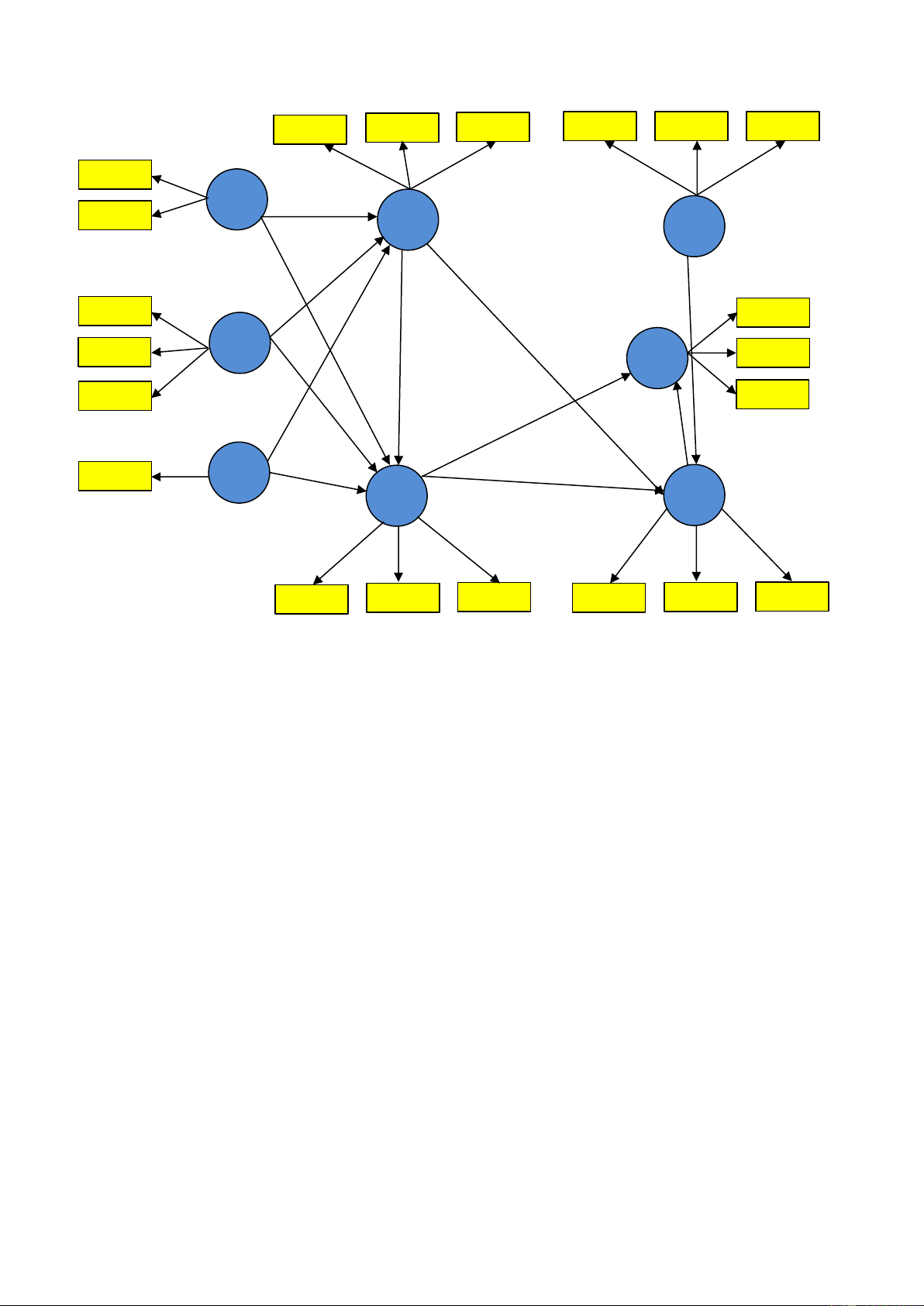
Mohammad Rakibul Islam Bhuiyan et al. / IJETT, 71(6), 274-288, 2023 Subjective Norm Self Efficacy Perceived Ease of Use Enjoy Attitude Perceived Usefullness Computer Anxiety Continuous Using Intension
Fig. 1 Conceptual framework 2.3. Methodology
2.3.1. Population Size
e-wallet adaptation to their responses to Self-Efficacy (SE),
For this research, online and offline surveys were
Enjoy (E), Computer Anxiety (CA), Perceived Ease of Use
conducted with university students of Bangladesh who
(PEOU). R. H. Holey suggested that carrying out path
directly and indirectly use e-wallet services like bKash,
modelling sample sizes ranging from 100-200 is good. For
mCash, Ucash, Upay, MyCash and etc., to complete their
this reason, researchers targeted to collect a minimum of
financial transactions. It is tough to determine the actual
250 data to ensure the quality and reliability of this
number of individuals, both directly and indirectly, using
research. This survey contains 29 questions, from which
e-wallet services in Bangladesh.
the first 5 questions are in Part A, and the remaining 24 are
in Part B. The questions were ranked as five point-Likert 2.3.2. Sampling Method
scales as 1 denotes strongly disagree while 5 denotes
This study is used as a quantitative approach where strongly agree.
sample respondents are from Bangladesh, some selected
public university students using e-wallets daily. Secondary 2.3.4. Data Analysis
data collection would also be required to conduct this
Collected data were analysed by using SPSS 25 and
research. Due to the researcher's job location, Dhaka and
Smart PLS 3.2.7. SPSS V.25. was used for descriptive
Rangpur districts would be prioritized for the investigation
statistics, and Structural Equation Modelling (SEM) was
and primary data collection. The University of Dhaka, and
carried out based on partial least squares (PLS).
Begum Rokeya University, Rangpur, would be easier for
the researcher to collect respondents because they have 3. Results
been involved in the above public universities in
3.1. Demographic Information Bangladesh.
Table 1.1 shows that 55.76% are male
respondents, and 44.24% are female. Among the
2.3.3. Sample Size, Questionnaire, and Data Collection
respondents, the age of the respondents 40.92% of
Total 347 data were collected from students at the
responses were collected from the age limit between
University of Dhaka, Begum Rokeya University, Rangpur,
18-20, 29.68% of responses were collected from ages
Bangladesh University, Daffodil International University,
21-23, and 29.4% were between 24-26. A total of 189
Dhaka University of Engineering and Technology, and
[54.47%] survey participants were from public
Jessore Science and Technology University via an online
universities, whereas 158 [45.53%] were from private
and offline questionnaire survey, measuring the factors of universities.
Table 1. Demographic information [Total N=347] Frequency [N] percentage [%] Male 190 55.76 Gender Female 156 44.24 18-20 142 40.92 Age 21-23 103 29.68 24-26 102 29.4 Public 189 54.47 University Private 158 45.53 278
Mohammad Rakibul Islam Bhuiyan et al. / IJETT, 71(6), 274-288, 2023
3.2. Characteristics of e-wallet Users
Cronbach's alpha and CR must be greater than 0.70. For
Here, Table 2 displays some features of e-wallet
assessing internal reliability, the calculated Cronbach's
customers. 89.63% of respondents generally used e-wallets
alpha and composite reliability values are presented in
by smartphone, 7.49% by computer, and just 2.88% by
Table 3. Excluding self-efficacy, other factors' values of
tablet PC. It showed that, as smartphones are available for
Cronbach's alpha range from 0.67 to 0.79 and the values of
the students, they feel comfortable using mobile phones to
composite reliability range from 0.76 to 0.88, except
use their e-wallets. Most responders, such as 34.01 or
computer anxiety, which is larger than recommended value
31.12, generally used one or two e-wallet apps for their
of 0.7. Thus, it is clear that most of the structures exhibit
transactions. 94 [31.12%] respondents stated that their
high levels of internal consistency.
monthly transaction was more than 5000, while only 70
[20.17%] were below 1000. About 109[35.73% of the user
3.5. Convergent Validity
used e-wallet from last more than 3 years ,78[22.48%]
It is measured by Convergent validity how much each
used from 3 years,73[21.04%] used from 2 years, while
item is positively correlated with other items in the same 72[20.75%] used from 1 years.
construct [102]. Fornell & Larcker [1981] suggested that
AVE values of 0.50 or higher are necessary to guarantee
3.3. Measurement Model
the convergent validity of the construct. AVE values in
Of the results, the constructs' reliability and validity
Table: 2 are above the recommended levels (except for
confirm the accuracy of any proposed measurement model.
computer anxiety). Both the indicator and the outer loading
For this purpose, testing of discriminate validity,
must be more than 0.708. However, if deleting the
convergent validity, and internal reliability is required for indication does not compromise the composite's
the measurement model [102]. So [103] suggested that
dependability, it can be disregarded as being between 0.4
validity and reliability must be tested before testing the
and 0.7. So, the study meets the criterion of convergent selected hypotheses. validity.
3.4. Internal Reliability
3.6. Discriminant Validity
For analysis, Cronbach's alpha and composite
Cross-loading and the square root of the average
reliability tests were done so that internal reliability could
variance extracted (AVE) are required to measure
be examined [104]. Accepted values of Cronbach's alpha
Discriminant validity [108]. Henseler et al. [2009] found
are more than 0.60 [105], and composite reliability's
that the correlation between AVE and other constructs
acceptance value is more than 0.70. If the values are above
should be lower than the square root of AVE. Table 4
the mentioned range, it is said to be satisfied for reliability
indicates that the correlation between AVE and other
[106]. In addition, Hair & Tatham [2006] stated that
constructs is lower than AVE's square root.
Table 2. Characteristics of e-wallet users [Total N=347] Characteristics Frequency [N] percentage [%] Smartphone 311 89.63
Device for Internet Usage Tablet PC 10 2.88 Computer 26 7.49 1 118 34.01 2 108 31.12
Number of e-wallet apps usage 3 72 20.75 More than 3 40 14.12 Below 1000 70 20.17 1000-3000 79 22.77
Monthly transaction [approx.] 3000-5000 90 25.94 More than 5000 94 31.12 1 year 72 20.75 2 years 73 21.04 Using e-wallet since 3 years 78 22.48 More than 3 years 109 35.73 279
Mohammad Rakibul Islam Bhuiyan et al. / IJETT, 71(6), 274-288, 2023
Table 3. Findings from measurement model Average Cron- Factor Composite Variance Variables Items bach's rho_A Loading Reliability Extracted Alpha [AVE] Attitude A1 e-wallet is good 0.85 A2 e-wallet is desirable 0.754 0.754 0.768 0.858 0.669 A3 e-wallet is pleasant 0.847 Computer Anxiety CA3
Using an e-wallet feels uncomfortable. 0.977 0.667 -2.766 0.54 0.368 Enjoy E1 The app is enjoyable to use. 0.851 E2
Using the app is more interesting 0.84 0.788 0.79 0.876 0.703 E3 Totally enjoy the e-wallet 0.823 Perceived Ease of Use PEOU1
The actions of the app are clear and understandable 0.754 PEOU2 Easier app to run 0.871 0.751 0.76 0.858 0.669 PEOU3
Easier to use to get required demands 0.823 Perceived Usefulness PU1
Using the app improves performance and productivity 0.802 PU2 Using an e-wallet saves time. 0.813 0.759 0.763 0.862 0.675 PU3
Using an e-wallet is useful in life. 0.849 Self-Efficiency SE1
I could use the app if nobody told me 0.797 SE2
I could use the app without using experience 0.695 0.511 0.528 0.753 0.506 SE3
I could use the app myself by seeing others. 0.634 Subjective Norms SN1
Influencing people's thoughts of my 0.764 SN2
My important people's thoughts on using this app. 0.852 0.725 0.737 0.844 0.644
Opinions of classmates/friends about using e-wallet has SN3 0.789 important to me. Continuance Intentions CI1
Use the e-wallet system regularly from now 0.855 CI2
Use the e-wallet frequently from now 0.824 0.755 0.76 0.86 0.672
Stalwartly commend others for to use CI3 0.778 e-wallet. 280
Mohammad Rakibul Islam Bhuiyan et al. / IJETT, 71(6), 274-288, 2023
Table 4. Outcomes of discriminate validity A CA CI E PEOU SE PU SN A 0.818 CA -0.144 0.606 CI 0.644 -0.108 0.82 E 0.568 -0.181 0.523 0.838 PEOU 0.698 -0.139 0.559 0.633 0.818 SE 0.682 -0.171 0.66 0.569 0.647 0.822 PU 0.47 -0.056 0.428 0.552 0.541 0.505 0.712 SN 0.621 -0.066 0.538 0.463 0.543 0.638 0.379 0.803
Note: A= Attitude; CA=Computer Anxiety; CI= Continuance Intentions; E= Enjoy; PEOU= Perceived Ease of Use; SE= Self-Efficiency; PU=
Perceived Usefulness; SN= Subjective Norms
Table 5. Path-coefficient and hypothesis test results Original Hypothe
Sample Mean Standard Deviation T Statistics Relationships Sample P Values Decision sis [M] [STDEV] [|O/STDEV|] [O]-Beta H1 SE-> PEOU 0.278 0.277 0.054 5.141 0 Accepted H2 SE-> PU 0.162 0.161 0.047 3.476 0.001 Accepted H3 E -> PEOU 0.473 0.472 0.059 7.979 0 Accepted H4 E -> PU 0.198 0.199 0.058 3.391 0.001 Accepted H5 CA -> PEOU -0.038 -0.03 0.058 0.656 0.512 Rejected H6 CA -> PU -0.067 -0.06 0.058 1.156 0.248 Rejected H7 PEOU -> PU 0.424 0.423 0.058 7.277 0 Accepted H8 PEOU -> A 0.39 0.391 0.053 7.389 0 Accepted H9 PU -> A 0.285 0.284 0.061 4.664 0 Accepted H10 PU -> CUI 0.412 0.413 0.06 6.914 0 Accepted H11 SN -> A 0.227 0.228 0.057 4 0 Accepted H12 A-> CUI 0.363 0.362 0.071 5.089 0 Accepted
[Here SE=Self-efficiency; PEOU=Perceived Ease Of Use; PU= Perceived Usefulness; E=Enjoy; CA=Computer Anxiety; A=Attitude; CUI=Continuous
Using Intention; SN=Subjective Norms]
3.7. Structural Model
variables, 60.8% of the change in attitude can be explained
The researcher tested the proposed hypothesis using
in three independent variables, and at last 50.6% of the
the structured equation model (SEM) [104]. Table 5
variance in attitude and perceived usefulness can be
represents coefficients, t-statistics, p-value, and decisions.
explained by using an e-wallet continuously.
Three external characteristics, such as Self-Efficiency,
Enjoy and Computer Anxiety, were tested. It is seen from 4. Discussion
the results that a positive relationship exists between Self-
Researchers applied extended TAM in this work to
Efficiency and Perceived Ease of Use, Self-Efficiency and
determine which factors continuously influence using e-
Perceived usefulness. Enjoy has also seemed to have a
wallets in Bangladesh. From this analysis, researchers
positive relationship with Perceived Ease of Use and
found that self-efficiency, Enjoy, Computer Anxiety,
Perceived Usefulness. But Computer Anxiety does not
Perceived Usefulness, Perceived Ease of Use, Subjective
negatively impact Perceived Ease of Use and Perceived
Norms and attitude influence e-wallet adoption. Most
Usefulness. While Perceived Usefulness and Attitude have
defined constructs and hypothesized relations are
seemed to have been influenced by Perceived Ease of Use.
supported by experiential results, which are unswerving
with the findings of prior revisions using TAM in e-wallet
This Perceived Usefulness positively affects Attitude implementation.
and Continuous Using intentions likewise. Besides,
Subjective Norms also have a positive relationship with
The study's findings denote a significant positive
attitude. Finally, this attitude encourages users to use this association between self-efficacy and Perceived
e-wallet regularly. Therefore, the proposed hypotheses, H1,
Usefulness, self-efficiency and Perceived Ease of Use [H1
H2, H3, H4, H7, H8, H9, H10, H11 and H12 were
& H2], supporting previous studies using any technology
supported. On the other hand, H5 & H6 were found to be
[110,111]. If the users are capable of using different latest
unsupported. The structural model explains that perceived
technologies, they will see the technology as comfortable
ease of use can be explained by 45.5% of the variation in
and more beneficial. Likewise, perceived enjoyment
three independent variables, perceived usefulness can be
positively influences Perceived Usefulness & Perceived
explained by 48% of the variation in four independent Ease of Use [H3 & H4]. 281
Mohammad Rakibul Islam Bhuiyan et al. / IJETT, 71(6), 274-288, 2023 PEOU(1) PEOU(2) PEOU(3) SN(1) SN(2) SN(3) 0.871 0.823 0.852 0.789 SE(1) 0.754 0.764 0.797 SE(2) 0.695 0.278 0.455 Self Efficiecy 0.473 Perceived Ease of Subjective Norms Use 0.227 E(1) CI(1) 0.855 0.851 0.162 0.424 0.840 0.390 0.824 E(2) -0.038 CI(2) 0.506 0.778 0.823 Enjoy E(3) CI(3) 0.412 Continuous Using 0.198 3 intentions 0.363 E(3) -0.067 0.480 0.285 0.608 Computer Anxiety Perceived Usefulness 0.8 Attitude 49 0.847 0.850 0.754 0.802 0.813 PU(1) PU(2) PU(3) A(1) A(2) A(3)
Fig. 2 Result of SmartPls
These results are the same as [111–114]. These
The connection between individual norms and
outcomes denote that the more perceived enjoyment occurs
perspectives has yet to receive much research. However,
while using new technology, the greater the acceptance,
Results from the analysis are consistent with[89] in
perceived ease of use, and perceived usefulness.
showing that subjective norms have a straight effect on
individuals' attitudes [H11]. Finally, the connotation
However, an insignificant association was found
between attitude and continuous use of e-wallets was
between computer anxiety and Perceived Usefulness [H5]
examined [H12], and a positive relationship was identified,
& Perceived Ease of Use [H6] which contrasts with the
consistent with previous information system research
results of previous studies [115–117]. The sample used in [89,124,125].
this study consisted entirely of some selected university
students, which explains why these findings hold true. That
4.1. Theoretical Implication
way, they can embrace new technologies without any
First, this study is a joint theoretical model of
apprehension and even get enthusiastic about them. The
university students' continuous intention to use an e-wallet.
research also shows that perceived ease of use is a
It builds on the TAM and TPB models and validates them
determinant of perceived usefulness [H7]. This outcome is
empirically at public and private universities. Second,
in concurrence with previous studies representing that ease
researchers incorporate TAM and TPB into the study
of use, such as simple navigation, enhances the experience
model and present a new conceptual framework (external
of users [118–120]. The easier technology must be
characteristics of e-wallets). Overall, the results lend considered useful.
credence to university students' plans to stick with
electronic wallets. Consequently, a new study model has
From the earlier research study, researchers found that
been formed thanks to this seminal contribution. At last,
perceived ease of use [H8] and perceived usefulness [H9]
the results can serve as a springboard for additional
both are sturdy forecasters of people's attitudes regarding a
research into e-wallet usage in developing countries,
new system [121,122]. The findings of this researcher
allowing for the accumulation of more complete and
found similarities with this statement. Besides, the
nuanced information on the topic.
researcher found a substantial affiliation between
continuance intention and perceived usefulness [H10].
4.2. Practical Implication
From the earlier study, it is seen that perceived usefulness
App creators and users alike will benefit from this
positively impacts user usage behaviour [123].
study's deeper comprehension of the elements influencing
college students' intention to continue using e-wallets. App 282
Mohammad Rakibul Islam Bhuiyan et al. / IJETT, 71(6), 274-288, 2023
developers must create electronic wallet apps with a
more accurate analysis. Individuals from diverse eras have
smaller memory footprint, increase the functionality of
diverse needs and want, so it may be difficult to grasp the
apps on a granular level, and improve the user experience. benefits of e-wallets.
In short, stockholders of e-wallet parties will benefit from considering this research.
Findings and other information from this study will
give a superior knowledge of the rule and provide 5. Conclusion
references to some app developers for improving the
Online payment methods using e-wallets are
services that are found as not perfect from the analysis.
increasingly popular. This work is anticipated to contribute
Furthermore, future researchers can remove unessential
to financial technology (Fintech), particularly e-wallets.
factors. Diverse elements can be taken into account by
Therefore, in the future, this study might be used as a
future researchers in different periods when going for
model for additional e-wallet or mobile payment studies. related research.
Regarding the constant aim, this study may provide some
important information for businesses that process Conflicts of Interest
electronic payments. Financial Technology companies are
Research is conducted with university students who
widely expanding into smartphones for banking activities,
have used electronic wallets. All of the authors have not
share market, shopping, payments, and budgeting. The
found any grants or sponsors from any organizations.
importance of the findings was then discussed, along with
There is a confidential participation issue for collecting
ideas for supplementary study. This research has
primary and secondary information. The authors do not
limitations and focuses on some particular university
have any conflicts of interest.
(public and private) students in Bangladesh. Further Acknowledgements
research should broaden the scope of the research model
The authors are thankful to Dr. Abu Reza Md.
applied in this study to gain in-depth knowledge of the
Towfiqul Islam, Associate Professor, Department of
factors influencing e-wallet adoption.
Geography and Environmental Science, Begum Rokeya
5.1. Limitations and Further Scope of the Research University, Rangpur, Bangladesh, provided proper
This study has a few limitations, such as only being
guidelines in this research. All authors are contributing
centered on some particular university students. Future equally.
researchers have the opportunity to work with big data for References [1]
Hairong Li, and John D. Leckenby, “Examining the Effectiveness of Internet Advertising Formats,” Internet Advertising: Theory
and Research, 2007. [Google Scholar] [2]
Ion Micu, and Alexandra Micu, “Financial Technology [Fintech] and Its Implementation on the Romanian Non-Banking Capital
Market,” SEA - Practical Application of Science, no. 11, pp. 379–384, 2016. [Google Scholar] [Publisher Link] [3]
W. Scott Frame, and Lawrence J. White, “Technological Change, Financial Innovation, and Diffusion in Banking,” SSRN, 2014. [Publisher Link] [4]
Zavolokina L, Dolata M, Schwabe G. FinTech – What’s in a Name? In: Zavolokina, Liudmila; Dolata, Mateusz; Schwabe,
Gerhard [2016] FinTech – What’s in a Name? In: Thirty Seventh International Conference on Information Systems, Dublin,
Ireland, 11 December 2016 - 14 December 2016, s.n. [Internet]. Dublin, Ireland: s.n.; 2016 [cited 2023 Jan 30]. Available from:
https://www.zora.uzh.ch/id/eprint/126806/ [5]
Hyun-Sun Ryu, “What Makes Users Willing or Hesitant to use Fintech?: The Moderating Effect of User Type,” Industrial
Management & Data Systems, vol. 118, no. 3, pp. 541-569, 2018. [CrossRef] [Google Scholar] [Publisher Link] [6]
Sushil Punwatkar, and Manoj Verghese, “Adaptation of e-Wallet Payment: An Empirical Study on Consumers’ Adoption
Behavior in Central India,” International Journal of Advanced in Management, Technology and Engineering Sciences, vol. 8, no.
3, pp. 1147–1156, 2018. [Google Scholar] [Publisher Link] [7]
Salah Uddin M, and Yesmin Akhi A., “E-Wallet System for Bangladesh an Electronic Payment System,” IJMO, vol. 4, no. 3, pp. 216–219, 2014. [8]
Ngoc Doan, “Consumer Adoption in Mobile Wallet: A Study of Consumers in Finlad,” Theseus, 2014. [Google Scholar] [Publisher Link] [9]
Hem Shweta Rathore, “Adoption of Digital Wallet by Consumers,” BVIMSR’s Journal of Management Research, vol. 8, no. 1,
2016. [Google Scholar] [Publisher Link] [10]
The Ninh Nguyen et al., “Predicting Consumer Intention to Use Mobile Payment Services: Empirical Evidence from Vietnam,”
International Journal of Marketing Studies, vol. 8, no. 1, pp. 117-124, 2016. [Google Scholar] [Publisher Link] [11]
R.I. Azad, Bangladesh MFS Market to Gain Momentum in 2019, Experts Say, The Independent, 2019. [Google Scholar] [12]
Md Fazlur Rahman, The Future of Mobile Financial Services in Bangladesh, The Daily Star, 2021. [Online]. Available:
https://www.thedailystar.net/supplements/mobile-financial-services/news/the-future-mobile-financial-services-bangladesh- 2028885 [13]
Bangladesh Bank. Annual Financial Report 2019-2020. [Online]. Available: 283
Mohammad Rakibul Islam Bhuiyan et al. / IJETT, 71(6), 274-288, 2023
https://www.bb.org.bd/pub/annual/anreport/ar1920/index1920.php [14]
M.R. Siddiquie, “Scopes and Threats of Mobile Financial services in Bangladesh,” IOSR Journal of Economics and Finance, vol.
4, no. 4, pp. 36–39, 2014. [Google Scholar] [15]
S. Manikandan, and J. Mary Jayakodi, “An Emprical Study on Consumers Adoption of Mobile Wallet with Special Reference to
Chennai City,” International Journal of Research – Granthaalayah, vol. 5, no. 5, pp. 107–115, 2017. [CrossRef] [Google Scholar] [Publisher Link] [16]
Atiqur Rahman, Mohammad Nayeem Abdullah, and Rahat Bari Tooheen, “Mobile Money in Bangladesh,” Developing Country
Studies, vol. 2, no. 8, 2012. [Google Scholar] [Publisher Link] [17]
Faisal Nizam, Ha Jin Hwang, and Naser Valaei, ‘Measuring the Effectiveness of E-Wallet in Malaysia,” Big Data, Cloud
Computing, Data Science & Engineering, pp. 59-69, 2018. [CrossRef] [Google Scholar] [Publisher Link] [18]
Nidhi Singh, Neena Sinha, and Francisco J. Liébana-Cabanillas, “Determining Factors in the Adoption and Recommendation of
Mobile Wallet Services in India: Analysis of the Effect of Innovativeness, Stress to Use and Social Influence,” International
Journal of Information Management, vol. 50, pp. 191–205, 2020. [CrossRef] [Google Scholar] [Publisher Link] [19]
Md Wasiul Karim, Mohammad Abdul Matin Chowdhury, and A K M Ahasanul Haque, “A Study of Customer Satisfaction
Towards E-Wallet Payment System in Bangladesh,” American Journal of Economics and Business Innovation, vol. 1, no. 1, pp.
1–10, 2022. [CrossRef] [Google Scholar] [Publisher Link] [20]
Fred D. Davis, “Perceived Usefulness, Perceived Ease of Use, and User Acceptance of Information Technology,” MIS Quarterly,
vol. 13, no. 3, pp. 319-340, 1989. [CrossRef] [Google Scholar] [Publisher Link] [21]
Samson Yusuf Dauda, and Jongsu Lee, “Technology Adoption: A Conjoint Analysis of Consumers ׳ Preference on Future Online
Banking Services,” Information Systems, vol. 53, pp. 1–15, 2015. [CrossRef] [Google Scholar] [Publisher Link] [22]
Rana A. Saeed Al-Maroof, and Mostafa Al-Emran, “Students Acceptance of Google Classroom: An Exploratory Study using
PLS-SEM Approach,” International Journal of Emerging Technologies in Learning, vol. 13, no. 6, 2018. [Google Scholar] [Publisher Link] [23]
Ronnie Cheung, and Doug Vogel, “Predicting user Acceptance of Collaborative Technologies: An Extension of the Technology
Acceptance Model for e-learning,” Computers & Education, vol. 63, pp. 160–175, 2013. [CrossRef] [Google Scholar] [Publisher Link] [24]
Moussa Barry, and Muhammad Tahir Jan, “Factors Influencing the Use of M-Commerce: An Extended Technology Acceptance
Model Perspective,” International Journal of Economics, Management and Accounting, vol. 26, no. 1, pp. 157–183, 2018.
[Google Scholar] [Publisher Link] [25]
Alexander Muk, and Christina Chung, “Applying the Technology Acceptance Model in a Two-country study of SMS
Advertising,” Journal of Business Research, vol. 68, no. 1, pp. 1–6, 2015. [CrossRef] [Google Scholar] [Publisher Link] [26]
Patrick Y.K. Chau, and Paul Jen-Hwa Hu, “Investigating Health Care Professionals Decisions to Accept Telemedicine
Technology: An Empirical Test of Competing Theories,” Information and Management, vol. 39, no. 4, pp. 297-311, 2002.
[CrossRef] [Google Scholar] [Publisher Link] [27]
Kwasi Amoako-Gyampah, and A.F. Salam, “An Extension of the Technology Acceptance Model in an ERP Implementation
Environment,” Information and Management, vol. 41, no. 6, pp. 731–745, 2004. [CrossRef] [Google Scholar] [Publisher Link] [28]
Regaieg Essafi Raida, and Bouslama Néji, “The Adoption of the E-Banking: Validation of the Technology Acceptance Model,”
Technology and Investment, 2013. [CrossRef] [Google Scholar] [Publisher Link] [29]
Eugenia Huang, “The Acceptance of Women-centric Websites,” Journal of Computer Information Systems, vol. 45, no. 4, pp.
75–83, 2005. [Google Scholar] [Publisher Link] [30]
I. Ajzen, and M. Fishbein, Understanding Attitudes and Predicting Social Behavior, Prentice-Hall, Englewood Cliffs, 1980. [31]
M. Fishbein, and I. Ajzen, Belief, Attitude, Intention, and Behavior: An Introduction to Theory and Research. Reading, MA: Addison-Wesley, 1975. [32]
Viswanath Venkatesh et al., “User Acceptance of Information Technology: Toward a Unified View,” MIS Quarterly, vol. 27, no.
3, pp. 425-478, 2003. [CrossRef] [Google Scholar] [Publisher Link] [33]
Icek Ajzen, “The Theory of Planned Behavior,” Organizational Behavior and Human Decision Processes, vol. 50, no. 2, pp.
179–211, 1991. [CrossRef] [Google Scholar] [Publisher Link] [34]
Lutz Sommer, “The Theory of Planned Behaviour and the Impact of Past Behavior,” International Business & Economics
Research Journal, vol. 10, no. 1, 2011. [CrossRef] [Google Scholar] [Publisher Link] [35]
Ali Balapour et al., “Mobile Technology Identity and Self-efficacy: Implications for the Adoption of Clinically Supported Mobile
Health Apps,” International Journal of Information Management, vol. 49, pp. 58–68, 2019. [CrossRef] [Google Scholar] [Publisher Link] [36]
Pushp Patil et al., “Understanding Consumer Adoption of Mobile Payment in India: Extending Meta-UTAUT Model with
Personal Innovativeness, Anxiety, Trust, and Grievance Redressal,” International Journal of Information Management, vol. 54,
p. 102144, 2020. [CrossRef] [Google Scholar] [Publisher Link] [37]
Pok´emon Go Outpaces Clash Royale as the Fastest Game Ever to No. 1 on the Mobile Revenue Charts, 2016. [Online]. Available:
https://venturebeat.com/games/pokemon-go-outpaces-clash-royale-as-the-fastest-game-ever-to-no-1-on-the-mobile- revenue-charts/ 284
Mohammad Rakibul Islam Bhuiyan et al. / IJETT, 71(6), 274-288, 2023 [38]
Masoor Iqbal, Pok´emon GO Revenue and Usage Statistics, 2023. [Online]. Available:
https://www.businessofapps.com/data/pokemon-go-statistics/ [39]
Anol Bhattacherjee, “Understanding Information Systems Continuance: An Expectation-Confirmation Model,” MIS Quarterly,
vol. 25, no. 3, pp. 351-370, 2001. [CrossRef] [Google Scholar] [Publisher Link] [40]
Donald Amoroso, and Ricardo Lim, “The Mediating Effects of Habit on Continuance Intention,” International Journal of
Information Management, vol. 37, vol. 6, pp. 693–702, 2017. [CrossRef] [Google Scholar] [Publisher Link] [41]
Peng Cheng, Zhe OuYang, and Yang Liu, “Understanding Bike Sharing use Over Time by Employing Extended Technology
Continuance Theory,” Transportation Research Part A: Policy and Practice, vol. 124, pp. 433–443, 2019. [CrossRef] [Google Scholar] [Publisher Link] [42]
Gokhan Dağhan, and Buket Akkoyunlu, “Modeling the Continuance usage Intention of Online Learning Environments,”
Computers in Human Behavior, vol. 60, pp. 198–211, 2016. [CrossRef] [Google Scholar] [Publisher Link] [43]
Christy M.K Cheung, Xiabing Zheng, and Matthew K O LEE, “How the Conscious and Automatic Information Processing
Modes Influence Consumers’ Continuance Decision in an e-Commerce WebsiteHow the Conscious and Automatic Information
Processing Modes Influence Consumers’ Continuance Decision in an e-Commerce Website,” Pacific Asia Journal of the
Association for Information Systems, vol. 7, no. 2, 2015. [CrossRef] [Google Scholar] [Publisher Link] [44]
Yichuan Wang, Yousra Asaad, and Raffaele Filieri, “What Makes Hosts Trust Airbnb? Antecedents of Hosts’ Trust toward
Airbnb and Its Impact on Continuance Intention,” Journal of Travel Research, vol. 59, no. 4, pp. 686–703, 2019. [CrossRef]
[Google Scholar] [Publisher Link] [45]
Wasim Ahmad, and Jin Sun, “Antecedents of SMMA Continuance Intention in Two Culturally Diverse Countries: An Empirical
Examination,” Journal of Global Information Technology Management, vol. 21, no. 1, pp. 45–68, 2018. [CrossRef] [Google Scholar] [Publisher Link] [46]
Shuchih Ernest Chang, Anne Yenching Liu, and Wei Cheng Shen, “User Trust in Social Networking Services: A Comparison of
Facebook and LinkedIn,” Computers in Human Behavior, vol. 69, pp. 207–217, 2017. [CrossRef] [Google Scholar] [Publisher Link] [47]
Zhibin Lin, and Raffaele Filieri, “Airline Passengers’ Continuance Intention towards Online check-in Services: The Role of
Personal Innovativeness and Subjective Knowledge,” Transportation Research Part E Logistics and Transportation Review, vol.
81, pp. 158-168, 2015. [CrossRef] [Google Scholar] [Publisher Link] [48]
Sun Quan, Cao Hao, and You Jianxin, “Factors Influencing the Adoption of Mobile Service in China: An Integration of TAM,”
Journal of Computers, vol. 5, no. 5, pp. 799–806, 2010. [CrossRef] [Google Scholar] [Publisher Links] [49]
Herbjorn Nysveen, Per E. Pedersen, Helge Thorbjernsen, “Intentions to Use Mobile Services: Antecedents and Cross-Service
Comparisons,” Journal of the Academy of Marketing Science, vol. 33, no. 3, pp. 330–346, 2005. [CrossRef] [Google Scholar] [Publisher Link] [50]
Albert Bandura, and Dale H. Schunk, “Cultivating Competence, Self-efficacy, and Intrinsic Interest through Proximal Self-
motivation,” Journal of Personality and Social Psychology, vol. 41, no. 3, pp. 586-598, 1981. [CrossRef] [Google Scholar] [Publisher Link] [51]
Bandura A. Social Foundations of Thought and Action: A Social Cognitive Theory. Englewood Cliffs, NJ, US: Prentice-Hall,
Inc; 1986. Xiii, 617 P. [Social Foundations of Thought and Action: A Social Cognitive Theory]. [52]
Sindhu Singh, and R.K. Srivastava, “Predicting the Intention to use Mobile Banking in India,” International Journal of Bank
Marketing, vol. 36, no. 2, pp. 357–378, 2018. [CrossRef] [Google Scholar] [Publisher Link] [53]
Bong Keun Jeong, and Tom E. Yoon, “An Empirical Investigation on Consumer Acceptance of Mobile Banking Services,”
Business and Management Research, vol. 2, no. 1, pp. 31-40, 2013. [Google Scholar] [Publisher Link] [54]
Pin Luarn, and Hsin-Hui Lin, “Toward an Understanding of the Behavioral Intention to use Mobile Banking,” Computers in
Human Behavior, vol. 21, no. 6, pp. 873–891, 2005. [CrossRef] [Google Scholar] [Publisher Link] [55]
Sandra Madorin, and Carroll Iwasiw, “The Effects of Computer-assisted Instruction on the Self-efficacy of Baccalaureate
Nursing Students,” Journal of Nursing Education, vol. 38, no. 6, pp. 282-285, 1999. [CrossRef] [Google Scholar] [Publisher Link] [56]
Jiraporn Sripalawat, Mathupayas Thongmak, and Atcharawan Ngramyarn, “M-Banking in Metropolitan Bangkok and a
Comparison with other Countries,” Journal of Computer Information Systems, vol. 51, no. 3, pp. 67–76, 2011. [Google Scholar] [Publisher Link] [57]
Pratibha A. Dabholkar, and Richard P. Bagozzi, “An Attitudinal Model of Technology-based Self-service: Moderating Effects of
Consumer Traits and Situational Factors,” Journal of the Academy of Marketing Science, vol. 30, pp. 184-201, 2002. [CrossRef]
[Google Scholar] [Publisher Link] [58]
Michael Reid, and Yair Levy, “Integrating Trust and Computer Self-Efficacy with TAM: An Empirical Assessment of
Customers’ Acceptance of Banking Information Systems [BIS] in Jamaica,” Journal of Internet Banking and Commerce, 2008.
[Google Scholar] [Publisher Link] [59]
Viswanath Venkatesh, and Hillol Bala, “Technology Acceptance Model 3 and a Research Agenda on Interventions,” Decision
Sciences, vol. 39, no. 2, pp. 273-315, 2008. [CrossRef] [Google Scholar] [Publisher Link] 285
Mohammad Rakibul Islam Bhuiyan et al. / IJETT, 71(6), 274-288, 2023 [60]
Dina H. Bassiouni, Chris Hackley, and Hakim Meshreki, “The Integration of Video Games in Family-life Dynamics: An
Adapted Technology Acceptance Model of Family Intention to Consume Video Games,” Information Technology & People, vol.
32, no. 6, pp. 1376-1396, 2019. [CrossRef] [Google Scholar] [Publisher Link] [61]
Toñita Perea y Monsuwé, Benedict G.C. Dellaert, and Ko de Ruyter, “What drives Consumers to shop Online? A Literature
Review,” International Journal of Service Industry Management, vol. 15, no. 1, pp. 102–121, 2004. [CrossRef] [Google Scholar] [Publisher Link] [62]
Mun Y Yi, and Yujong Hwang, “Predicting the Use of Web-based Information Systems: Self-efficacy, Enjoyment, Learning
Goal Orientation, and the Technology Acceptance Model,” International Journal of Human-Computer Studies Commerce, vol.
59, no. 4, pp. 431–449, 2003. [CrossRef] [Google Scholar] [Publisher Link] [63]
Pradeepkumar Chokkannan, and Vivekanandan Kaniappan, “Role of IT Mindfulness on Continuance Intention of Mobile
Payment System,” SSRG International Journal of Economics and Management Studies, vol. 7, no. 7, pp. 30-39, 2020. [CrossRef] [Publisher Link] [64]
Beeman N. Phillips, Roy P. Martin, and Joel Myers, “Interventions in Relation to Anxiety in School,” Anxiety Academic Press,
pp. 409–468, 1972. [Google Scholar] [65]
Viswanath Venkatesh, and Fred D. Davis, “A Theoretical Extension of the Technology Acceptance Model: Four Longitudinal
Field Studies,” Management Science, vol. 46, no. 2, pp. 169-332, 2000. [CrossRef] [Google Scholar] [Publisher Link] [66]
Ulun Akturan, and Nuray Tezcan, “Mobile Banking Adoption of the Youth Market: Perceptions and Intentions,” Marketing
Intelligence & Planning, vol. 30, no. 4, pp. 444–459, 2012. [CrossRef] [Google Scholar] [Publisher Link] [67]
Tomasz Stanislaw Szopiński, “Factors Affecting the Adoption of Online Banking in Poland,” Journal of Business Research, vol.
69, no. 11, pp. 4763–4768, 2016. [CrossRef] [Google Scholar] [Publisher Link] [68]
Aron O’Cass, and Tino Fenech, “Web Retailing Adoption: Exploring the Nature of Internet Users Web Retailing Behaviour,”
Journal of Retailing and Consumer Services, vol. 10, no. 2, pp. 81–94, 2003. [CrossRef] [Google Scholar] [Publisher Link] [69]
Ji-Woon Moon, and Young-Gul Kim, “Extending the TAM for a World-Wide-Web Context,” Information & Management, vol.
38, no. 4, 217–230, 2001. [CrossRef] [Google Scholar] [Publisher Link] [70]
Viswanath Venkatesh, and Michael G. Morris, “Why Don’t Men Ever Stop to Ask for Directions? Gender, Social Influence, and
Their Role in Technology Acceptance and Usage Behavior,” MIS Quarterly, vol. 24, no. 1, pp. 115–139, 2000. [CrossRef]
[Google Scholar] [Publisher Link] [71]
Barbara H. Wixom, and Peter A. Todd, “A Theoretical Integration of User Satisfaction and Technology Acceptance,”
Information Systems Research, vol. 16, no. 1, pp. 1-106, 2005. [CrossRef] [Google Scholar] [Publisher Link] [72]
A.M. Aladwani, “The Development of Two Tools for Measuring the Easiness and Usefulness of Transactional Web Sites,”
European Journal of Information Systems, vol. 11, no. 3, pp. 223–234, 2002. [CrossRef] [Google Scholar] [Publisher Link] [73]
Shih-Jung Hsiao, and Hsiao-Ting Tseng, “The Impact of the Moderating Effect of Psychological Health Status on Nurse
Healthcare Management Information System Usage Intention,” Healthcare, vol. 8, no. 1, p. 28, 2020. [CrossRef] [Google Scholar] [Publisher Link] [74]
Md Wasiul Karim, Mohammad Arije Ulfy, and Md Nazmul Huda, “Determining Intention to Use Smartphone Banking
Application among Millennial Cohort in Malaysia,” International Journal of Management and Sustainability, vol. 9, no. 1, pp.
43–53, 2020. [CrossRef] [Google Scholar] [Publisher Link] [75]
Jeongeun Kim, and Hyeoun-Ae Park, “Development of a Health Information Technology Acceptance Model Using Consumers’
Health Behavior Intention,” Journal of Medical Internet Research, vol. 14, no. 5, p. e133, 2012. [CrossRef] [Google Scholar] [Publisher Link] [76]
Fred D. Davis, Richard P. Bagozzi, and Paul R. Warshaw, “User Acceptance of Computer Technology: A Comparison of Two
Theoretical Models,” Management Science, vol. 35, no. 8, pp. 903-1028, 1989. [CrossRef] [Google Scholar] [Publisher Link] [77]
Magid Igabria, Gordon B. Davis, and Tor Guimaras, “Testing the Determinants of Microcomputer Usage via Structural
Equation,” Journal of Management Information System, vol. 11, no. 4, pp. 87-114, 1995. [CrossRef] [Google Scholar] [Publisher Link] [78]
Naresh K. Malhotra, and J. Daniel McCort, “A Cross-cultural Comparison of Behavioral Intention Models Theoretical
Consideration and an Empirical Investigation,” International Marketing Review, vol. 18, no. 3, pp. 235–269, 2001. [CrossRef]
[Google Scholar] [Publisher Link] [79]
Hernan E. Riquelme, and Rosa E. Rios, “The Moderating Effect of Gender in the Adoption of Mobile Banking,” International
Journal of Bank Marketing, vol. 28, no. 5, pp. 328–341, 2010. [CrossRef] [Google Scholar] [Publisher Link] [80]
Thomas Hill, Nancy D. Smith, and Millard F. Mann, “Role of Efficacy Expectations in Predicting the Decision to use Advanced
Technologies: The Case of Computers,” Journal of Applied Psychology, vol. 72, no. 2, pp. 307–313, 1987. [CrossRef] [Google Scholar] [Publisher Link] [81]
Matthew L. Meuter et al., “Self-Service Technologies: Understanding Customer Satisfaction with Technology-Based Service
Encounters,” Journal of Marketing, vol. 64, no. 3, pp. 50–64, 2000. [CrossRef] [Google Scholar] [Publisher Link] [82]
Constance Elise Porter, and Naveen Donthu, “Using the Technology Acceptance Model to Explain how Attitudes Determine
Internet Usage: The Role of Perceived Access Barriers and Demographics,” Journal of Business Research, vol. 59, no. 9, pp.
999–1007, 2006. [CrossRef] [Google Scholar] [Publisher Link] 286
Mohammad Rakibul Islam Bhuiyan et al. / IJETT, 71(6), 274-288, 2023 [83]
Ahmed Barakat, and Khaled Hussainey, “Bank Governance, Regulation, Supervision, and Risk Reporting: Evidence from
Operational Risk Disclosures in European Banks,” International Review of Financial Analysis, vol. 30, pp. 254–273, 2013.
[CrossRef] [Google Scholar] [Publisher Link] [84]
Artie W. Ng, and Benny K.B. Kwok, “Emergence of Fintech and Cybersecurity in a Global Financial Centre: Strategic Approach
by a Regulator,” Journal of Financial Regulation and Compliance, vol. 25, no. 4, pp. 422–434, 2017. [CrossRef] [Google Scholar] [Publisher Link] [85]
Janet Fulk, “Social Construction of Communication Technology,” Academy of Management Journal, vol. 36, no. 5, 2017.
[CrossRef] [Google Scholar] [Publisher Link] [86]
Ming-Chi Lee, “Explaining and Predicting users’ Continuance Intention Toward e-learning: An Extension of the Expectation-
Confirmation Model,” Computers & Education, vol. 54, no. 2, pp. 506–516, 2010. [CrossRef] [Google Scholar] [Publisher Link] [87]
Hyun-Sun Seo, Soo-Kyung Lee, and Soyoung Nam, “Factors Influencing Fast Food Consumption Behaviors of Middle-school
Students in Seoul: An Application of Theory of Planned Behaviors,” Nutrition Research and Practice, vol. 5, no. 2, pp. 169–178,
2011. [CrossRef] [Google Scholar] [Publisher Link] [88]
Yi Jin Lim, Selvan Perumal, and Norzieiriani Ahmad, “Social Cognitive Theory in Understanding Green Car Purchase
Intention,” SSRG International Journal of Economics and Management Studies, vol. 6, no. 4, pp. 16-24, 2019. [CrossRef]
[Google Scholar] [Publisher Link] [89]
Qian Xu et al., “Factors Affecting Medical Students’ Continuance Intention to Use Mobile Health Applications,” Journal of
Multidisciplinary Healthcare, vol. 15, pp. 471–484, 2022. [Google Scholar] [Publisher Link] [90]
Hee Sun Park, “Relationships among Attitudes and Subjective Norms: Testing the Theory of Reasoned Action across Cultures,”
Communication Studies, vol. 51, no. 2, pp. 162–175, 2000. [CrossRef] [Google Scholar] [Publisher Link] [91]
Richard P. Bagozzi, “A Field Investigation of Causal Relations among Cognitions, Affect, Intentions, and Behavior,” Journal of
Marketing Research, vol. 19, no. 4, pp. 562-584, 1982. [CrossRef] [Google Scholar] [Publisher Link] [92]
E.M. Rogers, Diffusion of Innovations, Free Press, 1995. [93]
L. Michelle Bobbitt, and Pratibha A. Dabholkar, “Integrating Attitudinal Theories to Understand and Predict use of Technology‐
based Self‐service: The Internet as an Illustration,” International Journal of Service Industry Management, vol. 12, no. 5, pp.
423-450, 2001. [CrossRef] [Google Scholar] [Publisher Link] [94]
Mark T. Dishaw, and Diane M. Strong, “Extending the Technology Acceptance Model with Task-Technology Fit Constructs,”
Information and Management, vol. 36, no. 1, pp. 9-21, 1999. [CrossRef] [Google Scholar] [Publisher Link] [95]
Viswanath Venkatesh, and Fred D. Davis, “A Model of the Antecedents of Perceived Ease of Use: Development and Test,”
Decision Sciences, vol. 27, no. 3, pp. 451–481, 1996. [CrossRef] [Google Scholar] [Publisher Link] [96]
Xitong Guo et al., “Exploring Patients’ Intentions for Continuous Usage of mHealth Services: Elaboration-Likelihood
Perspective Study,” JMIR Mhealth Uhealth, vol. 8, no. 4, p. e17258, 2020. [CrossRef] [Google Scholar] [Publisher Link] [97]
Mohamed Gamal Aboelmaged, and Tarek R. Gebba, “Mobile Banking Adoption: An Examination of Technology Acceptance
Model and Theory of Planned Behavior,” International Journal of Business Research and Development, vol. 2, no. 1, pp. 35-50,
2013. [Google Scholar] [Publisher Link] [98]
Aijaz A. Shaikh, and Heikki Karjaluoto, “Mobile Banking Adoption: A Literature Review,” Telematics and Informatics, vol. 32,
no. 1, pp. 129–142, 2015. [CrossRef] [Google Scholar] [Publisher Link] [99]
Mario Martínez Guerrero, José Manuel Ortega Egea, and María Victoria Román González, “Application of the Latent Class
Regression Methodology to the Analysis of Internet use for Banking Transactions in the European Union,” Journal of Business
Research, vol. 60, no. 2, pp. 137–145, 2007. [CrossRef] [Google Scholar] [Publisher Link]
[100] Shirley Taylor, and Peter A. Todd, “Understanding Information Technology Usage: A Test of Competing Models,” Information
Systems Research, vol. 6, no. 2, pp. 85-188, 1995. [CrossRef] [Google Scholar] [Publisher Link]
[101] Lim Bee Lee, Factors Influencing Email Usage: Applying the Utaut Model, 2005. [Google Scholar] [Publisher Link]
[102] J.F. Hair et al., A Primer on Partial Least Squares Structural Equation Modeling [PLS-SEM], California: SAGE, 2014.
[103] Richard P. Bagozzi, Youjae Yi, and Surrendra Singh, “On the use of Structural Equation Models in Experimental Designs: Two
Extensions,” International Journal of Research in Marketing, vol. 8, no. 2, pp. 125–140, 1991. [CrossRef] [Google Scholar] [Publisher Link]
[104] Claes Fornell, and David F. Larcker, “Structural Equation Models with Unobservable Variables and Measurement Error: Algebra
and Statistics,” Journal of Marketing Research, vol. 18, no. 3, pp. 382-388, 1981. [CrossRef] [Google Scholar] [Publisher Link]
[105] J.C. Nunnally, and I.H. Bernstein, “The Assessment of Reliability,” Psychometric Theory, vol. 3, pp. 248-292, 1994.
[106] J.F. Hair et al., Multivariate Data Analysis, Upper Saddle River, NJ: Prentice Hall, 1998.
[107] J. Hair, and R. Tatham, Multivariate Data Analysis, Upper Saddle River, NJ: Pearson Prentice Hall, vol. 6, 2006.
[108] R. Thompson, D. Barclay, and C.A. Higgins, “The Partial Least Squares Approach to Causal Modeling: Personal Computer
Adoption and Use as an Illustration,” Technology Studies: Special Issues on Research Methodology, vol. 2, pp. 284-324, 1995.
[109] Jorg Henseler, Christian M. Ringle, and Rudolf Sinkovics, “The Use of Partial Least Squares Path Modeling in International
Marketing, New Challenges to International Marketing, vol. 20, pp. 277-319, 2009. [CrossRef] [Google Scholar] [Publisher Link] 287
Mohammad Rakibul Islam Bhuiyan et al. / IJETT, 71(6), 274-288, 2023
[110] Osly Usman M. Bus et al., “The Effect of Computer Self-Efficacy and Subjective Norm on the Perceived Usefulness, Perceived
Ease of Use and Behavioural Intention to Use Technology,” Journal of Southeast Asian Research, 2020. [CrossRef] [Google Scholar] [Publisher Link]
[111] Mun Y. Yi, and Yujong Hwang, “Predicting the use of Web-based Information Systems: Self-efficacy, Enjoyment, Learning
Goal Orientation, and The Technology Acceptance Model,” International Journal of Human-Computer Studies, vol. 59, no. 4,
pp. 431–449, 2003. [CrossRef] [Google Scholar] [Publisher Link]
[112] Ritu Agarwal, Elena Karahanna, “Time Flies When you’re having Fun: Cognitive Absorption and Beliefs about Information
Technology Usage,” MIS Quarterly, vol. 24, no. 4, pp. 665–694, 2000. [CrossRef] [Google Scholar] [Publisher Link]
[113] Anh Tho To, Thi Hong Minh Trinh, and Carlos Gomez Corona, “Understanding Behavioral Intention to use Mobile Wallets in
Vietnam: Extending the Tam model with Trust and Enjoyment,” Cogent Business & Management, vol. 8, no. 1, 2021. [CrossRef]
[Google Scholar] [Publisher Link]
[114] Hans Van Der Heijden, “User Acceptance of Hedonic Information Systems,” MIS Quarterly, vol. 28, no. 4, pp. 695–704, 2004.
[CrossRef] [Google Scholar] [Publisher Link]
[115] Aygul Dönmez-Turan, and Merye Kır, “User Anxiety as an External Variable of Technology Acceptance Model: A Meta-
analytic Study,” Procedia Computer Science, vol. 158, pp. 715-724, 2019. [CrossRef] [Google Scholar] [Publisher Link]
[116] Oded Nov, Chen Ye, “Resistance to Change and the Adoption of Digital Libraries: An Integrative Model,” Journal of the
American Society for Information Science & Technology, vol. 60, no. 8, pp. 1702-1708, 2009. [CrossRef] [Google Scholar] [Publisher Link]
[117] Y. Sun, “The Dark Side of Elderly Acceptance of Mobile Health Services: The Role of Technology Anxiety and Resistance to
Change,” Electronic Markets, vol. 23, pp. 49-61, 2013.
[118] Fandy Gunawan, Mochammad Mukti Ali, and Arissetyanto Nugroho, “Analysis of the Effects of Perceived Ease of Use and
Perceived Usefulness on Consumer Attitude and Their Impacts on Purchase Decision on PT Tokopedia in Jabodetabek,”
European Journal of Business and Management Research, vol. 4, no. 5, 2019. [CrossRef] [Google Scholar] [Publisher Link]
[119] Yoon Jin Ma, Hae Jin Gam, and Jennifer Banning, “Perceived Ease of Use and Usefulness of Sustainability Labels on Apparel
Products: Application of the Technology Acceptance Model,” Fashion and Textiles, vol. 4, no. 3, 2017. [CrossRef] [Google Scholar] [Publisher Link]
[120] R. Rauniar et al., “Technology Acceptance Model [TAM] and Social Media Usage: An Empirical Study on Facebook,” Journal
of Enterprise Information Management, vol. 27, no. 1, pp. 6-30, 2014. [CrossRef] [Google Scholar] [Publisher Link]
[121] Patricio E. Ramírez-Correa, Jorge Arenas-Gaitán, and F. Javier Rondán-Cataluña, “Gender and Acceptance of E-Learning: A
Multi-Group Analysis Based on a Structural Equation Model among College Students in Chile and Spain,” PLOS ONE, vol. 10,
no. 10, p. e0140460, 2015. [CrossRef] [Google Scholar] [Publisher Link]
[122] Cathy Weng, Chin-hung Tsai, and Apollo Weng, “Social Support as a Neglected e-learning Motivator Affecting Trainee’s
Decisions of Continuous Intentions of Usage,” Australasian Journal of Educational Technology, vol. 31, no. 2, 2015. [CrossRef]
[Google Scholar] [Publisher Link]
[123] Ewelina Lacka, and Alain Chong, “Usability Perspective on Social Media Sites’ Adoption in the B2B Context,” Industrial
Marketing Management, vol. 54, pp. 80–91, 2016. [CrossRef] [Google Scholar] [Publisher Link]
[124] Dharun Lingam Kasilingam, “Understanding the Attitude and Intention to use Smartphone Chatbots for Shopping,” Technology
in Society, vol. 62, p. 101280, 2020. [CrossRef] [Google Scholar] [Publisher Link]
[125] Wan-Rung Lin, Yi-Hsien Wang, and Yi-Min Hung, “Analyzing the Factors Influencing Adoption Intention of Internet Banking:
Applying DEMATEL-ANP-SEM Approach,” PLOS ONE, vol. 15, no. 2, p. e0227852, 2020. [CrossRef] [Google Scholar] [Publisher Link]
[126] Putu Arinda Putriana, and I Dewa Nyoman Wiratmaja, “Analysis of Factors in the Effect on Acceptance of Accounting
Information System Acceptances at Denpasar City LPD (Village Credit Institution),” SSRG International Journal of Economics
and Management Studies, vol. 8, no. 7, pp. 99-105, 2021. [CrossRef] [Publisher Link]
[127] Michael R. Simonson et al., “Development of a Standardized Test of Computer Literacy and a Computer Anxiety Index,”
Journal of Educational Computing Research, vol. 3, no. 2, pp. 231-247, 1987. [CrossRef] [Google Scholar] [Publisher Link]
[128] Scott Sittig et al., “Characteristics of and Factors Influencing College Nursing Students’ Willingness to Utilize mHealth for
Health Promotion,” Computers Informatics Nursing, vol. 38, no. 5, 246–255, 2020. [CrossRef] [Google Scholar] [Publisher Link] 288 View publication stats