O Reilly Head First - Head First Design Patterns 2nd Edition
O Reilly. Head First - Head First Design Patterns 2nd Edition
Môn: Công nghệ phần mềm hướng đối tượng (OOSE330679) 2 tài liệu
Trường: Trường Đại học Sư phạm Kỹ thuật Thành phố Hồ Chí Minh 4.4 K tài liệu
Tác giả:












Preview text:
Se E c dit ond ion Design Patterns Building Extensible & Maintainable Object-Oriented Software Eric Freeman & Elisabeth Robson
with Kathy Sierra & Bert Bates A Brain-Friendly Guide .5”
Praise for Head First Design Patterns
“I received the book yesterday and started to read it on the way home…and I couldn’t stop. I took it to
the gym and I expect people saw me smiling a lot while I was exercising and reading. This is très ‘cool’.
It is fun, but they cover a lot of ground and they are right to the point. I’m really impressed.”
— Erich Gamma, IBM Distinguished Engineer
and coauthor of Design Patterns with the rest of the
Gang of Four—Richard Helm, Ralph Johnson, and John Vlissides
“Head First Design Patterns manages to mix fun, belly-laughs, insight, technical depth, and great practical
advice in one entertaining and thought-provoking read. Whether you are new to Design Patterns or have
been using them for years, you are sure to get something from visiting Objectville.”
— Richard Helm, coauthor of Design Patterns with the rest of the
Gang of Four—Erich Gamma, Ralph Johnson, and John Vlissides
“I feel like a thousand pounds of books have just been lifted off of my head.”
— Ward Cunningham, inventor of the Wiki
and founder of the Hillside Group
“This book is close to perfect, because of the way it combines expertise and readability. It speaks with
authority and it reads beautifully. It’s one of the very few software books I’ve ever read that strikes me as
indispensable. (I’d put maybe 10 books in this category, at the outside.)”
— David Gelernter, Professor of Computer Science, Yale University,
and author of Mirror Worlds and Machine Beauty
“A Nose Dive into the realm of patterns, a land where complex things become simple, but where simple
things can also become complex. I can think of no better tour guides than Eric and Elisabeth.”
— Miko Matsumura, Industry Analyst, The Middleware Company
Former Chief Java Evangelist, Sun Microsystems
“I laughed, I cried, it moved me.”
— Daniel Steinberg, Editor-in-Chief, java.net
“My first reaction was to roll on the floor laughing. After I picked myself up, I realized that not only is the
book technically accurate, it is the easiest-to-understand introduction to Design Patterns that I have seen.”
— Dr. Timothy A. Budd, Associate Professor of Computer Science at
Oregon State University and author of more than a dozen books,
including C++ for Java Programmers
“Jerry Rice runs patterns better than any receiver in the NFL, but Eric and Elisabeth have outrun him.
Seriously…this is one of the funniest and smartest books on software design I’ve ever read.”
— Aaron LaBerge, SVP Technology & Product Development, ESPN
More Praise for Head First Design Patterns
“Great code design is, first and foremost, great information design. A code designer is teaching a
computer how to do something, and it is no surprise that a great teacher of computers should turn out
to be a great teacher of programmers. This book’s admirable clarity, humor, and substantial doses of
clever make it the sort of book that helps even non-programmers think well about problem-solving.”
— Cory Doctorow, coeditor of Boing Boing
and author of Down and Out in the Magic Kingdom
and Someone Comes to Town, Someone Leaves Town
“There’s an old saying in the computer and videogame business—well, it can’t be that old because the
discipline is not all that old—and it goes something like this: Design is Life. What’s particularly curious
about this phrase is that even today almost no one who works at the craft of creating electronic games
can agree on what it means to ‘design’ a game. Is the designer a software engineer? An art director? A
storyteller? An architect or a builder? A pitch person or a visionary? Can an individual indeed be in
part all of these? And most importantly, who the %$!#&* cares?
It has been said that the ‘designed by’ credit in interactive entertainment is akin to the ‘directed by’
credit in filmmaking, which in fact allows it to share DNA with perhaps the single most controversial,
overstated, and too often entirely lacking in humility credit grab ever propagated on commercial art.
Good company, eh? Yet if Design is Life, then perhaps it is time we spent some quality cycles thinking about what it is.
Eric Freeman and Elisabeth Robson have intrepidly volunteered to look behind the code curtain for
us in Head First Design Patterns. I’m not sure either of them cares all that much about the PlayStation
or Xbox, nor should they. Yet they do address the notion of design at a significantly honest level such
that anyone looking for ego reinforcement of his or her own brilliant auteurship is best advised not to
go digging here where truth is stunningly revealed. Sophists and circus barkers need not apply. Next-
generation literati, please come equipped with a pencil.”
— Ken Goldstein, Executive Vice President & Managing Director, Disney Online
“This is a difficult blurb for me to write since Eric and Elisabeth were my students a long time ago, so
I don’t want to be seen to be too drooling, but this is the best book on Design Patterns available for
students. As proof: I have used it ever since it was published, in both in my grad and undergrad courses,
both for software engineering and advanced programming. As soon as it came out I abandoned the
Gang of Four as well as all competitors!”
— Gregory Rawlins, Indiana University
“This book combines good humor, great examples, and in-depth knowledge of Design Patterns in
such a way that makes learning fun. Being in the entertainment technology industry, I am intrigued
by the Hollywood Principle and the home theater Facade Pattern, to name a few. The understanding
of Design Patterns not only helps us create reusable and maintainable quality software, but also
helps sharpen our problem-solving skills across all problem domains. This book is a must-read for all
computer professionals and students.”
— Newton Lee, Founder and Editor-in-Chief, Association for Computing
Machinery’s (ACM) Computers in Entertainment (acmcie.org)
Praise for other books by Eric Freeman and Elisabeth Robson
“I literally love this book. In fact, I kissed this book in front of my wife.” — Satish Kumar
“Head First HTML and CSS is a thoroughly modern introduction to forward-looking practices in web
page markup and presentation. It correctly anticipates readers’ puzzlements and handles them just in
time. The highly graphic and incremental approach precisely mimics the best way to learn this stuff:
make a small change and see it in the browser to understand what each new item means.”
— Danny Goodman, author of Dynamic HTML: The Definitive Guide
“The Web would be a much better place if every HTML author started off by reading this book.”
— L. David Baron, Technical Lead, Layout & CSS, Mozilla Corporation
http://dbaron.org
“My wife stole the book. She’s never done any web design, so she needed a book like Head First HTML
and CSS to take her from beginning to end. She now has a list of websites she wants to build—for our
son’s class, our family…If I’m lucky, I’ll get the book back when she’s done.”
— David Kaminsky, Master Inventor, IBM
“This book takes you behind the scenes of JavaScript and leaves you with a deep understanding of
how this remarkable programming language works. I wish I’d had Head First JavaScript Programming when I was starting out!”
— Chris Fuselier, engineering consultant
“The Head First series utilizes elements of modern learning theory, including constructivism, to bring
readers up to speed quickly. The authors have proven with this book that expert-level content can be
taught quickly and efficiently. Make no mistake here, this is a serious JavaScript book, and yet, fun reading!”
— Frank Moore, web designer and developer
“Looking for a book that will keep you interested (and laughing) but teach you some serious programming
skills? Head First JavaScript Programming is it!”
— Tim Williams, software entrepreneur
Other O’Reilly books by Eric Freeman and Elisabeth Robson Head First Learn to Code
Head First JavaScript Programming Head First HTML and CSS Head First HTML5 Programming
Other related books from O’Reilly Head First Java Learning Java Java in a Nutshell Java Enterprise in a Nutshell Java Examples in a Nutshell Java Cookbook J2EE Design Patterns Head First Design Patterns Wouldn’t it be dreamy
if there was a Design Patterns book that was more fun than
going to the dentist, and more
revealing than an IRS form? It’s probably just a fantasy… Eric Freeman Elisabeth Robson
Beijing • Boston • Farnham • Sebastopol • Tokyo
Head First Design Patterns, 2nd Edition
by Eric Freeman, Elisabeth Robson, Kathy Sierra, and Bert Bates
Copyright © 2021 Eric Freeman and Elisabeth Robson. All rights reserved. Printed in Canada.
Published by O’Reilly Media, Inc., 1005 Gravenstein Highway North, Sebastopol, CA 95472.
O’Reilly Media books may be purchased for educational, business, or sales promotional use. Online
editions are also available for most titles (oreilly.com). For more information, contact our corporate/
institutional sales department: (800) 998-9938 or corporate@oreilly.com.
Editors 1st Edition: Mike Hendrickson, Mike Loukides
Editors 2nd Edition: Michele Cronin, Melissa Duffield Cover Designer: Ellie Volckhausen
Pattern Wranglers: Eric Freeman, Elisabeth Robson Printing History: October 2004: First edition December 2020: Second edition Release History: 2020-11-10 First release
The O’Reilly logo is a registered trademark of O’Reilly Media, Inc. Java and all Java-based trademarks and logos
are trademarks or registered trademarks of Sun Microsystems, Inc., in the United States and other countries.
O’Reilly Media, Inc. is independent of Sun Microsystems.
Many of the designations used by manufacturers and sellers to distinguish their products are claimed as trademarks.
Where those designations appear in this book, and O’Reilly Media, Inc. was aware of a trademark claim, the
designations have been printed in caps or initial caps.
While every precaution has been taken in the preparation of this book, the publisher and the authors assume no
responsibility for errors or omissions, or for damages resulting from the use of the information contained herein.
In other words, if you use anything in Head First Design Patterns to, say, run a nuclear power plant, you’re on your
own. We do, however, encourage you to use the DJ View app.
No ducks were harmed in the making of this book.
The original GoF agreed to have their photos in this book. Yes, they really are that good-looking. ISBN: 978-1-492-07800-5 [MBP]
To the Gang of Four, whose insight and expertise in
capturing and communicating Design Patterns has
changed the face of software design forever, and
bettered the lives of developers throughout the world.
But seriously, when are we going to see a second edition?
After all, it’s been only ten years. twenty-five the authors
Authors of Head First Design Patterns Elisabeth Robson Eric Freeman
Eric is described by Head First series co-
Elisabeth is a software engineer, writer,
creator Kathy Sierra as “one of those rare
and trainer. She has been passionate
individuals fluent in the language, practice,
about technology since her days as a
and culture of multiple domains from
student at Yale University, where she
hipster hacker, corporate VP, engineer,
earned a Masters of Science in Computer think tank.” Science.
By training, Eric is a computer scientist,
She’s currently cofounder of
having earned his PhD at Yale University.
WickedlySmart, where she creates books,
Professionally, Eric was formerly CTO of
articles, videos, and more. Previously, as
Disney Online & Disney.com at the Walt
Director of Special Projects at O’Reilly Disney Company.
Media, Elisabeth produced in-person
workshops and online courses on a variety
Eric now co-directs the Head First series
of technical topics and developed her
and devotes his time to creating print and
passion for creating learning experiences
video content at WickedlySmart, which is
to help people understand technology.
distributed across the leading educational channels.
When not in front of her computer, you’ll
find Elisabeth hiking, cycling, kayaking,
Eric’s Head First titles include Head First
and gardening in the great outdoors,
Design Patterns, Head First HTML & CSS, often with her camera nearby.
Head First JavaScript Programming, Head First
HTML5 Programming, and Head First Learn to Code. Eric lives in Austin, Texas. viii
Creators of the Head First Series Kathy Sierra Bert Bates
Kathy has been interested in learning theory
Before Bert was an author, he was a developer,
since her days as a game designer for Virgin,
specializing in old-school AI (mostly expert
MGM, and Amblin’, and a teacher of New
systems), real-time OSes, and complex
Media Authoring at UCLA. She was a master scheduling systems.
Java trainer for Sun Microsystems, and she
In 2003, Bert and Kathy wrote Head First Java
founded JavaRanch.com (now CodeRanch.com),
and launched the Head First series. Since then,
which won Jolt Cola Productivity awards in
he’s written more Java books, and consulted 2003 and 2004.
with Sun Microsystems and Oracle on many
In 2015, she won the Electronic Frontier
of their Java certifications. He’s also trained
Foundation’s Pioneer Award for her work
hundreds of authors and editors to create books
creating skillful users and building sustainable that teach well. communities.
Bert’s a Go player, and in 2016 he watched in
Kathy’s recent focus has been on cutting-edge,
horror and fascination as AlphaGo trounced
movement science and skill acquisition coaching,
Lee Sedol. Recently he’s been using Eco-D
known as ecological dynamics or “Eco-D.”
(ecological dynamics) to improve his golf game
Her work using Eco-D for training horses is
and to train his parrotlet Bokeh.
ushering in a far, far more humane approach
Bert and Kathy have been privileged to know
to horsemanship, causing delight for some (and
Beth and Eric for 16 years now, and the Head
sadly, consternation for others). Those fortunate
First series is extremely fortunate to count them
(autonomous!) horses whose owners are using as key contributors.
Kathy’s approach are happier, healthier, and
more athletic than their fellows who are
You can send Bert a message at CodeRanch.com. traditionally trained.
You can follow Kathy on Instagram: @pantherflows. ix table of contents
Table of Contents (summary) Intro xxv 1
Welcome to Design Patterns: intro to Design Patterns 1 2
Keeping your Objects in the Know: the Observer Pattern 37 3
Decorating Objects: the Decorator Pattern 79 4
Baking with OO Goodness: the Factory Pattern 109 5
One-of-a-Kind Objects: the Singleton Pattern 169 6
Encapsulating Invocation: the Command Pattern 191 7
Being Adaptive: the Adapter and Facade Patterns 237 8
Encapsulating Algorithms: theTemplate Method Pattern 277 9
Well-Managed Collections: the Iterator and Composite Patterns 317
10 The State of Things: the State Pattern 381
11 Controlling Object Access: the Proxy Pattern 425
12 Patterns of Patterns: compound patterns 493
13 Patterns in the Real World: better living with patterns 563
14 Appendix: Leftover Patterns 597
Table of Contents (the real thing) Intro
Your brain on Design Patterns. Here you are trying to learn something,
while here your brain is doing you a favor by making sure the learning doesn’t stick. Your
brain’s thinking, “Better leave room for more important things, like which wild animals to
avoid and whether naked snowboarding is a bad idea.” So how do you trick your brain into
thinking that your life depends on knowing Design Patterns? Who is this book for? xxvi
We know what you’re thinking. xxvii
And we know what your brain is thinking. xxvii
We think of a “Head First” reader as a learner. xxviii
Metacognition: thinking about thinking xxix Here’s what WE did xxx
Here’s what YOU can do to bend your brain into submission xxxi Read Me xxxii Tech Reviewers xxxiv Acknowledgments xxxv intro to Design Patterns
1 Welcome to Design Patterns
Someone has already solved your problems. In this
chapter, you’ll learn why (and how) you can exploit the wisdom and lessons
learned by other developers who’ve been down the same design problem road
and survived the trip. Before we’re done, we’ll look at the use and benefits
of design patterns, look at some key object-oriented (OO) design principles,
and walk through an example of how one pattern works. The best way to use
patterns is to load your brain with them and then recognize places in your
designs and existing applications where you can apply them. Instead of code
reuse, with patterns you get experience reuse.
It started with a simple SimUDuck app 2
But now we need the ducks to FLY 3
But something went horribly wrong… 4 Remember, knowing
Joe thinks about inheritance… 5 concepts like abstraction,
inheritance, and polymorphism do How about an interface? 6
not make you a good object oriented
What would you do if you were Joe? 7
designer. A design guru thinks about how to create flexible
The one constant in software development 8 designs that are maintainable and that can cope with Zeroing in on the problem… 9 change.
Separating what changes from what stays the same 10 Designing the Duck Behaviors 11
Implementing the Duck Behaviors 13 Integrating the Duck Behavior 15 Testing the Duck code 18 Setting behavior dynamically 20
The Big Picture on encapsulated behaviors 22 HAS-A can be better than IS-A 23
Speaking of Design Patterns… 24
Overheard at the local diner… 26
Overheard in the next cubicle… 27
The power of a shared pattern vocabulary 28
Encapsulated fly behavior How do I use Design Patterns? 29 <> FlyBehavior fly() Your BRAIN FlyNoWay FlyWithWings fly() { fly() {
// do nothing - can’t fly!
// implements duck flying } Tools for your Design Toolbox 32 Duck }
FlyBehavior flyBehavior; Client
QuackBehavior quackBehavior; swim()
Encapsulated quack behavior <> display() QuackBehavior performQuack() quack() performFly() setFlyBehavior() atterns setQuackBehavior()
// OTHER duck-like methods… MuteQuack Squeak quack() { Quack quack() {
// do nothing - can’t quack! } Decoy Duck quack) { -
// rubber duckie squeak Rubber Duck
// implements duck quack } display() { ing
// looks like a decoy duck } Redhead Duck display() { } Object that Mallard Duck display() {
// looks like a rubberduck } OBSERVER display() {
// looks like a redhead - holds state // looks like a mal } lard } 8 8 8 D S og Object u int b 8 ject Object ts 8 A Bunch of P Du ck Object Cat Object MVC M endent Objec ouse Object Observers Automatic update/notification Dep Controller Model Request Your Code, now new and improved with View design patterns! table of contents the Observer Pattern
2Keeping your Objects in the Know
You don’t want to miss out when something
interesting happens, do you? We’ve got a pattern that keeps your
objects in the know when something they care about happens. It’s the Observer
Pattern. It is one of the most commonly used design patterns, and it’s incredibly
useful. We’re going to look at all kinds of interesting aspects of Observer, like its
one-to-many relationships and loose coupling. And, with those concepts in mind,
how can you help but be the life of the Patterns Party?
The Weather Monitoring application overview 39 Meet the Observer Pattern 44 OO Basics
Publishers + Subscribers = Observer Pattern 45 Abstraction The Observer Pattern defined 51 Encapsulation The Power of Loose Coupling 54 Polymorphism OO Principles Designing the Weather Station 57 Inheritence
Implementing the Weather Station 58 Encapsulate what varies. Power up the Weather Station 61 Favor Composition over
Looking for the Observer Pattern in the Wild 65 inheritance.
Coding the life-changing application 66 Program to interfaces, not implementations.
Meanwhile, back at Weather-O-Rama 69 Strive for loosely coupled Test Drive the new code 71 designs between objects that Tools for your Design Toolbox 72 interact. Design Principle Challenge 73 ONE TO MANY RELATIONSHIP Object that holds state 8 8 8 D ts S og Object u int b 8 ject Object 8 Du ck Object Cat Object endent Objec Mous Dep e Object Automatic update/notification Observers the Decorator Pattern 3Decorating Objects
Just call this chapter “Design Eye for the Inheritance
Guy.” We’ll re-examine the typical overuse of inheritance and you’ll learn how
to decorate your classes at runtime using a form of object composition. Why?
Once you know the techniques of decorating, you’ll be able to give your (or
someone else’s) objects new responsibilities without making any code changes to the underlying classes. Welcome to Starbuzz Coffee 80 The Open-Closed Principle 86 I used to think real men Meet the Decorator Pattern 88
subclassed everything. That was until
I learned the power of extension
Constructing a drink order with Decorators 89
at runtime, rather than at compile time. Now look at me! The Decorator Pattern defined 91 Decorating our Beverages 92 Writing the Starbuzz code 95 Coding beverages 96 Coding condiments 97 Serving some coffees 98
Real-World Decorators: Java I/O 100
Decorating the java.io classes 101
Writing your own Java I/O Decorator 102
Test out your new Java I/O Decorator 103 Tools for your Design Toolbox 105 table of contents the Factory Pattern
4Baking with OO Goodness
Get ready to bake some loosely coupled OO designs.
There is more to making objects than just using the new operator. You’ll
learn that instantiation is an activity that shouldn’t always be done in public
and can often lead to coupling problems. And we don’t want that, do we?
Find out how Factory Patterns can help save you from embarrassing dependencies.
Identifying the aspects that vary 112 The clients of the Abstract Factory are the two instances of our PizzaStore, NYPizzaStore and ChicagoStylePizzaSore. Encapsulating object creation 114 NYPizzaStore createPizza()
Building a simple pizza factory 115
The abstract PizzaIngredientFactory
is the interface that defines how to
make a family of related products-
everything we need to make a pizza. The Simple Factory defined 117 <> Dough ThickCrustDough ThinCrustDough <>
A framework for the pizza store 120
PizzaIngredientFactory createDough() createSauce() <> Sauce createCheese() createVeggies()
Allowing the subclasses to decide 121 createPepperoni() PlumTomatoSauce MarinaraSauce createClam()
NYPizzaIngredientFactory
ChicagoPizzaIngredientFactory Declaring a factory method 125 <> Cheese createDough() createDough() createSauce() createSauce() createCheese() createCheese() Mozzarella Cheese ReggianoCheese createVeggies() createVeggies()
It’s finally time to meet the Factory Method Pattern 131 createPepperoni() createPepperoni() createClam() createClam() <> Clams
View Creators and Products in Parallel 132 The job of the concrete FrozenClams FreshClams pizza factories is to make pizza ingredients. Each factory knows
Factory Method Pattern defined 134 how to create the right Each factory produces a diff objects for their region. erent
implementation for the family of products.
Looking at object dependencies 138
The Dependency Inversion Principle 139 Applying the Principle 140 Families of ingredients… 145
Building the ingredient factories 146 Reworking the pizzas… 149 Revisiting our pizza stores 152 What have we done? 153
Abstract Factory Pattern defined 156
Factory Method and Abstract Factory compared 160 Tools for your Design Toolbox 162 the Singleton Pattern 5One-of-a-Kind Objects
Our next stop is the Singleton Pattern, our ticket to
creating one-of-a-kind objects for which there is only
one instance, ever. You might be happy to know that of all patterns,
the Singleton is the simplest in terms of its class diagram; in fact, the diagram
holds just a single class! But don’t get too comfortable; despite its simplicity
from a class design perspective, it’s going to require some deep object-oriented
thinking in its implementation. So put on that thinking cap, and let’s get going.
Dissecting the classic Singleton Pattern implementation 173 The Chocolate Factory 175 Singleton Pattern defined 177 Hershey, PA Houston, we have a problem 178 Dealing with multithreading 180
Can we improve multithreading? 181
Meanwhile, back at the Chocolate Factory… 183 Tools for your Design Toolbox 186 OO Patterns o-many
Strategy - defines a family of algorithms, Observer - defines a one-t - Attach additional - Provide an
encapsulates each one, and makes them lgorithm dependency bet Decoratorween objects so that Abstrac tegy lets the a es to an objec t Factory t dynamically. ting families of ory Method - Define an interchangeable. Stra when one objec responsibiliti Fact t changes state, all its interf s provide a f ace for crea lexible or creating an object, but
Singleton - Ensure a class only has l point
vary independently from clients that use it.
interface f edent objects without ass to dependents ar
Decorator e notified and updated rela tivoe to subcl
ted or dep assing for extending ete classes.
ne instance and provide a globa autaomasptica lterna lly let subclasses decide which cl functionality. ecifying their concr
instantiate. Factory Method lets of access to it.
a class defer instantiation to the subclasses. table of contents the Command Pattern
6 Encapsulating Invocation
In this chapter, we take encapsulation to a whole new
level: we’re going to encapsulate method invocation.
That’s right—by encapsulating method invocation, we can crystallize pieces
of computation so that the object invoking the computation doesn’t need to
worry about how to do things, it just uses our crystallized method to get it
done. We can also do some wickedly smart things with these encapsulated
method invocations, like save them away for logging or reuse them to
implement undo functionality in our code.
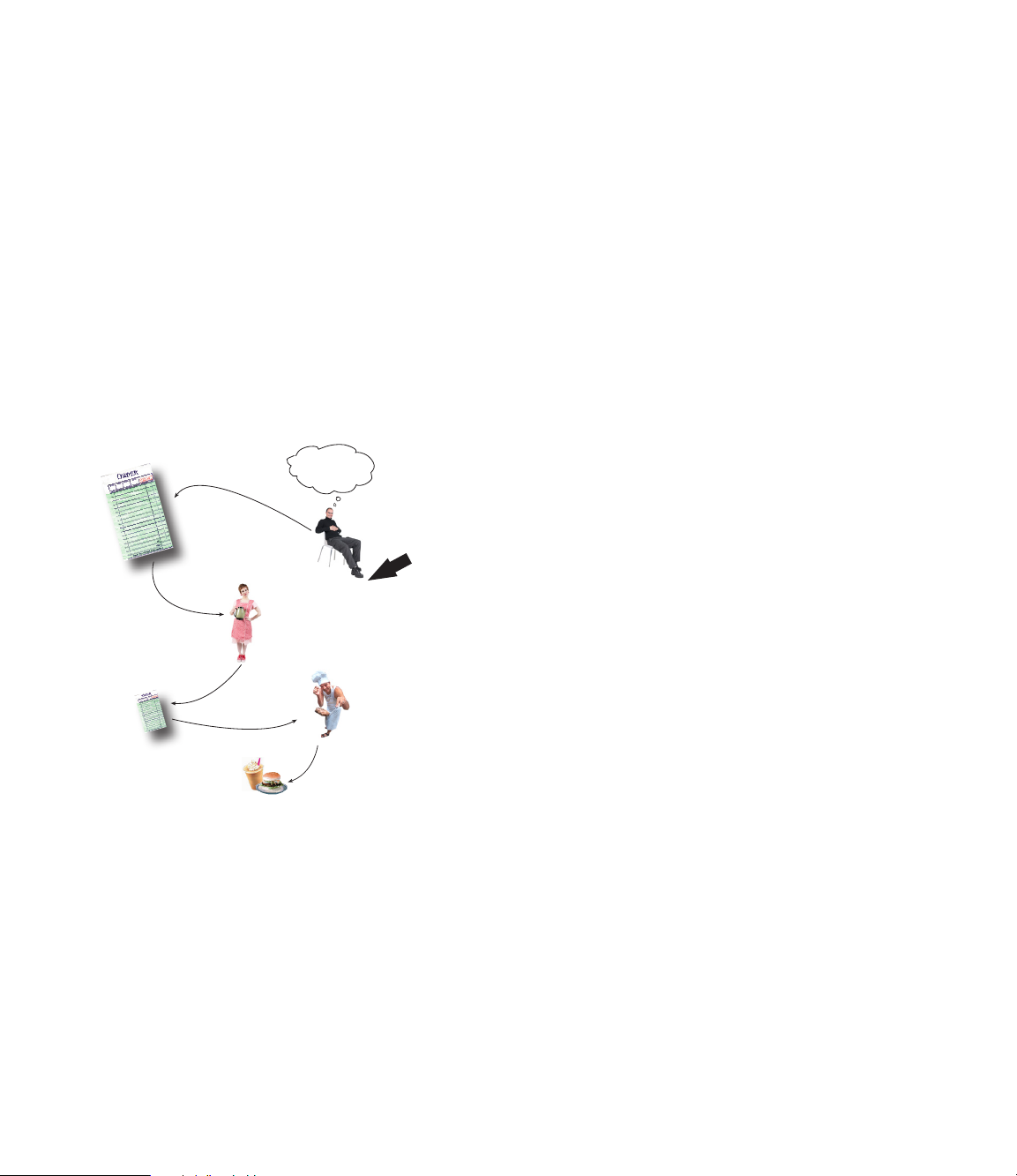
The Order consists of an order
slip and the customer’s menu I’ll have a Burger Home Automation or Bust 192 with Cheese and a Malt items that are written on it. Shake
Taking a look at the vendor classes 194 cr th Cheese eat Burger wi eOrder() Malt Shake
A brief introduction to the Command Pattern 197
From the Diner to the Command Pattern 201 Our first command object 203 Start Here The customer knows Using the command object 204 takeOr what he wants and der() creates an order. Assigning Commands to slots 209
The Waitress takes the Order, and when she
gets around to it, she calls its orderUp()
method to begin the Order’s pr
Implementing the Remote Control 210 eparation. Implementing the Commands 211 ll orderUp() The Short Order
Putting the Remote Control through its paces 212 th Cheese Cook f Burger wi The Order has a ollows the Malt Shake the instructions o prepare instructions of needed t the Order and
Time to write that documentation… 215 the meal. The ects the produces the meal. makeBurger(), makeShake() Order dir Short Order Cook What are we doing? 217 with methods like makeBurger(). Time to QA that Undo button! 220 output Using state to implement Undo 221
Adding Undo to the Ceiling Fan commands 222
Every remote needs a Party Mode! 225 Using a macro command 226
More uses of the Command Pattern: queuing requests 229
More uses of the Command Pattern: logging requests 230
Command Pattern in the Real World 231 Tools for your Design Toolbox 233
the Adapter and Facade Patterns 7 Being Adaptive
In this chapter we’re going to attempt such impossible
feats as putting a square peg in a round hole. Sound
impossible? Not when we have Design Patterns. Remember the Decorator
Pattern? We wrapped objects to give them new responsibilities. Now we’re
going to wrap some objects with a different purpose: to make their interfaces look
like something they’re not. Why would we do that? So we can adapt a design
expecting one interface to a class that implements a different interface. That’s not
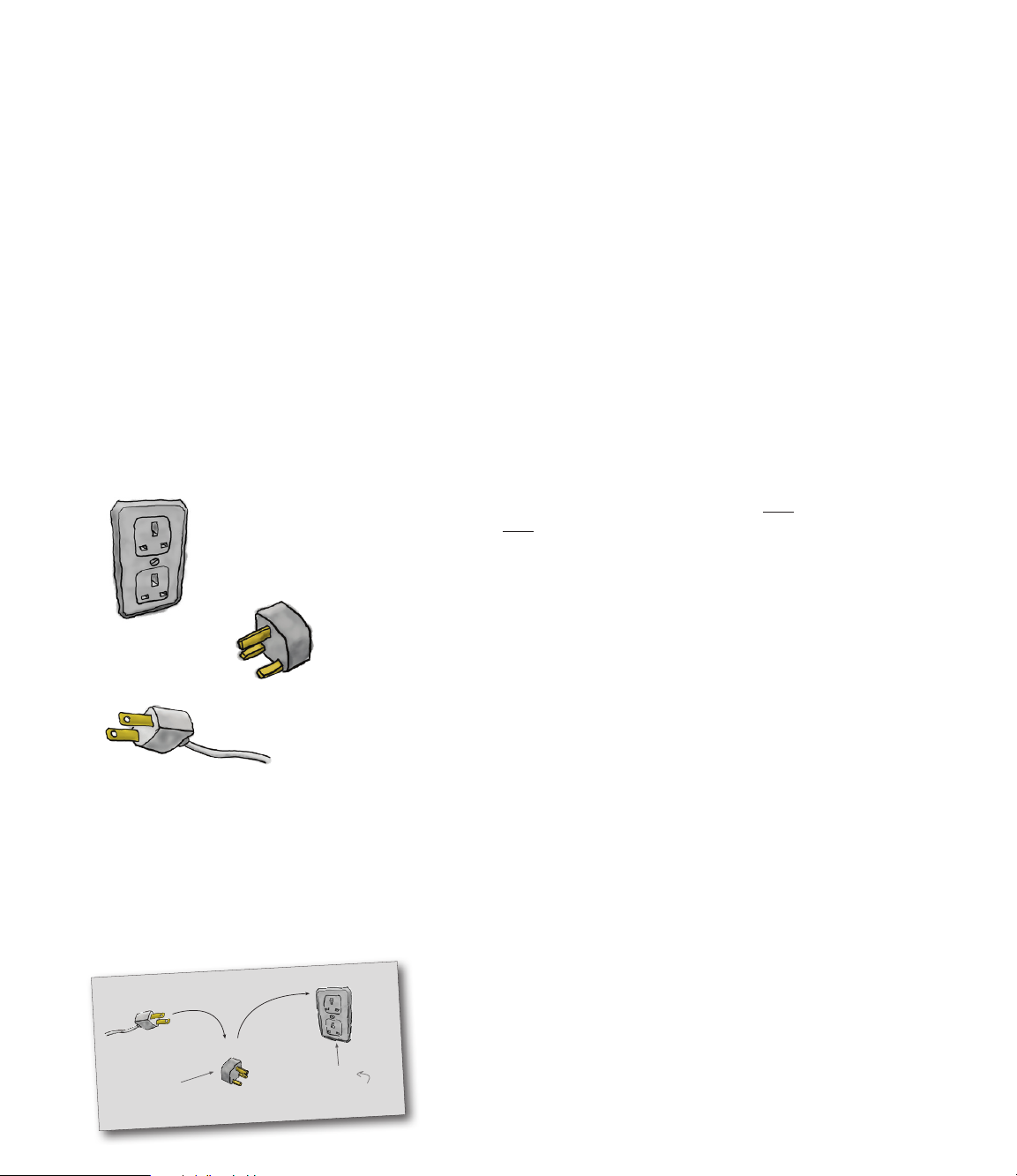
all; while we’re at it, we’re going to look at another pattern that wraps objects to simplify their interface. Adapters all around us 238 British Wall Outlet Object-oriented adapters 239
If it walks like a duck and quacks like a duck, then it must
might be a duck turkey wrapped with a duck adapter… 240 Test drive the adapter 242 AC Power Adapter The Adapter Pattern explained 243 Adapter Pattern defined 245 Object and class adapters 246 Real-world adapters 250 Standard AC Plug
Adapting an Enumeration to an Iterator 251 Home Sweet Home Theater 257
Watching a movie (the hard way) 258 Lights, Camera, Facade! 260
Constructing your home theater facade 263
Implementing the simplified interface 264
Time to watch a movie (the easy way) 265 Facade Pattern defined 266
The Principle of Least Knowledge 267
How NOT to Win Friends and Influence Objects 268
The Facade Pattern and the Principle of Least Knowledge 271 Tools for your Design Toolbox 272 Adaptee equest() tedR Client request() transla The Client is implemented against the target interface Adapter adaptee interface ace Turkey was the The Adapter implements the target interf adaptee interface target interface and holds an instance of the Adaptee table of contents the Template Method Pattern
8Encapsulating Algorithms
We’ve encapsulated object creation, method invocation,
complex interfaces, ducks, pizzas…what could be next?
We’re going to get down to encapsulating pieces of algorithms so that subclasses
can hook themselves right into a computation anytime they want. We’re even
going to learn about a design principle inspired by Hollywood. Let’s get started…
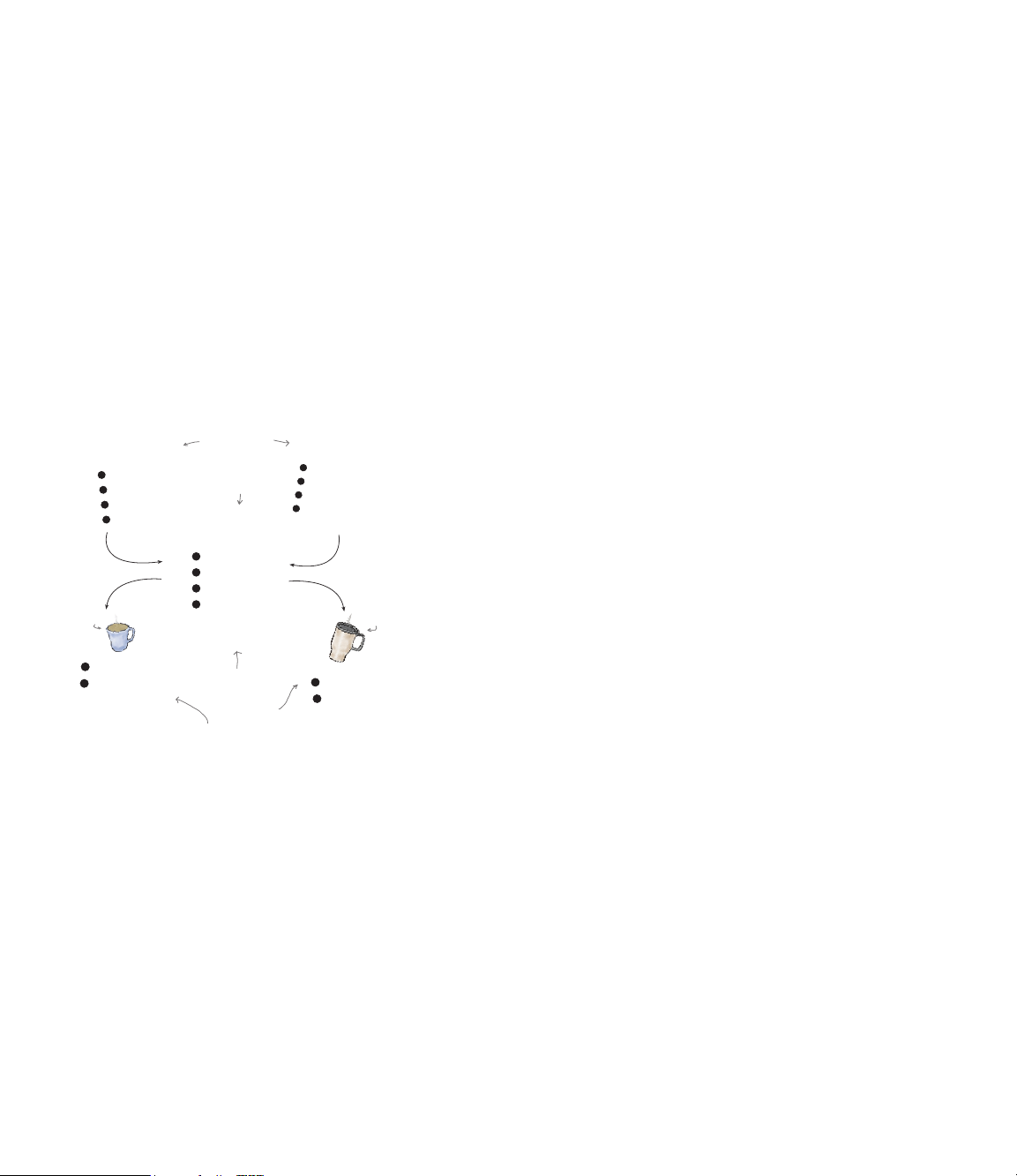
It’s time for some more caffeine 278 We’ve recognized that
Whipping up some coffee and tea classes (in Java) 279 the two recipes are essentially the same, although some of the
Let’s abstract that Coffee and Tea 282 steps require different implementations. So we’ve generalized the Coffee Tea Taking the design further… 283 recipe and placed it in the base class. 1 Boil s 1 Boil some water ome water Abstracting prepareRecipe() 284 2 Brew th
2 Steep the tea bag in the water e coffee gr 3 inds Pour coffee i 3 Pour tea in a cup n a cup What have we done? 287 4 Add sugar an 4 Add lemon d milk Meet the Template Method 288 Caffeine Beverage generalize 1 Boil some water
What did the Template Method get us? 290 generalize 2 Brew
Template Method Pattern defined 291 relies on
3 Pour beverage in a cup relies on subclass for subclass for some steps 4 Add condiments some steps Hooked on Template Method… 294 Tea subclass Coffee subclass Using the hook 295
The Hollywood Principle and Template Method 299
2 Steep the teabag in the water 4 Add l Caffeine Beverage knows emon
2 Brew the coffee grinds and controls the steps of Template Methods in the Wild 301 the recipe, and performs 4 Add sugar and milk steps 1 and 3 itself, but relies on Tea or Coffee Sorting with Template Method 302 to do steps 2 and 4.
We’ve got some ducks to sort… 303 What is compareTo()? 303 Comparing Ducks and Ducks 304 Let’s sort some Ducks 305
The making of the sorting duck machine 306 Swingin’ with Frames 308
Custom Lists with AbstractList 309 Tools for your Design Toolbox 313