Ôn Tập Chương 1-16 Môn Organizational behavior | Đại học Kinh Tế Quốc Dân
Ôn Tập Chương 1-16 Môn Organizational behavior. Tài liệu được sưu tầm gồm 27 trang, giúp bạn ôn tập tốt hơn. Mời các bạn đón xem.
Môn: Organizational behavior 40 tài liệu
Trường: Trường Đại học Kinh Tế Quốc Dân 8.7 K tài liệu
Tác giả:














Preview text:
lOMoAR cPSD| 58675420
Chapter 1: What Is Organizational Behavior? •
Definition: OB is the study of what people do in an organization and how their behavior
affects the organization’s performance. •
Key disciplines: Psychology, social psychology, sociology, and anthropology contribute to OB. •
Importance: Helps managers predict and influence employee behavior. • Concepts introduced:
o Systematic study vs. intuition: Managers should use data and evidence, not
just gut feelings. o OB model: Inputs (individual, group, organizational level) →
Processes (e.g., communication, leadership) → Outcomes
(e.g., performance, satisfaction)
Chapter 3: Attitudes and Job Satisfaction • Attitude Components:
o Cognitive (belief), Affective (feeling), Behavioral (intention to act). •
Job satisfaction is a key attitude predicting behavior. •
Major attitudes: Job involvement, organizational commitment, perceived
organizational support (POS), and employee engagement. •
Impact: Higher job satisfaction = better performance, lower turnover, less absenteeism
Chapter 4: Emotions and Moods •
Affect is a broad term that includes both emotions and moods. •
Emotions: Intense, short-lived, caused by specific events. •
Moods: Less intense, longer, no clear cause. • Key theories:
o Affective Events Theory (AET): Workplace events influence emotional
reactions → affect work outcomes. o Emotional Intelligence (EI): Ability to
detect, understand, and manage emotions. •
Applications: Emotions affect decision-making, leadership, customer service, etc.
Chapter 5: Personality and Values •
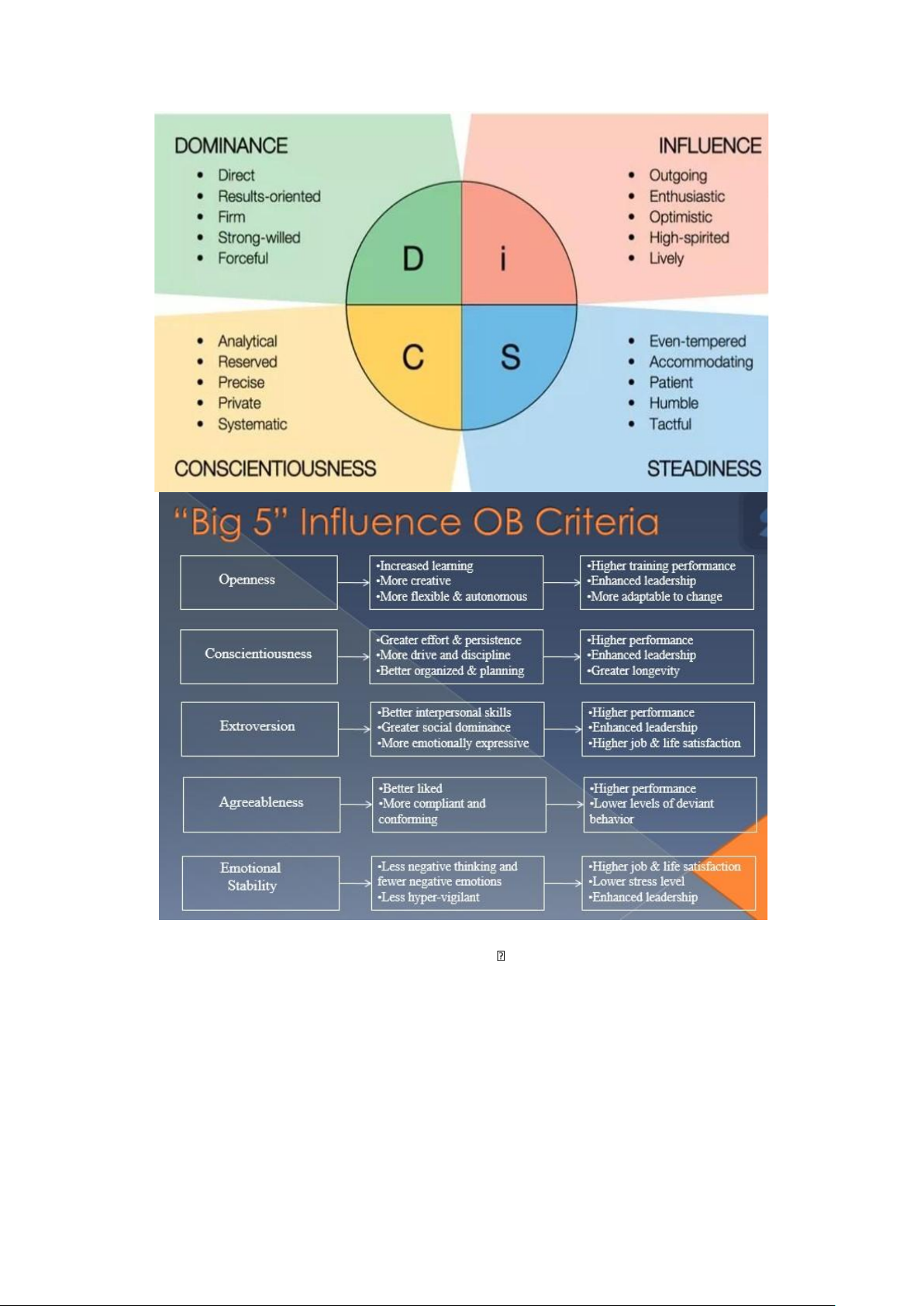
Personality: Stable characteristics influencing behavior. o Measured via MBTI or Big Five model (OCEAN). •
Big Five Traits: Openness, Conscientiousness, Extraversion, Agreeableness, Neuroticism. •
Other traits: Core self-evaluation, proactive personality, selfmonitoring. lOMoAR cPSD| 58675420 •
Values: Enduring beliefs of what is desirable. o Terminal (end goals) vs. Instrumental
(ways to achieve). Cultural frameworks: Hofstede & GLOBE model.
Chapter 6: Perception and Individual Decision Making •
Perception: How individuals interpret their environment. •
Attribution Theory: Explains how we assign causes to behavior (internal vs. external). •
Common biases: o Halo effect, stereotyping, confirmation bias. •
Decision-making models: o Rational, Bounded rationality, Intuition. •
Creativity in decision-making: Affected by expertise, personality, motivation, and the environment.
Chapter 7: Motivation Concepts • Theories:
o Maslow's Hierarchy: Needs from physiological to selfactualization.
o McClelland’s Theory: Need for achievement, affiliation, power.
o Self-determination theory: Focuses on intrinsic motivation.
o Goal-setting theory: Specific, challenging goals improve performance.
o Equity theory: People compare inputs/outputs with others. o Expectancy
theory: Motivation = Expectancy × Instrumentality × Valence.
Chapter 8: Motivation – From Concepts to Applications •
Job design: Influences motivation (e.g., skill variety, task identity). •
Job Characteristics Model (JCM): Core dimensions → psychological states → outcomes. •
Variable pay programs: Bonuses, piece-rate, stock options. •
Employee involvement: Participative management, representative participation.
Chapter 10: Understanding Work Teams •
Why teams?: Better collaboration, more innovation. •
Types: Problem-solving, self-managed, cross-functional, virtual teams. •
Key components: Roles, norms, status, size, cohesiveness. •
Team effectiveness model: Context + Composition + Process.
1. Problem-Solving Teams lOMoAR cPSD| 58675420 •
Definition: Groups from the same department or area who meet regularly to discuss
ways to improve quality, efficiency, and the work environment. •
Typical activities: Suggesting improvements, solving specific issues. •
Authority: Usually limited to making recommendations (not implementing).
📝 Ví dụ: Nhóm kỹ thuật trong nhà máy họp hàng tuần để đề xuất cải tiến quy trình sản xuất.
🧠 Lưu ý: Họ chỉ “giải quyết vấn đề” – không có quyền tự hành động.
2. Self-Managed Work Teams •
Definition: Groups of employees who perform highly related or interdependent jobs
and take on the responsibilities of their former supervisors. •
Authority: High autonomy — they plan, schedule, assign tasks, even evaluate performance. •
Challenge: Conflict management, decision-making skills required.
📝 Ví dụ: Nhóm chăm sóc khách hàng tự điều phối ca làm, theo dõi hiệu suất lẫn nhau mà
không cần sếp giám sát sát sao.
⚠ Khó áp dụng nếu nhóm chưa đủ trưởng thành hoặc không có sự tin tưởng cao.
3. Cross-Functional Teams •
Definition: Teams made up of employees from different departments (e.g., marketing,
operations, finance) working toward a common goal. •
Strengths: Brings diverse expertise → innovation, comprehensive problem solving. •
Challenges: Communication barriers, power struggles, alignment of priorities.
📝 Ví dụ: Dự án phát triển sản phẩm mới gồm người từ phòng kỹ thuật, marketing, tài chính,
sản xuất cùng hợp tác.
🧠 Lưu ý: Cần quản lý xung đột và vai trò rõ ràng vì khác chuyên môn. 4. Virtual Teams •
Definition: Teams that use technology (e.g., Zoom, Slack, Teams) to collaborate
remotely across different locations. •
Strengths: Global talent, cost-efficient. •
Challenges: Lack of face-to-face interaction → harder to build trust, monitor
performance, and manage conflict. lOMoAR cPSD| 58675420 Chapter 12: Leadership •
Leadership vs. Management: Leadership is about influencing, management is about organizing. •
Theories: o Trait theory: Leaders are born.
o Behavioral theory: Leaders can be trained (e.g., taskoriented vs. people- oriented).
o Contingency theories: Effectiveness depends on the situation (Fiedler, Path- Goal).
o Transformational leadership: Inspires followers beyond self-interest.
Chapter 14: Conflict and Negotiation •
Conflict types: Task (constructive), relationship (destructive), process. •
Conflict process: Potential opposition → cognition → behavior → outcomes. •
Conflict management styles: Competing, collaborating, compromising, avoiding, accommodating. • Negotiation:
o Distributive: Win–lose. o Integrative: Win–win.
Chapter 16: Organizational Culture •
Definition: Shared values, beliefs, and norms shaping behavior. • Levels:
o Artifacts (visible), espoused values (stated), basic assumptions (deep-rooted). • Functions:
o Boundary-defining, sense-making, control mechanism. •
Creating/Sustaining Culture: Through selection, top management, and socialization. •
Change and culture: Strong cultures resist change, but adaptive cultures support innovation. INTRODUCTION TO OB - Organizational behavior is: 1. Definition •
a field of study that investigates the impact that individuals, groups, and structure have on behavior within
organizations, for the purpose of applying such knowledge toward improving an
organization’s effectiveness lOMoAR cPSD| 58675420 •
the study of what people do in an organization and how their behavior affects the organization’s performance 2. Functions: •
Explanatory function: Managers need to be able to explain why employees engage in
some behaviors rather than others •
Predictive function: predict how employees will respond to various actions and decisions •
Controlling function: influence how employees behave
- Manager: Someone whose job it is to support the work efforts of others directly.
🔺Effective one: One whose team consistently achieves its goals while members remain
capable, committed, and enthusiastic - The management process •
Planning: can be highly specialized based on organizational goals, division goals,
departmental goals, and team goals. It is up to the manager to recognize which goals
need to be planned within his or her individual area
1. Creates a detail action plan aimed at some organization goal
2. In simple term: deciding in advance • What is to be done • When is to be done • How is to be done • By whom it is to be done
3. Bring the gap between where we are & where we want to go
4. Include selection of objectives, policies, procedures and programs from among alternatives •
Organizing: Determine how to distribute resources and organize employees according to the plan • Leading:
1. Motivate employees, direct their activities, select the most effective
communication channels, or resolve conflicts among members
2. Instructing & motivating subordinates to carry out tasks
3. Communicating company goals and policies to subordinates. The commanding
of subordinates should always be consistent with company policies, and every
manager should treat subordinates in line with the standards of the company • Controlling:
1. Evaluate the result against the goals
2. Controlling the team and resources so that the plan is implemented as planned
and in accordance with the organization's rules and procedures lOMoAR cPSD| 58675420
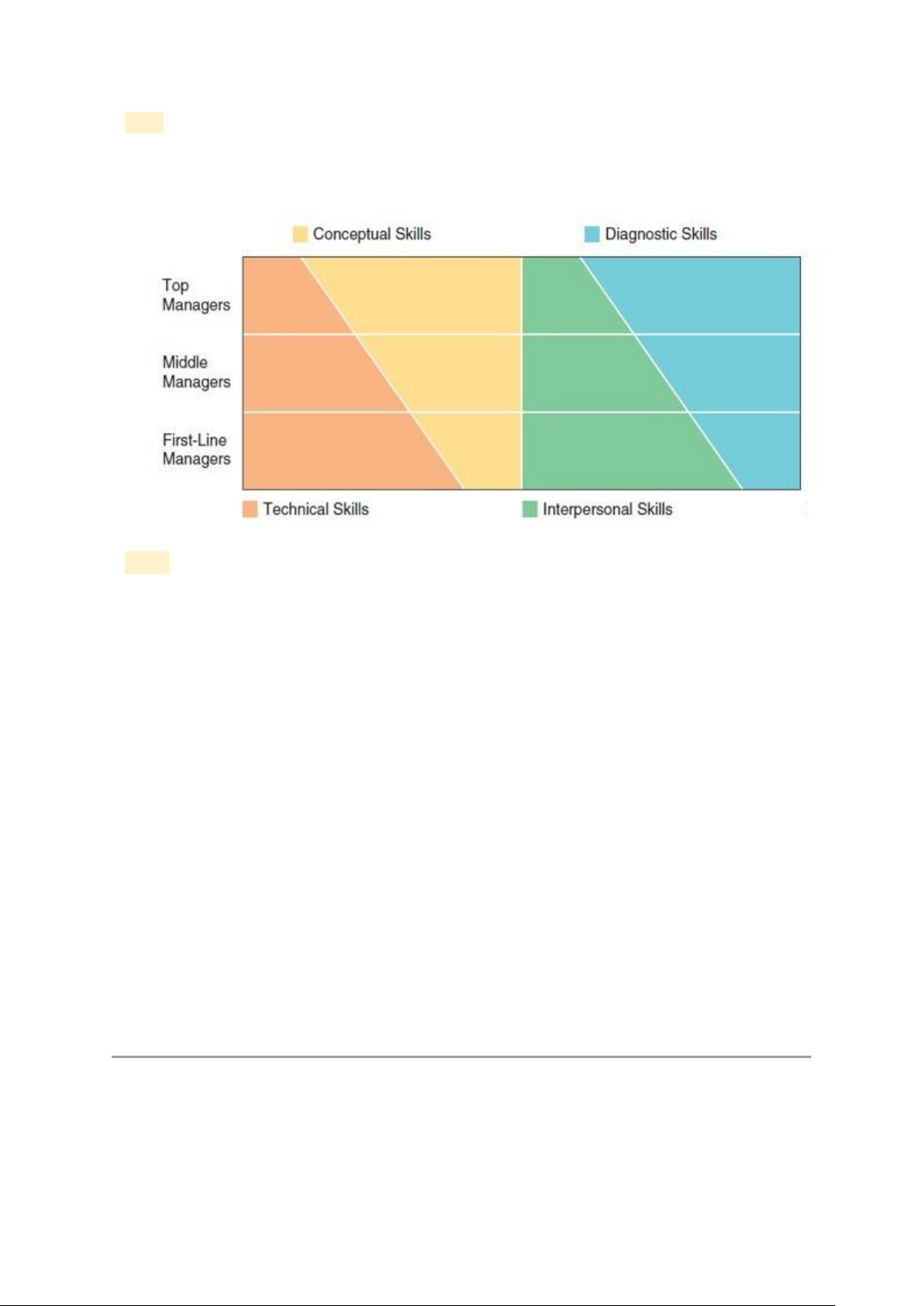
- Skill: An ability to translate knowledge into action that results in a desired performance.
🔺Technical skill: Ability to perform specialized tasks.
🔺Human skill: Ability to work well with other people.
🔺Conceptual skill: Capacity to analyze and solve complex and interrelated problems. - Roles: •
Interpersonal roles: management is considered as an interpersonal process
1. Figurehead: performing ceremonial & social duties as organization’s representative
2. Leader: selecting & training team members, & uniting & inspiring team to achieve its objectives
3. Liaison: communicating with people outside the work unit or the org.: building
up an informal system of info. exchange •
Informational roles: communication is manager’s work. A manager is likely to have a
wider network of contacts within and outside the organization than his subordinates,
so he is the best person to gather and spread information.
1. Monitor: receiving info from environment & from within org.
2. Disseminator: passing on info to subordinates
3. Spokesman: transmitting info to interested parties outside the work unit or organization •
Decisional roles: his authority and his job is to make decisions
1. Entrepreneur: being ‘fixer’, mobilising resources to get things done & to seize opportunities
2. Disturbance-handler: coping with unexpected, rectifying mistakes & getting
operations & relationship back on course if needed
3. Resources allocator: distributing limited resources in the way that will most
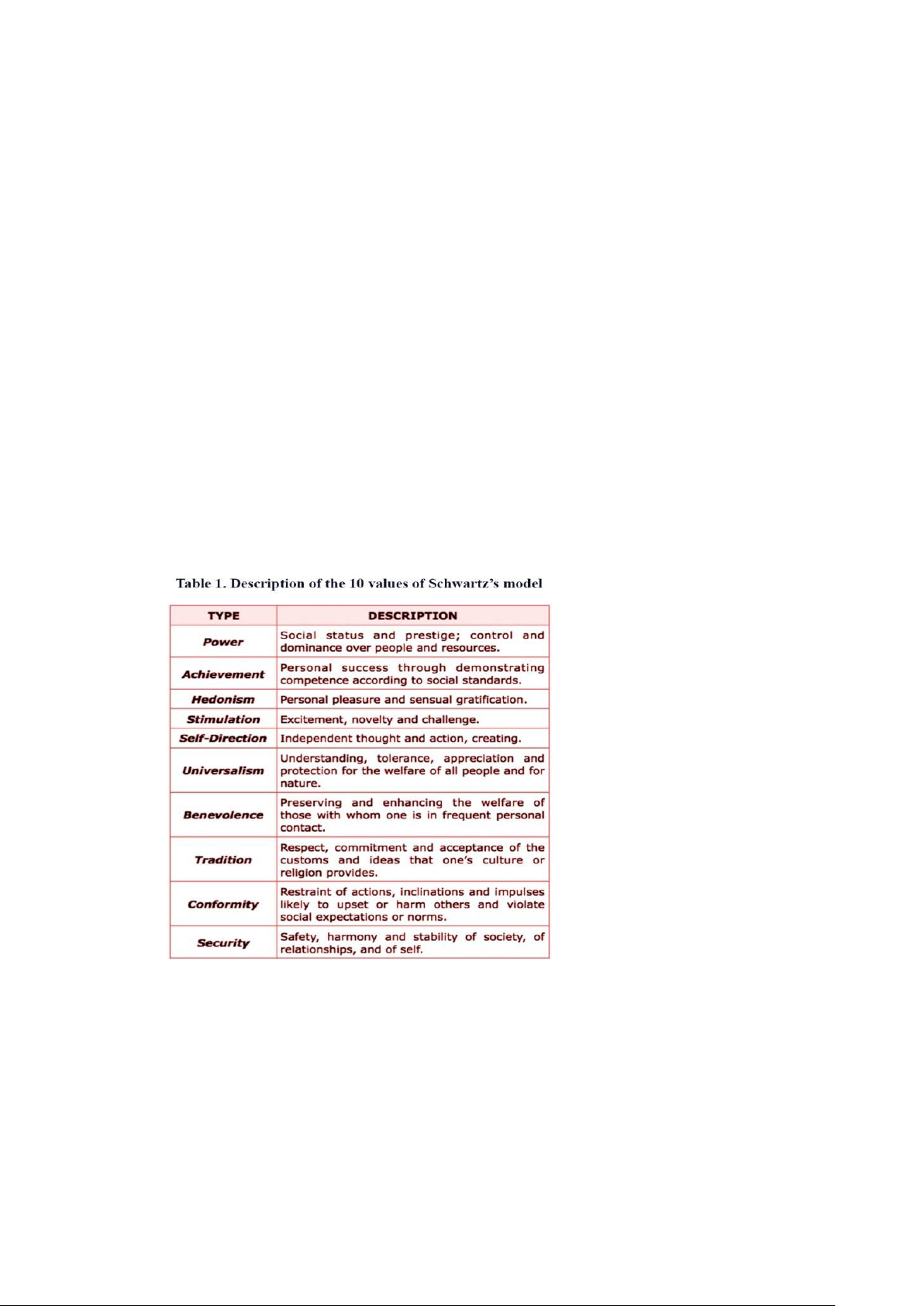
efficiently achieve defined objectives 4. Negotiator: bargaining INDIVIDUAL DIFFERENCE 1. Values: lOMoAR cPSD| 58675420 •
Values are beliefs about what is and isn't important in life. •
Broad preferences concerning appropriate courses of action or outcomes. •
Values influence attitudes and behavior. 🔺2 types: •
Terminal values: reflect a person’s preferences concerning the “ends” to be achieved. •
Instrumental values: reflect a person’s beliefs about the means for achieving desired ends
🔺Frameworks: Schwartz's Value Circumplex (6 main features of values) •
Values are beliefs linked inextricably to affect. When values are activated, they become infused with feeling •
Values refer to desirable goals that motivate action •
Values transcend specific actions and situations. This distinguishes values from norms
and attitudes that usually refer to specific actions, objects, or situations •
Serve as standards/ criteria. Values guide the selection or evaluation of actions, policies, ppl and events •
Are ordered by importance relative to one another •
The relative importance of multiple values guides action. Any attitude or behavior
typically has implications for
more than 1 value. and Maglino’s workplace values: lOMoAR cPSD| 58675420 • Achievement •
Helping and concern for others • Honesty • Fairness
Value congruence: occurs when individuals express positive feelings upon encountering
others who exhibit values similar to their own
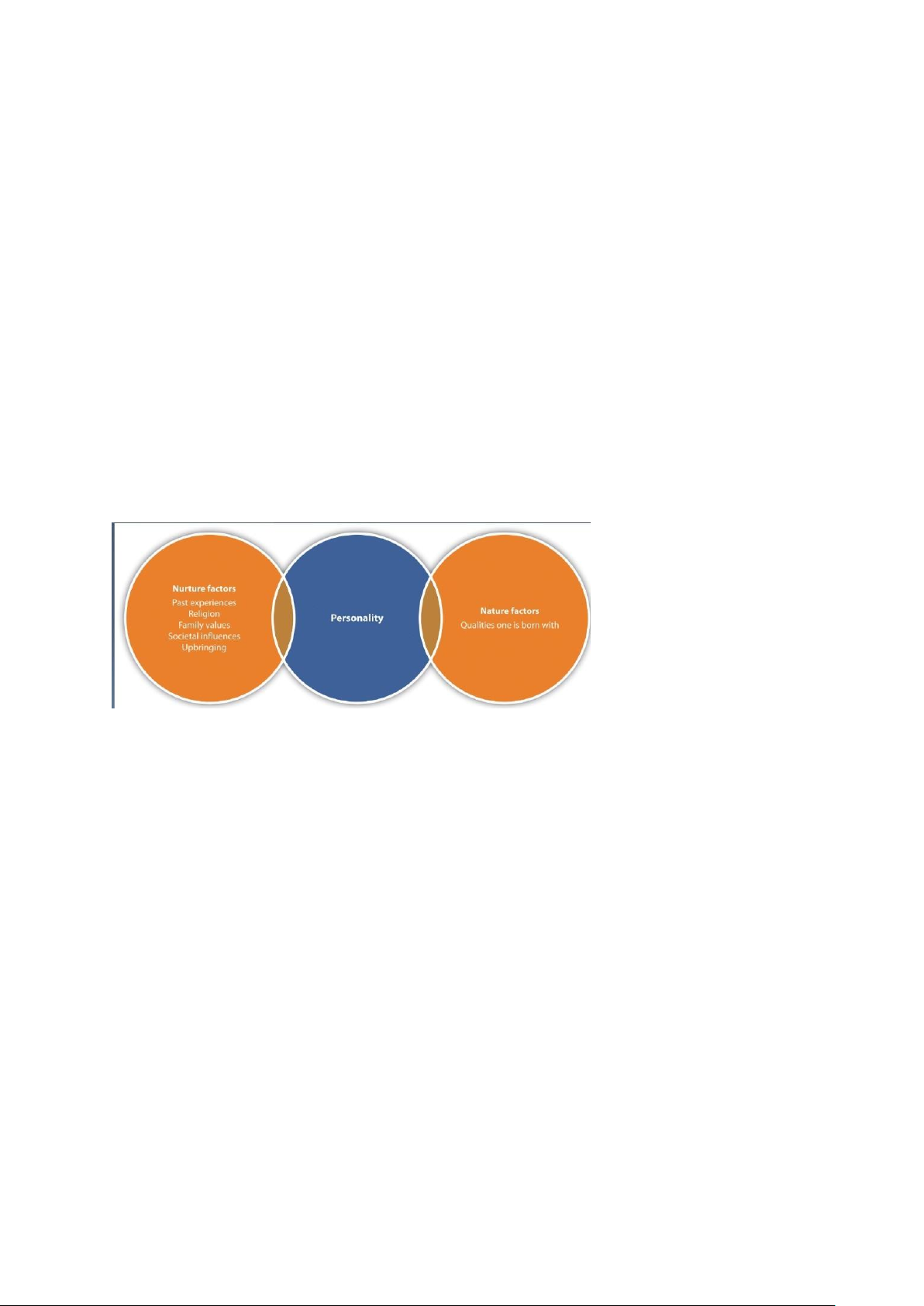
2. Personality: the relatively enduring pattern of thoughts, emotions, and behaviors that
characterize a person, and the psychological processes behind those. •
The growth and development of a person’s whole psychological system •
The sum total of ways in which an individual reacts and interacts with others, the
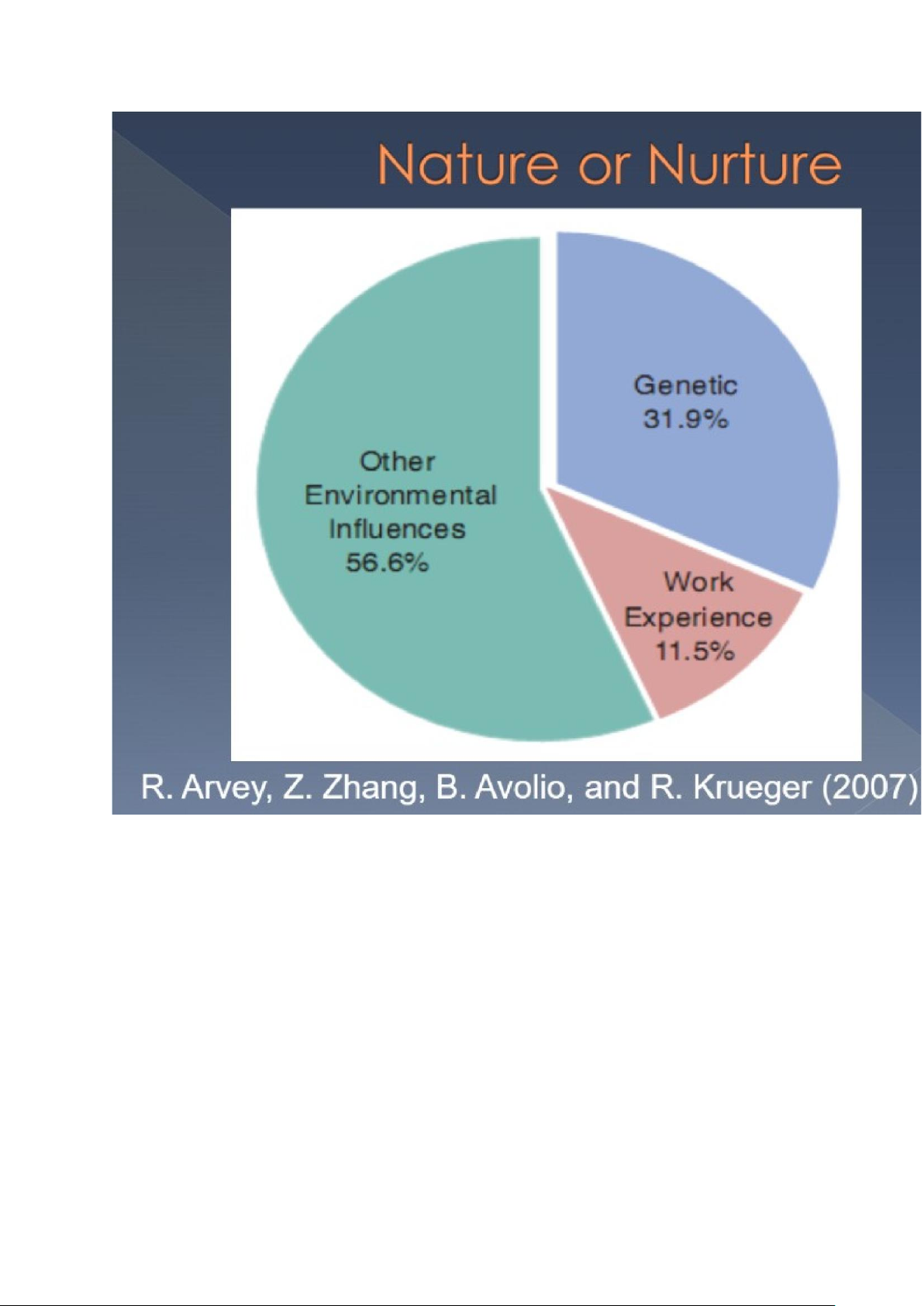
measurable traits a person exhibits Personality determinants: • Like father, like son •
The apple never falls from the tree •
Many a good father has but a bad son •
Parents gave birth to the child, god gives the child attitude
* Heredity: physical characteristics + gender
* Environment: cultural factors + social factors + situational factors lOMoAR cPSD| 58675420 Theories: •
Big Five Model of Personality. lOMoAR cPSD| 58675420 •
Myers-Briggs Type Indicator (MBTI). DISC personality profile. •
Linking personality to the workplace: person - org. Fit theory: •
The employee’s personality must fit with the organizational culture •
Ppl are attracted to org. That match their values •
Those who match are most likely to be selected •
Mismatches will result in turnover •
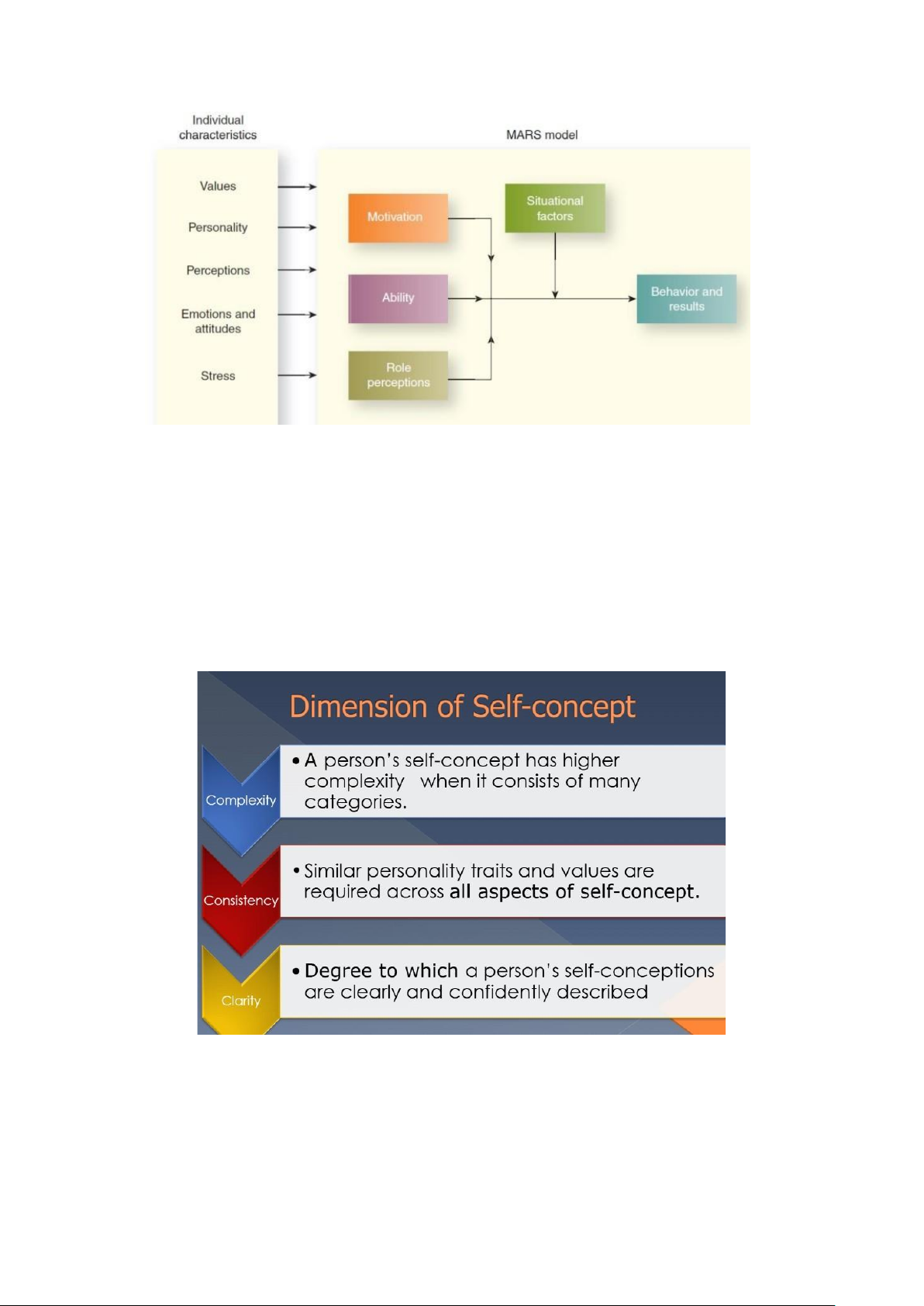
Can use the big five personality types to match to the org. culture • MARS model of performance: lOMoAR cPSD| 58675420
Learned capabilities + aptitude = ability/competency
3. 1 số khái niệm khác: •
Situational factors: external (uncontrollable) factors + controllable factors = situational factors •
Self-awareness means being aware of our own behaviors, preferences, styles, biases, personalities, and so on. •
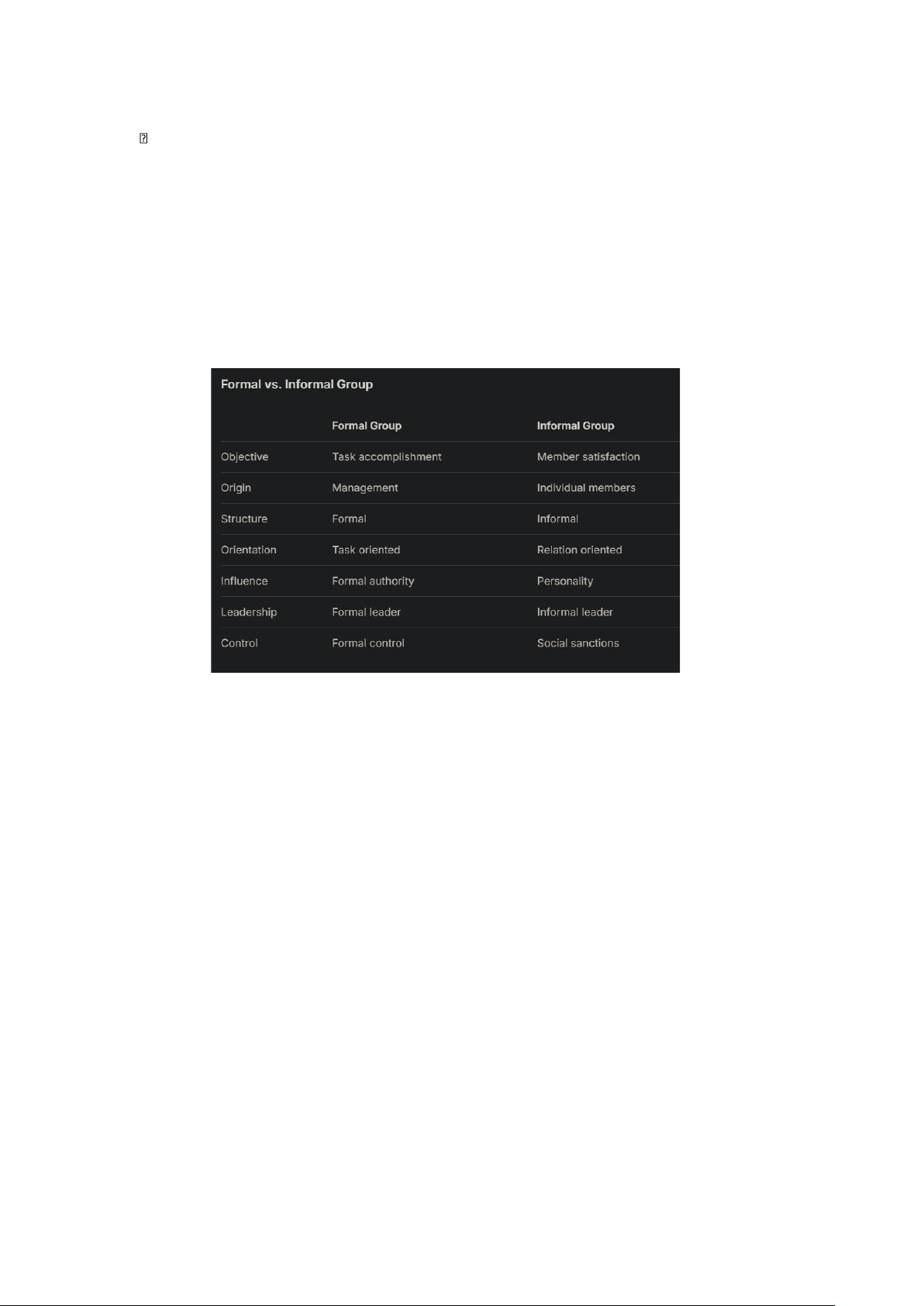
Self-concept: An individual’s self- beliefs and self- evaluations.
(People do not have a single unitary self-concept.) •
Self-enhancement is the desire to feel valued. People are inherently motivated to
promote and protect a self-view of being competent,
attractive, lucky, ethical, and important •
People are motivated to verify and maintain their existing self concept. Self-
verification stabilizes an individual’s self-concept that
guides his or her thoughts and actions lOMoAR cPSD| 58675420 •
Self esteem: the extent to which ppl like, respect, and are satisfied with themselves -
represents a global self-evaluation •
self - efficacy: a person’s belief that he or she can successfully complete a task •
Locus of control: a person’s general belief about the amount of control he or she has over personal life events. •
Personal Identity + Social Identity = The social self
4. Values in the Workplace: •
Are stable, evaluative beliefs that guide our preferences for outcomes or courses of
action in a variety of situations •
They are perceptions about what is good or bad, right or wrong. Values tell us what we “ought” to do. •
Value Congruence: Alignment of individual and organizational values. •
Ethical Values: Guiding behavior and decisions.
ATTITUDE AND JOB SATISFACTION 1. Attitude:
Evaluative statements or judgments concerning objects, people, or events •
Cognitive component: Underlying beliefs, opinions, knowledge, or information a person possesses. •
Affective component: Specific feeling regarding the personal impact of the antecedents. •
Behavioral component: Intention to behave in a certain way based on your
specific feelings or attitudes.
2. Cognitive dissonance:
A psychologically disturbing state of inconsistency between an individual’s attitudes and his or her behavior.
3. Types of job attitudes: •
Five facets of job satisfaction: • The work itself • Quality of supervision • Relationships with co-workers • Promotion opportunities • Pay •
Theory: performance causes satisfaction •
Managerial implication — help people achieve high performance, then satisfaction will follow. •
Performance in a given time period is related to satisfaction in a later time period. •
Rewards link performance with later satisfaction. •
Theory: rewards cause both satisfaction and performance •
Managerial implication — Proper allocation of rewards can positively influence
both satisfaction and performance. lOMoAR cPSD| 58675420 •
High job satisfaction and performance-contingent rewards influence a person’s work performance. •
Size and value of the reward should vary in proportion to the level of one’s performance. Stress and burnout EMOTIONS AND MOODS
Moods: Generalized positive or negative feelings or states of mind.
Emotion: Emotions are strong positive or negative feelings directed toward someone or something.
Self-conscious emotions: Arise from internal sources (shame, guilt, embarrassment, pride)
and help regulate interpersonal relationships.
Social emotions: Arise from external sources (pity, jealousy) and refer to individuals’ feelings
based on external information.
How do emotions and moods influence behavior in organizations? •
Informal standards govern the degree to which it is appropriate for people from
different cultures to display their emotions. •
Positive affect: tendency to be perceptually positive •
Negative affect: tend to experience negative moods in a wide range of settings
and under many different conditions
PERCEPTION AND ATTRIBUTION
Perception is the way individuals interpret and make sense of their surroundings, including
people, events, and situations within the workplace. Process: It involves: •
Selection: Choosing which stimuli to focus on. •
Organization: Grouping stimuli into meaningful patterns. •
Interpretation: Assigning meaning to the selected and organized information.
Factors Influencing Perception: •
Perceiver: Attitudes, motives, and past experiences. •
Target: Characteristics of the object or person being perceived. •
Situation: Context and environment. lOMoAR cPSD| 58675420 Perceptual Biases:
Stereotyping: Judging individuals based on group affiliation.
Halo effect: Forming a general impression based on a single characteristic.
Selective perception: Focusing on information that confirms existing beliefs.
Projection: Attributing one's own feelings or traits to others.
Perception: Process by which people select, organize, interpret, retrieve, and respond to
information from the world around them.
>< Sensation is the immediate response of our sensory receptors (eyes, ears, nose, mouth,
and fingers) to basic stimuli (light, color, sound, odor, and texture).
Schemas: Cognitive frameworks that represent organized knowledge developed through
experience about a given concept or stimulus. •
Script schemas: A knowledge of a framework that describes the appropriate sequence
of events in a given situation. •
Self schema: Contains information about a person’s own appearance, behavior, and personality. •
Person schemas: Refer to the way individuals sort others into categories such as types
of groups in terms of similar perceived features.
Quá trình cảm nhận Gồm 3 bước chính: 1. Chú ý và lựa chọn: •
Chỉ lọc một phần nhỏ thông tin mà chúng ta tiếp xúc. • Hai kiểu chọn lọc:
1. Xử lý có kiểm soát: Chủ động tập trung.
2. Xử lý không ý thức: Diễn ra tự nhiên, không nhận biết. 2. Tổ chức: •
Script schemas: Chuỗi sự kiện phù hợp trong một tình huống. •
Self schemas: Thông tin về bản thân (ngoại hình, hành vi, tính cách). Person
schemas: Phân loại người khác dựa trên đặc điểm chung. 3. Giải thích:
Phân tích lý do tại sao sự kiện hoặc hành động diễn ra theo cách nhất định. Perceptual distortion: • Stereotype •
Selective perception is the tendency to single out those aspects of a situation, person,
or object that are consistent with one’s needs, values, or attitudes. •
Halo effect: Occur when one attribute of a person or situation is used to develop an
overall impression of the individual or situation. •
Projection: The assignment of one’s personal attributes to other individuals. •
Contrast effects: The meaning or interpretation of something is arrived at by
contrasting it with a recently occurring event or situation lOMoAR cPSD| 58675420
Attribution theory: Process of developing explanations or assigning perceived causes for
events. Can be classified as internal or external: •
Internal causes – Believed to be under an individual’s control. •
External causes – Seen as coming from outside a person
Các yếu tố chính trong quy kết: •
Sự đặc trưng (Distinctiveness): Hành vi có khác nhau giữa các tình huống không? •
Sự đồng thuận (Consensus): Người khác có hành động tương tự không? •
Sự nhất quán (Consistency): Cá nhân có hành xử giống nhau qua thời gian không?
Fundamental attribution error: •
Tendency to underestimate the influence of situational factors and to overestimate the
influence of personal factors when evaluating someone else’s behavior. •
Self-serving bias: Tendency to deny personal responsibility for performance problems
but to accept personal responsibility for performance success. MOTIVATION:
Motivation is the willingness to exert high levels of effort towards organizational goals,
conditioned by the effort and ability to satisfy some individual need
Phân loại động lực: •
Nội tại (Intrinsic Motivation): Động lực xuất phát từ bên trong cá nhân, như niềm vui
trong công việc, sự hài lòng cá nhân. •
Ngoại tại (Extrinsic Motivation): Động lực từ các yếu tố bên ngoài, như tiền lương,
phần thưởng, hay sự công nhận. Theories of Motivation A. Content Theories: lOMoAR cPSD| 58675420
Maslow’s Hierarchy of Needs: Human needs are organized into five levels
(physiological, safety, social, esteem, and self-actualization). •
Herzberg’s Two-Factor Theory: •
Hygiene Factors: Elements like working conditions, salary, and relationships. •
Motivators: Factors such as opportunities for advancement and recognition. •
Alderfer’s ERG Theory: Similar to Maslow’s but condensed into three categories:
Existence, Relatedness, and Growth. •
McClelland’s Theory of Needs: Focuses on the needs for achievement, power, and affiliation. B. Process Theories: •
Adams’ Equity Theory: A person’s motivation is influenced by their perception of
fairness when comparing their effort and rewards to others. •
Vroom’s Expectancy Theory: People are motivated if they believe their effort will lead to desired outcomes. •
Goal-Setting Theory: Specific and challenging goals improve performance. •
Job Characteristics Model (JCM): Factors such as task variety, autonomy, and feedback influence motivation.
Practical Applications of Motivation A. Job Design: •
Job Rotation: Periodically shifting a worker from one task to another. •
Job Enrichment: Expanding the scope of jobs vertically. B. Flexible Work Arrangements: •
Flextime: Allowing employees to choose their working hours within a certain framework. •
Job Sharing: Two or more individuals sharing a traditional 40hour-a-week job. •
Telecommuting: Working from home at least two days a week using technology linked
to the office. C. Financial and Non-Financial Rewards: •
Financial: Salaries, bonuses, and variable pay structures. •
Non-Financial: Recognition and employee achievement programs.
D. Employee Involvement: • Participative Management. •
Representative Participation in organizational decisionmaking.
The Role of Leaders in Motivation Leaders should: •
Clearly define acceptable performance or behavioral objectives. •
Remove obstacles to achieving performance goals. •
Use rewards and discipline effectively.
Transform acceptable behavior into exceptional behavior. •
Ensure fairness in reward distribution. •
Provide timely feedback and accurate performance reviews. TEAMS Teams: • 2/more ppl lOMoAR cPSD| 58675420 • Fulfill a purpose • Interdependent •
Mutually accountable for achieving common goals • A social entity Why Teams? • Increases motivation • Work is completed faster • Responsibility is shared • Improves interpersonal skills •
Increases employee participation
Pros/Cons of Working in Groups/Teams • Advantages •
Teams have more information than individuals • Teams stimulate creativity •
Teams remember what they discuss •
Teams are more satisfied with decision making Members learn more about themselves • Disadvantages •
Members may conform to majority opinion (Groupthink) •
Individuals may dominate the group •
Individuals may rely too much on others •
Takes more time and money (otherwise an individual could just do it!) Types of Teams • Problem-solving • Functional • Virtual • Self-managed • Cross-functional Team vs. Group 1. Purpose and Goals •
Groups: Members may have a common purpose or interest, but individual goals can vary significantly.
Teams: All members work towards a shared purpose and specific goals, fostering collaboration. 2. Interdependence lOMoAR cPSD| 58675420 •
Groups: Members often work independently, with minimal reliance on one another. •
Teams: High interdependence exists, where members' contributions directly impact the team's success. 3. Roles and Responsibilities •
Groups: Roles may not be clearly defined, leading to varied contributions without coordination. •
Teams: Clearly defined roles ensure that each member knows their responsibilities, enhancing collaboration.
4. Communication and Collaboration •
Groups: Communication can be sporadic and may not focus on collaboration. •
Teams: Regular communication and collaboration are essential, with members actively
sharing information and making collective decisions. 5. Accountability •
Groups: Individual accountability is emphasized, with members primarily responsible for their own results. •
Teams: Members hold each other accountable for the team's performance, fostering
a sense of collective responsibility.
6. Performance and Productivity •
Groups: Performance can be inconsistent, often relying on individual efforts without a
strong focus on overall productivity. •
Teams: Performance is measured collectively, with a focus on achieving high
productivity and shared goals. 7. Cohesion and Trust •
Groups: Cohesion and trust may vary, and these elements are not central to group dynamics.
Teams: Building trust and cohesion is crucial, creating a positive environment that enhances collaboration. 8. Leadership •
Groups: Leadership may be informal or absent, with no designated leader. lOMoAR cPSD| 58675420 •
Teams: Typically have a designated leader who guides the team towards its goals and facilitates collaboration. Informal Groups •
Interest Group: Members with common interest. •
Friendship Groups: Members who enjoy similar social activities, political beliefs, religious values. •
Reference Groups: Reference groups have a strong influence on members' behavior.
Stages of the Model “Tuckman’s Team Development”: •
Forming: The initial stage where team members get to know each other and understand the common goals. •
Storming: The stage of conflicts arising due to differences in opinions, roles, and working styles. •
Norming: The stage where norms are established, and cohesion and collaboration begin to form. •
Performing: The stage of high performance where the team works smoothly together to achieve goals. •
Adjourning: The final stage when the team disbands after completing its tasks. Concepts: •
Starts with dependence in the early stages. •
Transitions to interdependence during the middle stages. •
Ends with independence when the team disbands. lOMoAR cPSD| 58675420 PREPARE AT HOME:
🔹 1. Promoting Positive Attitudes, Job Satisfaction, Emotions, and Moods ✅ Practical Approaches: Area How to Improve - Align job roles with employee Attitudes strengths -
Fair policies & recognition - Good work conditions Job - Opportunities for growth Satisfaction - Transparent culture - Provide EI training - Encourage breaks Emotions & - Celebrate wins Moods - Avoid toxic environments
🧠 Explanation: Attitudes come from how employees feel, what they believe, and how they
intend to behave. You can change those by changing their experiences, rewards, and relationships at work.
🔹 2. Increasing Values–Personality Fit ✅ What to Do: •
Use person-job fit and person-organization fit in hiring (match values & personality to company culture). •
Promote core value alignment in onboarding (mission, ethics, goals). •
Provide training to build self-awareness (e.g., personality assessments like MBTI, Big Five).
🧠 Explanation: You can’t “change” personality easily, but you can select, support, and align
roles so that personality works for the job and culture.
🔹 3. Can We Alter Someone’s Perception or Motivate Them?
✅ YES — through the right tools:
📌 To Change Perception: •
Awareness training: Help employees recognize cognitive biases. •
Feedback and coaching: Correct misjudgments in real-time. •
Clear communication: Reduce misunderstandings. •
Encourage empathy: Perspective-taking exercises.
Tài liệu liên quan:
-
Bài giảng về toán học lớp 12 - Chương 1 Đại số và giải tích
13 7 -

Foreign Language 2 - Basic 3 (Ngoại ngữ 2 - Cơ bản 3)
28 14 -
Ôn thi Môn Organizational behavior | Đại học Kinh Tế Quốc Dân
84 42 -
Câu hỏi tổng hợp Môn Organizational behavior | Đại học Kinh Tế Quốc Dân
96 48 -
Case Study Analysis Costco's Competitive Strategy | Môn Organizational behavior - Đại học Kinh Tế Quốc Dân
101 51