Performance Predictions and Motivation Theories in Organizations | Môn Organizational behavior - Đại học Kinh Tế Quốc Dân
Performance Predictions and Motivation Theories in Organizations Môn Organizational behavior. Tài liệu được sưu tầm gồm 20 trang, giúp bạn ôn tập tốt hơn. Mời các bạn đón xem.
Môn: Organizational behavior 38 tài liệu
Trường: Trường Đại học Kinh Tế Quốc Dân 6.7 K tài liệu
Tác giả:












Preview text:
lOMoAR cPSD| 58675420
Performance Predictions for High nAch
- People with a high need for achievement are likely to:
+ Prefer to undertake activities with a 50/50 chance of success, avoiding very low- or high-risk situations
+ Be motivated in jobs that offer high degree of personal responsibility, feedback, and moderate risk
+ Not necessarily make good managers - too personal a focus. Most good general
managers do NOT have a high nach
+ Need high level of nPow and low nAff for managerial success
- Good research support, but it is not a very practical theory
Parallels among the Need theories of Motivation Motivation Factors Self-actualization Growth Needs Need for Achievement Achievement Needs Work itself Responsibility Advancement Recognition Self-Esteem Respect Need for power of others Hygience Factors Social Needs Relatedness Needs Need for Affiliation Supervision Interpersonal relationship lOMoAR cPSD| 58675420 Job security Company Security Policies Pay Working Physiological Needs Existence Needs Conditions Goal Setting and Motivation - Basic Premise:
+ That specific and difficult goals, with self-generated feedback, lead to higher performance
- Purposes of Setting Goals in Organizations
+ To provide a useful framework for managing motivation to enhance employee performance
+ To serve management as a control device for monitoring of how well the organization is performing - Self-Efficacy
+ The extent to which we believe we can accomplish our goals even if we failed to do so in the past Expanded Goal Setting Theory - The Goal-Setting Process
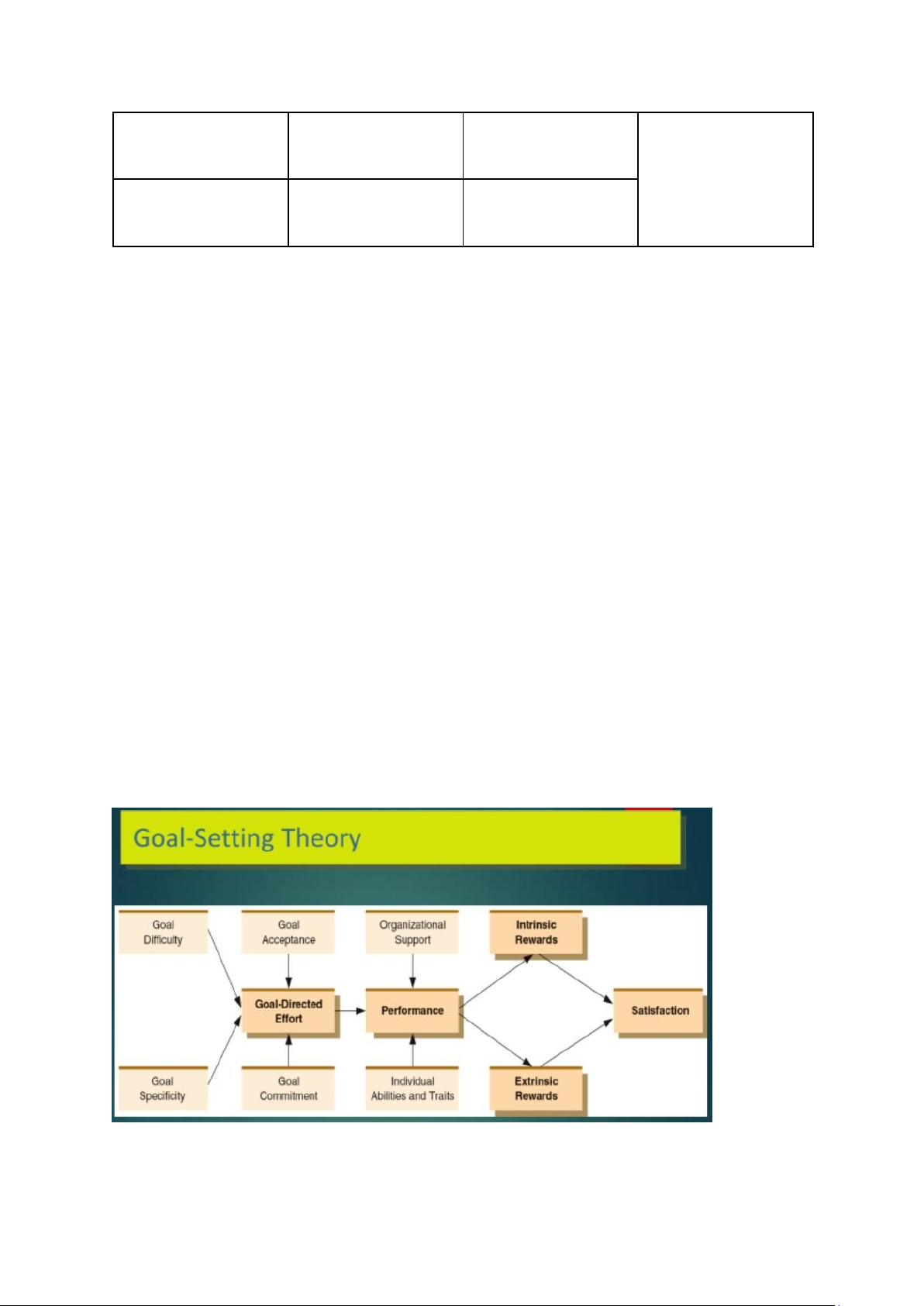
+ Goal-directed effort is a function of goal attributes:
1. Goal difficulty: The extent to which a goal is challenging, requires effort, and is attainable - Difficult Goals: + Focus and direct attention
+ Energize the person to work harder
+ Difficulty increases persistence
+ Force people to be more effective and efficient
2. Goal specificity: The clarity and precision of a goal
3. Goal acceptance: the extent to which a person accepts a goal as his/her own
4. Goal commitment: the extent to which a person is interested in reaching a goal
Broader Perspectives on Goal Setting
- Management by Objectives (MBO)
+ A collaborative goal-setting process through which organizational goals cascade
down throughout the organization lOMoAR cPSD| 58675420
+ Requires customizing to each organization
+ Can be effective for managing reward systems where the manager has individual
interactions with each employee
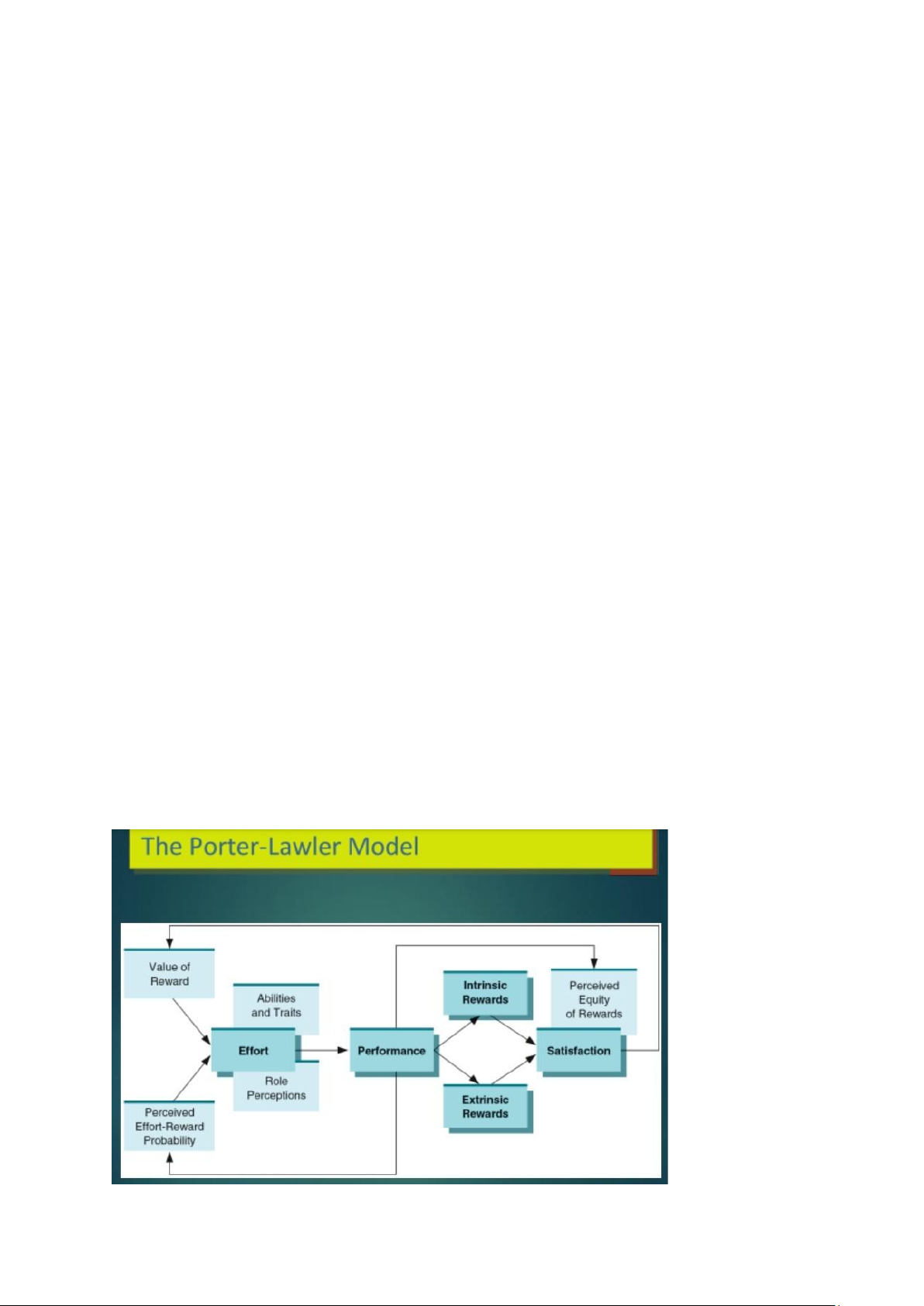
Expectancy Relationships (Linkages) - Effort-performance
+ The perceived probability that exerting a given amount of effort will lead to performance results
+ Factor influence Effort-Performance:
- Level of expectancy: belief/perception that one's effort will result attainment of desired performance goals.
- Factors affecting expectancy perception: self-efficacy vs Goal difficulty - Performance-reward
+ The belief that performing at a particular level will lead to the attainment of a desired outcome
+ Factor influence Performance-Reward:
- Instrumentality: Motivation depend on the perceived effective relationship between given
input and the expected outcome.
- Factor influence the individual's instrumentality perception: Trust, Control, Policies - Attractiveness
+ The importance placed on the potential outcome or reward that can be achieved on the job.
+ Factor influence Reward-Personal Goal:
- Valence: value placed on outcomes (intrinsic and extrinsic). It is a function of individual's
needs, goals, values and source of motivation
- Factors influencing valence for outcome: Values, Needs, Goals, Preferences
Implications for managers of Expectancy Theory
- Managers should give attention to a number of factors:
+ Use rewards appropriate in terms of individual performance
+ Attempt to establish clear relationships between effort- performance and rewards
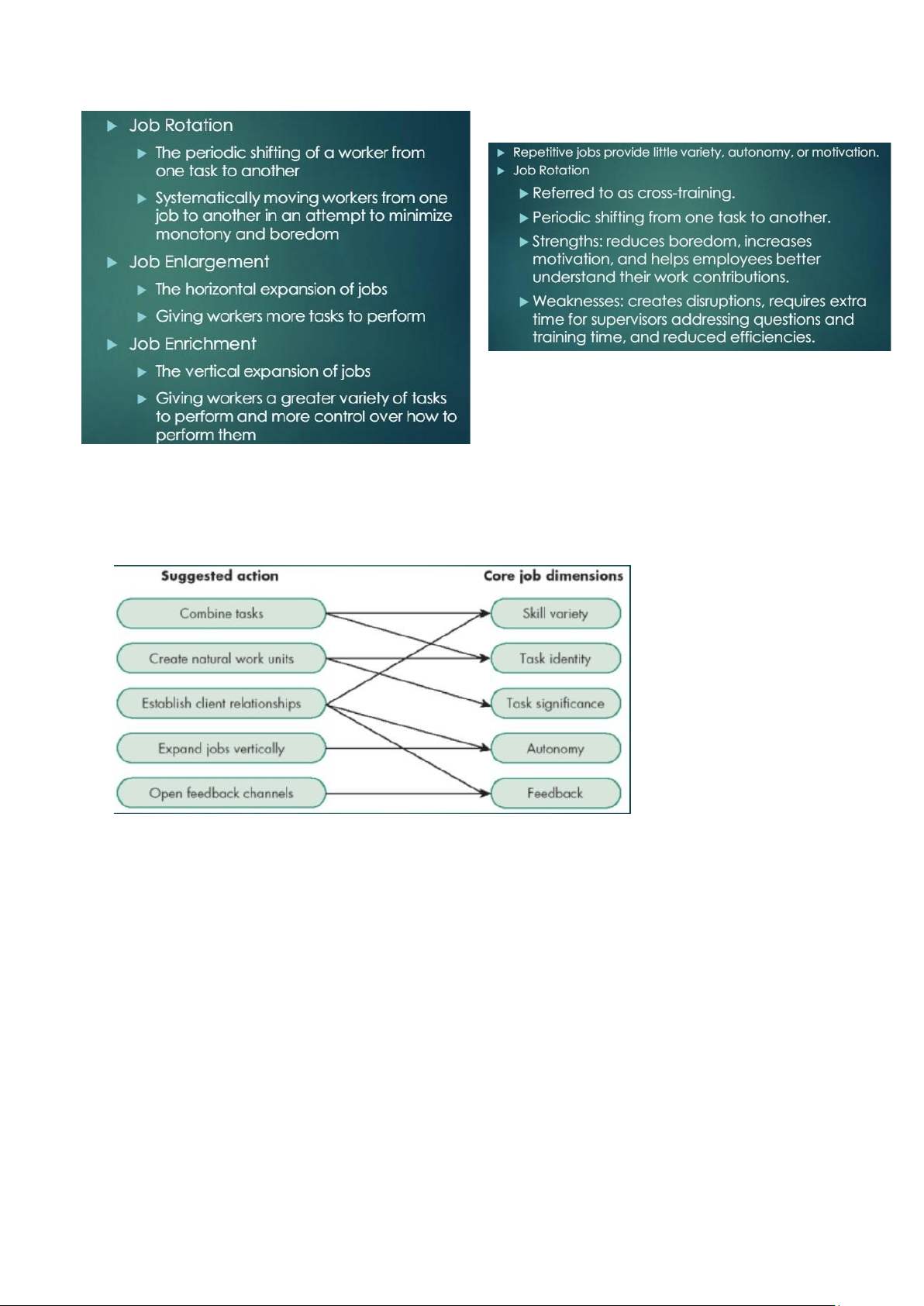
+ Establish clear procedures for the evaluation of individual levels of performance How Can Jobs Be Redesigned? lOMoAR cPSD| 58675420 Job enrichment
● Allow employees to plan their own work schedules.
● Allow employees to decide how the work should be performed.
● Allow employees to check their own work.
● Allow employees to learn new skills. Guidelines for Enriching a Job Flexible Work Arrangements ● Variable Work Schedules ○ Compressed work schedule
■ Employees work a full forty-hour week in fewer than the traditional five days
○ Flexible work schedules (flextime)
■ Employees gain more personal control over the hours they work each day ● Job Sharing
○ Part-time employees share one full-time job ○ Two or more people split a 40-hour- a-week job. ■ Declining in use.
■ Can be difficult to find compatible pairs of employees who can successfully
coordinate the intricacies of one job.
■ Increases flexibility and can increase motivation and satisfaction when a
40hour-a- week job is just not practical. ● Telecommuting
○ Employees spend part of their time working off-site
○ Employees do their work at home at least two days a week on a computer that is linked to their office. lOMoAR cPSD| 58675420 ● The Virtual Office
○ Employees work out of their home on a relatively permanent basis.
● Some well-known organizations actively discourage telecommuting, but for most
organizations it remains popular.
● Typical Telecommuting Jobs
○ Professional and other knowledge-related tasks
○ Routine information-handling tasks ○ Mobile activities
Employee Involvement and Motivation
● Early Perspectives on Employee Involvement ○ In the beginning:
■ Employee satisfaction is a result of their participation in decision-making ○ Recently:
■ Employees are valued human resources who can contribute to organizational effectiveness
■ Their participation is valued
● Areas of Employee Involvement
○ Personal job-related decisions
○ Administrative matters (e.g., work schedules) ○ Product quality decisions
● Techniques and Issues in Employee Involvement
○ Empowerment through work teams (quality circles)
○ Decentralization of decision-making and increased delegation Empowerment ● Empowering others by:
○ Articulating a clear vision and goals ○ Providing support
○ Providing necessary resources lOMoAR cPSD| 58675420 ○ Providing good information
Requirements for Effective Empowerment An organization must be:
► Sincere in its efforts to spread power and autonomy to lower levels of the organization
► Committed to maintaining participation and empowerment
► Systematic and patient in its efforts to empower workers
► Prepared to increase its commitment to training Delegation
● Delegation is the process of assigning tasks and granting sufficient authority for their accomplishment.
● Delegation is a process where a manager: ○
Determines the results expected ○
Allocates duties to subordinates
○ Grants them authority to enable those duties to be carried out
○ Holds them responsible for the completion of the work and achievement results.
The ultimate accountability for the task remains with the manager. Problems of Delegation
● Managers are reluctant to delegate because of: ● Low confidence and trust
● The burden of accountability for the mistakes of subordinates
● Poor control and communication system
● Lack of understanding of what delegation involves
● Lack of training and development of managers in delegation skills ● Fear of losing power Variable-Pay Programs ● What to Pay:
○ Complex process that entails balancing internal equity and external equity.
○ Some organizations prefer to pay leaders by paying above market.
○ Paying more may net better-qualified and more highly motivated employees who may stay with the firm longer. ● How to Pay: ○ Variable pay programs: ■ Piece-rate plans ■ Merit-based pay ■ Bonuses ■ Profit sharing
■ Employee stock ownership plans
○ Earnings therefore fluctuate up and down. ● Piece-Rate Pay
○ A pure piece-rate plan provides no base salary and pays the employee only for what he or she produces.
○ Limitation: not a feasible approach for many jobs.
○ The main concern for both individual and team piece-rate workers is financial risk. ● Merit-Based Pay lOMoAR cPSD| 58675420 ○
Allows employers to differentiate pay based on performance.
○ Creates perceptions of relationships between performance and rewards. ○ Limitations:
■ Based on annual performance appraisals. ■ Merit pool fluctuates. ■ Union resistance. ● Bonuses
○ An annual bonus is a significant component of total compensation for many jobs.
○ Increasingly include lower-ranking employees.
■ Many companies now routinely reward production employees with bonuses when profits improve.
○ Downside: employees' pay is more vulnerable to cuts. ● Profit-Sharing Plans
○ Organization-wide programs that distribute compensation based on some established
formula centered around a company's profitability.
○ Appear to have positive effects on employee attitudes at the organizational level.
■ Employees have a feeling of psychological ownership.
● Employee Stock Ownership Plan (ESOP)
○ A company-established benefit plan in which employees acquire stock, often at
below-market prices, as part of their benefits.
○ Increases employee satisfaction and innovation.
■ Employees need to psychologically experience ownership. ○
Can reduce unethical behavior.
● Evaluation of Variable Pay
○ Do variable-pay programs increase motivation and productivity? ■
Generally, yes, but that doesn't mean everyone is equally motivated by them Special Issues in Motivation ● Motivating Professionals
○ Provide challenging projects.
○ Allow them the autonomy to be productive ○ Reward with educational opportunities. ○ Reward with recognition.
○ Express interest in what they are doing.
○ Create alternative career paths.
● Motivating the Diversified Workforce
○ Provide flexible work, leave, and pay schedules.
○ Provide child and elder care benefits.
○ Structure working relationships to account for cultural differences and similarities.
● Motivating Low-Skilled Service Workers ○ Recruit widely.
○ Increase pay and benefits. ○ Make jobs more appealing.
● Motivating People Doing Highly Repetitive Tasks ○
Recruit and select employees that fit the job.
○ Create a pleasant work environment.
● Motivating Contingent Workers lOMoAR cPSD| 58675420 ○
○ Provide opportunity for permanent status.
Provide opportunities for training. ○ Provide equitable pay. Organization Structure
● The system of task, reporting, and authority relationships within which an organization does its work
● Purpose of structure is to order and coordinate the actions of employees to achieve organizational goals
● "Structure follows strategy"
Objectives of Organizational Structure
● To link individuals in an established network of relationships
● To group together the tasks required to fufil the objectives of the organization as a whole and
to allocate them to suitable individuals or groups
● To allocate to individuals or groups the authority they require to perform their functions
● To coordinate the objectives and activities of separated units
● To enable the flow of work, information and other resources via lines of cooperation and communication Organization Chart
● Organization chart: aid managerial thinking and communication but:
○ Static not dynamic as organization ○
Formal structrure of authority and communication, not present informal organization
○ Describe the structure of org, not the org itself (mission, values, people, activities)
● Describes the structure of an organization
○ Shows all people, positions, reporting relationships, and lines of formal communication
○ Depicts reporting relationships and work group memberships
○ Shows how positions and small work groups are combined into departments which
make up the shape (configuration) of the organization
● Units and relationships among them
● Formal communication and reporting channels ● Structure of authority, responsibility and delegation ● Different types of chart: ○ Vertical chart ○ Horizontal chart ○ Concentric chart ○ Matrix chart
○ "Metaphors": network spider web Departmentalization
● Functional Departmentalization
○ Jobs are combined according to the functions of the organization.
○ The principal advantage is efficiency.
■ By having departments of specialists, management creates efficient units.
○ A major disadvantage is that organizational goals may be sacrificed in favor of departmental goals.
● Customer Departmentalization lOMoAR cPSD| 58675420 ○
○ Customers and clients can be a basis for grouping jobs.
Examples of customer-oriented departments include: ■ Educational institutions
■ The loan department in a commercial bank ■ Telephone companies ■ Department stores
● Geographic Departmentalization
○ Groups are established according to geographic area.
○ The logic is that all activities in a given region should be assigned to a manager.
○ Advantageous in large organizations because physical separation of activities makes
centralized coordination difficult.
○ Provides a training ground for managerial personnel.
● Product Departmentalization
○ All jobs associated with producing and selling a product or product line are placed
under the direction of one manager.
○ Product becomes the preferred basis as a firm grows by increasing the number of products it markets.
○ Concentrating authority, responsibility, and accountability in a specific product
department allows top management to coordinate actions.
● Combined Bases for Departmentalization: The Matrix Organization
○ The matrix organization attempts to maximize the strengths and minimize the
weaknesses of both the functional and product bases.
■ Typically seen as a balanced compromise between functional and product organization.
■ Characterized by the existence of a dual authority system, which can cause conflicts.
■ Facilitates the utilization of highly specialized staff and equipment.
■ The flexibility of this system allows speedy response to challenges. Chain of Command
● System of reporting relationships in the organization from the first level up through the president or CEO
● The unbroken line of authority that extends from the top of the organization to the lowest
echelon and clarifies who reports to whom ● Unity of Command
○ A subordinate should have only one superior to whom he or she is directly responsible
● Organizational downsizing results in lower overhead costs, less bureaucracy, faster decision
making, smoother communications, and increases in productivity
● The chain of command is less relevant today because of technology and the trend of empowering people.
○ Operating employees make decisions once reserved for management.
○ Increased popularity of self-managed and cross- functional teams.
● Many organizations still find that enforcing the chain of command is productive. ● Responsibility
○ An obligation to do something with the expectation of achieving some act or output lOMoAR cPSD| 58675420 ○ ● Authority
○ The rights inherent in a managerial position to give orders and to expect the orders to be obeyed
Power that has been legitimized within a particular social context
■ Originates in the ownership of the organization
■ The relationship between responsibility and authority must be one of parity
■ Can be delegated down to others
■ Delegation is the transfer to others of authority to make decisions and
use organizational resources ●
An Alternative View of Authority
○ Acceptance Theory of Authority
■ The authority of a manager depends on their subordinates' acceptance of the
manager's right to give directives and to expect compliance with them
■ By either accepting or rejecting the directives of a supervisor, workers can limit supervisory authority
Conditions Affecting Span of Control
Optimal unit size (span of control) depends on:
1. The coordination requirements within the unit, including factors such as the degree of job specialization 2. Degree of specialization
3. Ability to communicate and manage
4. The similarity of the tasks in the unit
5. The type of information available or needed by unit members
6. Differences in the members' need for autonomy
7. The extent to which members need direct access to the supervisor
Centralization and Decentralization ● Centralization
○ The degree to which decision making is concentrated at a single point in the organization.
○ Decision-making authority is concentrated at the top of the organizational hierarchy ● Decentralization
○ The degree to which decision making is spread throughout the organization.
○ Decisions are made throughout the hierarchy. Delegation of Authority
● Delegation of authority: the process of distributing authority downward in an organization.
○ Managers decide how much authority should be delegated to each job and to each jobholder.
● The benefits of decentralizing authority include:
○ Relatively high delegation of authority encourages the development of professional managers.
○ Managers who have high authority can exercise more autonomy, and thus satisfy their
desires to participate in problem solving.
Reasons to Centralize Authority lOMoAR cPSD| 58675420 ○
● Managers must be trained to make the decisions that go with delegated authority, and training can be quite expensive.
● Managers accustomed to making decisions may resist delegating authority to their
subordinates, which can reduce effectiveness. lOMoAR cPSD| 58675420
● Administrative costs are incurred because new control systems must be developed to provide
top management with information about the effects of subordinates decisions.
● Decentralization means duplication of functions.
Delegation Decision Guidelines
● Delegation of authority differs among individuals, depending on each person's ability to make decisions.
● If a local manager is incapable of making decisions, decision making should be centralized,
regardless of how routine the decisions.
● Capable individuals aren't always motivated individuals.
● Motivation must accompany competency to create conducive conditions for decentralization. Formalization
● The degree to which rules and procedures shape the jobs and activities of employees ● The
degree to which jobs within the organization are standardized. ○ High formalization
■ Minimum worker discretion in how to get the job done
■ Many rules and procedures to follow ○ Low formalization
■ Job behaviors are nonprogrammed
■ Employees have maximum discretion
● Good managers use appropriate judgment in making exceptions to rules in recognizing that:
○ Individuals are unique with meaningful differences
○ There are commonalities among employees Matrix Designs
● Combines two different designs to gain the benefits of each.
● A structure that creates dual lines of authority and combines functional and product departmentalization ● Key Elements
○ Gains the advantages of functional and product departmentalization while avoiding their weaknesses
○ Facilitates coordination of complex and interdependent activities
○ Breaks down unity-of-command concept
● Matrix structure is appropriate when:
1. External pressure exists for a dual focus
2. Pressure exists for a high information-processing capacity
3. Pressure exists for shared focus Contingency Design Theories
● Contingency design theory: emphasizes the importance of fitting a design to the demands of a situation, including: ○ Technology ○ Environmental uncertainty ○ Strategy ○ Organization size
● The essence of this approach is expressed by this question:
Under what circumstances, and in what situations, is either the mechanistic or organic design
relatively more effective?
The Relationship Between Strategy and Structure
● Structure follows strategy” (Alfred Chandler) lOMoAR cPSD| 58675420
○ Management determines what the organization is to do and what its goals are before
designing appropriate structure ○ Innovation Strategy
■ A strategy that emphasizes the introduction of major new products and services ■ Organic structure best
○ Cost-minimization Strategy
■ A strategy that emphasizes tight cost controls, avoidance of unnecessary
innovation or marketing expenses, and price cutting ■ Mechanistic model best ○ Imitation Strategy
■ A strategy that seeks to move into new products or new markets only after
their viability has already been proven
■ Mixture of the two types of structure
● An organization's structure is a means to help management achieve its objectives.
● Most current strategy frameworks focus on three strategy dimensions: ○ Innovation ○ Cost Minimization ○ Imitation
The Relationship Between Size and Structure
○ Size: As measured by employee total, organization asset value, sales total, total of
clients served, physical capacity
■ Large organizations have a more complex structure
■ Large size -employing 2,000 or more people is associated with greater
specialization of labor, wider spans of control, more hierarchical levels, greater formalization
■ Large organizations are more efficient and take advantage of economies of scale
○ The impact of size becomes less important as an organization expands.
The Relationship Between Technology and Structure
● Technology: the way an organization transfers its inputs into outputs.
○ Numerous studies have examined the technology- structure relationship.
○ Organizational structures adapt to their technology
● The mechanistic design is effective for firms that mass produce products, such as clothing, foods, and automobiles.
○ Tasks are fairly routine, where workers tend machines designed and paced by engineering standards.
○ Actual control of the work flow is separated from supervision of the workforce.
○ In such organizations, the ideas of scientific management and mechanistic design are applicable
The Relationship Between Environment and Structure ● Environment
○ Institutions or forces outside the organization that potentially affect the organization's performance
○ All elements that lie outside the organization boundary
■ People, other organizations, economic factors, objects, events ■ General environment
● All of a broad set of dimensions and factors within which the organization operates
○ Political-legal, social, cultural, technological, economic, international lOMoAR cPSD| 58675420 ■ Task environment
● Specific organizations, groups, individuals who influence the organization
● Three key dimensions: capacity, volatility, and complexity
The Nature of Organization Culture ● Culture Values
○ Are often taken for granted (implicit)
○ May not be made explicit (i.e., not written down)
○ Are communicated through symbolic means; Are passed from one generation to the next
● Organizations are able to operate efficiently only when shared values exist among the employees.
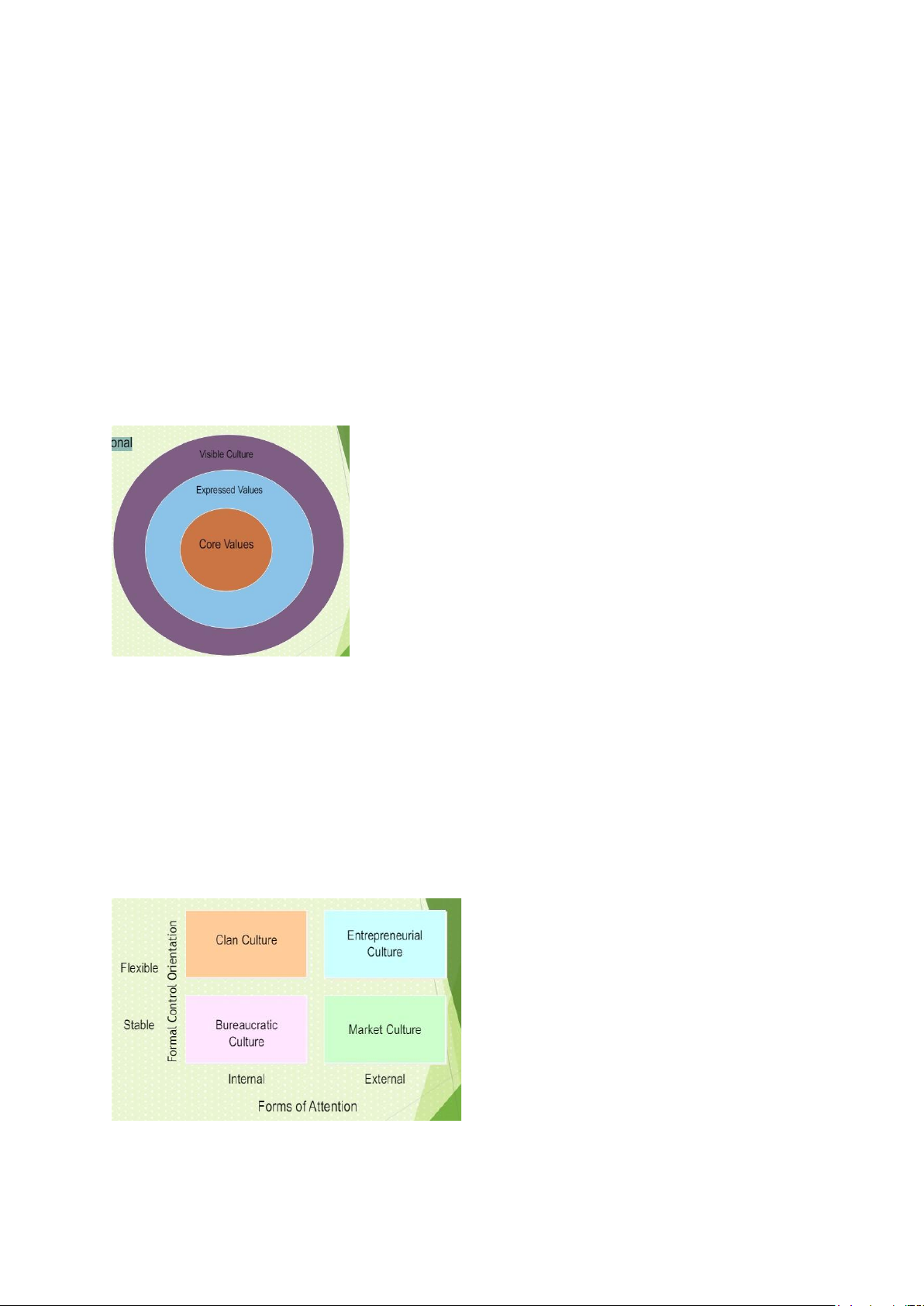
● An individual's personal values guide behavior on and off the job. Levels of organizational Culture What Do Cultures Do? ● Culture as a Liability ○ Institutionalization
○ Barrier to change: Occurs when culture's values are not aligned with the values necessary for rapid change
○ Barrier to diversity: Strong cultures put considerable pressure on employees to
conform, which may lead to institutionalized bias
○ Barrier to acquisitions and mergers: Incompatible cultures can destroy an otherwise successful merger Types of Culture
Managing Organization Culture
● Taking Advantage of the Existing Culture
○ Easier and faster to alter employee behaviors within the existing culture than it is to
change existing history, traditions, and values
○ Managers must be aware and understand the organization's values
○ Managers can communicate their understanding to lower-level individuals lOMoAR cPSD| 58675420
● Teaching Organization Culture
○ Organizational socialization
■ Is the process through which employees learn about the firm's culture and
pass their knowledge and understanding on to others ○ Organizational mechanisms
■ Are examples of organization culture that employees see in more experienced employees' behaviors
● Corporate pamphlets and formal training sessions
● Changing the Organization Culture ○ Managing symbols
■ Substituting stories and myths that support the new cultural values for those that support old ones
○ Culture can be difficult to change when upper management inadvertently reverts to old behaviors ● The Stability of Change
○ New values and beliefs must be seen as stable and influential as old ones
○ Changing value systems requires enormous effort because value systems tend to be self-reinforcing
● Culture can be changed, but ○ Need time ○ Support from top managers ○ Other resources
● How to make culture change ○ Change people
○ Change corporate vision and mission
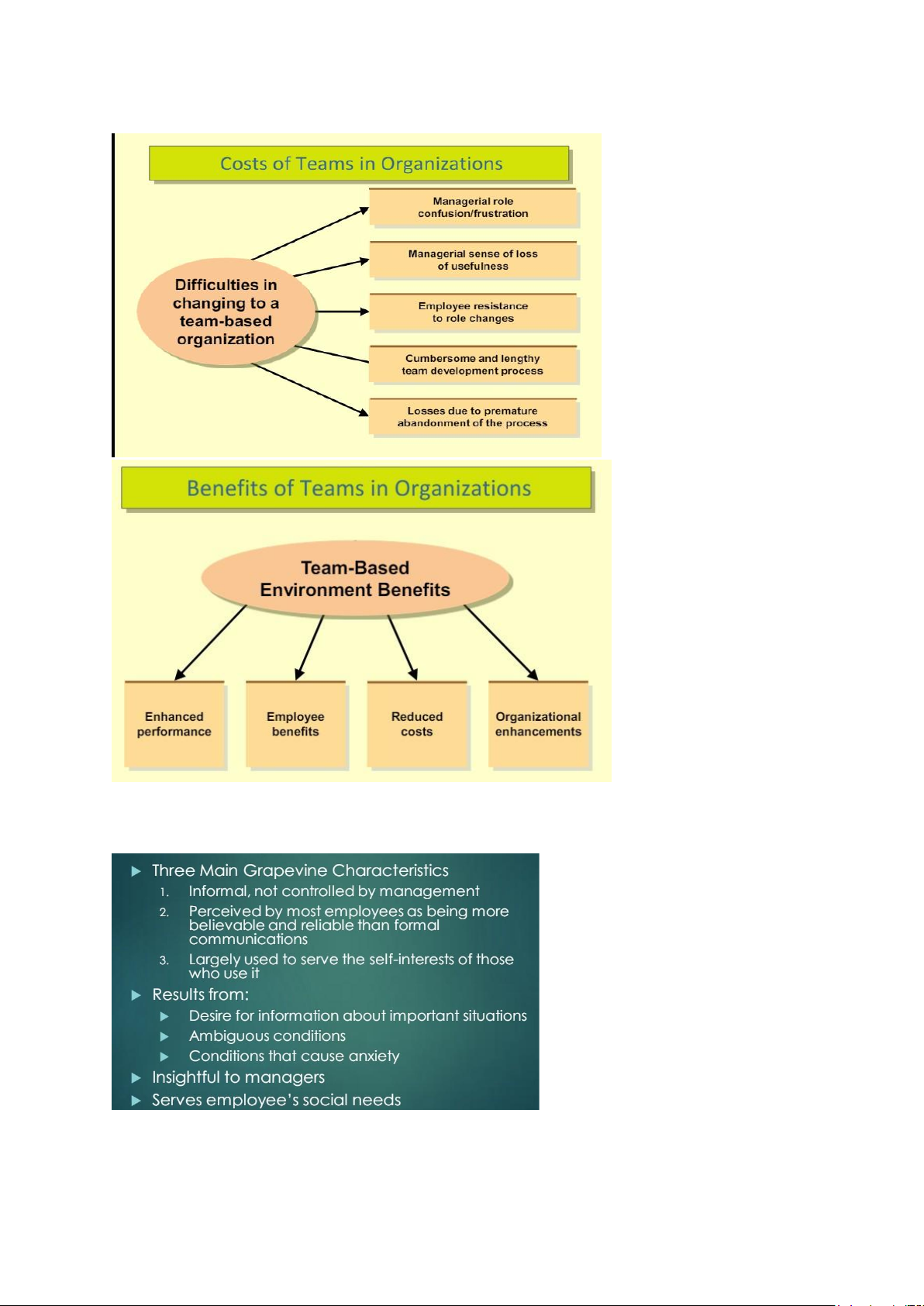
○ Change organizational policies and system: reward system, recruitment and selection policies, technology... lOMoAR cPSD| 58675420 TEAMWORK Communication The Grapevine lOMoAR cPSD| 58675420
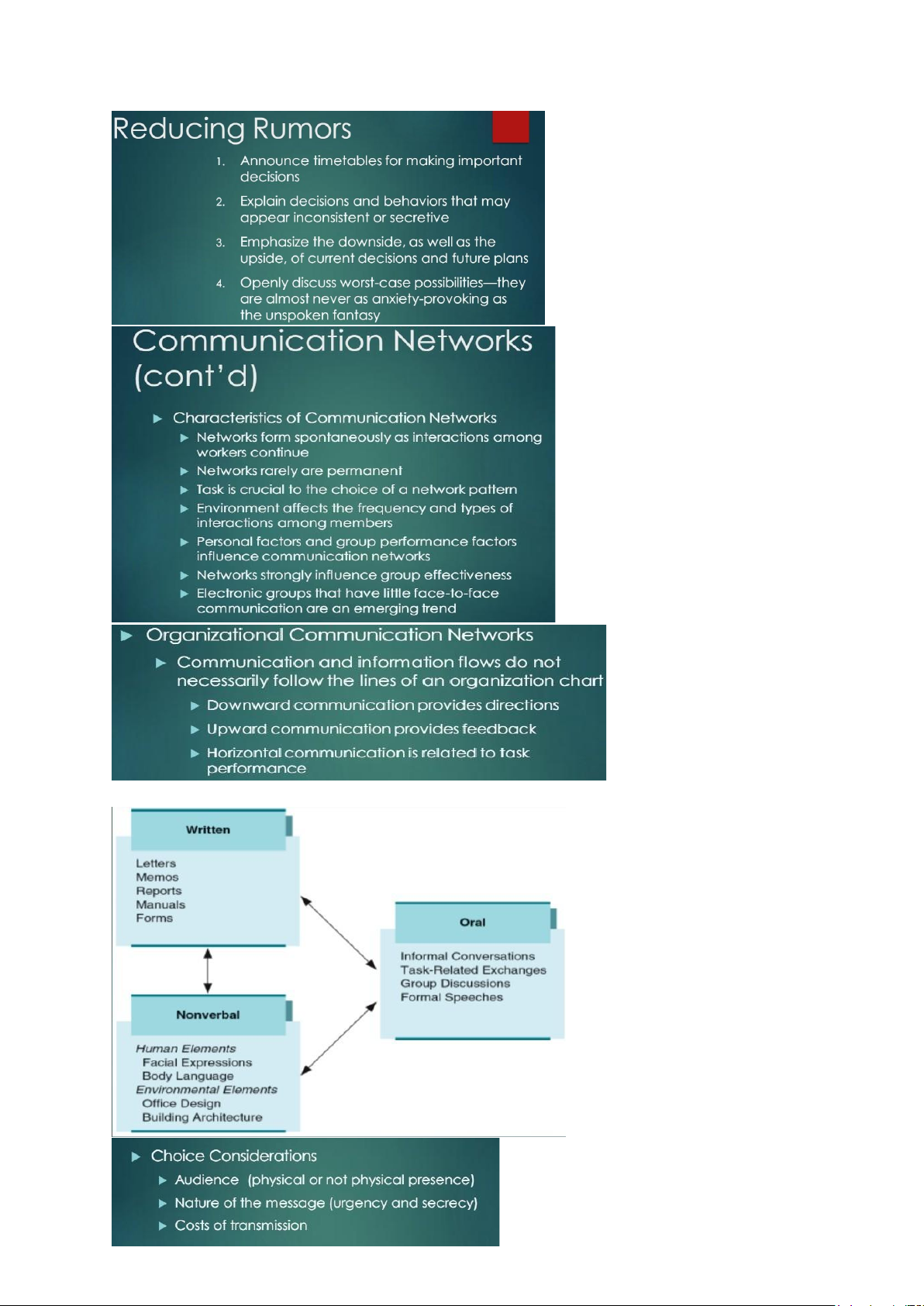
Methods of Communication lOMoAR cPSD| 58675420 LEADERSHIP What Is Leadership? Leadership
► The ability to influence a group toward the achievement of goals
► Not all leaders are managers, nor are all managers leaders.
► Is a property-the set of characteristics attributed to someone who is perceived to use influence successfully
► Is influence-the ability to affect the perceptions, beliefs, attitudes, motivation, and/or behavior of others Management
► Use of authority inherent in designated formal rank to obtain compliance from organizational members
► Both are necessary for organizational success
Trait Approaches to Leadership
■ Attempts to identify stable and enduring character that differentiate effective leaders from nonleaders focusing on:
► Identifying leadership traits
■ Developing methods for measuring them.
► Using the methods to select leaders
► Current limited set of leadership traits
► Emotional intelligence, drive, motivation; honesty and integrity, self-confidence, cognitive
ability, knowledge of the business, charisma
Traits can predict leadership, but they are better at predicting leader emergence than effectiveness. The Michigan Studies
►Two key dimensions of leader behavior:
►Employee-oriented/ Employee- centered
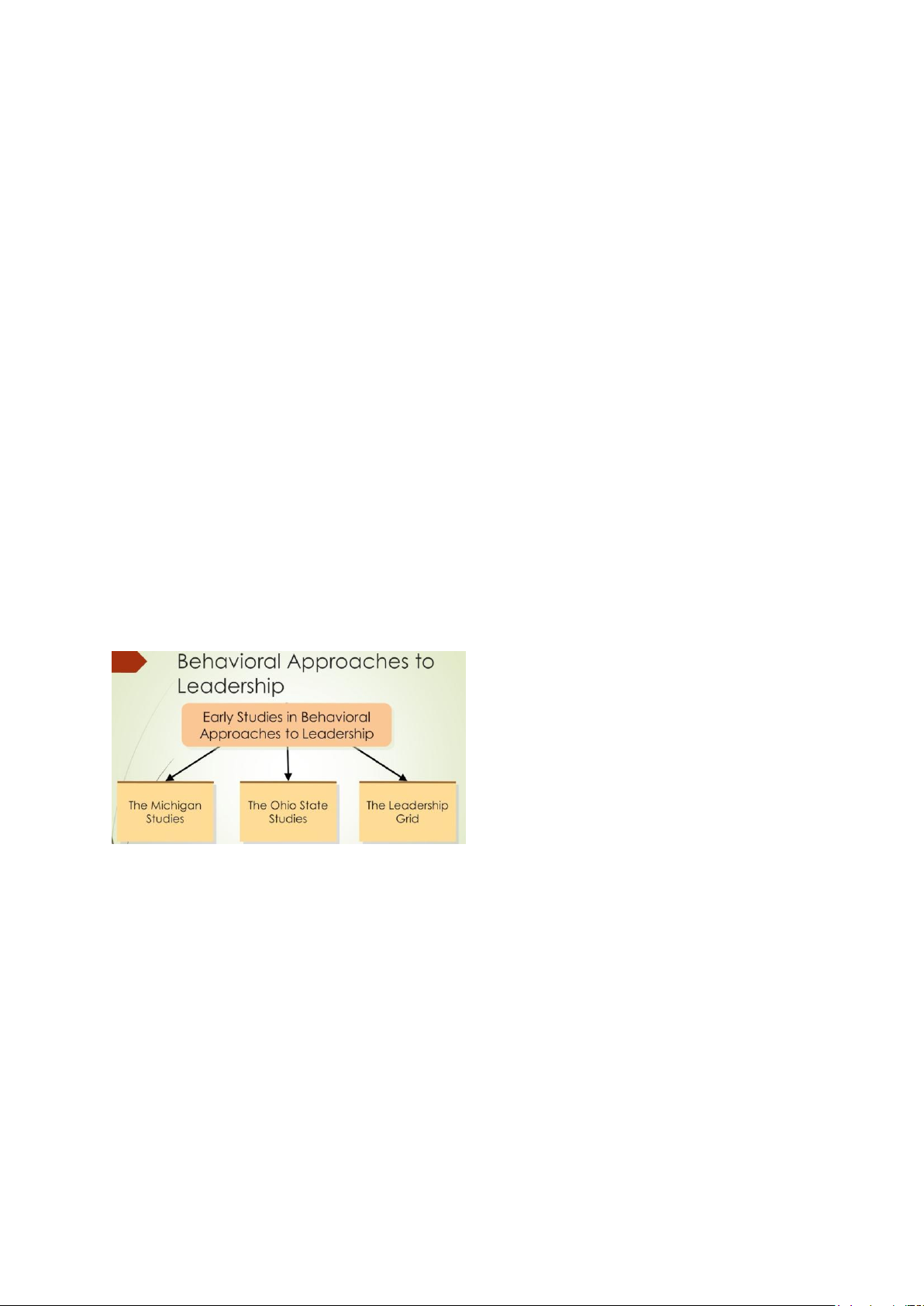
►Production-oriented / Job- centered The Ohio State Studies
►Found two key dimensions of leader behavior: ►Initiating structure ►Consideration ►Both are important The Leadership Grid
- Provides a means for evaluating leadership styles and then training managers to move toward an ideal style of behavior
- Draws on both studies to assess leadership style
+ "Concern for People" is Consideration and Employee-Orientation
+ "Concern for Production" is Initiating Structure and Production- Orientation
- Style is determined by position on the graph lOMoAR cPSD| 58675420
The Emergence of Contingency Leadership Models
► While trait and behavior theories do help us understand
leadership, an important component is missing: the environment in which the leader exists
► Situational leadership theories deals with this additional aspect of leadership effectiveness studies
+ Assume that appropriate leader behavior varies from one situation to another situation +
Seek to identify how key situational factors interact to determine appropriate leader
behavior ► Three key theories: ● Fielder's Model
● Hersey and Blanchard's Situational Leadership Theory ● Path-Goal Theory
Emerging Issues in Leadership (cont’d) Strategic Leadership
► Requires that leaders be capable of:
■ Understanding the complexities of both the organization and its environment
■ Leading change in the organization to achieve and maintain a superior alignment
between the organization and its environment ► Managerial requirements:
■ Encompassing understanding of the organization
■ Firm grasp of the organization's environment
■ Awareness of firm's alignment with the environment
■ Ability to improve the alignment
Why Ethical Leadership Is Essential
► Increasing pressure for high ethical standards for leadership positions
► Increasing pressure to hold leaders accountable for their actions
► Increasing environmental pressure for stronger corporate governance models Virtual Leadership Challenges
► Changes in leadership and mentoring as in-person contact replaces virtual contact
► Less nonverbal communication
► Increasing importance of e-mail's role in conveying appreciation, reinforcement, and constructive feedback
► Face-to-face leadership skills become critical as opportunities decrease for direct contact GROUP BEHAVIOR Group Property 1: Roles
● Role ambiguity occurs when there is lack of clarity as to the precise requirements of the role
and the person is unsure what to do
● Role overload is when a person faces too many separate roles or too great a variety of expectations.
● Role underload can arise when the prescribed role expectations fall short of the person's perception of their role Group Property 2: Norms
● Is an assumption or expectation held by group members concerning what kind of behavior is: ○ Right or wrong ○ Good or bad ○ Allowed or not allowed
○ Appropriate or not appropriate ● Classes of Norms ○ Performance norms - lOMoAR cPSD| 58675420 ○ Appearance norms ○ Social arrangement norms○ Allocation of resources norms
○ Improvement and change norms Group Property 4: Size
● Is the number of members of the group
○ Twelve or more members is a "large" group
○ Seven or fewer is a "small" group
● Affects resources available to perform the task
● Affects degree of formalization of interactions, communication, and participation
● Can increase the degree of social loafing
● Factors that Determine Ideal Group Size ○ Group members' ability
○ Maturity of individual group members ○ Group tasks
○ Ability of the group leader
Group Property 5: Cohesiveness
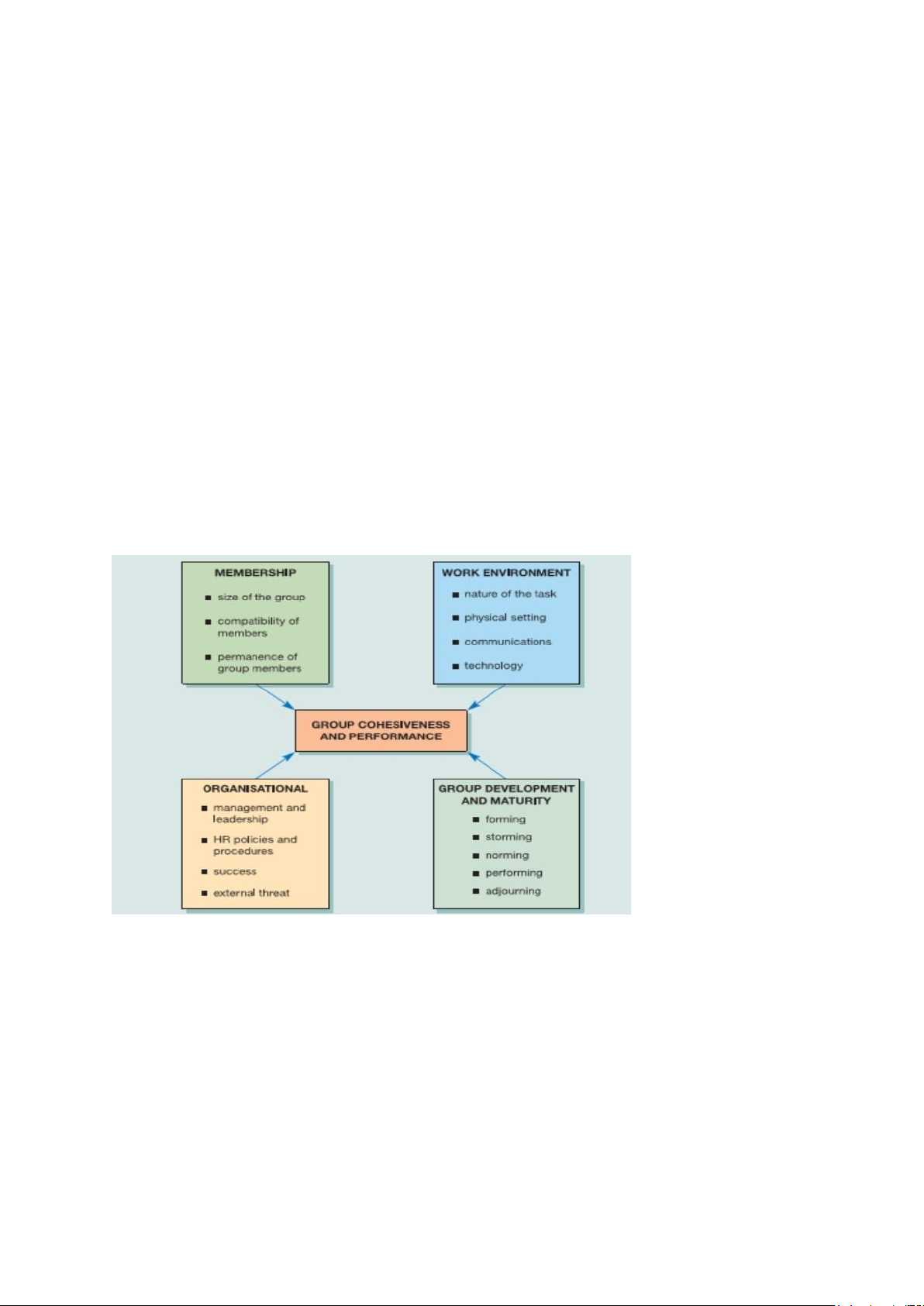
● Factors contributing to group cohesiveness Group Property 6 - Composition - The degree of similarity or difference among group members on factors important to the group's work - Homogeneity: Degree to which members are similar in one or several ways that are critical to the group's work - Heterogeneity:
Degree to which members differ in one or more ways that are critical to the group's work
Group Decision Making (cont'd) ● Groupthink
○ A mode of thinking that occurs when members of a group are deeply involved in a
cohesive in-group and the desire for unanimity offsets their motivation to appraise alternative courses of action ● Effects of Groupthink
○ Consideration of and focus on fewer alternatives
○ Failure to perceive non-obvious risks and drawbacks of an alternative
○ Rejection of expert opinions
○ Ignoring potential for setbacks or actions of competitors in not developing contingency plans
Tài liệu liên quan:
-
Ôn thi Môn Organizational behavior | Đại học Kinh Tế Quốc Dân
61 31 -
Câu hỏi tổng hợp Môn Organizational behavior | Đại học Kinh Tế Quốc Dân
64 32 -
Case Study Analysis Costco's Competitive Strategy | Môn Organizational behavior - Đại học Kinh Tế Quốc Dân
73 37 -
Ảnh hưởng của drone R2D2 đến hành vi nhân viên và đạo đức | Môn Organizational behavior - Đại học Kinh Tế Quốc Dân
57 29 -
Analyzing InnovateX's Organizational Behavior Issues | Môn Organizational behavior - Đại học Kinh Tế Quốc Dân
56 28