Product export plan for DH Foods company | Môn Marketing quốc tế - Đại học Kinh Tế Quốc Dân
CEO Nguyen Trung Dung started DH Foods Co Ltd. in 2012. In its 11 years of business, DH Foods has established itself as the premier, esteemed company specializing in regional spice specialties from Vietnam. Its primary offerings are authentic, traditional Vietnamese spices and sauces, including dipping sauces, salt, and spices for cooking and marinating. Tài liệu được sưu tầm gồm 45 trang, giúp bạn ôn tập tốt hơn. Mời các bạn đón xem.
Môn: Marketing quốc tế 93 tài liệu
Trường: Trường Đại học Kinh Tế Quốc Dân 8.2 K tài liệu
Tác giả:


















Preview text:
lOMoAR cPSD| 59691467
N ATIO N AL ECO N OMIC U N IVERSITY
SCHOOL OF ADVA N CED EDUCATIO N AL PROGRAMME
- - - - - - - - - - * * * - - - - - - - - - -
GROUP 6 - MARKETI N G MA N AGEME N T 63E
I N TER N ATIO N AL MARKETI N G
PRODUCT EXPORT PLA N FOR DH FOODS COMPA N Y Member ID
Tr ầ n Ánh D ươ ng 11211643
N guy ễ n H ươ ng Trà 11215696
Đỗ Thu Huy ề n 11212674 Hoàng Khánh Linh 11213145
N guy ễ n Võ Kim Th ị nh 11215517
L ụ c Minh H ạ nh 11212104
Lecturer: Mr. Tr ầ n Vi ệ t An Hanoi, Oct/2023 lOMoAR cPSD| 59691467 TABLE OF CONTENT CHAPTER I 5
GENERAL INTRODUCTION ABOUT DH FOODS, VIETNAMESE
ENVIRONMENT & PRODUCT PORTFOLIO 5 1. Dh Foods 5 1.1. Company Overview 5 1.2. Missions & Goals 5
1.3. Company's business activities 5 1.4. Resources 7 1.4.1.Human Resources 7 1.4.2.Financial resources 7 1.4.3.Physical resources 8 1.4.4.Brand Reputation 8 1.5. Suppliers 8 2. Vietnamese environment 8 3. SWOT 10 4. Product Portfolio 10
4.1. Product Portfolio of Dh Foods 10
4.2. Product lines that have been exported 11 4.3. The chosen product line 11 CHAPTER II 12
INTERNATIONAL MARKET SELECTION 12
1. A look at Dh Foods' current markets 12 2. First Screening 13 3. Second Screening 13
4. Comparison between Polish market and Canadian market 13
5. Marketing attractiveness evaluation 16 6. Conclusion 17 7. Region 17 CHAPTER III 18 lOMoAR cPSD| 59691467
GENERAL POLISH ENVIRONMENT & SPICES MARKET 18 1. General Polish Environment 18
1.1. Introduction of the Polish Market 18 1.2. Demographic Environment 19 1.3. Economic Environment 19
1.3.1.Overview of Poland’s Economic 19
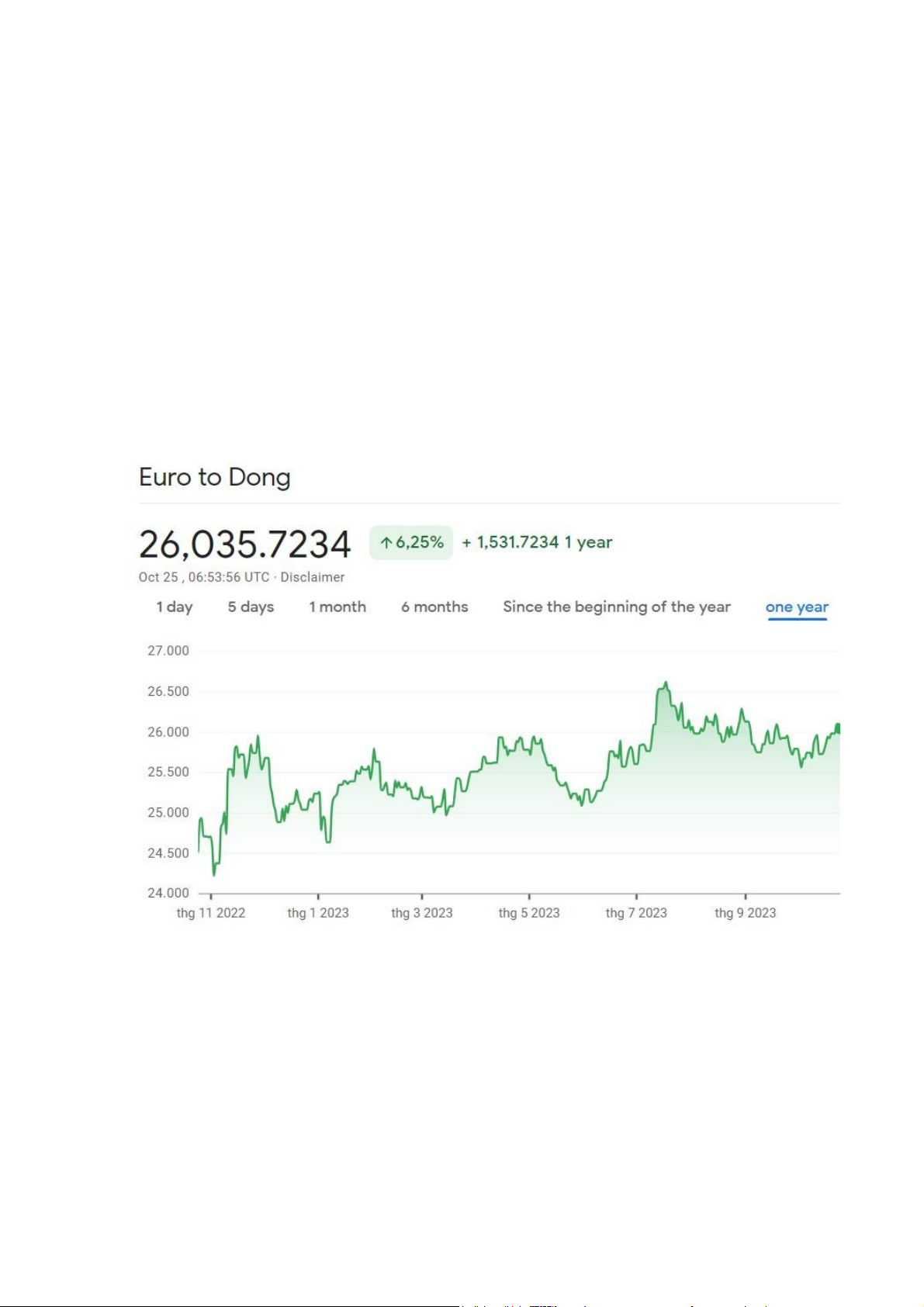
1.3.2.The stability in the exchange rate between Vietnam Dong and currencies used in Poland (EURO) 20
1.4. Sociocultural Environment 21
1.5. Technological Environment 21 1.6. Political Environment 22 1.6.1.EU 22 1.6.1.1.Food Safety 22
1.6.1.2.Tax Policies and Tax Rate 22 1.6.1.3.EVFTA 23 1.6.1.4.Custom Procedures 24 2. Polish Spices Market 25
2.1. Market Size & Potential 25 2.2. Competitors 26 2.3. Target Customers 28 2.3.1.Demography 28
2.3.2.Psychology and Buying Behavior 28 CHAPTER IV 29 MARKET ENTRY MODES 29
1. Choosing Market Entry Modes 29 1.1. Internal Factor 29 1.2. External Factor 29
1.3. Direct and indirect trade barriers 30
1.4. Transaction-specific factors 30 1.5. Conclusion 30 lOMoAR cPSD| 59691467 2. Direct Export Modes 30
2.1. Current partner of Dh Foods in EU markets 30
2.2. International Partner Matrix 31
2.2.1.The performance of the distributor partner 31
2.2.2.The general attractiveness of the market where the partner operates 31 CHAPTER V 31 MARKETING MIX 31 1. Product 31
1.1. Product design in current markets 31
1.2. Labelling & Packaging 32 1.2.1.EU Regulation 32 1.2.2.Adjust Packaging 32 2. Price 33
2.1.Factors influencing international pricing decisions 33
2.2.Price of Dh Foods’ product in other European markets & Price of similar products from competitors 34 2.3.Pricing Strategies 35 3. Place 35
3.1.Factors influencing channel width 35 3.2.Retail channels in Poland 36 4. Promotion 36
4.1.Factors affecting promotion activities 36 4.2.Communication tools 37 5. Marketing Mix Plan 37 CHAPTER VI 41 BUDGET & CONTROL 41
1. International Marketing Budget 41 2. Marketing Control 43 CONCLUSION 43 REFERENCES 45 lOMoAR cPSD| 59691467 MEMBER CONTRIBUTION 45 CHAPTER I
GENERAL INTRODUCTION ABOUT DH FOODS, VIETNAMESE
ENVIRONMENT & PRODUCT PORTFOLIO 1. Dh Foods 1.1. Company Overview
CEO Nguyen Trung Dung started DH Foods Co Ltd. in 2012. In its 11 years of business,
DH Foods has established itself as the premier, esteemed company specializing in regional
spice specialties from Vietnam. Its primary offerings are authentic, traditional Vietnamese
spices and sauces, including dipping sauces, salt, and spices for cooking and marinating.
Dh Foods believes that using high-quality spices would enhance the flavor of food and
make people happier. The spices from Dh Foods are also regional delicacies that showcase
some of Vietnam's most notable cultural characteristics.
With its current 9 product lines and 170 goods, DH Foods is generating a lot of buzz and
holding a dominant position in the home market. The products of DH Foods are specifically
categorized to fit each specialty in various places.
Since 2016, DH Foods has successfully exported to Japan, beginning a journey to deliver
Vietnamese spices to 98 nations with demanding requirements: Korea, Japan, the
Netherlands, Australia, the United States, the United Kingdom, Germany, Russia, France and others on many continents.
1.2. Missions & Goals
• DH Foods is acutely aware of the negative impact artificial substances have on public
health. As a result, DH Foods strives to produce goods that maintain the original hue and flavor of each ingredient.
• DH Foods works to educate customers on the value of thoroughly checking the
ingredients before buying any product in order to choose those that are safe.
• Every single DH Foods product is 100 percent pure.
• As a result of consistently adhering to the standards of "No Artificial Color, No
Preservatives, No Foreign Matter" since its inception, Dh Foods has emerged as the
consumer's top option for quality and safety.
1.3. Company's business activities
Although business activities were greatly affected during the Covid pandemic, Dh Foods'
operations still achieved many achievements:
• Dh Foods experienced good business outcomes in 2021. In the context of the Covid-
19 epidemic, the company generated income of 144.2 billion VND, up 51.6% from 2020
and 14.5% more than anticipated. lOMoAR cPSD| 59691467
• A partnership agreement between Dh Foods Joint Stock Company and Heritage
Beverage was inked in the early months of 2022, opening the US market to Vietnamese regional specialty spices. lOMoAR cPSD| 59691467 •
Dh Foods had the distinction of taking part at VietFood, the 26th International Food and
Beverage Exhibition, in 2022. Additionally in 2022, DH Foods organizes the Shareholders'
Meeting with much-needed future direction. to revamp the business strategy in order to dominate the global market.
• DH Foods began its journey to the great ocean in 2016 with problems and difficulties,
but the company has gradually demonstrated its potential to introduce Vietnamese products
to the rest of the world. After passing the "test" from the European market on procedure,
manufacturing, factory, and so on, DH Foods obtained the order in 2017; first with a 12,000 USD value.
• By 2018, DH Foods had continued to pass the stringent "test" imposed by the Japanese
market, which threatened to cancel the contract if DH Foods did not satisfy the product
quality requirements to which they had pledged to conclude.
• DH Foods expanded its journey to many more nations after acquiring the trust of
demanding markets, including the United States, Australia, Russia, the United Kingdom,
Korea, Japan, France and Germany. DH Foods consolidates its resources and continues to
prepare for the internationalization of Vietnamese products from 2020 to 2021. 1.4. Resources 1.4.1.Human Resources
• As of 2023, Dh Foods has a team of over 400 employees, including production
workers, quality control inspectors, marketing and sales staff, and administrative personnel.
• The company has a strong commitment to employee training and development, and
offers a variety of programs to help employees learn new skills and advance their careers.
• The company also has a number of initiatives in place to promote a healthy and
productive work environment. Instead of managing human resources with discipline
through KPIs, Mr. Dung experimented with the 'heart-warming' management style:
training, guidance and inspiration.
1.4.2. Financial resources
In 2022, Dh Foods had a revenue of $12 million and a net profit of $2 million. The
company has a strong financial foundation, with over $10 million in cash and cash
equivalents, as well as a good track record of profitability, and has been able to reinvest its
profits in new products, technologies, and marketing initiatives. Dh Foods is also debt-free,
which gives it more financial flexibility to invest in its future growth.
Dh Foods financial performance in 2021: lOMoAR cPSD| 59691467 • •
Total revenue: 144.2 billion VND (about 6.4 million USD), an increase of 51.6% from 2020. •
Net profit: 10.8 billion VND (about 450,000 USD), an increase of 21.9% from 2020.
Dh Foods has set a target of achieving total revenue of 190-215 billion VND (about 8-9
million USD) and net profit of 16-18 billion VND (about 650,000-720,000 USD) in 2022.
1.4.3. Physical resources
• Dh Foods has a modern production factory - Le Minh Xuan Factory in Ho Chi Minh
City. The facility is equipped with state-of-the-art machinery, including a high-speed
bottling line and a warehouse with a capacity of 1,500 tons.
• The company also has a network of distribution partners in 8 countries.
• The company is in the process of expanding its production capacity to meet the
growing demand for its products.
1.4.4. Brand Reputation •
Dh Foods has a relatively positive brand reputation in Vietnam and in export markets. •
The company is known for their high-quality products, their commitment to safety and
quality, and innovative marketing campaigns. For example, the company has been featured
in televisions, magazines and newspapers, actively participated in fairs and exhibitions in
Vietnam and in other countries, and won several awards for their products and business practices. 1.5. Suppliers
Dh Foods' spices are specialties with typical cultural features of Vietnam's regions. The
Company's raw material sources are mainly cooperated with typical agricultural products
from the North region to the South region in Vietnam such as pepper from Pleiku, chilli from
the Central region, salt from the Central region… So, their suppliers are mainly the farmers
in each region. Moreover, the company has cooperated with farmers to establish a granary of
raw materials that benefits both farmers and Dh Foods to ensure the quality of the ingredients and the price.
2. Vietnamese environment
Export incentives are understood as measures, policies, and financial assistance from the
government to domestic companies to promote exports and support the country's balance of
payments. Measures to encourage exports may include direct subsidies to reduce the price of
exported goods (export subsidies), tax incentives (tax exemption on profits earned from lOMoAR cPSD| 59691467 •
exports), and provision of credit (exemption of profits from exports). using preferential
exports, low interest rates) and financial guarantees.
Currently, the Vietnamese government has many policies to promote the export of goods
abroad by domestic companies. Some notable policies include the following:
• The imposition of low or 0% tax rates on Vietnamese goods as agreed in a total of 17
FTAs that Vietnam has been negotiating, signing, and implementing is a driving force to
boost export activities of businesses.
Export Promotion Programs: Vietnam still maintains several forms of export subsidy
under Government programs such as reducing or exempting taxes; providing direct
financial support (especially for new exporters) to the export of goods to new markets or to
goods affected by price fluctuations; and granting export rewards (under Trade Ministry
Decision No. 02/2002/QD-BTM). The Export Support Fund is maintained to support, encourage and promote export.
• Export Credit and Finance Support: The government, through institutions like the
Vietnam Export-Import Bank (Eximbank) and Agribank, provides export credit and
financing support to help businesses access the necessary capital to expand their export activities.
• Investment in Infrastructure: Infrastructure development, such as the expansion and
improvement of ports, transportation networks, and logistics facilities, is a key part of
facilitating efficient export processes. Vietnam has a lot of infrastructure constantly being
built, including road systems, seaports, airports,...
• Trade Promotion Agencies: Vietnam has several trade promotion agencies that assist
businesses with export-related activities. These agencies help with market research, trade
missions, and participation in international trade fairs and exhibitions.
• Customs Simplification: Streamlining customs procedures and reducing red tape make
it easier for companies to export their products. The Vietnamese government has made
efforts to simplify and modernize customs processes. lOMoAR cPSD| 59691467 3. SWOT Strengths Weaknesses •
Dh Foods has a relatively stable •
The quality and selling price of the financial foundation.
Dh Foods products depend entirely on the •
Dh Foods has a certain number of Le Minh Xuan factory. loyal customers. •
Product quality depends on many •
Dh Foods' product coverage in the
different raw material sources, which can
Vietnamese market and foreign markets is
be affected by factors such as weather, increasingly expanding. crops, diseases,... •
Dh Foods has a diverse product •
Promoting activities of Dh Foods
portfolio and the product quality meets
are not as effective as major competitors international standards.
such as Cholimex, Ajinomoto, Knorr,... •
Dh Foods has been effectively and
stably conducting business operations in
Vietnam and 9 other countries. Oppoturnities Threats •
The spice market in Vietnam is • Nowadays, competitors appear
vibrant and Vietnamese families have a
more and more and new product types are
great need to use spices in meals. The increasingly diverse.
average annual growth rate of this industry •
The large and rapidly changing
is forecast to continue to increase in the
spice market like Vietnam requires Dh coming years.
Foods to adjust and be more active in •
In recent years, the Vietnamese
promoting activities to avoid being kicked government has been promoting out of the spice market.
businesses participating in exporting the
seasoning industry to maintain its position
as the leading exporting country.
=> Although promoting activities of Dh Foods are not effective compared to experienced
competitors in the markets, the company's business activities at this time have shown the
position of the brand in Vietnam and other nations. Thereby, the company is strong enough
and should seize the opportunity by continuing to introduce its products to the international market. 4. Product Portfolio
4.1. Product Portfolio of Dh Foods.
Dh Foods have a wide range of product lines. The current product lines of Dh Foods include:
• Tay Ninh Dipping Salt speciality
• Sauce speciality and Chili sauce • NATURAL Spices specialty lOMoAR cPSD| 59691467
• NATURAL Cooking & Marinade spice
• NATURAL Dipping Salt speciality • Sate Sauce • Soup Base for cooking
4.2. Product lines that have been exported
Currently, there are 4 product lines exported by Dh Foods to foreign countries. Specific
information is given in the following table: Tay Ninh Sauce speciality NATURAL Spices NATURAL Dipping Salt and Chili sauce specialty Cooking & speciality Marinade spice Germany x x x Korea x x Australia x x x Russia x x x x US x x x Japan x x x France x x x Netherlands x x x UK x x x
4.3. The chosen product line
As illustrated in the table, Dh Foods mainly exported 2 types of their product lines
including: Sauce speciality and Chili sauce, and Tay Ninh Dipping Salt speciality. These 2
spice lines of Dh foods have received good feedback in the countries where Dh foods exports.
Furthermore, this is the most prominent product line of Dh Foods and is also the product line that makes the brand famous.
Our group suggested choosing the Sauce Speciality and Chili sauce line of Dh Foods to
export. This product line is suitable for many cuisines around the world, including Asian
cuisine and European cuisine. The Sauce Speciality line includes 19 different sauces such as: lOMoAR cPSD| 59691467
pineapple sauce, mango sauce, orange sauce, salted egg yolk sauce, cheese sauce, kumquat
sauce, black pepper sauce,... With Dh Foods dipping sauce, customers can use it instantly or
use it as a marinade for grilled dishes and vegetables in the simplest and most convenient way. CHAPTER II
INTERNATIONAL MARKET SELECTION
1. A look at Dh Foods' current markets
Currently, Dh Foods products have appeared in nine markets: US, UK, Germany,
Netherlands, France, Russia, Japan, Korea, Australia.
It can be seen that Dh Foods tends to export its products to European, American or East
Asian countries that have high incomes, large enough populations, and have signed trade
agreements with Vietnam. The following table offers some detailed information about the above markets: 2023 Sauces & Annual Condiments Has at least Vietnamese Wages in one FTA Population Revenue (in Community 2022 (in billion US with Population US dollars) dollars) Vietnam On US 335,533,000 77,463 29.90 2.183.000 negotiating Russia 146,424,729 14,771 5.24 150.000 V Japan 124,450,000 41,509 21.83 432.934 V Germany 84,482,267 58,940 6.53 188.000 V 300.000 – France 67,794,293 31,294 4.79 350.000 V 90.000. – UK 67,026,292 53,985 4.85 100.000 V Korea 51,439,038 48,922 5.42 208.000 V Australia 26,807,000 59,408 1.91 294.798 V
Netherlands 17,942,700 63,225 1.04 24.594 V
From the table above, we can see that Dh Foods has only exported products to markets that
have signed at least FTA with Vietnam, with the only exception being the United States, but
with whom an FTA is being negotiated. The reason is that US has an extremely large spice
market and holds the largest overseas Vietnamese community.
In addition, by taking the smallest figure of each factor, we can set minimum norm for each factor as follows: lOMoAR cPSD| 59691467
- Has the population of at least 17,942,700 people.
- Has the annual wages of at least $14,771.
- Has the revenue in sauces & condiments of $1.04 billion.
- Has the Vietnamese community population of at least 24,594 people. (1) 2. First Screening
We start with the global scale of 195 countries. After excluding 9 markets Dh Foods has
exported products to, there remains 186 countries.
As mentioned in the above section, Dh Foods mainly focuses on markets that have
concluded at least one FTA agreement with Vietnam. Therefore, we continue to filter out
markets that satisfy this requirement, and as a result, qualified countries fall into the following groups: - ASEAN (10 countries)
- South Asian & East Asian (2 countries, including China and India + 1 territory, including Hong Kong) - Central Asian (3 countries) - EU (24 countries)
- South American (2 countries) - North American (2 countries) - Oceanian (1 country)
- Middle East (1 country) These adds up to 46 countries. 3. Second Screening
We continue to filter out countries that satisfy all four requirements in (1).
- Out of 46 countries obtained after first screening, 14 of them has a population of at least
17,942,700 people, including China, India, Indonesia, Mexico, Philippines, Thailand,
Italy, Myanmar, Spain, Canada, Poland, Malaysia, Chile, and Kazakhstan - Out of these
14 countries, 6 of them has an annual wages exceeding $14,771, including Canada, Italy, Spain, Poland, Chile, Mexico.
- 4 of them has the revenue in sauces & condiments of at least of $1.04 billion, including
Canada, Poland, Mexico, Italy.
- The only two countries that satisfy all four requirements are Poland and Canada.
4. Comparison between Polish market and Canadian market
The following table gives an overview of the spice market in Poland and Canada. The 7
factors used for comparison here include: - Market size. - Market growth. - Buying power. lOMoAR cPSD| 59691467 - Strength of FTA. - Market Access. - Competitive intensity. - Political/Economic risk. Country Canada Poland
Revenue in the Sauces & Condiments Revenue in the Sauces &
market amounts to US$5.02bn in Condiments market amounts to 2023. US$1.64bn in 2023.
In relation to total population figures, In relation to total population
per person revenues of US$129.80 are figures, per person revenues of generated in 2023. US$43.63 are generated in
The average volume per person in the 2023. Market Size
Sauces & Condiments market is The average volume per
expected to amount to 18.7kg in 2023. person in the Sauces & Condiments market is expected to amount to 10.4kg in 2023.
In general, it can be seen that in terms of market size, Canada is the better choice.
The market is expected to grow Revenue is expected to show annually by 6.63% (CAGR 2023- an annual growth rate (CAGR Market Growth 2028). 2023-2027) of 9.68%.
Poland market is growing with a faster rate.
The average salary of Canadians is The average income of Polish
about 59,300 dollars a year, among people is approximately
the highest in the world. This enables 32,527 US dollars a year. This
people to invest more in their food, places Poland in the group of with demand for organic foods
developed countries. The rapid increasing. growth in average income also Buying Power gives Polish people more options in choosing food and spices.
Canadians, with the higher incomes and diverse immigrant
communities, have a greater buying power. lOMoAR cPSD| 59691467
CPTPP: CPTPP facilitates the export EVFTA: Poland is a member
of spices from Vietnam to Canada by of the European Union (EU),
reducing or eliminating tariffs on so exports to Poland can
many types of items. This helps benefit from the EU's free reduce export costs and makes trade agreements with other
Vietnamese spice products more
countries. This could reduce or FTA
competitive in the Canadian market. eliminate tariffs on spices from Vietnam.
Both countries have signed FTAs with Vietnam, however, for
agricultural or food products EVFTA has great advantages for exports
to Europe, while CPTPP can be useful for other industrial products .
Technical standards and food
EU food safety and technical
safety: Canada has strict standards for standards: Poland, as part of
food safety and product quality. Spice the EU, sets strict food safety
exports need to comply with these and technical standards.
standards, including food safety However, with exports to a
testing, quality management and number of other EU markets,
compliance with production and
the quality of the product has packaging standards. been certified by the EU.
Certificates and documents: To
import spices into Canada, it is
necessary to provide certificates of
origin, food safety certificates and
other related documents. Product
testing and quality assurance:
Market Access Before export, spice products may
need to undergo quality assurance
and testing to ensure that they meet
Canadian standards. Labeling and
packaging: Label design and product
packaging must comply with special
Canadian regulations. This includes
information about ingredients, origin,
expiration date, and other important information.
Exporting to the Polish market is currently more favorable, with the
support of trade agreements between Vietnam and the EU, as well as
the quality of Dh Foods products having been verified in a number of
markets in other members of this alliance lOMoAR cPSD| 59691467
The spice market, especially Asian Market competition is not too
spices in Poland today, is extremely fierce. In fact, most Asian
competitive. Immigrants from China
spices sold in Poland are often
and India are two large groups among imported individually, or
the immigrant communities here. With imported indirectly through
a rapidly growing population, they
countries in the region such as
brought cooking ingredients as well as Germany or France, instead of
spices from their homeland to Canada. imported directly in large
Supermarkets here also provide a full quantities. .
range of spices imported from Asia to
meet the growing culinary diversity in Competitive this country. intensity
It can be seen that, in terms of competition, the Polish market is the
least fierce market, when compared to a market that already has
imported products, and a market that has a rich amount of domestic spices with low price.
The latest value from 2021 is 0.94 The latest value from 2021 is points. 0.51 points. Political/
Economic risks Canada is of a better favor. However, it should be noted that this is not
a key factor, as the world average is -0.07, and any country with this
index greater than 0 is considered quite stable.
5. Marketing attractiveness evaluation * Poland Very Poor Acceptable Good Very Weight Criteria Poor (1) (2) (3) (4) Good (5) Factor Result Market size X 20% 0.6 Market growth X 10% 0.4 Buying power X 20% 0.6 FTA X 10% 0.4 Market access X 10% 0.4 Competitiv e intensity X 20% 0.8 Political/ economic X 10% 0.4 risks lOMoAR cPSD| 59691467 To tal 100% 3.6 * Canada Very Poor Acceptable Good Very Weight Criteria Poor (1) (2) (3) (4) Good (5) Factor Result Market size X 20% 0.8 Market growth X 10% 0.3 Buying power X 20% 1 FTA X 10% 0.3 Market access X 10% 0.2 Competitiv e intensity X 20% 0.4 Political/ economic X 10% 0.4 risks To tal 100% 3.4 6. Conclusion
Based on the evaluation and comparison table above, the team concluded that DH Foods
should export its dipping sauce products to the country with the higher result, which is Poland.
As demonstrated by the criteria listed in the table, it is possible to infer that Poland is a
promising market for DH Foods to develop in the long run. 7. Region
The Vietnamese community in Poland is the third largest Vietnamese community in
Europe, after that in France and Germany.
Studies show that, as a result of labor exports and student-exchanging activities in the past,
the Vietnamese community is mainly concentrated in large cities of this country. Therefore,
in the first phase of exporting products to Poland, our group will focus on big cities.
Specifically, cities with populations greater than 500,000 people, including Warsaw, Kraków, Wrocław, Łódź, Poznań lOMoAR cPSD| 59691467
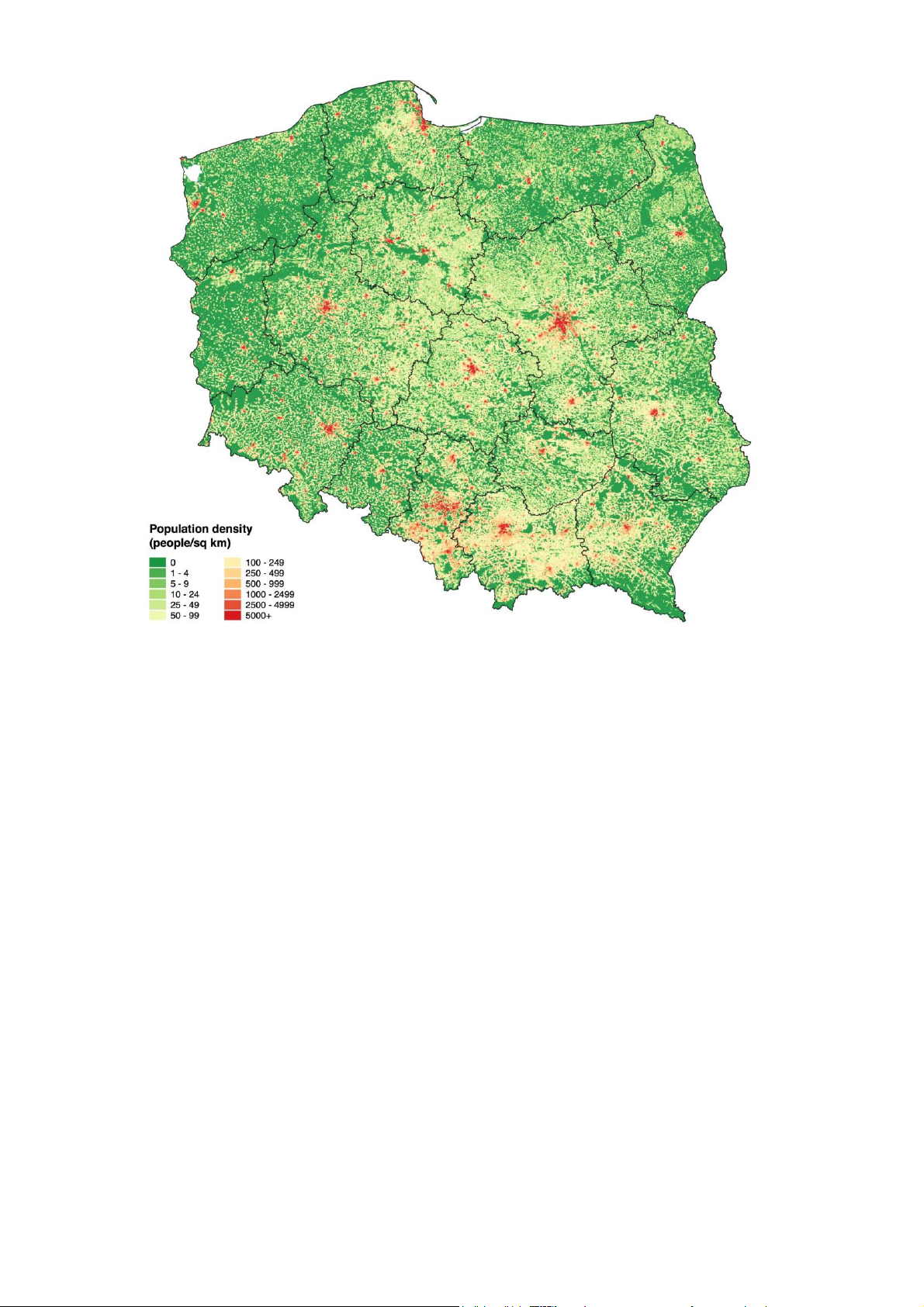
Population density chart in Poland. It can be seen that the 5 points with the largest population
density include the cities of Warsaw, Kraków, Wrocław, Łódź, Poznań CHAPTER III
GENERAL POLISH ENVIRONMENT & SPICES MARKET
1. General Polish Environment
1.1. Introduction of the Polish Market
With a population of over 40 million people, Poland is one of the most populous countries in Europe.
The country has a profound historical legacy, with a timeline that spans over a thousand
years. Having gained its independence in 1918 after World War I, the 20th century brought
significant challenges to Poland, including the devastation of World War II and the imposition
of communist rule by the Soviet Union. Nevertheless, Poland emerged from communism in
1989 and rapidly transitioned into a democratic republic, joining the European Union in 2004.
This history is the foundation for Poland to receive a large number of immigrants from Asian
countries, of which Vietnamese are the largest group here.
Today, Poland is a dynamic and economically developed nation with a diverse and growing
economy. Its prosperous economy and sound policies make Poland a remarkable market for
companies looking to import their goods into the country. lOMoAR cPSD| 59691467
1.2. Demographic Environment
The demographic of Polish customers using spices can vary widely, but there are some
general trends and preferences that can be observed:
• Population: The current population of Poland is 40,761,232 as of Saturday, October
28, 2023, based on Worldometer elaboration of the latest United Nations data. 55.2 % of
the population is urban.
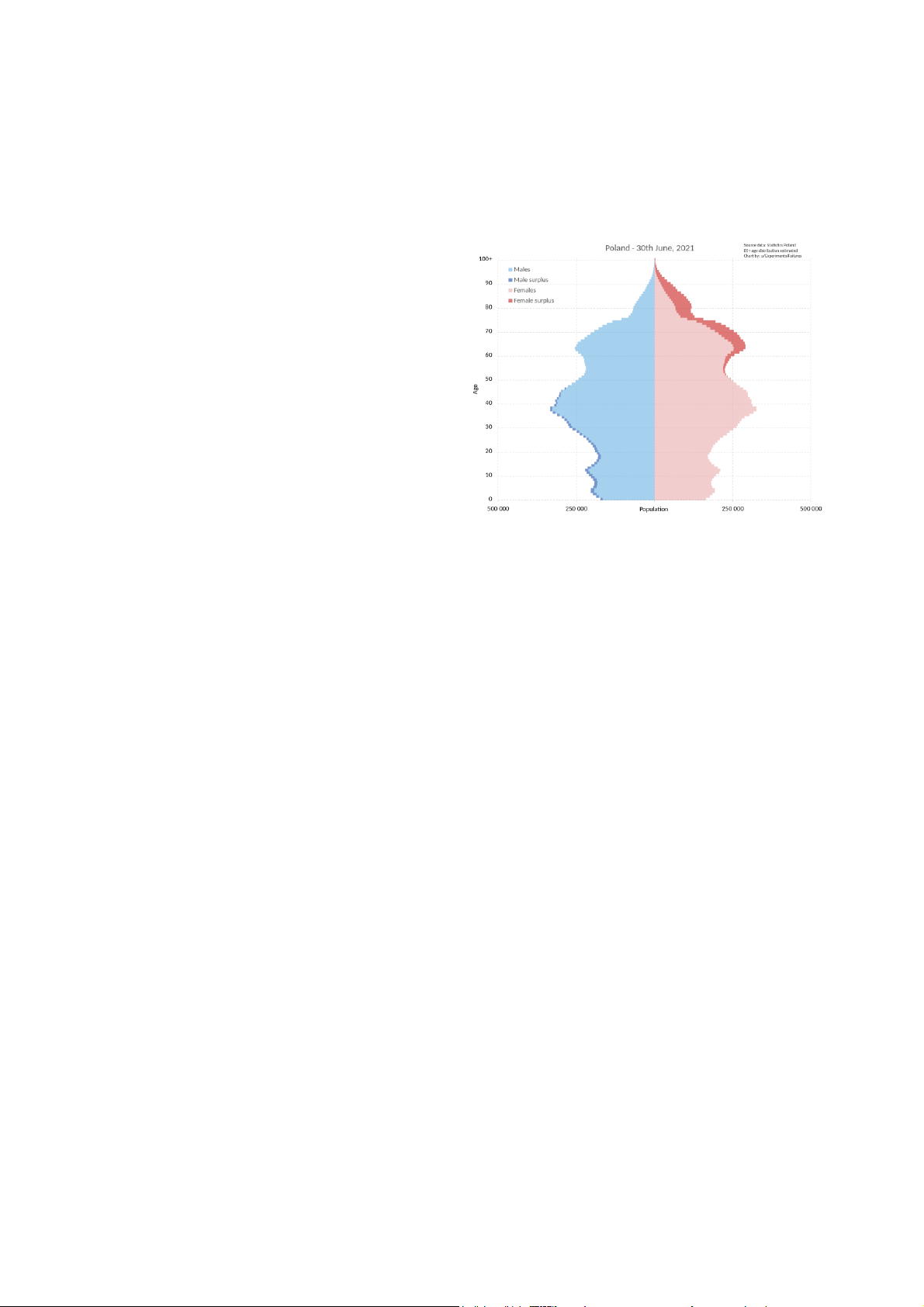
• The median age in Poland is 40.0
years. This means this is a country with an
aging population. Spice usage is prevalent
across all age groups in Poland. However,
younger generations might be more open to
experimenting with international cuisines
and exotic spices. In addition, the high median age also affects
Dh Foods' promotion method when entering this market.
• Gender: There's generally no significant gender bias when it comes to spice
consumption in Poland. Both men and women use spices in their cooking.
• Income Level: Polish people earn USD 32,527 per year on average. This means they
are in the group of high-income countries as defined by the World Bank. Higher-income
households might be more likely to afford a wider variety of spices, including exotic and
imported ones, while lower-income households might stick to more basic and affordable options.
• Ethnicity: European and other immigrant communities, including Vietnamese community. 1.3. Economic Environment
1.3.1.Overview of Poland’s Economic
The economy of Poland is an industrialized, mixed economy with a developed market that
serves as the sixth-largest in the European Union by nominal GDP and fifth-largest by GDP
(PPP).Poland boasts the extensive public services characteristic of most developed economies.
Since 1988, Poland has pursued a policy of economic liberalization but retained an
advanced public welfare system. This includes universal free public healthcare and education
(including tertiary), extensive provisions of free public childcare and parental leave. The
country is considered by many to be a successful post-communist state.
Polish people earn USD 32 527 per year on average, less than the OECD average of USD
49 165. Nevertheless, it is still classified as a high-income economy by the World Bank, lOMoAR cPSD| 59691467
ranking 21st worldwide in terms of GDP (PPP), 21st in terms of GDP (nominal), and 21st in
the 2023 Economic Complexity Index. Poland's economy is considered the strongest economy
among countries in Eastern Europe (after Russia), with an annual economic growth rate of over 6.0%.
1.3.2. The stability in the exchange rate between Vietnam Dong and currencies
used in Poland (EURO)
The falling EUR affects many exporters to Europe. Accordingly, all customers in Europe
pay in Euro, and Vietnamese businesses that receive money back home must change it to US
dollars. Besides, the local currency zloty is also used. The Euro affects the zloty in a
proportional manner. Therefore, the fact that the Euro falling almost equal to the USD means
that the export value of each shipment decreases accordingly. Meanwhile, profits fall as they
are affected by input costs such as gasoline, raw material prices, and labor costs that have all increased.