Pros and Cons - A Debater's Handbook - 19th edition | Đại Học Quốc Tế Hồng Bàng
Pros and Cons - A Debater's Handbook - 19th edition | Đại Học Quốc Tế Hồng Bàng. Tài liệu được sưu tầm giúp bạn tham khảo, ôn tập và đạt kết quả cao. Mời bạn đọc đón xem.
Môn: English 3 3 tài liệu
Trường: Đại Học Quốc Tế Hồng Bàng 187 tài liệu
Tác giả:



















Preview text:
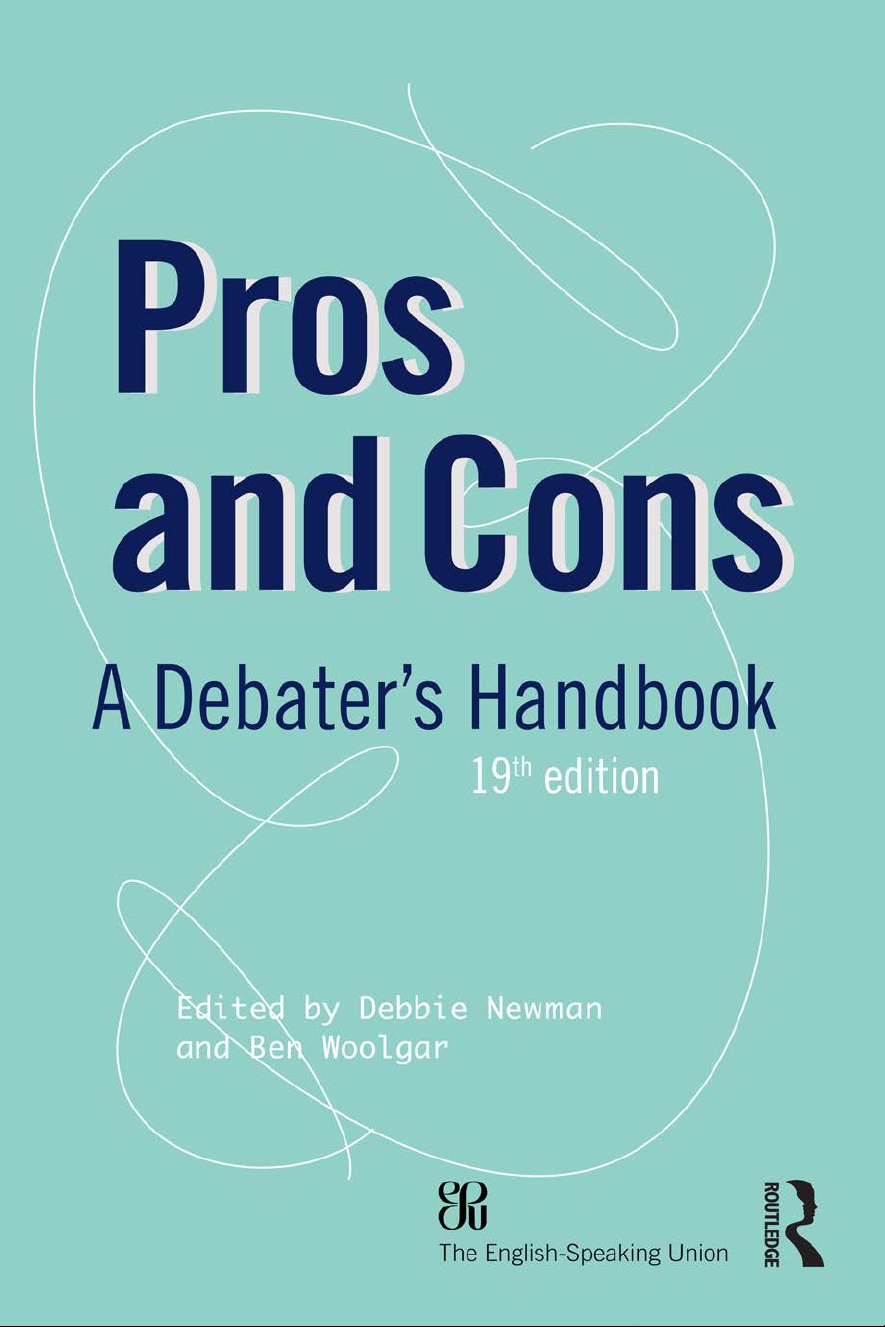
Pros and Cons
Pros and Cons: A Debater’s Handbook offers an indispensable guide to the arguments both
for and against over 140 current controversies and global issues.
The nineteenth edition includes new entries on topics such as the right to possess
nuclear weapons, the bailing out of failing companies, the protection of indigenous
languages and the torture of suspected terrorists. It is divided into eight thematic
sections where individual subjects are covered in detail, plus a UK section. Equal
coverage is given to both sides of each debate in a dual-column format which allows
for easy comparison, with a list of related topics and suggestions for possible motions.
Providing authoritative advice on debating technique, the book covers the rules,
structure and type of debate, offering tips on how to become a successful speaker. It is
a key read for debaters at any level.
The English-Speaking Union (ESU) builds bridges between people and nations
through the use of the English language. Its debate and public speaking competitions
are among the most prestigious and the longest running in the debate calendar.The
ESU’s mentors also tour the world to coach and advise debate students of all ages.The
ESU’s path-finding speech and debate work is coupled with a worldwide programme
of cross-generational education scholarships which places the English-Speaking Union
in the van of thinkers, deliverers and facilitators in creating life-changing educational
opportunities for people, whatever their age and social background.
This page intentionally left blank Pros and Cons A DEBATER’S HANDB OOK 19th Edition Edited by DEBBIE NEWMAN AND BEN WOOLGAR
First edition by J. B. Askew, published in 1896
Nineteenth edition published 2014 by Routledge
2 Park Square, Milton Park, Abingdon, Oxon OX14 4RN and by Routledge
711 Third Avenue, New York, NY 10017
Routledge is an imprint of the Taylor & Francis Group, an informa business
© 2014 The English-Speaking Union
The right of The English-Speaking Union to be identified as author of this work
has been asserted by it in accordance with sections 77 and 78 of the Copyright, Designs and Patents Act 1988.
All rights reserved. No part of this book may be reprinted or reproduced or
utilised in any form or by any electronic, mechanical, or other means, now
known or hereafter invented, including photocopying and recording, or in any
information storage or retrieval system, without permission in writing from the publishers.
Trademark notice: Product or corporate names may be trademarks or registered
trademarks, and are used only for identification and explanation without intent to infringe.
British Library Cataloguing in Publication Data
A catalogue record for this book is available from the British Library
Library of Congress Cataloging in Publication Data
A catalog record for this book has been requested ISBN: 978-0-415-82779-9 (hbk) ISBN: 978-0-415-82780-5 (pbk) ISBN: 978-1-315-88603-9 (ebk)
Typeset in Bembo and Franklin Gothic
by Keystroke, Station Road, Codsall, Wolverhampton CONTENTS Foreword x Preface xi Introduction 1
(A) Philosophy/political theory 9 Anarchism 11 Animal rights 13 Capitalism v. socialism 15 Censorship by the state 17 Civil disobedience 18 Democracy 20 Marxism 22 Pacifism 24 Privatisation 25
Protective legislation v. individual freedom 27
Social contract, existence of the 28 Utilitarianism 30 Welfare state 32 (B) Constitutional/governance 35 Churches in politics 37
Extremist political parties, banning of 38 Monarchy, abolition of 40 Political candidacy, age of 42 vi C O N T E N T S
Politicians’ outside interests, banning of 44 Proportional representation 45 Referenda, increased use of 47
Social movements: courts v. legislatures 49
State funding of political parties 51 Term limits for politicians 53 Voting age, reduction of 55 Voting, compulsory 57 (C) International relations 59
Armaments, limitations on conventional 61 Commonwealth, abolition of the 62 Democracy, imposition of 64 Dictators, assassination of 66
European Union, expansion of the 68
Military drones, prohibition of 70
Non-UN-sanctioned military intervention 72
Nuclear weapons, right to possess 73
Private military corporations, banning of 76 Sanctions, use of 78 Terrorism, justifiability of 79 Terrorists, negotiation with 81
United Nations, failure of the 83 United Nations standing army 84 United States of Europe 86 (D) Economics 89 Bonuses, banning of 91 Child labour can be justified 92 Euro, abolition of the 94
Failing companies, bailing out 95
Fairtrade, we should not support 98
Inheritance tax at 100 per cent 99
Regional trade blocs over global free trade 100 Salary capping, mandatory 102
State pensions, ending provision of 103
(E) Social, moral and religious 107 Abortion on demand 109 Affirmative action 111 Alcohol, prohibition of 113
Animal experimentation and vivisection, banning of 115 C O N T E N T S vii Drugs, legalisation of 117 Euthanasia, legalisation of 119 Gay marriage, legalising of 121 God, existence of 123
Holocaust denial, criminalisation of 125 Homosexuals, ordination of 126 Homosexuals, outing of 129 Immigration, limitation of 130 Mandatory retirement age 132 Marriage 134 National identity cards 136
National service, (re-)introduction of 139 Political correctness 141 Polygamy, legalisation of 143 Population control 144 Pornography 146 Prostitution, legalisation of 149
Right to strike for public sector workers 151 Slavery, reparations for 152
Smacking, remove parents’ right to 153 Smoking, banning of 155 Veil, prohibition of the 156
Women fighting on the front line 157
(F) Culture, education and sport 159
Arts funding by the state, abolition of 161 Beauty contests, banning of 163 Blood sports, abolition of 165 Boxing, banning of 167 Co-education 169
Cultural treasures, returning of 171 Examinations, abolition of 174 Gambling, banning of 176
Indigenous languages, protection of 179 Music lyrics, censorship of 180
Nursery education, free provision of by the state 181
Performance-enhancing drugs in sport 183
Press, state regulation of the 185 Privacy of public figures 187 Private schools 189 Religious teaching in schools 191 School sport, compulsory 193 School uniform 195 Sex education 196 Size zero models, banning of 198 viii C O N T E N T S
Sport, equalise status of men and women in 200
Sport, regretting the commercialisation of 201
Sports teams punished for the behaviour of fans 203
University education, free for all 204
Violent video games, banning of 206 Zoos, abolition of 208 (G) Crime and punishment 211 Capital punishment 213 Child curfews 214 Community sentencing 216
International Criminal Court, abolition of the 218 Judges, election of 219 Jury trials, abolition of 221 Mandatory prison sentences 223
Parents, responsibility for the criminal acts of their children 225
Prisoners’ right to vote, denial of 226 Prison v. rehabilitation 228 Racial profiling 229 Right to bear arms 231
Sex offenders, chemical castration of 232 Televised trials 233
Terrorist suspects, torture of 235 Zero tolerance 238
(H) Health, science and technology 241
Cars in city centres, banning of 243
Contraception for under-age girls 245 Cosmetic surgery, banning of 246 DNA database, universal 247
Environmental responsibility, developed world should take more 249
Eugenics: IVF and genetic screening 251 Genetic engineering 253
Global warming, binding emission targets for 255 Nuclear energy 256
Obese children, compulsory attendance at weight-loss camps 258
Organ donation: priority for healthy lifestyle 259 Organs, legal sale of 261
Social networking has improved our lives 263 Space exploration 264 Surrogate mothers, payment of 266 Vegetarianism 267 C O N T E N T S ix (I) United Kingdom issues 271 BBC, privatisation of 273
Disestablishment of the Church of England 274 English Parliament 276
House of Lords, elected v. appointed 277 Police, arming of the 279 Scottish independence 280 Should Britain leave the EU? 281 Written constitution 283 Appendices
Appendix A: Style tips for persuasive speaking 287
Appendix B: Preparation for debates that are not in this book 288
Appendix C: How can I keep speaking for the full time? 290
Appendix D: Guidance for the chairperson 291 Appendix E: Key vocabulary 292 FOREWORD
Writing the foreword for the last edition of Pros and Cons,Will Hutton commented:
‘reasoned argument . . . is the stuff of democracy’. I agree, and the English-Speaking
Union (ESU) has been aiding and abetting reasoned argument around the globe since 1918.
This book forearms the fledgling and the experienced debater alike with the tools
not only to engage with the stuff of democracy, but also to experience the sheer fun of
debate. It is, however, fun with a purpose. No matter how light or dark the subject,
debate broadens the mind and develops the intellect – practitioners gain in confidence
and self-belief and grow their critical thinking and social skills.The art of speaking –
and, as importantly, listening – underpins civic and civil society.
This is the nineteenth edition of Pros and Cons – itself a testimony to its usefulness.
Some of the topics it covers are radically different to those that have appeared in
previous editions and some are similar – although the issues within the issues will have
evolved and changed to meet new times and new realities.We at the English-Speaking
Union are proud to continue our association with Routledge and proud to be asso-
ciated with this publication. I urge everyone who reads Pros and Cons to get debating – it is an empowering feeling. Peter Kyle, OBE
Director-General,The English-Speaking Union PREFACE
This is the nineteenth edition of Pros and Cons, replacing the last which was written in
1999. In that time, much has changed in the world: 9/11 has reshaped the debates on
international relations, while the growth of the Internet has changed the complexion
of many of the social issues. About a third of the topics have changed; for example
‘restricting Sunday shopping’,‘easier divorce’ and ‘modernisation of trades unions’ have
been replaced with ‘social networking has improved our lives’,‘banning of violent video
games’ and ‘torture of terrorist suspects’.With the remaining topics, some have needed
little revision, but many have needed to be rewritten to reflect the world we live in.This
edition has also attempted to be more international in its outlook, with the UK-specific
issues in their own chapter and the other topics taking a more general approach.We
hope that most of the topics here will remain relevant and largely unchanged, for a few
years at least. For this reason, notable conflicts such as Israel and Palestine or Afghanistan have been omitted.
About the editorial team and acknowledgements
Debbie Newman, General Editor, is the director of The Noisy Classroom, which
supports Speaking and Listening across the curriculum. She is a previous English
national debating champion, president of the Cambridge Union Society and a coach
for the World Schools Debating Championships (WSDC). She is a former head of the
Centre for Speech and Debate at the English-Speaking Union, a fellow of the World
Debate Institute and a qualified secondary school teacher.
Ben Woolgar, Assistant Editor, won the World Schools Debating Championships in
2008 when he was on the England Schools Debating Team. As a student at the xii P R E FAC E
University of Oxford, he won the European Universities Debating Championships,
reached the Grand Final of the World Universities Debating Championships and was
ranked top speaker in the world. He is currently studying law at City University.
Many of the entries here have needed minimal revision due to the thorough and
thoughtful work of the editors of and contributors to the last edition:Trevor Sather,
Thomas Dixon,Alastair Endersby, Dan Neidle and Bobby Webster.
Thanks are due to Steve Roberts, Director of Charitable Activities at the English-
Speaking Union, and his team for support with the project; and to Jason Vit who,
when Head of Speech and Debate at the ESU, initiated the project. Thanks also to Paul Holleley. INTRODUCTION
How can Pros and Cons help you to debate? To debate well you need:
1 to have a range of good arguments and rebuttals
2 to develop these in a clear, detailed and analytical way
3 to deliver them persuasively.
Pros and Cons can help you with the first, and only the first, of these three. If you were
to read out one side of a pros and cons article, it would not fill even the shortest of
debate speeches. Each point is designed to express the idea, but you will need to flesh
it out. If you know your topic in advance, you will be able to use these points as a
springboard for your own research. If you are in an impromptu debate, you will have to
rely on your own knowledge and ideas to populate the argument with up-to-date
examples, detailed analysis and vivid analogies. But the ideas themselves can be useful.
It is hard to know something about everything and yet debating competitions expect
you to. It is important to read widely and follow current affairs, but doing that does not
guarantee that you will not get caught out by a debate on indigenous languages, nuclear
energy or taxation. Pros and Cons can be a useful safety net in those situations.
When using each article it is worth considering:
A Does each point stand up as a constructive argument in its own right, or is it only
really strong as a rebuttal to its equivalent point on the other side? Where there are
key points which directly clash, they have been placed opposite each other, but some
points have been used to counter an argument rather than as a positive reason for one side of the case. 2 I N T RO D U C T I O N
B Can the points be merged or split? Different debate formats favour different numbers
of arguments. Check to see if two of the points here could be joined into a larger
point. Or if you need quantity, sub-points could be repackaged as distinct arguments.
If you are delivering an extension in a World Universities-style debate (or a British
Parliament-style one), it is worth noting down the sub-points. It is possible that the
top half of the table may make an economic argument, but have they hit all three of
the smaller economic points? If they have not, then one of these, correctly labelled,
could form your main extension.
C Look at Pros and Cons last, not first.Try to brainstorm your own arguments first and
then check the chapter to see if there is anything there you had not thought of.The
articles are not comprehensive and often not surprising (especially if the other teams
also have the book!), so it is best not to rely on it too heavily. Also, if you do not
practise generating points yourself, what will you do when the motion announced is not in here?
D Adapt the arguments here to the jurisdiction in which you are debating.The book
is designed to be more international than its predecessor, but the writers are British
and that bias will come through.The debate within your own country may have its
own intricacies which are not reflected in the broader global debate. Some argu-
ments are based on assumptions of liberal democracy and other values and systems
which may just be plain wrong where you live.
E Is the argument or the example out of date? We have tried to write broad arguments
which will stand the test of time, but the world changes. Do not believe everything
you read here if you know or suspect it to be untrue! Things like whether something
is legal or illegal in a given country change very quickly, so please do your research.
F What is the most effective order of arguments? This book lists points, but that is not
the same as a debating case.You will need to think about how to order arguments,
how to divide them between speakers, and how to label them as well as how much
time to give to each. On the opposition in particular, some of the most significant
points could be towards the end of the list. Debating formats
There is an almost bewildering number of debate formats across the world.The number
of speakers, the length and order of speeches, the role of the audience and opportunities
for interruption and questioning all vary. So too do the judging criteria. On one side
of the spectrum, some formats place so much emphasis on content and strategy that the
debaters speak faster than most people can follow. On the other side, persuasive rhetoric
and witty repartee can be valued more than logical analysis and examples. Most debate
formats sit in the middle of this divide and give credit for content, style and strategy.
Here are a few debate formats used in the English-Speaking Union programmes: I N T RO D U C T I O N 3 Mace format
This format involves two teams with two speakers on each side. Each speaker delivers
a seven-minute speech and there is then a floor debate, where members of the audience
make brief points, before one speaker on each team delivers a four-minute summary
speech with the opposition team speaking first.The order is as follows:
First Proposition Speaker
First Opposition Speaker
Second Proposition Speaker
Second Opposition Speaker Floor Debate
Opposition Summary Speaker
Proposition Summary Speaker
The first Proposition Speaker should define the debate. This does not mean giving
dictionary definitions of every word, but rather explaining the terms so that everybody
is clear exactly what the debate is about. For example, the speaker may need to clarify
whether the law which is being debated should be passed just in their country or all
around the world and specify any exemptions or limits.This speaker should then outline
their side’s arguments and go through the first, usually two or three, points in detail.
The first Opposition speaker should clarify the Opposition position in the debate;
e.g. are they putting forward a counter-proposal or supporting the status quo? They
should then outline their side’s case, rebut the arguments put forward by the first
Proposition Speaker and explain their team’s first few arguments.
The second speakers on both sides should rebut the arguments which have come
from the other team, support the points put forward by their first speakers, if they have
been attacked, and then add at least one completely new point to the debate. It is not
enough simply to expand on the arguments of the first speaker.
The summary speakers must remind the audience of the key points in the debate
and try to convince them that they have been more persuasive in these areas than their
opponents.The summary speakers should respond to points from the floor debate (and
in the case of the Proposition team, to the second Opposition speech), but they should
not add any new arguments to the debate at this stage. Points of information
In this format, points of information (POIs) are allowed during the first four speeches
but not in the summary speeches.The first and last minute of speeches are protected
from these and a timekeeper should make an audible signal such as a bell ringing or a
knock after one minute and at six minutes, as well as two at the end of the speech to
indicate that the time is up.To offer point of information to the other team, a speaker
should stand up and say ‘on a point of information’ or ‘on that point’.They must then
wait to see if the speaker who is delivering their speech will say ‘accepted’ or ‘declined’. 4 I N T RO D U C T I O N
If declined, the offerer must sit down and try again later. If accepted, they make a short
point and then must sit down again and allow the main speaker to answer the point and
carry on with their speech.All speakers should offer points of information, but should
be sensitive not to offer so many that they are seen as barracking the speaker who has
the floor.A speaker is recommended to take two points of information during a seven-
minute speech and will be rewarded for accepting and answering these points. Rebuttal
Apart from the very first speech in the debate, all speakers are expected to rebut the
points which have come before them from the opposing team.This means listening to
what the speaker has said and then explaining in your speech why their points are
wrong, irrelevant, insignificant, dangerous, immoral, contradictory, or adducing any
other grounds on which they can be undermined. It is not simply putting forward
arguments against the motion – this is the constructive material – it is countering the
specific arguments which have been put forward.As a speaker, you can think before the
debate about what points may come up and prepare rebuttals to them, but be careful
not to pre-empt arguments (the other side may not have thought of them) and make
sure you listen carefully and rebut what the speaker actually says, not what you thought
they would. However much you prepare, you will have to think on your feet.
The mace format awards points equally in four categories: reasoning and evidence,
listening and responding, expression and delivery, and organisation and prioritisation. LDC format
The LDC format was devised for the London Debate Challenge and is now widely
used with younger students and for classroom debating at all levels. It has two teams of
three speakers each of whom speaks for five minutes (or three or four with younger or novice debaters).
For the order of speeches, the rules on points of information and the judging criteria,
please see the section on the mace format’.The only differences are the shorter (and
equal) length of speeches and the fact that the summary speech is delivered by a third
speaker rather than by a speaker who has already delivered a main speech.This allows more speakers to be involved.
World Schools Debating Championships (WSDC) style
This format is used at the World Schools Debating Championships and is also
commonly used in the domestic circuits of many countries around the world. It consists
of two teams of three speakers all of whom deliver a main eight-minute speech. One
speaker also delivers a four-minute reply speech.There is no floor debate.The order is as follows: I N T RO D U C T I O N 5
First Proposition Speaker
First Opposition Speaker
Second Proposition Speaker
Second Opposition Speaker
Third Proposition Speaker
Third Opposition Speaker Opposition Reply Speech
Proposition Reply Speech
For the roles of the first two speakers on each side, see the section on ‘the mace format’,
above.The WSDC format also has a third main speech: Third speakers
Third speakers on both sides need to address the arguments and the rebuttals put
forward by the opposing team.Their aim should be to strengthen the arguments their
team mates have put forward, weaken the Opposition and show why their case is still
standing at the end of the debate.The rules allow the third Proposition, but not the third
Opposition speaker to add a small point of their own, but in practice, many teams prefer
to spend the time on rebuttal. Both speakers will certainly want to add new analysis and
possibly new examples to reinforce their case. Reply speakers
The reply speeches are a chance to reflect on the debate, albeit in a biased way.The
speaker should package what has happened in the debate in such a way as to convince
the audience, and the judges, that in the three main speeches, their side of the debate
came through as the more persuasive. It should not contain new material, with the
exception that the Proposition reply speech may need some new rebuttal after the third Opposition speech.
Points of information are allowed in this format in the three main speeches, but
not in the reply speeches. The first and last minute of the main speeches are pro-
tected. For more information on points of information, see the section on ‘ the mace format’.
The judging criteria for the WSDC format is 40 per cent content, 40 per cent style and 20 per cent strategy.
The main features of the format as practised at the World Schools Debating Championships are:
• The debate should be approached from a global perspective.The definition should
be global with only necessary exceptions.The examples should be global.The argu-
ments should consider how the debate may be different in countries that are, for
example, more or less economically developed or more or less democratic.
• The motions should be debated at the level of generality in which they have been
worded. In some formats, it is acceptable to narrow down a motion to one example 6 I N T RO D U C T I O N
of the principle, but at WSDC, you are expected to give multiple examples of a wide topic if it is phrased widely.
• The WSDC format gives 40 per cent of its marks to style which is more than many
domestic circuits.This means that speakers should slow down (if they are used to
racing), think about their language choice and make an effort to be engaging in their delivery.
World Universities/British Parliamentary style
This format is quite different to the three described so far. It is one of the most
commonly used formats at university level (the World Universities Debating
Championships use it), and it is widely used in schools’ competitions hosted by universities in the UK.
It consists of four teams of two: two teams on each side of the motion.The teams on
the same side must agree with each other, but debate better than the other teams on
the same side in order to win.The teams do not prepare together. At university level,
speeches are usually seven minutes long, whereas at school level, they are commonly
five minutes. Points of information are allowed in all eight speeches and the first and
last minute of each speech is protected from them (for more on points of information,
see the section on ‘the mace format’.The speeches are often given parliamentary names
and the order of speeches is as follows: Opening Government Opening Opposition Prime Minister Leader of the Opposition Deputy Prime Minister
Deputy Leader of the Opposition Closing Government Closing Opposition Member of the Government Member of the Opposition Government Whip Opposition Whip
The speaking order in the World Universities or British Parliamentary debate format.
For the roles of the first two speakers on both sides, see the section on ‘the mace format’.
The roles of the closing teams are as follows:
Members of the government (third speakers on each side)
The third speaker should do substantial rebuttal to what has come before them in the
debate if needed.They are also required to move the debate forward with at least one I N T RO D U C T I O N 7
new argument which is sometimes called an ‘extension’.The closing team should not
contradict the opening team, but neither can they simply repeat their arguments, having
had more time to think about how to put them persuasively.
Whips (fourth speakers on each side)
The whips deliver summary speeches.They should not offer new arguments, but they
can (and should) offer new rebuttal and analysis as they synthesise the debate. They
should summarise all the key points on their team and try to emphasise why their
partner’s contribution has been particularly significant. Debating in the classroom
Teachers should use or invent any format which suits their lessons. Speech length and
the number of speakers can vary, as long as they are equal on both sides. The LDC
format explained here is often an effective one in the classroom. Points of information
can be used or discarded as wanted and the floor debate could be replaced with a
question and answer session. Students can be used as the chairperson and timekeeper
and the rest of the class can be involved through the floor debate and audience vote. If
more class participation is needed, then students could be given peer assessment sheets
to fill in as the debate goes on, or they could be journalists who will have to write up
an article on the debate for homework.
In the language classroom or with younger pupils, teachers may be free to pick any
topic, as the point of the exercise will be to develop the students’ speaking and listening
skills. Debates, however, can also be a useful teaching tool for delivering content and
understanding across the curriculum. Science classrooms could host debates on genetics
or nuclear energy; literature lessons can be enhanced with textual debates; geography
teachers could choose topics on the environment or globalisation.When assessing the
debate, the teacher will need to decide how much, if any, emphasis they are giving to
the debating skills of the student and how much to the knowledge and understanding of the topic shown.
In addition to full-length debates, teachers may find it useful to use the topics in this
book (and others they generate) for ‘hat’ debates.Write topics out and put them in a
hat. Choose two students and invite them to pick out a topic which they then speak on
for a minute each. Or for a variation, let them play ‘rebuttal tennis’ where they knock
points back and forth to each other.This can be a good way to get large numbers of
students speaking and can be an engaging starter activity, to introduce a new topic or to review student learning.