Reading Explorer 1 (Third Edition) môn IELTS | Học viện Phụ nữ Việt Nam
Reading Explorer 1 (Third Edition) môn IELTS | Học viện Phụ nữ Việt Nam. Tài liệu được sưu tầm giúp bạn tham khảo, ôn tập và đạt kết quả cao. Mời bạn đọc đón xem.
Môn: IELTS (02) 14 tài liệu
Trường: Học viện Phụ nữ Việt Nam 808 tài liệu
Tác giả:












Preview text:
1 THIRD EDITION NANCY DOUGLAS DAVID BOHLKE
Australia • Brazil • Mexico • Singapore • United Kingdom • United States
001-006_16258_REX_SB_1_FM_ptg01.indd 1 3/28/19 12:11 PM National Geographic Learning, © 2020 Cengage Learning, Inc. a Cengage Company
ALL RIGHTS RESERVED. No part of this work covered by the copyright herein
may be reproduced or distributed in any form or by any means, except as
permitted by U.S. copyright law, without the prior written permission of the Reading Explorer 1 copyright owner. Third Edition
“National Geographic", "National Geographic Society" and the Yellow Border
Nancy Douglas and David Bohlke
Design are registered trademarks of the National Geographic Society
Publisher: Andrew Robinson ® Marcas Registradas
Executive Editor: Sean Bermingham
Associate Development Editor: Yvonne Tan
For permission to use material from this text or product,
Director of Global Marketing: Ian Martin
submit all requests online at cengage.com/permissions
Heads of Regional Marketing:
Further permissions questions can be emailed to
Charlotte Ellis (Europe, Middle East and Africa)
permissionrequest@cengage.com Kiel Hamm (Asia) Irina Pereyra (Latin America)
Student Book with Online Workbook:
Product Marketing Manager: Tracy Bailie ISBN-13: 978-0-357-12351-5
Senior Production Controller: Tan Jin Hock Student Book:
Associate Media Researcher: Jeffrey Millies ISBN-13: 978-0-357-11625-8
Art Director: Brenda Carmichael
Operations Support: Hayley Chwazik-Gee
National Geographic Learning
Manufacturing Planner: Mary Beth Hennebury 20 Channel Center Street
Composition: MPS North America LLC Boston, MA 02210 USA
Locate your local office t international.cengage.com/region
Visit National Geographic Learning online at ELTNGL.com
Visit our corporate website at www.cengage.com Printed in China
Print Number: 01 Print Year: 2019
001-006_16258_REX_SB_1_FM_ptg01.indd 2 3/28/19 12:11 PM CONTENTS Scope and Sequence 4 Introduction 6 Unit 1: Amazing Animals 7 Unit 2: Travel and Adventure 21 Unit 3: The Power of Music 35 Unit 4: Into Space 49 Unit 5: City Life 63 Unit 6: Backyard Discoveries 77 Unit 7: When Dinosaurs Ruled 91 Unit 8:
Stories and Storytellers 105 Unit 9: Unusual Jobs 117
Unit 10: Uncovering the Past 131
Unit 11: Plastic Planet 145 Unit 12: Vanished! 159 Credits and Acknowledgments 173
Glossary / Exam Question Type Index 175 Tips for Effective Reading 176
001-006_16258_REX_SB_1_FM_ptg01.indd 3 3/28/19 12:11 PM SCOPE AND SEQUENCE UNIT THEME READING VIDEO 1 Amazing Animals
A: The Incredible Dolphin B: A Chameleon’s Colors Master of Disguise 2 Travel and Adventure
A: The Trip of a Lifetime B: Exploring Laponia Adventure Islands 3 The Power of Music A: Move to the Music B: The Mozart Effect A Musical Boost 4 Into Space A: Life Beyond Earth? B: The Red Planet Living in Space 5 City Life A: Global Cities B: New York Skyscraper A Taste of Two Cities 6 Backyard Discoveries A: In One Cubic Foot B: BioBlitz
What’s in Your Neighborhood? 7 When Dinosaurs Ruled
A: The Truth about Dinosaurs Dinosaurs: A Brief
B: Mystery of the Terrible Hand History 8 Stories and Storytellers A: The Brothers Grimm B: Fairy-tale Castle The Seven Ravens 9 Unusual Jobs
A: Meet the Meteorite Hunter B: Snake Catchers Smokejumpers 10 Uncovering the Past
A: The Army’s True Colors B: City in the Clouds Wonders of Egypt 11 Plastic Planet
A: The Problem with Plastic B: Our Plastic World
Five Tips for Using Less Plastic 12 Vanished!
A: Mystery on the Mountain B: Earhart Mystery The Missing Pilot 4 Scope and Sequence
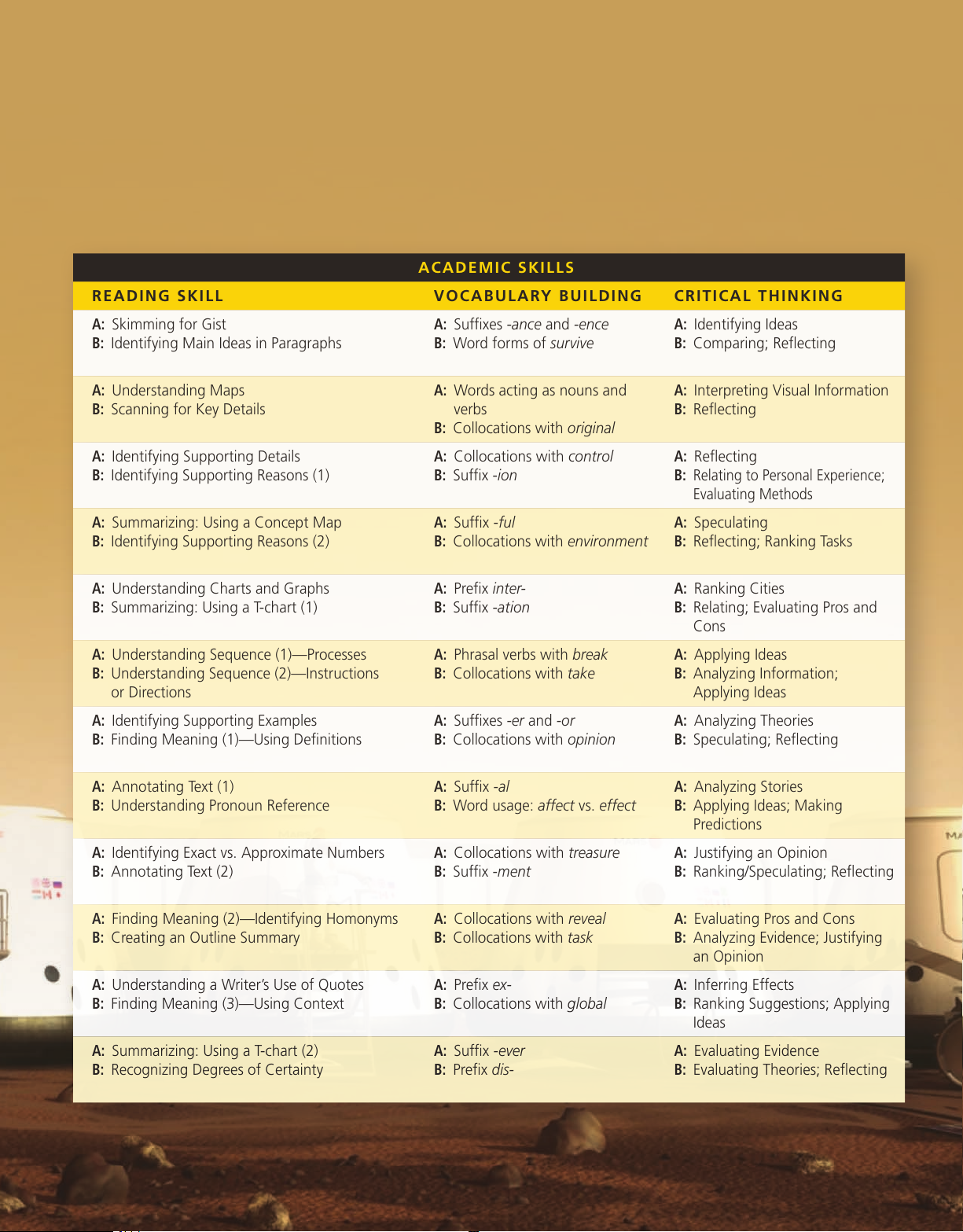
001-006_16258_REX_SB_1_FM_ptg01.indd 4 3/28/19 12:11 PM ACADEMIC SKILLS READING SKILL VOCABULARY BUILDING CRITICAL THINKING A: Skimming for Gist
A: Suffixes -ance and -ence A: Identifying Ideas
B: Identifying Main Ideas in Paragraphs
B: Word forms of survive
B: Comparing; Reflecting A: Understanding Maps
A: Words acting as nouns and
A: Interpreting Visual Information
B: Scanning for Key Details verbs B: Reflecting
B: Collocations with original
A: Identifying Supporting Details
A: Collocations with control A: Reflecting
B: Identifying Supporting Reasons (1) B: Suffix -ion
B: Relating to Personal Experience; Evaluating Methods
A: Summarizing: Using a Concept Map A: Suffix -ful A: Speculating
B: Identifying Supporting Reasons (2)
B: Collocations with environment
B: Reflecting; Ranking Tasks
A: Understanding Charts and Graphs
A: Prefix inter- A: Ranking Cities
B: Summarizing: Using a T-chart (1) B: Suffix -ation
B: Relating; Evaluating Pros and Cons
A: Understanding Sequence (1)—Processes
A: Phrasal verbs with break A: Applying Ideas
B: Understanding Sequence (2)—Instructions
B: Collocations with take
B: Analyzing Information; or Directions Applying Ideas
A: Identifying Supporting Examples
A: Suffixes -er and -or A: Analyzing Theories
B: Finding Meaning (1)—Using Definitions
B: Collocations with opinion
B: Speculating; Reflecting A: Annotating Text (1) A: Suffix -al A: Analyzing Stories
B: Understanding Pronoun Reference
B: Word usage: affect vs. effect
B: Applying Ideas; Making Predictions
A: Identifying Exact vs. Approximate Numbers
A: Collocations with treasure
A: Justifying an Opinion B: Annotating Text (2) B: Suffix -ment
B: Ranking/Speculating; Reflecting
A: Finding Meaning (2)—Identifying Homonyms
A: Collocations with reveal
A: Evaluating Pros and Cons
B: Creating an Outline Summary
B: Collocations with task
B: Analyzing Evidence; Justifying an Opinion
A: Understanding a Writer’s Use of Quotes A: Prefix ex- A: Inferring Effects
B: Finding Meaning (3)—Using Context
B: Collocations with global
B: Ranking Suggestions; Applying Ideas
A: Summarizing: Using a T-chart (2) A: Suffix -ever A: Evaluating Evidence
B: Recognizing Degrees of Certainty B: Prefix dis-
B: Evaluating Theories; Reflecting Scope and Sequence 5
001-006_16258_REX_SB_1_FM_ptg01.indd 5 3/28/19 12:11 PM
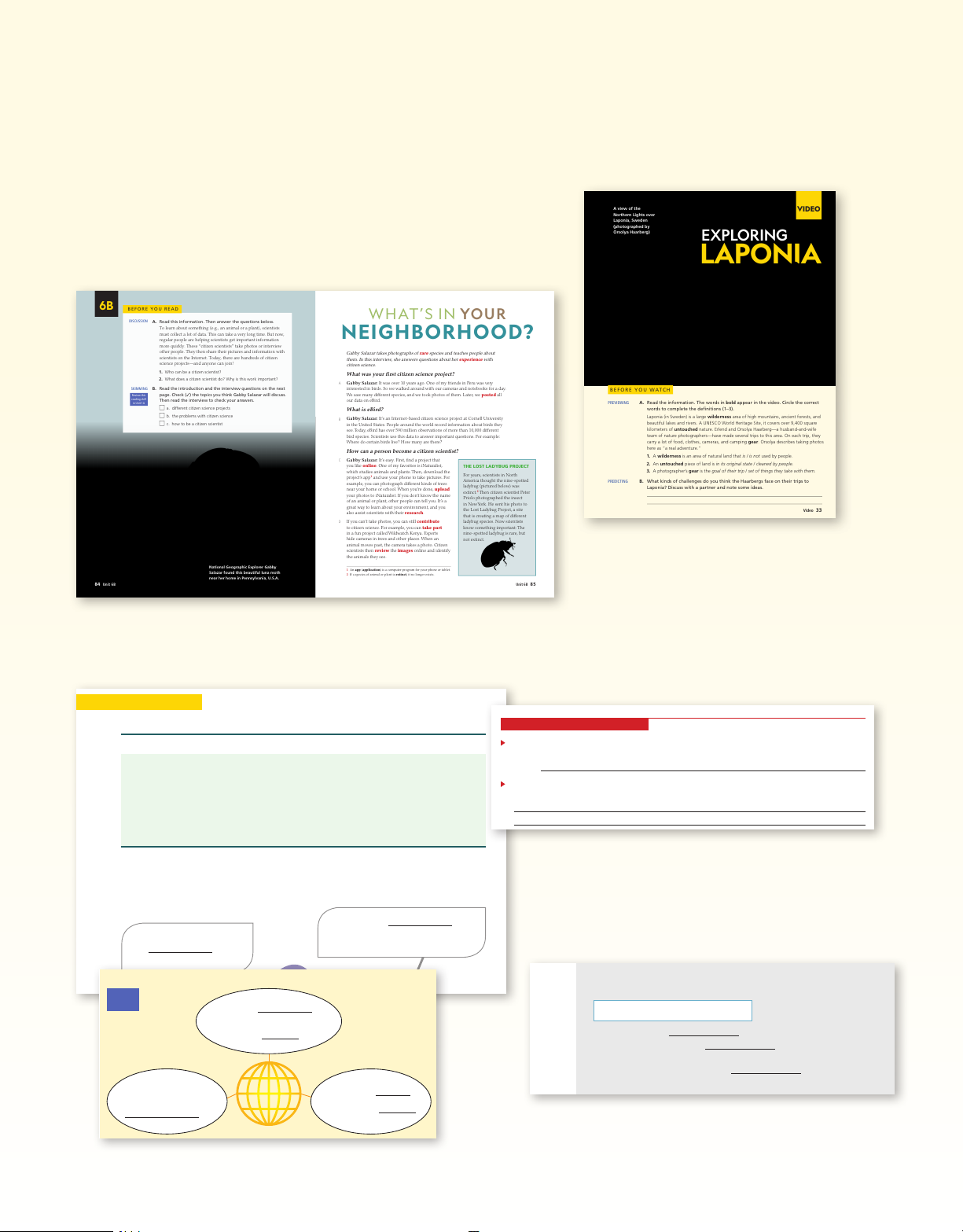
READING EXPLORER brings the world to your classroom.
With Reading Explorer you learn about real people and
places, experience the world, and explore topics that matter.
What you’ll see in the Third Edition: A view of the VIDEO Northern Lights over Laponia, Sweden (photographed by Orsolya Haarberg) EXPLORING
Real-world stories give you a better
understanding of the world and your place in it. LAPONIA 6B BEFORE YOU READ WHAT’S IN YOUR DISCUSSION
A. Read this information. Then answer the questions below. R E A D I N G S K I L L
To learn about something (e.g., an animal or a plant), scientists NEIGHBORHOOD?
must collect a lot of data. This can take a very long time. But now,
regular people are helping scientists get important information
more quickly. These “citizen scientists” take photos or interview
other people. They then share their pictures and information with
Gabby Salazar takes photographs of rare species and teaches people about
scientists on the Internet. Today, there are hundreds of citizen
them. In this interview, she answers questions about her experience with
science projects—and anyone can join! citizen science.
Recognizing Degrees of Certainty
1. Who can be a citizen scientist?
What was your first citizen science project?
2. What does a citizen scientist do? Why is this work important? A
Gabby Salazar: It was over 10 years ago. One of my friends in Peru was very
It is important to recognize how sure an author is about any claims that are made in a text. A fact SKIMMING
B. Read the introduction and the interview questions on the next
interested in birds. So we walked around with our cameras and notebooks for a day. Review this
page. Check (✓) the topics you think Gabby Salazar will discuss.
We saw many different species, and we took photos of them. Later, we posted all
would have a very high degree of certainty
B E F O R E Y O U . Theories or speculations would have a lower degr WAT C H ee of reading skill
Then read the interview to check your answers. our data on eBird. in Unit 1A
certainty. The following words and phrases can indicate degr PREVIEWING A. ees of certainty
Read the information. The words in bold .
appear in the video. Circle the correct
a. different citizen science projects
words to complete the definitions (1–3). What is eBird?
b. the problems with citizen science
Laponia (in Sweden) is a large wilderness area of high mountains, ancient forests, and B
Gabby Salazar: It’s an Internet-based citizen science project at Cornell University
c. how to be a citizen scientist
in the United States. People around the world record information about birds they
Complete certainty: certainly, definitely, without a doubt, for sure, certain
beautiful lakes and rivers. A UNESCO World Heritage Site, it covers over 9,400 square
kilometers of untouched nature. Erlend and Orsolya Haarberg—a husband-and-wife
see. Today, eBird has over 590 million observations of more than 10,000 different
bird species. Scientists use this data to answer important questions. For example:
Where do certain birds live? How many are there?
Strong certainty: probably, likely
team of nature photographers—have made several trips to this area. On each trip, they
carry a lot of food, clothes, cameras, and camping gear. Orsolya describes taking photos
here as “a real adventure.”
How can a person become a citizen scientist? C
Gabby Salazar: It’s easy. First, find a project that
Less certainty: might, may, could, possibly
1. , perhaps, maybe, doubtful
A wilderness is an area of natural land that is / is not used by people.
2. An untouched piece of land is in its original state / cleaned by people.
you like online. One of my favorites is iNaturalist,
THE LOST LADYBUG PROJECT
which studies animals and plants. Then, download the
3. A photographer’s gear is the goal of their trip / set of things they take with them.
For years, scientists in North
project’s app1 and use your phone to take pictures. For
America thought the nine-spotted
example, you can photograph different kinds of trees ladybug (pictur IDENTIFYING ed below) was
A. Look at the sentences below (1–6) from Reading B. Underline the words and PREDICTING
B. What kinds of challenges do you think the Haarbergs face on their trips to
Laponia? Discuss with a partner and note some ideas.
near your home or school. When you’re done, upload
extinct.2 Then citizen scientist Peter
your photos to iNaturalist. If you don’t know the name
phrases that indicate degrees of certainty.
Priolo photographed the insect
of an animal or plant, other people can tell you. It’s a
in New York. He sent his photo to
great way to learn about your environment, and you
the Lost Ladybug Project, a site
also assist scientists with their research. ANALYZING
B. For each claim below, circle the author’s degree of certainty (1 = lowest degree Video 33
that is creating a map of different D
If you can’t take photos, you can still contribute
ladybug species. Now scientists
of certainty; 5 = highest degree of certainty). Then compare answers with
to citizen science. For example, you can take part know something important: The
in a fun project called Wildwatch Kenya. Experts
nine-spotted ladybug is rare, but a partner.
hide cameras in trees and other places. When an not extinct.
animal moves past, the camera takes a photo. Citizen
1. This was without a doubt the longest and most 1
National Geographic V 2 3 ideos 4 5
scientists then review the images online and identify the animals they see.
dangerous part of their trip around the world.
National Geographic Explorer Gabby
expand on the unit topic and give you
1 An app (application) is a computer program for your phone or tablet.
Salazar found this beautiful luna moth
2 If a species of animal or plant is extinct, it no longer exists.
2. During the flight, she likely headed in the wrong 1 2 3 4 5
near her home in Pennsylvania, U.S.A. 84 Unit 6B Unit 6B 85
direction because the sun was bright and it was V O C A B U L
a chance to apply your language skills. har A Rd to see. Y P R A C T I C E
3. Perhaps she and Noonan got lost somewhere over 1 2 3 4 5 the Pacific. COMPLETION
A. Circle the correct words to complete the paragraph below.
4. Another idea is that Earhart might have landed 1 2 3 4 5
Reading Skill and Reading Comprehension sections on a nearby
Is ther , uninhabited island called Nikumaroro,
e life on other planets? Scientists use different methods to try to answer this where she later died.
question. Some use very 1powerful / whole radio telescopes. They hope to receive
messages from intelligent life on distant planets. Other scientists only 2search /
provide the tools you need to become an effective reader.
R E A D I N G C O M P R E H E N S I O N
5. These bones could have been Earhart’s. 1 2 3 4 5
contact for life in our solar system. But they aren’t looking for intelligent life—they
6. Whatever happened, Earhart pr want to 3circle / obably died as identify
any possible life forms. T 1 2 3 4 5 o do this, they test whether R E A D I N G S K I L L she wished.
conditions on a planet would 4allow / contact any kind of life to 5exist / search.
A. Choose the best answer for each question.
WORDS IN B. Complete each sentence with the correct GIST
1. What is the reading mainly about? CRITICAL THINKING
CONTEXT Evaluating Theories
answer (a or b). Discuss these questions with a partner.
a. why certain global cities are important
Summarizing: Using a Concept Map
Look back at Reading B. Of the theories about Amelia Earhart’
1. We measure distance in .
s disappearance, which does the
b. daily life in the world’s fastest-growing cities
c. Asian cities that will be important in 10 years author think is most likely? a. kilometers (km)
When you summarize a text, you record the main ideas and key details. A concept map can help Theory: b. kilograms (kg) DETAIL
2. What is NOT considered in the Global Cities Index?
you organize these ideas in a clear and logical way, and can help you understand information better. a. food
2. Some examples of tools are .
In a concept map, the main ideas are linked by words and phrases that explain the connection
Do you agree with the author? What do you think happened to Earhart and Noonan? Note b. weather a. monkeys and dolphins between them.
your answers below. Then compare them with your ideas in Before You Read B (on page 166). c. education b. cell phones and laptops
You can create a concept map by first starting with a main idea, topic, or issue. Then note the key DETAIL
3. According to the reading, which part of the world is predicted to grow in
3. If you contact someone, you them.
concepts that link to this main idea. The bigger and mor the area of politics?
e general concepts come first, which are then
linked to smaller, more specific concepts. a. meet or communicate with Unit 12B 169 a. Asia b. research and write about b. South America c. the Middle East
4. If you have lived in a place your whole life, ANALYZING
A. Look back at Reading A. Find the main ideas and key details in the text. you have lived there of your life. VOCABULARY
4. In paragraph D, what does urban refer to? SUMMARIZING
B. Complete the concept map below with words or phrases from Reading A. a. cities and towns a. some b. the future b. all
Expanded Vocabulary Practice sections c. the globe
5. If a spaceship circles a planet, it The SpaceX Falcon teach you the most useful wor Heavy rocket lifted of ds and phrases f INFERENCE
5. Which statement would the writer probably agr using po ee with? werful 4 , the planet. on February 6, 2018.
a. A top global city needs to be strong in several arso w
eas. e can now see solar systems that unlikely only one planet a. goes around needed for academic reading.
b. The Global Cities Index will pr we could not before
obably list the same top cities 10 years from now. in 1 years b. lands on
c. Tomorrow’s global cities will probably be less powerful than today’s. has intelligent life
SUMMARIZING B. Complete the concept map with words or phrases from the reading. WORD PARTS
C. The suffix -ful in powerful means “full of.” Complete the sentences using the
words in the box. One word is extra. Review this reading skill LIFE ON OTHER Asia might be in Unit 4A • Beijing and 1 PLANETS found by might exist care harm power wonder because will be very powerful
• More business potential in other 1. Moon dust can be
ful and can damage our DNA. Chinese and 2 cities
2. Astronomers need to be very
ful with the expensive equipment they use.
making contact with intelligent
3. The Falcon Heavy rocket is extremely
ful. It can carry a load beings using 5 universe is 2 , with billions of 60,000 kg. South America FUTURE Middle East or 6 of 3 (e.g., the Milky Way) • Cities in Turkey, 4 ,
• Several cities will be more GLOBAL and the UAE will have more
powerful due to the rise of the CITIES power in world 5 3 Unit 4A 55 and business
CRITICAL THINKING Speculating Imagine a space station receives a radio signal from another
planet confirming intelligent life there. What do you think would happen next? Discuss with Unit 5A 67 a partner and note your ideas. 6 Intr oduction 54 Unit 4A
001-006_16258_REX_SB_1_FM_ptg01.indd 6 3/28/19 12:11 PM 1 AMAZING ANIMALS A great gray owl is camouflaged against a tree. WA R M U P Discuss these questions with a partner.
1. What is your favorite animal? Why?
2. What are some things animals can do that humans can’t? 7
007-020_16258_REX_SB_1_U01_ptg01.indd 7 3/27/19 2:50 PM 1A B E F O R E Y O U R E A D LABELING
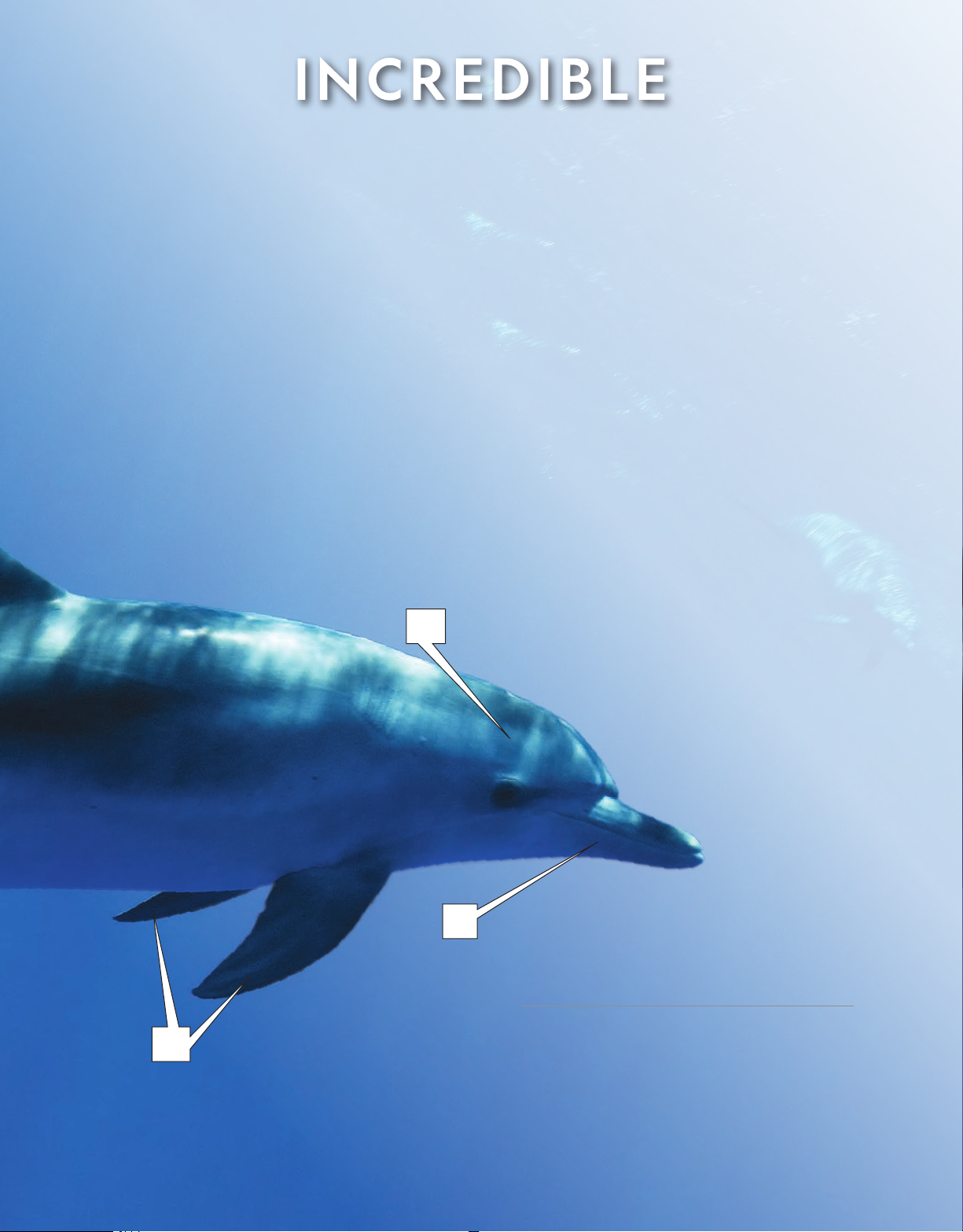
A. Look at the photo. Match each description
(1–4) with the correct part of the dolphin.
1. Dolphins sleep by resting one half of their brain at a time.
2. A dolphin’s tail doesn’t have any bones.
3. Dolphins “hear” through a special bone in their lower jaw.
4. The bones inside a dolphin’s flippers look like
the bones inside your arm and hand. SKIMMING
B. Look at the reading title and headings. What is
the reading about? Circle a, b, or c. Then read
the passage to check your answer. a. types of dolphins b. things dolphins do c. what dolphins eat A spotted dolphin swims in the clear waters of the Caribbean. 8 Unit 1A
007-020_16258_REX_SB_1_U01_ptg01.indd 8 3/27/19 2:50 PM THE DOLPHIN
A Many people say dolphins are intelligent.
feelings, and possible danger. They also
They seem to be able to think, understand, and
use a system of sounds and body language
learn things quickly. But are they as smart as
to communicate. Understanding dolphin
humans, or are they more like cats and dogs?
conversation is not easy for humans. No one
Dolphins use their brains quite differently from
“speaks dolphin” yet, but some scientists are
the way people do. But scientists say dolphins trying to learn.
and humans are alike in some ways. How? Play Communication
C Dolphins live in groups called pods, and
B Like humans, every dolphin has its own
they often join other dolphins from different
“name.” The name is a special whistle.1 Each
pods to play games and have fun—just like
dolphin chooses a whistle for itself, usually
people. Sometimes they chase other dolphins
by its first birthday. Dolphins are like people
carrying objects (e.g., seaweed) and throw
in other ways, too. They “talk” to each other
these objects back and forth. Scientists believe
about a lot of things—such as their age, their
playing together is something only intelligent animals do. Teamwork
D Dolphins and humans are similar in another
way: They both make plans for getting
things they want. In the seas of southern Brazil, for example, dolphins use an intelligent
method to get food. When there are fish near a boat,
dolphins signal2 to the fishermen to put their nets in the water. With the
dolphins’ help, the men can catch a lot of fish.
Why do dolphins assist the men? There is an
advantage for the dolphins: They get to eat
some of the fish that escape from the net.
1 A whistle is a high-pitched sound made by blowing air through a hole.
2 If you signal to someone, you make an action or a sound to tell them something. Unit 1A 9
007-020_16258_REX_SB_1_U01_ptg01.indd 9 3/27/19 2:50 PM
R E A D I N G C O M P R E H E N S I O N
A. Choose the best answer for each question. MAIN IDEA
1. What does the reading NOT mention?
a. how dolphins communicate with each other
b. how dolphins move quickly through the water
c. how dolphins play games and have fun INFERENCE
2. The author mentions cats and dogs in paragraph A to show that .
a. cats and dogs are very intelligent
b. there are different levels of intelligence
c. scientists have studied the brains of cats and dogs DETAIL
3. Where does a dolphin get its “name”? a. It gets it from its mother. b. It gets it from scientists. c. It chooses it for itself. DETAIL
4. Which sentence about dolphin language is true?
a. Dolphins “talk” to each other about many things.
b. Dolphin conversation is easy for humans to understand.
c. Dolphins can’t understand dolphins from other pods. DETAIL
5. Why do dolphins sometimes help fishermen? a. Dolphins are kind animals.
b. The dolphins can get food that way.
c. The fishermen ask the dolphins for help.
CATEGORIZING B. According to the reading passage, what do these dolphin behaviors (a–f)
demonstrate? Add them to the chart. a. using body language
d. joining other pods for games b. chasing each other
e. helping fishermen catch fish c. whistling
f. throwing seaweed back and forth Communication Play Teamwork
A bottlenose dolphin in the
Bay of Islands, New Zealand 10 Unit 1A
007-020_16258_REX_SB_1_U01_ptg01.indd 10 3/27/19 2:50 PM R E A D I N G S K I L L Skimming for Gist
The gist of a passage is what the text is mainly about. When you want to get the gist of a passage,
don’t read every word. Skim the text quickly to find out what it is mostly about. Look at the title and
any headings, photos, and captions. Another strategy is to read the first sentence of each paragraph. SKIMMING
A. Skim Reading A again. What is the main idea of the passage? Circle a, b, or c.
a. We can learn a lot from the way dolphins communicate, play, and work together.
b. The dolphin is the most intelligent sea animal in the world.
c. Dolphins are intelligent and—in some ways—are like humans. SKIMMING
B. Skim this short passage and answer the questions (1–2) below. Then read the
passage again and check your answers.
The albatross is one of the world’s largest flying birds. It also has the largest wings of
any bird—up to 3.4 meters from tip to tip. These giant birds use their wings to ride the
ocean winds. They can fly for hours without rest, or even without moving their wings.
Some may even be able to sleep while flying.
Most albatrosses spend nearly all their time in the air. In fact, they only return to
land to breed.1 A parent albatross might fly thousands of kilometers to find food for
its young. In its lifetime, an albatross can fly a total of more than six million kilometers. A wandering albatross
1 When animals breed, they have babies.
1. What is the above passage mainly about? a. where albatrosses live b. albatross flying behavior c. albatross intelligence
2. What could be a title for this passage? a. Riding the Ocean Winds b. Catching Fish c. The Smartest Bird
CRITICAL THINKING Identifying Ideas
Reading A mentions three similarities between dolphins and humans. What are they?
Can you think of other ways to tell if an animal is intelligent? Discuss with a partner and note some ideas. Unit 1A 11
007-020_16258_REX_SB_1_U01_ptg01.indd 11 3/27/19 2:50 PM
V O C A B U L A RY P R A C T I C E DEFINITIONS
A. Read the paragraph below and match each word in red with its definition (1–5).
There are a few ways to test how smart animals are. One method is to test memory.
Scientists in Japan showed a group of college students and a group of five-year-old
chimps the numbers 1 to 9 in different places on a computer screen. The test was to see
if the groups could remember the position of the numbers in the correct order. Each time,
the chimps were faster than the students. Why? Were the chimps special in some way?
Did someone assist them? No, but the chimps probably had an important advantage:
They were young. As both humans and animals get older, their memory gets worse. 1. : a way of doing something 2. : to help 3. : clever 4.
: better or more important than others 5.
: something that helps you succeed COMPLETION
B. Complete the information with the words from the box.
alike communicate feelings intelligent system A Sumatran orangutan Orangutans and humans are 1 in some ways. Both are very 2
animals. For example, to stay dry when it rains,
orangutans take leaves from trees and use them
like umbrellas. These apes don’t have a complex1 language 3 like humans do. But
today, some orangutans are learning basic sign
language to express their thoughts and 4 .
New research also suggests that orangutans can 5
about the past, just like humans.
1 If something is complex, it is complicated or made up of many parts.
WORD PARTS C. Some nouns use the suffixes -ance and -ence. Use the noun form of these words
to complete the sentences. Add the correct suffix to each word.
assist different intelligent 1. What is the
between a dolphin and a porpoise?
2. The fact that apes use tools shows they have great .
3. Whales will often give
to other whales that are in danger. 12 Unit 1A
007-020_16258_REX_SB_1_U01_ptg01.indd 12 3/27/19 2:50 PM 1B B E F O R E Y O U R E A D DEFINITIONS
A. Read the caption below. Then circle the correct words to complete these definitions.
1. If you disguise yourself, you change how you look so others know /
don’t know who you are.
2. A predator is an animal that eats other animals / plants.
3. If two animals look like each other, they look different / the same. SKIMMING
B. Look at the picture on page 15 and read the caption and labels. Review this
Then skim the passage and complete the sentence below. Read reading skill
the passage to check your answer. in Unit 1A
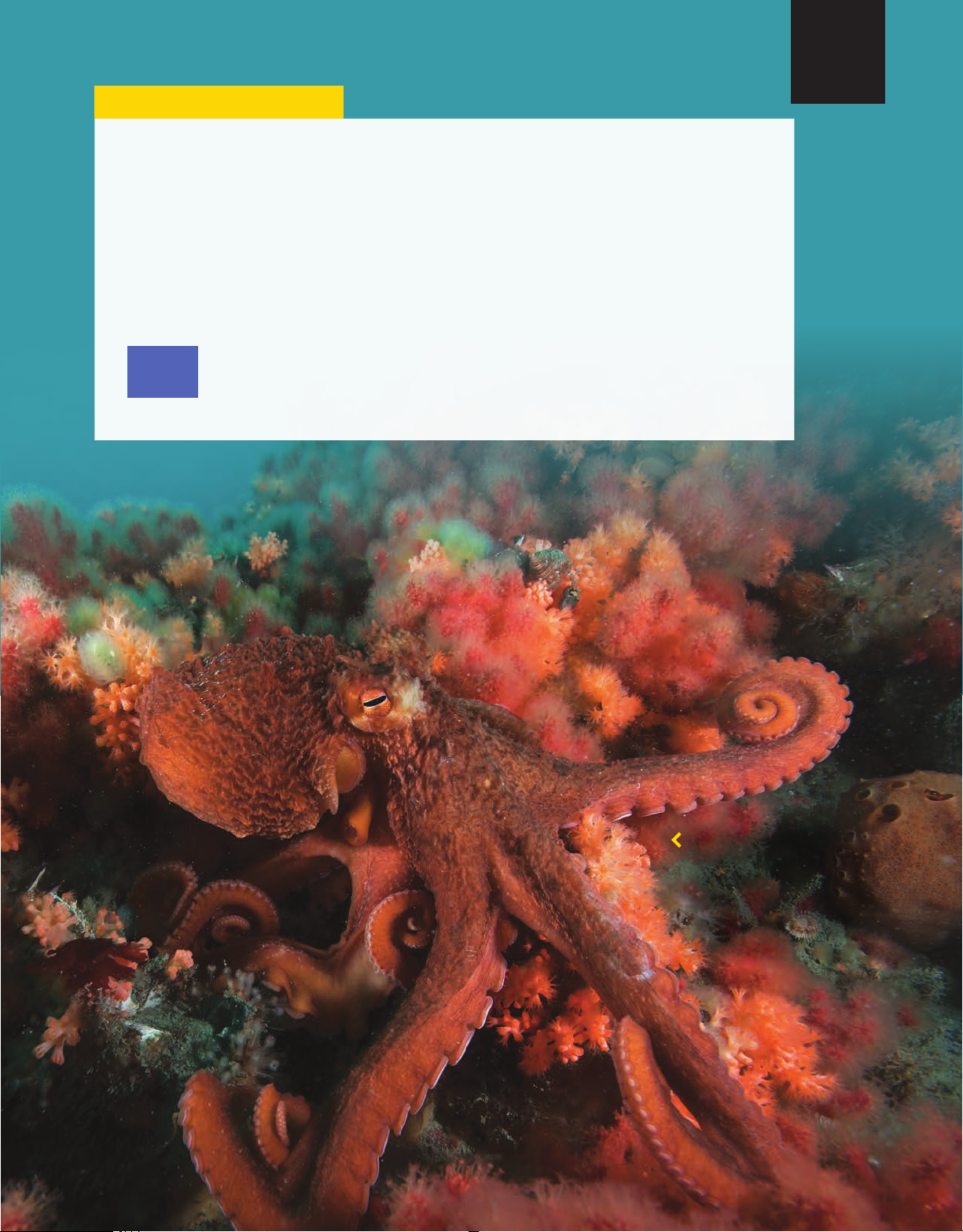
Most of the passage explains why / how octopuses disguise themselves. Octopuses disguise themselves so predators (e.g., dolphins or sharks) don’t see them. Here, the octopus looks like the coral nearby. Unit 1B 13
007-020_16258_REX_SB_1_U01_ptg01.indd 13 3/27/19 2:50 PM MASTER OF DISGUISE
A Octopuses are famous for their round bodies, big eyes, and eight arms. There
are many different types of octopuses, but all are alike in one way: They are
masters1 of disguise. Octopuses can change their appearance in less than a
second to look like rocks, plants, or even other animals. How do they do this?
B An octopus can disguise itself in three ways. One is by using color. An
octopus’s skin has special cells2 called chromatophores. These cells are filled
with yellow, brown, and red pigment.3 When an octopus moves its muscles
a certain way, the cells become large and produce colorful spots and other
patterns on its skin. Chromatophores can also reflect light. In blue light,
for example, an octopus’s skin will look blue. In white light, its skin will look
white. With these cells, an octopus can produce many different skin colors and patterns.
C An octopus can also change its skin texture.4 When the octopus moves its
muscles, its skin can go from smooth to spiky. It might then look like a plant,
or coral. Another way an octopus disguises itself is by changing its shape.
Some, for example, roll their bodies into balls so they look like rocks. One type
of octopus can change its form to look like other sea creatures—especially
dangerous ones, such as sea snakes.
D Why are octopuses so good at disguising themselves? They have to be. The
ocean is not a safe place for them. Because they have no bones in their bodies,
octopuses are like large pieces of meat. Many predators want to eat them—
and they can eat them whole. To survive, octopuses have developed the
amazing ability to change their appearance very quickly in order to hide from predators.
1 A master is very good at doing something.
2 A cell is the smallest living part of an animal or plant. Most animals have billions of cells in their bodies.
3 Pigment is a substance that gives something color. For example, green pigment makes most plants look green.
4 Texture is how something looks and feels (e.g., soft, smooth, spiky). 14 Unit 1B
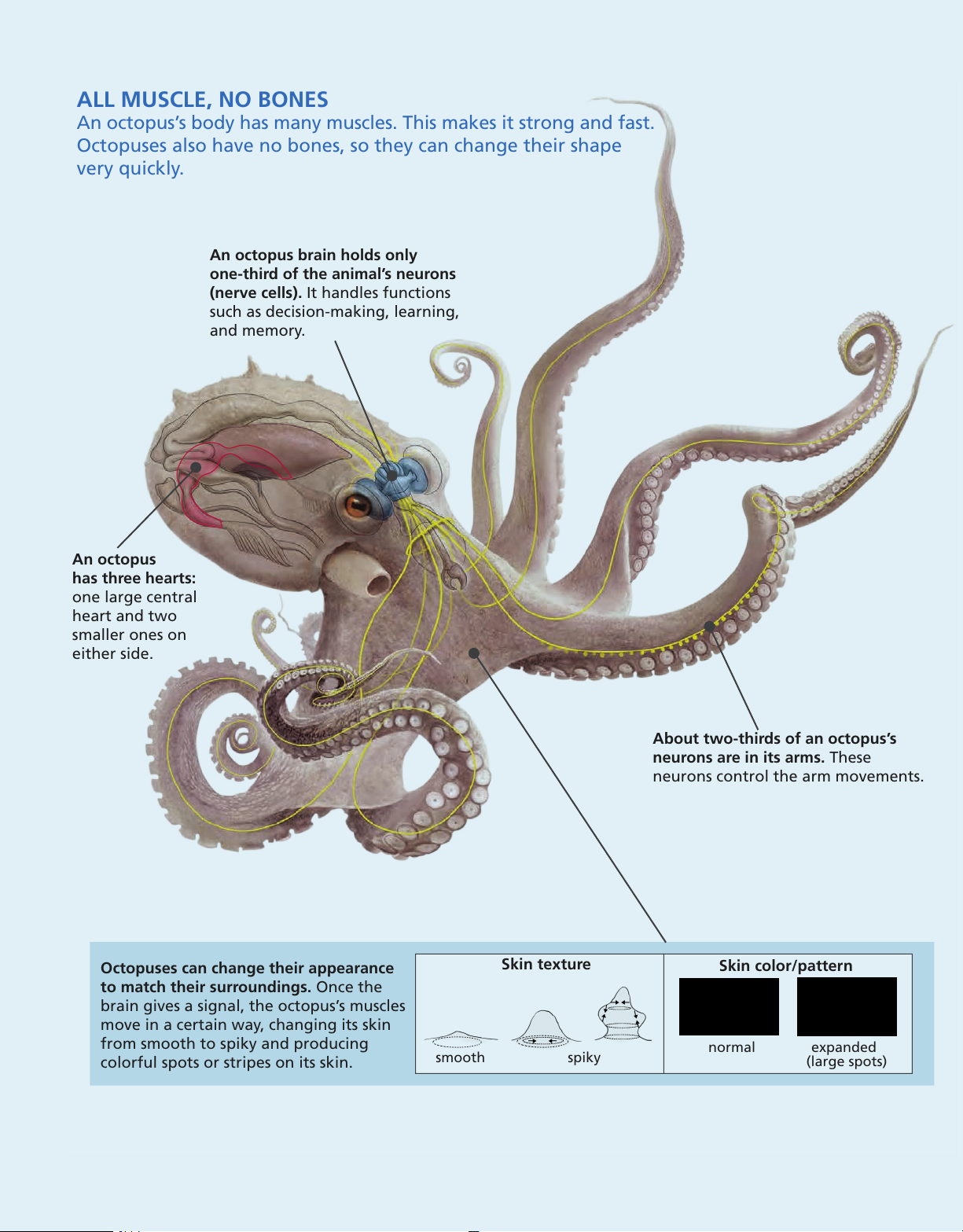
007-020_16258_REX_SB_1_U01_ptg01.indd 14 3/27/19 2:50 PM ALL MUSCLE, NO BONES
An octopus’s body has many muscles. This makes it strong and fast.
Octopuses also have no bones, so they can change their shape very quickly. An octopus brain holds only
one-third of the animal’s neurons
(nerve cells). It handles functions
such as decision-making, learning, and memory. An octopus has three hearts: one large central heart and two smaller ones on either side.
About two-thirds of an octopus’s
neurons are in its arms. These
neurons control the arm movements.
Octopuses can change their appearance Skin texture Skin color/pattern
to match their surroundings. Once the
brain gives a signal, the octopus’s muscles
move in a certain way, changing its skin
from smooth to spiky and producing normal expanded smooth spiky
colorful spots or stripes on its skin. (large spots) Unit 1B 15
007-020_16258_REX_SB_1_U01_ptg01.indd 15 3/27/19 2:50 PM
R E A D I N G C O M P R E H E N S I O N
A. Choose the best answer for each question. GIST
1. What would be the best alternative title for this passage? a. The Mind of an Octopus b. How an Octopus Hides
c. Octopus Numbers on the Rise DETAIL
2. Which of these sentences is NOT true?
a. Chromatophores are light-reflecting cells.
b. Chromatophores can change in size.
c. Chromatophores produce an animal’s skin texture. INFERENCE
3. In red light, an octopus probably appears . a. red b. blue c. white INFERENCE
4. In paragraph C, the author suggests that some corals . a. can change their color
b. can roll themselves into balls c. have spiky outer surfaces REFERENCE
5. What does they refer to in paragraph D, line 4? a. octopuses b. bones c. predators MATCHING
B. Look at the list of ways octopuses disguise themselves (a–c) and the statements
(1–5). Match each statement with the method of disguise. Write a, b, or c. a. color b. skin texture c. shape
1. by producing spots on their skin
2. by appearing to be sea snakes
3. by rolling their bodies into balls 4. by reflecting light
5. by making their skin spiky A Pacific red octopus shows its suckers. 16 Unit 1B
007-020_16258_REX_SB_1_U01_ptg01.indd 16 3/27/19 2:50 PM R E A D I N G S K I L L
Identifying Main Ideas in Paragraphs
A paragraph usually has one main idea and some details that support it. Paragraphs often include
a topic sentence that describes the main idea. Usually—but not always—a topic sentence is at or
near the start of the paragraph, or at the end. One way to find the main idea quickly is to read the
sentences at the beginning and end of the paragraph. A paragraph’s heading (if it has one) can also give a clue to its main idea. MAIN IDEA
A. Read the paragraph below. Which sentence gives the main idea? Circle a, b, or c.
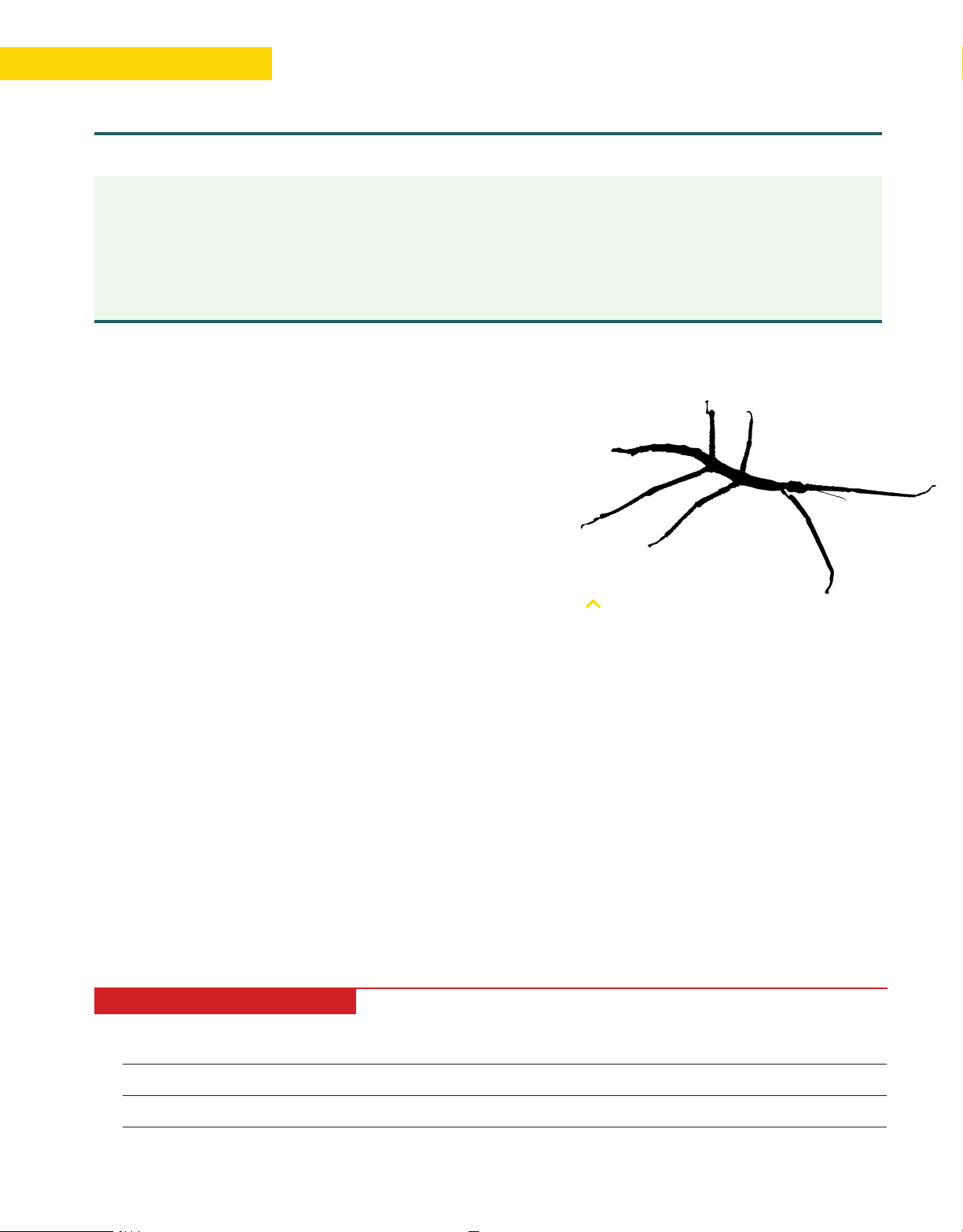
Is it a stick? Or is it an insect? It’s a stick insect—
an insect that looks like a stick. The stick insect
is an example of an animal that uses color,
texture, and shape to disguise itself. It lives—
and can easily hide—among the leaves and
twigs of plants. Most stick insects are either
brown or green. The smallest types are just
over a centimeter long. The largest is about
33 centimeters, making it one of the
A Malayan giant stick insect world’s longest insects.
a. The stick insect is an example of an animal that uses color, texture, and shape to disguise itself.
b. It lives—and can easily hide—among the leaves and twigs of plants.
c. The largest is about 33 centimeters, making it one of the world’s longest insects. MAIN IDEA
B. Look back at Reading B. Match each paragraph with its main idea (a–d). 1. Paragraph A •
• a. An octopus can change its shape and skin texture. 2. Paragraph B •
• b. Octopuses can change how they look very quickly. 3. Paragraph C •
• c. An octopus can change its skin color. 4. Paragraph D •
• d. Octopuses disguise themselves for their own protection.
CRITICAL THINKING Comparing Which animal do you think is smarter—the dolphin or the
octopus? Why? Note your ideas and discuss with a partner. Unit 1B 17
007-020_16258_REX_SB_1_U01_ptg01.indd 17 3/27/19 2:50 PM
V O C A B U L A RY P R A C T I C E COMPLETION
A. Complete the paragraph with words from the box.
ability appearance hide patterns produce
Reef squid—like their relatives, octopuses—have an amazing A bigfin 1
: They can quickly change their physical reef squid 2 in order to 3 from
predators. They also use this skill to send messages; they can even 4
two messages at the same time!
For example, a male reef squid swimming near a female squid
can create colorful, attractive 5 on the side
of its body closest to the female. On the other side, it shows
black and white lines that tell other male squid to stay away.
WORDS IN B. Complete each sentence with the correct answer (a or b). CONTEXT
1. A creature refers to any living . a. plant b. animal 2. A circle has a shape. a. round b. square
3. If you survive a dangerous situation, you through it. a. live b. don’t live
4. The muscles in the human body control how we . a. think b. move
5. If you develop a skill or ability, it becomes . a. better or stronger b. worse or weaker WORD FORMS
C. The verb survive can be made into a noun by adding the suffixes -or or -al.
Complete the sentences with the correct words from the box.
survive survivor survival 1. The
of whales is connected to the health of the ocean. 2. These plants cannot in very cold conditions.
3. The plane crash had only one . 18 Unit 1B
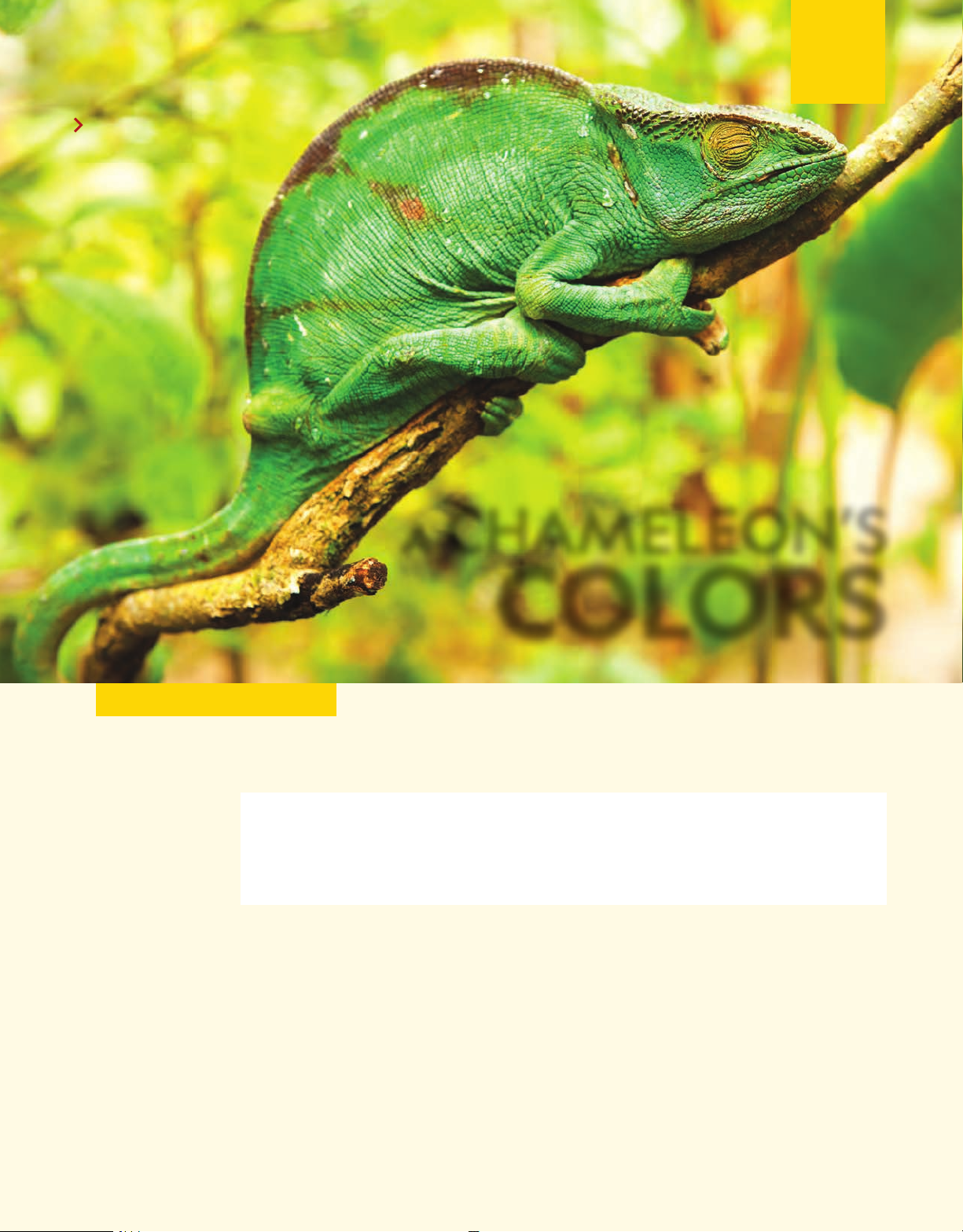
007-020_16258_REX_SB_1_U01_ptg01.indd 18 3/27/19 2:50 PM VIDEO A chameleon balances on a thin branch. A CHAMELEON’S COLORS B E F O R E Y O U WAT C H
PREVIEWING A. Read the extracts from the video. Then complete the definitions of the words or
phrases in bold. Circle the correct words.
“Chameleons can change color to attract other chameleons or to warn them to go away.”
“To catch food, a chameleon hides in the trees until an insect walks by. Then it
shoots out its tongue …”
1. If you want to attract something, you want it to come to you / go away.
2. When you warn someone about something, you tell them that something good / bad may happen.
3. When something shoots out, it moves very quickly / slowly.
QUIZ B. Read the sentences below and guess if they are correct. Circle T (true) or F (false).
1. The main reason chameleons change color is to hide from predators. T F
2. A chameleon’s tongue is very long. T F
3. Chameleons are in trouble because they are being hunted by other T F animals. Video 19
007-020_16258_REX_SB_1_U01_ptg01.indd 19 3/27/19 2:50 PM W H I L E Y O U WAT C H
GIST A. Watch the video. Check your answers in Before You Watch B.
MULTIPLE CHOICE B. Watch the video again. Choose the correct answer for each question.
1. According to the video, where do many different types of chameleons live? a. Malta b. Madagascar
2. What is one reason given in the video for chameleons’ color changes?
a. to show that they want some food
b. to show that they are scared
3. Why do chameleons rock back and forth?
a. to stay safe from predators
b. to get ready to attack other animals
4. The video uses a model of a bow and arrow to .
a. show how difficult it is for a predator to attack a chameleon
b. explain how a chameleon can stick out its tongue very fast
CRITICAL THINKING Reflecting If you were a scientist studying animals, what animal would you
study? What would you like to find out about this animal? Note some ideas and share your answers with a partner. V O C A B U L A RY R E V I E W
Do you remember the meanings of these words? Check (✓) the ones you know. Look back at the
unit and review any words you’re not sure of. Reading A advantage alike assist* communicate* feelings intelligent* method* smart special system Reading B ability appearance creature develop hide muscle pattern produce shape survive* * Academic Word List 20 Video
007-020_16258_REX_SB_1_U01_ptg01.indd 20 3/27/19 2:50 PM
Tài liệu liên quan:
-
Sách Cambridge IELTS 11 - Academic with answers | Học viện Phụ nữ Việt Nam
26 13 -
25 Đề dự đoán SPEAKING quý 1 2026 môn IELTS | Học viện Phụ nữ Việt Nam
62 31 -
Sách bài tập "Complete IELTS Band 4-5" môn IELTS | Học viện Phụ nữ Việt Nam
45 23 -

Hướng dẫn học IELTS Writing | Học viện Phụ nữ Việt Nam
35 18 -
Reading Explorer Foundations (Third Edition) môn IELTS | Học viện Phụ nữ Việt Nam
37 19