Sách bài tập Supplemental Problems and Solutions | Trường Đại học Khoa học tự nhiên, Đại học Quốc gia Thành phố Hồ Chí Minh
Sách bài tập Supplemental Problems and Solutions | Trường Đại học Khoa học tự nhiên, Đại học Quốc gia Thành phố Hồ Chí Minh. Tài liệu được sưu tầm giúp bạn tham khảo, ôn tập và đạt kết quả cao. Mời bạn đọc đón xem.
Môn: Hoá Hữu Cơ 1 5 tài liệu
Trường: Trường Đại học Khoa học tự nhiên, Đại học Quốc gia Thành phố Hồ Chí Minh 1.1 K tài liệu
Tác giả:














Preview text:
This page intentionally left blank
This page intentionally left blank WORKBOOK FOR ORGANIC CHEMISTRY
SUPPLEMENTAL PROBLEMS AND SOLUTIONS Jerry A. Jenkins Otterbein College W.H. Freeman and Company New York
© 2010 by W.H. Freeman and Company All rights reserved.
Printed in the United States of America ISBN-13: 978-1-4292-4758-0 ISBN-10: 1-4292-4758-4 First printing W.H. Freeman and Company 41 Madison Avenue New York, NY 10010 Houndmills, Basingstoke RG21 6XS England www.whfreeman.com/chemistry TABLE OF CONTENTS PREFACE v
About the author vi | Acknowledgments vi | Selected concepts/reactions locator vii
TIPS viii | Common abbreviations ix CHAPTER 1 THE BASICS 1
1.1 Hybridization, formulas, physical properties 1 | 1.2 Acids and bases 4 | 1.3 Resonance 7 CHAPTER 2 ALKANES 11
2.1 General 11 | 2.2 Nomenclature 12 | 2.3 Conformational analysis, acyclic 13 CHAPTER 3 CYCLOALKANES 15
3.1 General 15 | 3.2 Nomenclature 16 | 3.3 Conformational analysis, cyclic 18 CHAPTER 4 REACTION BASICS 21 CHAPTER 5
ALKENES AND CARBOCATIONS 27
5.1 General 27 | 5.2 Reactions 30 | 5.3 Syntheses 36 | 5.4 Mechanisms 39 CHAPTER 6 ALKYNES 49
6.1 Reactions 49 | 6.2 Syntheses 50 | 6.3 Mechanisms 53 CHAPTER 7 STEREOCHEMISTRY 55
7.1 General 55 | 7.2 Reactions and stereochemistry 61 CHAPTER 8
ALKYL HALIDES AND RADICALS 65
8.1 Reactions 65 | 8.2 Syntheses 66 | 8.3 Mechanisms 67 CHAPTER 9
SN1, SN2, E1, AND E2 REACTIONS 69
9.1 General 69 | 9.2 Reactions 71 | 9.3 Syntheses 76 | 9.4 Mechanisms 78 CHAPTER 10 NMR 87
CHAPTER 11 CONJUGATED SYSTEMS 93
11.1 Reactions 93 | 11.2 Syntheses 96 | 11.3 Mechanisms 98 CHAPTER 12 AROMATICS 103
12.1 General 103 | 12. Reactions 105 | 12.3 Syntheses 109 | 12.4 Mechanisms 111 CHAPTER 13 ALCOHOLS 117
13.1 Reactions 117 | 13.2 Syntheses 120 | 13.3 Mechanisms 124 CHAPTER 14 ETHERS 129
14.1 Reactions 129 | 14.2 Syntheses 133 | 14.3 Mechanisms 134
CHAPTER 15 ALDEHYDES AND KETONES 139
15.1 Reactions 139 | 15.2 Syntheses 149 | 15.3 Mechanisms 154
CHAPTER 16 CARBOXYLIC ACIDS 167
16.1 Reactions 167 | 16.2 Syntheses 169 | 16.3 Mechanisms 172
CHAPTER 17 CARBOXYLIC ACID DERIVATIVES 177
17.1 Reactions 177 | 17.2 Syntheses 186 | 17.3 Mechanisms 193
iv • Table of Contents Workbook for Organic Chemistry
CHAPTER 18 CARBONYL Į-SUBSTITUTION REACTIONS AND ENOLATES 201
18.1 Reactions 201 | 18.2 Syntheses 204 | 18.3 Mechanisms 207
CHAPTER 19 CARBONYL CONDENSATION REACTIONS 209
19.1 Reactions 209 | 19.2 Syntheses 217 | 19.3 Mechanisms 219 CHAPTER 20 AMINES 229
20.1 Reactions 229 | 20.2 Syntheses 233 | 20.3 Mechanisms 236 SOLUTIONS TO PROBLEMS 241 CHAPTER 1 THE BASICS 243 CHAPTER 2 ALKANES 251 CHAPTER 3 CYCLOALKANES 255
CHAPTER 4 REACTION BASICS 261
CHAPTER 5 ALKENES AND CARBOCATIONS 263 CHAPTER 6 ALKYNES 281
CHAPTER 7 STEREOCHEMISTRY 287
CHAPTER 8 ALKYL HALIDES AND RADICALS 295
CHAPTER 9 SN1, SN2, E1, AND E2 REACTIONS 299 CHAPTER 10 NMR 315
CHAPTER 11 CONJUGATED SYSTEMS 319 CHAPTER 12 AROMATICS 327 CHAPTER 13 ALCOHOLS 341 CHAPTER 14 ETHERS 351
CHAPTER 15 ALDEHYDES AND KETONES 357
CHAPTER 16 CARBOXYLIC ACIDS 379
CHAPTER 17 CARBOXYLIC ACID DERIVATIVES 387
CHAPTER 18 CARBONYL Į-SUBSTITUTION REACTIONS AND ENOLATES 405
CHAPTER 19 CARBONYL CONDENSATION REACTIONS 413 CHAPTER 20 AMINES 427 PREFACE
WORKBOOK FOR ORGANIC CHEMISTRY
SUPPLEMENTAL PROBLEMS AND SOLUTIONS
Organic Chemistry is mastered by reading (textbook), by listening (lecture), by writing (outlining,
notetaking), and by experimenting (laboratory). But perhaps most importantly, it is learned by doing, i.e.,
solving problems. It is not uncommon for students who have performed below expectations on exams to
explain that they honestly thought they understood the text and lectures. The difficulty, however, lies in
applying, generalizing, and extending the specific reactions and mechanisms they have “memorized” to the
solution of a very broad array of related problems. In so doing, students will begin to “internalize”
Organic, to develop an intuitive feel for, and appreciation of, the underlying logic of the subject. Acquiring
that level of skill requires but goes far beyond rote memorization. It is the ultimate process by which one
learns to manipulate the myriad of reactions and, in time, gains a predictive power that will facilitate solving new problems.
Mastering Organic is challenging. It demands memorization (an organolithium reagent will undergo
addition to a ketone), but then requires application of those facts to solve real problems (methyllithium and
androstenedione dimethyl ketal will yield the anabolic steroid methyltestosterone). It features a highly
logical structural hierarchy (like mathematics) and builds upon a cumulative learning process (like a
foreign language). The requisite investment in time and effort, however, can lead to the development of a
sense of self-confidence in Organic, an intellectually satisfying experience indeed.
Many excellent first-year textbooks are available to explain the theory of Organic; all provide extensive
exercises. Better performing students, however, consistently ask for additional exercises. It is the purpose
of this manual, then, to provide Supplemental Problems and Solutions that reinforce and extend those textbook exercises.
Workbook organization and coverage. Arrangement is according to classical functional group
organization, with each group typically divided into Reactions, Syntheses, and Mechanisms. To emphasize
the vertical integration of Organic, problems in later chapters heavily draw upon and integrate reactions learned in earlier chapters.
It is desirable, but impossible, to write a workbook that is completely text-independent. Most textbooks
will follow a similar developmental sequence, progressing from alkane/alkene/alkyne to aromatic to
aldehyde/ketone to carboxylic acid to enol/enolate to amine chemistry. But within the earlier domains
placement of stereochemistry, spectroscopy, SN/E, and other functional groups (e.g., alkyl halides, alcohols,
ethers) varies considerably. The sequence is important because it establishes the concepts and reactions
that can be utilized in subsequent problems. It is the intent of this workbook to follow a consensus
sequence that complements a broad array of Organic textbooks. Consequently, instructors utilizing a
specific textbook may on occasion need to offer their students guidance on workbook chapter and problem selection.
Most Organic textbooks contain later chapters on biochemical topics (proteins, lipids, carbohydrates,
nucleic acids, etc.). This workbook does not include separate chapters on such subjects. However,
consistent with the current trend to incorporate biochemical relevance into Organic textbooks, numerous
problems with a bioorganic, metabolic, or medicinal flavor are presented throughout all chapters.
To produce an error-free manual is certainly a noble, but unrealistic, goal. For those errors that remain, I
am solely responsible. I encourage the reader to please inform me of any inaccuracies so that they may be corrected in future versions. Jerry A. Jenkins Otterbein College Westerville, OH 43081 jjenkins@otterbein.edu
Grindstones sharpen knives; problem-solving sharpens minds!
vi • Preface Workbook for Organic Chemistry ABOUT THE AUTHOR
Jerry A. Jenkins received his BA degree summa cum laude from Anderson University and PhD in Organic
from the University of Pittsburgh (T Cohen). After an NSF Postdoctoral Fellowship at Yale University (JA
Berson), he joined the faculty of Otterbein College where he has taught Organic, Advanced Organic, and
Biochemistry, and chaired the Department of Chemistry & Biochemistry. Prof. Jenkins has spent
sabbaticals at Oxford University (JM Brown), The Ohio State University (LA Paquette), and Battelle
Memorial Institute, represented liberal arts colleges on the Advisory Board of Chemical Abstracts Service,
and served as Councilor to the American Chemical Society. He has published in the areas of oxidative
decarboxylations, orbital symmetry controlled reactions, immobilized micelles, chiral resolving reagents,
nonlinear optical effects, and chemical education. Prof. Jenkins has devoted a career to challenging
students to appreciate the logic, structure, and aesthetics of Organic chemistry through a problem-solving approach. ACKNOWLEDGMENTS
I wish to express gratitude to my students, whose continued requests for additional problems inspired the
need for this book; to Mark Santee, Director of Marketing, WebAssign, for encouraging and facilitating its
publication; to Dave Quinn, Media and Supplements Editor, W. H. Freeman, for invaluable assistance in
bringing this project to completion; to the production team at W.H. Freeman, specifically Jodi Isman,
Project Editor, for all their assistance with the printing process; to Diana Blume, Art Director, and Eleanor
Jaekel for their assistance in the cover design; and to my wife Carol, for her endless patience and support.
Supplemental Problems and Solutions • vii
SELECTED CONCEPTS/REACTIONS LOCATOR
The location of problems relating to the majority of concepts and reactions in most Organic textbooks will
be generally predictable: pinacol rearrangements will be found under ALCOHOLS, benzynes under
AROMATICS, acetals under ALDEHYDES AND KETONES, etc. Placement of others, however, may vary
from one text to another: diazonium ions may be under AROMATICS or AMINES, thiols may be under
ALCOHOLS or ETHERS, the Claisen rearrangement may be under ETHERS or AROMATICS, etc. The
following indicates where problems on several of these often variably placed concepts or reactions are
initially encountered in Workbook for Organic Chemistry. Selected concept/reaction Chapter
Active methylene chemistry (e.g., malonic/acetoacetic 18 ester syntheses) Brønsted-Lowry/Lewis equations 1 Carbocation rearrangements 5 cis-, trans- (geometric) isomers 3 Claisen, Cope, oxy-Cope rearrangements 14 Conformational analysis 2, 3 Curved arrow notation vi, 1 Degrees of unsaturation (units of hydrogen deficiency) 5 Diazonium ions 20 Diels-Alder reaction 11 Enamines, synthesis of 15 Enamines, reactions of 19 Epoxides, synthesis of 5 Epoxides, reactions of 14 Free radical additions 5 Free radical substitutions 8 Hydrogens, distinguishing different 2 Isocyanates, ketenes 17 Kinetic isotope effects 9 Kinetics, thermodynamics 4 Neighboring group participation 9 Nitriles 16 Organometallics (Grignard, organolithium, Gilman), 8 synthesis of Phenols 12 Polymers 5 Reaction coordinate diagrams 4 Reaction types/mechanisms 4 Resonance 1 Thiols, (di)sulfides 14 UV/VIS spectroscopy 11
viii • Preface Workbook for Organic Chemistry
TIPS (TO IMPROVE PROBLEM SOLVING)
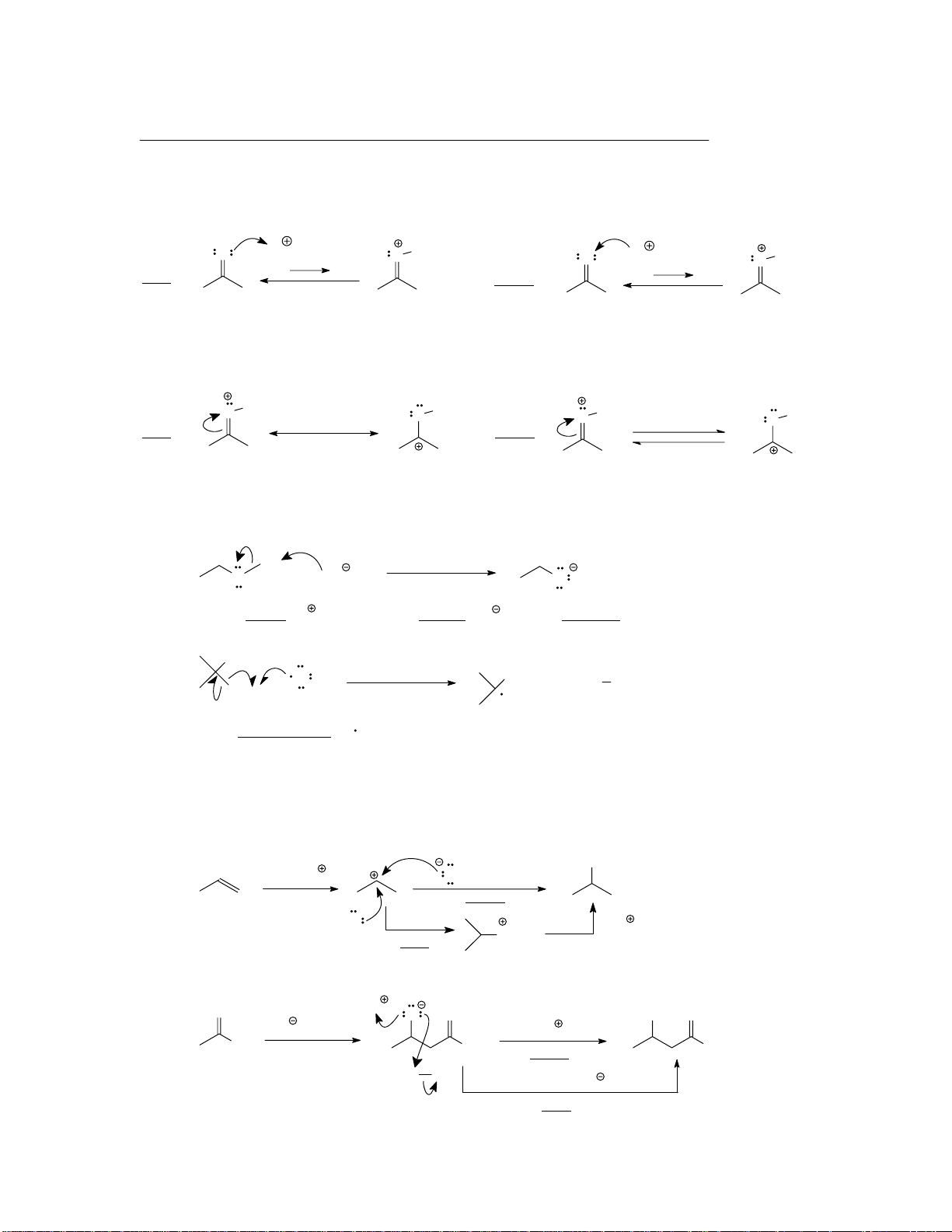
Mechanism arrows. All reactions (except nuclear) involve the flow of electrons. Arrows are used to
account for that movement. They originate at a site of higher electron density (e.g., lone pairs, S bond)
and point to an area of lower electron density (e.g., positively or partially positively charged atoms). O H O H O H O H right: wrong:
Equilibrium vs. resonance arrows. Equilibrium arrows interrelate real species (as above).
Resonance arrows interrelate imaginary valence bond structures. Do not interchange them. O H O H O H O H right: wrong: (resonance arrow) (equilibrium arrows)
Hydrogen nomenclature. The word “hydrogen” is commonly misused. Be more specific. (H O :H O + H2
A proton (H ) is removed by hydride (H: ) to form hydrogen (H2). H X H + H X H
A hydrogen atom (H ) is removed by a free radical species.
State of association/dissociation. Correct identification of the appropriate charge state on a species in
a particular environment is important. Generally speaking, alkoxides (hydroxide), carboxylates,
carbanions, enolates, amines, etc., exist under alkaline conditions. Protons, carboxylic acids,
carbocations, enols, etc., exist under acidic conditions. For example, hydroxide does not exist in an acidic solvent OH H OH 3O wrong H2O -H OH2 right
and a proton is not directly available in base. O H O O OH O OR +H H H H ROH wrong H) OR +ROH, -RO right
Supplemental Problems and Solutions • ix COMMON ABBREVIATIONS
The following abbreviations and symbols are used throughout this workbook: Ac acetyl (CH3CO-) AcOH acetic acid * chiral center or isotopic label B: base Bn benzyl (PhCH2-) Bu butyl (C4H9-) CA conjugate acid CB conjugate base ' heat energy D-A or (4+2) Diels-Alder DB double bond(s) DCC dicyclohexylcarbodiimide DIBAH diisobutylaluminum hydride DMF dimethylformamide DMSO dimethyl sulfoxide EAS electrophilic aromatic substitution ee enantiomeric excess equiv equivalent(s) Et ethyl (CH3CH2-) F-C Friedel-Crafts [H] reduction ~H+ proton shift HMPA hexamethylphosphoramide HSCoA coenzyme A hQ light energy H-V-Z Hell-Volhard-Zelinsky reaction inv inversion of configuration L leaving group LDA lithium diisopropylamide mCPBA
m-chloroperbenzoic acid Me methyl (CH3-) NAS nucleophilic acyl (or aryl) substitution NBS N-bromosuccinimide NGP neighboring group participation NR no reaction Nu: nucleophile [O] oxidation PCC pyridinium chlorochromate Ph phenyl (C6H5-) Pr propyl (C3H7-) py pyridine Ra-Ni Raney nickel ret retention of configuration rds rate determining step taut tautomerization THF tetrahydrofuran TMS tetramethylsilane or trimethylsilyl Ts
tosyl (p-toluenesulfonyl) TsOH tosyl acid
(p-toluenesulfonic acid) TS transition state W-K Wolff-Kishner reduction X halogen (XS) excess
This page intentionally left blank PROBLEMS
This page intentionally left blank CHAPTER 1 THE BASICS
1.1 Hybridization, formulas, physical properties
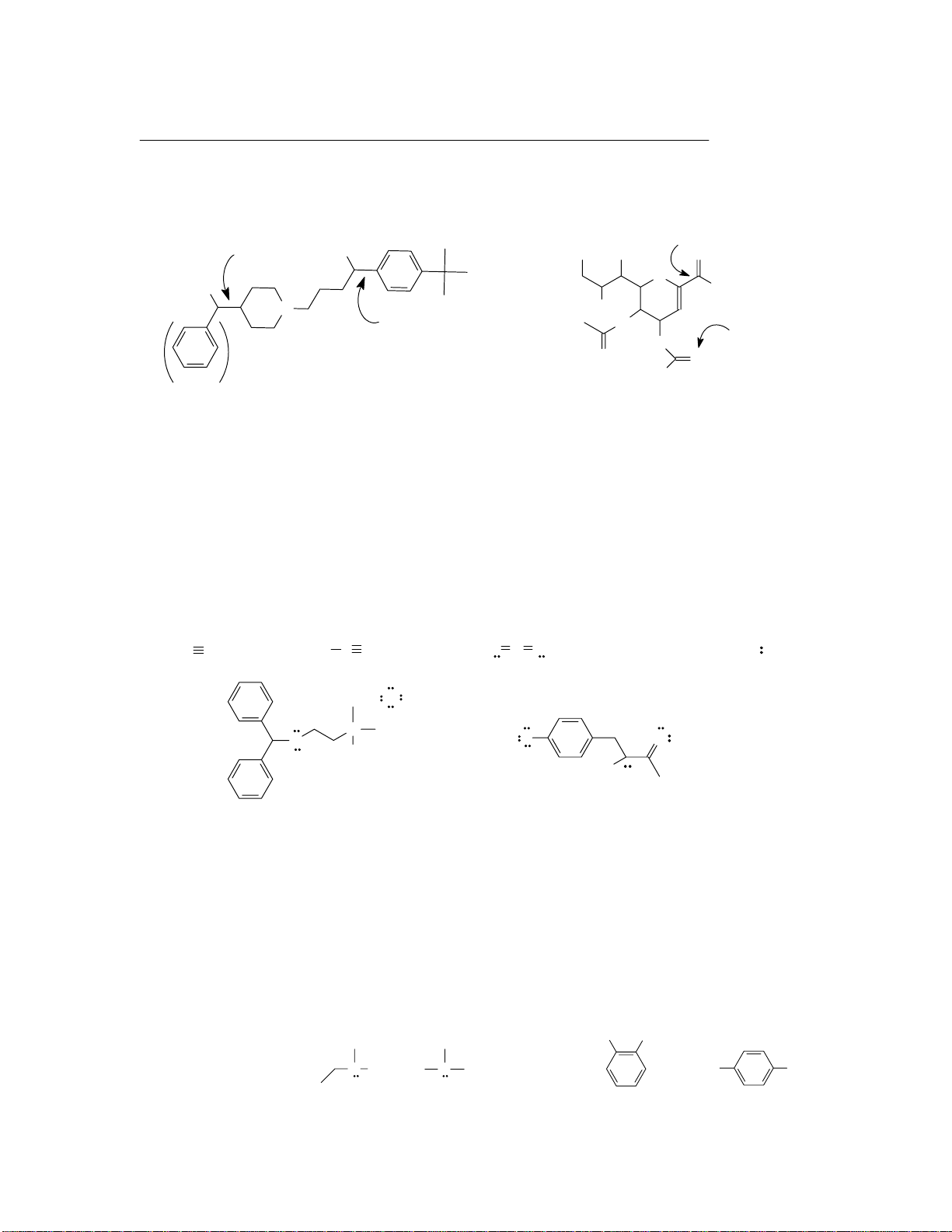
1. SeldaneTM is a major drug for seasonal allergies; RelenzaTM is a common antiviral. c HO a OH OH O O HO OH N OH b N H d NH O NH H2N 2 SeldaneTM RelenzaTM
a. Complete the molecular formula for each. SeldaneTM: C___H___NO2 RelenzaTM: C___H___N4O7
b. Draw all the lone electron pairs in both structures.
c. Which orbitals overlap to form the covalent bonds indicated by arrows a, b, and c? a ____________ b ____________ c ____________
d. What is the hybridization state of both oxygens in SeldaneTM and of nitrogen d in RelenzaTM?
2. Place formal charge over any atom that possesses it in the following structures: a. :C C: b. H C O: c. :O N O:
d. the conjugate base of NH2CH3 Cl N e. O f. O O H H BenadrylTM (antihistamine)
zingerone (a constituent of the spice ginger)
3. a. One type of carbene, [:CH2], a very reactive species, has the two unshared electrons in the same
orbital and is called “singlet” carbene. Identify the orbital and predict the HCH bond angle.
b. Another type of carbene is called “triplet” carbene and has a linear HCH bond angle. Identify the
orbitals housing the two lone electrons. HO OH
4. a. Which has the higher bp? N H or N b. lower mp? or HO OH catechol hydroquinone
1.1 Hybridization, formulas, physical properties
2 • Chapter 1 The Basics
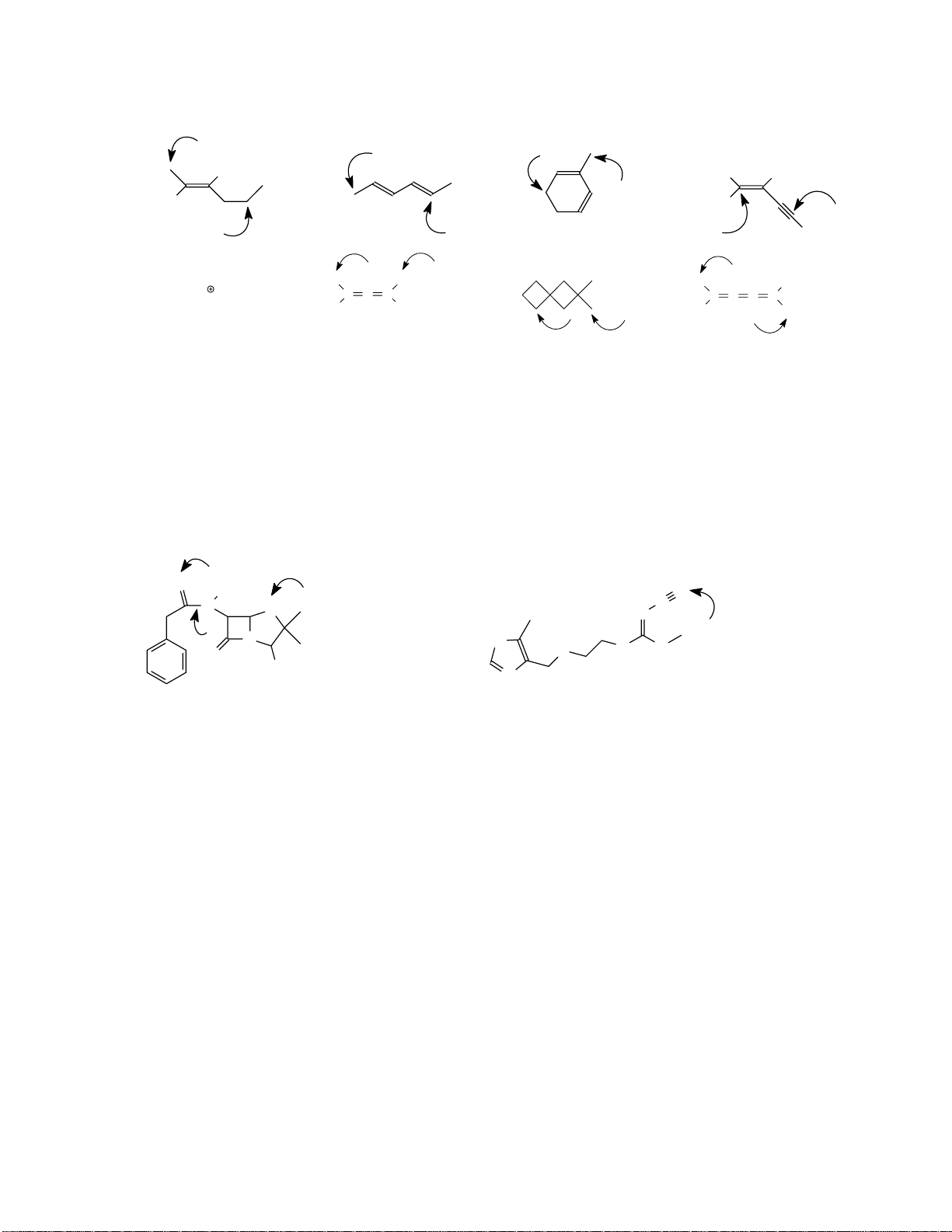
5. Must the indicated carbon atoms in each of the following structures lie in the same plane? H H H a. b. c. d. H H H H3C CH3 H3C H e. (CH g. h. 3)3C f. C C C C C C C all four carbons H H H CH3
6. Which species in each pair has the higher molecular dipole moment (P)? a. CHCl3 or CFCl3 b. CH3NH2 or CH3NO2 c. CO2 or SO2
7. Penicillin V and the antiulcerative cimetidine (TagametTM – the first billion dollar ethical drug) have the structures below: a O H b N N C S N d c N HN N O S N H H CO2H N penicillin V cimetidine
a. Complete the molecular formulas for each.
penicillin V: C_____H_____N_____O_____S
cimetidine: C_____H_____N_____S
b. Identify the type of orbital (s, p, sp, sp2, sp3) that houses the lone electron pairs on the atoms indicated
by arrows a, b, and c in the above structures. a ________ b ________ c ________
c. The bond between the carbonyl carbon and nitrogen (indicated by arrow d) is somewhat stronger than a
single but weaker than a double bond. Given that fact, what type of orbital houses the lone pair of electrons
on that nitrogen? (Suggestion: do this problem after studying resonance.)
d. How many lone pairs of electrons are in each structure? penicillin V: ________ cimetidine: ________
1.1 Hybridization, formulas, physical properties Problems • 3
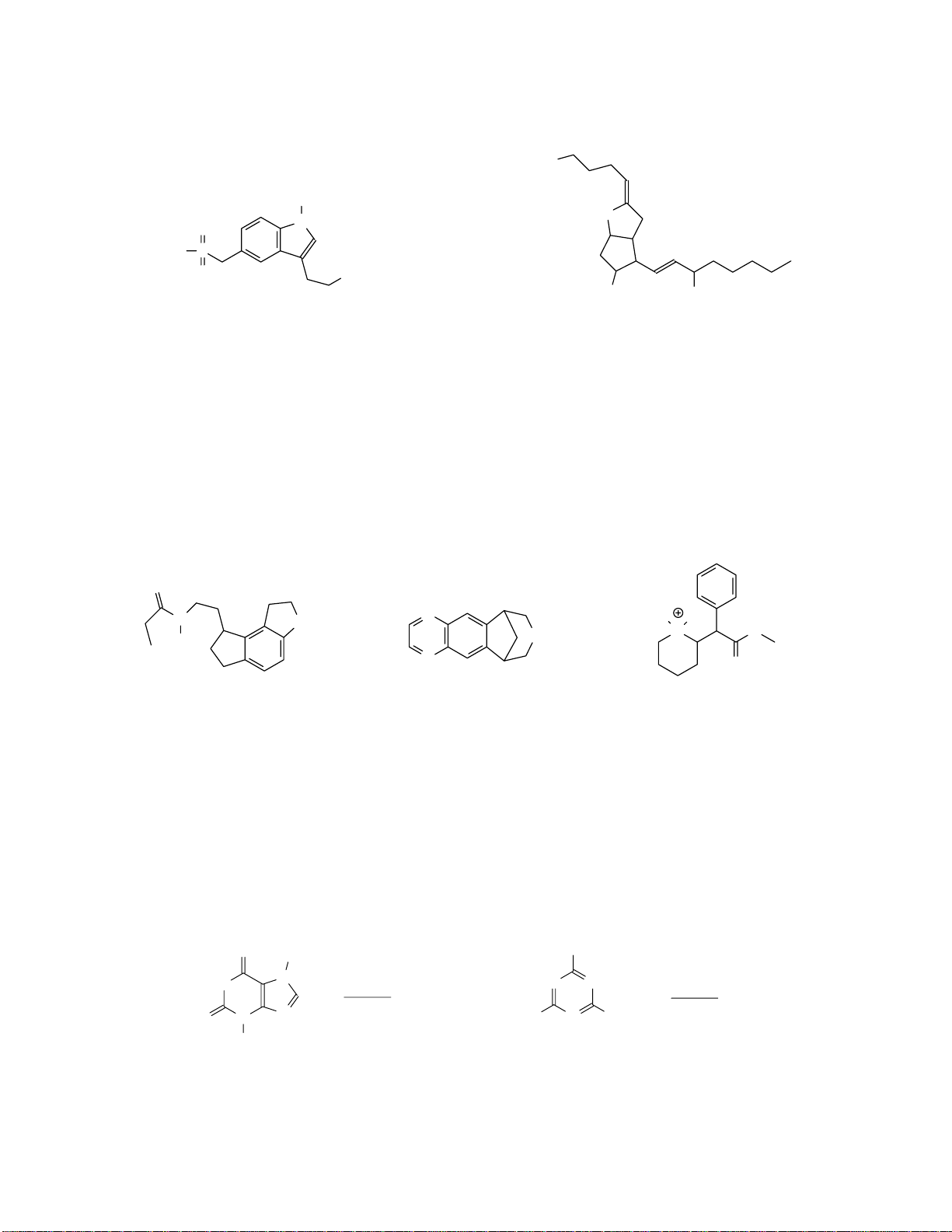
8. Sumatriptan is often prescribed for the treatment of migraines. Prostacyclin is a platelet aggregation inhibitor. HO2C H O N O MeHN S O NMe2 HO OH sumatriptan prostacyclin
a. Complete the molecular formulas for each.
sumatriptan: C____H____N____O____S
prostacyclin: C____H____O____
b. Sumatriptan contains _____ sp2 and _____ sp3 carbons; prostacyclin contains _____ sp2 and _____ sp3 carbons.
c. Sumatriptan and prostacyclin possess _____ and _____ lone pairs of electrons, respectively.
9. RozeremTM is prescribed for the treatment of insomnia, ChantixTM for smoking cessation, and RitalinTM for ADHD. O N N H H O O H NH N N O RoseremTM ChantixTM Ritalin TM
a. What is the molecular formula for each? RozeremTM ___________ ChantixTM ___________ RitalinTM ___________
b. How many lone pairs of electrons are there in each? RozeremTM ___________ ChantixTM ____________ RitalinTM ___________
10. Theobromine (Greek theobroma – “food of the gods”) is a constituent of cocoa. How many lone pairs
of electrons are in its structure? How many lone pairs of electrons are in the plasticizer melamine? O CH NH2 3 HN N N N O N N H2N N NH2 CH3 theobromine melamine
1.1 Hybridization, formulas, physical properties
4 • Chapter 1 The Basics
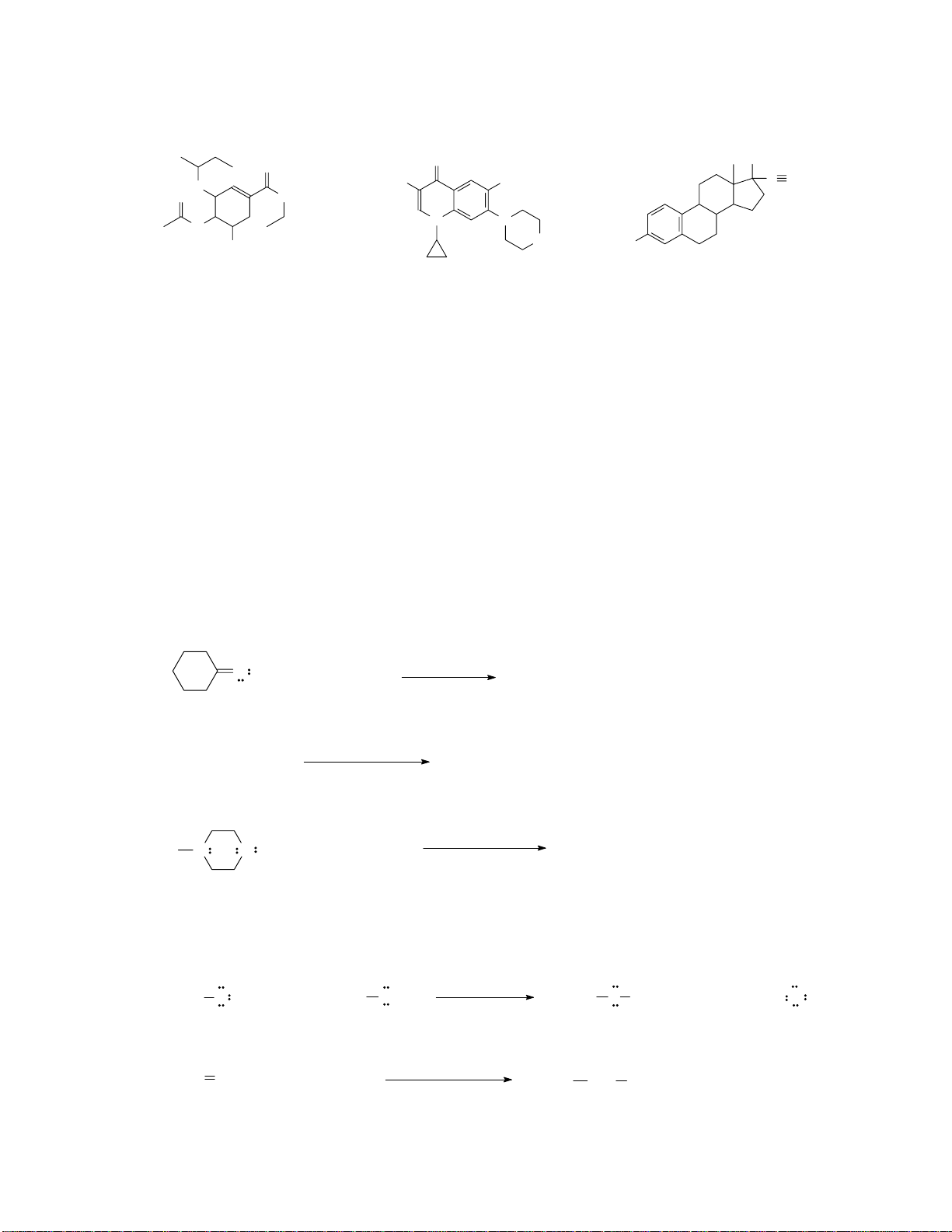
11. Which functional groups are present in each of the following medicines? O OH O HO C CH 2C F O O O a. b. c. N N N H NH NH HO 2 TamifluTM (antiviral) CiproTM (antibiotic) YasminTM component (OCP) 1.2 Acids and bases . What 1 is the strongest that can base exist in ammonia? odium S
hydride (NaH) is, in fact, a stronger base th bove a an the a
nswer. Write a reaction to describe what
happens when NaH is added to NH3. Use arrows to show the flow of electrons.
2. Which is the stronger base: (CH3)2NH or CH3-O-CH3?
3. Using curved arrow notation, write Lewis acid/base equations for each of the following. Remember to
place formal charge on the appropriate atoms. a. O + AlCl3 b. Ph3P: + BF3 c. N O + BH3 .
4 Place formal charge on all appropriate atoms. Label the reactants on the left of the arrow as Lewis acids
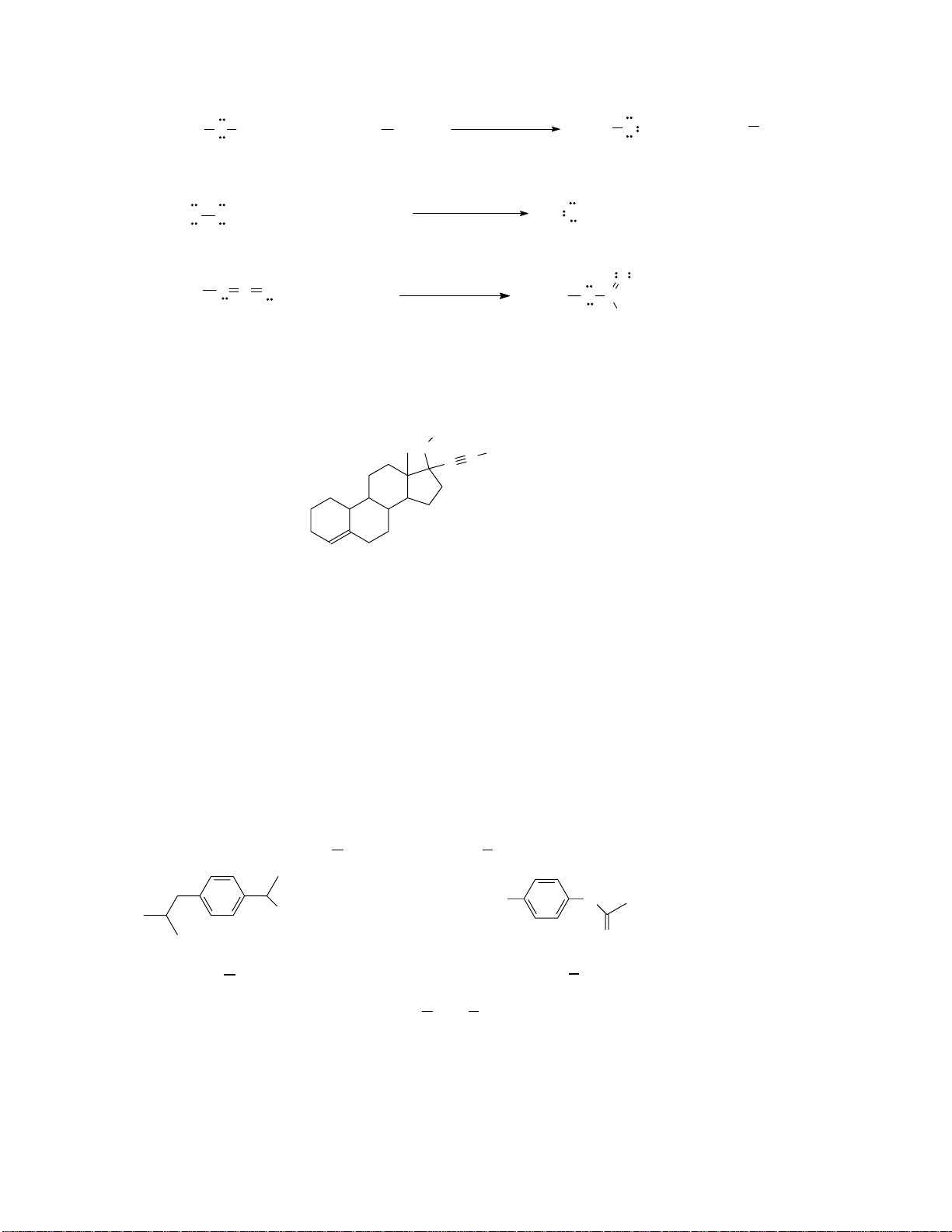
(LA) or Lewis bases (LB) and draw curved arrows to show the movement of electron pairs in each reaction. a. H3C O + CH3CH2 Cl: CH3 O CH2CH3 + Cl b. H2C CH2 + BF3 CH2 CH2 BF3 1.2 Acids and bases Problems • 5 c. H3C O H + :CH + 2 CH3 H3C O H3C CH3 d. :Cl Cl: + AlCl Cl + 3 AlCl4 S e. CH3 N C S: + :NH3 CH3 N C NH3
5. Lynestrenol, a component of certain oral contraceptives, has the structure Ha O Hb C C a. Calculate the mo orm lecular f ula: C___H___O.
b. The pKas of hydrogens a and b are about 16 and res 25,
pectively, and the pKa of ammonia is about 35.
Write a Brønsted-Lowry equation for the reaction of the conjugate base of lynestrenol with ammonia.
c. Is the Keq for the above reaction about equal to, greater than, or less than 1? .
6 The structure of ibuprofen (A) and acetaminophen (B) are drawn below. HO NH CO2H O A B
a. Write a reaction for the conjugate base of A with B. 1.2 Acids and bases
Tài liệu liên quan:
-
Báo cáo thí nghiệm: Tính chất hoá học của Hexane môn Hoá Hữu Cơ | Trường Đại học Khoa học tự nhiên, Đại học Quốc gia Thành phố Hồ Chí Minh
27 14 -
Lí thuyết và bài tập Alkane môn Hoá hữu cơ | Trường Đại học Khoa học tự nhiên, Đại học Quốc gia Thành phố Hồ Chí Minh
32 16 -
Soạn thực hành môn hoá hữu cơ 1 | Trường Đại học Khoa học tự nhiên, Đại học Quốc gia Thành phố Hồ Chí Minh
34 17 -
Đề thi giữa HKII học phần Hoá Hữu Cơ 1 năm 2024 - 2025 | Trường Đại học Khoa học tự nhiên, Đại học Quốc gia Thành phố Hồ Chí Minh
269 135