Sách Business Vocabulary in use - Self-study and classroom use môn Tiếng Anh | Trường Đại học Ngoại ngữ, Đại học Huế
Sách Business Vocabulary in use - Self-study and classroom use môn Tiếng Anh | Trường Đại học Ngoại ngữ, Đại học Huế. Tài liệu được sưu tầm giúp bạn tham khảo, ôn tập và đạt kết quả cao. Mời bạn đọc đón xem.
Môn: Tiếng anh 1 (ENGL 101E) 230 tài liệu
Trường: Trường Đại học Ngoại ngữ, Đại học Huế 468 tài liệu
Tác giả:


















Preview text:
BUSINESS VOCABULARY Self-study and classroom use IN USE Third Edition Intermediate K Y M C Bill Mascull ithout CD-ROM W TE IN USE INTERMEDIA Y VOCABULAR 978 0 521 12828 5 BUSINESS K Y M C MASCULL • • • • •
978-0-521-12250-4 Cambridge Business English Dictionary Cover with answers BUSINESS VOCABULARY Self-study and classroom use IN USE Third Edition Intermediate Bill Mascull
University Printing House, Cambridge CB2 8BS, United Kingdom
One Liberty Plaza, 20th Floor, New York, NY 10006, USA
477 Williamstown Road, Port Melbourne, VIC 3207, Australia
4843/24, 2nd Floor, Ansari Road, Daryaganj, Delhi – 110002, India
79 Anson Road, #06–04/06, Singapore 079906
Cambridge University Press is part of the University of Cambridge.
It furthers the University’s mission by disseminating knowledge in the pursuit of
education, learning and research at the highest international levels of excellence. www.cambridge.org
Information on this title: www.cambridge.org/9781316629987
© Cambridge University Press 2017
This publication is in copyright. Subject to statutory exception
and to the provisions of relevant collective licensing agreements,
no reproduction of any part may take place without the written
permission of Cambridge University Press. First published 2002 Second Edition 2010 Third Edition 2017
20 19 18 17 16 15 14 13 12 11 10 9 8 7 6 5 4 3 2 1
Printed in Malaysia by Vivar Printing
A catalogue record for this publication is available from the British Library
ISBN 978-1-316-62998-7 Book with Answers
ISBN 978-1-316-62997-0 Book with Answers and Ebook
Cambridge University Press has no responsibility for the persistence or accuracy
of URLs for external or third-party internet websites referred to in this publication,
and does not guarantee that any content on such websites is, or will remain,
accurate or appropriate. Information regarding prices, travel timetables, and other
factual information given in this work is correct at the time of first printing but
Cambridge University Press does not guarantee the accuracy of such information thereafter. Contents INTRODUCTION 8
9 Managers, executives and directors 26 JOBS, PEOPLE AND ORGANIZATIONS A Managers and executives: UK B Managers and executives: US 1 Work and jobs 10
10 Businesspeople and business A What do you do? leaders 28
B Word combinations with ‘work’
C Types of job and types of work
A Businesspeople and entrepreneurs B Leaders and leadership 2 Ways of working 12 C Magnates, moguls and tycoons A Working hours 11 Organizations 1 30 B Nice work if you can get it C Nature of work A Business and businesses B Commerce
3 Recruitment and selection 14 C Enterprise A Recruitment 12 Organizations 2 32 B Applying for a job C Selection procedures
A Self-employed people and partnerships B Limited liability
4 Skills and qualifications 16 C Mutuals D Non-profit organizations A Education and training B Skilled and unskilled PRODUCTION C The right person 13 5
Manufacturing and services 34 Pay and benefits 18 A Manufacturing and services A Wages, salary and benefits
B Countries and their industries B Compensation 1 C Compensation 2
14 The development process 36
6 People and workplaces 20 A Market research B Development and launch A Employees and management
B Management and administration
15 Innovation and invention 38 C Labour D Personnel and HRM A Innovation and invention B Research and technology
7 Companies and careers 22
C Patents and intellectual property A Career paths
16 Products and services 40 B Company structure
C In-house staff or freelancers? A Products D Leaving a company B Mass production C Capacity and output 8 Problems at work 24 A Discrimination B Bullying and harassment C Health and safety
Business Vocabulary in Use Intermediate 3
17 Materials and suppliers 42 25 Promotion 58 A Inputs A Advertising B Suppliers and outsourcing B The sales force C Just-in-time C Promotional activities
18 Business philosophies 44 26 E-commerce 60 A Mass customization A B2C, B2B and B2G B Wikinomics B Web 2.0 C The long tail C E-commerce companies D Benchmarking
D Word combinations with ‘online’ MARKETING MONEY
19 Buyers, sellers and the 27 Sales and costs 62 market 46 A Sales A Customers and clients B Costs B Buyers, sellers and vendors C Margins and mark-ups C The market 28 Profitability and
20 Markets and competitors 48 unprofitability 64 A Companies and markets
A Profitable and unprofitable products
B More word combinations with ‘market’ B Budgets and expenditure C Competitors and competition
C Economies of scale and the learning curve
21 Marketing and market orientation 50 29 Getting paid 66 A Marketing A Shipping and billing B The four Ps B Trade credit C The market orientation C Accounts 22 Products and brands 52
30 Assets, liabilities and the
A Word combinations with ‘product’ balance sheet 68 B Goods A Assets C Brands and branding B Depreciation C Liabilities 23 Price 54 D Balance sheet A Pricing 31
B Word combinations with ‘price’ The bottom line 70 C Upmarket and downmarket A Accounts D Mass markets and niches B Results C Financial reporting 24 Place 56 32
A Distribution: wholesalers, retailers and
Share capital and debt 72 customers A Capital B Shops B Share capital C Direct marketing C Loan capital D Security E Leverage 4
Business Vocabulary in Use Intermediate 33 Success and failure 74 DOING THE RIGHT THING A Cash mountains
40 Wrongdoing and corruption 88 B Debt and debt problems C Turnarounds and bailouts A Wrongdoing D Bankruptcy B Bribery and corruption C Fraud and embezzlement
34 Mergers, takeovers and 41 sell-offs 76 Business ethics 90 A Professional behaviour A Stakes and joint ventures B Social issues B Mergers and takeovers C Environmental issues C Conglomerates FINANCE AND THE ECONOMY PERSONAL SKILLS 35 42 Personal finance 78 Time and time management 92 A Traditional banking B Internet banking A Timeframes and schedules C Personal investing
B Projects and project management C Time tips 36 Financial centres 80 43 Stress and stress A Financial Centres management 94 B Stock markets C Other financial markets A When work is stimulating D Derivatives
B When stimulation turns to stress C Downshifting 37 Trading 82
44 Leadership and management A Market indexes styles 96
B Market activity: good times … C … and bad A Leadership B Modern management styles 38 Indicators 1 84 C Empowerment A Finance and economics CULTURE B Inflation and unemployment C Trade
45 Business across cultures 1 98 D Growth and GDP A Cultures and culture 39 Indicators 2 86 B Power and distance A Going up
46 Business across cultures 2 100 B Going down C Peaks and troughs A Individualism D Boom and bust B Time C Cross-cultural communication
Business Vocabulary in Use Intermediate 5 TELEPHONING AND WRITING
54 Interns, trainees and 47 apprentices 116 Telephoning 1: phones and numbers 102 A Interns B Experience or exploitation? A Telephones and beyond C Trainees and apprentices
B ‘Phone’, ‘call’ and ‘ring’ C Numbers BUSINESS SKILLS D Doing things over the phone
55 Meetings 1: types of
48 Telephoning 2: trying to meeting 118 get through 104
A Word combinations with ‘meeting’ A Asking to speak to someone B Types of meeting B Voicemail 1 C How was the meeting? C Voicemail 2
Meetings 2: the chair 56 Meetings 2: the chair 120
49 Telephoning 3: getting through 106
A The role of the chair: before the meeting A Getting through
B The role of the chair: running the B Giving and taking messages meeting C Spelling names C Follow-up
D Taking messages: checking information
57 Meetings 3: points of view 122
50 Telephoning 4: arrangements and ending calls 108 A Opening the meeting
B Asking for and expressing opinions A Phoning again B Making arrangements
58 Meetings 4: agreement and C Closing the conversation disagreement 124 D Changing arrangements A Agreeing
51 Business communication 1: B Disagreeing staying in touch 110
59 Meetings 5: discussion A Business cards 1 techniques 126 B Business cards 2 C Staying in touch
A Interrupting, referring back, checking
understanding, avoiding confrontation
52 Business communication 2:
B Agreement, consensus or compromise? email 112 C Concluding A Email
60 Presentations 1: key ideas 128 B Email expressions C Beginnings and endings A Types of presentation
B What makes a good presentation? 53 CVs, cover letters
C Presentation tools and visual aids and emails 114
61 Presentations 2: key steps 130 A CV tips B Parts of a CV A Key steps: introduction C Cover letters and emails B Key steps: main part C Key steps: closing 6
Business Vocabulary in Use Intermediate
62 Presentations 3: audience interaction 132
A Closing and dealing with questions B Intercultural aspects
63 Negotiations 1: situations and negotiators 134 A Types of negotiation
B Word combinations with ‘negotiations’ C Bargaining
64 Negotiations 2: preparing 136 A Preparing to negotiate B Opening the negotiation C Negotiating styles
65 Negotiations 3: win-win 138 A Probing B Positive positions C Negative positions D Concessions and trade-offs
66 Negotiations 4: reaching agreement 140 A Deadlock and mediators B Agreements and contracts C Checking the deal Answer key 142 Index 161 Also available 176
Business Vocabulary in Use Intermediate 7 Introduction Who is this book for?
Business Vocabulary in Use Intermediate is designed to help intermediate and upper-intermediate
learners of business English to improve their business vocabulary. It is for people studying
English before they start work and for those already working who need English in their job.
In addition to improving your business vocabulary, the book helps you to develop the language
needed for important business communication skills.
You can use the book on your own for self-study, with a teacher in the classroom, one-to-one or in groups. How is the book organized?
The book has 66 two-page units. The first 46 of these are thematic and look at the vocabulary of
business areas such as people, organizations, production, marketing and finance.
The other 20 units focus on the language of skills you need in business, such as those for
presentations, meetings, telephoning and negotiations.
The left-hand page of each unit explains new words and expressions, and the right-hand page
allows you to check and develop your understanding of the words and expressions, and how
they are used through a series of exercises.
There is cross-referencing between units to show connections between the same word or
similar words used in different contexts.
There is an Answer key at the back of the book. Most of the exercises have questions with only
one correct answer. But some of the exercises, including the Over to you activities at the end of
each unit (see below), are designed for writing and/or discussion about yourself and your own
organization or one that you know.
There is also an Index. This lists all the new words and phrases which are introduced in the book
and gives the unit numbers where the words and phrases appear. The Index also tells you how
the words and expressions are pronounced. The left-hand page
This page introduces new vocabulary and expressions for each thematic or skills area. The
presentation is divided into a number of sections indicated by letters: A, B, C, etc., with simple, clear titles.
In Business Vocabulary in Use Intermediate, explicit reference is made to the business
material in the Cambridge International Corpus (CIC) – business pages of
newspapers, business textbooks, and business meetings and discussions. The texts
are stored in a database, which is searchable in various ways to reveal the patterns of business
usage. The database has been exploited to identify typical word combinations found in the data,
and there are notes about their relative frequency.
As well as explanations of vocabulary, there is information about typical word combinations and
grammar associated with particular vocabulary, for example operative verbs – the verbs that
are typically used with particular nouns. Again, the CIC has been a prime source of information about these. 8
Business Vocabulary in Use Intermediate
There are notes about differences between British and American English.
BrE: CV; AmE: résumé or resume The right-hand page
The exercises on the right-hand page give practice in using the new vocabulary and expressions
presented on the left-hand page. Some units contain diagrams to complete, or crosswords. ‘Over to you’ sections
An important feature of Business Vocabulary in Use Intermediate is the Over to you section at the
end of each unit. There are sometimes alternative Over to you sections for learners who are in
work and for those who are studying pre-work. The Over to you sections give you the chance
to put into practice the words and expressions in the unit in relation to your own professional
situation, studies or opinions.
Self-study learners can do the section as a written activity. In many Over to you sections,
learners can use the internet to find more information.
In the classroom, the Over to you sections can be used as the basis for discussion with the whole
class, or in small groups with a spokesperson for each summarizing the discussion and its outcome
for the class. The teacher can then get students to look again at exercises relating to points that have
caused difficulty. Students can follow up by using the Over to you section as a written activity, for example as homework.
The Answer key contains sample answers for the Over to you questions.
How to use the book for self-study
Find the topic you are looking for by using the Contents page or the Index. Read through the
explanations on the left-hand page of the unit. Do the exercises on the right-hand page. Check
your answers in the Answer key. If you have made some mistakes, go back and look at the
explanations and the exercise again. Note down important words and expressions in your notebook.
How to use the book in the classroom
Teachers can choose units that relate to their students’ particular needs and interests, for
example areas they have covered in coursebooks, or that have come up in other activities.
Alternatively, lessons can contain a regular vocabulary slot, where students look systematically
at the vocabulary of particular thematic or skills areas.
Students can work on the units in pairs, with the teacher going round the class assisting and
advising. Teachers should get students to think about the logical process of the exercises,
pointing out why one answer is possible and the others are not (where this is the case).
We hope you enjoy using Business Vocabulary in Use Intermediate.
Business Vocabulary in Use Intermediate 9 1 work for a company
Work and jobs work on (an area, section run a department A What do you do? manage a team
To find out what someone’s job is, you ask ‘What do you do?’ Kerstin talks about her job: pp work under me
‘I work for a large European car maker. I work on car design. In fact, I run the design __________________ _________ _______ depart
department and I manage a team of designers: 20 people work under me. It’s very
interesting. One of my main responsibilities
____________ is to make sure that new model designs are
finished on time. I’m also in charge of design budgets.
‘I deal with a lot of different people in the company. I’m responsible for coordination
between design and production: I work with managers at our manufacturing plants.’ Note work with sb in charge of + noun
responsible for + verb + -ing
responsibility + infinitive / -ing
One of my responsibilities is to make sure that …
One of my responsibilities is making sure that …
You don’t say: ‘I’m a responsible.’ B
Word combinations with ‘work’
If you work or have work, you hav ___________
e a job. But you don’t say that someone has ‘a work’. Work is
also the place where you do your job. You don’t say for example, ‘at the work’ or ‘to the work’.
Here are some phrases with ‘work’.
The economy is growing fast and
more people are in work ____– have
a job – than ever before. The
percentage of people out of
work – without a job – has fallen
to its lowest level for 30 years. Frank talks about his job:
‘I work in a bank in New York City. I leave for work _______ at 7.30
every morning. I go to work _____
by train and subway. I get to / ____
arrive at work at about 9. I’m ______ usually at work ____ till 6. Luckily, I
don’t get ill very much so I don’t
often take time off work – aw _________ ay from work due to illness.’ C
Types of job and types of work
A full-time job is one for the whole of the normal working week; a part-time job is for less
time than that. You say that someone works full-time or _________ part-time.
A permanent job does not finish after a fixed period; a temporary job finishes after a fixed period. Ooo thời vụ
You talk about temporary work and permanent work. 10
Business Vocabulary in Use Intermediate Exercises 1.1
Look at A opposite. Margaux is talking about her work. Correct the expressions in italics.
‘I work for a large French supermarket company. It is
an international company and (1) I work about the ON
development of new supermarkets abroad. (2) In fact,
I running the development department and (3) RUN
I am manage for a team looking at the possibilities in MANAGE
different countries. It’s very interesting. (4) // One of my
main is to make sure that new supermarkets open on RESPONSIBILITIES
time. (5) I’m also char IN ged with financial r - OF eporting. (6) I deal at a lot of diff WITH
erent organizations in my work. (7)
I’m responsible of planning projects from start to finish. FOR __________
(8) I work closely near our foreign partners, and so I WITH travel a lot.’ 1.2
Complete each gap in the text with one of the prepositions from B opposite.
Rebecca lives in London and works in public relations. She leaves home for work at 7.30 am. She drives (1) to
work. The traffic is often bad and she worries about getting (2) work to
late, but she usually arrives (3)
work at around 9. She finishes work quite late, at about 8. at
‘Luckily, I’m never ill,’ she says. ‘I could never take time (4) off work.’
She loves what she does and is glad to be (5) in work. Some of her friends are not so lucky: they are (6) of w out ork. 1.3
What is being advertised in each of these job advertisements (1–6)? Use an expression from C
opposite, including the words in brackets. The first one has been done for you. 1
Librarian required for public library, a part-time job afternoons 2 till 6. (job) Apply now 2 4 Personal assistant needed ________
Teacher needed for summer course, for busy office, 9 am to 1 to 31 August. (job) Apply now 5.30 pm. (work) Apply now temporary full-time 5
Salesman required for showroom – 3 good prospects for right
Experienced barman wanted, 8 pm person. (work) Apply now until midnight. (work) permanent Apply now 6 part-time
Lawyer wanted for law firm – long hours,
4 weeks holiday per year. (job) Apply now permanent Over to you
If you work, answer these questions.
If you don’t work, answer these
• What do you do? What are you in charge of? questions.
What are your responsibilities?
• What sort of job would you like
• What time do you leave for work? How long does to do?
it take you to get to work? What time do you
• What sort of routine would you
arrive at work? Do you take a lot of time off work? like to have?
• Why do some people prefer to work part-time or to have temporary jobs?
Business Vocabulary in Use Intermediate 11 2 Ways of working A Working hours
‘I’m an office worker in an insurance company. It’s a
nine-to-five job with regular working hours. I need my swipe
card to get into the office. The work isn’t very interesting, but
I like to be able to go home at a reasonable time.’ You can also say clock BrE: flexitime
in and clock out. Note AmE: flextime Note
‘I’m in computer programming. There’s a system of flexitime
in my company, which means we can work when we want, Swiping a card
within certain limits. We can start at any time till 11, and
finish as early as 3 – as long as we do enough hours each
month. It’s ideal for me as I have two young children.’
‘I work in a car plant. I work in shifts and I have to clock on and clock off at the beginning
and end of every shift. I may be on the day shift one week and the night shift the next
week. It’s difficult changing from one shift to another. When I change shifts, I have problems
changing to a new routine for sleeping and eating. When the company is selling lots of cars,
they ask us to work overtime – more hours than usual for more money.’
‘I’m a commercial artist in an advertising agency. Unlike most other people in my
department who commute to work every day, I work from home and avoid the long
journeys that some commuters experience every day. That’s the benefit of teleworking or
telecommuting – working from home and using the computer and phone to communicate with other people.’ B Nice work if you can get it
All these words are used in front of job and work.
satisfying, stimulating, fascinating, exciting – the work is interesting and gives you positive feelings
dull, boring, uninteresting, unstimulating – the work is not interesting
repetitive, routine – the work involves doing the same things again and again
tiring, tough, hard, demanding – the work is difficult and makes you tired C Nature of work + noun human contact long hours My work involves teamwork
I like / dislike / prefer / enjoy + -ing working with figures dealing with customers solving problems 12
Business Vocabulary in Use Intermediate Exercises 2.1
Look at the six expressions (a–f) from A opposite. Which person (1–6) is most likely to do each of the things described? a / work in shifts b 1 A designer in a w ____
ebsite design company. Has to be in the office, b work under
but can decide when she wants to start and finish work each day. / a flexitime d
2 A manager in a department store in a large city. Liv _____ es in the system country. ____ c telecommute
3 A construction worker on a building site wher a ______ e work goes on d commute to 24 hours a day. / work
4 A worker in a chocolate factory in the three months bef f _______ ore e clock in and out Christmas. at the same time
5 A technical writer for a computer company. Lives in the country c every day
and visits the company offices once a month. f work overtime
6 An office worker in a large, traditional manufacturing company. / e 2.2
Look at the words and expressions in B and C opposite. Five people describe their jobs. Match
the jobs (1–5) with the descriptions (a–e) and put the words in brackets into the correct grammatical forms.
1 accountant 2 postwoman 3 flight /
attendant 4 software developer 5 teacher /
a ‘Obviously, my work involves travelling (travel) a lot. It can be quite physically (demand), but I enjoy
(deal) with customers, except when demanding dealing
they become tired and anxious about arriving. This doesn’t happen often, but it can be very
frustrating for us and the other passengers.’ 3
b ‘I love my job. It’s very (stimulate) and not at all (repeat): no stimulating repetitive
two days are the same. The children are fine: you see them learn and develop. The parents can be more of a problem.’ 5
c ‘I was good at maths at school and I like working
(work) with figures. But my job is much less boring
(bore) and routine than people think. The work involves
(involve) a lot of human contact and teamwork, working with other managers.’ 1
d ‘You’ve got to think in a very logical way. There’s a lot of teamwork between the developers. The work can be mentally
(tire), but it’s very satisfying to write a program tiring that works.’ 4
e ‘Of course, it involves getting up quite early in the morning. But I like being (be) out in
the open air. And you get a lot of exercise. I walk two or three miles every day.’ 2 Over to you
If you work, answer these questions.
If you don’t work, answer these questions.
• Do you have a nine-to-five job? Do you have
• What sort of working hours would you like
to clock on and off? Is there a flexitime
to have when you start working?
system in your organization? Are there people
• Would you like to work from home?
who do shiftwork in your company?
• What kind of job would you like? Complete
• Could you do your job working from home? If
this sentence in five ways to talk about so, would you like to? yourself.
• What do you like most about your job? What do you like least?
I’d like a job that involves …
Business Vocabulary in Use Intermediate 13
3 Recruitment and selection A Recruitment
The process of finding people for particular jobs is recruitment or, especially in American
English, hiring. Someone who has been recruited is a recruit, or in AmE, a hire. The
company employs or hires them and they join the company.
A company may recruit employees directly or use outside recruiters, recruitment agencies
or employment agencies. Outside specialists called headhunters may be used to find
people for very important jobs and to persuade them to leave the organizations they already
work for. Key people recruited like this are headhunted in a process of headhunting. B Applying for a job
Fred is an accountant, but he was fed up with his old job. He looked
in the situations vacant pages of his local newspaper, where a local
supermarket was advertising for a new accountant’s position. He applied
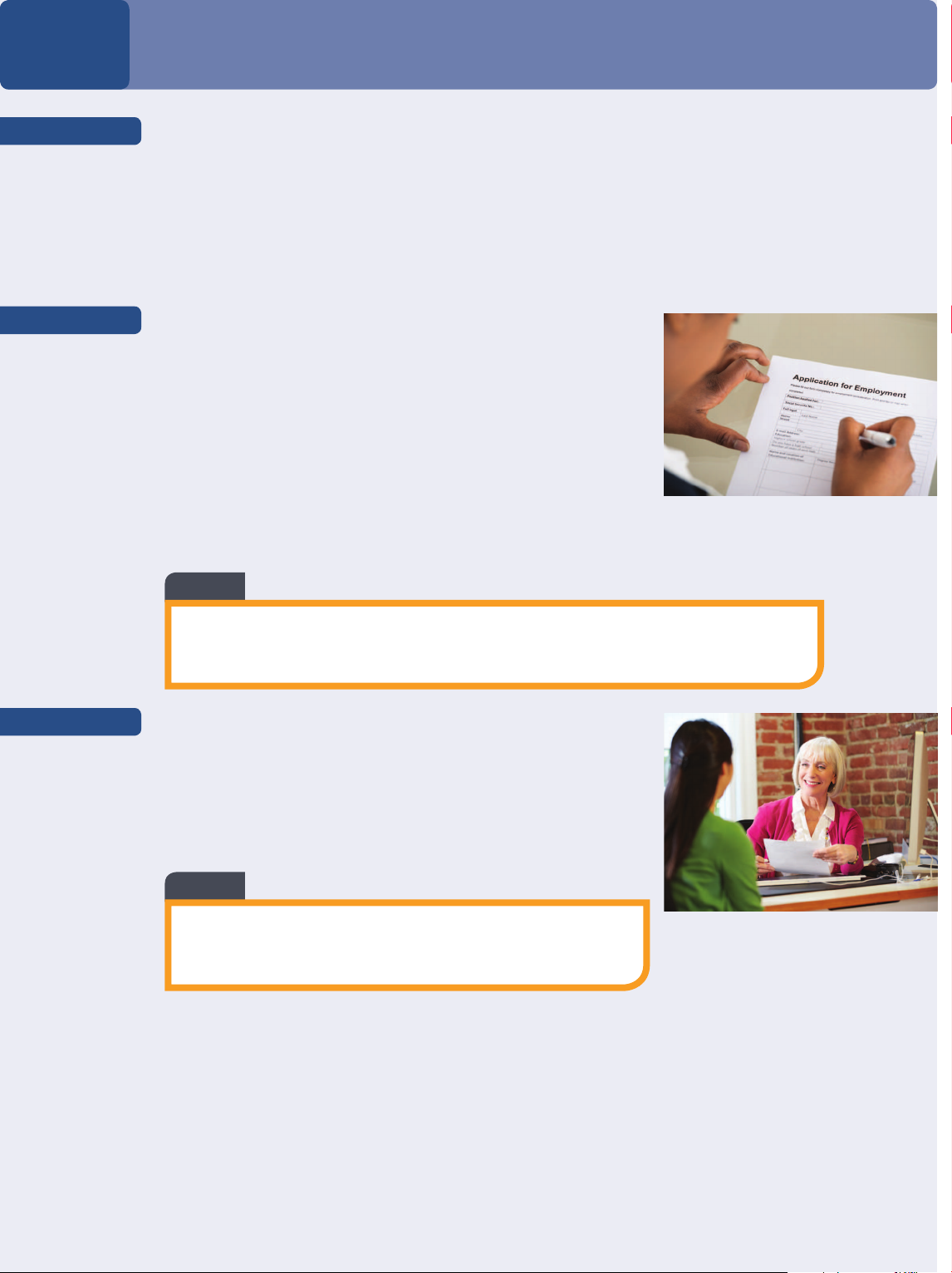
for the job by completing an application form and sending it in.
Harry is a building engineer. He’d been working for the same company
for ten years, but he wanted a change. He looked at jobs with different
engineering companies on a jobs website. He made an application,
sending in his CV (curriculum vitae – a document describing your
education, qualifications and previous jobs, that you send to a An application form
prospective employer) and a covering letter explaining why he
wanted the job and why he was the right person for it. Note
Situation, post and position are formal words often used in job advertisements and applications.
BrE: CV; AmE: résumé or resume
BrE: covering letter; AmE: cover letter C Selection procedures
Dagmar Schmidt is the head of recruitment at a German
telecommunications company. She talks about the selection
process, the methods that the company uses to recruit people.
‘We advertise in national newspapers and on the internet. We look
at the backgrounds of applicants – their experience of different
jobs and their educational qualifications. Note
Internet is sometimes written with a capital letter when it is a noun. A job interview
internet (noun): mostly BrE
Internet (noun): mostly AmE
‘We invite the most interesting candidates to a group discussion. Then we have individual
interviews with each candidate. The head of the department is also present. We also give
the candidates written psychometric tests to assess their intelligence and personality.
‘After this, we shortlist three or four candidates. We check their references by writing to
their referees – previous employers, teachers, and so on that candidates have named in
their applications. If the references are OK, we ask the candidates to come back for more
interviews. Finally we offer the job to someone, and if they turn it down we have to think
again. (Some applicants may get other job offers at the same time as ours.) If they accept
it, we hire them. We appoint someone only if we find the right person.’ 14
Business Vocabulary in Use Intermediate Exercises 3.1
Complete the crossword with the correct form of words from A, B and C opposite. 1 2 Across A T
5 I phoned to check on my application, but they 3O C said they’d already someone. (9) U 4
6 This job is so important; I think we need to H F C R someone. (8) F E I N
8 The selection procedure has lasted three months, R but we’re going to someone next E P S 5 week. (7) r E CR U I T E D D S S O Down W 1 and 2 I hope she the job, because if 6 7 she it , we’ll have to start H E A DH U N T looking again. (7, 5, 4) P
3 The last applicant was very strong, but 8
I understand he’d had two other job A P P O I N T already. (6) L 4 They’ve finally a new receptionist. She Y starts work next week. (5)
7 Computer programmers wanted. Only those with UNIX experience should . (5) 3.2
Now divide the words in 3.1 into two groups.
1 what a company personnel department does
2 what a person looking for work does 3.3
Replace the underlined phrases with correct forms of words and expressions from A, B and C opposite.
Fred had already (1) refused two job off ers when he went for (2) a discussion to see if he was
suitable for the job. They looked at his accountancy degree and contacted (3) previous employers
Fred had mentioned in his application. A few days later, the supermarket (4) asked him if he
would like the job and Fred (5) said yes.
Harry didn’t hear anything for six weeks, so he phoned the company. They told him that they
had received a lot of (6) requests for the job. Aft er looking at the (7) document describing his
education, qualifications and previous jobs of the (8) people asking for the job and looking at
(9) what exams they had passed during their education, the company had (10) chosen six people
to interview and then given them (11) tests on their personality and intelligence. They had then given someone the job. Over to you
If you work, answer these questions.
If you’re a student, answer these questions.
• Where did you see the jobs advertised?
• When you applied for your course did you
• What did you send to apply for the job?
use an online application form or send an application in?
• What was the selection procedure?
• Did you need to provide referees? • Did you have an interview?
Business Vocabulary in Use Intermediate 15
4 Skills and qualifications A Education and training
Two company managers, Kasia Gutowska and Nils Olsen, are talking. KG:
The trouble with graduates – people who’ve just left university – is that their paper
qualifications are good. They might have qualifications in interesting subjects, but
they have no work experience. They just don’t know how business works. NO:
I disagree. Education should teach people how to think, not train them for a particular
job. One of last year’s recruits graduated from Oxford University with a degree in
philosophy and she’s doing very well! KG:
Philosophy’s an interesting subject, but for our company, it’s more useful to do
training in a practical subject: it’s better for us if you train as a scientist, and qualify
as a biologist or a doctor, for example. NO:
Yes, but we don’t just need scientists. We also need good managers, which we can
achieve through in-house training – courses within the company. You know we put
a lot of money into management development, where managers regularly go on
specialized courses in leadership (see Unit 10), finance (see Unit 38), etc. You need to
acquire experience – get knowledge through doing things – for that. It’s not the sort
of thing you can learn when you’re 20! Note Note
In AmE, you can also say that someone
A master’s degree is a qualification you can get
graduates from high school – the
after one or two years of graduate study.
school that people usually leave when
A Master’s of Business Administration (MBA) is they are 18.
a master’s degree in advanced business studies. B Skilled and unskilled
A skill is a particular ability to do something well, especially because you have learned and practised it.
Jobs, and the people who do them, can be described as:
highly skilled, e.g. car designer
semi-skilled, e.g. taxi driver
skilled, e.g. car production manager
unskilled, e.g. car cleaner You can say that someone is:
You can also say that someone is: + noun + -ing computers skilled at customer care communicating good with figures or skilled in electronics using Excel people C The right person
These words are often used in job advertisements. Companies look for people who are:
a methodical, systematic and organized – working in a planned, orderly way
b computer-literate – good with computers
c numerate – good with numbers
d motivated – very keen to do well in their job because they find it interesting
e talented – very good at what they do
f self-starters; they must be proactive, self-motivated, or
Self-starter and team player
self-driven – good at working on their own Note are nouns. The other words in
g team players – people who work well with other people bold are adjectives. 16
Business Vocabulary in Use Intermediate Exercises 4.1
Look at A opposite. Complete each sentence with the correct word. 1 Ravi graduated Mumbai University a degree philosophy and politics.
2 He taught for a while, but didn’t like it. He wanted to get a qualification
accountancy and decided to train
an accountant at evening classes. 3 He qualified
an accountant and joined a big
accountancy firm in its Mumbai office.
4 After he had acquired some experience, he went
a number of management courses to get training
team-building and other skills. 4.2
Look at B opposite. Are these jobs generally considered to
be highly skilled, skilled, semi-skilled or unskilled? Use each expression twice. 1 teacher 2 software engineer
3 car worker on a production line 4 cleaner 5 office cleaner 6 airline pilot 7 bus driver 8 office manager 4.3
Complete these extracts from job advertisements using words from C opposite. 1
You’ll be researching developments on the internet, so you have to be
_ _ _ _ _ _ _ _-_ _ _ _ _ _ _ _ . You must be _ _ _ _ _ _ _ _ _ , able to work
on your own initiative, and a _ _ _ _-_ _ _ _ _ _ _ . But as part of
a team of researchers, you’ll need to be a good _ _ _ _-_ _ _ _ _ _ too. 2 3 4 You’ll need to be As part of our sales team, We’re looking for _ _ _ _ _ _ _ _ , as you’ll be working someone who can you’ll be working independently, so you have to work on ten projects on financial be self-_ _ _ _ _ _ _ _ _ at once, without being budgets. and self-_ _ _ _ _ _ . told what to do. You must be a _ _ _ _-_ _ _ _ _ _ _ – 5 _ _ _ _ _ _ _ _ _ _ , _ _ _ _ _ _ _ _ _ _ and
We need _ _ _ _ _ _ _ _ journalists who are very good at _ _ _ _ _ _ _ _ _ .
their job and extremely _ _ _ _ _ _ _ _ _ – very keen to find
out as much as they can about news stories. Over to you
Write an extract from a job advertisement for your job or one you would like to have, using words from C opposite.
Business Vocabulary in Use Intermediate 17 5 Pay and benefits A Wages, salary and benefits
‘My name’s Luigi and I’m a hotel
manager in Venice. I get paid a
salary every month. In summer,
we’re very busy, so we do overtime –
work a lot of extra hours. The pay for
this is quite good. Working in a hotel,
we also get some nice perks – for example, free meals!’
‘I’m Ivan and I work as a waiter in Prague. I like my job even if I don’t earn very much: I get
paid wages every week by the restaurant. We get the minimum wage – the lowest amount
allowed by law. But we also get tips – money that customers leave in addition to the bill.
Some tourists are very generous!’
‘Hi, I’m Catherine, and I’m a saleswoman in luxury goods, based in Paris. I get a basic
salary, plus commission – a percentage on everything I sell. If I sell more than a particular
amount in a year, I also get a bonus, which is nice. There are some good fringe benefits
with this job: I get a company car, a BMW; there’s a health plan to pay the costs of medical
treatment if I get ill; and the company makes payments for my pension – money that I’ll
get regularly after I stop working. So, with the bonuses, the car, the health plan and the
pension, I’ve got a very nice benefits package. And the working conditions are good too:
I have a nice office and I don’t have to travel too much.’ B Compensation 1
Catherine mentioned her pay and conditions. Remuneration and compensation are
formal words used to talk about pay and conditions, especially those of senior managers.
Remuneration package and compensation package are used especially in the US to talk
about all the pay and benefits that employees receive. For a senior executive, this may
include share options (BrE) or stock options (AmE), the right to buy the company’s shares
(see Unit 36) at low prices. There may be performance (-related) bonuses if the manager
reaches particular objectives for the company. C Compensation 2
Compensation is also used to talk about money and other benefits that someone receives
if they are forced to leave the organization, perhaps after a disagreement with other
managers in what newspapers call a boardroom row. This money is in the form of a
compensation payment or severance payment. If someone also receives benefits with
this, the payment and the benefits form a compensation package or severance package.
In Britain, executives with very high pay and benefits may be referred to as fat cats,
implying that they do not deserve this level of remuneration. 18
Business Vocabulary in Use Intermediate