Sách Language Testing môn Ngôn ngữ Anh | Đại học Thái Nguyên
Sách Language Testing môn Ngôn ngữ Anh | Đại học Thái Nguyên. Tài liệu được sưu tầm giúp bạn tham khảo, ôn tập và đạt kết quả cao. Mời bạn đọc đón xem.
Môn: Ngôn ngữ anh 3 tài liệu
Trường: Đại học Thái Nguyên 386 tài liệu
Tác giả:



















Preview text:
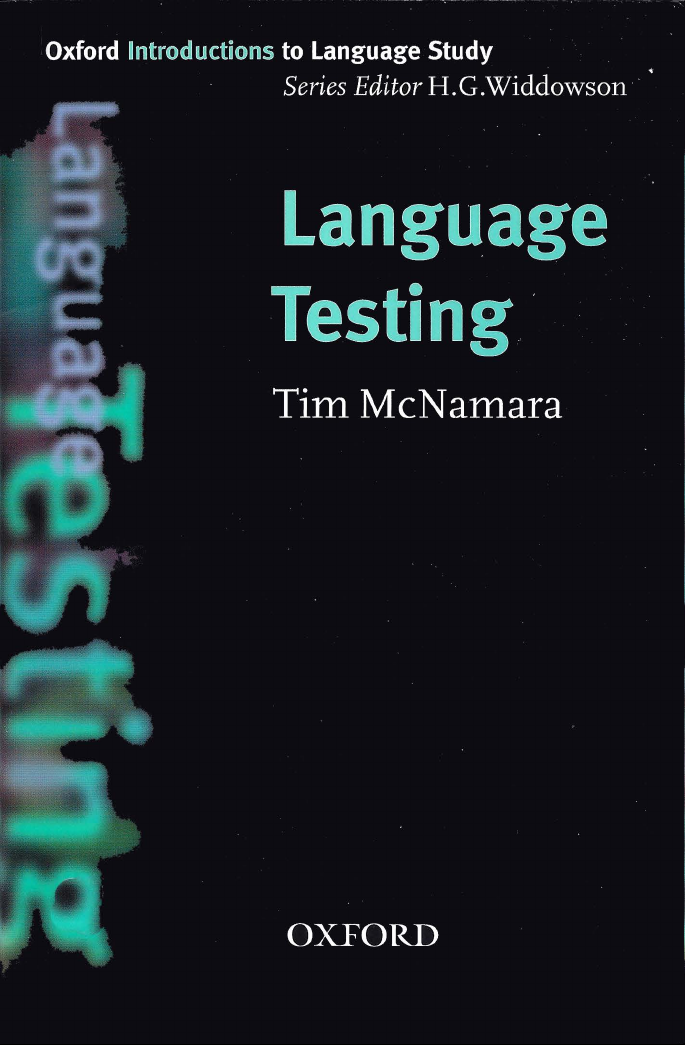
Oxford Introductions to Language Study Language Testing
Tim McNamara is Associate Professor
in the Department of Linguistics and
Applied Linguistics at the University of Melbourne. Published in this series:
Rod Ellis: Second Language Acquisition
Claire Kramsch: Language and Culture
Thomas Scovel: Psycholinguistics
Bernard Spolsky: Sociolinguistics H. G. Widdowson: Linguistics George Yule: Pragmatics
Oxford Introductions to Language Study Series Editor H.G. Widdowson Tim McNamara OXFORD UNIVERSITY PRESS OXFORD UNIVERSITY PRESS
Great Clarendon Street, Oxford ox2 6DP
Oxford University Press is a department of the University of Oxford.
It furthers the University's objective of excellence in research, scholarship,
and education by publishing worldwide in Oxford New York
Auckland Cape Town Dar es Salaam Hong Kong Karachi
Kuala Lumpur Madrid Melbourne Mexico City Nairobi
New Delhi Shanghai Taipei Toronto With offices in
Argentina Austria Brazil Chile Czech Republic France Greece
Guatemala Hungary Italy Japan Poland Portugal Singapore
South Korea Switzerland Thailand 1\n·key Ukraine Vietnam
OXFORD and OXFORD ENGLISH are registered trade marks of
Oxford University Press in the UK and in certain other countries
© Oxford University Press 2000
The moral rights of the author have been asserted
Database right Oxford University Press (maker) First published 2000 2014 2013 2012 2011 2010 10 9 8 7
All rights reserved. No part of this publication may be reproduced,
stored in a retrieval system, or transmitted, in any form or by any means,
without the prior permission in writing of Oxford University Press (with
the sole exception of photocopying carried out under the conditions stated
in the paragraph headed 'Photocopying'), or as expressly permitted by law, or
under terms agreed with the appropriate reprographics rights organization.
Enquiries concerning reproduction outside the scope of the above should
be sent to the ELT Rights Department, Oxford University Press, at the address above
You must not circulate this book in any other binding or cover
and you must impose this same condition on any acquirer Photocopying
The Publisher grants permission for the photocopying of those pages
marked 'photocopiable' according to the following conditions. Individual
Pll!chasers may make copies for their own use or for use by classes that
they teach. School purchasers may make copies for use by staff and students,
but this permission does not extend to additional schools or branches
Under no circumstances may any part of this book be photocopied for resale
Any websites referred to in this publication are in the public domain and
their addresses are provided by Oxford University Press for information only.
Oxford University Press disclaims any responsibility for the content ISBN·1.3: 978 019 437222 0 Printed in China To Terry Quinn Contents Preface Author's preface SECTION I Survey I
1 Testing, testing . . . What is a language test? 3
Understanding language testing 4 Types of test 5 Test purpose 6 The criterion 7
The test-criterion relationship IO Conclusion II
2 Communication and the design of language tests l3 Discrete point tests I3
Integrative and pragmatic tests l4 Communicative language tests I6
Models of communicative ability I7 Conclusion 2I 3 The testing cycle 23 Understanding the constraints 24 Test content 2 5 Test method 26 Authenticity of response 27
Fixed and constructed response formats 29 Test specifications 3 I Test trials 32 Conclusion 3 3 4 The rating process 3 5
Establishing a rating procedure 3 6 The problem with raters 3 7
Establishing a framework for making judgements 3 8 Rating scales 40 Holistic and analytic ratings 43 Rater training 44 Conclusion 44 5 Validity: testing the test 47 Threats to test validity so Test content so
Test method and test construct 52 The impact of tests 5 3 Conclusion 54 6 Measurement 5 5 Introduction 5 5 Measurement s 6 Quality control for raters s 6
Investigating the properties of individual test items 59
Norm�referenced and criterion-referenced measurement 62 New approaches to measurement 64 Conclusion 65
7 The social character of language tests 67 Introduction 67
The institutional character of assessment 68 Assessment and social policy 68
Assessment and educational policy 69
The social responsibility of the language tester 70 Ethical language testing 72 Accountability 72 Wash back 73 Test impact 74
Codes of professional ethics for language testers 75 Critical language testing 76 Conclusion 77
8 New directions-and dilemmas? 79
Computers and language testing 79
Technology and the testing of speaking 8 r Dilemmas: whose performance? 8 3 S ECT I O N 2 Readings 87 S ECT I O N 3 References I2I S ECT I O N 4 Glossary 131 Preface Purpose
What justification might there be for a series of introductions to
language study? After all, linguistics is already well served with
introductory texts: expositions and explanations which are com
prehensive, authoritative, and excellent in their way. Generally
speaking, however, their way is the essentially academic one of
providing a detailed initiation into the discipline of linguistics,
and they tend to be lengthy and technical: appropriately so, given
their purpose. But they can be quite daunting to the novice. There
is also a need for a more general and gradual introduction to lan
guage: transitional texts which will ease people into an under
standing of complex ideas. This series of introductions is designed to serve this need.
Their purpose, therefore, is not to supplant but to support the
more academically oriented introductions to linguistics: to pre
pare the conceptual ground. They are based on the belief that it is
an advantage to have a broad map of the terrain sketched out
before one considers its more specific features on a smaller scale,
a general context in reference to which the detail makes sense. It is
sometimes the case that students are introduced to detail without
it being made clear what it is a detail of. Clearly, a general under
standing of ideas is not sufficient: there needs to be closer
scrutiny. But equally, close scrutiny can be myopic and meaning
less unless it is related to the larger view. Indeed it can be said that
the precondition of more particular enquiry is an awareness of
what, in general, the particulars are about. This series is designed
to provide this large-scale view of different areas of language P R E F ACE XI
study. As such it can serve as preliminary to (and precondition
for) the more specific and specialized enquiry which students of
linguistics are required to undertake.
But the series is not only intended to be helpful to such stu
dents. There are many people who take an interest in language
without being academically engaged in linguistics per se. Such
people may recognize the importance of understanding language
for their own lines of enquiry, or for their own practical purposes,
or quite simply for making them aware of something which fig
ures so centrally in their everyday lives. If linguistics has revealing
and relevant things to say about language, this should presum
ably not be a privileged revelation, but one accessible to people
other than linguists. These books have been so designed as to
accommodate these broader interests too: they are meant to be
introductions to language more generally as well as to linguistics as a discipline. Design
The books in the series are all cut to the same basic pattern. There
are four parts: Survey, Readings, References, and Glossary. Survey
This is a summary overview of the main features of the area of
language study concerned: its scope and principles of enquiry, its
basic concerns and key concepts. These are expressed and
explained in ways which are intended to make them as accessible
as possible to people who have no prior knowledge or expertise in
the subject. The Survey is written to be readable and is unclut
tered by the customary scholarly references. In this sense, it is sim
ple. But it is not simplistic. Lack of specialist expertise does not
imply an inability to understand or evaluate ideas. Ignorance
means lack of knowledge, not lack of intelligence. The Survey,
therefore, is meant to be challenging. It draws a map of the sub
ject area in such a way as to stimulate thought and to invite a crit
ical participation in the exploration of ideas. This kind of
conceptual cartography has its dangers of course: the selection of
what is significant, and the manner of its representation, will not
be to the liking of everybody, particularly not, perhaps, to some XII P R E F ACE
of those inside the discipline. But these surveys are written in the
belief that there must be an alternative to a technical account on
the one hand, and an idiot's guide on the other if linguistics is to
be made relevant to people in the wider world. Readings
Some people will be content to read, and perhaps re-read, the
summary Survey. Others will want to pursue the subject and so
will use the Survey as the preliminary for more detailed study. The
Readings provide the necessary transition. For here the reader is
presented with texts extracted from the specialist literature. The
purpose of these Readings is quite different from the Survey. It is
to get readers to focus on the specifics of what is said, and how it
is said, in these source texts. Questions are provided to further
this purpose: they are designed to direct attention to points in
each text, how they compare across texts, and how they deal with
the issues discussed in the Survey. The idea is to give readers an
initial familiarity with the more specialist idiom of the linguistics
literature, where the issues might not be so readily accessible, and
to encourage them into close critical reading. References
One way of moving into more detailed study is through the
Readings. Another is through the annotated References in the
third section of each book. Here there is a selection of works
(books and articles) for further reading. Accompanying com
ments indicate how these deal in more detail with the issues dis
cussed in the different chapters of the Survey. Glossary
Certain terms in the Survey appear in bold. These are terms used
in a special or technical sense in the discipline. Their meanings are
made clear in the discussion, but they are also explained in the
Glossary at the end of each book. The Glossary is cross-refer
enced to the Survey, and therefore serves at the same time as an
index. This enables readers to locate the term and what it signifies
in the more general discussion, thereby, in effect, using the Survey
as a summary work of reference. P R E F ACE XIII Use
The series has been designed so as to be flexible in use. Each title is
separate and self-contained, with only the basic format in com
mon. The four sections of the format, as described here, can be
drawn upon and combined in different ways, as required by the
needs, or interests, of different readers. Some may be content with
the Survey and the Glossary and may not want to follow up the
suggested References. Some may not wish to venture into the
Readings. Again, the Survey might be considered as appropriate
preliminary reading for a course in applied linguistics or teacher
education, and the Readings more appropriate for seminar dis
cussion during the course. In short, the notion of an introduction
will mean different things to different people, but in all cases the
concern is to provide access to specialist knowledge and stimulate
an awareness of its significance. This series as a whole has been
designed to provide this access and promote this awareness in
respect to different areas of language study. H . G . W I D D O W S O N Author's acknowledgements
Language testing is often thought of as an arcane and difficult
field, and politically incorrect to boot. The opportunity to pro
vide an introduction to the conceptual interest of the field and to
some of its procedures has been an exciting one. The immediate
genesis for this book came from an invitation from Henry
Widdowson, who proved to be an illuminating and supportive
editor throughout the process of the book's writing. It was an
honour and a pleasure to work with him.
The real origins of the book lay further back, when over 15
years ago Terry Quinn of the University of Melbourne urged me
to take up a consultancy on language testing at the Australian
Language Centre in Jakarta. Terry has been an invaluable sup
port and mentor throughout my career in applied linguistics,
nowhere more so than in the field of language testing, which in his
usual clear-sighted way he has always understood as being inher
ently political and social in character, a perspective which I am XIV P R E F ACE
only now, after twelve years of research in the area, beginning to
properly understand. I am also grateful to my other principal
teachers about language testing, Alan Davies, Lyle Bachman, and
Bernard Spolsky, and to my friend and colleague Elana Shohamy,
from whom I have learnt so much in conversations long into the
night about these and other matters. I also owe a deep debt to
Sally Jacoby, a challenging thinker and great teacher, who has
helped me frame and contextualize in new ways my work in this
field. My colleagues at Melbourne, Brian Lynch and Alastair
Pennycook, have dragged me kicking and screaming at least some
way into the postmodern era. The Language Testing Research
Centre at the University of Melbourne has been for over a decade
the perfect environment within which thinking on language test
ing can flourish, and I am grateful to (again) Alan Davies and to
Cathie Elder, and to all my other colleagues there. Whatever clar
ity the book may have is principally due to my dear friend and
soulmate Lillian Nativ, who remains the most difficult and criti
cal student I have had. Being a wonderful teacher herself she will
never accept anything less than clear explanations. The students
to whom I have taught language testing or whose research I have
supervised over the years have also shaped this book in consider
able ways. At OUP, I have had excellent help from Julia Sallabank and Belinda Penn.
On a more personal note I am grateful for the continuing sup
port and friendship of Marie-Therese Jensen and the love of our son Daniel. T I M M cNAMARA P R E F A C E XV S EC T I O N I Survey Testing, testing ... What is a language test?
Testing is a universal feature of social life. Throughout history
people have been put to the test to prove their capabilities or to
establish their credentials; this is the stuff of Homeric epic, of
Arthurian legend. In modern societies such tests have proliferated
rapidly. Testing for purposes of detection or to establish identity has
become an accepted part of sport (drugs testing), the law (DNA
tests, paternity tests, lie detection tests), medicine (blood tests, can
cer screening tests, hearing, and eye tests), and other fields. Tests to
see how a person performs particularly in relation to a threshold of
performance have become important social institutions and fulfil a
gatekeeping function in that they control entry to many important
social roles. These include the driving test and a range of tests in edu
cation and the workplace. Given the centrality of testing in so<;:ial
life, it is perhaps surprising that its practice is so little understood. In
fact, as so often happens in the modern world, this process, which so
much affects our lives, becomes the province of experts and we
become dependent on them. The expertise of those involved in test
ing is seen as remote and obscure, and the tests they produce are typ
ically associated in us with feelings of anxiety and powerlessness.
What is true of testing in general is true also of language testing,
not a topic likely to quicken the pulse or excite much immediate
interest. If it evokes any reaction, it will probably take the form of
negative associations. For many, language tests may conjure up
an image of an examination room, a test paper with questions,
desperate scribbling against the clock. Or a chair outside the
interview room and a nervous victim waiting with rehearsed
phrases to be called into an inquisitional conversation with the
examiners. But there is more to language testing than this. T E S T I N G , T E S T I N G 3