

















Preview text:
A01_KURO1557_08_SE_FM.indd 18 12/02/20 10:57 AM COMPUTER NETWORKING A Top-Down Approach James F. Kurose
University of Massachusetts, Amherst Keith W. Ross
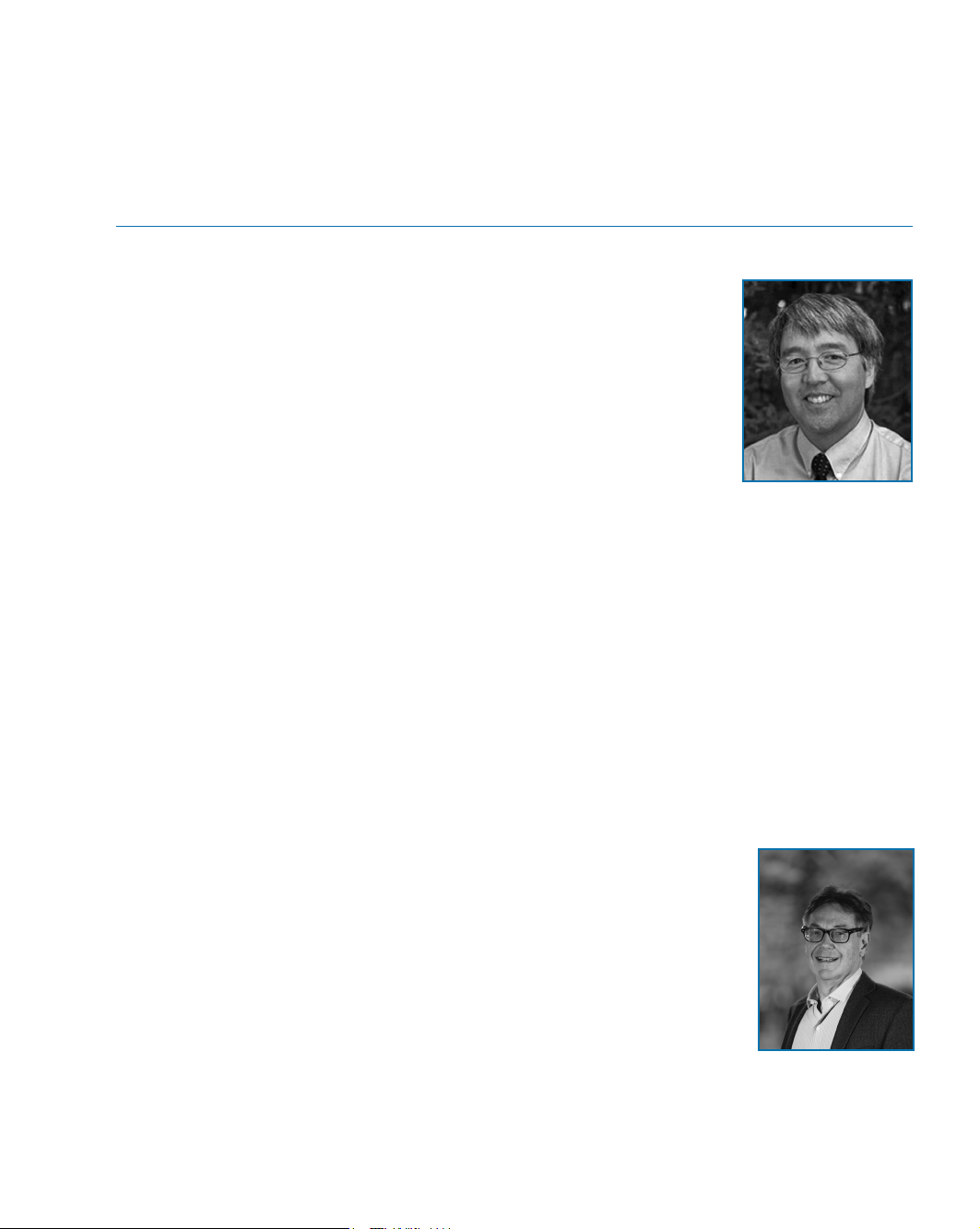
Polytechnic Institute of NYU About the Authors Jim Kurose
Jim Kurose is a Distinguished University Professor in the College of Information
and Computer Sciences at the University of Massachusetts Amherst, where
he has been on the faculty since receiving his PhD in computer science from
Columbia University. He received a BA in physics from Wesleyan University.
He has held a number of visiting scientist positions in the United States and
abroad, including IBM Research, INRIA, and the Sorbonne University in
France. He recently completed a five-year term as Assistant Director at the
US National Science Foundation, where he led the Directorate of Computer
and Information Science and Engineering in its mission to uphold the nation’s
leadership in scientific discovery and engineering innovation.
Jim is proud to have mentored and taught an amazing group of students,
and to have received a number of awards for his research, teaching, and
service, including the IEEE Infocom Award, the ACM SIGCOMM Lifetime
Achievement Award, the ACM Sigcomm Test of Time Award, and the
IEEE Computer Society Taylor Booth Education Medal. Dr. Kurose is a for-
mer Editor-in-Chief of IEEE Transactions on Communications and of IEEE/
ACM Transactions on Networking. He has served as Technical Program
co-Chair for IEEE Infocom, ACM SIGCOMM, ACM Internet Measurement
Conference, and ACM SIGMETRICS. He is a Fellow of the IEEE, the ACM
and a member of the National Academy of Engineering. His research
interests include network protocols and architecture, network measurement,
multimedia communication, and modeling and performance evaluation. Keith Ross
Keith Ross is the Dean of Engineering and Computer Science at NYU
Shanghai and the Leonard J. Shustek Chair Professor in the Computer Science
and Engineering Department at NYU. Previously he was at University of
Pennsylvania (13 years), Eurecom Institute (5 years) and NYU-Poly (10 years).
He received a B.S.E.E from Tufts University, a M.S.E.E. from Columbia
University, and a Ph.D. in Computer and Control Engineering from The
University of Michigan. Keith Ross is also the co-founder and original CEO
of Wimba, which develops online multimedia applications for e-learning and
was acquired by Blackboard in 2010.
Professor Ross’s research interests have been in modeling and meaurement
of computer networks, peer-to-peer systems, content distribution networks,
social networks, and privacy. He is currently working in deep reinforcement iii A01_KURO1557_08_SE_FM.indd 3 12/02/20 10:57 AM
iv ABOUT THE AUTHORS
learning. He is an ACM Fellow, an IEEE Fellow, recipient of the Infocom
2009 Best Paper Award, and recipient of 2011 and 2008 Best Paper Awards
for Multimedia Communications (awarded by IEEE Communications Society).
He has served on numerous journal editorial boards and conference pro-
gram committees, including IEEE/ACM Transactions on Networking, ACM
SIGCOMM, ACM CoNext, and ACM Internet Measurement Conference.
He also has served as an advisor to the Federal Trade Commission on P2P file sharing. A01_KURO1557_08_SE_FM.indd 4 12/02/20 10:57 AM
To Julie and our three precious
ones—Chris, Charlie, and Nina JFK
A big THANKS to my professors, colleagues,
and students all over the world. KWR A01_KURO1557_08_SE_FM.indd 5 12/02/20 10:57 AM A01_KURO1557_08_SE_FM.indd 6 12/02/20 10:57 AM Preface
Welcome to the eighth edition of Computer Networking: A Top-Down Approach.
Since the publication of the first edition 20 years ago, our book has been adopted
for use at many hundreds of colleges and universities, translated into 14 languages,
and used by many hundreds of thousands students and practitioners worldwide. We’ve
heard from many of these readers and have been overwhelmed by the positive response.
What’s New in the Eighth Edition?
We think one important reason for this success has been that our book continues to
offer a fresh and timely approach to computer networking instruction. We’ve made
changes in this eighth edition, but we’ve also kept unchanged what we believe (and
the instructors and students who have used our book have confirmed) to be the most
important aspects of this book: its top-down approach, its focus on the Internet and a
modern treatment of computer networking, its attention to both principles and prac-
tice, and its accessible style and approach toward learning about computer network-
ing. Nevertheless, the eighth edition has been revised and updated substantially.
Readers of earlier editions of our book may recall that in moving from the sixth to
the seventh edition, we deepened our coverage of the network layer, expanding material
which had been previously covered in a single chapter into a new chapter focused
on the so-called “data plane” component of the network layer (Chapter 4) and a new
chapter focused on the network layer’s “control plane” (Chapter 5). That change
turned out to be prescient, as software-defined networking (SDN), arguably the most
important and exciting advance in networking in decades, has been rapidly adopted
in practice—so much so that it’s already hard to imagine an introduction to modern
computer networking that doesn’t cover SDN. SDN has also enabled new advances
in the practice of network management, which we also cover in modernized and deep-
er detail in this edition. And as we’ll see in Chapter 7 of this eighth edition, the separa-
tion of the data and control planes is now also deeply embedded in 4G/5G mobile
cellular network architectures, as is an “all-IP” approach to their core networks. The
rapid adoption of 4G/5G networks and the mobile applications they enable are un-
doubtedly the most significant changes we’ve seen in networking since the publication
of our seventh edition. We’ve thus significantly updated and deepened our treatment
of this exciting area. Indeed, the ongoing wireless network revolution is so important
that we think it has become a critical part of an introductory networking course.
In addition to these changes, we’ve also updated many sections throughout the
book and added new material to reflect changes across the breadth of networking.
In some cases, we have also retired material from the previous edition. As always, vii A01_KURO1557_08_SE_FM.indd 7 12/02/20 10:57 AM viii PREFACE
material that has been retired from the printed text can always be found on our book’s
Companion Website. The most important changes in this eighth edition are the following:
• Chapter 1 has been updated to reflect the ever-growing reach and use of the In- ternet, and of 4G/5G networks.
• Chapter 2, which covers the application layer, has been significantly updated,
including material on the new HTTP/2 and HPPT/3 protocols for the Web.
• Chapter 3, has been updated to reflect advances in, and evolution in use of,
transport-layer congestion control and error-control protocols over the past five
years. While this material had remained relatively stable for quite some time,
there have been a number of important advances since the seventh edition. Several
new congestion-control algorithms have been developed and deployed beyond
the “classic” TCP algorithms. We provide a deeper coverage of TCP CUBIC, the
default TCP protocol in many deployed systems, and examine delay-based ap-
proaches to congestion control, including the new BBR protocol, which is de-
ployed in Google’s backbone network. We also study the QUIC protocol, which
is being incorporated into the HTTP/3 standard. Although QUIC is technically
not a transport-layer protocol—it provides application-layer reliability, conges-
tion control, and connection multiplexing services at the application layer—it
uses many of the error- and congestion-control principles that we develop in the early sections of Chapter 3.
• Chapter 4, which covers the network-layer data plane, has general updates
throughout. We’ve added a new section on so-called middleboxes, which per-
form network-layer functions other than routing and forwarding, such as firewall-
ing and load balancing. Middleboxes build naturally on the generalized “match
plus action” forwarding operation of network-layer devices that we cover earlier
in Chapter 4. We’ve also added timely new material on topics such as the amount
of buffering that is “just right” in network routers, on net neutrality, and on the
architectural principles of the Internet.
• Chapter 5, which cover the network-layer’s control plane, contains updated ma-
terial on SDN, and a significantly new treatment of network management. The
use of SDN has evolved beyond management of packet-forwarding tables to in-
clude configuration management of network devices as well. We introduce two
new protocols, NETCONF and YANG, whose adoption and use have fueled this
new approach toward network management.
• Chapter 6, which covers the link layer, has been updated to reflect the continu-
ing evolution of link-layer technologies such as Ethernet. We have also updated
and expanded our treatment of datacenter networks, which are at the heart of the
technology driving much of today’s Internet commerce.
• As noted earlier, Chapter 7 has been significantly updated and revised to reflect
the many changes in wireless networking since the seventh edition, from short-
range Bluetooth piconets, to medium-range wireless 802.11 local area networks
(WLANs), to wide-area 4G/5G wireless cellular networks. We have retired our A01_KURO1557_08_SE_FM.indd 8 13/02/20 9:37 AM PREFACE ix
coverage of earlier 2G and 3G networks in favor of a broader and deeper treat-
ment of today’s 4G LTE networks and tomorrow’s 5G networks. We have also
updated our coverage of mobility issues, from the local issue of handover of mo-
bile devices between base stations to the global issue of identity management and
mobile device roaming among different global cellular networks.
• Chapter 8, which covers network security, has been updated to reflect changes
in wireless network security in particular, with new material on WPA3 security in
WLANs, and mutual device/network mutual authentication and confidentiality in 4G/5G networks.
We have also retired Chapter 9, on multimedia networking, from this edition. Over
time, as multimedia applications became more prevalent, we had already migrated
Chapter 9 material on topics such as video streaming, packet scheduling, and content
distribution networks into earlier chapters. As noted earlier, all retired material from
this and earlier editions can be found on our book’s Companion Website. Audience
This textbook is for a first course on computer networking. It can be used in both
computer science and electrical engineering departments. In terms of programming
languages, the book assumes only that the student has experience with C, C++, Java,
or Python (and even then only in a few places). Although this book is more precise
and analytical than many other introductory computer networking texts, it rarely uses
any mathematical concepts that are not taught in high school. We have made a delib-
erate effort to avoid using any advanced calculus, probability, or stochastic process
concepts (although we’ve included some homework problems for students with this
advanced background). The book is therefore appropriate for undergraduate courses
and for first-year graduate courses. It should also be useful to practitioners in the networking industry.
What Is Unique About This Textbook?
The subject of computer networking is enormously complex, involving many con-
cepts, protocols, and technologies that are woven together in an intricate manner.
To cope with this scope and complexity, many computer networking texts are often
organized around the “layers” of a network architecture. With a layered organization,
students can see through the complexity of computer networking—they learn about
the distinct concepts and protocols in one part of the architecture while seeing the
big picture of how all parts fit together. From a pedagogical perspective, our personal
experience has been that such a layered approach indeed works well. Nevertheless,
we have found that the traditional approach of teaching—bottom up; that is, from the
physical layer toward the application layer—is not the best approach for a modern course on computer networking. A01_KURO1557_08_SE_FM.indd 9 13/02/20 9:38 AM x PREFACE A Top-Down Approach
Our book broke new ground 20 years ago by treating networking in a top-down
manner—that is, by beginning at the application layer and working its way down
toward the physical layer. The feedback we received from teachers and students alike
have confirmed that this top-down approach has many advantages and does indeed
work well pedagogically. First, it places emphasis on the application layer (a “high
growth area” in networking). Indeed, many of the recent revolutions in computer
networking—including the Web, and media streaming—have taken place at the
application layer. An early emphasis on application-layer issues differs from the
approaches taken in most other texts, which have only a small amount of material on
network applications, their requirements, application-layer paradigms (e.g., client-
server and peer-to-peer), and application programming interfaces. Second, our expe-
rience as instructors (and that of many instructors who have used this text) has been
that teaching networking applications near the beginning of the course is a powerful
motivational tool. Students are thrilled to learn about how networking applications
work—applications such as e-mail, streaming video, and the Web, which most stu-
dents use on a daily basis. Once a student understands the applications, the student
can then understand the network services needed to support these applications. The
student can then, in turn, examine the various ways in which such services might be
provided and implemented in the lower layers. Covering applications early thus pro-
vides motivation for the remainder of the text.
Third, a top-down approach enables instructors to introduce network applica-
tion development at an early stage. Students not only see how popular applica-
tions and protocols work, but also learn how easy it is to create their own network
applications and application-layer protocols. With the top-down approach, students
get early exposure to the notions of socket programming, service models, and
protocols—important concepts that resurface in all subsequent layers. By providing
socket programming examples in Python, we highlight the central ideas without
confusing students with complex code. Undergraduates in electrical engineering
and computer science will have no difficulty following the Python code. An Internet Focus
Although we dropped the phrase “Featuring the Internet” from the title of this book
with the fourth edition, this doesn’t mean that we dropped our focus on the Internet.
Indeed, nothing could be further from the case! Instead, since the Internet has become
so pervasive, we felt that any networking textbook must have a significant focus on
the Internet, and thus this phrase was somewhat unnecessary. We continue to use the
Internet’s architecture and protocols as primary vehicles for studying fundamental
computer networking concepts. Of course, we also include concepts and protocols
from other network architectures. But the spotlight is clearly on the Internet, a fact
reflected in our organizing the book around the Internet’s five-layer architecture: the
application, transport, network, link, and physical layers. A01_KURO1557_08_SE_FM.indd 10 12/02/20 10:57 AM PREFACE xi
Another benefit of spotlighting the Internet is that most computer science and
electrical engineering students are eager to learn about the Internet and its protocols.
They know that the Internet has been a revolutionary and disruptive technology and
can see that it is profoundly changing our world. Given the enormous relevance of
the Internet, students are naturally curious about what is “under the hood.” Thus, it
is easy for an instructor to get students excited about basic principles when using the Internet as the guiding focus.
Teaching Networking Principles
Two of the unique features of the book—its top-down approach and its focus on the
Internet—have appeared in the titles of our book. If we could have squeezed a third
phrase into the subtitle, it would have contained the word principles. The field of
networking is now mature enough that a number of fundamentally important issues
can be identified. For example, in the transport layer, the fundamental issues include
reliable communication over an unreliable network layer, connection establishment/
teardown and handshaking, congestion and flow control, and multiplexing. Three fun-
damentally important network-layer issues are determining “good” paths between two
routers, interconnecting a large number of heterogeneous networks, and managing the
complexity of a modern network. In the link layer, a fundamental problem is sharing a
multiple access channel. In network security, techniques for providing confidentiality,
authentication, and message integrity are all based on cryptographic fundamentals.
This text identifies fundamental networking issues and studies approaches toward
addressing these issues. The student learning these principles will gain knowledge
with a long “shelf life”—long after many of today’s network standards and protocols
have become obsolete, the principles they embody will remain important and rel-
evant. We believe that the combination of using the Internet to get the student’s foot in
the door and then emphasizing fundamental issues and solution approaches will allow
the student to quickly understand just about any networking technology. Student Resources
Student resources are available on the Companion Website (CW) at pearson.com/
cs-resources. Resources include:
• Interactive learning material. The book’s Website contains VideoNotes—
video presentations of important topics throughout the book done by the authors,
as well as walkthroughs of solutions to problems similar to those at the end
of the chapter. We’ve seeded the Website with VideoNotes and online prob-
lems for Chapters 1 through 5. As in earlier editions, the Website contains
the interactive animations that illustrate many key networking concepts. Pro-
fessors can integrate these interactive features into their lectures or use them as mini labs. A01_KURO1557_08_SE_FM.indd 11 12/02/20 10:57 AM xii PREFACE
• Additional technical material. As we have added new material in each edition of
our book, we’ve had to remove coverage of some existing topics to keep the book
at manageable length. Material that appeared in earlier editions of the text is still
of interest, and thus can be found on the book’s Website.
• Programming assignments. The Website also provides a number of detailed
programming assignments, which include building a multithreaded Web server,
building an e-mail client with a GUI interface, programming the sender and
receiver sides of a reliable data transport protocol, programming a distributed routing algorithm, and more.
• Wireshark labs. One’s understanding of network protocols can be greatly
deepened by seeing them in action. The Website provides numerous Wireshark
assignments that enable students to actually observe the sequence of messages
exchanged between two protocol entities. The Website includes separate Wire-
shark labs on HTTP, DNS, TCP, UDP, IP, ICMP, Ethernet, ARP, WiFi, TLS and
on tracing all protocols involved in satisfying a request to fetch a Web page. We’ll
continue to add new labs over time.
Authors’ Website. In addition to the Companion Website, the authors maintain
a public Website, http://gaia.cs.umass.edu/kurose_ross, which contains additional
interactive material for students and mirrors publically available material from the
Website, such as PowerPoint slides and Wireshark lab materials. Of particular interest
is http://gaia.cs.umass.edu/kurose_ross/interactive, containing interactive exercises
that create (and present solutions for) problems similar to selected end-of-chapter
problems. Since students can generate (and view solutions for) an unlimited number
of similar problem instances, they can work until the material is truly mastered. Pedagogical Features
We have each been teaching computer networking for more than 30 years. Together,
we bring more than 60 years of teaching experience to this text, during which time
we have taught many thousands of students. We have also been active researchers
in computer networking during this time. (In fact, Jim and Keith first met each other
as master’s students in a computer networking course taught by Mischa Schwartz
in 1979 at Columbia University.) We think all this gives us a good perspective on
where networking has been and where it is likely to go in the future. Nevertheless,
we have resisted temptations to bias the material in this book toward our own pet
research projects. We figure you can visit our personal Websites if you are interested
in our research. Thus, this book is about modern computer networking—it is about
contemporary protocols and technologies as well as the underlying principles behind
these protocols and technologies. We also believe that learning (and teaching!) about
networking can be fun. A sense of humor, use of analogies, and real-world examples
in this book will hopefully make this material more fun. A01_KURO1557_08_SE_FM.indd 12 13/02/20 9:38 AM PREFACE xiii
Supplements for Instructors
We provide a complete supplements package to aid instructors in teaching this
course. This material can be accessed from Pearson’s Instructor Resource Center
(http://www.pearsonhighered.com/irc). Visit the Instructor Resource Center for
information about accessing these instructor’s supplements.
• PowerPoint® slides. We provide PowerPoint slides for all eight chapters. The
slides have been completely updated with this eighth edition. The slides cover
each chapter in detail. They use graphics and animations (rather than relying only
on monotonous text bullets) to make the slides interesting and visually appealing.
We provide the original PowerPoint slides so you can customize them to best suit
your own teaching needs. Some of these slides have been contributed by other
instructors who have taught from our book.
• Homework solutions. We provide a solutions manual for the homework prob-
lems in the text, programming assignments, and Wireshark labs. As noted
earlier, we’ve introduced many new homework problems at each chapter’s end.
For additional interactive problems and solutions, an instructor (and students)
can consult this books Companion Website at Pearson, or the authors’ Website
of interactive problems at http://gaia.cs.umass.edu/kurose_ross/interactive. Chapter Dependencies
The first chapter of this text presents a self-contained overview of computer net-
working. Introducing many key concepts and terminology, this chapter sets the stage
for the rest of the book. All of the other chapters directly depend on this first chapter.
After completing Chapter 1, we recommend instructors cover Chapters 2 through 6
in sequence, following our top-down philosophy. Each of these five chapters lever-
ages material from the preceding chapters. After completing the first six chapters,
the instructor has quite a bit of flexibility. There are no interdependencies among the
last two chapters, so they can be taught in any order. However, the last two chapters
depends on the material in the first six chapters. Many instructors first teach the first
six chapters and then teach one of the last two chapters for “dessert.”
One Final Note: We’d Love to Hear from You
We encourage students and instructors to e-mail us with any comments they might
have about our book. It’s been wonderful for us to hear from so many instructors and
students from around the world about our first seven editions. We’ve incorporated
many of these suggestions into later editions of the book. We also encourage instructors A01_KURO1557_08_SE_FM.indd 13 13/02/20 9:38 AM xiv PREFACE
to send us new homework problems (and solutions) that would complement the cur-
rent homework problems. We’ll post these on the instructor-only portion of the Web-
site. We also encourage instructors and students to create new interactive animations
that illustrate the concepts and protocols in this book. If you have an animation that
you think would be appropriate for this text, please submit it to us. If the animation
(including notation and terminology) is appropriate, we’ll be happy to include it on
the text’s Website, with an appropriate reference to the animation’s authors.
So, as the saying goes, “Keep those cards and letters coming!” Seriously, please
do continue to send us interesting URLs, point out typos, disagree with any of our
claims, and tell us what works and what doesn’t work. Tell us what you think should
or shouldn’t be included in the next edition. Send your e-mail to kurose@cs.umass .edu and keithwross@nyu.edu. Acknowledgments
Since we began writing this book in 1996, many people have given us invaluable
help and have been influential in shaping our thoughts on how to best organize and
teach a networking course. We want to say A BIG THANKS to everyone who has
helped us from the earliest first drafts of this book, up to this eighth edition. We are
also very thankful to the thousands of readers from around the world—students,
faculty, practitioners—who have sent us thoughts and comments on earlier editions
of the book and suggestions for future editions of the book. Special thanks go out to: Al Aho (Columbia University)
Hisham Al-Mubaid (University of Houston-Clear Lake)
Pratima Akkunoor (Arizona State University)
Paul Amer (University of Delaware)
Shamiul Azom (Arizona State University)
Lichun Bao (University of California at Irvine)
Paul Barford (University of Wisconsin)
Bobby Bhattacharjee (University of Maryland)
Steven Bellovin (Columbia University) Pravin Bhagwat (Wibhu)
Supratik Bhattacharyya (Amazon)
Ernst Biersack (Eurécom Institute)
Shahid Bokhari (University of Engineering & Technology, Lahore)
Jean Bolot (Technicolor Research)
Daniel Brushteyn (former University of Pennsylvania student)
Ken Calvert (University of Kentucky)
Evandro Cantu (Federal University of Santa Catarina)
Jeff Case (SNMP Research International) Jeff Chaltas (Sprint) Vinton Cerf (Google) A01_KURO1557_08_SE_FM.indd 14 13/02/20 11:37 AM PREFACE xv
Byung Kyu Choi (Michigan Technological University) Bram Cohen (BitTorrent, Inc.)
Constantine Coutras (Pace University)
John Daigle (University of Mississippi)
Edmundo A. de Souza e Silva (Federal University of Rio de Janeiro)
Philippe Decuetos (former Eurecom Institute student) Christophe Diot (Google) Prithula Dhunghel (Akamai)
Deborah Estrin (Cornell University)
Michalis Faloutsos (University of California at Riverside)
Wu-chi Feng (Oregon Graduate Institute)
Sally Floyd (ICIR, University of California at Berkeley)
Paul Francis (Max Planck Institute) David Fullager (Netflix)
Lixin Gao (University of Massachusetts)
JJ Garcia-Luna-Aceves (University of California at Santa Cruz)
Mario Gerla (University of California at Los Angeles) David Goodman (NYU-Poly)
Yang Guo (Alcatel/Lucent Bell Labs)
Tim Griffin (Cambridge University)
Max Hailperin (Gustavus Adolphus College)
Bruce Harvey (Florida A&M University, Florida State University)
Carl Hauser (Washington State University)
Rachelle Heller (George Washington University) Phillipp Hoschka (INRIA/W3C) Wen Hsin (Park University)
Albert Huang (former University of Pennsylvania student)
Cheng Huang (Microsoft Research)
Esther A. Hughes (Virginia Commonwealth University) Van Jacobson (Google)
Pinak Jain (former NYU-Poly student)
Jobin James (University of California at Riverside)
Sugih Jamin (University of Michigan)
Shivkumar Kalyanaraman (IBM Research, India)
Jussi Kangasharju (University of Helsinki)
Sneha Kasera (University of Utah)
Parviz Kermani (U. Massachusetts)
Hyojin Kim (former University of Pennsylvania student)
Leonard Kleinrock (University of California at Los Angeles) David Kotz (Dartmouth College)
Beshan Kulapala (Arizona State University) Rakesh Kumar (Bloomberg)
Miguel A. Labrador (University of South Florida)
Simon Lam (University of Texas) A01_KURO1557_08_SE_FM.indd 15 12/02/20 10:57 AM xvi PREFACE
Steve Lai (Ohio State University)
Tom LaPorta (Penn State University)
Tim-Berners Lee (World Wide Web Consortium) Arnaud Legout (INRIA)
Lee Leitner (Drexel University)
Brian Levine (University of Massachusetts)
Chunchun Li (former NYU-Poly student) Yong Liu (NYU-Poly)
William Liang (former University of Pennsylvania student)
Willis Marti (Texas A&M University)
Nick McKeown (Stanford University)
Josh McKinzie (Park University)
Deep Medhi (University of Missouri, Kansas City)
Bob Metcalfe (International Data Group)
Vishal Misra (Columbia University) Sue Moon (KAIST) Jenni Moyer (Comcast) Erich Nahum (IBM Research)
Christos Papadopoulos (Colorado Sate University)
Guru Parulkar (Open Networking Foundation)
Craig Partridge (Colorado State University) Radia Perlman (Dell EMC)
Jitendra Padhye (Microsoft Research)
Vern Paxson (University of California at Berkeley) Kevin Phillips (Sprint)
George Polyzos (Athens University of Economics and Business)
Sriram Rajagopalan (Arizona State University)
Ramachandran Ramjee (Microsoft Research)
Ken Reek (Rochester Institute of Technology)
Martin Reisslein (Arizona State University)
Jennifer Rexford (Princeton University)
Leon Reznik (Rochester Institute of Technology) Pablo Rodrigez (Telefonica)
Sumit Roy (University of Washington)
Catherine Rosenberg (University of Waterloo)
Dan Rubenstein (Columbia University)
Avi Rubin (Johns Hopkins University)
Douglas Salane (John Jay College)
Despina Saparilla (Cisco Systems) John Schanz (Comcast)
Henning Schulzrinne (Columbia University)
Mischa Schwartz (Columbia University)
Ardash Sethi (University of Delaware)
Harish Sethu (Drexel University) A01_KURO1557_08_SE_FM.indd 16 12/02/20 10:57 AM PREFACE xvii
K. Sam Shanmugan (University of Kansas)
Prashant Shenoy (University of Massachusetts)
Clay Shields (Georgetown University)
Subin Shrestra (University of Pennsylvania)
Bojie Shu (former NYU-Poly student)
Mihail L. Sichitiu (NC State University)
Peter Steenkiste (Carnegie Mellon University)
Tatsuya Suda (University of California at Irvine)
Kin Sun Tam (State University of New York at Albany)
Don Towsley (University of Massachusetts)
David Turner (California State University, San Bernardino)
Nitin Vaidya (Georgetown University)
Michele Weigle (Clemson University) David Wetherall (Google)
Ira Winston (University of Pennsylvania) Di Wu (Sun Yat-sen University)
Shirley Wynn (former NYU-Poly student) Raj Yavatkar (Google)
Yechiam Yemini (Columbia University)
Dian Yu (former NYU-Shanghai student)
Ming Yu (State University of New York at Binghamton)
Ellen Zegura (Georgia Institute of Technology)
Honggang Zhang (Suffolk University)
Hui Zhang (Carnegie Mellon University)
Lixia Zhang (University of California at Los Angeles)
Meng Zhang (former NYU-Poly student)
Shuchun Zhang (former University of Pennsylvania student)
Xiaodong Zhang (Ohio State University)
ZhiLi Zhang (University of Minnesota)
Phil Zimmermann (independent consultant)
Mike Zink (University of Massachusetts)
Cliff C. Zou (University of Central Florida)
We also want to thank the entire Pearson team—in particular, Carole Snyder and
Tracy Johnson—who have done an absolutely outstanding job on this eighth edition
(and who have put up with two very finicky authors who seem congenitally unable
to meet deadlines!). Thanks also to artists, Janet Theurer and Patrice Rossi Calkin,
for their work on the beautiful figures in earlier editions of our book, and to Manas
Roy and his team at SPi Global for their wonderful production work on this edition.
Finally, a most special thanks go to our previous editors at Addison-Wesley and
Pearson—Matt Goldstein, Michael Hirsch, and Susan Hartman. This book would not
be what it is (and may well not have been at all) without their graceful management,
constant encouragement, nearly infinite patience, good humor, and perseverance. A01_KURO1557_08_SE_FM.indd 17 12/02/20 10:57 AM A01_KURO1557_08_SE_FM.indd 18 12/02/20 10:57 AM Brief Contents
Chapter 1 Computer Networks and the Internet 1
Chapter 2 Application Layer 81
Chapter 3 Transport Layer 181
Chapter 4 The Network Layer: Data Plane 303
Chapter 5 The Network Layer: Control Plane 377
Chapter 6 The Link Layer and LANs 449
Chapter 7 Wireless and Mobile Networks 531
Chapter 8 Security in Computer Networks 607 References 691 Index 731 xix A01_KURO1557_08_SE_FM.indd 19 12/02/20 10:57 AM