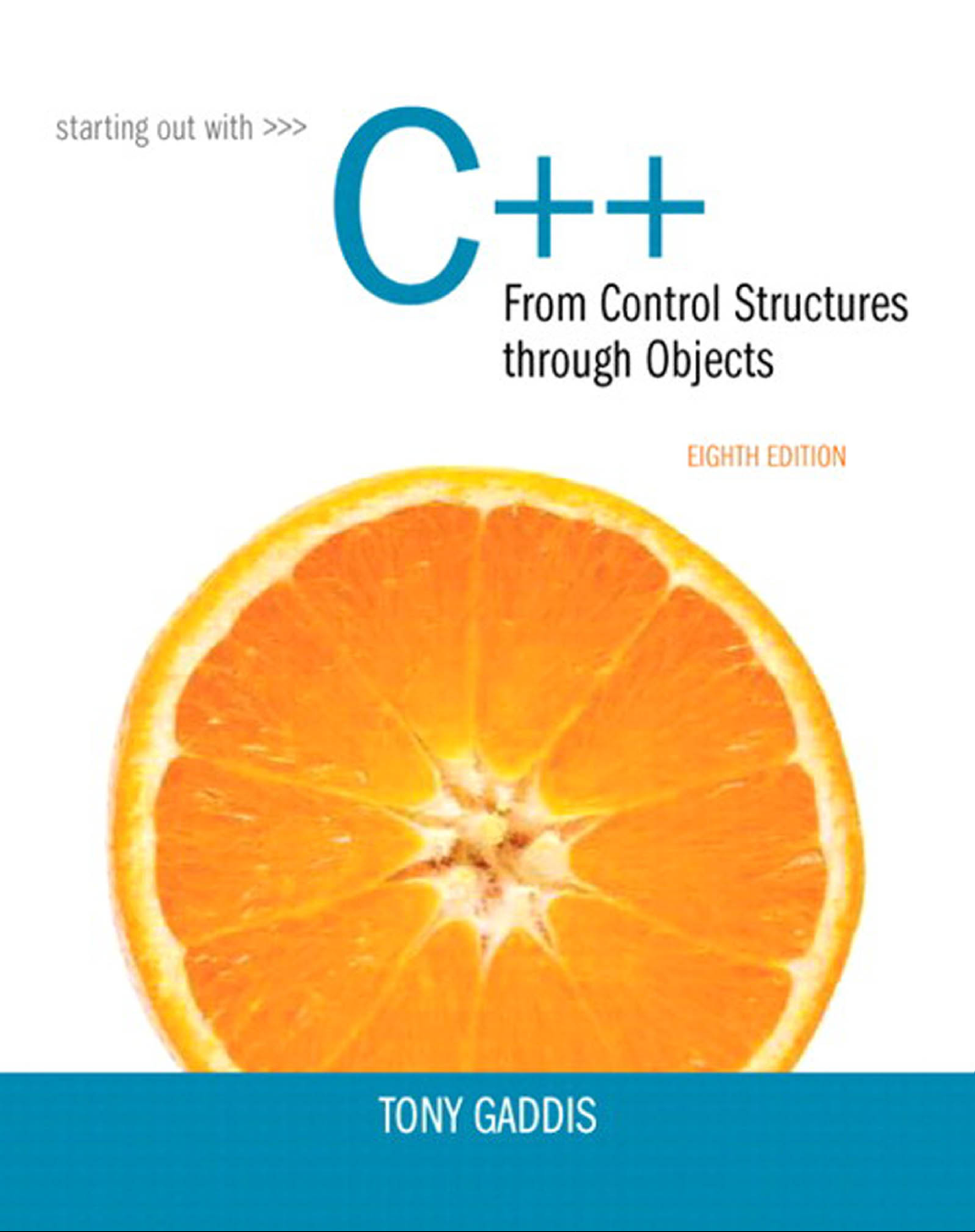
Sách Starting out with C++ - From Control Structures through Objects môn Lập trình C++ | Trường Đại học Kinh Doanh và Công Nghệ Hà Nội
Sách Starting out with C++ - From Control Structures through Objects môn Lập trình C++ | Trường Đại học Kinh Doanh và Công Nghệ Hà Nội. Tài liệu được sưu tầm giúp bạn tham khảo, ôn tập và đạt kết quả cao. Mời bạn đọc đón xem.
Môn: Lập trình với C++ (HUBT) 11 tài liệu
Trường: Trường Đại học Kinh Doanh và Công Nghệ Hà Nội 1.8 K tài liệu
Tác giả:



















Preview text:
STARTING OUT WITH C++ C++ From Control Structures through Objects
E I G H T H E D I T I O N
This page intentionally left blank STARTING OUT WITH C++ C++ From Control Structures through Objects
E I G H T H E D I T I O N Tony Gaddis
Haywood Community College
Boston Columbus Indianapolis New York San Francisco Upper Saddle River Amsterdam Cape
Town Dubai London Madrid Milan Munich Paris Montreal Toronto Delhi Mexico City São Paulo Sydney Hong
Kong Seoul Singapore Taipei Tokyo
Editorial Director: Marcia Horton
Cover Designer: Bruce Kenselaar
Acquisitions Editor: Matt Goldstein
Manager, Visual Research: Karen Sanatar
Program Manager: Kayla Smith-Tarbox
Permissions Supervisor: Michael Joyce
Director of Marketing: Christy Lesko
Permission Administrator: Jenell Forschler
Marketing Coordinator: Kathryn Ferranti
Cover Image: Sergio37_120/Fotolia
Marketing Assistant: Jon Bryant
Media Project Manager: Renata Butera
Senior Managing Editor: Scott Disanno
Full-Service Project Manager: Jogender Taneja
Senior Project Manager: Marilyn Lloyd Aptara®, Inc.
Operations Supervisor: Vincent Scelta
Full-Service Vendor: Aptara®, Inc.
Operations Specialist: Linda Sager
Printer/Binder: Courier Kendallville
Art Director, Cover: Jayne Conte
Cover Printer: Lehigh-Phoenix Color/Hagerstown
Text Designer: Joyce Cosentino Wells
Credits and acknowledgments borrowed from other sources and reproduced, with permission, appear on the
Credits page in the endmatter of this textbook.
Copyright © 2015, 2012, 2009 Pearson Education, Inc., publishing as Addison-Wesley All rights reserved.
Manufactured in the United States of America. This publication is protected by Copyright, and permission
should be obtained from the publisher prior to any prohibited reproduction, storage in a retrieval system, or
transmission in any form or by any means, electronic, mechanical, photocopying, recording, or likewise. To
obtain permission(s) to use material from this work, please submit a written request to Pearson Education,
Inc., Permissions Department, One Lake Street, Upper Saddle River, New Jersey 07458 or you may fax your request to 201 236-3290.
Many of the designations by manufacturers and sellers to distinguish their products are claimed as trademarks.
Where those designations appear in this book, and the publisher was aware of a trademark claim, the
designations have been printed in initial caps or all caps.
Library of Congress Cataloging-in-Publication Data Gaddis, Tony.
Starting out with C++ : from control structures through objects/Tony Gaddis.—Eighth edition. pages cm
Includes bibliographical references and index.
Online the following appendices are available at www.pearsonhighered.com/gaddis: Appendix D:
Introduction to fl owcharting; Appendix E: Using UML in class design; Appendix F: Namespaces; Appendix G:
Writing managed C++ code for the .net framework; Appendix H: Passing command line arguments; Appendix
I: Header fi le and library function reference; Appendix J: Binary numbers and bitwise operations; Appendix K:
Multi-source fi le programs; Appendix L: Stream member functions for formatting; Appendix M: Introduction
to Microsoft Visual C++ 2010 express edition; Appendix N: Answers to checkpoints; and Appendix O:
Solutions to odd-numbered review questions. ISBN-13: 978-0-13-376939-5 ISBN-10: 0-13-376939-9
1. C++ (Computer program language) I. Title. II. Title: From control structures through objects. QA76.73.C153G33 2014b 005.13’3—dc23 2014000213 10 9 8 7 6 5 4 3 2 1 ISBN 13: 978-0-13-376939-5 ISBN 10: 0-13-376939-9 Contents at a Glance Preface xv CHAPTER 1
Introduction to Computers and Programming 1 CHAPTER 2
Introduction to C++ 27 CHAPTER 3
Expressions and Interactivity 83 CHAPTER 4 Making Decisions 149 CHAPTER 5 Loops and Files 227 CHAPTER 6 Functions 299 CHAPTER 7 Arrays 375 CHAPTER 8
Searching and Sorting Arrays 457 CHAPTER 9 Pointers 495
CHAPTER 10 Characters, C-Strings, and More About the string Class 547
CHAPTER 11 Structured Data 599
CHAPTER 12 Advanced File Operations 657
CHAPTER 13 Introduction to Classes 711
CHAPTER 14 More About Classes 811
CHAPTER 15 Inheritance, Polymorphism, and Virtual Functions 891
CHAPTER 16 Exceptions, Templates, and the Standard Template Library (STL) 971
CHAPTER 17 Linked Lists 1025
CHAPTER 18 Stacks and Queues 1063
CHAPTER 19 Recursion 1121
CHAPTER 20 Binary Trees 1155
Appendix A: Getting Started with Alice 1185
Appendix B: The ASCII Character Set 1211
Appendix C: Operator Precedence and Associativity 1213 Quick References 1215 v vi Contents at a Glance Index 1217 Credit 1237 Online
The following appendices are available at www.pearsonhighered.com/gaddis.
Appendix D: Introduction to Flowcharting
Appendix E: Using UML in Class Design
Appendix F: Namespaces
Appendix G: Passing Command Line Arguments
Appendix H: Header File and Library Function Reference
Appendix I: Binary Numbers and Bitwise Operations
Appendix J: Multi-Source File Programs
Appendix K: Stream Member Functions for Formatting
Appendix L: Answers to Checkpoints
Appendix M: Solutions to Odd-Numbered Review Questions Contents Preface xv CHAPTER 1
Introduction to Computers and Programming 1 1.1 Why Program? 1 1.2
Computer Systems: Hardware and Software 2 1.3
Programs and Programming Languages 8 1.4 What Is a Program Made of? 14 1.5
Input, Processing, and Output 17 1.6 The Programming Process 18 1.7
Procedural and Object-Oriented Programming 22 CHAPTER 2
Introduction to C++ 27 2.1 The Parts of a C++ Program 27 2.2 The cout Object 31 2.3 The #include Directive 36 2.4 Variables and Literals 37 2.5 Identifiers 41 2.6 Integer Data Types 42 2.7 The char Data Type 48 2.8 The C++ string Class 52 2.9 Floating-Point Data Types 54 2.10 The bool Data Type 57 2.11
Determining the Size of a Data Type 58 2.12
Variable Assignments and Initialization 59 2.13 Scope 61 2.14 Arithmetic Operators 61 2.15 Comments 69 2.16 Named Constants 71 2.17 Programming Style 73 vii viii Contents CHAPTER 3
Expressions and Interactivity 83 3.1 The cin Object 83 3.2 Mathematical Expressions 89 3.3
When You Mix Apples and Oranges: Type Conversion 98 3.4 Overflow and Underflow 100 3.5 Type Casting 101 3.6
Multiple Assignment and Combined Assignment 104 3.7 Formatting Output 108 3.8
Working with Characters and string Objects 118 3.9
More Mathematical Library Functions 124 3.10
Focus on Debugging: Hand Tracing a Program 130 3.11
Focus on Problem Solving: A Case Study 132 CHAPTER 4
Making Decisions 149 4.1 Relational Operators 149 4.2 The if Statement 154 4.3
Expanding the if Statement 162 4.4 The if/else Statement 166 4.5 Nested if Statements 169 4.6 The if/else if Statement 176 4.7 Flags 181 4.8 Logical Operators 182 4.9
Checking Numeric Ranges with Logical Operators 189 4.10 Menus 190 4.11
Focus on Software Engineering: Validating User Input 193 4.12
Comparing Characters and Strings 195 4.13 The Conditional Operator 199 4.14 The switch Statement 202 4.15
More About Blocks and Variable Scope 211 CHAPTER 5
Loops and Files 227 5.1
The Increment and Decrement Operators 227 5.2
Introduction to Loops: The while Loop 232 5.3
Using the while Loop for Input Validation 239 5.4 Counters 241 5.5 The do-while Loop 242 5.6 The for Loop 247 5.7 Keeping a Running Total 257 5.8 Sentinels 260 5.9
Focus on Software Engineering: Deciding Which Loop to Use 261 5.10 Nested Loops 262 5.11
Using Files for Data Storage 265 5.12
Optional Topics: Breaking and Continuing a Loop 284 CHAPTER 6 Functions 299 6.1
Focus on Software Engineering: Modular Programming 299 6.2
Defining and Calling Functions 300 6.3 Function Prototypes 309 6.4
Sending Data into a Function 311 Contents ix 6.5 Passing Data by Value 316 6.6
Focus on Software Engineering: Using Functions in a Menu-Driven Program 318 6.7 The return Statement 322 6.8
Returning a Value from a Function 324 6.9 Returning a Boolean Value 332 6.10
Local and Global Variables 334 6.11 Static Local Variables 342 6.12 Default Arguments 345 6.13
Using Reference Variables as Parameters 348 6.14 Overloading Functions 354 6.15 The exit() Function 358 6.16 Stubs and Drivers 361 CHAPTER 7 Arrays 375 7.1
Arrays Hold Multiple Values 375 7.2 Accessing Array Elements 377 7.3 No Bounds Checking in C++ 384 7.4 Array Initialization 387 7.5 The Range-Based for Loop 392 7.6 Processing Array Contents 396 7.7
Focus on Software Engineering: Using Parallel Arrays 404 7.8
Arrays as Function Arguments 407 7.9 Two-Dimensional Arrays 418 7.10
Arrays with Three or More Dimensions 425 7.11
Focus on Problem Solving and Program Design: A Case Study 427 7.12
If You Plan to Continue in Computer Science: Introduction to the STL vector 429 CHAPTER 8
Searching and Sorting Arrays 457 8.1
Focus on Software Engineering: Introduction to Search Algorithms 457 8.2
Focus on Problem Solving and Program Design: A Case Study 463 8.3
Focus on Software Engineering: Introduction to Sorting Algorithms 470 8.4
Focus on Problem Solving and Program Design: A Case Study 477 8.5
If You Plan to Continue in Computer Science: Sorting and Searching vectors 485 CHAPTER 9 Pointers 495 9.1
Getting the Address of a Variable 495 9.2 Pointer Variables 497 9.3
The Relationship Between Arrays and Pointers 504 9.4 Pointer Arithmetic 508 9.5 Initializing Pointers 510 9.6 Comparing Pointers 511 9.7
Pointers as Function Parameters 513 9.8
Focus on Software Engineering: Dynamic Memory Allocation 522 9.9
Focus on Software Engineering: Returning Pointers from Functions 526 9.10
Using Smart Pointers to Avoid Memory Leaks 533 9.11
Focus on Problem Solving and Program Design: A Case Study 536 x Contents
CHAPTER 10 Characters, C-Strings, and More About the string Class 547 10.1 Character Testing 547 10.2 Character Case Conversion 551 10.3 C-Strings 554 10.4
Library Functions for Working with C-Strings 558 10.5
C-String/Numeric Conversion Functions 569 10.6
Focus on Software Engineering: Writing Your Own C-String-Handling Functions 575 10.7
More About the C++ string Class 581 10.8
Focus on Problem Solving and Program Design: A Case Study 590
CHAPTER 11 Structured Data 599 11.1 Abstract Data Types 599 11.2
Focus on Software Engineering: Combining Data into Structures 601 11.3
Accessing Structure Members 604 11.4 Initializing a Structure 608 11.5 Arrays of Structures 611 11.6
Focus on Software Engineering: Nested Structures 613 11.7
Structures as Function Arguments 617 11.8
Returning a Structure from a Function 620 11.9 Pointers to Structures 623 11.10
Focus on Software Engineering: When to Use . , When to Use -> , and When to Use * 626 11.11 Unions 628 11.12 Enumerated Data Types 632
CHAPTER 12 Advanced File Operations 657 12.1 File Operations 657 12.2 File Output Formatting 663 12.3
Passing File Stream Objects to Functions 665 12.4
More Detailed Error Testing 667 12.5
Member Functions for Reading and Writing Files 670 12.6
Focus on Software Engineering: Working with Multiple Files 678 12.7 Binary Files 680 12.8
Creating Records with Structures 685 12.9 Random-Access Files 689 12.10
Opening a File for Both Input and Output 697
CHAPTER 13 Introduction to Classes 711 13.1
Procedural and Object-Oriented Programming 711 13.2 Introduction to Classes 718 13.3
Defining an Instance of a Class 723 13.4 Why Have Private Members? 736 13.5
Focus on Software Engineering: Separating Class Specification from Implementation 737 13.6 Inline Member Functions 743 13.7 Constructors 746 13.8
Passing Arguments to Constructors 750 Contents xi 13.9 Destructors 758 13.10 Overloading Constructors 762 13.11 Private Member Functions 765 13.12 Arrays of Objects 767 13.13
Focus on Problem Solving and Program Design: An OOP Case Study 771 13.14
Focus on Object-Oriented Programming: Simulating Dice with Objects 778 13.15
Focus on Object-Oriented Programming: Creating an Abstract Array Data Type 782 13.16
Focus on Object-Oriented Design: The Unified Modeling Language (UML) 785 13.17
Focus on Object-Oriented Design: Finding the Classes and Their Responsibilities 788
CHAPTER 14 More About Classes 811 14.1
Instance and Static Members 811 14.2 Friends of Classes 819 14.3 Memberwise Assignment 824 14.4 Copy Constructors 825 14.5 Operator Overloading 831 14.6 Object Conversion 858 14.7 Aggregation 860 14.8
Focus on Object-Oriented Design: Class Collaborations 865 14.9
Focus on Object-Oriented Programming: Simulating the Game of Cho-Han 869
CHAPTER 15 Inheritance, Polymorphism, and Virtual Functions 891 15.1 What Is Inheritance? 891 15.2
Protected Members and Class Access 900 15.3
Constructors and Destructors in Base and Derived Classes 906 15.4
Redefining Base Class Functions 918 15.5 Class Hierarchies 923 15.6
Polymorphism and Virtual Member Functions 929 15.7
Abstract Base Classes and Pure Virtual Functions 945 15.8 Multiple Inheritance 952
CHAPTER 16 Exceptions, Templates, and the Standard Template Library (STL) 971 16.1 Exceptions 971 16.2 Function Templates 990 16.3
Focus on Software Engineering: Where to Start When Defining Templates 996 16.4 Class Templates 996 16.5
Introduction to the Standard Template Library (STL) 1005
CHAPTER 17 Linked Lists 1025 17.1
Introduction to the Linked List ADT 1025 17.2 Linked List Operations 1027 17.3 A Linked List Template 1043 17.4
Variations of the Linked List 1055 17.5 The STL list Container 1056 xii Contents
CHAPTER 18 Stacks and Queues 1063 18.1
Introduction to the Stack ADT 1063 18.2 Dynamic Stacks 1080 18.3 The STL stack Container 1091 18.4
Introduction to the Queue ADT 1093 18.5 Dynamic Queues 1105 18.6
The STL deque and queue Containers 1112
CHAPTER 19 Recursion 1121 19.1
Introduction to Recursion 1121 19.2
Solving Problems with Recursion 1125 19.3
Focus on Problem Solving and Program Design: The Recursive gcd Function 1133 19.4
Focus on Problem Solving and Program Design: Solving Recursively Defined Problems 1134 19.5
Focus on Problem Solving and Program Design: Recursive Linked List Operations 1135 19.6
Focus on Problem Solving and Program Design: A Recursive Binary Search Function 1139 19.7 The Towers of Hanoi 1141 19.8
Focus on Problem Solving and Program Design: The QuickSort Algorithm 1144 19.9 Exhaustive Algorithms 1148 19.10
Focus on Software Engineering: Recursion vs. Iteration 1151
CHAPTER 20 Binary Trees 1155 20.1
Definition and Applications of Binary Trees 1155 20.2
Binary Search Tree Operations 1158 20.3
Template Considerations for Binary Search Trees 1175
Appendix A: Getting Started with Alice 1185
Appendix B: The ASCII Character Set 1211
Appendix C: Operator Precedence and Associativity 1213 Quick References 1215 Index 1217 Credit 1237 Online
The following appendices are available at www.pearsonhighered.com/gaddis.
Appendix D: Introduction to Flowcharting
Appendix E: Using UML in Class Design
Appendix F: Namespaces
Appendix G: Passing Command Line Arguments
Appendix H: Header File and Library Function Reference
Appendix I: Binary Numbers and Bitwise Operations
Appendix J: Multi-Source File Programs
Appendix K: Stream Member Functions for Formatting
Appendix L: Answers to Checkpoints
Appendix M: Solutions to Odd-Numbered Review Questions
LOCATION OF VIDEONOTES IN THE TEXT Chapter 1
Introduction to Flowcharting, p. 20
Designing a Program with Pseudocode, p. 20
Designing the Account Balance Program, p. 25
Predicting the Result of Problem 33, p. 26 Chapter 2 Using cout, p. 31 Variabe Defi nitions, p. 37
Assignment Statements and Simple Math Expressions, p. 62
Solving the Restaurant Bill Problem, p. 80 Chapter 3 Reading Input with cin, p. 83
Formatting Numbers with setprecision, p. 111
Solving the Stadium Seating Problem, p. 142 Chapter 4 The if Statement, p. 154 The if/else statement, p. 166 The if/else if Statement, p. 176
Solving the Time Calculator Problem, p. 221 Chapter 5 The while Loop, p. 232 The for Loop, p. 247
Reading Data from a File, p. 274
Solving the Calories Burned Problem, p. 293 Chapter 6
Functions and Arguments, p. 311
Value-Returnlng Functions, p. 324
Solving the Markup Problem, p. 366 Chapter 7
Accessing Array Elements With a Loop, p. 380
Passing an Array to a Function, p. 407
Solving the Chips and Salsa Problem, p. 448 Chapter 8 The Binary Search, p. 460 The Selection Sort, p. 474
Solving the Charge Account Validation Modifi cation Problem, p. 492 Chapter 9
Dynamically Allocating an Array, p. 523
Solving the Pointer Rewrite Problem, p. 545 Chapter 10
Writing a C-String-Handling Function, p. 575
More About the string Class, p. 581
Solving the Backward String Problem, p. 594
(continued on the next page)
LOCATION OF VIDEONOTES IN THE TEXT (continued) Chapter 11 Creating a Structure, p. 601
Passing a Structure to a Function, p. 617
Solving the Weather Statistics Problem, p. 652 Chapter 12
Passing File Stream Objects to Functions, p. 665
Working with Multiple Files, p. 678
Solving the File Encryption Filter Problem, p. 708 Chapter 13 Writing a Class, p. 718
Defi ning an Instance of a Class, p. 723 Solving the Employee Class Problem, p. 802 Chapter 14 Operator Overloading, p. 831 Class Aggregation, p. 860 Solving the NumDays Problem, p. 885
Chapter 15 Redefi ning a Base Class Function in a Derived Class, p. 918 Polymorphism, p. 929 Solving the
Employee and Production-Worker Classes Problem, p. 963 Chapter 16 Throwing an Exception, p. 972 Handling an Exception, p. 972
Writing a Function Template, p. 990
Storing Objects in a vector, p. 1010
Solving the Exception Project Problem, p. 1024 Chapter 17
Appending a Node to a Linked List, p. 1028
Inserting a Node in a Linked List, p. 1035
Deleting a Node from a Linked List, p. 1039
Solving the Member Insertion by Position Problem, p. 1061 Chapter 18
Storing Objects in an STL stack, p. 1091
Storing Objects in an STL queue, p. 1114
Solving the File Compare Problem, p. 1119 Chapter 19
Reducing a Problem with Recursion, p. 1126
Solving the Recursive Multiplication Problem, p. 1153 Chapter 20
Inserting a Node in a Binary Tree, p. 1160
Deleting a Node from a Binary Tree, p. 1166
Solving the Node Counter Problem, p. 1182 Preface
Welcome to Starting Out with C++: From Control Structures through Objects, 8th edition.
This book is intended for use in a two-semester C++ programming sequence, or an acceler-
ated one-semester course. Students new to programming, as well as those with prior course
work in other languages, will fi nd this text benefi cial. The fundamentals of programming
are covered for the novice, while the details, pitfalls, and nuances of the C++ language are
explored in-depth for both the beginner and more experienced student. The book is written
with clear, easy-to-understand language, and it covers all the necessary topics for an intro-
ductory programming course. This text is rich in example programs that are concise, practi-
cal, and real-world oriented, ensuring that the student not only learns how to implement the
features and constructs of C++, but why and when to use them.
Changes in the Eighth Edition
C++11 is the latest standard version of the C++ language. In previous years, while the stan-
dard was being developed, it was known as C++0x. In August 2011, it was approved by
the International Standards Organization (ISO), and the name of the standard was offi cially
changed to C++11. Most of the popular compilers now support the C++11 standard.
The new C++11 standard was the primary motivation behind this edition. Although this
edition introduces many of the new language features, a C++11 compiler is not strictly
required to use the book. As you progress through the book, you will see C++11 icons in the
margins, next to the new features that are introduced. Programs appearing in sections that
are not marked with this icon will still compile using an older compiler.
Here is a summary of the new C++11 topics that are introduced in this edition:
● The auto key word is introduced as a way to simplify complex variable defi nitions.
The auto key word causes the compiler to infer a variable’s data type from its initial- ization value.
● The long long int and unsigned long long int data types, and the LL literal suffi x are introduced.
● Chapter 5 shows how to pass a string object directly to a fi le stream object’s open
member function, without the need to call the c_str() member function. (A discus-
sion of the c_str() function still exists for anyone using a legacy compiler.) xv xvi Preface
● The range-based for loop is introduced in Chapter 7 . This new looping mechanism
automatically iterates over each element of an array, vector , or other collection,
without the need of a counter variable or a subscript.
● Chapter 7 shows how a vector can be initialized with an initialization list.
● The nullptr key word is introduced as the standard way of representing a null pointer.
● Smart pointers are introduced in Chapter 9 , with an example of dynamic memory allocation using unique_ptr .
● Chapter 10 discusses the new, overloaded to_string functions for converting numeric values to string objects.
● The string class’s new back() and front() member functions are included in
Chapter 10 ’s overview of the string class.
● Strongly typed enum s are discussed in Chapter 11 .
● Chapter 13 shows how to use the smart pointer unique_ptr to dynamically allocate an object.
● Chapter 15 discusses the override key word and demonstrates how it can help prevent
subtle overriding errors. The final key word is discussed as a way of preventing a virtual
member function from being overridden.
In addition to the C++11 topics, the following general improvements were made:
● Several new programming problems have been added to the text, and many of the
existing programming problems have been modifi ed to make them unique from previ- ous editions.
● The discussion of early, historic computers in Chapter 1 is expanded.
● The discussion of literal values in Chapter 2 is improved.
● The introduction of the char data type in Chapter 2 is reorganized to use character
literals in variable assignments before using ASCII values in variable assignments.
● The discussion of random numbers in Chapter 3 is expanded and improved, with the
addition of a new In the Spotlight section.
● A new Focus on Object-Oriented Programming section has been added to Chapter 13 ,
showing how to write a class that simulates dice.
● A new Focus on Object-Oriented Programming section has been added to Chapter 14 ,
showing an object-oriented program that simulates the game of Cho-Han. The program
uses objects for the dealer, two players, and a pair of dice.
Organization of the Text
This text teaches C++ in a step-by-step fashion. Each chapter covers a major set of topics
and builds knowledge as the student progresses through the book. Although the chapters
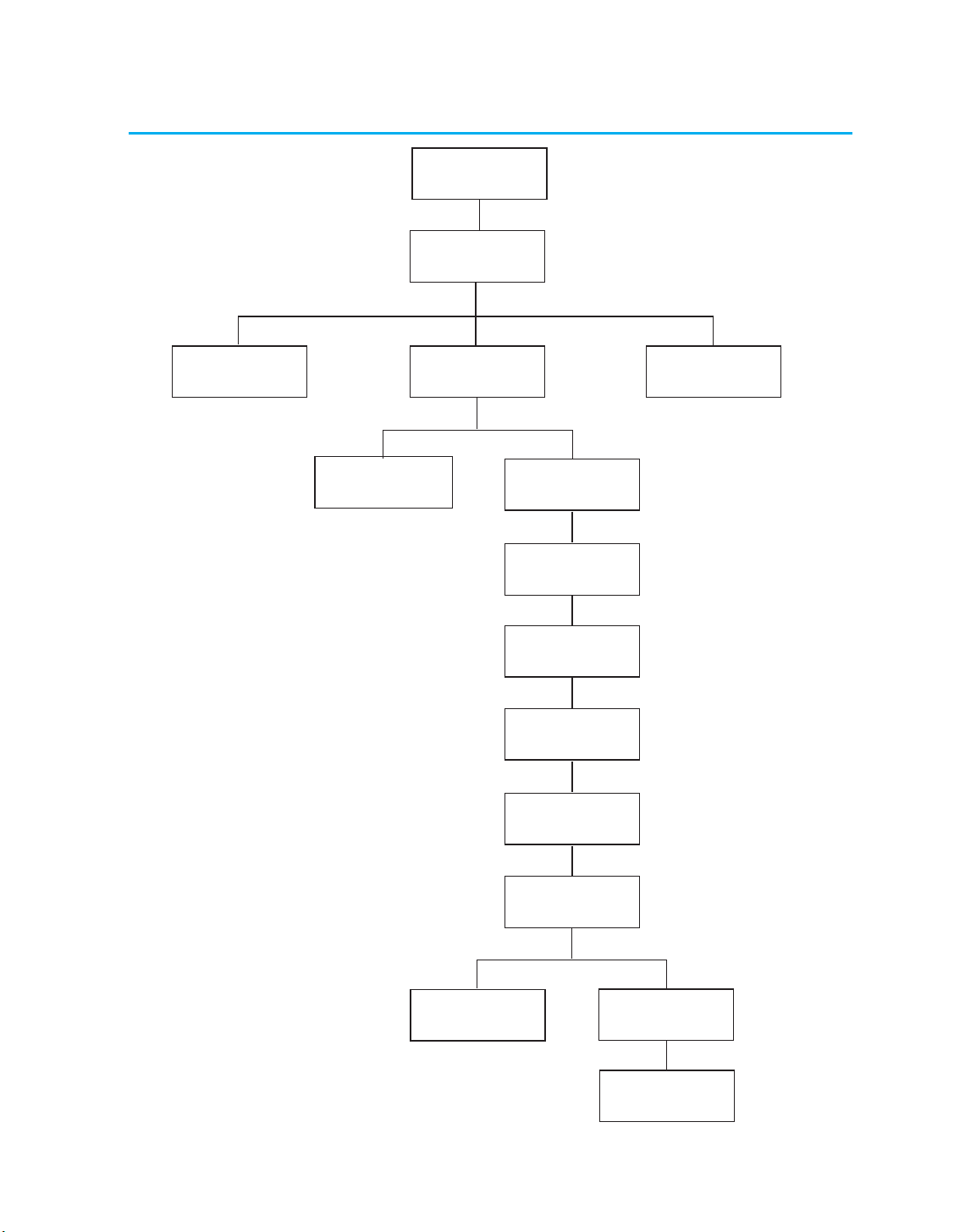
can be easily taught in their existing sequence, some fl exibility is provided. The diagram
shown in Figure P-1 suggests possible sequences of instruction. Preface xvii Figure P-1 Chapter 1 Introduction Chapters 2–7 Basic Language Elements Chapter 8 Chapter 9 Chapter 12 Searching and Pointers Advanced File Sorting Arrays Operations* *A few subtopics in Chapter 12 require Chapter 10 Chapters 9 and 11. Characters, Str ings, Chapter 11 and the Structures string Class Chapter 13 Introduction to Classes Chapter 14 More About Classes Chapter 15 Inheritance and Polymorphism Chapter 16 Exceptions, Templates, and STL Chapter 17 Linked Lists Chapter 18 Chapter 19 Stacks and Queues Recursion Chapter 20 Binary Trees xviii Preface
Chapter 1 covers fundamental hardware, software, and programming concepts. You may
choose to skip this chapter if the class has already mastered those topics. Chapters 2 through
7 cover basic C++ syntax, data types, expressions, selection structures, repetition structures,
functions, and arrays. Each of these chapters builds on the previous chapter and should be
covered in the order presented.
After Chapter 7 has been covered, you may proceed to Chapter 8 , or jump to either Chapter
9 or Chapter 12 . (If you jump to Chapter 12 at this point, you will need to postpone sections
12.7, 12.8, and 12.10 until Chapters 9 and 11 have been covered.)
After Chapter 9 has been covered, either of Chapters 10 or 11 may be covered. After Chap-
ter 11 , you may cover Chapters 13 through 17 in sequence. Next you can proceed to either
Chapter 18 or Chapter 19 . Finally, Chapter 20 may be covered.
This text’s approach starts with a fi rm foundation in structured, procedural programming
before delving fully into object-oriented programming and advanced data structures.
Brief Overview of Each Chapter
Chapter 1 : Introduction to Computers and Programming
This chapter provides an introduction to the fi eld of computer science and covers the fun-
damentals of programming, problem solving, and software design. The components of pro-
grams, such as key words, variables, operators, and punctuation are covered. The tools of
the trade, such as pseudocode, fl ow charts, and hierarchy charts are also presented.
Chapter 2 : Introduction to C++
This chapter gets the student started in C++ by introducing data types, identifi ers, vari-
able declarations, constants, comments, program output, simple arithmetic operations, and
C-strings. Programming style conventions are introduced and good programming style
is modeled here, as it is throughout the text. An optional section explains the difference
between ANSI standard and pre-standard C++ programs.
Chapter 3 : Expressions and Interactivity
In this chapter the student learns to write programs that input and handle numeric, char-
acter, and string data. The use of arithmetic operators and the creation of mathematical
expressions are covered in greater detail, with emphasis on operator precedence. Debug-
ging is introduced, with a section on hand tracing a program. Sections are also included on
simple output formatting, on data type conversion and type casting, and on using library
functions that work with numbers.
Chapter 4 : Making Decisions
Here the student learns about relational operators, relational expressions and how to con-
trol the fl ow of a program with the if , if / else , and if / else if statements. The condi-
tional operator and the switch statement are also covered. Crucial applications of these
constructs are covered, such as menu-driven programs and the validation of input. Preface xix
Chapter 5 : Loops and Files
This chapter covers repetition control structures. The while loop, do - while loop, and for
loop are taught, along with common uses for these devices. Counters, accumulators, run-
ning totals, sentinels, and other application-related topics are discussed. Sequential fi le I/O
is also introduced. The student learns to read and write text fi les, and use loops to process the data in a fi le. Chapter 6 : Functions
In this chapter the student learns how and why to modularize programs, using both void
and value returning functions. Argument passing is covered, with emphasis on when argu-
ments should be passed by value versus when they need to be passed by reference. Scope of
variables is covered, and sections are provided on local versus global variables and on static
local variables. Overloaded functions are also introduced and demonstrated. Chapter 7 : Arrays
In this chapter the student learns to create and work with single and multidimensional
arrays. Many examples of array processing are provided including examples illustrating
how to fi nd the sum, average, highest, and lowest values in an array and how to sum the
rows, columns, and all elements of a two-dimensional array. Programming techniques using
parallel arrays are also demonstrated, and the student is shown how to use a data fi le as
an input source to populate an array. STL vectors are introduced and compared to arrays.
Chapter 8 : Sorting and Searching Arrays
Here the student learns the basics of sorting arrays and searching for data stored in them.
The chapter covers the Bubble Sort, Selection Sort, Linear Search, and Binary Search algo-
rithms. There is also a section on sorting and searching STL vector objects. Chapter 9 : Pointers
This chapter explains how to use pointers. Pointers are compared to and contrasted with
reference variables. Other topics include pointer arithmetic, initialization of pointers, rela-
tional comparison of pointers, pointers and arrays, pointers and functions, dynamic mem- ory allocation, and more.
Chapter 10 : Characters, C-strings, and More About the string Class
This chapter discusses various ways to process text at a detailed level. Library functions for
testing and manipulating characters are introduced. C-strings are discussed, and the tech-
nique of storing C-strings in char arrays is covered. An extensive discussion of the string class methods is also given.
Chapter 11 : Structured Data
The student is introduced to abstract data types and taught how to create them using struc-
tures, unions, and enumerated data types. Discussions and examples include using pointers
to structures, passing structures to functions, and returning structures from functions.
Tài liệu liên quan:
-
Sách Beginning C++ môn Lập trình C++ | Trường Đại học Kinh Doanh và Công Nghệ Hà Nội
35 18 -
Giáo Trình Lập Trình C++ | Trường Đại học Kinh Doanh và Công Nghệ Hà Nội
36 18 -
Bài tập thực hành môn Lập trình C++ | Trường Đại học Kinh Doanh và Công Nghệ Hà Nội
45 23 -
Bài tập trắc nghiệm môn Lập trình với C++ | Trường Đại học Kinh Doanh và Công Nghệ Hà Nội
85 43