:eaallimg:
TocaburIar.1r:
; ra irt rna r:
=:steningl:
Speal<inq:
Use
yp1.16
EngIish:
..rlriliing;:
m u ltiple-choice, identifying key
information
emotion-related
words, tra n sform ing
words
present
simple &
present
continuous,
present perfect
simple &
present
norfact rnnfin r rnr r<
mu ltiple-choice, highlighting
key words
talkinE about free-time activities,
answering
personal questions,
linking words, time expressions,
tenses
phrasal
verbs,
prepositions,
completing
gapped
texts
informal letter
/
email, using the correct tone,
planning your
response
.#l
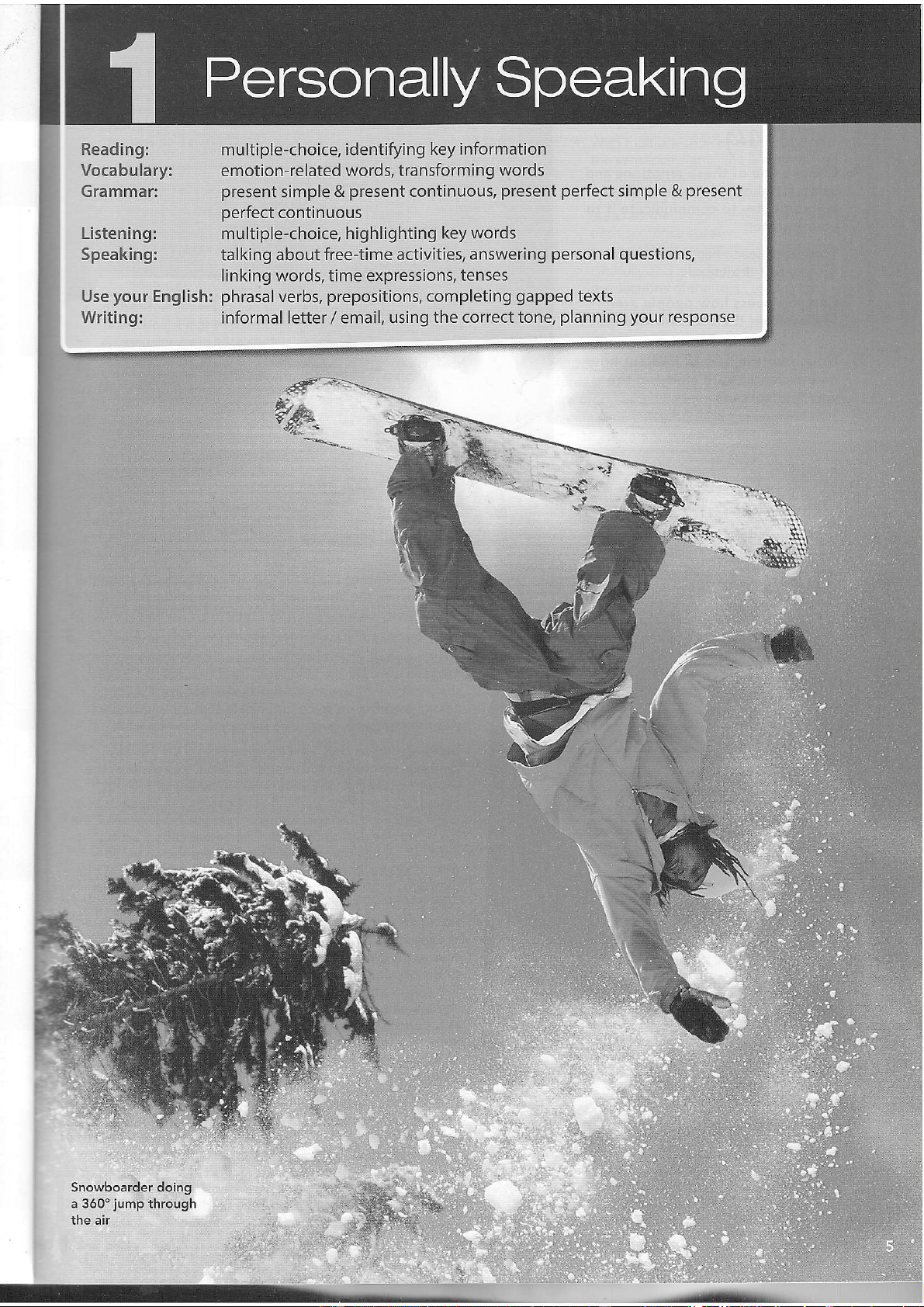
Snowboarder doing
a 360'jump
through
the air
ffi*
c
D
A
Choose one of these
emotions and,
using
facial expressions
and body
language,
try to communicate
it to
your partner.
disgust fear happiness
sadness anxiety
Can you guess
how people
are
feeling from
their body language?
Now read the
text to find out how
neuroscientists
are studying the
way fear spreads.
It has long
been known that fear
spreads
quickly
from
person
to
person.
However,
until recently, neuroscientists
believed
that this fear was communicated mainly through
facial expressions. Now
a new study has shown that body
language
may be
just
as important
as facial expressions
for communicating
fear. lt shows that fearful body
postures
are
processed
in the emotional
part
of the brain
and lead
to an automatic response. Body
postures
that
do not communicate
fear are
processed
differently, in
the visual
oart
of the brain.
Since the link between
the
Word Focus
neuroscientist: a scientist who
studies the brain and nervous
system
study: a
particular
piece
of research
automatic:
done without thinking,
instinctively
neutral: neither
positive
nor
negatrve
motor; relating
to muscles, nerves
and
parts
ofthe brain that control
movement
mechanismi a
part
of
your
behaviour which helps
you
deal
with a difficult
situation
emotional
part
of the brain and action is stronger than the
link
between the visual
part
of the brain and action, viewing
fearful
body expressions may create
an automatic response
ro Tea r.
'When we
talk about how humans communicate. we
alwavs
tar< aooJL lhings like language,'
said BeaLrice de Celder,
the neuroscientist
who led the studv.
'But
iust like in the
arin'al worlo, we
a so conn-lnicate through orr bodies
without
our conscious minds
being much aware of it.'
Unljke earlier studies, which
concentrated on the way
the brain
reacted to still images
of facial expressions, the
experiment which
de Gelder and her team carried
out
aimed to
prove
that fearful
body
posture
can create fear in
observers.
Since
previous
studies had
used still images, the
scientists decided
to use stills from video clios. Particioants
had their
brains scanned whi
e they
were
shown video
stills of actors
who were showing fear. For exampLe, in
one
situation, they had
just
opened a door to find an armed
robber waiting
for them. They were also
shown
in
neutral
situations;
pouring
a
glass
of water or combing their hair.
In each
case, though, the actors'faces were
blocked out
so tfaL lhe oa'tic pants
viewi'rg Lhen corld oaly reacl
to their body
posture
and not
to any facial expressions.
The resr
ts sl-owed thar when
par
l c
pa'tfs
saw fearful
images, the emotional
part
of the brain was active as we I
as regions
of the brain connected
to motor
processes
that
are responsible for
movement. There was a lot more
going
on
in
the brain than when the neutral images
were shown.
These only activated
the visual areas of the brain.
The response
to fear appears to be
quite
automatic, and
this is commonly
seen in the animal kingdom. lf a flock of
birds
has been feeding on the ground
and one is frightened
by something
and tal<es off, the others immediate
y
fol ow.
It is an extremely important
evolutionary mechanism
because
any bird left behind may become
prey.
Something
simi ar happens with
humans. At a fearful moment, humans
like animals
need to be ready to react
quickly
because they
B
Hour
does
fear
spread?
I
I
C Read
the Exam
Close-up. Then underline the key
words in
the sentence
stems in the Exam lask below.
D
Now complete
the Exam Task.
Exam Task
For
questions
1
-
6
choose the answer
(a,
b, c
or d) which fits
best according
to the
text.
1 Scientists
have recently
discovered that fear
a is
expressed in
the body as much as the face.
b is
more strongly
expressed in the face than the body.
c is
mainly expressed
in the body.
d
creates an automatic
response in others.
2 The
automatic response
to fearful
postures
comes from the
part
of the brain that processes
a visual
images.
b emotions-
5
c language.
d facia
expressions.
3 According
to de Gelder
a hunans
commur'care
nrainly tl-rough speecl^.
b humans
do not realise
they are using body language.
c hrmans
rhink body larguage
is Lnimporta.lt.
d humans
can control
their body language.
4
De Gelder's
study differed from
previous
ones in that
a it used
still images.
b it used images
of the face
and body.
c it showed
images ofthe
body.
d it used
moving images.
E
Complete
the sentences
below with these words.
Exam
ue
{:7:|%,
ldentifying key information
.
With
multiple-choice sentences, read
the sentence
stems first and underline
the
key words.
Then, find a section in
the text which
matches
the underlined key words rn
each sentence
stem.
Finally, read the answer
options
carefully
and check them against
the sections of the
texts to find the
correct
answer.
The
study showed that neutral and {earful
body
postures
a
are
processed
differently by
the
human
brain.
b
create similar responses in the human
brain.
c
create automatic responses in humans.
d
are similar in all animals.
The
automatic response to {ear
a is
always the same in animals and humans.
b is responsible
for
people
adopting different
body
postures.
c is the result
of careful evaluation of a
dangerous
situation.
d developed
as a way to escape danger
r9
e
carry
oul communicate
evatuate focus
process
react
Even wifhoJt
a corrmor language, peop
e find ways to
H uman brains
and computers
Neuroscientists
want to
In order
to be successful,
teachers need to
are
given
only a fraction
of a second to evaluate the situation.
f
a fire breaks
out, for instance, people quickly
adopt the
cody
posture
of those
close to them. However, our reaction
:o danger is
sometimes
slowed down as we try to rationalise
'ear
by asking ourselves
whether there is
a
reason
to
react.
So far, neuroscientists
have focussed
on showing
people
stills
:rom
videos, but
they are now interested
in finding out
what
rappens
in the brain when
humans watch moving images.
lams of neuroscientists
around
the world. includinq de
3e
de"'s, are carryirg
o.rt sLudies in w1 c't tre
paniclpanrs'
crains are
scanned while they
are watching films.
-ris
enables scientists
to study how
emotional actions are
3aseo
on movement.
l
ihe future, such research
may be used in
the
building of
'cbotic
human
companions
that would be able to
perceive.
:ecide, communicate
and react as humans
do.
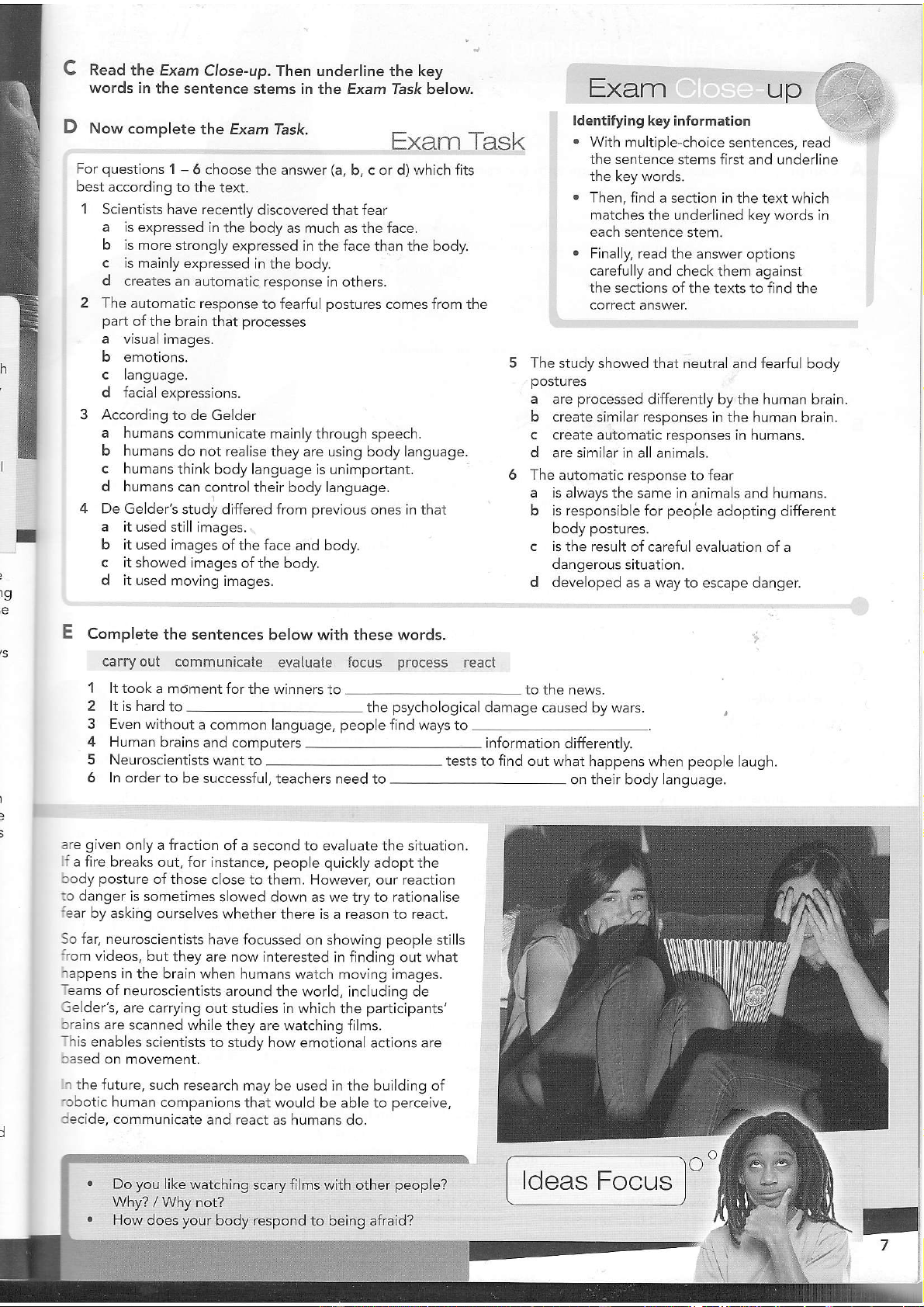
Do you
like watching
scary films with other
people?
Why?
/
Why not?
How
does
your
body respond
to being a{raid?
1
4
5
It Look a mo"nenL
for ll^e winners
ro
It is hard
to
to the
news.
the
psychological
damage caused
by wars.
information differently.
tests to find out what
happens when
people
laugh.
on their body language.
ldeas
Focus
A
Complete the phrases
about feelings with the correct
prepositions.
at in on
out under with
1
The
pain
of my
broken leg was so bad that lwas agony.
2
Just
-
of curiosity, would
you
mind telling me what he's like?
3 The
thriller was so
exciting that we were the edge of
our seats.
4 Herbeft
was so surprised
when he saw me that he was
-
a loss
for words.
It was
-
regret
that the manager announced the company was
closing.
I don't like your
cousin Cara at all;
she
really
gets
my
skin!
B
Replace the words
in bold with the following words.
amazement
anxiety confidence
disgust
fury
joy
misery
shame
'l
The children!
happiness was obvious when they were
given
the new
computer.
2 He
couldn't control
his anger when he saw the damage to his car.
3
James looked up
at the world's tallest skyscraper in total surprise.
4 Knowing
that many
people
live in
poverty
caused Mandy
great
sadness.
5 Martin
experienced
great
worry
when his beloved
pet went r0issing.
6 I know she'll
succeed; she has
a
lot
of belief
in her
abilities.
7 She looked
at the man who had
thrown
his rubbish in the street
with dislike.
8 Henry was
overcome by embarrassment
when the teacher
caught
him cheating.
Complete the sentences
with the
correct
word from each
pair.
affect / effect
Pre
Co
A
B
c
I Her
words had
a strange
2 Don't
let his unkind words
alone / tonety
Sarnanrha really
doesn'r mind livirg
Humphrey
often feels
huge
house.
express / convey
in his
wher he saw the bov kick the doq. D|SGUST
Exam
Transforming words
up
.
Before compleLing Ll'e senferces, create
a
word
family for each of the words
given
in the task. What is
the noun, the adjective,
the adverb?
.
Then think
about
which
form best fits in the
gap
in each sentence.
Remember to check
the spelling of all
the words
you
have written when
you
have finished.
You
will lose marks if any o{
your
words are
spelled incorrectly!
Exam Task
on me.
you.
4
5
6
c
PIease
my apologies to Celia.
Sam
finds it difficult
to himself.
D
Read the Exam
Close-up and
complete the
Exam
Task below.
Complete the sentences
with the correct form of the words in capitals.
1
Cesar was
2 Being
lost in the forest
was a experience for Joe. FRIGHT
her son
received
the award. PROUD
4 He en had
stuoied hard
and felt
5 Elderlv
people
who live alone often
suffer
from
3 ,Anne
couldn't hide her
when
abour l'er exam
results. OPTIMISM
LONELY
about
qoinq
to the beach.
ENTHUSIASM
by
slamming the door as he left.
ANNOY
6 The
children were very
7 Dan expressed
his
8 VioleL's
.num
was
anazed by l.er to help witl^ rhe housework. EAGER
1'
'
'f
r
'
."r
tt
't
t\t't
t
t.'.:
i
-
'
!
--"
Present
Simple & Present
Continuous
A Read and
mark the Present
Simple
sentences with
PS and
the Present
Continuous
sentences with PC.
1 She's
getting
more and more worried
about her
hea th.
2 We're
going
to the sc;ence museum
next week-
3
4
Helen lives in the
city centre.
-
In
the
photo,
two people
are
a
rg
u ing.
The
adult human brain
weighi about
1.3
<ilograms.
What
are
you
looking
at?
Fe
s always Lellirg me wf
a1 to dol
The
psychology
lecture
is at
12
o'clock.
lvisit my elderly grandparents
ever,
weeKencl.
6
'1
8
1O
This week, we're
studying the nervous
system.
11
Melissa scores
another
goall
B fUatch
the Present
Simple sentences
in
A with the uses
below.
a scientific
facts and general
truths
!
b
permanent
Situations
I
c habits and repeated
actions
t
l
d timetabled
and scheduled events
n
e ra.ral:ves
(slo
ies
jokes,
p
ots,
sports commentaries,
etc)
I
C Match the Present
Continuous
sentences in A with
the uses below.
a
c
d
something happening
now
ternporary srtuatroqs
plans
{or the future
annoying
habits
(with
always,
co nti n
u a I ly, f o r ev e r, eIc)
changing
situations
(often
used
with
comparatives)
what
is happening in
a
picture
n
I
D Circle the correct form
of the vero.
Approximately 1 0%
of the
people
that
(1)
read
/
are reading
this now are left-handed.
That's righI, 13% of all human beings
are left handed.
Some scientists
(2)
believe
/
are believing
let
hardedness
c
d
T.a r r6ar
pa
e1L'
\3'
pdss
.
are
passing
01 to
their children in a
particular
gene.
lf
you
(4)
have
/
are having
that
gene,
one or more
of
your
children may be left-handed.
Left handed
people
(5)
tend
/
are tending to be more creative
than right handers, and we
(6)
find
/
are finding more left-
handers than normal in
creative
professions
such as music and
the arts. The reason for
this can be found in the brain. The
brain
(7)
wor<s
/
is working in very
comp ex ways, and scientists
(8)
discover
/
are discovering
more and more about it every day.
The
eft side ofthe brain, which
is responsible for logical skills,
(9)
controls
,/
is controlling
the right-handed side of the body.
-he
r ght
s de o
-
ll-e
br air, w^ere
c.eaL viLy occJr :. is ir cha
ge
of the left-handed side
of the body. This
(10)
makes
/
is making
left-handers more creative
than right handers.
Complete the sentences
using the Present Simple or the
Present
Continuous of
the
verbs
in brackets.
1 Grandma,
(you
/ bake) a cal<e? lt
(sme
)de
iciousl
2 You
(look)
very serious. What
(you
/
think) about?
L:
n
l
3
(you
,/
like) science?
l
(have)
trouble with this maths
problem.
(not
understand) it at alll
J ACK
(seem)
stressed. He
(work)
too
hard these days.
6 Fay
(not
come) to the cliffs with us.
She
'l^aver
a fear oI l-eighrs.
(talk)
to Tom? |
(not
recognise) her
(they
/ run)?'
'Because
a lion
'why
(chase)
theml'
'r:-,t':;
rgr"nlnT
A
ltXryfr Listen to the recording and tick
(./)
the correct
sentence, a or b, in each item that means the
same
as the sentence vou hear.
It's
strange he freaked out at the competition.
It's weird
he didn't turn up for the competition.
Cheer up!
Concentratel
There isn't any logical reason for his behaviour.
I can explain his behaviour.
I was
absolutely terrified by the film.
I was really
disappointed by the film.
Read the Exam Close-up and underline
the important words in the Exam Task.
?],.{ifi
Now complete
the Exam Task
ta
o
2a
b
o
4a
o
o
c
I
I
I
n
I
I
I
I
B ffi:,?in Look
at the situations
and options below.
Then listen to
the
recording and write an
appropriate
question
for each one.
1 You will hear a boy speaking to his mother
a washing the dishes
b watering the
plants
c emptying the dishwasher
You will hear a head teacher speaking
to a
studert.
-
the
number
of absences
the student has had
the student's inability to concentrate
the studenr's
poor
academic'esrlLs
c
D
Exam
up
Highlighting key words
.
Read the multiple-choice
questions
first. ldentify who is
talking and the topic they are talking about.
.
Read the
questions
and underline the key words.
Then read
the answer options and think about the meaning
of any key words. Try to think about other words which
may mean the same thing, for example
'severe'
could be
expressed
also as'exrre.ne
.
Rerrember, on
y
one option wil answer the
questionl
6 You hear a man
talking about
living
alone.
How does he feel
when he comes home at night?
a ronery
b frightened
c
peaceful
Exam Task
You will hear
people
talking in
six
different
situations. For
questions
1
-
6, choose the
l-\a.t .hcr^/a. . h
^/.
You hear a wonan Lalking about a
phobia
she has. How does she describe her fear?
a severe
-
b irrational
c embarrassing
You hear
a man talking about his driving test.
What is he
anxious about?
a
crashing the car
b failing
the test
c not
turning up for the test
You hear
a
woman
talking about horror
films. What is
her opinion of the film she saw
last night?
a lt was very
amusing.
b lt was very
scary.
c lt was over-rated.
You hear a woman
talking to
he. daughLer.
Why is she talking
to
her?
a to convey her
annoyance
b to cheer her
daughter up
c to express
a
lack
of confidence
in her
daughter's abilities
You overhear two
people
talking
on a
plane.
Why is the man disappointed?
a He didn't expect to
be
so uncomfortable.
b He dislikes the food on the
plane.
c He feels confused.
:ii]..-t.:Swap
books with a
partner
and listen to
the recording
again to check each other's
questions.
Are vour answers the same?
-:.
1::'
t
i-
[1
l:;
i1',t1
7i7
Work
in
pairs
and make
questions
from
the
prompts
below.
1 What
/
you
/
usually
/ do
I
every
afternoon?
2 What
/
most
/
interesting place
/
you
/
visit?
3 Which
time
/
year
/
you
/
like
best?
4 lf
/
you/
learn
/
something
new
/
what
/
it
/ be?
5 How
much time
/
you
/
spend,/ online?
6
you
/ do
/
anything interesting
/
last weekend?
7
you
/ ever
/
use
/
your
English
r'
on holiday?
8 What kind
/
job
/
you
/
like
/ do / in the
future?
Match the questions
in A with
the
topics
shown in the
pictures.
i.a
.
Listen to five
students answering
the questions
in
A. Which
questions
do
they
each answer?
Useful Expressions
Linking
words
I like watching
films cnd music
programmes.
I
don't have much
time, so I usually...
I haven't
travelled much,
buf l'd like to in the future.
I didn't do anything
last weekend, becouse I had
to
...
Time expressions
First I have lunch,
then do my homework
and
after
that...
Tenses
We usually
finish school at
five oclock
lf I could visit
anywhere in the world, l'd
go
to...
l've
been studying
a
lot
recently, so I haven't done
any
travelling.
Last winter
lwent to... and...
A
i..
ri
#-
#,
-1
B
c
D
lXIFii.,l
Read the
Useful Expressions. Then listen again
and
answer the
questions
below.
Which
student(s) ...
a answer
the
question
with full
sentences?
b use linking
words to connect
their
ideas.
Which
ones do they use?
c use
time expressions to
sequence a series of events?
Which
ones?
d
only answer with very
short sentences and
repeat words?
e
give
examples or reasons
to explain their
ideas?
E Read
the
Exam
Close-up. Work with a
partner.
Take turns
to ask and answer the
questions
in
A. Try to expand on your answers and
give
examples
or reasons.
Use the
Useful Expressions to help
you.
Exam
up
Answering
personal
questions
.
At
the start of the exam, the examrner
will ask you personal questions
about
different topics.
r
Try to answer
with a few short sentences.
Always try to
give
examples
or
reasons
for
your
answers.
.
Listen carefully to the
questions
and decide
whaf verb
renses
you
need, e.g.
presenL,
past, present perfect,
future
or conditional.
.
Try Lo Jse linkirg
words and time expressions
to connect
your
ideas.
Do
you
usually feel
anxious before an exam?
Why?
/ Why not?
Have
you
ever felt
disappointed, happy or
proud?
When? And why?
ldeas Focus
figarwult'nar
Present Perfect Simple & Present
Perfect Continuous
A Tick
(,/)
the sentences that use the
Present
Perfect Simple and cross
(.x)
the sentences
that
use the Present Perfect Continuous.
1 Nigel's eyes are sore because he's been
reading all morning.
n
2 lt! the first time I have seen
Mark so angry.
n
3
She's been
studying neuroscience for
I hree years.
I
4
Chuck
has been sick; that's why he looks
so
pale.
I
5 .A b,omb has exploded in downtown
Springfield.
6 l've been thinking about my future.
7 You've asked me that
question
twice
already.
8 We haven't seen her since she
moved away.
B
Complete the
rules with
the correct
tense
name.
We use the
a {or something that happened in the
past, but has
a result in the
present.
for
an
action that happened several times
or
repeatedly in the
past.
with superlatives and expressions the
first/second time.
for something that happened at an indefinite
time in the
past.
for an action that started in the
past
and
continues up to the
present
with for; since
and
stative verbs.
We use the
f for a long action that has
just
finished
and has an
effect in the
present.
to emphasize how long something
has been
happening usually with for and
since.
for a recent or unfinished continuous
action.
C
nead
the sentences and answer
the
question
for
each sentence.
Where is Pam now?
1 Pam! gone to her friend's house.
2 Pam! been to her friend's house.
I
Be
careful
I
We
use tin'e expressiors with
the PreselL Perfect
O
tenses. Some are used at the end
of a
question
or
negative sentence like
yet,
before
and /ate/y. Some
appear after the subject of a sentence
or
question like
sti// and ever; while others are used
before the main
verb in the sentence like
just,
already
and never.
PI
B
D
Circle
the correct words.
1 Have
you
ever had /
Have
you
ever been having a
terrifying experience?
2 lfeei really down.
lt's rained
/
lt's been raining all
day!
3 Kate and I haven't spoken /
haven't been speaking
for a long time.
4 Of course l'm angry!
l've waited
/
l've been
waiting
for
you
since 10 o'cLockl
5 l'm very sorry, but I
haven't finished
/
haven't
been
finishing my report.
6 This is the first time
I have visited
/
have been
visiting
New York and
itl so exciting!
Complete the
questions with the correct
form
of the
Present Perfect Simple or Present
Perfect
Continuous of the
verbs in brackets.
1 What's alLthis mess? What
(you
/
do) all morning?
?l
c
I
I
n
D
E
(you
/ finish) cooking
your
omelette
yet?
3 Where
(Kim
/
be)? |
(look)
for her all afternoon.
4 How long
(they
/
study) English?
5 Sorry l'm lat-^.
(you
/
wait) long?
Kate: Yes. In fact, l've
(3)
my
prize
money. A hundred
poundsl
Shall
we
celebrate?
Sue:
Yes,
please!
That sounds fantastic.
Kate:
OK
then. How about dinner at Sayonara?
Have
you
(4)
been
there?
Sue: No, I haven'L eaten Lhere
(5)
In fact, I haven't been out anywhere
(ol
Kate: Why not?
Sue: l've been studying
really hard
(7)
naven t
n
E
n
(Karen
/
make) up her mind
about the new
job?
Complete the dialogue
with one word in each
gap.
Kate: Have
you
(1)
prize?
won a
lottery
Sue:
A Lottery
prize?
No l've
(2)
anything. Have
you?
collected
and I(8)
finished revising for exams.
Kate: You need a break! Come on,
let's
go.
I haven't
eaten
(9)
this
morning and
12
l'm starving!
,,Ase,
WDM.r
ffivnq{isln
Phrasal
verbs
A
Match
the
phrasal
verbs
to their meanings.
a feel better
b stop being angry
or excited
c not express
your
feelings
d show sudden emotion
e be too scared to do
something
f
suddenly feel shocked or
become
angry
B
Complete
the sentences
with
the correct form
of the
phrasal
verbs in
A.
1 You
shouldn't
your
feelings; now,
tell me what!
wrong.
3
4
5
6
I was going
to
go
bungee
jumping.
but then I
!Things
will be
better tomorfpw, l'm
sure of it.
lreally
when I
saw that huge spider in the
bathroom!
The
little boy
tears
when
his favourite
toy broke.
Please
and tell me what
happened-
Prepositions
C Complete
the
sentences
with these prepositions.
for in
on to
1 Loneliness
can sometimes
lead
_ severe depression.
2 Most people
respond
-
fear in
the same way.
3 Her research
concentrated
_ how we express emotions.
4 Happiness
is
closely connected
_
personal
satisfaction.
5 You are
responsible
-
your
own
happiness
and success.
6 Try to focus
-
the
positive
things in your
life.
D Read
the Exam
Close-up. Then
read the Exam Task
below and identify
the type
of word which is missing
from
each gap.
'l
bottle
up
2
burst into
3
calm down
4 cheer
up
5 chicken
out
6 freak
out
E Now
complete
the
Exam Task
Exam
Task
For questions
1
-
8, read
the
text below and think
of a word
which
best
fits each gap.
Use
only one word in each gap.
What
are
you
afraid of?
A phobia
(1)
-
a strong
and irrational fear of
a situation,
activity
or thing
that is not
actually dangerous.
There
are many
specific phobias.
Some of the
(2)
-
common
are acrophobia
(fear
of heights)
and
claustrophobia
(fear
of closed-in places).
Social
phobia
I
I
I
I
I
I
ay!
n9
up
na
1?
rP.
is
excessive
fear of being
in social
situations such as speaking
(3)
_
public
or
meeting
new people.
This particular phobia (4)
have
disastrous
effects
on
personal
and
work relationships.
Other common
phobias
involve
tunnels,
water, flying
and
animals. People
with
phobias
try to
(5)
what
they are terrified
of. I{ they
cannot,
they may
become anxious
and fearful,
and experience a rapid heartbeat,
difficulty breathing,
shaking
and
an uncontrollable
desire
to
get
away.
(6)_
it is not
treated,
a
phobia
can become
so bad that
the
person!
(7)
is seriously
affected.
In fact,
people
(8)
-
failed in
school and lost
jobs
while trying to cope
with a
severe
phobia.
Exam
Completing gapped
texts
.
Read
the text first
to
get
a
general
understanding.
.
Check
each
gap
and
look carefully
at the
words which
come before
and after.
.
Decide
what Lype of
word is missing,
e.9. a
verb,
a noun
or a
preposition
and complete
the gap.
.
Remember
to read the
complete text again
to make
sure it
all makes sense
and
you
have
completed
the
gaps
correctly.
13
D
I
irlt'rll
r'L.'
i'
Using the
(orrect
tone
When
you
are writing a letter or an
email,
you
must
make
sure
that
you
use the correct tone. For example,
an email to a
friend will be informal, but a letter of application
for a
job
will be
formal. You can achieve an lnlormcl
tone in the following
ways:
.
use contracted forms instead of long
forms, e.g.
I'd like
...
instead
of
I would
like
... . Do not use text
message
style abbreviations. They are informal, but
inappropriate.
.
use
punctuation
such as exclamation
marks
to show
surprise, excitement or enthusiasm, e.g.
No wayl
I couldn't believe it! He was
hilarious!
.
use a chatty style and less formal language,
e.g. / bet
New York is
great.
You have to tell me
ALL about
it!
o
use a
friendly
tone at the
beginning and end,
e.g. Hi, how are
you?
Lots of love ...,
Take care.
A Which are formal and which are informal?
Write
F or L
1 Unfortunately, we cannot attend.
-
2 Hope to hear fron
yo.r
soon.
3 However, lwould not recommend
it.
4 Oh well,
you
can't have everlthing!
5
Anyway, how
about
visiting?
--.
6 Thank
you
kindly for
your
email.
-
7 | am very
grateful
for
your
help.
-
8 C U LSer
9
lt
was
greatto
hearfrom
youl
'10
Got any advice for me?
E
F
B Read the writing task. What does
Tom want to know?
How many
questions
do
you
have to
answer?
You have
received
an email
from
your
English-speaking
friend.
I haven't heard from
you
in ages! What's
been happening
with you? Do
you
like
your
new
town?
Tell me about
your new school.
What's it
like?
Have you made
any
friends there? I can't
wait to hear all about it.
Write
soon,
Tom
Write
your
reply to this email.
(140-190
words)
C Read the example email and
complete it
with some of the
phrases
from A'
a
From: trmma >mtrn
Sent:
21st May
Subject: Hello
Hi Tom
(1)
l'm
glad you're well and
enjoying university. lt sounds like fun, but don't
forget to study!
l'm well, thanks. Getting ready
for my music exams,
you
know, so l'm a bit stressed at the
moment.
As for this town, I really like it.
lt! like a
postcard with its beautiful old'style streets and
buildings. Plus, itl by the
sea.
The bad news is it's full of tourists
in the summerl
(2)
The local school is
good
and
I like my teachers,
but I miss
my
old school and
I haven't made any friends
yet.
You know
how shv
I
am!
| reallv need to make some
friends, but how?
(3)
(4)
We live close to
the beach so summer
would be a
great
time to come.
Water sports are
really
popular
here. Maybe
we could
go
skiing
or surfing!
(5)
Err na
14
I
D
Read the
example email
again. Which of the
statements
about Emma
are true and which are false?
Write T
(true)
or F
(false).
'l
She isn't well
because she is taking
exams.
2 There
is something
she doesn't like
about her town.
3 She has
a
good
soc
al l
'e.
4 She gives
Torr some
advice.
5 Sl^e inv
res
Tom
Lo visit
her.
Read the
example email
again and answer the
questions.
1 Has Emma
answered all
of Toml
questions?
2
Are her answers
in Lhe same
order as Lhe
q.res-ions
Tom asked?
3 Are Emma's
answers in distinct paragraphs?
4
How has Emma
achieved
an
informal
tone? Underline
examples in
the email.
Read
the Useful
Expressions and
complete the
email
below.
(1)-Saml
(2)
-
for
your
email.
lt was really
great
to
(3)
-
from
you.
l'm
(4)
-,
thanks.
(5)
I
haven't
wriden,
but l've been very
(6)
with
school and my
part-time
job.
I never
seem to
have any
free time these
daysl
\7)
-
don't we
get
together
after my
exams
next month?
l'd love to see
youl
(8)
-
for now
Amy
G
nead
the Exam
Close-up and
then complete the Exarn Task below.
Think
about the language
and
structures
you need
to achieve an
informal
tone. Remember
to begin
and end
in
a
friendly way.
Use
Ihe
Useful Expressions
to help you.
Fxam
Task
You have received
an email from your
English speaking
friend.
I've finally finished
my exams!
I think I did OK, but
I'm not sure.
What about you?
How were
your
exams? Are
there any subjects you're
worried
about? How
did
you
cope with
the stress? |
thought I was going
to
go
crazy! Anyway, Iet me
know how you're
doing.
Write soon,
Jim
Write your
reply to this
email.
(140-190
words)
Exam
up
Planning
your
response
.
When
you
write
an informal letter or
email in the
exam,
remember to make
a
paragraph plan
before
you
start.
.
lvlake
sure
you
include
answers to all the
questions
in the letter you
are responding
to.
.
Remember
to read your
letter and check it carefully
before you
finish.
15
Useful Expresgions
Greetings
Asking for advice
Hi
/
Hello,
What would
you
do?
It was
great
to hear from
you.
Howcanl...?
Thanks for
your
email/letter
Making suggestions
Asking
for news
Why don't
you
...?
How haveyou
been? Howabout...?
What's
been happening
Maybe we
could ...
with
you?
Let's ...
Giving
news
Signing
off
l'm well,
thanks.
Take care.
l've
been really
busy with ... Bye for
now.
Sorry I
haven't written
. .. All the best,
As for ...
Looking
forward to
seeing
you.
Hope to hear from
you
soon.
Before
you
watch
A Match
the words to the
meanings.
1 the art of
producing beautiful
handwriting
using
a brush or a
speciaL
pen
tl
2 a
person
who
has come to live
in a country
from some other
country
l
3 a
painting or drawing of a
particular
person
I
4 somebody
who represents
the ideas,
customs
and arts of their country
ll
portrait
cultura ambassador
c rmrn
9rant
d
calligraphy
While
you watch
B Watch the
video clip and decide
i{ these
statements
are true or
false. Write
T for true and
F for
false.
1 About
eight million
peopLe ive in the
rnultic!ltura
city
of New York
2 Ming's
mother taught
him calligraphy
and
painting.
3
When Ming first
worked in New
York he
drew landscapes
for
torrrists.
4 The New
York
Chinese
Cultura
Centre
runs a
programme at Public School
36 in Harlem'
5 Children
have the opportunity
to have
contact
with
peop e from other
backgrounds
through the
programme
6 Ming
believes he also heLps
children
learn
about
peop e from
China.
After
you
watch
C Complete
the summary
of the
video clip
below
using these
words.
ariisi l:sneiiis
rstlmapalilan
dill'.re:-rces
eti.rnii!t!
lntrodu{cs
ilracii€es-
The
(1)
city of
New York
has many
immigrant
communities. Artlsts
there use their
cultural
(2)
to earn from each other
Mingliang
Lu, who
was born
in Shanghai,
but moved to the USA
in 1990, is
one of these
artists.
Ming learned calligraphy
and
painting from a
young age. When
he
went to America
he worked on the
street, drawing
and
painting
portraits
of
(3) . But this
was a hard
way to
make
a
living. He now
works {or the New
York Chinese
Cultura
Centre
programme.
He teaches
aft to chiLdren
at Public
Schoo
36 in
Har err'.
The
programme
(4)
both
Ming and
the children
Ming
(5)
in the
field he
has been
trained
for and
the chiLdren learn
first hand about
Ming's cultural
bacl<ground
The children regard
Ming as their
teacher from
China.
But lVing
looks
beyond
(6) and
just
sees
them
as
puPils who
want to leaTn
how to
parnt.
Ming is both a(n)
(7)
and
a cuLtural
ambassador
His art opens a door
to a new
world for these
children.
He teaches
Chinese
painting
and
calligraphy
to the children
and
at the same
time
(8)
them
to Chinese
cu ture.
I]
ti
ti
I
I
:l
Teacher
helping
student
learn
calligraphy
.'-
\rl
{
i0ur"isig
r
ldeas
Focus
Would
you
ike
to be a cultural
ambassador
for
your
country? Why? /
Why not?
What do
you
think
are the advantages
of
living in a
cosmopolitan city?
{'
Fow cat we ear'l
aboLL olhe
peop
e's
cul.L,res?
Reading;
',/ocahuIary:
G ra rn
nna n:
tistening:
5pealklng:
L,lse
your
English:
Writing;
multiple
matching,
finding
similar words
and
phrases
in the
text
culture-related
words,
countries, adjective
form
of countries,
lookinq
at
text around
a
gap
past
simple &
past
continuou s, used
to & would,
past
simple vs
present
perfect
simDle
gapped
text,
predlcting
content
talking
about cultures
and lifestyles, decision
making, talking
together,
managing
a d iscussion
phrasal
verbs, collocations
& expressions
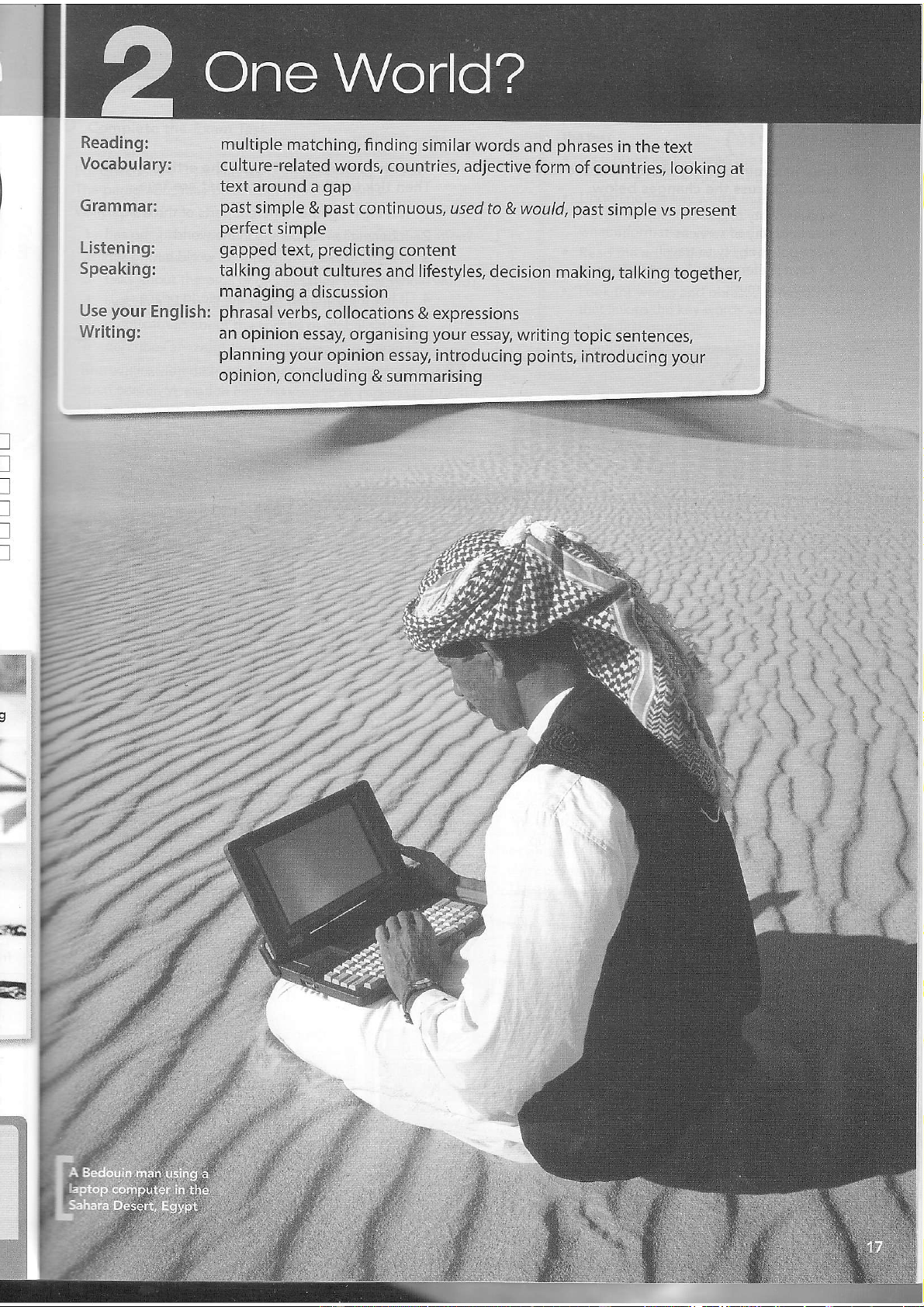
an
opinion
essa, organising your
essay,
writing topic
sentences,
planning
your
opinlon essay, introducing points,
introducing your
opinion, concluding
& summarising
I
:
:
.r
f
I
f
D
A How has
your country
changed
in the
last 50
years?
Discuss the changes
below.
.
availability
of
goods
.
availability
of services
.
people's ability to
travel
.
food
preferences
.
popular music
B
what is
globalisation?
Read the
article
quickly.
Then tick
(/)
the
sentences
that
are true.
1 lt brings
together
different
parts
of the
world.
!
2 lt benefits
every
person
in
the world
!
3 lt leads
to
people around the
world
having similar
experiences.
!
4 lt has
the
poteniial to create
world
peace.
!
Bomani Traore,
38, Malawi
Before
the factory
opened,
we could
barely
survive and
it
hurt me deeply
to see
my chi dren
hungry.
My home
had
a
small
garden where
my family
grew
some
vegetables
and
kept
a
few chickens
for eggs
and
a
goat
for milk,
but
it wasn't enough.
Our
lives
were extremely
difficult.
Sometimes,
months
would
pass
without any
rain and
the
plants
would die.
The village children
didn't
go
to school
h^..
'.^
tl-'^. h:r'l to
work
to help support
their
families. Without
education,
they
couldn't
improve
their
lives.
lt was an endless
circle of
poverty for
It0hrti$rtiill
lan 5nell,
z+, trngranq
GlobaLisation
can
be very beneficlal
for
some
people,
but
not for others.
lt has destroyed
my
communlty.
There
used to be
five factories
in
this town,
and they
were the biggest
source
of
emp
oyment for
miles around.
Then, one
by one,
they c
osed their doors
here and
moved to
countrles
where it is cheaper
to
produce
goods. As a
business
decision,
it makes
good
sense
-
they
can
pay a
worker
in
China
or India
less than
f1 an hour,
instead
of
f7 an hour
for a British
worker Once
their
products
have
been manufactured,
they
are shipped
back
to the UK and
sold here.
The factory
owners
make
bigger
profits
and
get
richer,
but the unemP
oyed
workers are
left with
no
jobs
and
no future.
There
are
many
towns like
that in the UK,
not
just
mine;
they are
depressing
places where the
people
have
given up
hope of ever
Livlng well.
E
our
people,
-nti
lhey
we e of ereo
ioos
^
a
.ed'by lown
A
M-
{^"^i^^
-^-n:nr;
n^^-ar'l r elnthinn {:.to.v fherF e few veaTs
!l
--l
foreign company
opened
a clothing
factory
there
a few
years
ago.
Now, we
are able to
look after
our families
and
send our
:
_
::
children
to schooL.
We used
to feel so
bad about
our lives,
but
::
-
:
now we are
happy.
-
::
l
.
..::..,
:,:-.:
.
.
C
Read
the Exam Close-up.
Then read the Exam lask
below
and underline
the kev woros.
Exam
up
Finding
similar words and
phrases
in
the text
.
lt's a good
idea to read the matching
questions
before you
read the article.
.
Underline
the key words in each
matching
question
so
you
understand
what information you
need to look for.
.
Read the article quicl{y
to
get
a
general
understanding of it.
.
Look
'or
words
and
pl^rases
in Lhe an cle
that link to the key words you
under ined
;n the first question.
.
Continue with the remaining questions
urtil you have
natched lhem al..
Word
Focus
source:the
place
something comes
from or starts at
profit:
money
earned after
paying
the cost of
producing
and selling
something
boundary: a real or imagined line
that
marks the edge
of something
tolerance: willingness
to accept beliefs
that are different to
your
own
lyrics:
the words to a song
rpr
t
D
Complete the
Exam Task.
Exam Task
:cr
questions
1
-
10,
choose from
paragraphs
(A
-
D).
-re
paragraphs
may be
chosen more than once.
,Vhich person
i
has
personal
experience
of the benefits of
globalisation?
I
2 does not want
to be
a
part
of a foreign culture?
f
3 talks about
the
pros
of g
obalisation for the whole wodd?
n
4
lived in a
place
where there were
many
jobs?
n
5 is
concerned about
the spread o{ globalisation?
tl
6
describes an event
that made a
positive
impact?
fl
7 mentions
the
gap
between
the wealthy and the
poor?
n
3 thinks
co-operation
between countries is
possible?
f]
9
talks
about a change in
a country's dietary
preferences?
f]
'C
says
people
shouldn't
be afraid of
g
obalisation?
f
Complete
the sentences
with the word given in the correct
form.
Use the
words in the
article to help
you.
1
Increasing
international
trade is very for a country.
(benefit)
2
What do the
young people
do in this town?
(ernploy)
3 The
mayor will
attend a
event at the museum tonight.
(culture)
4 Millions
of
people
around the world live in
conditions.
(poor)
5 Do you
think the
demonstration will
be orviolent?
(peace)
6 I love
Greek food; it's deliciousl
(tradition)
Kasumi
Ono,
75,
Japan
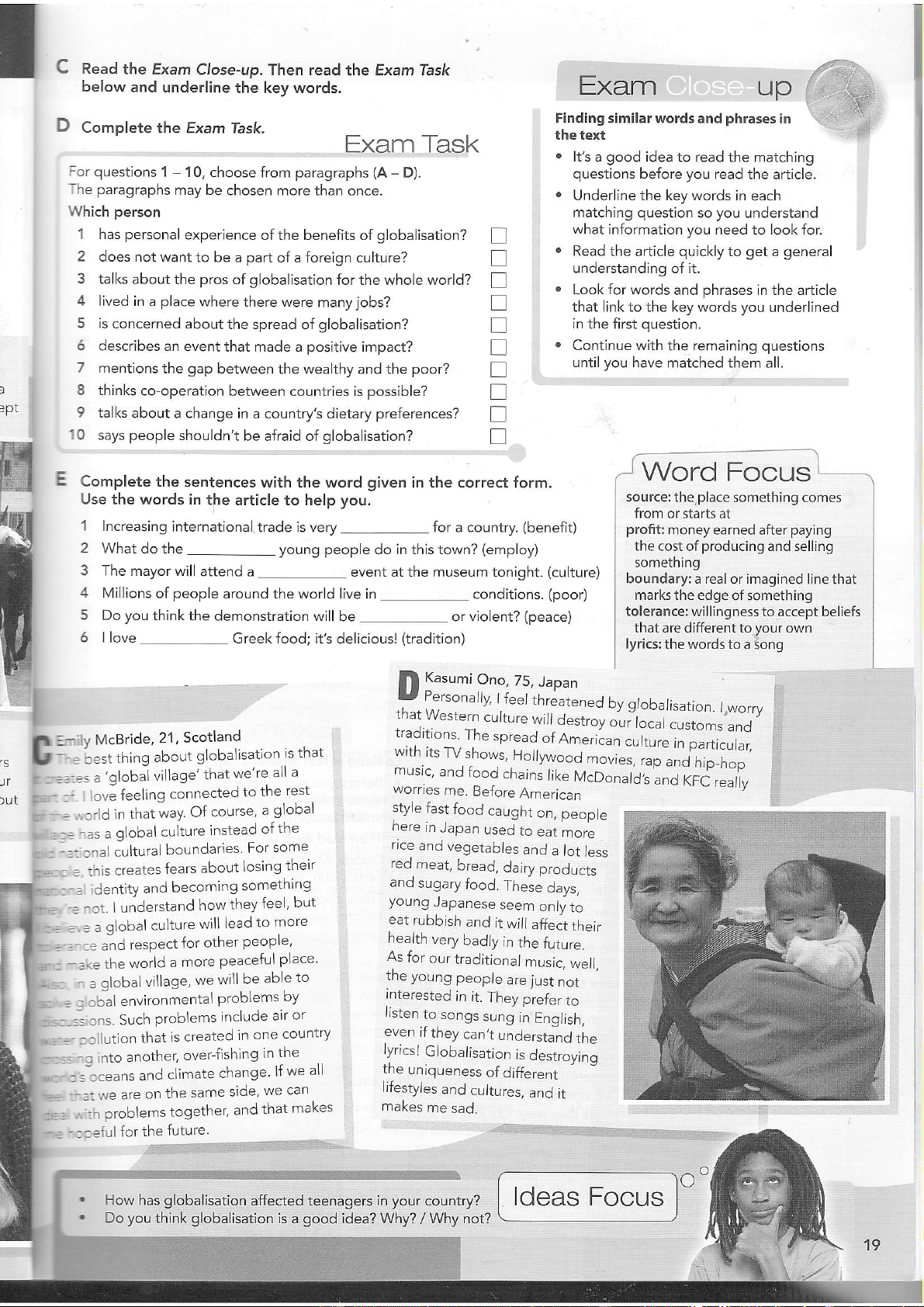
i^.,:X.1 I ]j::l lnreatened
by
slooarrsation. I
worry
's
JT
)ut
ft
--
,
McBride,2l,
Scotland
U
,
'r'n.J,bo-l
Iooa'"r'^'-
q"
..-:-'
:'global
village'
that
we're
aLl
a
:ve
{eeling
connected
to
the rest
-
:'d
in that
waY
O{
course,
a
global
:
-
-
::
a
global
culture
instead
of the
I:
:^:l
cultural
boundaries
For
some
.
-ls
creates
fears
about
losing
thelr
: .
:eniitv
and
becoming
something
:
-:r.
I understand
how
theY
feel'
but
.
.
: .
global
culture
will
lead
to
more
,
:: :nd
resPect
for
other
PeoPle'
:
.::he
world
a
rnore
Peacetul
P
ace
-
'
:lobal
village,
we
will
be
able
to
.
,
-c""1
.nuironm.ntal
problems
by
.-
,.
Su.
L
procr'o'r.
''l
'
ic
air o-
.
::
.riion
that
is
created
in
one
country
r
rto
anothet
over
fishing
in the
:
-
::eans
and
climate
change
lf
we
all
,
:
-
e are
on
the
same
side'
we
can
:- croblems
together,
and
that
makes
.
-
::--11
for
the
future'
ln"lW*a":
culture
wili
destroy
our
loca/
customs
and
traditions.,The
spread
of
American
.rltrr.
in purti.ulul
wrth
its
TV
shows,
Ho/lywood
movi
music,
and
rood
.n,i"l
l,r.
,.i.""";;Tltr?if;3"1i,
worries
me.
Before
America
n
style
last
food
caught
on,
people
nere
ln
Japan
used
to
eat
mor-^
nce
and
vegetables
and
a
lot
Jess
reo,
meat,
bread,
dairy
products
ano
sugary
tood.
These
days,
young
Japanese
seem
oniy
to
eat
r!bbish
and
it
will
affect
their
heaith
very
badly
in
the
future
As
for
our
traditionai
music,
well,
rne young
people
are
just
not
rnterested
in
it.
They
prefer
to
rsren
to
songs
sung
in
English,
even
rT
they
can,t
understand
the
lyrics!
G lobalisation
is
destrovinq
the
uniqueness
of
different
iilestyles
and
cultures,
and
it
makes
me
sad.
How has
globalisation
affected teenagers in
your
country?
Do you
think globalisation
is a
good
idea? Why?
/
Why not?
ldeas Focus
't9
A Circle
the odd
ones
out.
'l
global
2 culture
J DEIIET
4 aspect
5
expand
6
exchange
B Complete
the
word
groups
with
the
countries
they
are
associated
with'
Brazit
China
Egypt
The Nethertands
America
India
Sweden
Switzertand
desert,
pyramids,
international
knowreoge
event
extend
provide
tocal
lifestyle
experience
occurrence
demand
swap
universal
socrety
idea
phenomenon
spread
trade
1 snow,
reindeer,
2
canals,
bicycles,
5
6
7
8
watches,
mountalns,
spices,
tea,
highways,
cars,
C
Complete
the
sentences
with
the
adjective
form
of
the
countries
in B'
1
4
6
7
8
fhere
are
hundreds
o{
d,ive-rnrough
fast-{ooo
restaJranls
'1
You
can see
pretty windmills
in
the
countryside.
The
museum
is
famous
for
its collection
of
mummleS.
Many
cheap
goods
a"e
row
availab'e
all
over
t
he ciry
llove
cuisine,
but
some
dishes
are
very
hot!
people love
skiing
and
dog
sledding.
They say
he's
got
a
secret
bank
account!
The
most successful
national
football
team
is the
D Read
the
Exam
Close-up.
Then
complete
the
Exam
Task' Use
the
words
below
to
help
you'
civilisations
customs
export
hometands
influence
networks
ports roadwayg
Exam
Looking
at
text around
a
gaP
.
Before
you complete
a
gaPPed
text,
quickly read
the
whole
text
first
for
general
understanding.
3
bamboo,
pandas,
4 dancing,
beaches,
(1)
import
and
(3)
and
(4)
cities.
Exam
Task
For
questions
1
-
8, read
the
text
below
and
think
of a
word
which
best
fits
each
gap Use
only
one
word
in each
gap
The beginning
of
international
trade
ln ancient
times,
there
were
no
proper
in order
to
rest, or
to transfer
the
goods they
were
carrylng
to shlps'
Many Greek
and
Roman
towns
were
founded
this
way, expanding
their
(5)
-
\,ntil
lheir
(61
was
felt in
Airica and
Asia.
And
in
each
of these
places, foreign
traders
shared
stories
and
(7)
from
their
(8)
teaving
more
than
just
their
spices,
textiles
or
pottery behind'
20
I
*,,,,,
'r
'
Then
read
each
sentence
with a
gap carefully'
Decide
which
type
of word
is missing
(adjective,
verb,
noun,
etc.)
Think
about
what each
gapped
sentence
means
before
you choose
a
word
which
fits
in the
gap'
ooods
from
one
place
to
another
was on
water'
For
this
ieason,
the
{irst and
most
extensive
trade
e)
-were
rrvers
like
the
Nile
in Egypt,
the
Tigris and
the
Euphrates
in
present-day
lraq and
the
Yellow
River
in
China
Cities
were built
by
those
rivers
and
grew rich
by
using
the
rivers
for
the
so the
most
efficient
way to
transpoft
of
goods.
appeared
wherever
the
caravans
stopped
-lraoe
routes
over
land,
conducteo
by
ca'avars,
deveroped
in lhe
severtl-
and
eighth
centuries
after
camels
were
dorresricared
Towrs
Bedouin
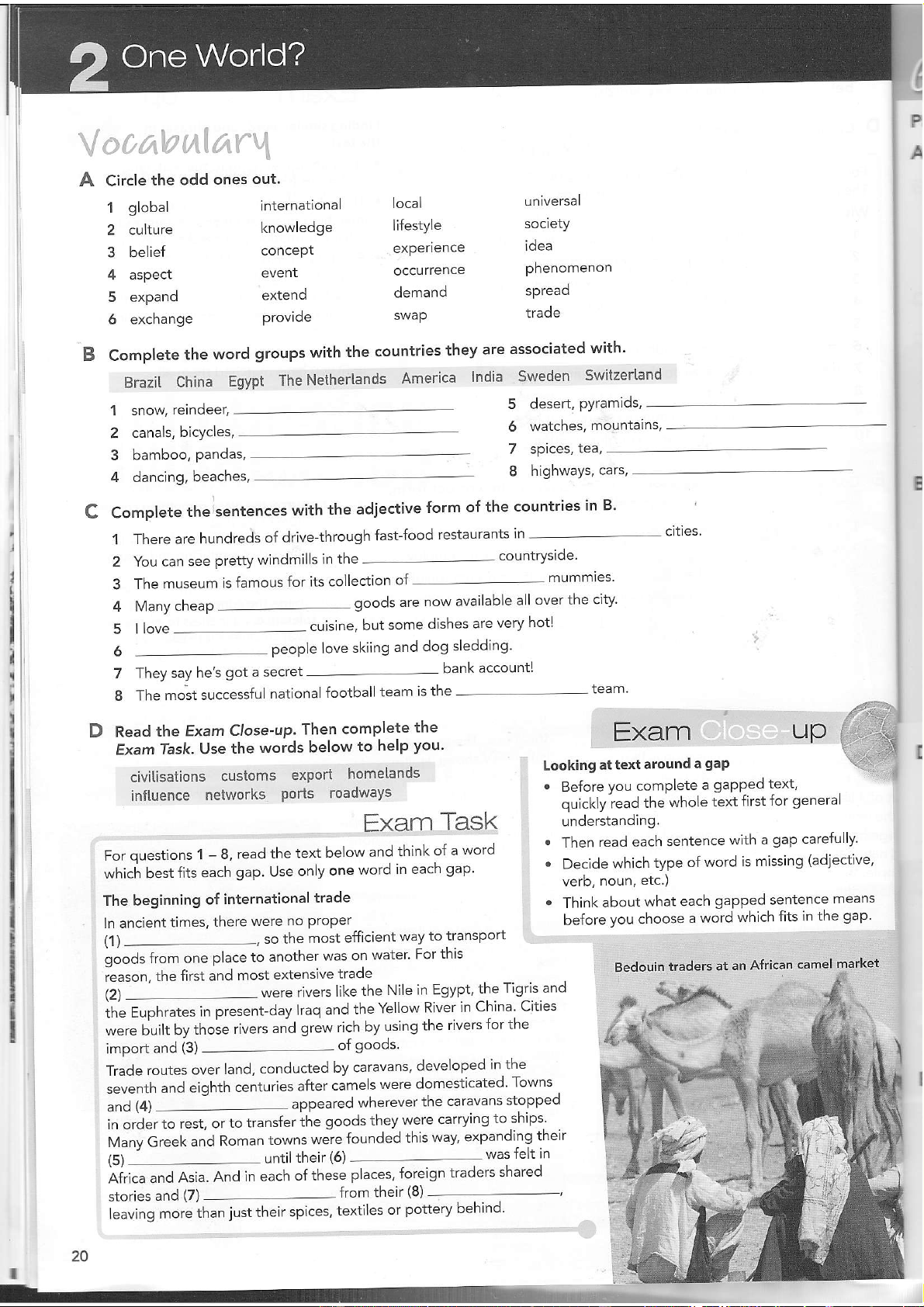
traders
at
an
African
camel
market
it
t'l
?ast
Sinnpie
& Fast
eontinuous
A
Read
sentences 1-9
below. Underline the sentences that
use the
Past Simple
and circle the sentences that use the
Past
Continuous.
'1
As soon
as the
plane
landed,
Ted switched on his mobile and
checked
his emails.
2 lh^ vil
age r oe elected
a
-en
Ll- er
eve
y yedr.
3 My cousin
was working
as a history teacher at the time.
4
t was
a beautiful day; the
sun
was
shining and the birds
were singing.
5 The
Romans
conquered Britain and
other
areas.
6 | was
reading
the recipe when I spjlt the hot mi k.
7 At
ten o'c ock last
night, I was watching a fi m about the Persians.
8 We were
very tired
after the conceft.
9 While
Josh was reading
an artic e about
globalisation,
Tina was
sleeping
on the
sofa.
B
Write Past
Simple or Past
Continuous above each set of uses.
1
Used
fo & kVoufd
W. ut.
used to for states, habits
and repeated
actions in the
past.
We use would for habits
ano
repeated
actions
in
the
past,
but
we do not use it
for
past
states.
Read the
sentences below and
decide which
one is wrong. Why is
it wrong?
Jim liked
traditiona dancing when he
was
younger.
J r would iike
r.ad r ona oar.ing
wnen ne was
younger.
Jir used to like
tradit
or
al darc'r
g
when he was
younger.
\i
i\ti)l'i' \'t'
2
for a comp
eted action in the
past
for past
habits
and routines
for
past
states
for comp eted
actions that happened
one after the other in the
past
for
an action in progress
at a
particulaI
mornent
in the
past
for
a longer action
that was interrupted by a shorter action
fo'two
o
'no
e
lorge
ac ior: happ^ripg ar r.F sare t'na
fo'teloora y
sitLdtio'ts
I the
past
to
provide
background
information in a story
R
I
Complete the
text with
the Past Simple or the Past Continuous
of
the verbs in brackets.
There
(1)
(be)
many
similarities between the
c,"salions of Ve.ooold-
d
a^o
tgyp-.
Borr
we
e cf i- cu ru.e aro
\2)
(contrlbute)
to the development of other civilrsat ons
ln
the east and the
west. They were
both
(3)
iorms
of writing with picture
symbols
which they
were
mainly
4\
Irse'
ro I'eeo reco-ds ir palaces
a^o orrer
government
centres.
Both civilisations
(5) (establish)
rhemselves a ong famous
rivers
-
while
the cities and towns o{
Mesopotamia
(6)
(spring
up)
between the
Tigris
and the
Euphrates,
Egyptian
civilisation
was
(7) (deve
op) a ong the Nile.
Due
to their
positions
on waterways,
they
were
ab e to trade and they
i8)
(become)
wea
thy. Also, both civilisations were
i9)
(come
up
with)
new ways of farming to handle the
regular
floods from
the rivers. These
deve opments
in
trade and agriculture
{10)
(
ead)
to
incredible
cultural advancement.
Look
at the
sentences. Which verb forms are incorrect?
1 Whi
ethearl^aeologist
d,.rg
-.hedese
r a'ardso'nbegar.
2 Be
a tried to
paint
a
portrait,
but she didn't know what she was
dorng.
3 They
were discovering
the ruins of the dnclent temp e a century
ago.
4 The
chi dren would
always
get
excited when we wentto museums-
5 Did yau
used to /isten
to
jazz
with
your grandfather?
1
i
--
j!=,f
I t1!,11 ;l
'Ll
r-lrr ll
)'
A
%fr?,ill
Read
the sentences
below
and
discuss
with
a
partner
what kind
of
words
(e.g.
verb, noun,
adjective,
etc')
can
go in the
gaps' Then
listen
to
see if
you were
correct.
'l
You should
go
to lVuseum
lsland
if
you are
on
a tour
of
-
2 The
island
has made
a name
for
itsel{
as a
-
centre
in Berlin'
3 Museum
lsland houses
-
museums.
4 These
impressive
buildings
were built
between
-
and
-
5 In
1999.
the island
-
a UNESCO
World
Heritage
Site
B
f.r-
Now
listen
again
and
complete
the
sentences.
EXam
Up
ffi&
C
nead the
Exam
close-upand
underline
the
key
words
in
Predicting
content
,
"-WI
B
c
E
the
Exam
Task
below.
'
Look at
the
gaps and
try
to
predict
what
kind of
word
is missing
-
a verb,
a
noun,
an
D
iL?ili-l
Now
complete
the
Exam
Task.
adjective'
an adverb'
a date'
a
name'
etc'
.
Read
the
gapped
sentences
and
underline
ExamTask
;;["vi'J;i
F;isupp.J."nt"n."',tt.
^ ^.
,r+,,"-r {^-+i,,-r
key words
are
usu;lly
just
before
or
right
You will
hear
part of a
radio
report
about
a cultural
festival
Ncv vvv'vJ
o'e
q'
For
questions
1
-
8, complete
the
sentences
with
a word
or
after
the
gap
short
phrase.
1
The speaker
says
foreign
travel
and
modern
technology
play an
-
in spreading
news about
other
places.
2
The Berlin
Long
Night
dates
back
to
-'
3
The Berlin
event
takes
place twice
yearly
-
in
-
and
-'
4 You can
buy
a
-
for The
Long
Night
for
only
€1
5'
5 Aswell
as
visiting
museums,
you can
also
goto concerts,
-orfilm
viewings'
6 The
Long
Night
is now
a
-
in many
major
cities
worldwide'
7|nSaintPetersburg,theyho|dthe-everyyeartoce|ebratethe|ongsummernights'
I In
mid-June
the
daylight
finally
disappears
at
-'
E
'ffiHE
Listen
again
and
check
your answers'
A
B
:'t'
tt...::t)ti:it::
1:')
Work
with a
partner
and answer
these
questions.
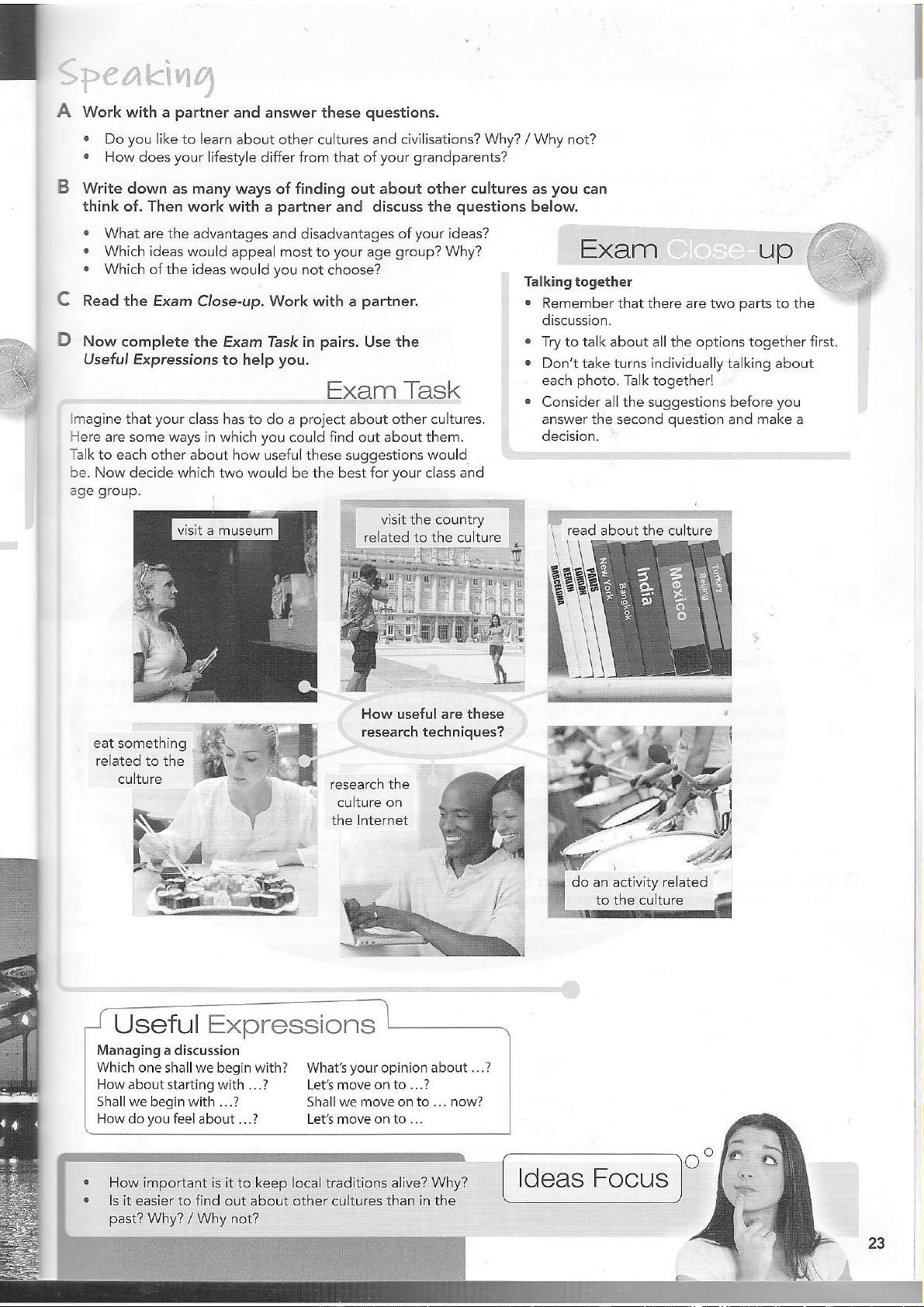
.
Do
you
like to learn
about other cultures and civilisations?
Why?
/ Why not?
.
How does
your
lifestyle
differ from that ofyour
grandparents?
Write down as many
ways of finding out about
other cultures
as
you
can
think of. Then work with
a
partner
and discuss
the
questions
below.
.
What are the advantages
and disadvantages
of
your
ideas?
.
Which ideas would
appeal most to
your
age
group?
Why?
.
Which ofthe ideas would
you
not choose?
Read the Exam
Close-up, Work with a
partner.
Now
complete the Exam Task in
pairs.
Use the
Useful Expressions to help
you.
up
Talking together
.
Remember that there are two
parts
to the
discussion.
Try
to talk about all the options together
first.
Don'L Lake Lurns individually talking abouL
each
photo.
Talk together!
Consider all the suggestions before
you
answer the second
question
and nake a
decision.
Exam
D
Exam Task
lmagine that your
class has to do a
project
about other cultures.
Here are
some ways in which
you
could find out about them.
Talk to each
other about how useful these suggestions would
be. Now
decide which two would be the best for
your
class and
a9e
group.
How useful are these
research techniques?
eat something
related to the
culture
research the
culture on
the lnternet
Useful
Exoressions
Managing a discussion
Which
one shall we begin with? What's
your
opinion about ...?
Howaboutstartingwith...?
Let's move on to
...?
Shall we begin with ...? Shall we move on to ... now?
How
do
you
feelabout...? Let's move on to , . .
How important is it
to
keep local
traditions
alive? Why?
ls it easier to find
out about other cultures
than in the
past?
Why?
/
Why not?
ldeas Focus
$ga:tv'nbvrarr
actron that
past.
When
1
4
5
o
Sorry, Mum.
I
Since I
'':i
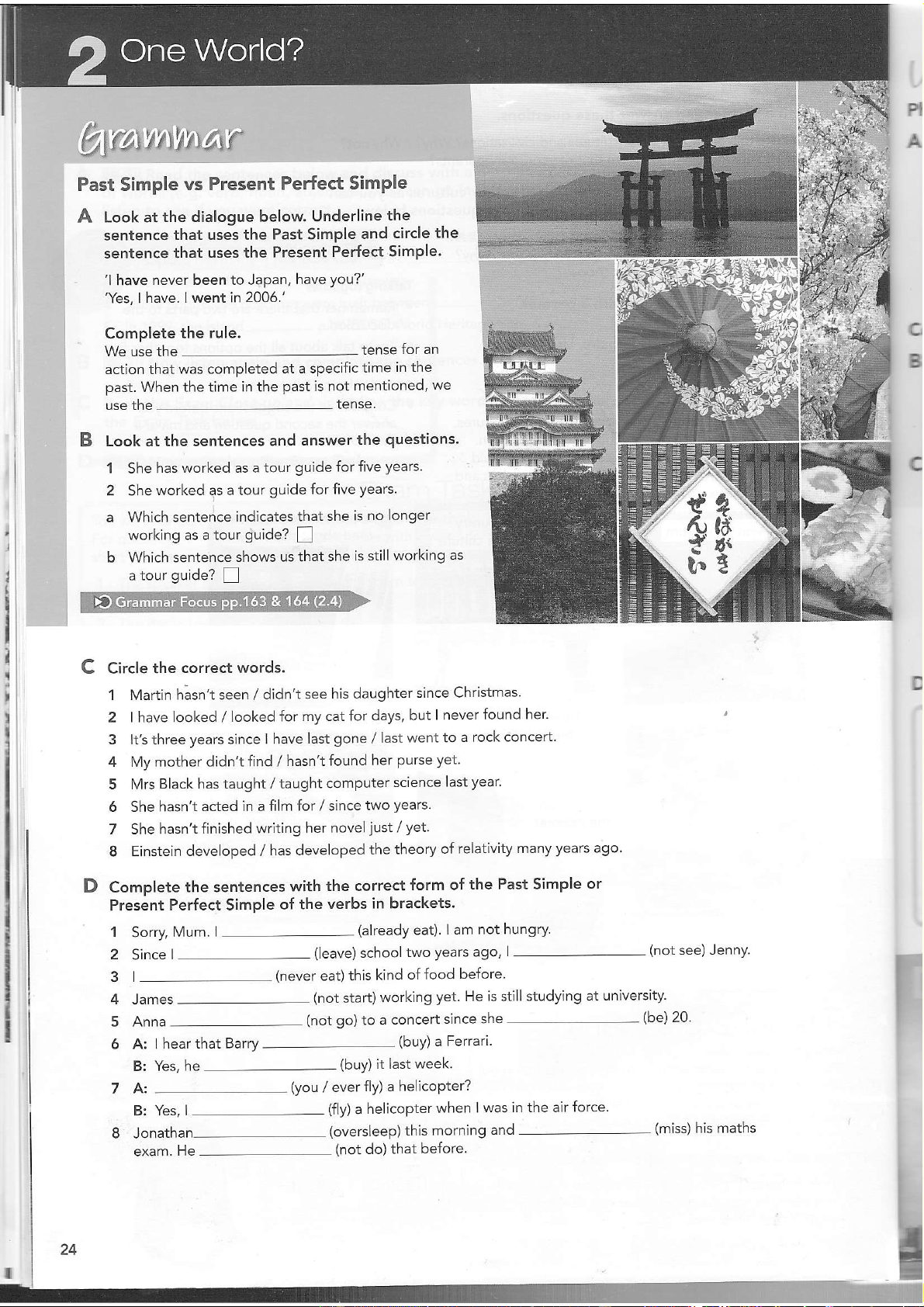
Past Simple
vs Present
Perfect
Simple
A Look
at the dialogue
below- Underline
the
sentence
that uses the
Past Simple
and
circle
the
sentence
that uses the
Present
Perfect
Simple.
'l
have
never been to Japan,
have
you?'
'Yes,
I have. lwent
in 2006.'
Complete
We use the
the
rule.
tense
for an
was completed
at a specific
time
in the
the time in the
past
is not
mentioned,
we
use the
tense.
Look at the
sentences and
answer
the
questions.
'l
She
has worked as a tour
guide for five
years.
2 She
worked as a tour
guide for five
years.
a Which sentence
indicates
that she
is no longer
working as a tour
guide?
[
b Which sentence
shows us
that she
is still
working as
a tour
guide?
!
C Circle
the correct
words.
1 lMartin hasn't seen /
didn't
see his daughter
since Christmas.
2 | have looked /
looked for
my cat for
days,
but I never
found her.
3 lt's three
years
since I have
last
gone
/
ast
went to
a rock
concert
4 My mother
didn't find /
hasn't
found her
purse yet.
5 Mrs
Black has taJgnt /
laught compurer
scierce
last
year.
6 She
hasn't acted in a
film for / since
two
years.
7 She
hasn't finished
writing her
noveljust /
yet.
8
Einstein developed /
has developed
the theory
of relativity
many
years
ago'
D Complete
the sentences
with the correct
form of
the Past Simple
or
Present Perfect Simple
of the
verbs
in brackets'
(already
eat).
lam not
hungry.
B
=
E
(leave)
school
two
years ago,
I
(not
see) Jenny.
(never
eat)
this kind
of food
before
J ames
(not
start)
working
yet. He
is still studying at
university.
Anna
(not
9o)
to a
concert
since
she
(be)
20.
A: I
hear that Barry
(buy)
a Ferrari.
(buy)
it last
week.
(you
/
ever
fly) a
he icoPter?
(fly)
a helicopter
when I
was in the air
force.
g
Jonathan-
(oversleep)
this
morning
and
(miss)
his maths
exam.
|-le
(not
do) that
before.
g
24