Second_Language_Learning_Theories_----_(1_Second_language_learning_key_concepts_and_issues)pdf
Những vấn đề đang được cập nhật trong giảng dạy tiếng Anh như ngôn ngữ thứ 2
Môn: Tiếng anh cơ bản(TA) 73 tài liệu
Trường: Trường Đại học Sư Phạm Hà Nội 3.9 K tài liệu
Tác giả:




















Preview text:
Copyright © 2013. Routledge. All rights reserved.
Ebook pages 20-46 | Printed page 1 of 28
1 Second language learning: key concepts and issues 1.1 Introduction
This preparatory chapter provides an overview of key concepts and issues which will recur throughout
the book. We offer introductory definitions of a range of terms, and try to equip the reader with the
means to compare the goals and claims of particular theories with one another. We also summarize key
issues, and indicate where they will be explored in more detail later in the book.
The main themes to be dealt with in the following sections are:
1.2 What makes for a ‘good’ explanation or theory?
1.3 Views on the nature of language
1.4 Views of the language learning process
1.5 Views of the language learner
1.6 Links between language learning theory and social practice.
First, however, we must offer a preliminary definition of our most basic concept, ‘second language
learning’. We define this broadly, to include the learning of any language, to any level, provided only
that the learning of the ‘second’ language takes place sometime later than the acquisition of the first language.
Simultaneous infant bilingualism is a specialist topic, with its own literature, which we do not try to
address in this book. For overviews see Döpke (2000), relevant sections in Bhatia and Ritchie (2004)
and Müller (2009). However, we do take some account of growing research interest in interactions and
mutual influences between ‘first’ languages and later-acquired ‘second’ languages, surveyed for
example in Cook (2003) and Pavlenko (2011); aspects of this work are discussed in some later chapters.
For us, therefore, ‘second languages’ are any languages learned later than in earliest childhood. They
may indeed be the second language the learner is working with, in a literal sense, or they may be his/her
third, fourth, fifth language … They encompass both languages of wider communication encountered
Mitchell, Rosamond, et al. Second Language Learning Theories, Routledge, 2013. ProQuest Ebook Central, http://ebookcentral.proquest.com/lib/flinders/detail.action?docID=1356341.
Created from flinders on 2025-08-15 16:50:56.
Copyright © 2013. Routledge. All rights reserved.
Ebook pages 20-46 | Printed page 2 of 28
within the local region or community (for example, in educational institutions, at the work place, or in
the media), and truly foreign languages, which have no substantial local uses or numbers of speakers.
We include ‘foreign’ languages under our more general term of ‘second’ languages because we believe
that the underlying learning processes are essentially the same for more local and for more remote target
languages, despite differing learning purposes and circumstances. (And, of course, such languages today
are likely to be increasingly accessible via the internet, a means of communication which self-evidently
cuts across any simple ‘local’/‘foreign’ distinction.)
We are also interested in all kinds of learning, whether formal, planned and systematic (as in classroom-
based learning), or informal and unstructured (as when a new language is ‘picked up’ in the community
or via the internet). Following the proposals of Stephen Krashen (1981), some second language
researchers have made a principled terminological distinction between formal, conscious learning and
informal, unconscious acquisition. Krashen's distinctive ‘Acquisition-Learning’ Hypothesis is discussed
further in Chapter 2; however, most researchers in the field do not sustain any principled distinction
between the two terms. Unless specially indicated therefore, we ourselves will be using both terms
interchangeably. (And in Chapters 4 and , where the distinction between conscious and unconscious 5
learning is central, we will use the terms ‘implicit’ and ‘explicit’ learning to distinguish the two.)
1.2 What makes for a good theory?
Second language learning is an immensely complex phenomenon. Millions of human beings have
experience of second language learning, and may have a good practical understanding of the activities
which helped them to learn. But this practical experience, and the common-sense knowledge which it
leads to, are clearly not enough to help us understand the process fully. We know, for a start, that people
cannot reliably describe the language system which they have somehow internalized, nor the inner
mechanisms which process, store and retrieve many aspects of that new language.
We need to understand second language learning better than we do, for two basic reasons:
(a) Improved knowledge in this particular domain is interesting in itself, and can also contribute to
more general understanding about the nature of language, of human learning, and of intercultural
communication, and thus about the human mind itself, as well as how all these are interrelated and affect each other.
(b) The knowledge will be useful; if we become better at explaining the learning process, and are better
able to account for both success and failure in L2 learning, there will be a payoff for millions of
teachers, and tens of millions of students and other learners, who are struggling with the task.
Mitchell, Rosamond, et al. Second Language Learning Theories, Routledge, 2013. ProQuest Ebook Central, http://ebookcentral.proquest.com/lib/flinders/detail.action?docID=1356341.
Created from flinders on 2025-08-15 16:50:56.
Copyright © 2013. Routledge. All rights reserved.
Ebook pages 20-46 | Printed page 3 of 28
We can only pursue a better understanding of L2 learning in an organized and productive way if our
efforts are guided by some form of theory. For our purposes, a theory is a more or less abstract set of
claims about the entities which are significant within the phenomenon under study, the relationships
which exist between them, and the processes which bring about change. Thus a theory aims not just at
description, but at explanation. Theories may be embryonic and restricted in scope, or more elaborate,
explicit and comprehensive. They may deal with different areas of interest; thus a property theory will
be primarily concerned with modelling the nature of the language system which is to be acquired, while
a transition theory will be primarily concerned with modelling the change/developmental processes of
language acquisition (Gregg, 2003b; Jordan, 2004, Chapter 5). (A particular transition theory for L2
learning may itself deal only with a particular stage or phase of learning or with the learning of some
particular sub-aspect of language; or it may propose learning mechanisms which are much more general
in scope.) Worthwhile theories are collaboratively produced, and evolve through a process of systematic
enquiry, in which the claims of the theory are assessed against some kind of evidence or data. This may
take place through a process of hypothesis-testing through formal experiment, or through more
ecological procedures, where naturally occurring data is analysed and interpreted. (There are now many
manuals offering guidance on SLL research methods in both traditions; for example, Mackey and Gass,
2012. We will provide basic introductions to a range of research procedures as needed, throughout the
book, and also in the glossary.) Finally, the process of theory building is a reflexive one; new
developments in the theory lead to the need to collect new information and explore different phenomena
and different patterns in the potentially infinite world of ‘facts’ and data. Puzzling ‘facts’, and patterns
which fail to ft in with expectations, in turn lead to new, more powerful theoretical insights.
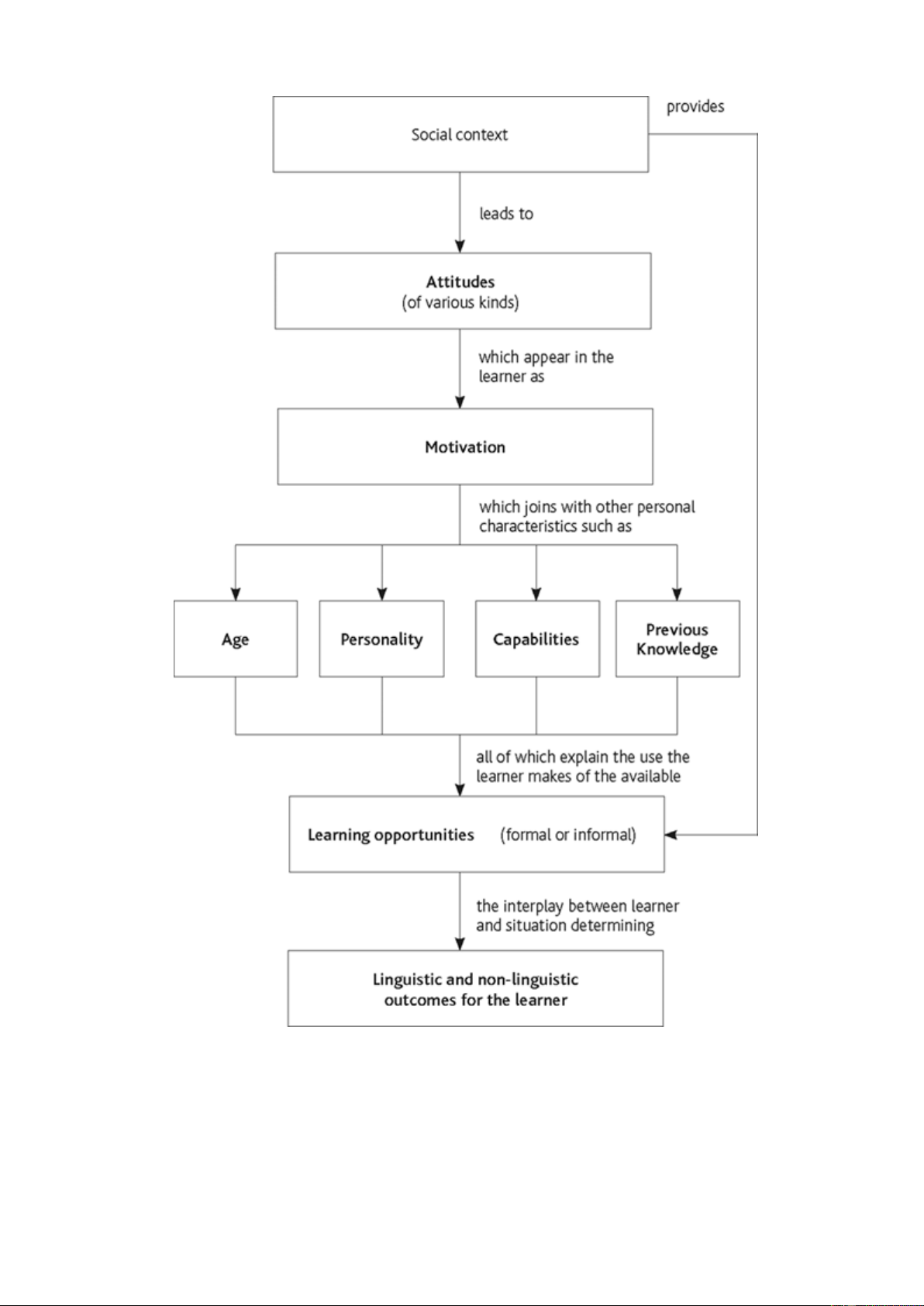
To make these ideas more concrete, an early ‘model’ of second language learning is shown in Figure 1.1
, taken from Spolsky, 1989, p. 28.
This model represents a ‘general theory of second language learning’, as the proposer describes it
(Spolsky, 1989, p. 14). The model encapsulates this researcher's theoretical views on the overall
relationship between contextual factors, individual learner differences, learning opportunities and
learning outcomes. It is thus an ambitious model in the breadth of phenomena it is trying to explain. The
rectangular boxes show the factors (or variables) which the researcher believes are most significant for
learning, that is, where variation can lead to differences in success or failure. The arrows connecting the
various boxes show directions of influence. The contents of the various boxes are defined at great length
Mitchell, Rosamond, et al. Second Language Learning Theories, Routledge, 2013. ProQuest Ebook Central, http://ebookcentral.proquest.com/lib/flinders/detail.action?docID=1356341.
Created from flinders on 2025-08-15 16:50:56.
Copyright © 2013. Routledge. All rights reserved.
Ebook pages 20-46 | Printed page 4 of 28
as consisting of clusters of interacting ‘Conditions’ (74 in all: 1989, pp. 16–25), which make language
learning success more or less likely. These summarize the results of a great variety of empirical language
learning research, as Spolsky interprets them.
How would we begin to ‘evaluate’ this or any other model, or even more modestly, to decide that this
was a view of the language learning process with which we felt comfortable and within which we
wanted to work? This would depend partly on the extent to which the author seems to have taken
account of empirical evidence available in the field, and provided a synthetic account of
Mitchell, Rosamond, et al. Second Language Learning Theories, Routledge, 2013. ProQuest Ebook Central, http://ebookcentral.proquest.com/lib/flinders/detail.action?docID=1356341.
Created from flinders on 2025-08-15 16:50:56.
Copyright © 2013. Routledge. All rights reserved.
Ebook pages 20-46 | Printed page 5 of 28
Figure 1.1 Spolsky's General Model of Second Language Learning (source: Spolsky, 1989, p. 28)
it. It would also depend on rather broader philosophical positions: for example are we satisfied with an
account of human learning which sees individual differences as both relatively fixed, and also highly
influential for learning? Finally, it would also depend on the particular focus of our own interests within
Mitchell, Rosamond, et al. Second Language Learning Theories, Routledge, 2013. ProQuest Ebook Central, http://ebookcentral.proquest.com/lib/flinders/detail.action?docID=1356341.
Created from flinders on 2025-08-15 16:50:56.
Copyright © 2013. Routledge. All rights reserved.
Ebook pages 20-46 | Printed page 6 of 28
second language learning; this particular model seems well adapted for the study of the individual
learner, for example, but has relatively little to say about the social relationships in which they engage,
the way they process new language, nor the kinds of language system they construct.
Since the mid-1990s, there has been increasing debate about the adequacy of the theoretical frameworks
used to underpin research on second language learning. One main line of criticism has been that SLL
research and theorizing (as exemplified by Spolsky, 1989) has historically been too preoccupied with the
cognition of the individual learner, and sociocultural dimensions of learning have been neglected. From
this perspective language is an essentially social phenomenon, and second language learning itself is a
‘social accomplishment’, which is ‘situated in social interaction’ (Firth and Wagner, 2007, p. 807), and
discoverable through scrutiny of second language use, using techniques such as conversation analysis
(Pekarek Doehler, 2010; Kasper and Wagner, 2011). A second – though not unrelated – debate has
concerned the extent to which SLL theorizing has become too broad. Long (1993) and others argued that
‘normal science’ advanced through competition between a limited number of theories, and that the SLL
field was weakened by theory proliferation. This received a vigorous riposte from Lantolf (1996) among
others, advancing the postmodern view that knowledge claims are a matter of discourses, which ‘cannot
be extralinguistically described’ (Lantolf, 1996, p. 734). From this point of view, all scientific theories
are merely ‘metaphors that have achieved the status of acceptance by a group of people we refer to as
scientists’ (p. 721), and scientific theory building is all about ‘taking metaphors seriously’ (p. 723). For
Lantolf, any reduction in the number of ‘official metaphors’ debated could ‘sufocate’ those espousing different world views.
These debates about the nature of knowledge, theory and explanation in second language learning have
persisted up to the present. It is probably fair to say that the majority of SLL researchers today adopt
some version of a ‘realist’ or ‘rationalist’ position (Jordan, 2004; Sealey and Carter, 2004; Long, 2007),
grounded in the philosophical view that an objective and knowable world exists (that is, not only
discourses), and that it is possible to build and test successively more powerful explanations of how that
world works, through systematic programmes of inquiry and of problem-solving, and this is the position
taken in this book. However, like others such as Jordan (2004) and Ortega (2011), we acknowledge that
a proliferation of theories is necessary and desirable to make better sense of the varied phenomena of
SLL, the agency of language learners, and the contexts and communities of practice in which they
operate. We believe that our understanding advances best where theories are freely debated and
challenged among a community of scholars. As later chapters show, we accommodate a range of
linguistic, cognitive, sociocultural and poststructuralist perspectives in our overall review. But whatever
the particular focus of a given theory, we would expect to find the following:
Mitchell, Rosamond, et al. Second Language Learning Theories, Routledge, 2013. ProQuest Ebook Central, http://ebookcentral.proquest.com/lib/flinders/detail.action?docID=1356341.
Created from flinders on 2025-08-15 16:50:56.
Copyright © 2013. Routledge. All rights reserved.
Ebook pages 20-46 | Printed page 7 of 28 1.
Clear and explicit statements of the ground the theory is supposed to cover, and the claims which it is making. 2.
Systematic procedures for confirming/disconfirming the theory, through data gathering and
interpretation: the claims of a good theory must be testable/falsifiable in some way. 3.
Not only descriptions of L2 phenomena, but attempts to explain why they are so, and to propose mechanisms for change. 4.
Last but not least, engagement with other theories in the field, and serious attempts to account for at
least some of the phenomena which are ‘common ground’ in ongoing public discussion (Long,
1990; VanPatten and Williams, 2007). Remaining sections of this chapter offer a preliminary overview of numbers of these.
(For fuller discussion of rationalist evaluation criteria, see Gregg, 2003a; Jordan, 2004, pp. 87–122;
Sealey and Carter, 2004, pp. 85–106; and for a postmodern perspective on theory evaluation, see Lantolf, 1996, pp. 730–5.)
1.3 Views on the nature of language
1.3.1 Levels of language
Linguists have traditionally viewed language as a complex communication system which must be
analysed on a number of levels: phonology, syntax, morphology, lexis, semantics, pragmatics,
(Readers unsure about this basic descriptive terminology will find help from the glossary, and discourse.
in more depth from an introductory linguistics text, such as Fromkin et al., 2010.) They have differed
about the degree of separateness/integration of these levels; for example, while Chomsky, for example,
argued at one time that ‘grammar is autonomous and independent of meaning’ (1957, p. 17), another
tradition initiated by the British linguist Firth claims that ‘there is no boundary between lexis and
grammar: lexis and grammar are interdependent’ (Stubbs, 1996, p. 36). In examining different
perspectives on second language learning, we will first of all be looking at the levels of language which
they attempt to take into account. (Does language learning start with words, or with discourse?) We will
also examine the degree of integration/separation which they assume, across the various levels. We will
find that the control of syntax and morphology is commonly seen as somehow ‘central’ to language
learning, and that most general SLL theories try to account for development in this area. Other levels of
language receive much more variable attention, and some areas are commonly treated in a semi-
Mitchell, Rosamond, et al. Second Language Learning Theories, Routledge, 2013. ProQuest Ebook Central, http://ebookcentral.proquest.com/lib/flinders/detail.action?docID=1356341.
Created from flinders on 2025-08-15 16:50:56.
Copyright © 2013. Routledge. All rights reserved.
Ebook pages 20-46 | Printed page 8 of 28
autonomous way, as specialist fields. This is often true for SLL-oriented studies of pragmatics, lexical
development and phonology for example: see Kasper and Rose (2002), Kasper (2009) or Bardovi-Harlig
(2012) on pragmatics; Daller et al. (2007), Juffs (2009), Elgort and Nation (2010) or Laufer and Nation
(2012) on vocabulary; Archibald (1998, 2005), Hansen (2006) or Moyer (2007) on phonology.
1.3.2 Competence and performance
Throughout the twentieth century, linguists also disagreed in other ways over their main focus of interest
and of study. Should this be the collection and analysis of actual attested samples of language in use, for
example by recording and analysing peoples' speech? The structuralist linguistics tradition of the early
twentieth century leaned towards this view. Or, should it be to theorize underlying principles and rules
which govern language behaviour, in its potentially infinite variety? The linguist Noam Chomsky has
famously argued that it is the business of theoretical linguistics to study and model underlying language
competence, rather than the performance data of actual utterances which people have produced
(Chomsky, 1965). By competence, Chomsky is referring to the abstract and hidden representation of
language knowledge held inside our minds, with its potential to create and understand original utterances
in a given language. As we shall see in Chapter 3, this view has been influential in much second language learning research.
However, for linguists committed to this dualist position, there are difficulties in studying competence.
Language performance data is believed to be an imperfect refection of competence, partly because of the
processing complications which are involved in speaking or other forms of language production, and
which lead to errors and slips. More importantly, it is believed that in principle, the infinite creativity of
the underlying system can never adequately be reflected in a finite data sample (for example, see
Chomsky, 1965, p. 18). Strictly speaking, many researchers who set out to study language competence
believe it can be accessed only indirectly, and under controlled conditions, through tasks such as
sentence-completion, eye-tracking or grammaticality judgement tests (roughly, when people are
offered sample sentences, which are in (dis)agreement with the rules proposed for the underlying
competence, and invited to say whether they think they are grammatical or not: Sorace, 1996; Ionin, 2012).
This split between competence and performance has never been universally accepted, however, with, for
example, linguists in the British tradition of Firth and Halliday arguing for radically different models in
which this distinction between competence and performance does not appear. Firth himself described
such dualisms as ‘a quite unnecessary nuisance’ (Firth, 1957, p. 2n, quoted in Stubbs, 1996, p. 44). In
Mitchell, Rosamond, et al. Second Language Learning Theories, Routledge, 2013. ProQuest Ebook Central, http://ebookcentral.proquest.com/lib/flinders/detail.action?docID=1356341.
Created from flinders on 2025-08-15 16:50:56.
Copyright © 2013. Routledge. All rights reserved.
Ebook pages 20-46 | Printed page 9 of 28
the Firthian view, the only option for linguists is to study language in use, and there is no opposition
between language as system and observed instances of language behaviour; the only difference is one of perspective.
Of course, the abstract language system cannot be ‘read’ directly of small samples of actual text, any
more than the underlying climate of some geographical region of the world can be modelled from
today's weather (a metaphor of Michael Halliday, quoted in Stubbs, 1996, pp. 44–5). The arrival of
corpus linguistics has challenged the competence-performance distinction and has revitalized the writing
of observation-based, ‘probabilistic’ grammars (Conrad, 2010). In this form of linguistics, very large
corpora (databases) comprising millions of words of running text are collected, stored electronically and
analysed with a growing range of software tools. New corpus-based grammars of English have provided
enhanced accounts of spoken language and of variation among spoken and written genres (Biber et al.,
1999; Carter and McCarthy, 2006). In first language acquisition research, the CHILDES project has
made extensive child language corpora available in an increasing number of languages, and is a central
tool in contemporary research (MacWhinney, 2000, 2007). Within the field of second language
acquisition, the more recent creation of learner corpora is also making it possible to analyse large
databases of learner language, both from a ‘bottom-up’ perspective (to find patterns in the data), and
from a ‘top-down’ perspective (to test specific hypotheses) (Myles, 2007, 2008; Granger, 2012).
In making sense of contemporary perspectives on SLL, then, we will also need to take account of the
extent to which a competence/performance distinction is assumed. This will have significant
consequences for the research methodologies associated with various positions, for example the extent to
which these pay attention to naturalistic samples and databases of learner language, spoken and written,
or rely on more controlled and focused – but more indirect – testing of learners' underlying knowledge.
(For further discussion of the relationship between language use and language learning, see Section 1.4.8 .)
1.3.3 Formalist and functionalist models of language
A further debate in contemporary linguistics which is relevant to SLL research and theorizing has to do
with whether language is viewed primarily as a formal or a functional system. From a formal linguistics
perspective such as that adopted in structuralist or Chomskyan theory, language comprises a set of
elements (parts of speech, morphosyntactic features, phonemes etc.) which are combined together by a
series of rules or procedures. Semantics form part of this formal system but do not drive it (for example, see Rispoli, 1999).
Mitchell, Rosamond, et al. Second Language Learning Theories, Routledge, 2013. ProQuest Ebook Central, http://ebookcentral.proquest.com/lib/flinders/detail.action?docID=1356341.
Created from flinders on 2025-08-15 16:50:56.
Copyright © 2013. Routledge. All rights reserved.
Ebook pages 20-46 | Printed page 10 of 28
From a functionalist perspective, research and theorizing must start with the communicative functions of
language, and functionalists seek to explain the structure of language as a refection of meaning making.
For example, a speaker's intention to treat a particular piece of information as already known to their
interlocutor, or alternatively as new for them, is seen by theories such as Halliday's systemic functional
grammar as motivating particular grammar phenomena such as clefting (that is, fronting a piece of
information within a sentence: it was my mother who liked jazz). Theoretical linguists who have adopted
this perspective in varying ways, and whose work has been important for both first and second language
learning research, include Givón (for example, 1979, 1985), Halliday (for example, Halliday and
Matthiessen, 2004), Lakof (1987), Langacker (1987, 2008) and L. Talmy (2000, 2008).
1.3.4 The language target
Much twentieth-century linguistics has followed the Chomskyan notion that the object of study should
be the underlying competence of an ‘ideal speaker-listener’ of each given language, and that the
intuitions of the (educated) native speaker provide access to this. In turn, much SLL research has
assumed that native speaker competence provides a convergent, single target for L2 development. 1970s
researchers urged that learners' developing L2 competence should be seen as a language system in its
own right, and not merely a defective copy of the target. However the term interlanguage proposed for
L2 systems implied an ‘in-between’ system in transition towards a native-like target.
These ideas were challenged in some quarters in later twentieth-century linguistics, and in turn they have
also been challenged in SLL research. Corpus linguistics and sociolinguistics have highlighted aspects of
variability within ‘native speaker’ usage, and complexity theorists have emphasized the dynamic nature
of all language knowledge, defined as a ‘dynamic set of graded patterns emerging from use’, with some
‘emergent stabilities’, but by definition never fully acquired (Larsen-Freeman, 2011a, pp. 52–3).
Proponents of ‘multicompetence’ have argued that multilingualism involves a merged language system,
in which different languages (L1, L2, L3 …) mutually influence each other (Cook, 2008a).
Finally, an increasing number of researchers concerned with the learning of English as a global language
have rejected altogether the notion of a standard native speaker target, instead arguing that English as a
lingua franca (ELF) is the prime target for most learners, with its own distinctive expert ‘end point’
(Jenkins, 2006, p. 141). Duff (2012, p. 410) points out that a range of new terminology has emerged,
reflecting this more open view of language learning goals: advanced L2 users, lingua franca speakers,
multi-competent speakers, etc. These changing views of language are important for how we understand
the learning process, to which we now turn.
Mitchell, Rosamond, et al. Second Language Learning Theories, Routledge, 2013. ProQuest Ebook Central, http://ebookcentral.proquest.com/lib/flinders/detail.action?docID=1356341.
Created from flinders on 2025-08-15 16:50:56.
Copyright © 2013. Routledge. All rights reserved.
Ebook pages 20-46 | Printed page 11 of 28
1.4 The language learning process
1.4.1 Nature and nurture
Discussions about second language learning have always been coloured by debates on fundamental
issues in human learning more generally. One of these is the nature–nurture debate. How much of
human learning derives from innate predispositions, that is, some form of genetic pre-programming, and
how much of it derives from social and cultural experiences which influence us as we grow up? In the
twentieth century, the best-known controversy on this issue concerning first language learning involved
the behaviourist psychologist B.F. Skinner and the linguist Noam Chomsky. Skinner took the view that
language in all its essentials could be and was taught to the young child by the same mechanisms which
he believed accounted for other types of learning. (In Skinner's case, the mechanisms were those
envisaged by general behaviourist learning theory – essentially, the shaping of ‘habits’ through repeated
trial, error and reward. From this point of view, language could be learned primarily by imitating
caretakers' speech. The details of the argument are discussed further in Chapter 2.)
Chomsky on the other hand has argued consistently for the view that human language is too complex to
be learned in its entirety from the performance data actually available to the child; we must therefore
have some innate predisposition to expect natural languages to be organized in particular ways and not
others. For example, all natural languages have word classes such as Noun and Verb, and operations
which apply to these word classes. It is this type of information which Chomsky doubts children could
discover from scratch, in the speech they hear around them. Instead, he argues that there must be some
innate core of abstract knowledge about language form, which pre-specifies a framework for all natural
human languages. This core of knowledge is currently known as Universal Grammar (see Chapter 3).
Here, it is enough to note that child language specialists now generally accept the basic notion of an
innate predisposition to language, though views continue to differ as to whether the underlying
grammatical core of language is learned by the distinctive mechanisms of Universal Grammar, or
‘emerges’ through language use and the application of more general learning mechanisms. Other aspects
of language development, not least which language(s) is/are actually learned, and many aspects of
vocabulary and pragmatics, clearly must result from an interaction between innate and environmental
factors. Whatever view is taken of the learning of the grammatical core, active involvement in language
use is essential for the overall development of communicative competence. (See Foster-Cohen, 2009,
for an overview of this debate.)
Mitchell, Rosamond, et al. Second Language Learning Theories, Routledge, 2013. ProQuest Ebook Central, http://ebookcentral.proquest.com/lib/flinders/detail.action?docID=1356341.
Created from flinders on 2025-08-15 16:50:56.
Copyright © 2013. Routledge. All rights reserved.
Ebook pages 20-46 | Printed page 12 of 28
How does the nature–nurture debate impact on theories of second language learning? If humans are
endowed with an innate predisposition for language, then perhaps they should be able to learn as many
languages as they need or want to, provided (important provisos!) that the time, circumstances and
motivation are available. On the other hand, the environmental circumstances for L2 learning differ
systematically from L1 learning, except where infants are reared in multilingual surroundings. Should
we be aiming to reproduce the ‘natural’ circumstances of L1 learning as far as possible for the L2
learner? This was a fashionable view in the 1970s, but one which downplayed some very real social and
psychological obstacles. In recent decades there has been a closer and more critical examination of
‘environmental’ factors which seem to influence L2 learning; some of these are detailed briefly in
, and elaborated in later chapters (especially Section 1.4.8 Chapters 6– ). 9
1.4.2 Modularity vs. unitary views of cognition
A further issue of controversy for students of the human brain and mind has been the extent to which the
mind should be viewed as modular or unitary. That is, should we see the mind as a single, flexible
organism, with one general set of procedures for learning and storing different kinds of knowledge and
skills? Or, is it more helpfully understood as a bundle of modules, with distinctive mechanisms relevant
to different types of knowledge (for example, Fodor, 1983; Smith and Tsimpli, 1995; Lorenzo and Longa, 2003)?
The modular view has found significant support from within linguistics, most famously in the further
debate between Chomsky and the child development psychologist, Jean Piaget. This debate is reported
in Piatelli-Palmarini (1980); a helpful summary is offered by Johnson (1996, pp. 6–30). Briefly, Piaget
argued that language was simply one manifestation of the more general skill of symbolic representation,
acquired as a stage in general cognitive development; no special mechanism was therefore required to
account for first language acquisition. Chomsky's general view is that not only is language too complex
to be learned from environmental exposure (his criticism of Skinner), it is also too distinctive in its
structure to be learnable by general cognitive means. Universal Grammar is thus endowed with its own
distinctive mechanisms for learning (so-called parameter-setting: see Chapter 3 below).
There are good numbers of linguists today who support the concept of a distinctive language module in
the mind, the more so as there seems to be a dissociation between the development of cognition and of
language in some cases (Bishop and Mogford, 1993; Smith and Tsimpli, 1995; Bishop, 2001; Lorenzo
and Longa, 2003). There are also those who argue that language competence itself is modular, with
different aspects of language knowledge being stored and accessed in distinctive ways. However there is
Mitchell, Rosamond, et al. Second Language Learning Theories, Routledge, 2013. ProQuest Ebook Central, http://ebookcentral.proquest.com/lib/flinders/detail.action?docID=1356341.
Created from flinders on 2025-08-15 16:50:56.
Copyright © 2013. Routledge. All rights reserved.
Ebook pages 20-46 | Printed page 13 of 28
still no general agreement on the number and nature of such modules, nor on how they relate to other
aspects of cognition. The alternative view, that language ‘emerges’ as a symbolic system among others
through the working of general cognitive processes, has also been significantly further developed by
numerous child language acquisition researchers (for example, see Tomasello, 2003; Vihmann, 2009; Peters, 2009).
1.4.3 Modularity and second language learning
The possible role of an innate, specialist language module in second language learning has been much
discussed. If distinctive language learning mechanisms indeed exist, there are four logical possibilities: 1.
That they continue to operate during second language learning, and make key aspects of second
language learning possible, in the same way that they make first language learning possible. 2.
That after the acquisition of the first language in early childhood, these mechanisms cease to be
operable, and second languages must be learned by other means. 3.
That the mechanisms themselves are no longer operable, but that the first language provides a
model of a natural language and how it works, which can be ‘copied’ in some way when learning a second language. 4.
That distinctive learning mechanisms for language remain available, but only in part, and must be
supplemented by other means. (From a Universal Grammar (UG) point of view, this would mean
that UG was itself modular, with some modules still available and others not.)
The first position was popularized in the second language learning field by Stephen Krashen in the
1970s, in a basic form (see Chapter 2). This strand of theorizing has been revitalized by the continuing
development of Chomsky's Universal Grammar proposals (see Chapter 3).
On the other hand, thinking about those general learning mechanisms which may be operating at least
for adult learners of second languages has also developed considerably further, since, for example, the
original proposals of McLaughlin (1987, pp. 133–53). For example, the work of the cognitive
psychologist J.R. Anderson on human learning, from an information processing perspective, and
related proposals for a distinction between declarative and procedural forms of knowledge, have been
applied to various aspects of second language learning by different researchers (O'Malley and Chamot,
1990; Towell and Hawkins, 1994; Ullman, 2005). There has also been a significant recent revival of
interest in neo-behaviourist (associative) theories of learning with reference to SLL, especially in what
has come to be called connectionism or ‘statistical learning’ (N.C. Ellis, 2003). This is ‘a strongly
Mitchell, Rosamond, et al. Second Language Learning Theories, Routledge, 2013. ProQuest Ebook Central, http://ebookcentral.proquest.com/lib/flinders/detail.action?docID=1356341.
Created from flinders on 2025-08-15 16:50:56.
Copyright © 2013. Routledge. All rights reserved.
Ebook pages 20-46 | Printed page 14 of 28
empiricist and emergentist approach that sees acquisition as the absorption of statistical regularities in
the environment through implicit learning mechanisms’ (Williams, 2009, p. 328). Such statistical
learning effects have been demonstrated for phonology, and for the identification of words and of phrase
structures. These general cognitive theories are discussed further in Chapters 4 and . 5
1.4.4 Systematicity and variability in L2 learning
When the utterances produced by L2 learners are examined and compared with traditionally accepted
target language norms, they are often condemned as full of errors or mistakes. Indeed, language teachers
have often viewed learners' errors as the result of carelessness or lack of concentration. If only learners
would try harder, surely their productions could accurately reflect the target language rules which they
had been taught! In the mid-twentieth century, under the influence of behaviourist learning theory, errors
were often viewed as the result of ‘bad habits’, which could be eradicated if only learners did enough
rote learning and pattern drilling using target language models.
As will be shown in more detail in Chapter 2, one of the big lessons learned from early SLL research is
that though learners' L2 utterances may depart from target language norms, they are by no means lacking
in system. So-called errors and mistakes are patterned, and though some recurring errors are due to the
influence of the first language, this is by no means true of all of them. Instead, there is a good deal of
evidence that learners work their way through a number of developmental stages, from apparently
primitive and deviant versions of the L2, to progressively more elaborate and target-like versions. Just
like fully expert users of a language, their language productions can be described by a set of underlying
‘rules’, which have their own integrity and are not just inadequately applied versions of the target language rules.
One clear example, which has been studied for a range of target languages, has to do with the formation
of negative sentences. It has commonly been found that learners start of by tacking a negative particle of
some kind on to the beginning or the end of an utterance (no you are playing here). Next, they learn to
insert a negative particle of some kind into the verb phrase (Mariana not coming today); and finally,
they learn to manipulate modifications to auxiliaries and other details of negation morphology (I can't
play that one) (English examples from R. Ellis, 2008, pp. 92–3). This kind of data has commonly been
interpreted to show that, at least for key parts of the L2 grammar, learners' development follows a
common route, even if the speed (or rate) at which learners actually travel along the route may be very different.
Mitchell, Rosamond, et al. Second Language Learning Theories, Routledge, 2013. ProQuest Ebook Central, http://ebookcentral.proquest.com/lib/flinders/detail.action?docID=1356341.
Created from flinders on 2025-08-15 16:50:56.
Copyright © 2013. Routledge. All rights reserved.
Ebook pages 20-46 | Printed page 15 of 28
This systematicity in the language produced by L2 learners is of course paralleled in the early stages
through which first language learners also pass, described more fully in Chapter 2. Many commentators
identify it as one of the key features which L2 learning theories are required to explain (for example,
VanPatten and Williams, 2007, pp. 10–11), and we will refer to it repeatedly throughout the book.
However, learner language (or interlanguage: Selinker, 1972) is not only characterized by
systematicity. Learner language systems are frequently unstable and in course of change; they are
characterized also by high degrees of variability (VanPatten and Williams, 2007, p. 11). Most
obviously, learners' utterances may vary from moment to moment, in the types of ‘errors’ which are
made, and learners seem liable to switch between a selection of ‘optional’ forms over lengthy periods of
time (Sorace, 2005). A well-known example offered by R. Ellis involves a child learner of L2 English
who seemed to produce the utterances no look my card, don't look my card interchangeably over an
extended period (1985a). Myles et al. (1998) reported similar data from a classroom learner of L2
French, who variably produced forms such as non animal, je n'ai pas de animal within the same 20
minutes or so (to say that he did not have a pet; the correct French form should be je n'ai pas d'animal).
Here, in contrast to the underlying systematicity earlier claimed for the development of rules of negation,
we see performance varying quite substantially from moment to moment.
Like systematicity, variability is also found in child language development. However, the variability
found among L2 learners is undoubtedly greater than that found for children; in later chapters we will
see various attempts to account for this phenomenon. These will include explanations in terms of
linguistic optionality/indeterminacy (discussed in Chapter 3), and psycholinguistic factors such as
processing constraints, short-term memory load, planning time available etc., to be discussed in
Chapters 4 and . They will also include explanations in terms of sociolinguistic factors such as speech 5
style, to be discussed in Chapter 9.
1.4.5 Creativity and routines in L2 learning
In the last section, we referred to evidence which shows that L2 learners' utterances can be described as
systematic, at least in part. This systematicity is linked to another key concept, that of originality or
creativity. Learners' surface utterances can be linked to underlying rule systems, even if these cannot be
matched neatly with the target language system. It logically follows that learners can generate original
utterances, which they have never heard before.
There is, of course, plenty of commonsense evidence that learners can put their L2 knowledge to
creative use, even at the very earliest stages of L2 learning. It becomes most obvious that this is
Mitchell, Rosamond, et al. Second Language Learning Theories, Routledge, 2013. ProQuest Ebook Central, http://ebookcentral.proquest.com/lib/flinders/detail.action?docID=1356341.
Created from flinders on 2025-08-15 16:50:56.
Copyright © 2013. Routledge. All rights reserved.
Ebook pages 20-46 | Printed page 16 of 28
happening when learners produce utterances like non animal (no animal = ‘I haven't got any pet’), which
we cited before, and which they are unlikely to have heard from any French interlocutor. It seems most
likely that the learner has produced it through applying a very early interlanguage mechanism for
marking negation, in combination with some basic vocabulary.
But how did this same learner manage to produce the near-target je n'ai pas de animal, with its negative
particles correctly inserted within the verb phrase, within a few minutes of the other form? One likely
explanation is that at this point the learner was reproducing an utterance which they have indeed heard
before (and probably rehearsed), which has been memorized as an unanalysed whole, that is a formulaic sequence or a chunk.
Work in corpus linguistics has led to the increasing recognition that formulaic sequences play an
important part in everyday language use; when we talk, our L1 utterances are a complex mix of
creativity and prefabrication (Sinclair, 1991). L1 acquisition research has documented the use of
unanalysed chunks by young children (Wray, 2002, 2008; Lieven and Tomasello, 2008), though for L1
learners the contribution of chunks seems limited by processing constraints. For older L2 learners,
however, memorization of lengthy sequences is much more possible. (Think of those singers who
successfully memorize and deliver entire songs, in different languages.)
Analysis of L2 data produced by classroom learners in particular seems to show extensive and
systematic use of chunks to fulfil communicative needs in the early stages (Myles et al., 1998, 1999;
Myles, 2004). Studies of informal learners also provide some evidence of chunk use, and the
phenomenon is now receiving more sustained attention among theorists (Wray, 2002, 2008; N.C. Ellis, 2008b; Bardovi-Harlig, 2009).
1.4.6 Incomplete success, fossilization and ultimate attainment
Young children learning their first language embark on the enterprise in widely varying social situations.
Yet with remarkable uniformity, at the end of five years or so, they have achieved a very substantial
measure of success. Teachers and students know that this is by no means the case with second
languages, embarked on after these critical early years, and that few, if any, adult learners ever come to
blend indistinguishably with the community of target language ‘native speakers’, even if they are strongly motivated to do so.
If the eventual aim of the second language learning process is to adopt native speaker usage, therefore, it
is typified by incomplete success. Indeed, while some learners go on learning, and arrive very close to
the target language norm, others seem to stabilize as users of an alternative language system, no matter
Mitchell, Rosamond, et al. Second Language Learning Theories, Routledge, 2013. ProQuest Ebook Central, http://ebookcentral.proquest.com/lib/flinders/detail.action?docID=1356341.
Created from flinders on 2025-08-15 16:50:56.
Copyright © 2013. Routledge. All rights reserved.
Ebook pages 20-46 | Printed page 17 of 28
how many language classes they attend, or how actively they continue to use their second language for
communicative purposes. The term fossilization has been proposed to describe this phenomenon
(Selinker, 1972; Han and Selinker, 2005), though this term has been seen as objectionable by some (for
example, Jenkins, 2007), and more neutral terms such as ‘end state’, ‘ultimate attainment’ are also regularly used.
These phenomena of incomplete success, at least with reference to native speaker norms, are also
significant ‘facts’ about the process of L2 learning, which SLL theory needs eventually to explain. As
we will see, explanations of two basic types have been offered. The first group of explanations are
psycholinguistic: the learning mechanisms available to the young child simply cease to work for older
learners, at least partly, and no amount of study and effort can recreate them. The second group of
explanations are sociolinguistic: older L2 learners do not have the social opportunities, or the
motivation, to identify completely with the native speaker community, but may instead value their
distinctive identity as learners, as members of an identifiable minority group, or as ‘lingua franca’
speakers (Block, 2007; Jenkins, 2006, 2007). These ideas are discussed in more detail in relevant chapters.
1.4.7 Cross-linguistic influences in L2 learning
Everyday observation tells us that learners' performance in a second language is influenced by the
language, or languages, that they already know. This is routinely obvious from learners' ‘foreign accent’,
that is pronunciation which bears traces of the phonology of their first language. It is also obvious when
learners make certain characteristic mistakes, for example when a native speaker of English says
something in French like je suis douze, an utterance parallel to the English ‘I am twelve’. (The correct
French expression would be j 'ai douze ans = I have twelve years.)
This kind of phenomenon is often called language transfer. But how important is it, and what exactly is
being transferred? Second language researchers have been through several ‘swings of the pendulum’ on
this question, as Gass put it (1996). Behaviourist theorists of the 1950s and 1960s viewed language
transfer as an important source of error and interference in L2 learning, because L1 ‘habits’ were so
tenacious and deeply rooted. The interlanguage theorists who followed in the 1970s downplayed the
influence of the L1 in L2 learning, however, because of their preoccupation with identifying creative
processes at work in L2 development; they pointed out that many L2 errors could not be traced to L1
influence, and were primarily concerned with discovering patterns and developmental sequences on this creative front.
Mitchell, Rosamond, et al. Second Language Learning Theories, Routledge, 2013. ProQuest Ebook Central, http://ebookcentral.proquest.com/lib/flinders/detail.action?docID=1356341.
Created from flinders on 2025-08-15 16:50:56.
Copyright © 2013. Routledge. All rights reserved.
Ebook pages 20-46 | Printed page 18 of 28
Theorists today, as we shall see, would generally accept once more that cross-linguistic influences play
an important role in L2 learning, on all language levels from phonology to discourse (Ortega, 2009, pp.
31–54). However, we will still find widely differing views on the extent and nature of these influences.
In Chapter 7 below we visit the issue from a functionalist perspective, and find an important group of
researchers studying informal adult learners, who argue that L1 influence is weak (Klein and Perdue,
1992). However, other researchers have claimed that learners with different L1s progress at somewhat
different rates, and even follow different acquisitional routes, at least in some areas of the target
grammar. For example, Ringböm has shown that L1 Swedish speakers can learn many aspects of L2
English at a faster rate than L1 Finnish speakers; he attributes this to the fact that Swedish and English
are typologically close (Ringböm, 2007). A more general effect has also been observed in some recent
multilingualism research (commonly known as ‘L3 acquisition research’), whereby learners of any third
or fourth language seem to do so with added efficiency, and to be able to draw on all of the previous
languages they may know as sources of support for the newest language (Hufeisen and Jessner, 2009).
From a Universal Grammar perspective, the language transfer problem is looked at somewhat
differently. If second language learners have continuing direct access to their underlying Universal
Grammar, L1 influence will affect only the more peripheral areas of L2 development. If on the other
hand learners' only access to UG is indirect, via the working example of a natural language which the L1
provides, then L1 influence lies at the heart of L2 learning. We review these alternatives in detail in Chapter 3.
1.4.8 The relationship between second language use and second language learning In
, we considered the distinction between language competence and performance. Here, Section 1.3.2
we look more closely at the relationship between using (that is, performing in) an L2, and learning (that
is, developing one's competence in) that same language.
We should note first of all, of course, that ‘performing’ in a language not only involves speaking it.
Making sense of the language data which we hear around us is an equally essential aspect of
performance. It is also obviously necessary to interpret and to process (= analyse) incoming language
data in some form for language development to take place.
There is thus a consensus that language input of some kind is essential for normal language learning.
During the late 1970s and early 1980s, the view was argued by Stephen Krashen and others that input (at
the right level of difficulty) was all that was necessary for L2 acquisition to take place (Krashen, 1982,
Mitchell, Rosamond, et al. Second Language Learning Theories, Routledge, 2013. ProQuest Ebook Central, http://ebookcentral.proquest.com/lib/flinders/detail.action?docID=1356341.
Created from flinders on 2025-08-15 16:50:56.
Copyright © 2013. Routledge. All rights reserved.
Ebook pages 20-46 | Printed page 19 of 28
1985: see fuller discussion of the Comprehensible Input Hypothesis in Chapter 2). Input, and what
learners do with it, has remained a central issue in L2 theorizing ever since.
Krashen was unusual in not seeing any central role for language production in his theory of second
language acquisition. Most other theoretical viewpoints support in some form the commonsense view
that speaking a language is helpful for learning it, though they offer a wide variety of explanations as to
why this should be the case. For example, behaviourist learning theory saw regular (oral) practice as
helpful in forming correct language ‘habits’. A directly contrasting view to Krashen's is the so-called
Comprehensible Output Hypothesis, argued for by Merrill Swain and colleagues (for example, Izumi,
2003; Swain, 2005). Swain originally pointed out (1985) that much L2 input is comprehensible, without
any need for a full grammatical analysis. If we don't need to pay attention to the grammar in order to
understand the message, why should we be compelled to learn it? On the other hand, when we try to say
something in our chosen second language, we are forced to try out our ideas about how the target grammar actually works.
Other contemporary theorists continue to lay stress on the ‘practice’ function of language production,
especially in building up fluency and control of an emergent L2 system (DeKeyser, 2007b). For
example, information processing theorists commonly argue that language competence consists of both a
knowledge component (‘knowing that’) and a skill component (‘knowing how’). Researchers in this
perspective agree in seeing a vital role for L2 use/L2 performance in developing the second, skill
component. (See Chapter 5 for fuller discussion.)
So far in this section, we have seen that theorists can hold different views on the contribution both of
language input and language output to language learning. However, another way of distinguishing
among current theories of L2 learning from a ‘performance’ perspective has to do with their view of L2
interaction – when the speaking and listening in which the learner gets engaged are viewed as an integral
and mutually influential whole, for example in everyday conversation. Two major perspectives on
interaction are apparent, one psycholinguistic, one sociolinguistic.
From a psycholinguistic point of view, L2 interaction is mainly interesting because of the opportunities
it seems to offer to individual L2 learners to fine-tune the language input they are receiving. This ensures
that the input is well adapted to their own internal needs (that is, to the present state of development of
their L2 knowledge). What this means is that learners need the chance to talk with native speakers in a
fairly open-ended way, to ask questions, and to clarify meanings when they do not immediately
understand. Conversational episodes involving the regular negotiation of meaning have been
intensively studied by many of the interactionist researchers whose work is discussed in Chapter 6.
Mitchell, Rosamond, et al. Second Language Learning Theories, Routledge, 2013. ProQuest Ebook Central, http://ebookcentral.proquest.com/lib/flinders/detail.action?docID=1356341.
Created from flinders on 2025-08-15 16:50:56.
Copyright © 2013. Routledge. All rights reserved.
Ebook pages 20-46 | Printed page 20 of 28
Interaction is also interesting to linguistic theorists because of recent controversies over whether the
provision of negative evidence is necessary or helpful for L2 development. By ‘negative evidence’ is
meant some kind of input which lets the learner know that a particular form is not acceptable according
to target language norms, such as, for example, a formal correction offered by a teacher.
Why is there a controversy about negative evidence in L2 learning? The problem is that correction often
seems ineffective – and not only because L2 learners are lazy. It seems that learners often cannot benefit
from correction, but continue to produce the same forms despite feedback being offered. For some
current theorists, any natural language must therefore be learnable from positive evidence alone, and
corrective feedback is largely irrelevant. Others continue to see value in corrections and negative
evidence, though it may have to be accepted that these will be useful only when they relate to ‘hot spots’
currently being restructured in the learner's emerging L2 system.
These different (psycho)linguistic views have one thing in common, however; they view the learner as
operating and developing a relatively autonomous L2 system, and see interaction as a way of feeding
that system with more or less fine-tuned input data. Sociolinguistic views of interaction are very
different. Here, the language learning process is viewed as essentially social; both the identity of the
learner, and his/her language knowledge, are collaboratively constructed and reconstructed in the course
of interaction (Duf and Talmy, 2011; Duf, 2012). The details of how this is supposed to work vary from
one theory to another, as we shall see in Chapters 8 and . 9
1.5 Views of the language learner
Who is the second language learner, and how are they introduced to us, in current SLL research?
We have already made it clear that the infant bilingual is not the subject of this book. Instead, ‘second
language’ research generally deals with learners who embark on the learning of an additional language at
least some years after they have started to acquire their first language. So, second language learners may
be children, or they may be adults; they may be learning the target language formally in school or
college, or ‘picking it up’ in the playground, the internet or the workplace. They may be learning a
highly localized language, which will help them to become insiders in a local speech community; or the
target language may be a language of wider communication relevant to their region, which gives access
to economic development and public life.
Indeed, in the first part of the twenty-first century, the target language is highly likely to be English;
estimates suggest that while around 5 per cent of the world's population (approximately 350 million)
Mitchell, Rosamond, et al. Second Language Learning Theories, Routledge, 2013. ProQuest Ebook Central, http://ebookcentral.proquest.com/lib/flinders/detail.action?docID=1356341.
Created from flinders on 2025-08-15 16:50:56.