Calculus | Tài liệu Tiếng Anh
Calculus | Tài liệu Tiếng Anh. Tài liệu giúp bạn tham khảo, ôn tập và đạt kết quả cao. Mời đọc đón xem!
Môn: Tiếng Anh chuyên ngành 332 tài liệu
Trường: Tài liệu Tiếng Anh chuyên ngành, Tiếng Anh cho người đi làm 432 tài liệu
Tác giả:


















Preview text:
Study Smarter.
Ever wonder if you studied enough? WebAssign from Cengage can help.
WebAssign is an online learning platform for your math,
statistics, physical sciences and engineering courses.
It helps you practice, focus your study time and absorb
what you learn. When class comes—you’re way more confide t. With WebAssign you will: Get instant feedback Know how well you and grading understand concepts Watch videos and tutorials Perform better on when you’re stuck in-class assignments
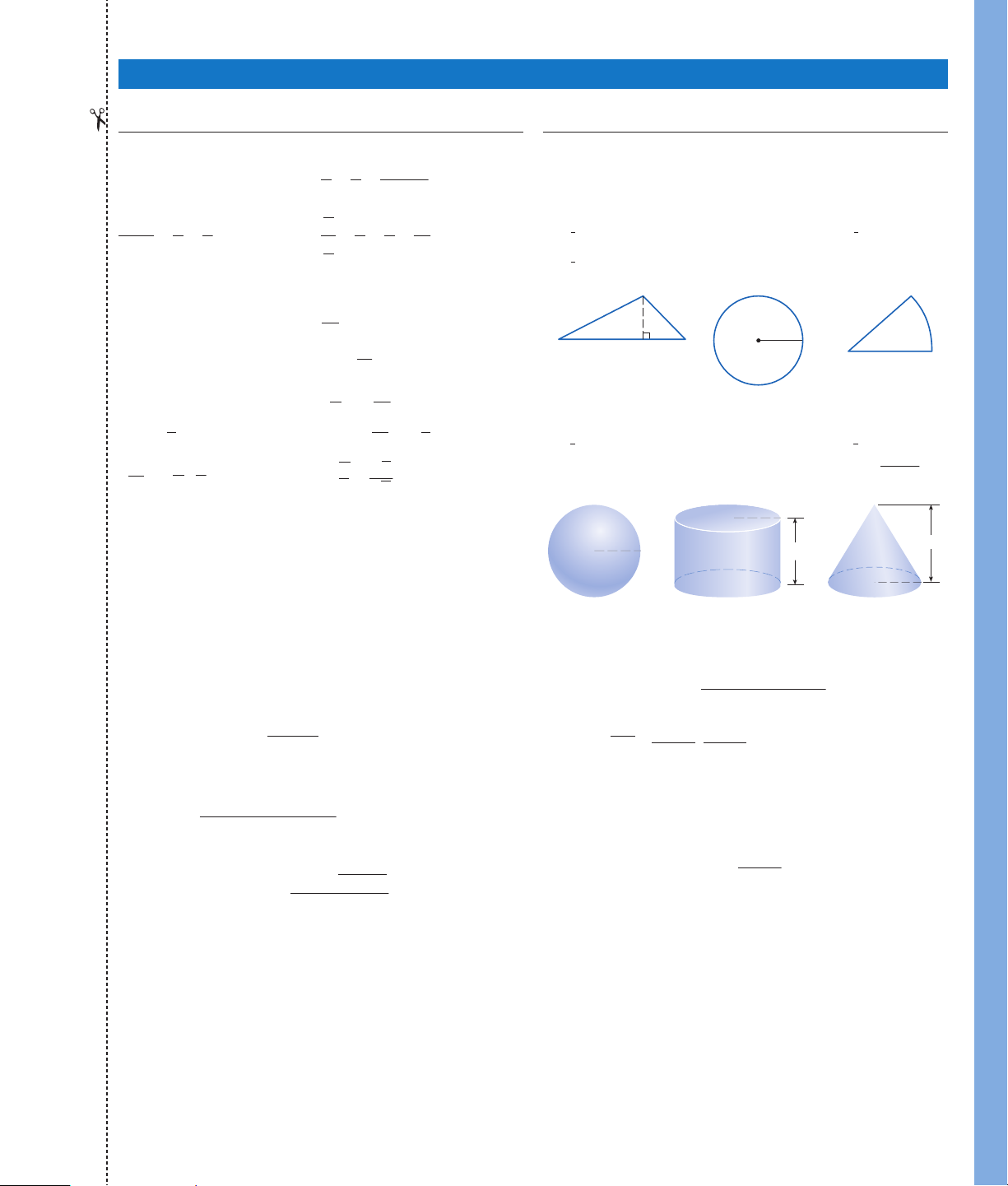
Ask your instructor today how you can get access to WebAssign! cengage.com/webassign REFERENCE page 1 ALGEBRA GEOMETRY Arithmetic Operations Geometric Formulas ence er a c ad 1 bc ef
asb 1 cd − ab 1 ac 1 −
Formulas for area A, circumference C, and volume V: b d bd or r a Triangle Circle Sector of Circle a a c b a d ad eep f 1 c A 1 3 − 1 − − − 2 bh A − r 2 A − 12 r2 b b b c b c bc d − 12 ab sin C − 2r
s − r s in radiansd e and k Exponents and Radicals a x m r Cut her h s
x mx n − x m1n − x m2n x n ¨ r ¨ 1 b
sx mdn − x mn x2n − r x n x n s Dn
xydn − x nyn Sx − y yn Sphere Cylinder Cone
x 1yn − snx
x myn − snxm − (snx )m V − 43 r3
V − r 2h
V − 13 r2h x snx A − 4r 2 A − r n sr2 1 h2 Î
snxy − snx sny − y sny r
Factoring Special Polynomials r h
x 2 2 y2 − sx 1 ydsx 2 yd h
x 3 1 y3 − sx 1 ydsx 2 2 xy 1 y2d r
x 3 2 y3 − sx 2 ydsx 2 1 xy 1 y2d Binomial Theorem
Distance and Midpoint Formulas
sx 1 yd2 − x 2 1 2xy 1 y2
sx 2 yd2 − x 2 2 2xy 1 y2
Distance between P1sx1, y1d and P2sx2, y2d:
sx 1 yd3 − x 3 1 3x 2y 1 3xy2 1 y3
d − ssx2 2 x1d2 1 sy2 2 y1d2
sx 2 yd3 − x 3 2 3x 2y 1 3xy2 2 y3 nsn 2 1d sx 1 ydn x n22y2 y
− x n 1 nx n21y 1 2 Midpoint of D P 1 1 y2
1P2: Sx1 1 x2 , 2 2 SnD 1 … 1
x n2kyk 1 … 1 nxyn21 1 yn k Lines
nsn 2 1d … sn 2 k 1 1d where SnD − k 1 ? 2 ? 3 ? … ? k
Slope of line through P1sx1, y1d and P2sx2, y2d: Quadratic Formula y m − 2 2 y1 x2 2 x1
2b 6 sb 2 2 4ac
If ax 2 1 bx 1 c − 0, then x − . 2a
Point-slope equation of line through P1sx1, y1d with slope m:
Inequalities and Absolute Value
y 2 y1 − msx 2 x1d
If a , b and b , c, then a , c.
If a , b, then a 1 c , b 1 c.
Slope-intercept equation of line with slope m and y-intercept b:
If a , b and c . 0, then ca , cb.
y − mx 1 b
If a , b and c , 0, then ca . cb. If a . 0, then Circles
|x | − a means x − a or x − 2a
Equation of the circle with center sh, kd and radius r:
| x | , a means 2a , x , a
sx 2 hd2 1 s y 2 kd2 − r 2
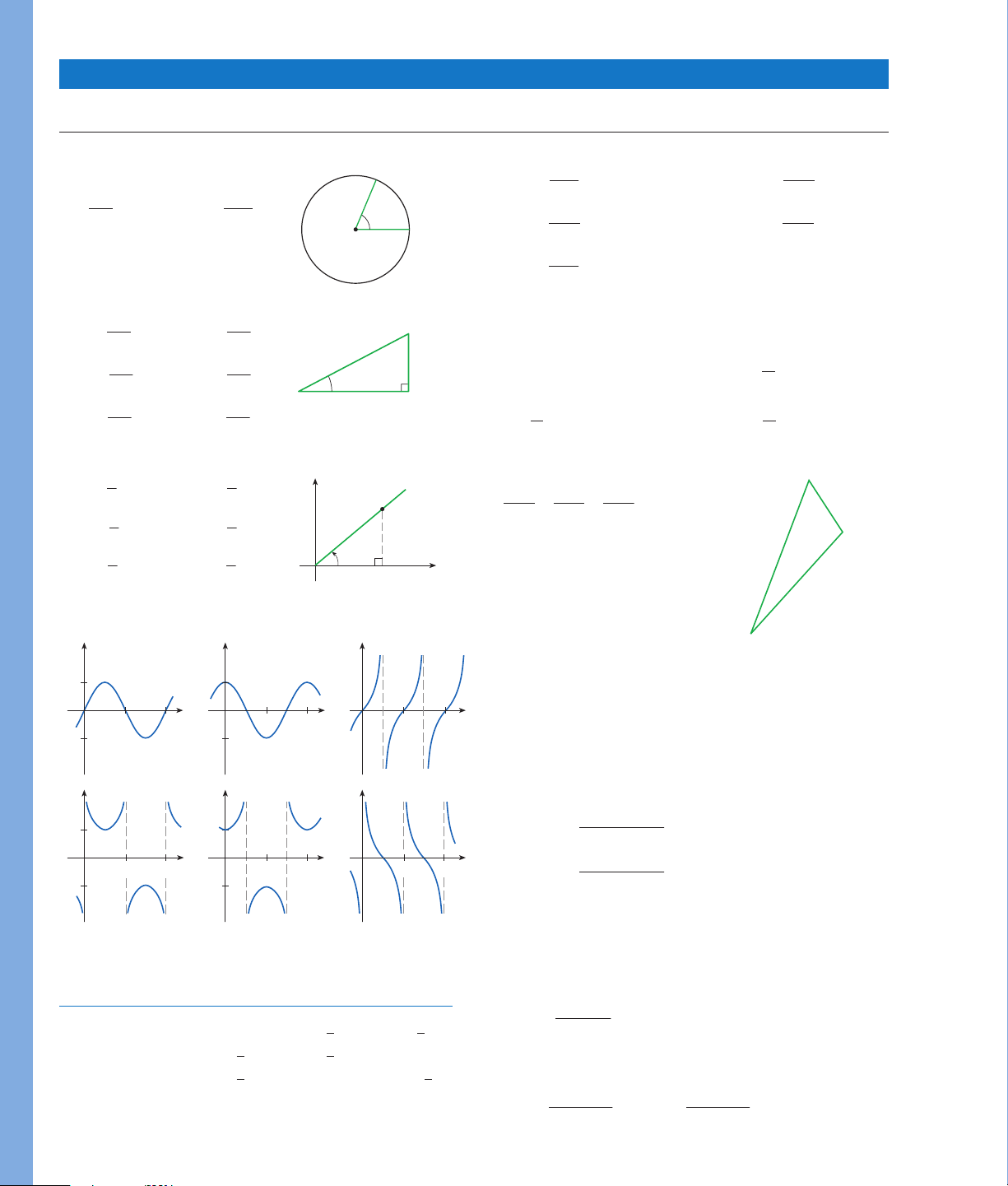
|x| . a means x . a or x , 2a REFERENCE page 2 TRIGONOMETRY Angle Measurement Fundamental Identities 1 1 radians − 1808 csc − sec − s sin cos 180° r 18 − rad 1 rad − 180 ¨ sin cos tan − cot − cos sin s r − r 1 s in radiansd cot −
sin2 1 cos2 − 1 tan
Right Angle Trigonometry
1 1 tan2 − sec2 1 1 cot2 − csc2 opp hyp sin − csc − sins2d − 2sin coss2d − cos hyp opp hyp opp adj hyp tan cos sec s − − hyp adj ¨ D 2d − 2tan sinS 2 − cos 2 adj opp adj tan − cot − cos adj opp S D D 2 − sin tanS 2 − cot 2 2 Trigonometric Functions The Law of Sines B y r y sin − csc − sin A sin B sin C r y − − a (x, y) a b c x r r cos − sec − C r x c y x ¨ tan − cot − The Law of Cosines x y x b
a 2 − b 2 1 c 2 2 2bc cos A
Graphs of Trigonometric Functions
b 2 − a 2 1 c 2 2 2ac cos B y y y y=tan x
c 2 − a 2 1 b 2 2 2ab cos C A y=sin x y=cos x 1 1
Addition and Subtraction Formulas π 2π 2π sin x x
sx 1 yd − sin x cos y 1 cos x sin y π 2π x π _1 _1
sinsx 2 yd − sin x cos y 2 cos x sin y
cossx 1 yd − cos x cos y 2 sin x sin y y y=csc x y y=sec x y y=cot x
cossx 2 yd − cos x cos y 1 sin x sin y tan x 1 tan y 1 1
tansx 1 yd − 1 2 tan x tan y tan x 2 tan y π 2π x π 2π x π 2π x
tansx 2 yd − 1 1 tan x tan y _1 _1 Double-Angle Formulas
sin 2x − 2 sin x cos x
Trigonometric Functions of Important Angles
cos 2x − cos2x 2 sin2x − 2 cos2x 2 1 − 1 2 2 sin2x radians sin cos tan 2 tan x 08 0 0 1 0
tan 2x − 1 2 tan2x 308 y6 1y2 s3y2 s3y3 458 y4 s2y2 s2y2 1 Half-Angle Formulas 608 y3 s3y2 1y2 s3 1 2 cos 2x 1 1 cos 2x sin2x − cos2x − 908 y2 1 0 — 2 2 CALCULUS EARLY TRANSCENDENTALS NINTH EDITION Metric Version JAMES STEWART McMASTER UNIVERSITY AND UNIVERSITY OF TORONTO DANIEL CLEGG PALOMAR COLLEGE SALEEM WATSON
CALIFORNIA STATE UNIVERSITY, LONG BEACH
Australia • Brazil • Mexico • Singapore • United Kingdom • United States
This is an electronic version of the print textbook. Due to electronic rights restrictions,
some third party content may be suppressed. Editorial review has deemed that any suppressed
content does not materially affect the overall learning experience. The publisher reserves the right
to remove content from this title at any time if subsequent rights restrictions require it. For
valuable information on pricing, previous editions, changes to current editions, and alternate
formats, please visit www.cengage.com/highered to search by ISBN#, author, title, or keyword for
materials in your areas of interest.
Important Notice: Media content referenced within the product description or the product
text may not be available in the eBook version.
Calculus: Early Transcendentals, Ninth Edition,
© 2021, 2016 Cengage Learning, Inc. Metric Version WCN: 02-300
James Stewart, Daniel Clegg, Saleem Watson
ALL RIGHTS RESERVED. No part of this work covered by the copyright herein
may be reproduced or distributed in any form or by any means, except as
Metric Version Prepared by Anthony Tan and
permitted by U.S. copyright law, without the prior written permission of the
Michael Verwer both at McMaster University copyright owner.
International Product Director, Global Editions:
For product information and technology assistance, contact us at Timothy L. Anderson
Cengage Customer & Sales Support, 1-800-354-9706
Product Assistant: Andrew Reddish or support.cengage.com. Content Manager: Emma Collins
For permission to use material from this text or product, submit all
requests online at www.cengage.com/permissions.
Production Service: Kathi Townes, TECHart Compositor: Graphic World ISBN: 978-0-357-11351-6
Art Director: Angela Sheehan, Vernon Boes
Cengage International Offices IP Analyst: Ashley Maynard Asia Australia/New Zealand
IP Project Manager: Carly Belcher www.cengageasia.com www.cengage.com.au tel: (65) 6410 1200 tel: (61) 3 9685 4111
Manager, Global IP Integration: Eleanor Rummer Brazil India Text Designer: Diane Beasley www.cengage.com.br www.cengage.co.in Cover Designer: Nadine Ballard tel: (55) 11 3665 9900 tel: (91) 11 4364 1111
Cover Image: WichitS/ShutterStock.com Latin America
UK/Europe/Middle East/Africa www.cengage.com.mx www.cengage.co.uk tel: (52) 55 1500 6000 tel: (44) 0 1264 332 424 Represented in Canada by Nelson Education, Ltd.
tel: (416) 752 9100 / (800) 668 0671 www.nelson.com
Cengage Learning is a leading provider of customized learning solutions
with office locations around the globe, including Singapore, the United
Kingdom, Australia, Mexico, Brazil, and Japan. Locate your local office at: www.cengage.com/global.
For product information: www.cengage.com/international
Visit your local office: www.cengage.com/global
Visit our corporate website: www.cengage.com Printed in China Print Number: 01 Print Year: 2019 Contents Preface x
A Tribute to James Stewart xxii About the Authors xxiii
Technology in the Ninth Edition xxiv To the Student xxv Diagnostic Tests xxvi A Preview of Calculus 1 1 Functions and Models 7
1.1 Four Ways to Represent a Function 8
1.2 Mathematical Models: A Catalog of Essential Functions 21
1.3 New Functions from Old Functions 36
1.4 Exponential Functions 45
1.5 Inverse Functions and Logarithms 54 Review 67
Principles of Problem Solving 70
2 Limits and Derivatives 77
2.1 The Tangent and Velocity Problems 78
2.2 The Limit of a Function 83
2.3 Calculating Limits Using the Limit Laws 94
2.4 The Precise Definition of a Limit 105 2.5 Continuity 115
2.6 Limits at Infinity; Horizontal Asymptotes 127
2.7 Derivatives and Rates of Change 140
writing project • Early Methods for Finding Tangents 152
2.8 The Derivative as a Function 153 Review 166 Problems Plus 171 iii iv CONTENTS
3 Differentiation Rules 173
3.1 Derivatives of Polynomials and Exponential Functions 174
applied project • Building a Better Roller Coaster 184
3.2 The Product and Quotient Rules 185
3.3 Derivatives of Trigonometric Functions 191 3.4 The Chain Rule 199
applied project • Where Should a Pilot Start Descent? 209
3.5 Implicit Differentiation 209
discovery project • Families of Implicit Curves 217
3.6 Derivatives of Logarithmic and Inverse Trigonometric Functions 217
3.7 Rates of Change in the Natural and Social Sciences 225
3.8 Exponential Growth and Decay 239
applied project • Controlling Red Blood Cell Loss During Surgery 247 3.9 Related Rates 247
3.10 Linear Approximations and Differentials 254
discovery project • Polynomial Approximations 260
3.11 Hyperbolic Functions 261 Review 269 Problems Plus 274
4 Applications of Differentiation 279
4.1 Maximum and Minimum Values 280
applied project • The Calculus of Rainbows 289
4.2 The Mean Value Theorem 290
4.3 What Derivatives Tell Us about the Shape of a Graph 296
4.4 Indeterminate Forms and l’Hospital’s Rule 309
writing project • The Origins of l’Hospital’s Rule 319
4.5 Summary of Curve Sketching 320
4.6 Graphing with Calculus and Technology 329
4.7 Optimization Problems 336
applied project • The Shape of a Can 349
applied project • Planes and Birds: Minimizing Energy 350
4.8 Newton’s Method 351 4.9 Antiderivatives 356 Review 364 Problems Plus 369 CONTENTS v 5 Integrals 371
5.1 The Area and Distance Problems 372
5.2 The Definite Integral 384
discovery project • Area Functions 398
5.3 The Fundamental Theorem of Calculus 399
5.4 Indefinite Integrals and the Net Change Theorem 409
writing project • Newton, Leibniz, and the Invention of Calculus 418
5.5 The Substitution Rule 419 Review 428 Problems Plus 432
6 Applications of Integration 435
6.1 Areas Between Curves 436
applied project • The Gini Index 445 6.2 Volumes 446
6.3 Volumes by Cylindrical Shells 460 6.4 Work 467
6.5 Average Value of a Function 473
applied project • Calculus and Baseball 476
applied project • Where to Sit at the Movies 478 Review 478 Problems Plus 481
7 Techniques of Integration 485
7.1 Integration by Parts 486
7.2 Trigonometric Integrals 493
7.3 Trigonometric Substitution 500
7.4 Integration of Rational Functions by Partial Fractions 507
7.5 Strategy for Integration 517
7.6 Integration Using Tables and Technology 523
discovery project • Patterns in Integrals 528
7.7 Approximate Integration 529
7.8 Improper Integrals 542 Review 552 Problems Plus 556 vi CONTENTS
8 Further Applications of Integration 559 8.1 Arc Length 560
discovery project • Arc Length Contest 567
8.2 Area of a Surface of Revolution 567
discovery project • Rotating on a Slant 575
8.3 Applications to Physics and Engineering 576
discovery project • Complementary Coffee Cups 587
8.4 Applications to Economics and Biology 587 8.5 Probability 592 Review 600 Problems Plus 602
9 Differential Equations 605
9.1 Modeling with Differential Equations 606
9.2 Direction Fields and Euler’s Method 612
9.3 Separable Equations 621
applied project • How Fast Does a Tank Drain? 630
9.4 Models for Population Growth 631
9.5 Linear Equations 641
applied project • Which Is Faster, Going Up or Coming Down? 648
9.6 Predator-Prey Systems 649 Review 656 Problems Plus 659
10 Parametric Equations and Polar Coordinates 661 10.1
Curves Defined by Parametric Equations 662
discovery project • Running Circles Around Circles 672 10.2
Calculus with Parametric Curves 673
discovery project • Bézier Curves 684 10.3 Polar Coordinates 684
discovery project • Families of Polar Curves 694 10.4
Calculus in Polar Coordinates 694 10.5 Conic Sections 702 CONTENTS vii 10.6
Conic Sections in Polar Coordinates 711 Review 719 Problems Plus 722
11 Sequences, Series, and Power Series 723 11.1 Sequences 724
discovery project • Logistic Sequences 738 11.2 Series 738 11.3
The Integral Test and Estimates of Sums 751 11.4 The Comparison Tests 760 11.5
Alternating Series and Absolute Convergence 765 11.6 The Ratio and Root Tests 774 11.7
Strategy for Testing Series 779 11.8 Power Series 781 11.9
Representations of Functions as Power Series 787
11.10 Taylor and Maclaurin Series 795
discovery project • An Elusive Limit 810
writing project • How Newton Discovered the Binomial Series 811
11.11 Applications of Taylor Polynomials 811
applied project • Radiation from the Stars 820 Review 821 Problems Plus 825
12 Vectors and the Geometry of Space 829 12.1
Three-Dimensional Coordinate Systems 830 12.2 Vectors 836
discovery project • The Shape of a Hanging Chain 846 12.3 The Dot Product 847 12.4 The Cross Product 855
discovery project • The Geometry of a Tetrahedron 864 12.5
Equations of Lines and Planes 864
discovery project • Putting 3D in Perspective 874 12.6
Cylinders and Quadric Surfaces 875 Review 883 Problems Plus 887 viii CONTENTS 13 Vector Functions 889 13.1
Vector Functions and Space Curves 890 13.2
Derivatives and Integrals of Vector Functions 898 13.3 Arc Length and Curvature 904 13.4
Motion in Space: Velocity and Acceleration 916
applied project • Kepler’s Laws 925 Review 927 Problems Plus 930 14 Partial Derivatives 933 14.1
Functions of Several Variables 934 14.2 Limits and Continuity 951 14.3 Partial Derivatives 961
discovery project • Deriving the Cobb-Douglas Production Function 973 14.4
Tangent Planes and Linear Approximations 974
applied project • The Speedo LZR Racer 984 14.5 The Chain Rule 985 14.6
Directional Derivatives and the Gradient Vector 994 14.7
Maximum and Minimum Values 1008
discovery project • Quadratic Approximations and Critical Points 1019 14.8 Lagrange Multipliers 1020
applied project • Rocket Science 1028
applied project • Hydro-Turbine Optimization 1030 Review 1031 Problems Plus 1035 15 Multiple Integrals 1037 15.1
Double Integrals over Rectangles 1038 15.2
Double Integrals over General Regions 1051 15.3
Double Integrals in Polar Coordinates 1062 15.4
Applications of Double Integrals 1069 15.5 Surface Area 1079 15.6 Triple Integrals 1082
discovery project • Volumes of Hyperspheres 1095 15.7
Triple Integrals in Cylindrical Coordinates 1095
discovery project • The Intersection of Three Cylinders 1101 CONTENTS ix 15.8
Triple Integrals in Spherical Coordinates 1102
applied project • Roller Derby 1108 15.9
Change of Variables in Multiple Integrals 1109 Review 1117 Problems Plus 1121 16 Vector Calculus 1123 16.1 Vector Fields 1124 16.2 Line Integrals 1131 16.3
The Fundamental Theorem for Line Integrals 1144 16.4 Green’s Theorem 1154 16.5 Curl and Divergence 1161 16.6
Parametric Surfaces and Their Areas 1170 16.7 Surface Integrals 1182 16.8 Stokes’ Theorem 1195 16.9 The Divergence Theorem 1201 16.10 Summary 1208 Review 1209 Problems Plus 1213 Appendixes A1 A
Numbers, Inequalities, and Absolute Values A2 B
Coordinate Geometry and Lines A10 C
Graphs of Second-Degree Equations A16 D Trigonometry A24 E Sigma Notation A36 F Proofs of Theorems A41 G
The Logarithm Defined as an Integral A53 H
Answers to Odd-Numbered Exercises A61 Index A143 Preface
A great discovery solves a great problem but there is a grain of discovery in the solution
of any problem. Your problem may be modest; but if it challenges your curiosity and
brings into play your inventive faculties, and if you solve it by your own means, you may
experience the tension and enjoy the triumph of discovery. george polya
The art of teaching, Mark Van Doren said, is the art of assisting discovery. In this Ninth
Edition, Metric Version, as in all of the preceding editions, we continue the tradition
of writing a book that, we hope, assists students in discovering calculus — both for its
practical power and its surprising beauty. We aim to convey to the student a sense of the
utility of calculus as well as to promote development of technical ability. At the same
time, we strive to give some appreciation for the intrinsic beauty of the subject. Newton
undoubtedly experienced a sense of triumph when he made his great discoveries. We
want students to share some of that excitement.
The emphasis is on understanding concepts. Nearly all calculus instructors agree that
conceptual understanding should be the ultimate goal of calculus instruction; to imple-
ment this goal we present fundamental topics graphically, numerically, algebraically,
and verbally, with an emphasis on the relationships between these different representa-
tions. Visualization, numerical and graphical experimentation, and verbal descriptions
can greatly facilitate conceptual understanding. Moreover, conceptual understanding
and technical skill can go hand in hand, each reinforcing the other.
We are keenly aware that good teaching comes in different forms and that there
are different approaches to teaching and learning calculus, so the exposition and exer-
cises are designed to accommodate different teaching and learning styles. The features
(including projects, extended exercises, principles of problem solving, and historical
insights) provide a variety of enhancements to a central core of fundamental concepts
and skills. Our aim is to provide instructors and their students with the tools they need
to chart their own paths to discovering calculus. Alternate Versions
The Stewart Calculus series includes several other calculus textbooks that might be
preferable for some instructors. Most of them also come in single variable and multi- variable versions.
• Calculus, Ninth Edition, Metric Version, is similar to the present textbook except
that the exponential, logarithmic, and inverse trigonometric functions are covered
after the chapter on integration.
• Essential Calculus, Second Edition, is a much briefer book (840 pages), though it
contains almost all of the topics in Calculus, Ninth Edition. The relative brevity is
achieved through briefer exposition of some topics and putting some features on the website. x PREFACE xi
• Essential Calculus: Early Transcendentals, Second Edition, resembles Essential
Calculus, but the exponential, logarithmic, and inverse trigonometric functions are covered in Chapter 3.
• Calculus: Concepts and Contexts, Fourth Edition, emphasizes conceptual under-
standing even more strongly than this book. The coverage of topics is not encyclo-
pedic and the material on transcendental functions and on parametric equations is
woven throughout the book instead of being treated in separate chapters.
• Brief Applied Calculus is intended for students in business, the social sciences, and the life sciences.
• Biocalculus: Calculus for the Life Sciences is intended to show students in the life
sciences how calculus relates to biology.
• Biocalculus: Calculus, Probability, and Statistics for the Life Sciences contains all
the content of Biocalculus: Calculus for the Life Sciences as well as three addi-
tional chapters covering probability and statistics.
What’s New in the Ninth Edition, Metric Version?
The overall structure of the text remains largely the same, but we have made many
improvements that are intended to make the Ninth Edition, Metric Version even more
usable as a teaching tool for instructors and as a learning tool for students. The changes
are a result of conversations with our colleagues and students, suggestions from users
and reviewers, insights gained from our own experiences teaching from the book, and
from the copious notes that James Stewart entrusted to us about changes that he wanted
us to consider for the new edition. In all the changes, both small and large, we have
retained the features and tone that have contributed to the success of this book.
• More than 20% of the exercises are new:
Basic exercises have been added, where appropriate, near the beginning of exer-
cise sets. These exercises are intended to build student confidence and reinforce
understanding of the fundamental concepts of a section. (See, for instance, Exer-
cises 7.3.1 – 4, 9.1.1 – 5, 11.4.3 – 6.)
Some new exercises include graphs intended to encourage students to understand
how a graph facilitates the solution of a problem; these exercises complement
subsequent exercises in which students need to supply their own graph. (See
Exercises 6.2.1– 4, Exercises 10.4.43 – 46 as well as 53 – 54, 15.5.1 – 2, 15.6.9 – 12,
16.7.15 and 24, 16.8.9 and 13.)
Some exercises have been structured in two stages, where part (a) asks for the
setup and part (b) is the evaluation. This allows students to check their answer
to part (a) before completing the problem. (See Exercises 6.1.1 – 4, 6.3.3 – 4, 15.2.7 – 10.)
Some challenging and extended exercises have been added toward the end of
selected exercise sets (such as Exercises 6.2.87, 9.3.56, 11.2.79 – 81, and 11.9.47).
Titles have been added to selected exercises when the exercise extends a con-
cept discussed in the section. (See, for example, Exercises 2.6.66, 10.1.55 – 57, 15.2.80 – 81.)
Some of our favorite new exercises are 1.3.71, 3.4.99, 3.5.65, 4.5.55 – 58, 6.2.79,
6.5.18, 10.5.69, 15.1.38, and 15.4.3 – 4. In addition, Problem 14 in the Problems
Plus following Chapter 6 and Problem 4 in the Problems Plus following Chap-
ter 15 are interesting and challenging. xii PREFACE
• New examples have been added, and additional steps have been added to the solu-
tions of some existing examples. (See, for instance, Example 2.7.5, Example 6.3.5,
Example 10.1.5, Examples 14.8.1 and 14.8.4, and Example 16.3.4.)
• Several sections have been restructured and new subheads added to focus the
organization around key concepts. (Good illustrations of this are Sections 2.3, 11.1, 11.2, and 14.2.)
• Many new graphs and illustrations have been added, and existing ones updated, to
provide additional graphical insights into key concepts.
• A few new topics have been added and others expanded (within a section or
in extended exercises) that were requested by reviewers. (Examples include a
sub section on torsion in Section 13.3, symmetric difference quotients in Exer-
cise 2.7.60, and improper integrals of more than one type in Exercises 7.8.65 – 68.)
• New projects have been added and some existing projects have been updated.
(For instance, see the Discovery Project following Section 12.2, The Shape of a Hanging Chain.)
• Derivatives of logarithmic functions and inverse trigonometric functions are now
covered in one section (3.6) that emphasizes the concept of the derivative of an inverse function.
• Alternating series and absolute convergence are now covered in one section (11.5).
• The chapter on Second-Order Differential Equations, as well as the associated
appendix section on complex numbers, has been moved to the website. Features
Each feature is designed to complement different teaching and learning practices.
Throughout the text there are historical insights, extended exercises, projects, problem-
solving principles, and many opportunities to experiment with concepts by using tech-
nology. We are mindful that there is rarely enough time in a semester to utilize all of
these features, but their availability in the book gives the instructor the option to assign
some and perhaps simply draw attention to others in order to emphasize the rich ideas
of calculus and its crucial importance in the real world. n Conceptual Exercises
The most important way to foster conceptual understanding is through the problems that
the instructor assigns. To that end we have included various types of problems. Some
exercise sets begin with requests to explain the meanings of the basic concepts of the
section (see, for instance, the first few exercises in Sections 2.2, 2.5, 11.2, 14.2, and
14.3) and most exercise sets contain exercises designed to reinforce basic understanding
(such as Exercises 2.5.3 – 10, 5.5.1 – 8, 6.1.1 – 4, 7.3.1 – 4, 9.1.1 – 5, and 11.4.3 – 6). Other
exercises test conceptual understanding through graphs or tables (see Exercises 2.7.17,
2.8.36 – 38, 2.8.47 – 52, 9.1.23 – 25, 10.1.30 – 33, 13.2.1 – 2, 13.3.37 – 43, 14.1.41 – 44,
14.3.2, 14.3.4 – 6, 14.6.1 – 2, 14.7.3 – 4, 15.1.6 – 8, 16.1.13 – 22, 16.2.19 – 20, and 16.3.1 – 2).
Many exercises provide a graph to aid in visualization (see for instance Exer-
cises 6.2.1 – 4, 10.4.43 – 46, 15.5.1 – 2, 15.6.9 – 12, and 16.7.24). Another type of exercise
uses verbal descriptions to gauge conceptual understanding (see Exercises 2.5.12,
2.8.66, 4.3.79 – 80, and 7.8.79). In addition, all the review sections begin with a Concept Check and a True-False Quiz. PREFACE xiii
We particularly value problems that combine and compare graphical, numerical, and
algebraic approaches (see Exercises 2.6.45 – 46, 3.7.29, and 9.4.4). n Graded Exercise Sets
Each exercise set is carefully graded, progressing from basic conceptual exercises, to
skill-development and graphical exercises, and then to more challenging exercises that
often extend the concepts of the section, draw on concepts from previous sections, or
involve applications or proofs. n Real-World Data
Real-world data provide a tangible way to introduce, motivate, or illustrate the concepts
of calculus. As a result, many of the examples and exercises deal with functions defined
by such numerical data or graphs. These real-world data have been obtained by contact-
ing companies and government agencies as well as researching on the Internet and in
libraries. See, for instance, Figure 1 in Section 1.1 (seismograms from the Northridge
earthquake), Exercise 2.8.36 (number of cosmetic surgeries), Exercise 5.1.12 (velocity
of the space shuttle Endeavour), Exercise 5.4.83 (power consumption in the New Eng-
land states), Example 3 in Section 14.4 (the heat index), Figure 1 in Section 14.6 (tem-
perature contour map), Example 9 in Section 15.1 (snowfall in Colorado), and Figure 1
in Section 16.1 (velocity vector fields of wind in San Francisco Bay). n Projects
One way of involving students and making them active learners is to have them work
(perhaps in groups) on extended projects that give a feeling of substantial accomplish-
ment when completed. There are three kinds of projects in the text.
Applied Projects involve applications that are designed to appeal to the imagina-
tion of students. The project after Section 9.5 asks whether a ball thrown upward takes
longer to reach its maximum height or to fall back to its original height (the answer
might surprise you). The project after Section 14.8 uses Lagrange multipliers to deter-
mine the masses of the three stages of a rocket so as to minimize the total mass while
enabling the rocket to reach a desired velocity.
Discovery Projects anticipate results to be discussed later or encourage discovery
through pattern recognition (see the project following Section 7.6, which explores pat-
terns in integrals). Other discovery projects explore aspects of geometry: tetrahedra
(after Section 12.4), hyperspheres (after Section 15.6), and intersections of three cyl-
inders (after Section 15.7). Additionally, the project following Section 12.2 uses the
geometric definition of the derivative to find a formula for the shape of a hanging chain.
Some projects make substantial use of technology; the one following Section 10.2
shows how to use Bézier curves to design shapes that represent letters for a laser printer.
Writing Projects ask students to compare present-day methods with those of the
founders of calculus — Fermat’s method for finding tangents, for instance, following
Section 2.7. Suggested references are supplied.
More projects can be found in the Instructor’s Guide. There are also extended exer-
cises that can serve as smaller projects. (See Exercise 4.7.53 on the geometry of beehive
cells, Exercise 6.2.87 on scaling solids of revolution, or Exercise 9.3.56 on the forma- tion of sea ice.) n Problem Solving
Students usually have difficulties with problems that have no single well-defined
procedure for obtaining the answer. As a student of George Polya, James Stewart xiv PREFACE
experienced first-hand Polya’s delightful and penetrating insights into the process
of problem solving. Accordingly, a modified version of Polya’s four-stage problem-
solving strategy is presented following Chapter 1 in Principles of Problem Solving.
These principles are applied, both explicitly and implicitly, throughout the book. Each of
the other chapters is followed by a section called Problems Plus, which features examples
of how to tackle challenging calculus problems. In selecting the Problems Plus prob-
lems we have kept in mind the following advice from David Hilbert: “A mathematical
problem should be difficult in order to entice us, yet not inaccessible lest it mock our
efforts.” We have used these problems to great effect in our own calculus classes; it is
gratifying to see how students respond to a challenge. James Stewart said, “When I put
these challenging problems on assignments and tests I grade them in a different way . . .
I reward a student significantly for ideas toward a solution and for recognizing which
problem-solving principles are relevant.” n Technology
When using technology, it is particularly important to clearly understand the con-
cepts that underlie the images on the screen or the results of a calculation. When
properly used, graphing calculators and computers are powerful tools for discovering
and understanding those concepts. This textbook can be used either with or without
technology — we use two special symbols to indicate clearly when a particular type of
assistance from technology is required. The icon ; indicates an exercise that definitely
requires the use of graphing software or a graphing calculator to aid in sketching a
graph. (That is not to say that the technology can’t be used on the other exercises as
well.) The symbol means that the assistance of software or a graphing calculator is
needed beyond just graphing to complete the exercise. Freely available websites such
as WolframAlpha.com or Symbolab.com are often suitable. In cases where the full
resources of a computer algebra system, such as Maple or Mathematica, are needed, we
state this in the exercise. Of course, technology doesn’t make pencil and paper obsolete.
Hand calculation and sketches are often preferable to technology for illustrating and
reinforcing some concepts. Both instructors and students need to develop the ability
to decide where using technology is appropriate and where more insight is gained by
working out an exercise by hand. n WebAssign: webassign.net
This Ninth Edition is available with WebAssign, a fully customizable online solution
for STEM disciplines from Cengage. WebAssign includes homework, an interactive
mobile eBook, videos, tutorials and Explore It interactive learning modules. Instructors
can decide what type of help students can access, and when, while working on assign-
ments. The patented grading engine provides unparalleled answer evaluation, giving
students instant feedback, and insightful analytics highlight exactly where students are
struggling. For more information, visit cengage.com/WebAssign. n Stewart Website
Visit StewartCalculus.com for these additional materials: • Homework Hints
• Solutions to the Concept Checks (from the review section of each chapter)
• Algebra and Analytic Geometry Review
• Lies My Calculator and Computer Told Me
• History of Mathematics, with links to recommended historical websites PREFACE xv
• Additional Topics (complete with exercise sets): Fourier Series, Rotation of Axes,
Formulas for the Remainder Theorem in Taylor Series
• Additional chapter on second-order differential equations, including the method of
series solutions, and an appendix section reviewing complex numbers and complex exponential functions
• Instructor Area that includes archived problems (drill exercises that appeared in
previous editions, together with their solutions)
• Challenge Problems (some from the Problems Plus sections from prior editions)
• Links, for particular topics, to outside Web resources Content
Diagnostic Tests The book begins with four diagnostic tests, in Basic Algebra, Analytic Geometry, Func- tions, and Trigonometry.
A Preview of Calculus This is an overview of the subject and includes a list of questions to motivate the study of calculus.
1 Functions and Models From the beginning, multiple representations of functions are stressed: verbal, numeri-
cal, visual, and algebraic. A discussion of mathematical models leads to a review of the
standard functions, including exponential and logarithmic functions, from these four points of view.
2 Limits and Derivatives The material on limits is motivated by a prior discussion of the tangent and veloc-
ity problems. Limits are treated from descriptive, graphical, numerical, and algebraic
points of view. Section 2.4, on the precise definition of a limit, is an optional section.
Sections 2.7 and 2.8 deal with derivatives (including derivatives for functions defined
graphically and numerically) before the differentiation rules are covered in Chapter 3.
Here the examples and exercises explore the meaning of derivatives in various contexts.
Higher derivatives are introduced in Section 2.8.
3 Differentiation Rules All the basic functions, including exponential, logarithmic, and inverse trigonometric
functions, are differentiated here. The latter two classes of functions are now covered in
one section that focuses on the derivative of an inverse function. When derivatives are
computed in applied situations, students are asked to explain their meanings. Exponen-
tial growth and decay are included in this chapter.
4 Applications of Differentiation The basic facts concerning extreme values and shapes of curves are deduced from the
Mean Value Theorem. Graphing with technology emphasizes the interaction between
calculus and machines and the analysis of families of curves. Some substantial optimi-
zation problems are provided, including an explanation of why you need to raise your
head 42° to see the top of a rainbow.
5 Integrals The area problem and the distance problem serve to motivate the definite integral, with
sigma notation introduced as needed. (Full coverage of sigma notation is provided in
Appendix E.) Emphasis is placed on explaining the meanings of integrals in various
contexts and on estimating their values from graphs and tables.
6 Applications of Integration This chapter presents the applications of integration — area, volume, work, average
value — that can reasonably be done without specialized techniques of integration.
General methods are emphasized. The goal is for students to be able to divide a quantity
into small pieces, estimate with Riemann sums, and recognize the limit as an integral.
Tài liệu liên quan:
-
Cambridge IELTS 13 Test-1 Overview and Practice Review | Tài liệu Tiếng Anh
6 3 -
IELTS Test 2 Review - Cambridge 13 Preparation Guide | Tài liệu Tiếng Anh
8 4 -
Litfocus Litreading Survey: Student Reading Interests & Habits Questionnaire | Tài liệu Tiếng Anh
7 4 -

Sách Pre-intermediate Market leader - Business English Course Book
23 12 -
Exam booster for B1 preliminary and B1 preliminary for schools with answer key
9 5