Vectors And The Geometry Of Space | Tài liệu Tiếng Anh
Vectors And The Geometry Of Space | Tài liệu Tiếng Anh . Tài liệu giúp bạn tham khảo, ôn tập và đạt kết quả cao. Mời đọc đón xem!
Môn: Tiếng Anh chuyên ngành 332 tài liệu
Trường: Tài liệu Tiếng Anh chuyên ngành, Tiếng Anh cho người đi làm 432 tài liệu
Tác giả:

Preview text:
12
VECTORS AND THE GEOMETRY OF SPACE
12.1 Three-Dimensional Coordinate Systems
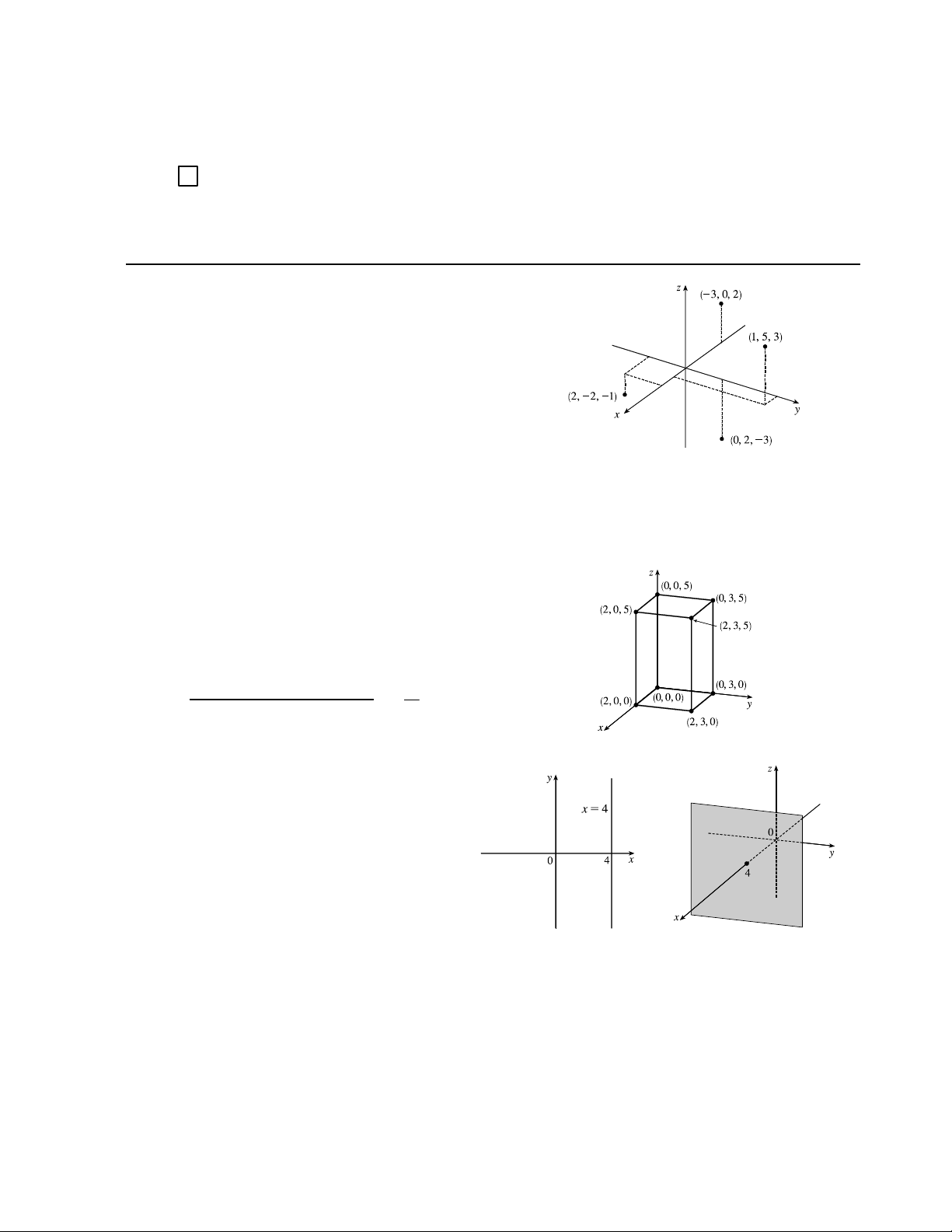
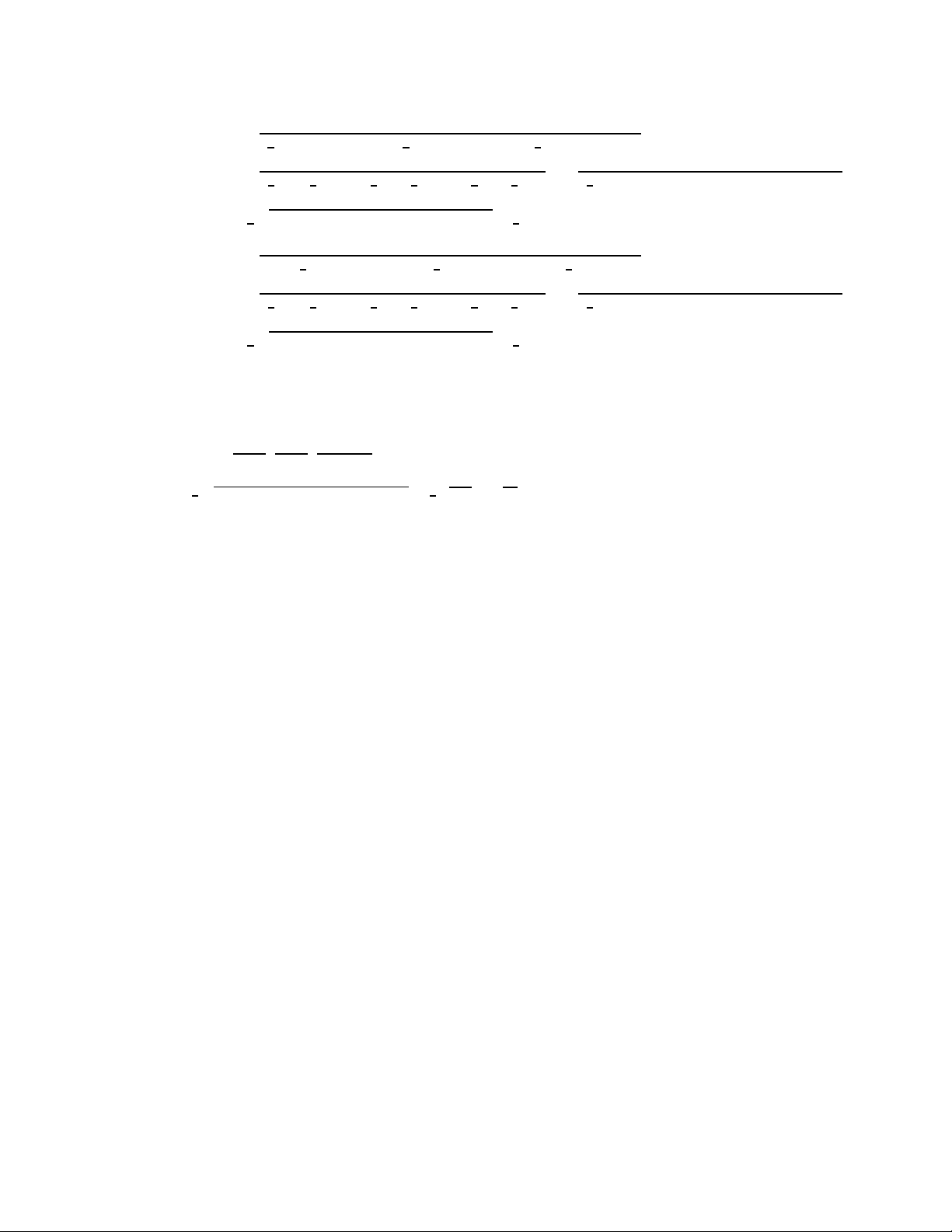
1. We start at the origin, which has coordinates (0 0 0). First we 2.
move 4 units along the positive axis, affecting only the
coordinate, bringing us to the point (4 0 0). We then move
3 units straight downward, in the negative direction. Thus
only the coordinate is affected, and we arrive at (4 0 −3).
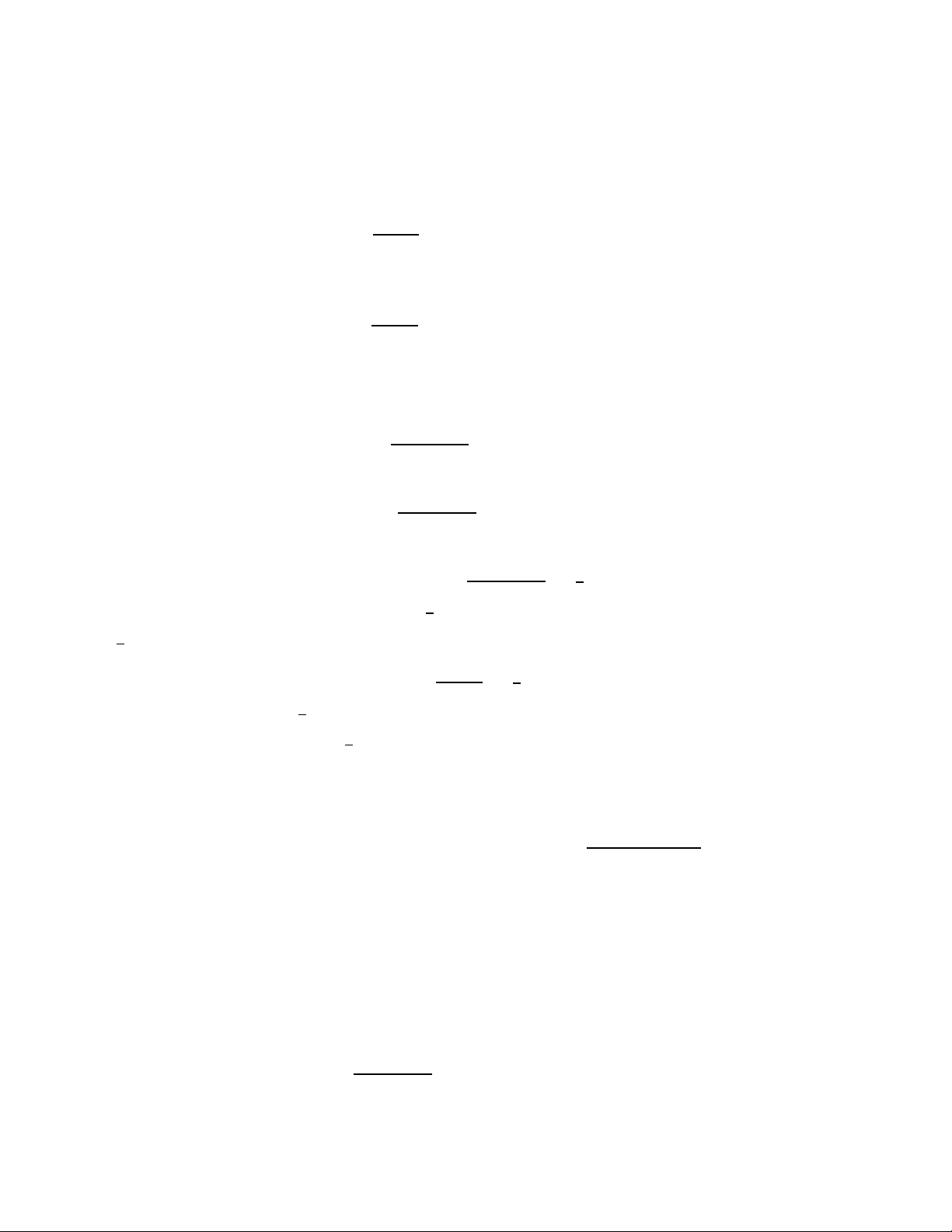
3. The distance from a point to the plane is the absolute value of the coordinate of the point. (2 4 6) has the coordinate
with the smallest absolute value, so is the point closest to the plane. (−4 0 −1) must lie in the plane since the
distance from to the plane, given by the coordinate of , is 0.
4. The projection of (2 3 5) onto the plane is (2 3 0);
onto the plane, (0 3 5); onto the plane, (2 0 5).
The length of the diagonal of the box is the distance between
the origin and (2 3 5), given by √
(2 − 0)2 + (3 − 0)2 + (5 − 0)2 = 38 ≈ 616
5. In 2, the equation = 4 represents a line parallel to
the axis and 4 units to the right of it. In 3, the
equation = 4 represents the set {( ) | = 4},
the set of all points whose coordinate is 4. This is the
vertical plane that is parallel to the plane and 4 units in front of it.
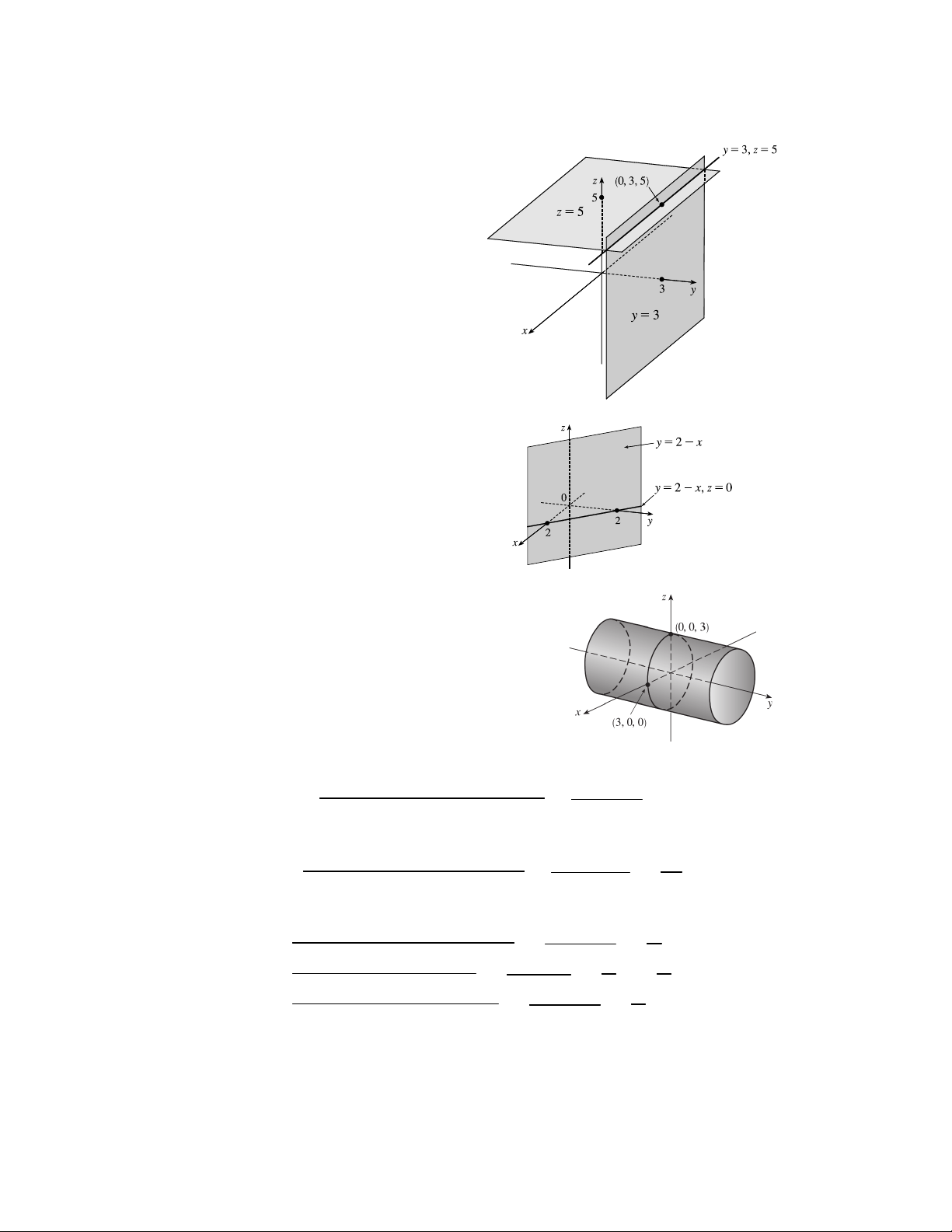
6. In 3, the equation = 3 represents a vertical plane that is parallel to the plane and 3 units to the right of it. The equation
= 5 represents a horizontal plane parallel to the plane and 5 units above it. The pair of equations = 3, = 5 represents
the set of points that are simultaneously on both planes, or in other words, the line of intersection of the planes = 3, = 5. [continued] c
° 2021 Cengage Learning. All Rights Reserved. May not be scanned, copied, or duplicated, or posted to a publicly accessible website, in whole or in part. 1191 1192
¤ CHAPTER 12 VECTORS AND THE GEOMETRY OF SPACE
This line can also be described as the set {( 3 5) | ∈ },
which is the set of all points in 3 whose coordinate may
vary but whose and coordinates are fixed at 3 and 5,
respectively. Thus the line is parallel to the axis and
intersects the plane in the point (0 3 5).
7. The equation + = 2 represents the set of all points in
3 whose and coordinates have a sum of 2, or
equivalently where = 2 − This is the set
{( 2 − ) | ∈ ∈ } which is a vertical plane
that intersects the plane in the line = 2 − , = 0.
8. The equation 2 + 2 = 9 has no restrictions on , and the and
coordinates satisfy the equation for a circle of radius 3 with center the
origin. Thus the surface 2 + 2 = 9 in 3 consists of all possible vertical
circles (parallel to the plane) 2 + 2 = 9, = , and is therefore a
circular cylinder with radius 3 whose axis is the axis.
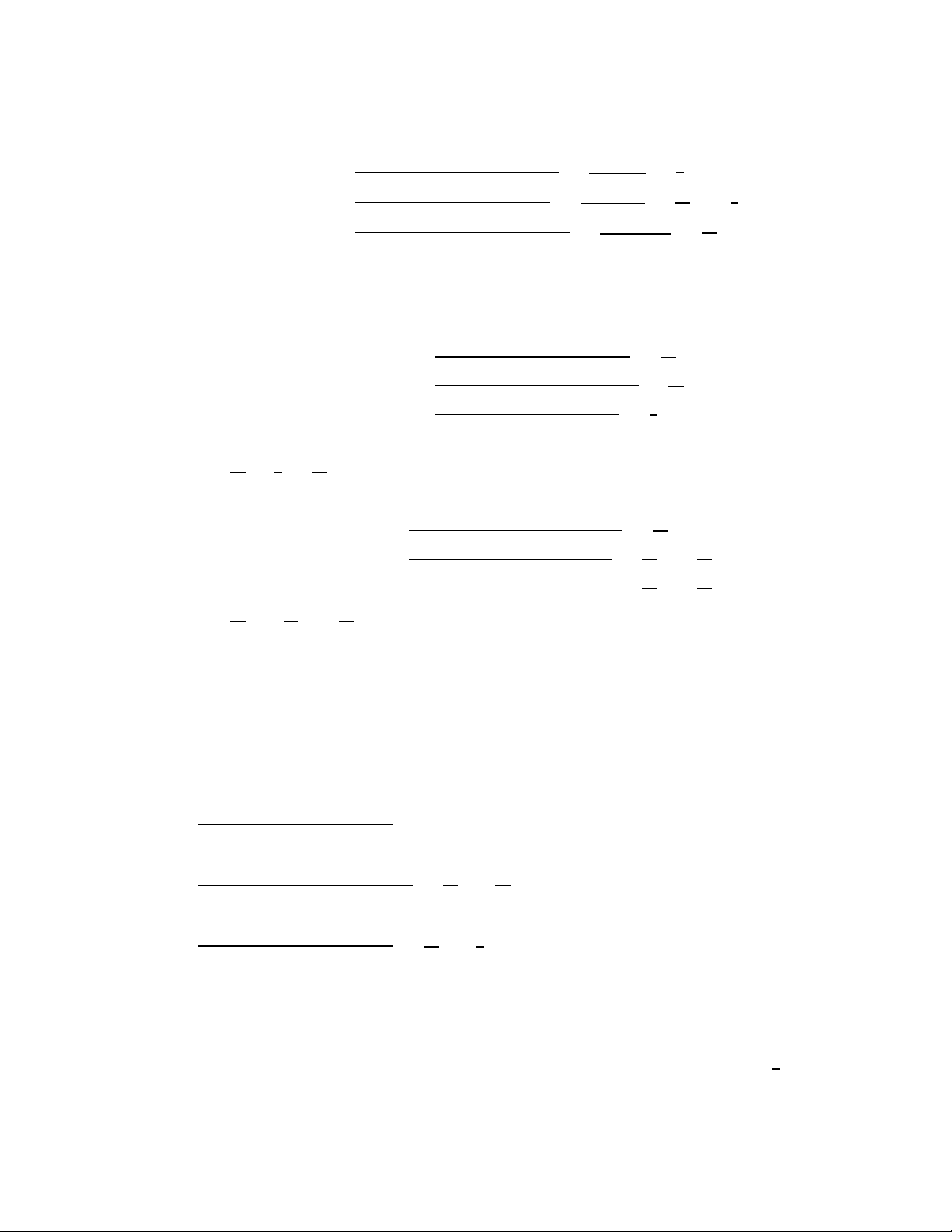
9. The distance between the points 1(3 5 −2) and 2(−1 1 −4) is √ |12| =
(−1 − 3)2 + (1 − 5)2 + [−4 − (−2)]2 = 16 + 16 + 4 = 6
10. The distance between the points 1(−6 −3 0) and 2(2 4 5) is √ √ |12| =
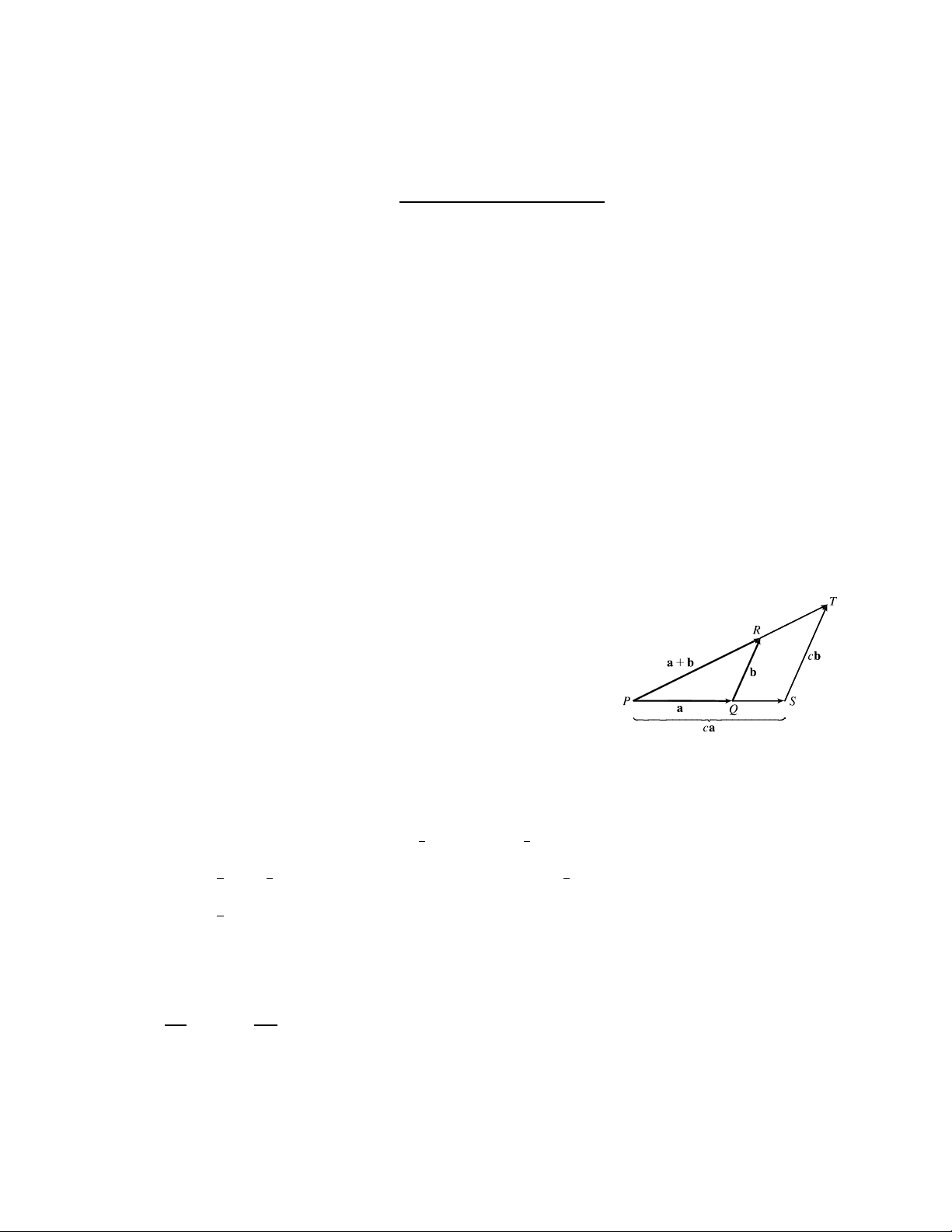
[2 − (−6)]2 + [4 − (−3)]2 + (5 − 0)2 = 64 + 49 + 25 = 138
11. We can find the lengths of the sides of the triangle by using the distance formula between pairs of vertices: √ √ | | =
(7 − 3)2 + [0 − (−2)]2 + [1 − (−3)]2 = 16 + 4 + 16 = 36 = 6 √ √ √ || =
(1 − 7)2 + (2 − 0)2 + (1 − 1)2 = 36 + 4 + 0 = 40 = 2 10 √ √ | | =
(3 − 1)2 + (−2 − 2)2 + (−3 − 1)2 = 4 + 16 + 16 = 36 = 6
The longest side is , but the Pythagorean Theorem is not satisfied: | |2 + | |2 6= ||2. Thus is not a right
triangle. is isosceles, as two sides have the same length. c
° 2021 Cengage Learning. All Rights Reserved. May not be scanned, copied, or duplicated, or posted to a publicly accessible website, in whole or in part.
SECTION 12.1 THREE-DIMENSIONAL COORDINATE SYSTEMS ¤ 1193
12. Compute the lengths of the sides of the triangle by using the distance formula between pairs of vertices: √ √ | | =
(4 − 2)2 + [1 − (−1)]2 + (1 − 0)2 = 4 + 4 + 1 = 9 = 3 √ √ √ || =
(4 − 4)2 + (−5 − 1)2 + (4 − 1)2 = 0 + 36 + 9 = 45 = 3 5 √ √ | | =
(2 − 4)2 + [−1 − (−5)]2 + (0 − 4)2 = 4 + 16 + 16 = 36 = 6
Since the Pythagorean Theorem is satisfied by | |2 + | |2 = ||2, is a right triangle. is not isosceles, as
no two sides have the same length.
13. (a) First we find the distances between points: √ || =
(3 − 2)2 + (7 − 4)2 + (−2 − 2)2 = 26 √ || =
(1 − 3)2 + (3 − 7)2 + [3 − (−2)]2 = 45 √ || =
(1 − 2)2 + (3 − 4)2 + (3 − 2)2 = 3
In order for the points to lie on a straight line, the sum of the two shortest distances must be equal to the longest distance. √ √ √
Since 26 + 3 6= 45, the three points do not lie on a straight line.
(b) First we find the distances between points: √ || =
(1 − 0)2 + [−2 − (−5)]2 + (4 − 5)2 = 11 √ √ | | =
(3 − 1)2 + [4 − (−2)]2 + (2 − 4)2 = 44 = 2 11 √ √ | | =
(3 − 0)2 + [4 − (−5)]2 + (2 − 5)2 = 99 = 3 11 √ √ √
Since 11 + 2 11 = 3 11, the three points lie on a straight line.
14. (a) The distance from a point to the plane is the absolute value of the coordinate of the point. Thus, the distance from
(4 −2 6) to the plane is |6| = 6.
(b) Similarly, the distance to the plane is the absolute value of the coordinate of the point: |4| = 4.
(c) The distance to the plane is the absolute value of the coordinate of the point: |−2| = 2.
(d) The point on the axis closest to (4 −2 6) is the point (4 0 0). (Approach the axis perpendicularly.)
The distance from (4 −2 6) to the axis is the distance between these two points: √ √
(4 − 4)2 + (−2 − 0)2 + (6 − 0)2 = 40 = 2 10 ≈ 632.
(e) The point on the axis closest to (4 −2 6) is (0 −2 0). The distance between these points is √ √
(4 − 0)2 + [−2 − (−2)]2 + (6 − 0)2 = 52 = 2 13 ≈ 721.
(f ) The point on the axis closest to (4 −2 6) is (0 0 6). The distance between these points is √ √
(4 − 0)2 + (−2 − 0)2 + (6 − 6)2 = 20 = 2 5 ≈ 447.
15. An equation of the sphere with center (−3 2 5) and radius 4 is [ − (−3)]2 + ( − 2)2 + ( − 5)2 = 42, or
( + 3)2 + ( − 2)2 + ( − 5)2 = 16. The intersection of this sphere with the plane is the set of points on the sphere
whose coordinate is 0. Putting = 0 into the equation, we have 9 + ( − 2)2 + ( − 5)2 = 16 = 0 or √
( − 2)2 + ( − 5)2 = 7 = 0, which represents a circle in the plane with center (0 2 5) and radius 7. c
° 2021 Cengage Learning. All Rights Reserved. May not be scanned, copied, or duplicated, or posted to a publicly accessible website, in whole or in part. 1194
¤ CHAPTER 12 VECTORS AND THE GEOMETRY OF SPACE
16. An equation of the sphere with center (2 −6 4) and radius 5 is ( − 2)2 + [ − (−6)]2 + ( − 4)2 = 52, or
( − 2)2 + ( + 6)2 + ( − 4)2 = 25. The intersection of this sphere with the plane is the set of points on the sphere
whose coordinate is 0. Putting = 0 into the equation, we have ( − 2)2 + ( + 6)2 = 9 = 0 which represents a circle
in the plane with center (2 −6 0) and radius 3. To find the intersection with the plane, we set = 0:
( − 2)2 + ( − 4)2 = −11. Since no points satisfy this equation, the sphere does not intersect the plane. (Also note that
the distance from the center of the sphere to the plane is greater than the radius of the sphere.) To find the intersection with √
the plane, we set = 0: ( + 6)2 + ( − 4)2 = 21 = 0, a circle in the plane with center (0 −6 4) and radius 21. √
17. The radius of the sphere is the distance between (4 3 −1) and (3 8 1): =
(3 − 4)2 + (8 − 3)2 + [1 − (−1)]2 = 30.
Thus, an equation of the sphere is ( − 3)2 + ( − 8)2 + ( − 1)2 = 30.
18. If the sphere passes through the origin, the radius of the sphere must be the distance from the origin to the point (1 2 3): √ =
(1 − 0)2 + (2 − 0)2 + (3 − 0)2 =
14. Then an equation of the sphere is ( − 1)2 + ( − 2)2 + ( − 3)2 = 14.
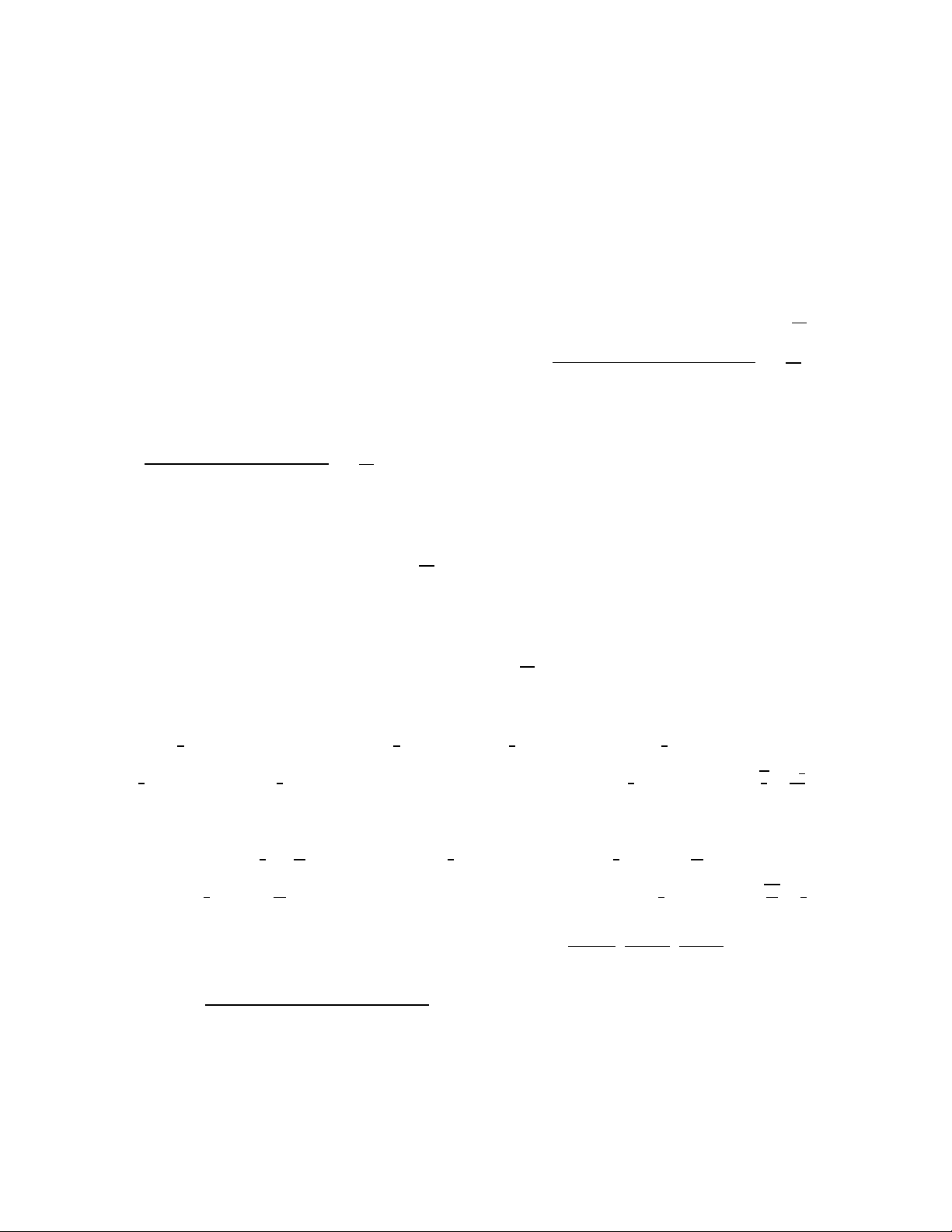
19. Completing squares in the equation 2 + 2 + 2 + 8 − 2 = 8 gives
(2 + 8 + 16) + 2 + (2 − 2 + 1) = 8 + 16 + 1 ⇒ ( + 4)2 + 2 + ( − 1)2 = 25, which we recognize as an √
equation of a sphere with center (−4 0 1) and radius 25 = 5.
20. Completing squares in the equation 2 − 6 + 2 + 4 + 2 + 10 = 0 gives
(2 − 6 + 9) + (2 + 4 + 4) + (2 + 10 + 25) = 9 + 4 + 25 ⇒ ( − 3)2 + ( + 2)2 + ( + 5)2 = 38, which we √
recognize as an equation of a sphere with center (3 −2 −5) and radius 38.
21. Completing squares in the equation 22 − 2 + 22 + 4 + 22 = −1 gives 2
2 2 − + 1 + 2(2 + 2 + 1) + 22 = −1 + 1 + 2 ⇒ 2 − 1 + 2( + 1)2 + 22 = 3 ⇒ 4 2 2 2 √ 2 − 1
+ ( + 1)2 + 2 = 3 , which we recognize as an equation of a sphere with center 1 −1 0 and radius 3 = 3 . 2 4 2 4 2
22. Completing the squares in the equation 42 − 16 + 42 + 6 + 42 = −12 gives 2
4(2 − 4 + 4) + 4 2 + 3 + 9 + 42 = −12 + 16 + 9 ⇒ 4( − 2)2 + 4 + 3 + 42 = 25 ⇒ 2 16 4 4 4 2 ( − 2)2 + + 3
+ 2 = 25 , which we recognize as the equation of a sphere with center 2 − 3 0 and radius 25 = 5 . 4 16 4 16 4
23. If the midpoint of the line segment from 1 + 2 1 + 2 1 + 2
1(1 1 1) to 2(2 2 2) is = , 2 2 2
then the distances |1| and |2| are equal, and each is half of |12|. We verify that this is the case: |12| =
(2 − 1)2 + (2 − 1)2 + (2 − 1)2 [continued] c
° 2021 Cengage Learning. All Rights Reserved. May not be scanned, copied, or duplicated, or posted to a publicly accessible website, in whole or in part.
SECTION 12.1 THREE-DIMENSIONAL COORDINATE SYSTEMS ¤ 1195 2 2 2 | 1 1 1 1| = ( + ( + ( 2 1 + 2) − 1 2 1 + 2) − 1 2 1 + 2) − 1 2 2 2 2 = 1 + 1 + 1 = 1 ( 2 2 − 1 2 1 2 2 − 1 2 1 2 2 − 1 2 1 2
2 − 1)2 + (2 − 1)2 + (2 − 1)2 = 1 ( | 2
2 − 1)2 + (2 − 1)2 + (2 − 1)2 = 1 2 12| 2 2 2 |2| = 2 − 1 ( + ( + ( 2 1 + 2) 2 − 1 2 1 + 2) 2 − 1 2 1 + 2) 2 2 2 2 = 1 + 1 + 1 = 1 ( 2 2 − 1 2 1 2 2 − 1 2 1 2 2 − 1 2 1 2
2 − 1)2 + (2 − 1)2 + (2 − 1)2 = 1 ( | 2
2 − 1)2 + (2 − 1)2 + (2 − 1)2 = 1 2 12|
So is indeed the midpoint of 12.
24. By Exercise 23(a), the midpoint of the diameter that has endpoints (5 4 3) and (1 6 −9) (and thus the center of the sphere) is 5 + 1 4 + 6 3 + (−9)
= (3 5 −3). The radius is half the diameter, so 2 2 2 √ √ = 1
(1 − 5)2 + (6 − 4)2 + (−9 − 3)2 = 1 164 =
41. Therefore, an equation of the sphere is 2 2
( − 3)2 + ( − 5)2 + ( + 3)2 = 41.
25. (a) Since the sphere touches the plane, its radius is the distance from its center, (−1 4 5), to the plane, which is 5.
Therefore, an equation is ( + 1)2 + ( − 4)2 + ( − 5)2 = 25.
(b) Since the sphere touches the plane, its radius is the distance from its center, (−1 4 5), to the plane, which is 1.
Therefore, an equation is ( + 1)2 + ( − 4)2 + ( − 5)2 = 1.
(c) Since the sphere touches the plane, its radius is the distance from its center, (−1 4 5), to the plane, which is 4.
Therefore, an equation is ( + 1)2 + ( − 4)2 + ( − 5)2 = 16.
26. The shortest distance from the center, (7 3 8), to any of the three coordinate planes is 3, which is the distance to the plane.
Therefore, an equation of the sphere is ( − 7)2 + ( − 3)2 + ( − 8)2 = 9.
27. The equation = −2 represents a plane, parallel to the plane and 2 units below it.
28. The equation = 3 represents a plane, parallel to the plane and 3 units in front of it.
29. The inequality ≥ 1 represents a halfspace consisting of all the points on or to the right of the plane = 1.
30. The inequality 4 represents a halfspace consisting of all the points behind the plane = 4.
31. The inequality −1 ≤ ≤ 2 represents all points on or between the vertical planes = −1 and = 2.
32. The equation = represents a plane, perpendicular to the plane, and intersecting the plane in the line = , = 0.
33. Because = −1, all points in the region must lie in the horizontal plane = −1. In addition, 2 + 2 = 4, so the region
consists of all points that lie on a circle with radius 2 and center on the axis that is contained in the plane = −1. c
° 2021 Cengage Learning. All Rights Reserved. May not be scanned, copied, or duplicated, or posted to a publicly accessible website, in whole or in part. 1196
¤ CHAPTER 12 VECTORS AND THE GEOMETRY OF SPACE
34. Here 2 + 2 = 4 with no restrictions on , so a point in the region must lie on a circle of radius 2, center on the axis, but it
could be in any horizontal plane = (parallel to the plane). Thus the region consists of all possible circles 2 + 2 = 4,
= and is therefore a circular cylinder with radius 2 whose axis is the axis.
35. The inequality 2 + 2 ≤ 25 is equivalent to 2 + 2 ≤ 5, which describes the set of all points in 3 whose distance from
the axis is at most 5. Thus, the inequality represents the region consisting of all points on or inside a circular cylinder of
radius 5 with axis the axis. √
36. The inequality 2 + 2 ≤ 25 is equivalent to 2 + 2 ≤ 5, which describes the set of all points in 3 whose distance from
the axis is at most 5. Further, 0 ≤ ≤ 2 consists of the points on or between the planes = 0 and = 2. Thus, the
inequalities represent the region consisting of all points on or inside a circular cylinder of radius 5 with axis the axis from = 0 to = 2.
37. The equation 2 + 2 + 2 = 4 is equivalent to
2 + 2 + 2 = 2, so the region consists of those points whose distance
from the origin is 2. This is the set of all points on a sphere with radius 2 and center (0 0 0).
38. The inequality 2 + 2 + 2 ≤ 4 is equivalent to 2 + 2 + 2 ≤ 2, so the region consists of those points whose distance
from the origin is at most 2. This is the set of all points on or inside a sphere with radius 2 and center (0 0 0). √
39. The inequalities 1 ≤ 2 + 2 + 2 ≤ 5 are equivalent to 1 ≤ 2 + 2 + 2 ≤
5, so the region consists of those points √
whose distance from the origin is at least 1 and at most 5. This is the set of all points on or between spheres with radii 1 and √5 and centers (000). √
40. The inequalities 1 ≤ 2 + 2 ≤ 5 are equivalent to 1 ≤ 2 + 2 ≤
5, which represents the set of all points in 3 whose √
distance is at least 1 and at most 5 from the axis. Thus, the region consists of all points on or between a circular cylinder of √
radius 1 and a circular cylinder of radius 5 with axis the axis.
41. The inequalities 0 ≤ ≤ 3, 0 ≤ ≤ 3, 0 ≤ ≤ 3 represent the set of all points in 3 that lie on or between the planes = 3,
= 3, = 3 in the first octant. Thus, the region is a cube with dimensions 3 × 3 × 3.
42. The inequality 2 + 2 + 2 2 ⇔ 2 + 2 + ( − 1)2 1 is equivalent to 2 + 2 + ( − 1)2 1, so the region
consists of those points whose distance from the point (0 0 1) is greater than 1. This is the set of all points outside the sphere
with radius 1 and center (0 0 1).
43. This describes all points whose coordinate is between 0 and 5, that is, 0 5.
44. For any point on or above the disk in the plane with center the origin and radius 2 we have 2 + 2 ≤ 4. Also each point
lies on or between the planes = 0 and = 8, so the region is described by 2 + 2 ≤ 4, 0 ≤ ≤ 8.
45. This describes a region all of whose points have a distance to the origin which is greater than , but smaller than . So
inequalities describing the region are
2 + 2 + 2 , or 2 2 + 2 + 2 2. c
° 2021 Cengage Learning. All Rights Reserved. May not be scanned, copied, or duplicated, or posted to a publicly accessible website, in whole or in part.
SECTION 12.1 THREE-DIMENSIONAL COORDINATE SYSTEMS ¤ 1197
46. The solid sphere itself is represented by
2 + 2 + 2 ≤ 2. Since we want only the upper hemisphere, we restrict the
coordinate to nonnegative values. Then inequalities describing the region are
2 + 2 + 2 ≤ 2, ≥ 0, or
2 + 2 + 2 ≤ 4, ≥ 0.
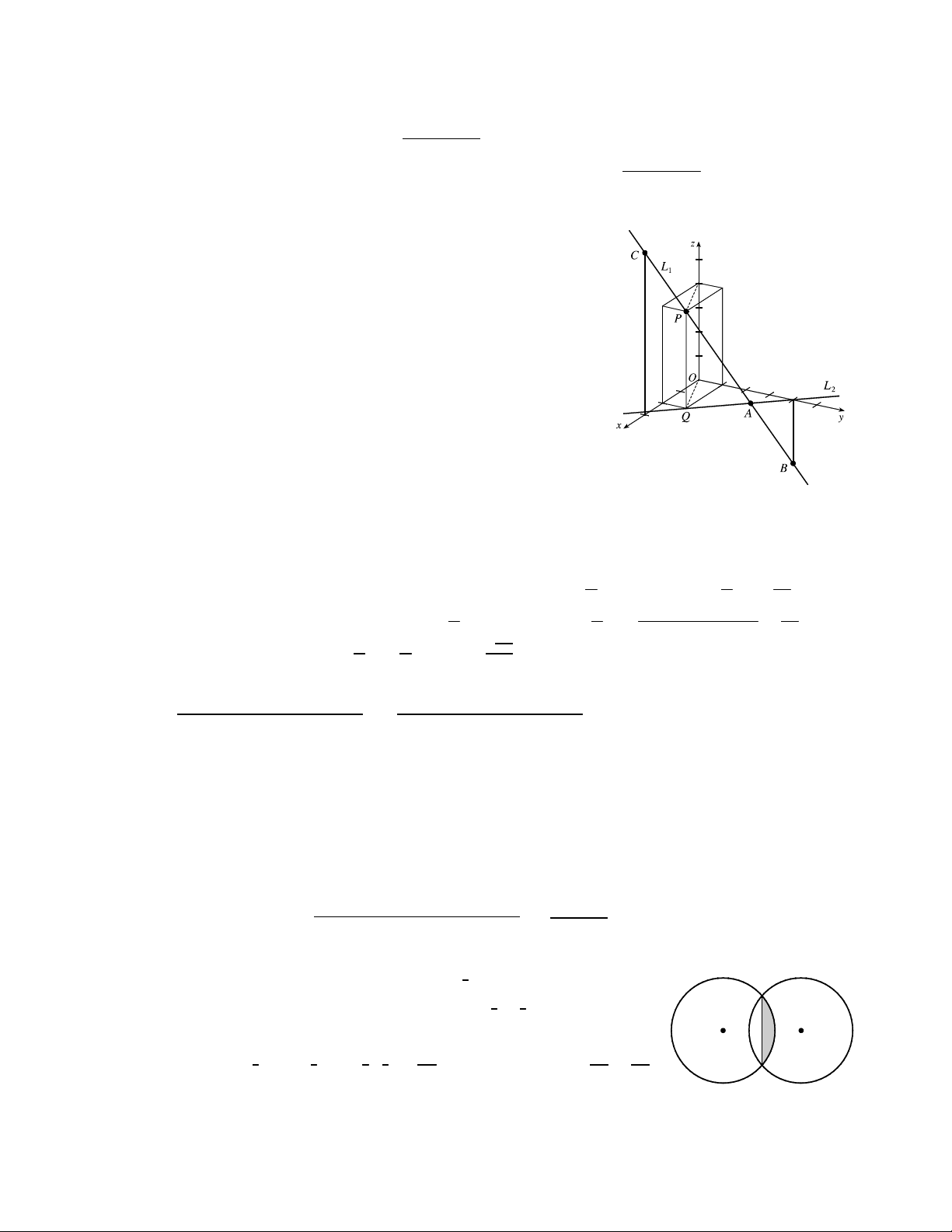
47. (a) To find the and coordinates of the point , we project it onto 2
and project the resulting point onto the and axes. To find the
coordinate, we project onto either the plane or the plane
(using our knowledge of its or coordinate) and then project the
resulting point onto the axis. (Or, we could draw a line parallel to
from to the axis.) The coordinates of are (2 1 4).
(b) is the intersection of 1 and 2, is directly below the
intercept of 2, and is directly above the intercept of 2.
48. Let = ( ). Then 2 | | = | | ⇔ 4 | |2 = | |2 ⇔
4 ( − 6)2 + ( − 2)2 + ( + 2)2 = ( + 1)2 + ( − 5)2 + ( − 3)2 ⇔
4 2 − 12 + 36 − 2 − 2 + 4 2 − 4 + 4 − 2 + 10 + 4 2 + 4 + 4 − 2 + 6 = 35 ⇔
32 − 50 + 32 − 6 + 32 + 22 = 35 − 144 − 16 − 16 ⇔ 2 − 50 + 2 − 2 + 2 + 22 = − 141 . 3 3 3
By completing the square three times we get 2 2 − 25 + ( − 1)2 + + 11
= −423 + 625 + 9 + 121 = 332 , which is an 3 3 9 9 √
equation of a sphere with center 25 1 −11 and radius 332 . 3 3 3
49. We need to find a set of points ( ) | | = | | .
( + 1)2 + ( − 5)2 + ( − 3)2 =
( − 6)2 + ( − 2)2 + ( + 2)2 ⇒
( + 1)2 + ( − 5)2 + ( − 3)2 = ( − 6)2 + ( − 2)2 + ( + 2)2 ⇒
2 + 2 + 1 + 2 − 10 + 25 + 2 − 6 + 9 = 2 − 12 + 36 + 2 − 4 + 4 + 2 + 4 + 4 ⇒ 14 − 6 − 10 = 9.
Thus, the set of points is a plane perpendicular to the line segment joining and (since this plane must contain the
perpendicular bisector of the line segment ).
50. Completing the square three times in the first equation gives ( + 2)2 + ( − 1)2 + ( + 2)2 = 22, a sphere with center
(−2 1 −2) and radius 2. The second equation is that of a sphere with center (0 0 0) and radius 2. The distance between the √ centers of the spheres is
(−2 − 0)2 + (1 − 0)2 + (−2 − 0)2 =
4 + 1 + 4 = 3. Since the spheres have the same radius,
the volume inside both spheres is symmetrical about the plane containing the circle of intersection of the spheres. The
distance from this plane to the center of the circles is 3 . So the region inside both 2
spheres consists of two caps of spheres of height = 2 − 3 = 1 . From 2 2
Exercise 6.2.61, the volume of a cap of a sphere is 2
= 2 − 1 = 1
2 − 1 · 1 = 11 . So the total volume is 2 · 11 = 11 . 3 2 3 2 24 24 12 c
° 2021 Cengage Learning. All Rights Reserved. May not be scanned, copied, or duplicated, or posted to a publicly accessible website, in whole or in part. 1198
¤ CHAPTER 12 VECTORS AND THE GEOMETRY OF SPACE
51. The sphere 2 + 2 + 2 = 4 has center (0 0 0) and radius 2. Completing squares in 2 − 4 + 2 − 4 + 2 − 4 = −11
gives (2 − 4 + 4) + (2 − 4 + 4) + (2 − 4 + 4) = −11 + 4 + 4 + 4 ⇒ ( − 2)2 + ( − 2)2 + ( − 2)2 = 1,
so this is the sphere with center (2 2 2) and radius 1. The (shortest) distance between the spheres is measured along
the line segment connecting their centers. The distance between (0 0 0) and (2 2 2) is √ √
(2 − 0)2 + (2 − 0)2 + (2 − 0)2 = 12 = 2
3, and subtracting the radius of each circle, the distance between the √ √
spheres is 2 3 − 2 − 1 = 2 3 − 3.
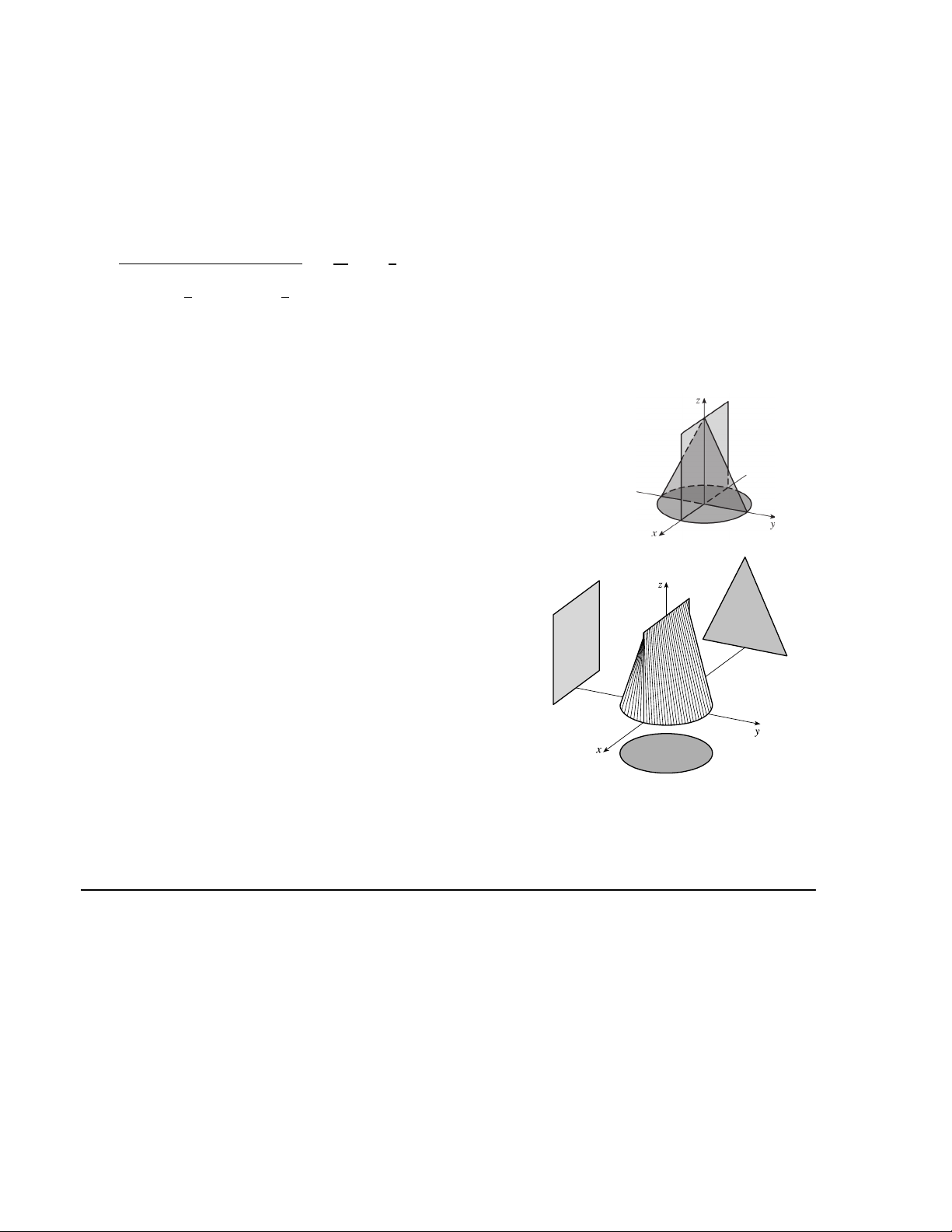
52. There are many different solids that fit the given description. However, any possible solid must have a circular horizontal
crosssection at its top or at its base. Here we illustrate a solid with a circular base in the plane. (A circular crosssection at
the top results in an inverted version of the solid described below.) The vertical
crosssection through the center of the base that is parallel to the plane must be a
square, and the vertical crosssection parallel to the plane (perpendicular to the
square) through the center of the base must be a triangle with two vertices on the circle
and the third vertex at the center of the top side of the square. (See the figure.)
The solid can include any additional points that do not extend beyond these
three "silhouettes" when viewed from directions parallel to the coordinate
axes. One possibility shown here is to draw the circular base and the vertical
square first. Then draw a surface formed by line segments parallel to the
plane that connect the top of the square to the circle.
Problem 8 in the Problems Plus section at the end of the chapter illustrates another possible solid. 12.2 Vectors
1. (a) The cost of a theater ticket is a scalar, because it has only magnitude.
(b) The current in a river is a vector, because it has both magnitude (the speed of the current) and direction at any given location.
(c) If we assume that the initial path is linear, the initial flight path from Houston to Dallas is a vector, because it has both
magnitude (distance) and direction.
(d) The population of the world is a scalar, because it has only magnitude. c
° 2021 Cengage Learning. All Rights Reserved. May not be scanned, copied, or duplicated, or posted to a publicly accessible website, in whole or in part. SECTION 12.2 VECTORS ¤ 1199
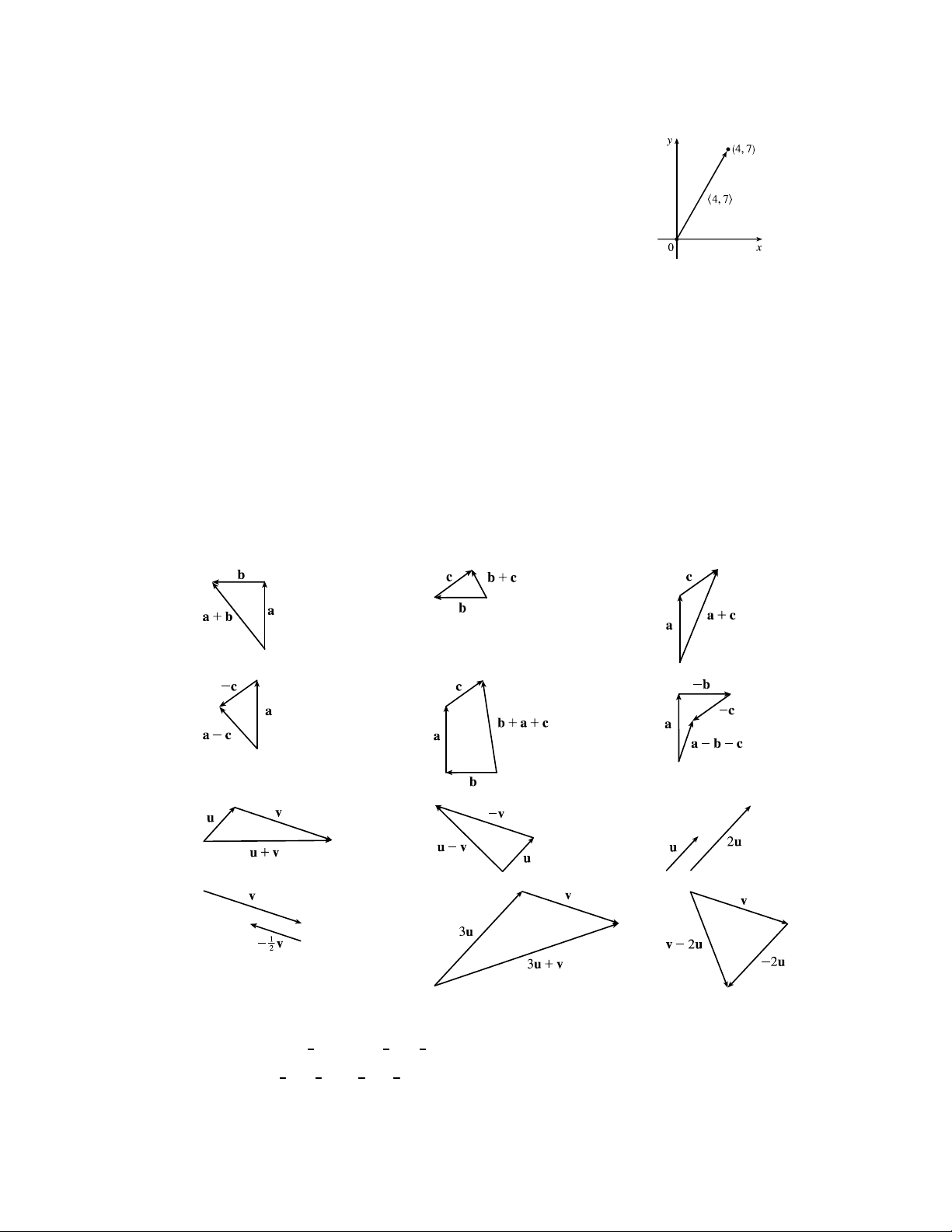
2. If the initial point of the vector h4 7i is placed at the origin, then
h4 7i is the position vector of the point (4 7).
3. Vectors are equal when they share the same length and direction (but not necessarily location). Using the symmetry of the −→ −−→ −−→ −−→ −−→ −−→ −→ −−→
parallelogram as a guide, we see that = , = , = , and = . −−→ −→ −→ −−→
4. (a) The initial point of is positioned at the terminal point of , so by the Triangle Law the sum + is the vector −→
with initial point and terminal point , namely . −−→ −−→ −−→
(b) By the Triangle Law, + is the vector with initial point and terminal point , namely . −−→ −→ −−→ −→ −→ −→
(c) First we consider − as + − . Then since − has the same length as but points in the opposite −→ −→ −−→ −→ −−→ −→ −−→
direction, we have − = and so − = + = . −−→ −→ −→
−−→ −→ −→ −−→ −→ −−→
(d) We use the Triangle Law twice: + + = + + = + = . 5. (a) (b) (c) (d) (e) (f ) 6. (a) (b) (c) (d) (e) (f ) −→
7. Because the tail of d is the midpoint of we have = 2d, and by the Triangle Law, a + 2d = b ⇒
2d = b − a ⇒ d = 1 (b − a) = 1 b − 1 a. Again by the Triangle Law, we have c + d = b so 2 2 2
c = b − d = b − 1 b − 1 a = 1 a + 1 b. 2 2 2 2 c
° 2021 Cengage Learning. All Rights Reserved. May not be scanned, copied, or duplicated, or posted to a publicly accessible website, in whole or in part. 1200
¤ CHAPTER 12 VECTORS AND THE GEOMETRY OF SPACE
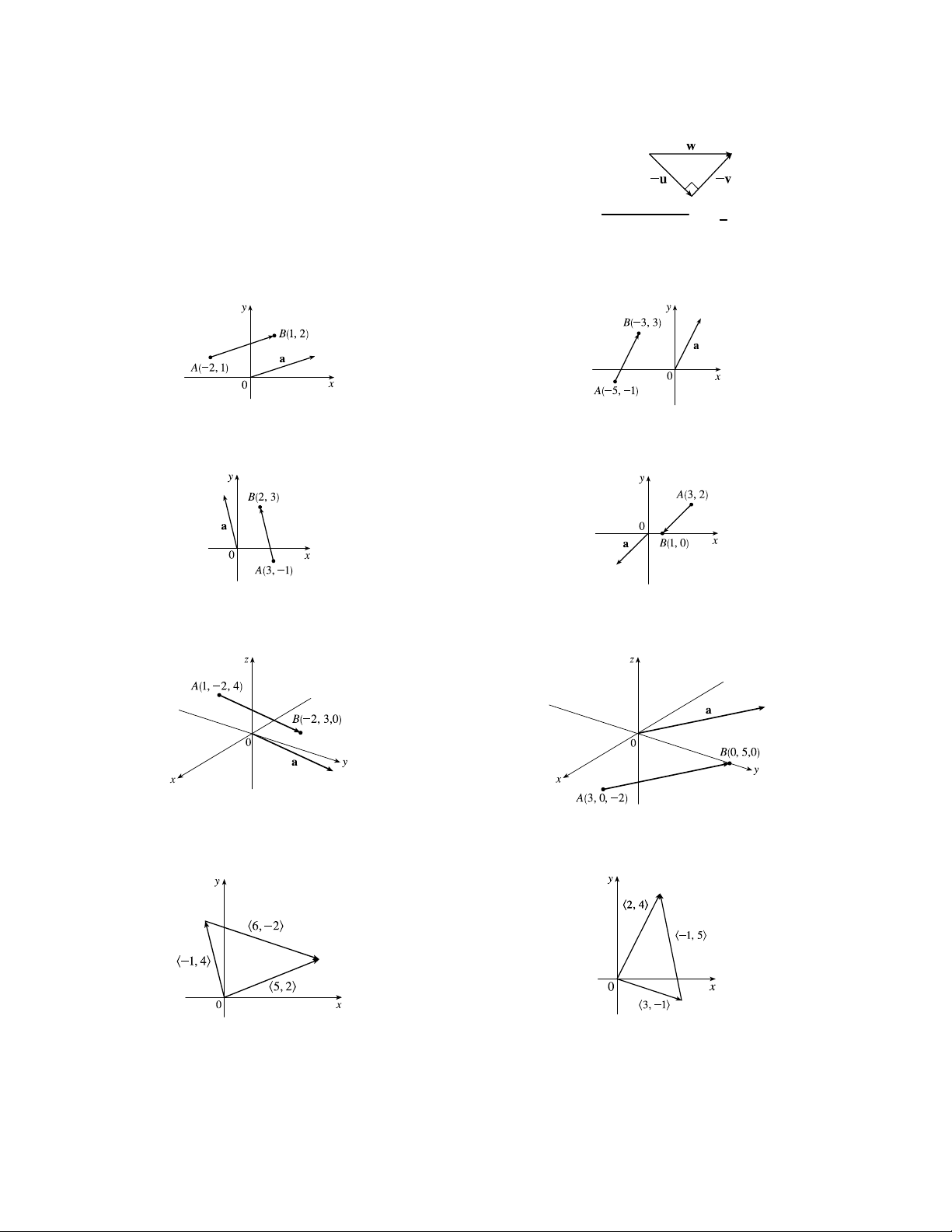
8. We are given u + v + w = 0, so w = (−u) + (−v). (See the figure.)
Vectors −u, −v, and w form a right triangle, so from the Pythagorean Theorem √
we have |−u|2 + |−v|2 = |w|2. But |−u| = |u| = 1 and |−v| = |v| = 1, so |w| = |−u|2 + |−v|2 = 2.
9. a = h1 − (−2) 2 − 1i = h3 1i
10. a = h−3 − (−5) 3 − (−1)i = h2 4i
11. a = h2 − 3 3 − (−1)i = h−1 4i
12. a = h1 − 3 0 − 2i = h−2 −2i
13. a = h−2 − 1 3 − (−2) 0 − 4i = h−3 5 −4i
14. a = h0 − 3 5 − 0 0 − (−2)i = h−3 5 2i
15. h−1 4i + h6 −2i = h−1 + 6 4 + (−2)i = h5 2i
16. h3 −1i + h−1 5i = h3 + (−1) −1 + 5i = h2 4i c
° 2021 Cengage Learning. All Rights Reserved. May not be scanned, copied, or duplicated, or posted to a publicly accessible website, in whole or in part. SECTION 12.2 VECTORS ¤ 1201
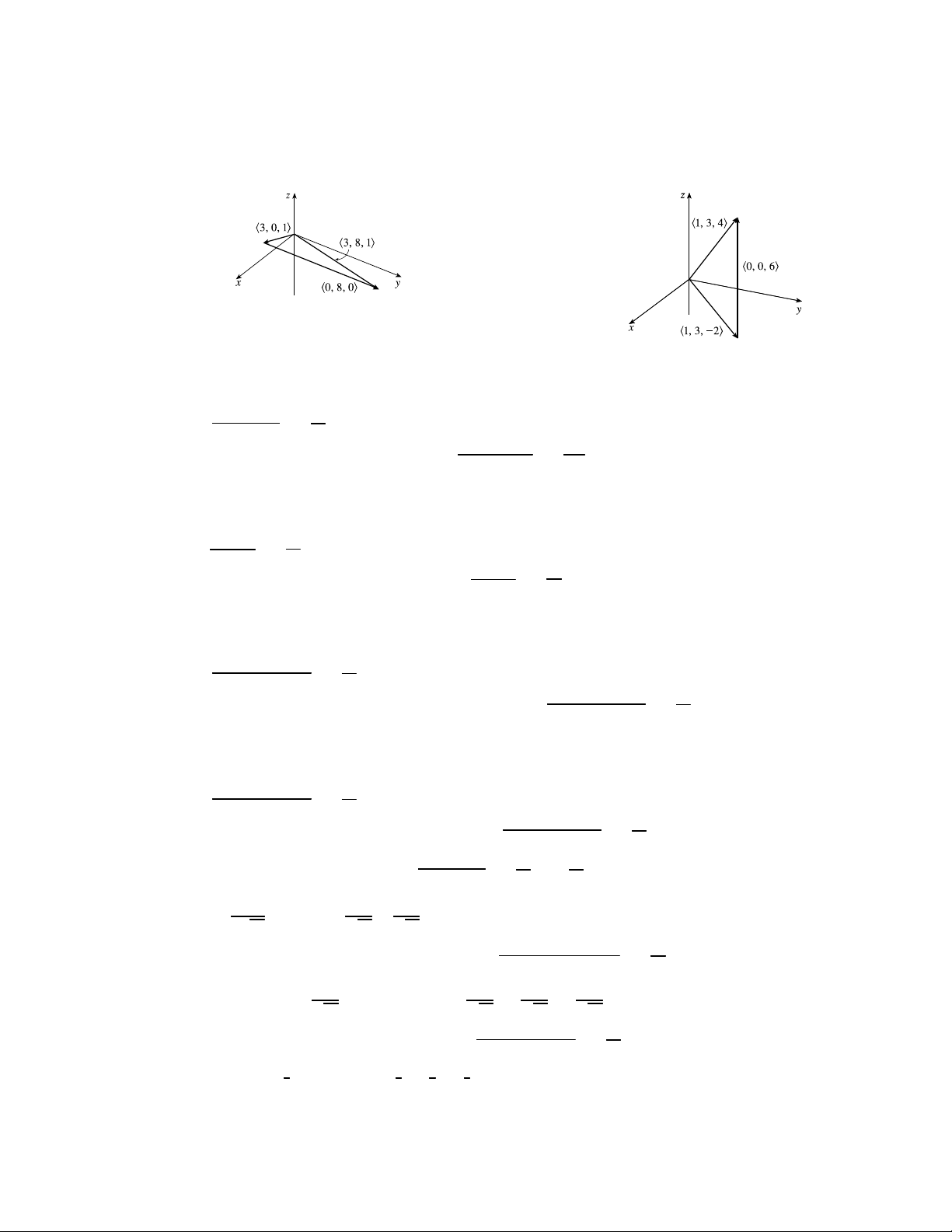
17. h3 0 1i + h0 8 0i = h3 + 0 0 + 8 1 + 0i
18. h1 3 −2i + h0 0 6i = h1 + 0 3 + 0 −2 + 6i = h3 8 1i = h1 3 4i
19. a + b = h−3 4i + h9 −1i = h−3 + 9 4 + (−1)i = h6 3i
4 a + 2 b = 4 h−3 4i + 2 h9 −1i = h−12 16i + h18 −2i = h6 14i √ |a| = (−3)2 + 42 = 25 = 5 √
|a − b| = |h−3 − 9 4 − (−1)i| = |h−12 5i| = (−12)2 + 52 = 169 = 13
20. a + b = (5 i + 3 j) + (−i − 2 j) = 4 i + j
4 a + 2 b = 4 (5 i + 3 j) + 2 (−i − 2 j) = 20 i + 12 j − 2 i − 4 j = 18 i + 8 j √ √ |a| = 52 + 32 = 34 √ √
|a − b| = |(5 i + 3 j) − (−i − 2 j)| = |6 i + 5 j| = 62 + 52 = 61
21. a + b = (4 i − 3 j + 2 k) + (2 i − 4 k) = 6 i − 3 j − 2k
4 a + 2 b = 4 (4 i − 3 j + 2 k) + 2 (2 i − 4 k) = 16 i − 12 j + 8 k + 4 i − 8 k = 20 i − 12 j √ |a| = 42 + (−3)2 + 22 = 29 √
|a − b| = |(4 i − 3 j + 2 k) − (2 i − 4 k)| = |2 i − 3 j + 6 k| = 22 + (−3)2 + 62 = 49 = 7
22. a + b = h8 1 −4i + h5 −2 1i = h8 + 5 1 + (−2) −4 + 1i = h13 −1 −3i
4 a + 2 b = 4 h8 1 −4i + 2 h5 −2 1i = h32 4 −16i + h10 −4 2i = h42 0 −14i √ |a| = 82 + 12 + (−4)2 = 81 = 9 √
|a − b| = |h8 − 5 1 − (−2) −4 − 1i| = |h3 3 −5i| = 32 + 32 + (−5)2 = 43 √ √
23. The vector h6 −2i has length |h6 −2i| = 62 + (−2)2 =
40 = 2 10, so by Equation 4 the unit vector with the same direction is 1 3 1 √ h6 −2i = √ − √ . 2 10 10 10 √
24. The vector −5 i + 3 j − k has length |−5 i + 3 j − k| = (−5)2 + 32 + (−1)2 =
35, so by Equation 4 the unit vector with the same direction is 1 5 3 1 √ (−5 i + 3 j − k) = − √ i + √ j − √ k. 35 35 35 35 √
25. The vector 8 i − j + 4 k has length |8 i − j + 4 k| = 82 + (−1)2 + 42 =
81 = 9, so by Equation 4 the unit vector with
the same direction is 1 (8 i − j + 4 k) = 8 i − 1 j + 4 k. 9 9 9 9 c
° 2021 Cengage Learning. All Rights Reserved. May not be scanned, copied, or duplicated, or posted to a publicly accessible website, in whole or in part. 1202
¤ CHAPTER 12 VECTORS AND THE GEOMETRY OF SPACE √
26. |h6 2 −3i| = 62 + 22 + (−3)2 =
49 = 7, so a unit vector in the direction of h6 2 −3i is u = 1 h6 2 −3i. 7
A vector in the same direction but with length 4 is 4u = 4 · 1 h6 2 −3i = 24 8 −12 . 7 7 7 7 √3 √ 27.
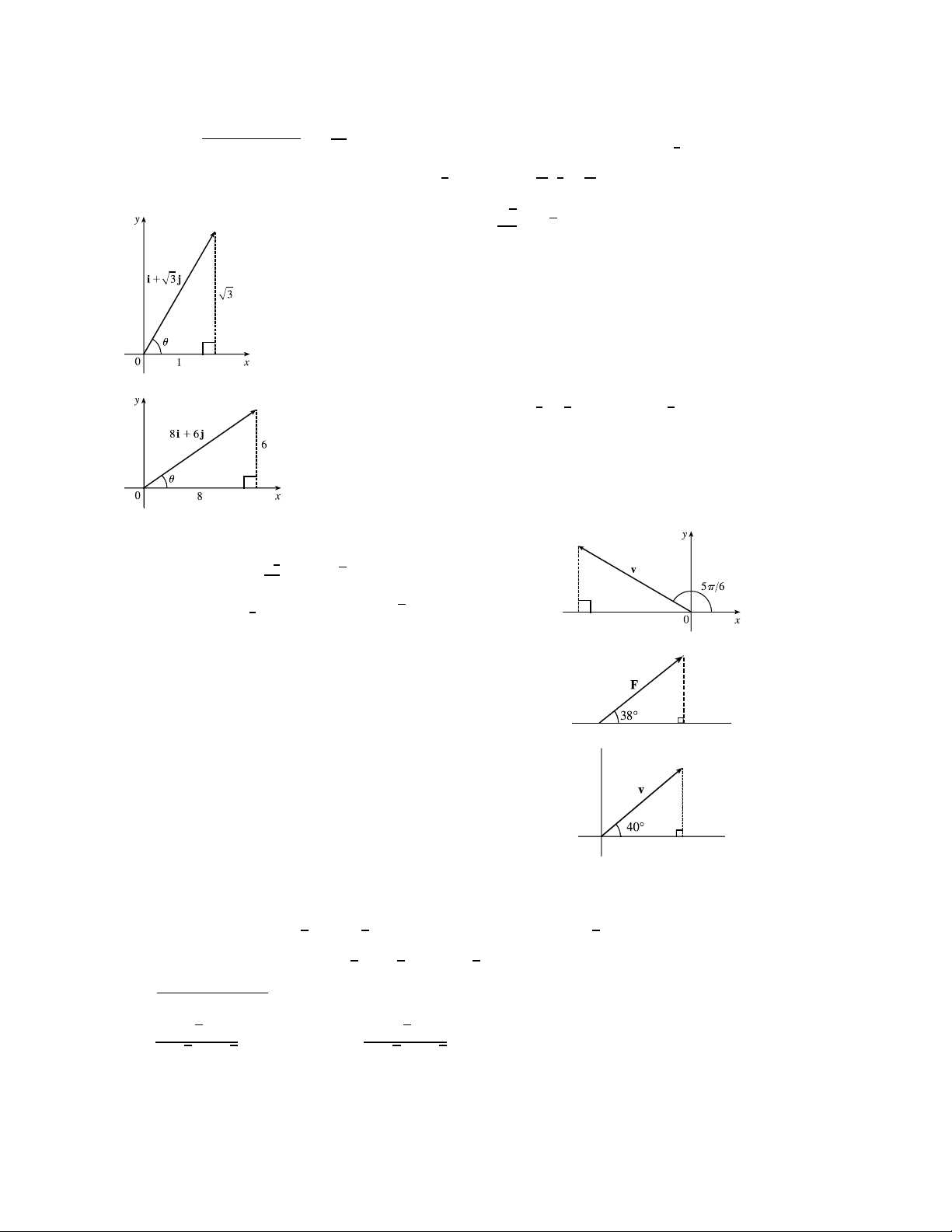
From the figure, we see that tan = = 3 ⇒ = 60◦. 1 28.
From the figure, we see that tan = 6 = 3 , so = tan−1 3 ≈ 369◦. 8 4 4
29. From the figure, we see that the component of v is √ √ 3 1 = |v| cos(56) = 4 −
= −2 3 and the component is 2 √ 1 2 = |v| sin(56) = 4 = 2. Thus, v = −2 3 2 . 2
30. From the figure, we see that the horizontal component of the
force F is |F| cos 38◦ = 50 cos 38◦ ≈ 394 N, and the
vertical component is |F| sin 38◦ = 50 sin 38◦ ≈ 308 N.
31. The velocity vector v makes an angle of 40◦ with the horizontal and
has magnitude equal to the speed at which the football was thrown.
From the figure, we see that the horizontal component of v is
|v| cos 40◦ = 60 cos 40◦ ≈ 4596 fts and the vertical component
is |v| sin 40◦ = 60 sin 40◦ ≈ 3857 fts.
32. The given force vectors can be expressed in terms of their horizontal and vertical components as √ √ √
20 cos 45◦ i + 20 sin 45◦ j = 10 2 i + 10
2 j and 16 cos 30◦ i − 16 sin 30◦ j = 8 3 i − 8 j. The resultant force F √ √ √
is the sum of these two vectors: F = 10 2 + 8 3 i + 10 2 − 8 j ≈ 2800 i + 614 j. Then we have |F| ≈
(2800)2 + (614)2 ≈ 287 lb and, letting be the angle F makes with the positive axis, √ √ 10 2 − 8 10 2 − 8 tan = √ √ ⇒ = tan−1 √ √ ≈ 124◦. 10 2 + 8 3 10 2 + 8 3 c
° 2021 Cengage Learning. All Rights Reserved. May not be scanned, copied, or duplicated, or posted to a publicly accessible website, in whole or in part. SECTION 12.2 VECTORS ¤ 1203
33. The given force vectors can be expressed in terms of their horizontal and vertical components as −300 i and √ √
200 cos 60◦ i + 200 sin 60◦ j = 200 1 i + 200 3 j = 100 i + 100
3 j. The resultant force F is the sum of 2 2 √ √
these two vectors: F = (−300 + 100) i + 0 + 100 3 j = −200 i + 100 3 j. Then we have √ 2 √ √ |F| ≈ (−200)2 + 100 3 = 70,000 = 100
7 ≈ 2646 N. Let be the angle F makes with the √ √ positive 100 3 3 axis. Then tan = = −
and the terminal point of F lies in the second quadrant, so −200 2 √ 3 = tan−1 −
+ 180◦ ≈ −409◦ + 180◦ = 1391◦. 2
34. Let T1 and T2 be the tension vectors corresponding to the support cables as
shown in the figure. In terms of vertical and horizontal components, √ 1 3
T1 = |T1| cos 60◦i + |T1| sin 60◦j = |T1| i + |T1| j 2 2 √ 1 3
T2 = − |T2| cos 60◦i + |T2| sin 60◦j = − |T2| i + |T2| j 2 2
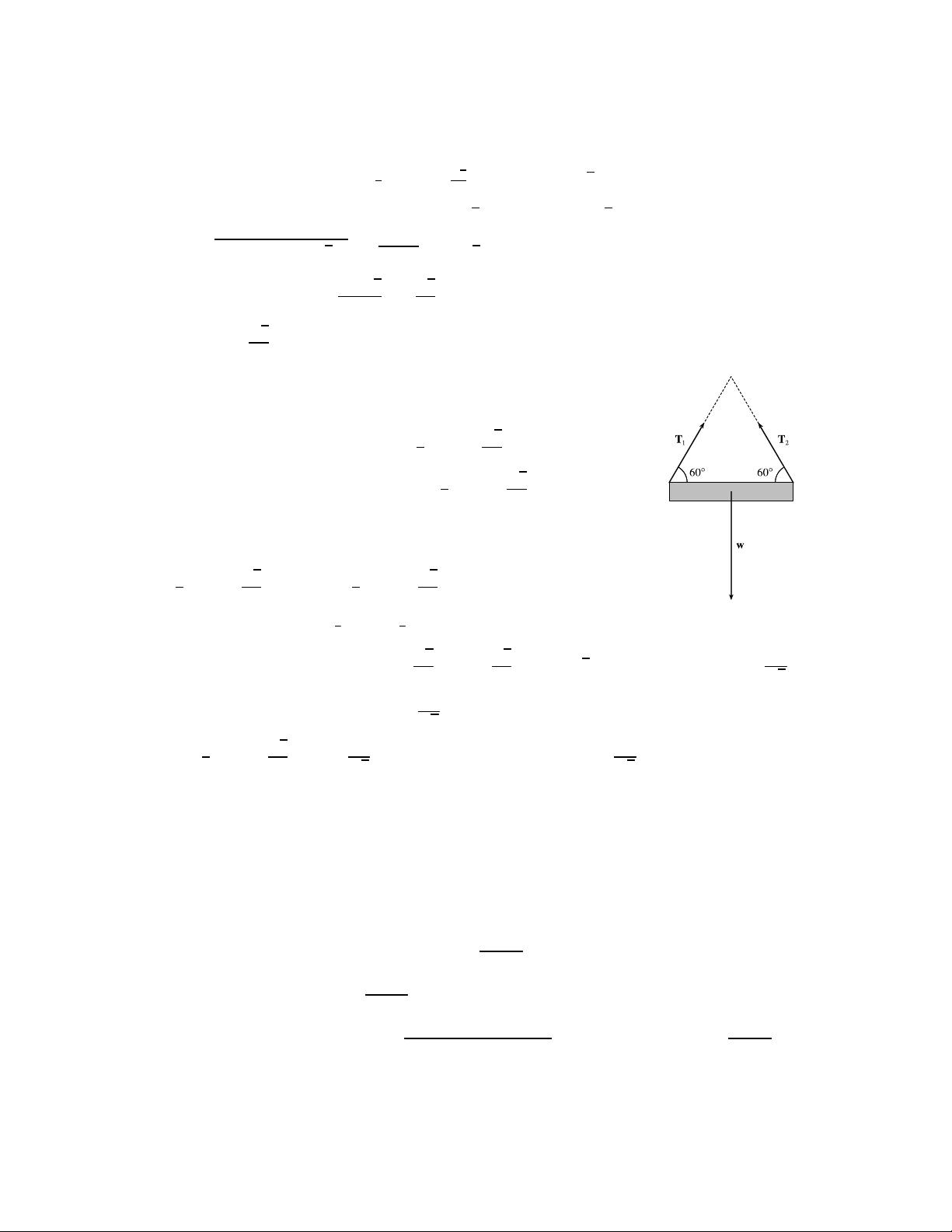
The resultant of these tensions, T1 + T2, counterbalances the weight
w = −500 j. So T1 + T2 = −w = 500 j ⇒ √ √ 1 3 1 3 |T1| i + |T1| j + − |T2| i + |T2| j = 500 j. 2 2 2 2
Equating components gives 1 |T |T 2 1| i − 1 2
2| i = 0, so |T1| = |T2| (as we would expect from the symmetry of the √ √ √ problem). Equating 3 3 500 components, we have |T1| j + |T2| j =
3 |T1| j = 500 j ⇒ |T1| = √ . Thus the 2 2 3 magnitude of each tension is 500
|T1| = |T2| = √ ≈ 28868 lb. The tension vectors are 3 √ 1 3 250 250 T1 = |T1| i +
|T1| j = √ i + 250 j ≈ 14434 i + 250 j and T2 = − √ i + 250 j ≈ −14434 i + 250 j. 2 2 3 3
35. Call the two tension vectors T2 and T3, corresponding to the ropes of length 2 m and 3 m. In terms of vertical and horizontal components,
T2 = − |T2| cos 50◦i + |T2| sin 50◦j (1) and
T3 = |T3| cos 38◦i + |T3| sin 38◦j (2)
The resultant of these forces, T2 + T3, counterbalances the weight of the hoist (which is −350 j), so T2 + T3 = 350 j ⇒
(− |T2| cos 50◦ + |T3| cos 38◦) i + (|T2| sin 50◦ + |T3| sin 38◦) j = 350 j. Equating components, we have cos 38◦
− |T2| cos 50◦ + |T3| cos 38◦ = 0 ⇒ |T2| = |T3|
and |T2| sin 50◦ + |T3| sin 38◦ = 350. Substituting the first cos 50◦ equation into the second gives cos 38◦ |T3|
sin 50◦ + |T3| sin 38◦ = 350 ⇒ |T3| (cos 38◦ tan 50◦ + sin 38◦) = 350, so cos 50◦
the magnitudes of the tensions are 350 cos 38◦ |T3| = ≈ 22511 N and |T2| = |T3| ≈ 27597 N.
cos 38◦ tan 50◦ + sin 38◦ cos 50◦
Finally, from (1) and (2), the tension vectors are T2 ≈ −17739 i + 21141 j and T3 ≈ 17739 i + 13859 j. c
° 2021 Cengage Learning. All Rights Reserved. May not be scanned, copied, or duplicated, or posted to a publicly accessible website, in whole or in part. 1204
¤ CHAPTER 12 VECTORS AND THE GEOMETRY OF SPACE
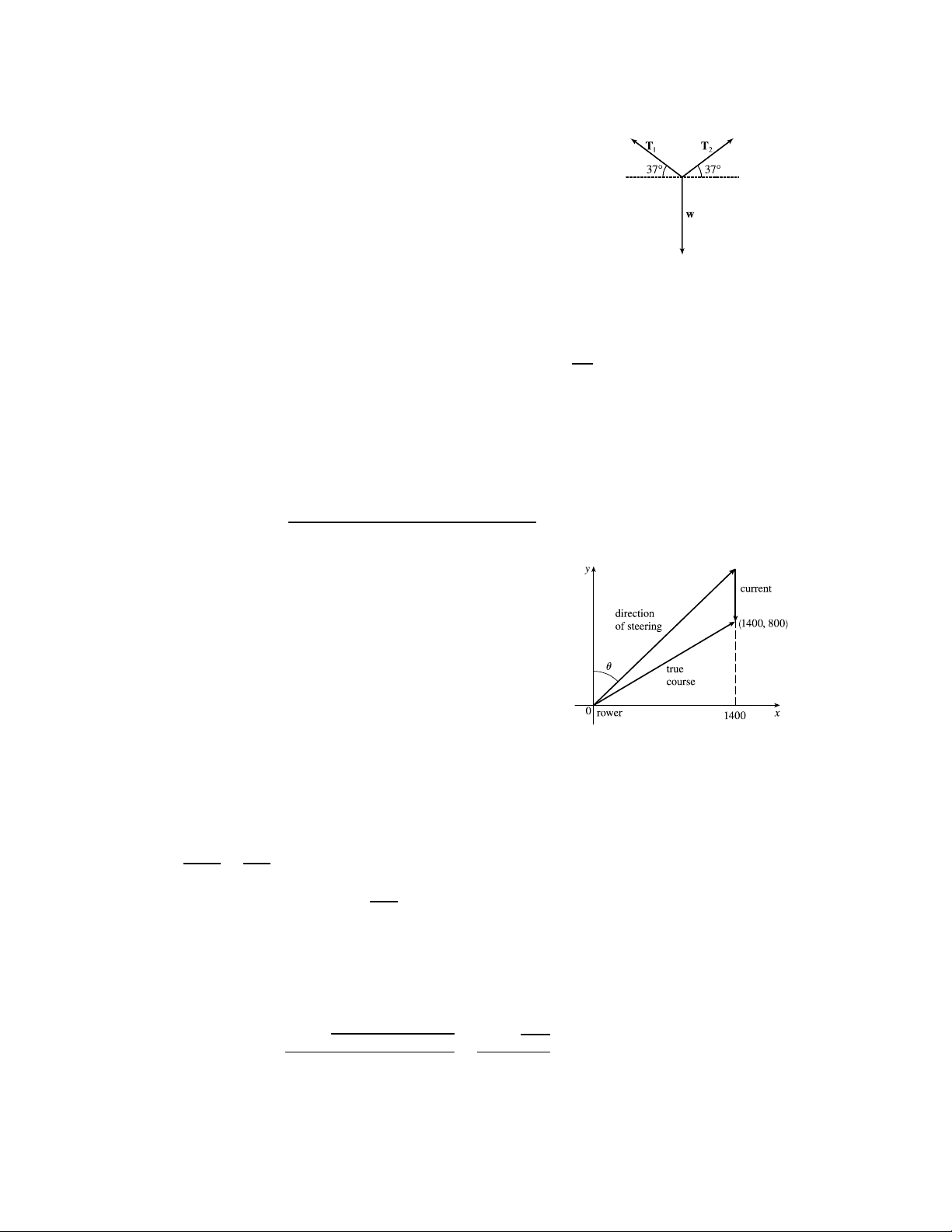
36. We can consider the weight of the chain to be concentrated at its midpoint. The
forces acting on the chain then are the tension vectors T1, T2 in each end of the
chain and the weight w, as shown in the figure. We know |T1| = |T2| = 25 N
so, in terms of vertical and horizontal components, we have
T1 = −25 cos 37◦i + 25 sin 37◦j
T2 = 25 cos 37◦i + 25 sin 37◦j
The resultant vector T1 + T2 of the tensions counterbalances the weight w giving T1 + T2 = −w Since w = − |w| j,
we have (−25 cos 37◦i + 25 sin 37◦j) + (25 cos 37◦i + 25 sin 37◦j) = |w| j ⇒ 50 sin 37◦j = |w| j ⇒
|w| = 50 sin 37◦ ≈ 301. So the weight is 301 N, and since = , the mass is 301 ≈ 307 kg. 98
37. Let v1, v2, and v3 be the force vectors where |v1| = 25, |v2| = 12, and |v3| = 4. Set up coordinate axes so that the object is
at the origin and v1, v2 lie in the plane. We can position the vectors so that v1 = 25 i, v2 = 12 cos 100◦ i + 12 sin 100◦ j,
and v3 = 4 k. The magnitude of a force that counterbalances the three given forces must match the magnitude of the resultant
force. We have v1 + v2 + v3 = (25 + 12 cos 100◦) i + 12 sin 100◦ j + 4 k, so the counterbalancing force must have magnitude |v1 + v2 + v3| =
(25 + 12 cos 100◦)2 + (12 sin 100◦)2 + 42 ≈ 261 N.
38. (a) Set up coordinate axes so that the rower is at the origin, the channel is
bordered by the axis and the line = 1400, and the current flows in the
negative direction. The rower wants to reach the point (1400 800). Let
be the angle between the positive axis in the direction she should steer. (See the figure.)
In still water, the rower has velocity v = h7 sin 7 cos i and the velocity of the current is v = h0 −3i, so the true
course of the rower is determined by the velocity vector v = v + v = h7 sin 7 cos − 3i. Let be the time in seconds
after the rower departs. Then the position of the rower is given by v and the rower crosses the channel when
v = h7 sin 7 cos − 3i = h1400 800i ⇒ 7 sin = 1400 and (7 cos − 3) = 800 Then 1400 200 = = and substituting gives 7 sin sin 200 (7 cos − 3) = 800
⇒ 7 cos − 3 = 4 sin (1) sin Squaring both sides, we have
49 cos2 − 42 cos + 9 = 16 sin2 = 16(1 − cos2 )
65 cos2 − 42 cos − 7 = 0 The quadratic formula gives √ 42 ± (−42)2 − 4(65)(−7) 42 ± 3584 cos = = ≈ 078359 or −013743 2(65) 130 [continued] c
° 2021 Cengage Learning. All Rights Reserved. May not be scanned, copied, or duplicated, or posted to a publicly accessible website, in whole or in part. SECTION 12.2 VECTORS ¤ 1205
The acute value for is approximately cos−1(078359) ≈ 384◦. Thus, the rower should steer in the direction that is
384◦ from the bank, toward upstream.
Alternate solution: We could solve (1) graphically by plotting 1 = 7 cos − 3 and 2 = 4 sin on a graphing device and
finding the approximate intersection point (06704 49702). Thus, ≈ 06704 radians, or equivalently, 384◦.
(b) From part (a) we know the trip is completed when 200 =
. As ≈ 384◦, the time required is approximately sin 200
≈ 3219 seconds or 54 minutes. sin(384◦)
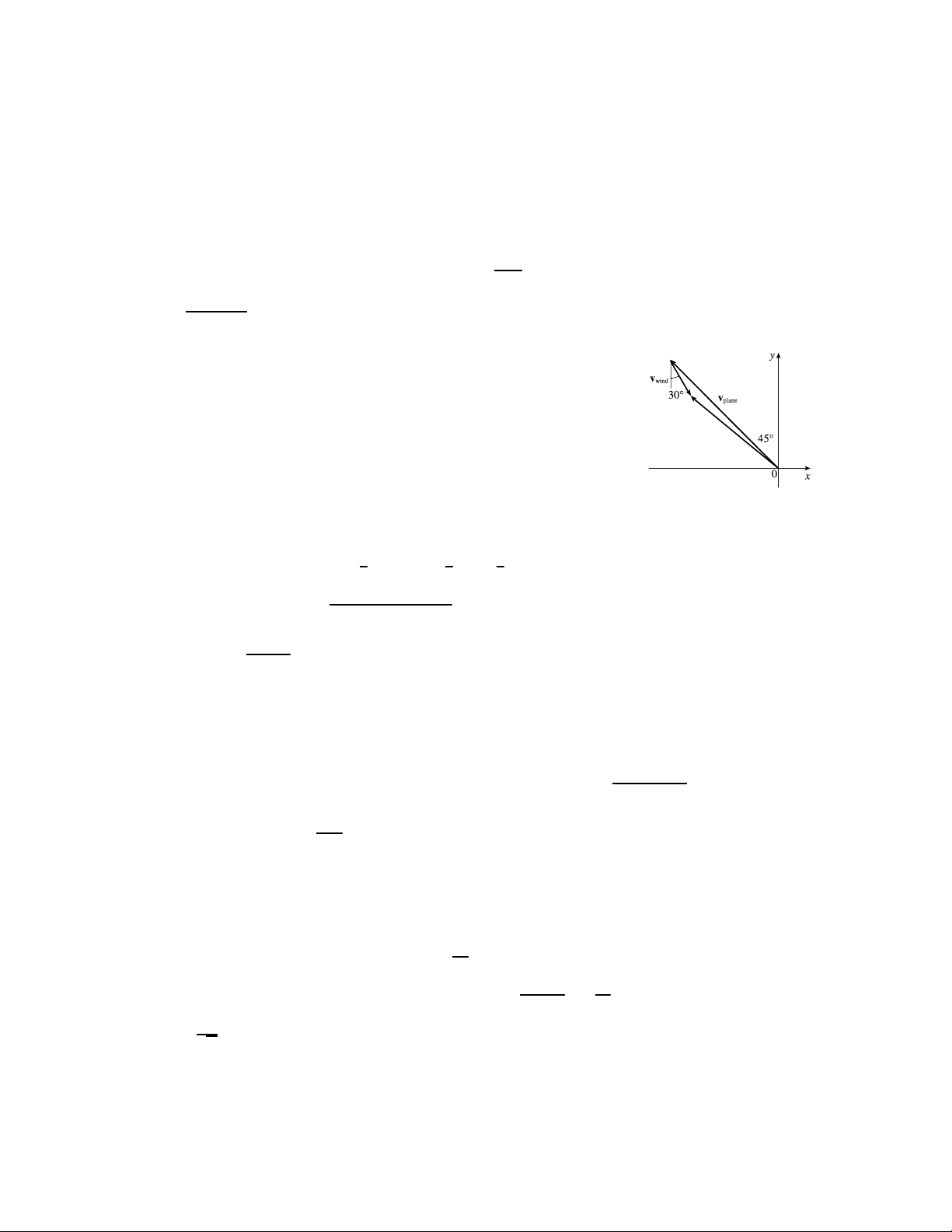
39. Set up the coordinate axes so that north is the positive direction and west
is the negative direction. With respect to the still air, the velocity of the
plane can be written as vplane = h−180 sin 45◦ 180 cos 45◦i and the
velocity of the wind is given by vwind = h35 sin 30◦ −35 cos 30◦i. (See the figure.)
Then the velocity vector of the plane relative to the ground is
v = vplane + vwind = h−180 sin 45◦ 180 cos 45◦i + h35 sin 30◦ −35 cos 30◦i √ √ √
= −90 2 + 352 90 2 − 35 32 ≈ h−1098 970i The ground speed is |v| ≈
(−1098)2 + (970)2 ≈ 1465 mih. The angle the velocity vector makes with the axis is about 970 tan−1
≈ −415◦ and −415◦ + 180◦ = 1385◦. Therefore, the course of the plane is about −1098
N (1385 − 90)◦ W or N 485◦ W.
40. With respect to the water’s surface, the dog’s velocity is the sum of the velocity of the ship with respect to the water and the
velocity of the dog with respect to the ship. If we let north be the positive direction and west be the negative direction, we
have v = h−32 0i + h0 4i = h−32 4i. Then, the speed of the dog is |v| =
(−32)2 + 42 ≈ 322 kmh. The vector v makes an angle of 4 tan−1
≈ −71◦ and −71◦ + 180◦ = 1729◦. Therefore, the dog’s direction is −32
N (1729 − 90)◦ W or N 829◦ W.
41. The slope of the tangent line to the graph of = 2 at the point (2 4) is = 2 = 4 =2 =2 √ √
Thus, a parallel vector is i + 4 j, which has length |i + 4 j| = 12 + 42 = 17, and so unit vectors parallel to the tangent line are ± 1 √ (i + 4 j). 17 c
° 2021 Cengage Learning. All Rights Reserved. May not be scanned, copied, or duplicated, or posted to a publicly accessible website, in whole or in part. 1206
¤ CHAPTER 12 VECTORS AND THE GEOMETRY OF SPACE
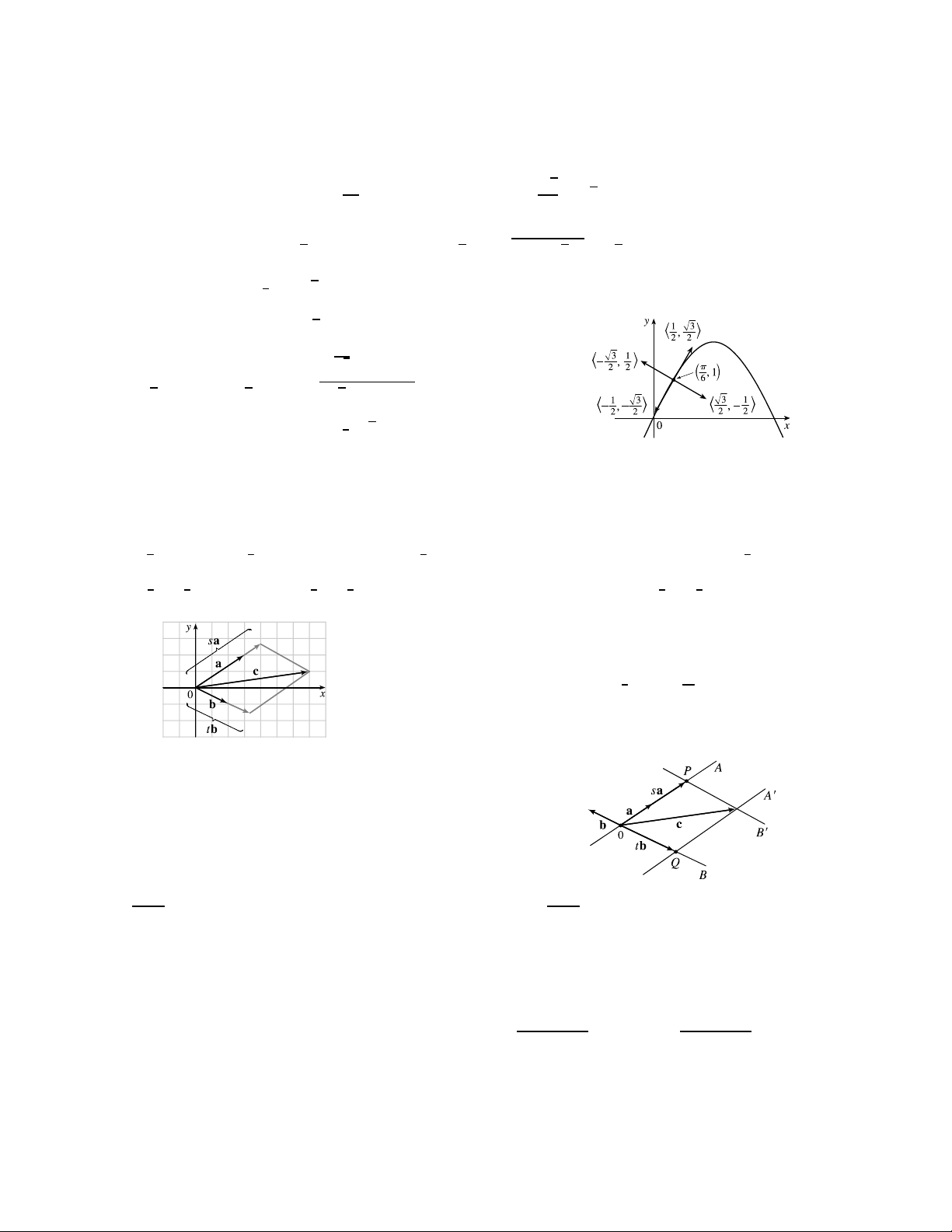
42. (a) The slope of the tangent line to the graph of = 2 sin at the point (6 1) is √ 3 √ = 2 cos = 2 · = 3 2 =6 =6 √ √ √ √ Thus, a parallel vector is 2 i + 3 j, which has length i + 3 j = 12 + 3 =
4 = 2, and so unit vectors parallel √
to the tangent line are ±1 i + 3 j . 2 √
(b) The slope of the tangent line is 3, so the slope of a line (c)
perpendicular to the tangent line is − 1 √ and a vector in this direction 3 √ √ is 2
3 i − j. Since √3 i − j = 3 + (−1)2 = 2, unit vectors √
perpendicular to the tangent line are ±1 3 i − j . 2 −→ −−→ −→ −→ −−→ −→ −→ −→ −→ −→ −→ −→
43. By the Triangle Law, + = . Then + + = + , but + = + − = 0. −→ −−→ −→
So + + = 0. −→ −→ −−→ −→ −→ −→ −→ −→ −−→ −−→ −−→ −→
44. = 1 and = 2 . c = + = a + 1 ⇒ = 3 c − 3 a. c = + = + 2 ⇒ 3 3 3 3 −→ −→ −→
= 3 c − 3 b. = −, so 3 c − 3 b = 3 a − 3 c ⇔ c + 2 c = 2 a + b ⇔ c = 2 a + 1 b. 2 2 2 2 3 3 45. (a), (b)
(c) From the sketch, we estimate that ≈ 13 and ≈ 16.
(d) c = a + b ⇔ 7 = 3 + 2 and 1 = 2 − .
Solving these equations gives = 9 and = 11 . 7 7
46. Draw a, b, and c emanating from the origin. Extend a and b to form lines
and , and draw lines 0 and 0 parallel to these two lines through the terminal
point of c. Since a and b are not parallel, and 0 must meet (at ), and 0 −−→ −−→
and must also meet (at ). Now we see that + = c, so if −−→ −−→ −−→ =
or its negative, if a points in the direction opposite and =
(or its negative, as in the diagram), |a| |b|
then c = a + b, as required.
Argument using components: Since a, b, and c all lie in the same plane, we can consider them to be vectors in two
dimensions. Let a = h1 2i, b = h1 2i, and c = h1 2i. We need 1 + 1 = 1 and 2 + 2 = 2. Multiplying the first equation by 21 − 12 21 − 12
2 and the second by 1 and subtracting, we get = . Similarly = . 21 − 12 21 − 12
Since a 6= 0 and b 6= 0 and a is not a scalar multiple of b, the denominator is not zero. c
° 2021 Cengage Learning. All Rights Reserved. May not be scanned, copied, or duplicated, or posted to a publicly accessible website, in whole or in part. SECTION 12.2 VECTORS ¤ 1207
47. |r − r0| is the distance between the points ( ) and (0 0 0), so the set of points is a sphere with radius 1 and center (0 0 0).
Alternate method: |r − r0| = 1 ⇔
( − 0)2 + ( − 0)2 + ( − 0)2 = 1 ⇔
( − 0)2 + ( − 0)2 + ( − 0)2 = 1, which is the equation of a sphere with radius 1 and center (0 0 0).
48. Let 1 and 2 be the points with position vectors r1 and r2 respectively. Then |r − r1| + |r − r2| is the sum of the distances
from ( ) to 1 and 2. Since this sum is constant, the set of points ( ) represents an ellipse with foci 1 and 2. The
condition |r1 − r2| assures us that the ellipse is not degenerate.
49. a + (b + c) = h1 2i + (h1 2i + h1 2i) = h1 2i + h1 + 1 2 + 2i
= h1 + 1 + 1 2 + 2 + 2i = h(1 + 1) + 1 (2 + 2) + 2i
= h1 + 1 2 + 2i + h1 2i = (h1 2i + h1 2i) + h1 2i = (a + b) + c
50. Algebraically:
(a + b) = (h1 2 3i + h1 2 3i) = h1 + 1 2 + 2 3 + 3i
= h (1 + 1) (2 + 2) (3 + 3)i = h1 + 1 2 + 2 3 + 3i
= h1 2 3i + h1 2 3i = a + b Geometrically: −−→ −→
According to the Triangle Law, if a = and b = , then −→ −→
a + b = . Construct triangle as shown so that = a and −→
= b. (We have drawn the case where 1.) By the Triangle Law, −→
= a + b. But triangle and triangle are similar triangles −→ −→
because b is parallel to b. Therefore, and are parallel and, in fact, −→ −→
= . Thus, a + b = (a + b). −→ −−→ −→
51. Consider triangle , where and are the midpoints of and . We know that + = (1) and −−→ −−→ −−→ −−→ −→ −−→ −−→ −−→ −−→ + =
(2). However, = 1 , and = 1 . Substituting these expressions for and into 2 2 −→ −−→ −−→ −−→ −→ −→ −−→
(2) gives 1 + 1 = . Comparing this with (1) gives = 1 . Therefore and are parallel and 2 2 2 −−→ −→ = 1 . 2
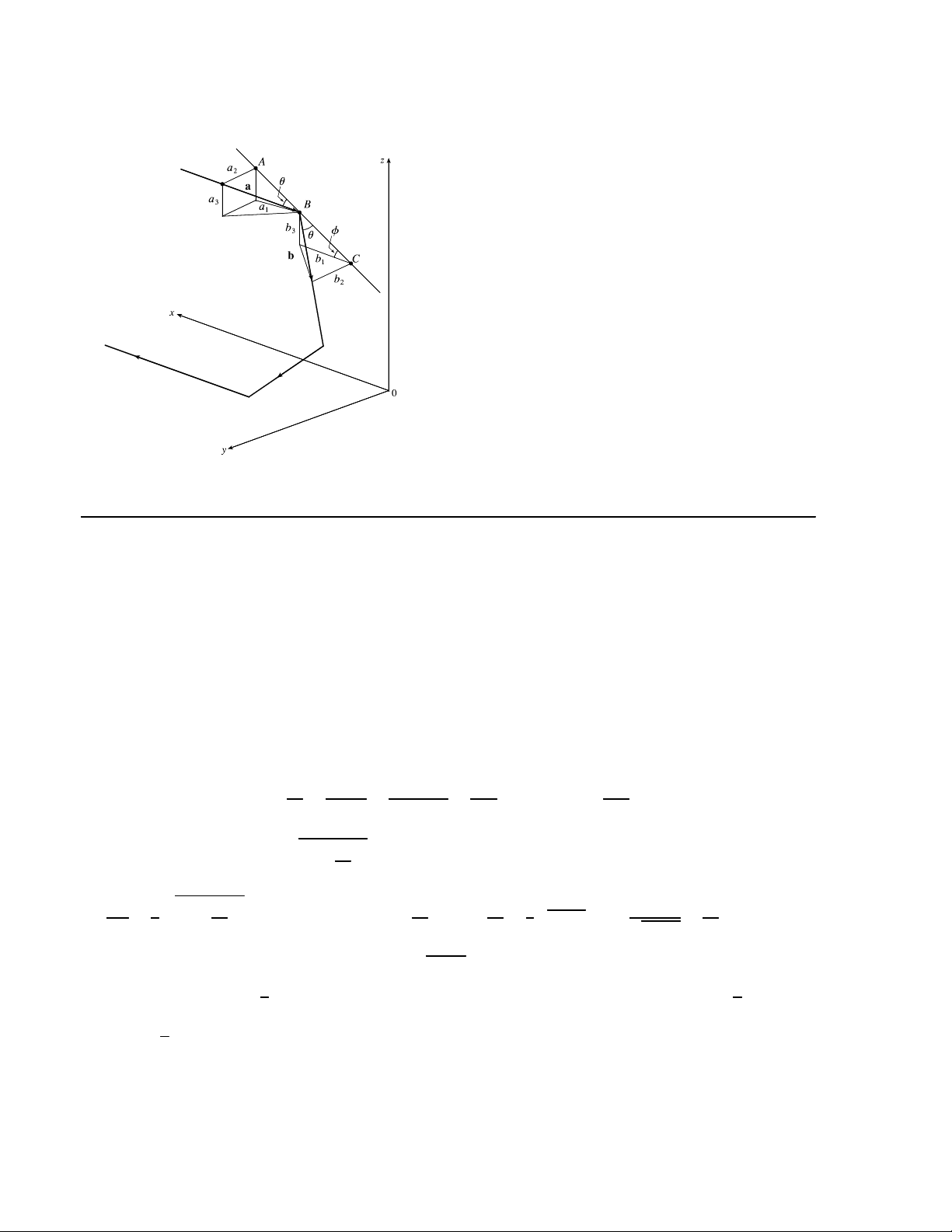
52. The question states that the light ray strikes all three mirrors, so it is not parallel to any of them and 1 6= 0, 2 6= 0 and
3 6= 0. Let b = h1 2 3i, as in the diagram. We can let |b| = |a|, since only its direction is important. Then |2| | = sin = 2| ⇒ |2| = |2|. |b| |a| [continued] c
° 2021 Cengage Learning. All Rights Reserved. May not be scanned, copied, or duplicated, or posted to a publicly accessible website, in whole or in part. 1208
¤ CHAPTER 12 VECTORS AND THE GEOMETRY OF SPACE
From the diagram 2 j and 2 j point in opposite directions,
so 2 = −2. || = ||, so
|3| = sin || = sin || = |3|, and
|1| = cos || = cos || = |1|.
3 k and 3 k have the same direction, as do 1 i and 1 i, so
b = h1 −2 3i. When the ray hits the other mirrors, similar
arguments show that these reflections will reverse the signs of
the other two coordinates, so the final reflected ray will be
h−1 −2 −3i = −a, which is parallel to a.
DISCOVERY PROJECT The Shape of a Hanging Chain
1. As () is the length of the chain with uniform density , the mass of the chain is given by (). Then the downward
gravitational force is given by w = h0 −()i. Also, T0 = h|T0| cos 180◦ |T0| sin 180◦i = h−|T0| 0i. As the system is in equilibrium, we have T0 + T + w = 0 T = −T0 − w
= − h−|T0| 0i − h0 −()i = h|T0| ()i
2. Note that the vector T is parallel to the tangent line to the curve at the point ( ). Thus, the slope of the tangent line can be written as () () () |T = = = where = 0| |T0| |T0|() 2
3. By Equation 8.1.6, 0() = 1 +
, so differentiating both sides of the equation from Problem 2 gives 0 2 1 2 1 √ = 1 +
. Making the substitution = , we have = 1 + 2 ⇒ √ = . 2 1 + 2 √
From Table 3.11.6 we know that an antiderivative of 1 1 + 2 is sinh−1 , so integrating both sides of the preceding equation gives sinh−1 =
+ . We are given that 0(0) = 0
⇒ (0) = 0 ⇒ = 0, so sinh−1 = ⇒ = sinh . [continued] c
° 2021 Cengage Learning. All Rights Reserved. May not be scanned, copied, or duplicated, or posted to a publicly accessible website, in whole or in part.
SECTION 12.3 THE DOT PRODUCT ¤ 1209 As = , = sinh ⇒ = sinh ⇒ = sinh ⇒ = cosh + . From the initial
condition (0) = 0, we have 0 = cosh 0 + ⇒ 0 = + ⇒ − = . Therefore, the equation of the curve is = cosh − .
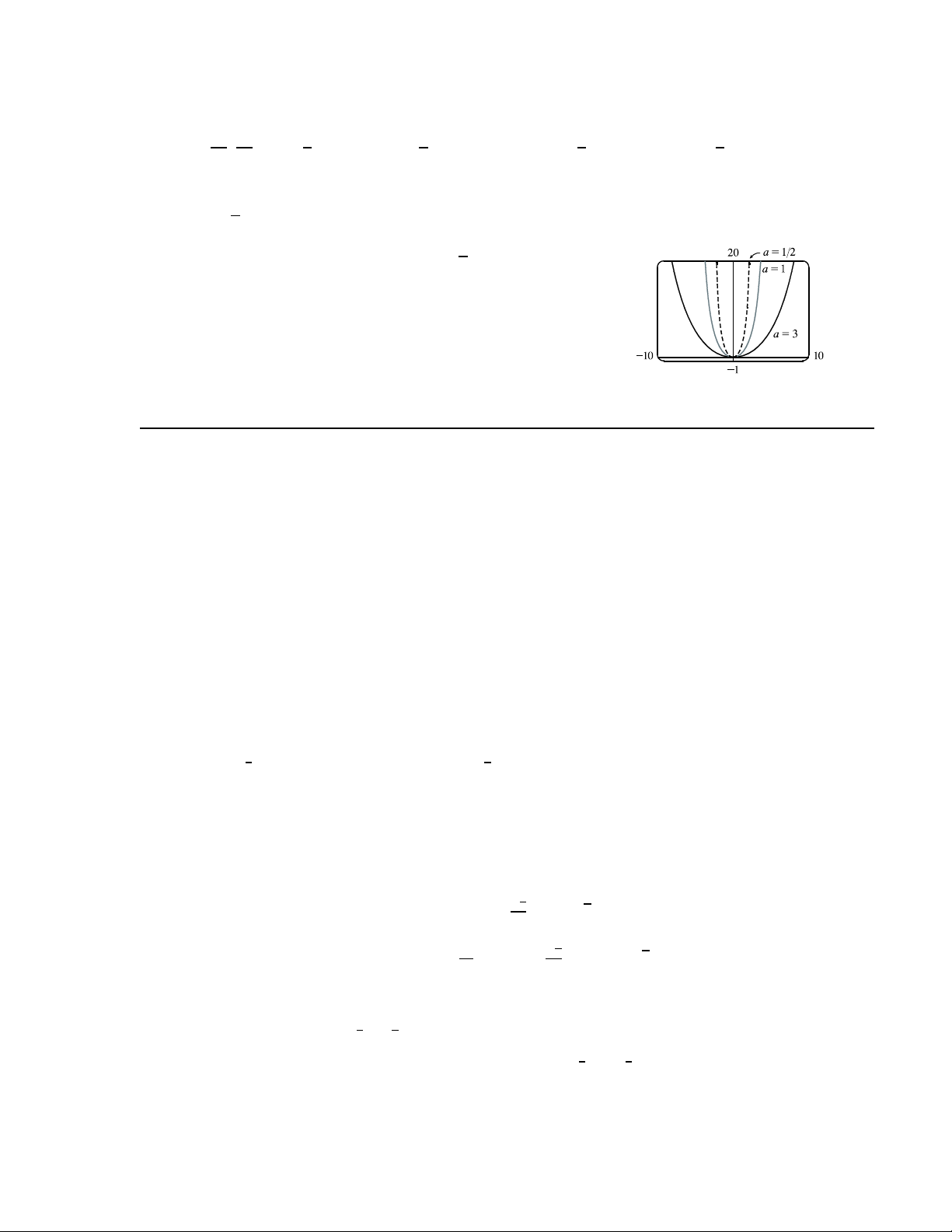
4. As the value of increases, the graph of = cosh − is stretched horizontally. 12.3 The Dot Product
1. (a) a · b is a scalar, and the dot product is defined only for vectors, so (a · b) · c has no meaning.
(b) (a · b) c is a scalar multiple of a vector, so it does have meaning.
(c) Both |a| and b · c are scalars, so |a| (b · c) is an ordinary product of real numbers, and has meaning.
(d) Both a and b + c are vectors, so the dot product a · (b + c) has meaning.
(e) a · b is a scalar, but c is a vector, and so the two quantities cannot be added and a · b + c has no meaning.
(f ) |a| is a scalar, and the dot product is defined only for vectors, so |a| · (b + c) has no meaning.
2. a · b = h5 −2i · h3 4i = (5)(3) + (−2)(4) = 15 − 8 = 7
3. a · b = h15 04i · h−4 6i = (15)(−4) + (04)(6) = −6 + 24 = −36
4. a · b = h6 −2 3i · h2 5 −1i = (6)(2) + (−2) (5) + (3)(−1) = 12 − 10 − 3 = −1
5. a · b = 4 1 1 · h6 −3 −8i = (4)(6) + (1)(−3) + 1 (−8) = 19 4 4
6. a · b = h − 2i · h2 −i = ()(2) + (−)() + (2)(−) = 2 − − 2 = −
7. a · b = (2 i + j) · (i − j + k) = (2)(1) + (1)(−1) + (0)(1) = 1
8. a · b = (3 i + 2 j − k) · (4 i + 5 k) = (3)(4) + (2)(0) + (−1)(5) = 7 √ √
9. By Theorem 3, a · b = |a| |b| cos = (7)(4 ) cos 30◦ = 28 3 = 14 3. 2 √ √
10. By Theorem 3, a · b = |a| |b| cos = (80)(50) cos 3 = 4000 − 2 = −2000 2. 4 2
11. u v and w are all unit vectors, so the triangle is an equilateral triangle. Thus the angle between u and v is 60◦ and
u · v = |u| |v| cos 60◦ = (1)(1) 1 = 1 If w is moved so it has the same initial point as u, we can see that the angle 2 2
between them is 120◦ and we have u · w = |u| |w| cos 120◦ = (1)(1) −1 = −1 . 2 2 c
° 2021 Cengage Learning. All Rights Reserved. May not be scanned, copied, or duplicated, or posted to a publicly accessible website, in whole or in part. 1210
¤ CHAPTER 12 VECTORS AND THE GEOMETRY OF SPACE
12. u is a unit vector, so w is also a unit vector, and |v| can be determined by examining the right triangle formed by u and v √ √ √
Since the angle between u and v is 45◦, we have |v| = |u| cos 45◦ = 2 . Then u · v = |u| |v| cos 45◦ = (1) 2 2 = 1 . 2 2 2 2
Since u and w are orthogonal, u · w = 0.
13. (a) i · j = h1 0 0i · h0 1 0i = (1)(0) + (0)(1) + (0)(0) = 0. Similarly, j · k = (0)(0) + (1)(0) + (0)(1) = 0 and
k · i = (0)(1) + (0)(0) + (1)(0) = 0.
Another method: Because i, j, and k are mutually perpendicular, the cosine factor in each dot product (see Theorem 3) is cos = 0. 2
(b) By Property 1 of the dot product, i · i = |i|2 = 12 = 1 since i is a unit vector. Similarly, j · j = |j|2 = 1 and k · k = |k|2 = 1.
14. The dot product A · P is
h i · h4 25 1i = (4) + (25) + (1)
= (number of hamburgers sold)(price per hamburger)
+ (number of hot dogs sold)(price per hot dog)
+ (number of bottles sold)(price per bottle)
so it is equal to the vendor’s total revenue for that day. √ √ √ √
15. u = h5 1i, v = h3 2i ⇒ |u| = 52 + 12 = 26, |v| = 32 + 22 = 13, and u · v = 5(3) + 1(2) = 17. From Corollary 6, we have u · v 17 17 17 cos = = √ √ =
√ and the angle between u and v is = cos−1 √ ≈ 22◦. |u||v| 26 13 13 2 13 2 √
16. a = i − 3 j, b = −3 i + 4 j ⇒ |a| = 12 + (−3)2 = 10, |b| = (−3)2 + 42 = 5, and a · b −15 −3
a · b = 1(−3) + (−3)(4) = −15. From Corollary 6, we have cos = = √ = √ and the angle between |a||b| 5 10 10 −3 a and b is = cos−1 √ ≈ 162◦. 10 √ √ √ √
17. a = h1 −4 1i, b = h0 2 −2i ⇒ |a| = 12 + (−4)2 + 12 = 18 = 3 2, |b| = 02 + 22 + (−2)2 = 8 = 2 2, and a · b −10 10 5
a · b = (1)(0) + (−4)(2) + (1)(−2) = −10. From Corollary 6, we have cos = = √ √ = − = − |a| |b| 3 2 · 2 2 12 6
and the angle between a and b is = cos−1 −5 ≈ 146◦. 6 √ √ √
18. a = h−1 3 4i, b = h5 2 1i ⇒ |a| = (−1)2 + 32 + 42 = 26, |b| = 52 + 22 + 12 = 30, and a · b 5 5 5
a · b = (−1)(5) + (3)(2) + (4)(1) = 5. From Corollary 6, we have cos = = √ √ = √ = √ and |a| |b| 26 · 30 780 2 195 the angle between 5 a and b is = cos−1 √ ≈ 80◦. 2 195 c
° 2021 Cengage Learning. All Rights Reserved. May not be scanned, copied, or duplicated, or posted to a publicly accessible website, in whole or in part.
Tài liệu liên quan:
-
Cambridge IELTS 13 Test-1 Overview and Practice Review | Tài liệu Tiếng Anh
6 3 -
IELTS Test 2 Review - Cambridge 13 Preparation Guide | Tài liệu Tiếng Anh
9 5 -
Litfocus Litreading Survey: Student Reading Interests & Habits Questionnaire | Tài liệu Tiếng Anh
8 4 -

Sách Pre-intermediate Market leader - Business English Course Book
24 12 -

Exam booster for B1 preliminary and B1 preliminary for schools with answer key
10 5