Tài liệu Digital Marketing in Financial institutions
Tài liệu Digital Marketing in Financial institutions. Tài liệu được tổng hơp và sưu tầm. Mời các bạn tham khảo
Môn: Core Banking và ngân hàng điện tử 2 tài liệu
Trường: Trường Đại học ngân hàng Thành phố Hồ Chí Minh 337 tài liệu
Tác giả:












Preview text:
DIGITAL MARKETING IN FINANCIAL INSTITUTIONS
Lecturer: PhD. Nguyen Thi Minh Chau
Email: chauntm@hub.edu.vn 1 COURSE OBJECTIVES
Apply knowledge of the characteristics of digital marketing and financial services marketing Knowledge
activities, the 7Ps marketing mix to customer
acquisition and care activities within financial
institutions in the digital era.
• Apply learned knowledge to develop financial
services marketing plans and strategies, and Skills team collaboration to implement the
established marketing plans and strategies
• Apply learned knowledge to involve the information digital
marketing activities and the factors influencing the
effectiveness of digital marketing strategies within financial Attitude
institutions. Then, propose solutions that help financial
institutions enhance their marketing effectiveness and adapt
to changing banking and financial industry trends. 2 1
Components of Course Assessment Assessment Component Evaluation Method Weight A1.1 Class participation 10% A1.2 Individual test: A1. Process Evaluation multiple-choice mid-term 20% test A1.3 Team project 20% A2.1 Final exam: multiple A2. Final Evaluation 50%3 choices and a case study. 3 Reference Materials 1.Main Textbook
1.1 Ritu Srivastava (2023), Marketing of Consumer Financial Products: Insights
From Service Marketing, Business Expert Press
2. Supplementary Materials 2.1
Dave Chaffey, Fiona Ellis Chadwick (2019), Digital Marketing - Strategy,
Implementation and Practice, Prentice Hall Financial Times, 7th Edition, UK, 2019
2.2 Christine Ennew, Nigel Waite, Roisin Waite (2018), Financial Services Marketing
An International Guide to Principles and Practice, 3rd Edition, Routledge 4 2 Course Contents
• OVERVIEW OF DIGITAL MARKETING IN C1 FINANCIAL INSTITUTIONS
• STRATEGIC DIGITAL MARKETING IN C2 FINANCIAL INSTITUTIONS
• THE FINANCIAL SERVICES MARKETING MIX AND C3
CUSTOMER ACQUISITION IN THE DIGITAL ERA
• CUSTOMER RELATIONSHIP MANAGEMENT IN C4 THE DIGITAL MARKETING
• FINANCIAL SERVICE DELIVERY AND SERVICE C5
QUALITY IN THE DIGITAL MARKETING 5 5 CHAPTER 1: OVERVIEW OF DIGITAL MARKETING IN FINANCIAL INSTITUTIONS
Lecturer: PhD. Nguyen Thi Minh Chau Email: chauntm@hub.edu.vn
Financial Services Marketing: An International Guide to Principles and Practice 6 3 Learning Objectives 1.
Understand and explain the structure, products, and participants in the financial service market.
2. Grasp the concepts of financial marketing, including the target customers and tools in financial marketing.
3. Distinguish the differences between financial service marketing and tangible product marketing.
4. Explain the digital transformation in marketing in financial institutions. 7 MAIN CONTENTS
• Overview of financial institutions and financial services 1.1
• Marketing Financial Services: An Overview 1.2
• Digital transformation in marketing in financial institutions 1.3 8 4
1.1 Overview of financial
institutions and financial services Learning objectives
• Identify the different types of organisations engaged in the provision of financial services
• Understand the range and diversity of financial services and how they relate to customer needs
• Comprehend the complexity of the industry
• Understand the economic and social significance of the financial services sector. 9
1.1.1 Definition and classification of financial institution Definition:
A financial institution (FI) is a company engaged in the business of dealing
with financial and monetary transactions such as deposits, loans, investments, and currency exchange. Roles:
• Connects capital holders with capital seekers.
• Maintains the stability of the financial system.
• Builds trust and promotes economic growth. 10 5
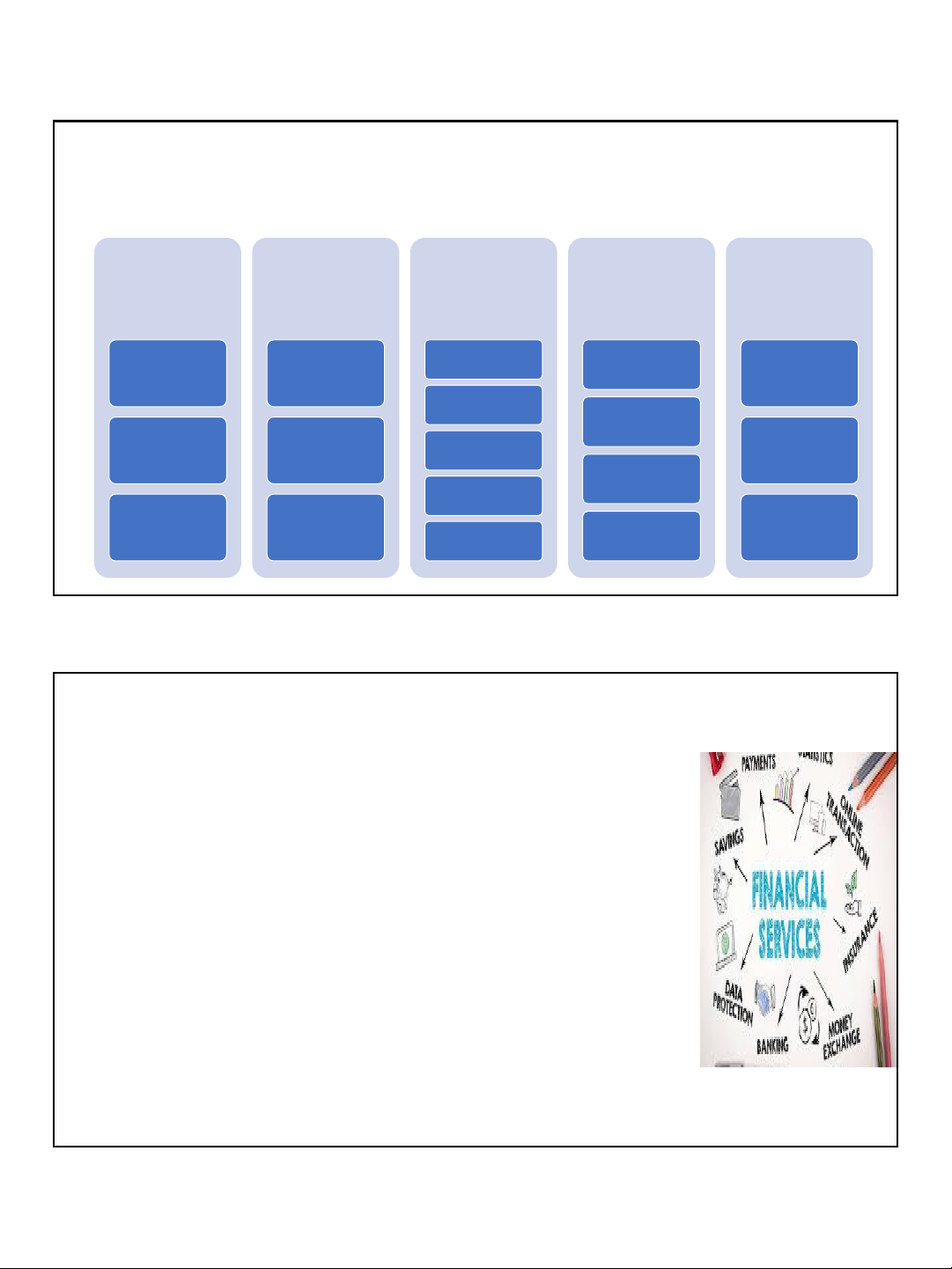
1.1.1 Definition and classification of financial institution Savings Investment Credit and Banking Insurance and Loans Companies Liquidity Life Insurers Mutual Funds/Unit Building Societies Retail Banks Trust Companies Credit Card issuers (UK) General Insurers Investment Trusts Secured Loan Commercial banks Credit Unions Composite Insurers providers Pensions providers Health Insurers Unsecured Loan Investment Banks National Savings providers Lloyds Syndicates Stockbrokers 11
1.1.2 Defining and classification financial service
Service is “any activity or benefit that
one party can offer to another which is
essentially intangible and does not
result in the ownership of anything.” (Kotler, 1991) 12 6
1.1.2 Defining and classification financial service
• Financial services include all services
related to insurance, banking, and other financial services
(World Trade Organization, 1997).
• Financial services are services that directly affect people's intangible assets.
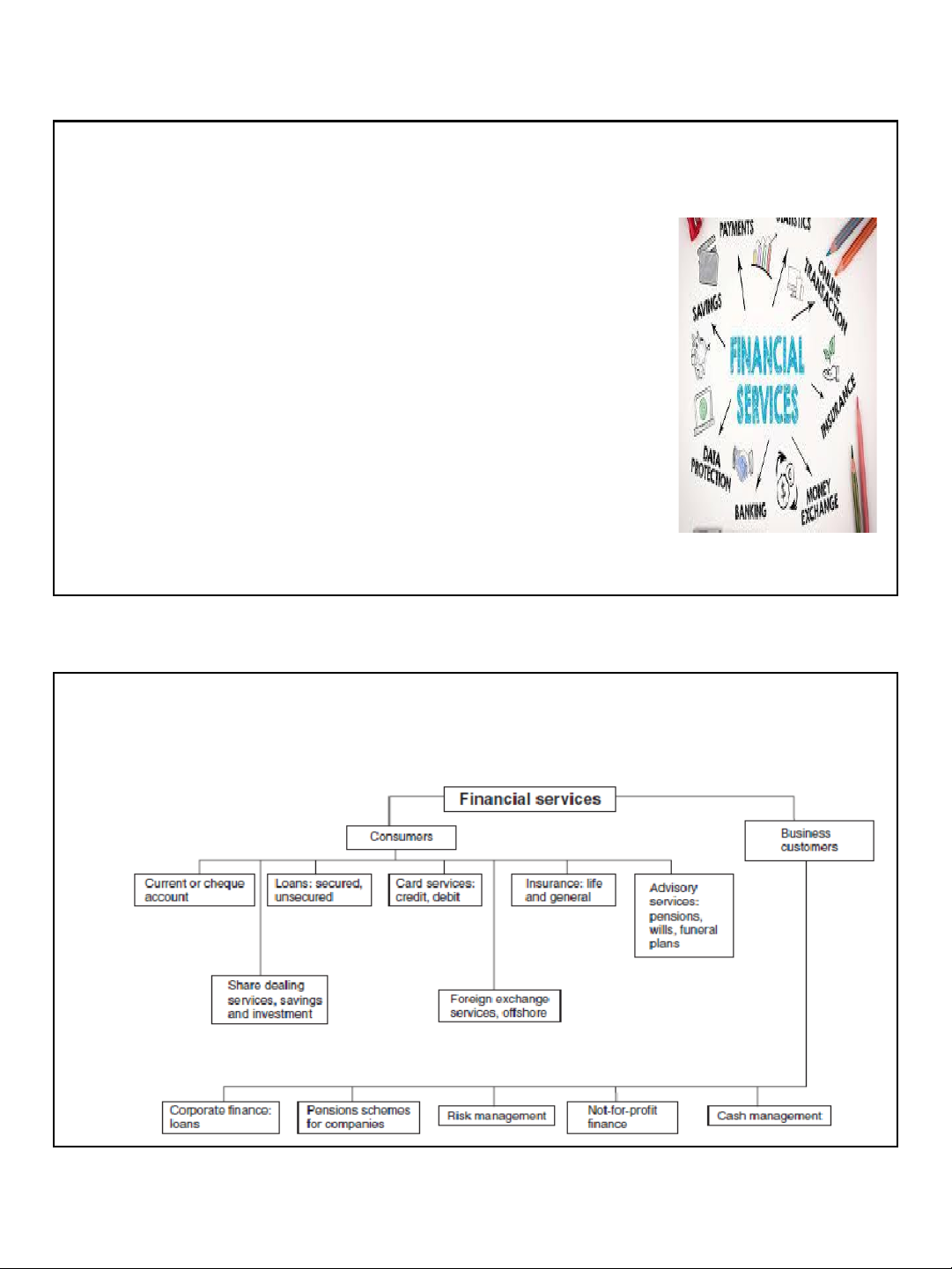
(Christine Ennew, Nigel Waite, 2007) 13 Financial Services 14 7
Distinctive characteristics of financial services • Intangibility • Inseparability • Perishability • Heterogeneity
• Fiduciary responsibility
• Contingent consumption
• Duration of consumption
Financial Services Marketing: An International Guide to Principles and Practice 15
Match the English terms with their corresponding definitions Characteristic Definition 1. Intangibility
a. Production and consumption of services occur simultaneously. 2. Inseparability
b. Services cannot be stored or inventoried. 3. Perishability
c. Services cannot be physically touched or examined before consumption. 4. Heterogeneity
d. Service providers have a duty to act in the best interests of their clients.
5. Fiduciary responsibility
e. Services can vary in terms of their duration.
6. Contingent consumption
f. Money spent on them does not yield a direct consumption benefit
7. Duration of consumption
g. Services are highly variable in quality and consistency. 16 8
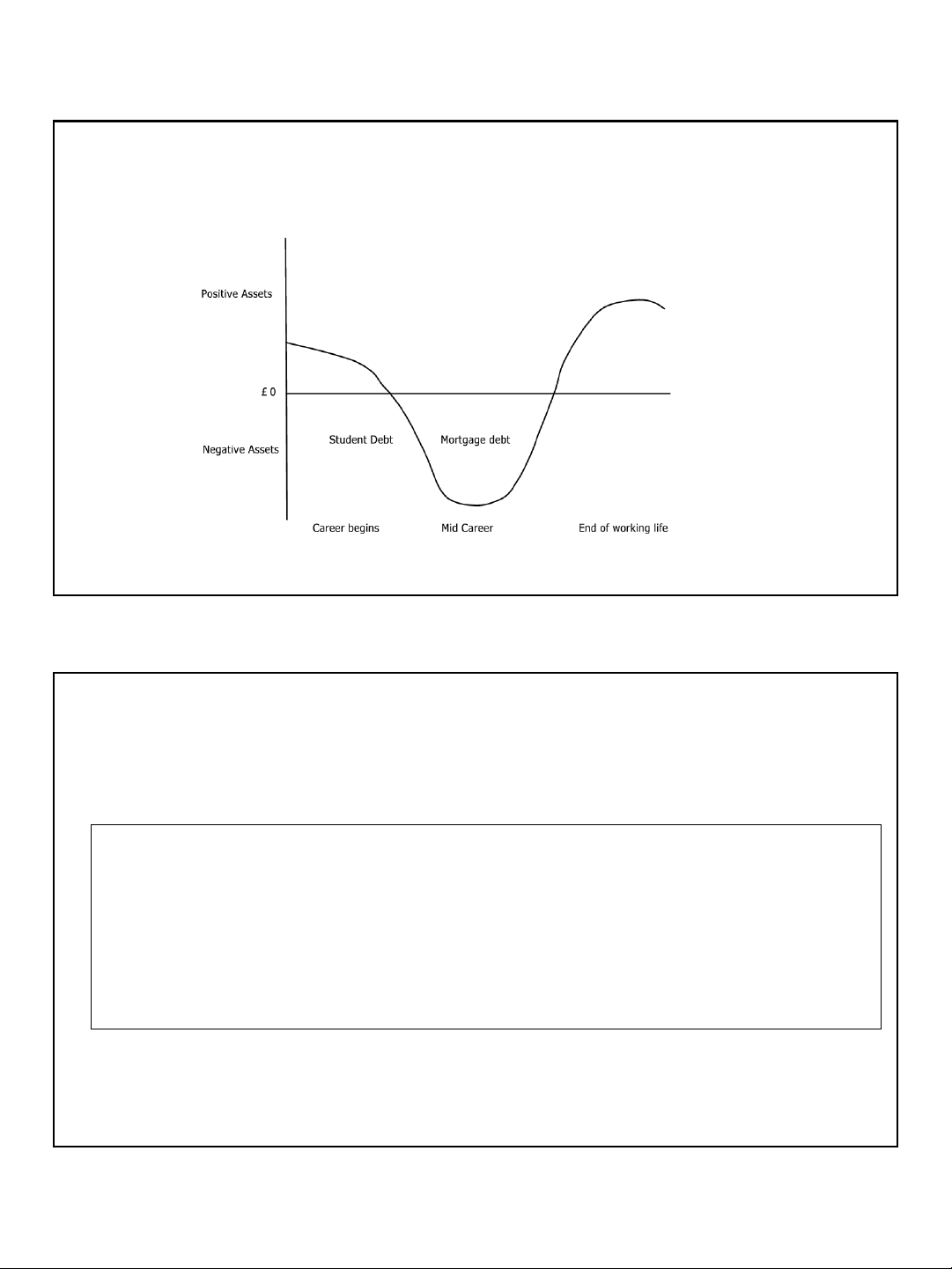
Lifetime financial assets profile 17
1.2 Financial services marketing: An overview Learning objectives
• identify how and why services in general and financial services in particular are different from goods
• understand the implications of these differences for marketing practice
• understand the way in which financial services can be classified and the position of
different types of financial services within this classification
Financial Services Marketing: An International Guide to Principles and Practice 18 9
1.2.1. Defining financial service marketing
Marketing is the entire system of business activities, from designing, pricing,
promoting, to distributing products that satisfy the needs of the target customers in Definition
order to achieve the defined corporation's goals.
(Fundamental of marketing - Bruce J.W. William, Michel J.Etzel)
Marketing is the process through which individuals and organizations can fulfill their
needs and wants by creating and exchanging products and values between parties.
Philip Kotler - Principle of Marketing, 1994 19 19 1.2.1. Defining financial service marketing
• Financial Services Marketing: The
process of researching, planning, and implementing activities to satisfy
customers’ financial needs through the
products and services of financial institutions (banks, insurance
companies, securities firms, finance companies). 20 10
Characteristic of financial service marketing
• Specificity of Financial Service Products
• Financial products are abstract and difficult to evaluate before use.
• Purchase decisions often involve assets, income, and long-term plans. 1
• Marketing Implication: Emphasize long-term value, benefits, and safety
• High Sensitivity to Trust and Risk
• Customers are highly sensitive to the reputation and safety of the service provider.
• Financial risks make customers more cautious compared to buying 2 goods.
• Marketing Implication: Build a trustworthy brand, ensure transparency,
and communicate financial safety 21
Characteristic of financial service marketing
• Complexity and Difficulty for Customers
• Financial products often have complex structures (interest rates, fees, terms). • 3
Customers may be confused or lack financial literacy • Marketing Implication:
• Communicate simply and clearly.
• Provide financial education.
• Ensure transparency to build trust. 22 11
Characteristic of financial service marketing
• High Competition and Substitutability
• The financial services market has many
competitors; products are easily substituted.
• Customers have multiple options: banks, finance companies, fintech firms. 4
• Marketing Implication: • Create differentiation. • Personalize services.
• Apply digital technology to retain customers 23
Characteristic of financial service marketing
• Integration with Technology and Digital Transformation
• Financial services marketing today is closely tied to digital technology.
• Digital tools expand reach and enable service personalization. 5
• Marketing Implication:
• Develop digital marketing strategies. • Leverage Big Data.
• Integrate omni-channel platforms to enhance customer experience 24 12
The role of the financial service marketing
• Essential for delivering competitive advantage through differentiation
• Is the link between strategy and the customer
• The primary means by which marketing objectives can be achieved
• Defines the customer experience
• Enhance value and service quality 25
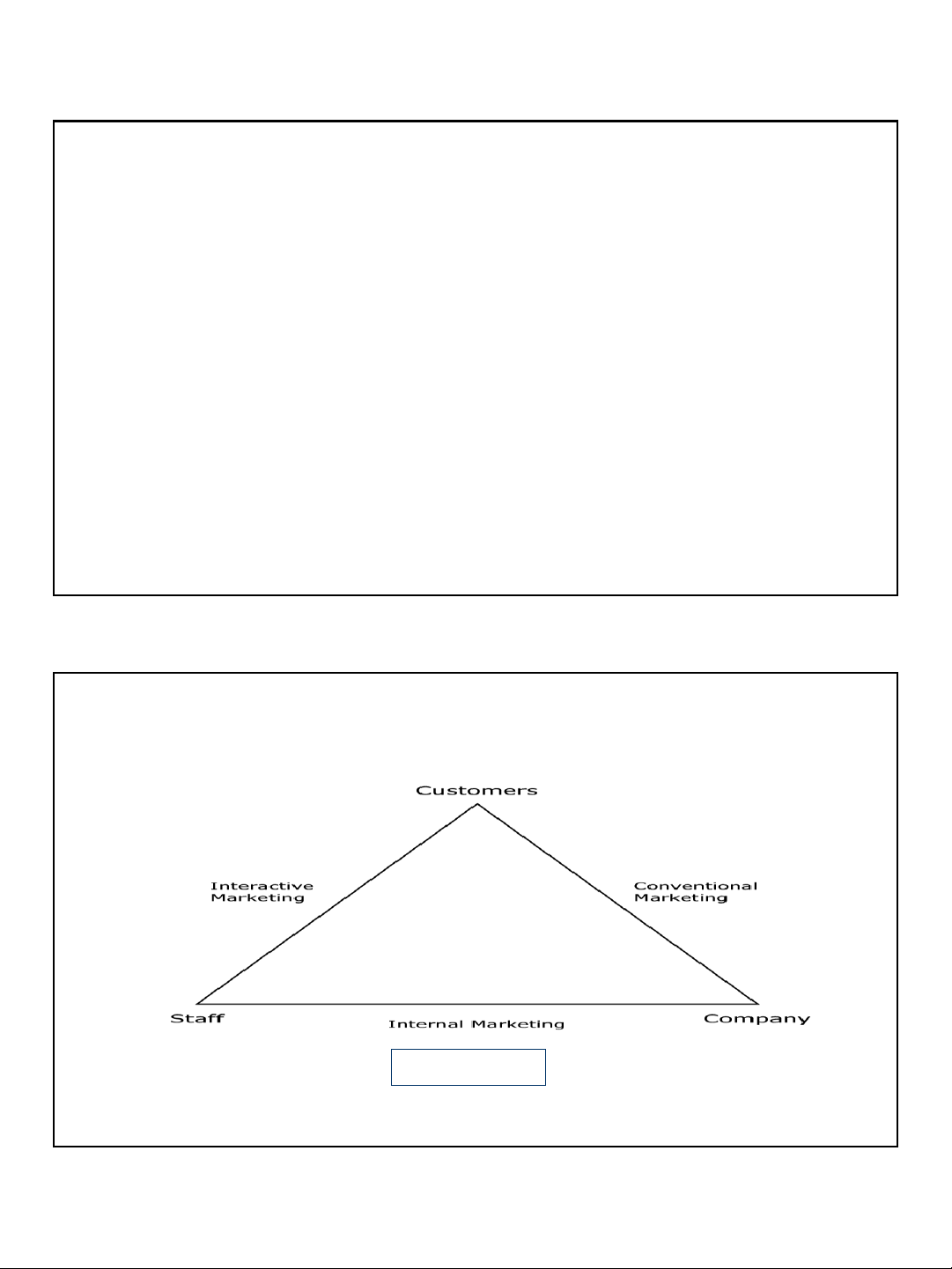
1.2.3 Differences between financial service marketing and
tangible product marketing
The services marketing triangle Services marketing triangle (adapted from Kotler)
Financial Services Marketing: An International Guide to Principles and Practice 26 13
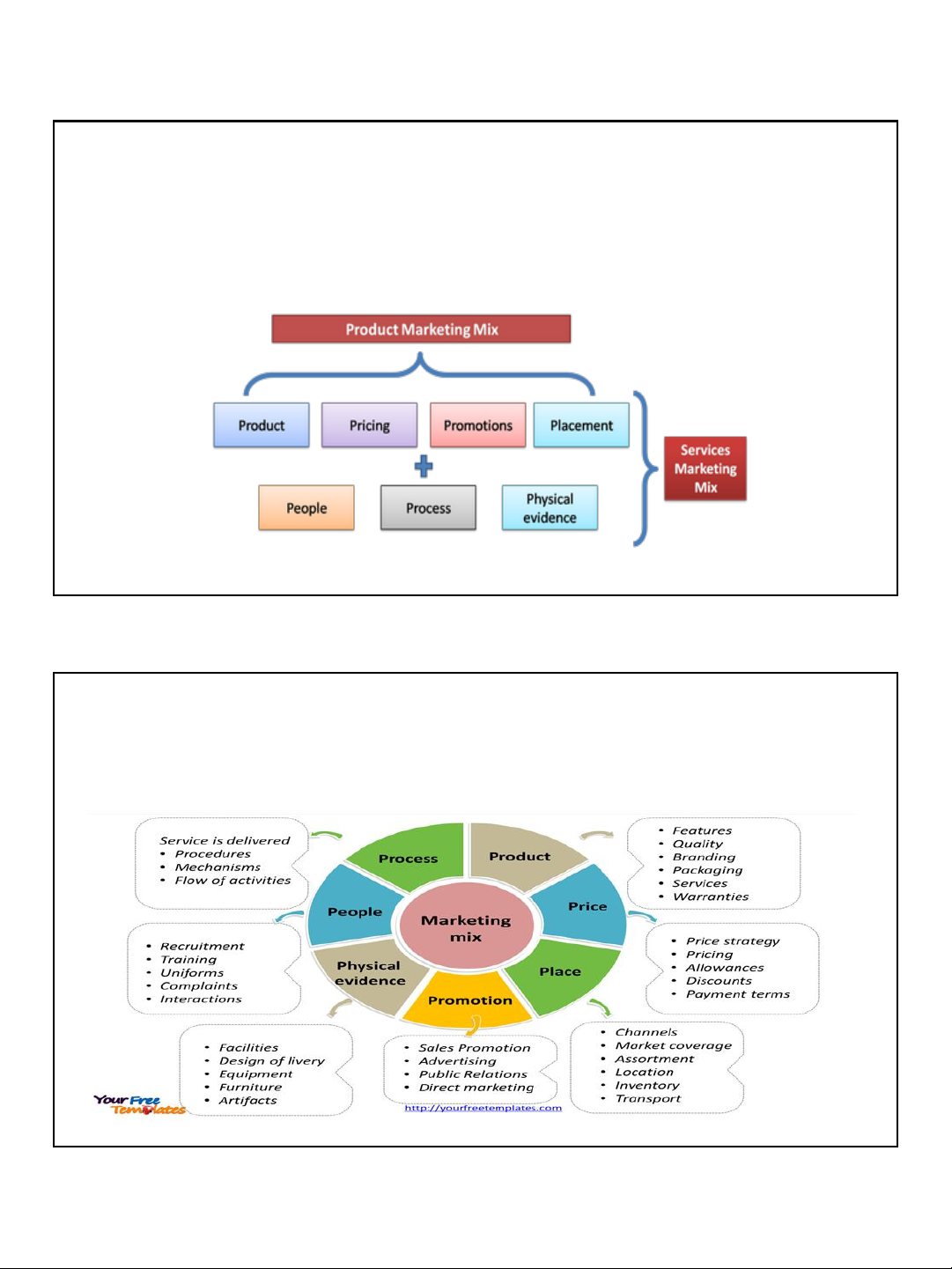
Marketing Mix Tools Applied in Financial Services
• The marketing mix is a set of business tools used in marketing activities. 27
Marketing Mix Tools Applied in Financial Services 28 14
1.3 Digital Transformation in Marketing Institutions 39
1.3 Digital Transformation in Marketing Institutions
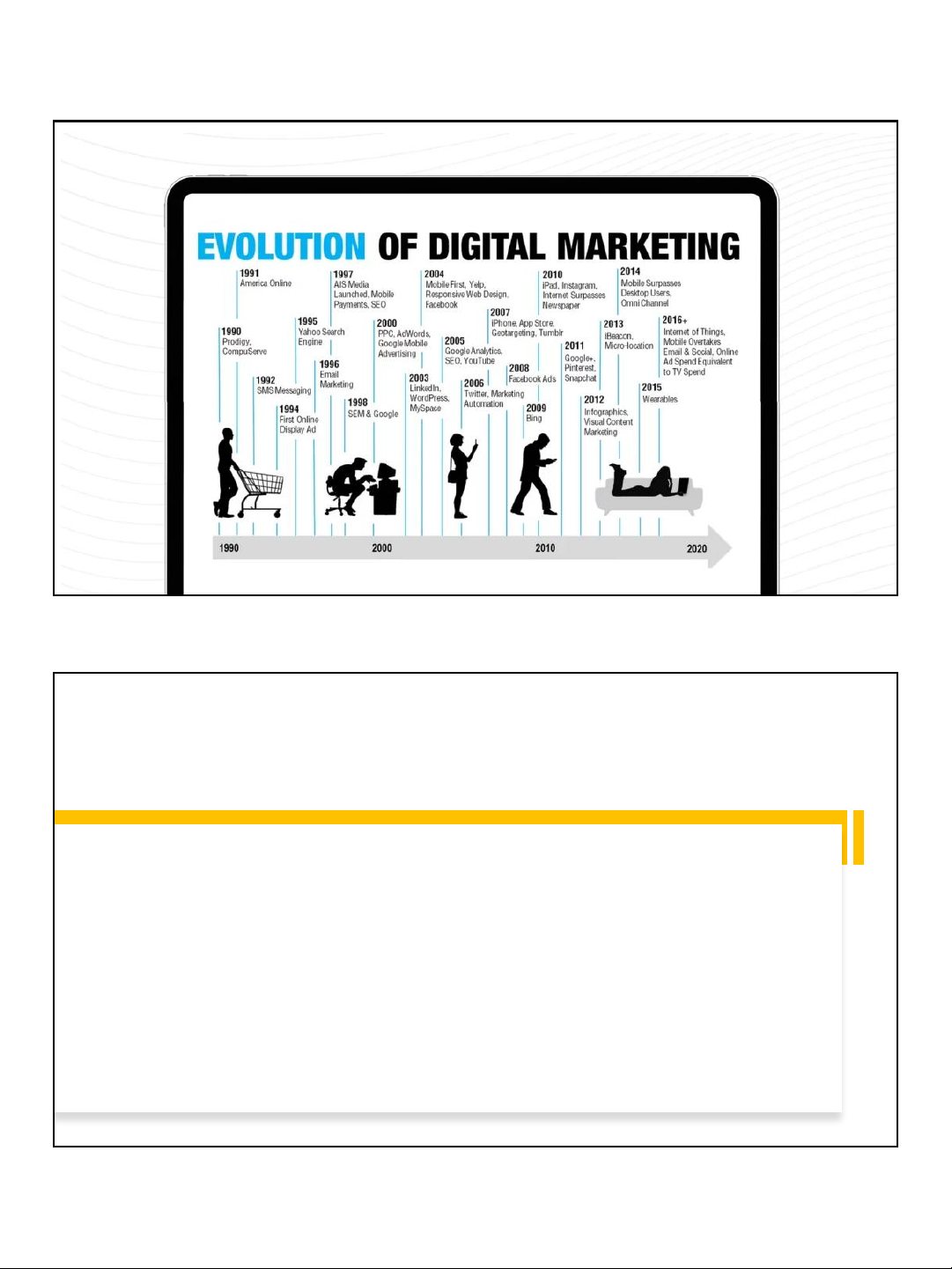
1.3.1 The Process of Formation and Development of Digital Marketing
• General Introduction: Digital marketing in finance is the process of applying digital technologies to promote,
distribute, and manage financial services.
Its formation and development have gone through multiple stages: from Internet Banking to AI-driven marketing.
➢ Initial Stage (1990s–2000s): Internet Banking emerged, marking the beginning of online marketing. Bank
websites provided basic information; email marketing began to appear.
• Example: HSBC and Citibank launched the first Internet Banking services
➢ Early Development Stage (2005–2010): Mobile Banking and SMS Banking appeared. Marketing focused on
mobile convenience, promotions via SMS.
• Example: Vietcombank introduced SMS Banking and promoted services via text messages. 40 15
1.3.1 The Process of Formation and Development of Digital Marketing
➢Social Media Stage (2010–2015)
• Facebook, Twitter, LinkedIn became major marketing channels.
• Banks and insurers built online communities.
• Example: Prudential ran the “Protect the Future” campaign on Facebook
➢FinTech and Big Data Stage (2015–2020)
• FinTech startups (MoMo, PayPal, Revolut) reshaped customer engagement.
• Big Data & Analytics enabled personalized marketing services.
• Example: MoMo personalized promotions based on transaction behavior 41
1.3.1 The Process of Formation and Development of Digital Marketing
➢AI and Automation Stage (2020–2025)
• AI & Machine Learning predicted customer behavior and optimized advertising.
• Chatbots & Virtual Assistants provided 24/7 customer support.
• Example: Techcombank deployed AI chatbots for loan consultation
➢Modern Trends (2025–2026)
• AI-driven Marketing: Automated campaigns, cost optimization.
• Embedded Finance Marketing: Financial services integrated into e-commerce platforms.
• Example: ShopeePay integrates financial services directly into its shopping app.
➢Drivers of Development:
• Customers: Demand digital experiences, convenience, transparency.
• Technology: AI, Blockchain, Cloud, IoT.
• Competition: FinTech and BigTech entering the market.
• Regulation: Data security requirements, compliance with international standards. 42 16 Digital Marketing ➢Impact on Banking
• Shift from traditional to comprehensive digital marketing.
• Focus on multi-channel customer experience.
• Example: Timo Bank promotes digital banking services via apps and social media ➢Impact on Insurance
• Shift from direct sales to digital platforms.
• AI applied to predict risks and personalize products.
• Example: Manulife launched an online insurance contract management app ➢Impact on Securities
• Shift from floor trading to online applications.
• Marketing based on investor behavior data.
• Example: VNDirect promotes its trading app with data analytics features 43 Digital Marketing
➢Modern Tools in Financial Digital Marketing
• SEO & SEM: Optimize search visibility for financial services.
• Social Media Marketing: Build customer communities.
• Content Marketing: Provide financial knowledge.
• Example: Banks publish blogs on personal financial management.
➢Development Challenges • Customer data security.
• Compliance with international regulations.
• Intense competition from FinTech and BigTech.
• Example: Data breaches can severely damage a bank’s reputation 44 17
Summary of Formation and Development
• 1990s–2000s: Internet Banking, Email Marketing.
• 2005–2010: Mobile Banking, SMS Marketing.
• 2010–2015: Social Media.
• 2015–2020: FinTech, Big Data.
• 2020–2025: AI, Chatbots, Omni-channel.
• 2025–2026: AI-driven, Embedded Finance, Trust & Compliance 45
1.3.2 The 7Ds Pillars of Digital Marketing in Financial Institutions
• Introduction to 7Ds:
The 7Ds framework is a strategic model for digital marketing in finance.
• It helps financial institutions:
• Integrate digital technologies. • Personalize services.
• Enhance customer experience.
• The 7Ds includes: Data, Devices, Platforms, Media, Content, Strategy, Experience 46 18 1. Data
• Pillar: Customer data is the foundation of all digital marketing activities.
• Applications: Big Data, AI, behavioral analytics.
• Example: Banks use transaction data to personalize promotions.
• Implication: Accurate data reduces risks and increases campaign effectiveness 2. Digital Devices
• Pillar: Smartphones, tablets, wearables are primary access channels. • Examples: • Mobile Banking Apps.
• Smartwatches with transaction alerts.
• Implication: Marketing must be optimized for multi-device, multi-platform use 47 3. Digital Platforms
• Pillar: Websites, apps, social media, e-commerce platforms. • Examples:
• ShopeePay integrates financial services into shopping platforms. • Facebook Ads for banks.
• Implication: Digital platforms are the venues for marketing campaigns and customer interaction 4. Digital Media
• Pillar: Online communication channels: social media, email, search engines. • Examples:
• Email marketing for insurance.
• Google Ads for loan services.
• Implication: Expands reach and enables instant performance measurement 48 19 5. Digital Content
• Pillar: Content persuades and educates customers. • Examples:
• Videos on personal financial management.
• Infographics on insurance benefits.
• Implication: Content must be engaging, transparent, and easy to
understand to reduce complexity 6. Digital Strategy
• Pillar: Build a comprehensive digital marketing strategy. • Examples:
• Omni-channel strategy for banks.
• Comprehensive digital transformation strategy for insurers.
• Implication: Provides long-term direction, integrating data, technology, and customer experience. 49 7. Digital Experience
• Pillar: Customer experience on digital channels determines success. • Examples:
• User-friendly banking app interfaces. • 24/7 chatbot support.
• Implication: Positive experiences increase loyalty and reduce marketing costs
Integration of 7Ds in Practice
• Banking: Omni-channel, AI chatbots, Big Data.
• Insurance: Contract management apps, financial education content.
• Securities: Online trading platforms, investor behavior analytics.
• FinTech: E-wallets, embedded financial services in e-commerce
Challenges in Implementing 7Ds
• Customer data security.
• Compliance with international regulations.
• Competition from FinTech and BigTech.
• High technology investment requirements 50 20