Tài liệu về Ngôn ngữ học ứng dụng | Trường Đại học Ngoại ngữ, Đại học Quốc gia Hà Nội
Tài liệu về Ngôn ngữ học ứng dụng | Trường Đại học Ngoại ngữ, Đại học Quốc gia Hà Nội. Tài liệu được sưu tầm giúp bạn tham khảo, ôn tập và đạt kết quả cao. Mời bạn đọc đón xem.
Môn: ENG2015 18 tài liệu
Trường: Trường Đại học Ngoại ngữ, Đại học Quốc gia Hà Nội 646 tài liệu
Tác giả:









Preview text:
C H A P T E R 6 Semantics © 2015 by Julia Porter Papke F I L E 6.0 What Is Semantics?
Semantics is a subfield of linguistics that studies linguistic meaning and how expres-
sions convey meanings. It deals with the nature of meaning itself—what exactly are
linguistic meanings, and what is their relationship to the language user on the one
hand and the external world on the other? Semanticists study not only word meanings,
but also how word meanings combine to produce the meanings of larger phrasal expres-
sions. Finally, an important part of the study of natural language meaning involves mean-
ing relations between expressions. Contents 6.1 An Overview of Semantics
Describes the components of linguistic meaning (sense and reference) and introduces lexical and
compositional semantics, the two main areas of semantics. 6.2
Lexical Semantics: The Meanings of Words
Examines the different ways that word senses could be represented in the mind of a language user
and discusses the types of reference that words can have, as well as meaning relationships between words. 6.3
Compositional Semantics: The Meanings of Sentences
Introduces propositions (the senses expressed by sentences), truth values (their reference), and
truth conditions, and discusses relationships between propositions. 6.4
Compositional Semantics: Putting Meanings Together
Introduces the Principle of Compositionality in more detail and discusses different ways that
lexical meanings combine to give rise to phrasal meanings. 6.5 Practice
Provides exercises, discussion questions, activities, and further readings related to semantics. 246 F I L E 6.1
An Overview of Semantics
6.1.1 Lexical and Compositional Semantics
Semantics is the subfield of linguistics that studies meaning in language. We can further
subdivide the field into lexical and compositional semantics. Lexical semantics deals with
the meanings of words and other lexical expressions, including the meaning relationships
among them. In addition to lexical expressions, phrasal expressions carry meaning. Com-
positional semantics is concerned with phrasal meanings and how phrasal meanings are assembled.
Every language contains only a finite number of words, with their meanings and other
linguistic properties stored in the mental lexicon. However, every language contains an in-
finite number of sentences and other phrasal expressions, and native speakers of a language
can understand the meanings of any of those sentences. Since speakers cannot memorize
an infinite number of distinct sentence meanings, they need to figure out the meaning of
a sentence based on the meanings of the lexical expressions in it and the way in which these
expressions are combined with one another.
Compositional semanticists are interested in how lexical meanings combine to give
rise to phrasal meanings, while lexical semanticists focus on meanings of words. In this
chapter, we discuss both lexical and compositional semantics, but before we address either,
we must first clarify exactly what we mean by meaning.
6.1.2 Two Aspects of Linguistic Meaning
There are two aspects of linguistic meaning: sense and reference. You can think of the
sense of an expression as some kind of mental representation of its meaning, or perhaps
some kind of concept. Hearing the word cat might bring up images of your neighbor’s cat,
or the thought of pet allergies, or the Latin name for the species. Other things may be
packaged into this mental representation—the number of limbs that a typical cat has, the
fact that most of them are furry, the fact that they are related to panthers, etc. In short, to
know the sense of an expression is to have some mental representation of its meaning.
By virtue of knowing the sense of some expression, you also know its relationship to
the world, or its reference. If you have a mental representation of what cats are (four-legged,
usually furry, potentially allergy-causing felines, etc.) that is associated with the expres-
sion cat, you will also be able to pick out those things in the world that are indeed cats. We
could show you pictures of different kinds of animals and ask you, “Which of the following
animals are cats?” and you would be able to determine that, say, Garfield, Felix, and Fluffy
are all cats, but that Fido, Rex, and Fishy the Goldfish are not. To be able to correctly pick
out the cats in the pictures is to know the reference of the expression cat—in other words,
to know what things in the world the expression cat refers to. The particular entities in the
world to which some expression refers are called its referents. So, Garfield, Felix, and Fluffy
are among the referents of the expression cat. The collection of all the referents of an expres- sion is its reference. 247 248 Semantics
In order to know the reference of some expression, it is necessary to know its sense.
However, knowing the sense of some expression does not guarantee that you will invari-
ably be able to pick out its referents. For example, although you probably know the sense
expressed by diamond, you may not always be able to distinguish real diamonds from fake
diamonds—you might think that some fake diamonds are real, and so fail to correctly pick
out the referents of diamond. Similarly, maybe you have heard the word lychee and know
that it is some kind of fruit, but are unable to distinguish an actual lychee from a pearl on-
ion. The exact reference of some expressions may be accessible only to experts. It’s impor-
tant to appreciate the fact that in order to know the reference of some expression, you must
understand the sense it expresses; however, understanding its sense doesn’t guarantee that
you’ll be able to pick out all of its referents correctly.
Now we will examine a couple of examples to clarify the distinction between sense
and reference. Consider the expression unicorn. You most likely know the sense of this ex-
pression—perhaps the mention of it stirred up the image of a white, four-legged creature
with a single horn on its forehead, or anything else your concept of ‘unicorn’ may include.
So the expression unicorn definitely has a sense. But what is the relationship of unicorn to
the world—what is its reference? Unlike cat, which refers to many, many different things
in the world that are cats, there is no creature in our world that is a unicorn (to the best of
our knowledge). Therefore, unicorn has no referents—but it has a sense nonetheless.
Similarly, the queen of the United States has no referents, but it has a sense. You know
that for somebody to be the queen of the United States, she would have to be the highest-
ranking member of the reigning royalty, she would have to be female, and, of course, the
United States would have to be a monarchy. Precisely because you understand the sense of
this expression, and you have some basic knowledge about the world we live in, you know
that the queen of the United States does not happen to refer to anybody.
Not only is it possible for expressions to have a sense but no referents; it is also pos-
sible for multiple distinct expressions with different senses to pick out the same referent.
For example, the most populous country in the world and the country that hosted the 2008 Sum-
mer Olympics both refer to China. A person could know that the most populous country in the
world refers to China without knowing that the country that hosted the 2008 Summer Olym-
pics also refers to China. The converse is also possible. This shows that the sense of one of
these expressions is not inextricably linked to the sense of the other; that is, they do not
have to be packaged into the same mental representation. Consequently, although both
expressions the most populous country in the world and the country that hosted the 2008 Sum-
mer Olympics refer to China, the senses associated with those expressions are different.
Sense can also be thought of as the way in which an expression refers to something in
the world. For example, while the expressions Barack Obama and the 44th president of the
United States both refer to the individual Barack Obama, they do so in different ways. In the
first case, Barack Obama is referred to by his name, and in the second case by the uniquely
identifying description of his political status.
We cannot do away with either sense or reference but have to consider them togeth-
er as components of linguistic meaning. The notion of sense underlies the intuition that
there is a mental component to linguistic meaning. The notion of reference in turn relates
this mental representation to the outside world. If we discounted senses, it would be diffi-
cult to talk about the meanings of expressions such as unicorn that do not refer to anything.
It would also be difficult to accommodate the fact that one and the same thing in the world
can be talked about or referred to in many different ways. And if we discounted reference,
we would lose the connection between meanings of expressions and what these meanings
are about. After all, we often use language to communicate information about the world
to one another, so there should be some relationship between the meanings of expressions
we use to communicate and things in the outside world about which we would like to com- municate these meanings. F I L E 6.2 Lexical Semantics: The Meanings of Words
6.2.1 Dictionary Definitions
When we think about the term meaning, we almost always think of word meanings. We
are all familiar with looking words up in dictionaries, asking about the meaning of a word,
and discussing or even arguing about exactly what a certain word means. The aim of this
file is not to discuss what individual words mean, however. Rather, we will endeavor to
pin down word meaning (lexical meaning) itself. That is, what exactly does it mean for a word to mean something?
We first consider the commonly held idea that dictionaries are the true source of word
meanings. Dictionaries define word meanings in terms of other words and their meanings.
This makes them easy to print, easy to access, and easy to memorize. Is it the case, though, that
a word’s meaning is just what the dictionary says it is? In our culture, where the use of dic-
tionaries is widespread, many people accept dictionaries as authoritative sources for word
meanings. Therefore, people may feel that the dictionary definition of a word more accu-
rately represents the word’s meaning than does an individual speaker’s understanding of
the word. But keep in mind that people who write dictionaries arrive at their definitions by
studying the ways speakers of the language use words. A new word or definition could not
be introduced into a language by way of being printed in a dictionary. Moreover, entries in
dictionaries are not fixed and immutable; they change over time and from edition to edition
(or year to year, with electronic dictionaries) as people come to use words differently. Dic-
tionaries model usage, not the other way around. There simply is no higher authority on
word meaning than the community of native speakers of a language. 6.2.2 Word Senses
Like all other linguistic expressions, words are associated with senses—mental representa-
tions of their meaning. In this section, we consider what form these representations
might have. How exactly do we store word meanings in our minds?
a. Dictionary-Style Definitions. While dictionaries themselves cannot be the
true sources of word meanings, is it possible that speakers’ mental representations of word
meanings, the senses of words, are much like dictionary entries? Perhaps the nature of a
word’s meaning is similar to what we might find in some idealized dictionary: a dictionary-
style definition that defines words in terms of other words, but that also reflects the way
that speakers of a language really use that word. We can envision an imaginary idealized
dictionary that changes with the times, lists all the words in a language at a given time, and
provides a verbal definition of each according to speakers’ use of that word. Would this be
an appropriate way to conceptualize word meanings? The answer is that we would still run into problems.
If a word’s sense were a dictionary- style definition, then understanding this meaning
would involve understanding the meanings of the words used in its definition. But under-
standing the meanings of these words would have to involve understanding the meanings 249 250 Semantics
of the words in their definitions. And understanding these definitions would have to in-
volve understanding the words they use, which, of course, would have to involve under-
standing even more definitions. The process would be never ending. There would be no
starting point: no way to build word meaning out of some more basic understanding. More-
over, circularities would inevitably arise. For instance, one English dictionary defines di-
vine as ‘being or having the nature of a deity,’ but defines deity as ‘divinity.’ Another defines
pride as ‘the quality of state of being proud,’ but defines proud as ‘feeling or showing pride.’
Examples like these are especially graphic, but essentially the same problem would hold
sooner or later for any dictionary- style definition. Furthermore, don’t forget that to under-
stand a definition would require understanding not only the content words, but also such
common function words as the, of, to, and so on.
We must conclude that dictionaries are written to be of practical aid to people who
already speak a language and that they cannot make theoretical claims about the nature
of meaning. A dictionary-style entry doesn’t explain the meaning of a word or phrase in
terms of something more basic—it just gives paraphrases (gives you one lexical item for
another). People can and do learn the meanings of some words through dictionary defini-
tions, so it would be unfair to say that such definitions are completely unable to character-
ize the meanings of words, but it should be clear that dictionary- style definitions can’t be
all there is to the meanings of the words in a language. In other words, it may be useful for
us to define words in terms of other words, but that type of definition cannot be the only
way in which meanings are stored in our heads.
b. Mental Image Definitions. What other options are there? One possibility is
that a word’s meaning is stored in our minds as a mental image. Words often do seem to
conjure up particular mental images. Reading the words Mona Lisa, for example, may well
cause an image of Leonardo da Vinci’s painting to appear in your mind. You may find that
many words have this sort of effect. Imagine that someone asked you, “What does fingernail
mean?” You would very likely picture a fingernail in your mind while you tried to provide
the definition. Your goal would likely be trying to get your conversational partner to wind
up with a mental image similar to your own. In some ways, mental image definitions seem
more promising than did dictionary-style definitions, because, as the fingernail example
shows, mental images are things that we really do have in our heads and that we do use in
some way to conceptualize reality.
However, a mental image can’t be all there is to a word’s meaning any more than a
dictionary- style definition could be. One reason is that different people’s mental images
may be very different from each other without the words’ meanings varying very much
from individual to individual. For a student, the word lecture will probably be associated
with an image of one person standing in front of a blackboard, and it may also include
things like the backs of the heads of one’s fellow students. The image associated with the
word lecture in the mind of a teacher, however, is more likely to consist of an audience of
students sitting in rows facing forward. A lecture as seen from a teacher’s perspective is ac-
tually quite a bit different from a lecture as seen from a student’s perspective. Even so, both
the student and the teacher understand the word lecture as meaning more or less the same
thing, despite the difference in mental images. Likewise, food might conjure a different
mental image for a pet store owner, a gourmet chef, and your little brother, but presumably
all three think that it has roughly the same meaning. It’s hard to see how words like lecture
and food could mean essentially the same thing for different people if meanings were just
mental images without any other cognitive processing involved.
Consider a similar example: most people’s mental image for mother is likely to be an
image of their own mother—and, of course, different mothers look quite different from one
another—but certainly we all mean the same thing when we use the word. This example
raises a second concern, though. If you hear the word mother in isolation, you may well
picture your own mother. But if you hear the word in some context, like “Mother Teresa”
File 6.2 Lexical Semantics: The Meanings of Words 251
or “the elephant’s mother,” you almost certainly do not picture your own mother! This
shows that the mental image you form when you hear mother out of the blue is far from be-
ing all that the word is able to mean to you. The same is true of almost any word.
Here is a third problem. The default mental image associated with a word tends to be
of a typical or ideal example of the kind of thing the word represents: a prototype. Often,
however, words can be used to signify a wide range of ideas, any one of which may or may
not be typical of its kind. For example, try forming a mental image for the word bird. Make
sure that the image is clear in your mind before reading on.
If you are like most people, your mental image was of a small bird that flies, not of an
ostrich or a penguin. Yet ostriches and penguins are birds, and any analysis of the meaning
of the word bird must take this into account. It may be that the meaning of bird should also
include some indication of what a typical bird is like, but some provision must be made for atypical birds as well.
A fourth, and much more severe, problem with this theory is that many words, per-
haps even most, simply have no clear mental images attached to them. What mental image
is associated in your mind, for example, with the word forget? How about the word the or
the word aspect? Reciprocity? Useful? Only certain words seem to have definite images, but
no one would want to say that only these words have meanings.
We conclude that, as with dictionary definitions, mental image definitions have some
merit, because mental images are associated in some way with the words stored in our
heads. But, as with verbal dictionary- style definitions, mental image definitions cannot be
all there is to how we store meaning in our minds.
c. Usage- Based Definitions. We have considered and rejected two possibilities for
what constitutes the sense of a word, because neither was quite right for the task. In fact,
defining the sense of a word is quite difficult. We could simply gloss over the entire issue by
saying that sense is some sort of a mental concept, but concept itself is rather vague. How-
ever, we will leave it as an open question, at this point, as to exactly what lexical sense is: it
is a question that linguists, philosophers, and psychologists must continue to investigate.
What we indisputably know when we know a word, though, is when it is suitable to
use that word in order to convey a particular meaning or grammatical relationship. If I want
to describe a large, soft piece of material draped across a bed for the purpose of keeping
people warm while they sleep, I know that I can use the word blanket. That doesn’t neces-
sarily mean that blanket is stored in my mind with the particular set of words just used in
the previous sentence (“large soft piece of material . . .”): just that something about a par-
ticular set of circumstances tells me whether it is suitable to use that word. Moreover, when
somebody else uses a word, I know what the circumstances must be like for them to have
used it. This is true for content words like blanket, bird, and reciprocity as well as for function
words like the, if, and to. Thus, regardless of the form that our mental representations of
word meanings take, if we know what a word means, then we know under what conditions it is appropriate to use it. 6.2.3 Word Reference
Whatever the exact nature of word senses may be, another component of a word’s mean-
ing is its reference. In this section, we briefly examine certain kinds of reference that words can have.
Proper names present the simplest case. China obviously refers to the country China.
Arkansas refers to the state of Arkansas. Barack Obama refers to the individual Barack 252 Semantics
Obama. White House refers to the thus named building in Washington, DC. In general,
proper names refer to specific entities in the world—people, places, etc.
Yet, what do nouns such as cat or woman refer to? Unlike proper names, they do not re-
fer to some specific thing all by themselves. Suppose somebody asks the following question: (1) Does Sally have a cat?
They cannot be asking about some specific cat. The expression cat in this question cannot
be taken to stand for the particular feline that Sally has, since whoever uttered the ques-
tion doesn’t even know whether there is such a feline. In fact, the answer to the question
could be no. Suppose this question is answered as follows:
(2) No, Sally has never had a cat.
Again, cat cannot be referring to a particular cat since the answer explicitly states that
there are no cats that Sally ever owned.
What is clear from both (1) and (2) is that using the expression cat is intended to re-
strict the attention of the listener to a certain set of things in the world, namely, those
things that are cats. If somebody asks Does Sally have a cat?, they are inquiring about enti-
ties in the world that are cats and whether Sally has one of them. They are not inquiring
about entities in the world that are crocodiles or states or notebooks, and whether Sally
has any of those. Similarly, if somebody utters (2), they are not trying to state that Sally
never had anything, or that Sally never had a computer or a friend, for example.
Thus, common nouns like cat do not refer to a specific entity in the world, but rather
they focus the attention on all those things in the world that are cats, i.e., the set of all cats.
A set is just a collection of things. A set of cats, then, is a collection of precisely those things
that are cats. That is the reference of the expression cat, and all the individual cats that com-
prise this set of cats are its referents.
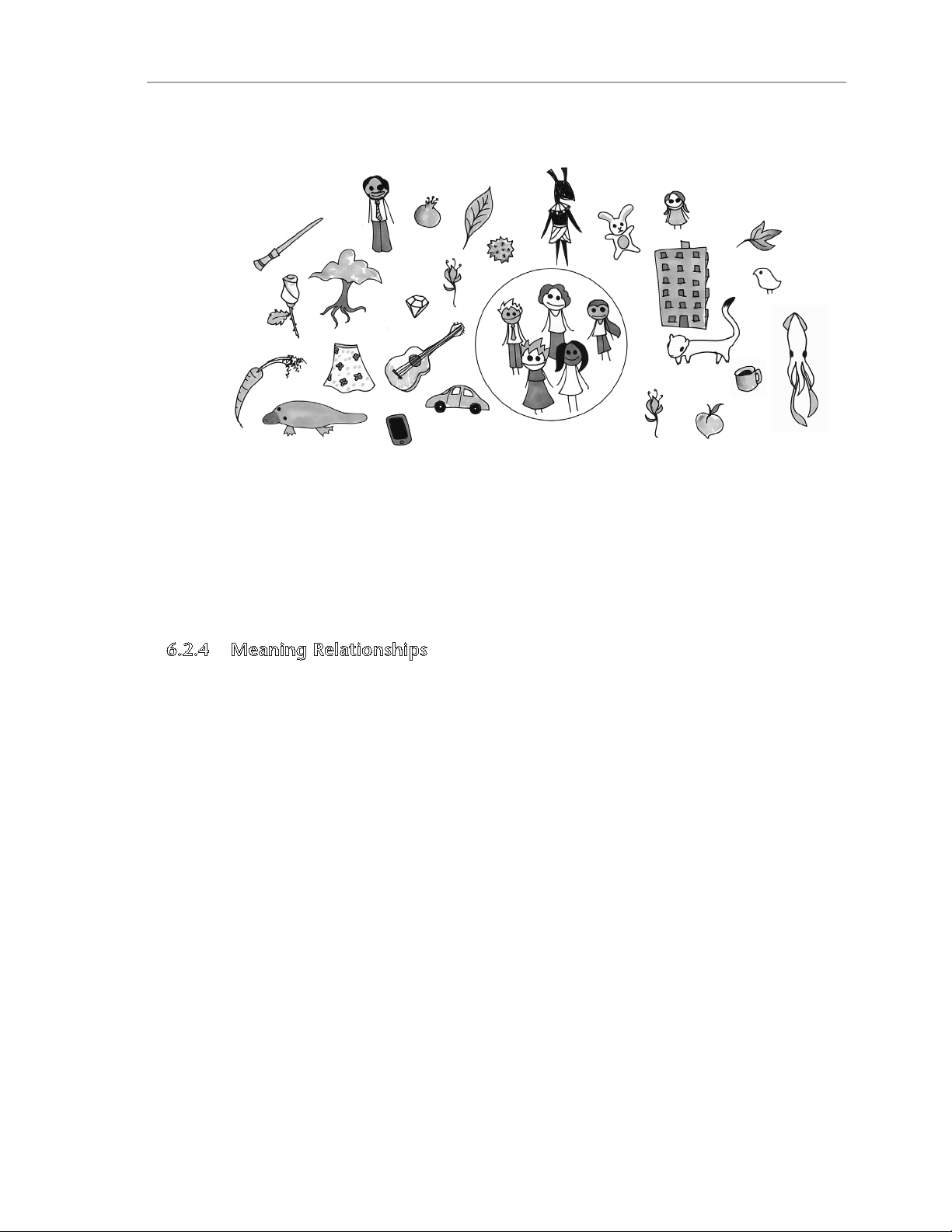
Similarly, the reference of the expression woman is the set of all women in the world.
The diagram in (3) depicts the reference of the expression woman in a simple world that
contains very few things. Keep in mind that this diagram is just a visual representation of
the reference of the expression woman. That is, woman does not refer to the collection of
figures in the diagram. Instead, woman refers to the set of actual individuals in the world who are women.
You may object that an expression like Sally’s cat does indeed refer to a specific thing,
or that the woman who is married to Barack Obama refers specifically to Michelle Obama, and
not to the set of all women. While this is true, it is not the case that common nouns like
cat or woman in isolation refer to specific individuals. Expressions that contain nouns can
have specific referents, but this is a consequence of how noun meanings combine with
meanings of other expressions. Put another way, there is something about the combination
of cat and Sally’s that produces its specific reference. Similarly, it is the combination of the
lexical expressions in the woman who is married to Barack Obama that creates the reference
to a particular individual. Since the meaning that arises through combinations of expres-
sions is in the domain of compositional, not lexical, semantics, we will return to this gen- eral topic in File 6.4.
Just like nouns, intransitive verbs also refer to sets of entities. The reference of an in-
transitive verb like swim is the set of all swimmers in the world. If this seems a little coun-
terintuitive, suppose somebody asks you, Who swims? You would probably answer this
question by trying to list the swimmers that you can think of, e.g., Sally, Polly, whales, and
Sally’s dog Fido. You would be trying to identify the set of things in the world that swim.
Similarly, the reference of an adjective like purple is the set of all purple things in the world.
File 6.2 Lexical Semantics: The Meanings of Words 253
(3) A visual representation of the set identified by woman, relative to all things in the universe © 2015 by Julia Porter Papke
We have hardly exhausted all of the different kinds of reference that words can have.
Nonetheless, we hope to have given you a taste of how words may relate to the things in
the world and how we can use diagrams (like the one in (3)) to represent their reference. In
the next section, we build on the notion of word reference to discuss different kinds of
meaning relations between words.
6.2.4 Meaning Relationships
There are many ways for two words to be related. In previous chapters we have already
seen a number of ways: they may be phonologically related (e.g., night/knight, which share
the same pronunciation), they may be morphologically related (e.g., lift/lifted, which
both share the same root), or they may be syntactically related (e.g., write/paint, which are
both transitive verbs). There is yet another way two words can be related, and that is seman-
tically. For instance, the word pot is intuitively more closely related semantically to the
word pan than it is to the word floor. The reason, clearly, is that both pot and pan have
meanings that involve being containers used for cooking, while floor does not. (We will
later reach the conclusion that pot and pan are sister terms.)
To facilitate our survey of semantic relationships among words, we will focus on their
reference. So we will talk about specific things in the world (the reference of proper names)
or sets of things in the world (the reference of nouns or adjectives). This will allow us to
construct convenient diagrams to represent semantic relationships among words.
a. Hyponymy. One kind of word meaning relation is hyponymy. We say that a word
X is a hyponym of a word Y if the set that is the reference of X is always included in the set
that is the reference of Y. When some set X is included in a set Y, we also say that X is a sub- set of Y.
For example, consider the words dog and poodle. The reference of dog is the set of all
things that are dogs, while the reference of poodle is the set of all things that are poodles.
Suppose that there are exactly three individuals in the world that are poodles, namely,
Froofroo, Princess, and Miffy. Of course, all poodles are also dogs. Now in this simple world
that we are imagining, in addition to the three poodles, there are also some individuals that
are dogs but not poodles, namely, Fido, Spot, and Butch. 254 Semantics
Diagram (4) depicts this scenario. The names of the sets that represent the reference
of dog and poodle are in capital letters and underlined. The names of individuals appear in-
side the sets they belong to. For example, the referents of poodle are inside the set that rep-
resents the reference of poodle.
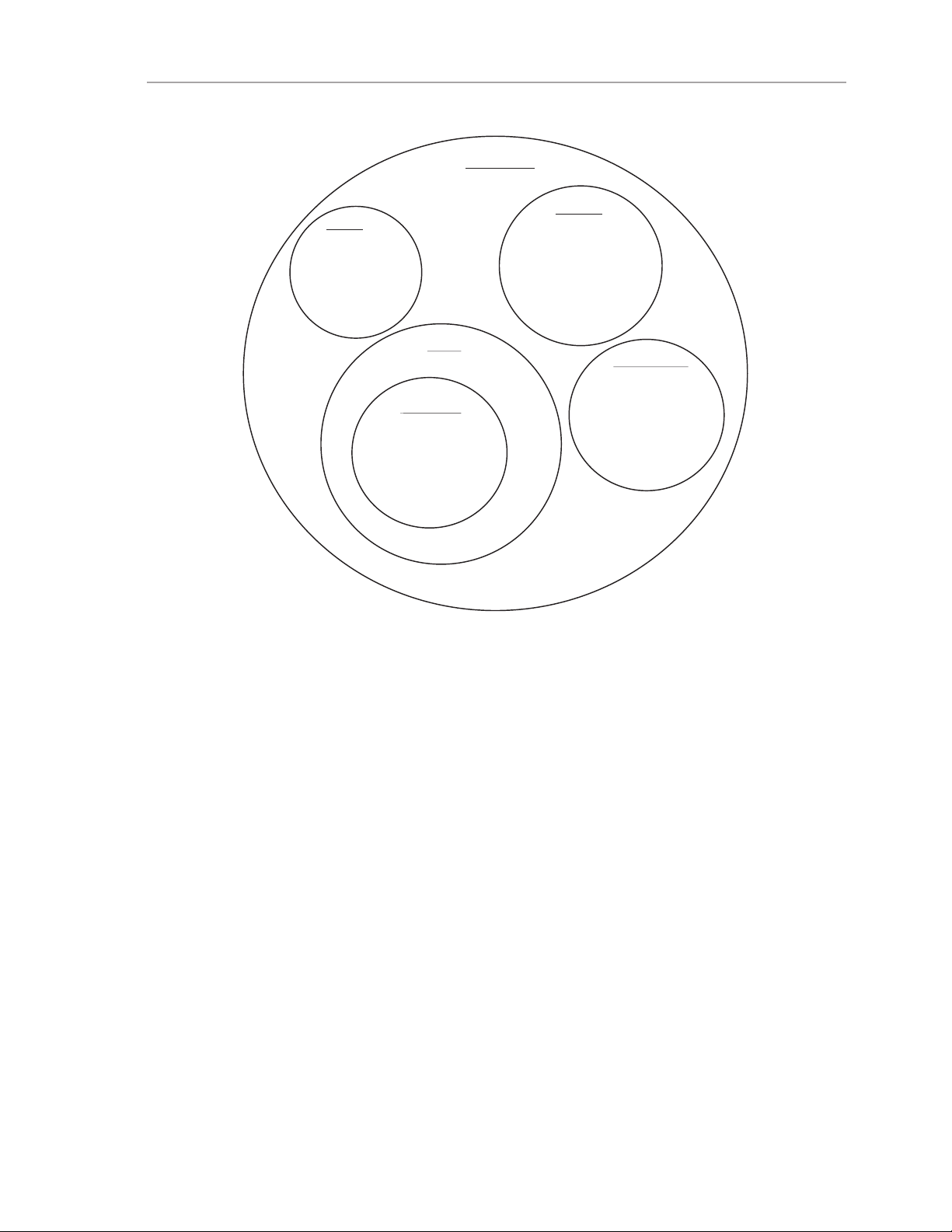
(4) Visual representation of the hyponymous relation between poodle and dog DOGS Spot Fido POODLES Butch Miffy Froofroo Princess
Of course, this diagram is just a visual aid. The referent of Froofroo is not a sequence
of letters on a piece of paper, but some actual individual. The reference of poodle is not a
circle with some sequences of letters in it, but a set of actual poodles. For obvious reasons,
we cannot put real dogs in this textbook, so a diagram will have to suffice.
What we see in the diagram is that the set of poodles is contained in the set of dogs;
i.e., the set that is the reference of poodle is a subset of the set that is the reference of dog.
It represents the fact that all poodles are dogs (so Miffy is a member of the set of poodles,
but also a member of the set of dogs), but not all dogs are poodles (e.g., Fido is a member of
the set of dogs, but not a member of the set of poodles). In this case, we say that the word
poodle is a hyponym of the word dog. Conversely, dog is a hypernym of poodle.
Hyponymous relationships stack very well. For example, poodle is a hyponym of dog,
dog is a hyponym of mammal, mammal is a hyponym of vertebrate, vertebrate is a hyponym
of animal, etc. We say that two words are sister terms if their reference is, intuitively, on the
same level in the hierarchy. This means that they are contained in all the same sets, or
that they have exactly the same hypernyms. For example, in diagram (4), Miffy and Froofroo
are sister terms because there is no set that Miffy belongs to and Froofroo does not, and
vice versa. However, Fido and Miffy are not sister terms because Fido is not in the set of
poodles, while Miffy is. In diagram (5), dog and cow are sister terms, while cow and poodle are
not because dog is a hypernym of poodle, but it is not a hypernym of cow.
b. Synonymy. Another kind of semantic relation is synonymy. Two words are syn-
onymous if they have exactly the same reference. It may be difficult to come up with
pairs of truly synonymous words, but couch/sofa, quick/rapid, and groundhog/woodchuck
come close. Anything that is a groundhog is also a woodchuck, and vice versa. The set that
is the reference of groundhog is exactly the same set as the one that is the reference of wood-
chuck. Of course, the senses of the words in these pairs may differ—it is possible for some-
one to know what woodchucks are without knowing what groundhogs are, so their senses
are not the same thing. Similarly, quick and rapid may have different senses, but the set of
quick things in the world is probably the same as the set of rapid things.
c. Antonymy. A third kind of semantic relation is antonymy. The basic notion of
antonymy is of being “opposite” in some sense. In order for two words to be antonyms of
one another, they must have meanings that are related, yet these meanings must contrast
with each other in some significant way.
File 6.2 Lexical Semantics: The Meanings of Words 255
(5) Visual representation of sister terms and of nested hyponymous relations MAMMAL SHEEP COW Daisy Fluffy Puffy Bessie Elsie Poofy Angus Woolly DOG PLATYPUS Spot Fido Eugene POODLE Butch Dorothy Miffy Sigmund Froofroo Princess
It turns out that the word opposite is fairly vague: there are actually several ways for
a pair of words to be opposites, and each is distinct from the others. The most straightfor-
ward are complementary pairs. We can characterize complementary antonymy in terms of
word reference. Two words X and Y are complementary antonyms if there is nothing in the
world that is a part of both X’s reference and Y’s reference. Thus, if everything in the world
is either in X’s reference set or in Y’s reference set or in neither of those sets, but crucially
not in both sets, and if stating that something is X generally implies that it isn’t Y, then X
and Y form a complementary pair. (6) gives examples of complementary antonyms. (6) Complementary antonyms a. married/unmarried b. existent/nonexistent c. alive/dead d. win/lose
For each of these pairs, everything is either one or the other, or else is neither. So, for ex-
ample, a boulder is neither alive nor dead, but critically, it isn’t both.
The second way a pair of words can be antonyms is by being gradable pairs. Gradable
antonyms typically represent points on a continuum, so while something can be one or the
other but not both, it can also easily be between the two (in contrast to complementary
pairs), so saying “not X” does not imply “and therefore Y.” For example, water may be hot,
cold, or neither, but if you say that the water is not hot, it does not imply that it is cold. It
may be warm, lukewarm, cool, chilly, or anywhere else in between. In addition, gradable
antonyms tend to be relative, in that they do not represent an absolute value: an old dog 256 Semantics
has been around many fewer years than an old person, and a large blue whale is a very dif-
ferent size from a large mouse (see also the discussion of relative intersection in Section
6.4.3). Examples of gradable antonyms appear in (7). (7) Gradable antonyms a. wet/dry b. easy/hard c. old/young d. love/hate
The fact that there are often words to describe states in between the two extremes can help
in identifying gradable antonyms; for example, damp means something like ‘between wet
and dry,’ and middle-aged means something like ‘between old and young,’ but there is no
word that means ‘between alive and dead’ or other complementary pairs. Also, it is pos-
sible to ask about the extent of a gradable antonym and to use comparative and superla-
tive endings or phrasing with them. Compare, for example, (8a) and (8b) with (8c) and
(8d). It is easy to answer questions like (8a) and (8b) with something like He is older/
younger than Sally or It was the easiest/hardest test I’ve ever taken, but it is much stranger to
ask or answer a question like (8c) or (8d), and phrases like less alive or more nonexistent are semantically odd, at best. (8) a. How old is he? b. How hard was the test? c. How alive is he?
d. How nonexistent is that unicorn?
The third kind of antonymy is seen in pairs of words called reverses, which are pairs such as those in (9). (9) Reverses a. put together/take apart b. expand/contract c. ascent/descent
Reverses are pairs of words that suggest some kind of movement, where one word in the
pair suggests movement that “undoes” the movement suggested by the other. For example,
the descent from a mountain undoes the ascent, and putting something together undoes taking it apart.
Finally, there are converses. Converses have to do with two opposing points of view
or a change in perspective: for one member of the pair to have reference, the other must as
well. Consider the examples in (10). (10) Converses a. lend/borrow b. send/receive c. employer/employee d. over/under
In order for lending to take place, borrowing must take place as well. In order for there to
be an employer, there must also necessarily be at least one employee. If an object is over
something, then something must be under it. Note how the pairs in (10) thereby differ from
the pairs in (9). It is possible, for example, for something to expand without having any- thing contract. F I L E 6.3 Compositional Semantics: The Meanings of Sentences
6.3.1 Propositions and Truth Values
Thinking about what words mean is a critical part of semantics. Having a knowledge of
lexical semantics, however, doesn’t get us even halfway to being able to perform some of
the complex communicative acts that we perform every day. If we could communicate by
only using individual words, then our language would lack the sort of productivity that
allows us to communicate complex new ideas. Therefore, we must consider not only word
meanings but phrase and sentence meanings as well. In this file, we discuss the meanings
of sentences, starting with their reference. Once we understand the relationship between
sentence meanings and the world—their reference—we will be better equipped to discuss
the senses that they express and the meaning relationships between them.
We encountered two types of word reference when we discussed lexical semantics.
Some words, like proper names, refer to specific things in the world, while other words, like
nouns and intransitive verbs, refer to sets of things in the world. Sentences, however, do not
refer to either specific things or sets of things. Consider the following sentence:
(1) China is the most populous country in the world.
The sentence in (1) is making a specific claim about entities in the world. It doesn’t sim-
ply refer to China, or to the set of countries, or to the set of very populous countries. Un-
like the name China, which picks out the entity in the world that is China, or countries,
which directs our attention to the set of countries in the world, this sentence makes an
assertion about certain entities in the world. The claim expressed by a sentence is called a proposition.
Note that words in isolation do not express propositions. The expression China does
not in and of itself make a claim about China. Similarly, the word countries does not assert
anything about countries or about anything else for that matter. On the other hand, the
sentence in (1) does make a claim, namely, that China is the most populous country in the
world. We will return to the discussion of propositions themselves—the senses expressed by
sentences—shortly. For now, we will focus on the relationship between propositions and the world.
The crucial, in fact defining, characteristic of a proposition is that it can be true or
false. The ability to be true or false is the ability to have a truth value. We can inquire about
the truth value of propositions explicitly. For example, we could ask, Is it true that China is
the most populous country in the world? Yet it wouldn’t make much sense to try to inquire
about the truth value of the meanings of nouns or proper names. That is, it would be very
strange to ask whether China is true or whether the most populous country in the world is
false. Trying to ask such a question is generally an excellent test for figuring out whether
you are dealing with a proposition or not, since, by definition, all propositions have a truth value. 257 258 Semantics
The proposition expressed by the sentence in (1) happens to be true. The proposition
expressed by the sentence in (2) also has a truth value, but its truth value happens to be false.
(2) Luxembourg is the most populous country in the world.
So, having a truth value does not mean being true, but rather being either true or false. To
figure out whether a proposition is true or false, we have to evaluate it with respect to the
world. In that way, truth values really do represent a relationship between the sense ex-
pressed by a sentence (a proposition) and the world. Thus, we consider truth values to be the reference of sentences.
You could think of it this way: when we consider the meaning of the expression the
44th president of the United States with respect to the world, we come up with the individual
Barack Obama as its reference, and when we consider cat with respect to the world, we come
up with the set of cats as its reference. Similarly, when we consider the meaning of China
is the most populous country in the world with respect to the world that we live in, we can de-
termine whether it is true or false. In sum, sentences express propositions and refer to truth values.
What does it mean to understand the proposition expressed by some sentence? Obvi-
ously, you must understand the sense of all the words that the sentence contains. You can-
not understand the proposition expressed by China is the most populous country in the world
without having mental representations of the meaning of China, country, populous, etc., and
knowing how these expressions are syntactically combined to form a sentence. We will re-
turn to this discussion in the next file.
Ultimately, though, understanding a proposition must involve being able to deter-
mine its reference, in principle. This means understanding what the world would have to
be like for the proposition to be true. The conditions that would have to hold in the world
in order for some proposition to be true are called truth conditions. Thus, understanding
the proposition expressed by a sentence means understanding its truth conditions. Con-
sider the following sentence and the proposition it expresses:
(3) The Queen of England is sleeping.
We all know what the world would have to be like for the proposition expressed by (3) to
be true: on [insert current date] at exactly [insert current time] the individual that the
Queen of England refers to would have to be asleep. However, the majority of us have no
idea whether this proposition is actually true or false at any given time. This is not because
we don’t understand the proposition expressed by this sentence—we do, since we under-
stand under what conditions it would be true—but because we don’t have the requisite
knowledge about the actual world to determine its reference.
Let’s consider a more extreme example. The sentence in (4) expresses a proposition
whose truth value nobody definitively knows, although all English speakers understand its truth conditions:
(4) Sometime in the future, another world war will occur.
It is important to note that just because the truth value of a proposition is unknown does
not mean that it doesn’t have one. The proposition expressed by (4) indeed has a truth
value. However, whether it is actually true or false is not something that we can deter-
mine. Notice that we can easily inquire about its truth value. You could, for example, le-
gitimately ask a friend, Do you think it’s true that sometime in the future another world war
will occur? This is how we know that it really does express a proposition.
File 6.3 Compositional Semantics: The Meanings of Sentences 259
In sum, in order to know the truth value of a proposition, it is necessary to understand
its truth conditions—you cannot begin to figure out whether a proposition is true or false
unless you know what the world would have to be like for it to be true. However, since no
one has perfect information, it is possible to understand its truth conditions but still not
know its reference. This is not entirely unlike the fact that although you may have some
mental representation about what lychee means, you may nevertheless fail to correctly pick out its referents.
6.3.2 Relationships between Propositions
Now that we know a little bit about propositions, we can investigate different kinds of
relationships between them. Consider the following pair of sentences and the proposi- tions that they express: (5) a. All dogs bark. b. Sally’s dog barks.
If the proposition expressed by the sentence in (5a) is true, the proposition expressed by
(5b) also has to be true. In other words, the truth of (5a) guarantees the truth of (5b). If
indeed all dogs in the world bark, and one of those dogs is Sally’s pet, then clearly Sally’s
dog barks too. In this case, we say that the proposition expressed by All dogs bark entails
the proposition expressed by Sally’s dog barks. We call this relationship entailment.
Note that in reasoning about entailment, we are not concerned with actual truth val-
ues of propositions. Rather, we are evaluating their truth conditions. For example, look at the following pair: (6) a. No dogs bark.
b. Sally’s dog doesn’t bark.
In this case, too, (6a) entails (6b), because if (6a) were true, (6b) would also have to be
true. As we all know, (6a) happens to be false. But its actual truth value is not relevant.
What is relevant is that if we lived in a world in which (6a) were true, then (6b) would
have to be true as well. Intuitively, the truth conditions for (6a) already include the truth
conditions for (6b). Now consider the following pair of sentences:
(7) a. Barack Obama is the 44th president of the United States.
b. China is the most populous country in the world.
The propositions expressed by both of these sentences happen to be true. However, neither
one entails the other. Intuitively, the truth conditions for (7a) have nothing to do with the
truth conditions for (7b). It’s easy to imagine a world in which (7a) is true but (7b) is false, or
vice versa. The truth of (7a) doesn’t guarantee the truth of (7b), and the truth of (7b) doesn’t
guarantee the truth of (7a), so there is no entailment between these two propositions.
Some more examples of entailment follow. In each pair, the proposition expressed by
the sentence in (a) entails the one expressed by the sentence in (b). (8) a. Ian owns a Ford Focus. b. Ian owns a car.
(9) a. Ian has a full-time job. b. Ian is employed. (10) a. Ian has visited Spain. b. Ian has visited Europe. 260 Semantics
Notice that entailment is not necessarily symmetric. For example, if Ian has visited Spain,
it has to be true that he has visited Europe. However, if Ian has visited Europe, that doesn’t
imply that he has visited Spain—perhaps he went to Finland or Ukraine instead. Thus,
while (10a) entails (10b), (10b) does not entail (10a). When two propositions entail one
another, we refer to their relationship as one of mutual entailment. For example, (11a) and (11b) are mutually entailing.
(11) a. Ian has a female sibling. b. Ian has a sister.
Propositions can also be incompatible. This means that it would be impossible for both of
them to be true; that is, the truth conditions for one are incompatible with the truth
conditions for the other. The following are some pairs of mutually incompatible proposi- tions: (12) a. No dogs bark. b. All dogs bark.
(13) a. George Washington is alive. b. George Washington is dead.
(14) a. Ian has a full-time job. b. Ian is not unemployed.
When two propositions are incompatible, it is impossible to imagine a world in which they could both be true. F I L E 6.4 Compositional Semantics: Putting Meanings Together
6.4.1 The Principle of Compositionality
Investigating propositions and their relationships is only one aspect of compositional
semantics. Another important set of questions that compositional semantics tries to an-
swer has to do with meaning combinations. Given the meanings of words, how do we
arrive at meanings of larger expressions? Clearly, the meanings of phrasal expressions
(such as sentences) depend on the meanings of the words they contain. For example, Sally
never had a cat and Sally never had a dog express different propositions, and we could say
that this difference boils down to cat and dog having different meanings. However, it is
not just the meanings of words that are relevant for figuring out the meanings of larger
expressions that contain them. Consider the following pair of sentences: (1) a. Sally loves Polly. b. Polly loves Sally.
Both of these sentences contain exactly the same words, none of which are ambiguous.
However, the sentence in (1a) expresses a different proposition than the sentence in (1b).
It is possible for the proposition expressed by (1a) to be true, and the one expressed by
(1b) to be false—unrequited love is a real possibility.
What is the source of this difference in meaning between (1a) and (1b) since they both
contain exactly the same expressions? It must be the way that these words are syntactically
combined. In (1a), Polly is the object of loves, and Sally is its subject. In (1b), the reverse is
the case. Thus, the syntactic structure of these two sentences is different, and that has an effect on meaning.
Consider the following structurally ambiguous string of words: The cop saw the man
with the binoculars. This sequence can be used to express two distinct propositions. It could
mean that the cop had the binoculars and was using them to look at the man, or it could
mean that the man whom the cop saw was the one who had the binoculars. This differ-
ence in meaning arises because the expressions can syntactically combine in two different
ways: the PP with the binoculars could be a VP adjunct, modifying saw the man, or it could
be a noun adjunct, modifying man (see File 5.5). Therefore, the meaning of a phrasal expres-
sion, such as a sentence, depends not only on the meanings of the words it contains, but
also on its syntactic structure.
This is precisely what the principle of compositionality states: the meaning of a sen-
tence (or any other multi-word expression) is a function of the meanings of the words it
contains and the way in which these words are syntactically combined. There has to be
some way for speakers to figure out the meanings of sentences based on lexical meanings
and syntactic structures, since all languages contain an infinite number of sentences. It is
clearly impossible to memorize all distinct sentence meanings. However, the meanings of
all words and other lexical expressions are stored in the mental lexicon, and a part of speak-
ers’ mental grammar is syntax. Because the meanings of sentences can be computed based 261 262 Semantics
on word meanings and syntactic structures, speakers can produce and understand an infi-
nite number of sentences. In this way, the principle of compositionality is related to the
design feature of productivity. Crucially, speakers can comprehend the meanings of com-
pletely novel sentences, as illustrated by the sentences in (2). While you’ve most likely never
encountered these sentences before, you should have no trouble figuring out what they mean.
(2) a. I stuffed my apron full of cheese and frantically ran away from the dairy snatchers.
b. It seems unlikely that this book will spontaneously combust while you are reading
it, but nonetheless it is theoretically possible that this might happen.
c. The platypus is enjoying a bubble bath.
The principle of compositionality simply states that the meanings of multi-word ex-
pressions are compositional, that is, predictable from the meanings of words and their syn-
tactic combination. To appreciate the compositional nature of the meanings of most phrasal
expressions, let’s look at some examples where compositionality fails. Consider the ex-
pression kicked the bucket in Polly kicked the bucket. This sentence could mean that Polly
performed some physical action whereby her foot came into forceful contact with some
bucket; this is the compositional meaning of this sentence that we can compute based on
the meanings of Polly, kicked, the, and bucket, along with the syntactic structure of the sen- tence.
Yet kick the bucket also has another, idiomatic meaning, which has nothing to do with
forceful physical contact between somebody’s foot and a bucket. The non-compositional
meaning of kick the bucket is ‘die,’ so Polly kicked the bucket could also mean ‘Polly died.’
Since this meaning is not predictable given the meanings of kick, the, and bucket, and given
their syntactic combination, the entire phrase kick the bucket has to be stored in your men-
tal lexicon together with its non-compositional meaning. Thus, even though it’s not a sin-
gle word, kick the bucket is a kind of lexical expression. We call such expressions idioms.
Whenever the meaning of some multi-word expression is not compositional, it has to
be stored in the mental lexicon. Fortunately, in the vast majority of cases, phrasal meanings
are compositional. In the remainder of this file, we explore how, exactly, the meanings of
words combine into phrasal meanings, which, as you will recall, depends partly on their syntactic combination.
6.4.2 Combining the Meanings of Verb Phrases and Noun Phrases
Recall from Chapter 5 that sentences in English typically consist of a noun phrase (NP)
and a verb phrase (VP). As an example, consider the phrase structure tree for the sentence
Sandy runs, shown in (3). What is the process for computing the meaning of the whole
sentence from the meanings of its two constituents, an NP and a VP? (3) S NP VP Sandy runs
As we discussed in File 6.2, proper names like Sandy refer to specific entities in the
world, and intransitive verbs like runs refer to sets of entities in the world. So Sandy refers to
some individual Sandy, and runs refers to the set of all runners in the world. How can we
figure out, based on the reference of Sandy and runs, what the truth conditions for the
File 6.4 Compositional Semantics: Putting Meanings Together 263
proposition Sandy runs are? It’s quite simple, really: for the proposition expressed by Sandy
runs to be true, it would have to be the case that Sandy (the referent of Sandy) is a member
of the set that is the reference of runs.
Consider the following scenario. Suppose we live in a very simple world that contains
exactly five individuals: Kim, Robin, Lee, Sandy, and Michael. Suppose further that of these
five individuals, Robin, Kim, and Lee are runners, but Sandy and Michael are not. In other
words, the reference of runs in this world is the set that contains the individuals Robin,
Kim, and Lee. This situation is depicted in (4). (4) RUNS Sandy Robin Kim Michael Lee
In this world, the proposition expressed by Sandy runs is false, since Sandy is not in the
set that is the reference of runs.
But now suppose that in this simple world in which there are only five individuals,
the reference of runs is different, so that Sandy, Robin, and Lee are runners while Kim and
Michael are not. This situation is depicted in (5). (5) RUNS Kim Robin Sandy Michael Lee
In this case, the proposition expressed by Sandy runs would be true, since Sandy is in the
set that is the reference of runs.
Although discussing the details of computing the meanings of multi-word NPs such
as the 44th president of the United States or multi-word VPs such as likes Bob a lot is beyond
the scope of this book, we note that many expressions whose syntactic category is NP refer
to specific individuals, while expressions whose syntactic category is VP refer to sets of in-
dividuals. Thus, the 44th president of the United States refers to the individual Barack Obama,
and likes Bob a lot refers to the set of individuals who like Bob a lot. In many cases, then, the
proposition expressed by a sentence is true just in case the referent of the subject NP is a
member of the set that is the reference of the VP. For example: (6) a. Sandy’s dog barks. truth conditions:
true just in case the individual that Sandy’s dog refers to is in the set of all barkers
b. The 44th president of the United States eats apples. truth conditions:
true just in case Barack Obama is in the set of all apple-eaters
6.4.3 Combining the Meanings of Adjectives and Nouns
Computing truth values for simple sentences was a fairly straightforward demonstration
of semantic composition. We find a more complex sort of composition when we turn our
attention to adjective- noun combinations. While the adjective and the noun syntactically 264 Semantics
combine the same way in green sweater, good food, and fake money, we will see that in each of
these phrases, their meanings combine differently. How their meanings combine depends
primarily on the particular adjective involved.
We’ll start out with the simplest form of adjectival combination, pure intersection. In
the phrase green sweater, we have two words, green and sweater, each of which refers to a set
of entities (individuals or objects). The reference of green is the set of green entities, and that
of sweater is the set of entities that are sweaters. To compute the meaning of the phrase,
then, we need only collect all the entities that are in the set both of green things and of
sweaters. This is illustrated in the following diagram; here, the intersection (the overlapping
portions of the two circles) contains the set of entities that are both in the set of green things and in the set of sweaters. (7) set of all set of all sweaters green things set of all green sweaters
Other phrases that work in the same way are healthy cow, blue suit, working woman, etc.
Because they produce pure intersections, adjectives like healthy, blue, and working are called
intersective adjectives. An important point about these cases of pure intersection is that the
two sets can be identified independently. For example, we can decide what is green and
what isn’t before we even know that we’re going to look for sweaters.
Other adjectives do not necessarily combine with nouns according to this pattern;
examples of a second kind of semantic combination can be found in the phrases big whale
or good beer. In the case of big whale, the problem is that it is not possible to identify a set of
big things in absolute terms. Size is always relative: what is big for whales is tiny for moun-
tains; what is big for mice is tiny for whales; what is short for a giraffe is tall for a chicken.
While it is possible to find a set of whales independently, the set represented by the adjec-
tive big can’t be just a set identified by the meaning ‘big’ but rather must be a set identified
by ‘big- for- a- whale.’ Similarly, tall giraffe will involve a set of things that are tall- for- a-
giraffe, and loud explosion, a set of things that are loud- for- an- explosion (compare this with
loud whisper, which would use a completely different standard for loudness). Such cases we
call relative intersection, since the reference of the adjective has to be determined relative
to the reference of the noun. Examples are shown in (8). (8) MICE WHALES BIG BIG WHALES MICE