Team Dynamics and Cooperation Analysis | Môn Organizational behavior - Đại học Kinh Tế Quốc Dân
Group 27 consists of 8 members from I15 and I16, so there will be differences in ages but no problem in this regard. This group is considered a formal group when teachers are assigned and established to work together on final group assignments and several exercises that are assigned by the teacher in the in-class lessons, beginning from session 6 to session 11, in order to improve interactions among members. Tài liệu được sưu tầm gồm 50 trang, giúp bạn ôn tập tốt hơn. Mời các bạn đón xem.
Môn: Organizational behavior 38 tài liệu
Trường: Trường Đại học Kinh Tế Quốc Dân 6.7 K tài liệu
Tác giả:



















Preview text:
lOMoAR cPSD| 58675420 OB ASM 2 - Group 27 Table of Contents
PART I: SYNDICATE EFFORT 2 I. INTRODUCTION 2 Role 2 Norm 7 Status 8 Size 11 Cohesiveness 11 II.
DEVELOPMENT OF TEAM COOPERATION 12 Punctuated-Equilibrium theory 12 Communication in team 14 III.
REFLECTION AND EVALUATION TEAM 16 Individual differences 16 Motivation: 18 Empowerment 19 Leadership theories 20 IV.
FACTORS THAT MAKE THE TEAM EFFECTIVE OR INEFFECTIVE 21
Factors supporting effectiveness 21
Factors hindering effectiveness 22 Overall performance 23 V.
RELATIONSHIP BETWEEN THE EFFECTIVENESS OF
TEAMWORK AND GOAL ACHIEVEMENT 24 Internal 24 External 25 VI.
CONTRIBUTION OF EACH MEMBER 25 lOMoAR cPSD| 58675420 VII. CONCLUSION 27 VIII. REFERENCES 27
PART I: SYNDICATE EFFORT I. INTRODUCTION
Group 27 consists of 8 members from I15 and I16, so there will be differences in ages
but no problem in this regard. This group is considered a formal group when teachers
are assigned and established to work together on final group assignments and several
exercises that are assigned by the teacher in the in-class lessons, beginning from session
6 to session 11, in order to improve interactions among members. It is a task group
where everyone coming to the same OB class but from many different enrollments,
ages, randomly gathers to solve the above task. After completing this large exercise,
this group will complete the mission and disband.
We are a team because everyone's skills complement each other. At the same time, we
work together through two forms, including face-to-face communications and online
discussions via Microsoft Teams to divide and complete work. To make sure that
everyone can do their task well in this type of group, the team leader namely Quyen
Sinh Truong has always tried to keep a close eye on each person's work by reporting
weekly work, and every week that the person assigned to the task will have to post it
publicly so everyone can know the quality and progress of the task. 1. ROLE
According to Meredith Belbin (2010) who is a famous British management researcher
and consultant, he defined a team role as a tendency of behaviors, contributions and
interactions within a team among members in a specific way. In which, he has
categorized behaviors of each individual into nine different roles and grouping them
into three main clusters, which are Thinking/Problem Solving-oriented roles,
Peopleoriented roles and Action-oriented roles. In the usual perspective, everybody
tends to have definable ways of acting when collaborating with others in a team. Despite
the fact that not in any case people will behave like these archetypes, Belbin's model of lOMoAR cPSD| 58675420
roles is well-catched for the common clusters of behaviors, which are reliable enough
for people’s characteristics to be identified separately.
In the case of our Group 27, the Belbin’s roles model is applied pretty well to make the
team have a straightforward identification for each member's roles, before we really
have a profound understanding about one's strengths and weaknesses to reach the best performance.
The table below provides an united viewpoint about the roles of each member, after
several discussions and sharings between the whole team. In the process of working,
we have refined so many things, so a person can have more than one role. Name Role Explanation Quyen Sinh Resource
As a leader, Sinh Truong puts his great effort in Truong Investigator
connecting others when the team completes the
teacher’s tasks in the class. He also gathers people’s (Leader)
ideas and opinions through meetings, refining Completer/
which things are suitable to be expressed, setting Finisher
deadlines for the whole team to keep the work on
track and then completing the report with a sense Coordinator
of perfection and a high level of accuracy for details. lOMoAR cPSD| 58675420
Nguyen Van Coordinator
Phuong is a person who works with enthusiasm and Phuong
an open-minded attitude when coordinating others Team
in the team. She expresses a duty of a coordinator
in trying to balance the relations, and also Worker
catching the unique possibilities of other members
to motivate people to confidentially choose the Plant
tasks they can do well. Also, as a team worker, she
provides essential external materials and
information which are helpful for the team;
mediate and negotiate with others to minimize the
stresses and conflicts in the team. Duc Anh Shaper
Duc Anh drives the team forward, motivating not
only himself but also other members, and he does Team
not hesitate to pose challenges at work,
contributing creative ideas for the report as well as Worker
for problem-solving within the team. He also has a
good vision that leads people to the outcome of Plant
work. Not only that, he regularly gives honest
comments for people’s works. lOMoAR cPSD| 58675420 Cung Viet Team Bach Worker
Bach is a team worker who actively participates in
meetings and he usually speaks out loud about
concerns of not only himself but also others to
extinguish anxieties within the team. Also, he
motivates others to work with high productivity. Nguyen Team
As a team worker and also a resource investigator, Huong Worker
Quynh belongs to the people-oriented group in the
team. She holds the duty of the person who takes Quynh
notes in class, searching for related information Resource
and helping others in referencing suitable Investigator
knowledge sources for each task. Also, she makes
a great contribution to the progress by closely
following the leader’s allocation. lOMoAR cPSD| 58675420 Tuan Khai Plant
Khai takes the advantages of his critical thinking
and creativity to produce the seed and excellent Specialist
ideas for the team. He knows and deeply
understands the lectures to explain them to other Shaper
people, also raising in others a sense of
criticalness in developing ideas. Along with that,
Khai also is a specialist due to his understanding
about the topics that are assigned in each lecture,
and orienting people to the appropriate strategies. Dang Nam Implementer Anh Completer
Nam Anh was really active and dynamic as an
implementer, he not only completed his task but Finisher
also checked other people’s assignments together
with the leader, showing that he has a strong
awareness of how work should be done,
supporting those who need assistance and
providing solutions to solve arising problems. lOMoAR cPSD| 58675420 Nguyen Shaper Khanh Huy Monitor Evaluator
Huy plays the role of shaper and monitor evaluator,
expressed in how he generates an inspiration for
people to work together, and he also does not mind
to suggest changes in assigning tasks, creating
necessary debates to drive the team, raising in us a
sense of assertiveness, determination and devotion
for working. Also, he gives evaluations about the
team’s productivity to make sure that people work with high-efficiency.
In general, it can be seen that all the members of the team have a significant impact on
others’ activities, especially between the people who have the same orientation in the
three groups of goals. Everybody has a specialized strength that can assist others
welldone, so all the participants do not feel that they are inferior due to the great support
they receive. Indeed, our team-work resulted in a pretty good score compared to our
team’s goals. Good explanation of roles a. Role conflicts
Although our team has performed pretty well for each role of members to fully get the
task done, there are still several conflicts between people’s roles.
Too many shapers: In Group 27, there are 3 shapers, a number that may not be
considered as ideal. This can lead to confusions among shapers due to the fact that the
typical concern of them is achievement, winnings, increased competitiveness and sometimes disagreements.
Most of the members hold more than one role despite the large numbers of
participants: In Group 27, a person could take too many roles, somehow this leads to a
larger pressure for them and brings no-needed stress. lOMoAR cPSD| 58675420 2. NORM a. Performance norm
In group 27, all of the tasks and parts of deadlines are allocated reasonably for each
member to avoid confusion. According to the specific tasks and requirements of
lecturers and tutors, all the members need to prepare essential information, with
particular evidence to complete the task. Also, it is crucial for us to come up with
appropriate solutions with the hope of timely fixing issues during teamwork. b. Appearance norm
Basically, our group did not have too strict-standards in terms of appearance or clothes
with members to make sure that all the members can feel comfortable with their
outlooks, and most of the meetings were also arranged in Microsoft Teams. In direct
interactions at class, each member has a high self-consciousness in wearing so it was
not offensive. Nevertheless, the leader still made careful recommendations for people
to have polited-dressing on the final presentation.
c. Social arrangement norm
As mentioned above, most of the meetings are arranged on Teams to ensure the most
convenience for members. Thanks to that, some urgent discussions could be easier to
schedule. Nevertheless, our team also took the advantages of direct-classes at the
campus, as well as following the assigned-group work tasks of teachers in class to have
better collaborations and understandings with others.
d. Allocation of resources norm
Group 27 reaches an agreement in terms of the work tasks for each member, which is
allocated equally and reasonably. Each member is encouraged to catch the parts that they are confident with.
Negative norms: However, group 27 has some negative sides during working. Firstly,
it is the dependency between members before reporting the progress and outcomes for lOMoAR cPSD| 58675420
teachers. Secondly, the level of activeness in class was still shy and some of us did not
express ourselves freely. And, some of the members did not pay full attention to the
assigning-tasks, until other people acknowledged their assignments. 3. STATUS a. Group status
Group 27 can be considered as a hard-working group since the group members agreed
to set a deadline for the group assignment approximately three weeks before the official
deadline, which is earlier compared with other groups. In contrast, though members of
the group are always ready to take part in every single group activities within the class
sections, the average scores of group 27 is ranked below average for some reasons.
Hence, group 27’s status is medium. b. Individual status Name Role Personality Power Ability to Performance contribute Quyen Sinh Leader Extroverted High High High Truong Nguyen Van Member Introverted Medium High Medium-High Phuong lOMoAR cPSD| 58675420 Nguyen Duc Member Extroverted Medium Medium Medium Anh Cung Viet Member Extroverted Medium Medium Medium Bach Nguyen Member Extroverted Medium High High Huong Quynh Tuan Khai Member Introverted Medium Medium Medium Dang Nam Member Introverted Medium High High Anh Nguyen Member Extroverted Medium Medium Medium Khanh Huy c. Status effects Conformity
Members of a group or community are more likely to have less affection for the group's
norms and pressure than those who have a higher position in the group. Nonetheless, in lOMoAR cPSD| 58675420
the case of group 27, the problem has been reduced. Particularly as the group's head,
Sinh Truong had never disregarded the customary norms despite his position of
authority. For this reason, he serves as an inspiration to his colleagues, who may learn
a lot from his example of adhering to the group's rules. Among the examples are when
he has completed the work by the deadline he set, or when arrived on time to the group meeting. Group Interactions
There is usually a huge discrepancy in status that reduces creativity and ideas in a group.
Despite this, there isn't much of a disparity in status among the members of group 27
because everyone's status is listed from medium to high. The consequence is a more
diverse and self-sufficient group of people who are less dependent on others. As a
consequence, the workforce is always open to new ideas and approaches whenever it
comes to solving problems. However, because the general status is quite high,
individuals are more likely to be assertive and loud in their convictions and expect their
views to be accepted. In some cases, this might lead to a quarrel. A decision will be
made by the group leader if there are several opinions to choose from. It is also
emphasized that one must be able to listen and show respect for others. When someone
had a point of view, the group agreed they needed convincing proof before they could
offer positive and helpful remarks on the thoughts of others. Equity
Since every individual in group 27 has the same responsibility of accomplishing the
tasks and assignment together, everybody has their ideas spoken and the best idea is chosen unbiased. 4. SIZE
There were a total of eight people in group 27, that is why this group is considered a
small group when the lecture teacher separated them up. Since group 27 is a small
group, it is easier to quickly organize meetings and unify our thoughts, which leads to
faster decision-making. In addition, everyone has the chance to contribute more and lOMoAR cPSD| 58675420
improve their performance. Even yet, having a small number of people on the board
might restrict the number of new ideas that can be generated. 5. COHESIVENESS
When a team has a high level of cohesion, it means that its members are enamored with
the group and inspired to stay. When members of a team have faith in one another, they
are more likely to work together to attain a shared objective as well as their individual
needs for affiliation or prestige (Lunenburg and Lunenburg, 2015). The whole group
members are all in agreement of paying attention to lectures and tutorial sessions as
well as read as much academic research related to organization behavior to maximize
the knowledge in order to gain a Merit score. Even members in the group have very
tight schedules, people still try to arrange at least one hour after school to gather the
whole group together and plan everything out. The leader has had a very time efficient
plan in accomplishing the assignment. In addition to fostering a sense of unity and
mutual respect among the group's members, we make an effort to ensure that everyone's
voice is heard and valued. Our assignment goes more smoothly with the aid of these
strategies, which are also incredibly effective. If group 27 can get a Merit score, the
leader (Truong) promises the whole group a luxury buffet. II.
DEVELOPMENT OF TEAM COOPERATION
1. Punctuated-Equilibrium Theory
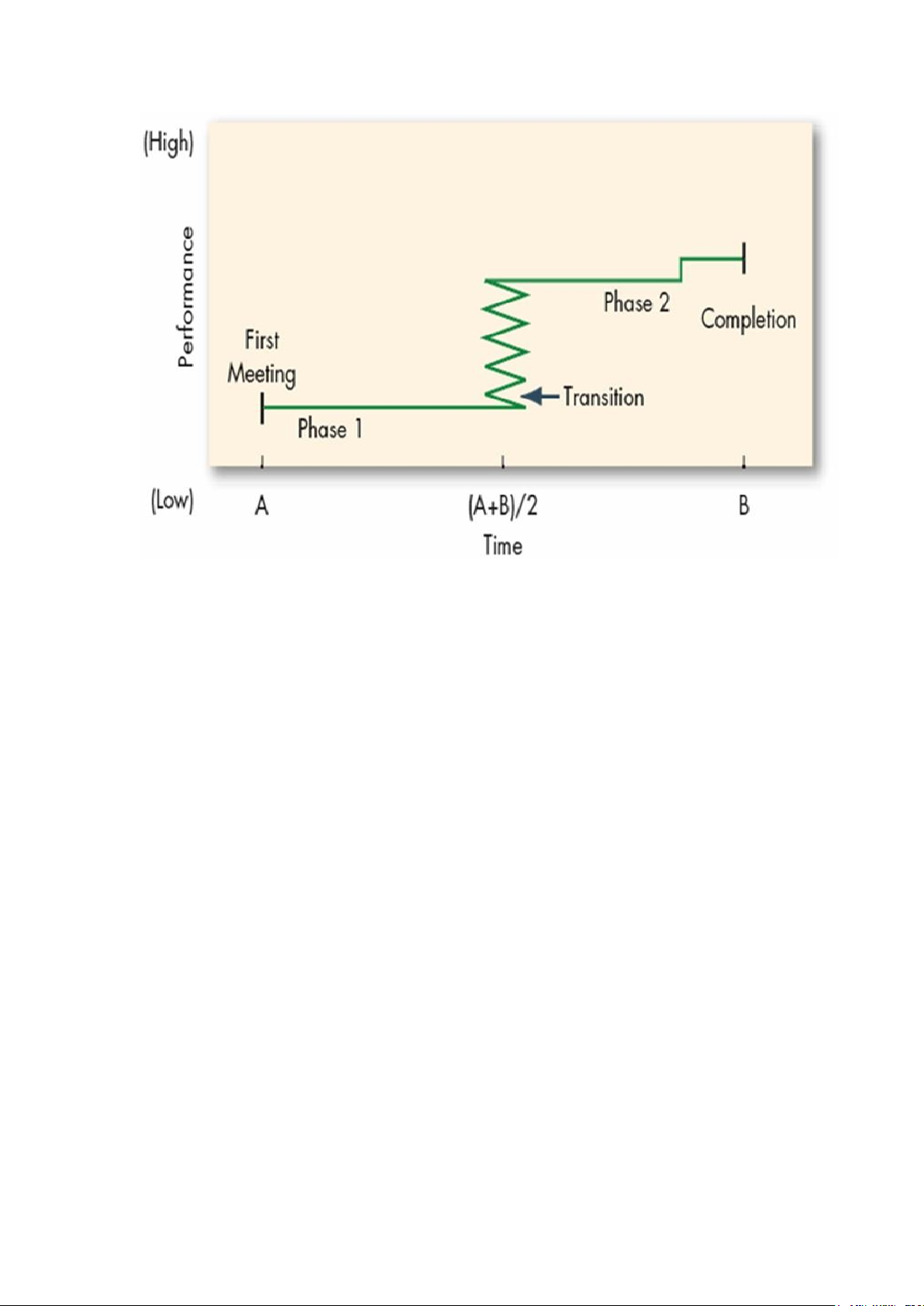
Gersick suggested in 1991 that instead of growing steadily over time, teams experienced
an alternation of stagnation and growth after analyzing between eight groups.
Specifically, the punctuated equilibrium (PEM) will describe changes in a group's time
perception and task performance over time. This is the Model: lOMoAR cPSD| 58675420
● Phase 1 and First Meeting
The group was established on April 2 with eight randomly selected members: Sinh
Truong, Nam Anh, Duc Anh, Khanh Huy, Van Phuong, Huong Quynh, Tuan Khai, Viet
Bach. However, the first meeting related to the group's joint report and the division of work began on April 10.
In the first group meeting, the communication between the members was still quite
awkward and not good. This can be explained because this is a group with random
members, between members who have not communicated with each other before. In
addition, the time the group was created was at the peak of the Covid-19 epidemic, so
in this first meeting, two members could not come because they were F0. For the above
reasons, the first meeting of group 27 only analyzed the requirements of the assignment.
However, in the next meeting on April 15, it can be said that the shyness among the
members has decreased quite a bit, and there is full participation of eight members.
Therefore, this is considered the first meeting of the whole group. The content of this
meeting was to define the common goal of the group in this report, choose a team leader,
and assign tasks in Phase 1. Although during this first meeting the group was able to lOMoAR cPSD| 58675420
talk freely, the cohesion between the members is still not much, so the leader Sinh
Truong has made a table to divide each task so that the members can freely choose the
part they want to do and pair up with the person they know. In this phase 1, people begin
to adapt to working in a group and understand tasks that they undertake. At the
beginning of the transition period, due to group activities given by the teacher in the
Lecture classes, communication in team was improved. This is an important phase for
the relationship between members. ● Transition
During the transition period after Phase 1, Group 27 encountered a few problems while
working. In terms of time, group 27 had a little problem when there were still deadlines
for other subjects, so the leader decided to delay the completion of work from April 25
to April 27. Besides the issue of time, we also encountered some problems in agreeing
on ideas with each other. Currently, the time for group meetings and discussions in the
chat group on Messenger is also more, the previous discussion time when starting phase
1 was only about half an hour, but there has been a change during the Transition phase,
meetings can last up to an hour or more. In these meetings, everyone brings up the
problems so that the fastest remedial measures can be taken. The fact that the group has
8 members should lead to a word multiplier and duplicate ideas in each part. Therefore,
the whole group decided to solve this problem in the final stage of Completion by
reviewing the content of each part, removing the duplicate parts to avoid excessive
word count, and agreeing on everyone's opinion.
● Phase 2 and Completion
After there were some changes in the time for submitting individual tasks, everyone had
more time to research and refine the content, leading to increased productivity and
efficiency when working in groups. Just like the plan is decided during the Transition
period, people also actively communicate with each other more often. When everyone
completes the tasks, the members will re-read all the content together to remove or
change the duplicate ideas in each section as well as to gain a deeper understanding of lOMoAR cPSD| 58675420
the content of the report. This helps the group exercise to clearly present the main ideas
and the required number of words. Finally, after all the parts have been combined into
a complete lesson, the whole group will review the knowledge and content of the whole
lesson together to practice the most fluent presentation. During this Completion stage,
the team agreed on a common working style, problems were resolved, and conflicts were minimal.
2. Communication in Team
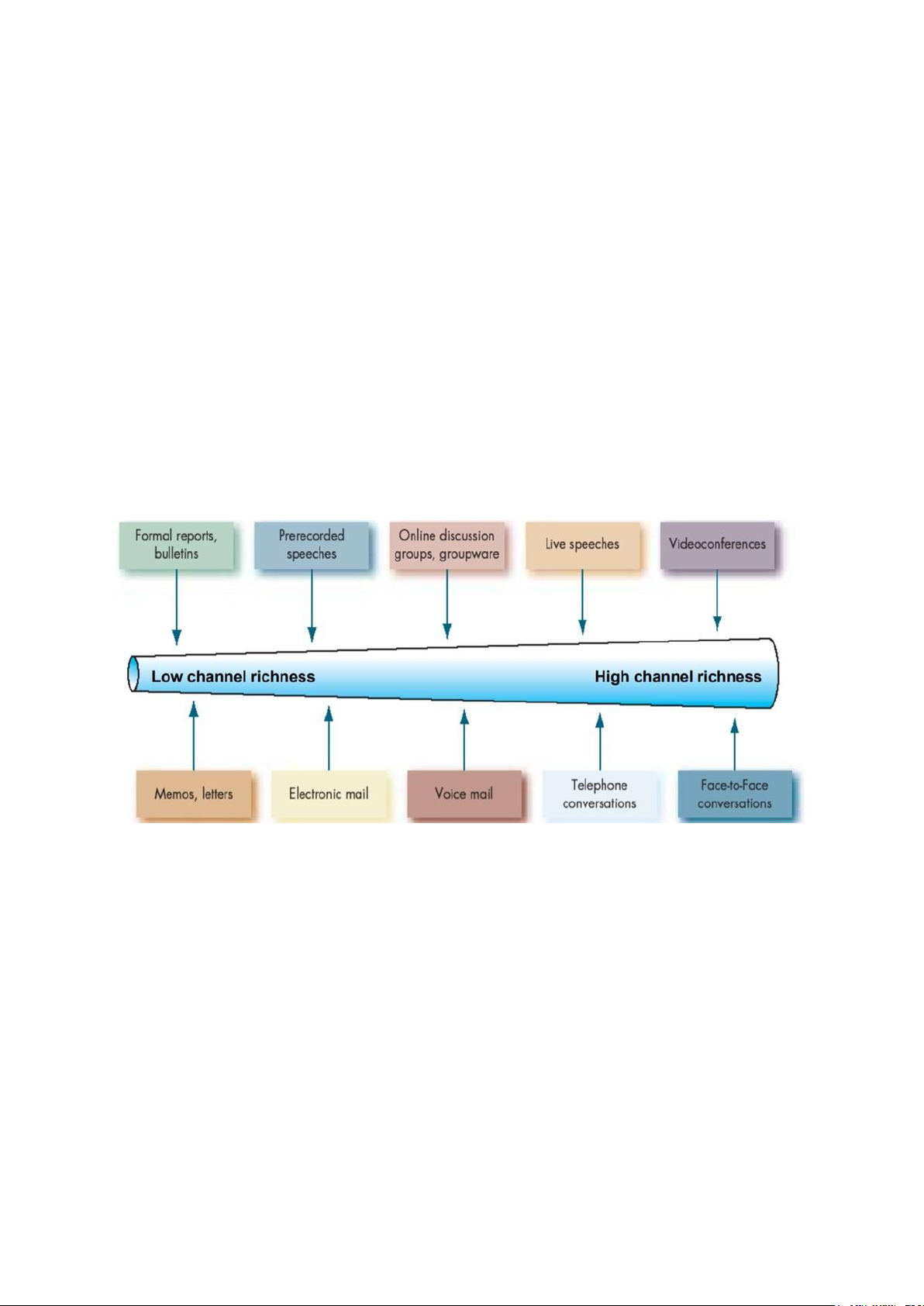
According to Lengel and Daft (1988), "media richness" can be used to explain
organizational behavior. The choice of communication channel plays an important part
in analyzing group behavior. This is an illustration of the model from low to high:
Although the Covid-19 epidemic situation is still happening, we were able to meet face-
to-face at the weekly Lecture and Tutor class. Each time the group meets, the whole
group will discuss class situations or exchange ideas, raise questions, solutions, and
contribute ideas for the group's report. In addition to face-to-face conversations, our
team also exploits electronic channels and regularly communicates with each other via
Messenger on Facebook, in addition, the content of the exercises are written and edited
via a common Google Docs link so that the Leader can easily synthesize the components. lOMoAR cPSD| 58675420
Being able to meet face-to-face is a good thing during the current pandemic. People can
communicate face-to-face, interacting with each other through words, and actions to
help build trust and avoid conflicts in the group. However, there are also some
disadvantages such as people missing class that day or studying for half a period and
then going home. Using online media to communicate also offers benefits. Members
can talk, exchange information without a time limit, and contact each other quickly, but
besides that, there are also problems such as online members and offline members. or
even there are members who do not read all messages in the group, do not reply, leading
to delay in group homework. To overcome this shortcoming, the group has clearly
informed each member of the date and time of the online discussion to ensure that the
members understand the lesson and keep up with the progress of the group. Group 27
can both use online means and meet face-to-face, but there are still communication
problems between members, so it can be concluded that the group is at a medium channel richness.
Regarding the communication network, at the beginning when the group was formed
because they did not know each other and only a few members knew each other before,
the group used "Chain" to transmit information from one person to another, but how
This is cumbersome and time-consuming and can reduce the accuracy of the
information being transmitted, which can lead to minor conflicts. However, after about
2 weeks, the whole team got to know each other more, so the team started to
communicate using "All channel" to be able to exchange information with each other
more easily, clearly, and ensure opinions. their own is understood by the other person
and what needs to be done. Often small groups from time to time will use this feature
because of its convenience, accuracy, and speed.
III. REFLECTION AND EVALUATION TEAM
1. Individual differences
MBTI was founded in 1920 after 20 years of research by mother and daughter Myers
and Briggs based on previous research by Carl Gustav Jung. The purpose of this tool is
to shape the right career group for each individual, so that everyone can focus on lOMoAR cPSD| 58675420
developing their own strengths. Team 27 took full advantage of the MBTI so that every
team member could be assessed. Capabilities and limitations are what allow team leader
Truong Xuan Quyen to assign tasks. Below is the table of MBTI results of group 27. Members Personality types Description Duc Anh Protagonist - Extraverted: 56% - intuitive: 56% - feeling: 63% - judging: 57% - assertive: 58% Khai Logician - introverted: 84% - intuitive: 63% - thinking: 55% - prospecting: 82% - Turbulent: 58% lOMoAR cPSD| 58675420 Nam Anh Defender - judging: 79% - Turbulent: 57% - observant: 57% - introverted: 71% - feeling: 51% Khanh Huy Debator - assertive: 63% - prospecting: 58% - thinking: 54% - intuitive: 55% - Extraverted: 59% Van Phuong Turbulent Mediator - feeling: 52% - prospecting: 53% - Turbulent: 51% - intuitive: 70% - introverted: 75% lOMoAR cPSD| 58675420 Huong Quynh Analyst - Extraverted: 59% - intuitive: 55% - thinking: 52% - judging: 60% - assertive: 61% Viet Bach Entertainer - Turbulent: 63% - prospecting: 51% - Feeling: 53% - Observant: 52% - Extraverted: 59% Quyen Sinh Truong Consul - Extraverted: 59% - Observant: 55% - Feeling: 52% - judging: 66% - prospecting: 51%
At the request of the team leader, every member of the group performs and sends the
results of the MBTI test to the group chat. Thereby, team leader Truong Sinh Quyen lOMoAR cPSD| 58675420
assigned tasks to each member based on suitable personalities. Van Phuong will be the
one to give a common voice in the group members' controversies as a turbulent
mediator. Truong Sinh Quyen was voted as the team leader by the whole group because
his MBTI results were consular. Tuan Khai is a person who works with logic, so the
team leader has assigned the task of making slides. Bach is an entertainer so the task
for him will not be in favor of argument. The work related to argumentation and
criticism will be undertaken by Nam Anh, Duc Anh, Khanh Huy and Huong Quynh.
They will be the people who do the last part of the tasks, supplementing the arguments
of the people who did the previous part. every member of the team feels that the
assigned work is extremely reasonable and no one has any disargreement.
To illustrate the differences amongst Group 27 members, Goleman's five dimensions of
Emotional Intelligence, together with a few important factors, are used to exhibit group
behavior. According to Goleman, people are born with common emotional intelligence
capable of detecting potential chances for improving emotional abilities. According to
Goleman, the advantages of having a high EQ in top management and seniority connect
to intellectual communication and identifying a high performance (Buchanan and
Huczynski, 2019). 2019 (Buchanan and Huczynski).
Based on the material offered during the presentation on Goleman's model-related tests,
the eight members of group 27 were scored for each of the following aspects in the table below:
Self-awareness Self-regulation Motivation Empathy Social Skills Huy 15 12 14 14 17
Tài liệu liên quan:
-
Ôn thi Môn Organizational behavior | Đại học Kinh Tế Quốc Dân
61 31 -
Câu hỏi tổng hợp Môn Organizational behavior | Đại học Kinh Tế Quốc Dân
63 32 -
Case Study Analysis Costco's Competitive Strategy | Môn Organizational behavior - Đại học Kinh Tế Quốc Dân
72 36 -
Ảnh hưởng của drone R2D2 đến hành vi nhân viên và đạo đức | Môn Organizational behavior - Đại học Kinh Tế Quốc Dân
56 28 -

Analyzing InnovateX's Organizational Behavior Issues | Môn Organizational behavior - Đại học Kinh Tế Quốc Dân
56 28