The Economist: Global Arms Race and AI Perspectives môn English Studies| Trường Đại học Thăng Long
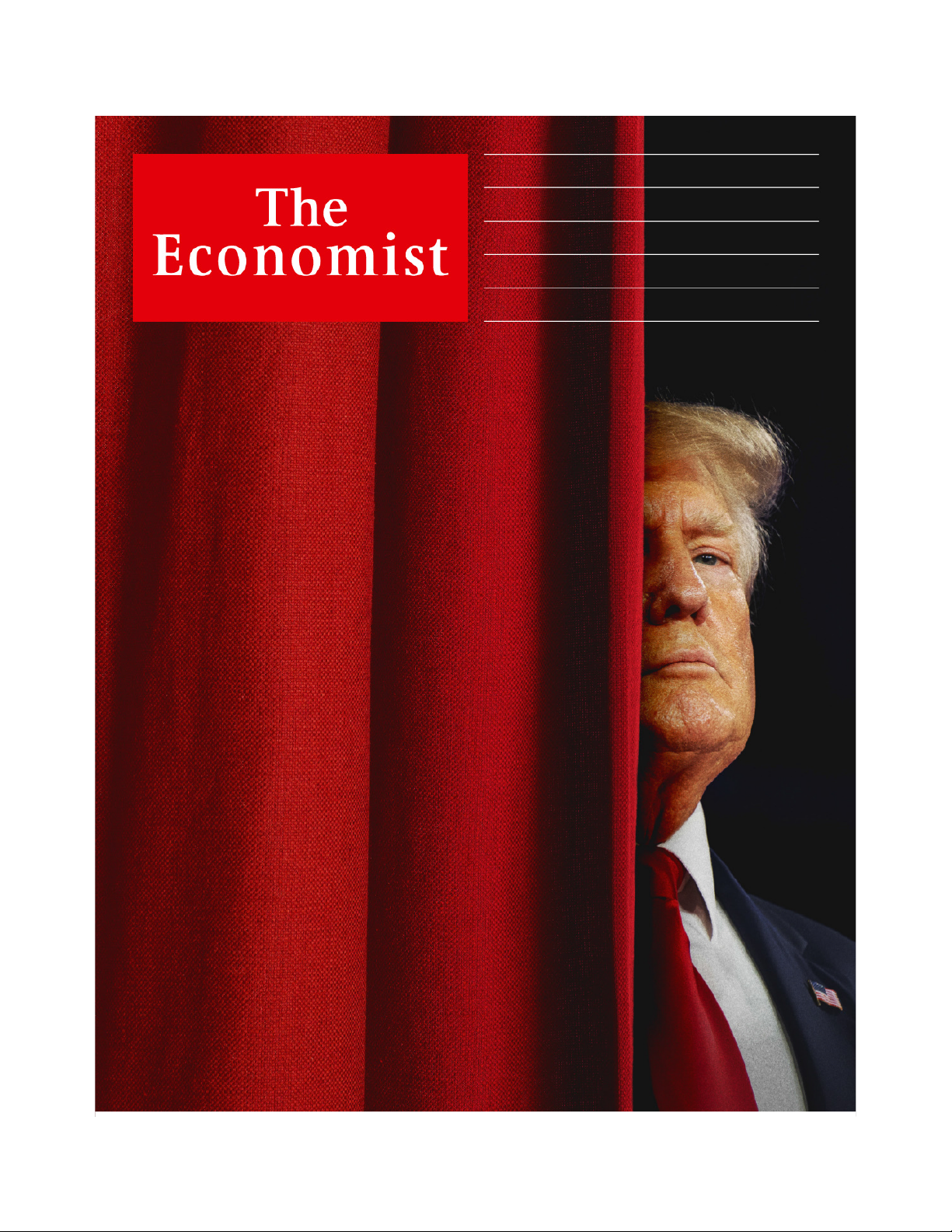
Donald Trump’s chances ofbeing America’s next president are uncomfortably high: leader, page 11. Ron DeSantis has little chance of winning the Republican nomination: briefing, page 17, and Lexington, page 25. Mr Trump’s trials, page 20. Tài liệu giúp bạn tham khảo, ôn tập và đạt kết quả cao. Mời đọc đón xem!
Môn: English Studies 199 tài liệu
Trường: Trường Đại học Thăng Long 550 tài liệu
Tác giả:







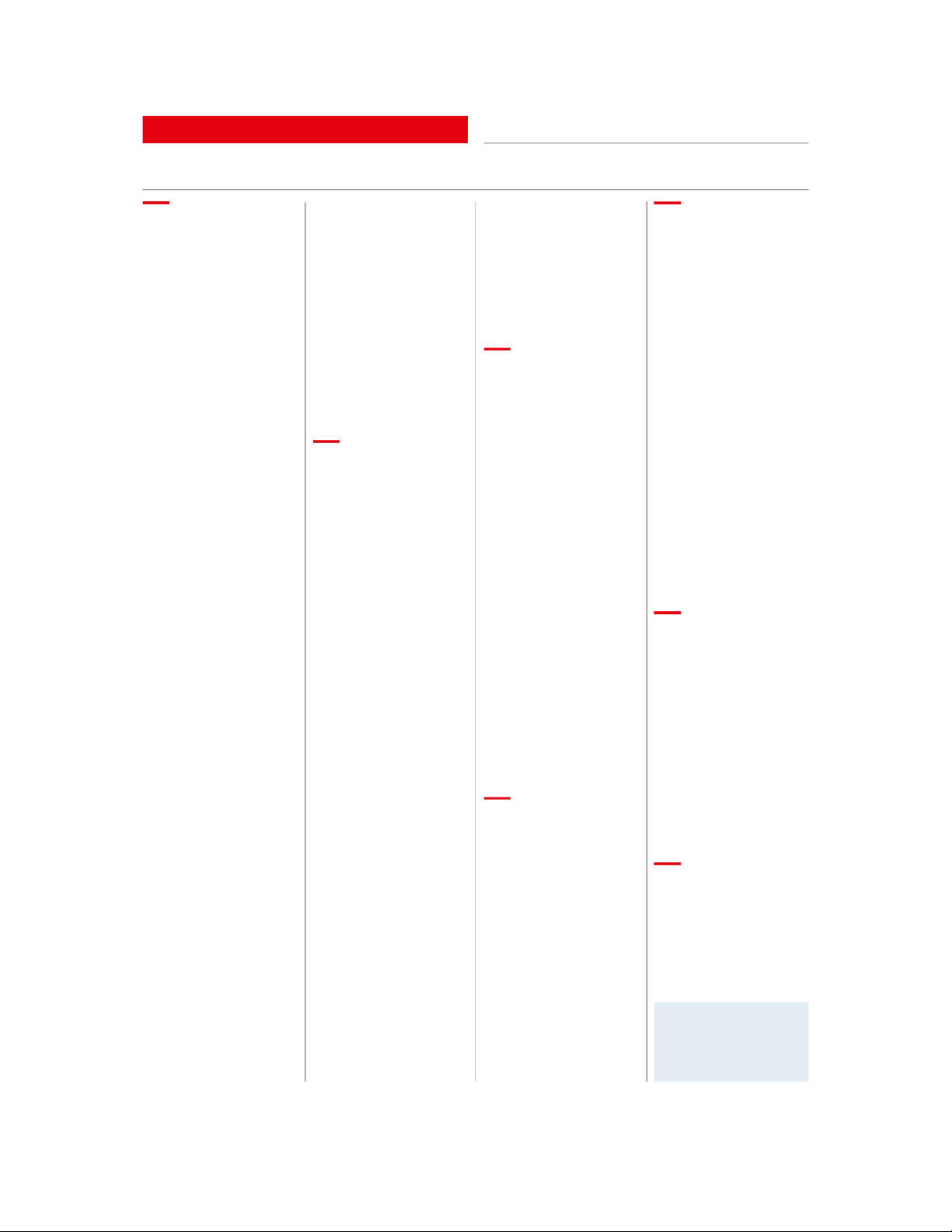





Preview text:
00:12, 10/01/2026
The Economist: Global Arms Race and AI Perspectives (May 27, 2023) - Studocu
The price of the global arms race
Superpower AI: what’s left for humans? The business of carbon removal
Helicopter parents: lessons from beetles MAY 27TH–JUNE 2ND 2023 the haunting non-fiction 012 00:12, 10/01/2026
The Economist: Global Arms Race and AI Perspectives (May 27, 2023) - Studocu 012 00:12, 10/01/2026
The Economist: Global Arms Race and AI Perspectives (May 27, 2023) - Studocu 012 00:12, 10/01/2026
The Economist: Global Arms Race and AI Perspectives (May 27, 2023) - Studocu 012 00:12, 10/01/2026
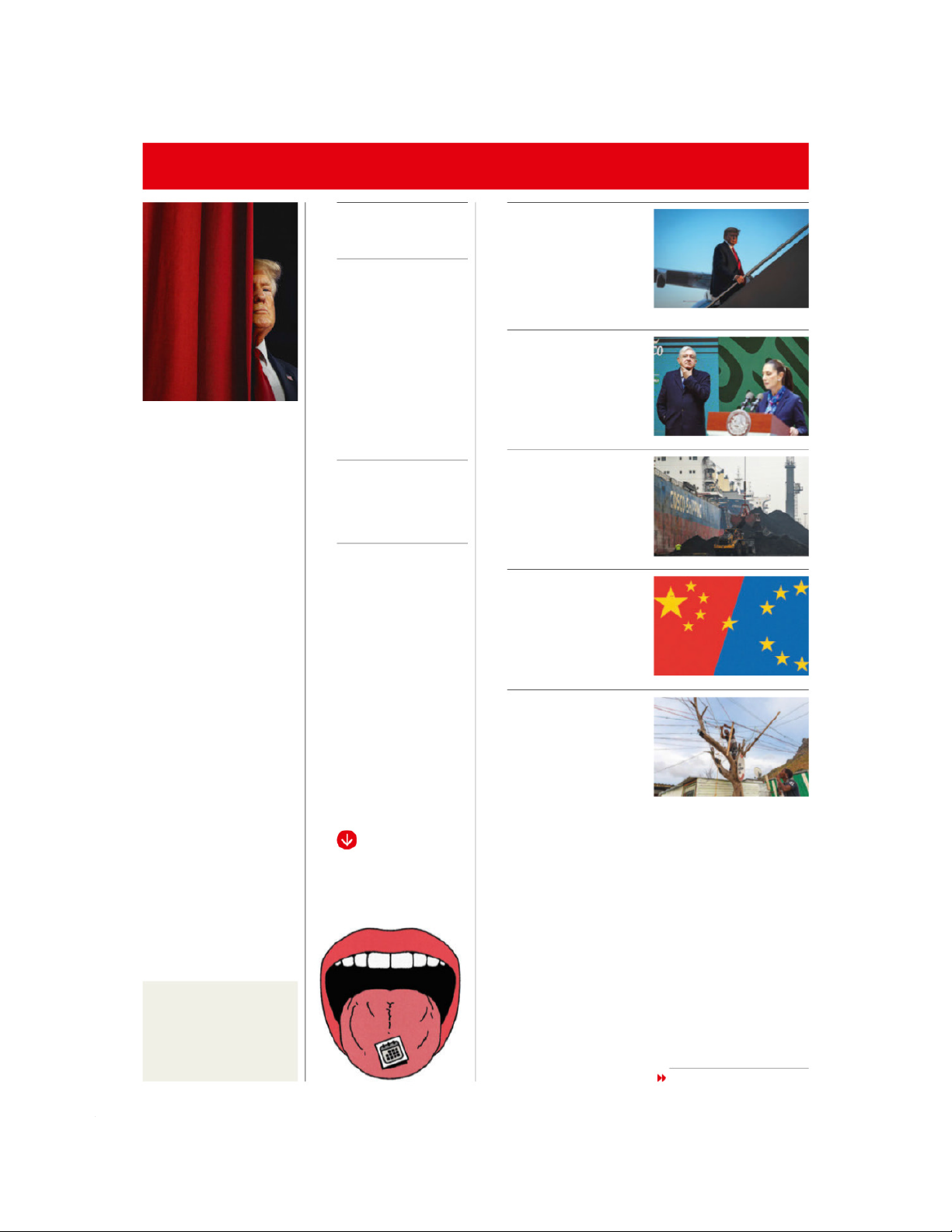
The Economist: Global Arms Race and AI Perspectives (May 27, 2023) - Studocu The Economist May 27th 2023 5 Contents The world this week United States 8Asummary of political 20 All the Trump cases and business news 21 Vasectomies after Dobbs Leaders 22 San Francisco’s doom loop 11 Donald Trump 22 The cost of insulin Seriously? Yes 23 Missing police o cers 12 The sick factor 25 Lexington Ron DeSantis How to fix the nhs 13 Greece’s election The Americas Carry on Kyriakos 26 Mexico’s next leader 13 The end of the peace 28 Apower struggle in Brazil dividend Acostly new arms race On the cover 14 Investor activism Donald Trump’s chances of Seize the day (and the
being America’s next president board) are uncomfortably high: Asia leader, page 11. Ron DeSantis Letters 29 Australia and China has little chance of winning 15 On international aid, the Republican nomination: inflation, Britain’s royal 30 Asia’s iron lady briefing, page 17, and family, walking, bacteria, 31 Japanese funerals
Lexington, page 25. Mr Trump’s soft skills, Liz Truss 32 Banyan Pacific islands trials, page 20 and America Briefing The price of the global arms 17 The Republican primary race How to get a better bang Abungled coup China
for every billion bucks: leader, 33 Hungary, a toe-hold
page 13. What a “war tax” means in Europe
for the global economy, page 49 34 Music festivals take o Superpower ai What would 35 Nationalist cancel culture humans do in a world of 36 Chaguan Why the party ultra-powerful artificial fears gay rights
intelligence? Page 63. Man-made brains are helping scientists Middle East & Africa study the real thing, page 66. 37 Could South Africa aimodels are developing their become a failed state?
own artistic style, page 70. Why
the tech giants have an interest 39 Querying credit ratings in regulating generative ai:
39 Iran’s awkward succession Schumpeter, page 58 40 Awedding in Jordan Carbon removal Can it become atrillion-dollar business? Page 52 Helicopter parents: lessons from beetles Parenting can be Free exchange What
bad for the young—at least from a shortage of Adderall
agenetic point of view, page 68 means for economic growth, page 65 →The digital element of your subscription means that you can search our archive, read
all of our daily journalism and
listen to audio versions of our stories. Visit economist.com Contents continues overleaf 012 00:12, 10/01/2026
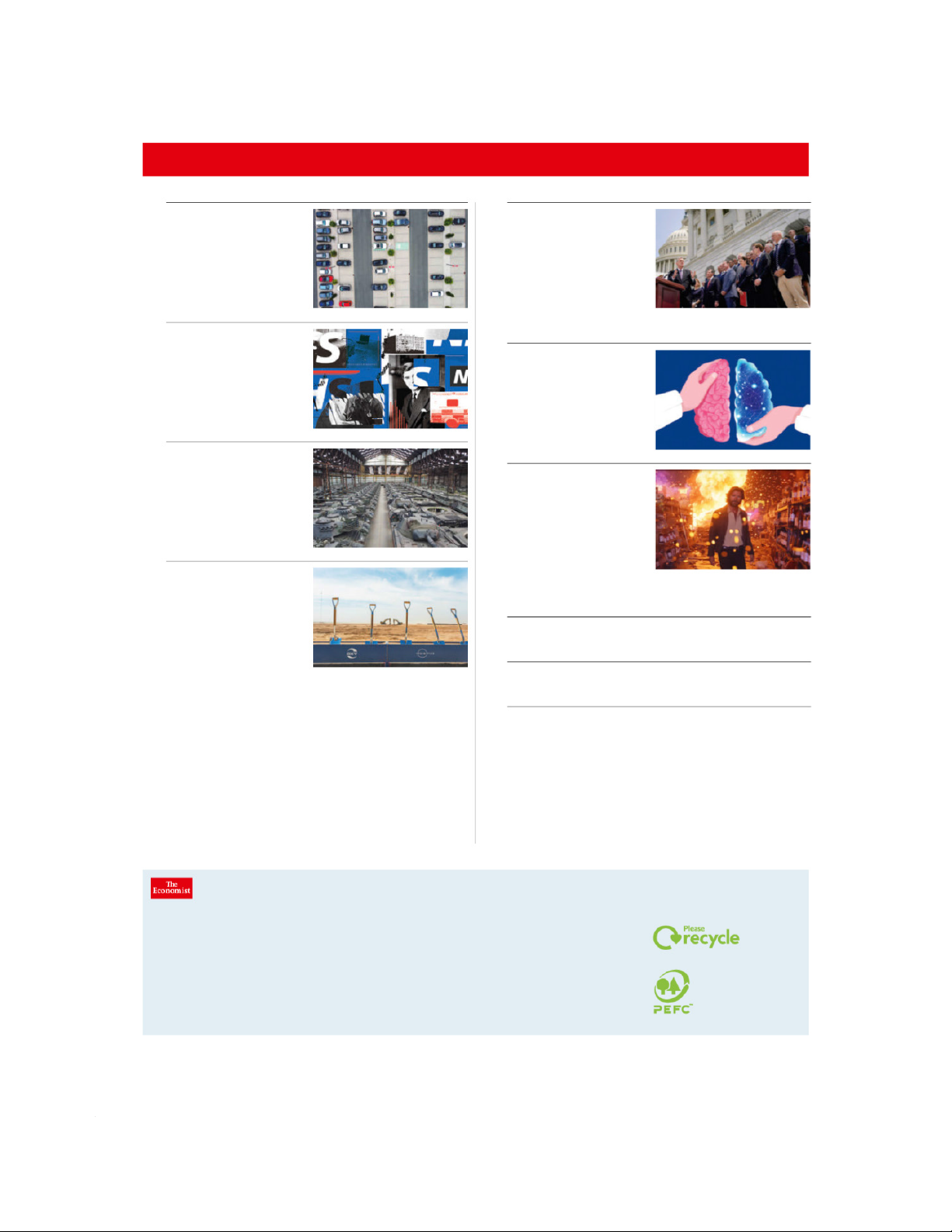
The Economist: Global Arms Race and AI Perspectives (May 27, 2023) - Studocu 6 Contents The Economist May 27th 2023 Europe Finance & economics 41 Electric cars in Europe 59 An American default 43 Raid on Belgorod 61 Xi v Putin in Central Asia 43 France’s trade unions 61 China’s state capitalism 44 Charlemagne After the 62 Buttonwood Credit cycle gas crisis 63 Supercharged ai 65 Free exchange Drugs and economic growth Britain 45 Healing the nhs Science & technology 48 Bagehot Immigration 66 Neuroscience and ai 67 New diesel from old tyres 68 Why parenting is bad for the kids 69 Saving Venice International 49 The cost of the global Culture arms race 70 The ai school of art 71 Contemplative spy fiction 72 The perils of perfectionism 72 Learning from Rome’s fall 73 Johnson Who owns Business English? 52 The carbon-removal 74 August Wilson, American business bard 54 Deutsche Bahn delayed, again
Economic & financial indicators 55 The chip war’s new front 76 Statistics on 42 economies 55 Activist investors, reactivated Graphic detail 56 Sam Zell’s legacy
77 Our model suggests that covid-19 is still killing a lot of people 56 Techno-transgressions Obituary 57 Bartleby Corporate
78 Martin Amis, novelist and scourge summer camps 58 Schumpeter AI non-proliferation Volume 447 Number 9348 Published since September 1843 Subscription service
to take part in “a severe contest between
For our full range of subscription o ers, including
To manage your account online, please visit
intelligence, which presses forward,
digital only or print and digital bundled, visit:
my.economist.com where you can also access our
and an unworthy, timid ignorance Economist.com/o ers
live chat service which is available 24/7. To call us, obstructing our progress.”
contact our dedicated service centre on:
If you are experiencing problems when trying to
Editorial o ces in London and also:
subscribe, please visit our Help pages at: PEFC certified
Amsterdam, Beijing, Berlin, Brussels, Chicago, www.economist.com/help North America: +1 888 815 0215 This copy of The Economist
Dakar, Dallas, Dubai, Johannesburg, Madrid, for troubleshooting advice.
Latin America & Mexico: +1 646 248 5983 is printed on paper sourced
Mexico City, Moscow, Mumbai, New Delhi, New from sustainably managed
York, Paris, San Francisco, São Paulo, Seoul, forests certified by PEFC
Shanghai, Singapore, Tokyo, Washington DC PEFC/29-31-58 www.pefc.org
© 2023 The Economist Newspaper Limited. All rights reserved. Neither this publication nor any part of it may be reproduced, stored in a retrieval system, or transmitted in any form or by any means, electronic, mechanical, photocopying,
recording or otherwise, without the prior permission of The Economist Newspaper Limited. The Economist (ISSN 0013-0613) is published weekly except combined issues in July and December, by The Economist Newspaper Limited, 900 3rd
Avenue, 16th Floor, New York, NY 10022-5088. The Economist is a registered trademark of The Economist Newspaper Limited. Periodicals postage paid at New York, NY and additional mailing o ces. Postmaster: Send address changes to The
Economist, PO Box 920 Getzville, New York 14068, USA. Canada Post publications mail (Canadian distribution) sales agreement no. 40012331. Printed by Quad/Graphics, Saratoga Springs, NY 12866 012 00:12, 10/01/2026
The Economist: Global Arms Race and AI Perspectives (May 27, 2023) - Studocu 012 00:12, 10/01/2026
The Economist: Global Arms Race and AI Perspectives (May 27, 2023) - Studocu The Economist May 27th 2023 8The world this week Politics
Pacific island nation. The State Parliament and the American diamond business, and said it Department said the deal Congress called for the desig-
would support Ukraine for “as would “support freedom, nation of Sultan al-Jaberas as long as it takes”. America
security, and prosperity in the head of the coming COP28
reversed its position, and will Indo-Pacific”. climate conference in the now support a plan to train United Arab Emirates to be Ukrainian pilots to fly F-16 The opposition won a general rejected. He is CEO of the Abu
fighter jets, but it has not yet election in East Timor. Ac- Dhabi National Oil Company. decided whether to send F-16s cording to preliminary results directly to Ukraine. the National Congress for Net migration exceeded Timorese Reconstruction took
600,000 in Britain last year, a Russia claimed to have
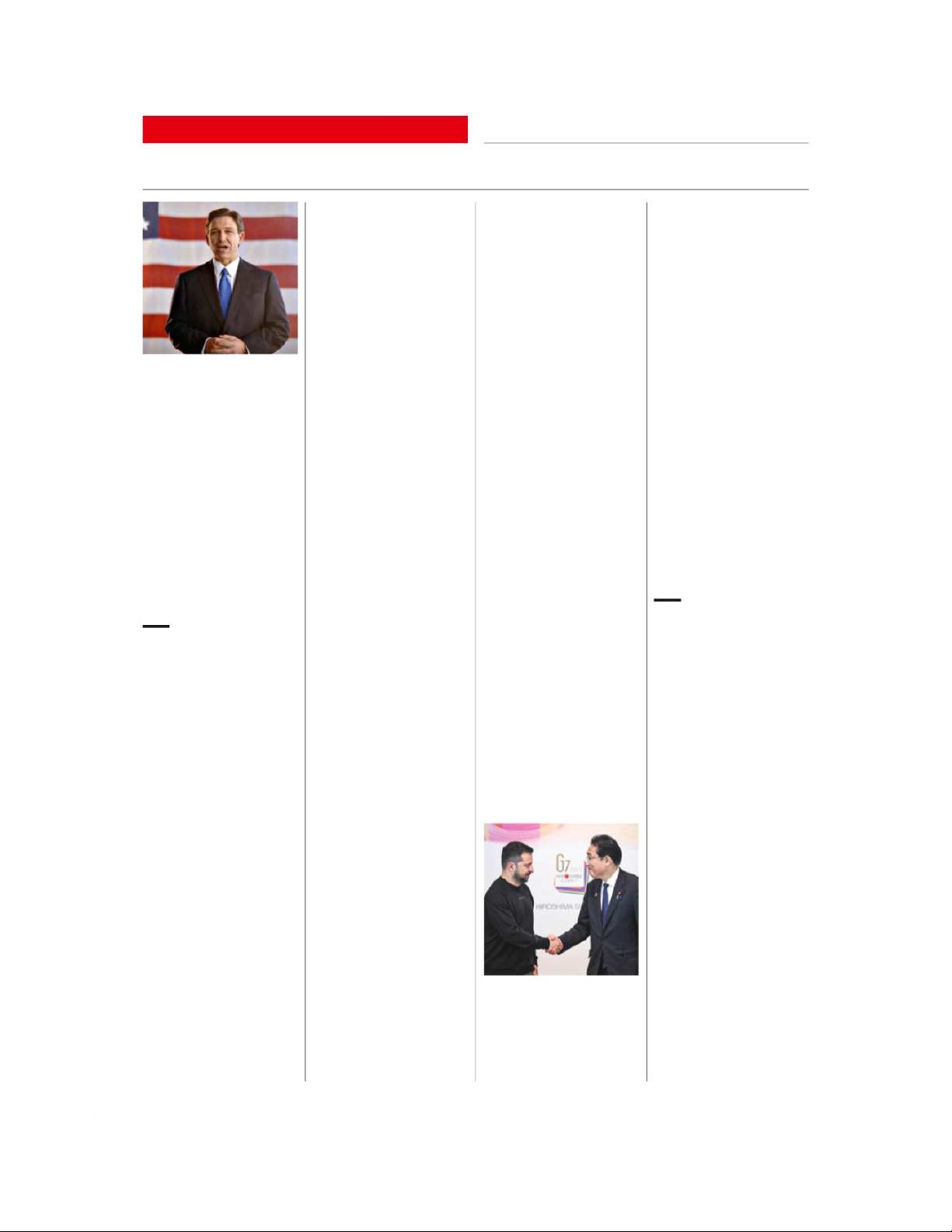
42% of the vote, increasing the record figure. The number was repelled an attack on its Ron DeSantis launched his chances that Xanana Gusmão, boosted in part by arrivals Belgorod region that came campaign for the Republican its leader and a war hero dur- from Ukraine and Hong Kong. from across the Ukrainian presidential nomination. The
ing the country’s resistance to The news is a big embarrass- border. It was the biggest governor of Florida made his
Indonesian rule, will return as ment for the Conservative incursion into Russian terri- announcement in an audio
prime minister. The legislature government, which for years
tory since the start of the war. conversation with Elon Musk makes that appointment. has been promising to Russia blamed Ukrainian on Twitter, though the event reduce migration.
“militants”. Ukraine said the was marred by technical It emerged that Alejandro fighters belonged to pro-
glitches for the first 20 min- Encinas, a Mexican o cial
Sinn Féin, the main republican Ukrainian Russian groups utes. Mr DeSantis said he close to President Andrés party in Northern Ireland, that want to topple Vladimir would revitalise America and Manuel López Obrador, had his claimed victory in local elec- Putin as president. Respond- criticised Joe Biden for being phone hacked by Pegasus, a tions, and now has the most
ing to Russia’s assertion that woke; as governor Mr DeSantis type of spyware. Pegasus has
council seats. Michelle O’Neill, it destroyed American-made has made a point of clashing been deployed in Mexico
Sinn Féin’s provincial leader, weapons in the skirmish, the
with the left on gay issues and before, but Mr López Obrador called on the Democratic
State Department said “it is up identity politics. He didn’t
had said he would stop its use. Unionists to return to the to Ukraine to decide how to mention Donald Trump, who Yet the armed forces continue Stormont Assembly, so that the conduct this war.” holds a big lead in the Repub- to spy on human-rights cam- power-sharing executive can
lican race at this early stage. paigners. Mr Encinas was start again. Stormont has been hacked last year while in- suspended for over a year. Greek revival period
vestigating the armed forces’ The centre-right governing Swimming with the current role in the disappearance of The G7 held a summit in New Democracy party was the Seven states in the American 43 students in 2014. Hiroshima, which was domin- biggest winner in the Greek west reached an agreement to ated by a collective e ort on general election. It took 41% protect the sustainability of An internationally monitored how to tackle China and Rus-
of the vote, double that of its the Colorado river, which
ceasefire in Sudan, due to last
sia. The forum criticised China closest rival, the left-wing provides water and electricity a week, lessened the intensity over Taiwan, nuclear arms, Syriza party. But New Democ- to 40m people. Described as of the civil war, though human-rights violations and
racy fell just short of gaining
“historic” by the White House, violence persisted here and economic coercion. It adopted an outright majority of seats. the deal will see Arizona,
there. The UN said that 60,000-
a strategy of “de-risking” the Rather than form a coalition, California and Nevada reduce 90,000 people had fled into
West’s trade and financial links Kyriakos Mitsotakis, the their intake of water from the Chad from Sudan’s western with China. Chinese media prime minister, wants to hold Colorado river system.
region of Darfur, where fight- denounced the meeting as an another round of voting,
ing has been especially fierce. “anti-China workshop”. probably on June 25th. America signed a security pact with Papua New Guinea, a The secretary-general of the At least 75,000 people attend- deal that seeks to counter the ruling African National Con- ed a rally in Moldova calling
rise of Chinese influence in the gress said that South Africa for the country to join the
Pacific. The prime minister of
risks becoming a “failed state”, European Union. It was or- PNG, James Marape, tried to causing business leaders to ganised by the government, reassure domestic critics that lament the state of the econ- which again accused Russia of America would not be allowed
omy more forcefully than ever. meddling in its a airs. to launch “o ensive military
operations” from his country. The trial of Ousmane Sonko, a
Belarus’s dictator, Alexander The pact was signed at the US Senegalese opposition leader Lukashenko, popped up on Pacific Islands Forum. Joe accused of rape, resumed. He state TV to scotch rumours
Biden had to miss the event, as was absent, denouncing the that he is dying. Speculation he continued haggling with
trial as politically motivated. If Volodymyr Zelensky attended mounted that he is seriously Republicans in Washington found guilty, he would almost the G7 summit to discuss his ill after he appeared in poor
over the federal-debt ceiling. certainly be ruled out of run- plan to end the war in
health at Russia’s Victory Day ning in the presidential elec- Ukraine, which includes a parade. Unfortunately for the In separate negotiations Amer- tion due next February. demand that Russia restore people of Belarus, Mr Lu- ica signed agreements with
Ukraine’s territorial integrity. kashenko is seen telling o - Micronesia to expand Over a hundred green-minded The G7 announced new sanc-
cials, “You’ll have to struggle economic assistance to the members of the European
tions on Russia, notably on its
with me for a very long time.” 012 00:12, 10/01/2026
The Economist: Global Arms Race and AI Perspectives (May 27, 2023) - Studocu The Economist May 27th 2023 9 The world this week Business technology. China claimed
production of electric vehicles. Facing what it described as
Micron’s chips “posed signif- China exported more than 1m “volatile circumstances”,
icant security risks”. America vehicles in total during the Target removed some pro- has reportedly asked South three months, compared with ducts related to LGBT pride Korea to dissuade Samsung Japan’s 950,000. from its stores. The retailer and SK Hynix, which make said that in some cases cus- similar chips to Micron, from tomers have confronted sta
filling the gap in the Chinese Lady Luck smiles again over the merchandise. The market that will be left by There was more evidence that pride range includes books Micron’s absence. Macau’s gambling industry is aimed at young children with on the rebound from covid and
titles such as “I’m Not a Girl”
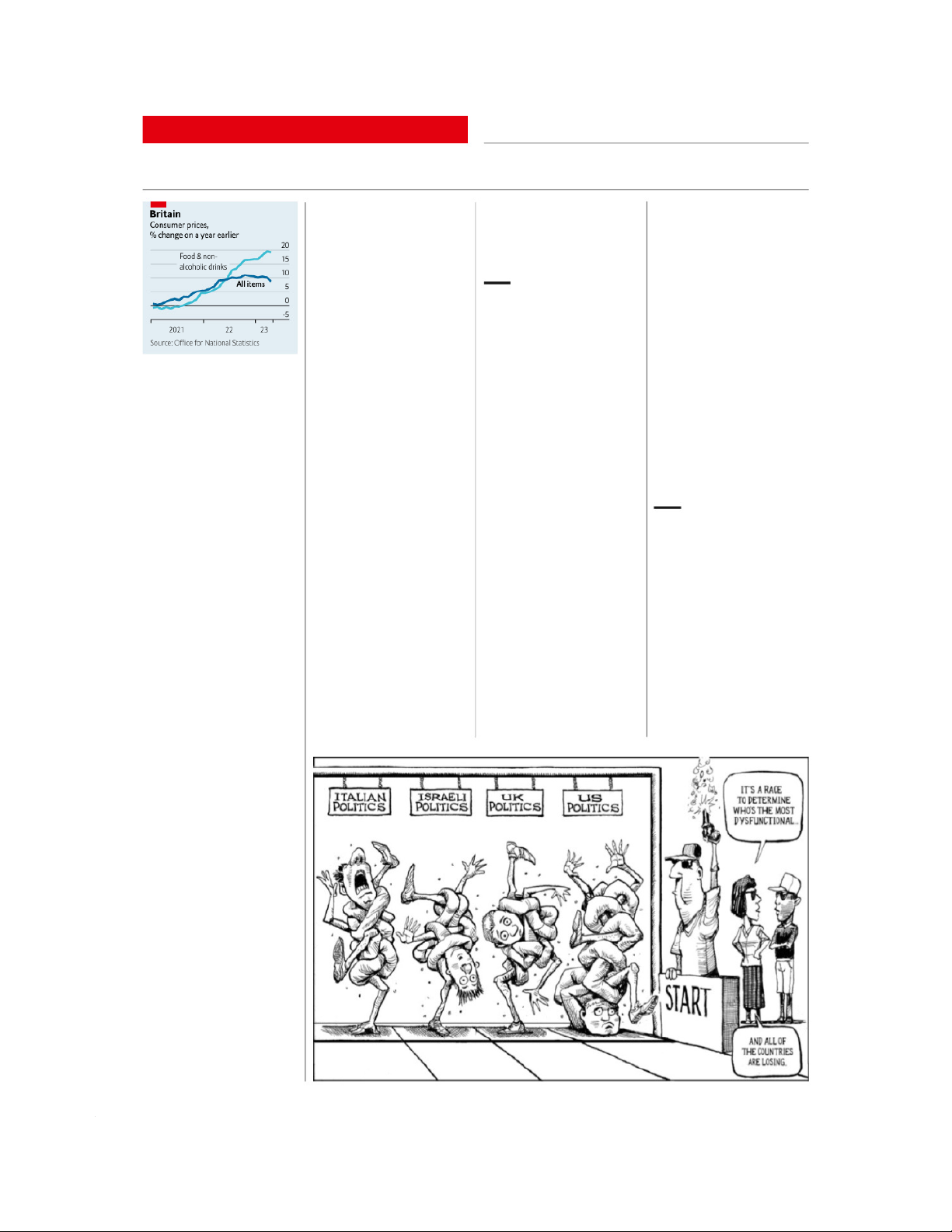
TikTok filed a lawsuit against a crackdown on betting by the and “The Pronoun Book”. Britain’s headline rate of
Montana for its decision to ban authorities. Galaxy Entertain- annual inflation fell sharply
the social-media app, the first ment, which owns hotels and Virgin Orbit was wound
in April, to 8.7%. But the fall statewide prohibition of Tik-
casinos in the Chinese territo- down, less than two months was less than expected, given Tok in America. The Chinese ry, said its net revenues were after filing for bankruptcy
that last April’s rise in energy firm argues that the ban is
72% higher in the first quarter
protection. A sale of the rock- prices dropped out of the unconstitutional, and that
than a year earlier. Other resort et-launch company’s assets annual comparison. The core Montana’s claim that TikTok operators have reported simi- fetched just $36m, around 1%
rate of inflation, stripping out shares data with the Chinese
lar results. Macau’s casinos are of the $3.7bn it was valued at energy and food, rose again to government is based on now focused on catering to when it floated on the Nasdaq 6.8%; food prices were up by “unfounded speculation”. ordinary punters, rather than stock exchange in 2021. 19.1%. The yield on British the high rollers who attracted government bonds jumped as Apple announced an agree- the ire of o cials.
markets bet that interest rates ment in which Broadcom, a The terminator
would increase further. Earlier, big American maker of semi- Citigroup abandoned plans to
Netflix began its long-trailed Andrew Bailey, the governor of conductors, will supply 5G find a buyer for Banamex, a crackdown on sharing pass- the Bank of England, admitted components for the iPhone. bank chain in Mexico that it words. The streaming giant
that there are “big lessons to Sensitive to claims that it bought in 2001, and will in- sent emails to subscribers in
learn” from the failure of the relies on China for the assem- stead spin o the business in 100 countries reminding them bank’s economic models to bly of its devices, Tim Cook, an IPO, probably in 2025. that only one household can predict the persistence of
Apple’s chief executive, said watch Netflix on a single high inflation.
that all “of Apple’s products
Shell’s annual general meeting account. Viewers will get depend on technology was seriously disrupted by prompts when they tune in; An updated estimate of
engineered and built here” in climate-change protesters. Led those who share passwords Germany’s GDP in the first the United States. by green investors, 20% of the outside the household will be quarter showed the economy shareholders present rejected booted o . The decision to get shrinking by 0.3% over the China overtook Japan as the the company’s energy-transi- tough now has nothing to do previous three months. That world’s biggest exporter of tion plan, claiming its time- with the company’s PR naming means that Germany is tech-
cars in the first quarter, mostly table for reducing fossil-fuel Arnold Schwarzenegger as a nically in a recession, as the because of its expanding production is too slow. new “chief action o cer”. economy contracted by 0.5%
in the fourth quarter of 2022. The European Union slapped a
€1.2bn ($1.3bn) fine on Meta, the owner of Facebook, for
breaching rules on the transfer
of personal data from the EU to America. It is the biggest penalty imposed by the EU on a company for privacy violations. The decision gives Meta six months to stop pro-
cessing data in America that it holds on EU citizens. Meta described the actions as
“unjustified” and said it would appeal against the fine. China banned memory chips made by Micron, an American company, from being used in the country’s infrastructure development, a tit-for-tat
move in response to America’s prohibition on Chinese 012 00:12, 10/01/2026
The Economist: Global Arms Race and AI Perspectives (May 27, 2023) - Studocu 012 00:12, 10/01/2026
The Economist: Global Arms Race and AI Perspectives (May 27, 2023) - Studocu Leaders 11 Seriously? Yes
Donald Trump’s chances of a comeback are uncomfortably high A
Bernie Sanders, a leftist. Backroom manoeuvring by party big-
glitch-plagued chat with Elon Musk, live on Twitter, is an
unconventional way to launch a presidential campaign. But
wigs is less likely to work against Mr Trump, however, for the
with the entry of Florida’s governor, Ron DeSantis (see Lexing-
simple reason that he is the Republican establishment.
ton), the race for the Republican nomination is now properly
The way the primary calendar and pending legal cases
under way. The first states will not vote until January. Primaries
against Mr Trump intersect is nightmarish. His trial for falsify-
are hard to predict, because it is expensive to conduct enough
ing records in New York will get under way shortly after Super
high-quality polls of primary voters in the key states. But, with
Tuesday, when more than a dozen states vote (see United States
that disclaimer over, one candidate has a huge, perhaps
section). Neither this case nor any of the other investigations he
mountable, lead: Donald Trump. Mr Trump thus has a real
faces are likely to be resolved by the time the primaries are over.
chance of becoming America’s next president. Betting markets
It is therefore possible that the candidate of one of the two great
put his odds of returning to the White House at one in three.
parties could be subject to criminal charges when he is on the
If you decided to pay less attention to Mr Trump after he lost
ballot. America has had badly behaved presidents before. It has
in 2020, to preserve your sanity, you may be wondering how this
never had one who is also the defendant in a criminal trial.
can be the case. Parties do not usually stick with losers. Mr
You might think that, at this point, voters would abandon Mr
Trump led the Republicans to defeats in the 2018 midterm and
Trump in large numbers. Maybe. But when, earlier this year, a ju-
the 2020 presidential elections. After he encouraged his suppor-
ry found that he had sexually abused a woman 30 years ago, the
ters to “stop the steal”, some of them broke into Congress, with
verdict had no measurable e ect on his poll numbers. Mr
the result that one police o cer died of a stroke and four com-
Trump, it turns out, is adept at persuading Republican voters
mitted suicide. He has since been found liable for sexual assault,
that he is the real victim. Democrats, and plenty of America’s al-
too. Would the Republican Party really nominate him again?
lies, think Mr Trump is a threat to democracy (as does this news-
Yes, it probably would. In 2016 and in 2020 it made some
paper). His campaign is already turning this accusation back on
sense to think of the Trump movement as a hostile takeover of
the accuser: “The 2024 election”, a recent Trump campaign
the party. In 2023 it no longer does. He is the front-runner be-
email announced, “will determine whether we can keep our Re-
cause a large proportion of Republicans really
public or whether America has succumbed to
like him. His supporters have had their hands
the dark forces of tyranny.” Those who accept
on the Republican National Committee for six
that these are the stakes will probably overlook
years now. More than half of Republicans in the
Mr Trump’s innumerable and obvious flaws.
House of Representatives were elected for the
Imagine, then, that it is November 2024 and
first time since 2016, and therefore under Mr
Mr Trump and President Biden are having a re-
Trump’s banner. Almost all of those House and
match—the first since Dwight Eisenhower beat
Senate Republicans who refused to make their
Adlai Stevenson back in the 1950s. Could Mr
peace with him have stood down or retired. Of Trump win?
the ten House members who voted to impeach Mr Trump in Jan-
The general election will surely be close. The electoral college
uary 2021, only two are still there. They are outnumbered in their
gives Republicans a slight edge. The most recent landslide was
own caucus by more than 100 to 1.
40 years ago. America has since become evenly divided politi-
Mr Trump’s campaign is also better organised than in either
cally and calcified because voters seldom switch sides. Mr Biden
2016 or 2020. Our analysis of the primaries shows how hard he
has some under-appreciated strengths, but he is no one’s idea of
will be to beat (see Briefing). He has a stunning lead: polling for
formidable. Were the country to enter a recession, Mr Trump’s
The Economist by YouGov suggests Republican primary voters
chances would go up. Some mooted post-primary tactics intend-
prefer Mr Trump to Mr DeSantis by 33 percentage points. He also
ed to stop him, such as running a third-party candidate, smack
has a big lead in endorsements from elected Republicans, which
of desperation: they could easily backfire and boost him further.
are usually a good predictor of what will happen. In 2016, the last
time Mr Trump contested a primary, he won the early primaries Prima Donald
with much less support than he has now.
All of which means that you should take seriously the possibility
There are still Republican voters who would like an alterna-
that America’s next president will be someone who would divide
tive—his 58% poll share means that close to half of primary
the West and delight Vladimir Putin; who accepts the results of
voters must be open to choosing someone else. Yet the di cul-
elections only if he wins; who calls the thugs who broke into the
ties of co-ordinating the opposition to Mr Trump are daunting.
Capitol on January 6th 2021 martyrs and wants to pardon them;
People close to the Trump campaign say privately that the more
who has proposed defaulting on the national debt to spite Mr Bi-
candidates who enter the primary, dividing the field, the better
den; and who is under multiple investigations for breaking
for their candidate. Some big donors are giving money to non-
criminal law, to add to his civil-law rap sheet for sexual assault.
Trump candidates on the condition that they drop out after
Anyone who cares about America, about democracy, about con-
South Carolina, an early primary, if told to do so. The idea is to
servatism or about decency should hope that Mr DeSantis or one
engineer unity around a single non-Trump candidate, just as es-
of the other non-Trump Republican candidates can defy the
tablishment Democrats united around Joe Biden in 2020 to stop odds and beat him. 012 00:12, 10/01/2026
The Economist: Global Arms Race and AI Perspectives (May 27, 2023) - Studocu 12The L E e c a o d n erosm ist May 27th 2023 The sick factor How to fix the NHS
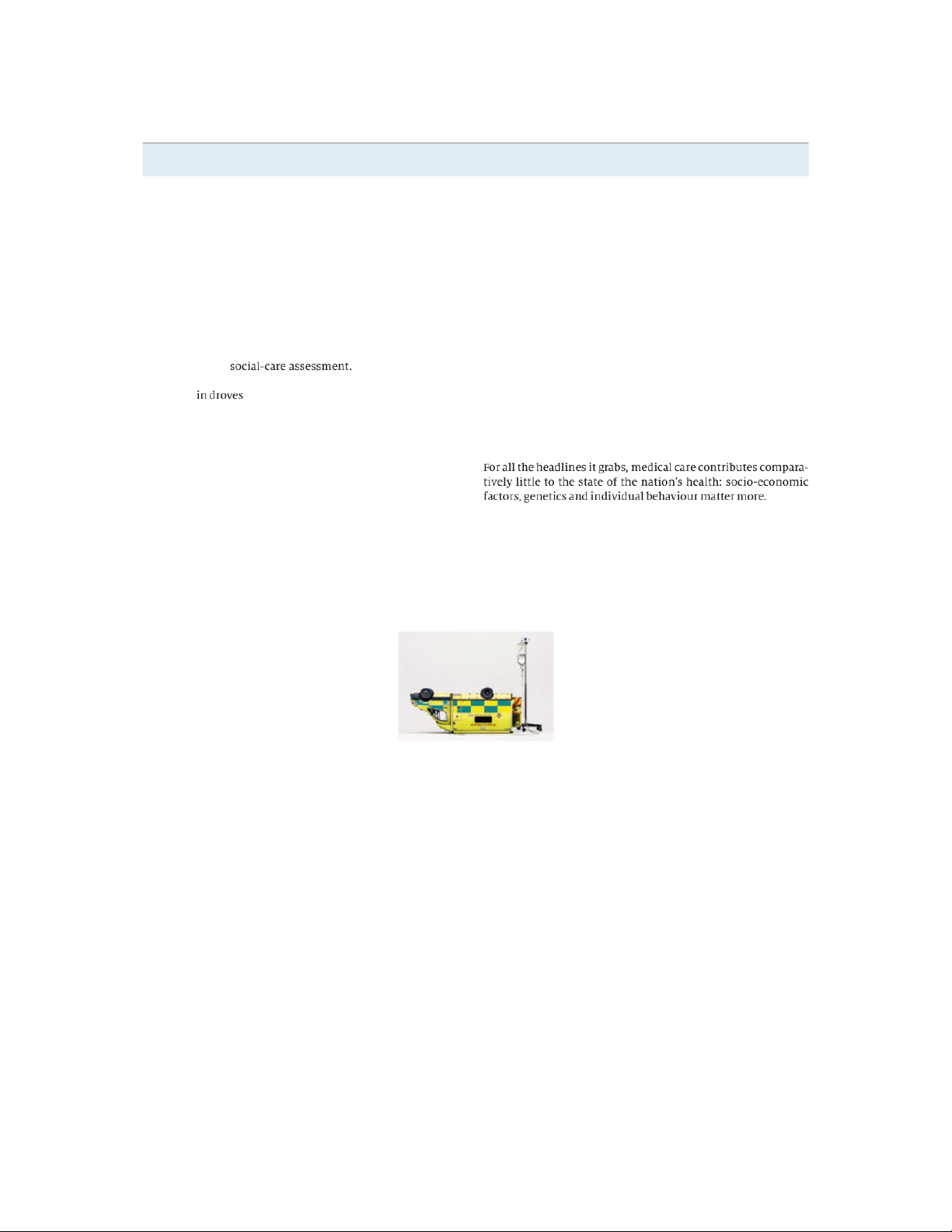
Money will help. But a radical shift in focus is more important B
dismantling the smoke alarms. The majority of health and so-
ritons are prouder of their health-care system than they are
of the monarchy. But when the English National Health Ser-
cial-care spending now goes on treating long-term conditions
vice (NHS) turns 75 in July, the mood will not be celebratory. Hos-
like diabetes, high blood pressure and arthritis. Such conditions
pital waiting lists in England spiral beyond 7m, forcing many to
are managed best by patients themselves, in their own homes
wait months or even years for treatment. Almost 300,000 adults
and with the support of networks of general practitioners and lo- are waiting for a A record 2.5m Britons
cal specialists. The share of money going to primary care should
are out of work because they are sick. NHS sta are leaving the
be restored from 8% of the NHS budget to the 11% proportion it workforce
. On basic measures of health, Britain su ers
was two decades ago. Social care needs more money, too, and a
by comparison with its rich-world peers. Its people barely live
proper long-term funding plan.
any longer than they did a decade ago, and have some of the
The corollary of moving care out of hospitals and into com-
worst survival rates for diseases such as cancer. During the pan-
munities is to focus on prevention: keeping people healthy for
demic the public clapped for the NHS. Now they are more likely
as long as possible. That means widening the lens on health care.
to throw up their hands in frustration.
When something is broken, the boldest reforms can often
seem the most tempting. Some want to overhaul the NHS’s fund- One ob-
ing model, switching from a system funded by taxation to one
vious example is obesity. Britain is the third-fattest country in
based on social insurance, as in France or Germany. Others mull
Europe; an obese patient costs the NHS twice as much to treat as
the case for much wider use of means-tested charges. But
one who is not. The government needs a more muscular strategy
Britons will not easily ditch what Nigel Lawson, a former chan-
to tackle this problem before it turns up in waiting rooms and
cellor, once called their “national religion” of health care funded
hospital beds, for example by making e ective use of promising
by taxes and free at the point of use. And the country’s recent re- new anti-obesity drugs.
cord of revolutionary change does not inspire confidence.
The way that the NHS measures and motivates performance
It is also unnecessary (see Britain section). The recipe for sav-
also needs to change. At the moment the system is geared to-
ing the NHS requires radicalism, but of a sim-
wards inputs. Politicians conventionally com-
pler sort: turning the NHS from what it has be-
pete to make promises about the number of
come—a sickness service—into what its name
new hospitals or the ranks of new doctors. Top-
promises—a health service. That will mean
down metrics based on “activity” encourage
spending more money. But to spend it produc-
hospitals to spend billions on unnecessary and
tively requires a shift in focus: away from hos-
unwanted treatments towards the end of life.
pitals to the community, from treatment to pre-
Funding should be relentlessly focused on
vention, from incentivising inputs to encour-
health outcomes; to encourage innovation, aging better outcomes.
money saved by making people healthier
Health already absorbs the biggest single chunk of govern-
should be made available to regional bodies to reinvest.
ment spending. Of every pound the state spends on public ser-
Will any of these changes ever actually happen? The good
vices, 38p goes on the NHS. But Britain spends less on health care
news is that these ideas are neither new nor even particularly
than countries like France and Germany as a share of GDP. It es-
controversial: just this week Sir Keir Starmer, the leader of the
pecially skimps on capital spending: no OECD country invests
Labour Party, laid out in a speech the need to shift focus from
less on a per-person basis. And the demands on the health ser-
acute care to chronic care. The establishment in England of “in-
vice are only going to go up. In the next 25 years the number of
tegrated care systems”, a set of 42 regional partnerships between
Britons aged 85 and older is set to double. The NHS is the largest
NHS providers and local bodies, paves the way for a more decen-
single employer in Europe; the phenomenon of “cost disease”
tralised approach to health provision. The covid-19 pandemic
means that the pay of nurses and doctors needs to keep rising to
vividly demonstrated the power of data and technology to reach
compete with wages elsewhere in the labour market.
people quicker, from carefully targeted vaccination campaigns
The critical question is where the money is spent. At the mo- to online consultations.
ment, the answer to that question can be boiled down to one
word: hospitals. Spending on public health (covid-19 prevention Faith healing
aside) and social care has fallen in real terms over the past de-
But this refocusing of e ort does require a radical shift in mind-
cade. The share of total NHS spending allocated to primary and
set, from politicians above all. Care workers and insulin pumps
community care was falling even before the pandemic; the share
are less sexy during election campaigns than heart surgeons and
doled out to hospitals had risen to almost two-thirds. As a share
new hospitals. No crisis is more urgent for a politician to fix than
of GDP spent by rich-world governments and compulsory insur-
one involving desperately ill people waiting for ambulances to
ance schemes, only America spends more on hospitals.
arrive—one reason why technology and capital budgets are raid-
This makes no sense. A system focused on hospitals is one
ed to cope with each new winter crisis. The NHS can be saved.
designed to treat people only after they have become really sick.
But only if the people who run it see their job as keeping Britons
That is the equivalent of buying more fire extinguishers while
healthy at home rather than treating them on the wards. 012 00:12, 10/01/2026
The Economist: Global Arms Race and AI Perspectives (May 27, 2023) - Studocu The Economist May 27th 2023 Leaders 13 Greece’s election Carry on Kyriakos
The Greek prime minister deserves his unexpected triumph T
interest rates; the spread between what it must pay on its ten- here is beating
him, and the your political opponent, there is trouncing
n there is what Kyriakos Mitsotakis, Greece’s
year bond and what Germany pays is only 1.4 percentage points.
prime minister, did on May 21st to Alexis Tsipras, the leader of
During the crisis of 2015, it hit a terrifying 18.7 percentage points.
the radical-left Syriza party. Syriza ran the country from 2015 to
The unemployment rate is still too high, at nearly 11%, but annu-
2019, a time when Greece came close to defaulting on its debts,
al inflation is back down at only 3%. Greece, in short, has be-
crashing out of the euro and threatening the stability of the en-
come a normal country, not a worry. Away from the economy, Mr
tire euro zone. Mr Mitsotakis then took over. Now Greek voters
Mitsotakis has done a reasonable job of managing tensions with
have decided, by a whopping margin, that they prefer stability
Turkey, helped by his swift dispatch of aid to the earthquake-
and technocratic competence to drama.
devastated Turkish south-east in February.
Mr Mitsotakis picked up 41% of the vote to Syriza’s 20%, a
That is not to say that things are perfect. Mr Mitsotakis has
stunning result, especially given that pollsters had predicted
three big blots on his record and, assuming he gets his second
only a six- or seven-point gap. Mr Tsipras’s future, and that of his
term, he will need to deal with them. The first is a nasty scandal
party, are now in doubt. Yanis Varoufakis, the
involving the phone-tapping, actual and at-
shaven-headed, leather-jacketed finance min-
tempted, of dozens of politicians, journalists
ister who propelled Syriza down the path of
and businesspeople by the security services. Mr
confrontation with Brussels but then quit and
Mitsotakis’s government has yet to come clean
formed his own splinter party, is out of parlia-
about exactly what happened; until a lot more is
ment. Mr Mitsotakis fell a few seats short of an
disclosed, trust in his administration will re-
overall majority. But he says he has no interest
main badly dented. The second is persistent re-
in forming a coalition; and no one else can. So a
ports of Greek border guards beating up and
second election will be held, probably on June
robbing migrants trying to enter from Turkey:
25th; an interim prime minister will hold the reins until then.
something that may not much bother Mr Mitsotakis’s more
Mr Mitsotakis is sure to be back, because the next election will
nationalist-minded supporters, but ought to bother him.
be held under a new electoral system that will reward the largest
And finally, far more needs to be done to reform Greece’s scle-
party, presumably his right-of-centre New Democracy, with up
rotic and sometimes corrupt public services. The shortcomings
to 50 bonus seats, out of a parliamentary total of 300.
of the state were demonstrated in February by a train crash
Mr Mitsotakis has earned it. Over the past four years he has
which took 57 lives and revealed a litany of du equipment and
governed, for the most part, with energy and skill. The economy
shoddy working practices. It was the result of decades of mis-
has bounced back better than most from the disasters of covid-19
management, but it sent Mr Mitsotakis’s polls reeling (they reco-
and the energy-price shock; its growth rate last year was around
vered in time for the election, which he put back by more than a
twice the euro-zone average, and is forecast to exceed it comfort-
month). The mission of modernising Greek government has a ably this year too.
long way to go—and Mr Mitsotakis will have his work cut out in a
Greece’s sovereign debt now trades at investment-grade
second term. But he clearly deserves one. The end of the peace dividend Paying for a new arms race
How to get a better bang for every billion bucks T
nuclear-powered submarines with America and Britain. he world is tooling since the end of up. The peace dividend i the cold war—rel t has enjoye easing wads of cash f d rom
Yet for Western governments, finding money for arms will
defence to spend on other things—is ending. Now comes the
not be easy. They must pay interest on debts and cope with fiscal
new “war tax”. Our simulations suggest global defence spending
pressures that did not exist in the 1980s, such as the need to care
may rise by $200bn-$700bn a year, or 9-32% (see International
for ageing populations and curb climate change. Furthermore,
section). Blame fraught geopolitics—especially Russia’s inva-
as in the cold-war era, there is a risk that cash is blown on good-
sion of Ukraine and China’s sabre-rattling at Taiwan.
but-exorbitant equipment, thanks to red tape and cronyism.
America and China are locked in a race for military ascendan-
How to get the best value from defence spending in the 2020s?
cy in Asia. European countries are scrambling to meet nato’s
The war in Ukraine o ers some pointers. The first priority for
target of spending 2% of gdp on defence. Poland is aiming for
Western governments is to restock depleted arsenals and boost
4% and wants to double its armed forces. Japan’s defence budget
the factories that make shells and missiles. War eats up vast
will rise by at least two-thirds by 2027, which may make it the
amounts of ammunition. Ukraine has been firing roughly as
world’s third-largest spender. Australia is developing pricey
many 155mm artillery shells in a month as America can produce 012 00:12, 10/01/2026
The Economist: Global Arms Race and AI Perspectives (May 27, 2023) - Studocu 14The L E e c a o d n erosm ist May 27th 2023
in a year. In a war with China over Taiwan, America could run out
market for defence that boosts economies of scale and competi-
of vital anti-ship missiles within days. Increasing output re-
tion. Common standards, which nato can help set, are one part
quires certainty for industry, in the form of multi-year contracts,
of this. With its tutti-frutti arsenal of donated weapons, Ukraine
and much work to find and clear production bottlenecks.
knows all about the incompatibilities of Western kit: British
Next, governments should shake up procurement processes
tanks have rifled guns, so they cannot fire ammunition made for
and disrupt the cosy structure of the defence industry. Western
smooth-bored German and American ones. American tanks run
weapons have shown their value in Ukraine, and the war ought
on petrol; European ones on diesel. Given the growing impor-
to be a “battle lab” for new ideas. Yet procurement is still woeful-
tance of data in weaponry, open-architecture software that al-
ly slow and costly. New entrants, notably dynamic tech firms,
lows kit to “plug and play” should be helpful.
could end the oligopoly of the big contractors.
Creating an integrated market also means resisting
SpaceX, a satellite firm, has broken the hold of big, stodgy ri-
protectionism. Europe got into a needless twist—and wasted
vals and slashed the cost of putting objects into orbit. Its Starlink
time—over French attempts to exclude non-European firms
constellation of communication satellites has proved invalu-
from the eu’s scheme to deliver 1m artillery shells to Ukraine in a
able to Ukrainian forces. More Silicon Valley firms are helping
year. Even mighty America could benefit from more co-opera-
with the fusion and analysis of data to create a “kill web”: a net-
tion. It has one supplier of rocket motors for many missiles;
work of scattered “sensors” and “shooters” that is more powerful
buying from trusted allies would make its supply chains more
than any single weapon. Governments should welcome the flow
resilient. In an unruly world, liberal democracies must figure
of venture capital into experimental defence startups, and ac-
out how to bolster their security despite other pressing demands
cept that some failures are inevitable.
on the public purse. The best way is to embrace innovation, and
Finally, Western countries need to create more of a single
ruthlessly pursue e ciency and scale. Investor activism Seize the day (and the board)
Why activist investors are needed more than ever L
firms have been a persistent threat to underperforming execu- ittle scares the C-suit
stay awake worryin e like sharehol g about a call der activis , a letter or a m. Bosse 1 s 00-page pre-
tives. The best way to deter a hostile takeover is to raise your
sentation in which a hedge fund outlines the depths of their
company’s share price. Today, however, the buy-out industry is
ineptitude. At the start of the year executives were especially on
roiling from the e ects of higher interest rates, and is unlikely to
edge. During this year’s annual “proxy season”—a succession of recover fully for some time.
shareholder meetings—they have mostly avoided votes on dissi-
While the routes by which managers are held to account have
dent nominees to their boards. Nevertheless in recent months
shrunk, the need to boost profits by applying discipline has
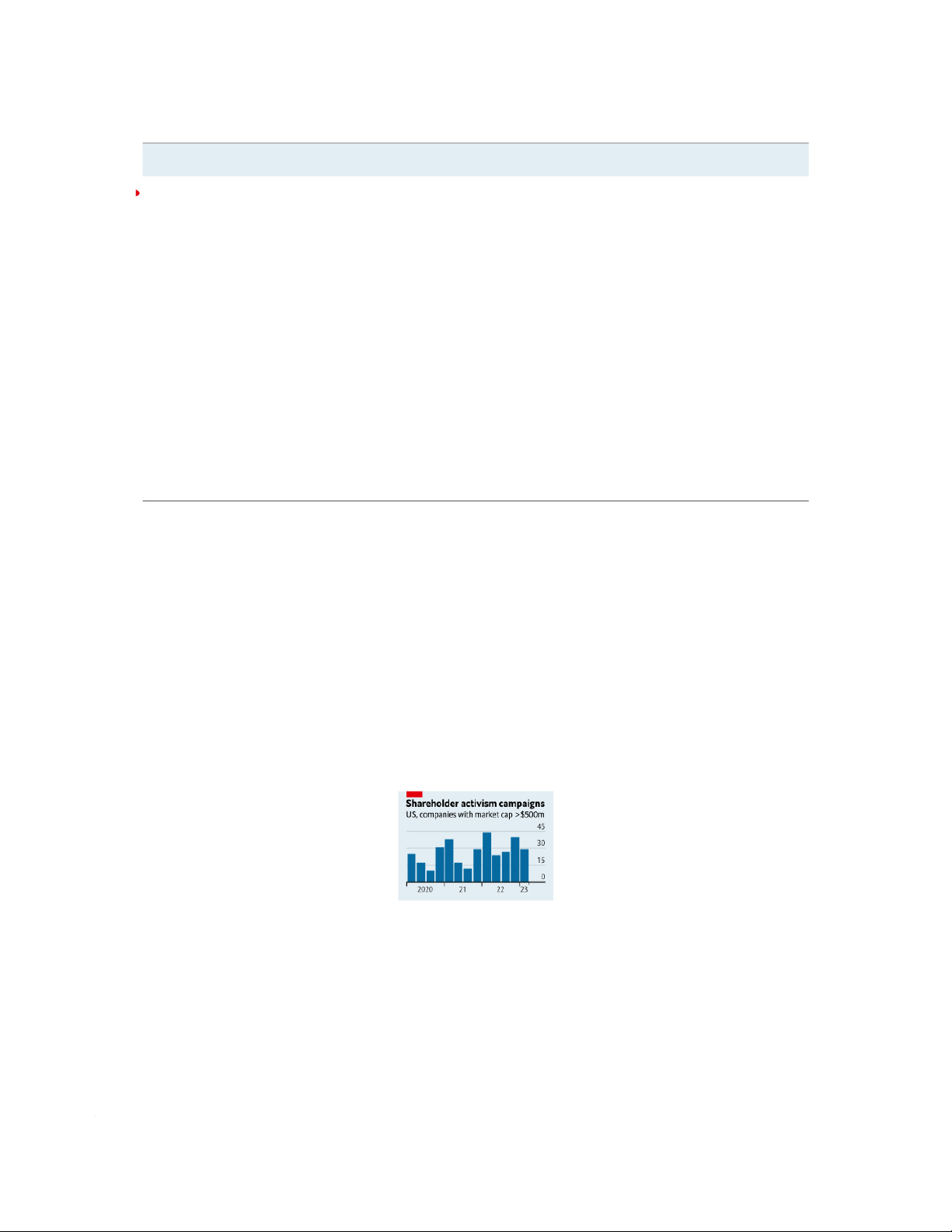
some of the world’s largest firms—including Alphabet, Bayer,
grown. When interest rates were low, large technology firms
Disney and Salesforce—have had to tussle with activists, who
hired aggressively and expanded into peripheral lines of busi-
are increasingly focused on the biggest companies. On May 25th,
ness. Now profits are more important than growth. Over the past
as we published this article, the battle between Carl Icahn, a
decade the demand for managers to respond to environmental,
prominent activist, and Illumina, a genomics giant, was set to
social and governance (esg) concerns has also grown. Some
come to a head (see Business section).
shareholders campaign for esg—as is their
Activist hedge funds are often seen as vil-
right—but the danger of firms losing focus and
lains who are nasty, brutish and focused on the
wasting money as they are drawn into politics
short term. Sometimes the shoe fits. But more has increased.
often activists are playing a role that is essential
In such an environment the presence of ac-
for shareholder capitalism. For several reasons,
tivists is a welcome reminder that it is owners,
their campaigns are increasingly important.
not managers, in whose interest firms should
One is the rise of passive investing, which
be run. And because dealmaking is down, activ-
attempts to replicate the returns of an index
ists will be more likely to improve a firm’s oper-
rather than surpass them. Only one in three dollars invested by
ations than force it to sell itself in search of a quick buck. That
institutions in America’s thousand largest public companies is
should assuage the fears of those who see activists as corporate
actively allocated, according to Man Group, an investment firm.
cowboys rather than drivers of e ciency.
The biggest passive asset-managers, such as BlackRock, charge
low fees and run lean investment-stewardship teams which are Get out the vote
not designed to spot empire-building bosses or lazy boards. The
Fortunately, the job of activists is getting easier. New rules that
result is an increasingly idle corporate electorate. E orts to en-
came into force in America last September should make it sim-
franchise the ultimate owners of funds are unlikely to solve the
pler for them to obtain board seats by letting shareholders vote
problem. They typically want to earn returns but leave the deci-
for candidates individually, rather than as a bloc. The wave of sion-making to somebody else.
nail-biting shareholder votes some expected to follow immedi-
There are other channels by which bosses’ feet might be held
ately has not yet materialised. But more battles between activ-
to the fire. Since the 1980s leveraged buy-outs by private-equity
ists and complacent managers would be no bad thing. 012 00:12, 10/01/2026
The Economist: Global Arms Race and AI Perspectives (May 27, 2023) - Studocu The Economist May 27th 2023 15 Letters local agencies we could expect soaring income gains at the Promoting local aid these government sta to seek top. But there is no question Divine organisms As you noted, risk aversion
“rents” from the agencies, and that the share of corporate Your review of Jonathan and bureaucracy get in the way that the agencies, which
profits in national income has Kennedy’s book on bacteria of the American government depend on the government been increasing. says that he puts germs at the e ectively supporting locally sta for licences to operate, Thomas Remington
centre of human history (“Bugs led development and emer- will not be able to say no. Visiting professor of in the system”, April 15th). gency relief (“The e ort to In my 15 years working with government Mark Twain went a step fur- transform the aid business”,
USAID I have seen this scenario Harvard University ther. In “Letters from the May 6th). The same is true for repeated countless times. Cambridge, Massachusetts Earth”, Twain claimed that most other government Local agencies operate at the microbes are God’s favourite donors, UN agencies and pleasure of the host govern-
creatures: “The microbes were international NGOs. After the ment. International NGOs are Royal charities by far the most important part earthquake in Syria and Tur- somewhat insulated from “Crowning story” (May 6th)
of the Ark’s cargo and the part
key, just as on the front lines in similar pressures. could have mentioned some of the Creator was most anxious Ukraine and in remote parts of Thomas D’Agnes the charities founded by Brit- about and most infatuated Myanmar, local volunteer Kailua, Hawaii
ain’s royal family. The Prince’s with…The large intestine was networks stayed and delivered Trust has helped over 1m in e ect their heaven.” life-saving help, whereas young people into employ- Elsewhere, Twain solved international agencies with- The factors behind inflation ment. The Queen’s Green the age-old conundrum of drew or never ventured.
“Capital v labour” (May 6th) set Canopy has planted more than theodicy, or why a benevolent Sadly, the standard operat- up a straw-man argument 1m trees. The Duke of Edin- God allows evil to exist. He ing models have often been to
about capital’s responsibility burgh’s Award sees more than said we falsely assume God is sideline local agencies rather for the surge in inflation. 300,000 young people volun- like us and that we are his than reinforce them, or to Corporate mark-ups have been teer each year, and as was the favourites. Twain concluded sub-contract them into pro- steadily rising in America case with this reader, can that, based on which species jects that do not adequately since the early 1980s, but are inspire a lifelong commitment thrive the best, God clearly cover their overheads, or to not necessarily reflected in to volunteering. In addition must be a microbe. poach their sta . Some aid
capital’s share of GDP. A grow- there is the Earthshot Prize, Richard Waugaman agencies are taking a more ing body of economics the Royal Foundation and Washington, DC responsible approach. The research shows that capital Heads Together. American government’s aid- share need not rise when The royal family fills an reform agenda is already chal-
labour share falls, and that the unfashionable gap engaging Undercover boss lenging other donors and big
share of “factorless income” with communities that poli- Bartleby wrote about employ- aid agencies to move from lip has been growing even as both
ticians can’t be bothered with
ers looking for soft skills when
service on localisation towards labour and capital share
and celebrities can’t bear to be
they hire someone (May 13th). I more practical action. have fallen.
seen with. Royal factory visits was always keen on employing Donors hold the purse- Much of this is explained by
are not to be sni ed at. If the the very best people. The most strings. For meaningful the growth of intangible cap- media gave more focus to e ective way to hire the right change, we need to see them ital, such as algorithms, but these endeavours it would match was for me to sweep the shift funding to local leader-
also by increased fixed costs, change many more lives for parking lot upon the candi- ship. Over the past decade the which for many firms include the better.
date’s arrival, pushing a broom aid industry scaled up cash the compensation to managers Gayathri Fernando and looking busy. I would say: assistance as a more e ective accounted for as part of sales London
“Hello”, wait and observe. It and dignified way to help and general administration was much more e ective than people in times of crisis than costs. The data show that over any of the usual techniques. food aid. The mantra was:
the past four decades, after-tax Taking the high road André Moncheur “Why not cash?” Likewise, corporate profits in America
Walking is a British thing, says de Rieudotte donors should be asking them-
have generally risen as a share Lexington (May 6th). One Boise, Idaho selves and the partners they of gross national income, name missing from his list of fund in every context: “Why falling in recessionary years, famous walkers is Ben Jonson, not local?” then rising again as the econ- an English poet and playwright Her salad days are over Howard Mollett
omy recovers. In the first year and friend of William Shake- Bagehot is right (May 20th). Head of humanitarian policy of the pandemic, their share speare. Jonson set out on his Britain really “would rather CAFOD shot up from 7.2% of national
400-mile “foot voyage” from
forget about Liz Truss”. She just London income to 8.4%. London to Edinburgh in July won’t lettuce. Median wages have risen 1618. Despite the fact that he Jonathan Aspin Your proposal to shift towards since mid-2014 and spiked was 46 at the time and seri- St Christophe en Brionnais, localisation in aid is com- briefly during the pandemic, ously overweight, he had a France mendable but naive. The sta but they have since settled marvellous time en route of governments in host coun- back to their pre-pandemic
being treated like the celebrity tries like Cambodia, Haiti, levels. Although we cannot he was, and feted and housed
Letters are welcome and should be Jordan and Nigeria receive
ascribe the recent inflation to by William Drummond of addressed to the Editor at
The Economist, The Adelphi Building, risible salaries that must be
either higher capital or labour Hawthornden, his wealthy
1-11 John Adam Street, London wc2n ht 6 supplemented in order for shares, these are neither Scottish fan and fellow poet. Email: letters@economist.com them to gain a living wage. If necessarily inversely linked, JAMES HUNTER More letters are available at: Economist.com/letters large grants were disbursed to nor the main reason for Toronto 012 00:12, 10/01/2026
The Economist: Global Arms Race and AI Perspectives (May 27, 2023) - Studocu 00:12, 10/01/2026
The Economist: Global Arms Race and AI Perspectives (May 27, 2023) - Studocu 00:12, 10/01/2026
The Economist: Global Arms Race and AI Perspectives (May 27, 2023) - Studocu 00:12, 10/01/2026
The Economist: Global Arms Race and AI Perspectives (May 27, 2023) - Studocu 00:12, 10/01/2026
The Economist: Global Arms Race and AI Perspectives (May 27, 2023) - Studocu
Tài liệu liên quan:
-
English-Vietnamese Translation Guide: The World is Flat môn English Studies| Trường Đại học Thăng Long
30 15 -
Midterm Exam - IC Course: Intercultural Communication Insights môn English Studies| Trường Đại học Thăng Long
33 17 -
Outline and Essay on Apathy's Effects on Individuals & Society môn English Studies| Trường Đại học Thăng Long
35 18 -
Listening Practice: Tapescripts and Exercises - Level 1 môn English Studies| Trường Đại học Thăng Long
34 17 -

TOEIC Sample Tests: Speaking and Writing Overview môn English Studies| Trường Đại học Thăng Long
37 19