The exponential probability distribution explained môn Xác suất thống kê| Trường Đại học Ngoại Thương
Is often concerned with the amount of time until some specificevent occurs. For example, the amount of time (beginning now) until an earthquake occurs has an exponential distribution. Tài liệu giúp bạn tham khảo, ôn tập và đạt kết quả cao. Mời đọc đón xem!
Môn: Xác suất thống kê (FTU) 355 tài liệu
Trường: Trường Đại học Ngoại Thương 1.1 K tài liệu
Tác giả:


Preview text:
Chapter 5 - Continuous Probability Distributions NAME: ______________________
Section 5.3 - The Exponential Distribution
The __________________________ is often concerned with the amount of time until some specific event
occurs. For example, the amount of time (beginning now) until an earthquake occurs has an exponential distribution.
____________________________ include the length, in minutes, of long distance business telephone calls, and
the amount of time, in months, a car battery lasts. It can be shown, too, that the value of the change that you
have in your pocket or purse approximately follows an exponential distribution.
Values for an exponential ______________________ occur in the following way. There are fewer large values
and more small values. For example, the amount of money customers spend in one trip to the supermarket
follows an exponential distribution. There are more people who spend small amounts of money and fewer
people who spend large amounts of money.
The exponential distribution is widely used in the ___________________. Reliability deals with the amount of time a product lasts. Example 1 :
Let X = amount of time (in minutes) a postal clerk spends with his or her customer. The time is known to
have an exponential distribution with the average amount of time equal to four minutes. X is a _______________ since ti ____________________
me is measured. It is given that μ = 4 minutes. To do any calculations,
m = ______. Therefore, m =1/4 = 0.25.
The standard deviation, σ, is the same as the mean. μ = σ
The distribution notation is X ~ Exp(m). Therefore, X ~ Exp(0.25).
The probability density function is ____________. The number e = 2.71828182846... It is a number that is used
often in mathematics. Scientific calculators have the key "ex." If you enter one for x, the
calculator will display the value e. The curve is: f( ) = 0.25 x e–0.25x where is at lea x st zero and m = 0.25.
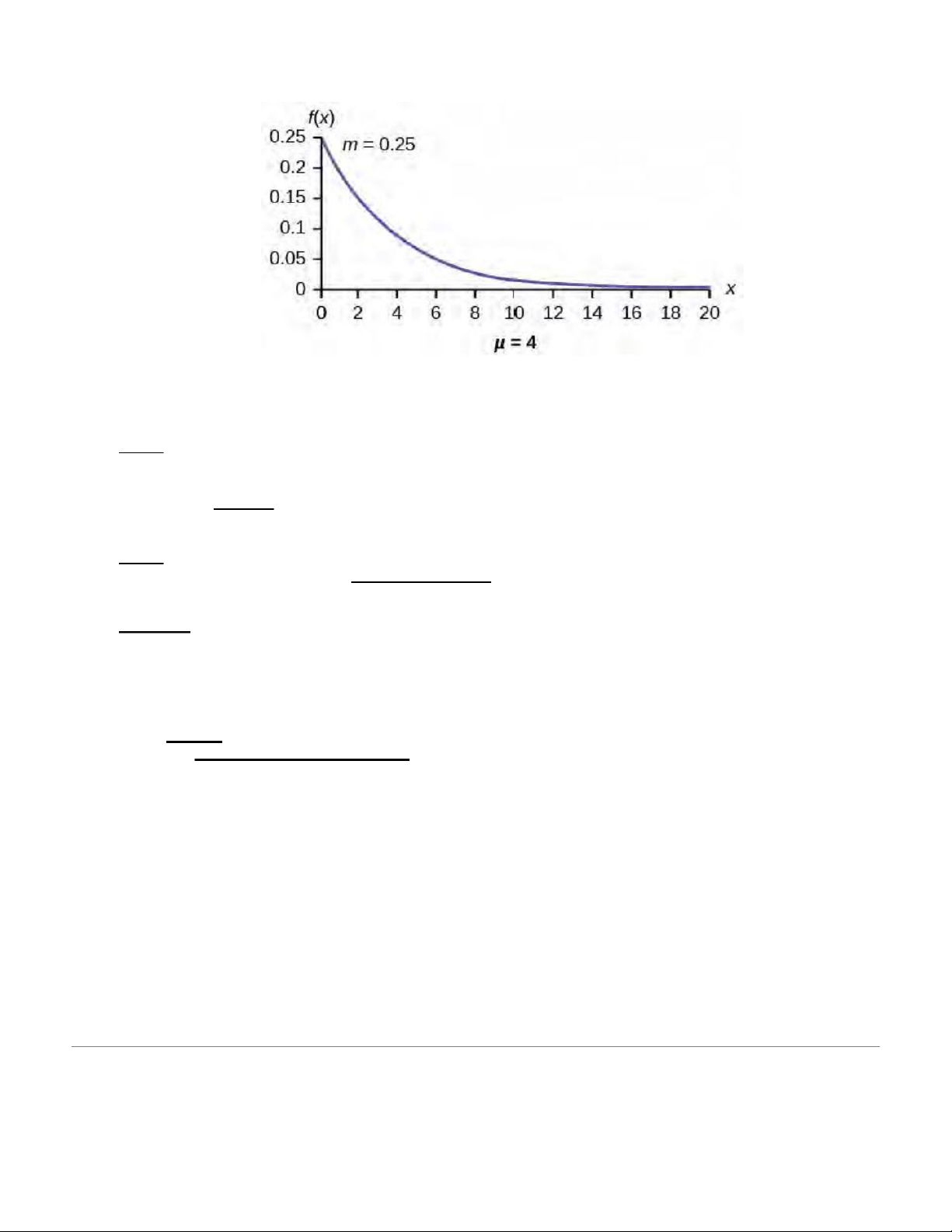
For example, f(5) = 0.25e−(0.25)(5) = 0.072. ________________________. The graph is as follows:
Notice the graph is a declining curve. When x = 0, f(x) = 0.25e(−0.25)(0) = (0.25)(1) = 0.25 = m. The maximum value on the -axis is y m. NOTE
The cumulative distribution function (CDF) for exponential distributions is given by
_______ = (1 - me-mx) and gives the area under the exp curve to the left of . x NOTE
A formula for the percentile is
k k = 𝐥𝐧 (𝟏−𝑨𝒓𝒆𝒂 𝒕𝒐 𝒕𝒉𝒆 𝒍𝒆𝒇𝒕)
−𝒎 where ln is the natural log. Example 2.
Using the information from Example 1, calculate the probability that a clerk spends four to five minutes with a randomly selected customer. a. Find P(4 < x < 5). Solution
The ___________________________ (CDF) gives the area to the left.
The probability that a postal clerk spends four to five minutes with a randomly selected customer is
P(4 < x < 5) = P(x < 5) – P(x < 4) = 0.928 − 0.908 = 0.02.
b. Half of all customers are finished within how long? ( .) ______________________ Solution
P(x < k) = 0.50, k = 2.8 minutes (calculator or computer). Half of all customers are finished within 2.8 minutes.
You can do the calculation as follows:
c. Which is larger, the mean or the median? Solution
c. From part b, the median or 50th percentile is 2.8 minutes. The theoretical mean is four minutes. The mean is larger. Example 3.
On the average, a certain computer part lasts ten years. The length of time the computer part lasts is exponentially distributed.
a. What is the probability that a computer part lasts more than 7 years? Solution
Let x = the amount of time (in years) a computer part lasts. μ = 10 so m = 1/μ = 1/10 = 0.1
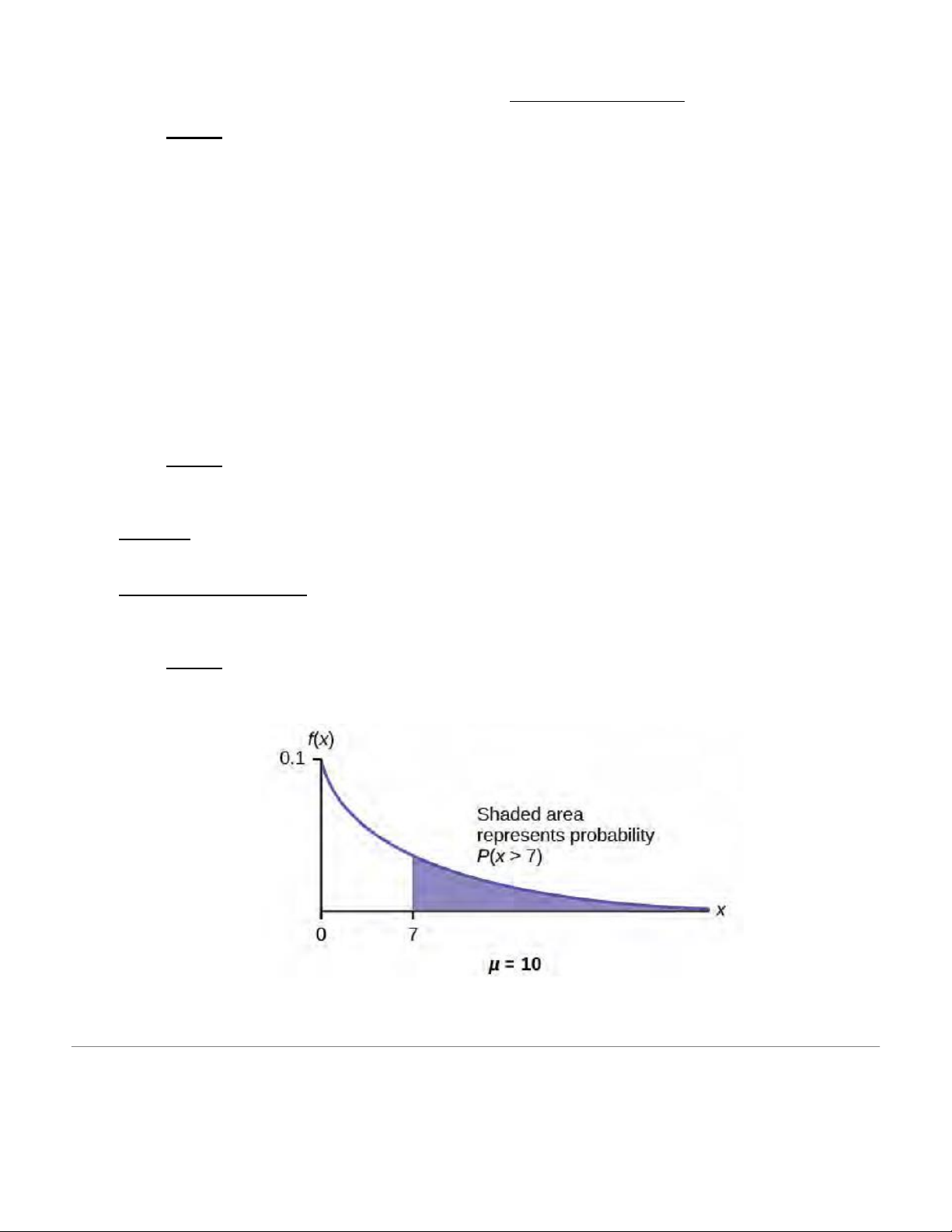
Find P(x > 7). Draw the graph. Workspace:
_______________________. Since P(X < ) = 1 x –me–mx then P(X > ) = 1 x (1 – –me–mx) = e-mx
P(x > 7) = e(–0.1)(7) = __________. The probability that a computer part lasts more than seven years is 0.4966.
b. On the average, how long would five computer parts last if they are used one after another? Solution
On the average, one computer part lasts ten years. Therefore, five computer parts, if they are used one
right after the other would last, on the average, (5)(10) = 50 years.
c. Eighty percent of computer parts last at most how long? Solution
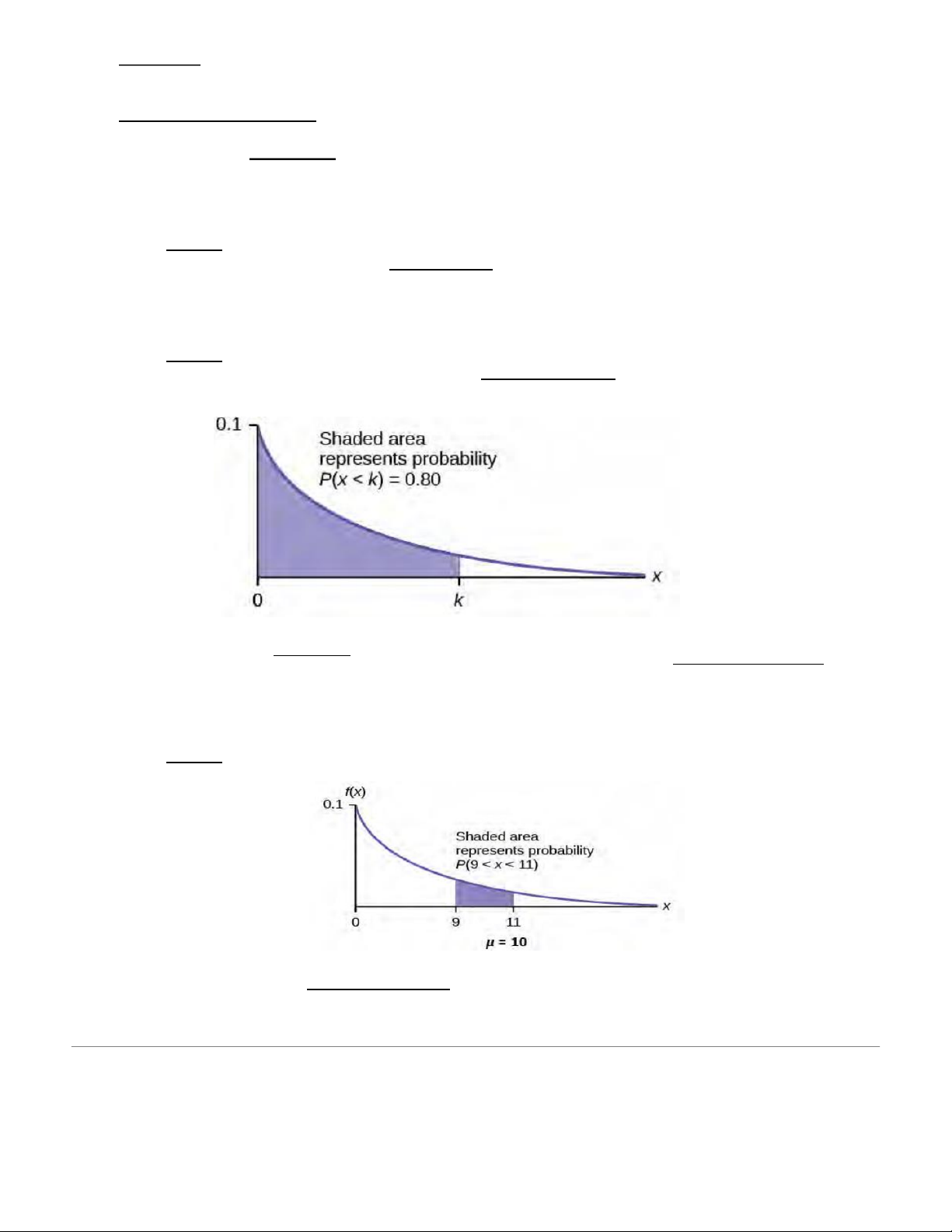
Find the 80th percentile. Draw the graph. Let k = _________________. Solve for :
k k = 𝐥𝐧 (𝟏−𝟎.𝟖 ) 𝟎
−𝟎.𝟏 = 16.1. Eighty percent of the computer parts last . ___________________
d. What is the probability that a computer part lasts between nine and 11 years? Solution
Find P(9 < x < 11). Draw the graph. P(9 < < 1 x 1) = P(x < 11) P – (x < 9) = (1 – e (–0.1)(11)) – (1 – e
(–0.1)(9)) = 0.6671 – 0.5934 = 0.0737. The probability that a lasts between nine and 1 __________________ 1 years is 0.0737.
Tài liệu liên quan:
-
Bảng giá trị phân phối thống kê poisson và student môn Xác suất thống kê| Trường Đại học Ngoại Thương
27 14 -
Bảng giá trị quyết định thống kê wilcoxon rank-sum test môn Xác suất thống kê| Trường Đại học Ngoại Thương
30 15 -
Bài 1 Định nghĩa cổ điển về xác suất môn Xác suất thống kê| Trường Đại học Ngoại Thương
26 13 -
Exercises for probability & statistics môn Xác suất thống kê| Trường Đại học Ngoại Thương
26 13 -
Đề thi cuối kỳ lý thuyết môn Xác suất thống kê| Trường Đại học Ngoại Thương
27 14