The impact of emojis and memes on modern communication | Discussion Authentic english
In the modern digital age, technology has profoundly transformed the way people
communicate. With the widespread use of smartphones, messaging applications, and social media platforms, online interaction has become an essential part of everyday life. Tài liệu giúp bạn tham khảo, ôn tập và đạt kết quả cao. Mời đọc đón xem!
Môn: Tiếng anh Thương mại tatm 90 tài liệu
Trường: Trường Đại học Thương Mại 2.9 K tài liệu
Tác giả:



















Preview text:
lOMoAR cPSD| 39651089 THUONGMAI UNIVERSITY FACULTY OF ENGLISH ----- ----- DISCUSSION AUTHENTIC ENGLISH
TOPIC: THE IMPACT OF EMOJIS AND MEMES ON MODERN COMMUNICATION Lecturer
: Dao Phuong Linh Group : 06 Class
: 251_ENPR6111_ 04 Ha Noi, 2025 lOMoAR cPSD| 39651089
MEMBERS EVALUATION TABLE Presentation No ID Name Tasks Evaluation Order The role of Emojis Left one task in 1 22D170016 Hoàng Gia Bảo B in Communication choosing topic. Finish by the 2 22D170269 Cao Hà Vy Positive Impacts A deadline. The role of Memes Finish by the 3 22D170002 Đào Quỳnh Anh A in Communication deadline. Negative Impacts Finish by the 4 22D170036 Đặng Minh Đại and Limitations A Word deadline. Finish by the Lê Hữu Hùng deadline. 5 22D170090 Conclusion A ( Leader ) Offer suggestions on the outline. Finish by the 6 22D170114 Hoàng Hải Nam Introduction A deadline. i TABLE OF CONTENTS I.
INTRODUCTION........................................................................................ ...3
1.1. Definition of Emojis...................................................................................3
1.2. Definition of Meme....................................................................................4
1.3. Brief history of Emojis and Meme.............................................................4
1.4. Why People Use Emojis and Meme in Daily Online Conversations..........5 II.
THE ROLE OF EMOJIS IN COMMUNICATION..................................6
2.1. Emojis as Digital Nonverbal Communication:..........................................6
2.3. Fostering Emotional Connection and Rapport..........................................7
2.4. Challenges: Variability, Ambiguity, and Cultural Gaps............................8 III.
THE ROLE OF MEMES IN COMMUNICATION.................................10 3.1.
What is a meme and how it spreads
online:........................................10 3.2. Memes as a tool for sharing opinions,
humor, or social commentary:10 3.3. How memes create a shared online
culture:........................................10 IV. POSITIVE IMPACTS IN
COMMUNICATION.....................................11 V.
NEGATIVE IMPACTS AND LIMITATIONS........................................14
5.1. Emojis and memes can be misunderstood because meanings differ across lOMoAR cPSD| 39651089
cultures...........................................................................................................14
5.2. Overuse can make communication less serious or unclear......................15
5.3. Not appropriate for formal or professional situations.............................15 VI.
CONCLUSION........................................................................................18
REFERENCES....................................................................................................19 ii lOMoAR cPSD| 39651089 I. INTRODUCTION
In the modern digital age, technology has profoundly transformed the way people
communicate. With the widespread use of smartphones, messaging applications, and
social media platforms, online interaction has become an essential part of everyday life.
Unlike traditional face-to-face conversations, digital communication relies heavily on
written text, which often lacks tone, emotion, and context. To bridge this gap, visual
elements such as emojis and memes have emerged as important tools that allow users to
express emotions, ideas, and humor more effectively in online environments.
Emojis and memes have become cultural symbols that reflect how people adapt
to the fast-paced and informal style of modern communication. Emojis, for instance, are
small digital icons that help convey emotional meaning and non-verbal cues in text-
based messages. In contrast, memes are humorous or thought-provoking images, videos,
or short texts that spread rapidly across social media, often representing shared
experiences or offering social commentary. Together, they demonstrate the growing
trend of using visual language to enhance online interaction and self-expression.
The popularity of emojis and memes has not only changed individual
communication habits but also shaped online culture and collective behavior. They
enable users to connect emotionally despite linguistic and cultural differences,
influencing how humor, opinions, and feelings are shared globally. Moreover, these
symbols have become powerful tools for creativity, identity-building, and even social
activism within digital communities.
This discussion will focus on the role of emojis and memes in modern
communication, exploring how they affect the way people express emotions and connect
with others in the digital world.
1.1. Definition of Emojis
An emoji is a small digital image or icon used to express an idea, emotion, or concept
in electronic communication. According to the Oxford English Dictionary, an emoji is
“a small digital image or icon used to express an idea, emotion, etc., in electronic
communications”. Emojis function as visual representations that help people convey
tone and emotional nuance in text-based interactions, compensating for the absence of
non-verbal cues such as facial expressions or gestures.
The term emoji originates from the Japanese words e (絵, meaning “picture”) and moji 1 lOMoAR cPSD| 39651089
(文字, meaning “character”), which together describe “a pictorial character”. Over time,
emojis have evolved into a universal visual language used worldwide on platforms such
as WhatsApp, Instagram, and X (formerly Twitter). They allow users to express feelings
quickly and intuitively, bridging cultural and linguistic gaps.
Furthermore, emojis play an important role in improving the clarity and tone of online
messages. A study published in Computers in Human Behavior emphasizes that emojis
act as “non-verbal communication cues” that help prevent misinterpretation and increase
social presence in digital conversations. For example, adding a smiley face can
transform a neutral sentence into a friendly one, reflecting how users employ emojis to
manage interpersonal relationships and emotional expression online.
1.2. Definition of Meme
A meme can be broadly defined as a unit of cultural information that spreads from person
to person, often through imitation or replication. According to Oxford Reference, a
meme is “a self-replicating cultural element or pattern of behaviour, analogous to a gene
but passed from one individual to another by imitation rather than genetic transmission.”
In the context of the internet, memes have taken on a new digital form. MerriamWebster
Dictionary defines an internet meme as “an amusing or interesting item (such as a
captioned picture or video) or genre of items that is spread widely online, especially
through social media”. Internet memes often consist of humorous images, short videos,
or catchphrases that are rapidly shared, edited, and remixed by users across online
communities. They function as collective expressions of humor, criticism, or shared
experience, making them a unique mode of cultural communication.
1.3. Brief history of Emojis and Meme
The origins of visual expression in digital communication trace back to the era of
emoticons, combinations of punctuation marks used to represent facial expressions. In
1982, computer scientist Scott Fahlman proposed using “:-)” and “:-(” to distinguish
joking posts from serious ones on an online bulletin board, marking one of the earliest
intentional uses of emoticons in digital interaction.
As mobile phones and digital communication evolved, the need for richer emotional
cues became evident. In the late 1990s, Japanese mobile carriers began experimenting
with small pictorial characters to enhance text messages. In 1999, Shigetaka Kurita 2 lOMoAR cPSD| 39651089
created a set of 176 pixel-based emojis for NTT DoCoMo’s “i-mode” platform to allow
users to express moods, weather, objects, and more in a compact visual form.
The spread of emojis beyond Japan became possible when they were incorporated into
the Unicode Standard around 2010, ensuring that emojis could be displayed consistently
across devices and platforms. Since then, the number of emojis has expanded
dramatically, with thousands of characters now available for users worldwide.
Meanwhile, the concept of memes long predates their internet usage; the term was first
coined by Richard Dawkins in 1976 to describe units of cultural transmission (ideas,
practices) that replicate through imitation. Over time, especially with the rise of internet
forums, social media, and image-sharing platforms in the 2000s, memes transformed
into visual or textual artifacts circulated digitally. These internet memes often remix
popular culture, humor, and social commentary, evolving quickly through user
participation and spreading virally across online communities.
1.4. Why People Use Emojis and Meme in Daily Online Conversations
Emojis and memes address communicative limitations inherent in plain text by offering
emotional, contextual, and cultural cues in a compact form. In text-only messages, it is
often difficult to convey tone, sarcasm, or humor; adding an emoji can supply emotional
nuance and reduce misinterpretation. For example, a smiley or crylaughing emoji can
clarify that a message is friendly or humorous rather than sarcastic.
Furthermore, emojis and memes facilitate faster, more expressive communication. Users
can convey complex emotional states or shared cultural references in a split second,
rather than explaining with long text. This efficiency is especially valued in informal,
conversational contexts such as chat, social media comments, and instant messaging.
Memes, in particular, leverage shared cultural knowledge and humor to resonate with
audiences. Because memes refer to trending topics, cultural events, or collective
experiences, they help users feel part of a community, and they convey meanings beyond
literal words. Memes can also function as social commentary or satire, allowing
individuals to express opinions in creative yet concise ways.
Finally, both emojis and memes support identity-building and self-expression in digital
spaces. The choice of which emojis or memes to use signals personality, social
alignment, values, or stance on issues. In many online communities, the frequent usage
of certain memes or emoji styles becomes part of subcultural or generational identity. 3 lOMoAR cPSD| 39651089 II.
THE ROLE OF EMOJIS IN COMMUNICATION
2.1. Emojis as Digital Nonverbal Communication:
Emojis—stylized graphical icons—represent a vital evolution in Computer-Mediated
Communication (CMC), serving as quasi-nonverbal signals that compensate for the lack
of facial expressions, gestures, and vocal tone found in face-to-face interaction.
Governed by the Unicode Consortium , the lexicon has grown substantially, with the
latest Unicode version containing nearly 3,790 emojis.
Neurocognitive studies suggest emojis are processed halfway between symbols and
natural human expressions, validating their functional equivalence to real emotional
cues. According to the Emotion as Social Information (EASI) model, emojis instigate
affective processes (emotion transfer) and inferential processes (understanding intent),
which subsequently drive behavioral responses such as empathic concern.
A critical finding is that emojis do not passively substitute for nonverbal cues; they
actively amplify the affective perception of a message, making digital communication
feel more intense and exhibit a more extreme emotional valence. The stakes are high:
misuse the grinning face with sweat (😅), and you might accidentally confirm that
you're sprinting away from the conversation, not just slightly stressed.
2.2. The Pragmatics of Affect: Expressing Feeling and Tone
The utility of emojis extends beyond simple expression. Linguistic analysis identifies
three primary functions and five secondary functions that structure digital discourse :
A. Core Functions in Clarity and Expression •
Expressive (Feeling): Conveys the writer’s explicit emotional state (e.g., happiness 😊, anger 😡). •
Interpretative (Tone/Clarity): Reduces ambiguity by signaling the emotional tone
and context appropriation of the message. The wink face (😉), for example, is
frequently used to mark sarcasm or humor, acting as a necessary safety valve to
prevent a joke from being taken literally. •
Referential (Substitution): Allows non-face emojis (objects, symbols) to
substitute for a word or concept (e.g., using 🏥 to reference a hospital or ⛪ for a church). 4 lOMoAR cPSD| 39651089
B. Modulation and Control
Users strategically employ emojis to manage the intensity of their communicative acts.
Emojis can reliably correspond to detailed human emotions when measured across valence and arousal axes. •
Intensification: Users primarily strengthen text by including emojis to instill
emotion or clarify the message’s core intention. •
Attenuation: Conversely, users aim to weaken or tone down text using emojis
primarily to maintain relationships and manage the conversation, often to “chill down a heated discussion”.
2.3. Fostering Emotional Connection and Rapport
The primary value of emojis lies in their ability to enhance social interactions and strengthen personal bonds.
A. Enhancing Responsiveness and Closeness
Messages containing emojis are perceived as significantly more responsive than
textonly messages, regardless of the emoji type (face or non-face). Perceived
responsiveness is interpreted as a signal of attentiveness and emotional engagement
from the partner. This perception is critical, as it strongly predicts higher ratings of
closeness and overall relationship satisfaction.
Furthermore, research shows that emoji use with potential partners is associated with
maintaining connections beyond initial interactions and is linked to a higher frequency
of romantic and sexual encounters over time. Using positive emojis consistently
enhances the receiver's emotional state, strengthens the sender's credibility, and results
in higher perceptions of warmth and playfulness.
B. Relationship Regulation through Incongruence
Emojis are essential for managing rapport and deploying politeness strategies, softening
criticism and negative texts. This is most prominent in incongruent messaging,
particularly prevalent in close relationships.
When the text conveys criticism or negative news (a relationship threat), the sender may
pair it with a positive emoji. This positive emoji performs an interpersonal pragmatic
role: it shifts the message's perceived valence, signaling the issue is “not a serious issue,”
thus toning down the content's severity and confirming interest in the relationship. It is 5 lOMoAR cPSD| 39651089
the digital equivalent of delivering bad news while nervously holding up a giant, glittery "Everything is Fine" sign.
C. Digital Emotion Work and Well-being
Online socializing has created "digital display rules"—unspoken norms that dictate
which emotions are appropriate to express. Users manage these norms by engaging in
"digital emotion work," often using euphemistic or smiling emojis in negative contexts
to attenuate their true feelings.
While the authentic expression of emotions using emojis is positively associated with
subjective happiness, the conscious management or masking of emotions carries a
potential psychological cost, as it is weakly associated with depressive symptoms.
2.4. Challenges: Variability, Ambiguity, and Cultural Gaps
Despite their sophisticated usage, emojis pose communication risks due to inherent semantic variability.
A. Sources of Misinterpretation •
Platform Rendering: The appearance of a single Unicode character can vary
significantly across operating systems (e.g., Apple vs. Android), creating
inconsistencies in perceived emotional intensity. •
Semantic Drift: Through widespread, unconventional use, emojis can acquire
secondary meanings that diverge from their official definition, reducing clarity.
For example, the “slightly smiling face” (🙂) has acquired passive-aggressive
connotations among some user groups. •
Context: Controlled studies have found that placing an emoji within a textual
context does not substantially reduce the potential for miscommunication
compared to viewing it in isolation.
B. Cultural and Generational Stratification
Interpretation is stratified significantly by user demographics, compounding the ambiguity : •
Generational Gaps: Younger generations (Generation Z) frequently employ
emojis ironically or contrary to their literal meaning. Conversely, older
participants (Baby Boomers) tend to interpret them strictly at face value, often
missing the contextual nuance. 6 lOMoAR cPSD| 39651089 •
Cultural Divergence: Cultural background is a major factor leading to misinterpretation. •
Middle East: The Thumbs Up (👍), a sign of approval in the West, carries vulgar
connotations akin to the middle finger in countries like Iran, Iraq, and Afghanistan. •
East Asia: In China, the standard Smiley Face (🙂) can signal distrust, sarcasm,
or insincerity. In Japanese culture, the Poop Emoji (💩) symbolizes good fortune
due to a linguistic coincidence, a concept that is universally charming and deeply weird.
Given the high semantic variability, analysts advise moderation (limiting use to two or
three per conversation) and generally refraining from using emojis in formal documents
or emails, unless the organization's culture explicitly permits them, to ensure the focus
remains on the primary message. Furthermore, fields like healthcare often restrict their
use due to confidentiality concerns and system limitations. 7 lOMoAR cPSD| 39651089 III.
THE ROLE OF MEMES IN COMMUNICATION
III.1. What is a meme and how it spreads online:
A meme is an image, video, or short piece of text that is often humorous and easily
shared across the internet. Memes usually include a simple message or joke that people
can quickly understand and relate to. They spread through social media platforms like
Facebook, Instagram, TikTok, or X (Twitter), where users repost or remix them, giving
new meanings to the same image or format. Because of how fast and widely they are
shared, memes can go “viral” in just a few hours.
III.2. Memes as a tool for sharing opinions, humor, or social commentary:
Beyond entertainment, memes are also a powerful way for people to express opinions
and emotions. Many users use memes to comment on political events, social issues, or
everyday struggles in a light-hearted way. This allows serious topics to be discussed
more casually and reach a wider audience. For example, during elections or global
events, memes often reflect people’s thoughts, frustrations, or support in a creative and humorous style.
III.3. How memes create a shared online culture:
Memes help build a sense of community among internet users. When people understand
the same meme references, they feel part of a larger group with shared humor and
experiences. In this way, memes act like a digital “language” that connects people from
different cultures and countries.
Example – meme phrase “Cơm nước gì chưa người đẹp?”
A recent viral meme phrase among Vietnamese youth in 2025 is “Cơm nước gì chưa
người đẹp?”, which roughly translates to “Have you eaten yet, beautiful?”. This phrase
began spreading rapidly on TikTok and other social media platforms as users used it in
funny, flirty, or affectionate ways. In Vietnamese culture, asking “Have you eaten yet?”
is a common expression of care, so when combined with “người đẹp” (meaning
“beautiful person”), it became both humorous and endearing.
The phrase was widely remixed in short videos, captions, and comment sections,
showing its flexibility and appeal. Many young people created variations, while
influencers and even brands joined in to engage with audiences in a friendly and trendy 8 lOMoAR cPSD| 39651089
way. The popularity of this meme shows how a simple phrase can quickly become part
of everyday online conversations, reflecting both the humor and warmth typical of Vietnamese social culture. IV.
POSITIVE IMPACTS IN COMMUNICATION
Emojis and memes have brought many positive impacts to modern communication.
Firstly, they make online interaction more emotional and creative. Unlike plain text,
which can sometimes seem cold or ambiguous, emojis help convey tone and emotion,
while memes allow people to express complex ideas or humor in a visual and
imaginative way. Through these tools, communication becomes more personal, expressive, and engaging.
For example: When someone sends a text-only message, “You’re late again.” The
meaning can be interpreted in many ways. The sender might be angry, annoyed, or
simply reminding the other person. Without nonverbal cues such as tone of voice or
facial expression, the receiver can easily misunderstand the sender’s true emotion.
However, when the sender adds an emoji like:
“You’re late again 😊” or “You’re late again 😂”
The meaning and emotion of the sentence completely change. •
The 😊 emoji makes the message sound gentle and friendly, turning it into a
lighthearted reminder rather than a complaint. •
The 😂 emoji adds a humorous tone, suggesting that the sender is joking or not truly upset.
Secondly, emojis and memes help people connect across cultures and languages.
Because they rely mainly on visuals and shared cultural symbols, they can overcome
linguistic barriers. A smiling face emoji or a popular meme can be understood globally,
allowing people from different backgrounds to share feelings and ideas more effectively.
This universality fosters inclusiveness and cultural exchange in online spaces.
For example: When someone sends a meme instead of saying “good job,” it illustrates
how memes help people connect beyond language. The meme expresses appreciation 9 lOMoAR cPSD| 39651089
and positive emotion through visuals and shared cultural symbols, so even without
words, its meaning is clear. This supports the idea that memes can overcome linguistic
barriers - both sender and receiver understand the praise because they share the same online visual culture.
https://www.tiktok.com/@soundeff/video/7238277189915987201
Moreover, emojis and memes have become valuable tools in various fields such as
marketing, education, and entertainment. Companies use them in advertisements and
social media campaigns to attract attention, create relatable messages, and strengthen
brand identity. In education, they can make lessons more interactive and appealing to
students, while in entertainment, memes have evolved into a form of digital storytelling
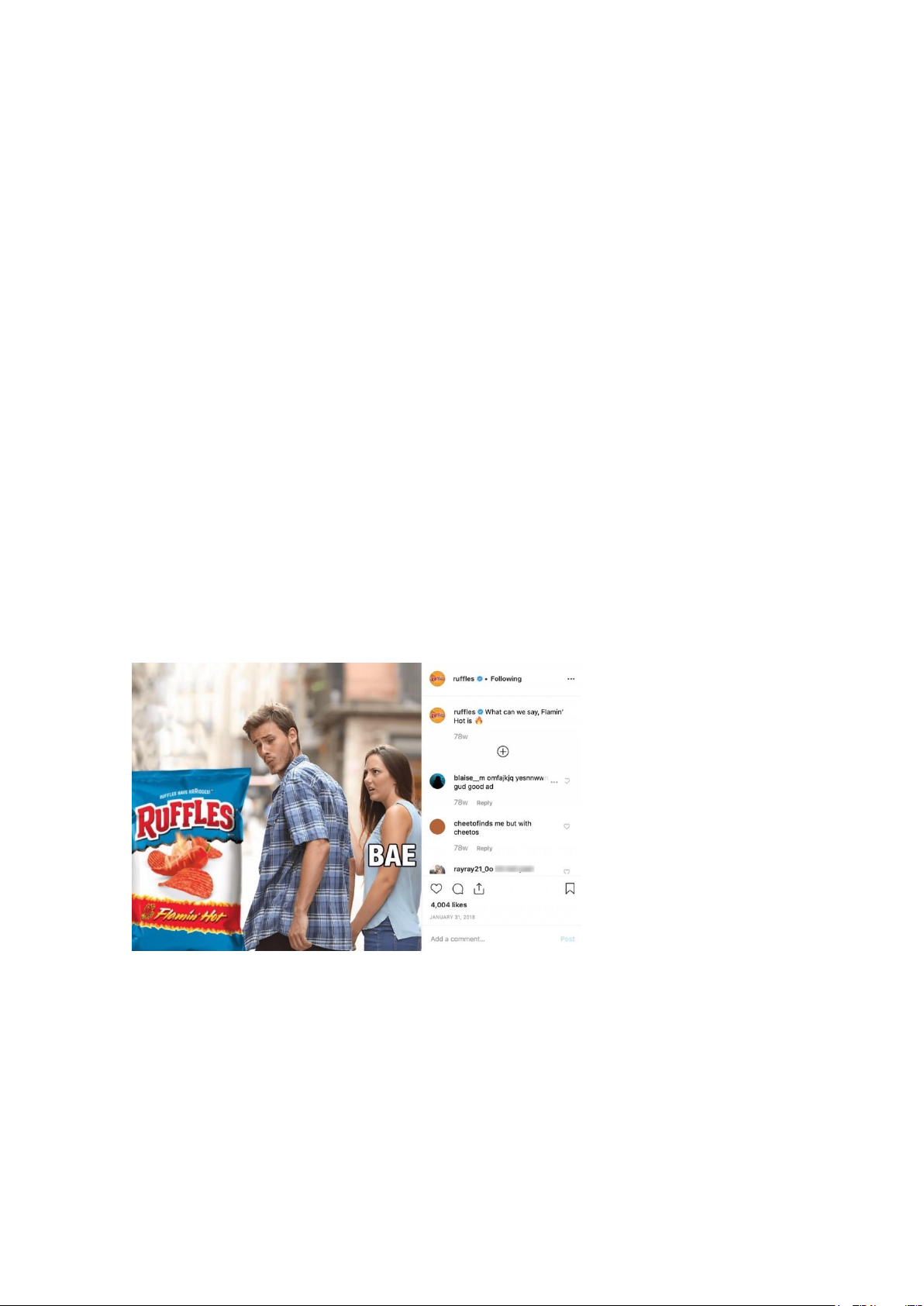
and social commentary that reflects modern life. For example: • For marketing
When launching a new snack, Rulffles posts popular and funny memes to advertise it.
This action helps the brand appear more relatable, attract engagement, and spread naturally. •
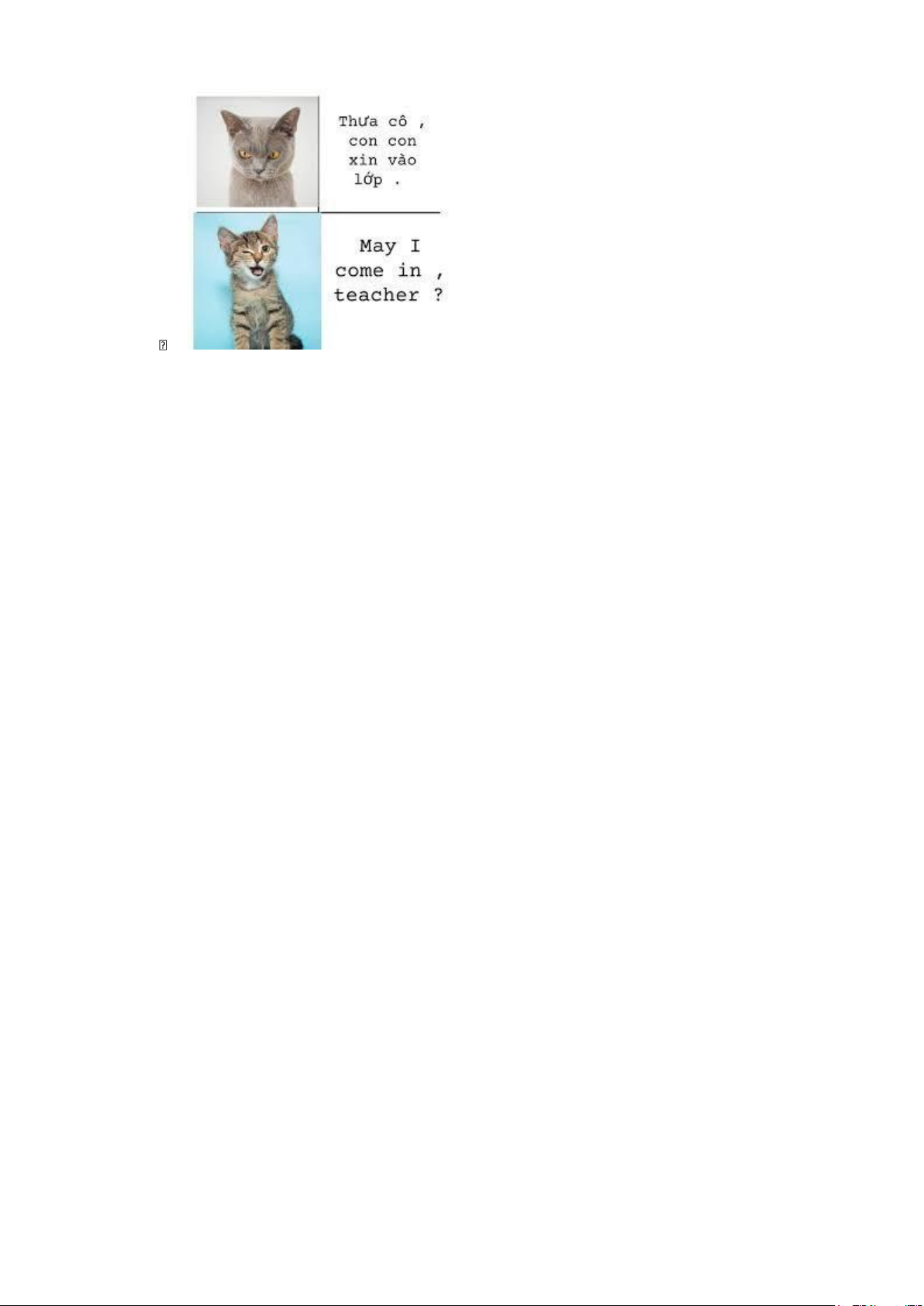
For education: This meme is a fun example of how memes can make learning
more engaging. It shows two cats - one serious with the Vietnamese sentence
“Thưa cô, con con xin vào lớp,” and another cat saying “May I come in,
teacher?”. By combining humor, visuals, and bilingual text, the meme helps
learners easily remember a common English classroom phrase. It makes
language learning more enjoyable and less stressful, showing how memes can
be effective tools in education to spark interest and improve retention. 10 lOMoAR cPSD| 39651089
In conclusion, emojis and memes have made online communication more enjoyable and
engaging. They bring humor, reduce formality, and encourage participation in digital
interactions. Overall, these elements have transformed the way people express
themselves on the internet, making communication not only quicker and more efficient
but also more personal, emotional, and connected. 11 lOMoAR cPSD| 39651089 V.
NEGATIVE IMPACTS AND LIMITATIONS
5.1. Emojis and memes can be misunderstood because meanings differ across cultures
A major limitation of emojis and memes lies in the fact that their meanings are not
universal, but culturally and contextually contingent. What appears innocuous or
humorous in one cultural setting may be confusing or even offensive in another. For
example, emojis are often ambiguous: in a crowdsourced study of 1,289 emojis with no
surrounding text, many emojis showed a wide variance in interpretation, and only a
small proportion (about 1.2 %) were entirely unambiguous. The “thumbs-up” emoji is a
common illustration: in some Western cultures it signals approval or “good job,” while
in parts of the Middle East it can be interpreted as rude or equivalent to a middle-finger gesture.
Memes, likewise, build on cultural in-jokes, references, or shared media knowledge.
When a meme that relies on a local pop-culture reference or linguistic pun is transmitted
across cultural boundaries, its humor or meaning may not carry over; recipients
unfamiliar with the referent may misinterpret—or miss entirely—the intended message.
A study on meme use by non-EU students in the U.K. found that students sometimes
adapted or reinterpreted memes in intercultural settings, revealing gaps in shared frames
of reference. Moreover, cultural norms about what is acceptable humor, political satire,
or social commentary can differ widely, making certain memes problematic outside their
original cultural milieu (e.g. taboo topics, sarcasm, or sensitive historical connotations).
Because of this semantic instability, a message employing emojis or memes may risk
miscommunication. One experiment on text–emoji incongruence revealed that when the
emotional valence of an emoji conflicts with the accompanying text (e.g. positive text +
negative emoji), recipients draw stronger negative inferences, even if the text alone was
positive. Additionally, in adolescent messaging contexts, researchers observed that even
when users intend emojis to reduce ambiguity, a significant proportion of recipients
interpret them differently — in one study, participants disagreed on whether face-emojis
were positive, neutral, or negative about 25 % of the time.In sum, cultural and semantic
divergence poses a real limitation: emojis and memes do not offer a stable, shared code
across diverse audiences, which can lead to confusion, unintended meanings, or even
offense in cross-cultural and intercultural communication. 12 lOMoAR cPSD| 39651089
5.2. Overuse can make communication less serious or unclear
Another limitation of relying heavily on emojis and memes is that overuse may
undermine the clarity, seriousness, and perceived credibility of communication.
Frequent insertion of visual symbols can clutter a message and distract from its core
content, leading to ambiguity rather than clarity. In effect, excessive emoji use may
reduce processing fluency and degrade message credibility. Empirical research in social
media contexts shows that messages containing many emojis are judged as less
trustworthy and less credible. Similarly, in brand or marketing communication,
substitution of textual content with emojis—especially when not congruent with the
surrounding text—has been shown to produce negative brand outcomes, partly mediated
by the recipient’s difficulty in processing the message smoothly.
Furthermore, excessive emoji use may lead to a perception of immaturity or lack of
professionalism, particularly in contexts where the sender wishes to be taken seriously.
Some commentators argue that when people substitute real emotional articulation with
stock symbols, communication becomes depersonalized and flattened. Overreliance on
memes and jokes may also shift the tone to one of playfulness or irony, making it
difficult for recipients to discern the sender’s genuine intentions—especially in
ambiguous or delicate situations.
The ambiguity effect is compounded when an emoji or meme is redundant (i.e. it repeats
exactly what the text says) or used excessively across a message. In those cases, the
visual additions may not add value but instead clutter the perceptual channel. One
academic review suggests that while emoticons and emojis can enhance nuance, their
“ideographic ambiguity” remains a challenge and motivates the development of more
refined nonverbal digital symbols.
5.3. Not appropriate for formal or professional situations
While emojis and memes have become well-established in informal digital
communication, they tend to be ill-suited to formal or professional contexts. In business,
academic, legal, or diplomatic settings, communication often demands precision,
decorum, and a tone of seriousness. Introducing emojis or humorous memes can
undermine that expected register, appear unprofessional, or risk misinterpretation.
First, many professionals presume that emotive symbols belong to casual domains, not
to workplace correspondence; their inclusion may be seen as trivializing or
disrespectful. Even if the sender intends the emoji or meme as a light-hearted gesture, 13 lOMoAR cPSD| 39651089
recipients might question the sender’s judgment, maturity, or seriousness. Indeed,
research on emoji use in online reviews shows that while expressive emoticons
sometimes enhance perceived helpfulness in narrative contexts, they can backfire in
more formal evaluative settings.
Second, in contexts where clarity, legal precision, or risk mitigation is critical (e.g.
contractual discussions, financial advisories, project documentation), ambiguity is
particularly dangerous. The very semantic instability of emojis and memes, as discussed
earlier, is more perilous in professional settings: a misinterpreted symbol could lead to
confusion, offended parties, or even reputational harm.
Third, workplace cultures and generational expectations differ: older or more traditional
stakeholders may find emoji-laden communication demeaning, confusing, or off-
putting. The contrast between informal social media norms and formal business norms
remains wide. In effect, using emojis or memes in formal settings violates the
expectation of linguistic decorum, and it may create friction rather than rapport.
Hence, for formal or professional correspondence, conventional text-based
communication—concise, unambiguous, tone-appropriate—remains safer and more effective.
Example: Sending a joke meme or emoji in a business message
To illustrate the risks concretely: imagine a project manager sends an email to
stakeholders with the message:
"We have one more deadline extension — not ideal 🙃. Let’s push hard this week 🙂."
Here, the manager attempts a lighthearted tone by inserting a wry emoji ("🙃") and a
smile ("🙂"). But several negative effects may follow: •
Misinterpretation or offense: A recipient may interpret the “upside-down face”
emoji as sarcasm, passive aggression, or insincerity — rather than a humorous
apology. As research shows, recipients may assign negative inferences when
emoji valence conflicts with text or context. •
Loss of credibility: Using emojis in a message to stakeholders might lead some
to view the manager as less serious, reducing trust in the message’s professional
weight. The contrast between the serious content (deadline extension) and casual
symbols can undermine perceived authority. •
Cultural mismatch: If the stakeholders are from a more formal culture or are in
different countries, the emojis may be seen as flippant, unprofessional, or even 14 lOMoAR cPSD| 39651089
bewildering. The light tone may clash with expectations in cultures that prefer
direct, formal business communication. •
Ambiguity of tone: Stakeholders might debate whether the manager is
apologetic, frustrated, sarcastic, or merely joking. This ambiguity can prompt
follow-up clarification requests, wasting time or causing confusion. •
Potential relational cost: If some recipients feel the joke is inappropriate given
the seriousness of the delay, relationships or reputations may suffer. 15 lOMoAR cPSD| 39651089 VI. CONCLUSION
In short, emojis and memes have truly transformed the way people communicate in the
digital era. They have become a kind of visual language that allows us to express
emotions, ideas, and reactions instantly. Instead of long explanations, a single emoji or
meme can show exactly how we feel — whether it’s happiness, sarcasm, or surprise. In
today’s fast-moving world, these tools help people stay connected and make online
messages more human and expressive. Without them, our digital conversations might
feel less colorful and more distant.
However, while emojis and memes make our communication richer, they also have
certain limitations. The same emoji or meme can be interpreted in different ways
depending on culture, generation, or even the relationship between the speakers. For
example, the 🙃 emoji might seem funny to some but sarcastic to others. Similarly, a
meme that is humorous in one country might be confusing or even offensive in another.
Because of this, we need to remember that visual communication is not always universal
— it still depends on shared understanding and cultural background.
Therefore, it is essential to use emojis and memes wisely and appropriately. In casual
chats or on social media, they are a fun and creative way to connect with others. But in
more formal or professional situations, overusing them can seem careless or
unprofessional. For example, sending a laughing emoji in a business email may not
leave a good impression. Knowing when and how to use these digital symbols shows
emotional intelligence and communication skills. In other words, balance is the key to effective use.
Overall, emojis and memes are more than just fun decorations in our messages — they
represent a new form of human expression in the digital age. They help people share
feelings, humor, and ideas across languages and cultures, creating a global sense of
connection. As technology continues to evolve, this visual language will also grow and
adapt, shaping the future of online communication. Emojis and memes remind us that
even in a digital world, people still seek emotion, understanding, and connection in every conversation. 🌍💬 REFERENCES.
1. Oxford University Press. Emoji. In Oxford Learner’s Dictionaries. Retrieved
October 15, 2025, from
https://www.oxfordlearnersdictionaries.com/definition/english/emoji 16
Tài liệu liên quan:
-
The Importance of Telephoning in Business and its Etiquette | Bài thảo luận tiếng anh thương mại
13 7 -
How to Become a Good Presenter | Bài thảo luận tiếng anh thương mại
18 9 -
How to handle negative publicity in your business and someillustrations | Bài thảo luận tiếng anh thương mại
22 11 -
Important events in our life | Bài thảo luận tiếng anh thương mại
20 10 -

Technological Innovations in Customer Experience for Vietnam's F&B Industry | Bài thảo luận tiếng anh thương mại
17 9