The Impact of Lifelong Learning and Upskilling on Career Advancement | Bài thảo luận tiếng anh thương mại
Definition of Lifelong Learning. Lifelong learning is the ongoing, voluntary pursuit of knowledge and skills throughout life, driven by personal interests and aimed at personal growth and adaptability. It can occur in both formal or informal settings, ‘from cradle to grave’. Tài liệu giúp bạn tham khảo, ôn tập và đạt kết quả cao. Mời đọc đón xem!
Môn: Tiếng anh Thương mại tatm 90 tài liệu
Trường: Trường Đại học Thương Mại 2.9 K tài liệu
Tác giả:




















Preview text:
THUONGMAI UNIVERSITY ENGLISH FACULTY
--------🙞✪🙜-------- PRESENTATION BUSINESS ENGLISH 2.1 TOPIC 6 :
The Impact of Lifelong Learning and Upskilling on Career Advancement Group: 09 Class: 241_ENPR5211_04
Lecturer: Vũ Thị Hoài
Ha Noi, November 19, 2024 1
SOCIALIST REPUBLIC OF VIETNAM
Independence - Freedom - Happiness ----------------- GROUP MEETING REPORT
Subject: The Impact of Lifelong Learning and Upskilling on Career Advancement Class: 241_ENPR5211_04 Group: 9 I. Time and location
1. Time: 22:00 PM – 00:12 PM 2. Date: October 31, 2024 3. Location: Google Meet II. Attendance 1. Present: 6/6 2. Absent: 0
III. Discussion content
1. All members analyze the topic and discuss to build an outline
2. Refer to and learn documents to build a suitable outline IV. General assessment
- Members enthusiastically contribute comments
- The second meeting went well
Ha Noi, October 31, 2024 Leader
Pham Thi Lan Anh 2
SOCIALIST REPUBLIC OF VIETNAM
Independence - Freedom - Happiness ----------------- GROUP MEETING REPORT
Subject: The Impact of Lifelong Learning and Upskilling on Career Advancement Class: 241_ENPR5211_04 Group: 9 I. Time and location Time: 22:00 PM – 00:12 PM Date: November 8, 2024 Location: Google Meet II. Attendance Present: 6/6 Absent: 0
III. Discussion content
Revise, unify the outline, and assign tasks V. General assessment
- Members enthusiastically contribute comments
- The second meeting went well
Ha Noi, November 8, 2024 Leader
Pham Thi Lan Anh 3
SOCIALIST REPUBLIC OF VIETNAM
Independence – Freedom – Happiness ----------------- GROUP MEETING REPORT
Subject: The Impact of Lifelong Learning and Upskilling on Career Advancement Class: 241_ENPR5211_04 Group: 9 I. Time and location
1. Time: 9: 30 PM – 10: 00PM 2. Date: November 14, 2024 3. Location: Google Meet II. Attendance 1. Present: 6/6 2. Absent: 0
III. Discussion content
1. Members discuss, evaluate and adjust the content each member has completed. 2. Choose a suitable template VI. General assessment
- Members enthusiastically contribute comments
- The second meeting went well
Ha Noi, Nowember 14,2024 Leader
Pham Thi Lan Anh 4
SOCIALIST REPUBLIC OF VIETNAM
Independence – Freedom – Happiness ----------------- GROUP MEETING REPORT
Subject: The Impact of Lifelong Learning and Upskilling on Career Advancement Class: 241_ENPR5211_04 Group: 9 IV. Time and location
4. Time: 9: 30 PM – 10: 00PM 5. Date: November 25, 2024 6. Location: Google Meet V. Attendance 3. Present: 6/6 4. Absent: 0 VI. Discussion content
1. Conduct a mock presentation review
2. Summary review of the content and final presentation slides General assessment
- Members enthusiastically contribute comments
- The second meeting went well
Ha Noi, Nowember 25, 2024 Leader
Pham Thi Lan Anh 5 TABLE OF CONTENTS
I: Introduction................................................................................................................... 6
Definition of Lifelong Learning....................................................................................6
Definition of Upskilling................................................................................................. 6
The Importance of Lifelong Learning and Upskilling................................................6
II: The benefits of Lifelong Learning on Career Advancement....................................8
III: Challenges................................................................................................................. 10
Time management.......................................................................................................10
Costs:............................................................................................................................ 11
Access Ability:.............................................................................................................. 12
Lack of motivation:.....................................................................................................13
IV: Strategies for Lifelong Learning and Upskilling on Career Advancement.........13
V: Case study..................................................................................................................13
Reference:........................................................................................................................14 6 I: Introduction
Definition of Lifelong Learning
Lifelong learning is the ongoing, voluntary pursuit of knowledge and skills throughout
life, driven by personal interests and aimed at personal growth and adaptability. It can
occur in both formal or informal settings, ‘from cradle to grave’.
Examples of Lifelong Learning:
-Developing a new skill: sewing, cooking, programming, public speaking, etc.
-Self-taught study: learning a new language, researching a topic of interest, subscribing to a podcast, etc.
-Learning a new sport or activity: Joining martial arts, learning to ski, learning to exercise, etc.
-Learning to use a new technology: smart devices, new software applications, etc. -
Acquiring new knowledge: taking a self-interest course via online education or classroom-based course
Definition of Upskilling
Upskilling is the process of learning new and improved skills related to one’s current job,
essentially “leveling up” abilities. It involves intentionally deepening knowledge through
courses, certifications, or mentorship, allowing individuals to enhance their expertise and
adapt to their roles more effectively Example:
-For students: Students join clubs to enhance soft skills such as teamwork, public
speaking, and communication. They also particpate in scientific research to enhance
analytical and research skills or gain internship experience at companies to enhance
their professional skills in their field of study.
- For office employees, upgrading office skills such as obtaining MOS certification
and taking an online course in graphic design to learn software like Adobe Photoshop
or Illustrator, enhancing their skills for future projects.
The Importance of Lifelong Learning and Upskilling 7
In the context of rapidly advancing technology, particularly automation and artificial
intelligence (AI), the labor market is undergoing profound changes. Concerns about job
loss due to technology have driven the urgent need for Lifelong Learning and upskilling.
According to a report by the World Economic Forum, around 85 million jobs could be
displaced by automation by 2025, therefore Lifelong Learning and upskilling is now
being viewed as increasingly vital to individuals, including businesses. For businesses:
-Meet skills needs: In the context of rapidly evolving technology, employers need a
workforce that is able to adapt to changes in work. Encouraging employees to upskill
helps ensure that they can meet new technical and professional requirements.
-Reduce the risk of talent loss: When employees feel invested in their professional
development through training and lifelong learning programs, they tend to be more
engaged with the company. This helps reduce the turnover rate and save on recruitment costs.
-Adapting to new technologies: The development of automation, artificial intelligence,
and big data is changing the way people work. Employers need employees who can
work with new technologies and understand how to apply them to daily work processes. For individuals:
- Lifelong learning and Upskilling has become crucial as it not only helps individuals
remain competitive but also opens up opportunities for career development. A
LinkedIn survey shows that 94% of employers’ value employees' ability to learn
continuously, as this is a decisive factor in adapting to changes in the work environment.
The Covid-19 crisis has also demonstrated that lifelong learning has many benefits
beyond skill development and employability. During the pandemic there was huge
demand for online courses and a large appetite to gain new skills and learn something
entirely different. Personal enjoyment, a feeling of achievement and a demand to 8
reduce social isolation are all great benefits for adults wanting to engage in lifelong learning.
=> In conclusion, investing in lifelong learning and upskilling not only helps individuals
survive but also thrive in an increasingly competitive and technology-driven world. Those
who proactively enhance their skills will create a flexible workforce, ready to face future challenges
II: The benefits of Lifelong Learning and Upskilling on Career Advancement
Often, the benefits of upskilling are listed from a company perspective. Namely,
companies that invest in upskilling their employees tend to see better employee
engagement and a greater retention rate. In the long run, this can save money by reducing
recruitment costs. However, upskilling is beneficial for individuals as well. Here are the
benefits of upskilling as well as lifelong learning for employees' career advancement.
Remain competitive in the job market
In today’s fast-paced and competitive environment, continuous learning and upskilling
helps employees stay ahead of their peers and remain valuable to their employers.
-Why it matters: Employers seek individuals who can drive innovation, improve
productivity, and solve problems. Lifelong Learning and Upskilling not only allows
you to take on more complex and impactful projects but also positions you as a leader
in your field. The more skills you develop, the more essential you become to your employer's success.
-For instance, a technical professional who masters advanced programming languages
can handle more complex projects, boosting their value to the company and enhancing their chances of promotion.
Open New Career Pathways
Upskilling isn't just about climbing the ladder in your current role, it’s about unlocking
new opportunities in different industries or positions. By continuously expanding your
skill set, you increase your flexibility and adaptability in an ever-changing job market. 9 -
Why it mattes: As industries diversify and job roles evolve, having a broader skill set
helps you pivot into new areas. This flexibility makes you more resilient and opens
doors to career paths you might not have considered. - Examples:
A marketing professional who learns data analytics can seamlessly transition into
digital marketing or a data-driven role.
A teacher who develops skills in online course design can enter the booming e-
learning industry, crafting educational content for businesses or online platforms. By
expanding your skill set, you not only increase career options but also position
yourself for success in a variety of work environments. Strengthen Job Security
Employees who embrace lifelong learning and upskilling are more likely to thrive in
dynamic environments and less likely to face job displacement during times of
downsizing or restructuring. By continuously updating your skills, you demonstrate that
you are adaptable and prepared for future challenges. -
Why it matters: In a world where technology and industry standards are constantly
evolving, employers prefer to invest in upskilling their existing workforce rather than
hiring externally. Employees who align their skills with the company’s needs become indispensable assets.
-For instance, an administrative assistant who learns automation software like
Microsoft Power Automate or Google Workspace tools is better positioned to
streamline workflows, securing their role while others might face redundancy.
Increased Confidence and Job Satisfaction
- Another benefit of lifelong learning and upskilling is increased fulfillment and job
satisfaction. Upskilling and lifelong learning can help individuals gain a sense of
personal satisfaction and fulfillment. By continuously learning and growing,
individuals can remain motivated and engaged in their careers, and experience a
greater sense of personal growth and achievement. 10
-For instance, Sarah, a marketing professional, decided to enroll in an online data
analytics course to stay updated with industry trends. Through this process, she not
only learned valuable skills that made her work more efficient, but she also discovered
a passion for analyzing data and solving complex problems. As a result, Sarah felt a
deep sense of accomplishment and pride in mastering a challenging subject. This
newfound confidence motivated her to apply for a leadership role in her company,
where she now mentors others and continues to grow personally and professionally.
Future-Proofing the Career Path
- Additionally, continual learning and Upskilling not only bring practical benefits to the
current job but also contribute to prepare for future careers.
- Lifelong learning and Upskilling help individuals stay competitive by acquiring new
skills that are in demand, adapt to industry changes, and enhance their expertise. This
can help us orient career and have better preparation for the future. Specially, as
industries and technologies advance, specific job roles or skills may become obsolete.
Upskilling allows workers to stay competitive by learning emerging skills like
artificial intelligence, data analysis, or block chain, which are increasingly in demand. Widen the relation
- Last but not least, upskilling and lifelong learning help to broaden relationships by
providing opportunities to connect with professionals from diverse fields, fostering
collaboration, and expanding one’s network. These learning experiences often involve
interacting with peers, mentors, and industry experts, which can lead to valuable
professional relationships and open doors to new opportunities.
-For example, IT professionals learn cloud computing to stay with current industry
trends. Through certification courses, they connect with other IT professionals via
forums and webinars. These interactions broaden their network, expose them to new
technologies, and open up job opportunities, leading to career advancement in the
growing field of cloud technology. III: Challenges Time management 11
Lifelong Learning and Upskilling are continuous lifestyles that inevitably demand time.
-For workers in general: Even 5 hours a week dedicated to learning can seem like a
lot to full-time laborers who are busy both inside and outside of work around 8 hours
per day. They also have fundamental needs: to eat, rest, and entertain to reproduce
their physical and mental batteries. Balancing different projects, family, social life,
and personal life means that most people don’t have the time or energy for recreational
activities, let alone learn to ameliorate further skills.
-For married workers in particular, especially women, almost all take on more
responsibility for being homemakers. Putting their position into perspective, we can
recognize that maintaining Lifelong Learning and Upskilling can put huge pressure on them.
For instance: if a woman has a cozy home, she will need to spend her time not only
sharing household chores but keeping her children and earning a living as well. Thus,
lifelong learning or upskilling can mess up her time budget for these duties. Costs:
-Actual costs (learning expenses): When pursuing Lifelong Learning and Upskilling,
you must cope with tuition fees for online or offline courses. Even when you intend to
self-study, you also have to pay for books and course materials like that. In addition,
the prices of these courses vary differently depending on time, reputation, commitment and field.
Example: the learning course of a famous English center named IELTS Fighter.
According to our English output standard, we need to acquire at least 6.5 IELTS. So if
you want to have a 6.5 band score IELTS Certificate, you must spend 19,560,000
VND for 89 lessons to polish your band up from 3.0 to 6.5. Besides, we have to pay
for the IELTS exam fee of 4,664,000 VND at least once, without any certain
commitment that we will achieve the desired band score after taking the exam. 12 -
Opportunity costs: Besides, considering from the economic viewpoint, you have to bear
the opportunity cost. You must spend your valuable time on learning instead of having
other opportunities such as: letting your hair down, gathering your friends, broadening
your networking through participating in several connecting activities and so on. Access Ability:
-Hard access to high-credible courses: When information technology time is
increasingly developed, it is more possible to find aligned courses for your own. But
on the other hand, we cannot refuse its dark side of scamming and inauthentic
information about these courses. That is making the accessibility process to reputable
classes more and more difficult.
Example of a fraudulent incident: according to cafef.vn website, the competent
agency inspected a “pitfall” in selling online courses and issuing certificates. Mr.
N.V.P., who remained anonymous, reported that the subjects, impersonated lecturers
of Hanoi University to defraud and appropriate a total of 1,020,948,000 VND.
-The lack of accessibility: to remote areas is poor due to the lack of Internet and
technology for online courses.
Example of Internet access rate: In Vietnam, according to statistics from Wear Social
and DataReportal, as of January 2024, we have 78.44 million Internet users,
equivalent to 79.1% of the population. That means about of the ⅕ population does not 13
have access to the Internet, making it difficult for those who want to pursue Lifelong Learning and Upskilling. Lack of motivation:
-With Lifelong Learning and Upskilling also being an arduous and tiring process due to
having to face the boredom caused by learning, lack of willpower and lack of self-
discipline are also some of the reasons that make Lifelong Learning and Upskilling more and more arduous.
For instance, when you learn with your friends, you are more motivated to study
together. But when you study alone, you will easily fall into a feeling of boredom, not
be able to learn, and have difficulty maintaining concentration and alertness.
IV: Strategies for Lifelong Learning and Upskilling on Career Advancement
1. Be Intentional with Your Time.
Time is often considered the most significant barrier to pursuing lifelong learning and
upskilling. To tackle this challenge, we must approach our time with intention and
clarity. Effective time management is all about taking control of your schedule and
unlocking its full potential. By using your time wisely, you can reduce distractions from
unimportant activities, lower your stress levels, boost your productivity, and ultimately
reach your aspirations more effectively.
The Eisenhower Matrix Also known as the Urgent-Important Matrix, it was popularized
by Stephen Covey in his best-selling book, The 7 Habits of Highly Effective People. It
was named after Dwight D. Eisenhower, the 34th President of the United States, known
for his high output and organization. This is a simple decision-making tool that helps
you make the distinction between tasks that are important, not important, urgent, and not
urgent. It splits tasks into four boxes, each representing a different category of tasks:
Do (Urgent & Important): Focus on tasks with deadlines or immediate consequences.
Schedule (not urgent but important): Plan tasks that contribute to long-term
goals but don't require immediate action. 14
Delegate (Urgent but Not Important): Assign tasks that need to be done but
don't require your specific expertise.
Delete (Not Urgent and Not Important): Eliminate distractions or activities that don't add value.
For example: As an English teaching assistant, using the Eisenhower matrix can help you
prioritize tasks effectively for career advancement:
Do: Focus on urgent deadlines, like addressing students' immediate questions.
Schedule: Allocate time for long-term goals, such as researching effective teaching methods.
Delegate: Solve necessary administrative tasks, but not too important.
Delete: Try not to waste too much time on social media or other activities that
don’t help your career development.
2. Set S.M.A.R.T. goals relevant to your objectives 15
Once you figure out what you want to dive headfirst into, create goals that will push you
further toward that result. As Tony Robbins says, “Setting goals is the first step in
turning the invisible into the visible.” Without goals, your aspirations are just that: only
aspirations. One thing to consider is that the goals you set for yourself should be dynamic and adaptable.
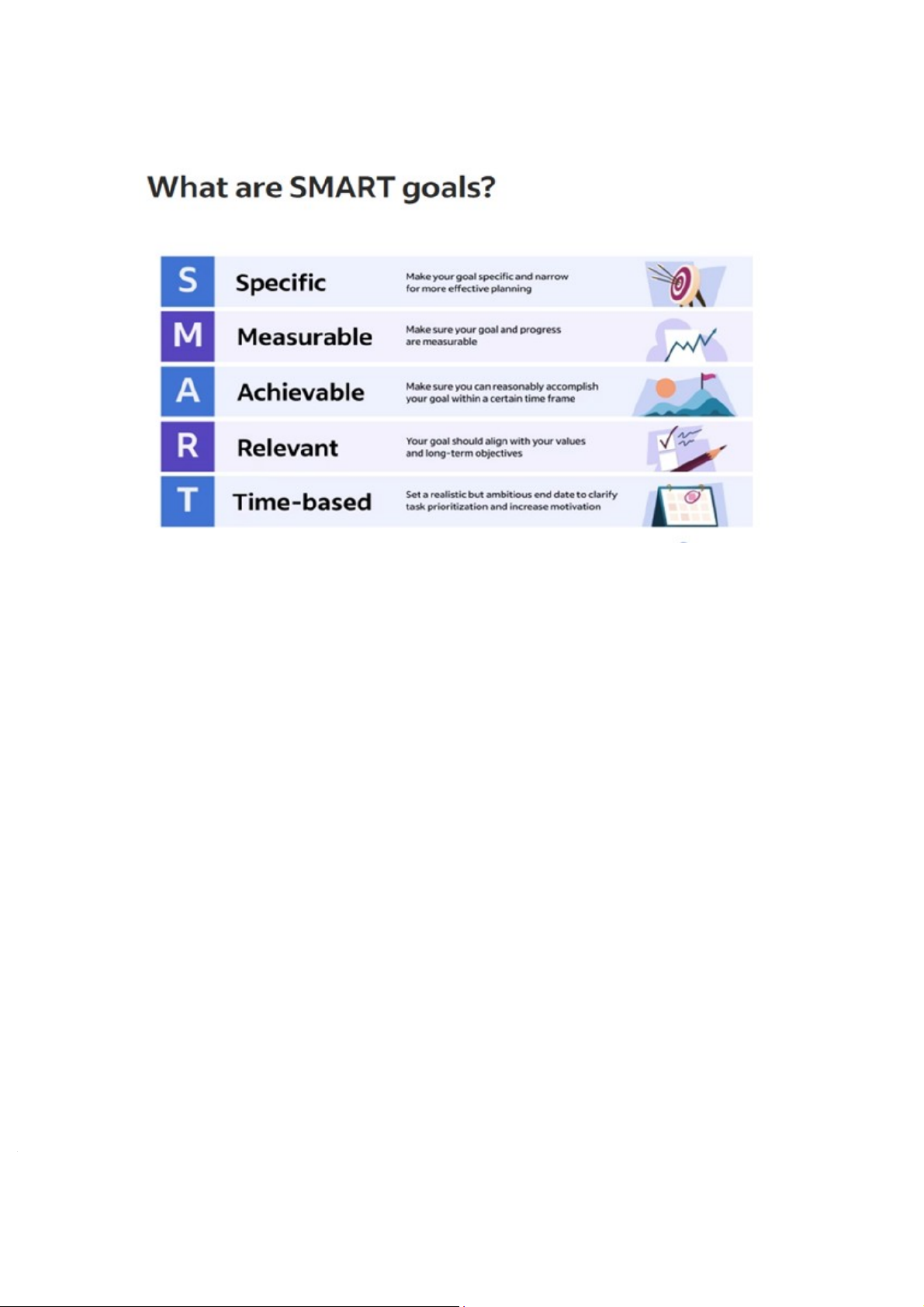
The SMART goals were first outlined in 1981 by George T. Doran in volume 70, issue
11 of Management Review. SMART is a best practice framework for setting goals. A
SMART goal should be specific, measurable, achievable, realistic, and time-bound. By
setting a goal, an individual is making a roadmap for a specific target. The elements in
the framework work together to create a goal that is carefully and thoughtfully planned
out, executable, and trackable. SMART refers to the following:
Specific refers to being as specific as possible with the desired goal. Generally, the
narrower and more specific a goal is, the clearer the steps to achieving it will be.
Measurable refers to ensuring there will be evidence that can be tracked to monitor progress.
Achievable refers to ensuring the set goal is realistic and possible to complete or
maintain within the set time frame.
Relevant refers to making sure the goal itself aligns with values and long-term goals and objectives.
Time-bound refers to making sure the goal is set within an appropriate time frame.
For example, as an English teaching assistant. You can use the following criteria:
Specific: Enhance your lesson planning and teaching techniques
Measurable: Gather feedback from at least 10 students after each lesson.
Achievable: Spend 2 hours every week looking over teaching materials and
learning new teaching methods.
Relevant: Improving my teaching skills will help you become a better candidate
for future teaching opportunities. 16
Time-bound: try to spend at least three new teaching methods in your lessons during the next semester. 3.
Diverse sources of self-study
-Online platforms:
The rapid evolution of the job market has underscored the critical need for continuous
learning and upskilling. The prospect of “anytime, anywhere” skilling has transformed
the learning landscape. In this dynamic time, online learning has emerged as a
powerful tool for acquiring new skills, upskilling, and reskilling, catering to both
domain expertise and soft skills development.
By offering flexibility, accessibility, and a vast array of courses, these platforms
empower individuals to take control of their professional growth. Whether you’re
aiming to enhance your technical proficiencies, develop strong leadership qualities, or
explore new career paths, online learning platforms provide the resources to achieve your goals.
You can use online platforms such as courses, podcasts, blogs, webinars, newsletters,
and more to learn new topics, update your knowledge, gain insights from experts, and
expand your network. Some examples of online platforms that you can explore are
LinkedIn Learning, Coursera, Medium, TED, and Skillshare. 17
For example: LinkedIn Learning, which offers a wide variety of courses in areas such
as technology, business, and design. Learners can access courses anytime, anywhere,
through video lectures taught by experts with real-world experience. After courses,
you can receive a certificate that can enhance your CV and boost your career prospects.
-Learn at the workplace:
Observe and understand the work culture around you:
Start by watching how your colleagues, particularly the experienced ones, approach
their tasks, handle challenges, and prioritize their work. Pay attention to how they
communicate with others, manage their time, and collaborate in different work
situations. Additionally, take the time to familiarize yourself with your company’s
values, goals, and culture. Understanding the bigger picture allows you to align your
efforts with the organization’s objectives, enabling you to contribute more effectively
while positioning yourself for continued growth and career progression.
Engage in projects and challenges at the workplace:
Projects and challenges are practical sources of information for career development
that can help you apply your skills, test your knowledge, and solve real-world
problems as well as stretch your abilities, stimulate your curiosity, and enhance your
portfolio. You can find projects and challenges through your work, education,
volunteering, hobby activities, or platforms like Kaggle or Codecademy.
Connect with a mentor who specializes in your area
An experienced mentor can provide invaluable guidance through regular discussions
about career development, goal-setting, and skill enhancement. Don't hesitate to reach
out to potential mentors in your field; their insights and feedback can significantly
help you navigate your career path. When approaching a mentor, express your
enthusiasm for taking on more challenging and diverse responsibilities, which can
open doors for you to learn about new aspects of your industry, expand your skill set,
and foster both personal and professional growth.
V: Case study: Lifelong Learning and Upskilling of Đặng Lê Nguyên Vũ 18
(Chairman of Trung Nguyên Group) Background
Đặng Lê Nguyên Vũ, the founder of Trung Nguyên Group, is a self-made entrepreneur
who turned his passion for coffee into Vietnam’s leading coffee brand. Born in 1971 to a
poor farming family in Đắk Lắk, he grew up surrounded by coffee plantations but had
limited opportunities. Despite financial struggles, he excelled academically and was
accepted into the Medical University of Tây Nguyên. However, in his third year, he left
school to pursue a vision: to create a world-class Vietnamese coffee brand.
Today, Trung Nguyên is one of the largest coffee companies in Vietnam, exporting to
over 60 countries and inspiring millions with its message of ambition, creativity, and national pride.
Lifelong Learning and Upskilling Journey
1. Self-Learning About Coffee
Đặng Lê Nguyên Vũ had no formal education in coffee production or business when he
started. He began by reading books and learning from local coffee farmers.
He spent years studying the entire supply chain, from cultivating beans to processing
and brewing techniques. By combining traditional Vietnamese methods with modern
technology, he developed Trung Nguyên’s signature coffee blends.
2. Expanding knowledge in business and leadership:
Beyond coffee, he recognized the need to learn business and management skills. By
studying successful global brands like Starbucks and Nestlé, he understood the
importance of strong distribution systems, effective marketing, and building a compelling brand identity.
3. Learning to globalize and build an international brand:
With his ambition to bring Trung Nguyên to the global stage, he studied consumer
behavior in key international markets like Asia, Europe, and the US.He created the
unique concept of “Coffee Energy,” positioning coffee as more than just a drink but a
source of creativity and inspiration.
4. Multidisciplinary learning: 19
He believes learning should go beyond a single discipline. He explored thousands of
books on science, culture, religion, and economics to develop a holistic perspective.
This broad approach allowed him to combine coffee with cultural and spiritual elements,
setting Trung Nguyên apart from competitors.
5. Sharing knowledge and promoting learning:
Đặng Lê Nguyên Vũ doesn’t keep his learning to himself. He actively encourages his
employees and the community to adopt lifelong learning. He initiated programs and
workshops to spread knowledge and inspire growth through education.
Achievements Through Lifelong Learning and Upskilling
- Built the Trung Nguyên empire: From a small coffee business, he created Vietnam’s
leading coffee brand, now present in over 60 countries.
- Global Brand RecognitionTrung Nguyên is widely recognized as Vietnam’s top coffee
exporter, with its products sold in major international markets like the US, Germany, and Japan.
- Impact on Vietnamese Coffee Culture: Đặng Lê Nguyên Vũ transformed the
perception of Vietnamese coffee. He emphasized its quality and cultural significance,
turning it into a symbol of national pride. His efforts contributed to making Vietnam
the second-largest coffee exporter in the world, with annual exports exceeding $3 billion.
=> Đặng Lê Nguyên Vũ’s journey is a remarkable example of how lifelong learning and
upskilling can overcome limitations and achieve greatness. His story is a motivational
example for young people to embrace learning, innovate, and dream big. 20
Tài liệu liên quan:
-
The Importance of Telephoning in Business and its Etiquette | Bài thảo luận tiếng anh thương mại
13 7 -
How to Become a Good Presenter | Bài thảo luận tiếng anh thương mại
18 9 -
How to handle negative publicity in your business and someillustrations | Bài thảo luận tiếng anh thương mại
22 11 -
Important events in our life | Bài thảo luận tiếng anh thương mại
20 10 -
Technological Innovations in Customer Experience for Vietnam's F&B Industry | Bài thảo luận tiếng anh thương mại
17 9