[ 10] CLASSICAL MUTAGENESIS TECHNIQUES 189
[I O] Classical Mutagenesis Techniques
By CHRISTOPHER W. LAWRENCE
Introduction
Generating mutants, to identify new genes and to study their properties, is the
starting point for much of molecular biology. Forward mutations and metabolic
suppressors obtained by reversion can provide powerful insights into the functions
and relationships of normal gene products. Similarly, mutations and intragenic
revertants provide the raw material for the analysis of gene product structure-
function relationships. Site-specific mutagenesis and other methods based on
recombinant DNA techniques are increasingly used for these purposes, and they
are clearly the methods of choice where particular changes in specified genes
or genetic sites are needed. Nevertheless, classical methods, in which cells are
treated with mutagens, are likely to remain the chief means for inducing mutations
in many circumstances because they require no prior knowledge of gene or product
and are generally applicable: the user need only specify an appropriate alteration
in phenotype. However, unless selection for the desired strain is possible, hunt-
ing for mutants can be extremely laborious and analyzing the material obtained
even more so. Good planning, efficient mutagenesis, careful choice of strain, and
effective mutant detection usually pay off in time and labor.
Choice of Mutagen and Dose
The best mutagens for most purposes are those that induce high frequencies
of base-pair substitutions and little lethality. The widely used alkylating agents
N-methyl-N'-nitro-N-nitrosoguanidine (MNNG) and ethylmethane sulfonate
(EMS) fulfill these criteria but are highly specific in their action: they almost
exclusively produce transitions at G-C sites.1 For most purposes, such as forward
mutagenesis, this specificity is unlikely to pose any problem, though it may be
a disadvantage when, as in some kinds of reversion, particular kinds of muta-
tions at specified sites are needed. Germicidal ultraviolet light (254 nm UV) is
also a fairly efficient mutagen, and it has the advantage of producing a greater
range of substitutions 2,3: most occur in runs of pyrimidines, particularly T-T pairs,
and include both transitions and transversions. UV also induces a significant fre-
quency of frameshift mutations, almost exclusively of the single nucleotide deletion
variety. One or other of the chemical mutagens together with UV are likely to satisfy
1 S. E. Kohalmi and B. A. Kunz,
J. Mol. Biol.
204, 561 (1988).
2 B. A. Kunz, M. K. Pierce, J. R. A. Mis, and C. N. Giroux,
Mutagenesis
2, 445 (1987).
3 G. S. E Lee, E. A. Savage, R. G. Ritzel, and R. C. von Borstel,
Mol. Gen. Genet.
214, 396 (1988).
Copyright 2002. Elsevier Science (USA).
All rights reserved.
METHODS IN ENZYMOLOGY, VOL. 350 0076-6879/02 $35.00
190 MAKING MUTANTS [ 101
most experimental needs, and it may be an advantage to induce different samples
of mutants with each of these agents (for an example, see Ref. 4). Although base-
pair substitution mutagens have most general utility, the alkylating acridine mus-
tard ICR- 170 (2-methoxy-6-chloro-9- [3-(ethyl-2-chloroethyl)aminopropylamino]
acridine dihydrochloride can be used when + 1 frameshift mutations are required. 5-7
The majority of mutations induced by this agent are single G insertions in runs of
two or more G's, with preference for runs of three or more G's. 7
Choosing an optimal dose usually requires balancing the competing needs for
a high mutation frequency, reasonably high survival, and avoidance of multiple
mutations. The highest proportion of mutants per treated cell is usually found at
doses giving 10 to 50% survival. The highest fraction of mutations per surviving
cell most commonly requires a larger dose, but mutation frequencies often decline
at very high doses. In any case, it is desirable to avoid doses that kill more than
95% of cells, because they may select multicell clusters or atypically resistant
variants, which occur spontaneously in all cell populations. In addition, multiple
mutants become more common and may interfere with analysis. An indication
of the effectiveness of the mutagenic treatment in the particular strain used can
be obtained by measuring the frequency of canavanine-resistant mutants that it
induces.
Growth Conditions after Mutagen Treatment
After being treated with mutagens, cell cultures should be allowed to grow
for several generations under nonselective or permissive conditions, to enhance
the production and expression of mutations. With some mutagens, such as EMS,
mutations are thought to occur principally during S-phase replication, and un-
repaired damage can continue to produce mutations in successive generations.
However, with others, such as UV, most mutations probably occur during G1 ex-
cision repair synthesis. Growth is also required to promote dilution and turnover
of gene products, or the synthesis of new ones, to allow full expression of the
mutant or revertant phenotype. In addition, cells may require time to recover from
mutagen damage, which can cause some cells to stop growing temporarily or to
grow more slowly. Full recovery from mutagen damage is particularly important
when mutagen enrichment procedures are used.
Various ways of accomplishing outgrowth of mutagenized cultures can be
chosen, depending on experimental needs. Plating dilutions of treated cells on
solid medium, to get colonies for screening, has the advantage that each induced
mutation identified is of independent origin. Many of the desired mutations may
occur as sectors in otherwise normal colonies, however, and therefore be hard to
4 R. Sitcheran, R. Emter, A. Kralli, and K. R. Yamamoto,
Genetics
156, 963 (2000).
5 D. J. Brusick,
Murat. Res.
10, 11 (1970).
6 M. R. Culbertson, L. Charnas, M. T. Johnson, and G. R. Fink,
Genetics
86, 745 (1977).
7 L. Mathison and M. R. Culbertson,
Mol. Cell. Biol.
5, 2247 (1985).
[ 101 CLASSICAL MUTAGENESIS TECHNIQUES 191
detect by some screening procedures. Outgrowth in liquid medium is convenient
and allows segregation of pure mutant clones, but different mutant isolates may
represent repeat copies of the same, rather than independent, mutational events.
If outgrowth in liquid medium is needed, independent mutations can be isolated
by dividing the mutagenized culture before outgrowth and taking a single mutant
from each subculture. However, more than one mutant can be taken if they are
shown to be different by sequence analysis. When selective methods allow a large
number of cells to be spread on each plate, as in the selection of prototrophs from
an auxotrophic strain, outgrowth can be achieved by adding small amounts of the
required nutrilite to the medium. In experiments of this kind it is usually advisable
to spread no more than about 107 cells on each plate, since the efficiency with
which revertants are recovered drops greatly at higher cell densities. Finally, it
should be noted that all mutagens increase the frequency of rho ° petites, some,
like ICR-170, to very high levels. It may therefore be useful to grow mutagenized
cultures in medium containing a nonfermentable carbon source, such as glycerol,
to avoid recovering such strains.
Choice of Strain
With many experimental species, it is customary to isolate mutations in a
designated wild-type strain or genetic background, but there is no such wild type
of
Saccharomyces cerevisiae
in general laboratory use. However, many mutations
have been isolated in the haploid strains A364A and $288C, both of which are
obtainable from the Yeast Genetics Stock Center (Berkeley, CA). In addition, a
pair of strains of opposite mating type, X2180-1A and X2180-1B, that are both
isogenic with $288C are also available. These are useful for mutant "cleanup"
(see below).
Although these strains are sometimes useful, for many purposes it will be
necessary to select a strain tailored to meet the investigator's specific experimental
needs, and it is particularly important to examine the strain chosen carefully, to
ensure its suitability. In addition to building into it any particular mutations that
may be required for enrichment, selection, mutant detection, or analytical methods,
it is prudent to check that the parental strain performs satisfactorily with respect
to mating, transformation, and, when crossed to other strains, sporulation, since
some laboratory strains perform poorly in these respects. Nonflocculent strains
that give single-budded cells directly or after brief sonication are also highly
desirable. Further, haploid yeast strains may carry additional copies of one or
more chromosomes, and such aneuploidy may underlie the not-uncommon failure
to recover mutations at one locus, even though similar mutations at other loci are
found readily. When exhaustive mutagenesis studies are planned, it may there-
fore be desirable to use a variety of unrelated strains. Alternatively, the presence
of aneuploidy in the parental strain can be investigated genetically, by crossing it
with strains carrying recessive markers and analyzing the tetrads. Aneuploidy is
192 MAIONG MUTANTS [ 101
unlikely if2 : 2 segregation for these markers is observed. Pulsed gel electrophoresis
may also be used to detect aneuploidy. 8'9
Mutant Enrichment Procedures
Although mutants can sometimes be selected, they more often can be isolated
only by screening individual clones from mutagenized cell populations, a highly la-
borious process. Enrichment procedures, which increase the proportion of mutants,
can sometimes be used to reduce this labor. Various procedures of this kind have
been proposed, 1°-13 but most depend on the same principle: the use of conditions
which temporarily prevent mutant, but not nonmutant, growth and which pro-
mote the selective killing of growing cells. The method using inositol starvation 12
to achieve selective killing is convenient and has been widely used. For good
enrichment with mutagenized cultures, the cells must be grown nonselectively
for several generations, to allow mutant expression and to promote recovery of
damaged, but nonmutant, cells. To ensure the independent origin of the mutants
eventually isolated, such outgrowth can be done on solid medium. Alternatively,
a single mutant can be isolated from each of a series of liquid cultures.
Mutant "Cleanup"
Since strains treated with powerful mutagens often contain mutations in more
than one gene, the mutant phenotype initially observed may be a misleading com-
pound of several individual phenotypes. It is therefore usually helpful to "clean up"
the strain by placing the mutation of interest in a nonmutagenized genetic back-
ground. This can be done by repeated backcrossing to an untreated isogenic strain
or, if the locus in question's identity is known, by cloning the mutant gene by
PCR (polymerase chain reaction) and transferring it to an untreated strain by gene
replacement.
Safety
Powerful mutagens are powerful carcinogens: their use and disposal require
care. Chemical mutagens should be handled only in a hood, using protective
8 M. V. Olsen,
in
"The Molecular Biology of the Yeast
Saccharomyces,
Genome Dynamics, Protein
Synthesis, and Energetics" (J. R. Broach, J. R. Pringle, and E. W. Jones, eds.), p. 1. Cold Spring
Harbor Laboratory Press, Cold Spring Harbor, NY, 1991.
9 A. J. Link and M. V. Olsen,
Genetics,
681 (1991).
1o R. Snow,
Nature (London)
211, 206 (1966).
11 B. S. Littlewood,
in
"Methods in Celt Biology" (D. M. Prescott, ed.), Vol. 11, p. 273. Academic
Press, New York, 1975.
12 S. A. Henry, T. E Donahue, and M. R. Culbertson,
Mol. Gen. Genet.
143, 5 (1975).
13 M. T. McCammon and L. W. Parks,
MoL Gen. Genet.
186, 295 (1982).
[ 10] CLASSICAL MUTAGENESIS TECHNIQUES 193
clothing, gloves and eye protection. MNNG decomposes to release volatile di-
azomethane, a powerful carcinogen, and EMS is itself volatile. Handle open bottles
only in a hood in good working condition (i.e., air flow at face height of 150 fpm)
with the window closed as much as possible, and avoid inhaling the volatile
materials. Keep a freshly made supply of 10% (w/v) sodium thiosulfate on hand, to
deal with accidental spills. Treatments with MNNG and EMS can be stopped, and
the mutagens destroyed, by making the cell suspension 5% in sodium thiosulfate,
using a filter-sterilized stock solution of this reagent. ICR-170, removed from cells
by centrifugation, can be destroyed by making the solution 0.1 M in sodium hy-
droxide. Supernatants of inactivated chemical mutagens are often toxic, so should
be handled with care; consult your institutional hazardous waste unit with respect
to their disposal. Germicidal UV (principally 254 nm UV) is particularly damag-
ing to the eyes, but it can also cause sunburn and skin cancer, and it is important
to avoid all exposure of the skin to the radiation by wearing a UV-opaque face
mask, opaque gauntlet gloves, and protective clothing if exposure is anticipated.
UV tubes should be housed in a wood or metal structure, with screened ventilation
louvers, painted matte black. Samples being irradiated can be observed through
6-mm-thick Lucite, which effectively blocks scattered UV.
Methods
MNNG and EMS Mutagenesis
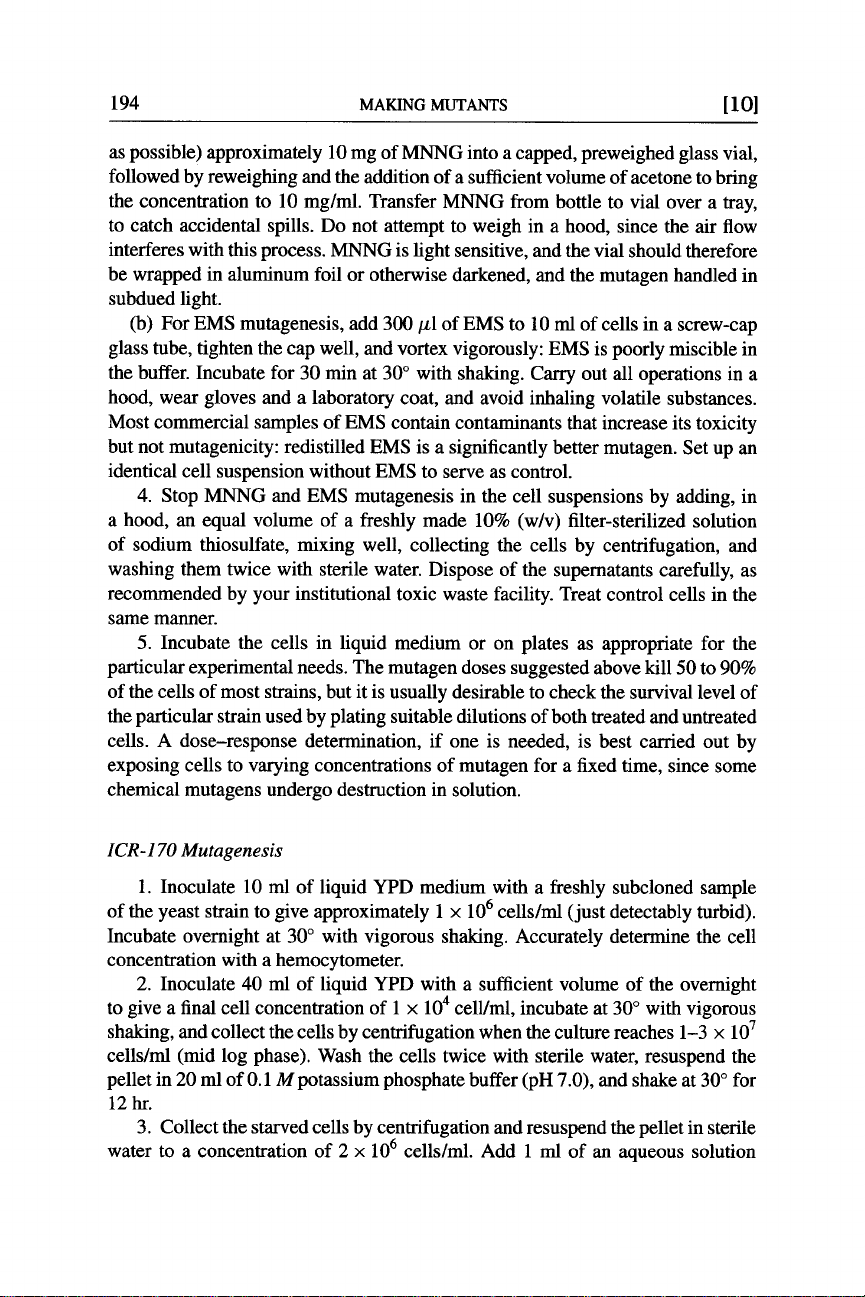
1. Inoculate 10 ml (or other appropriate volume) of liquid YPD medium with a
freshly subcloned sample of the yeast strain to give approximately 1 x 10⁶ cells/ml
(just detectably turbid). Incubate overnight at 30 ° with vigorous shaking. In the
morning, the culture should contain about 2 x 10⁸ cells/ml.
2. Wash 2.5 ml of the overnight culture twice in 50 mM potassium phosphate
buffer, pH 7.0, and resuspend in 10 ml of this buffer. Cell concentration should be
~5
x l0 7
cells/ml. Check cell concentration with a hemocytometer, and adjust if
necessary. Observation of the cells on the hemocytometer slide will also indicate
the presence of cell clumping. If sonication is needed to disperse clumped cells,
chill cell suspension in ice and sonicate for 15 sec. A second cycle of chilling
and sonication can be given, but further cycles are unlikely to be of benefit. As
mentioned above under "Choice of Strain," it is important to select a strain that
gives single-budded cells directly, with brief sonication.
3. (a) For MNNG mutagenesis, add 40 #1 of a solution of MNNG in acetone
(10 mg/ml) to 10 ml of cells in a screw-cap glass tube, tighten the cap, and mix well.
Carry out all operations in a hood, wear gloves and a laboratory coat, and avoid
inhaling volatile substances. Incubate in the tightly capped tube at 30 ° without
shaking for 60 min. Add 40 lzl of acetone without MNNG to an identical cell
suspension to serve as control and for the determination of cell survival. The
MNNG solution is made by dispensing (in a hood, with window lowered as much
194 MAKING MUTANTS [ 10]
as possible) approximately 10 mg of MNNG into a capped, preweighed glass vial,
followed by reweighing and the addition of a sufficient volume of acetone to bring
the concentration to 10 mg/ml. Transfer MNNG from bottle to vial over a tray,
to catch accidental spills. Do not attempt to weigh in a hood, since the air flow
interferes with this process. MNNG is light sensitive, and the vial should therefore
be wrapped in aluminum foil or otherwise darkened, and the mutagen handled in
subdued light.
(b) For EMS mutagenesis, add 300/zl of EMS to 10 ml of cells in a screw-cap
glass tube, tighten the cap well, and vortex vigorously: EMS is poorly miscible in
the buffer. Incubate for 30 min at 30 ° with shaking. Carry out all operations in a
hood, wear gloves and a laboratory coat, and avoid inhaling volatile substances.
Most commercial samples of EMS contain contaminants that increase its toxicity
but not mutagenicity: redistilled EMS is a significantly better mutagen. Set up an
identical cell suspension without EMS to serve as control.
4. Stop MNNG and EMS mutagenesis in the cell suspensions by adding, in
a hood, an equal volume of a freshly made 10% (w/v) filter-sterilized solution
of sodium thiosulfate, mixing well, collecting the cells by centrifugation, and
washing them twice with sterile water. Dispose of the supernatants carefully, as
recommended by your institutional toxic waste facility. Treat control cells in the
same manner.
5. Incubate the cells in liquid medium or on plates as appropriate for the
particular experimental needs. The mutagen doses suggested above kill 50 to 90%
of the cells of most strains, but it is usually desirable to check the survival level of
the particular strain used by plating suitable dilutions of both treatod and untreated
cells. A dose-response determination, if one is needed, is best carded out by
exposing cells to varying concentrations of mutagen for a fixed time, since some
chemical mutagens undergo destruction in solution.
ICR-170 Mutagenesis
1. Inoculate 10 ml of liquid YPD medium with a freshly subcloned sample
of the yeast strain to give approximately 1 x 10⁶ cells/ml (just detectably turbid).
Incubate overnight at 30 ° with vigorous shaking. Accurately determine the cell
concentration with a hemocytometer.
2. Inoculate 40 ml of liquid YPD with a sufficient volume of the overnight
to give a final cell concentration of 1 x 10⁴ cell/ml, incubate at 30 ° with vigorous
shaking, and collect the cells by centrifugation when the culture reaches 1-3 x 10⁷
cells/ml (mid log phase). Wash the cells twice with sterile water, resuspend the
pellet in 20 ml of 0.1 M potassium phosphate buffer (pH 7.0), and shake at 30 ° for
12hr.
3. Collect the starved cells by centrifugation and resuspend the pellet in sterile
water to a concentration of 2 x 10⁶ cells/ml. Add 1 ml of an aqueous solution
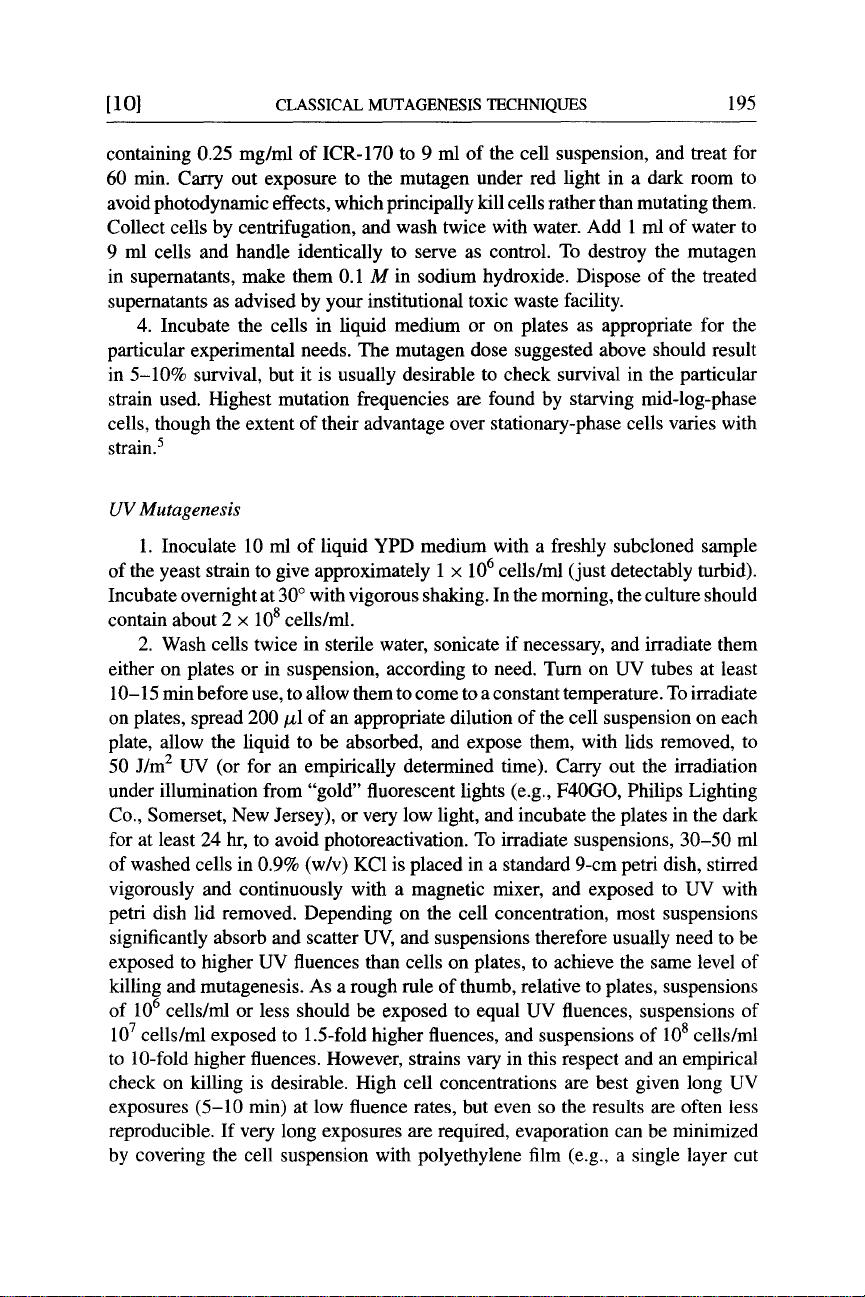
[ 10] CLASSICAL MUTAGENESIS TECHNIQUES 195
containing 0.25 mg/ml of ICR-170 to 9 ml of the cell suspension, and treat for
60 min. Carry out exposure to the mutagen under red light in a dark room to
avoid photodynamic effects, which principally kill cells rather than mutating them.
Collect cells by centrifugation, and wash twice with water. Add 1 ml of water to
9 ml cells and handle identically to serve as control. To destroy the mutagen
in supernatants, make them 0.1 M in sodium hydroxide. Dispose of the treated
supernatants as advised by your institutional toxic waste facility.
4. Incubate the cells in liquid medium or on plates as appropriate for the
particular experimental needs. The mutagen dose suggested above should result
in 5-10% survival, but it is usually desirable to check survival in the particular
strain used. Highest mutation frequencies are found by starving mid-log-phase
cells, though the extent of their advantage over stationary-phase cells varies with
strain. 5
UV Mutagenesis
1. Inoculate 10 ml of liquid YPD medium with a freshly subcloned sample
of the yeast strain to give approximately 1 × 10⁶ cells/ml (just detectably turbid).
Incubate overnight at 30 ° with vigorous shaking. In the morning, the culture should
contain about 2 × 10⁸ cells/ml.
2. Wash cells twice in sterile water, sonicate if necessary, and irradiate them
either on plates or in suspension, according to need. Turn on UV tubes at least
10-15
min before use, to allow them to come to a constant temperature. To irradiate
on plates, spread 200/zl of an appropriate dilution of the cell suspension on each
plate, allow the liquid to be absorbed, and expose them, with lids removed, to
50 J/m 2 UV (or for an empirically determined time). Carry out the irradiation
under illumination from "gold" fluorescent lights (e.g., F40GO, Philips Lighting
Co., Somerset, New Jersey), or very low light, and incubate the plates in the dark
for at least 24 hr, to avoid photoreactivation. To irradiate suspensions, 30-50 ml
of washed cells in 0.9% (w/v) KC1 is placed in a standard 9-cm petri dish, stirred
vigorously and continuously with a magnetic mixer, and exposed to UV with
petri dish lid removed. Depending on the cell concentration, most suspensions
significantly absorb and scatter UV, and suspensions therefore usually need to be
exposed to higher UV fluences than cells on plates, to achieve the same level of
killing and mutagenesis. As a rough rule of thumb, relative to plates, suspensions
of 106 cells/ml or less should be exposed to equal UV fluences, suspensions of
107 cells/ml exposed to 1.5-fold higher fluences, and suspensions of 108 cells/ml
to 10-fold higher fluences. However, strains vary in this respect and an empirical
check on killing is desirable. High cell concentrations are best given long UV
exposures (5-10 min) at low fluence rates, but even so the results are often less
reproducible. If very long exposures are required, evaporation can be minimized
by covering the cell suspension with polyethylene film (e.g., a single layer cut
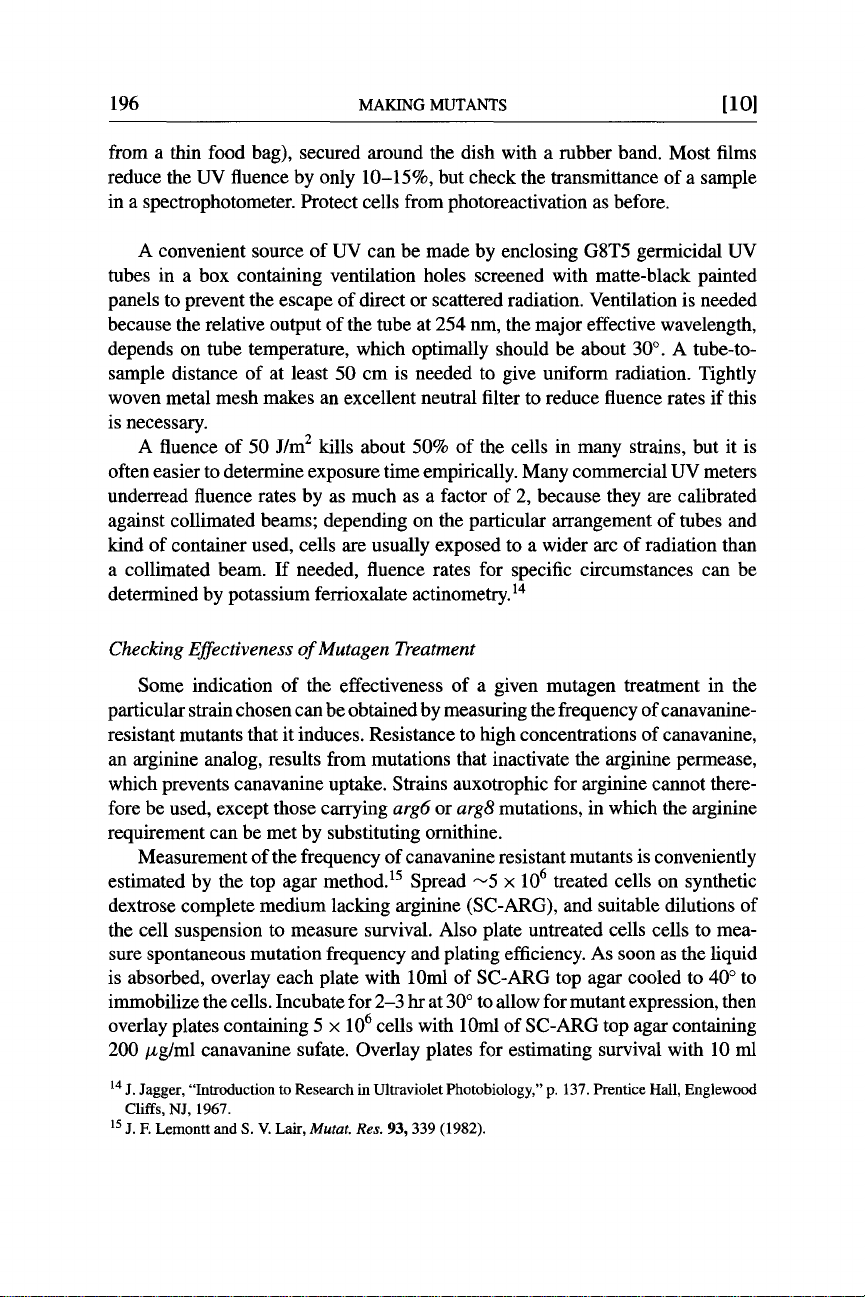
196 MAKING MUTANTS [ 101
from a thin food bag), secured around the dish with a rubber band. Most films
reduce the UV fluence by only 10-15%, but check the transmittance of a sample
in a spectrophotometer. Protect cells from photoreactivation as before.
A convenient source of UV can be made by enclosing G8T5 germicidal UV
tubes in a box containing ventilation holes screened with matte-black painted
panels to prevent the escape of direct or scattered radiation. Ventilation is needed
because the relative output of the tube at 254 nm, the major effective wavelength,
depends on tube temperature, which optimally should be about 30 °. A tube-to-
sample distance of at least 50 cm is needed to give uniform radiation. Tightly
woven metal mesh makes an excellent neutral filter to reduce fluence rates if this
is necessary.
A fluence of 50 J/m 2 kills about 50% of the cells in many strains, but it is
often easier to determine exposure time empirically. Many commercial UV meters
underread fluence rates by as much as a factor of 2, because they are calibrated
against collimated beams; depending on the particular arrangement of tubes and
kind of container used, cells are usually exposed to a wider arc of radiation than
a collimated beam. If needed, fluence rates for specific circumstances can be
determined by potassium ferrioxalate actinometry. 14
Checking Effectiveness of Mutagen Treatment
Some indication of the effectiveness of a given mutagen treatment in the
particular strain chosen can be obtained by measuring the frequency of canavanine-
resistant mutants that it induces. Resistance to high concentrations of canavanine,
an arginine analog, results from mutations that inactivate the arginine permease,
which prevents canavanine uptake. Strains auxotrophic for arginine cannot there-
fore be used, except those carrying
arg6
or
arg8
mutations, in which the arginine
requirement can be met by substituting ornithine.
Measurement of the frequency of canavanine resistant mutants is conveniently
estimated by the top agar method. 15 Spread ~"5 x 10⁶ treated cells on synthetic
dextrose complete medium lacking arginine (SC-ARG), and suitable dilutions of
the cell suspension to measure survival. Also plate untreated cells cells to mea-
sure spontaneous mutation frequency and plating efficiency. As soon as the liquid
is absorbed, overlay each plate with 10ml of SC-ARG top agar cooled to 40 ° to
immobilize the cells. Incubate for 2-3 hr at 30 ° to allow for mutant expression, then
overlay plates containing 5 × 10⁶ cells with 10ml of SC-ARG top agar containing
200/zg/ml canavanine sufate. Overlay plates for estimating survival with 10 ml
14 j. Jagger, "Introduction to Research in Ultraviolet Photobiology," p. 137. Prentice Hall, Englewood
Cliffs, NJ, 1967.
15 j. F. Lemontt and S. V. Lair,
Murat. Res.
93, 339 (1982).
[ 10] CLASSICAL MUTAGENESIS
TECHNIQUES
197
SC-ARG top agar without canavanine. Direct plating of mutagen treated cells on
SC-ARG + canavanine can kill a variable proportion of cells, because of the initial
existence of functional permease; pools of the preferentially incorporated arginine
may not always be adequate to offset canavanine toxicity. Measurement of the
induced frequency of canavanine resistant mutants in some standard strain, such as
$288C, provides a benchmark against which to determine results from other strains.
Synthetic dextrose complete medium contains, per liter, 1.67 g Difco (Detroit, MI)
yeast nitrogen base (without amino acids and ammonium sulfate), 5 g ammonium
sulfate, 20 gm dextrose, and such nutrilites as the strain requires (see below for
concentrations), solidified with 2% (plates) or 0.75% (overlay) agar.
Mutant Enrichment by Inositol Starvation
Selective killing of growing cells by starvation for inositol, and hence en-
richment of mutants unable to grow in the particular conditions used, was first
described
forNeurospora 16
and has since been developed for yeast. 12 A necessary
prerequisite is the presence of one or more
ino
mutations in the parent strain. Initial
studies 12 used an
ino1-13 ino4-8
double mutant, but a single mutant containing a
inol
deletion/disruption j7 is likely to be more convenient.
1. Mutagenize cells by one of the methods described above. Inoculate the
culture to be treated with a carefully subcloned strain: enrichment procedures
indiscriminately increase the frequency of all slow-growing cells, such as mito-
chondrial petites which can occur at high frequency in old cultures. If independent
mutations at any given locus are needed, distribute aliquots of the mutagenized
cells to different tubes before outgrowth, and carry out the procedure on each in
parallel.
2. Allow the treated cells to recover from the mutagen damage and to express
mutations by resuspending them in YPD or other appropriate medium at a concen-
tration of about 5 x 10⁵ cells/ml, grow the culture to no more than 107 cells/ml, and
collect the cells by centrifugation: it is important to harvest exponential-phase cells.
3. Wash the cells in prewarmed prestarvation medium, resuspend in this
medium at a concentration of between 1 x 10⁴ and 1 x l06 cells/ml, and incubate
for 3-4 hr under conditions that will stop the growth of the mutants for which en-
richment is desired. If histidine auxotrophs are sought, for example, prestarvation
medium is synthetic complete medium that contains inositol but not histidine. For
temperature-sensitive mutations, prestarvation medium is any complete medium
containing inositol, but the incubation is carried out at 35 °.
16 H. E. Lester and S. R. Gross,
Science
139, 572 (1959).
t7 M. Dean-Johnson and S. A. Henry,
J. Biol. Chem.
264, 1274 (1989).
198 MAKING MUTANTS [ 10l
4. Wash cells twice in prewarmed starvation medium and resuspend at a con-
centration of no more than 5 x 10⁶ cells/ml. Starvation medium is prestarvation
medium lacking inositol. Incubate for 24 hr at 35 ° to enrich for temperature-
sensitive mutants; otherwise incubate at 30 °. At 30 °, cells begin to die after 5-6 hr,
and eventually only about 0.1-1% should remain viable.
5. Plate cells on any suitable permissive medium and incubate under per-
missive conditions to obtain well-separated colonies. Rich medium containing a
nonfermentable carbon source (e.g., YPG) can be used at this stage if selection
against petites is desirable.
6. Screen surviving clones for the desired mutant.
A second cycle of enrichment can be tried, but is usually not required when cells
are mutagenized. Solid medium can be used in place of liquid for the starvation
phase of the procedure, and surviving cells recovered from these plates by velveteen
replication.12 When this is done, the plating density needs to be adjusted to account
not only for inositol-less death, but also for the fact that only about 10% cells are
transferred by velveteen.
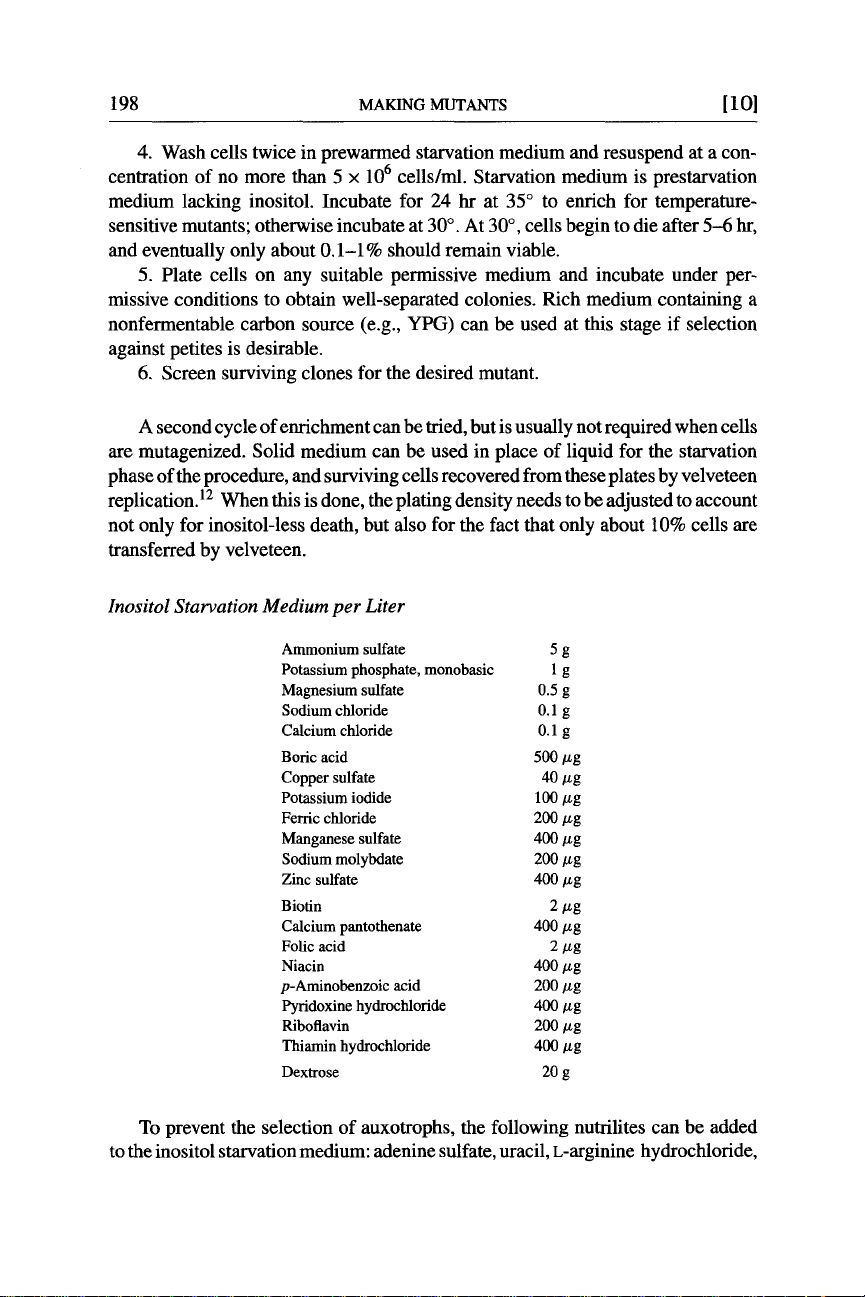
Inositol Starvation Medium per Liter
Ammonium sulfate 5 g
Potassium phosphate, monobasic 1 g
Magnesium sulfate 0.5 g
Sodium chloride 0.1 g
Calcium chloride 0.1 g
Boric acid 500/zg
Copper sulfate 40/zg
Potassium iodide 100/~g
Ferric chloride 200/zg
Manganese sulfate 400/~g
Sodium molybdate 200/zg
Zinc sulfate 400/zg
Biotin 2/zg
Calcium pantothenate 400/zg
Folic acid 2/zg
Niacin 400/zg
p-Aminobenzoic acid 200/zg
Pyridoxine hydrochloride 400/zg
Riboflavin 200/zg
Thiamin hydrochloride 400/zg
Dextrose 20 g
To prevent the selection of auxotrophs, the following nutrilites can be added
to the inositol starvation medium: adenine sulfate, uracil, L-arginine hydrochloride,
[
1 1] POINT MUTATIONS IN CLONED GENES
199
L-histidine hydrochloride, L-methionine, L-tryptophan, each at 20 mg/liter;
L-isoleucine, L-leucine, L-lysine hydrochloride, L-tyrosine, each at 30 mg/liter;
L-phenylalanine, 50 mg/liter; L-valine, 150 mg/liter; L-aspartic acid, L-glutamic
acid, each at 100 mg/liter; L-homoserine, L-threonine, each at 200 mg/liter;
L-serine, 375 mg/liter. The last five nuWilites can often be omitted from the medium,
since auxotrophs with these requirements are rare.
Synthetic prestarvation medium is inositol starvation medium plus 2000/zg of
inositol. Starvation medium can also be made using Difco vitamin-free yeast nitro-
gen base (16.9 g/liter), but this provides 1% dextrose and also histidine, methionine,
and tryptophan. YPD medium is 1% yeast extract, 2% peptone, and 2% dextrose.
YPG medium is similar, but with 2% glycerol (v/v) replacing the dextrose.
[ i i] Introduction of Point Mutations into Cloned Genes
By BRENDAN CORMACK and IRENE CASTA/~IO
Introduction
In the 10 years since the publication of Guide to Yeast Genetics and Molecular
Biology, 1 the availability of the complete yeast genomic sequence and more re-
cently of a set of haploid and diploid strains deleted for each of the yeast open
reading frames (ORFs) has dramatically affected the practice of classical yeast
genetics. Researchers are likely to choose, when possible, to use the collection of
ORF deletion strains as the default for genetic screens and selections. There are, of
course, limitations to the utility of the Saccharomyces cerevisiae deletion collec-
tion: global methods of mutagenesis will still be required for genetic analysis of
strains with backgrounds different than the type strains used for the S. cerevisiae
knockout project 2,3 (see chapters 12 and 13). Equally, the genetic analysis of es-
sential genes still relies largely on the generation of point mutations in those genes
(for an alternative approach, exploiting repressible promoters and ubiquitin desta-
bilization of the gene product, see a recent review by Varshavsky. 5 This chapter
first discusses briefly the principle of the plasmid shuffle technique which is critical
to the generation and analysis of point mutants in essential genes. Second, two ap-
proaches to in vitro generalized mutagenesis of cloned yeast genes are discussed.
I C. Guthrie and G. R. Fink (eds.),
Methods Enzymol,
194 (1991).
2N. Backman, M. Biery, J. D. Boeke, and N. L. Craig,
Methods EnzymoL
350, [13], 2002 (this
volume).
3 A. Kumar, S. Vidam, and M. Snyder,
Methods EnzymoL
350, [12], 2002 (this volume).
4 Deleted in proof.
5 A. Varshavsky,
Methods Enzymol.
327, 578 (2000).
Copyright 2002, Elsevier Science (USAI.
All rights reserved.
METHODS IN ENZYMOLOGY, VOL. 350 0076-6879/02 $35.00