TOPIC: COSMETICS môn Kinh tế vi mô | Trường Đại học Kinh tế Quốc dân
"The beauty industry is more than just skin deep.” This statement holds as thecosmetics market encompasses a wide array of elements beyond mere financial gains. It encapsulates notions of personal care.Tài liệu giúp bạn tham khảo, ôn tập và đạt kết quả cao. Mời đọc đón xem!
Môn: Kinh tế vi mô ( NEU ) 771 tài liệu
Trường: Trường Đại học Kinh Tế Quốc Dân 8.3 K tài liệu
Tác giả:









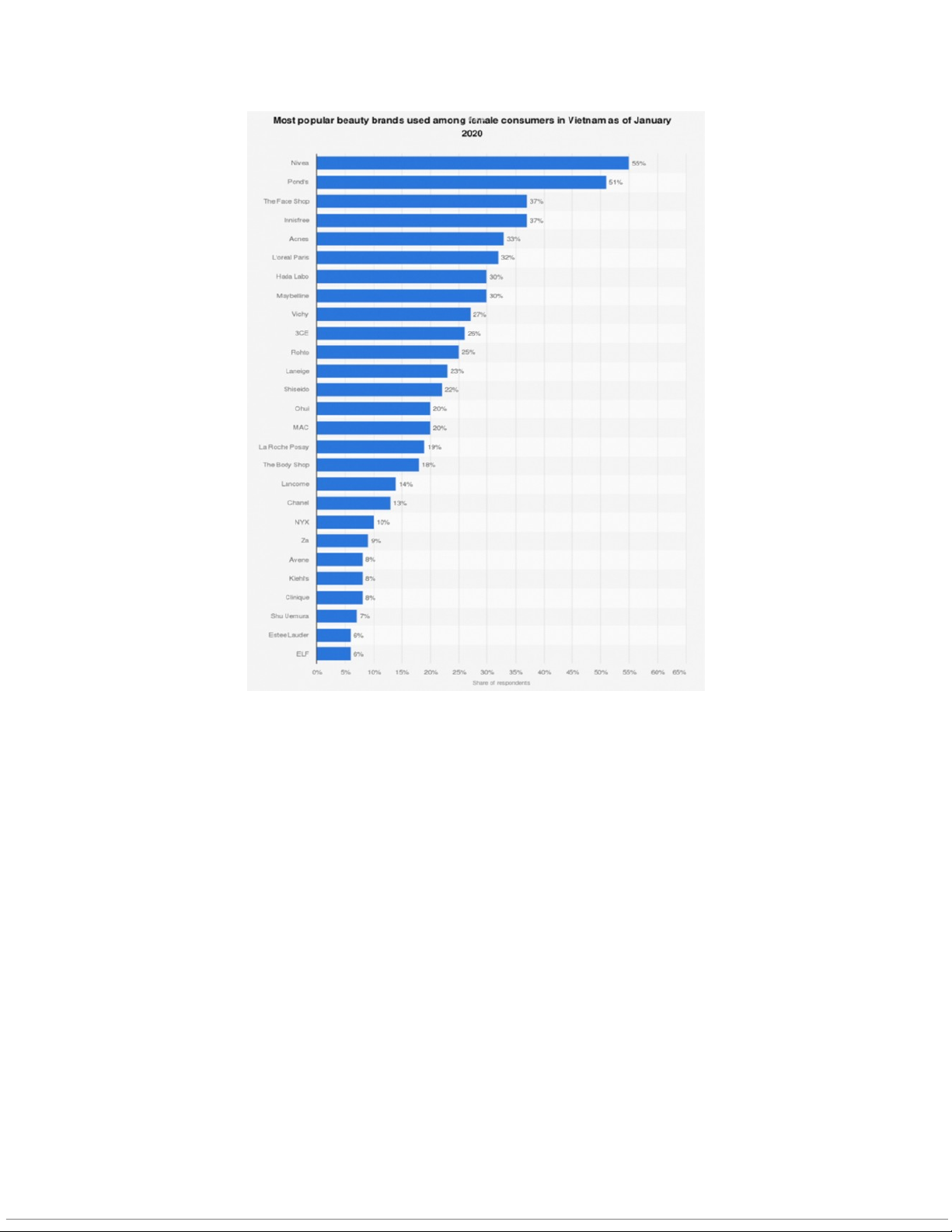








Preview text:
NATIONAL ECONOMICS UNIVERSITY BUSINESS SCHOOL MICROECONOMICS TOPIC: COSMETICS Lecture : TS. Tran Thi Hong Viet Subject : Microeconomics Class : E-BDB 4 Group : 9 Do Thi Ngoc Anh - 11220717 Do Thi Khanh Linh - 11223391 Ta Bich Ngoc - 11224765 Vu Hong Nhi - 11224989 Duong Thu Phuong - 11225191 Pham Minh Phuong - 11225295 Ha Noi, June 2023 Table of Contents
A. INTRODUCTION...........................................................................................2
B. BODY SECTION..........................................................................................3
I. Development history of the cosmetics industry in VietNam.........................3
1. Early Years (Pre-1990s)...............................................................................3
2. Liberalization and Expansion (1990s-2000s).............................................3
3. Modernization and International Integration (2010s-2019).....................4
4. Technological Advancements and Shifts in Consumer Behavior (2020s-
present)..............................................................................................................4
II. The nature of cosmetics..................................................................................5
III. Factors affecting the supply of cosmetic industry in Vietnam..................6
1. Cost of material.............................................................................................6
2. Technological advancements.......................................................................7
3. Government regulation and trade policies.................................................7
4. Industry competition has a significant impact on the supply of
cosmetics............................................................................................................9
IV. Factors affecting the demand for the cosmetic industry in Vietnam......10
1. Disposable income.......................................................................................10
2. Consumer preferences................................................................................11
3. Marketing and advertising........................................................................12
4. Culture and social norms:..........................................................................13
5. Seasonal and special occasions:.................................................................13
C. CONCLUSION..............................................................................................14
D. REFERENCES.................................................................................................15 1 A. INTRODUCTION
"The beauty industry is more than just skin deep.” This statement holds as the
cosmetics market encompasses a wide array of elements beyond mere financial
gains. It encapsulates notions of personal care, self-expression, and evolving
beauty standards. Analyzing the cosmetics market requires delving into its intricate
compositions and evaluating the industry based on multifaceted aspects. Cosmetics
form a thriving market that has witnessed significant transformations throughout
history, shaping a dynamic and ever-evolving industry. So, cosmetics are an
example of a typical market, very popular in society - monopolies. Understanding
the nature of the cosmetics market is crucial for gaining insights into how it
operates and influences the broader societal landscape.
In this project, we will delve into an in-depth analysis of the cosmetics market to
discern whether it aligns more closely with perfect competition or tends towards
monopolistic characteristics. Furthermore, we will explore the various factors that
impact this market's supply and demand dynamics over the years. By examining
these aspects, we aim to provide readers with a comprehensive understanding of
the cosmetics market's functioning, shedding light on its complex interplay of
market forces and consumer behavior. Through this analysis, we hope to uncover
the intricate nature of the cosmetics market, unveiling the driving forces behind its
growth and exploring the unique challenges and opportunities it presents. By doing
so, readers can gain valuable insights into this vibrant industry and appreciate the
multifaceted dimensions that shape the world of cosmetics. B. BODY SECTION
I. Development history of the cosmetics industry in Vietnam 1. Early Years (Pre-1990s)
The development of the cosmetic industry in Vietnam during the early years,
before the 1990s, was influenced by various factors and witnessed the entry of both
Vietnamese and foreign brands into the market. In the 1960s, Vietnam's cosmetic
market started to take shape, albeit slowly. Foreign brands like Avon, Pond's, and
Revlon made their way into the Vietnamese market, offering a range of beauty and
personal care products to consumers. These international brands introduced new
concepts and trends in skincare and cosmetics, providing Vietnamese consumers
with more options. On the local front, brands such as Da Lan and Nam Huong 2
emerged as pioneers in the Vietnamese cosmetic industry. Da Lan, established in
1948, focused on producing perfumes, soaps, and skincare products, while Nam
Huong, founded in 1963, specialized in creating beauty and personal care items.
Despite limited availability and a developing market, these early Vietnamese and
foreign brands laid the groundwork for the future growth and transformation of the cosmetic industry in Vietnam.
2. Liberalization and Expansion (1990s-2000s)
The liberalization and expansion of the cosmetic industry in Vietnam during the
1990s and 2000s witnessed significant growth and diversification, fueled by
economic reforms and increased foreign investment. The market value of the
cosmetic industry in Vietnam reached approximately $2.35 billion in 2000, a
significant increase from just $52 million in 1990. This rapid growth attracted the
attention of foreign brands, leading to a surge in their presence in the Vietnamese
market. For instance, L'Oréal, a leading global cosmetics company, established its
presence in Vietnam in 2003 and experienced substantial success. Another major
player, Estée Lauder, expanded its operations in Vietnam in 2006, introducing
popular brands like Clinique and MAC. On the local front, Saigon Cosmetics
Corporation (SCC) experienced remarkable growth, with an annual revenue of
over $150 million in the 2000s. Lan Hao, known for its natural and organic
skincare products, gained popularity and captured a significant market share. The
liberalization and expansion of the cosmetic industry during this period not only
brought a wider variety of products to Vietnamese consumers but also contributed
to the growth of the economy and the emergence of a competitive market.
3. Modernization and International Integration (2010s- 2019)
The modernization and international integration of the cosmetic industry in
Vietnam from the 2010s to 2019 marked a period of significant growth and
transformation. With the country's integration into the global economy and an
increasing middle-class population, the cosmetic market experienced a remarkable
expansion. The market value of the cosmetic industry in Vietnam reached
approximately $2.35 billion in 2019, a substantial increase from around $1.7
billion in 2010. This growth attracted both Vietnamese and foreign brands to enter
the Vietnamese market. International cosmetic giants such as L'Oréal, Estée
Lauder, and Shiseido expanded their presence, offering a wide range of high-
quality beauty products to Vietnamese consumers. Moreover, local Vietnamese
brands emerged and gained popularity during this period. Brands like Scentuals, 3
Gia Dinh, and Romano, to name a few, became recognized names in the domestic
market. The modernization and international integration of the cosmetic industry in
Vietnam during this period not only led to increased consumer choices but also
contributed significantly to the economy and the country's reputation as a rising
beauty market in Southeast Asia.
4. Technological Advancements and Shifts in Consumer Behavior (2020s-present)
The cosmetic industry in Vietnam has witnessed a rapid evolution in the 2020s,
driven by technological advancements and shifts in consumer behavior. With the
widespread adoption of internet usage and the rise of e-commerce platforms,
online shopping for cosmetics has gained immense popularity among Vietnamese
consumers. The e-commerce market for cosmetics in Vietnam reached a value of
approximately $1.2 billion in 2021, indicating a significant increase from previous
years. This shift in consumer behavior has encouraged both Vietnamese and
foreign brands to focus on digital marketing strategies and enhance their online
presence. International brands such as Sephora, Innisfree, and The Face Shop
expanded their footprint in Vietnam, capitalizing on the growing demand for
beauty and skincare products. Additionally, local Vietnamese brands like Sữa Non,
M.O.I Cosmetics, and Skin1004 have emerged, catering to the rising preference for
natural and organic products. The convergence of technological advancements and
evolving consumer behavior has led to a dynamic and competitive cosmetic
industry in Vietnam, offering a wide range of products and shopping experiences
to meet the diverse needs of Vietnamese consumers. II. The nature of cosmetics.
The available data shows that cosmetics are closer to the monopolistic competition
market, which is very common among many types of goods today.
It can be seen that the cosmetic market classification is based on different
classification criteria, namely: a. Number of sellers:
In the cosmetic industry, many sellers are offering differentiated products,
allowing each firm to have some control over its pricing and marketing
strategies. There are plenty of cosmetic brands, for example, L’Oreal,
Lancome, and Estee Lauder as high-end brands, or some small local brands
in Vietnam such as Cocoon, Thai Duong, and Vedette. 4 b. Differentiated products:
There is a wide variety of products available from numerous brands. Each
brand strives to differentiate its products through various means, such as
formulation, packaging, branding, and marketing. This product
differentiation creates a perceived uniqueness and brand identity for each
company, giving them some degree of market power.
c. Close substitutes available:
The cosmetic industry offers a wide range of close substitutes, providing
consumers with various options to meet their beauty and personal care
needs. Within the industry, numerous brands offer similar products that
serve similar purposes, such as moisturizers, cleansers, foundations,
mascaras, and lipsticks. For example, there are multiple brands offering
moisturizers with different formulations and ingredients, allowing
consumers to choose based on their specific preferences and skin type.
Additionally, the industry offers alternatives in terms of price range, from
high-end luxury brands to more affordable options. These close substitutes
give consumers the flexibility to select products that align with their
preferences, budget, and desired outcomes.
d. Relatively free entry and exit:
New firms can enter the market without major regulatory barriers, thanks to
available manufacturing partnerships. However, competition and the need
for brand recognition should be considered. Exiting the market is also
relatively simple for businesses facing challenges. Overall, the industry's
flexibility enables companies to adapt and make strategic decisions based on market conditions.
e. Non-price competition in the form of advertising and product innovation:
Non-price competition in the cosmetic industry takes the form of advertising
and product innovation. Companies invest in advertising to create brand
awareness, while also continuously developing new formulations and
technologies to differentiate their products. These strategies help them stand
out and succeed in the competitive market.
III. Factors affecting the supply of cosmetic industry in Vietnam 1. Cost of material. 5
For businesses, the cost of input factors is of utmost importance as it plays a
decisive role in market prices and profits, directly impacting their overall situation.
When the price of input factors used in cosmetics production increases, it results in
higher production costs. Consequently, businesses may be compelled to raise the
selling price of cosmetics, thereby reducing their profit margins. Reflecting on the
market, astute businesses will proactively seek ways to mitigate the impact of
rising material costs by implementing strategies to reduce input expenses. By
finding cost-effective alternatives or optimizing their procurement processes,
businesses can lower their cosmetics production costs, allowing for more
competitive selling prices, which can attract a larger pool of potential customers
and ultimately drive profits to increase steadily.
The cosmetics market in Vietnam is experiencing significant growth due to the
increasing presence of cosmetic brands that offer high-quality products at
affordable prices to meet the demand for affordable purchases among Vietnamese
consumers. Domestic cosmetic brands have recently chosen to use natural,
environmentally-friendly ingredients that are familiar to Vietnamese customers in
their production processes. This has resulted in reasonable raw material costs and reduced production expenses.
One notable example is the brand Cocoon, which is at the forefront of the vegan
cosmetics trend in Vietnam and embraces the "green cosmetics" wave with a
meaningful humanitarian message. Cocoon carefully selects gentle and familiar
ingredients for Vietnamese consumers, such as coffee, coconut, cocoa, rose,
pennywort, and winter melon. These ingredients are directly sourced from
agricultural factories and undergo strict scrutiny before being used in production.
By choosing a nature-friendly approach, Cocoon utilizes the diverse and abundant
plant resources that Mother Nature has generously bestowed upon Vietnam. This
not only supports domestic agriculture but also improves the livelihoods of farmers
while providing a low-cost source of raw materials, thereby reducing production costs.
2. Technological advancements5
The production technology employed in any industry has a significant impact on
productivity and labor costs, including the cosmetics sector. A well-established
production system that achieves high economic efficiency minimizes raw material
usage, and meets industry standards enables enterprises to produce high-quality
cosmetics. This, in turn, enhances their competitiveness and attracts a larger 6
consumer base. And conversely, companies that adhere to outdated production
practices, lack creativity and innovation, and fail to leverage technological
advancements, will struggle to thrive in the current Vietnamese cosmetics market.
Vietnam has made significant strides in the cosmetics manufacturing industry. No
longer relying on manual production methods as in the early days, Vietnamese
cosmetics brands, such as Candid, have embraced advanced technology to produce
products with effective skincare ingredients, minimizing irritation, and reasonable
prices that foreign cosmetics brands find challenging to achieve.
3. Government regulation and trade policies5
Government regulations play a crucial role in shaping the supply of cosmetics by
ensuring product safety, quality, and accurate information for consumers.
Compliance with these regulations may require adjustments in manufacturing
processes, ingredient usage, labeling, and registration procedures, which can
impact the availability, cost, and innovation of cosmetic products in the market.
Trade policies have a substantial influence on the supply of cosmetics through the
imposition of tariffs, import restrictions, non-tariff barriers, intellectual property
rights protection, trade agreements, and regulations related to market access and
distribution channels. Understanding and navigating these trade policies are crucial
for cosmetic manufacturers and distributors to ensure a smooth supply chain and
access to global markets. Besides, cosmetic businesses can adapt to changing trade
dynamics, maintain competitiveness, and meet the demands of consumers worldwide.
Currently, the government has implemented specific measures to address two
major issues in the cosmetics industry in Vietnam, including the widespread
presence of counterfeit and untraceable products, and the preference of consumers
for foreign cosmetics due to the lack of diversity and breakthrough quality in
domestic brands, mainly because of the lack of strict regulations from the previous
government. According to statistics from the US Department of Commerce,
approximately 93% of personal care products consumed in Vietnam are imported,
with a total import value of around $950 million in 2019. 7
Thanks to increasingly specific and stringent legal frameworks established by the
government to comprehensively address these major issues, including policies
against smuggling, counterfeiting, and trade fraud from the government (March
2020); market development and technological innovation policies, as well as
reduced import taxes on raw materials and the implementation of measures to
promote the development of supporting industries (June 2021), the Vietnamese
cosmetics industry has entered a new phase. Brands' products now meet consistent
quality standards, and notable examples include domestic cosmetic brands such as
Cocoon, Zakka, Candid, and Co Mem HomeLad, which have regained consumer trust.
In summary, Vietnam's directions and preferential policies have contributed to the
development of the domestic cosmetics industry, creating a potential market and
attracting investment and expansion. These incentives have provided favorable
conditions for domestic cosmetics manufacturers. 8
4. Industry competition has a significant impact on the supply of cosmetics.5
Industry Competition: Competition within the cosmetics industry can drive
innovation, product quality, and pricing strategies, which in turn affect the supply of cosmetics. Here's how: a. Innovation:
Competing companies strive to differentiate themselves by introducing innovative
products, formulations, or packaging. To stay ahead, cosmetic companies invest in
research and development, leading to the creation of new products that meet
evolving consumer needs. This constant drive for innovation influences the supply
of cosmetics by introducing new options to the market. b. Quality:
With multiple companies vying for market share, maintaining high product quality
becomes crucial. Consumers have higher expectations, and companies must ensure
that their cosmetics meet or exceed these expectations. This emphasis on quality
impacts the supply of cosmetics by ensuring that products available to consumers
are reliable, safe, and effective. c. Pricing:
The competition also affects pricing strategies. Companies may engage in price
wars or offer competitive pricing to attract customers. The supply of cosmetics
may be influenced as companies adjust their production volumes, profit margins,
or promotional activities to remain competitive in the market.
IV. Factors affecting the demand for the cosmetic industry in Vietnam 1. Disposable income
Disposable income refers to the amount of money individuals have available to
spend or save after deducting taxes and other necessary expenses.
a. Purchasing Power: Higher disposable income levels generally result in increased
purchasing power for consumers. When people have more money available, they
are more likely to allocate a portion of it toward discretionary items like cosmetics.
As disposable income increases, consumers may be more willing to spend on
premium or luxury cosmetics, leading to overall higher demand for such products. 9
b. Affordability and Accessibility: Disposable income affects the affordability and
accessibility of cosmetics. Lower disposable income levels may limit consumers'
ability to afford expensive or high-end cosmetic products. In contrast, higher
disposable income allows individuals to allocate a larger budget to purchasing
cosmetics, expanding their choices and potentially increasing demand for a wider range of products.
c. Consumer Behavior: Disposable income also influences consumer behavior and
purchasing habits. When disposable income is limited, consumers may prioritize
essential goods and services over discretionary purchases like cosmetics.
Conversely, when disposable income is higher, consumers may be more inclined to
indulge in beauty and self-care products, driving the demand for cosmetics.
d. Brand Preferences: Disposable income can impact brand preferences within the
cosmetics market. Consumers with higher disposable income may be more willing
to invest in well-known or prestige brands, as they perceive these products to be of
higher quality or status. Consequently, luxury cosmetic brands often target
consumers with greater disposable income, capitalizing on their willingness to spend on premium products.
e. Market Segmentation: Disposable income variations across different
demographic groups can lead to market segmentation in the cosmetics industry.
Consumers with lower disposable income may gravitate towards more affordable
or budget-friendly cosmetic options, while those with higher disposable income
may seek out premium or niche products. This segmentation prompts companies to
tailor their product offerings and pricing strategies to cater to the specific needs
and budgets of different consumer segments. 2. Consumer preferences
Consumer preferences play a crucial role in shaping the demand for cosmetics.
Here's how they affect the market:
a. Product Features: Consumers' preferences for specific product features, such as
organic or natural ingredients, cruelty-free formulations, or specific skincare
benefits, influence their choices when purchasing cosmetics. Companies that align
their product offerings with these preferences are likely to experience increased demand. 10
b. Brand Reputation: Consumers often develop preferences for certain cosmetic
brands based on their reputation, image, or perceived quality. Positive brand
associations, such as trustworthiness, sustainability, or inclusivity, can attract
consumers and drive demand for cosmetics from those specific brands.
c. Packaging and Presentation: Aesthetics and packaging design can significantly
impact consumer preferences. Unique and visually appealing packaging,
innovative dispenser systems, or travel-friendly designs can attract consumer
attention and influence purchasing decisions, thereby affecting the demand for cosmetics.
d. Trends: Consumer trends play a significant role in shaping the demand for
cosmetics. These trends may arise from cultural shifts, beauty influencers, social
media, or emerging lifestyle choices. Some examples include:
e. Clean Beauty: The growing preference for clean beauty, which focuses on
products formulated with non-toxic and environmentally friendly ingredients, has
led to increased demand for natural and organic cosmetics.
f. Inclusivity: Consumers are increasingly seeking cosmetic brands that celebrate
and cater to diverse skin tones, body types, and gender identities. Brands that
embrace inclusivity in their product range and marketing campaigns can attract a
broader consumer base and drive demand.
g. Sustainability: The rising awareness of environmental issues has fueled the
demand for sustainable and eco-friendly cosmetics. Consumers are more likely to
choose products with recyclable packaging, refillable options, or those
manufactured using sustainable sourcing and production methods.
h. Demographics: Demographic factors, such as age, gender, income level, and
cultural background, also influence the demand for cosmetics. Here's how demographics play a role:
i. Age: Different age groups have distinct cosmetic preferences and needs. For
example, younger consumers may be more interested in makeup trends, while
older demographics may focus more on skincare and anti-aging products. Cosmetic
companies often tailor their product lines to cater to the specific demands of different age segments. 11
k. Gender: Traditionally, cosmetics were primarily marketed towards women, but
there is a growing demand for cosmetics among men. The rise of male grooming
and the expansion of gender-neutral or gender-inclusive beauty products have
influenced the demand for cosmetics among diverse gender identities. 3. Marketing and advertising
Marketing and advertising play a significant role in the cosmetics industry. They
not only help to create brand awareness but also influence consumer behavior in
terms of purchasing decisions. Below are some of the impacts of marketing and advertising on cosmetics:
Brand Recognition: Marketing and advertising help to create brand recognition.
With so many cosmetic brands available in the market, consumers need a way to
differentiate between them. Marketing helps to create a brand image that
consumers can relate to and remember.
Increased Sales: Advertising is a crucial driver of sales in the cosmetics industry. It
helps to promote new products, offers, and deals and encourages consumers to try
them out. Effective advertising campaigns can lead to significant increases in sales,
which is essential for the growth and success of a cosmetic brand.
Consumer Loyalty: Through marketing and advertising, cosmetic brands can create
an emotional connection with their customers. By communicating the values and
vision of the brand, they can build trust and loyalty. This is important for repeat
business and positive word-of-mouth referrals.
Influence on Consumer Behavior: Marketing and advertising can influence
consumer behavior, especially regarding product choices. By highlighting their
products' unique features and benefits, cosmetic brands can encourage consumers to make a purchase.
Competition: Marketing and advertising can also help to create healthy
competition within the cosmetics industry. By promoting their products, brands
can showcase their unique selling points and stand out from their competitors. 4. Culture and social norms: 12
Culture and social norms have a significant impact on cosmetics. Different cultures
have different beauty standards and preferences, which influence the type of
cosmetics used and the way they are applied.
For example, in some cultures, fair skin is considered more beautiful than dark
skin, so people may use skin-lightening products. In contrast, in some other
cultures, tanned or bronzed skin is preferred, which leads to the use of self-tanning
products. Moreover, in some areas, such as mountainous areas, people don’t use
cosmetics products. Therefore, the demand for them is lower than in other areas.
Social norms also play a role in the use of cosmetics. For instance, in some
societies, it is considered inappropriate or even frowned upon for men to wear
makeup, while in others, it is accepted and even considered fashionable. Similarly,
some cultures place more emphasis on natural beauty and minimal makeup, while
others encourage bold and dramatic looks.
Furthermore, cultural and social norms can also influence the ingredients and
formulations used in cosmetics. For example, some cultures value natural and
organic ingredients, while others prioritize high-tech and scientific formulations.
In conclusion, the impact of culture and social norms on cosmetics is considerable.
The beauty standards and preferences of different cultures and societies influence
the types of cosmetics used, the way they are applied, and even the ingredients and
formulations used in cosmetic products.
5. Seasonal and special occasions
Seasonal and special occasions have an important impact on the cosmetics
industry. The demand for cosmetics tends to increase during certain seasons and
special occasions such as weddings, proms, and holidays.
During the summer months, people tend to use more sunscreen, lightweight
moisturizers, and oil-free products to protect their skin from the sun and prevent
breakouts due to sweat and heat. On the other hand, during the winter months,
people tend to use heavier moisturizers and hydrating products to combat dryness
caused by cold weather and indoor heating.
Special occasions such as weddings, proms, and other formal events also have an
impact on the cosmetics industry. During these occasions, people tend to use more
long-lasting and waterproof makeup products to ensure that their makeup stays in 13
place throughout the event. Additionally, people may choose to use bold and
dramatic makeup looks to make a statement and complement their outfits.
Holidays such as Christmas, Valentine's Day, and Halloween also have an impact
on the cosmetics industry. During these holidays, people tend to use themed
makeup products such as red lipstick for Valentine's Day or spooky makeup for Halloween.
Overall, seasonal and special occasions play a crucial role in driving the demand
for cosmetics. Companies in the cosmetics industry often release seasonal
collections and limited edition products to meet the needs and preferences of consumers during these times. C. CONCLUSION
The cosmetics market in Vietnam is a large and long-standing market, so analyzing
this market helps us better understand how the market works and the factors that
affect the supply and demand of a market. Cosmetics products are also associated
with the development of Vietnam, a product that is very popular with Vietnamese
people, so there have been notable changes in recent years.
By analyzing the salient features of the cosmetics market in Vietnam, we can
determine that this is an oligopolistic market type - a market type that is very
popular in the era of the industrial revolution 4.0. Along with that, this project
relies on available data to analyze the factors that affect the supply and demand of
this market. It can be seen that this is a market with all the common fluctuations of
a market such as government policy, price expectations, or buyer preferences.
Therefore, this market analysis helps us gain a clearer view of how a market
works, from which there are methods to optimize revenue for businesses or
optimize the development of the market for the state.
The cosmetics market in Vietnam in recent years has generally grown
significantly. From there we can use this project to analyze similar markets in the
future to find the aspects that need attention to continue to grow the business better with future market changes. 14 D. REFERENCES
1. Jun 1, 2023. Revenue of the cosmetics market in Vietnam from 2014 to 2027. Statista Research Department
https://www.statista.com/forecasts/1259320/vietnam-revenue-cosmetics- market?
fbclid=IwAR2LdrGFU506tzuV2yCjduXl3KNntQboAtBeRReGkDzt2wa4KUu 2H_aT2_s
2. Celina Pham (2022). Vietnam’s Emerging Cosmetics Industry: Strong Potential
for Growing Market. Vietnam Briefing.
https://www.vietnam-briefing.com/news/vietnams-emerging-cosmetics-
industry-strong-potential-growing-market.html/
3. Raju K , Roshan D (2020) . Vietnam Skin Care Products Market. Allied Market Research
https://www.alliedmarketresearch.com/vietnam-skin-care-products-market- A06729
4. 2023. Beauty & Personal Care - Vietnam Statista Research Department
https://www.statista.com/outlook/cmo/beauty-personal-care/vietnam
5. 2019. A Dynamic Cosmetics Market In Vietnam. B-company
https://b-company.jp/cosmetic-en/
6. 2023. Young But Not Broke: Vietnam cosmetics industry. Indochina Logistics Expert
https://vico.com.hk/resource/news/young-but-not-broke-vietnam-cosmetics- industry 15
Tài liệu liên quan:
-
Bài tập trắc nghiệm Kinh tế vi mô (có đáp án) | Trường Đại học Kinh Tế Quốc Dân
19 10 -
Bài tập Kinh tế vi mô chọn lọc | Trường Đại học Kinh Tế Quốc Dân
28 14 -

Bài tập chương 4 môn Kinh tế vĩ mô | Trường Đại học Kinh tế Quốc dân
29 15 -
Kinh Tế Vi Mô: Ceteris Paribus và Ảnh Hưởng Đến Nhu Cầu
24 12 -

Chương 6: Tác Động Chính Sách Đến Thị Trường - Đúng/Sai và Lựa Chọn môn Kinh tế vi mô | Trường Đại học Kinh tế Quốc dân
25 13