Repertoire Choices for Teaching Intermediate-Level Piano Students, with Practice Suggestionsand Exercises, Based on Five Pillars of Musicianship | Tài liệu Tiếng Anh
Repertoire Choices for Teaching Intermediate-Level Piano Students, with Practice Suggestionsand Exercises, Based on Five Pillars of Musicianship | Tài liệu Tiếng Anh . Tài liệu giúp bạn tham khảo, ôn tập và đạt kết quả cao. Mời đọc đón xem!
Môn: Tiếng Anh chuyên ngành 332 tài liệu
Trường: Tài liệu Tiếng Anh chuyên ngành, Tiếng Anh cho người đi làm 432 tài liệu
Tác giả:

















Preview text:
Repertoire Choices for Teaching Intermediate-Level Piano Students, with Practice Suggestions
and Exercises, Based on Five Pillars of Musicianship Yimo Zhang AGLVVHUWDWLRQ
submitted in partial fulfillment of the
requirements for the degree of Doctor of Musical Arts University of Washington 2020 5HDGLQJCommittee: Robin McCabe, Chair Jonathan Bernard Craig Sheppard
Program Authorized to Offer Degree: Music ©Copyright 2020 Yimo Zhang University of Washington Abstract
Repertoire Choices for Teaching Intermediate-Level Piano Students, with Practice Suggestions and
Exercises, Based on Five Pillars of Musicianship Yimo Zhang
Chair of Supervisory Committee: Dr. Robin McCabe Music
This document is to form a practical tool for the development of piano students in general during
their early years of piano learning. My research seeks to develop the argument that piano
performance training should not be the same as training for athletes. Although the two have many
similarities in terms of the physiology of hand and body movement, and building up stamina for a
performance, an important goal of the pianist is to acquire a variety of skills to create differences
in touch. The ultimate goal of acquiring techniques and skil s in piano playing is to apply them to
repertoire and to bring the musical score to life. This thesis seeks to identify pieces that are
available for teaching piano students in the early years of learning, but are overlooked in the field.
Each piece has certain areas of pianistic/musical goals to address, and some provide creative
exercises based on principles of piano playing designed to overcome certain challenges. The
organization of the document is based on the development of selected pillars in musicianship. Table of Contents
Acknowledgment………………………………………………………………………..iii
Preface……………………………………………………………………………………iv
Chapter One: the Fundamentals of Piano Playing
I. Introduction………………………………………………………………… 1
II. Score with comments
1. Stable five-finger position in Single notes, with change by stepwise motion (p.6)—
2.Slight expansion from five-finger position with small wrist circles (p.10)—3. L.H.
changing position while R.H. has thumb crossing (p.13)— 4. Alternation between double
versus single notes, using rotation (p.17)—5. Hands gradually open plus rotation (p.21)—6.
One hand two voices: melody plus accompaniment, using slight rotation or rebalance of
weight on the melodic notes (p.24)—7. Unusual meter, chords and clusters, hand
coordination, 16th notes and leaps with close and open hands. (p.27)—8. Longer-passage
pieces with changing and leaping away from a fixed position (p.37)—9. More complicated L.H. octave leaps (p.38)
Chapter Two: Rhythmic Realization and Internalization
I. Introduction…………………………………………………………………….....43
Duration and importance of counting (p.44)— General practice suggestions to form basic
beats and to train hand independence (p.45)— A brief discussion on conscious versus
unconscious practicing (p.45)—Memorization of rhythmic patterns—(p.46)
II. Scores with Comments 47
1.Duple Dance features repeated notes, in lively tempo (p.47)—2.Triple versus
Duple Rhythm (p.52)— 3.Dotted Rhythm in Various Settings (p.57)— 4.Pick up and Off
beat in Various Meters (p.61)— 5. Polish Folk Dances (p.73)
Chapter Three: Articulation and Phrasing
I. Introduction………………………………………………………………………78
II. Score with Comments
Legato (p.80)— 1. Vocal imitation, small slurs, canon in conversation (p.82)—
Small Slur (Two-notes slur) (p.85)— 2. Pattern recognition for groups of six and eight
notes, two note slurs, legato playing (p.89)— 3. Staccato in Single notes, repeated notes,
sixteenth notes, double notes and chords (p.94)— 4. Lyrical music in longer phrases with
legato playing (p.101)— 5.Combination of various articulations (p.105)— 6. Integration of various articulations (p.110) i
Chapter Four: Harmonic Awareness
I. Introduction…………………………………………………………… 120
II. Score with Comments 122
1. Different types of accompaniment figures and key centers (p.122)—2. Musical tension
versus resolution (p.130)— 3. Cadences (p.140)— 4.Intervallic relationship (p.146)— 5.
use of harmony to determine the direction of the phrase or the character of the piece (p. 148)
Chapter Five: Artistic Imagery
I. Introduction……………………………………………………………………152
II. Score with Comments 154
1. What is the mood of this music? (p. 154)—2. What sound quality does the music convey?
(p. 158)—3. What motive or theme does this music consist of? (p. 162)— 4.What Character
or story is the music depicting? (p. 177)
Conclusion………………………………………………………………………… 193
Bibliography………………………………………………………………… 194
Index: Composers and List of Compositions 197 ii Acknowledgments
I would like to give my heartfelt gratitude to the fol owing people, who have believed in me and
inspired me throughout my journey in music:
Dr. Robin McCabe, Dr. George Bozarth, Dr. Tamás Ungár, Dr. Paul Schoenfeld,
Eugene and Elisabeth Pridonoff, Dr. James Helton, Prof. Qifang Li.
Thank you, my dear friends and mentors: Karen, Maria,Hannah, Li-Cheng, Colleen, Steven,
Laure, Van, Penny, Akina, Nozomi, Shaofen Chen, Reggie Tsang, Dr. Mike Matesky,
Hope and Leo Robinsons, Anna, Nancy, Angelo, Lorenzo, Kristen, Dave and Anna Hibbard.
Thank you for helping me with the editing of my thesis: Brian Watson and Dorothy Jones, Dr.
Jonathan Bernard, Trevor and Elaine Tsang.
Thank you, Dr. Carolyn True, for your generosity with your time to give me a chance to
interview you about your editions and ask questions about teaching in general.
Thank you to my committee for helping me reviewing my thesis: Dr. Jonathan Bernard, Dr.
Robin McCabe, Dr. Kenneth Pyle and Professor Craig Sheppard.
To all my dear students, who have inspired me to continue my learning about music and people.
Each one of you is uniquely gifted in different ways. It is my honor and privilege to be called
your teacher. Thank you for continuing lessons with me online, even during the COVID-19
pandemic. You do not know how much you have meant to me during these challenging times.
To all my family, especially my most precious parents, Ting and Yan Zhang, who have
nurtured me and cared for me with all their might.
Last but not least, to my beloved husband, Andrew, thank you for accepting me as who I
am, and being willing to climb the mountains in this life with me. iii Preface
In this thesis, we have examined basic skil s needed for piano studies. There are five concepts, or
pillars, we have developed with the help with my advisor, and each forms its own chapter. The five
chapters are: 1) the Fundamentals of Piano Playing, 2) Rhythmic Realization and Internalization, 3)
Articulation and Phrasing, 4) Harmonic Awareness, 5) Artistic Imagery. Each of these pillars
supports the overall musicianship one needs to develop in the early years of music study. For the
purpose of this thesis, we have addressed each pillar by itself. However, in practice, none of these
pillars can support musicality alone. Over-development or over-emphasis in any one area might
cause a weakness in another. All five areas must be understood to be interconnected, in order to
help piano students perform at a high level. This thesis is an attempt to identify issues and
challenges each area will present to students, and address them using repertoire which allows
teachers to focus on these issues and challenges. As a performer and a teacher, one understands
that in any composition there are challenging sections. Some areas need more focus than the rest of
the piece, to overcome certain issues. The issue might only be a group of four or five notes, or a
few measures. In this study, such areas are marked by brackets [. . .] or by red circles. In some
cases, I created accompanying exercises,inspired by my formal training, based on the principles of
piano playing, to help address a challenge.
Chapter One focuses on the discussion of techniques, from the technical aspects of posture,
coordination versus tension, to hand position and keyboard orientation. We argue that technique
should not be an end goal in itself. Technique must serve musicality and expressiveness in music.
Each of these aspects of technique, from posture to hand position, is not only a gesture and shape,
but an organic whole that is supported by the entire body’s mechanism in order to generate the desired sound. iv
The next chapter presents one of the basics in music, Rhythm, which gives the music forward
momentum and organization. We address the issue of consciousness in practicing and remind the
reader that the process of learning is a conscious one. Dancing is a natural way to feel the rhythm,
so it is always desirable for teacher to demonstrate examples of dance steps while teaching dance forms.
The third chapter forms the center of the whole thesis, as it also presents the core value of my
understanding and teaching of music. We explore the point that music is closely related to
language and speech. We offer the following statement: Articulation and dynamic shadings are
indications from the composers to help the performer express the composers' intended emotional
nuances or to form vocal imitations. They should be taught through pieces of music instead of
being treated as isolated entities.
In the fourth chapter, we examine importance of harmonic awareness. Several examples are given
in which the melody contains many repeated notes that cannot determine direction by themselves.
We observe the changing L.H. harmonic progression during such instances, which carries the
melodic line and gives the music direction.
In the final chapter we use selections from the rich nineteenth and twentieth century repertoire,
some exploring vivid characters from children’s cartoons (cat and mouse), some exploring a
particular sound quality (No.2 of Le Printemps), while some are representative of a particular style
such as polytonal harmony in Purple, or the early classical style of the sonatina No.12 by James Hook.
We believe the path in musical learning is an unending journey. The challenges of piano playing
are complex and involve great concentration and intellectual thinking during practice. One should
avoid the pitfall of endless repetition out of frustration. At the intermediate level, in order to v
develop the necessary skills, one needs to be mindful that there is a purpose and reason for every sound one makes on the piano. vi
Introduction to Chapter One
This chapter focuses on the technical dimensions of piano playing. According to Hans von Bulow:
“One does not play the piano with one’s hands. One plays the piano with one’s mind.” 1
Since our goals originate within the mind, the concepts presented here are physical descriptions
gleaned from observation of many artists’ master classes and lessons. Most importantly we will
discuss posture, coordination and tension, and hand position (basic movement for changing hand
positions or playing between the black keys).
What is meant by technique? Many artist-teachers have attempted to define this broad term. Nadia
Boulanger said, “Music is technique. It is the only aspect of music we can control.” She further
noted that “one can only be free if the essential technique of one’s art has been completely
mastered.”2 Tobias Matthay stated,
Technique means the power of expressing oneself musically. . . . Technique is rather a
matter of the mind than of the “fingers.”. . . To acquire technique therefore implies that you
must induce and enforce a particular mental-muscular association and co-operation for
every possible musical effect. 3
This mental-muscular association leads to our first concept in this chapter, posture. We all
remember that in our first piano method book, we were taught to sit tall at the piano with forearms
parallel to the keyboard. Some method books also have accompanying pictures to enlighten the
students. This is a good starting point for beginners to visualize the ideal posture, but it does not
convey the actual body placement or how to achieve this goal. Harold Taylor argues that fine piano
playing results from fine coordination, a particular interaction of brain, body and keyboard, which
1 Gerig, Reginald R. Famous Pianists & Their Technique. New ed. (Bloomington: Indiana University Press, 2007), xi. 2 Ibid., 1 3 Ibid., 1 1
intrinsically precludes any misdirected effort.4 Regarding coordination, he states that an increase in
mental control corresponds with a heightened feeling of physical efficiency, resulting in less work
being done to greater effect by the total mind-body mechanism. Following on, Taylor points out
that two physical events allow for bet er coordination: 1) alteration in the balance of muscular
activity; 2) subtle changes in the total posture such as the relationship of the head to the neck, of
the shoulders to the trunk, and so on throughout the body. He continues to discuss the meaning of
posture. It is not only position, he states, but also the way in which the parts are maintained in
position. The human body being one indivisible entity, the behavior of any single part is ependent
on the relationship between all the parts. Therefore, posture is not a fixed position, but a living
body of energy flowing through us. When we sit tal , this energy can flow smoothly and easily.
However, if we allow our emotional or physical tension to get in the way of this natural flow, the
energy will be distorted, resulting in tense playing.
The issue of tension versus relaxation has created debate over the years. Some piano teachers
confuse the concept of relaxation with that of coordination. For example, some teachers will
“throw” a student’s hand repeatedly on the keyboard, with the intent of creating a sense of
complete relaxation. This sense of relaxation is a myth because the “drop”, so to speak, falls on the
student’s palm close to the wrist area, and one normally does not play the piano with one’s palm.
Where does support of the hands go in this approach? Is the reason for a weak or small sound only
that there is not enough weight from above? These teachers are striving for total relaxation, which
does not exist in piano playing, but only in rest and sleep.
Several master teachers have given their thoughts on the issue of relaxation and tension. Ozan
Marsh, using the example of follow-through in tennis playing, called such coordination “controlled
4 Harold Taylor, F Matthias Alexander, and Raymond Thiberge. The pianist's talent: A new approach to piano playing
based on the principles of F. Matthias Alexander and Raymond Thiberge (1st U.S. pbk. ed.). (London: Long Beach,
Calif.: Kahn & Averill; Centerline Press, 1987), 18. 2
relaxation.” Seymour Bernstein addressed the relaxation myth by using the term “controlled
tension” in playing, and said, “excess tension sabotages effort; organized tension facilitates
efforts.”5 On this matter, Boris Berman stated,
I may draw fire for this statement, but I believe that achieving a state of sustained
relaxation is both impossible and unnecessary. The pianist approaches the piano not to
relax but to perform a certain task involving significant physical work. . . . At the same
time, one must guard against tension in parts of the body that do not participate.6
Rudolph Ortmann divided this issue of relaxation into three categories in his publication— The
Physiological Mechanics of Piano Technique:
1) The Physiological Organism: too much relaxation can be as detrimental in keyboard
performance as too lit le. . . 2) General Aspects of Physiological Movement: economy
of movement in which there are four elements of keyboard movement: weight, distance, time and aim. . . .
In this respect, he also said,
Piano playing is alternation between rapid contraction and relaxation.7 . . . 3) The touch-
forms of Piano Technique: Reflex action is involved in coordination, that a movement
should not be taught by calling attention to the muscles taking part. With proper resistance
present, proper contraction will normally follow.8
While possessing a high regard for Ortmann and his analytical research, Abby Whiteside made her
own observations outside of the science laboratory and throughout the world of nature, where
physical skills were displayed. She carefully observed the graceful and skilled movements of
athletes in many fields: dancers, jugglers, musicians, and anyone highly engaged with their
physical activity. She then formed the belief that “a vital, all-encompassing rhythm is the basic
coordinating factor involved in building an effective technique.”9
Tracing this line of thought, we can explore the issue of hand position. Commonly, beginning
students start learning the piano with the C Major five-finger position, which is the easiest pattern
5 Bernstein, Seymour. With Your Own Two Hands: Self-discovery through Music. (New York: G. Schirmer, 1981), 131.
6 Berman, Boris. Note from the Pianist’s Bench. (New Haven: Yale University Press, 2000), 51 7 Gerig, 426 8 Ibid., 426 9 Ibid., 470 3
to recognize due to the absence of sharps or flats. Students are typically taught to hold their hands
out with fingers straight, and then relax and round the hand, so the fingers are al the same length.
According to Béla Siki, Frederic Chopin’s students “had to become familiar with a new hand
position: the hand was put on the keyboard and turned slightly outward, with the fingers on the
keys of E, F sharp, G sharp, A sharp, and B.”10 This position is more comfortable for the hands
than the C position, as the fingers are naturally shaped and more extended by the position of the
black keys. In this position, the natural extension of fingers almost makes the fingers longer and
hands bigger. The position provides freedom from a fixed white-key approach and is more
comfortable for the playing of the black keys, because there is more contact of the fingers on black
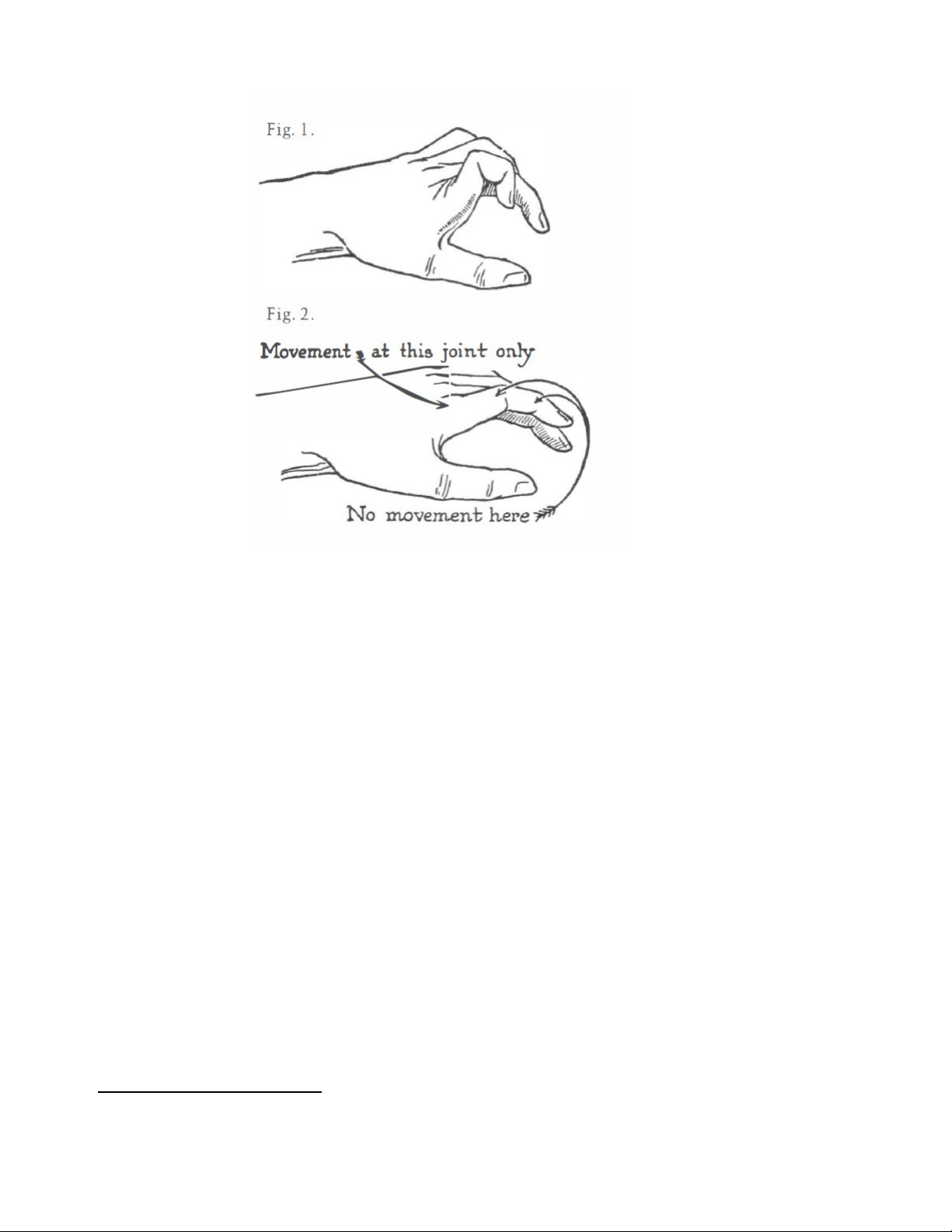
keys and more space is created under the hand. This hand position corresponds to the illustration
below from Josef Lhevinne’s book. It is also easier to transfer between the black keys and white
keys with the arm helping the fingers by using some in and out motion, as described in the
Taubman approach. A well-known piano pedagogue, Dorothy Taubman (1917-2013), formed a
technical approach to the piano aimed at enabling pianists to express themselves to the fullest
through their instrument. Her method helps pianists to use their bodies in the most natural and
coordinated way, preventing injuries and muscular fatigue.11 One of the most helpful aspects of
this approach is the caution against the “twist movement,” in which the hand moves in isolation by
itself, from side to side, against its natural alignment. Such motion is the major cause of injury in
pianists since it puts pressure and limitations on the natural flow of the blood to the hands. The
Taubman approach also cautions against any unnecessary and constant stretches for the hands,
which lead to the twisting motion.
10 Siki, Béla. Piano Repertoire: A Guide to Interpretation and Performance. (New York, London: Schirmer Books; Collier
Macmillan Publishers, 1981), 179.
11 Guest Writer [Nikos Kokkinis], "What is the Taubman Approach and how can it help me improve?", Pianist,
November 6, 2019, accessed December 26, 2020, https://www.pianistmagazine.com/blogs/what-is-the-taubman-
approach-and-how-can-it-help-me-improve/. 4
Lhevinne provided two examples for the finger movement in his Basic Principles in Piano Forte
Playing, to emphasize the point that the essentials of good touch are related to the natural motion
of the finger (efficiency of movement), with only the knuckle from the palm joint initiating the movement.12
These three areas need to be kept in mind throughout the study of piano performance: posture,
tension and coordination, hand position and keyboard orientation.
12 Lhevinne, Josef. Basic Principles in Pianoforte Playing. (New York: Dover Publications, INC., 1972), 13 5
1. Stable Five Finger Position in single notes, with change by stepwise motion
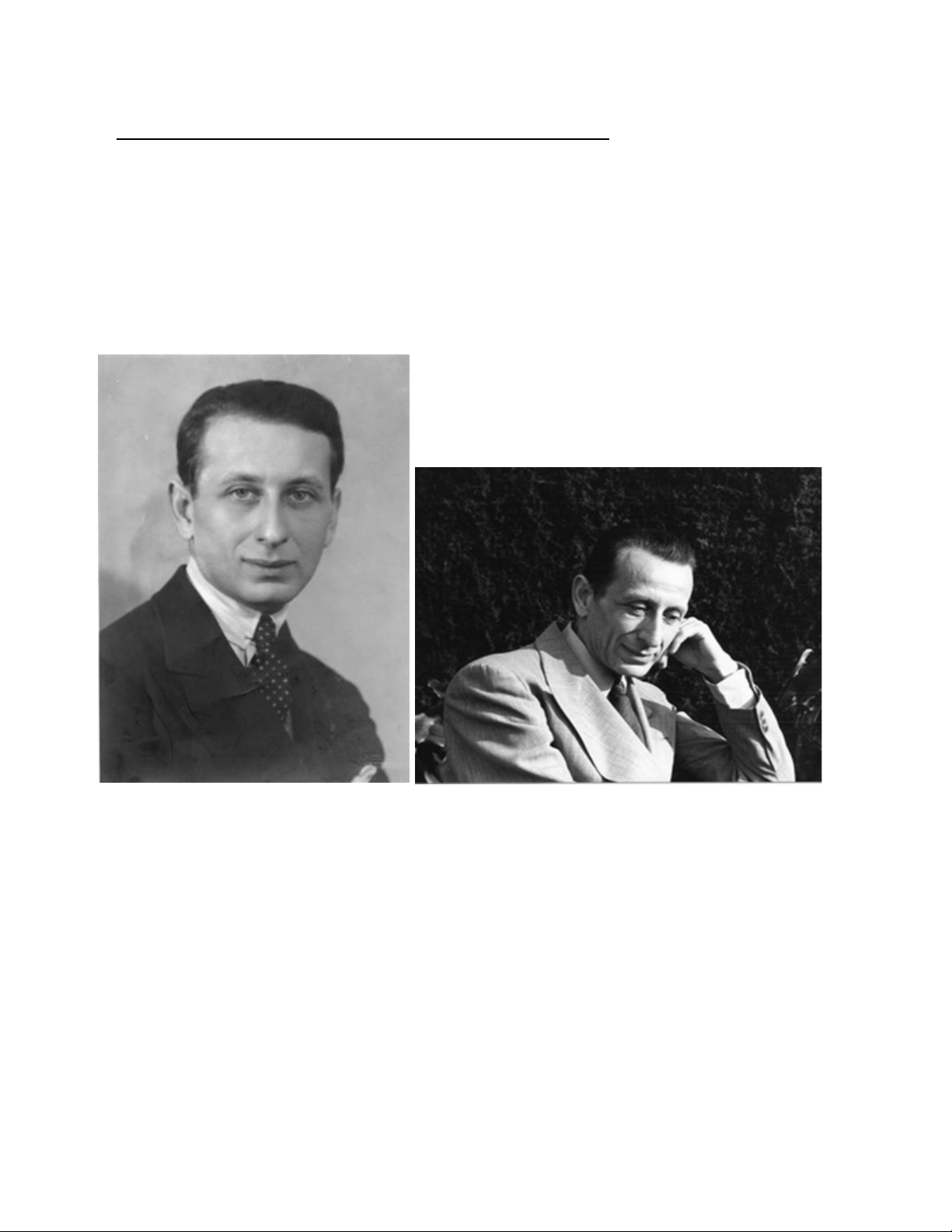
Jenö Takács (1902-2005) Hungarian composer, pianist, pedagogue, and ethnomusicologist,
Takács taught and performed in several different countries. While in the USA, he taught at the
Cincinnati Col ege-Conservatory of Music for many years. This thesis contains pieces from two
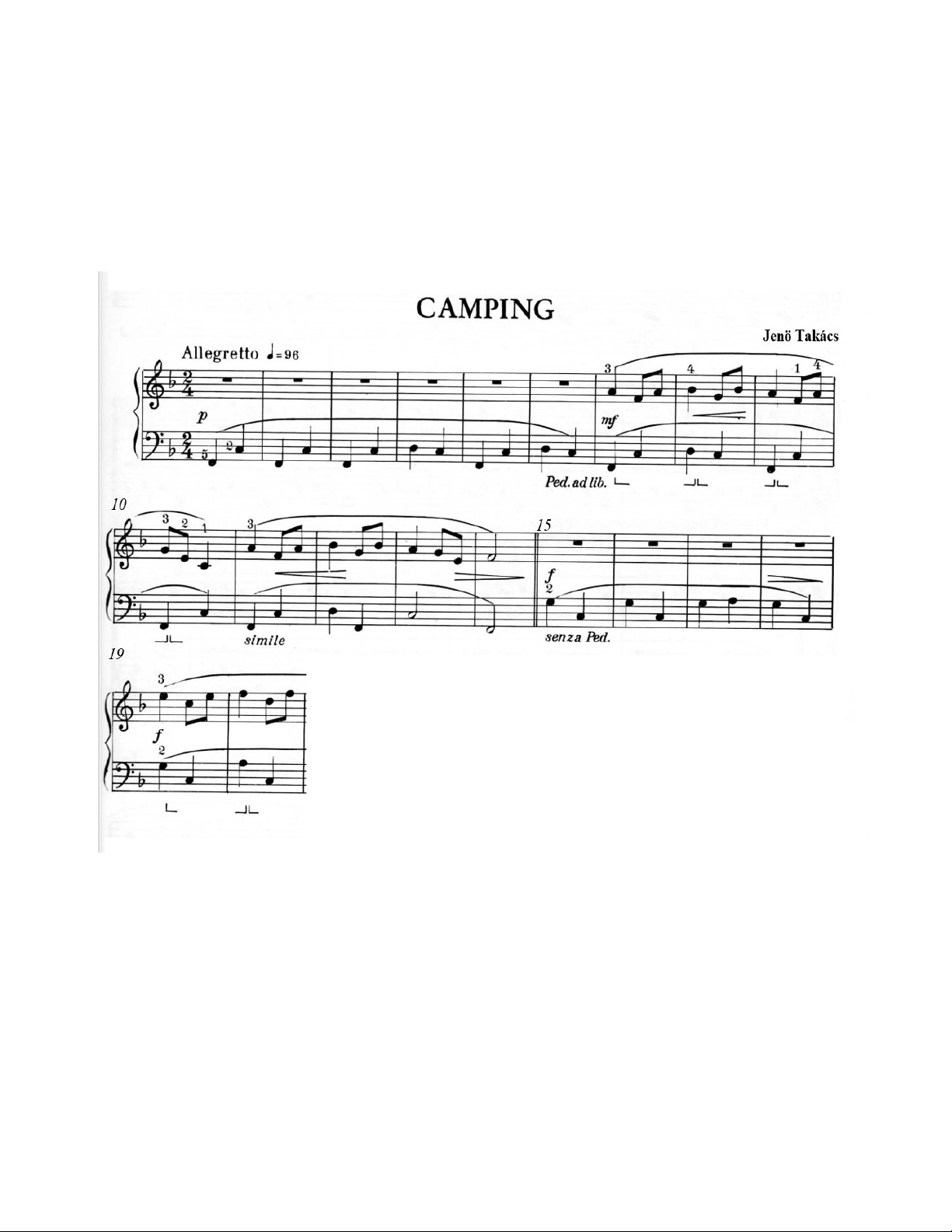
opuses: Doubledozen for Small Fingers, Op.63; For Me, Op.76. 6 Camping
Both hands span an interval of a 6th while changing register twice, during the transition between
the sections of the A-B-A form. Note the tempo is Allegretto, which means not too fast, but not
dragging. The eighth notes in the R.H. must feel lighter and move toward the quarter note in the
next measure. Follow the dynamic marks for the direction of the line. Pay attention to the balance between the two hands. 7 It's raining on the bridge
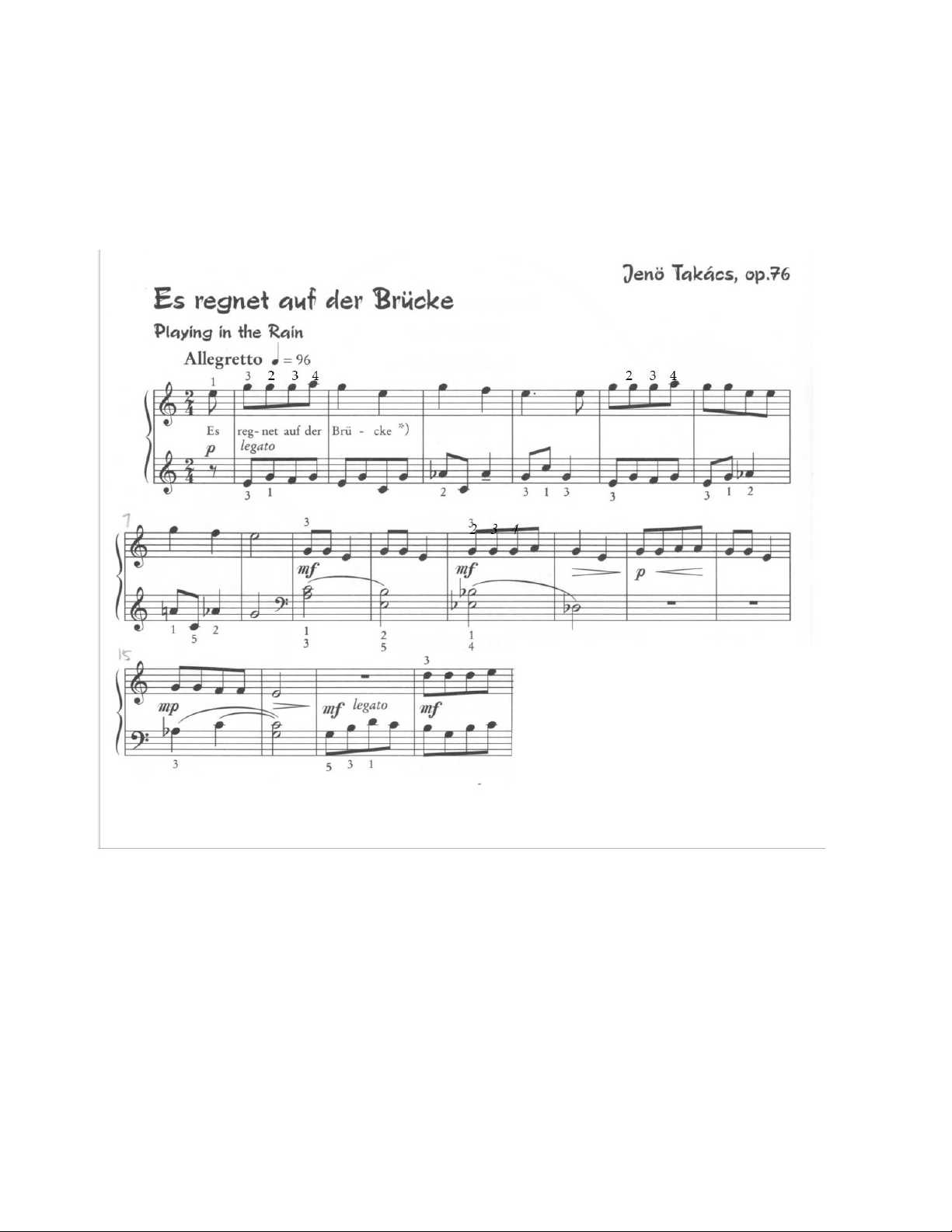
In this piece, most of the phrases last for eight bars. The hand changes between different five-
finger positions in each phrase. The half notes at the end of each phrase provide enough time for
the changes to be made smoothly. Note the fingering changes for the repeated notes, which allow
for a smooth and connected sound between the repeated notes. 8 A Dance from Old Vienna
The accompaniment line in the L.H. descends step by step with smooth legato treatment. The
melody features repeated notes. One might change fingering on the repeated notes to achieve a
longer sound. Notice the short + short + long (2+2+4) classical phrase structure. Due to this
structure, and the fact that the last repeated note is the longest one of all (dotted quarter) in
measures 2 and 4, one can have the direction of the phrase (repeated notes) lean toward the dotted
quarter note. A principle of phrasing is that shorter notes gravitate toward longer ones; in case of
doubt as to the direction, usually going to the middle of the phrase is the goal. 9
2. Slight expansion from five-finger position with small wrist circles
Alexandre Tansman (1897-1986) Tansman was a Polish composer who lived mostly in Paris. His
style evolved over time from an earlier one influenced by Chopin, to Impressionist and Neoclassic
writing. Jazz elements were also a large part of some of his music. His works for children included
here are from Happy Times and For Children, both graded collections dedicated to beginning and intermediate students. 10
Tài liệu liên quan:
-
Cambridge IELTS 13 Test-1 Overview and Practice Review | Tài liệu Tiếng Anh
6 3 -
IELTS Test 2 Review - Cambridge 13 Preparation Guide | Tài liệu Tiếng Anh
8 4 -
Litfocus Litreading Survey: Student Reading Interests & Habits Questionnaire | Tài liệu Tiếng Anh
7 4 -
Sách Pre-intermediate Market leader - Business English Course Book
23 12 -
Exam booster for B1 preliminary and B1 preliminary for schools with answer key
9 5