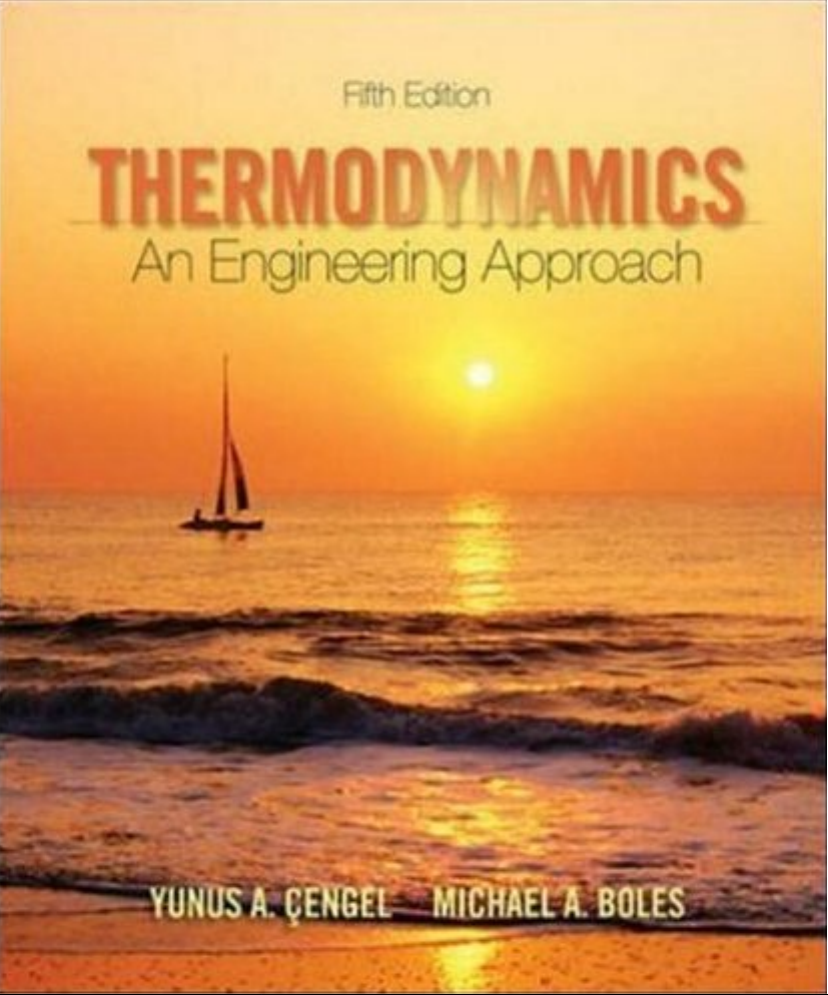
1 Thermodynamics An Engineering Approach
1 Thermodynamics An Engineering Approach
Môn: Tài liệu Tổng hợp 3.6 K tài liệu
Trường: Tài liệu khác 3.9 K tài liệu
Tác giả:




















Preview text:
Chapter 1
Introduction and Basic Concepts 1-1 Thermodynamics and Energy
Application Areas of Thermodynamics
1-2 Importance of Dimensions and Units Some SI and English Units Dimensional Homogeneity Unity Conversion Ratios
1-3 Systems and Control Volumes 1-4 Properties of a System Continuum
1-5 Density and Specific Gravity 1-6 State and Equilibrium The State Postulate 1-7 Processes and Cycles The Steady-Flow Process
1-8 Temperature and the Zeroth Law of Thermodynamics Temperature Scales
The International Temperature Scale of 1990 (ITS-90) 1-9 Pressure
Variation of Pressure with Depth 1-10 The Manometer
Other Pressure Measurement Devices
1-11 The Barometer and Atmospheric Pressure
1-12 Problem-Solving Technique Step 1: Problem Statement Step 2: Schematic
Step 3: Assumptions and Approximations Step 4: Physical Laws Step 5: Properties Step 6: Calculations
Step 7: Reasoning, Verification, and Discussion Engineering Software Packages
A Remark on Significant Digits Summary
References and Suggested Reading Problems Chapter 2
Energy Conversion and General Energy Analysis 2-1 Introduction 2-2 Forms of Energy
Some Physical Insight to Internal Energy Mechanical Energy More on Nuclear Energy 2-3 Energy Transfer by Heat Historical Background on Heat 2-4 Energy Transfer by Work Electrical Work 2-5 Mechanical Forms of Work Shaft Work Spring Work
Work Done on Elastic Solid Bars
Work Associated with the Stretching of a Liquid Film
Work Done to Raise or to Accelerate a Body Nonmechanical Forms of Work
2-6 The First Law of Thermodynamics Energy Balance
Energy Change of a System, ǻEsystem
Mechanisms of Energy Transfer, Ein and Eout
2-7 Energy Conversion Efficiencies 2-8 Energy and Environment Ozone and Smog Acid Rain
The Greenhouse Effect: Global Warming and Climate Change
Topic of Special Interest: Mechanisms of Heat Transfer Summary
References and Suggested Reading Problems Chapter 3 Properties of Pure Substances 3-1 Pure Substance
3-2 Phases of a Pure Substance
3-3 Phase-Change Processes of Pure Substances
Compressed Liquid and Saturated Liquid
Saturated Vapor and Superheated Vapor
Saturation Temperature and Saturation Pressure
Some Consequences of Tsat and Psat Dependence
3-4 Property Diagrams for Phase-Change Processes 1 The T-v Diagram 2 The P-v Diagram
Extending the Diagrams to Include the Solid Phase 3 The P-T Diagram The P-v-T Surface 3-5 Property Tables
Enthalpy—A Combination Property
1a Saturated Liquid and Saturated Vapor States
1b Saturated Liquid–Vapor Mixture 2 Superheated Vapor 3 Compressed Liquid
Reference State and Reference Values
3-6 The Ideal-Gas Equation of State Is Water Vapor an Ideal Gas?
3-7 Compressibility Factor—A Measure of Deviation from Ideal-Gas Behavior 3-8 Other Equations of State
Van der Waals Equation of State
Beattie-Bridgeman Equation of State
Benedict-Webb-Rubin Equation of State Virial Equation of State Topic of Special Interest
Vapor Pressure and Phase Equilibrium Summary
References and Suggested Reading Problems Chapter 4
Energy Analysis of Closed Systems 4-1 Moving Boundary Work Polytropic Process
4-2 Energy Balance for Closed Systems 4-3 Specific Heats
4-4 Internal Energy, Enthalpy, and Specific Heats of Ideal Gases
Specific Heat Relations of Ideal Gases
4-5 Internal Energy, Enthalpy, and Specific Heat of Solids and Liquids Internal Energy Changes Enthalpy Changes
Topic of Special Interest: Thermodynamic Aspects of Biological Systems Summary
References and Suggested Reading Problems Chapter 5
Mass and Energy Analysis of Control Volumes 5-1 Conservation of Mass Mass and Volume Flow Rates
Conservation of Mass Principle
Mass Balance for Steady-Flow Processes
Special Case: Incompressible Flow
5-2 Flow Work and the Energy of a Flowing Fluid
Total Energy of a Flowing Fluid Energy Transport by Mass
5-3 Energy Analysis of Steady-Flow Systems Energy Balance
5-4 Some Steady-Flow Engineering Devices 1 Nozzles and Diffusers 2 Turbines and Compressors 3 Throttling Valves 4a Mixing Chambers 4b Heat Exchangers 5 Pipe and Duct Flow
5-5 Energy Analysis of Unsteady-Flow Processes Mass Balance Energy Balance
Topic of Special Interest: General Energy Equation Summary
References and Suggested Reading Problems Chapter 6
The Second Law of Thermodynamics
6-1 Introduction to the Second Law 6-2 Thermal Energy Reservoirs 6-3 Heat Engines Thermal Efficiency Can We Save Qout ?
The Second Law of Thermodynamics: Kelvin–Planck Statement
6-5 Refrigerators and Heat Pumps Coefficient of Performance Heat Pumps
The Second Law of Thermodynamics: Clausius Statement
Equivalence of the Two Statements 6-6 Perpetual-Motion Machines
6-7 Reversible and Irreversible Processes Irreversibilities
Internally and Externally Reversible Processes 6-8 The Carnot Cycle The Reversed Carnot Cycle 6-9 The Carnot Principles
6-10 The Thermodynamic Temperature Scale 6-11 The Carnot Heat Engine The Quality of Energy
Quantity versus Quality in Daily Life
6-12 The Carnot Refrigerator and Heat Pump
Topics of Special Interest: Household Refrigerators Summary
References and Suggested Reading Problems Chapter 7 Entropy 7-1 Entropy
A Special Case: Internally Reversible Isothermal Heat Transfer Processes
7-2 The Increase of Entropy Principle Some Remarks about Entropy
7-3 Entropy Change of Pure Substances 7-4 Isentropic Processes
7-5 Property Diagrams Involving Entropy 7-6 What Is Entropy?
Entropy and Entropy Generation in Daily Life 7-7 The T ds Relations
7-8 Entropy Change of Liquids and Solids
7-9 The Entropy Change of Ideal Gases
Constant Specific Heats (Approximate Analysis)
Variable Specific Heats (Exact Analysis)
Isentropic Processes of Ideal Gases
Constant Specific Heats (Approximate Analysis)
Variable Specific Heats (Exact Analysis)
Relative Pressure and Relative Specific Volume
7-10 Reversible Steady-Flow Work
Proof that Steady-Flow Devices Deliver the Most and Consume the Least
Work when the Process Is Reversible
7-11 Minimizing the Compressor Work
Multistage Compression with Intercooling
7-12 Isentropic Efficiencies of Steady-Flow Devices
Isentropic Efficiency of Turbines
Isentropic Efficiencies of Compressors and Pumps
Isentropic Efficiency of Nozzles 7-13 Entropy Balance
Entropy Change of a System, ¨S system
Mechanisms of Entropy Transfer, Sin and Sout 1 Heat Transfer 2 Mass Flow Entropy Generation, Sgen Closed Systems Control Volumes
Entropy Generation Associated with a Heat Transfer Process
Topics of Special Interest: Reducing the Cost of Compressed Air Summary
References and Suggested Reading Problems Chapter 8
Exergy: A Measure of Work Potential
8-1 Exergy: Work Potential of Energy
Exergy (Work Potential) Associated with Kinetic and Potential Energy
8-2 Reversible Work and Irreversibility
8-3 Second-Law Efficiency, ȘII 8-4 Exergy Change of a System
Exergy of a Fixed Mass: Nonflow (or Closed System) Exergy
Exergy of a Flow Stream: Flow (or Stream) Exergy
8-5 Exergy Transfer by Heat, Work, and Mass
Exergy Transfer by Heat Transfer, Q Exergy Transfer by Work, W Exergy Transfer by Mass, m
8-6 The Decrease of Exergy Principle and Exergy Destruction Exergy Destruction
8-7 Exergy Balance: Closed Systems
8-8 Exergy Balance: Control Volumes
Exergy Balance for Steady-Flow Systems Reversible Work, W rev
Second-Law Efficiency of Steady-Flow Devices, ȘII
Topics of Special Interest: Second-Law Aspects of Daily Life Summary
References and Suggested Reading Problems Chapter 9 Gas Power Cycles
9-1 Basic Considerations in the Analysis of Power Cycles
9-2 The Carnot Cycle and Its Value in Engineering 9-3 Air-Standard Assumptions
9-4 An Overview of Reciprocating Engines
9-5 Otto Cycle: The Ideal Cycle for Spark-Ignition Engines
9-6 Diesel Cycle: The Ideal Cycle for Compression-Ignition Engines
9-7 Stirling and Ericsson Cycles
9-8 Brayton Cycle: The Ideal Cycle for Gas-Turbine Engines Development of Gas Turbines
Deviation of Actual Gas-Turbine Cycles from Idealized Ones
9-9 The Brayton Cycle with Regeneration
9-10 The Brayton Cycle with Intercooling, Reheating, and Regeneration
9-11 Ideal Jet-Propulsion Cycles
Modifications to Turbojet Engines
9-12 Second-Law Analysis of Gas Power Cycles
Topics of Special Interest: Saving Fuel and Money by Driving Sensibly Summary
References and Suggested Reading Problems Chapter 10
Vapor and Combined Power Cycles 10-1 The Carnot Vapor Cycle
10-2 Rankine Cycle: The Ideal Cycle for Vapor Power Cycles
Energy Analysis of the Ideal Rankine Cycle
10-3 Deviation of Actual Vapor Power Cycles from Idealized Ones
10-4 How Can We Increase the Efficiency of the Rankine Cycle?
Lowering the Condenser Pressure (Lowers T low,av)
Superheating the Steam to High Temperatures (Increases Thigh,av)
Increasing the Boiler Pressure (Increases Thigh,av)
10-5 The Ideal Reheat Rankine Cycle
10-6 The Ideal Regenerative Rankine Cycle Open Feedwater Heaters Closed Feedwater Heaters
10-7 Second-Law Analysis of Vapor Power Cycles 10-8 Cogeneration
10-9 Combined Gas–Vapor Power Cycles
Topics of Special Interest: Binary Vapor Cycles Summary
References and Suggested Reading Problems Chapter 11 Refrigeration Cycles
11-1 Refrigerators and Heat Pumps
11-2 The Reversed Carnot Cycle
11-3 The Ideal Vapor-Compression Refrigeration Cycle
11-4 Actual Vapor-Compression Refrigeration Cycle
11-5 Selecting the Right Refrigerant 11-6 Heat Pump Systems
11-7 Innovative Vapor-Compression Refrigeration Systems Cascade Refrigeration Systems
Multistage Compression Refrigeration Systems
Multipurpose Refrigeration Systems with a Single Compressor Liquefaction of Gases 11-8 Gas Refrigeration Cycles
11-9 Absorption Refrigeration Systems
Topics of Special Interest: Thermoelectric Power Generation and Refrigeration Systems Summary
References and Suggested Reading Problems Chapter 12
Thermodynamic Property Relations
12-1 A Little Math—Partial Derivatives and Associated Relations Partial Differentials Partial Differential Relations 12-2 The Maxwell Relations 12-3 The Clapeyron Equation
12-4 General Relations for du, dh, ds, Cv, and Cp Internal Energy Changes Enthalpy Changes Entropy Changes Specific Heats Cv and Cp
12-5 The Joule-Thomson Coefficient
12-6 The ǻh, ǻu, and ǻs of Real Gases
Enthalpy Changes of Real Gases
Internal Energy Changes of Real Gases Entropy Changes of Real Gases Summary
References and Suggested Reading Problems Chapter 13 Gas Mixtures
13-1 Composition of a Gas Mixture: Mass and Mole Fractions
13-2 P-v-T Behavior of Gas Mixtures: Ideal and Real Gases Ideal-Gas Mixtures Real-Gas Mixtures
13-3 Properties of Gas Mixtures: Ideal and Real Gases Ideal-Gas Mixtures Real-Gas Mixtures
Topics of Special Interest: Chemical Potential and the Separation Work of Mixtures
Ideal Gas Mixtures and Ideal Solutions
Minimum Work of Separation of Mixtures Reversible Mixing Processes Second-Law Efficiency
Special-Case: Separation of a Two-Component Mixture
An Application: Desalination Processes Chapter 14
Gas–Vapor Mixtures and Air-Conditioning 14-1 Dry and Atmospheric Air
14-2 Specific and Relative Humidity of Air 14-3 Dew-Point Temperature
14-4 Adiabatic Saturation and Wet-Bulb Temperatures 14-5 The Psychrometric Chart
14-6 Human Comfort and Air-Conditioning
14-7 Air-Conditioning Processes
Simple Heating and Cooling (w = constant) Heating with Humidification Cooling with Dehumidification Evaporative Cooling Adiabatic Mixing of Airstreams Wet Cooling Towers Summary
References and Suggested Reading Problems Chapter 15 Chemical Reactions 15-1 Fuels and Combustion
15-2 Theoretical and Actual Combustion Processes
15-3 Enthalpy of Formation and Enthalpy of Combustion
15-4 First-Law Analysis of Reacting Systems Steady-Flow Systems Closed Systems
15-5 Adiabatic Flame Temperature
15-6 Entropy Change of Reacting Systems
15-7 Second-Law Analysis of Reacting systems
Topics of Special Interest: Fuel Cells Summary
References and Suggested Reading Problems Chapter 16
Chemical and Phase Equilibrium
16-1 Criterion for Chemical Equilibrium
16-2 The Equilibrium Constant for Ideal-Gas Mixtures
16-3 Some Remarks about the KP of Ideal-Gas Mixtures
16-4 Chemical Equilibrium for Simultaneous Reactions
16-5 Variation of KP with Temperature 16-6 Phase Equilibrium
Phase Equilibrium for a Single-Component System The Phase Rule
Phase Equilibrium for a Multicomponent System Summary
References and Suggested Reading Problems Chapter 17 Compressible Flow 17-1 Stagnation Properties
17-2 Speed of Sound and Mach Number
17-3 One-Dimensional Isentropic Flow
Variation of Fluid Velocity with Flow Area
Property Relations for Isentropic Flow of Ideal Gases
17-4 Isentropic Flow through Nozzles Converging Nozzles Converging–Diverging Nozzles
17-5 Shock Waves and Expansion Normal Shocks Oblique Shocks
Prandtl–Meyer Expansion Waves
17-6 Duct Flow with Heat Transfer and Negligible Friction (Rayleigh Flow)
Property Relations for Rayleigh Flow Choked Rayleigh Flow 17-7 Steam Nozzles Summary
References and Suggested Reading Problems Appendix 1
Property Tables and Charts (SI Units) Table A-1
Molar mass, gas constant, and critical-point properties
Table A-2 Ideal-gas specific heats of various common gases
Table A-3 Properties of common liquids, solids, and foods
Table A-4 Saturated water—Temperature table
Table A-5 Saturated water—Pressure table Table A-6 Superheated water
Table A-7 Compressed liquid water
Table A-8 Saturated ice—water vapor
Figure A-9 T-s diagram for water
Figure A-10 Mollier diagram for water
Table A-11 Saturated refrigerant-134a—Temperature table
Table A-12 Saturated refrigerant-134a—Pressure table
Table A-13 Superheated refrigerant-134a
Figure A-14 P-h diagram for refrigerant-134a
Figure A-15 Nelson–Obert generalized compressibility chart
Table A-16 Properties of the atmosphere at high altitude
Table A-17 Ideal-gas properties of air
Table A-18 Ideal-gas properties of nitrogen, N2
Table A-19 Ideal-gas properties of oxygen, O2
Table A-20 Ideal-gas properties of carbon dioxide, CO2
Table A-21 Ideal-gas properties of carbon monoxide, CO
Table A-22 Ideal-gas properties of hydrogen, H2
Table A-23 Ideal-gas properties of water vapor, H2O
Table A-24 Ideal-gas properties of monatomic oxygen, O
Table A-25 Ideal-gas properties of hydroxyl, OH
Table A-26 Enthalpy of formation, Gibbs function of formation, and
absolute entropy at 25qC, 1 atm
Table A-27 Properties of some common fuels and hydrocarbons
Table A-28 Natural Logarithms of the equilibrium constant Kp
Figure A-29 Generalized enthalpy departure chart
Figure A-30 Generalized entropy departure chart
Figure A-31 Psychrometric chart at 1 atm total pressure
Table A-32 One-dimensional isentropic compressible-flow functions for an ideal gas with k = 1.4
Table A-33 One-dimensional normal-shock functions for an ideal gas with k =1.4
Table A-34 Rayleigh flow functions for an ideal gas with k = 1.4 Appendix 2
Property Tables and Charts (English Units)
Table A-1E Molar mass, gas constant, and critical-point properties
Table A-2E Ideal-gas specific heats of various common gases
Table A-3E Properties of common liquids, solids, and foods
Table A-4E Saturated water—Temperature table
Table A-5E Saturated water—Pressure table Table A-6E Superheated water
Table A-7E Compressed liquid water
Table A-8E Saturated ice—water vapor
Figure A-9E T-s diagram for water
Figure A-10E Mollier diagram for water
Table A-11E Saturated refrigerant-134a—Temperature table
Table A-12E Saturated refrigerant-134a—Pressure table
Table A-13E Superheated refrigerant-134a
Figure A-14E P-h diagram for refrigerant-134a Table A-15E
Table A-16E Properties of the atomosphere at high altitude
Table A-17E Ideal-gas properties of air
Table A-18E Ideal-gas properties of nitrogen, N2
Table A-19E Ideal-gas properties of oxygen, O2
Table A-20E Ideal-gas properties of carbon dioxide, CO2
Table A-21E Ideal-gas properties of carbon monoxide, CO
Table A-22E Ideal-gas properties of hydrogen, H2
Table A-23E Ideal-gas properties of water vapor, H2O Table A-24E Table A-25E
Table A-26E Enthalpy of formation, Gibbs function of formation, and
absolute entropy at 77qC, 1 atm
Table A-27E Properties of some common fuels and hydrocarbons
Figure A-31E Psycrometric chart at 1 atm total pressure PREFACE BACKGROUND
Thermodynamics is an exciting and fascinating subject that deals with
energy, which is essential for sustenance of life, and thermodynamics has
long been an essential part of engineering curricula all over the world. It has
a broad application area ranging from microscopic organisms to common
household appliances, transportation vehicles, power generation systems,
and even philosophy. This introductory book contains sufficient material for
two sequential courses in thermodynamics. Students are assumed to have an
adequate background in calculus and physics. OBJECTIVES
This book is intended for use as a textbook by undergraduate engineering
students in their sophomore or junior year, and as a reference book for prac-
ticing engineers. The objectives of this text are
• To cover the basic principles of thermodynamics.
• To present a wealth of real-world engineering examples to give
students a feel for how thermodynamics is applied in engineering practice.
• To develop an intuitive understanding of thermodynamics by empha-
sizing the physics and physical arguments.
It is our hope that this book, through its careful explanations of concepts
and its use of numerous practical examples and figures, helps students
develop the necessary skills to bridge the gap between knowledge and the
confidence to properly apply knowledge. PHILOSOPHY AND GOAL
The philosophy that contributed to the overwhelming popularity of the prior
editions of this book has remained unchanged in this edition. Namely, our
goal has been to offer an engineering textbook that
• Communicates directly to the minds of tomorrow’s engineers in a
simple yet precise manner.
• Leads students toward a clear understanding and firm grasp of the
basic principles of thermodynamics.
• Encourages creative thinking and development of a deeper under-
standing and intuitive feel for thermodynamics.
• Is read by students with interest and enthusiasm rather than being
used as an aid to solve problems. | xvii xviii | Preface
Special effort has been made to appeal to students’ natural curiosity and
to help them explore the various facets of the exciting subject area of ther-
modynamics. The enthusiastic responses we have received from users of
prior editions—from small colleges to large universities all over the world—
indicate that our objectives have largely been achieved. It is our philosophy
that the best way to learn is by practice. Therefore, special effort is made
throughout the book to reinforce material that was presented earlier.
Yesterday’s engineer spent a major portion of his or her time substituting
values into the formulas and obtaining numerical results. However, formula
manipulations and number crunching are now being left mainly to comput-
ers. Tomorrow’s engineer will need a clear understanding and a firm grasp of
the basic principles so that he or she can understand even the most complex
problems, formulate them, and interpret the results. A conscious effort is
made to emphasize these basic principles while also providing students with
a perspective of how computational tools are used in engineering practice.
The traditional classical, or macroscopic, approach is used throughout the
text, with microscopic arguments serving in a supporting role as appropri-
ate. This approach is more in line with students’ intuition and makes learn-
ing the subject matter much easier. NEW IN THIS EDITION
All the popular features of the previous editions are retained while new ones
are added. With the exception of reorganizing the first law coverage and
updating the steam and refrigerant properties, the main body of the text
remains largely unchanged. The most significant changes in this fifth edi- tion are highlighted below.
EARLY INTRODUCTION OF THE FIRST LAW OF THERMODYNAMICS
The first law of thermodynamics is now introduced early in the new Chapter
2, “Energy, Energy Transfer, and General Energy Analysis.” This introduc-
tory chapter sets the framework of establishing a general understanding of
various forms of energy, mechanisms of energy transfer, the concept of
energy balance, thermo-economics, energy conversion, and conversion effi-
ciency using familiar settings that involve mostly electrical and mechanical
forms of energy. It also exposes students to some exciting real-world appli-
cations of thermodynamics early in the course, and helps them establish a
sense of the monetary value of energy.
SEPARATE COVERAGE OF CLOSED SYSTEMS
AND CONTROL VOLUME ENERGY ANALYSES
The energy analysis of closed systems is now presented in a separate chap-
ter, Chapter 4, together with the boundary work and the discussion of
specific heats for both ideal gases and incompressible substances. The con-
servation of mass is now covered together with conservation of energy in
new Chapter 5. A formal derivation of the general energy equation is also
given in this chapter as the Topic of Special Interest.
REVISED COVERAGE OF COMPRESSIBLE FLOW
The chapter on compressible flow that deals with compressibility effects
(now Chapter 17) is greatly revised and expanded. This chapter now includes Preface | xix
coverage of oblique shocks and flow with heat transfer (Rayleigh flow) with
some exciting photographs and extended discussions of shock waves.
UPDATED STEAM AND REFRIGERANT-134A TABLES
The steam and refrigerant-134a tables are updated using the most current
property data from EES. Tables A-4 through A-8 and A-11 through A-13, as
well as their counterparts in English units, have all been revised. All the exam-
ples and homework problems in the text that involve steam or refrigerant-
134a are also revised to reflect the small changes in steam and refrigerant
properties. An added advantage of this update is that students will get the
same result when solving problems whether they use steam or refrigerant
properties from EES or property tables in the appendices.
OVER 300 NEW COMPREHENSIVE PROBLEMS
This edition includes over 300 new comprehensive problems that come
mostly from industrial applications. Problems whose solutions require para-
metric investigations, and thus the use of a computer, are identified by a computer-EES icon, as before.
CONTENT CHANGES AND REORGANIZATION
The noteworthy changes in various chapters are summarized below for
those who are familiar with the previous edition.
• Chapter 1 is greatly revised, and its title is changed to “Introduction
and Basic Concepts.” A new section Density and Specific Gravity and
a new subsection The International Temperature Scale of 1990 are
added. The sections Forms of Energy and Energy and the Environment
are moved to new Chapter 2, and the Topic of Special Interest Ther-
modynamic Aspects of Biological Systems is moved to new Chapter 4.
• The new Chapter 2 “Energy, Energy Transfer, and General Energy
Analysis” mostly consists of the sections Forms of Energy and Energy
and the Environment moved from Chapter 1, Energy Transfer by Heat
and Energy Transfer by Work, and Mechanical Forms of Energy from
Chapter 3, The First Law of Thermodynamics from Chapter 4, and
Energy Conversion Efficiencies from Chapter 5. The Topic of Special
Interest in this chapter is Mechanisms of Heat Transfer moved from Chapter 3.
• Chapter 3 “Properties of Pure Substance” is essentially the previous
edition Chapter 2, except that the last three sections on specific heats
are moved to new Chapter 4.
• Chapter 4 “Energy Analysis of Closed Systems” consists of Moving
Boundary Work from Chapter 3, sections on Specific Heats from
Chapter 2, and Energy Balance for Closed Systems from Chapter 4.
Also, the Topic of Special Interest Thermodynamic Aspects of Biolog-
ical Systems is moved here from Chapter 1.
• Chapter 5 “Mass and Energy Analysis of Control Volumes” consists
of Mass Balance for Control Volumes and Flow Work and the Energy
of a Flowing Fluid from Chapter 3 and the sections on Energy
Balance for Steady- and Unsteady-Flow Systems from Chapter 4. The
Tài liệu liên quan:
-

Ung dung game hoa trong cac chien dich MKT
27 14 -

Bao cao Chi so TMDT Viet Nam 2025
30 15 -
Thông tư quy định về việc phân quyền, phân cấp và phân định thẩm quyền quản lý nhà nước về giáo dục cho chính quyền địa phương
31 16 -
Nghị quyết về phát huy các giá trị di sản văn hóa gắn với phát triên du lịch bền vững tỉnh Khánh Hòa đến năm 2025, định hướng đến năm 2030
34 17 -
Quyết định phê duyệt Chiến lược phát triển du lịch Việt Nam đến năm 2030
20 10