5 Cross Lingual Semantic Textual Similarity Using Neural Networks
5 Cross Lingual Semantic Textual Similarity Using Neural Networks. Tài liệu được sưu tầm giúp bạn tham khảo, ôn tập và đạt kết quả cao. Mời bạn đọc đón xem.
Môn: Tài liệu Tổng hợp 3.6 K tài liệu
Trường: Tài liệu khác 3.9 K tài liệu
Tác giả:











Preview text:
See discussions, stats, and author profiles for this publication at: https://www.researchgate.net/publication/330257597
Cross-Lingual Semantic Textual Similarity Modeling Using Neural Networks:
14th China Workshop, CWMT 2018, Wuyishan, China, October 25-26, 2018, Proceedings Chapter · January 2019
DOI: 10.1007/978-981-13-3083-4_5 CITATIONS READS 0 572 3 authors, including: Xia Li Minping Chen
Guangdong University of Foreign Studies
13 PUBLICATIONS 26 CITATIONS
40 PUBLICATIONS 123 CITATIONS SEE PROFILE SEE PROFILE
Some of the authors of this publication are also working on these related projects:
Automatic Essay Scoring View project
All content following this page was uploaded by Xia Li on 14 February 2019.
The user has requested enhancement of the downloaded file.
Cross-Lingual Semantic Textual Similarity Modeling Using Neural Networks
Xia Li1,2(&), Minping Chen2, and Zihang Zeng2
1 Key Laboratory of Language Engineering and Computing,
Guangdong University of Foreign Studies, Guangzhou, China
2 School of Information Science and Technology/School of Cyber Security,
Guangdong University of Foreign Studies, Guangzhou, China
shelly_lx@126.com, minpingchen@126.com, raymondtseng0912@126.com
Abstract. Cross-lingual semantic textual similarity is to measure the semantic
similarity of sentences in different languages. Previous work pay more attention
on leveraging traditional NLP features (e.g., alignment features, syntactic fea-
tures) to evaluate the semantic similarity of sentences. In this paper, we only use
word embedding as basic features without any handcrafted features and build a
model which is able to capture local and global semantic information of the
sentences to evaluate semantic textual similarity. We test our model on
SemEval-2017 and STS benchmark datasets. Our experiments show that our
model improves the performance of the semantic textual similarity and achieves
the best results compared with the baseline neural-network based methods reported on the two datasets.
Keywords: Cross-lingual semantic textual similarity SemEval-2017 Neural networks 1 Introduction
Cross-lingual semantic textual similarity measures the degree to which two sentences in
different languages are semantically equivalent to each other, which is a fundamental
language understanding problem in many fields, such as information retrieval, infor-
mation extraction, machine translation and so on. Evaluation of sentence semantic
similarity in English has achieved great success, but there are still some challenges in
modeling sentences similarity in different languages due to lacking of enough training
data for a particular language [1, 2]. In this paper, we focus on building a model to
evaluate the semantic similarity between cross-lingual sentence pairs. We translated all
the foreign languages into English by Google translator1 following the state-of-the-art works in SemVal-2017 [3–5].
1 https://cloud.google.com/translate/.
© Springer Nature Singapore Pte Ltd. 2019
J. Chen and J. Zhang (Eds.): CWMT 2018, CCIS 954, pp. 52–62, 2019.
https://doi.org/10.1007/978-981-13-3083-4_5
Cross-Lingual Semantic Textual Similarity Modeling Using Neural Networks 53
Most previous works focus on leveraging traditional NLP features to evaluate the
semantic similarity between cross-lingual sentence pairs [3, 4]. These hand-crafted
features helped improve the performance of the models, but also are expensive for the system.
Few work only used neural features without any hand-crafted features in modeling
semantic textual similarity between cross-lingual sentence pairs. Shao et al. [5] is one
of the few exceptions. They use convolutional neural network to capture the semantic
representation of the source and target sentences, and then fed both of them into the
fully connected layer to get the semantic similarity scores of the two sentences. The
model achieved good results in the task of SemVal-2017.
However, the model only captured the local semantic information of a sentence by
CNN. The local n-grams information captured by CNN sometimes doesn’t work well
when modeling the semantic textual similarity in cross-lingual sentences. This is
because when a language is translated into another language2, the words order of the
translated sentence may change or be inaccurate due to translation errors. Therefore,
obtaining local n-grams information of a sentence through CNN may be insufficient
due to the wrong words order caused by the translation.
On the other hand, in the task of cross-language semantic textual similarity, we not
only need to pay attention to the local semantic matching information between sen-
tences, but also need to consider the global semantic information of the sentences.
Therefore, in order to better measure the semantic similarity of two sentences, we
should integrate the semantic information of the source and target sentences in both
local and global aspects as much as possible.
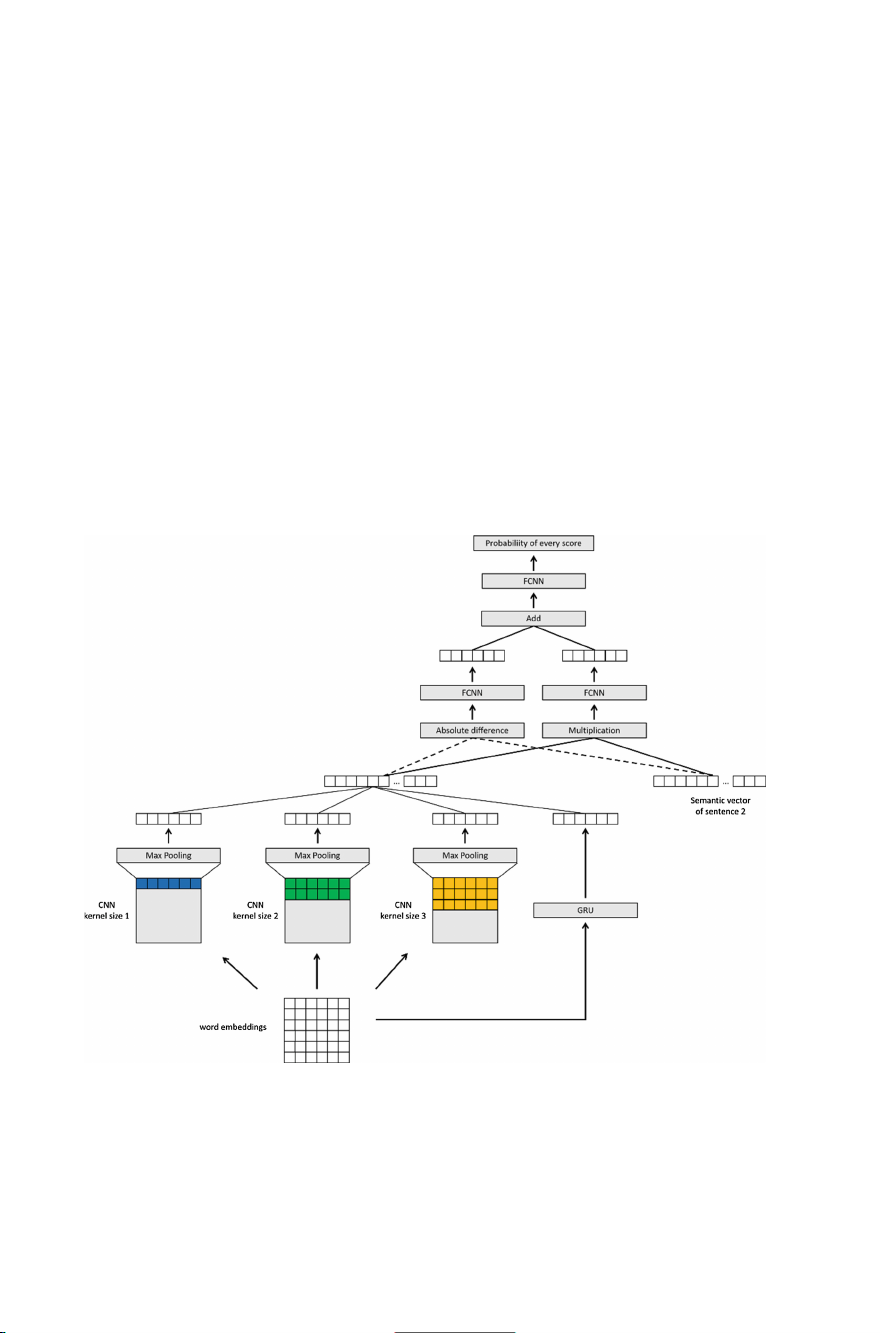
Based on these observations, this paper proposes a model which is able to capture
the local and global semantic information between cross-lingual sentence pairs. Firstly,
we use CNN with kernels of multiple sizes to capture the local matching information
between sentence pairs. Then, we use the recurrent neural network to capture the
semantic dependences of the sentence words and use this accumulation of the semantic
relationship as the global semantic information of the sentence and output an accu-
mulated vector of the sentence. Finally, the local information and the global infor-
mation are concatenated to represent the final semantic of the sentence.
The architecture of our model is showed as Fig. 1. We do several experiments on
SemVal-2017 data and STS benchmark data and the experimental results show that our
model outperforms the current best neural network model without any manual NLP features. 2 Model 2.1 Sentence Encoding
Each source sentence and target sentence are initially represented by a fixed-size word-
embeddings matrix. We use padding operation in our model. Supposing the maximum
length of the sentence in our model is L, then if the number of words in a sentence is
2 In this paper, all the other languages are translated into English. 54 X. Li et al.
less than L, we will add 0 to it. If the number of words in a sentence exceeds L, we will
remove the extra words. All the words in the sentence are converted into corresponding
word embedding, and then we can get a matrix representation of the sentence. Source
sentence matrix and target sentence matrix are inputted into the model as sentence initial encoding. 2.2
Local Semantic Information Extraction
In order to capture the local matching information of the sentence pair sufficiently, we
use convolution blocks of different convolution kernel sizes to convolve the sentences.
As shown in Fig. 1, we convolve the sentences using three convolution blocks with
convolution kernel windows of 1, 2, and 3, each with 300 convolution kernels. We also
use ReLu function as activation function in CNN layer and maximum down-sampling
for extracting the most informative vector from the output of convolution. The outputs
of the three convolutional blocks pooling are jointed as a 900-dimensional semantic
vector which represents the local semantic information of the sentences.
Fig. 1. Structure of our model based on convolutional neural network. 2.3
Global Semantic Information Extraction
In the cross-lingual sentence semantic similarity evaluation task, although the word order
of the translated sentence may change, the semantic information of most words is correct.
Cross-Lingual Semantic Textual Similarity Modeling Using Neural Networks 55
Therefore, our motivation is to capture the global semantic information of the sentence
through the information accumulation operation of the recurrent neural network.
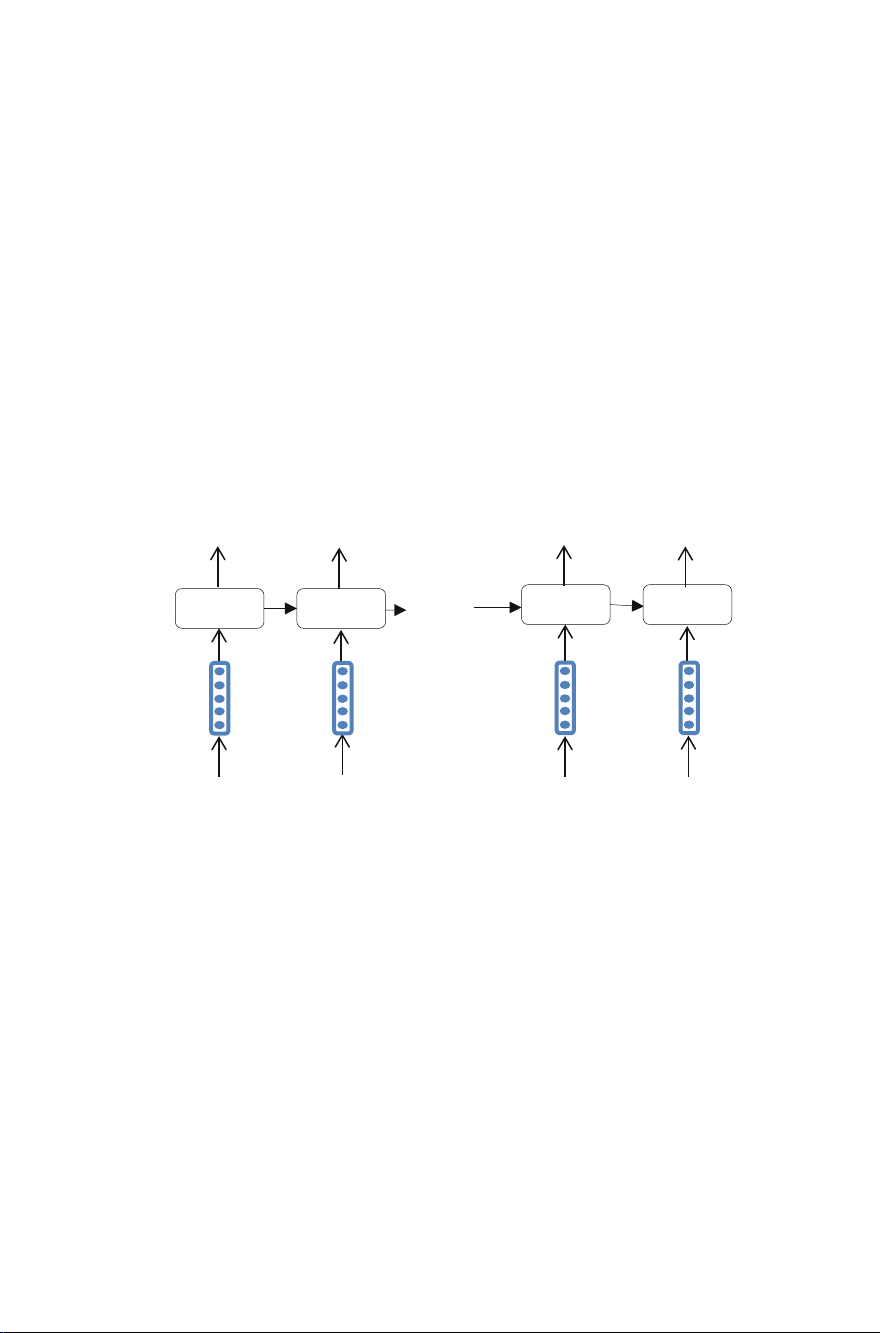
Different from the previous work, our model does not take the average of the output
of each GRU [6, 7] unit as the final output, but accumulates the semantic information of
each word from left to right and takes the output of the last GRU unit as the final
representation of the global semantics of the sentence (Fig. 2). Assuming that a sen-
tence consists of m words S = {w w … 1, 2,
, wm}. We use GRU to produce the internal
states for the sequence at each timestep t: (y1, y2,…, ym−1, …, ym). As for our task, we
use the last hidden state output ym as the result of RNN with GRU units. We believe
that this output accumulates the global semantic information of the sentence. As the
output of GRU is also a 300-dimensional semantic vector, we concatenate the 900-
dimensional local semantic vector obtained in Sect. 2.2 and the 300-dimensional global
semantic vector as a 1200-dimensional vector and take it as a final semantic repre-
sentation of the comprehensive information of the sentence. y y y y 1 2 m-1 m GRU ..... GRU GRU GRU ..... ..... w w w w 1 2 m-1 m
Fig. 2. Global semantic information extraction from GRU. 2.4
Representation of Semantic Similarity of Sentence Pairs
In order to calculate the text semantic similarity of two sentences, following Shao et al.
[5], we carry two kinds of operations to the semantic representations of two sentences:
absolute difference and multiplication. Here, the absolute difference operation for two
sentences can be considered as getting the difference information between two semantic
vectors, and the multiplication operation for two sentences can be considered as cap-
turing the similarity information of two semantic vectors.
Different from the work of Shao et al. [5], we do not directly concatenate these two
vectors of absolute difference operation and multiplication operation to get a final
vector to represent the semantic similarity of sentence pairs. Instead, we firstly input the
difference result vector and the multiplication result vector to a fully connected layer
respectively. Then we add the two output vectors from these two fully connected layers 56 X. Li et al.
and take it as a final representation of semantic similarity of the source sentence and
target sentence. The formula is shown in Eqs. (1)–(3). h sub ¼ W ! ! 1 SV1 SV2 þ b1 ð1Þ h mul ¼ W ! ! 2 SV1 SV2 þ b2 ð2Þ ! SDV ¼ h sub þ h mul ð3Þ ! !
Here SV1 and SV2 are the final semantic vectors of the two sentences. W1, b1, W2, b2
are weights used in fully connected layers. The number of neurons used here is 900. !
SDV is the final representation of semantic similarity between two sentences. We put !
SDV into a fully connected layer and the Softmax layer. The fully connected layer has
900 neurons and use the Tanh activation function followed by a dropout layer with a
dropout rate of 0.5. At the last layer, the number of neurons is 6 as the range of
semantic similarity score is 0–5 and a Softmax function is used to get the probability value of each score. 2.5 Loss Function
We use KL divergence as a loss function and use ADAM [8] as a gradient descent
optimizer. Because the similarity score is a value range from 0 to 5 and our model will
get the probability value of each score, we need to convert the similarity score into a
fractional probability distribution. The conversion formula is as Eq. (4). 8 < y jyj; i ¼ jyj þ 1 pi ¼ jyj y þ 1; i ¼ jyj ; i 2 ½0; K : ð4Þ 0; otherwise
Where K is the maximum similarity score. Loss function is the KL divergence
between the standard fractional probability distribution p and the predicted fractional
probability distribution ^ph. KL divergence can effectively measure the difference
between two distributions and when two distributions are the same, the value is zero.
The loss function of our model is shown in Eq. (5). Xm ð Þ k JðhÞ ¼ 1 KLðpðkÞjj^p k khk2 ð m 5Þ k¼1 h Þ þ 2 2
Here m is the total number of sentence pairs in the training set, k represents the kth
sentence pair in the training set, h2 is the L2 loss of parameters in the network, k is 2 coefficient of L2 loss.
Cross-Lingual Semantic Textual Similarity Modeling Using Neural Networks 57 3 Experiments 3.1 Datasets
In our experiment, we use two datasets as our training data and test data. Because of the
need for large size of training data, following work of [3–5], we collect the English
sentence similarity dataset in the text semantic similarity task from SemEval-2012 to
SemEval-2016 as our training data3. We randomly divide the collected data into 10
parts. 90% of the data is used as training data which contains 13,191 sentence pairs in
total, and the other 10% of the data is used as a development set which contains 1,465
sentence pairs. We use multi-lingual and cross-lingual dataset [2] in the text semantic
similarity task in SemEval-2017 as our test data4. In this task [2], there are 7 tracks with
total 1750 sentence pairs, each track has 250 sentence pairs. The details of the
SemEval-2017 data are shown in Table 1.
Table 1. Details of SemEval-2017 dataset. Track Language Test pairs 1 Arabic (ar-ar) 250 2 Arabic-English (ar-en) 250 3 Spanish (es-es) 250 4a Spanish-English (es-en) 250 4b Spanish-English (es-en) 250 5 English (en-en) 250 6 Turkish – English (tr-en) 250 Total – 1750
We also use the SST benchmark dataset in SemEval-20175 to test our model. The
training data in SST benchmark contains 5749 sentence pairs, the development set
contains 1500 sentence pairs, and the test set contains 1379 sentence pairs. Details of
the two datasets are shown in Table 2.
Table 2. Details of two datasets used in our experiments. Task
Training data Test data Development data SemEval2017 Task1 13191 1465 1750 STS benchmark 5749 1500 1379
3 http://ixa2.si.ehu.es/stswiki/index.php/Main_Page.
4 http://alt.qcri.org/semeval2017/task1/index.php?id=data-and-tools.
5 http://ixa2.si.ehu.es/stswiki/index.php/STSbenchmark. 58 X. Li et al. 3.2 Experimental Setup
We use the Pearson correlation coefficient as our evaluation metric in our experiment
following SemEval-2017 task. The Pearson correlation coefficient can be used to reflect
the degree of linear correlation between the two variables in a range of [− 1,1]. In our
experiment, the Pearson correlation coefficient is calculated between the gold similarity
score graded by human and the predicted similarity score graded by our model.
We implement some preprocessing operations for the data which include:
(1) Remove all punctuations in the sentences; (2) Transform all words into lowercase;
(3) Use NLTK segmentation to segment words; (4) Use pretrained paragram6 word
embedding [9] to represent the words of sentences. If the word does not exist in the
paragram vocabulary, it is set to 0. (5) The length of all sentences is converted to a
fixed size of 30. Those sentences with size larger than 30 will be cut, and shorter than
30 will be filled in zero. The hyperparameters used in our experiments are shown in
Table 3. The initial leaning rate of our model is set to 0.001 and the batch size is 64.
Besides, a dropout rate of 0.5 and regularization of 0.004 are used to avoid overfitting.
Table 3. Parameters of our model Steps Paramters Value Preprocessing Sentence size 30 Dimension of paragram 300
Similarity computing model Convolution kernel size 1,2,3 Convolution kernels 300
Convolution neural network activation function Relu
Fully connection layer neuros (first layer) 900
Fully connection layer neuros (second layer) 6 Training Optimizer ADAM Minimum batch size 64 Learning rate 0.001 Dropout rate 0.5 Regularization 0.004 3.3
Experimental Results and Analysis
We do several experiments on SemEval-2017 Task1 and STS benchmark datasets. In
our experiments, we use top 3 systems on SemEval-2017 Task1 and top 4 systems on
STS benchmark as our baselines [3–5, 9]. Among these four systems, the Rank 1
system (ECNU) [3] ensembled several machine learning methods and three neural
network models with rich traditional NLP features. These features include a total of 67
manual features such as sentence pair matching features, n-gram overlaps features,
sequence features, syntactic parse features, machine translated based features,
6 https://drive.google.com/file/d/0B9w48e1rj-MOck1fRGxaZW1LU2M/view.
Cross-Lingual Semantic Textual Similarity Modeling Using Neural Networks 59
alignment features and single sentence features etc. The Rank 2 system (BIT) [4] was
completely based on traditional features. The system introduced semantic information
space (SIS), which is constructed based on the semantic hierarchical taxonomy in
WordNet, to compute non-overlapping information content (IC) of sentences. The
system ranks 2nd on SemEval-2017 Task1. And the Rank 3 system (HCTI) [5] was a
neural-network based method which only used convolutional neural networks to
capture the semantic information of the sentences without any handcrafted features.
Results on SemEval-2017. As shown in Table 4, the average Pearson correlation
coefficient of our model in the SemEval-2017 Task1 dataset is 69.61 which is higher
than the rank 2 system BIT model [4] for 1.72% and higher than the rank 3 system
HCTI [5] for 3.64%. Compared with neural-network based system [5], our model
outperforms on 6 tracks, especially on track 4b which is Spanish to English, our model
outperforms for 9.55%. Although our model achieves better results than the neural-
network based systems HCTI [5] and also outperforms than traditional-features based
system BIT [4], the results of the work ECNU [3] are better than ours. As ECNU used
67 rich traditional NLP features and ensembled different machine learning methods and
neural network models, it is more powerful to model the sentence pairs and can
integrate the advantages of different models. However, compared with neural-network-
based models, which can automatically learn the features of the sentences, the work to
extract the features of ECNU is very heavy and time-expensive.
Table 4. Results of different methods on SemEval-2017 Task1 dataset. Models
Primary Track1 Track2 Track3 Track4a Track4b Track5 Track6 AR-AR AR-EN SP-SP SP-EN SP-EN-WMT EN-EN EN-TR ECNU [3] 73.16 74.40 74.93 85.59 81.31 33.63 85.18 77.06 BIT [4] 67.89 74.17 69.65 84.99 78.28 11.07 84.00 73.05 HCTI [5] 65.98 71.30 68.36 82.63 76.21 14.83 81.13 67.41 Our model 69.61 74.37 72.96 81.13 80.22 24.38 83.34 70.90
Results on STS Benchmark Dataset. As shown in Table 5, on the STS benchmark
dataset, the Pearson correlation coefficient on the development data is 85.41% and is
79.38% on the test data. According to the STS benchmark Wiki, our model achieves
the best performance on the dev data and the rank 3 on the test data. However,
compared with neural-network-based models without any feature engineering, our
model achieves the best results.
Table 5. Results of different methods on STS benchmark dataset. Dev Test ECNU [3] 84.70 81.00 BIT [4] 82.91 80.85 DT TEAM [18] 83.00 79.20 HCTI [5] 83.32 78.42 Our model 85.41 79.38 60 X. Li et al. 4 Related Work
In recent years, neural-network based methods have achieved excellent results in many
different tasks. Some previous work has used neural network methods in the field of
semantic text similarity [1–7, 9–13]. The word embedding [14, 15] generated by the
neural network is a basic research work for calculating the similarity of texts for neural-
network based methods. Word embedding is low-dimensional real number vector
unsupervised trained from large-scale texts, aiming to represent tokens. This repre-
sentation can better reflect the contextual semantics of the word. It can better solve the
problem brought by traditional bag of the words such as high-dimensional sparseness
and lack of sequences semantics. Some widely used word embeddings are Word2Vec [16] and Glove [17].
Many studies used word embeddings as the basis features to calculate text simi-
larities through various formulas or models. Kusner et al. [18] thought that the mini-
mum movement distance needed to move all the words from one text to the
corresponding word in the word vector space is the similarity of the two texts. This
method only considered the semantics of words ignoring the semantics of the entire
sentence or the entire document which can cause deviations when computing simi-
larities. Pagliardini et al. [19] proposed a sen2vec model based on the word vector.
They used n-grams to combine the word vectors into sentence vectors and extended the
word context to the sentence context. The experimental results showed that sentence
vectors can express semantic information more effectively. Tai et al. [20] used the long
short-term memory network (LSTM) [21] and bidirectional long short-term memory
network (BiLSTM) to calculate semantic text similarity. At the same time, the syntactic
analysis was introduced in the long short-term memory network which further mined
the semantic information through the semantic dependency tree. Although this method
can effectively extract the global semantic information of sentences, it is computa-
tionally intensive and does not work well for the long texts, and it did not pay attention
to local information in sentences which is important for sentence textual similarity.
Different from previous works which used many traditional NLP handcrafted
features to evaluate the semantic similarity of sentences [3, 4], Shao et al. [5] used a
convolutional neural network to calculate the similarity of semantic texts, but their
model only used a convolution kernel of size 1 which only can focus on the local
information of the unigram without considering global information of sentences.
In this paper, we build a text similarity calculation model based on the convolu-
tional neural network without any traditional NLP features. Also, different from pre-
vious methods, we represent the sentences with the local and global semantic
information. We use convolution kernels of size 1, 2 and 3 to capture unigrams,
bigrams and trigrams information as local information vectors of the sentence and use
the last hidden output of recurrent neural network with GRU units to capture the global
semantic information of the sentence. Combining vectors with local and global
information into one vector which can be regarded as a final semantic representation of
the sentences. We perform absolute difference and multiplication operations on the
source and target sentence and then input them into a fully connected layer respec-
tively, and we can get a final representation of the semantic similarity of the sentence
Cross-Lingual Semantic Textual Similarity Modeling Using Neural Networks 61
pair by adding operation. Several experiments showed that our model performs well on
SemEval-2017 task1 and STS benchmark datasets. 5 Conclusion
In this paper, we build a model to evaluate cross-lingual sentence semantic textual
similarity based on the neural networks without any traditional manual NLP features.
Different from previous models, we represent the sentence pairs with joint of the local
and global semantic information captured from the sentence. We use three kinds
convolution kernels of window size 1, 2 and 3 to capture unigrams, bigrams and
trigrams information as local semantic information vectors of the sentence. And then,
we use recurrent neural network with GRU units and take the last hidden states as the
global semantic information of the sentence. We combine these vectors with local and
global semantic information into a vector to be a final representation of the semantic of
the sentences. In order to get the semantic similarity of the sentences, we perform
absolute difference and multiplication operations on the sentence pair and then input
them into a fully connected layer respectively, getting a final representation of the
semantic similarity of the sentence pair. We test our model on SemEval-2017 Task1
and STS benchmark datasets. Despite the simplicity of our model, the results of our
several experiments in two datasets show that our model has a good performance.
There is still some work to do with our model in the future. First, the words order of
a sentence may change when it is translated from one language into English, but the
relationship between each two words anywhere in the sentence is relatively constant.
Therefore, in the future, we will consider incorporating the self-semantic relationship of
the words of a translated sentence into the semantic representation of the sentence in
order to improve the performance of the model. In addition, we also see that the ECNU
system [3] still outperforms our neural network system due to the use of rich traditional
features. In the future, we will consider incorporating traditional features into neural
network to enhance learning and improve the performance of the model.
Acknowledgement. This work is supported by the National Science Foundation of China
(61402119) and Special Funds for the Cultivation of Guangdong College Students’ Scientific and
Technological Innovation. (“Climbing Program” Special Funds.) References
1. Agirre, E., et al.: Semeval-2016 Task 1: semantic textual similarity, monolingual and cross-
lingual evaluation. In: Proceedings of the 10th International Workshop on Semantic
Evaluation (SemEval-2016), pp. 497–511 (2016)
2. Cer, D., Diab, M., Agirre, E., Lopez-Gazpio, I., Specia, L.: SemEval-2017 Task 1: semantic
textual similarity-multilingual and cross-lingual focused evaluation. arXiv preprint arXiv: 1708.00055 (2017) 62 X. Li et al.
3. Tian, J., Zhou, Z., Lan, M., Wu, Y.: ECNU at SemEval-2017 Task 1: leverage kernel-based
traditional nlp features and neural networks to build a universal model for multilingual and
cross-lingual semantic textual similarity. In: Proceedings of the 11th International Workshop
on Semantic Evaluation (SemEval-2017), pp. 191–197 (2017)
4. Wu, H., Huang, H.Y., Jian, P., et al.: BIT at SemEval-2017 Task 1: using semantic
information space to evaluate semantic textual similarity. In: Proceedings of the 11th
International Workshop on Semantic Evaluation (SemEval-2017), pp. 77–84 (2017)
5. Shao, Y.: HCTI at SemEval-2017 Task 1: use convolutional neural network to evaluate
semantic textual similarity. In: Proceedings of the 11th International Workshop on Semantic
Evaluation (SemEval-2017), pp. 130–133 (2017)
6. Cho, K., Van Merriënboer, B., Bahdanau, D., Bengio, Y.: On the properties of neural
machine translation: encoder-decoder approaches. arXiv preprint arXiv:1409.1259 (2014)
7. Chung, J., Gulcehre, C., Cho, K., Bengio, Y.: Empirical evaluation of gated recurrent neural
networks on sequence modeling. arXiv preprint arXiv:1412.3555 (2014)
8. Kingma, D.P., Ba, J.: Adam: a method for stochastic optimization. CoRR abs/1412.6980 (2014)
9. Wieting, J., Bansal, M., Gimpel, K., Livescu, K.: Towards universal paraphrastic sentence
embeddings. arXiv preprint arXiv:1511.08198 (2015)
10. Agirre, E., Diab, M., Cer, D., Gonzalez-Agirre, A.: Semeval-2012 Task 6: a pilot on
semantic textual similarity. In: Proceedings of the First Joint Conference on Lexical and
Computational Semantics-Volume 1: Proceedings of the Main Conference and the Shared
Task, and Volume 2: Proceedings of the Sixth International Workshop on Semantic
Evaluation, pp. 385–393 (2012)
11. Agirre, E., Cer, D., Diab, M., Gonzalez-Agirre, A., Guo, W.: * SEM 2013 shared task:
semantic textual similarity. In: Second Joint Conference on Lexical and Computational
Semantics (* SEM), Volume 1: Proceedings of the Main Conference and the Shared Task:
Semantic Textual Similarity, vol. 1, pp. 32–43 (2013)
12. Agirre, E., et al.: Semeval-2014 Task 10: multilingual semantic textual similarity. In:
Proceedings of the 8th International Workshop on Semantic Evaluation (SemEval 2014), pp. 81–91 (2014)
13. Agirre, E., et al.: Semeval-2015 Task 2: semantic textual similarity, English, Spanish and
pilot on interpretability. In: Proceedings of the 9th International Workshop on Semantic
Evaluation (SemEval 2015), pp. 252–263 (2015)
14. Hinton, G.E.: Learning distributed representations of concepts. In: Proceedings of the Eighth
Annual Conference of the Cognitive Science Society, vol. 1, p. 12, (1986)
15. Bengio, Y., Ducharme, R., Vincent, P., Jauvin, C.: A neural probabilistic language model.
J. Mach. Learn. Res. 3(6), 1137–1155 (2003)
16. Mikolov, T., Sutskever, I., Chen, K., Corrado, G. S., Dean, J.: Distributed representations of
words and phrases and their compositionality. In: Advances in Neural Information
Processing Systems, pp. 3111–3119 (2013)
17. Pennington, J., Socher, R., Manning, C.: Glove: global vectors for word representation. In:
Proceedings of the 2014 Conference on Empirical Methods in Natural Language Processing
(EMNLP), pp. 1532–1543 (2014)
18. Kusner, M., Sun, Y., Kolkin, N., Weinberger, K.: From word embeddings to document
distances. In: International Conference on Machine Learning, pp. 957–966 (2015)
19. Pagliardini, M., Gupta, P., Jaggi, M.: Unsupervised learning of sentence embeddings using
compositional n-gram features. arXiv preprint arXiv:1703.02507 (2017)
20. Tai, K.S., Socher, R., Manning, C.D.: Improved semantic representations from tree-
structured long short-term memory networks. arXiv preprint arXiv:1503.00075 (2015)
21. Hochreiter, S., Schmidhuber, J.: Long short-term memory. Neural Comput. 9(8), 1735–1780 (1997) View publication stats
Document Outline
- Cross-Lingual Semantic Textual Similarity Modeling Using Neural Networks
- Abstract
- 1 Introduction
- 2 Model
- 2.1 Sentence Encoding
- 2.2 Local Semantic Information Extraction
- 2.3 Global Semantic Information Extraction
- 2.4 Representation of Semantic Similarity of Sentence Pairs
- 2.5 Loss Function
- 3 Experiments
- 3.1 Datasets
- 3.2 Experimental Setup
- 3.3 Experimental Results and Analysis
- 4 Related Work
- 5 Conclusion
- Acknowledgement
- References
Tài liệu liên quan:
-

Ung dung game hoa trong cac chien dich MKT
26 13 -

Bao cao Chi so TMDT Viet Nam 2025
30 15 -

Thông tư quy định về việc phân quyền, phân cấp và phân định thẩm quyền quản lý nhà nước về giáo dục cho chính quyền địa phương
31 16 -
Nghị quyết về phát huy các giá trị di sản văn hóa gắn với phát triên du lịch bền vững tỉnh Khánh Hòa đến năm 2025, định hướng đến năm 2030
33 17 -
Quyết định phê duyệt Chiến lược phát triển du lịch Việt Nam đến năm 2030
19 10