Lesson 8:Construction Site Layout Planning môn Quản lý dự án cho kỹ sư | Trường Đại học Sư phạm Kỹ thuật Thành phố Hồ Chí Minh
Lesson 8:Construction Site Layout Planning môn Quản lý dự án cho kỹ sư | Trường Đại học Sư phạm Kỹ thuật Thành phố Hồ Chí Minh . Tài liệu giúp bạn tham khảo, ôn tập và đạt kết quả cao. Mời đọc đón xem!
Môn: Quản lý dự án cho kỹ sư (IM1025) 5 tài liệu
Trường: Trường Đại học Sư phạm Kỹ thuật Thành phố Hồ Chí Minh 4.4 K tài liệu
Tác giả:
















Preview text:
Lesson 8:
Construction Site Layout Planning
Construction Project Management Lecturer: Nguyen Van Minh 2 3 Main contents 1. Construction site layout 2.
Regulations and Safety Standards 4 1. Introduction Site Management:
• Site investigation before construction process starts;
• Material delivery and procurement management;
• Keeping better site records;
• Keeping good site communication and high level of information flow;
• Monitoring performance regularly;
• Establishing a well co-ordination system among different parts;
• Performing a good site layout planning. 5 1. Introduction
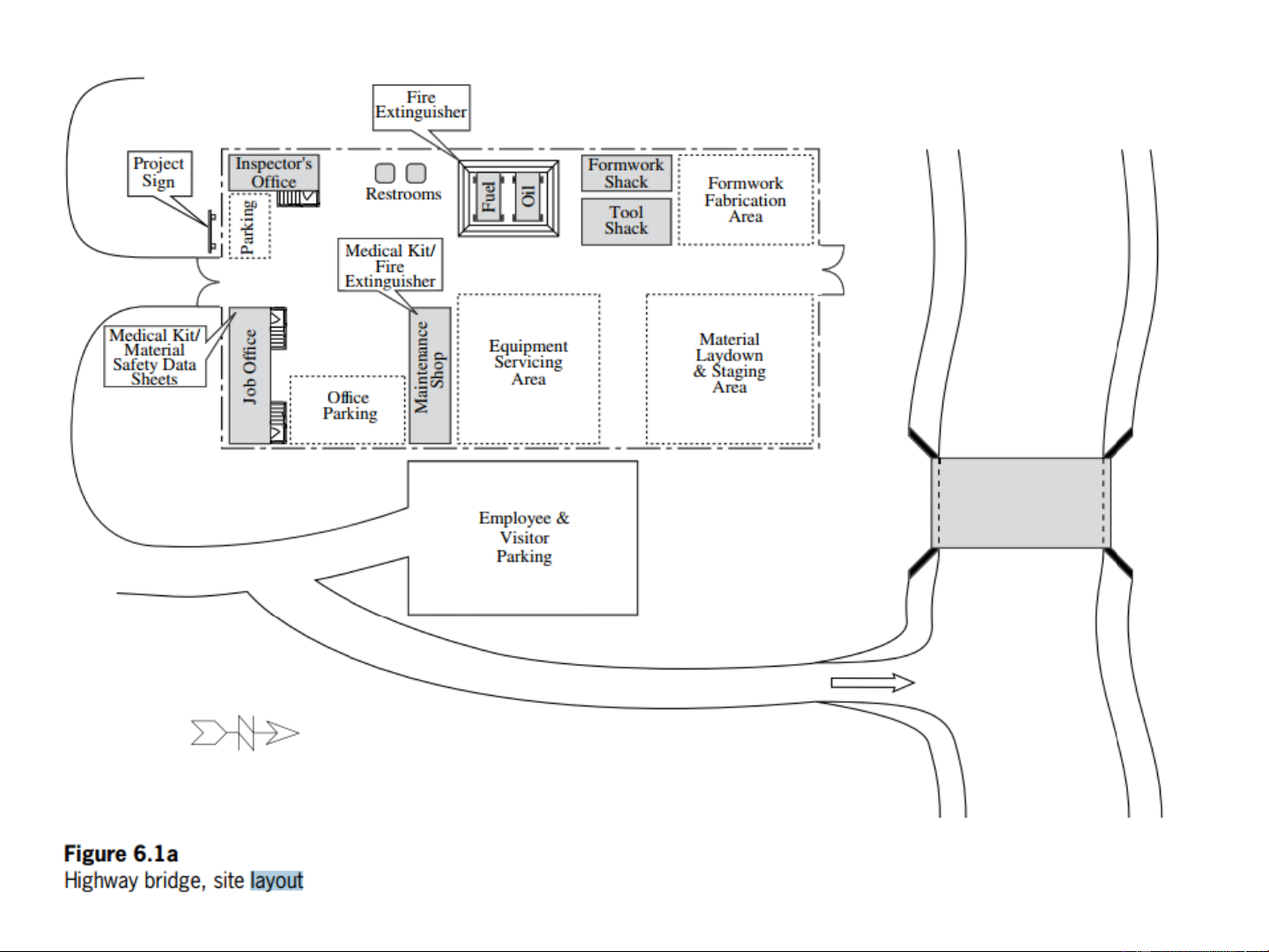
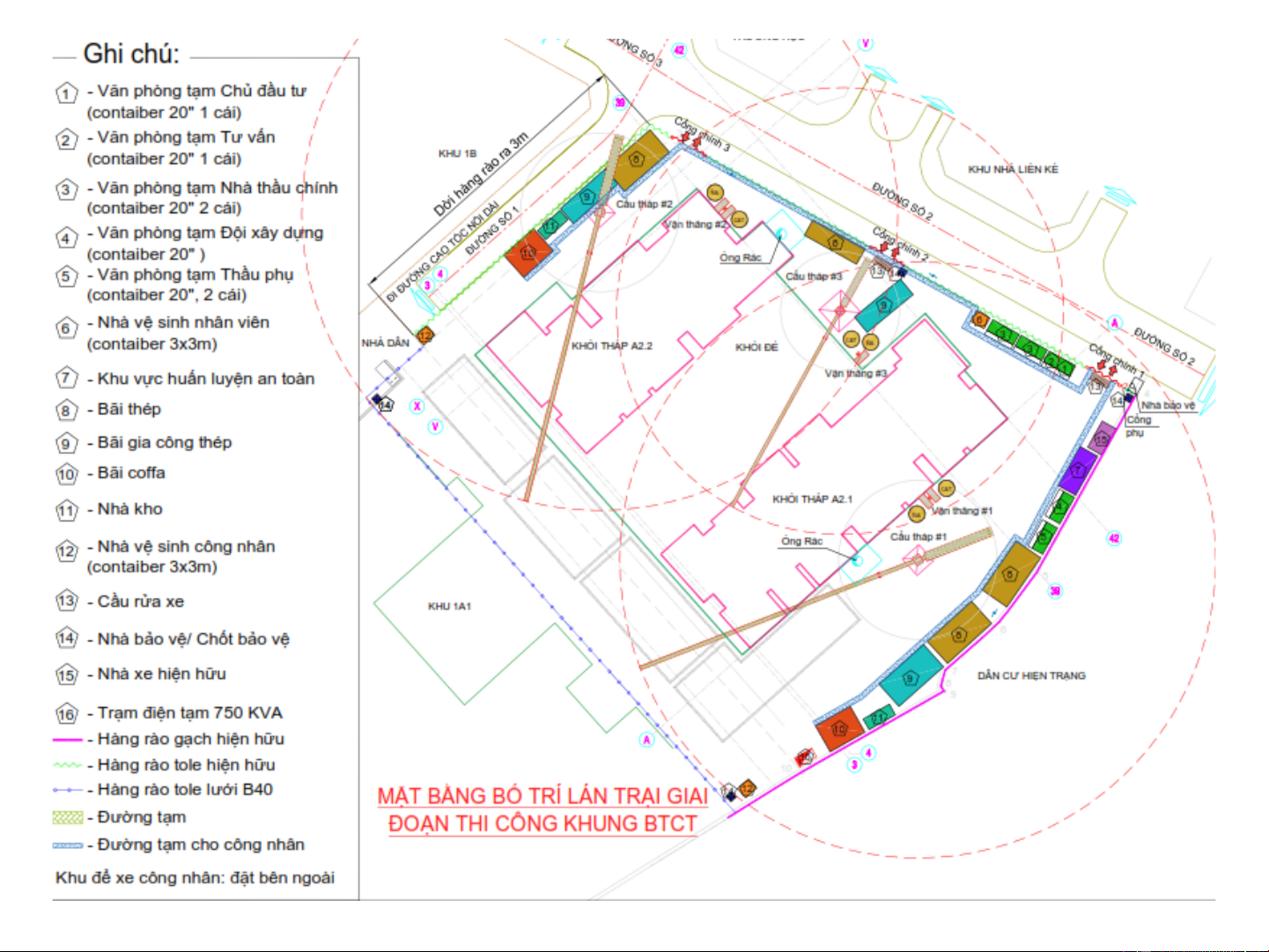
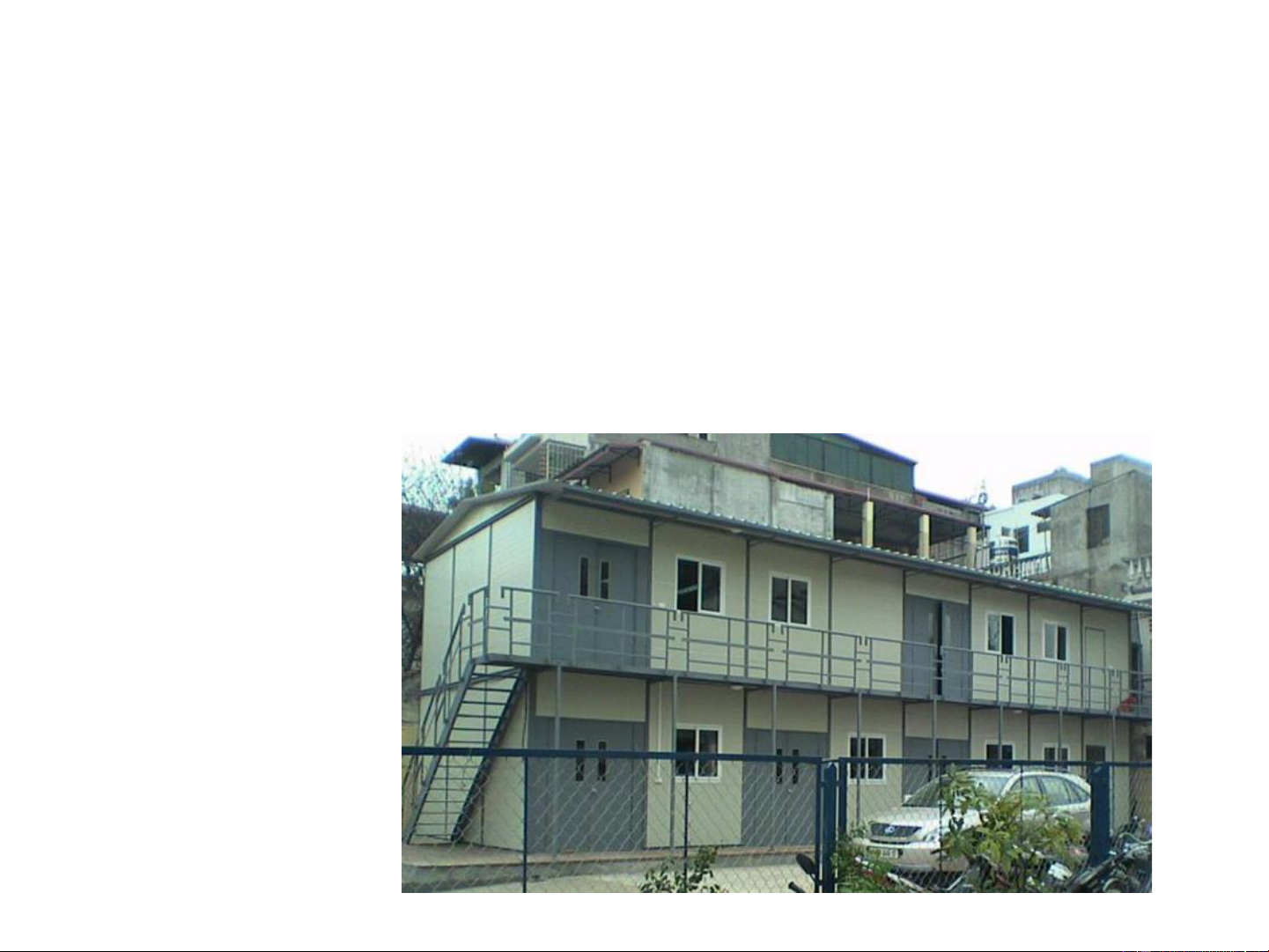
• Construction Site Layout involves identifying, sizing and placing
temporary facilities (TFs) within the boundaries of construction site.
• These TFs range from simple laydown areas to warehouses,
fabrication shops, maintenance shops, batch plant, and residence facilities.
• Required TFs and their areas are depending in many factors
including project type, scale, design, location, and organization of construction work. 6 1. Introduction
There are two general objectives which planners
should seek to meet through careful organization of the site for construction:
• First, the site must be designed to maximize
efficiency of operations in order to promote worker
productivity, to shorten project time and to reduce cost.
• Second, the final plan must create a project with a
good work environment in order to attract and
retain the best personnel and thus contribute to
better work quality and productivity. 7 2. Problems
Failure to plan the site layout in advance is a prime cause of
operational inefficiency, and can increase the overall cost of a project substantially.
In the absence of a precise site layout plan, the following problems may occur: 8 2. Problems
❖ Material stacks wrongly located. Materials arriving on
site are off-loaded into what someone guesses to be the
correct location. This problem may involve double or triple
handling of materials to another location. For example:
• They may stokedover a drainage line or near the edge of excavation;
• They are too far from the work area;
• They are too remote from the hoist or not within the radius of the crane;
• They impede the smooth flow of work traffic across the site;
• Their delivery was wrongly phased and they are not needed
until much later in the project; • They are fragile. 9 2. Problems
❖ Plant and equipment wrongly located. For example:
The mixer is inaccessible for the delivery of materials;
not enough room for the storage of aggregates;
Fixed cranes are unable to reach all parts of the works;
Hoists have insufficient capacity or height to handle the
loads or badly located in relation to the floor layout; 10 2. Problems
❖ Inadequate space allowed. Where inadequate
space is allowed for the stacking of materials or activities:
Materials may be stacked to high or stacked on roadways causing hazards.
Working areas may become too cramped or
additional areas may have to be allocated with
the consequent waste of time caused by having to travel between them. 11 2. Problems
❖ Site huts wrongly located in relation to their effective use, such as:
Site office located too near noisy activities such as mixer, or
located too near to site roads in dusty conditions, or too remote
with insufficient overview of the site.
Warehouses having inadequate access for loading and
unloading or located in insecure area. 12 2. Problems
Therefore, before moving on to a site, it is necessary to prepare a
detailed site plan, showing the positions to be taken by every item of
equipment, accommodation, ancillary work areas and materials storage areas. 13
3. Site layout planning elements
A well planned site including all TFs and utilities lead to:
1) Increasing productivity and safety,
2) Reducing area(s) needed for temporary construction, 3) Maximizing utilization.
The following points should be considered in good site layout. 14
3. Site layout planning elements 1) Safety:
Fire prevention: Fire is a major cause of damage on
construction sites. So that, fire extinguishers are basic
requirements on a construction project.
Medical services: On construction project a first aid kit is a
must. In remote projects a well-equipped medical room with a doctor and nurse is important. 15
3. Site layout planning elements 1) Safety:
Construction safety clothing: Basic safety supplies like safety
shoes, hard hats, gloves, and goggles must be used by workers. 16
3. Site layout planning elements 2) Site Accessibility:
Easy accessibility will keep the morale of the equipment and
vehicle drivers high, minimize the chance of accidents, and
save time in maneuvering to arrive at and leave the project.
In case of large projects, proper planning is required to layout
the roads leading from the nearest highway.
Internal roads are necessary for easy flow of work.
Also, Parking Lots are provided for the owner, office, and craft
personnel, but this facility must be planned where space does exist. 17
3. Site layout planning elements
3) Information Signs
Site map: It should locate details of the project, and displayed
in the office of the site superintendent or project manager and posted at the entrance gate.
Traffic regulatory signs: For large projects, traffic regulatory
signs help in guiding the traffic on the site and avoid accidents to a considerable extent.
Display of labor relations’ policy and safety rules: This will
help in eliminating disputes between labor and management.
Emergency routes and underground services: It is important
to display the emergency escape routes on every floor as the
building progresses. Locations of underground services should
be marked to prevent its damage. 18
3. Site layout planning elements 4) Security
Entrance: It is necessary to have a proper guard entrance to
the site provided by a booth. Also, it is necessary to keep track
of all visitors to the project.
Lighting: It is necessary to have a standby generator to maintain site lighting.
Fencing: The boundary should be fenced off from a security point of view. 19
3. Site layout planning elements 5) Accommodation
On large construction projects, it is necessary to provide camp
accommodation for all type of staff involved in the project. 20
Tài liệu liên quan:
-

Lesson 7:Cost Management môn Quản lý dự án cho kỹ sư | Trường Đại học Sư phạm Kỹ thuật Thành phố Hồ Chí Minh
43 22 -
Ôn tập giữa kì | Môn Quản lý dự án cho kỹ sư - Đại học Sư phạm Kỹ thuật Thành phố Hồ Chí Minh
164 82 -

Cách quản lý rủi ro trong xây dựng | Tài liệu môn quản lý dự án cho kỹ sư Trường đại học sư phạm kỹ thuật TP. Hồ Chí Minh
384 192 -
Đề cương ôn tập thi giữa kỳ môn Quản lý dự án cho kỹ sư | Đại học Sư phạm Kỹ thuật Thành phố Hồ Chí Minh
1.2 K 589