A Combination between Genetic Algorithm and Heuristic Algorithmin Electric Vehicle Routing Problem
A Combination between Genetic Algorithm and Heuristic Algorithmin Electric Vehicle Routing Problem. Tài liệu được sưu tầm giúp bạn tham khảo, ôn tập và đạt kết quả cao. Mời bạn đọc đón xem.
ACombinationbetweenGeneticAlgorithmandHeuristicAlgorithm inElectricVehicleRoutingProblem
Môn: Tài liệu Tổng hợp 3.6 K tài liệu
Trường: Tài liệu khác 3.9 K tài liệu
Tác giả:







Preview text:
A Combination between Genetic Algorithm and Heuristic Algorithm
in Electric Vehicle Routing Problem An Vo, Tan Ngoc Pham
University of Information Technology,
Vietnam National University HCMC
Email: {19520007, 19520925}@gm.uit.edu.vn
Abstract—Driven by the badly directing in the present envi-
[4], EVRP is considered as a more difficult problem in
ronment, it is urgent to find out alternative way to reduce
comparison with the original one due to the recharging
the greenhouse gas and using electric vehicles is by far the
decision-making and more complex objective function
best choice nowadays. And solving the problem of optimizing
requiring to minimize distance cost [5]. EVRP is found to
routes for the electric vehicles or also known as the Electric
be quite difficult since it is relevant to distribute logistics
Vehicle Routing Problem is considered as a needed problem
in not only identifying customers set with a fixed demand
to be solved. In this paper, we give out a combination between
but satisfying EVs’ energy capacity also. In addition, the
Genetic Algorithm and a simple heuristic for Charging Stations
ultimate goal is to minimize the total distance between the
Placement to solve this problem. We divided our problem into
EVs. And in this paper, we did make a minor change -
two separate sections, which are Electric Vehicle Routing and
which is discussed further in 2.1 - to the indigenous version.
Locations of Charging Stations.
Index Terms—Electric Vehicles, K-means, Heuristics, Distance
Genetic algorithm (GA) [6] is a search-based technique
which have been used in optimization fields for practical
Optimizing, Genetic Algorithm, Charging Stations Placement
problems. The idea behind the algorithm itself is based on
the natural selection given by Charles Darwin’s evolutionary 1. Introduction
synthesis in the 1860s. The basic concept for GA can be
understood as the well-performed result will still remain
In present days, the market has a more tendency to
in the population and produce their better successor
compete to each other. The existence for an effective,
continuously, while the worse performance is removed.
feasible and environmental-friendly transporting system is
And the process proceeds on and on until the inappropriate
a crucial factor of a logistic company. One of the present
individuals become extincted eventually.
strategy of those companies is to shift to a newer type of
vehicles: Electric Vehicles (EVs). This is understandable
due to the continuously raising need for energy alternatives,
The rest of this paper is organized as follows. We
which is comprehensible due to the present global warming,
will discuss some of related work sharing the similarity
pollution and climate changes. The problem is such urgent
to our paper in section 2. We also discuss further about
that there are quite a few logistic companies around the
mathematical view for EVRP in section 3. Next, section 4
world now establish their own campaigns to manufacture
describes about our methods to solve this problem. Then, CO
section 5 will display our results in using methods in the 2-emission
reduction of daily operations, e.g. Tesla,
FedEx. Among the contributing factor to environmental
previous section. After that, section 6 will talk more about
harm, there is no doubt that transportation is the primary
our limitations and ways to minimize them in our future
component, which gives out 29% of the total greenhouse
work. Finally, we will have our final conclusion for the
gas emission to the Earth [1]. The most effective way to whole paper.
reduce the greenhouse gas, hence, is to use electric vehicles (EVs). 2. Related work
The vehicle routing problem (VRP) is not a new
problem, it was first introduced in 2002 [2]. The problem
is demonstrated as finding the shortest routing solution
for a set of vehicles to visit a set of locations satisfying
Solving the EVRP with an effective solution is an urgent
customers’ needs [3]. Due to the effective of the VRP, there
need, and it is clear to realize in the study below. Throughout
is a wide range of variation to the original problem itself.
this work, we solve the electric vehicle routing and location
One of the upgraded versions for VRP is known as the VRP
of Charging Stations (CSs) separately. The mentioned re-
with EVs or the electric vehicle routing problem (EVRP)
search, thus, is divided into two individual sections.
2.1. Location of charging stations
and human solving by Clarke and Wright in 1964 [16].
Location of CSs is a problem with multiple objective
Braekers et al. (2015) [17] showed the importance and
functions, e.g. energy cost and total travel distance.
potential for the vehicle routing problem in our present 21st
days by manifesting its variants and differently approaching
Hidalgo et al. (2016) [7] proposed a GA for location
techniques from 2009 to 2015; and Metaheuristic algorithms
of CSs considering actual demand of electric energy
by far outweighed the others. There, one of the most
consumption, with different capacities and energy levels
investigated variants for the VRP was the EVRP due to
between vehicles. Dong et al. (2016) [8] proposed a
the need for cost reducing and protecting the environment
two-phases solution. In the first one, they use K-means [9]
in the industry. The solution for the problem was also first
to divide the market into regions based on demands. They
proposed as in Braekers et al. after considering several
use a model to acknowledge locations of CSs while still restrictions.
maximizing operational productivity in the second one.
The exact problem of the EVRP with recharging stations
Lam et al. (2013) [10] proposed a mathematical
and an exact method was first introduced by Conrad and
formulation for the problem and they provide four
Figliozzi (2011) [18]. In this work, the author gave a exact
strategies to solve that problem, including mixed integer
demonstration for a sub-problem in the present EVRP
linear programming iterative method, greedy algorithm,
nowadays of which EVs are enabled to recharging battery
mixed integer linear programming approach, chemical
after traveling at customers nodes. In later times, Erdogan
reaction optimization. Gatica et al. (2018) [11] also
and Miller-Hooks (2012) [19] proposed two construction
proposed four solution strategies for the location of
heuristics, which are the Modified Clarke - Wright Savings
CSs and a heuristic solution for electric vehicle routing.
heuristic and the Density-Based Clustering Algorithm, was
Comparing to other strategies, K-means gives out the best
shown to work efficiently on the problem of Green Vehicle
performance when locating the charging stations at the
Routing Problem (GVRP). Anagnostopoulou et al. (2014) centroid of the cluster.
[20] proposed a mathematical formulation to modelize
multiple constraints in the Electric Vehicle Routing Problem
Zhenfeng et al. (2017) [12] proposed a effective genetic with Time Windows (EVRP-TW).
algorithm with crossover, mutation and initialization.
Hence, GA’s operations in this work is mostly based on the
Reviewing these proposals and approaching point to
forementioned paper. This paper, however, goes through
solve the EVRP, we might consider to use heuristics and
all the charging stations once only. Fazeli et al. (2021)
metaheuristics instead of exact strategies. This is compre-
[13] proposed an efficient branch and cut framework and
hensible due to the unpredictable customers’ demands and
a three-phase heuristic algorithm that can efficiently solve
too many constraints for an exact efficient solution strategy
a variety of instances for min-max electric vehicle routing to handle.
problem (MEVRP). They use a wide range of techniques,
e.g. Variable Neighborhood Search, LKH Heuristic, Genetic 3. Problem statement Algorithm.
The EVRP is an extension of the original NP-hard VRP
Almost recent studies show the advance in researching
problem, of which goal is to find the smallest route for all
for this problem. Late trends are to propose modelizing the
vehicles to satisfy all customers’ demands, and with the
problem into mathematical formulas, as well as differently
constraint of starting and ending at the central depot. The
problem-approaching strategies. And among those high-
additional constraint for the EVRP is that there are battery
lighted K-means strategy, which seems to be quite simple
charge level limits and recharging decision-making. but highly effective.
The mathematical model of the EVRP is a fully 2.2. Electric vehicle routing
connected weighted graph G(V, A), where V = U ∪ R
such that U = {1, ..., n} is a set of n nodes (customers) in
At the beginning, the Electric Vehicle Routing problem
the graph, R = {n + 1, ..., n + s} is a set of s recharging
was invariant and far different from what we know
stations for EVs, set F 0 denotes the set of R recharging nowadays [14].
station, a central depot 0 as the starting point for all
EVs, and A = {(i, j) | i, j ∈ N, i 6= j} is a set of arcs
The vehicle routing problem was first laid the ground connecting those nodes.
by Dantzig and Ramser in 1959 [15]; they showed the
explanation for the problem of assigning stations for
For every arc in the graph, it is assigned to a non-
vehicles to travel between two any given points in the negative real value d + ij ∈ R as the Euclidean distance
shortest way and satisfy all the customers’ demands.
between two connected nodes i and j and for every node
And five years later, the problem was formalised and
i labeled as customer has a positive demand bi ∈ U .
mathematically demonstrated for both computer solving
Besides, each EV traveling in the arc (i, j) will consume 2
an energy amount ρdij, in which ρ is a constant denoting
the consumption rate for all EVs. 0 ≤ yi ≤ Q, ∀i ∈ V (9)
The solution for the EVRP is modelized as an objective
where variable yi denotes the remaining battery charge
function φ, then our task is to find a set of routes satisfy-
level of an EV on its arrival at node i ∈ V . The condition
ing all the customers’ demand, having the minimum total
that the battery charge never falls below 0 is guaranteed by
traveling time, followed by the conditions as: equations (7), (8) and (9). •
EVs all start (with a full energy level and full load)
xij ∈ {0, 1}, ∀i ∈ V, ∀j ∈ V, i 6= j (10) and end at the central depot. •
All recharging stations should be visited multiple
The last equation defines a set of binary decision variables
times on the go. (central depot included).
to recognized whether an arc is traveled or not valued by 1 •
Customer nodes are visited only once by one EV. and 0 respectively. •
The total demand of customers does not exceed the
EV’s total capacity C for every single route. 4. Methods •
The total energy consumption must not exceed any
maximal battery charge level Q for every single
This method is inspired by Zhenfeng et al. (2017) route.
[22]. Since the Electric Vehicle Routing Problem is a •
EVs leave the charging station with a full battery
NP-hard problem with sophisticated constraints, there is charge level.
no obvious optimal solution to the problem itself, thus we
Mathematically, the EVRP is expressed as [21]:
have to approximate the solution as optimal as possible. In
this paper, Genetic Algorithm is proposed as a promising X min φ = d solution to solve the EVRP. ij xij (1) (i,j∈U ∪R)∧(i6=j)
The problem is encoded in such a way that the depot s.t.
(0), customer nodes (1,...,n) and recharging stations (n + 1, X
n + 2,...,n +m) are encoded by a natural number, and the xij = 1 (2)
gene values are put into order of visiting sequence [22]. ∀i∈U ∪R,j∈V,i6=j
Figure 1 demonstrates the way three routes of 3 EVs are
where two these equations respectively define the EVRP
encoded into a chromosome: EV 1 starts from the depot 0
objective function and enforce the connectivity of customer
and visits customer node 5 and 3 and returns to the depot visits.
after recharging at recharging nodes 6 and visits customer
node 7; EV 2 from the depot travels to customer node 8 X xij ≤ 1, ∀i ∈ F 0 (3)
and recharges at recharging node 9, then it visits customer j∈V,i6=j
node 2 and returns to the depot; EV 3 starts from the depot,
visits customer nodes 4, 1 and 10 and returns to the depot
The third equation handles the connectivity of recharging without a need to recharge. stations. X X xij − xji = 0, ∀i ∈ V (4) j∈V,i6=j j∈V,i6=j
Figure 1: Chromosome representation of a problem
Equation (4) establishes flow conservation, i.e., by assuring
that for every node, the number of incoming arcs is equal
GA’s procedure is divided into 5 separate steps, which
to the number of outgoing ones. are:
uj ≤ ui − bixij + C (1 − xij) , ∀i ∈ V, ∀j ∈ V, i 6= j (5)
Initialization: In this step, we randomly assign the 0 ≤ u
code number for customer nodes in the genes, but we do i ≤ C, ∀i ∈ V (6)
not execute the same thing for Recharging Stations. In
s.t. variables ui denote the remaining carrying capacity of
order to generate a better population, we use K-means [9]
an EV on its arrival at node i ∈ V . Equations (5) and (6)
to initialize chromosomes (individual): we choose k =
are to assure all customers’ demands are all fulfilled via a
number of EV in the problem, and for every gene in our
non-negative carrying load upon arrival at any node (the
population, we will choose a different random seed to depot included).
guarantee the diversity of the original population. We have
to ensure that the population involves N individuals, s.t.
yj ≤ yi − ρdijxij, ∀i ∈ I, ∀j ∈ V, i 6= j (7)
N = number of customers + number of EV + 1, the
initialization satisfy the customer needs for each node and
never do an EV exceed the loading capacity Q as well.
yj ≤ Q − ρdijxij, ∀i ∈ F 0 ∪ {0}, ∀j ∈ V, i 6= j (8)
Let denote q0 as the customer node’s demand. We shall i 3
add number 0 after the t gene in the chromosome if Pt q0 ≤ Q and
Pt+1 q0 < Q. We will repeatedly i=1 i i=1 i
execute this number 0 insertion n − 1 times in both first
Figure 2: Randomly choose the sub-solution in parents 1 and last gene respectively.
Evaluation: In this paper, we will use fitness value f (i) = P d
Figure 3: Randomly choose the sub-solution in parents 2 (i,j∈U ∪R)∧(i6=j)
ij xij . The smaller our fitness
value, the better our solution quality. On the contrary,
the fitness value is invalid when f (i) = ∞. An invalid
solution is when the constraint of the EVs’ capacity or the
EVs’ energy capacity is violated. However, we realized
Figure 4: Change the sub-solution in parents 1 to the front
that violating the EVs’ capacity constraint is much worse
than violating the energy one. This is because we can fix
the energy capacity constraint by improving our heuristic
function for charging stations placement, but in other
Figure 5: Change the sub-solution in parents 2 to the front
hands, capacity violating makes our solution meaningless.
Selection: In this problem, we choose the Tournament 4)
Keep sub-path of the first chromosome in offspring
Selection [23] as the key. Tournament Selection is a method
1, add the genes of the second chromosome which
to choose an individual from a population of individuals
the first chromosome does not include after sub-
in a Genetic Algorithm. It consists of several tournaments
path as their sequence. Add number 0 in the last
between a few randomly chosen individuals from the gene of chromosome.
population. The winner (individual with the best fitness)
in each tournament is selected to proceed the crossover process. Figure 6: Offspring 1
Heuristic function to add recharging stations: We create
an energy list e, in which ei is the distance from node i to
the nearest charging station, at the beginning. Then, we will
loop through each element i in the population’s individual, Figure 7: Offspring 2
if the sum of total energy consumption from beginning to
node i and sufficient energy to get to the next node (node 5)
Add number 0 in any gene after the first sub-path
i + 1) is larger than Q subtracted by ei+1, after that we will
and select the offspring with the highest value of
add the charging stations between node i and node i + 1
fitness. The second offspring is obtained in the
via Dijkstra algorithm [24], in which the starting point is same manner.
node i, the ending point is node i + 1 and the rest in graph
is charging stations. We only add the edges between two
vertices into graph if energy cost of those does not exceed the EV’s remaining energy.
Figure 8: Add number 0 to any genes randomly
The result of Dijkstra algorithm is a list of charging stations
and we will add these nodes into between node i and i + 1 in this individual.
Crossover: We realized that keeping charging stations in
Figure 9: Add number 0 to any genes randomly
individuals will make the problem more difficult when indi-
vidual’s size is not the same in the population. Furthermore, 6)
Add recharging stations to every chromosome in
recharging stations do not play an important role when it the population.
comes to crossover process. We will get rid of all existing
recharging stations from the whole population in this step,
Mutation: Although GA requires mutation step, we do thus.
not use this step in our paper.
The crossover procedure consists of 6 sub-steps:
Terminated criterion: We will stop the procedure once 1)
Remove all recharging stations in the population.
the number of iteration exceeds the maximum value or 2)
Randomly choose a segment of genes in the chro-
our population converges, which means all the individuals mosome.
are perfectly identical. Or else, if both conditions are not 3)
Move the selected sub-path in each parent to the
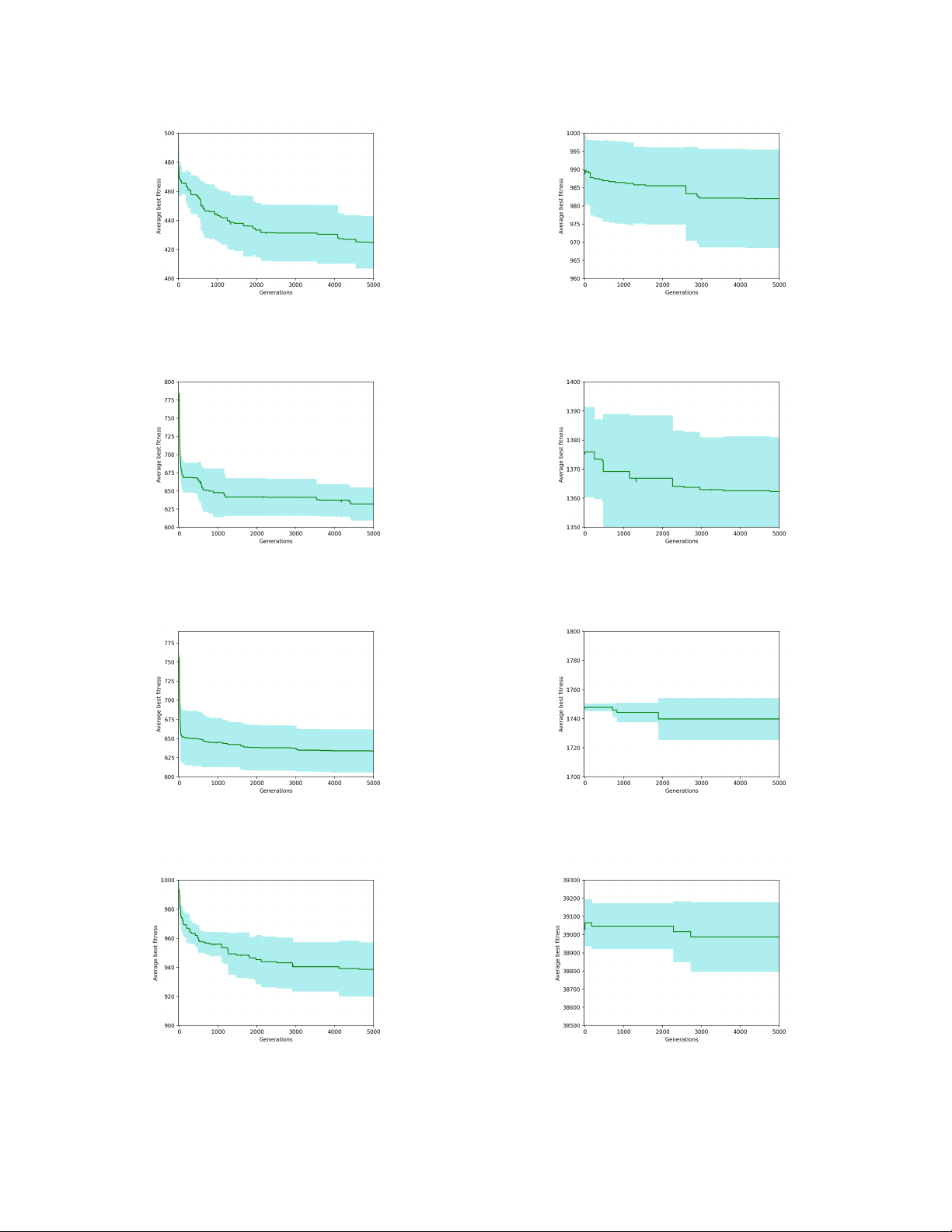
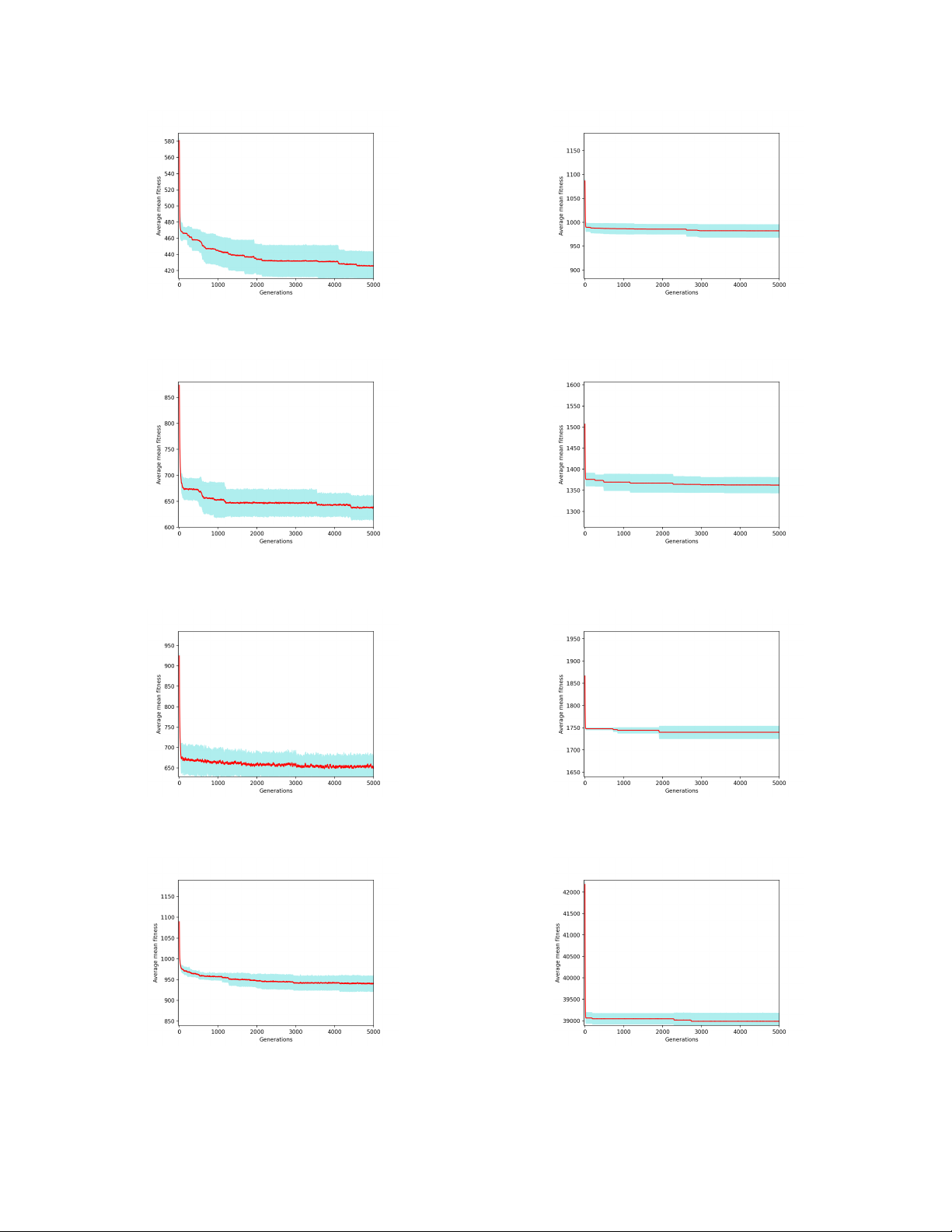
satisfied, we will return and continue the above process. front genes in the chromosome. 4 Figure 10: E-n22-k4 Figure 14: E-n51-k5 Figure 11: E-n23-k3 Figure 15: E-n76-k7 Figure 12: E-n30-k3 Figure 16: E-n101-k8 Figure 13: E-n33-k4 Figure 17: X-n143-k7 5 Figure 18: E-n22-k4 Figure 22: E-n51-k5 Figure 19: E-n23-k3 Figure 23: E-n76-k7 Figure 20: E-n30-k3 Figure 24: E-n101-k8 Figure 21: E-n33-k4 Figure 25: X-n143-k7 6
In addition to Genetic Algorithm, we also propose
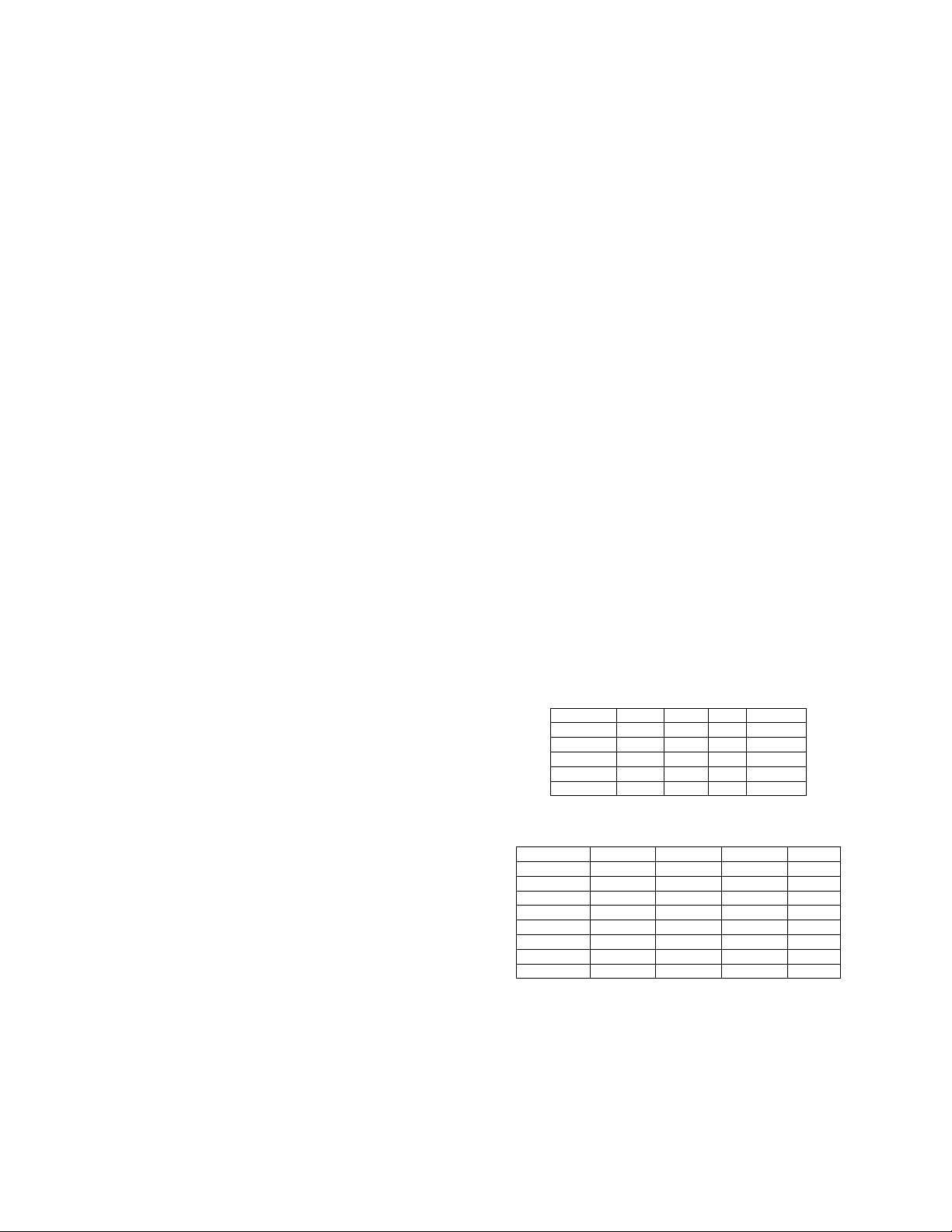
which are GA’s results (Table 1), Google OR-Tools’ results
Google OR-Tools [25] to handle the EVRP. Google
(Table 2) and the winner team in the competition’s one
OR-Tools provides us a tool to handle combinatorial
(Table 3). Each table is demonstrated as: the first column
optimization problem (C.O.P) via an open-source software.
consists of name of instances; the second, third, fourth and
This tool can help us to find the best (or relatively good)
the last one respectively consists of mean, max, min and
solution for our present problem through a large set of
standard deviation results in 10 runs. possible feasible solutions.
We also give out 8 plots responding to 8 first instances solve
by GA. The x-axis stands for number of generations and
In the vehicle routing problem, Google OR-Tools is
the y-axis is the average best fitness in 10 runs. The pale
designed to find the optimal routes as the solution, and OR-
turquoise zone represents for the standard deviation.
Tools defines an optimal route as the route with the smallest
total distance and all constraints are satisfied [3]. Since OR- Result analysis
Tools has not introduced an obvious tool to solve the EVRP
but the VRP only, we shall demonstrate our approach to
Incomplete as Google OR-Tools is, it still gives out the
make OR-Tools able to solve this problem effectively.
solution for the first five instances, in which the results for
E-n22-k4 and E-n51-k5 is excellent; the results are even 5. Results
better than our GA’s and quite close to the winner team’s results.
This section is to show the result of the EVRP when
Our GA’s result in Table 3 is outstanding with n ¡ 50
applying GA. Besides, we also compare our result with
and it is quite close to the winner team’s results. It becomes
Google OR-Tools and the winner in CEC-12 Competition
worse or even unsolvable, however, when n > 50 and n >
on Electric Vehicle Routing Problem1. 200, respectively. Settings
When observing plots, it is clear that K-means helps
Genetic algorithm to generate a relatively good population.
In this work, we choose the population size as 400 and
This can be shown since the green line has a tendency
number of generation as 5000 for Genetic Algorithm.
to decrease, which is a good signal. Thus, if we increase
number of generations, that green line has a probability to
Google OR-Tools is a restricted framework and there
go shallower. However, crossover as soon as the loop starts
is few documents to reference which leads to many a
makes GA unable to keep good individuals in the generating
difficulty when applying this framework into solving the
step. This is the reason for green line goes up when starting
EVRP. When applying OR-Tools to solve this problem, we
and go downhill when the numbers of generation increase
got into trouble which is EVs forgot to pay energy cost in some plot.
while moving to another recharging stations but still got
fully recharged. This unfortunately leads to the OR-Tools Instances mean max min stdev E-n22-k4 401 401 401 0
can not give any appropriate solutions. E-n23-k3 701 701 701 0 E-n30-k3 635.4 644 603 11.7149
Hence, we came into decision to restrict EVs’ battery E-n33-k4 997.8 1012 967 19.3845
level to a range calculated by: E-n51-k5 606.8 624 572 14.4069
TABLE 1: Google OR-Tools’ results X X Q = Q − max min ρdijxij (11) i∈V j∈R,i6=j Instances mean max min stdev E-n22-k4 384.67 384.67 384.67 0
This helps us to find the feasible solution for some initial E-n23-k3 571.94 571.94 571.94 0
instances, but none for later instances. E-n30-k3 509.47 509.47 509.47 0 E-n33-k4 840.14 840.46 840.43 1.18 E-n51-k5 529.90 548.98 543.26 3.52 Test instances E-n76-k7 692.94 707.49 697.89 3.09 E-n101-k8 839.29 853.34 853.34 4.73
Our benchmark set for this paper comes from the CEC- X-n143-k7 16028.05 16883.38 16459.31 242.59
12 Competition on Electric Vehicle Routing Problem [21].
TABLE 2: Variable Neighborhood Search’s results by D.
Woller, V. Vavra, V. Kozak, M. Kulich Table of results
There are 17 instances in the standard benchmark, we 6. Future work
just show solvable ones however. There are 3 tables in total,
In this paper, due to the time pressure, we did not do
1https://mavrovouniotis.github.io/EVRPcompetition2020
the mutation. However, we do believe that mutation step is 7 Instances mean max min stdev Biography E-n22-k4 424.95 464.39 402.53 18.7183 E-n23-k3 632.19 671.62 607.01 23.5857 E-n30-k3 633.81 669.65 593.78 29.0584 An Vo E-n33-k4 938.66 959.64 898.62 19.4428 E-n51-k5 981.97 1004.74 961.03 14.1877 E-n76-k7 1362.30 1391.84 1323.60 19.6518 E-n101-k8 1739.82 1752.73 1702.07 14.9056 X-n143-k7 38987.96 39384.5 38683.4 200.2779
TABLE 3: Genetic Algorithm’s results
a crucial factor in GA and it might increase the quality of
our solution. We will research it more in the future.
We also research a better heuristic function for locating
recharging stations compared to our present one. This is
due to the fact that adding recharging stations based on the
energy cost from the next node to the nearest recharging
station of that node is not good at all. We could choose a
An Vo graduated in 2019 at Phan Ngoc Hien High
further recharging station sharing the same direction to the
school for the gifted, Ca Mau province, specified for
solution’s trajectory, as long as going to that recharging
Mathematics - Informatics. From 2019, he has been
station does not exhaust the whole remaining energy level.
studying at University of Information Technology, Vietnam
National University HCMC, faculty of Computer Science,
Besides, we would also research more efficient crossover class of KHCL2019.1.
methods. We just solve the EVRP with the problem size
of less than 200 in present, the population with a larger
He received several prizes at provincial, Southern and
than 200 problems size is unacceptable poor since there is
National Olympics in Informatics. Besides, he has also
no feasible solution in the indigenous population. Thus, we
achieved himself three scholarships from Office of Student
will also find a more effective way to initialize the starting
Affairs, UIT - VNU HCM and two scholarships from Office
population as good as possible to solve large-scale problems
of Excellent Programs, UIT - VNU HCM.
and improve the smaller-problem size solution. Tan Ngoc Pham 7. Conclusion
In this work, we consider the Electric Vehicle Routing
Problem. We did propose a potential solution with several
techniques, e.g. Genetic Algorithm, Dijkstra, K-means and some heuristics.
Separating a big problem into two smaller ones, which
are electric vehicle routing and locations of charging
stations, enables us inheriting results from previous
researches in GA for the VRP. Then, we could design
Tan Ngoc Pham graduated in 2019 at Nguyen Du
an additional heuristic to add recharging stations into
High school for the gifted, Dak Lak province, specified for chromosomes to solve the EVRP.
English. From 2019, he has been studying at University
of Information Technology, Vietnam National University
However, heuristics seem to be insufficient despite sus-
HCMC, faculty of Computer Science, class of KHCL2019.2.
taining feasible at least one solution. Furthermore, gener-
ating a not so well population prevents GA from finding
He received several prizes at provincial and National
any solution. Thus, beside the proposed solution - which is
Olympics in English and second prize in the National
K-means, we would find newer methods.
Olympics in English is among the top prizes of him. Acknowledgment References
The authors would like to thank the support of the Evo- [1] U. S. E. P. Agency. (2019) Carbon pol-
lutionary Learning and Optimization (ELO@UIT) group at lution from transportation. [Online]. Avail-
the University of Information Technology, Vietnam National
able: https://www.epa.gov/transportation-air-pollution- University HCMC.
and-climate-change/carbon-pollution-transportation 8 [2]
P. Toth and D. Vigo, The vehicle routing problem.
https://doi.org/10.1287/mnsc.6.1.80 SIAM, 2002. [16] G. Clarke and J. W. Wright, “Scheduling of [3] “Vehicle routing problem,”
vehicles from a central depot to a number of Google, 2019. [Online]. Available: delivery points,” Oper. Res., vol. 12, no. 4,
https://developers.google.com/optimization/routing/vrp p. 568–581, Aug. 1964. [Online]. Available: [4]
J. Lin, W. Zhou, and O. Wolfson, “Electric vehicle
https://doi.org/10.1287/opre.12.4.568
routing problem,” Transportation Research Procedia,
[17] K. Braekers, K. Ramaekers, and I. Nieuwenhuyse,
vol. 12, pp. 508–521, 2016, tenth International Con-
“The vehicle routing problem: State of the art classifi-
ference on City Logistics 17-19 June 2015, Tenerife,
cation and review,” Computers Industrial Engineering, Spain. vol. 99, 12 2015. [5] A. Ceselli,
Felipe, M. T. Ortu˜no, G. Righini, and
[18] R. Conrad and M. Figliozzi, “The recharging vehicle
G. Tirado, “A branch-and-cut-and-price algorithm
routing problem,” Proc. of the 61st Annual IIE Con- for the electric vehicle routing problem with ference, 01 2011. multiple technologies,” SN Operations Research
[19] S. Erdogan and E. Miller-Hooks, “A green vehicle rout-
Forum, vol. 2, no. 1, pp. 1–33, 2021. [Online].
ing problem,” Transportation Research Part E: Logis-
Available: https://doi.org/10.1007/s43069-020-00052-
tics and Transportation Review, vol. 109, p. 100–114, x 01 2012. [6]
M. Mitchell, An Introduction to Genetic Algorithms. [20] A. Anagnostopoulou, M. Boile, S. Theofanis,
Cambridge, MA, USA: MIT Press, 1998.
E. Sdoukopoulos, and D. Margaritis, “Electric vehicle [7]
P. A. L. Hidalgo, M. Ostendorp, and M. Lienkamp,
routing problem with industry constraints: Trends and
“Optimizing the charging station placement by consid-
insights for future research,” Transportation Research
ering the user’s charging behavior,” in 2016 IEEE In-
Procedia, vol. 3, p. 452 – 459, 07 2014.
ternational Energy Conference (ENERGYCON), 2016,
[21] M. Mavrovouniotis, C. Menelaou, S. Timotheou, pp. 1–7.
C. Panayiotou, G. Ellinas, and M. Polycarpou, “Bench- [8]
Y. Dong, S. Qian, J. Liu, L. Zhang, and K. Zhang,
mark set for the ieee wcci-2020 competition on evo-
“Optimal placement of charging stations for electric
lutionary computation for the electric vehicle routing
taxis in urban area with profit maximization,” in 2016 problem,” 03 2020.
17th IEEE/ACIS International Conference on Soft-
[22] G. Zhenfeng, L. Yang, J. Xiaodan, and G. Sheng, “The
ware Engineering, Artificial Intelligence, Networking
electric vehicle routing problem with time windows
and Parallel/Distributed Computing (SNPD), 2016, pp.
using genetic algorithm,” in 2017 IEEE 2nd Advanced 177–182.
Information Technology, Electronic and Automation [9]
X. Jin and J. Han, K-Means Clustering, C. Sammut
Control Conference (IAEAC), 2017, pp. 635–639. and G. I. Webb, Eds. Boston, MA: Springer US,
[23] B. L. Miller and D. Goldberg, “Genetic algorithms,
2010. [Online]. Available: https://doi.org/10.1007/978-
tournament selection, and the effects of noise,” Com- 0-387-30164-8 425 plex Syst., vol. 9, 1995.
[10] A. Y. Lam, Y.-W. Leung, and X. Chu, “Electric vehi-
[24] E. W. Dijkstra, “A note on two problems in connexion
cle charging station placement,” in 2013 IEEE Inter-
with graphs,” Numerische mathematik, vol. 1, no. 1,
national Conference on Smart Grid Communications pp. 269–271, 1959.
(SmartGridComm), 2013, pp. 510–515.
[25] L. Perron and V. Furnon, “Or-tools,” Google. [Online].
[11] G. Gatica, G. AHUMADA, J. Escobar, and R. LIN-
Available: https://developers.google.com/optimization/
FATI, “Efficient heuristic algorithms for location of
charging stations in electric vehicle routing problems,”
Studies in Informatics and Control, vol. 27, 03 2018.
[12] G. Zhenfeng, L. Yang, J. Xiaodan, and G. Sheng, “The
electric vehicle routing problem with time windows
using genetic algorithm,” in 2017 IEEE 2nd Advanced
Information Technology, Electronic and Automation
Control Conference (IAEAC), 2017, pp. 635–639.
[13] S. S. Fazeli, S. Venkatachalam, and J. M. Smereka,
“Efficient algorithms for electric vehicles’ min-max routing problem,” 2021.
[14] G. Gatica, G. AHUMADA, J. Escobar, and R. LIN-
FATI, “Efficient heuristic algorithms for location of
charging stations in electric vehicle routing problems,”
Studies in Informatics and Control, vol. 27, 03 2018.
[15] G. B. Dantzig and J. H. Ramser, “The truck dispatching problem,” Manage. Sci., vol. 6,
no. 1, p. 80–91, Oct. 1959. [Online]. Available: 9
Tài liệu liên quan:
-

Ung dung game hoa trong cac chien dich MKT
18 9 -

Bao cao Chi so TMDT Viet Nam 2025
15 8 -

Thông tư quy định về việc phân quyền, phân cấp và phân định thẩm quyền quản lý nhà nước về giáo dục cho chính quyền địa phương
24 12 -
Nghị quyết về phát huy các giá trị di sản văn hóa gắn với phát triên du lịch bền vững tỉnh Khánh Hòa đến năm 2025, định hướng đến năm 2030
14 7 -

Quyết định phê duyệt Chiến lược phát triển du lịch Việt Nam đến năm 2030
13 7