A Model for Mobile Content Filtering in Recommendation Systems môn Xử lý tín hiệu số| Đại học Bách khoa Hà Nội
A Model for Mobile Content Filtering on Non-Interactive Recommendation Systems.Tài liệu giúp bạn tham khảo, ôn tập và đạt kết quả cao. Mời đọc đón xem!
Môn: Xử lý tín hiệu số hust 33 tài liệu
Trường: Đại học Bách Khoa Hà Nội 5.8 K tài liệu
Tác giả:


















Preview text:
15:04, 10/01/2026
A Model for Mobile Content Filtering in Recommendation Systems (IM313) - Studocu
See discussions, stats, and author profiles for this publication at: https://www.researchgate.net/publication/220753459
A model for mobile content filtering on non-interactive recommendation systems
Conference Paper · October 2011
DOI: 10.1109/ICSMC.2011.6084100·Source: DBLP CITATIONS READS 4 134 3 authors: Worapat Paireekreng Kok Wai Wong Murdoch University Murdoch University
27 PUBLICATIONS128 CITATIONS
290 PUBLICATIONS5,836 CITATIONS SEE PROFILE SEE PROFILE Chun Che Fung Murdoch University
311 PUBLICATIONS4,539 CITATIONS SEE PROFILE 15:04, 10/01/2026
A Model for Mobile Content Filtering in Recommendation Systems (IM313) - Studocu
All content following this page was uploaded by Chun Che Fung on 18 March 2014.
The user has requested enhancement of the downloaded file. 15:04, 10/01/2026
A Model for Mobile Content Filtering in Recommendation Systems (IM313) - Studocu
MURDOCH RESEARCH REPOSI TORY
http: / / researchrepository.murdoch.edu.au/
This is the author’s final version of the work, as accepted for publication fol owing
peer review but without the publisher’s layout or pagination.
Pair eek r en g , W ., W on g , K.W . an d Fu n g , C.C. ( 2 0 1 1 ) A m o del f o r
m o bi le co n t en t f ilt er in g on n on - in t er act i ve r eco m m en d at io n
sy st em s. I n : I EEE I n t er n at io n al Con f er en ce on Sy st em s, Man
an d Cy b er n et ics, 9 - 1 2 Oct o ber , An ch or ag e, Alask a.
http: / / researchrepository.murdoch.edu.au/ 6472/ 15:04, 10/01/2026
A Model for Mobile Content Filtering in Recommendation Systems (IM313) - Studocu Copyright © 2011 IEEE
Personal use of this material is permitted. However, perm ission to reprint/ republish
this material for advertising or promotional purposes or for creating new col ective
works for resale or redistribution to servers or lists, or to reuse any copyrighted
component of this work in other works must be obtained from the IEEE. 15:04, 10/01/2026
A Model for Mobile Content Filtering in Recommendation Systems (IM313) - Studocu
A Model for Mobile Content Filtering on
Non-Interactive Recommendation Systems
Worapat Paireekreng, Kok Wai Wong and Chun Che Fung
School of Information Technology Murdoch University Perth, Australia
{w.paireekreng, k.wong, l.fung}@murdoch.edu.au
Abstract— To overcome the problem of information
terms of demographic factors to identify the group of users
overloading in mobile communication, a recommendation
that a new user belongs to [1]. Some researchers have
system can be used to help mobile device users. However, there
focused only on item rating for recommendation systems [2,
are problems relating to sparsity of information from a first-
3] despite the fact that the system needs both user-based
time user in regard to initial rating of the content and the information and item rating-based information to
retrieval of relevant items. In order for the user to experience
personalized content delivery via the mobile recommendation
recommend the items even for a first-time user on a non-
system, content filtering is necessary. This paper proposes an
interactive system. A non-interactive system is a system
integrated method by using classification and association rule
without any feedback from the user [4]. Research by Chen
techniques for extracting knowledge from mobile content in a
and Yu [5] presented a hybrid technique based on item and
user’s profile. The knowledge can be used to establish a model
user collaborative filtering. However, this technique is not
for new users and first rater on mobile content. The model
completed in a user’s characteristic analysis. They focused
recommends relevant content in the early stage during the
only on a user’s statistical rating data.
connection based on the user’s profile. The proposed method
The next problem related to the establishment of the
also facilitates association to be generated to link the first rater
model is that most techniques ignore non-rated items or new
items to the top items identified from the outcomes of the
items. If a new item appears in the record and it is not rated
classification and clustering processes. This can address the
problem of sparsity in initial rating and new user’s connection
yet, or the rating is quite low compared to top-rated item, it
for non-interactive recommendation systems .
has less chance to appear at the top even though it might be
Keywords-mobile recommendation; content-based filtering;
relevant to the user indirectly based on the user’s profile.
Strictly speaking, there should be some mechanisms to
association rule; classification
allow such content to be retrieved by associating the item to the interests of the user. I. INTRODUCTION
In this paper, we address the problem of first raters for
non-interactive mobile content recommendation systems by
In recent years, users can access information
proposing an integrated Classification and Association
ubiquitously with devices such as mobile or smart phones.
Rules-based technique for extracting knowledge from a
The main limitation on mobile phones is the overloading of
mobile content user’s profile. The proposed approach can
information. This has led to the focus of development on
gain knowledge to establish a model for new users based on
mobile content recommendation systems. Mobile content is
mobile content from the user’s profile, as well as providing
normally available through various kinds of websites. It is a
association of the non-rated or new items to the top items.
challenge for the recommendation systems to provide first-
time users with appropriate personalized content. II. RELATED WORKS
Most recommendation systems have problem in the A. Recommendation System
early stage to make a reasonable recommendation due to the
lack of user profile information. This problem is known as
Personalization has been incorporated in applications
sparsity for items with initial rating or first rater, and first-
such as recommending product items from a menu, as in the
time users. It is difficult to establish the recommendation
case of an infotainment TV show [6]. One of the techniques
model for users in the early stage of a recommendation
used to implement a recommendation system is 15:04, 10/01/2026
A Model for Mobile Content Filtering in Recommendation Systems (IM313) - Studocu
system, as there are insufficient amount of rated content to
collaborative filtering. This technique has focused on an
determine the recommended or relevant items. It is also
item-based approach such as that reported in [7]. Some
difficult to find similar groups of users because of the
other approaches concentrated on the users. For example,
sparsity problem especially when using collaborative
Shani et al. [8] proposed to establish user profiles in
filtering method. Collaborative filtering (CF) is a commonly
recommendation systems. However, a hybrid CF has also
used technique in recommendation systems. To focus on
been proposed by [5, 9] by combining information from
this problem, it is a challenge to incorporate a user profile in both users and items. 15:04, 10/01/2026
A Model for Mobile Content Filtering in Recommendation Systems (IM313) - Studocu
Using only collaborative filtering may not be sufficient C. Association Rules
to fulfill all the requirements of a recommendation system,
Association Rule (AR) is a rule-based technique that
especially in addressing the non-interactive and first rater
was proposed by Agrawal et al. [16] This technique is an
problem. The other approach for recommendation systems
important tool for data mining from databases that can be
is content-based filtering (CBF), which aims to find the
used to solve knowledge discovery problems and is also
correlation among items and user’s preferences [10]. Pazzini
suitable for handling categorical data. Association Rule is
also proposed a framework for recommendation systems
also capable of finding relevant relationships between the
using CF, CBF and demographic factors [1].
data, and constructs the rules for the association. It was
Recently, recommendation systems for mobile platforms
initially used for market basket analysis to determine the
have been established in the mobile channel media. This
relationship among shopping items and to understand the
was derived from multiple channels including TV, catalogs
decisions made by the customers in the purchases.
and the Web [11]. The approach mitigates the problem in
This technique works with large transactions in a
the early stage due to the lack of information from new
database to find the relationship among the items and
users and new items on the recommendation system.
construct the rules for decision. The model starts with a set
However, this research has not included the demographic
of items I which contains {i1, i2, i3,…, im} and there is a
factors and it could not identify the consumers’ behavior
transaction t in the database where t is a set of items, t I.
among the different user groups. In addition, an association
The transaction database is a set of transactions, T = {t1, t2,
rule technique has been used for product category or item-
t3,…, tn}. The Association Rules can measure the quality of
based approach. The technique did not find the relationships
the rules by 2 metrics, support and confidence.
between the users and the items.
Association rule has been used in mobile applications to
B. Data Mining and Classification Techniques on Mobile
find the top N items, as well. For example, Liu et al. [11] Content and Services used association rules to find multiple channel
recommendations for mobile users using channel weighting.
Data Mining can be used to interpret the problem
Another work focused on the segmentation of users with the
context and to provide solutions. Techniques such as
k-nearest neighbor method for collaborative filtering. It
classification, prediction, association and detection can be
implemented association rules to find the top N items based
used. Wu et al. [12] have shown that some commonly used
on customers’ content usage behavior (Recency, Frequency
algorithms in data mining are k-means, SVM, Apriori, and and Monetary) [17].
PageRank including Naïve Bayes.
However, when association rules alone are used in the
Classification techniques have also been incorporated recommendation system for mobile content
into the available mobile services. Research has suggested
recommendation, it may require a significant amount of
that selecting the best available service is not a simple task.
computation to find all the possible rules. Alternative
For example, Artificial Neural Networks (ANN) with feed-
approaches are therefore required to speed up this process.
forward back-propagation neural network were incorporated
to assist the selection of different types of particular mobile
III. METHODOLOGY AND EXPERIMENT
services [13]. Other research by Cufoglu et al. [14] had
proposed which classifier is the most appropriate for
A. Pre-processing data for Classification and Association
classifying user profiles in the same way as Nurmi and Rules
Hessinen [15]. Their work also presented the analysis of
The data source used for the experiment was obtained
personalization techniques for contextual data.
from published research work on the mobile internet content
However, these research proposals again have not taken
users in Bangkok [18]. This set of data consists of the user’s
care of the problem in the early stage of the mobile content
content preference such as multimedia, news or information
recommendation system for first-time users and non-rated or
services on mobile internet. 300 randomly selected records
new items. It mainly focused on the prediction and the
were used as training data. The clustering process has been
accuracy for the identified or known classes. Furthermore,
processed using cluster analysis from [19] in order to find
they were not used to handle the relevant items for content
groups of users with similar demographic factors.
recommendation. Some classification techniques are
From the clustering stage, the data have been separated
suitable for specific kinds of user data and when they are
into 6 groups, which are the un-clustered group and
combined with other techniques, some missing information
clustered groups (cluster number 1 to cluster number 5). 15:04, 10/01/2026
A Model for Mobile Content Filtering in Recommendation Systems (IM313) - Studocu
may not be used to continue with the next phase of the
After that, the top 3 mobile content items in each group are
recommendation system in finding the recommended or
calculated based on the average scores. The top 3 highest
relevant items. Hence, a more appropriate classification
scores have been chosen to work on the classification
method needs to be established. experiments.
The target variable is the item that users may need for their connection session. Before establishing the
classification model, all the data and variables are 15:04, 10/01/2026
A Model for Mobile Content Filtering in Recommendation Systems (IM313) - Studocu
normalized. In addition, the target variables which recorded
the user’s preference rating (1 to 5) are converted to binary
The proposed methodology to find the Association Rules
(0 and 1) for the prediction, where 0 is derived from user’s
of mobile content filtering for the recommendation system
preference range from 1 to 3 while 1 is derived from rating
on the relevant content items is a combination of the
4 or 5. So, ‘0’ means the user is not interested in this item,
classification association rule and multi-level association
while, ‘1’ represents the user’s preference for this item. This
rules. The purpose is to reduce the number of redundant
methodology is derived based on binary operation from
rules and to classify relevant content items based on
[20]. Then, the experiment is carried out item by item, that
classification and clustering techniques.
is, starting from the first item, then the second item, and the
In this stage of constructing the Association Rules for
third item etc. consecutively.
recommending relevant items on the system for the first-
The classification techniques that are used in this
time user in establishing the model, the Apriori algorithm
experiment are Artificial Neural Networks (ANN), Support
has been implemented in this phase. For the first step of
Vector Machine (SVM), Bayesian Networks (BS) and
Multi-level Targeting Classification Association Rule
Decision Tree with C5.0 algorithm.
Technique (MTCAR), the minimum support and confidence
After that, the adaptive association rule is applied for
are both set at 50%. After that, the rules for the first level
rule extraction. The solution to this problem can be used for
are obtained with 3 antecedents. Then, the second level is
partitioning and targeting. Partitioning can help to reduce
run separately for each target item based on its ranking
the number of itemsets to be counted, rather than dealing
specifically first, second and third. With the lower minimum
with all the items in the entire database [21]. The
support and confidence, the results of the second level are
Classification Association Rule (CAR) is an alternative the rules from each item.
method for this approach. However, this technique can be
So, from the first level and second level, all rules will be
used for solving classification problems in the known-class
consolidated to rank the outcome sorting by level (first or
database. So, the classification phase is needed. The multi-
second level) and order of the ranking items (for the second
level Association Rules [21] technique is another adaptive
level). The duplicate rules are eliminated and the rules that
association rule technique which divides the problem into
show the same result are also cut off using support,
levels for extracting the rules. It is a hierarchical concept in
confidence, level and sequence.
which the higher levels of frequent itemsets have more
From the experiment dataset, the data are not clustered,
support than the lower levels. The minimum support in the
but in the previous phase, clustering has been performed to
same level is identical. The advantage of this method is that
find the groups based on similar demographic factors. In
no complete rule processing is required, as the frequent
addition, a classification technique has been incorporated to
itemsets in the higher level help filter the itemsets in the
predict the most wanted items based on cluster information.
lower level with less minimum support. This means the
Then, from the classification results, these can be used as
lower level needs less support to run the algorithm for rule
targets and antecedents to find the Association Rules from
extraction and it will be run within the frequent itemsets of datasets.
higher level. This saved significant computational time in
The following description refers to Figure 2. The first
extracting the association rules.
level concerns the top-ranked items which are grouped to
B. The Proposed Multi-level Targeting Classification
increase support and confidence of rules for ensuring
Association Rule Technique (MTCAR)
people’s preference towards content items. This stage
implements the concept of classification association rules to
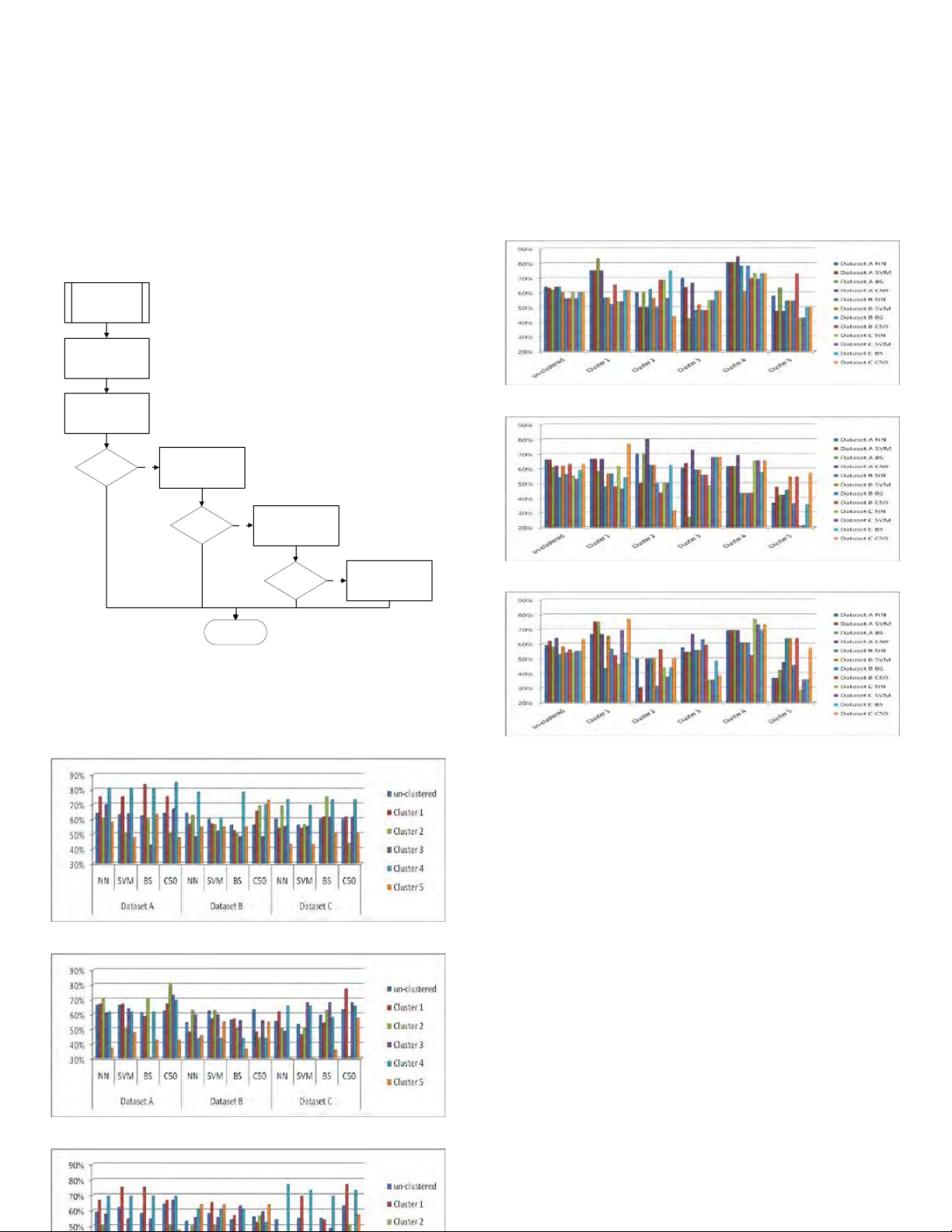
find the relevant items. The top-ranked items derived from Cluster User’s rating Classification Information Prediction
the classification phase are defined as targets for rule AR Generator
extraction. The second level of Association Rules Combination Individual target target rule rule extraction extraction
implements the concept of multi-level association rules. The
rules for this level are extracted by setting the target from Rule
the first level which is top ranking items. The second level Consolidation 13%12% 18% 15% 20% 7%8%
also uses support and confidence to measure the rules.
After the rules for 2 levels have been extracted, the next
step is rule consolidation. The first step is using rules from
Item(s) merger for recommendation generator
the first level to find the target items based on the top N. If 15:04, 10/01/2026
A Model for Mobile Content Filtering in Recommendation Systems (IM313) - Studocu
the system can find relevant items up to the top N, it is Item content Database
stopped. In contrast, if the first-level rule cannot complete
the requirement, the system goes to the next model and finds
the target according to the ranking of content items in each
cluster, specifically first, second and third. In addition, if the
Figure 1. Represent extraction of relevant items module based on
rules and targets are duplicated from the first level, it will be Association Rules process
cut off. Finally, the recommended items are derived and 15:04, 10/01/2026
A Model for Mobile Content Filtering in Recommendation Systems (IM313) - Studocu
prepared to be delivered to the mobile recommendation system. Rule Consolidation Identify number of items (N)
Figure 6. Accuracy rate for the first item compared to each cluster for all
Find ‘N’ targets from fist datasets level rule Find ‘N’ targets from No second level rule with 1st Target = ‘N’ ranking Find ‘N’ targets from second level rule with 2nd Target = ‘N’ No ranking Find ‘N’ targets from
Figure 7. Accuracy rate for the second item compared to each cluster for all No second level rule with 3rd Target = ‘N’ ranking datasets End
Figure 2. Rule consolidation process IV. EXPERIMENTAL RESULTS A. Classification Results
Figure 8. Accuracy rate for the third item compared to each cluster for all
The results of classification are shown in Fig. 3-8 datasets
B. Classification Model Selection
From the classification results, it can be seen that the
datasets and clusters show different results inconsistently.
As a result, it cannot be concluded which model is the most
suitable for mobile content recommendation for the top
items. The classification models are varied due to the data, variables and conditions.
Figure 3. Accuracy rate for the first item compared to each dataset and each
Therefore, the measurement of each cluster and each classification technique
classification model for each dataset is needed for justifying
the model selection. The CM-Score, Classification Model
Score, is built in order to generalize the results and to
choose the appropriate model. The purpose of this
measurement is to find which classifier is the most suitable
for cluster-based mobile content recommendation.
The scores for each classifier are calculated based on
accuracy rate and the ranking of the items which are first,
second and third in each dataset. In this metric, the weight
Figure 4. Accuracy rate for the second item compared to each dataset and each classification technique
for ranking of items is denoted as 3 points for the first item,
then 2 points for the second item and 1 point for the third
item. The number of cases in each cluster is also weighted
in the metric for generalization of the score based on
clustering. The CMScore is shown as follows: 15:04, 10/01/2026
A Model for Mobile Content Filtering in Recommendation Systems (IM313) - Studocu CMScore c c c CS nAC i1 where
CS = number of cases in cluster c,
Figure 5. Accuracy rate for the third item compared to each dataset and
AC = accuracy rate of cluster c, each classification technique c = cluster number, n = number of items. 15:04, 10/01/2026
A Model for Mobile Content Filtering in Recommendation Systems (IM313) - Studocu
Next, the CMScore for each classification technique is IM313 = 1.0
IM14 = 1.0 and IM31 = 1.0 and IM311 = 1.0 34.2466 84.0000 IM313 = 1.0 IM31 = 1.0 and IM311 = 1.0 50.6849 83.7838
derived, and then the model selection can use these scores to IM313 = 1.0 IM311 = 1.0 54.7945 80.0000
justify what is the appropriate technique to use for IM313 = 1.0 IM31 = 1.0 53.4247 79.4872 IM313 = 1.0 IM14 = 1.0 and IM311 = 1.0 36.9863 77.7778 predicting the top items for mobile content
(Please note that IM stands for Item number) recommendation.
Then, the second-level of rule extraction are shown in
CMScore, it is concerned with the cluster-based mobile
Tables III to V with ranking item from first-level targets.
content user groups. Although there is a variable number of
They are first, second and third ranking, respectively.
cases in each cluster, CMScore tries to generalize the score
for a cluster-based group because after clustering analysis,
TABLE III. EXAMPLE OF ASSOCIATION RULE EXTRACTION FOR THE
CLUSTER 5 BY SECOND-LEVEL RULES WITH FIRST RANKING ITEM
the results found that each cluster is grouped and represent
cluster’s characteristics such as teenager or mature people Consequent Antecedent Support % Confidence % IM311 = 1.0 IM14 = 1.0 52.0548 71.0526
with high income. This reflects the real-world situation that IM31 = 1.0 IM14 = 1.0 52.0548 65.7895
different people in the same group have similar preferences. IM312 = 1.0 IM14 = 1.0 52.0548 65.7895 IM313 = 1.0 IM14 = 1.0 52.0548 55.2632
In contrast, people in different groups may like different IM23 = 1.0 IM14 = 1.0 52.0548 52.6316 IM32 = 1.0 IM14 = 1.0 52.0548 52.6316
content items. The principal concept of clustering is to find IM326 = 1.0 IM14 = 1.0 52.0548 52.6316
the similar characteristics of the group that can predict IM11 = 1.0 IM14 = 1.0 52.0548 50.0000
which group incoming or new members belong to.
The CMScore results are shown below
TABLE IV. EXAMPLE OF ASSOCIATION RULE EXTRACTION FOR THE
CLUSTER 5 BY SECOND-LEVEL RULES WITH SECOND RANKING ITEM
TABLE I. CMSCORE AND WEIGHT RANKING ITEMS Consequent Antecedent Support % Confidence % IM312 = 1.0 IM311 = 1.0 54.7945 95.0000 NN SVM BS C5.0 IM31 = 1.0 IM311 = 1.0 54.7945 92.5000 CMScore 56.4540 56.5894 54.7105 60.8865 IM313 = 1.0 IM311 = 1.0 54.7945 80.0000 Weight ranking 116.6259 114.3763 112.801 123.4508 IM14 = 1.0 IM311 = 1.0 54.7945 67.5000 IM326 = 1.0 IM311 = 1.0 54.7945 60.0000 IM315 = 1.0 IM311 = 1.0 54.7945 55.0000
The CMScore shows that the highest score for IM32 = 1.0 IM311 = 1.0 54.7945 55.0000 IM316 = 1.0 IM311 = 1.0 54.7945 50.0000
classification techniques is Decision Tree with C5.0. Then, IM327 = 1.0 IM311 = 1.0 54.7945 50.0000
when the CMScore is influenced by ranking, the ranking
factor is used in CMScore calculation by adding weight 3 for
TABLE V. EXAMPLE OF ASSOCIATION RULE EXTRACTION FOR THE 5
the first item, 2 for the second item and 1 for the third item.
CLUSTER BY SECOND-LEVEL RULES WITH THIRD RANKING ITEM
The score suggested that Decision Tree is significantly Consequent Antecedent Support % Confidence %
higher than any other techniques based on the CMScore IM312 = 1.0 IM31 = 1.0 53.4247 94.8718 IM311 = 1.0 IM31 = 1.0 53.4247 94.8718 weight ranking. IM313 = 1.0 IM31 = 1.0 53.4247 79.4872 IM326 = 1.0 IM31 = 1.0 53.4247 64.1026 IM14 = 1.0 IM31 = 1.0 53.4247 64.1026 IM315 = 1.0 IM31 = 1.0 53.4247 53.8462 IM32 = 1.0 IM31 = 1.0 53.4247 53.8462 IM327 = 1.0 IM31 = 1.0 53.4247 51.2821
Finally, the results of the rule consolidation between
first-level and second-level of rules are shown in Table VI.
The results are the content items with top 10 ranking. The
top 3 are done in the classification phase and the rest are
Figure 9. Illustrate the CMScore and CMScore with weight ranking
done by the MTCAR for the relevant items. These results
C. Experiment Results of Association Rules
will be shown in the recommendation system.
This section presents the results of extracting the
TABLE VI. EXAMPLE OF RESULT OF RULE CONSOLIDATION FOR THE CLUSTER 5 BY MTCAR
Association Rules to find the relevant items for the
recommendation system. Table II shows an example of the Rank Results 1 ITEM#14
extracted rules from the first-level MTCAR. The 2 ITEM#311
Consequent represents the relevant items which are derived 3 ITEM#31 4 ITEM#312 from target items. 5 ITEM#313 6 ITEM#23 7 ITEM#32 15:04, 10/01/2026
A Model for Mobile Content Filtering in Recommendation Systems (IM313) - Studocu
TABLE II. EXAMPLE OF ASSOCIATION RULE EXTRACTION FOR THE 8 ITEM#326
CLUSTER 5 BY FIRST-LEVEL RULES WITH 3 CONTENT ITEMS 9 ITEM#11 10 ITEM#315 Consequent Antecedent Support % Confidence % IM312 = 1.0 IM31 = 1.0 and IM311 = 1.0 50.6849 97.2973 IM312 = 1.0 IM14 = 1.0 and IM31 = 1.0 34.2466 96.0000
V. DISCUSSION ON ESTABLISHING MODEL OF MOBILE IM312 = 1.0
IM14 = 1.0 and IM31 = 1.0 and IM311 = 1.0 34.2466 96.0000 CONTENT FILTERING IM312 = 1.0 IM311 = 1.0 54.7945 95.0000 IM312 = 1.0 IM31 = 1.0 53.4247 94.8718
Access through the mobile Internet with content filtering IM312 = 1.0 IM14 = 1.0 and IM311 = 1.0 36.9863 92.5926 IM313 = 1.0 IM14 = 1.0 and IM31 = 1.0 34.2466 84.0000
is a feature that mobile device users would like to have. 15:04, 10/01/2026
A Model for Mobile Content Filtering in Recommendation Systems (IM313) - Studocu Exchanging some allow-to-provide data such as
Computational and Information Sciences, Chengdu, Sichuan, China,
fundamental information like demographic factors can help 2010.
recommendation systems to provide personalized content by
[6] J. J. Cole, et al., "Personalisation for User Agents," in Proceedings of
filtering some content. It is also important to provide filtered
the fourth international joint conference on Autonomous agents and
content to new users and help them experience mobile
multiagent systems (AAMAS'05), Utrecht, Netherlands, 2005, pp. 603-
personalized content using a recommendation system. 610.
In this paper, the knowledge of mobile content filtering
[7] J. Zhang, et al., "An Optimized Item-based Collaborative Filtering
for a recommendation system has been extracted to address Recommendation Algorithm," in 2009 IEEE International
the problem of sparsity to initial rating or first rater and
Conference on Network Infrastructure and Digital Content, Beijing,
first-time connection user. The method proposed in this China, 2009.
paper can establish the model to handle first-time users and
[8] G. Shani, et al., "Establishing User Profiles in the MediaScout non-rated or new items for a non-interactive
Recommender System," in IEEE Symposium on Computational recommendation system.
Intel igence and Data Mining (CIDM 2007), Honolulu, Hawaii, USA,
The methodology uses classification that can help 2007.
mobile content recommendation to classify the users and
[9] H. Liang, et al., "Collaborative Filtering Recommender Systems
content to determine the prediction module used. In this
stage, different classification techniques have been
Using Tag Information," presented at the 2008 IEEE/WIC/ACM
compared. It can be seen from CMScore that for this type of
International Conference on Web Intelligence and Intelligent Agent
data on experimental datasets, Decision tree is an
Technology, Sydney, Australia, 2008.
appropriate algorithm to predict the top items for users.
[10] R. v. Meteren and M. v. Someren, "Using Content-Based Filtering for
Normally until this stage, most classification can only
Recommendation," in MLnetECML2000 Workshop, 2000.
comfortably identify the top 3 items.
[11] D.-R. Liu and C.-H. Liou, "Mobile Commerece Product
To predict the relevant top N items for mobile content
Recommendations Based on Hybrid Multiple Channels," Electronic
recommendation, Association Rules help to find the relevant
Commerce Research and Applications, vol. 10, pp. 94-104, 2011.
items by extracting rules based on support and confidence.
[12] X. Wu, et al., "Top 10 Algorithms in Data Mining," Knowledge and
The proposed MTCAR facilitates rule generation with level
Information Systems, vol. 14, pp. 1-37, 2008.
separation and target determination by top items from the
[13] Q. H. Mahmoud, et al., "Design and implementation of a smart
classification phase. Higher the level of confidence, the
system for personalization and accurate selection of mobile services,"
more confidence will be correlated between content items.
Requirement Engineering, vol. 12, pp. 221-230, October 2007.
As a result, MTCAR can extract rules by reducing the rule
[14] A. Cufoglu, et al., "A Comparative Study of Selected Classifiers with
complexity and cutting redundant rules by the rule
Classification Accuracy in User Profiling," presented at the 2009 consolidation process.
World Congress on Computer Science and Information Engineering,
Finally, the established recommendation systems in this
Los Angeles, California USA 2009.
paper can address the problems of first rater or new user for
[15] P. Nurmi, et al., "A Comparative Analysis of Personalization
non-interactive recommendation system and finding
Techniques for a Mobile Application," presented at the 21st
relevant items. In addition, it gives a process for first-time
International Conference on Advanced Information Networking and
user connection and not only predicts top content items but
Applications Workshops (AINAW'07), Niagara Falls, Ontario,
also retrieves relevant items. Canada, 2007. REFERENCES
[16] R. Agrawal, et al., "Mining Association Rules between Sets of Items
in Large Databases," in ACM-SIGMOD International Conference on
[1] M. J. Pazzani, "A Framework for Collaborative, Content-Based and
Management of Data, 1993, pp. 207-216.
Demographic Filtering," Artificial Intel igence Review, vol. 13, pp.
[17] D.-R. Liu, et al., "A Hybrid of Sequential Rules and Collaborative 398-408, 1999.
Filtering for Product Recommendation," Information Sciences, vol.
[2] S. K. Lee, et al., "Collaborative Filtering with Ordinal Scale-based 179, pp. 3505-3519, 2009.
implicit ratings for Mobile Music Recommendation," Information Sciences, [18] W. Paireekreng, "Influence Factors of Mobile Content
vol. 180, pp. 2142-2155, 2010.
Personalization on Mobile Device User in Bangkok," Research
[3] P. Melville, et al., "Content-Boosted Collaborative Filtering for report2007.
Improved Recommendation," in Eighteenth National Conference on
[19] W. Paireekreng, et al., "Cluster Analysis for Personalised Mobile
Artificial Intelligence (AAAI-2002), Edmonton, Canada, 2002, pp. 15:04, 10/01/2026
A Model for Mobile Content Filtering in Recommendation Systems (IM313) - Studocu
Entertainment Content," presented at the World Computer Congress, 187-192. Brisbane, Australia, 2010.
[4] F. H. d. Olmo and E. Gaudioso, "Evaluation of Recommender [20] B. Sarwar,
et al., "Item-based Collaborative Filtering
Systems: A New Approach," Expert Systems with Applications, vol.
Recommendation Algorithms," presented at the WWW10, Hong 35, pp. 790-804, 2008. Kong, 2001.
[5] Y.-n. Chen and M. Yu, "A Hybrid Collaborative Filtering Algorithm
[21] M. H. Dunham, Data Mining, Introductory and Advanced Topics.
Based on User-Item," presented at the International Conference on
New Jersey: Pearson Education Inc., 2003. 15:04, 10/01/2026
A Model for Mobile Content Filtering in Recommendation Systems (IM313) - Studocu 15:04, 10/01/2026
A Model for Mobile Content Filtering in Recommendation Systems (IM313) - Studocu View publication stats 15:04, 10/01/2026
A Model for Mobile Content Filtering in Recommendation Systems (IM313) - Studocu
Tài liệu liên quan:
-
Bài Tập Chương 2: Cơ Học - Tính Toán Lực và Gia Tốc môn Xử lý tín hiệu số| Đại học Bách khoa Hà Nội
40 20 -
Lấy Mẫu và Lượng Tử Hóa Tín Hiệu Trên Kit C6713 DSK - Báo Cáo Thí Nghiệm môn Xử lý tín hiệu số| Đại học Bách khoa Hà Nội
45 23 -
Mô phỏng hàm truyền trong Python: Hướng dẫn sử dụng scipy.signal và control môn Xử lý tín hiệu số| Đại học Bách khoa Hà Nội
45 23 -
VXL HK231 DE1 DA Final Exam Solutions and Code Explanations môn Xử lý tín hiệu số| Đại học Bách khoa Hà Nội
47 24