A Review of IoT Applications and Architecture | Iot và ứng dụng | Học viện Công nghệ Bưu chính Viễn thông
Evolution of internet began by connecting computers. Later many computers were connected together which) created World Wide Web.)Then mobile devices were able to connect to the internet which)leads to mobile-Internet technique. People started using the internet via social)networks. Finally the idea of connecting daily objects to the internet was proposed, which)lead to the Internet of Things technology [1]. Tài liệu được sưu tầm và soạn thảo dưới dạng file PDF để gửi tới các bạn cùng tham khảo, ôn tập đầy đủ kiến thức, chuẩn bị cho các buổi học thật tốt. Mời bạn đọc đón xem!
Môn: IoT và ứng dụng 143 tài liệu
Trường: Học viện Công Nghệ Bưu Chính Viễn Thông 1.8 K tài liệu
Tác giả:

Preview text:
!
International Research Journal of Engineering and Technology (IRJET) e-ISSN: 2395-0056
Volume: 06 Issue: 06 | June 2019 www.irjet.net p-ISSN: 2395-0072
A Review Paper on Internet of Things (IoT) and it’s Applications
Mrs. Sarika A. Korade1, Dr. Vinit Kotak2, Mrs. Asha Durafe3
1Student, Dept. of Electronics Engineering, SAKEC, Chembur, Mumbai, Maharashtra, India
2Professor, Dept. of Electronics Engineering, SAKEC, Chembur, Mumbai, Maharashtra, India
3Professor, Dept. of Electronics Engineering, SAKEC, Chembur, Mumbai, Maharashtra, India
---------------------------------------------------------------------***---------------------------------------------------------------------"
Abstract - Internet, a revolutionary invention, is always transforming into some new kind of hardware and software making it
unpreventable for anyone. The type of communication that we see today is either human-to-human or human-to-device, but the
Internet of Things (IoT) promises a great future for the internet where the type of communication is machine-to-machine (M2M). The
Internet of Things (IoT) is defined as a paradigm in which objects provide with sensors, actuators, and processors communicate
with each other to serve a meaningful purpose. In this paper we discussed IoT and its architecture. Further we explained different
applications of IoT for users, IoT advantages and disadvantages.
Key$Words:"IoT,"Edge"Computing,"Field"Protocol,"Cloud"Protocol,"Smart"City,"Smart"Grid,"Smart"Health,"Smart"Farming"" 1. INTRODUCTION
Evolution) of) internet) began) by) connecting) computers.) Later) many) computers) were) connected) together) which) created) World)
Wide)Web.)Then)mobile)devices)were)able)to) connect)to)the) internet)which)leads)to)mobile-Internet)technique.)People)started)
using)the)internet)via)social)networks.)Finally)the)idea)of)connecting)daily)objects)to)the)internet)was)proposed,)which)lead)to)the)
Internet)of)Things)technology)[1].) )
The)Internet)of)Things)term)is)coined)by)Kevin)Ashton)executive)director)of)the)Auto-ID)Center.)The)concept)of)IoT)first)became)
very)popular)through)the)Auto-ID)Centre)in)2003)and)in)related)market)analytics)and)it’s)publications[2].)When)the)concept)of)
such)communication)came)into)existence,)different)companies)focused)on)it)and)tried)to)recognize)its)significance)and)began)to)
identify) its) role) and) the) correlated) future) aspects,) then) these) companies) started) investing) in) the) domain) of) IOT) in) different)
periods)but)at)regular)intervals)of)time[3].)) ) 1.1 Definition of IoT
If)we)want)to)define)IOT)then)we)cannot)define)it)precisely)and)concisely)but)Vermesan)et) al.)defined)the)Internet)of)Things)as)
simply) an) interaction) between) the) physical) and) digital) worlds.) The) digital) world) interacts) with) the) physical) world) using) a)
plethora)of)sensors)and)actuators)[4].) )
IoT)can)also)be) defined)as)“An)open)and) comprehensive)network)of)intelligent)objects)that) have)the)capacity)to)auto-organize,)
share)information,)data)and)resources,)reacting)and)acting)in)face)of)situations)and)changes)in)the)environment”[5].)
Current)research)on)Internet)of)Things)(IoT))mainly)focuses)on)how)to)enable)general)objects)to)see,)hear,)and)smell)the)physical)
world)for)themselves,)and)make)them)connected)to)share)the)observations.)In)that)sense,)monitoring)and)decision)making)can)be)
moved)from)the)human)side)to)the)machine)side.) )
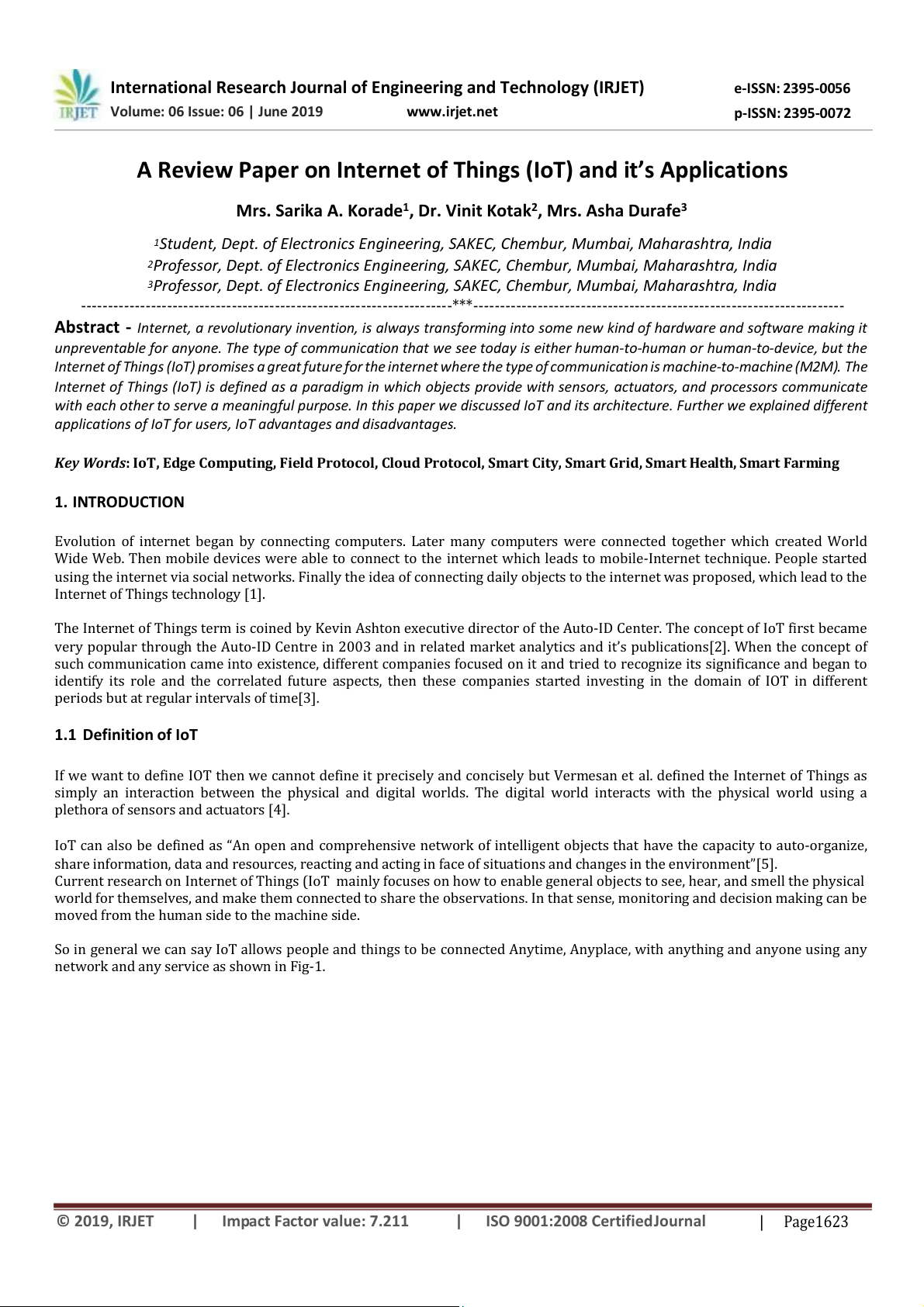
So)in)general)we)can)say)IoT)allows)people)and)things)to)be)connected)Anytime,)Anyplace,)with)anything)and)anyone)using)any)
network)and)any)service)as)shown)in)Fig-1.) " " ! ! © 2019, IRJET |
Impact Factor value: 7.211 |
ISO 9001:2008 Certified Journal |" Page"1623"
International Research Journal of Engineering and Technology (IRJET) e-ISSN: 2395-0056
Volume: 06 Issue: 06 | June 2019 www.irjet.net p-ISSN: 2395-0072
Fig -1: Definition of IoT 2. THE IOT ARCHITECTURE
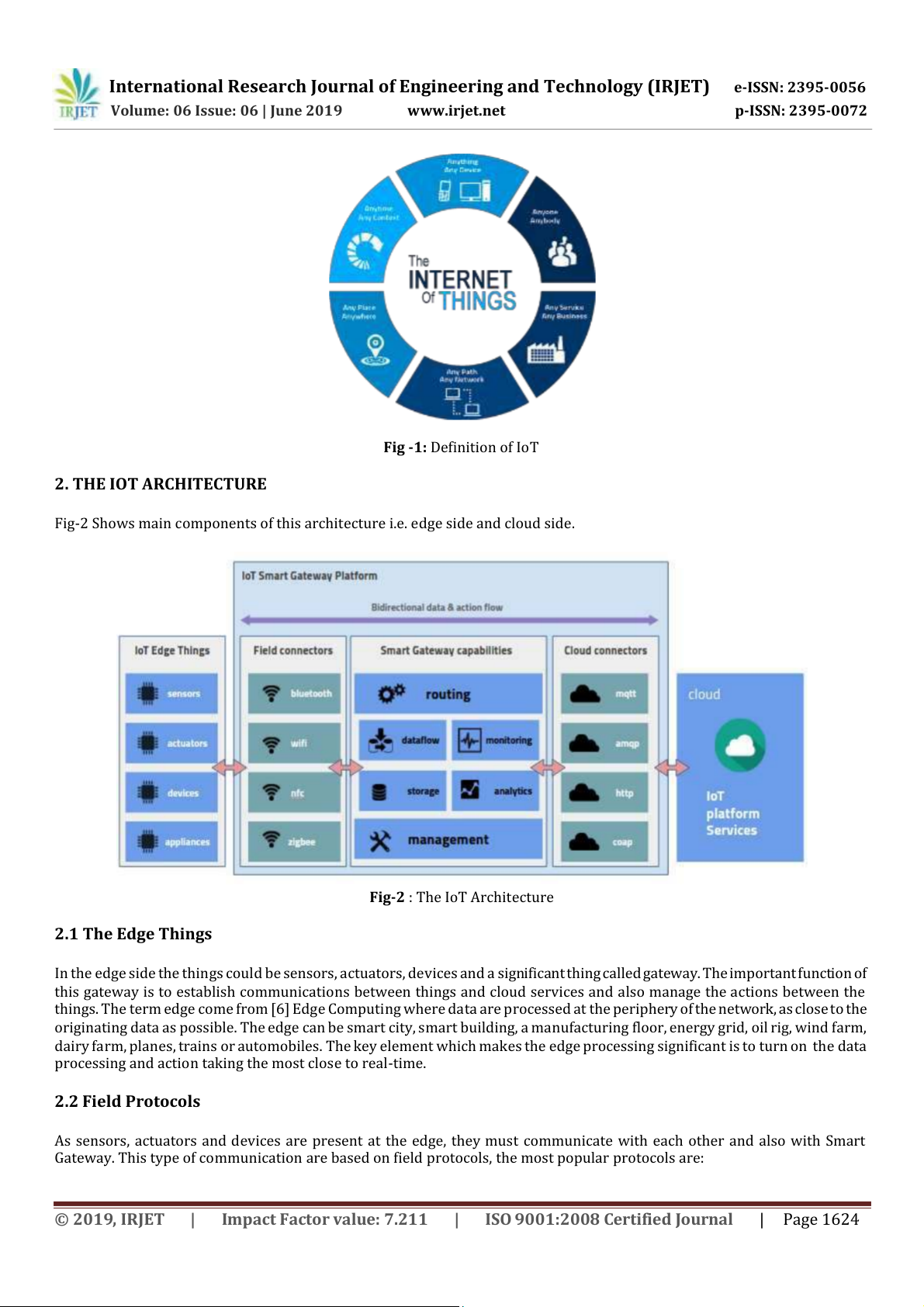
Fig-2 Shows main components of this architecture i.e. edge side and cloud side.
Fig-2 : The IoT Architecture 2.1 The Edge Things
In the edge side the things could be sensors, actuators, devices and a significant thing called gateway. The important function of
this gateway is to establish communications between things and cloud services and also manage the actions between the
things. The term edge come from [6] Edge Computing where data are processed at the periphery of the network, as close to the
originating data as possible. The edge can be smart city, smart building, a manufacturing floor, energy grid, oil rig, wind farm,
dairy farm, planes, trains or automobiles. The key element which makes the edge processing significant is to turn on the data
processing and action taking the most close to real-time. 2.2 Field Protocols
As sensors, actuators and devices are present at the edge, they must communicate with each other and also with Smart
Gateway. This type of communication are based on field protocols, the most popular protocols are:
© 2019, IRJET | Impact Factor value: 7.211 | ISO 9001:2008 Certified Journal | Page 1624
International Research Journal of Engineering and Technology (IRJET) e-ISSN: 2395-0056
Volume: 06 Issue: 06 | June 2019 www.irjet.net p-ISSN: 2395-0072
Bluetooth: It is a significant protocol for IoT applications. It has been designed to offer significantly reduced power
consumption. Standard: Bluetooth 4.2 core specification, Frequency: 2.4GHz (ISM), Range: 50-150m (Smart/BLE), Data Rates: 1Mbps (Smart/BLE)[7].
Zigbee: Similar to Bluetooth, it has a large installed base of operation, although perhaps traditionally more in industrial
settings. ZigBee PRO and ZigBee Remote Control (RF4CE), among other available ZigBee profiles, are based on the
IEEE802.15.4 protocol, which is an industry-standard wireless networking technology operating at 2.4GHz targeting
applications that need comparatively unusual information exchanges at low data-rates over a restricted area and within a
100m range such as in a home or building[7].
Wi-fi: This type is often a distinct choice for many developers, especially given the ubiquitous of Wi-Fi within the home
environment within LANs. It offers fast data transfer and the ability to handle high quantities of data[7].
NFC: Near Field Communication (NFC) is a technology that enables simple and safe two-way communication between
electronic devices, and especially applicable for smartphones, allowing consumers to perform contactless payment
transactions, access digital content and connect electronic devices. Essentially it extends the capability of contactless card
technology and enables devices to share information at a distance that is less than 4cm[7]. 2.3 IoT Smart Gateway
A main capability of IoT Gateway is enabling communication from the Edge to the Cloud. It means it must understand field
protocols and convert it to cloud protocols. Smart Gateway has the capabilities such as routing, Dataflow, management of data,
monitoring of data and storage of data[8]. 2.4 Cloud Protocols
The most of IoT solutions, even those ones live almost entirely on the edge need to integrate with cloud services or other IoT
solution based on cloud. We need to communicate using a cloud protocol as listed below:
MQTT: Message Queue Telemetry Transport (MQTT) was introduced by IBM in 1999 and standardized by OASIS in 2013 .
MQTT is frequently used and supported by embedded devices, and is also common in machine-to-machine interactions. It is
designed to provide embedded connectivity between applications and middle wares on one side and networks and
communications on the other side[9].
AMQP: The Advanced Message Queuing Protocol (AMQP) is a protocol that was designed for financial industry. It runs over TCP
and provides a publish/ subscribe architecture which is similar to that of MQTT. The difference is that the broker is divided into
two main components: exchange and queues. The exchange is responsible for receiving publisher messages and distributing
them to queues based on pre-defined roles and conditions. Queues basically represent the topics and subscribed by subscribers
which will get the sensory data whenever they are available in the queue[9].
CoAP: The Constrained Application Protocol (CoAP) is another session layer protocol designed by IETF Constrained Resurce
Environment working group to provide lightweight RESTful (HTTP) interface. Representational State Transfer (REST) is the
standard interface between HTTP client and servers. However, for lightweight applications such as IoT, REST could result in
significant overhead and power consumption. CoAP is a document transfer protocol. CoAP is designed to enable low-power
sensors to use RESTful services while meeting their power constraints. It is built over UDP, instead of TCP commonly used in
HTTP and has a light mechanism to provide reliability. CoAP architecture is divided into two main sublayers: messaging and
request/response. The messaging sublayer is responsible for reliability and duplication of messages while the
request/response sublayer is responsible for communication. As in HTTP, CoAP uses GET, PUT, PUSH, DELETE messages
requests to retrieve, create, update, and delete, respectively[9].
HTTP: HTTP is a "connectionless" protocol. With the HTTP bridge, devices do not maintain a connection to Cloud IoT Core.
Instead, they send requests and receive responses. This is the standard protocol for web services and still will be using in IoT
solutions. The overhead of this protocol is well known but we will continue use of this protocol in some case when latency and bandwidth are not issues[9].
© 2019, IRJET | Impact Factor value: 7.211 | ISO 9001:2008 Certified Journal | Page 1625
International Research Journal of Engineering and Technology (IRJET) e-ISSN: 2395-0056
Volume: 06 Issue: 06 | June 2019 www.irjet.net p-ISSN: 2395-0072
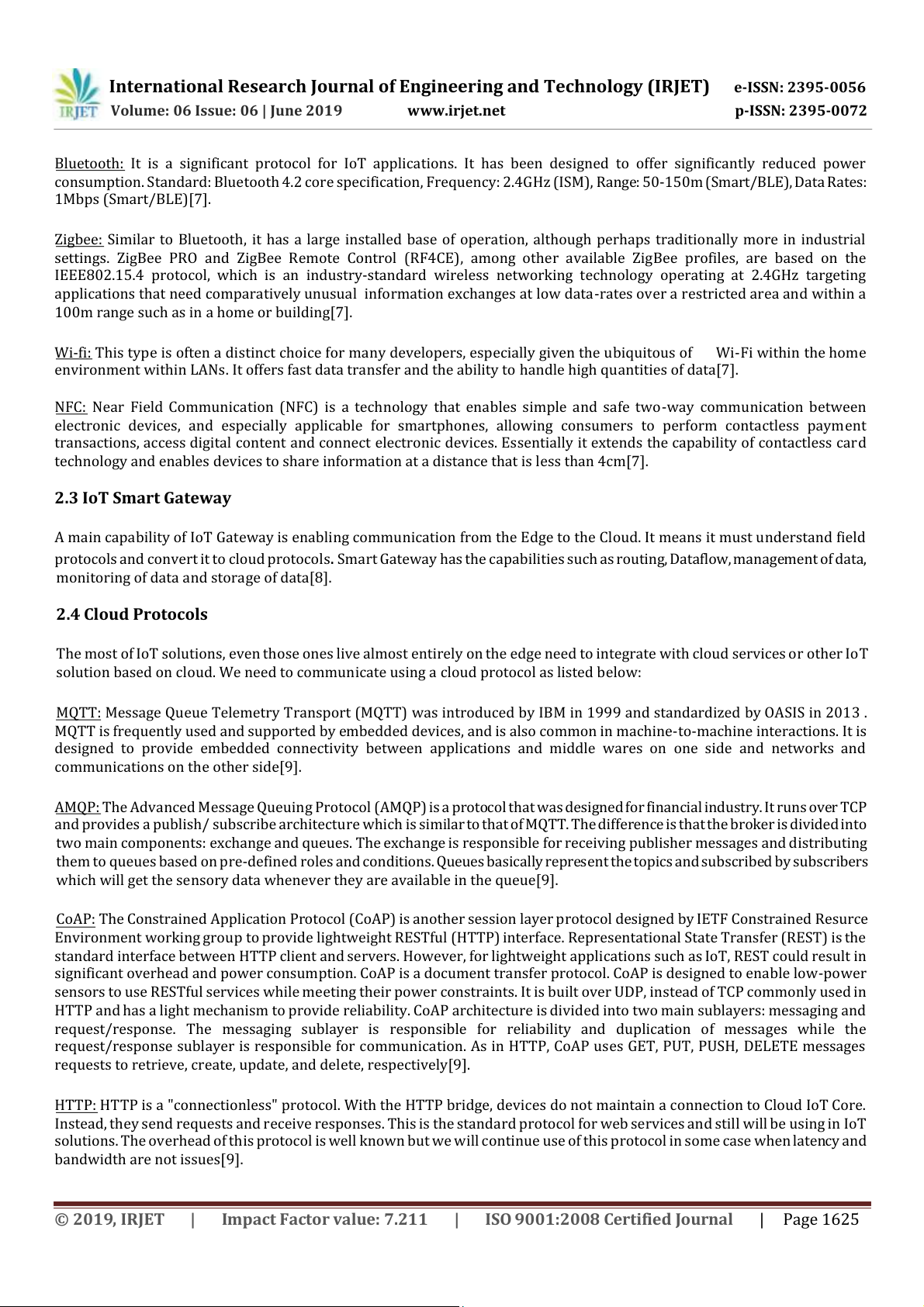
3. USE OF IoT IN VARIOUS APPLICATIONS
Most of the daily life applications are already smart but they are unable to communicate with each other and to enable them to
communicate with each other and share useful information with each other will create a wide range of innovative applications
[10]. These emerging applications with some autonomous capabilities would certainly improve the quality of our lives, all due
to the concept of IoT. In this section, we present few of IoT applications as shown in Fig-3.
Fig-3 : Applications of IoT
3.1 IoT For Smart Home/Building
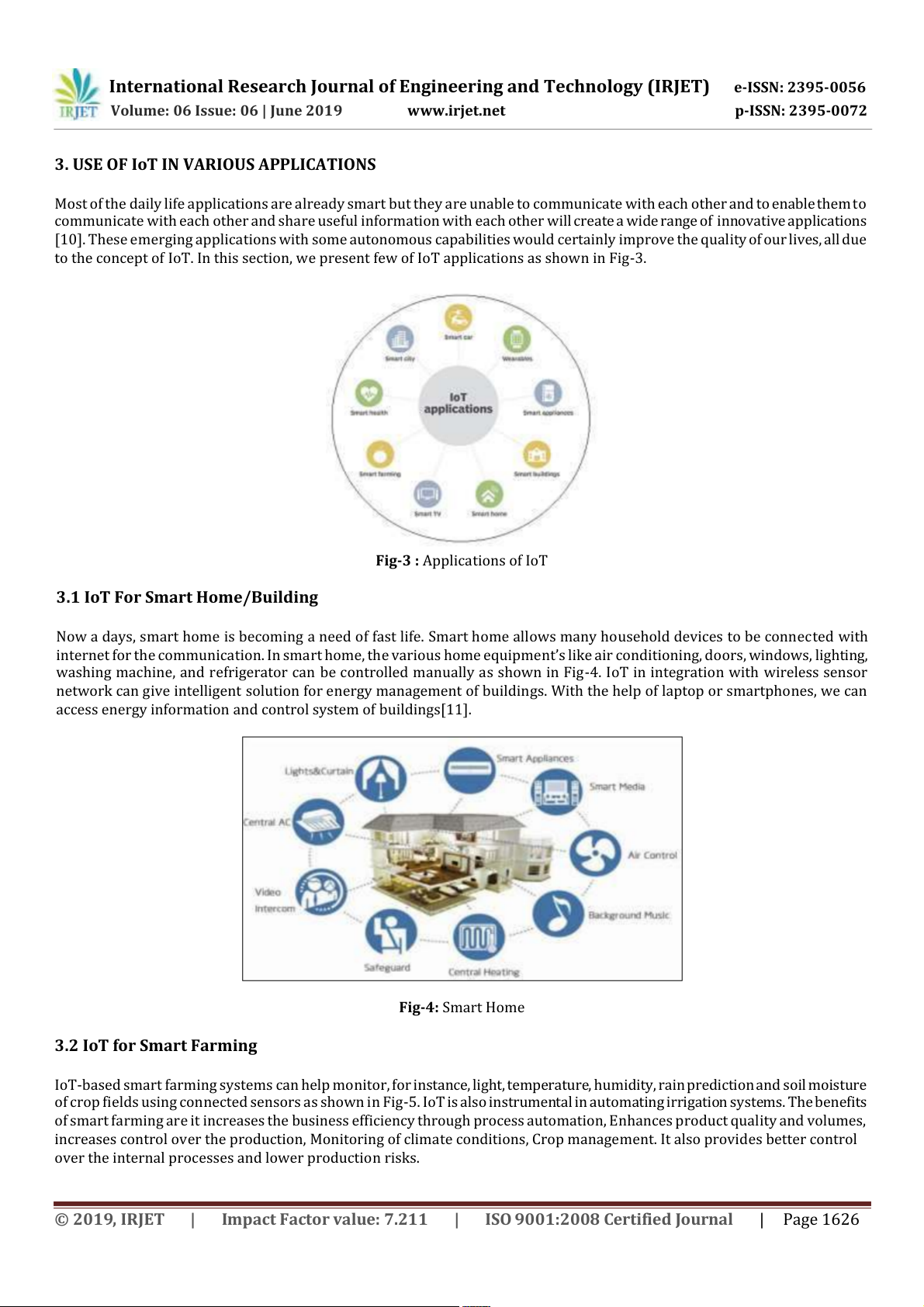
Now a days, smart home is becoming a need of fast life. Smart home allows many household devices to be connected with
inerne for he commnicaion In smar home he arios home eqipmens like air condiioning doors indos lighing
washing machine, and refrigerator can be controlled manually as shown in Fig-4. IoT in integration with wireless sensor
network can give intelligent solution for energy management of buildings. With the help of laptop or smartphones, we can
access energy information and control system of buildings[11].
Fig-4: Smart Home 3.2 IoT for Smart Farming
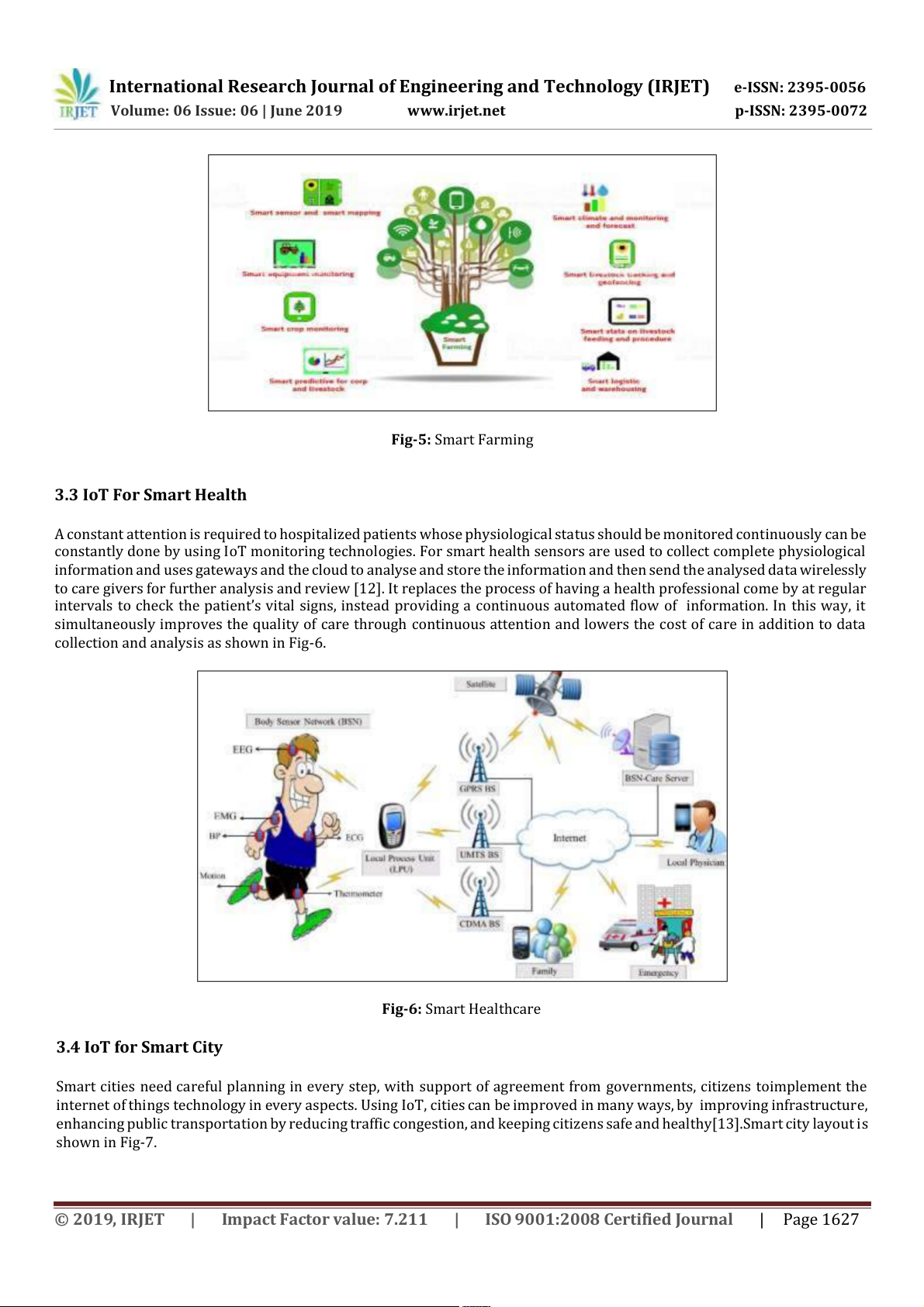
IoT-based smart farming systems can help monitor, for instance, light, temperature, humidity, rain prediction and soil moisture
of crop fields using connected sensors as shown in Fig-5. IoT is also instrumental in automating irrigation systems. The benefits
of smart farming are it increases the business efficiency through process automation, Enhances product quality and volumes,
increases control over the production, Monitoring of climate conditions, Crop management. It also provides better control
over the internal processes and lower production risks.
© 2019, IRJET | Impact Factor value: 7.211 | ISO 9001:2008 Certified Journal | Page 1626
International Research Journal of Engineering and Technology (IRJET) e-ISSN: 2395-0056
Volume: 06 Issue: 06 | June 2019 www.irjet.net p-ISSN: 2395-0072 Fig-5: Smart Farming 3.3 IoT For Smart Health
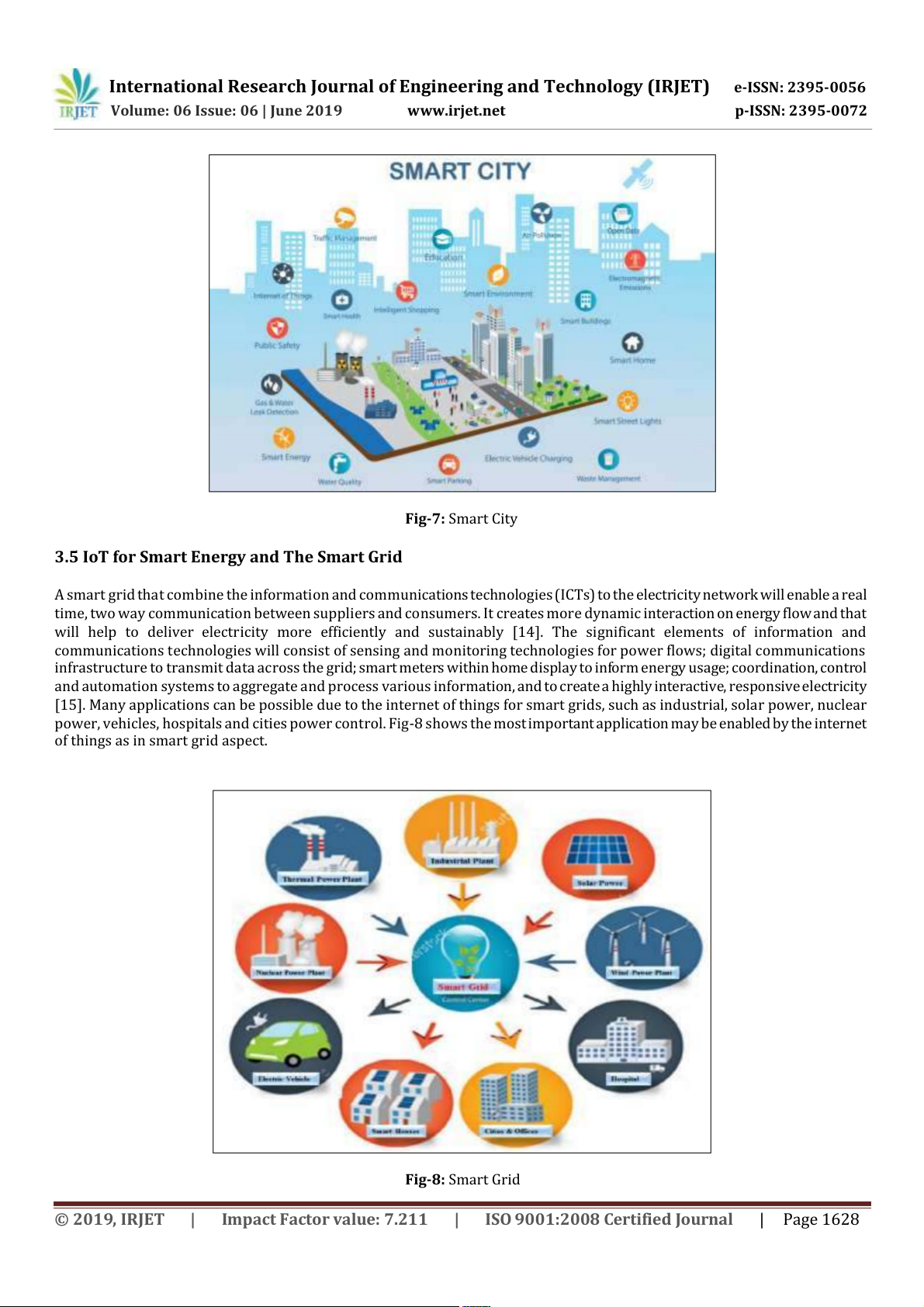
A constant attention is required to hospitalized patients whose physiological status should be monitored continuously can be
constantly done by using IoT monitoring technologies. For smart health sensors are used to collect complete physiological
information and uses gateways and the cloud to analyse and store the information and then send the analysed data wirelessly
to care givers for further analysis and review [12]. It replaces the process of having a health professional come by at regular
inerals o check he paiens ial signs insead proiding a coninos aomaed flo of informaion In his a i
simultaneously improves the quality of care through continuous attention and lowers the cost of care in addition to data
collection and analysis as shown in Fig-6.
Fig-6: Smart Healthcare 3.4 IoT for Smart City
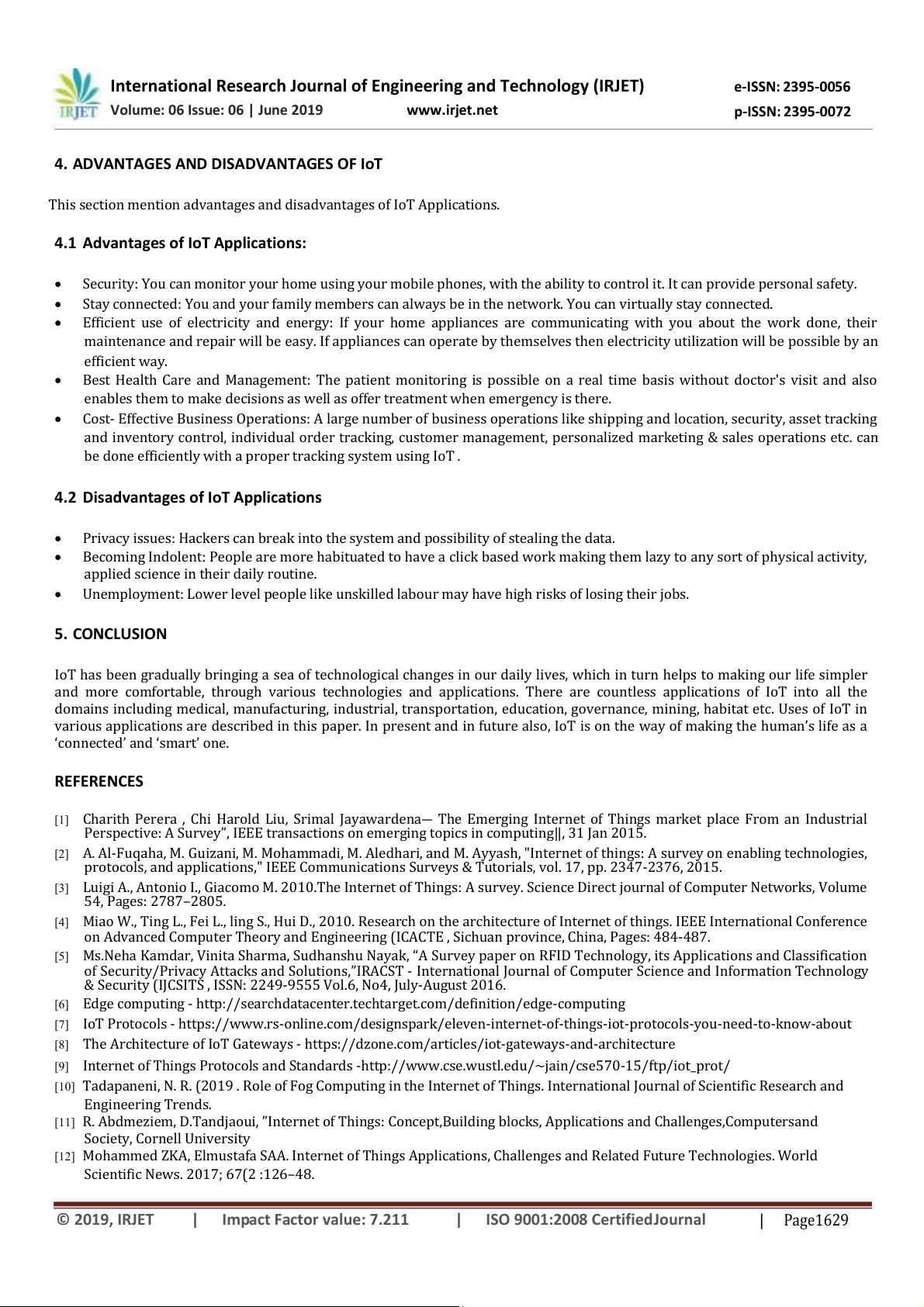
Smart cities need careful planning in every step, with support of agreement from governments, citizens toimplement the
internet of things technology in every aspects. Using IoT, cities can be improved in many ways, by improving infrastructure,
enhancing public transportation by reducing traffic congestion, and keeping citizens safe and healthy[13].Smart city layout is shown in Fig-7.
© 2019, IRJET | Impact Factor value: 7.211 | ISO 9001:2008 Certified Journal | Page 1627
International Research Journal of Engineering and Technology (IRJET) e-ISSN: 2395-0056
Volume: 06 Issue: 06 | June 2019 www.irjet.net p-ISSN: 2395-0072 Fig-7: Smart City
3.5 IoT for Smart Energy and The Smart Grid
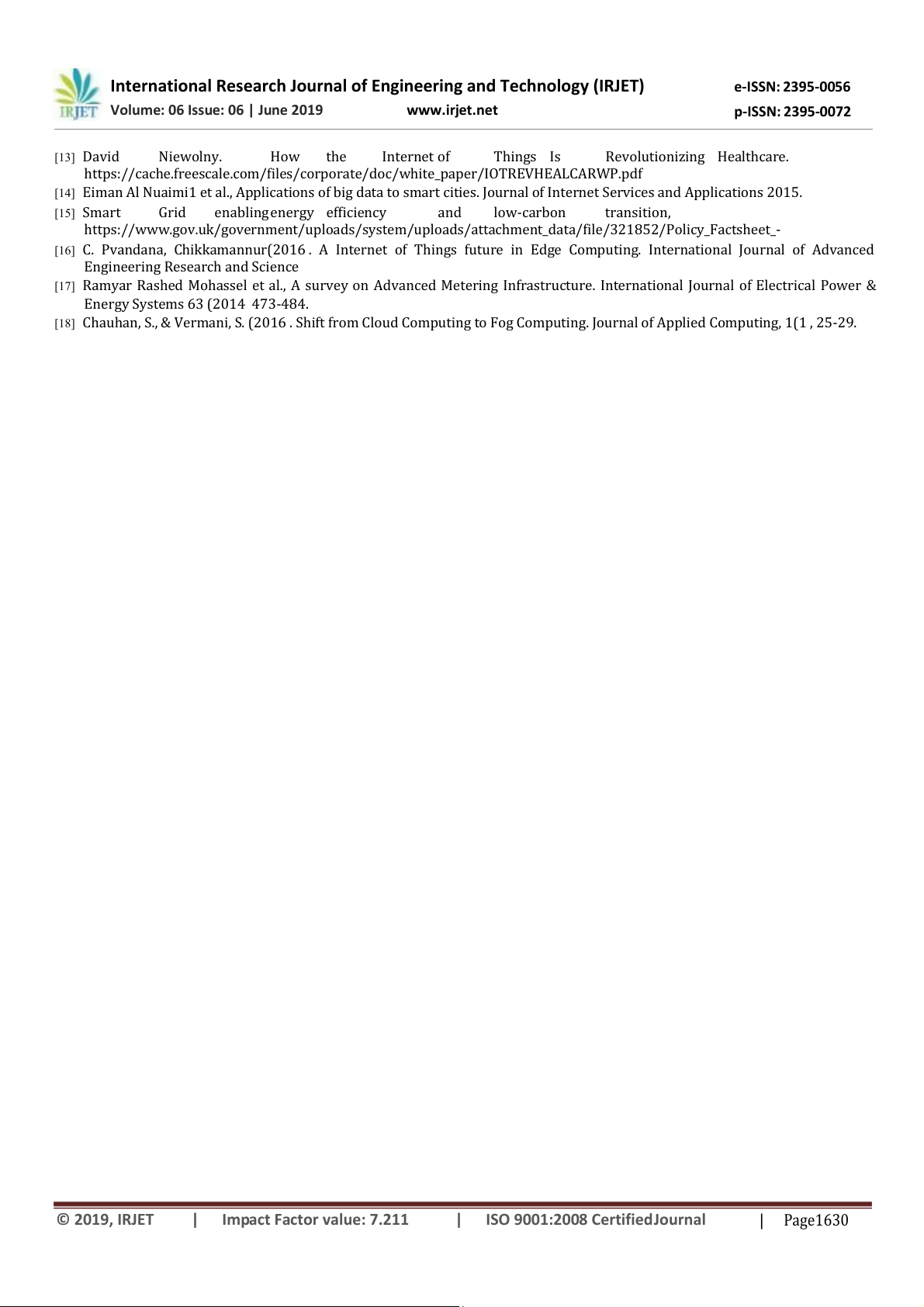
A smart grid that combine the information and communications technologies (ICTs) to the electricity network will enable a real
time, two way communication between suppliers and consumers. It creates more dynamic interaction on energy flow and that
will help to deliver electricity more efficiently and sustainably [14]. The significant elements of information and
communications technologies will consist of sensing and monitoring technologies for power flows; digital communications
infrastructure to transmit data across the grid; smart meters within home display to inform energy usage; coordination, control
and automation systems to aggregate and process various information, and to create a highly interactive, responsive electricity
[15]. Many applications can be possible due to the internet of things for smart grids, such as industrial, solar power, nuclear
power, vehicles, hospitals and cities power control. Fig-8 shows the most important application may be enabled by the internet
of things as in smart grid aspect.
Fig-8: Smart Grid
© 2019, IRJET | Impact Factor value: 7.211 | ISO 9001:2008 Certified Journal | Page 1628 !
International Research Journal of Engineering and Technology (IRJET) e-ISSN: 2395-0056
Volume: 06 Issue: 06 | June 2019 www.irjet.net p-ISSN: 2395-0072 !
4. ADVANTAGES AND DISADVANTAGES OF IoT
This)section)mention)advantages)and)disadvantages)of)IoT)Applications.) !
4.1 Advantages of IoT Applications: ¥
Security:)You)can)monitor)your)home)using)your)mobile)phones,)with)the)ability)to)control)it.)It)can)provide)personal)safety.) ¥
Stay)connected:)You)and)your)family)members)can)always)be)in)the)network.)You)can)virtually)stay)connected.) ¥
Efficient) use) of) electricity) and) energy:) If) your) home) appliances) are) communicating) with) you) about) the) work) done,) their)
maintenance)and)repair)will)be)easy.)If)appliances)can)operate)by)themselves)then)electricity)utilization)will)be)possible)by)an) efficient)way.) ¥
Best) Health) Care) and) Management:) The) patient) monitoring) is) possible) on) a) real) time) basis) without) doctor's) visit) and) also)
enables)them)to)make)decisions)as)well)as)offer)treatment)when)emergency)is)there.) ¥
Cost-)Effective)Business)Operations:)A)large)number)of)business)operations)like)shipping)and)location,)security,)asset)tracking)
and)inventory)control,)individual)order)tracking,)customer)management,)personalized)marketing)&)sales)operations)etc.)can)
be)done)efficiently)with)a)proper)tracking)system)using)IoT).) "
4.2 Disadvantages of IoT Applications ¥
Privacy)issues:)Hackers)can)break)into)the)system)and)possibility)of)stealing)the)data.) ¥
Becoming)Indolent:)People)are)more)habituated)to)have)a)click)based)work)making)them)lazy)to)any)sort)of)physical)activity,)
applied)science)in)their)daily)routine.) ¥
Unemployment:)Lower)level)people)like)unskilled)labour)may)have)high)risks)of)losing)their)jobs.) ! 5. CONCLUSION
IoT)has)been)gradually)bringing)a)sea)of)technological)changes)in)our)daily)lives,)which)in)turn)helps)to)making)our)life)simpler)
and) more) comfortable,) through) various) technologies) and) applications.) There) are) countless) applications) of) IoT) into) all) the)
domains)including)medical,)manufacturing,)industrial,)transportation,)education,)governance,)mining,)habitat)etc.)Uses)of)IoT)in)
various)applications)are)described)in)this)paper.)In)present)and)in)future)also,)IoT)is)on)the)way)of)making)the)human’s)life)as)a)
‘connected’)and)‘smart’)one.) ) REFERENCES
[1] Charith) Perera) ,) Chi) Harold) Liu,) Srimal) Jayawardena―) The) Emerging) Internet) of) Things) market) place) From) an) Industrial)
Perspective:)A)Survey”,)IEEE)transactions)on)emerging)topics)in)computing‖,)31)Jan)2015.)
[2] A.)Al-Fuqaha,)M.)Guizani,)M.)Mohammadi,)M.)Aledhari,)and)M.)Ayyash,)"Internet)of)things:)A)survey)on)enabling)technologies,)
protocols,)and)applications,")IEEE)Communications)Surveys)&)Tutorials,)vol.)17,)pp.)2347-2376,)2015.)
[3] Luigi)A.,)Antonio)I.,)Giacomo)M.)2010.The)Internet)of)Things:)A)survey.)Science)Direct)journal)of)Computer)Networks,)Volume) 54,)Pages:)2787–2805.)
[4] Miao)W.,)Ting)L.,)Fei)L.,)ling)S.,)Hui)D.,)2010.)Research)on)the)architecture)of)Internet)of)things.)IEEE)International)Conference)
on)Advanced)Computer)Theory)and)Engineering)(ICACTE),)Sichuan)province,)China,)Pages:)484-487.)
[5] Ms.Neha)Kamdar,)Vinita)Sharma,)Sudhanshu)Nayak,)“A)Survey)paper)on)RFID)Technology,)its)Applications)and)Classification)
of)Security/Privacy)Attacks)and)Solutions,”IRACST)-)International)Journal)of)Computer)Science)and)Information)Technology)
&)Security)(IJCSITS),)ISSN:)2249-9555)Vol.6,)No4,)July-August)2016.)
[6] Edge)computing)-)http://searchdatacenter.techtarget.com/definition/edge-computing)
[7] IoT)Protocols)-)https://www.rs-online.com/designspark/eleven-internet-of-things-iot-protocols-you-need-to-know-about)
[8] The)Architecture)of)IoT)Gateways)-)https://dzone.com/articles/iot-gateways-and-architecture)
[9] Internet)of)Things)Protocols)and)Standards)-http://www.cse.wustl.edu/~jain/cse570-15/ftp/iot_prot/)
[10] Tadapaneni,)N.)R.)(2019).)Role)of)Fog)Computing)in)the)Internet)of)Things.)International)Journal)of)Scientific)Research)and) Engineering)Trends.)
[11] R.)Abdmeziem,)D.Tandjaoui,)”Internet)of)Things:)Concept,Building)blocks,)Applications)and)Challenges,Computersand) Society,)Cornell)University)
[12] Mohammed)ZKA,)Elmustafa)SAA.)Internet)of)Things)Applications,)Challenges)and)Related)Future)Technologies.)World)
Scientific)News.)2017;)67(2):126–48.) ! © 2019, IRJET |
Impact Factor value: 7.211 |
ISO 9001:2008 Certified Journal |" Page"1629" !
International Research Journal of Engineering and Technology (IRJET) e-ISSN: 2395-0056
Volume: 06 Issue: 06 | June 2019 www.irjet.net p-ISSN: 2395-0072 ! [13] David) Niewolny.) How) the) Internet)of) Things) Is) Revolutionizing) Healthcare.)
https://cache.freescale.com/files/corporate/doc/white_paper/IOTREVHEALCARWP.pdf)
[14] Eiman)Al)Nuaimi1)et)al.,)Applications)of)big)data)to)smart)cities.)Journal)of)Internet)Services)and)Applications)2015.) [15] Smart) Grid) enabling)energy) efficiency) and) low-carbon) transition,)
https://www.gov.uk/government/uploads/system/uploads/attachment_data/file/321852/Policy_Factsheet_-)
[16] C.) Pvandana,) Chikkamannur(2016).) A) Internet) of) Things) future) in) Edge) Computing.) International) Journal) of) Advanced)
Engineering)Research)and)Science))
[17] Ramyar) Rashed) Mohassel) et)al.,) A) survey)on) Advanced) Metering) Infrastructure.) International) Journal) of)Electrical) Power) &)
Energy)Systems)63)(2014))473-484.)
[18] Chauhan,)S.,)&)Vermani,)S.)(2016).)Shift)from)Cloud)Computing)to)Fog)Computing.)Journal)of)Applied)Computing,)1(1),)25-29.) ) ! © 2019, IRJET |
Impact Factor value: 7.211 |
ISO 9001:2008 Certified Journal |" Page"1630"
Tài liệu liên quan:
-
Tóm tắt lý thuyết môn IoT và ứng dụng | Học viện Công Nghệ Bưu Chính Viễn Thông
23 12 -

Accelerated Corner-Detector Algorithms: GPU Implementations and Results | Iot và ứng dụng | Học viện Công nghệ Bưu chính Viễn thông
46 23 -
Đề xuất Dự án IoT: Thiết bị phát hiện chạm cho xe máy | Iot và ứng dụng | Học viện Công nghệ Bưu chính Viễn thông
35 18 -
Phân Tích và Giải Pháp FastAPI | Iot và ứng dụng | Học viện Công nghệ Bưu chính Viễn thông
30 15 -
Tăng cường pháp chế xã hội chủ nghĩa trong quản lý nhà nước | Iot và ứng dụng | Học viện Công nghệ Bưu chính Viễn thông
25 13