Bài giảng chương 1 Thương mại điện tử | Đại học Huế
Bài giảng chương 1 Thương mại điện tử | Đại học Huế. Tài liệu giúp bạn tham khảo, ôn tập và đạt kết quả cao. Mời đọc đón xem!
Môn: Thương mại điện tử (ĐHH) 11 tài liệu
Trường: Đại học Huế 411 tài liệu
Tác giả:










Preview text:
8/6/2025
E-commerce 2023: business. technology. society. Seventeenth Edition Chapter 1 The Revolution Is Just Beginning
Copyright © 2024, 2022, 2020 Pearson Education, Inc. All Rights Reserved Learning Objectives
1.1 Understand why it is important to study e-commerce.
1.2 Define e-commerce, understand how e-commerce differs from e-
business, identify the primary technological building blocks underlying
e-commerce, and recognize major current themes in e-commerce.
1.3 Identify and describe the unique features of e-commerce
technology and discuss their business significance.
1.4 Describe the major types of e-commerce.
1.5 Understand the evolution of e-commerce from its early years to today.
1.6 Describe the major themes underlying the study of e-commerce.
Copyright © 2024, 2022, 2020 Pearson Education, Inc. All Rights Reserved
TikTok: Creators and the Creator Economy • Class Discussion – Why is TikTok so popular?
– Do you use TikTok? If so, in what manner—do you
just view content or also post content?
– Do you consider yourself a creator? Have you ever
received payments for content you have created?
– What are some of the negative consequences
associated with being a creator?
Copyright © 2024, 2022, 2020 Pearson Education, Inc. All Rights Reserved 1 8/6/2025
The First Five Minutes: Why You Should Study E-commerce
• First quarter-century or so of e-commerce – Stil just the beginning – Rapid growth and change
• Technologies evolve at exponential rates – Disruptive business change – New opportunities • Why study e-commerce
– Understand opportunities and risks
– Analyze e-commerce ideas, models, issues
Copyright © 2024, 2022, 2020 Pearson Education, Inc. All Rights Reserved What Is E-commerce?
• Use of Internet to transact business
– Includes Web, mobile browsers and apps • More formal y:
– Digital y enabled commercial transactions between
and among organizations and individuals
Copyright © 2024, 2022, 2020 Pearson Education, Inc. All Rights Reserved
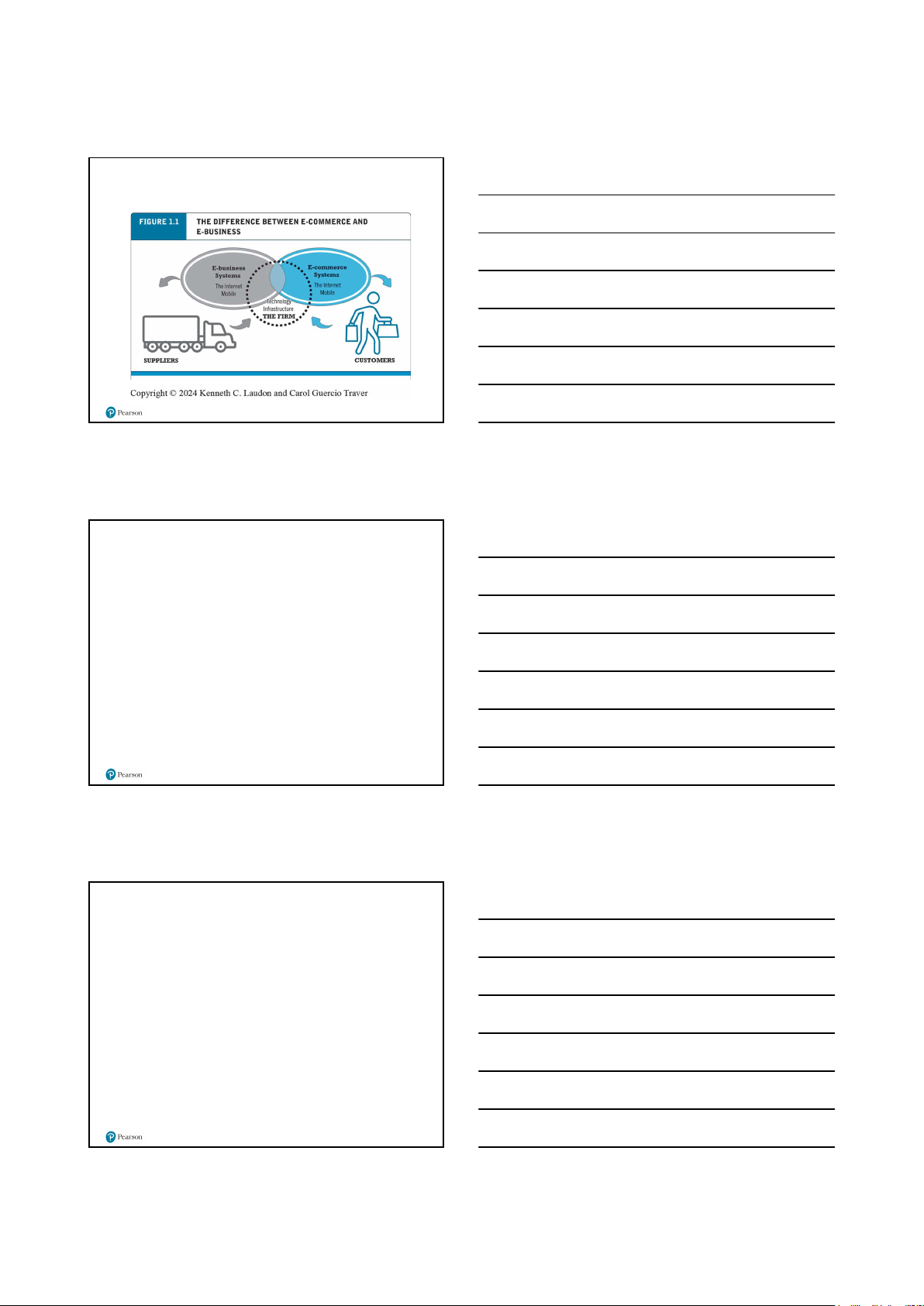
The Difference Between E-commerce and E-business • E-business
– Digital enabling of transactions and processes within
a firm, involving information systems under firm’s control
– Does not include commercial transactions involving
an exchange of value across organizational boundaries
Copyright © 2024, 2022, 2020 Pearson Education, Inc. All Rights Reserved 2 8/6/2025
Figure 1.1 The Difference Between E-commerce and E-business
Copyright © 2024, 2022, 2020 Pearson Education, Inc. All Rights Reserved Technological Building Blocks Underlying E-commerce • The Internet
– Worldwide network of computer networks built on common standards • The World Wide Web
– Provides access to tril ions of web pages created in HTML
– “Surface” Web versus “deep” Web • Mobile platform
– Smartphones, tablets, ultra-lightweight laptops – Mobile apps
Copyright © 2024, 2022, 2020 Pearson Education, Inc. All Rights Reserved
Insight on Technology: Will Apps Make the Web Irrelevant? • Class Discussion
– What are the advantages and disadvantages of
apps, compared with websites, for mobile users?
– What are the benefits of apps for content owners and creators?
– What are progressive web apps and how do they differ from native apps?
– Wil apps eventual y make the Web irrelevant? Why or why not?
Copyright © 2024, 2022, 2020 Pearson Education, Inc. All Rights Reserved 3 8/6/2025
Major Trends in E-commerce (1 of 3) • Business trends include:
– Retail e-commerce and m-commerce settle back to
normal growth rates (around 10%) after Covid-19 pandemic
– Mobile app ecosystem: almost 250 mil ion U.S. adults use smartphone apps
– Social e-commerce estimated to generate around $55 bil ion in 2022
– B2B e-commerce revenues expected to reach about $8.5 tril ion in 2022
Copyright © 2024, 2022, 2020 Pearson Education, Inc. All Rights Reserved
Major Trends in E-commerce (2 of 3) • Technology trends include: – Mobile platform – Cloud computing – Internet of Things – Big data
– Artificial intel igence technologies – Blockchain – Web3 – Metaverse
Copyright © 2024, 2022, 2020 Pearson Education, Inc. All Rights Reserved
Major Trends in E-commerce (3 of 3) • Societal trends include: – User-generated content
– Commercial and governmental invasion of privacy
– Concerns about increasing market dominance of
Amazon, Google, Meta (Big Tech) – Online security issues
Copyright © 2024, 2022, 2020 Pearson Education, Inc. All Rights Reserved 4 8/6/2025 Unique Features of E-commerce Technology (1 of 2) 1. Ubiquity 2. Global reach 3. Universal standards 4. Information richness
Copyright © 2024, 2022, 2020 Pearson Education, Inc. All Rights Reserved Unique Features of E-commerce Technology (2 of 2) 5. Interactivity 6. Information density
7. Personalization/customization 8. Social technology
Copyright © 2024, 2022, 2020 Pearson Education, Inc. All Rights Reserved
Figure 1.4 Eight Unique Features of E-commerce Technology
Copyright © 2024, 2022, 2020 Pearson Education, Inc. All Rights Reserved 5 8/6/2025 Types of E-commerce • Business-to-consumer (B2C) • Business-to-business (B2B) • Consumer-to-consumer (C2C)
• Mobile e-commerce (M-commerce) • Social e-commerce • Local e-commerce
Copyright © 2024, 2022, 2020 Pearson Education, Inc. All Rights Reserved
Figure 1.9 The Relative Size of Different Types of E-commerce
Copyright © 2024, 2022, 2020 Pearson Education, Inc. All Rights Reserved
E-commerce: A Brief History (1 of 4) • Precursors
– Baxter Healthcare modem-based system (1970s)
– Order entry systems (1980s)
– Electronic Data Interchange (EDI) standards (1980s) – French Minitel (1981)
Copyright © 2024, 2022, 2020 Pearson Education, Inc. All Rights Reserved 6 8/6/2025
E-commerce: A Brief History (2 of 4) • 1995–2000: Invention
– Sale of simple retail goods
– Limited bandwidth and media – Euphoric visions of: Friction-free commerce First-mover advantages – Dot-com crash of 2000
Copyright © 2024, 2022, 2020 Pearson Education, Inc. All Rights Reserved
E-commerce: A Brief History (3 of 4) • 2001–2006: Consolidation
– Emphasis on business-driven approach
– Traditional large firms expand presence – Start-up financing shrinks
– More complex products and services sold
– Growth of search engine advertising
– Business web presences expand
Copyright © 2024, 2022, 2020 Pearson Education, Inc. All Rights Reserved
E-commerce: A Brief History (4 of 4)
• 2007–Present: Reinvention – Rapid growth of:
Web 2.0, including online social networks Mobile platform Local commerce On-demand service economy
– Entertainment content develops as source of revenues
– Transformation of marketing
Copyright © 2024, 2022, 2020 Pearson Education, Inc. All Rights Reserved 7 8/6/2025
Figure 1.10 Periods in the Development of E-commerce
Copyright © 2024, 2022, 2020 Pearson Education, Inc. All Rights Reserved
Insight on Business: Y Combinator’s Startup Boot Camp • Class Discussion
– Why do you think investors today are stil interested in investing in startups?
– What are the benefits of investing in a company that
is a graduate of a Y Combinator boot camp?
– Is an incubator the best solution for startups to find funding? Why or why not?
Copyright © 2024, 2022, 2020 Pearson Education, Inc. All Rights Reserved Assessing E-commerce (1 of 2)
• Stunning technological success
• Early years a mixed business success
– Few early dot-coms have survived
– Online sales growing rapidly
• Many early visions not fulfil ed – Price dispersion – Information asymmetry – New intermediaries
Copyright © 2024, 2022, 2020 Pearson Education, Inc. All Rights Reserved 8 8/6/2025 Assessing E-commerce (2 of 2) • Other surprises – Fast-fol ower advantages – Start-up costs – Impact of mobile platform
– Emergence of on-demand e-commerce
Copyright © 2024, 2022, 2020 Pearson Education, Inc. All Rights Reserved Understanding E-commerce: Organizing Themes • Technology
– Development and mastery of digital computing and communications technology • Business
– New technologies present businesses with new ways
of organizing production and transacting business • Society
– Intel ectual property, individual privacy, public welfare policy
Copyright © 2024, 2022, 2020 Pearson Education, Inc. All Rights Reserved
Insight on Society: Facebook and the Age of Privacy • Class Discussion
– Why are social networks interested in col ecting user information?
– What types of privacy invasion are described in the
case? Which is the most privacy-invading, and why?
– Was the Federal Trade Commission’s $5 bil ion fine
and its placement of restrictions on Facebook’s
business operations sufficient in light of Facebook’s
history with respect to privacy violations?
– How do you protect your privacy online?
Copyright © 2024, 2022, 2020 Pearson Education, Inc. All Rights Reserved 9 8/6/2025 Careers in E-commerce
• Position: Category Specialist in the E-commerce Retail Program • Qualification/Skil s
• Preparing for the Interview
• Possible Interview Questions
Copyright © 2024, 2022, 2020 Pearson Education, Inc. All Rights Reserved Copyright
This work is protected by United States copyright laws and is
provided solely for the use of instructors in teaching their
courses and assessing student learning. Dissemination or sale of
any part of this work (including on the World Wide Web) will
destroy the integrity of the work and is not permitted. The work
and materials from it should never be made available to students
except by instructors using the accompanying text in their
classes. All recipients of this work are expected to abide by these
restrictions and to honor the intended pedagogical purposes and
the needs of other instructors who rely on these materials.
Copyright © 2024, 2022, 2020 Pearson Education, Inc. All Rights Reserved 10